You search Alibaba, find a great product, but worry you are paying middlemen. High prices and poor control hurt your business. You need direct factories.
To avoid trading companies on Alibaba, check their product catalog for tight specialization, verify their business license for manufacturing tags, and ask deep technical questions. Real factories focus on one niche and know their production inside out, while traders sell unrelated items and struggle with technical details.
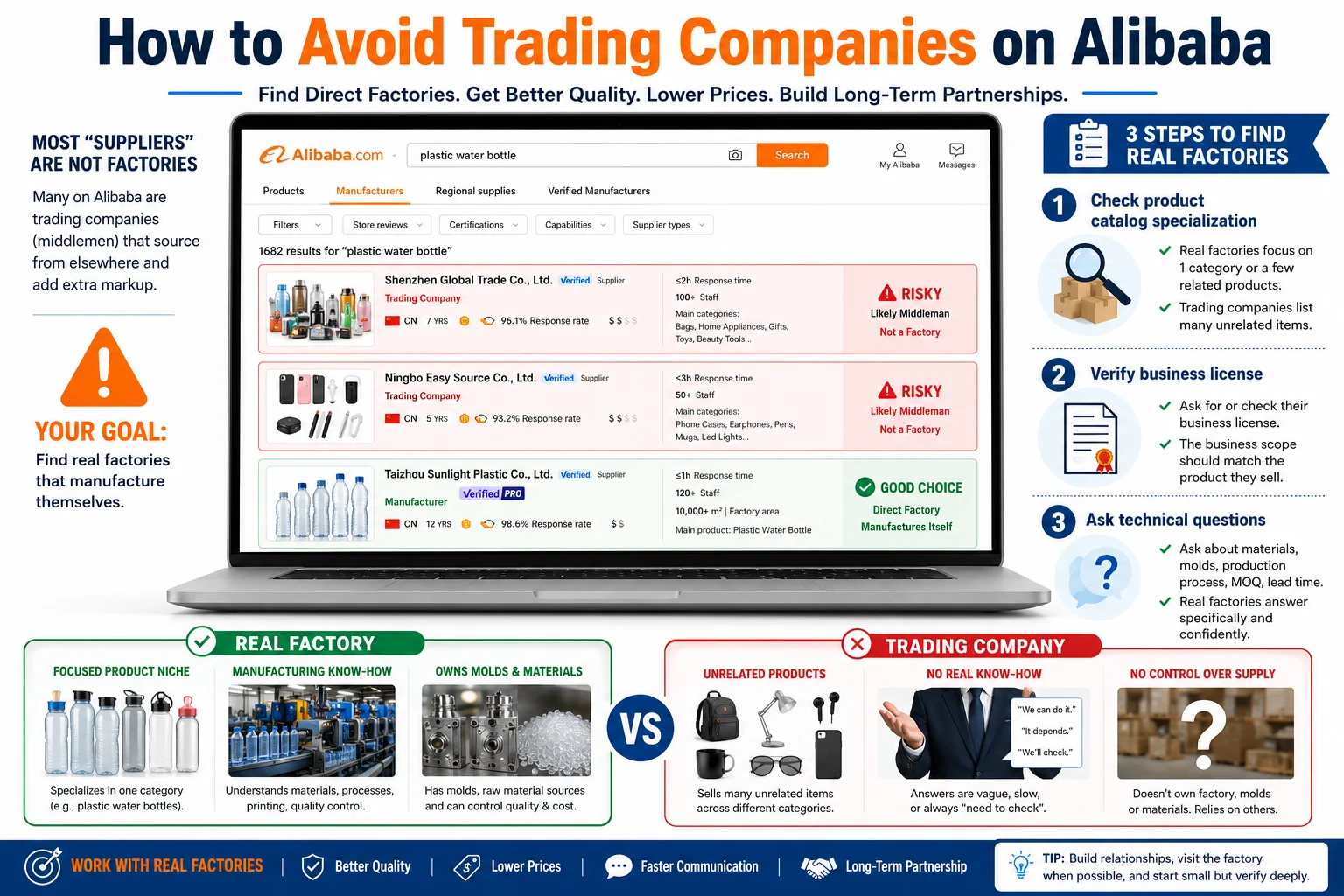
I will show you exactly how to spot the real manufacturers on the platform. Do not let hidden middlemen drain your profit margin and ruin your supply chain.
1. Why Many Buyers Want to Avoid Trading Companies on Alibaba?
You pay hidden fees to middlemen. Your profit shrinks and communication breaks down. You must find direct factories to protect your brand.
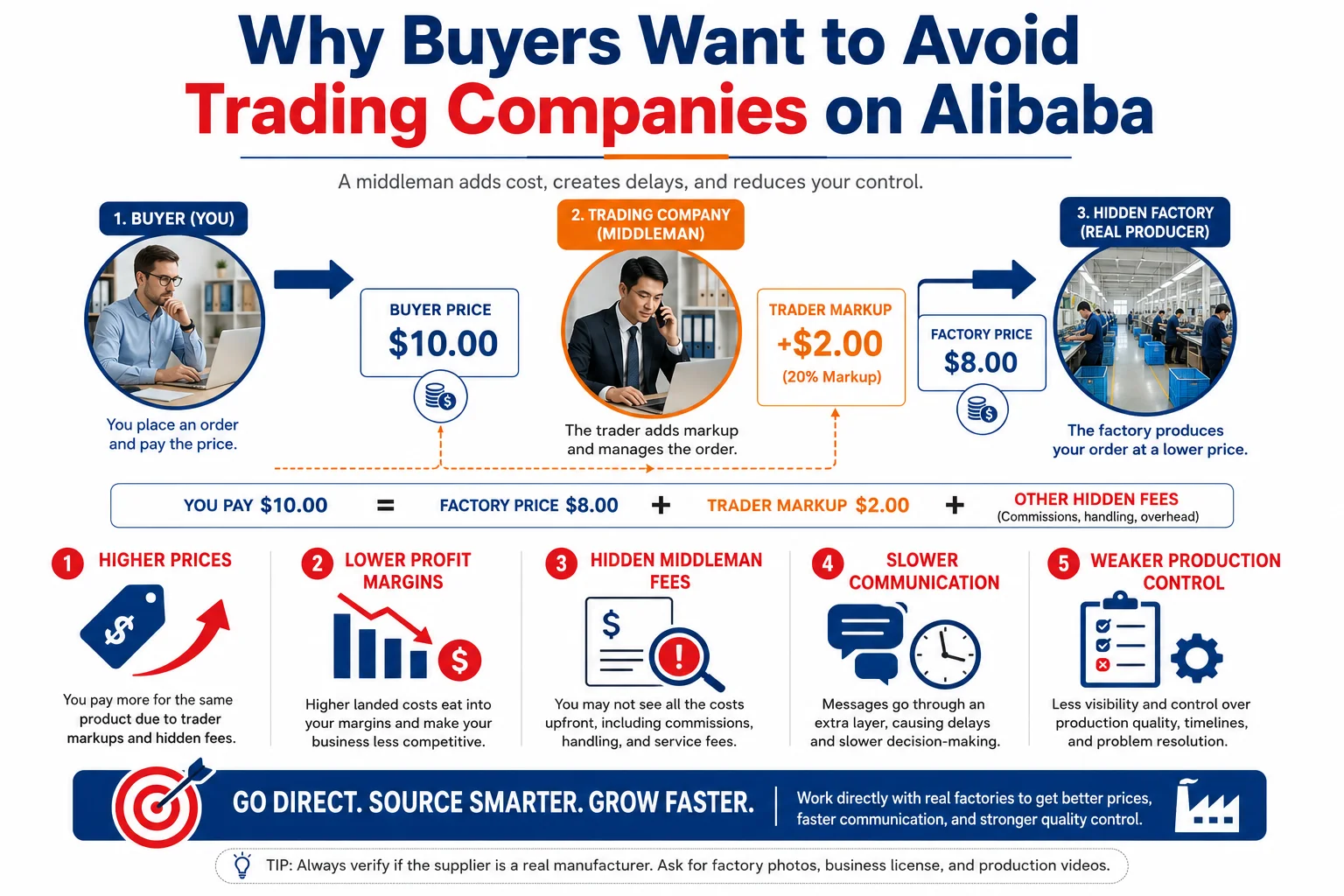
Buyers avoid trading companies because middlemen increase costs by 10% to 30%[^1]. They also lack direct control over the production line. Quality issues cause massive delays because the trader must contact the hidden factory.[^2] This hurts your business.
The Real Cost of Hidden Middlemen
As a sourcing expert at KingSourcing, I talk to overseas buyers every day. Many clients come to me with a big problem. They bought goods on Alibaba. They thought they worked with a factory. Later, they found out they used a trading company. They paid too much money. They lost their profit margin. You want to buy at the best price. You want to control the quality. A trading company stands in your way. They hide the real factory from you. They add a high markup to the unit price.
If you find a defect, you tell the trader. The trader tells the factory. The factory tells the trader. The trader tells you. This long chain wastes your time. It creates big misunderstandings. You lose money and you lose customers. You need a direct line to the people making your product.
| Problem Area | Real Factory | Trading Company |
|---|---|---|
| Pricing | Direct price, no markups. | Adds 10% to 30% markup. |
| Communication | Direct answers to problems. | Slow answers, plays telephone. |
| Customization | Can change molds easily. | Hard to change product details. |
I see this happen often. You start a new brand. You need tight control. You need fast answers. Trading companies cannot give you this. They only want to close the deal. They do not care about your long-term quality. You must find the true source. This is the only way to build a safe business.
2. What Is the Difference Between a Trading Company and a Real Factory?
You see thousands of suppliers online. You cannot tell who actually makes the goods. You need clear rules to separate factories from traders.
A real factory owns machines and specializes in one niche. A trading company buys finished goods and acts like a supermarket. If a supplier sells phone cases, dog toys, and kitchen tools, they are a trading company.
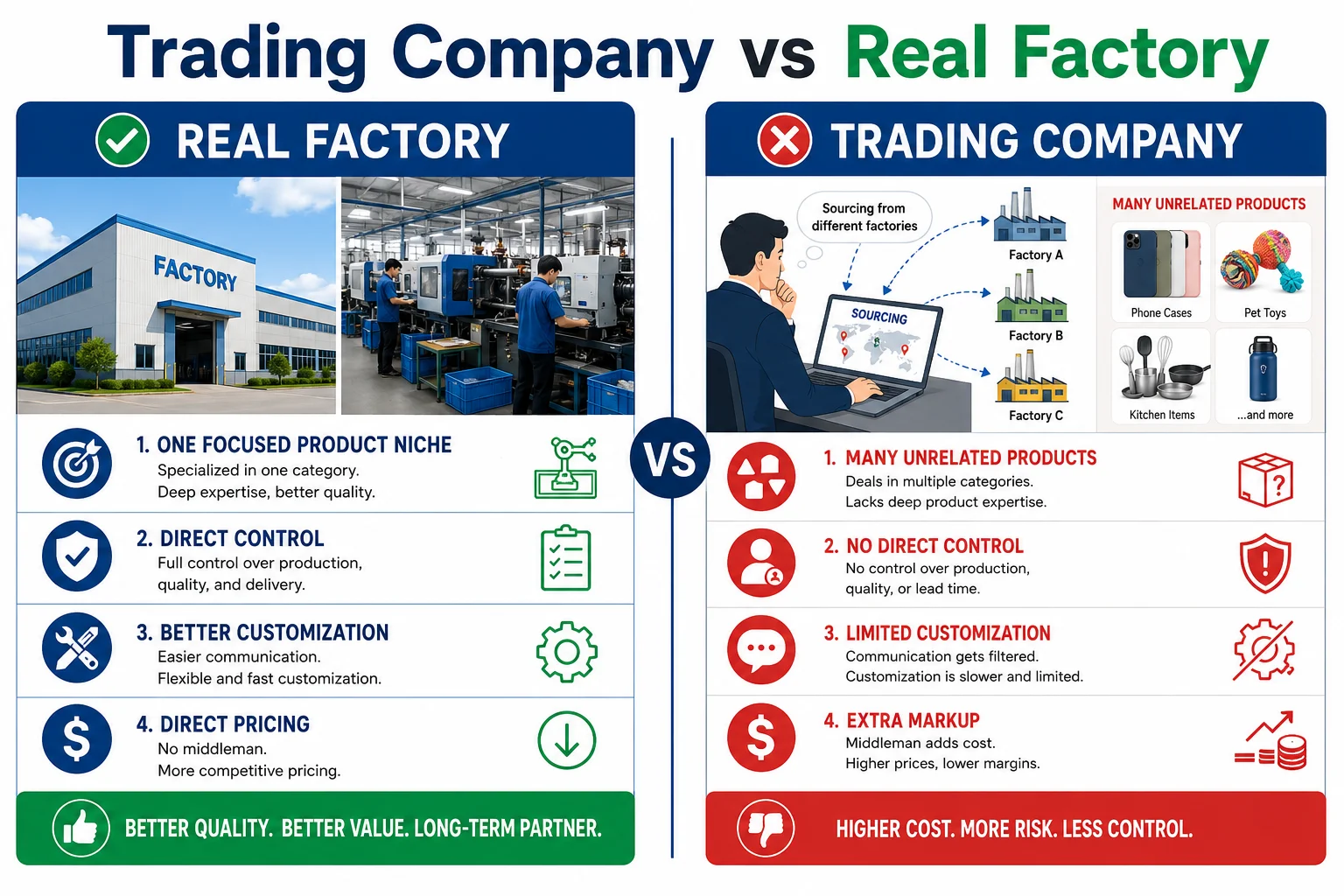
Factory Focus vs Trading Supermarket
You must understand the real difference. A factory makes things. A trading company buys and sells things. I look at supplier catalogs all the time. This is my best trick. I look for specialization. A real factory focuses on one niche. They buy specific machines.[^3] They hire specific engineers. If a factory makes steel water bottles, they only make steel water bottles. They might make steel cups. They do not make dog collars. They do not make plastic toys.
A trading company acts like a big supermarket. They want to sell you everything. They put phone cases, kitchen tools, and clothes in one store.
| Feature | Real Factory | Trading Company |
|---|---|---|
| Product Range | Deep focus on one category. | Wide mix of unrelated goods. |
| Assets | Owns machines and land. | Owns office computers. |
| Knowledge | Knows technical limits. | Knows basic sales trends. |
You can spot a trader very fast. You just click on their product list. You see too many categories. This means they do not own machines. They just buy from many different places. A real factory puts all its money into one type of production. You want a partner who knows their product perfectly. A supermarket seller cannot help you fix a deep technical problem.
3. Why Some Alibaba Suppliers Look Like Manufacturers but Are Not?
You trust the platform's verified tags. Then you get scammed by a hidden trader. You must look past the simple badges to find the truth.
Many traders use legal loopholes to appear as factories. They buy a tiny assembly line or use an affiliated factory's license to get verified. The platform badge only means someone checked their papers, not that they produce your specific goods.
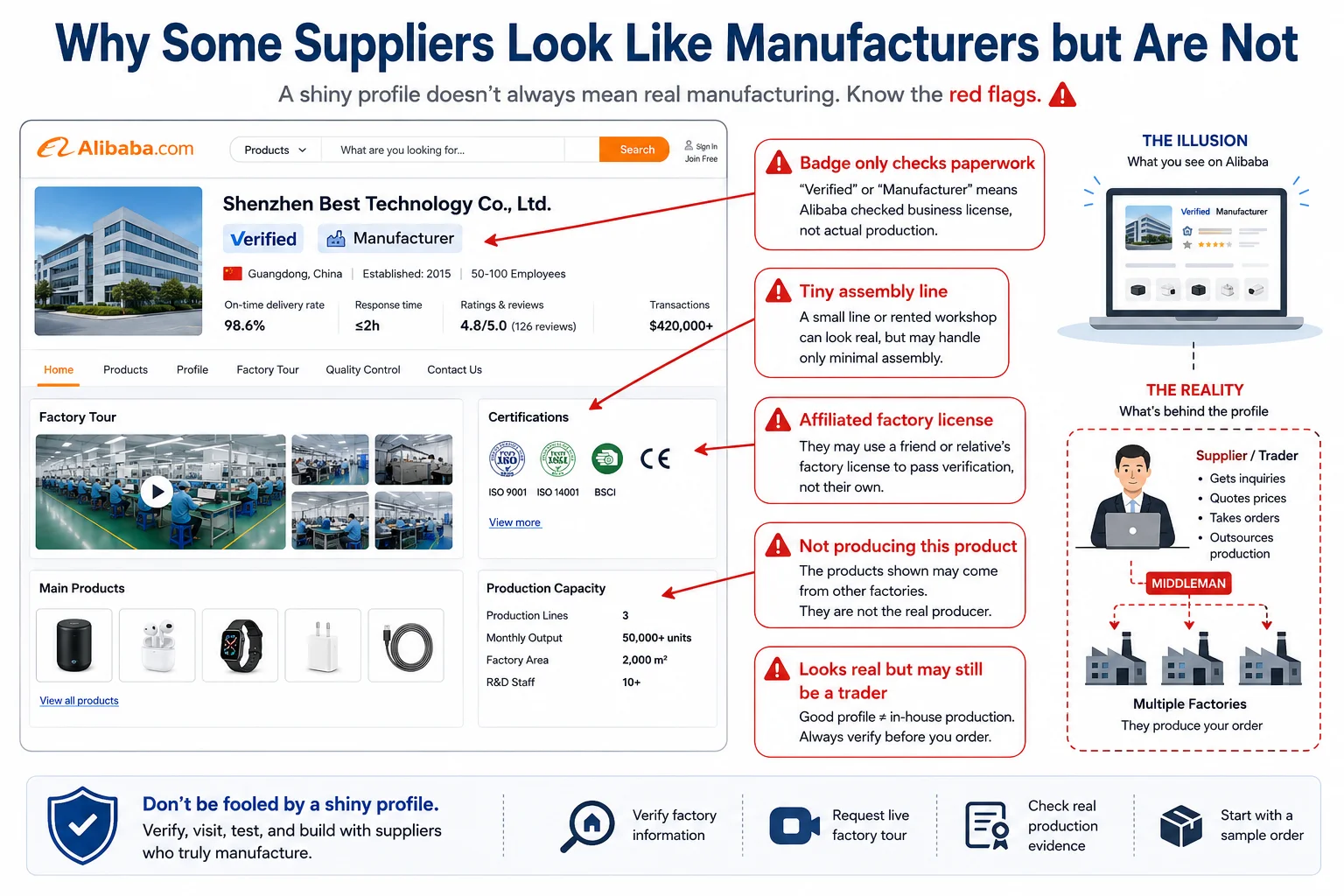
The Illusion of the Verified Badge
Alibaba has a "Verified Manufacturer" badge. Many buyers trust this badge blindly. I see many buyers make this mistake. You think the badge means they own the factory. This is not always true. I know how the system works. Trading companies use legal loopholes. They buy a very small assembly line. They pass the verification test.[^4] Then they outsource your big order to another factory.
Sometimes, they use a real factory's business license. The platform algorithm changes all the time. The badges do not promise 100% safety.
| Verification Type | What You See | What It Actually Means |
|---|---|---|
| Verified Tag | Factory status. | Passed a basic paper check. |
| Factory Video | Machines running. | Could be a partner's factory. |
| Certificates | ISO 9001. | Might belong to another company. |
You must look past the shiny badge. The third-party inspector only checks the papers on that specific day. They do not check who actually makes your specific order. You cannot rely on a single filter. You must do your own risk assessment. I always tell my clients to ignore the badge. We must look at the real actions of the supplier.
4. How to Check Alibaba Supplier Profiles, Business Licenses, and Product Range?
You stare at a long supplier page. You miss the tiny red flags. You must know exactly where to look to expose fake factories.
Check the supplier's business license for the word "Manufacturer." Look at their catalog. A real factory shows a deep focus on one material. If you see electronics and clothes in the same store, it is a trading company.
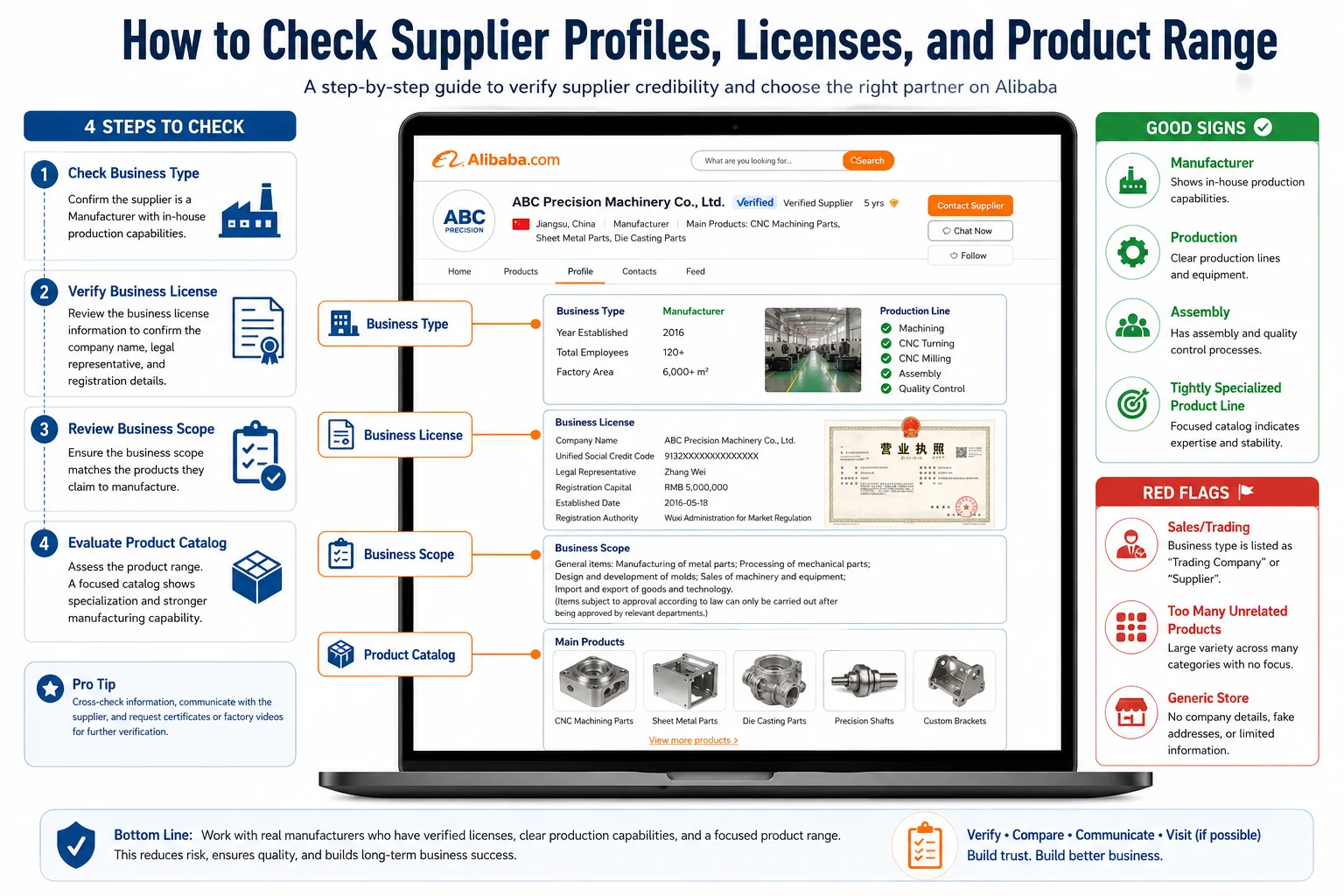
Reading the Clues in the Supplier Profile
You can find many clues on the supplier profile. You must check their business license. The Chinese government issues this license. It shows the "Business Scope."[^5] You need to see words like "manufacture" or "produce." If you only see words like "sales," "trade," or "wholesale," you are looking at a trading company.
I always check the date of the license. I check the registered capital. A real factory needs a lot of money to buy machines. A trader only needs a small office.[^6] I also check their location. Factories sit in industrial zones. Traders sit in city office buildings.[^7]
| Profile Detail | Factory Clue | Trader Clue |
|---|---|---|
| Business Scope | Manufacture, Produce. | Trade, Sales, Wholesale. |
| Location | Industrial Zone, Park. | City Center, Floor 15. |
| Capital | High amount. | Low amount. |
You must act like a detective. You look at their product categories. You check if the categories make sense together. You check their export markets. You check their factory pictures. If the pictures show an office with computers, they are a trader. You need to see big machines and workers. These small details show you the truth.
5. What Questions Help You Identify a Real Manufacturer on Alibaba?
You talk to a friendly supplier. They promise you the moon. You need sharp questions to cut through the lies and test their real skills.
Ask deep technical questions about raw materials and mold limits. Real factories give direct, specific answers. Trading companies say yes to everything quickly, but then delay. They say "let me check with the engineer" because they must call the factory.
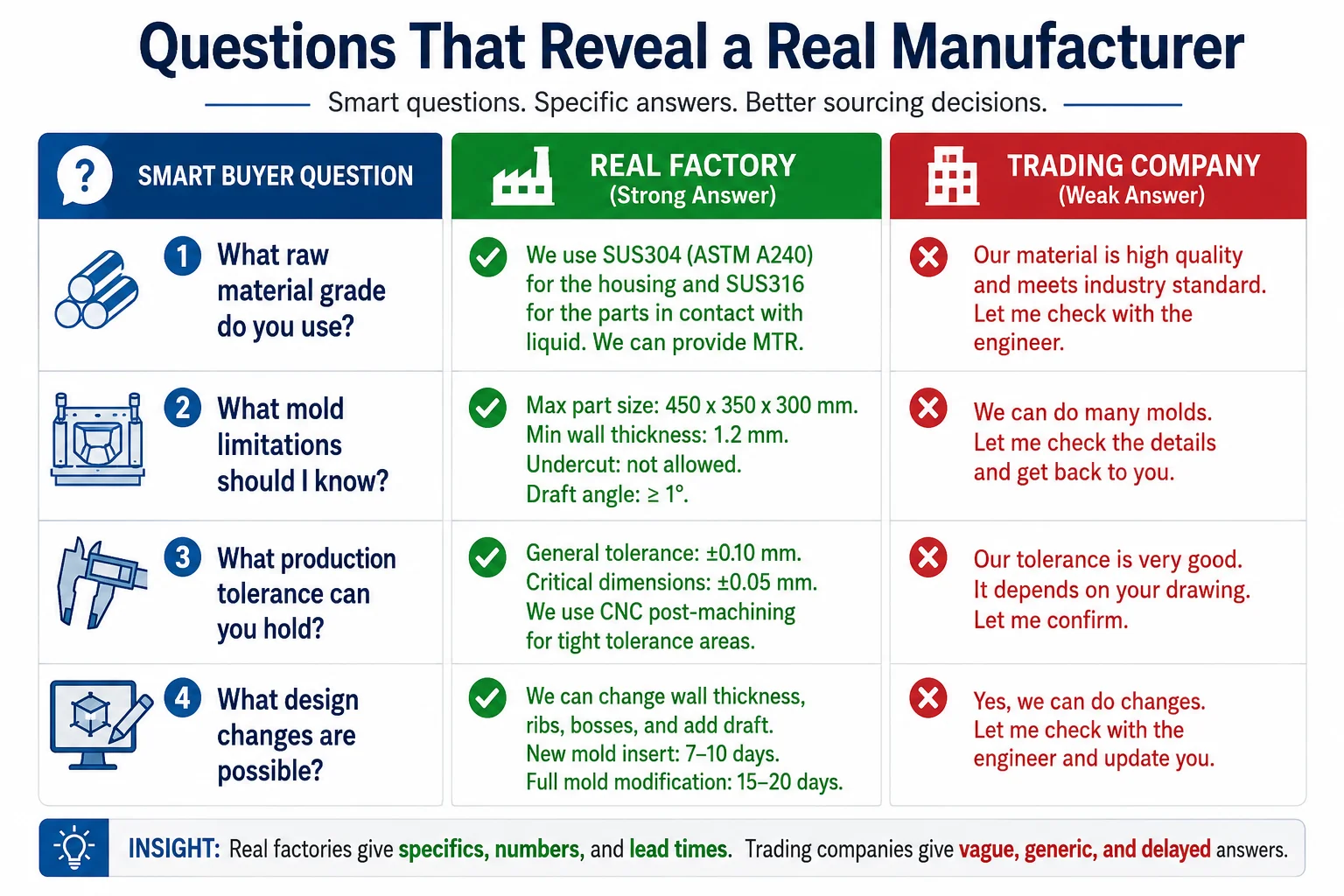
The Technical Stress Test for Suppliers
You can test them with questions. I call this the technical stress test. A real factory knows everything about their product. A trader only knows the basic price.[^8] I always ask hard questions. I ask about the raw material grade. I ask about the limits of their machines. I ask how we can change the mold.
A true engineer gives a fast and exact answer. They tell me if my idea is impossible. A trader says yes to everything. They want your money quickly. They say, "I will check with my engineer." This means they must call the real factory.
| Question Type | Factory Answer | Trader Answer |
|---|---|---|
| Material Details | Gives exact grade and source. | Gives vague or general terms. |
| Mold Changes | Explains machine limits. | Says "Yes, no problem." |
| Response Time | Fast and detailed. | Slow, needs to ask someone else. |
You must listen to how they answer. You do not just listen to what they answer. Delays mean they are asking someone else. Fast answers mean they have the knowledge in the room. You want to work with the experts. You do not want a messenger. The right questions expose the fake factories very quickly.
6. Why Quotes, Samples, Video Calls, and Factory Checks Matter Before Ordering?
You place a huge order blindly. The final products look like trash. You must demand proof before you send your money overseas.
You must request samples to check real quality. You must demand a live video call to see the factory machines running. Physical audits verify their true capacity. These steps expose traders who hide behind nice pictures on a computer screen.
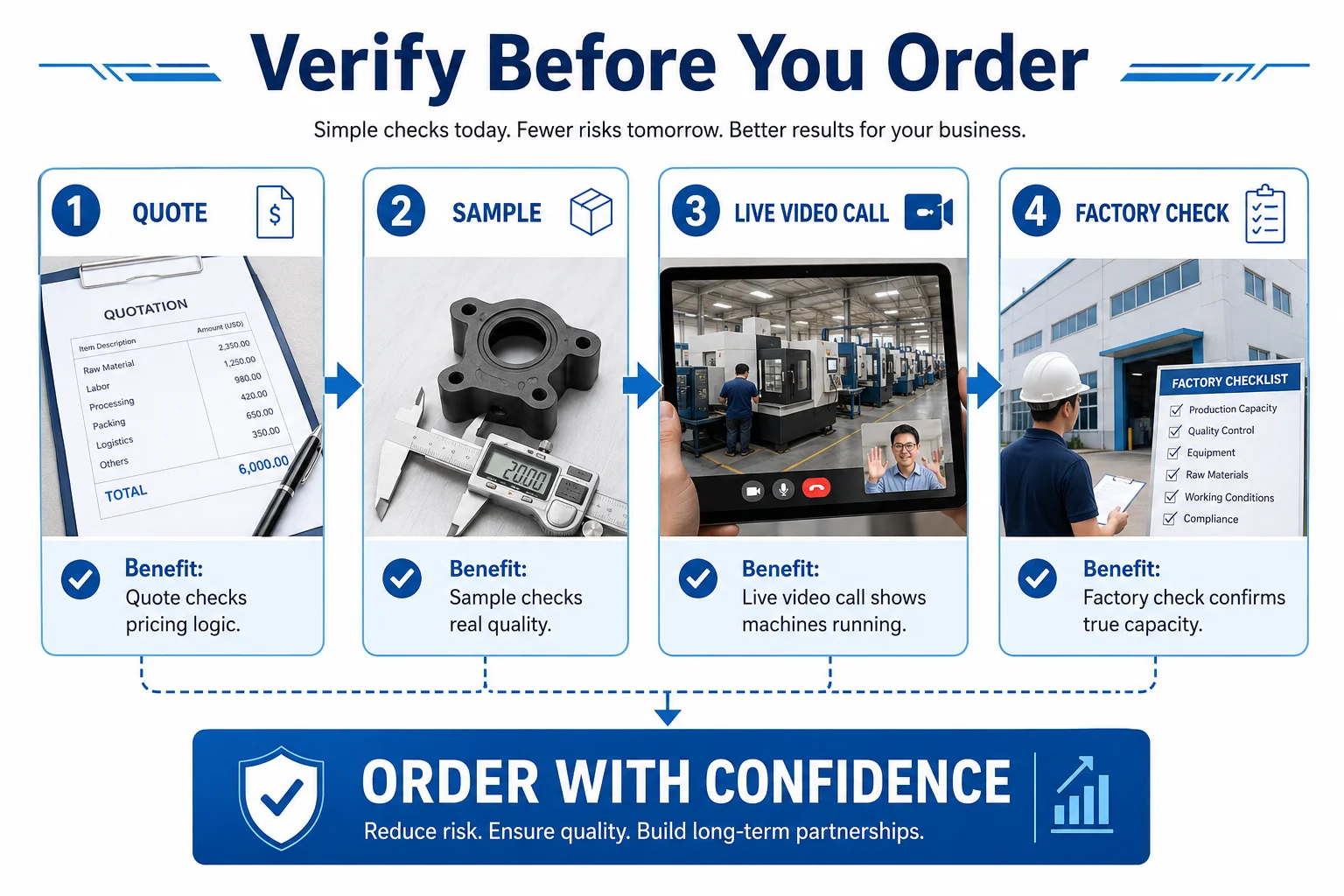
Actions Speak Louder Than Badges
You cannot trust pictures on a screen. You must take real action. You must ask for a sample. The sample shows their true quality level.[^9] You must ask for a live video call. I do this for my clients. I ask the supplier to walk around the factory floor. I ask them to show me the machines running.
A real factory welcomes this call. A trading company makes excuses. They say the internet is bad. They say the factory is closed today.
| Verification Step | Why It Matters | Red Flag |
|---|---|---|
| Order Sample | Tests real quality. | Sample does not match photos. |
| Video Call | Proves factory exists. | Refuses to show machines. |
| Factory Audit | Checks size and capacity. | Address does not match license. |
A physical check is the ultimate test. You send someone to visit the factory. You verify their size.[^10] You check their production line. You match the address on the license to the real building. This stops the scammers. You spend a little money on a sample or an audit. You save a lot of money on a bad order. You must see it to believe it.
7. Common Mistakes Buyers Make When Trying to Avoid Trading Companies?
You block all traders and struggle to find suppliers. You end up with bad factories. You must rethink your strategy to make smart choices.
The biggest mistake is trusting Alibaba badges blindly without asking technical questions. Another mistake is thinking all trading companies are bad. Sometimes a good trader is better than a bad factory. You must decide what level of control you need.
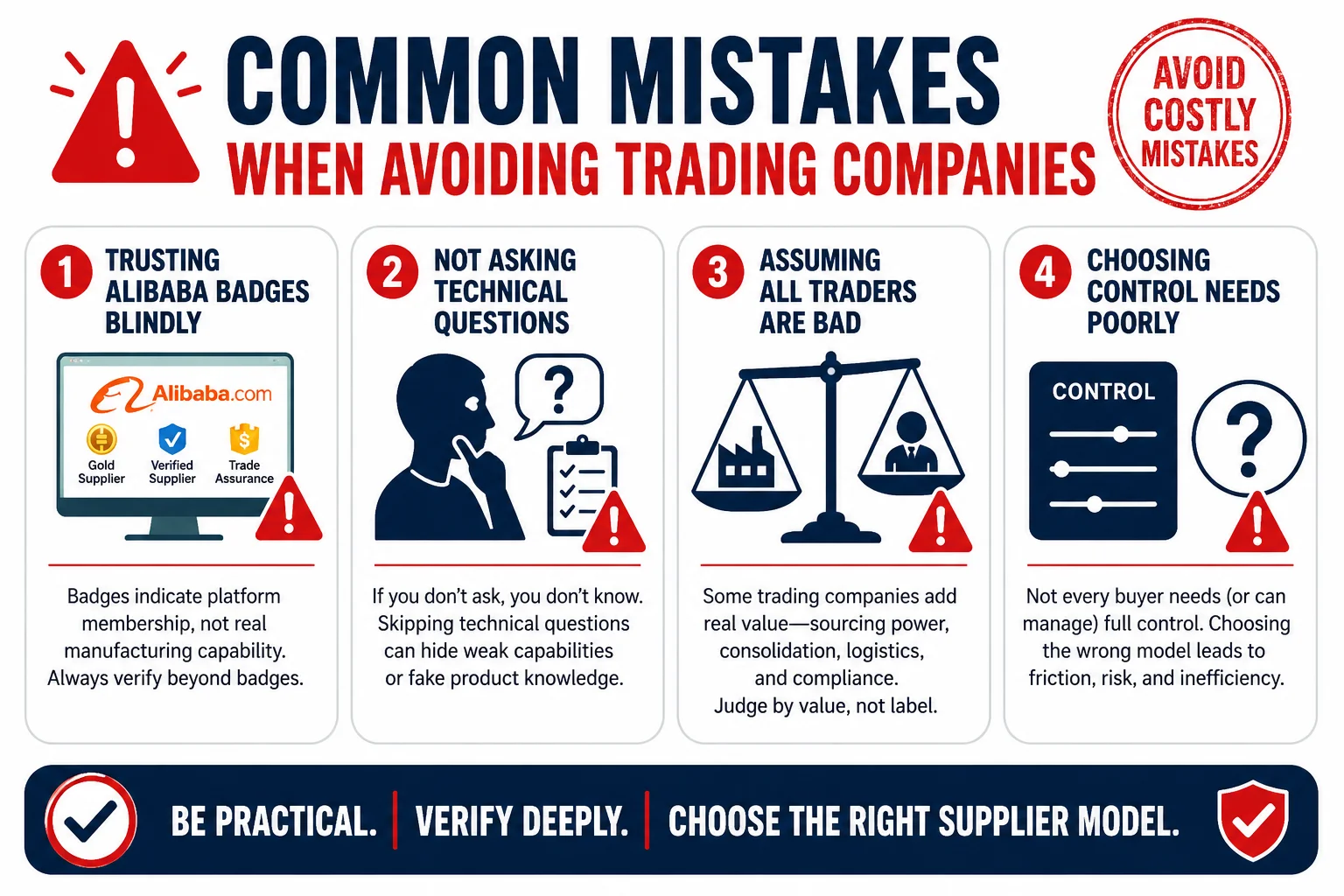
Reframing Your Sourcing Goal
Buyers make many mistakes. You think all trading companies are bad. This is a mistake. Sometimes, a good trader helps a small buyer. A big factory might ignore a small order. A trader might give you better service.[^11] But you must know they are a trader. You cannot pay factory prices for a trader.
Another big mistake is relying only on Alibaba tools. You use a single filter. You think you are safe. You stop asking questions. You must reframe your goal. Your goal is to avoid paying factory-level expectations for trader-level control.
| Buyer Mistake | Bad Result | Better Approach |
|---|---|---|
| Trusting Badges | Pick disguised traders. | Do the technical stress test. |
| Hating All Traders | Factory ignores small order. | Use good traders for test orders. |
| Skipping Audits | Receive bad products. | Book a live video call. |
You must align your strategy with your budget. If you buy a small test order, a trader might work. If you buy a large volume, you must find a factory. You must know who you deal with. Transparency is the most important thing. You do not want surprises. You want a safe and clear supply chain.
8. How KingSourcing Helps Buyers Find and Verify Real Factories in China?
You waste months guessing on Alibaba. You still worry about quality and delays. You need a trusted local partner in China to secure your supply chain.
KingSourcing acts as your local office in China. We skip the Alibaba guesswork. We visit factories, check licenses, test technical skills, and inspect products one by one. We protect your margins and connect you directly with reliable, real manufacturers.
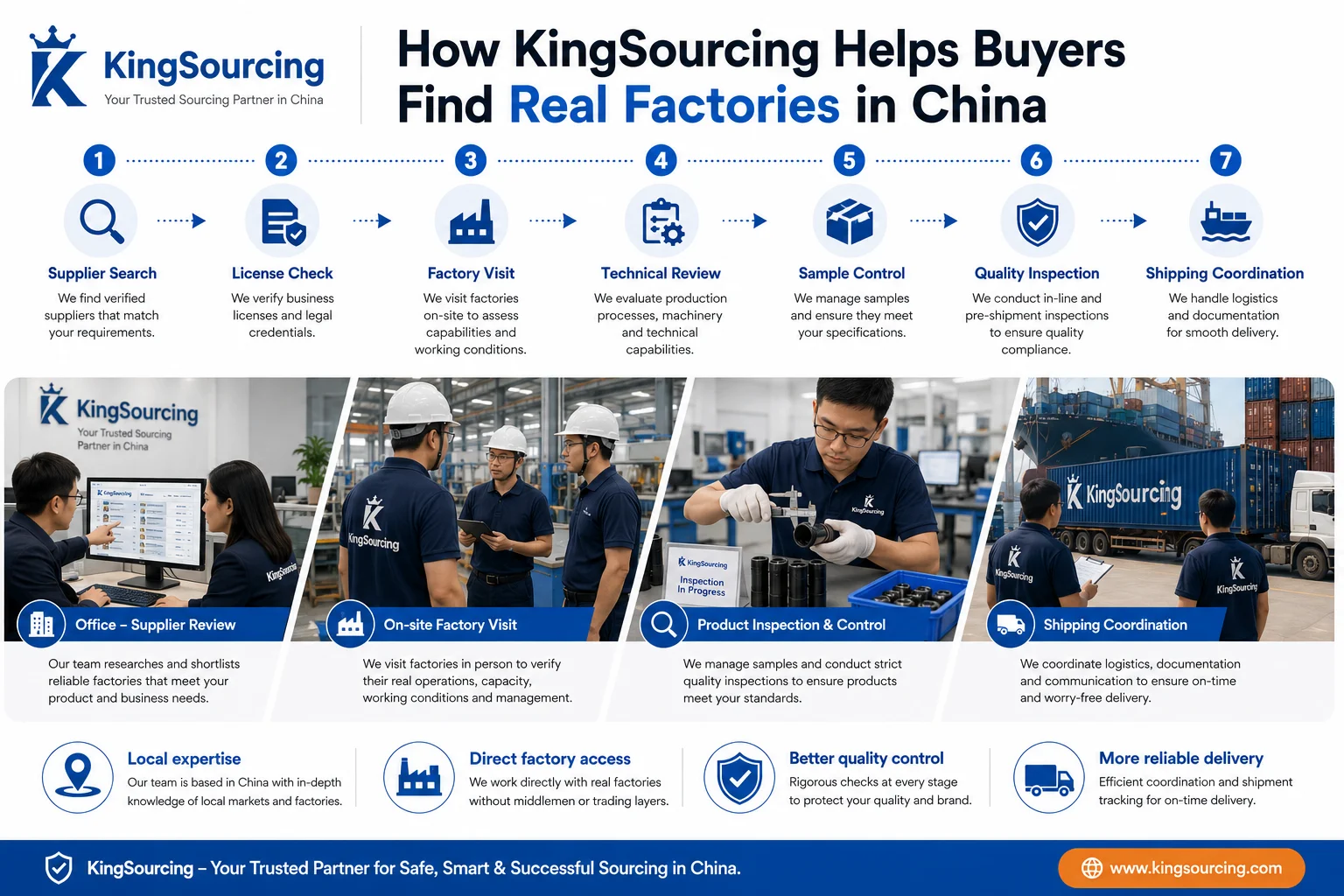
Your Local Sourcing Office in China
You might find all this very hard. You spend weeks searching. You send many messages. You still feel unsure. I understand your struggle. KingSourcing is your local office in China. We handle this hard work for you. We help dropshippers, DTC brands, and large buyers.
We visit the factories. We look at the machines. We ask the hard technical questions. We check the business licenses. We do the 1-by-1 product checks. We make sure you get direct factory prices.
| Our Service | Your Benefit |
|---|---|
| Factory Vetting | No hidden middlemen. |
| Quality Inspection | No defective products. |
| Logistics Management | Door-to-door easy delivery. |
We lower your risk. We save your time. We stop the scammers and hidden middlemen. We do the custom packaging and the international shipping. You do not need to guess anymore. You can focus on selling your products. We act as your eyes and ears in China. We make your China sourcing simple and safe.
Conclusion
Avoiding trading companies requires smart checks, technical questions, and physical verification. Find real factories, protect your margins, or use a trusted local partner like KingSourcing to do it for you.
[^1]: "International Trade: Commerce among Nations", https://www.imf.org/en/publications/fandd/issues/series/back-to-basics/trade. Research on international trade intermediaries indicates that export trading companies typically apply markups ranging from 10% to over 30% to cover transaction costs and profit margins. Evidence role: statistic; source type: paper. Supports: typical markups applied by export intermediaries in global trade. Scope note: Markups vary significantly by industry, product complexity, and the specific value-added services provided by the intermediary. [^2]: "Information asymmetry - Wikipedia", https://en.wikipedia.org/wiki/Information_asymmetry. Supply chain management literature demonstrates that adding intermediary nodes increases information asymmetry and delays the resolution of quality defects due to indirect communication channels. Evidence role: mechanism; source type: paper. Supports: how intermediaries introduce communication delays and information distortion in supply chains. Scope note: Some highly integrated trading companies use advanced ERP systems to minimize these communication delays. [^3]: "U.S. Manufacturing Economy | NIST", https://www.nist.gov/el/applied-economics-office/manufacturing/manufacturing-economy/total-us-manufacturing. According to transaction cost economics, manufacturing requires high asset specificity, compelling factories to specialize in narrow product categories to achieve economies of scale, whereas intermediaries leverage economies of scope. Evidence role: mechanism; source type: paper. Supports: the economic principle of asset specificity requiring manufacturers to specialize. [^4]: "A Supply Chain Management Perspective on Mitigating the Risks of ...", https://a-capp.msu.edu/article/a-supply-chain-management-perspective-on-mitigating-the-risks-of-product-counterfeiting/. Studies on global B2B e-commerce platforms highlight that supplier verification systems can be circumvented by trading firms that maintain nominal assembly operations to pass as primary manufacturers. Evidence role: case_reference; source type: paper. Supports: the phenomenon of supplier misrepresentation and verification circumvention on B2B platforms. Scope note: Platform verification algorithms and third-party auditing standards are frequently updated to close these specific loopholes. [^5]: "China - Licensing Requirements for Professional Services", https://www.trade.gov/country-commercial-guides/china-licensing-requirements-professional-services. Under Chinese corporate law, a company's Business Scope (经营范围) is a legally binding section of its business license that strictly defines its permitted commercial activities, distinguishing between manufacturing and trading entities. Evidence role: definition; source type: government. Supports: the legal function of the 'Business Scope' on Chinese business licenses. [^6]: "Industry Fixed Assets | U.S. Bureau of Economic Analysis (BEA)", https://www.bea.gov/data/investment-fixed-assets/industry. Economic analyses of firm structure show that manufacturing entities exhibit significantly higher capital intensity and require larger initial investments in fixed assets compared to wholesale or trading firms. Evidence role: general_support; source type: paper. Supports: the higher capital intensity and fixed asset requirements of manufacturing firms. [^7]: "Manufacturing Districts - Department of City Planning - DCP - NYC.gov", https://www.nyc.gov/content/planning/pages/zoning/zoning-districts-guide/manufacturing-districts. Urban economic geography and Chinese zoning regulations typically restrict heavy and medium manufacturing to designated industrial parks, while service and trading firms cluster in central business districts. Evidence role: mechanism; source type: paper. Supports: the spatial segregation of manufacturing and trading firms due to zoning and infrastructure needs. Scope note: Light manufacturing or small-scale assembly can sometimes legally operate in mixed-use or commercial zones. [^8]: "(PDF) A literature review on information asymmetry in supply chain ...", https://www.academia.edu/44408283/A_literature_review_on_information_asymmetry_in_supply_chain_coordination. Research on multi-tier supply chains demonstrates a significant knowledge asymmetry, where primary manufacturers possess tacit technical knowledge regarding production constraints that intermediaries often lack. Evidence role: mechanism; source type: paper. Supports: the technical knowledge gap between primary manufacturers and supply chain intermediaries. [^9]: "Prototyping - Adaptive Acquisition Framework", https://aaf.dau.edu/aaf/mca/prototyping/. Procurement best practices dictate that evaluating pre-production samples is a critical risk mitigation strategy to verify a supplier's actual manufacturing capabilities against their advertised specifications. Evidence role: general_support; source type: paper. Supports: the importance of pre-production sampling in evaluating supplier quality capabilities. Scope note: A high-quality sample does not guarantee consistent quality across a mass production run without ongoing quality control. [^10]: "Managing Third Party Risks in a Global Supply Chain - Panorays", https://panorays.com/blog/managing-third-party-risks-global-supply-chain/. Supply chain risk management frameworks emphasize that physical on-site audits are essential for verifying actual production capacity and mitigating the risks of supplier misrepresentation in global sourcing. Evidence role: expert_consensus; source type: paper. Supports: the necessity of physical audits in verifying supplier capabilities and mitigating risk. [^11]: "[PDF] Handbook on Public Procurement Demand Aggregation ... - OECD", https://web-archive-storage.oecd.org/aemint-web-archive-prod/web-archive/a7/a78d1cc4d0fc7fbbb6f83f4911588042b2966218b04b03efd72798371b4d7d5e.pdf. Supply chain literature highlights that intermediaries perform a crucial economic function by aggregating demand from multiple small buyers to meet the high Minimum Order Quantities (MOQs) required by primary manufacturers. Evidence role: mechanism; source type: paper. Supports: the role of intermediaries in aggregating demand to meet manufacturer MOQs.