Are you tired of finding good products on Alibaba, only to hit a wall with a massive MOQ? High minimums kill your cash flow. Let us fix this today.
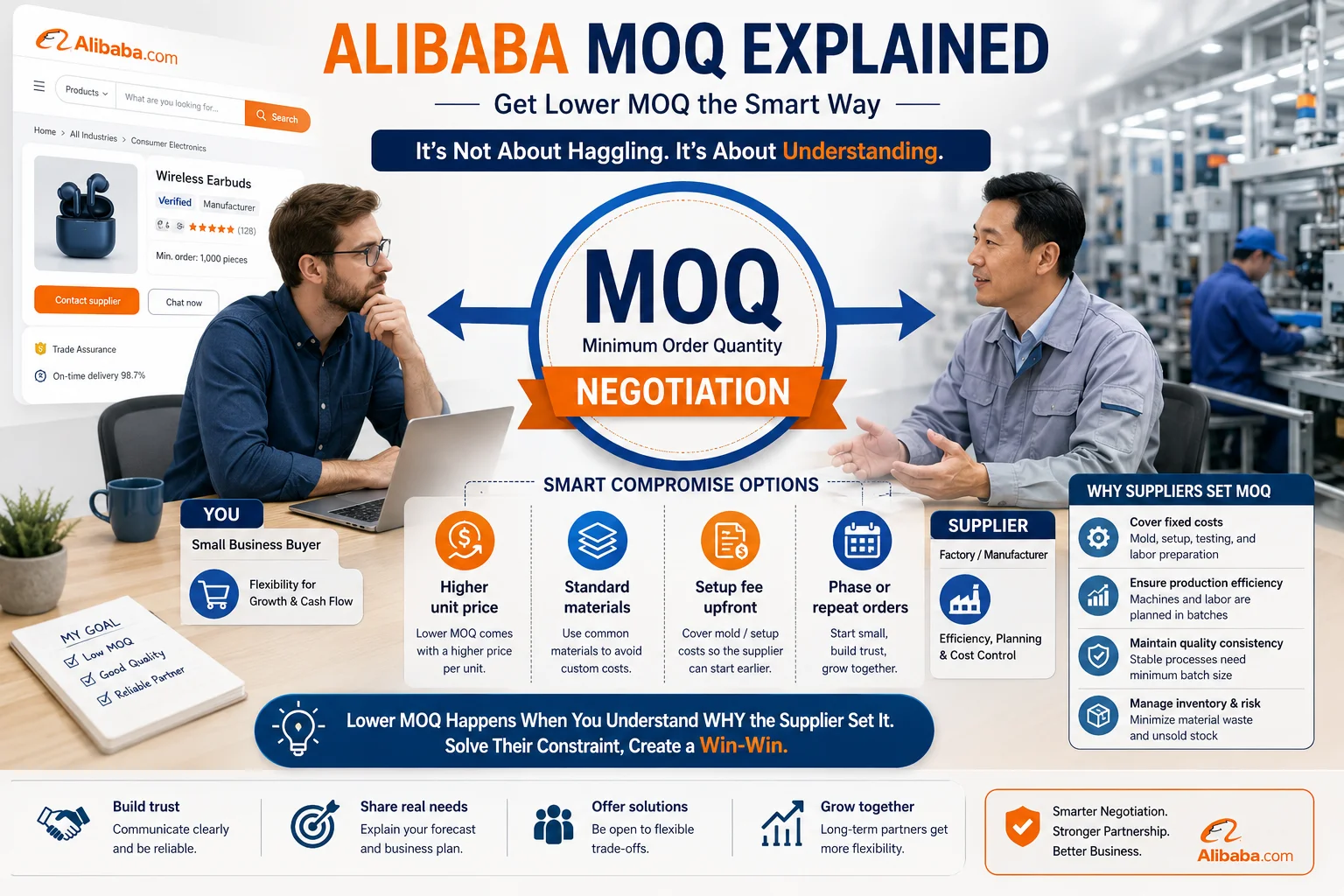
To get a lower Minimum Order Quantity (MOQ) on Alibaba, you must understand why the supplier set it. Offer smart compromises like paying a higher unit price, using standard materials, or covering setup costs upfront instead of just blind haggling.
Many buyers think lowering an MOQ requires a magic negotiation script. That is completely wrong. In my daily work at KingSourcing, I see buyers fail because they do not understand the factory's real limits. Let me show you how we negotiate with Chinese factories and get the numbers you actually need to test your products safely.
1. What Does MOQ Mean on Alibaba?
You see a huge MOQ on a product page and feel stuck. Buying too much risks dead inventory. What does this number actually mean for your small business?
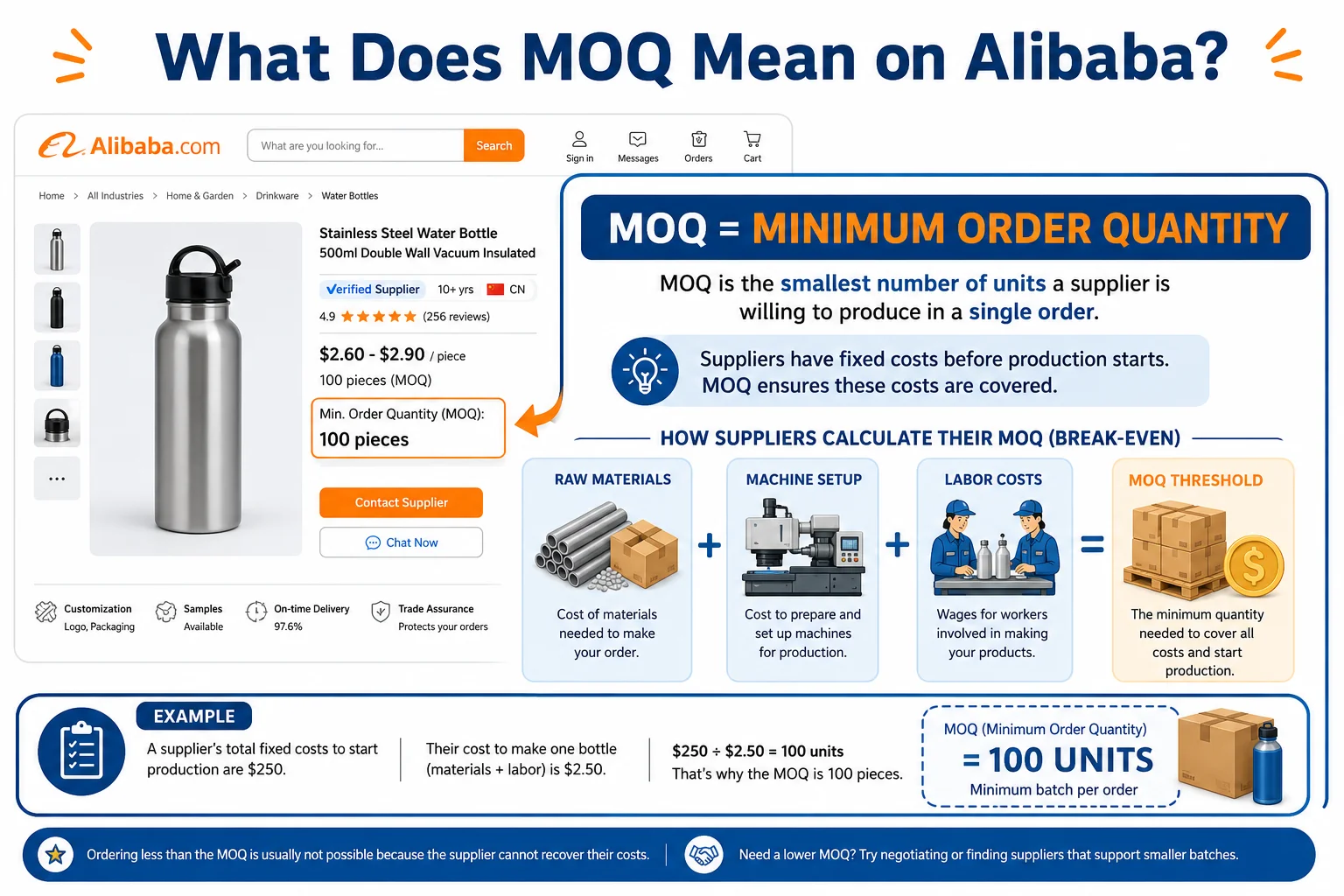
MOQ means Minimum Order Quantity. On Alibaba, it is the smallest number of units a supplier will produce in one order. It shows the factory's break-even point for raw materials, machine setup, and labor costs[^1].
Understanding the Real Meaning Behind the Numbers
I talk to global buyers every day. Many people think an MOQ is just a random number chosen to make things hard for small buyers. But I have visited hundreds of factories in China. I know factories do not set MOQs to be difficult. They set them to survive in a very tough market.
When you see an MOQ on Alibaba, it reflects the supplier's actual production limits. A factory needs to buy raw materials in bulk. They also have to pay workers to set up the large machines. If they produce only 50 units, they lose money.
Here is a simple way to look at how different suppliers treat MOQ on Alibaba.
| Supplier Type | Typical MOQ | Customization Level | Who It Fits Best |
|---|---|---|---|
| Real Manufacturer | High (1000+ units) | High (Custom designs, logos) | Big brands with steady sales |
| Trading Company | Low (10-100 units) | Low (In-stock items only) | Small sellers testing new ideas |
If you deal with a trading company, the MOQ is low because the goods are already sitting in a warehouse[^2]. If you deal with a real manufacturer, the MOQ is high because they have to start the machines just for you. You need to pick the right supplier for your current business stage.
2. Why Do Alibaba Suppliers Set Minimum Order Quantities?
Do you wonder why a supplier refuses your small order? It is very frustrating when they say no. But they have strict production rules. Let us look at why.
Suppliers set MOQs because they face strict production limits. They must meet raw material purchasing rules from their sub-suppliers[^3]. They also need to cover high machine setup costs and custom packaging minimums just to make a small profit on your order.
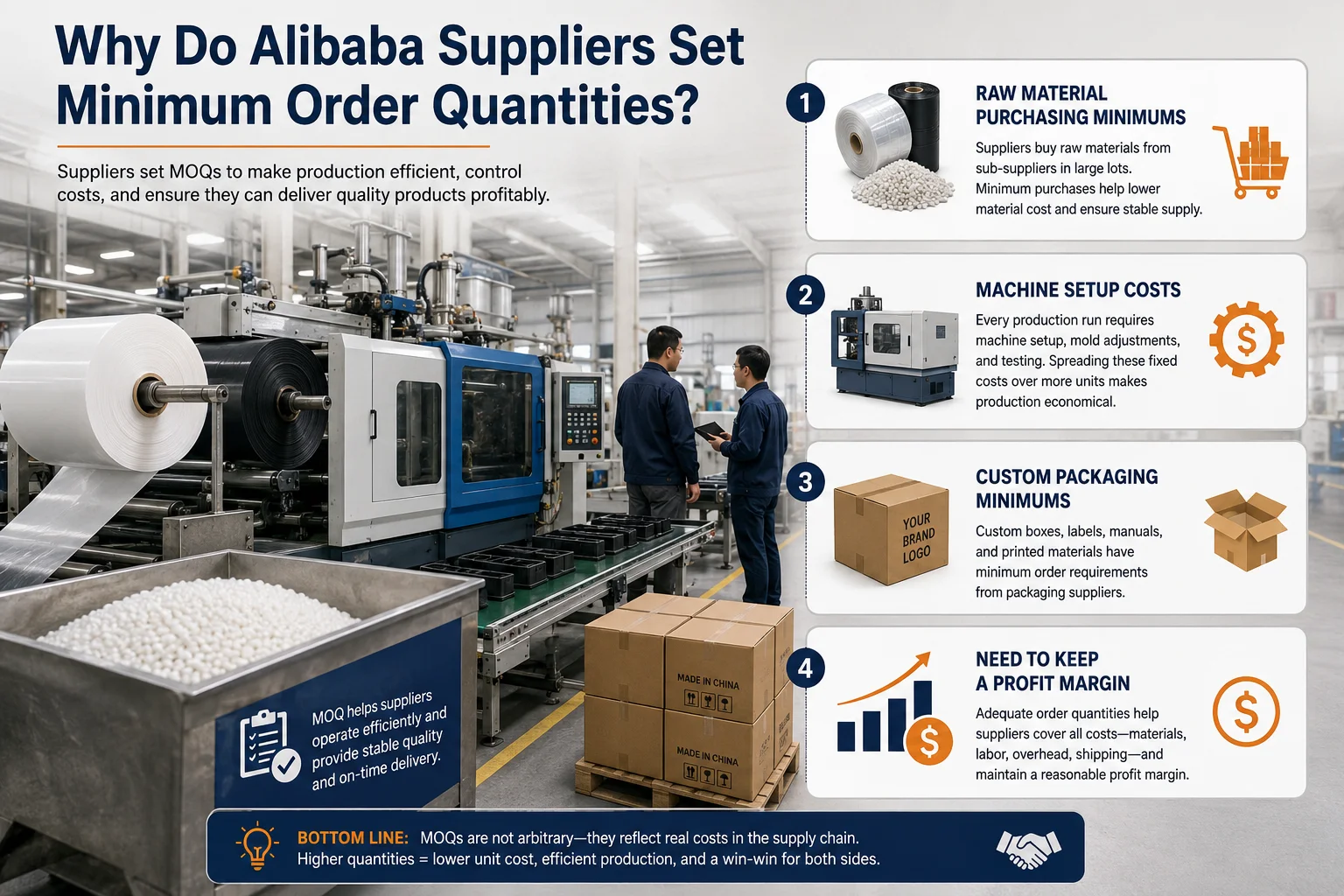
The Supply Chain Reality Behind MOQs
When I help clients at KingSourcing, I always explain that the factory is just one piece of a bigger puzzle. Chinese factories do not make everything from scratch. They buy parts from other places.
If you want custom pink fabric for a bag, the fabric mill tells the bag factory they must buy at least 500 meters. The bag factory has no choice. They must pass that rule on to you. This is the raw material limit.
Another big factor is machine setup. It takes a lot of time to clean machines, change molds, and adjust settings[^4].
Main Factors Driving MOQs
| Cost Factor | Why It Increases MOQ | How to Solve It |
|---|---|---|
| Raw Materials | Sub-suppliers require big bulk purchases. | Use standard colors or materials. |
| Machine Setup | Molds and setup waste time and money. | Pay the setup fee upfront. |
| Custom Packaging | Printing boxes requires large print runs. | Use blank boxes with custom stickers. |
You cannot negotiate effectively if you do not know which limit applies to your product. Next time a supplier gives you a high MOQ, ask them directly. Ask if it is because of the raw materials, or the packaging. Once you know the real reason, you can find a solution together.
3. Can You Negotiate a Lower MOQ with Alibaba Suppliers?
Walking away from a good product feels terrible. You might think factory rules are permanent. But there is hope if you know how to talk to them properly.
Yes, you can negotiate a lower MOQ with Alibaba suppliers. However, you cannot just demand it. You will succeed if you offer practical compromises that protect the factory from losing money on your small order. Find a mutual business alignment.
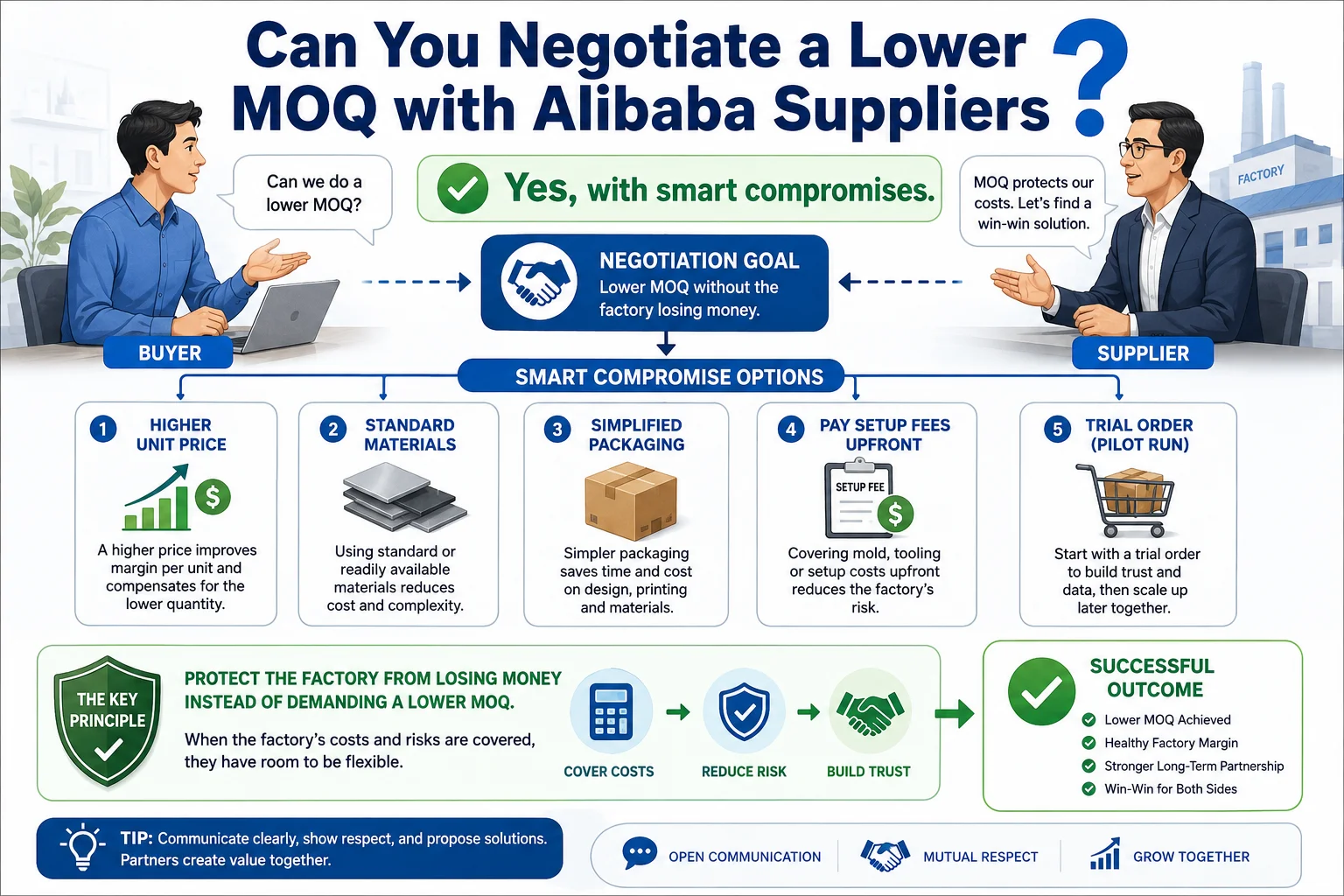
Moving From Haggling to Smart Compromise
In my experience as a sourcing agent, blind haggling never works. If you just ask the supplier to drop the MOQ from 1000 to 200 without giving them anything in return, they will ignore you. They deal with hundreds of messages a day from people who just want cheap things.
But Chinese suppliers are business people. They want to make money, and they want long-term partners. We get lower MOQs for our clients every day by offering smart compromises. You have to give a little to get a little.
Effective Negotiation Strategies
| Strategy | How It Works | Best Used For |
|---|---|---|
| Trial Order Premium | Pay 10% to 20% more per unit for the first small order.[^5] | Testing market demand safely. |
| Standardization | Drop custom colors and use the factory's standard parts.[^6] | Overcoming raw material limits. |
| Combine Orders | Wait until the factory has a large order from someone else and join it. | Products with long lead times. |
You must treat negotiation as a way to solve a shared problem. If you show the factory that you understand their costs, they will be much more willing to work with you. A small change in your product design can often cut the MOQ in half easily.
4. How to Ask for a Lower MOQ Without Looking Like an Unserious Buyer?
Sending a bad email can get you ignored forever. Suppliers hate wasting time on buyers who will never grow. How do you prove you are a real business?
To ask for a lower MOQ and look serious, be clear about your business plan. State your target market, share your website, and explain this is a paid trial run.[^7] Offer to pay a higher unit price or cover machine setup fees upfront.
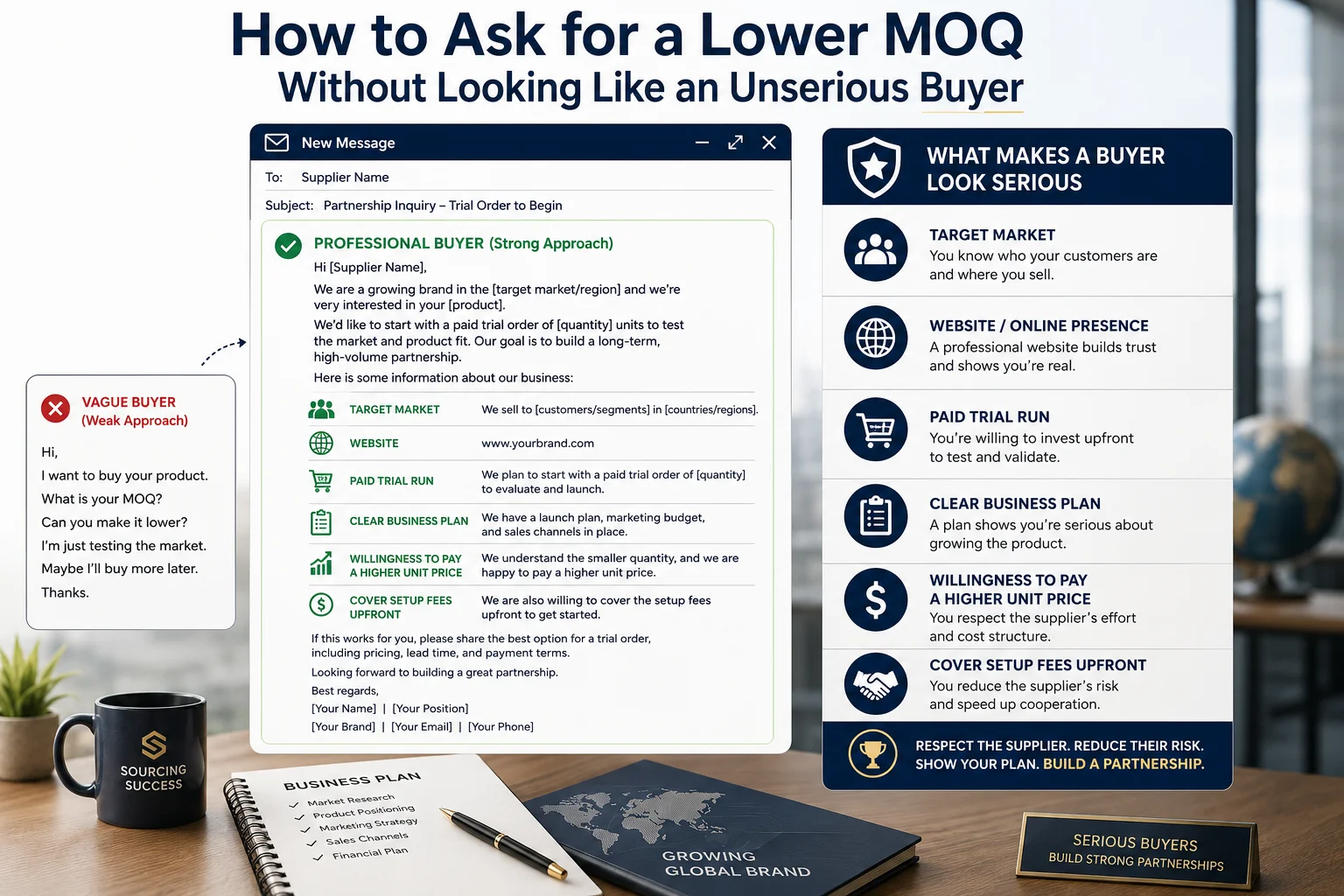
The Right Way to Communicate Your Value
Many new buyers send a message like, "Hi, I want 50 pieces, what is the price?" This is the fastest way to get ignored. The supplier thinks you are just a retail shopper trying to get a cheap deal for yourself.
At KingSourcing, we always present our clients as professional businesses. You need to show the supplier the bigger picture. Explain that you are doing a market test and you have a budget.
Do's and Don'ts of Asking for Lower MOQs
| Action | Do This | Do Not Do This |
|---|---|---|
| Introduce Yourself | Share your brand name and target market clearly. | Keep your business a secret. |
| Explain the Order | Call it a "first trial order to test market fit." | Beg for a small amount to save money. |
| Discuss Price | Offer to pay a bit more for the small quantity. | Demand the lowest bulk price for a small order. |
If you act like a professional, the supplier will treat you like one. Always be honest. Do not lie and say you will order a million units next month if you will not. Just be direct. Tell them you have a budget for testing, and ask what they can do to help you start today.
5. What Trade-Offs Should You Expect with Low MOQ Orders?
Getting a low MOQ feels like a big win. But cheap shortcuts usually bring bad surprises later. What hidden costs will you pay for that small test order?
When you get a low MOQ, expect some trade-offs. You will likely pay a higher price per unit. You will also have fewer choices for custom colors and packaging. The supplier might also give your small order a lower priority, causing longer production times.
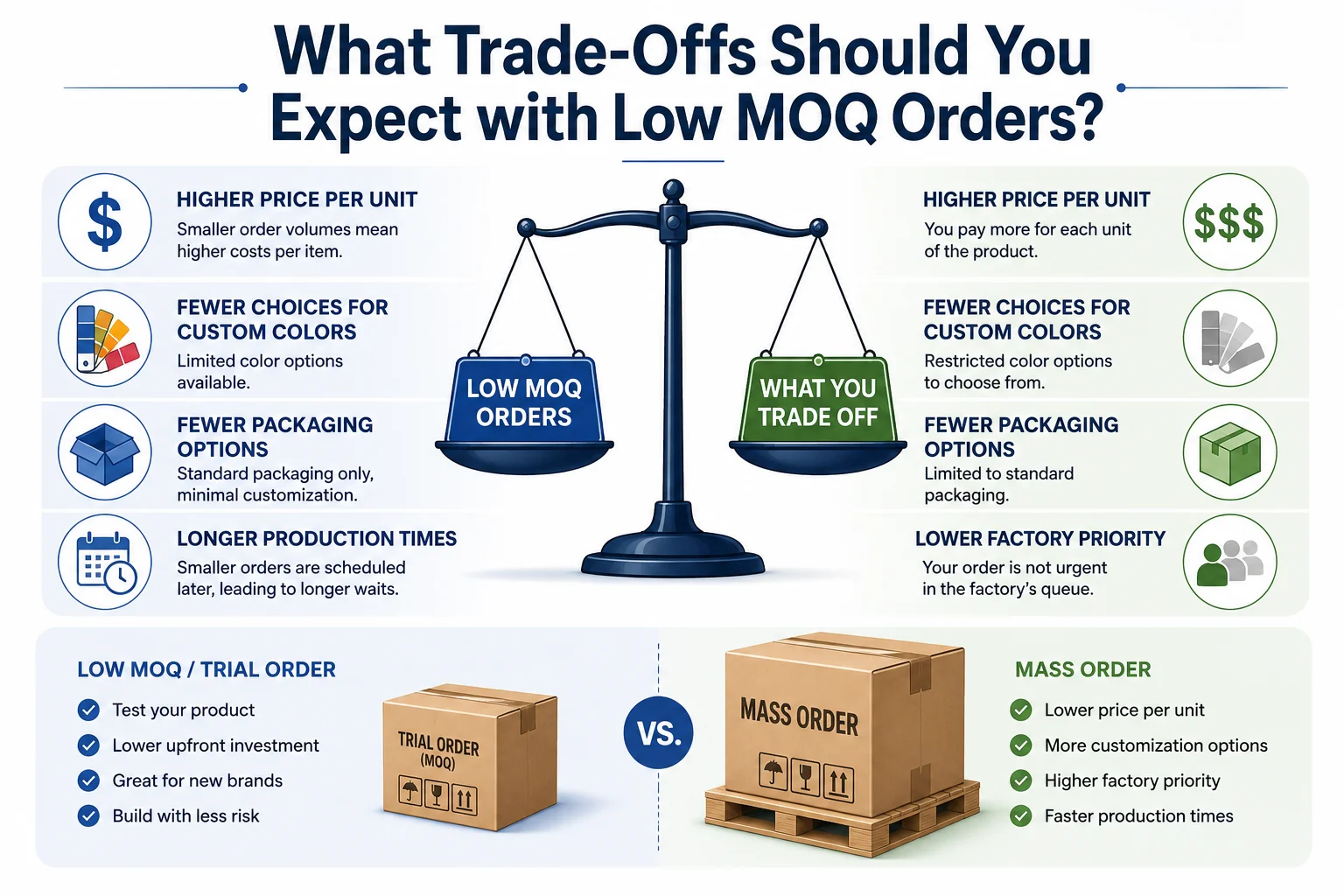
The Hidden Costs of Small Orders
I always tell my clients that nothing is free in manufacturing. If you push a factory into an unnaturally low MOQ through aggressive talk, you might create new problems. This is the hidden risk of "forced" low MOQs. The factory will always find a way to balance their costs.
When a factory takes a small order at a low price, they still need to make a profit. How do they do it? Sometimes they use cheaper materials. Sometimes they skip quality control.[^8] Sometimes they push your order to the back of the line behind big buyers.[^9]
Common Trade-Offs for Low MOQ
| Trade-Off | What Happens | How to Manage It |
|---|---|---|
| Higher Unit Price | Factory charges more to cover their base costs. | Accept it as the cost of lowering your risk. |
| Limited Customization | Factory forces you to use in-stock generic parts. | Focus on customizing the packaging, not the product. |
| Slower Lead Time | Factory waits to produce your order during downtime. | Plan your inventory timeline carefully. |
You have to choose what is most important to you right now. If testing the product quickly is your main goal, then paying a higher price for a standard color is a smart move. Do not try to win on every single point, because that will hurt your product quality.
6. How to Compare Alibaba Quotes Beyond MOQ and Unit Price?
Comparing quotes only by price and MOQ is dangerous. You might pick the cheapest option and lose your money on bad quality. How do you find the real winner?
To compare Alibaba quotes, look past the unit price and MOQ. You must check the shipping costs, production lead times, and the supplier's communication skills. Also, review their business type to see if they are a real factory or a middleman trading company.
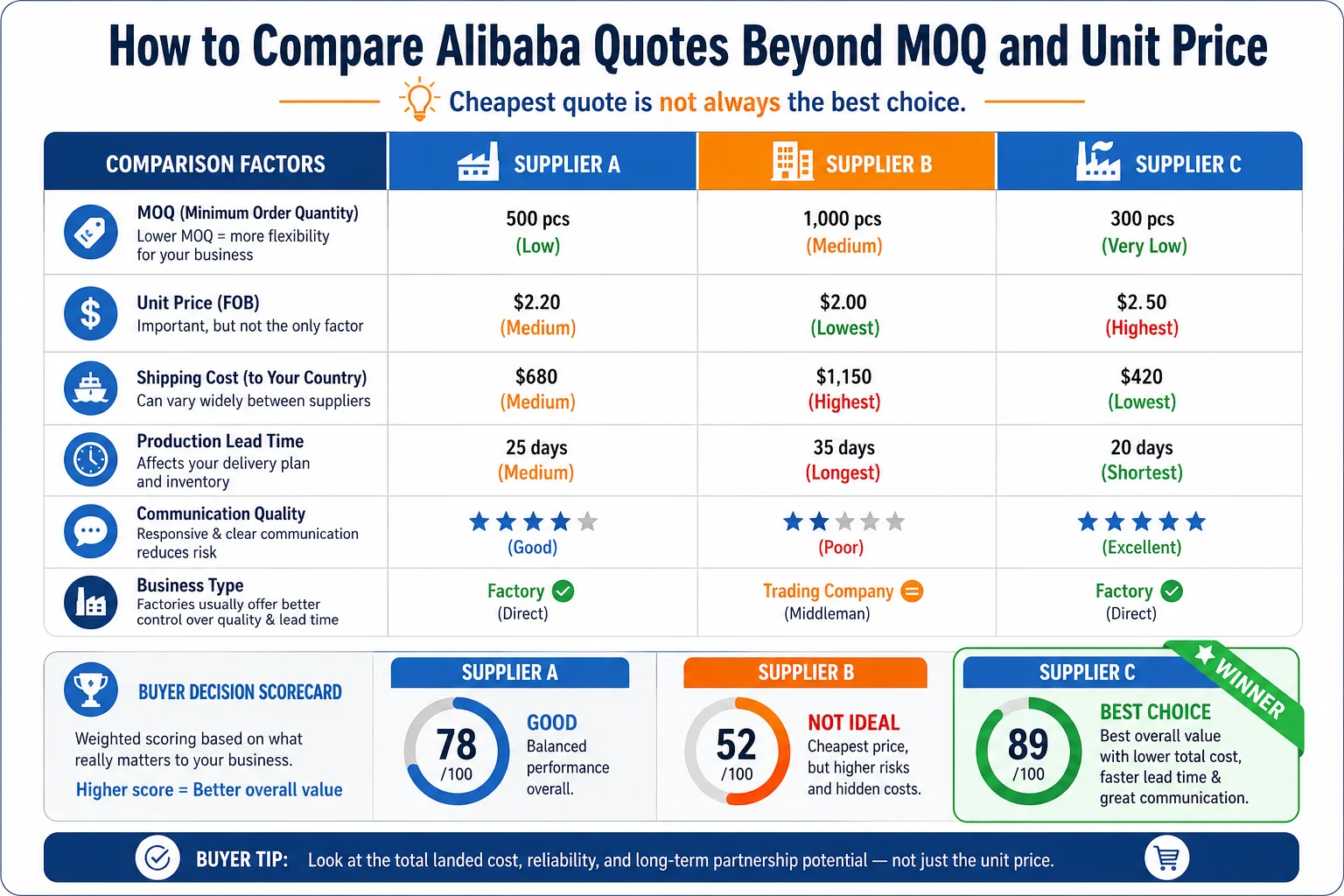
Looking at the Total Cost of Sourcing
Many buyers open a spreadsheet and just look at the lowest price. This is a big mistake. In my years of sourcing, I have seen cheap quotes turn into very expensive disasters. You must look at the whole picture to make a safe choice.
A trading company might offer you a low MOQ of 50 pieces. But their shipping fee might be twice as high as the factory's fee. Or a factory might offer a low price, but they take 60 days to make the goods. Time is money in business.
Key Metrics to Compare Suppliers
| Metric | Why It Matters | What to Check |
|---|---|---|
| Shipping Terms (Incoterms) | It changes your total landed cost completely. | Ask if the quote is EXW, FOB, or DDP.[^10] |
| Lead Time | Slow production ruins your sales momentum. | Ask for a guaranteed completion date. |
| Communication | Bad English and slow replies cause errors. | See if they answer your questions clearly and fast. |
You need to calculate the total landed cost. This includes the product, the shipping, the duties[^11], and the time spent managing the order. A slightly more expensive supplier who is reliable is always better than a cheap supplier who causes stress and delays.
7. How Supplier Verification, Samples, and QC Reduce Low-MOQ Order Risk?
Ordering a small batch from a new factory is scary. What if the products arrive broken? You need a strong safety net before you pay any money.
You reduce risk by taking three steps. First, verify the supplier's background to ensure they are real. Second, always buy a physical sample before the main order. Third, hire a Quality Control (QC) service to inspect the goods before they leave China.[^12]
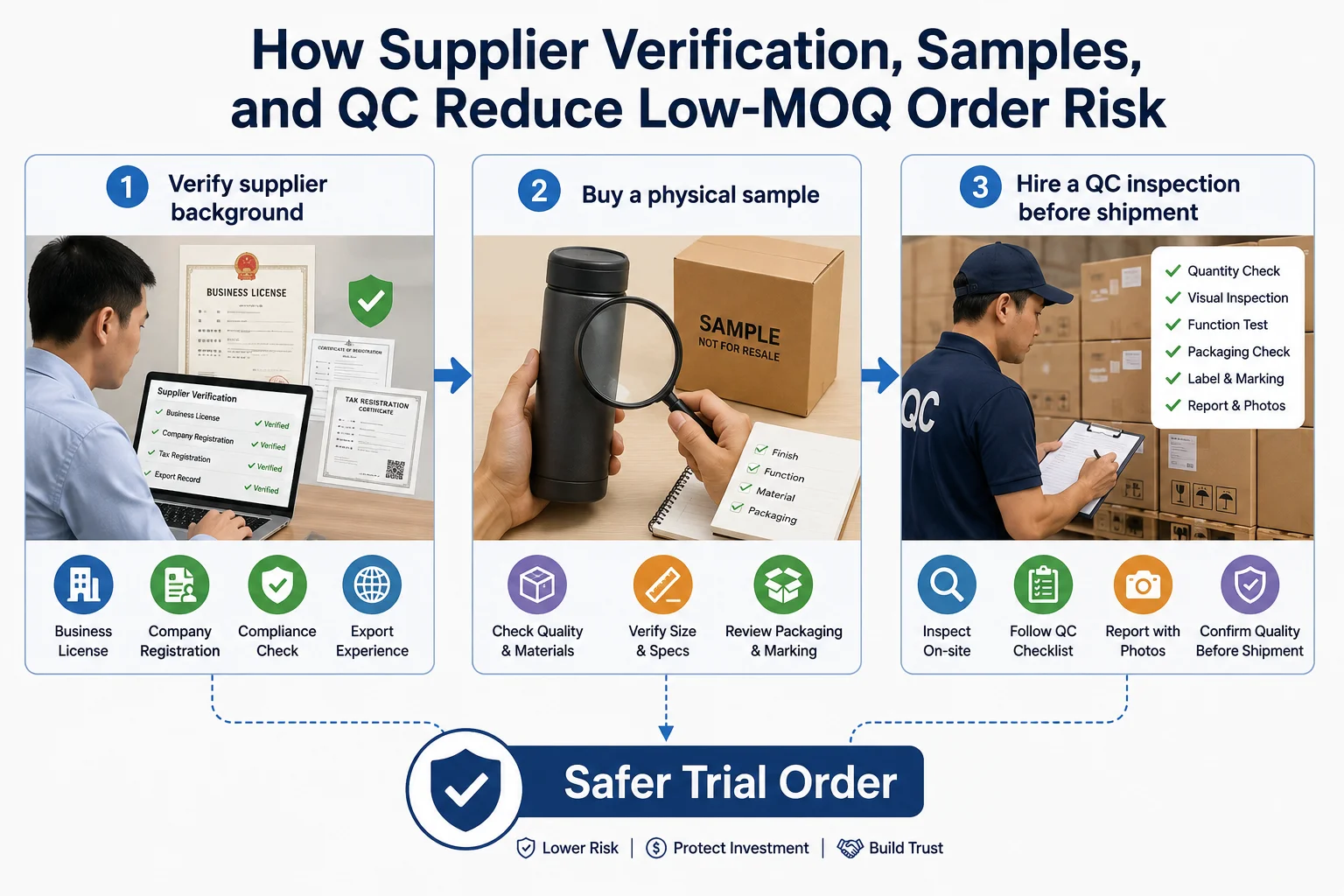
Building a Safe Sourcing Process
Even with a low MOQ, you are still spending your hard-earned money. I have seen buyers lose $1000 on a test order because they trusted a bad factory. You cannot skip the basic safety steps just because the order is small. Safety is always the priority.
When we manage orders at KingSourcing, we never trust blind luck. We verify every factory. We always insist on physical samples. A picture on Alibaba is not enough. You must feel the product in your hands to know if it is good enough for your customers.
Essential Safety Steps for Small Orders
| Safety Step | Action to Take | Why It Saves You Money |
|---|---|---|
| Supplier Verification | Check their business license and factory video. | Stops you from sending money to scammers. |
| Pre-Production Sample | Pay for one final sample before bulk production. | Ensures the factory understands your exact needs. |
| Pre-Shipment QC | Do a 1-by-1 check or basic inspection. | Stops bad items from being shipped across the world. |
Quality control is the most important part. If a factory accepts a very low MOQ, they might assign their newest workers to your order. A quick inspection before you pay the final balance will save you from major headaches and angry customers later.
8. How KingSourcing Helps Buyers Negotiate MOQ and Manage Safer Orders from China?
Managing Chinese suppliers across different time zones is exhausting. You waste hours messaging back and forth without real progress. You need a trusted local partner on your side.
KingSourcing acts as your local office in China. We talk directly to factories, find the real reasons behind their MOQs, and negotiate smart compromises for you. We manage the sampling, daily communication, and quality control to ensure your small trial orders are safe.
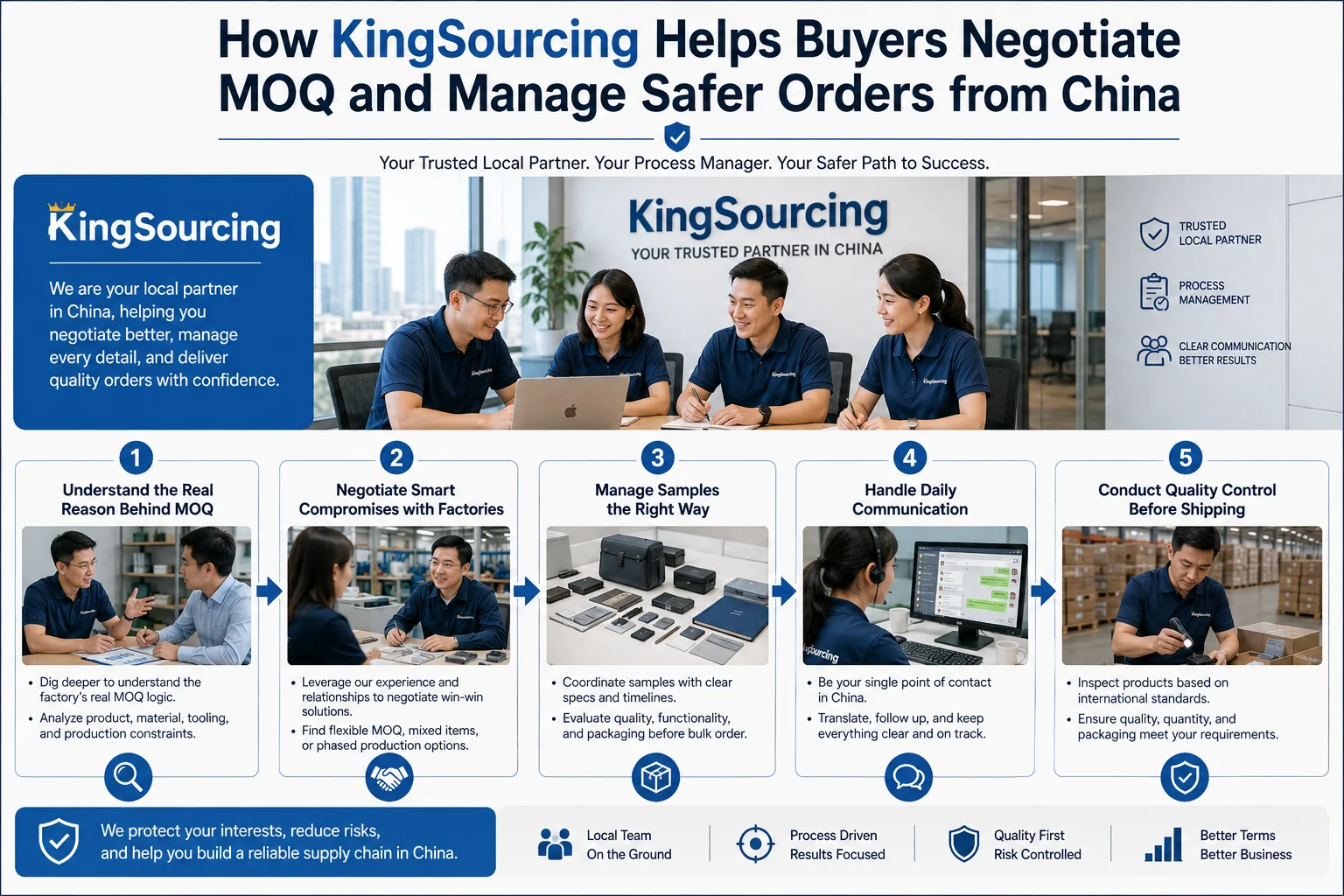
Making Your China Sourcing Simple
Many of our clients come to us after failing to negotiate with Alibaba suppliers on their own. They are tired of the constant back-and-forth and the hidden risks. At KingSourcing, our goal is not just to buy things for you. We want to lower your trial-and-error costs.
We serve small sellers starting with $500 test budgets, and we also manage large buyers spending over $500,000 a year. Because we are on the ground in China, we can call the factory boss directly. We find out if the MOQ issue is a raw material problem or just a lazy salesperson.
How We Support Your Business Growth
| Service | How We Help | Your Benefit |
|---|---|---|
| Supplier Development | We find real factories, not just middlemen. | Better prices and clear communication. |
| Smart Negotiation | We use our local network to secure lower MOQs. | Less cash tied up in inventory. |
| 1-by-1 Quality Control | We check every single unit before it ships. | No angry customers and no wasted money. |
We handle the packaging, the warehousing, and the door-to-door shipping. You do not need a big purchasing team. You just need KingSourcing. We help you find reliable suppliers so you can focus on building your brand and selling more products.
Conclusion
Getting a lower MOQ on Alibaba requires understanding factory limits and offering smart compromises. Pick the right supplier, communicate professionally, and protect your order with strong quality control.
[^1]: "Economic Order Quantity (EOQ) | www.waru.edu", https://www.waru.edu/acquipedia-article/economic-order-quantity-eoq. Supply chain literature indicates that manufacturers establish Minimum Order Quantities to ensure that the fixed costs of machine setup, labor, and raw material procurement are distributed across enough units to achieve a break-even margin. Evidence role: mechanism; source type: paper. Supports: how manufacturing setup costs, labor, and raw material constraints dictate minimum viable batch sizes. Scope note: While setup costs are a primary driver, strategic factors like client relationship value can also influence a factory's willingness to lower MOQs. [^2]: "[PDF] Managing Global Sourcing: Inventory Performance - INSEAD", https://sites.insead.edu/facultyresearch/research/doc.cfm?did=51508. Intermediaries such as trading companies and wholesalers typically purchase in bulk from manufacturers and hold inventory, allowing them to break bulk and offer significantly lower minimum order quantities to smaller retailers. Evidence role: mechanism; source type: education. Supports: the role of trading companies and wholesalers in absorbing inventory risk to offer smaller order quantities to downstream buyers. [^3]: "Manufacturing Supply Agreement - SEC.gov", https://www.sec.gov/Archives/edgar/data/317093/000119312506252522/dex1037.htm. In multi-tier supply chains, primary manufacturers are often bound by the minimum order quantities of their tier-2 and tier-3 raw material suppliers, forcing them to pass these volume constraints down to the final buyer. Evidence role: mechanism; source type: paper. Supports: how upstream raw material purchasing constraints dictate downstream manufacturing MOQs. [^4]: "[PDF] Performance Improvement Using the Single Minute Exchange of Die ...", https://staff.najah.edu/media/sites/default/files/Performance_Improvement_Using_the_Single_Minute_Exchange_of_Die_(SMED)_Methodology_in_an_Aluminum_Profiles_Extrusion_Production_System.pdf. Operations management research highlights that machine changeovers, mold replacements, and calibration require significant downtime, driving manufacturers to increase batch sizes to amortize these fixed setup costs. Evidence role: general_support; source type: paper. Supports: the significant impact of machine changeover and setup times on production costs and batch sizing. [^5]: "Part 15 - Contracting by Negotiation | Acquisition.GOV", https://www.acquisition.gov/far/part-15. Procurement studies suggest that buyers can successfully negotiate lower initial volumes by offering a unit price premium, which compensates the manufacturer for the unamortized fixed costs of a small production run. Evidence role: mechanism; source type: research. Supports: the economic rationale of offering a unit price premium to compensate manufacturers for the disproportionate setup costs of small batch orders. Scope note: The exact percentage premium required varies heavily by industry and the specific fixed costs involved in the product's manufacturing. [^6]: "[PDF] Raw Material Minimum Order Quantity Optimization - DSpace@MIT", https://dspace.mit.edu/bitstream/handle/1721.1/121302/1240293813-MIT.pdf?sequence=1. Design for Manufacturing (DFM) principles emphasize that utilizing off-the-shelf, standardized components eliminates the need for custom tooling and specialized raw material orders, thereby significantly lowering the required minimum order quantity. Evidence role: mechanism; source type: paper. Supports: how utilizing standardized components and materials reduces manufacturing complexity and lowers minimum volume requirements. [^7]: "Examining collaborative buyer–supplier relationships and social ...", https://pmc.ncbi.nlm.nih.gov/articles/PMC9434505/. Research in Supplier Relationship Management (SRM) indicates that suppliers are more willing to offer flexible terms, such as lower initial order volumes, when buyers demonstrate organizational legitimacy and the potential for long-term relational value. Evidence role: expert_consensus; source type: paper. Supports: the importance of buyer transparency and perceived legitimacy in securing favorable terms from suppliers. [^8]: "Opportunism Knocks - MIT Sloan Management Review", https://sloanreview.mit.edu/article/opportunism-knocks/. Supply chain risk literature documents the phenomenon of 'quality fade,' where manufacturers facing squeezed profit margins from aggressive buyer negotiations may covertly substitute inferior materials or reduce quality assurance efforts to restore profitability. Evidence role: mechanism; source type: paper. Supports: the phenomenon of quality fade and supplier opportunism when manufacturing margins are overly compressed. [^9]: "[PDF] the implications of customer prioritization on lead time", https://kb.osu.edu/bitstream/handle/1811/417/1/AmyStarr.pdf. Operations management studies on production scheduling reveal that manufacturers frequently utilize customer stratification, prioritizing high-volume, high-margin orders while delaying smaller, less profitable batches during periods of capacity constraint. Evidence role: mechanism; source type: paper. Supports: how manufacturers prioritize production schedules based on client volume and profitability. [^10]: "Know Your Incoterms - International Trade Administration", https://www.trade.gov/know-your-incoterms. According to the International Chamber of Commerce (ICC), Incoterms such as EXW (Ex Works), FOB (Free on Board), and DDP (Delivered Duty Paid) legally define the allocation of shipping costs, insurance, and customs duties between the buyer and seller, drastically altering the final cost of goods. Evidence role: definition; source type: institution. Supports: the definitions of Incoterms and their role in determining which party bears the costs and risks of international shipping. [^11]: "Landed Cost: What it is and How to Calculate it | DCL Logistics", https://dclcorp.com/blog/supply-chain/landed-cost/. In global supply chain management, Total Landed Cost (TLC) is defined as the sum of all costs associated with making a product available for sale, which includes the original unit price, freight, customs duties, insurance, and handling fees. Evidence role: definition; source type: education. Supports: the standard components that make up the total landed cost in international procurement. [^12]: "Pre-Shipment Inspections (PSI) - TÜV SÜD", https://www.tuvsud.com/en-us/services/inspection/pre-shipment-inspection. Empirical research in global sourcing demonstrates that implementing third-party pre-shipment inspections (PSI) significantly reduces the incidence of receiving defective inventory and mitigates the financial risks associated with cross-border supplier opportunism. Evidence role: general_support; source type: paper. Supports: the role of third-party pre-shipment inspections in reducing defect rates and mitigating risks in offshore procurement.