You hold three quotes from Chinese suppliers. The prices are wildly different. You feel confused. You worry about picking the wrong factory and losing your money.
To compare quotes from Chinese suppliers, you must look beyond the unit price. You need to standardize your request, check material specs, confirm shipping terms, and test communication speed. A cheap price often hides poor quality or high shipping costs later.
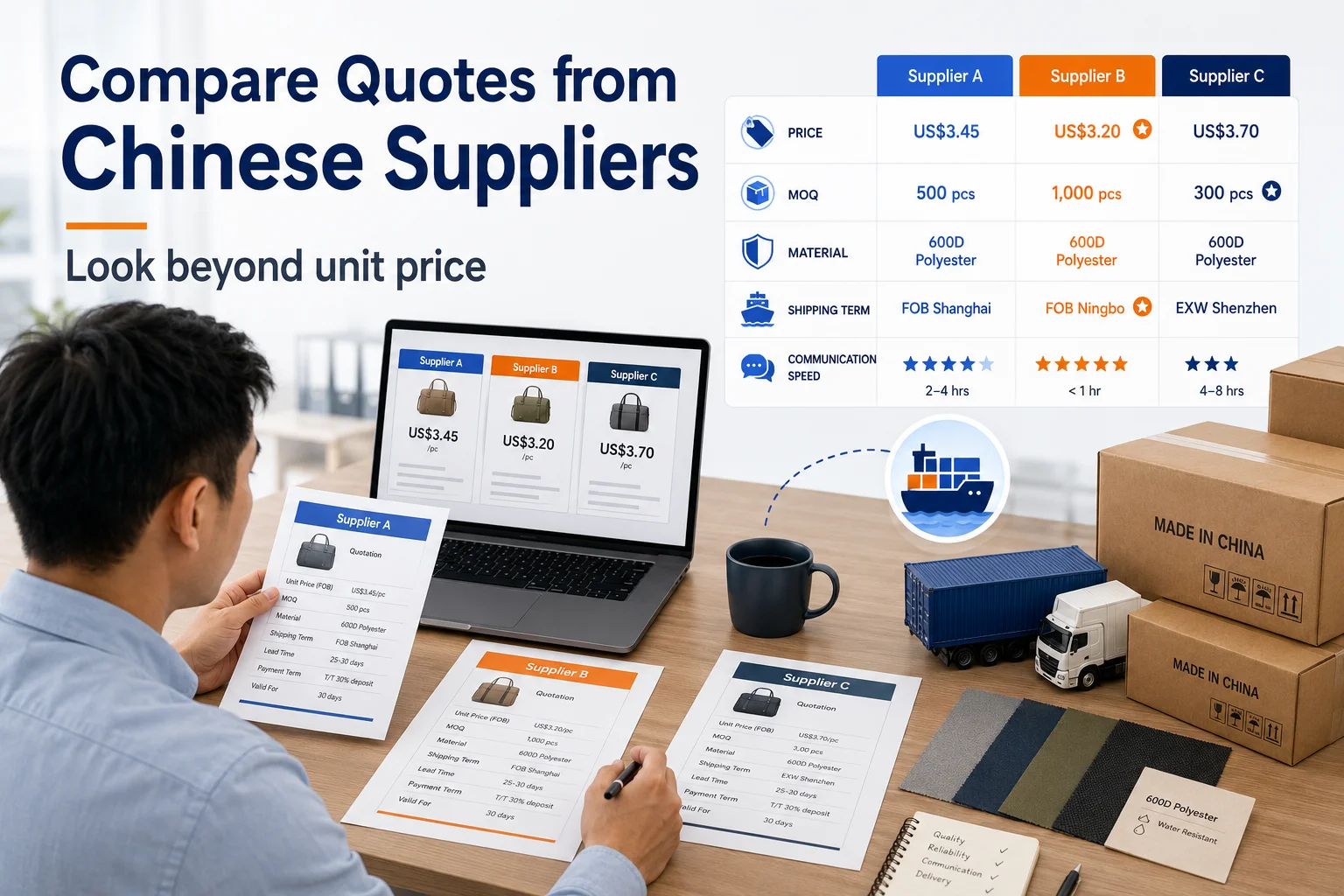
Many clients show me a very cheap quote and think they found a great deal. They want to place an order immediately. But when I look closer, I see huge risks. Let me show you exactly how I compare supplier quotes every day in China. This process will protect your money and keep your business safe.
1. Why Chinese Supplier Quotes Can Be So Different?
Do you wonder why one factory charges $2 and another charges $5 for the exact same item? This huge price gap can ruin your budget.
Supplier quotes differ because factories quote on different baselines. They change material thickness, use generic parts, lower the product weight, or exclude shipping costs.[^1] If you do not give strict details, each factory guesses what you want.
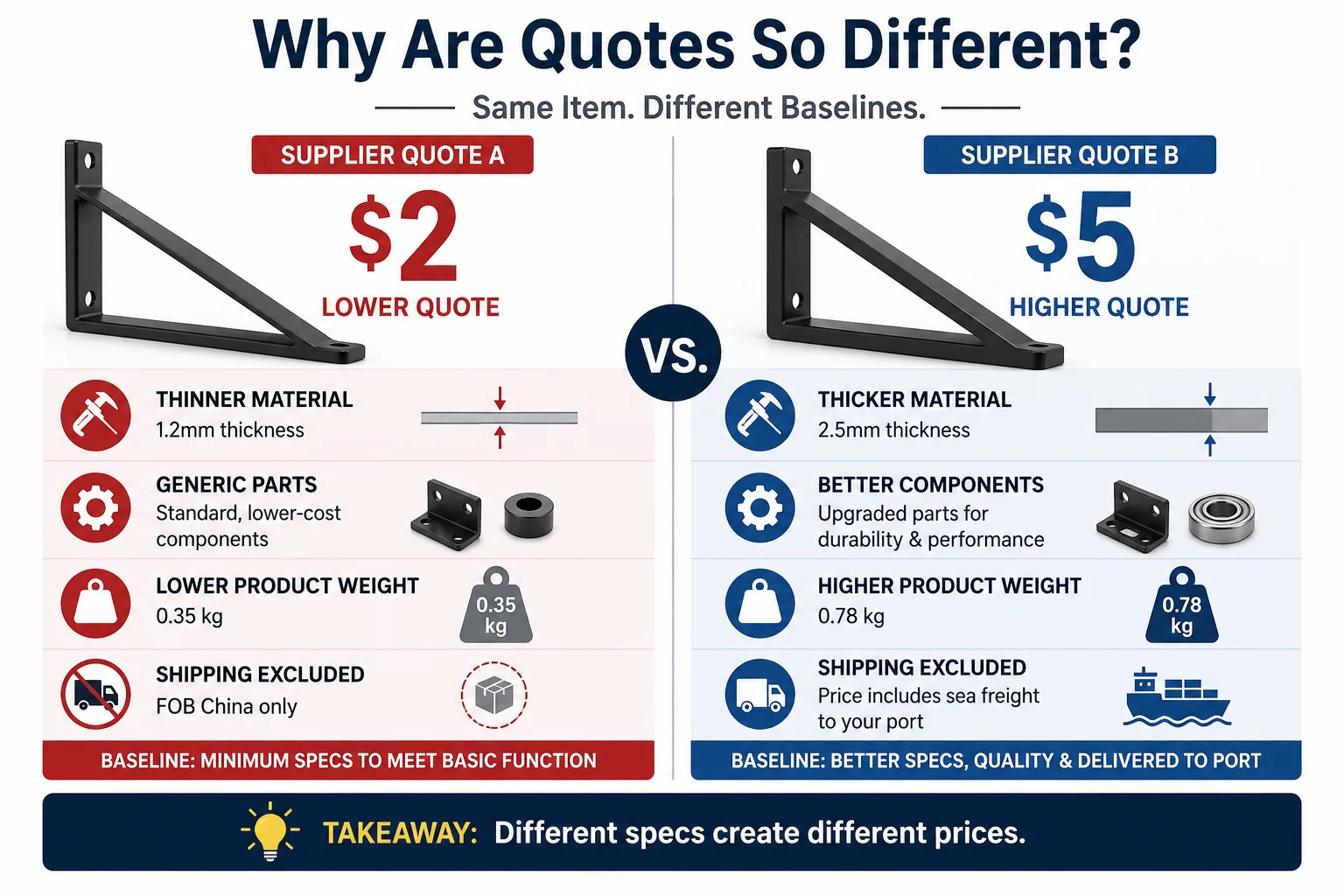
Clients often come to us with a quote that is 30% cheaper than the rest. They feel very excited. They think they found a secret bargain. But when my team visits the factory, we find the real truth. The cheap factory uses thinner metal. They use recycled plastic instead of new plastic.[^2] They install a smaller battery. I call this the "Apples-to-Oranges" trap. You think you compare the same product, but you do not.
The Hidden Spec Changes
Suppliers want to win your order. They know overseas buyers love low prices. If you ask for a simple price, they will quote the cheapest possible version to look good on paper. They do not tell you about the missing details.
How Materials Change Prices
| Variable | Cheap Quote Factory | Expensive Quote Factory |
|---|---|---|
| Plastic Type | Recycled PP (breaks easily) | New ABS (strong) |
| Metal Thickness | 0.5mm (bends quickly) | 1.0mm (very durable) |
| Product Packaging | Thin plastic polybag | Custom retail box |
You must understand that factories do not work for free. If a price drops by 50%, the product quality drops by 50% too. You need to dig deep into the details before you trust a number.
2. What Information Should You Provide Before Asking for Quotes?
If you just send a picture and ask for a price, you will get bad data. You will waste your time talking to the wrong suppliers.
You must provide a strict Request for Quotation (RFQ).[^3] This document includes your exact material needs, weight limits, product sizes, packaging rules, and order quantity. This strict list forces all suppliers to quote on the exact same product.
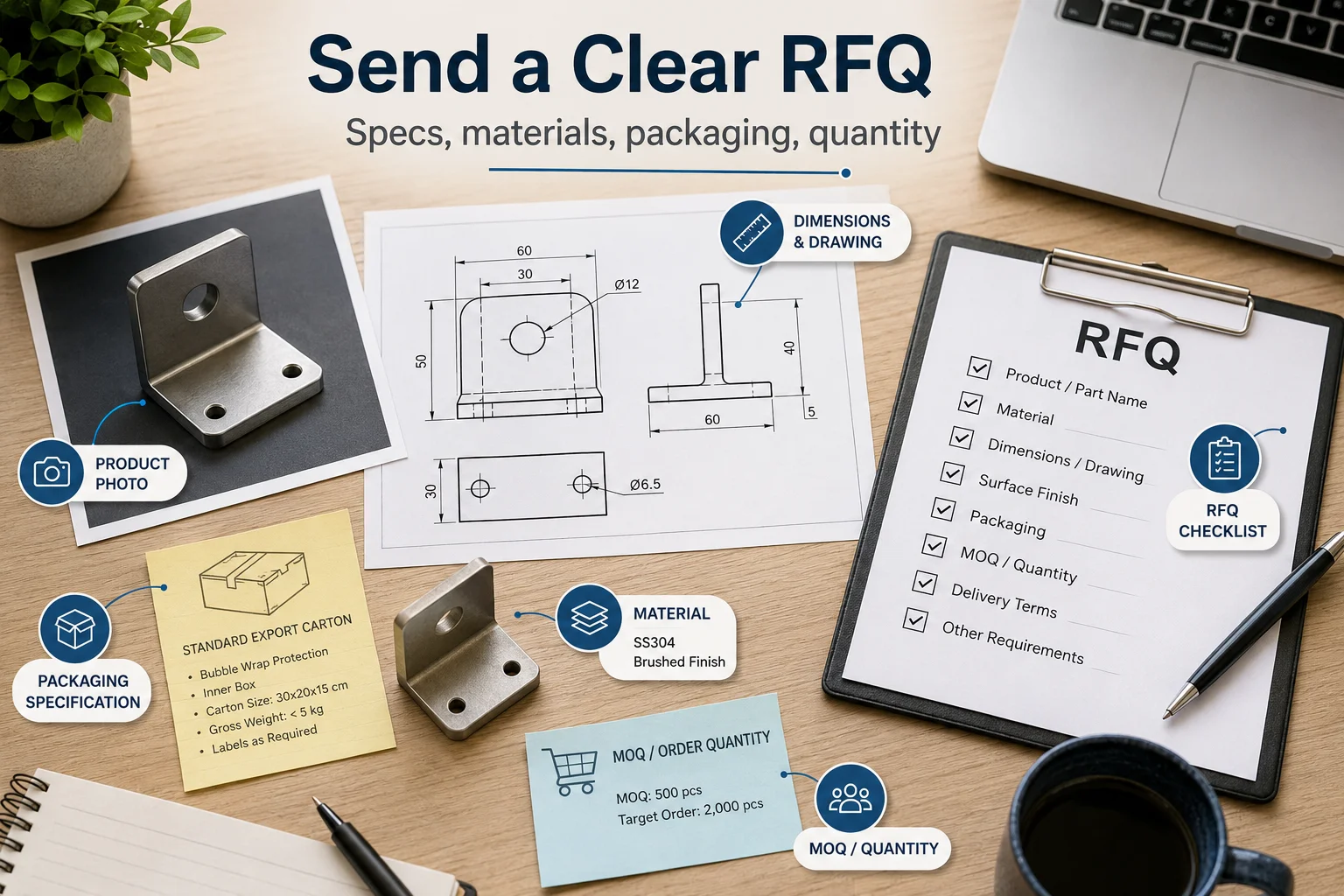
You cannot compare quotes if the suppliers use different starting rules. As a local buyer in China, I never ask a factory for a simple price. I always use a strict RFQ list. This puts all factories on a level playing field. If a supplier leaves a blank space in my RFQ, I know they are hiding something. They want to leave room to lower the quality later.
Build a Strong RFQ
You must tell the supplier everything. Do not let them guess your needs. If they guess, they will guess the cheapest way possible to win your business. You must take full control of the details.
What Your RFQ Must Include
| RFQ Item | Why You Need It |
|---|---|
| Target Quantity | 500 units will always cost more than 5000 units. |
| Material Specs | This stops them from using cheap recycled parts. |
| Product Weight | This ensures they do not make the product hollow. |
| Shipping Terms | This clarifies who pays for the transport to the port. |
When you give a strict RFQ, you take control of the conversation. You stop the supplier from playing games with your specs. This is the only way to get real numbers that you can actually compare safely.
3. How to Compare Unit Price, MOQ, Materials, Packaging, and Lead Time?
Looking at a spreadsheet full of numbers is very hard. If you only look at the final unit price, your business will suffer soon.
To compare quotes safely, make a side-by-side table. Check if the unit price matches the Minimum Order Quantity (MOQ). Verify the exact materials listed. Confirm the packaging type. Finally, check the lead time to see who can deliver faster.
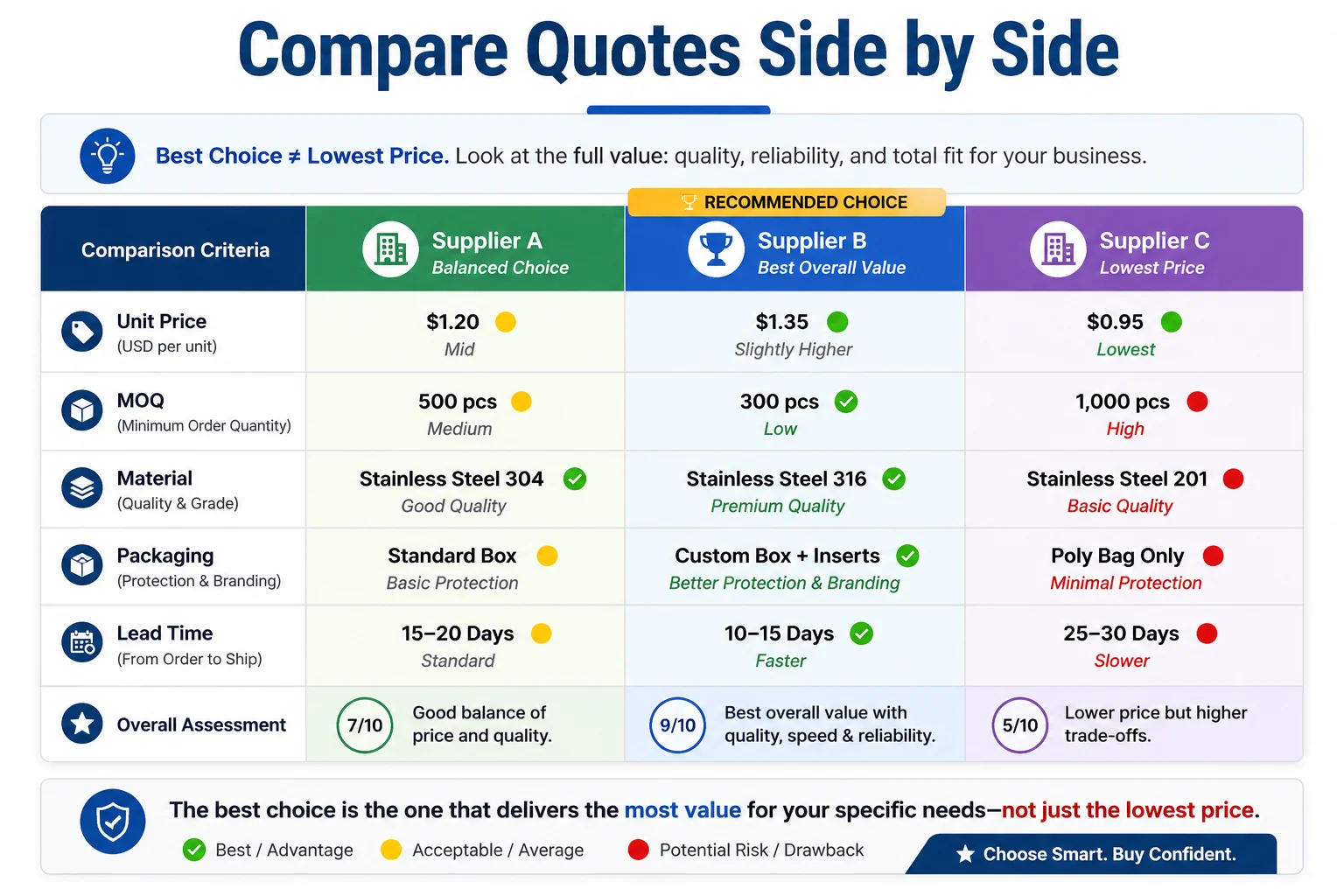
I always build a clear comparison matrix for my clients. A quote is a full package deal. You cannot separate the price from the MOQ or the lead time. Sometimes, a factory gives a great unit price, but their MOQ is 10,000 units. If your budget only allows 1,000 units, that cheap quote is totally useless to you. You must look at the whole picture.
Lead Time is Real Money
A 5% cheaper quote from a factory with slow lead times will cost you more money. If your DTC brand runs out of stock, you lose daily sales. Your advertising campaigns stop working.[^4]
The Comparison Matrix
| Decision Factor | Supplier A | Supplier B |
|---|---|---|
| Unit Price | $3.00 | $3.50 |
| Minimum Order (MOQ) | 5,000 units | 500 units |
| Materials | Generic unbranded parts | High-quality branded parts |
| Production Time | 45 days | 20 days |
Supplier B is more expensive on paper. But they are much better for a new product test. They ship faster and need less money upfront. You must weigh these factors to protect your profit margin and keep your stock flowing smoothly.
4. Why the Cheapest Quote Is Not Always the Best Choice?
You might feel tempted to pick the lowest number. But a rock-bottom price usually means high risk and angry customers later.
The cheapest quote often hides danger. Factories lower prices by cutting corners on quality, using untrained workers, or skipping safety tests.[^5] If you buy the cheapest product, you will pay more later in refunds and bad customer reviews.
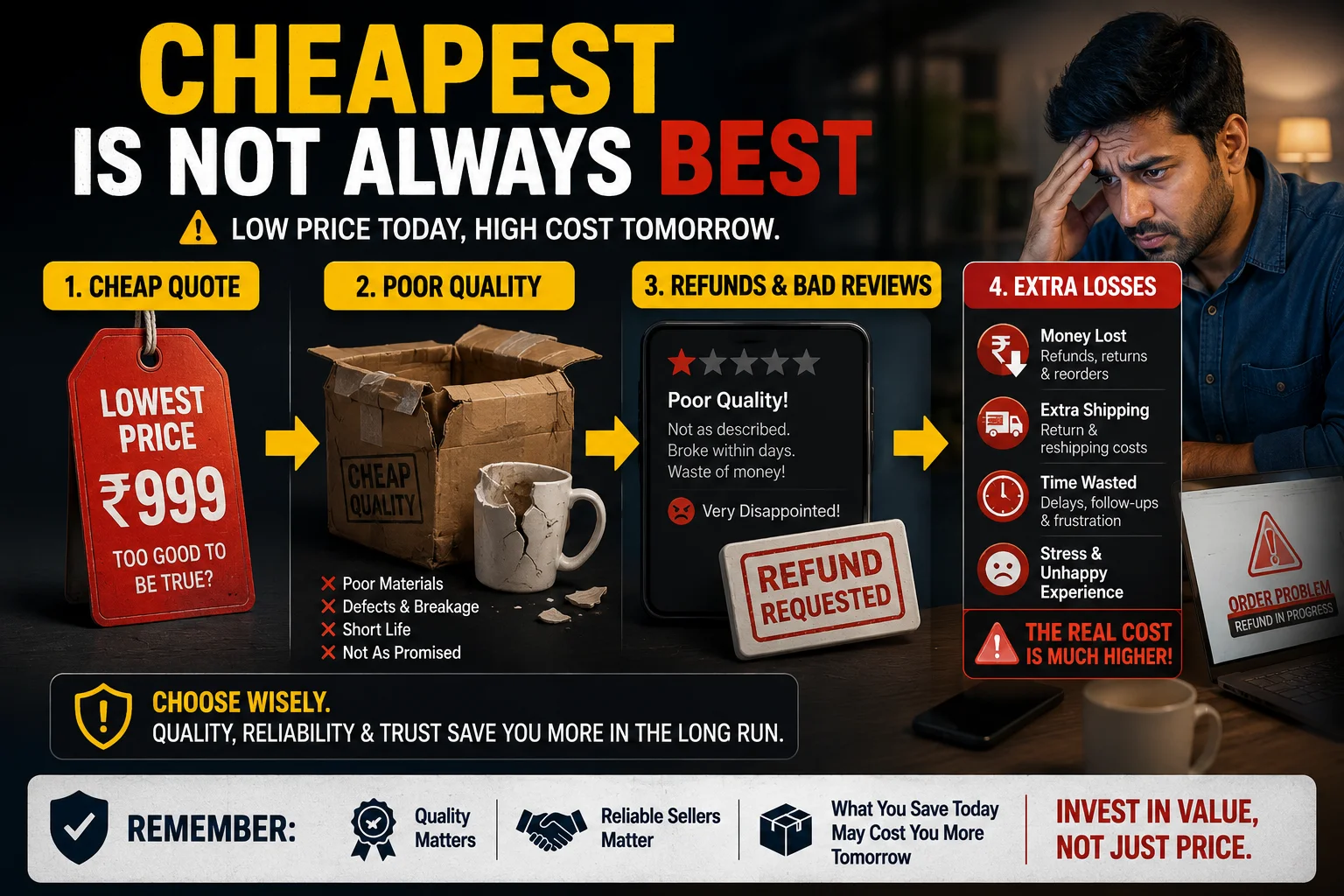
Clients often come to us with a quote that is shockingly low. They ask me, "Why can't KingSourcing match this amazing price?" I always tell them to wait. When we audit that very cheap factory, we usually find terrible things. The factory might be very dirty. The machines might be old and broken. They might plan to use defective parts from a past order. They hide these facts from overseas buyers.
The True Cost of Bad Reviews
You sell real products to real people. If a cheap part breaks in your customer's hand, they will leave a angry one-star review. Your store listing will die immediately.[^6]
What Cheap Quotes Really Mean
| The Supplier Promise | The Reality We See Locally |
|---|---|
| "We offer the lowest price!" | They do no quality control checks at all. |
| "We use the same materials!" | They mix new clean materials with dirty scrap. |
| "We ship very fast!" | They rush production and skip important safety checks. |
You must see the unit price as just one small part of your business. A slightly higher price buys you peace of mind. It keeps your customers happy and your brand strong.
5. How to Check Hidden Costs in Chinese Supplier Quotations?
The unit price looks very good, but your final bill is huge. Hidden costs can eat your profit if you do not check them early.
You must check the shipping terms carefully. A cheap EXW price means you pay for inland shipping and export customs.[^7] You also need to ask about tooling fees, sample costs, and custom packaging fees. These extras add up very fast.
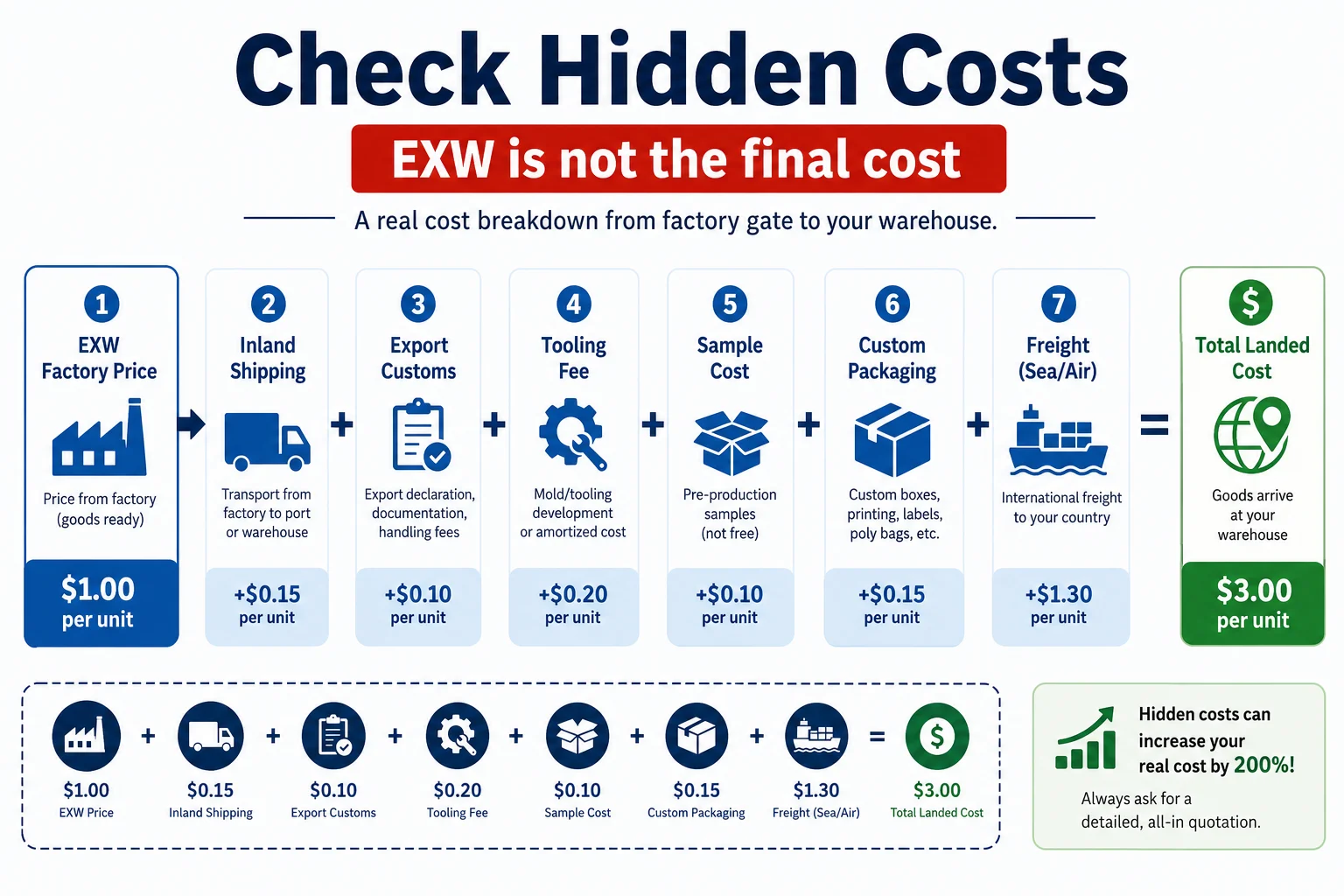
Many buyers fall into the logistics trap. A factory quotes $2.00 on EXW terms. Another factory quotes $2.20 on FOB terms.[^8] The EXW quote looks much cheaper. But with EXW, you must pay to move the goods from the factory to the sea port. You must pay the customs clearance fees in China. Suddenly, that $2.00 product actually costs $2.50. You lose your margin because you did not read the terms.
Always Ask for the Full Breakdown
I always force suppliers to list every single fee. I ask them about export licenses. I ask about inner box costs. I never assume anything is free.
Common Hidden Costs
| Hidden Fee Name | What It Actually Means |
|---|---|
| Inland Freight (EXW) | The truck cost to move goods from factory to the sea port. |
| Export Documents | The local fees to clear Chinese customs legally. |
| Tooling/Molds | The expensive setup fees to make your specific design. |
| Sub-standard Packing | You have to buy new strong boxes because their boxes broke. |
Do not let a factory trick you with a basic unit price. You must calculate the final landed cost to your warehouse door to see the real winner.
6. How Samples, Quality Standards, and Payment Terms Affect the Real Cost?
You get a perfect sample and pay a cheap price. Then the big order arrives, and the quality is completely terrible.
A supplier might quote low and send a perfect hand-made sample. But they cut corners in mass production to make a profit.[^9] You must set clear quality standards and favorable payment terms. If you pay 100% upfront, you lose all your leverage.
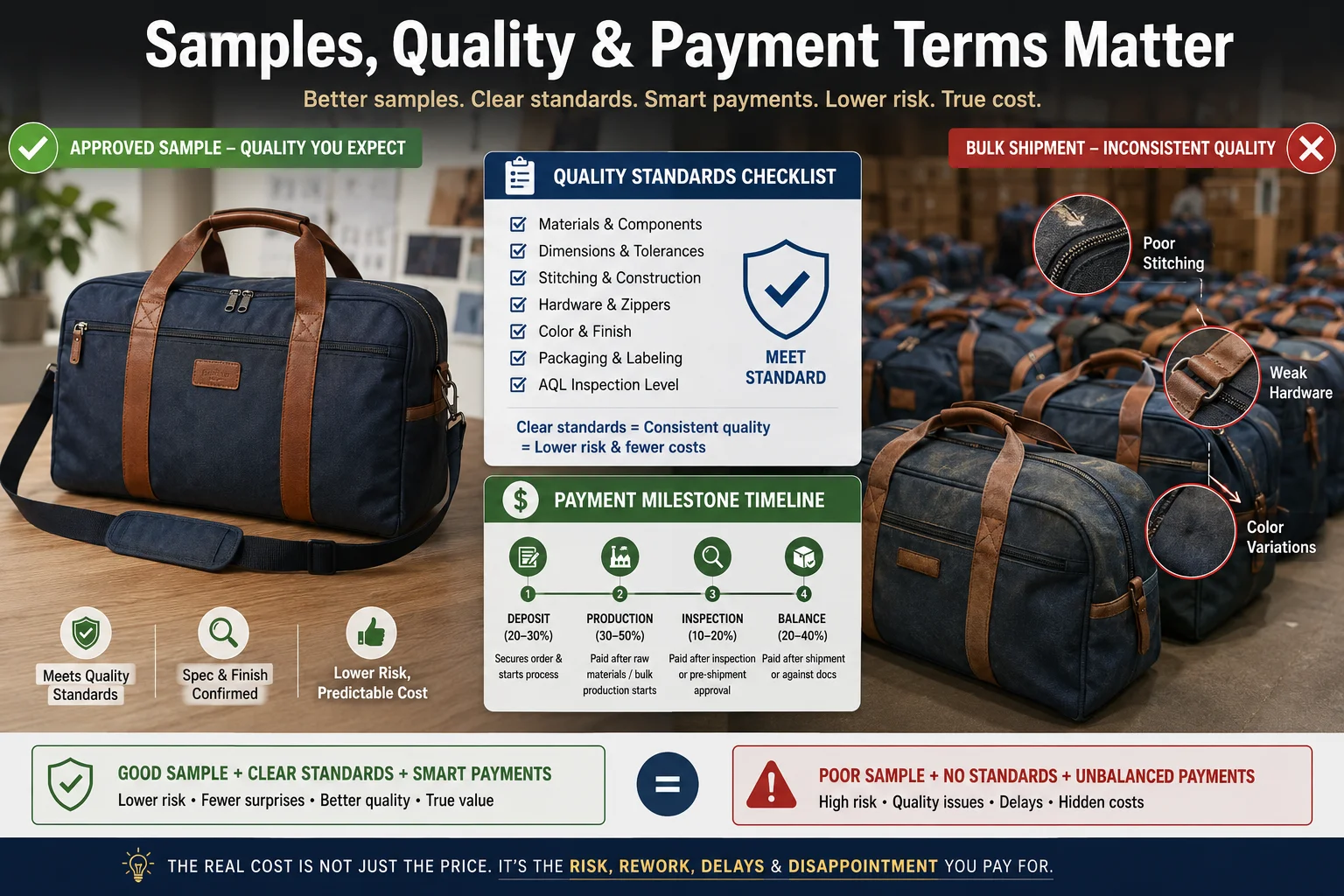
This is a very common supplier trick. A factory quotes a very low price to win your heart. They make a beautiful sample slowly by hand. You approve it. But for the mass production of 5,000 units, they put your order on the fast line. They skip important steps. This is why you must include 1-by-1 quality control (QC) as a required step. You must force them to accept inspections.
Use Payment Terms to Protect Yourself
Never pay 100% money in advance. Standard safe B2B terms in China are a 30% deposit first. You pay the 70% balance only after a successful QC inspection.[^10]
How Variables Change the Cost
| Process Variable | High Risk Choice | Safe Choice |
|---|---|---|
| Sample Match | No mass production check | 1-by-1 QC check before shipping |
| Payment Terms | Pay 100% upfront | 30% deposit, 70% after QC pass |
| Quality Standard | Let the factory decide | Strict defect limits written in contract |
The real cost of a product includes the cost of checking it. If a supplier refuses an independent QC inspection, you must walk away immediately.
7. Why Supplier Verification and Backup Suppliers Matter Before Ordering?
You pick a quote and place the big order. But the supplier is actually a middleman who delays your goods for weeks.
You must verify the supplier before sending money. Check if they are a real factory or just a trading company.[^11] You also need a backup supplier. If your main factory fails, your backup can step in quickly. This protects your supply chain from sudden stops.
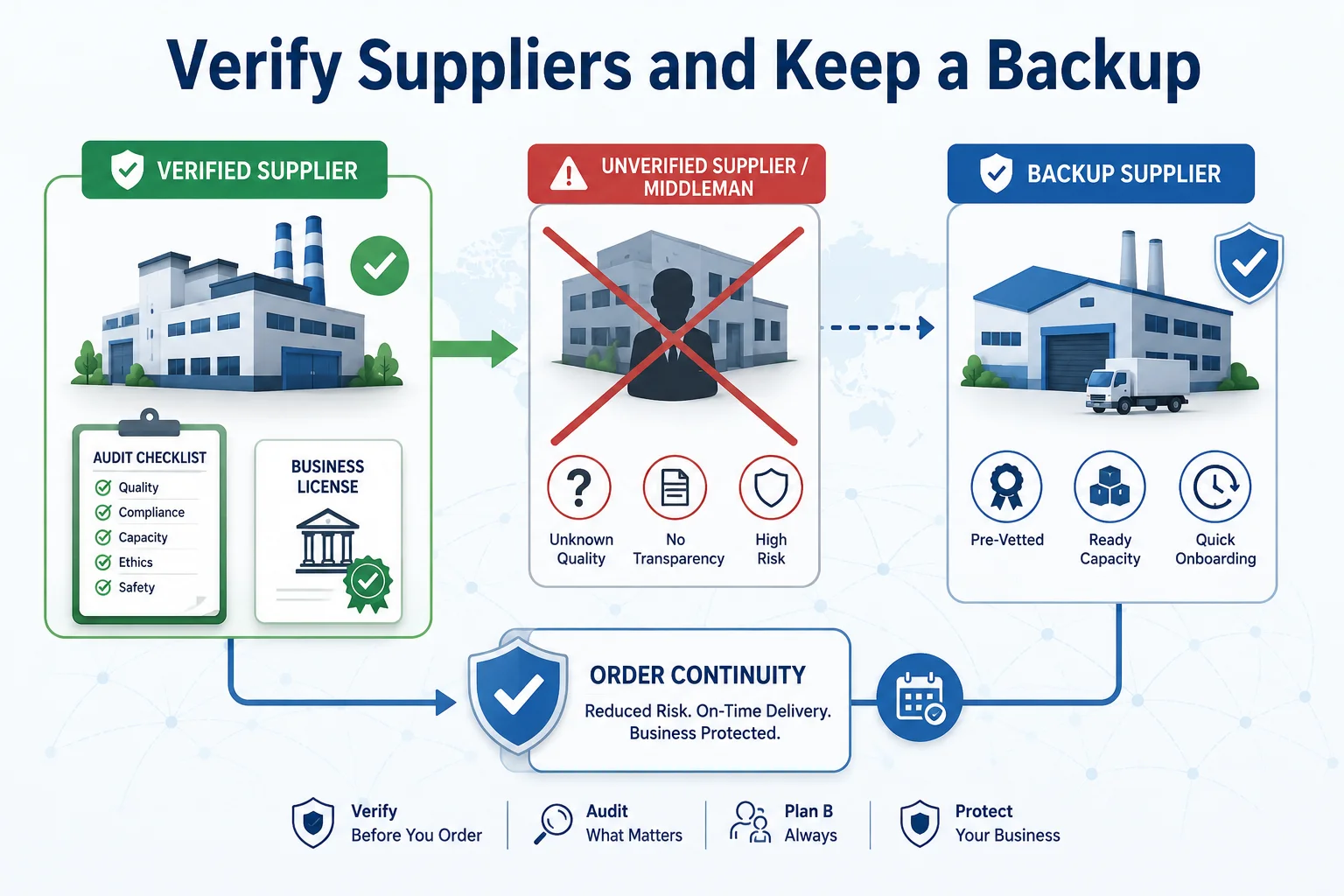
Anyone can make a nice PDF quote. Clients often come to us with a beautiful quote from a "big factory" on Alibaba. My team drives to the address to check. We find a small dirty office with three people and zero machines. They are just middlemen adding a markup to the price. You must verify exactly who you send your money to. You need local eyes on the ground.
The Power of Backup Options
Steps for Safe Verification
| Verification Step | Why It Matters For You |
|---|---|
| Check Business License | This proves they are a legal company in China. |
| Video Call the Factory | This shows you real machines and real working people. |
| Audit the Production Line | This checks if they have real space for your big order. |
Comparing quotes is totally useless if the supplier is fake or unreliable. A thorough background check is a mandatory part of your business cost analysis.
8. How KingSourcing Helps Buyers Compare Quotes and Manage Safer Orders from China?
Doing all this work from across the world is very exhausting. You deal with time zones, language barriers, and endless emails.
KingSourcing acts as your local office in China. We standardize your RFQs, audit factories, and break down hidden costs. We provide 1-by-1 product inspections and handle all logistics. We help you find reliable suppliers and protect your money.
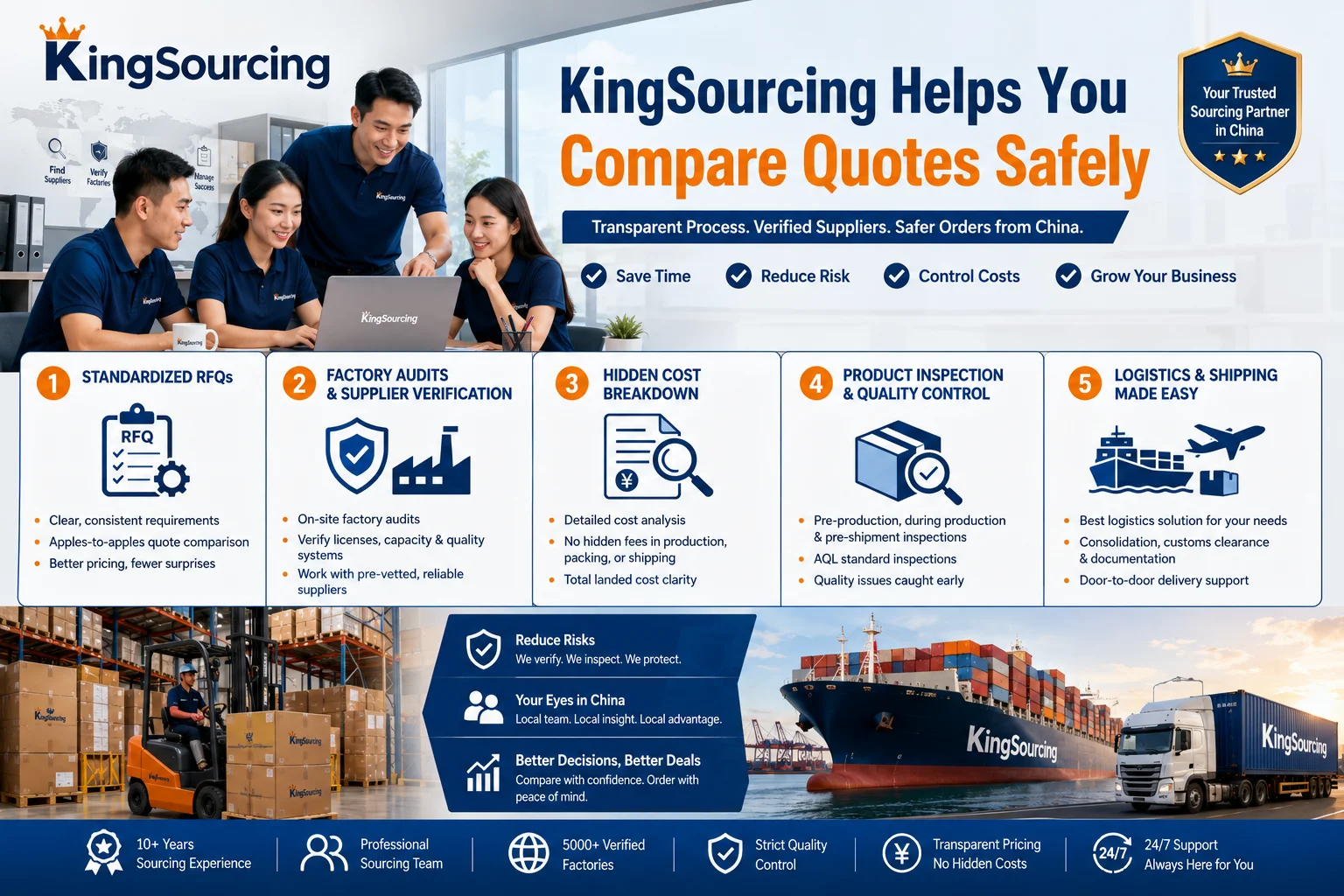
You do not have to fight this battle alone. I see overseas buyers struggle every single day with fake quotes and hidden logistics fees. At KingSourcing, we do not just forward raw quotes to you. We analyze them deeply. We tear them apart. We use our local Chinese sourcing experience to find out why Factory A is cheaper than Factory B. We find the hidden traps before you pay.
Your Local Team on the Ground
We know the local factory tricks. We visit the factories for you. We make sure the material they quote is the exact material they actually use for your mass production.
How We Protect Your Supply Chain
| Our Service | Your Business Benefit |
|---|---|
| Supplier Audits | We stop you from sending money to bad middlemen. |
| Quote Analysis | We find hidden EXW costs and logistics traps early. |
| 1-by-1 Quality Control | We ensure every item matches your golden sample. |
| Door-to-Door Shipping | We handle customs and deliver directly to your warehouse. |
You should focus on marketing and selling your brand. Let KingSourcing handle the complex supplier comparisons, quality checks, and shipping details safely in China.
Conclusion
Comparing Chinese supplier quotes requires careful attention to materials, hidden costs, and quality risks. Do not just look at the price. Build a smart system to protect your business today.
[^1]: "'Quality Fade': China's Great Business Challenge", https://knowledge.wharton.upenn.edu/podcast/knowledge-at-wharton-podcast/quality-fade-chinas-great-business-challenge/. Research on supply chain opportunism demonstrates that suppliers may substitute inferior materials or reduce dimensions to maintain margins when buyers select solely on price. Evidence role: mechanism; source type: paper. Supports: how information asymmetry allows suppliers to substitute materials. Scope note: Focuses on general offshore manufacturing rather than specifically Chinese suppliers. [^2]: "Impact of recyclability on the tensile and Impact properties of coated ...", https://pmc.ncbi.nlm.nih.gov/articles/PMC11976218/. Materials science studies indicate that recycled polymers often exhibit reduced tensile strength and impact resistance compared to virgin resins due to thermal degradation during reprocessing. Evidence role: mechanism; source type: paper. Supports: the mechanical degradation of recycled plastics. [^3]: "Request for Quotation (RFQ): Format, Process & Example - Happay", https://happay.com/blog/rfq-request-for-quotation/. Standard procurement frameworks emphasize that highly specified Requests for Quotation (RFQs) are essential to mitigate information asymmetry and enable accurate cross-supplier bid comparisons. Evidence role: expert_consensus; source type: education. Supports: the role of RFQs in procurement. [^4]: "Navigating Stockout Costs: A Guide for Ecommerce - Extensiv", https://www.extensiv.com/blog/stockout-costs. Retail supply chain research highlights that stockouts not only result in immediate lost sales but also degrade long-term customer loyalty and disrupt algorithmic marketing efficiencies. Evidence role: statistic; source type: paper. Supports: the financial impact of stockouts on retail and e-commerce. [^5]: "Cost of quality tradeoffs in manufacturing process and inspection ...", https://dspace.mit.edu/handle/1721.1/76133. Studies on global sourcing reveal that intense buyer price pressure frequently incentivizes suppliers to compromise on labor training, quality control, and safety protocols to preserve margins. Evidence role: mechanism; source type: paper. Supports: the correlation between aggressive cost-cutting and reduced compliance. [^6]: "Effects of negative reviews and managerial responses on consumer ...", https://www.sciencedirect.com/science/article/abs/pii/S0747563221002351. Empirical research in e-commerce demonstrates that a high volume of negative reviews significantly reduces product conversion rates and lowers algorithmic search visibility on major retail platforms. Evidence role: statistic; source type: paper. Supports: the effect of negative reviews on consumer purchasing behavior. [^7]: "Know Your Incoterms - International Trade Administration", https://www.trade.gov/know-your-incoterms. According to the International Chamber of Commerce (ICC) Incoterms rules, Ex Works (EXW) places the maximum obligation on the buyer, who must bear all costs and risks involved in taking the goods from the seller's premises. Evidence role: definition; source type: institution. Supports: the definition of EXW Incoterms. [^8]: "Know Your Incoterms - International Trade Administration", https://www.trade.gov/know-your-incoterms. The International Chamber of Commerce defines Free on Board (FOB) as an arrangement where the seller clears the goods for export and bears the costs and risks of delivering them past the ship's rail at the named port of shipment. Evidence role: definition; source type: institution. Supports: the definition of FOB Incoterms. Scope note: FOB is technically restricted to sea and inland waterway transport under official ICC guidelines. [^9]: "'Quality Fade': China's Great Business Challenge", https://knowledge.wharton.upenn.edu/podcast/knowledge-at-wharton-podcast/quality-fade-chinas-great-business-challenge/. Supply chain literature documents 'quality fade,' a phenomenon where manufacturers gradually or suddenly reduce the quality of materials or processes during mass production to widen profit margins after initial sample approval. Evidence role: mechanism; source type: paper. Supports: the phenomenon of quality fade in manufacturing. [^10]: "Methods of Payment - International Trade Administration", https://www.trade.gov/methods-payment. International trade advisory resources commonly recommend a 30% advance and 70% balance payment structure (T/T) tied to pre-shipment inspections to balance risk between buyers and overseas manufacturers. Evidence role: expert_consensus; source type: education. Supports: standard payment terms in global sourcing. [^11]: "Role of Intermediaries in Supply Chains TN - Faculty & Research", https://www.hbs.edu/faculty/Pages/item.aspx?num=28255. Research on global value chains distinguishes between direct manufacturers and trading companies, noting that intermediaries often provide communication and aggregation services but add markup costs and obscure direct factory oversight. Evidence role: definition; source type: paper. Supports: the role of trading intermediaries in export markets. [^12]: "Single versus multiple supplier sourcing strategies - ScienceDirect", https://www.sciencedirect.com/science/article/abs/pii/S037722170600587X. Procurement theory indicates that multiple sourcing strategies reduce dependency and mitigate supplier hold-up risks, thereby preserving the buyer's bargaining power during price negotiations. Evidence role: mechanism; source type: paper. Supports: the strategic advantages of multiple sourcing.