A Guangzhou sourcing agent can make China procurement easier, but choosing the wrong one may create new problems with unclear quotes, weak supplier communication, inconsistent quality, and delayed shipments. We help buyers reduce these risks by showing them how to evaluate an agent’s local capability, service scope, and supplier-management process before placing orders.
A reliable Guangzhou sourcing agent should offer transparent supplier sourcing, quote comparison, sample coordination, production follow-up, quality control, warehouse consolidation, and shipping support. We recommend choosing an agent based on clear responsibilities, supplier verification methods, relevant product experience, and documented pricing conditions—not simply the lowest service fee or fastest initial reply.
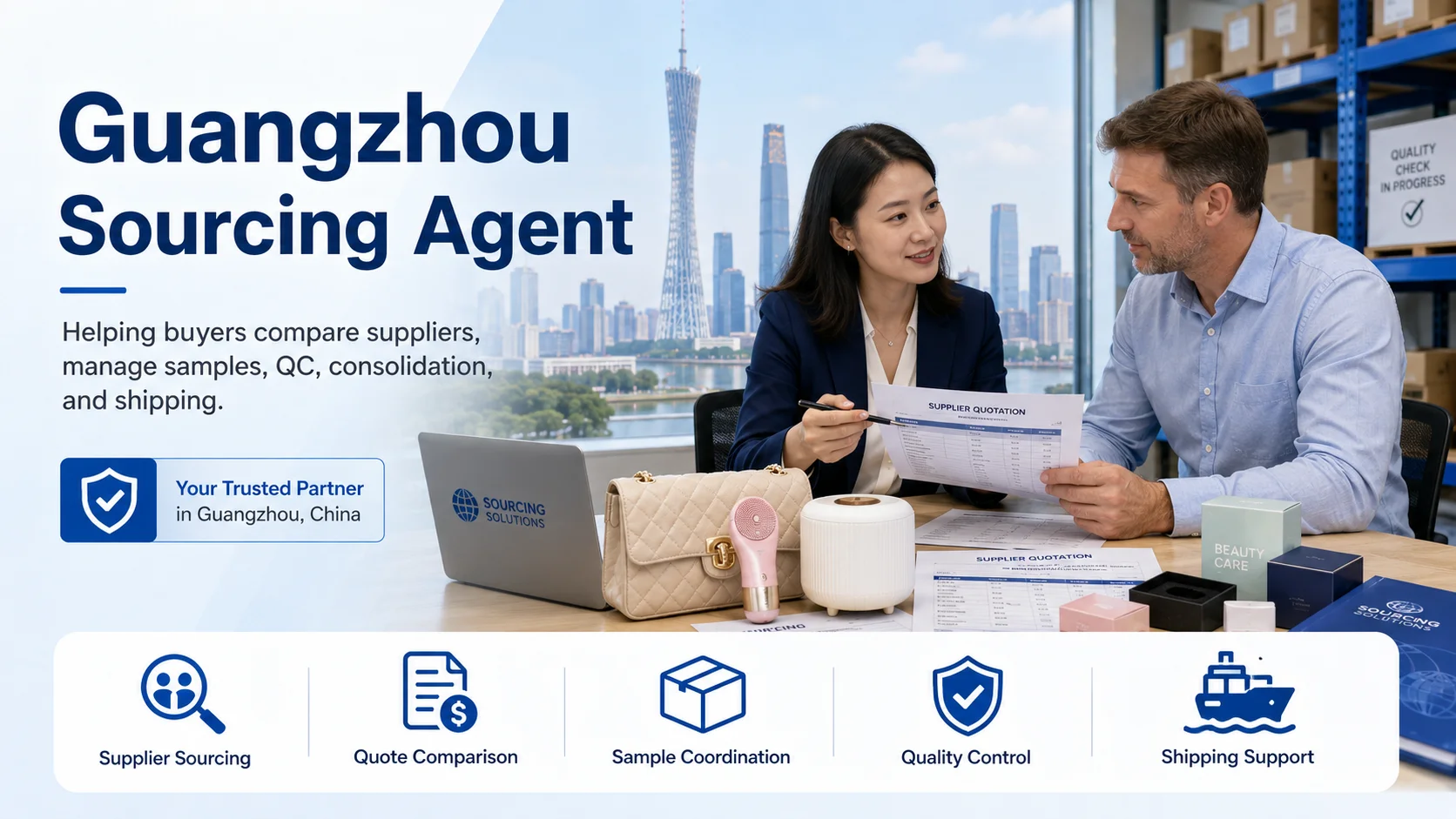
Guangzhou is a strong sourcing base for fashion, home products, accessories, gifts, beauty-related goods, and general merchandise.[^1] However, the best sourcing route depends on your product, order volume, quality standards, and whether your supply chain may extend into Foshan, Dongguan, Shenzhen, or the wider Pearl River Delta.
What Is the Quick Way to Choose a Guangzhou Sourcing Agent?
Many buyers want a fast answer because supplier selection can feel overwhelming. A low agent fee may look attractive at first, but hidden scope gaps can later lead to extra inspection charges, packaging issues, missed deadlines, or expensive shipping decisions.
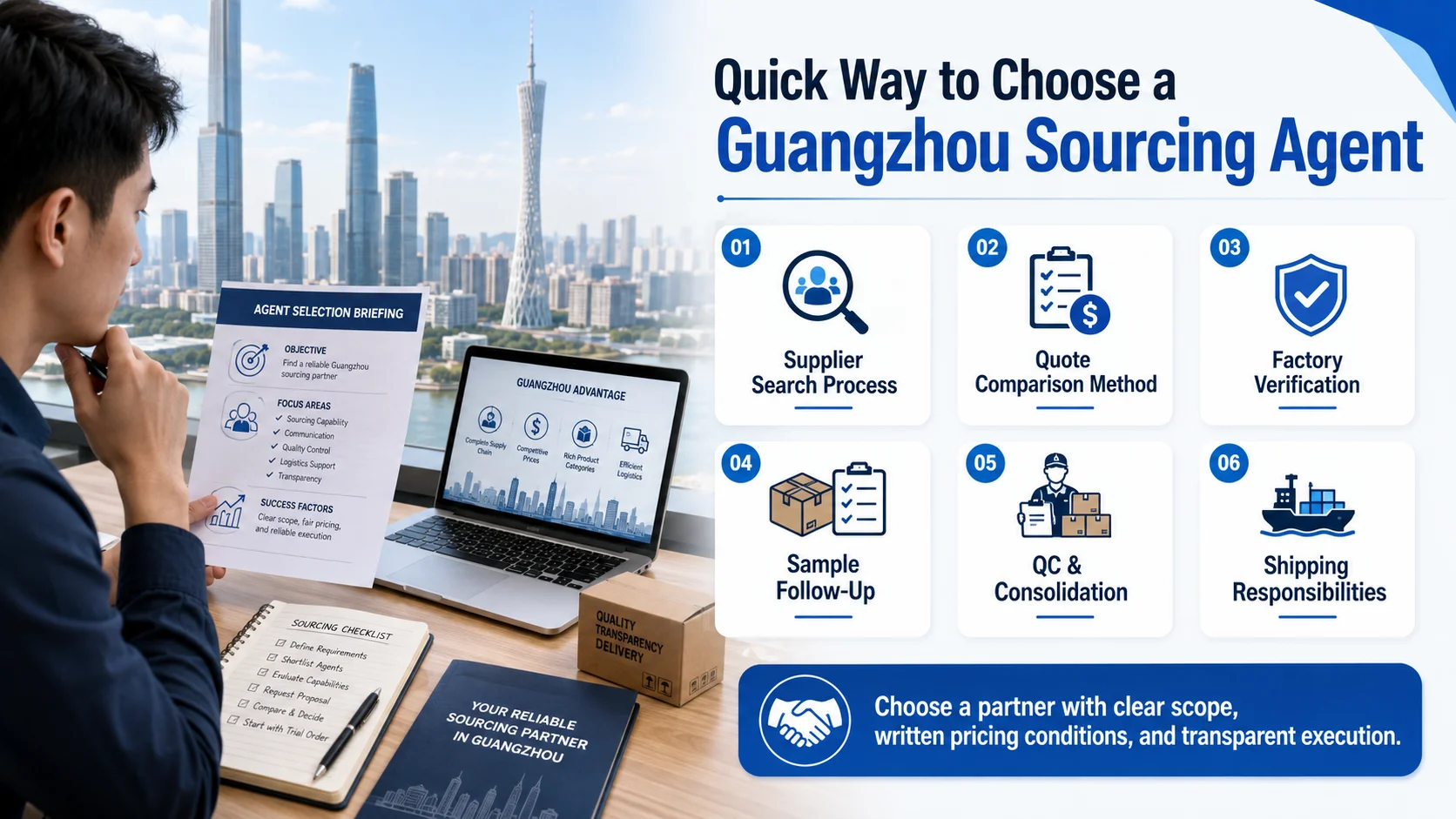
We suggest selecting a Guangzhou sourcing agent that can explain its supplier search process, quotation comparison method, factory verification scope, sample follow-up, quality-control options, consolidation process, and shipping responsibilities. Buyers should also request a written explanation of included services, exclusions, and conditions that may change the final cost.
Start With Scope, Not Promises
A sourcing agent does not need to promise access to every factory in China to be useful. In fact, we believe broad promises such as “we can find anything at the lowest price” should lead to more questions.
A capable sourcing agent in Guangzhou should first understand:
- Your product specifications
- Target price range
- Expected order quantity
- Required materials and finishes
- Packaging requirements
- Target market compliance needs
- Delivery deadline
- Whether you need private label or custom development
We often see buyers compare agents only by commission percentage or sourcing fee. That comparison is incomplete. A lower fee may cover only supplier introduction, while another quote may include sample handling, supplier communication, order tracking, warehouse receiving, and basic quality coordination.
Before you commit, ask for a simple responsibility list.
| Service Area | Questions to Ask |
|---|---|
| Supplier sourcing | How many suppliers will be compared? |
| Supplier checks | What documents, business details, or production information are reviewed? |
| Quotation comparison | Are materials, MOQ, tooling, packaging, and shipping terms compared? |
| Samples | Who follows up on revisions and approvals? |
| Production | How often will the order status be checked? |
| Quality control | Is inspection included, optional, or handled by a third party? |
| Consolidation | Can goods from several suppliers be received and combined? |
| Shipping | Does the agent coordinate export paperwork and freight options? |
A reliable partner should explain what it can do, what requires additional approval, and where risks remain. That is more useful than an instant quote with vague wording.
Why Do Buyers Use a Guangzhou Sourcing Agent?
Buyers often struggle to manage suppliers from overseas because product information, quote terms, sample details, and delivery updates can become fragmented. Without local coordination, even a simple multi-supplier order can require many late-night messages and repeated follow-ups.
Buyers use a Guangzhou sourcing agent to access wholesale markets, regional manufacturing networks, Canton Fair suppliers[^2], and Pearl River Delta factories while receiving support with supplier communication, quotations, samples, quality checks, consolidation, and export coordination. This can reduce the time needed to manage separate suppliers independently.
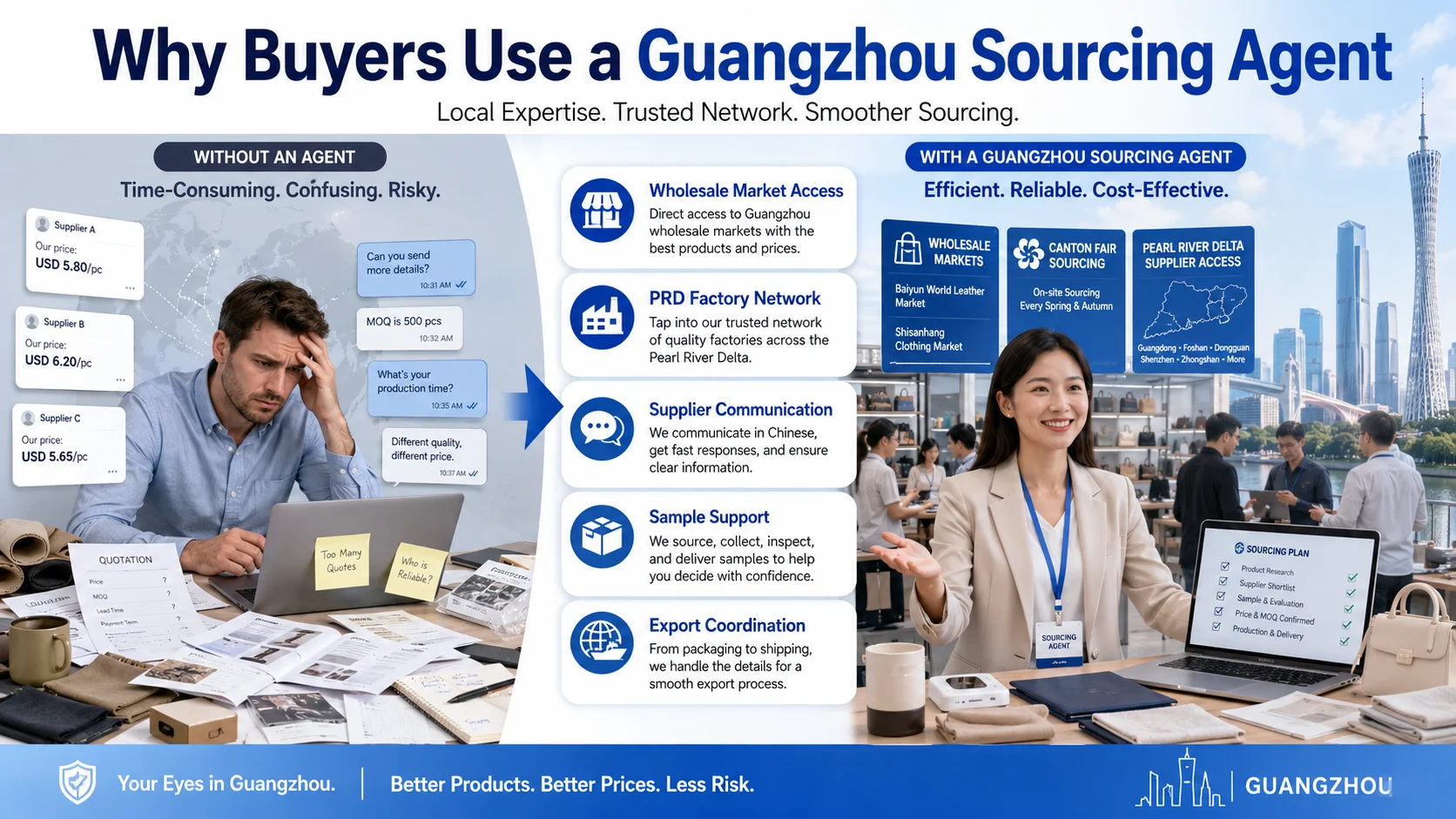
Guangzhou Connects Markets and Manufacturing Networks
Guangzhou is not only a city for trading companies and wholesale markets. It also sits within the larger Pearl River Delta supply chain.[^3] This regional position matters because many products are sourced across multiple cities.
For example, a buyer may source:
- Apparel or accessories from Guangzhou
- Furniture or household hardware from Foshan
- Bags or consumer goods from nearby manufacturing areas
- Electronics accessories from Shenzhen or Dongguan[^4]
- Packaging from a specialist supplier elsewhere in Guangdong
This is why local coordination can be valuable. A Guangzhou procurement agent may help organize suppliers that are not all located in Guangzhou itself.
In our Guangzhou-based work, we have seen that overseas buyers often arrive after facing one of three issues: a supplier stopped responding, a sample did not match the production expectation, or several suppliers could not coordinate packaging and shipping dates. These issues do not mean direct sourcing is always wrong. They show why buyers need a process for comparing supplier conditions and managing handoffs.
Guangzhou can be especially practical for buyers who need:
- Consumer goods from several product categories
- Fashion, accessories, or lifestyle products
- Wholesale-ready products with customization options
- Supplier visits during trade fairs
- Mixed orders from different factories
- A regional procurement base for Guangdong suppliers
Local presence helps, but product fit should still guide the decision. The best supplier may be in another city, even when your sourcing agent is based in Guangzhou.
What Services Should a Guangzhou Sourcing Agent Provide?
Some agents only introduce suppliers. Others manage supplier selection, samples, production, quality checks, warehousing, and shipping. Buyers can become frustrated when they assume a service is included but discover later that it requires a separate fee or falls outside the agent’s responsibility.
A Guangzhou sourcing agent should clearly define whether it provides supplier sourcing, quotation comparison, supplier verification, sample coordination, price negotiation, order follow-up, quality control, warehouse consolidation, packaging support, and shipping coordination. The service scope should match the buyer’s product complexity and internal purchasing capability.
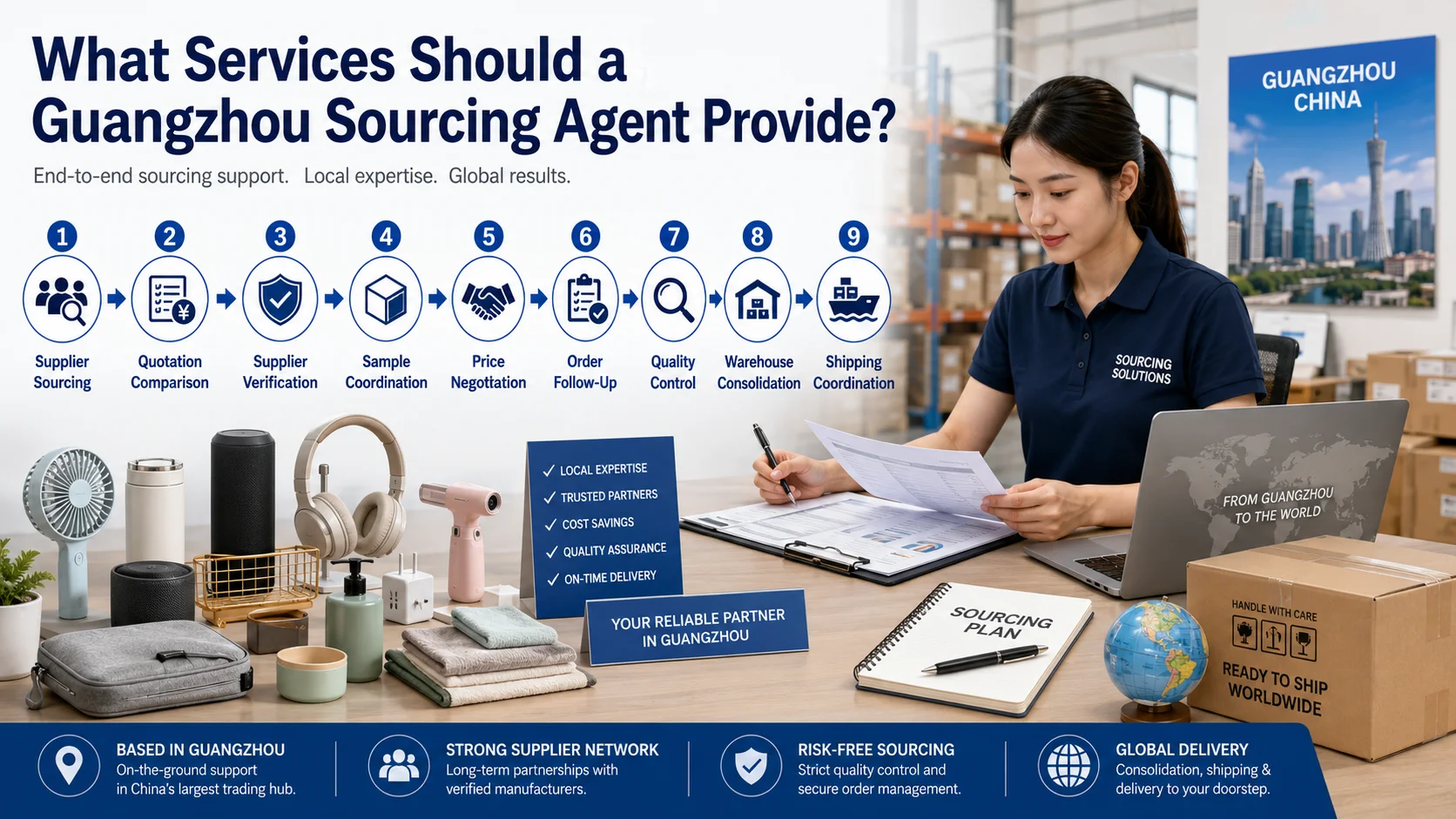
A Full Process Usually Has Several Stages
At KingSourcing, we see sourcing as more than finding a factory name. A buyer needs information that supports a practical purchasing decision.
A structured service can include the following stages:
-
Product brief review
We clarify specifications, target quantity, materials, packaging, and market requirements. -
Supplier search and comparison
We identify potential suppliers and compare key quote conditions rather than comparing unit price alone. -
Supplier communication and verification
We review available business information, production capability discussions, sample feasibility, and communication quality. Buyers should independently verify certifications or compliance documents that apply to their market. -
Sample coordination
We follow sample progress, collect feedback, and confirm required changes before production approval. -
Order and production follow-up
We track agreed milestones, material readiness, production timing, and packing plans. -
Quality control and consolidation
We can arrange inspections based on the buyer’s standards and receive goods from multiple suppliers for consolidation. -
Shipping coordination
We help organize shipment options, export preparation, and delivery coordination.
A sourcing service should make the process more visible. It should not replace the buyer’s need to approve product specifications, samples, and commercial terms.
The right level of support depends on your team. A small ecommerce seller may need end-to-end help. A larger importer may only need supplier development, on-site coordination, and inspection support.
What Products Are Best Sourced From Guangzhou?
Buyers sometimes assume every product in Guangdong comes from Guangzhou. That is not accurate. Guangzhou is a major commercial hub, but many factories and specialist supply chains operate across the wider Pearl River Delta.
Guangzhou sourcing is often well suited to fashion and apparel, bags, accessories, beauty-related products, home and lifestyle items, gifts, promotional products, and general consumer goods. Buyers should also consider nearby supply networks in Foshan, Dongguan, Shenzhen, and other Guangdong manufacturing areas.
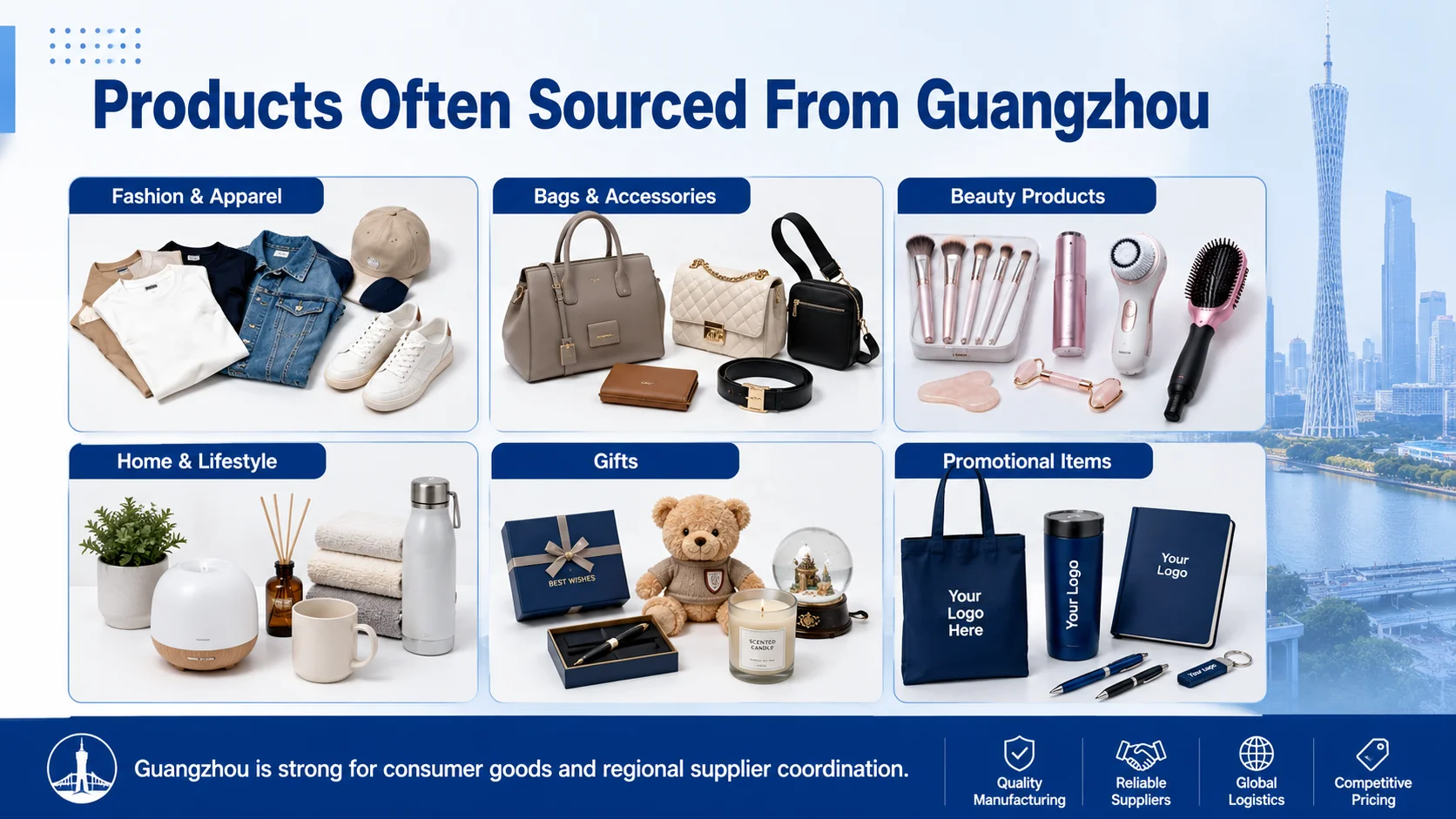
Product Categories With Strong Regional Fit
Guangzhou’s wholesale ecosystem and regional supplier access can support many consumer-facing businesses. It can be particularly useful for DTC brands, online sellers, wholesalers, and retailers that need product variety or frequent assortment updates.
Common product categories include:
| Category | Typical Guangzhou and PRD Sourcing Strength |
|---|---|
| Fashion and apparel | Clothing, activewear, seasonal collections, private-label development |
| Bags and accessories | Handbags, wallets, belts, jewelry, hair accessories, travel accessories |
| Home and lifestyle | Storage items, kitchen tools, décor, textiles, pet products |
| Beauty-related goods | Tools, packaging, accessories, selected personal-care supply chains |
| Gifts and promotions | Event gifts, novelty goods, custom branding, bundles |
| General merchandise | Broad consumer goods and mixed-SKU sourcing |
We recommend being precise with product requirements. “I need a cosmetic bag” is not enough for a meaningful quote comparison. You should state dimensions, fabric, lining, zipper type, logo method, packaging, quantity, and target market.
For regulated products, such as cosmetics, electrical products, children’s products, food-contact items, or products with chemical restrictions, buyers should seek qualified compliance advice.[^5] An agent can help collect documents and coordinate communication, but product testing and legal compliance decisions require appropriate professional evaluation.
How Does a Guangzhou Sourcing Agent Compare With Shenzhen and Yiwu?
Choosing the wrong city can waste time because each sourcing region has different strengths. Guangzhou, Shenzhen, and Yiwu are all useful, but they serve different product strategies, supplier types, and buying models.
Guangzhou is generally strong for consumer goods, fashion, wholesale sourcing, and Pearl River Delta supplier coordination. Shenzhen and Dongguan are better known for electronics and technical manufacturing, while Yiwu is widely used for small commodities, broad-SKU buying, and ready-to-ship general merchandise.[^6]
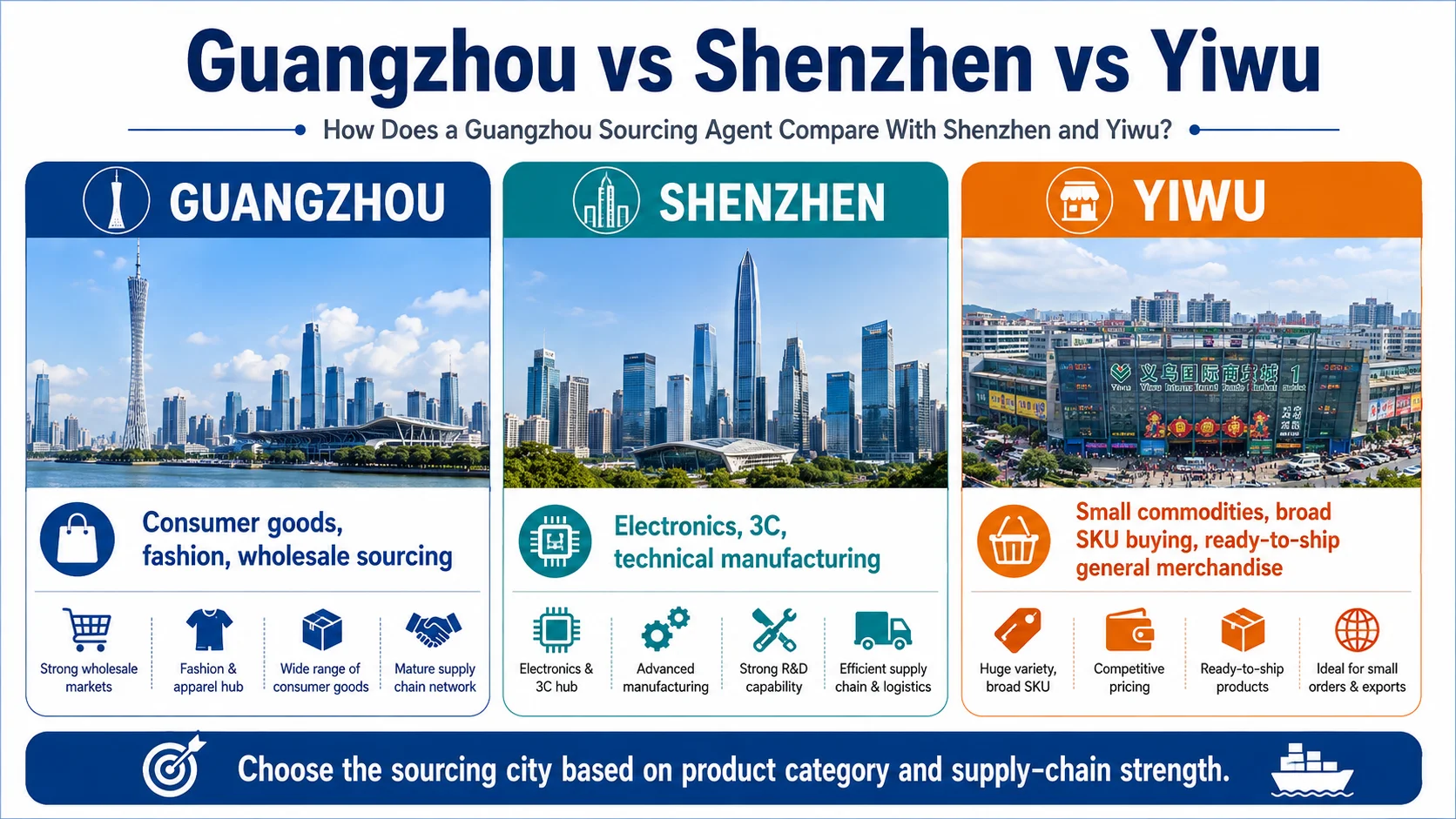
Choose the City Based on Product Fit
| Factor | Guangzhou | Shenzhen / Dongguan | Yiwu |
|---|---|---|---|
| Best Known For | Consumer goods, fashion | Electronics, technology | Small commodities |
| Product Variety | High | Specialized | Very high |
| Multi-Supplier Buying | Strong | Strong | Very strong |
| OEM/ODM Capability | Strong | Very strong | Varies |
| Wholesale Markets | Strong | Limited | Very strong |
| Electronics Supply Chain | Moderate | Very strong | Limited |
| Best For | Consumer product buyers | Tech buyers | Broad-SKU wholesalers |
We do not recommend choosing Guangzhou simply because it is a famous trading city. We recommend matching your sourcing location to your product.
For example:
- A buyer developing Bluetooth accessories may find Shenzhen or Dongguan more relevant.
- A retailer building a large assortment of small, ready-made goods may prefer Yiwu.
- A fashion, homeware, accessory, or lifestyle brand may benefit from Guangzhou wholesale sourcing and regional factory access.
Some businesses need more than one region. A brand may source fashion accessories in Guangzhou, electronics components in Shenzhen, and low-cost add-on items in Yiwu. A capable China sourcing agent can coordinate these routes, but buyers should still assess whether the added complexity is justified by their order volume and margin.
How Should You Evaluate a Guangzhou Sourcing Company?
A polished website and fast replies can create confidence, but they do not prove procurement capability. Buyers need to know how an agent evaluates suppliers, handles disputes, documents decisions, and communicates changes when an order does not go as planned.
To evaluate a Guangzhou sourcing company, buyers should review its relevant product experience, supplier transparency, local coordination process, fee structure, quotation documentation, quality-control capability, communication standards, and problem-handling approach. A reliable Guangzhou sourcing agent should explain limits as clearly as it explains services.
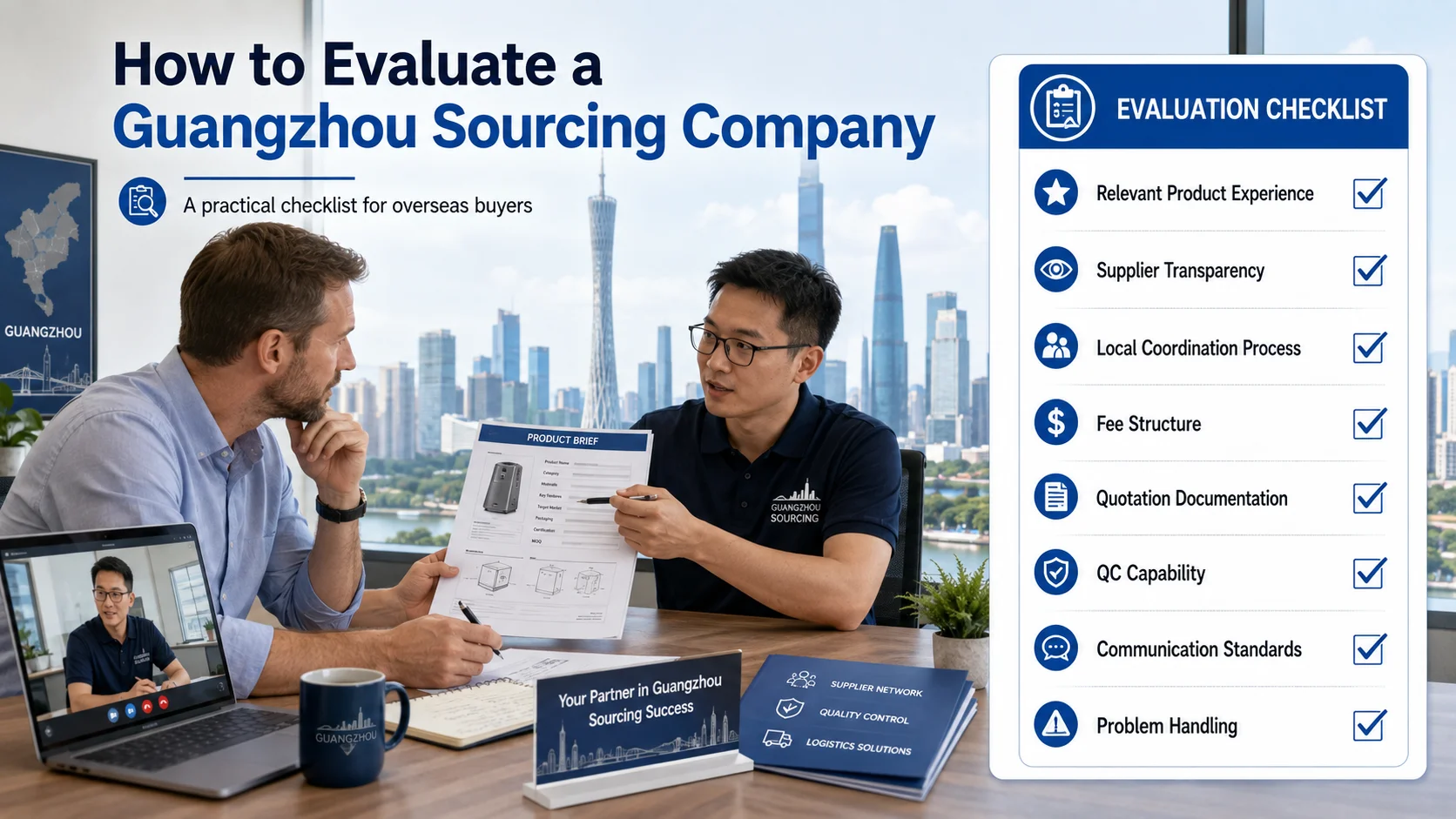
Questions We Recommend Asking Before You Start
Ask direct questions before transferring deposits or approving production:
- How do you shortlist suppliers for my product?
- Will I receive comparable quotation details?
- Can you explain differences in material, MOQ, packaging, tooling, and lead time?
- What supplier information can you share?
- What does your sourcing fee include and exclude?
- Who manages samples and production follow-up?
- What inspection options are available?
- How do you handle defective goods or supplier delays?
- Can you receive and consolidate goods from multiple factories?
- What documents and shipment updates will I receive?
A good answer should be specific. For example, “we inspect everything” is less useful than an explanation of inspection timing, sampling method, acceptance criteria, reporting format, and whether a full 1-by-1 product check is required.
We also recommend reviewing quote conditions carefully. A unit price may change because of material changes, logo method, order quantity, exchange movements, packaging, test requirements, or shipping terms.[^7] Price changes are not automatically a warning sign. The important issue is whether the supplier and agent explain the reason early and document it clearly.
How Can a Guangzhou Agent Manage Multiple Suppliers and Orders?
Managing several suppliers is difficult because every factory may have different MOQs, production schedules, carton sizes, payment terms, and communication habits.[^8] Small errors can leave buyers with incomplete shipments, mismatched packaging, or goods arriving too late for consolidation.
A Guangzhou sourcing agent can manage multiple suppliers by tracking samples, confirming order details, monitoring production milestones, receiving goods into a warehouse, checking quantities and packaging, and coordinating consolidation. This process helps buyers see the order as one supply-chain project rather than separate factory transactions.
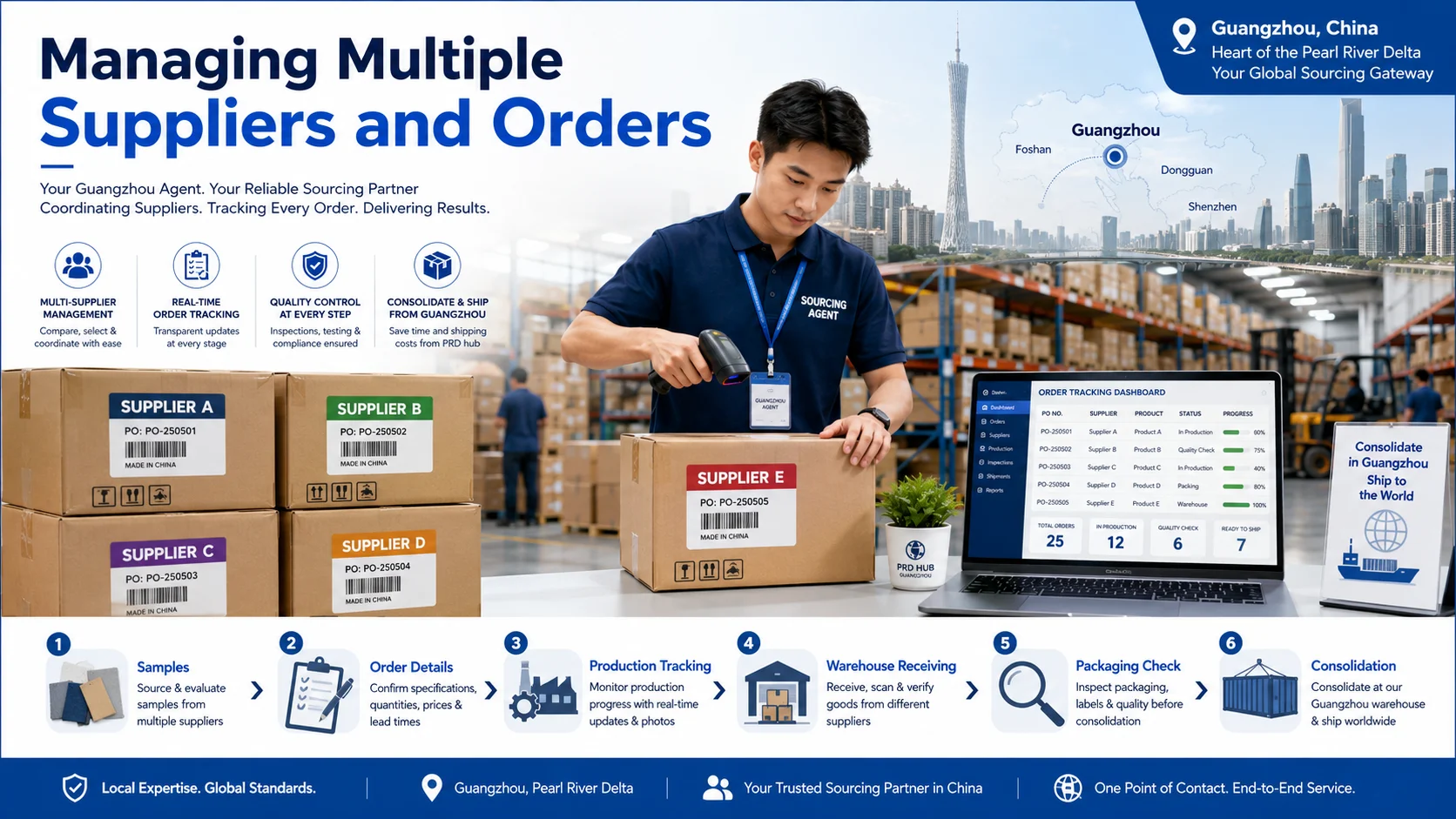
Coordination Is Often the Real Value
A multi-supplier order needs a shared timeline. We recommend building one before production begins.
A basic order tracker should include:
- Supplier name and product code
- Approved sample status
- Deposit date
- Estimated production completion date
- Inspection window
- Carton dimensions and gross weight
- Warehouse arrival date
- Packaging status
- Consolidation deadline
- Shipping method and destination
When one supplier is late, the buyer must decide whether to wait, ship partially, substitute a product, or move the delayed goods to a later shipment. These decisions involve cost, inventory planning, and customer commitments.
Our team can coordinate the moving parts, but we believe buyers should stay involved in key approvals. This includes sample sign-off, final product specifications, packaging artwork, inspection standards, and shipment timing.
A Guangzhou procurement agent should provide practical updates instead of generic messages such as “production is going well.” Useful updates state what has been completed, what is pending, what could affect timing, and what decision the buyer needs to make.
How Are Quality Control, Consolidation, and Shipping Handled?
Buyers often focus on finding a supplier first and only think about quality control and shipping near the end. That approach can create pressure when goods are already packed, supplier balances are due, and shipment dates are close.
A Guangzhou sourcing agent should plan quality control, packing checks, warehouse receiving, consolidation, export preparation, and shipping coordination before final production is complete. Buyers should agree on inspection standards, defect handling, packaging requirements, and shipment timing early in the purchasing process.
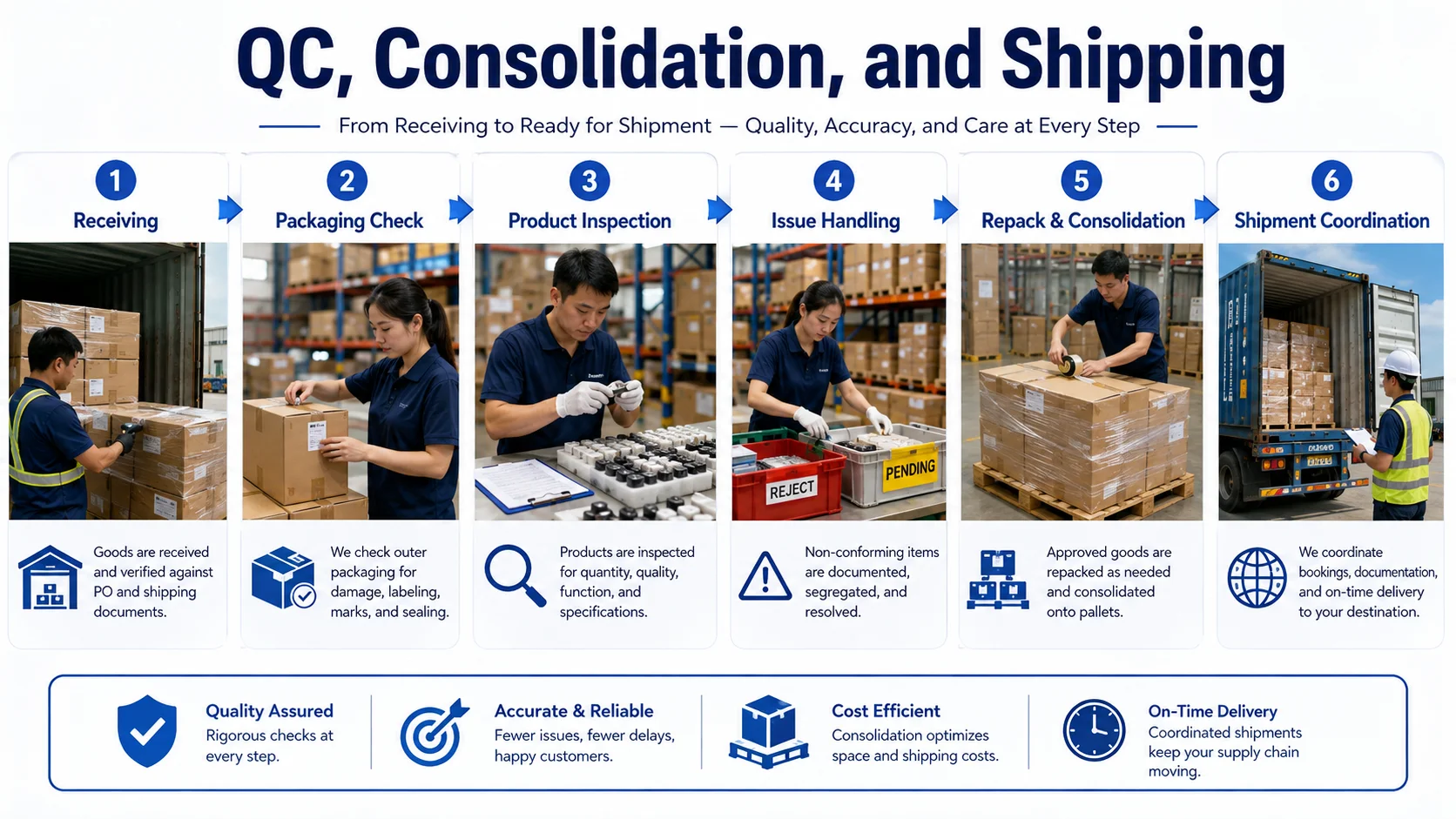
Build Quality Checks Into the Order Timeline
Quality control works best when standards are clear. We recommend documenting:
- Product dimensions and tolerances
- Material and color requirements
- Logo placement and print quality
- Function or assembly checks
- Packaging and labeling requirements
- Carton marks
- Quantity requirements
- Acceptable defect criteria
Inspection may happen before production, during production, before shipment, or after goods arrive at a consolidation warehouse. The right approach depends on product value, risk level, order size, and supplier history.
After goods reach a warehouse, we can help check receiving quantities, carton conditions, and packaging requirements before consolidation. For mixed orders, consolidation can reduce the need for separate shipments and make freight planning simpler.[^9] However, it may also add warehouse handling time and cost, so buyers should compare options.
Shipping decisions should consider:
- Incoterms and responsibility transfer
- Air freight versus sea freight[^10]
- Express options for samples or urgent replenishment
- Carton volume and chargeable weight
- Customs documentation
- Destination-country duties and import requirements
We recommend that buyers confirm destination compliance and customs obligations with qualified freight, customs, or legal professionals where needed.
How Do You Start Working With a Guangzhou Sourcing Agent?
New buyers may delay sourcing because they think they need every detail finalized before contacting an agent. In reality, an early product brief can help identify missing assumptions before those assumptions become expensive during sampling or production.
To start with a Guangzhou sourcing agent, send a clear product brief, target quantity, reference images, required specifications, packaging needs, target price range, and destination market. The typical process then moves from supplier search and quote comparison to samples, supplier selection, production follow-up, quality control, consolidation, and shipping.
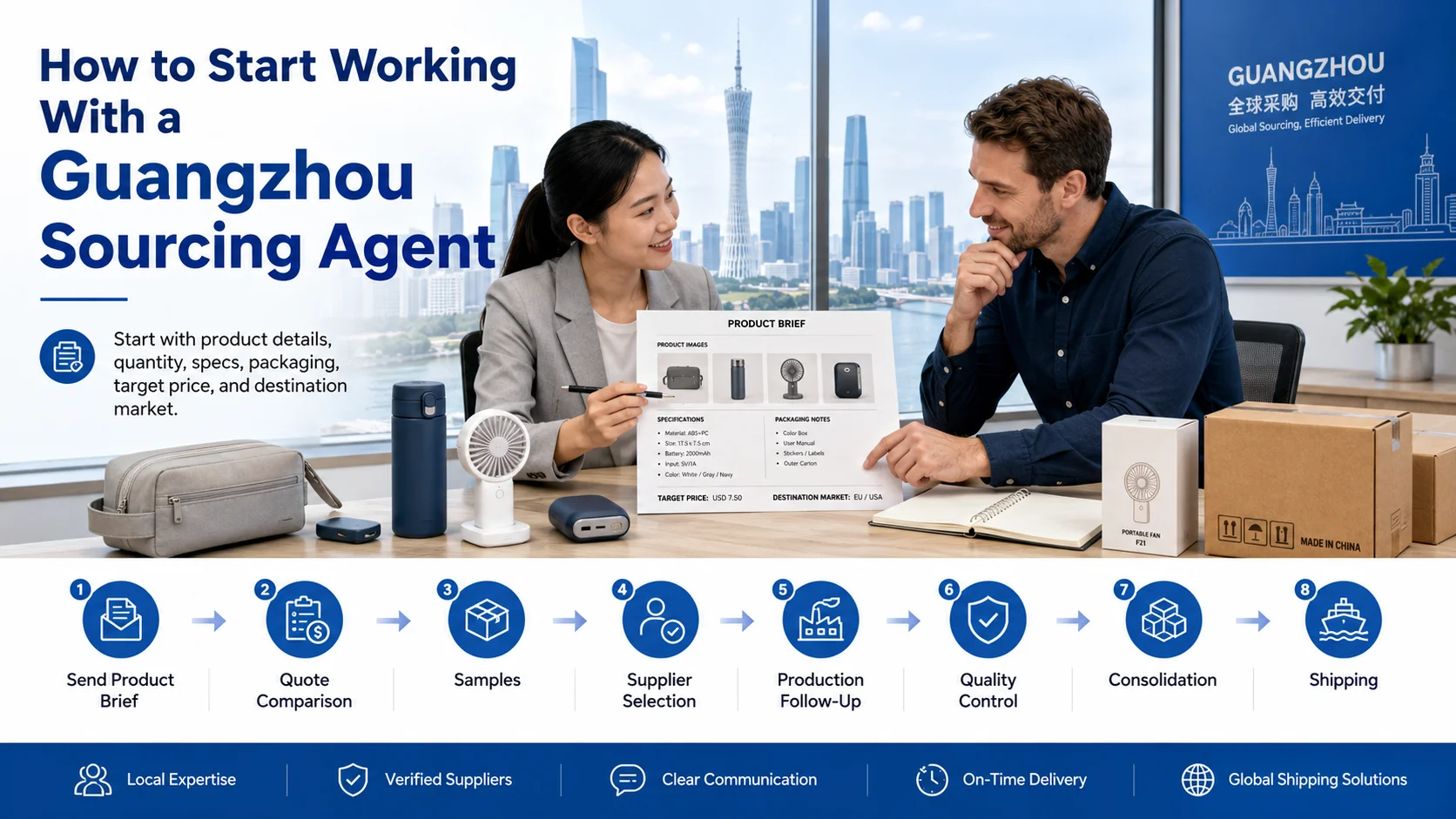
A Practical Sourcing Workflow
We usually recommend this sequence:
-
Product Brief
Share specifications, photos, quantity, target market, and packaging needs. -
Supplier Search
We identify relevant supplier options in Guangzhou and the wider Pearl River Delta where appropriate. -
Quote Comparison
We compare price conditions, MOQs, materials, lead times, and packaging assumptions. -
Sample Development
You review samples before confirming production. -
Supplier Selection
You choose based on total purchasing conditions, not price alone. -
Order Placement
Specifications, payment terms, production timing, and quality requirements are documented. -
Production Follow-Up
We coordinate updates and flag issues that need buyer decisions. -
Quality Control
Inspection is arranged according to the agreed plan. -
Consolidation and Shipping
Goods are received, combined if needed, and prepared for shipment.
A detailed brief creates better supplier comparisons. If you already have supplier quotations, we can also review the commercial conditions and help identify what may be missing from a simple unit-price comparison.
Frequently Asked Questions
Is Guangzhou good for sourcing fashion products?
Yes. Guangzhou is widely used for apparel, bags, shoes, accessories, and fashion-related consumer goods. However, buyers should still assess individual suppliers based on product specialization, sample quality, MOQ, lead time, and communication. Some suitable factories may also be located elsewhere in Guangdong.
What is the difference between a Guangzhou sourcing agent and a trading company?
A sourcing agent usually works to identify, compare, and coordinate suppliers for the buyer. A trading company may sell products under its own commercial structure. The actual model varies, so we recommend asking how supplier selection, pricing, quality control, and service fees are handled.
How much does a Guangzhou sourcing agent cost?
Costs vary based on order value, product complexity, supplier count, inspection needs, warehousing, consolidation, and shipping support. Buyers should request a clear fee breakdown and ask which services are included, excluded, or charged separately before starting.
Can a Guangzhou sourcing agent help with small orders?
Many agents can support small orders, especially for ecommerce testing, product validation, or mixed-SKU purchases. However, low order values may face higher unit costs, supplier MOQs, and shipping expenses. Buyers should discuss budget and expected volume early.
Can a sourcing agent guarantee product quality?
No sourcing agent can remove every quality or delivery risk.[^11] A structured process with approved samples, written specifications, inspections, and documented supplier communication can reduce risk and improve visibility, but buyers should still make informed approval decisions.
Conclusion
A reliable Guangzhou sourcing agent should help you understand supplier options, quote conditions, product feasibility, quality requirements, and shipping responsibilities before hidden costs emerge. Guangzhou is a strong base for consumer goods, fashion, accessories, home products, and regional Pearl River Delta procurement, but the right city and supplier always depend on your product. Send your product brief, supplier quotation, or sourcing list to KingSourcing for supplier comparison and procurement support in Guangzhou and across the Pearl River Delta.
Tags: Guangzhou sourcing agent, Guangzhou sourcing company, Guangzhou procurement agent, Guangzhou wholesale sourcing, China sourcing agent, supplier sourcing Guangzhou, Pearl River Delta sourcing, China procurement service
Work With a China Sourcing Partner
If you're planning an order from China, our sourcing team can help with supplier verification, factory audits, QC inspections, order consolidation, and shipping. Contact our sourcing team to discuss your requirements.
Related reading: How to Find a Reliable Sourcing Agent in Ningbo, China
[^1]: "Report Name:Guangzhou City Snapshot Report", https://apps.fas.usda.gov/newgainapi/api/Report/DownloadReportByFileName?fileName=Guangzhou+City+Snapshot+Report_Guangzhou+ATO_China+-+People%27s+Republic+of_CH2026-0058.pdf. Official regional trade information identifies Guangzhou as a major commercial center with extensive wholesale activity in consumer-goods sectors, including apparel, accessories, household goods, and related merchandise. Evidence role: general_support; source type: government. Supports: Guangzhou's role as a commercial and wholesale center for consumer goods, including fashion-related and household-product categories.. Scope note: Sector prominence does not establish that every product or supplier in these categories is best sourced in Guangzhou. [^2]: "Canton Fair", https://en.wikipedia.org/wiki/Canton_Fair. The China Import and Export Fair, commonly called the Canton Fair, is an official trade exhibition in Guangzhou that brings together exporters and international buyers across numerous product categories. Evidence role: historical_context; source type: institution. Supports: The Canton Fair is a major Chinese import and export trade exhibition through which international buyers can meet exhibiting suppliers.. Scope note: Fair participation is not itself evidence that an exhibitor is suitable, compliant, or capable of meeting a particular buyer's requirements. [^3]: "Cleaning Up China's Polluted Pearl River - World Bank", https://www.worldbank.org/en/results/2016/05/26/cleaning-up-china-polluted-pearl-river. International analyses of the Pearl River Delta describe Guangzhou as part of a highly integrated urban and manufacturing region with extensive production and logistics linkages among neighboring cities. Evidence role: general_support; source type: institution. Supports: Guangzhou's position within the economically integrated Pearl River Delta region and its links to regional manufacturing activity.. Scope note: Regional integration does not mean that all supplier relationships or transport arrangements are equally efficient for every product. [^4]: "[PDF] Pearl River Delta Regional Planning and Its Implication to Mekong ...", https://documents1.worldbank.org/curated/en/099062923033011864/pdf/P16270202a0df10c10891106f50650bc830.pdf. Research on industrial development in the Pearl River Delta identifies Shenzhen and Dongguan as important centers for electronics production and related supplier networks. Evidence role: general_support; source type: research. Supports: The Pearl River Delta, including Shenzhen and Dongguan, has a major concentration of electronics and related manufacturing activity.. Scope note: The regional concentration of electronics manufacturing does not verify the capabilities, quality systems, or pricing of any individual factory. [^5]: "Food Contact Materials - Food Safety - European Commission", https://food.ec.europa.eu/food-safety/chemical-safety/food-contact-materials_en. Government product-safety guidance explains that product categories such as cosmetics, electrical equipment, toys, food-contact materials, and goods containing restricted substances may be subject to category-specific safety and compliance requirements. Evidence role: expert_consensus; source type: government. Supports: Cosmetics, electrical goods, toys and children's products, food-contact materials, and chemically restricted goods can be subject to product-specific regulatory obligations in destination markets.. Scope note: Requirements vary by destination market, product design, intended use, and applicable legal framework; this general guidance is not legal advice. [^6]: "How China is divided into different city for different Products? Every city in ...", https://www.instagram.com/reel/DUS8QIdkgwg/. Regional economic research characterizes Shenzhen and Dongguan as major electronics-manufacturing centers, while Yiwu is widely documented as an international wholesale hub for small commodities and diverse low-volume merchandise. Evidence role: general_support; source type: research. Supports: The differing industrial and market specializations of Shenzhen/Dongguan and Yiwu.. Scope note: These are broad regional patterns; product fit, order scale, supplier capability, and compliance needs still require case-specific assessment. [^7]: "Determine Total Export Price - International Trade Administration", https://www.trade.gov/determine-total-export-price. Export-pricing guidance notes that product specifications, packaging, order quantity, quality or testing requirements, currency exposure, and agreed delivery terms can affect the final commercial price of an international sale. Evidence role: mechanism; source type: government. Supports: Commercial quotations can change when product specifications, volume, packaging, testing requirements, currency conditions, or trade terms change.. Scope note: The relative importance of each factor depends on the product, contract currency, supplier cost structure, and agreed Incoterms. [^8]: "Vendor Buyer Coordination Research Papers - Academia.edu", https://www.academia.edu/Documents/in/Vendor_Buyer_Coordination. Supply-chain research finds that coordinating multiple suppliers requires buyers to manage differences in lead times, capacity, ordering conditions, and delivery schedules, which can increase planning complexity. Evidence role: mechanism; source type: paper. Supports: Multiple-supplier procurement increases coordination demands because buyers must reconcile differing lead times, capacities, order conditions, and delivery schedules.. Scope note: The degree of complexity depends on product standardization, information systems, supplier reliability, and the buyer's own procurement processes. [^9]: "[PDF] Supply Chain Assessment of the Transportation Industrial Base", https://www.transportation.gov/sites/dot.gov/files/2022-02/EO%2014017%20-%20DOT%20Sectoral%20Supply%20Chain%20Assessment%20-%20Freight%20and%20Logistics_FINAL.pdf. Logistics research describes freight consolidation as the grouping of smaller consignments into fewer shipments, a practice that can improve load utilization and reduce the administrative complexity of separate dispatches. Evidence role: mechanism; source type: research. Supports: Freight consolidation combines smaller consignments into fewer loads and can reduce handling of separate shipments.. Scope note: Consolidation can also introduce warehouse handling, delay, and inventory costs, so it is not necessarily the lowest-cost option. [^10]: "Shipping Options - International Trade Administration", https://www.trade.gov/shipping-options. International trade guidance distinguishes air freight from ocean freight primarily by transit time, cost, shipment size, and operational suitability, requiring importers to select a mode based on the shipment's commercial constraints. Evidence role: general_support; source type: government. Supports: Air and ocean freight differ materially in transit speed, shipment capacity, and typical cost characteristics.. Scope note: Actual transit times and total landed costs vary by route, carrier, cargo characteristics, customs processing, and market conditions. [^11]: "Zero Defects Concept: Mastering Quality Excellence in ...", https://www.6sigma.us/lean-six-sigma-articles/zero-defects/. Quality-management standards emphasize risk-based planning, process control, and monitoring as methods for improving consistent outcomes, while recognizing that such controls manage rather than eliminate operational risk. Evidence role: expert_consensus; source type: institution. Supports: Quality-management systems use risk-based controls and monitoring to improve conformity but do not provide an absolute guarantee against all defects or delivery failures.. Scope note: The effectiveness of any quality-control process depends on the inspection plan, sampling approach, supplier performance, and the buyer's defined acceptance criteria.