Low prices look attractive. Bad suppliers look cheap at first. I have seen many importers lose time, money, and trust after one rushed choice.
I find the best way to find reliable manufacturers in China is to use sourcing channels as starting points, then verify each supplier through price logic, samples, production follow-up, factory checks, and quality control before placing larger orders.
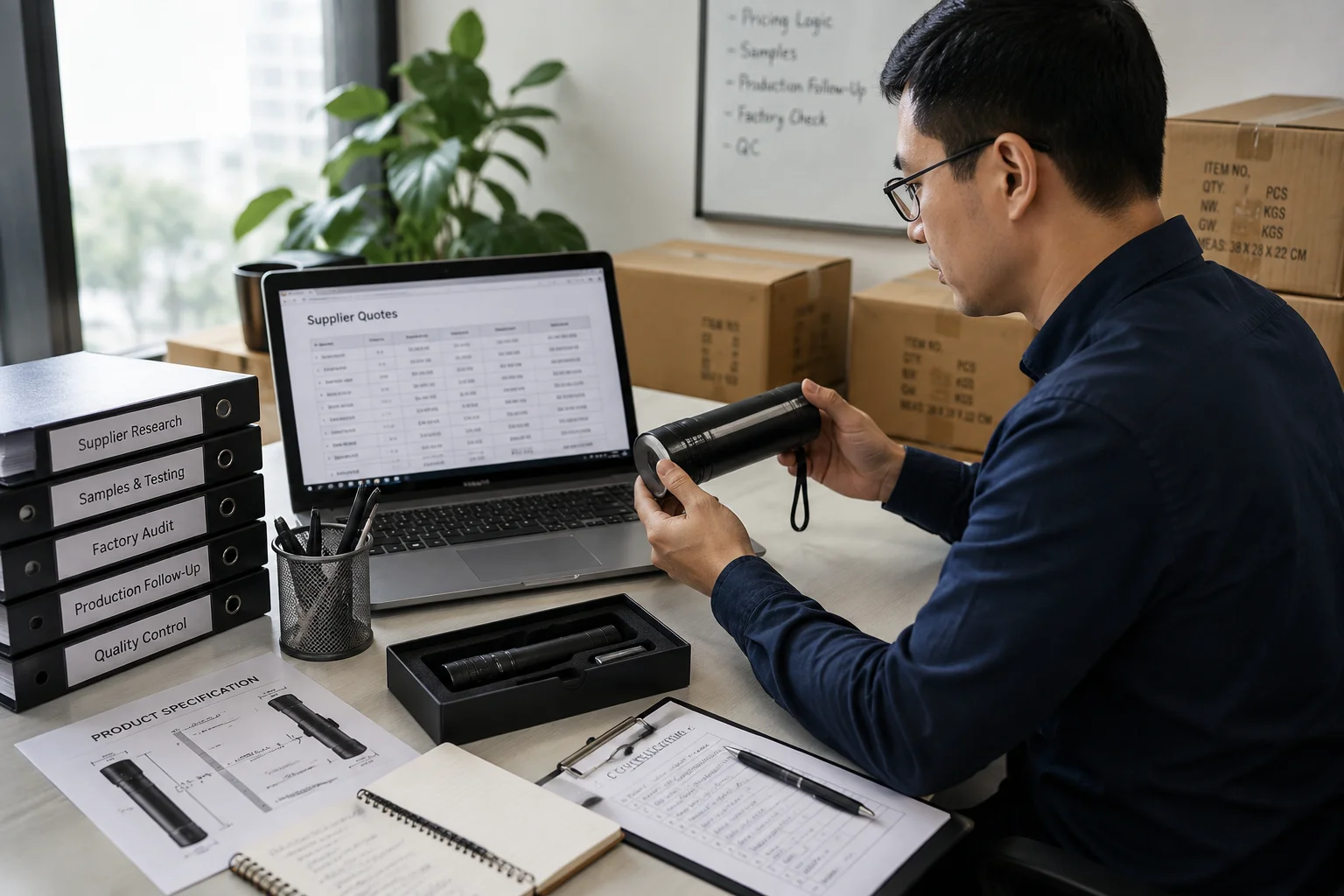
Many new importers ask me where to find manufacturers in China. I understand the question. I also think the better question is how to judge them after you find them.
I work with overseas buyers who need products, factories, samples, packaging, inspections, and shipping support. I often see the same pattern. A buyer finds three suppliers online. One supplier gives the lowest price. The buyer feels excited. Then the sample looks fine, but the bulk order arrives with weak material, wrong packaging, late delivery, or poor finishing.
This problem does not mean China sourcing is unsafe. It means sourcing needs a process. I treat supplier finding as only the first step. I then check whether the supplier understands the product, explains the price, supports sampling, accepts inspection, and communicates clearly when problems happen.
If you are a small business, DTC brand, ecommerce seller, wholesaler, or first-time importer, this guide will help you build a safer path before you pay for a bulk order.
1. Why Is Finding Reliable Manufacturers in China Not Just About Price?
A cheap quote can hide weak material, missing packaging, poor checks, or slow service.[^1] I always treat price as a clue, not a final answer.
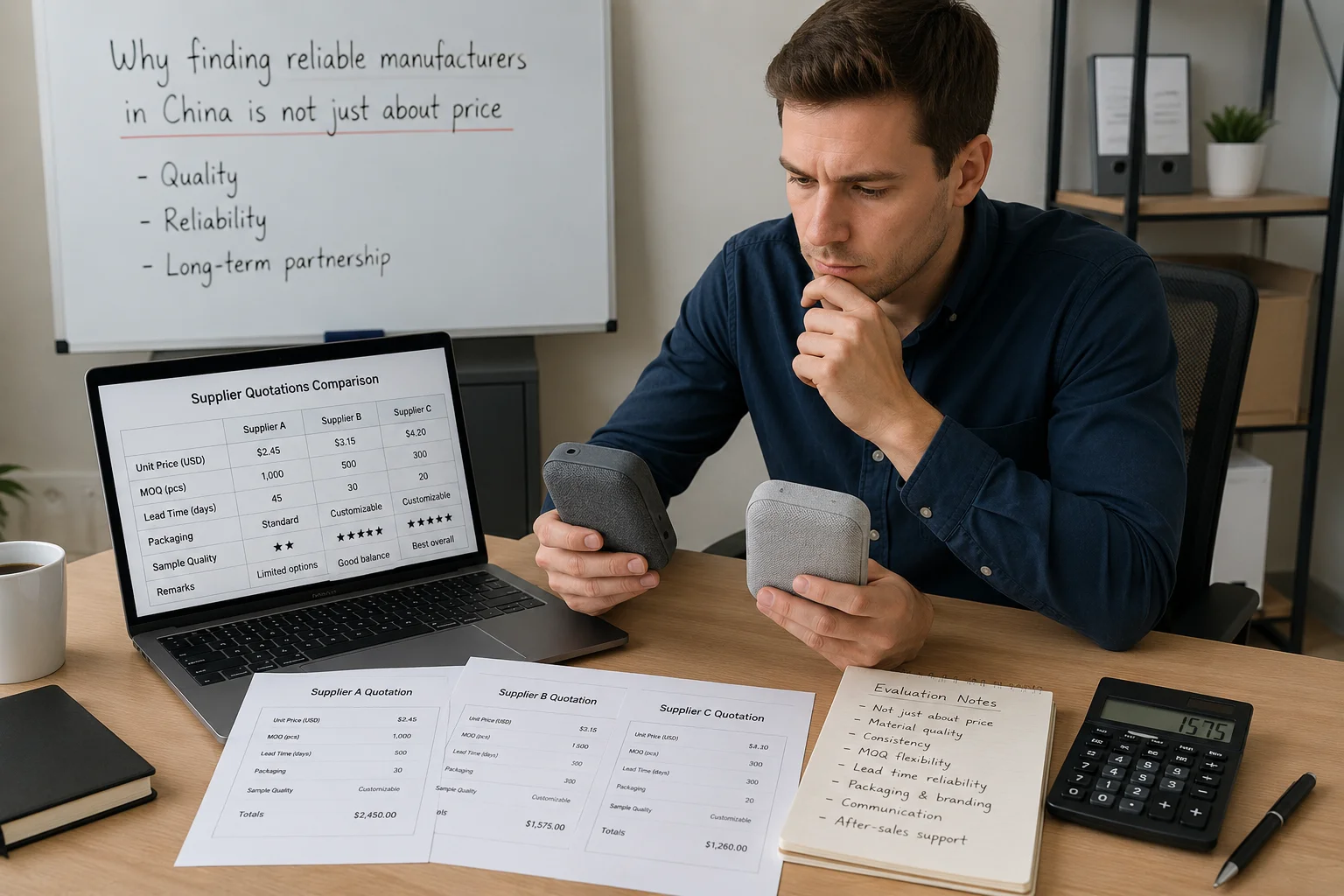
I compare Chinese manufacturers by specification, material, MOQ, packaging, lead time, payment terms, sample quality, and problem-solving attitude. A reliable manufacturer should explain the price difference in clear terms, not just say “best price.”
What I Check Before I Trust a Price
I never look at price alone because one product can have many versions. A water bottle can use different plastic grades. A bag can use different fabric weight. A cosmetic tool can look the same in photos but feel very different in hand. I ask suppliers to explain the material, size, weight, finish, accessories, carton size, and packaging. I also ask them to state what is included and what is not included.
| Price Factor | What I Ask | Why It Matters |
|---|---|---|
| Material | What exact material or grade do you use? | I need to know if quotes are comparable. |
| Specification | Is the size, weight, and finish the same? | Small changes can change cost and quality. |
| Packaging | Is retail packaging included? | Packaging can add cost and delay. |
| MOQ | What is the real minimum order? | A low unit price may need a high MOQ. |
| Lead time | When can production finish? | Fast promises need proof. |
I often see new importers compare one low quote with one high quote and think the higher supplier is overcharging. Sometimes that is true. Many times, the quotes are not based on the same product.[^2] I ask for a written quotation with clear details. I also ask for photos, videos, and sample confirmation. If a supplier refuses to explain the price, I treat that as a risk signal. I do not need the cheapest supplier. I need a supplier whose price matches the product standard and order size.
2. Where Can You Find Manufacturers in China?
You can find manufacturers through Alibaba, Made-in-China, Google, trade shows, referrals, industrial clusters, and sourcing agents. I use these channels as entry points, not final proof.
I choose a channel based on product type, order size, urgency, customization needs, and risk level. I still verify suppliers after first contact because every channel includes both strong and weak options.
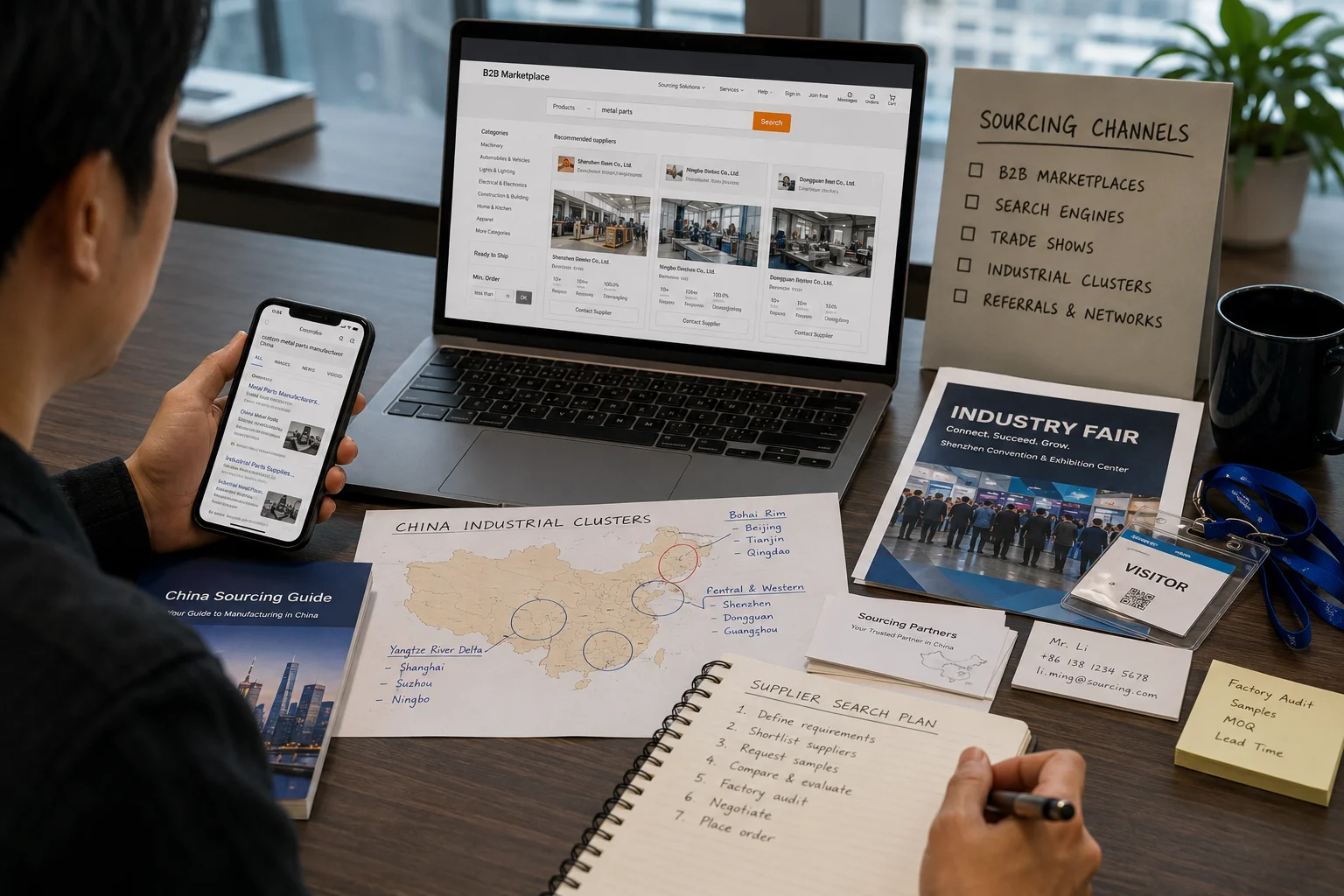
How I Use Each Sourcing Channel
I see every sourcing channel as a doorway. Alibaba and Made-in-China are useful because I can find many suppliers fast. Google can help me find suppliers with their own websites. Trade shows help when I need to touch products and meet teams in person.[^3] Referrals can save time if the referrer has real order experience. A sourcing agent can help when the buyer has no China team, no time, or no local checking ability.
| Channel | Best Use | Main Risk |
|---|---|---|
| Alibaba | Fast supplier search and quote comparison | Many suppliers look similar online. |
| Made-in-China | Industrial and B2B product search | Product details still need checking. |
| Find suppliers with websites | SEO strength does not prove factory strength. | |
| Trade shows | See samples and talk face to face | Booth quality does not prove production quality. |
| Referrals | Start with a trusted contact | Your product needs may be different. |
| Sourcing agent | Local search, checking, follow-up | You still need clear service scope. |
I do not recommend using only one channel.[^4] I usually collect several supplier options, then compare them under the same requirements. I send the same product brief, target quantity, packaging need, and quality standard. This makes the quote more meaningful. If I change the details for each supplier, I cannot compare them fairly. The channel helps me find names. The screening process helps me find the right match.
3. How Can You Tell the Difference Between a Real Factory and a Trading Company?
I check business scope, address, production photos, factory videos, sample source, quotation behavior, and communication details. I do not trust the “factory direct” label alone.
A real factory usually controls production directly, while a trading company may coordinate orders through partner factories.[^5] Both can be useful if they match your order size, service needs, and quality control process.
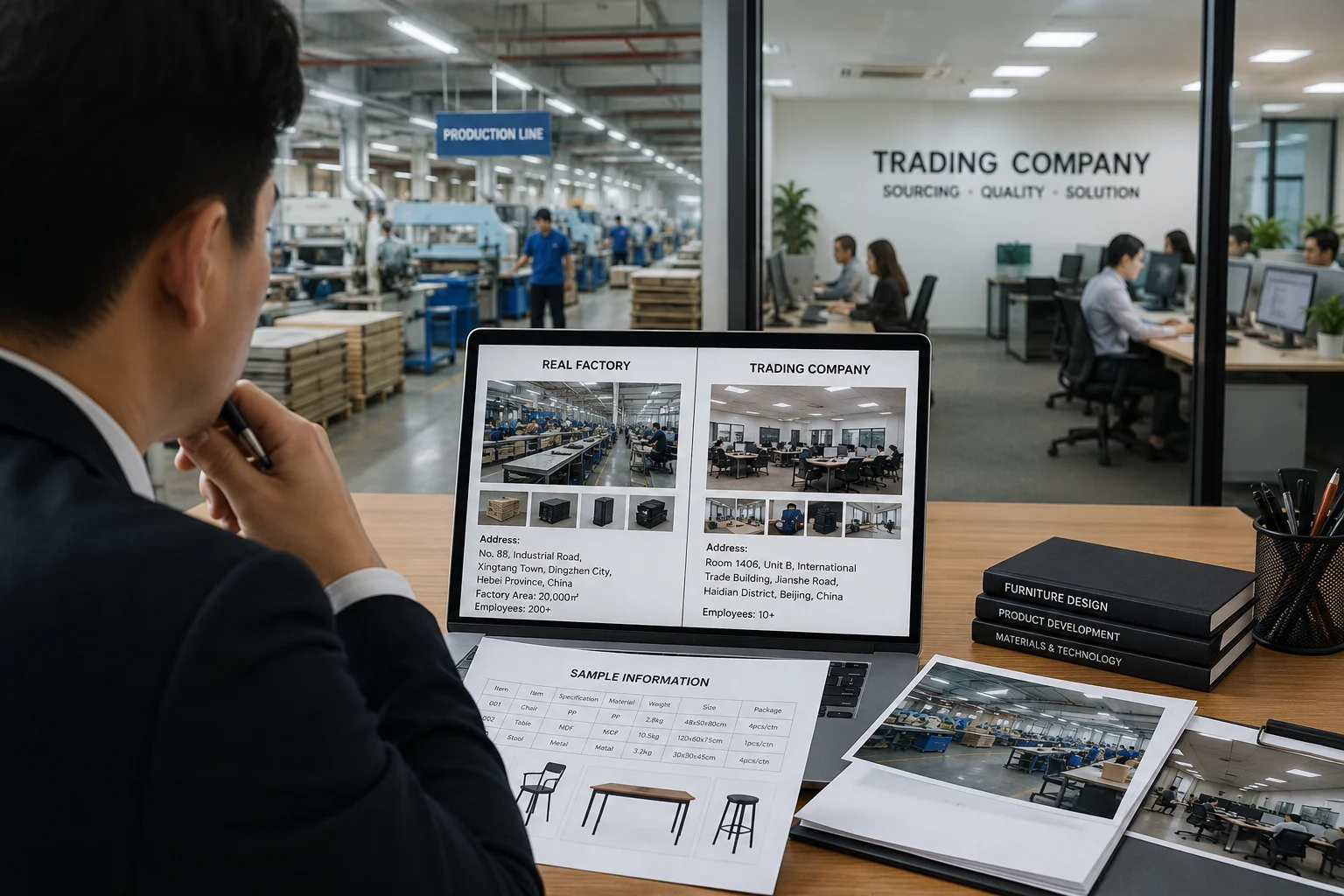
What I Look For Beyond the Label
Many buyers ask me if they must work only with factories. My answer is no. A factory can be strong for one product but poor at communication or small orders. A trading company can be helpful if it manages several product types, supports small MOQs, or handles packaging and consolidation.[^6] The key is not the label. The key is control, honesty, and fit.
| Check Point | Real Factory Signal | Trading Company Signal |
|---|---|---|
| Product range | Narrow and deep product line | Wider product range |
| Address | Production area or industrial zone | Office or commercial area |
| Photos | Machines, lines, workers, warehouse | Showroom and mixed samples |
| MOQ | Often higher or stricter | Sometimes more flexible |
| Support | Strong on production details | Often stronger on service coordination |
I ask direct questions. I ask where the product is made. I ask whether the supplier owns the production line. I ask if I can see a video of the workshop with current date proof. I ask who handles quality control. I ask who will fix defects after inspection. I also compare their answers with their business license and product range. If a supplier says they are a factory but sells hundreds of unrelated products, I check more carefully. If a trading company is honest and has good factory control, I may still consider them. I care more about order execution than a simple title.
4. How Can You Check a Chinese Manufacturer’s Business License and Company Background?
I check the company name, registration number, legal representative, business scope, address, operating status, and registration date. I also compare these details with what the supplier tells me.
A Chinese business license helps confirm whether a company legally exists and what it is registered to do.[^7] It does not prove product quality, so I combine it with background checks, communication review, samples, and inspection.
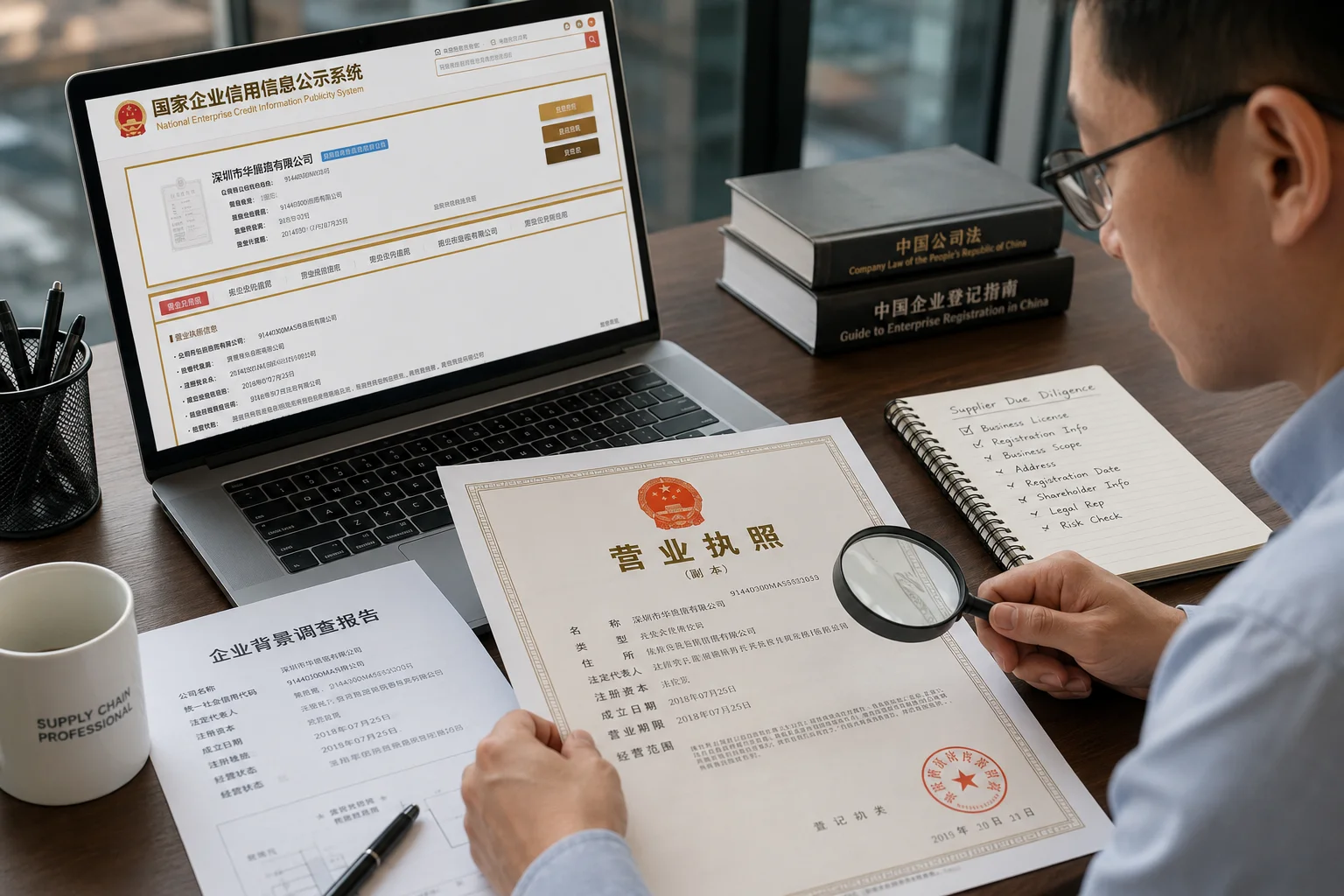
How I Read Basic Company Information
I do not treat a business license as a magic guarantee. I treat it as a basic identity check. I ask the supplier for the Chinese company name and business license. I check whether the name on the license matches the bank account, invoice, quotation, and contract.[^8] If the names do not match, I ask for a clear reason. Sometimes a group company has several entities. Sometimes there is a trading company and a factory company. I need the structure in writing.
| License Detail | What I Check | Why I Check It |
|---|---|---|
| Company name | Does it match documents? | I need to know who I pay. |
| Business scope | Does it fit the product? | I want to avoid mismatch. |
| Registered address | Is it office or factory area? | It gives context. |
| Operating status | Is the company active? | I need a legal supplier. |
| Registration date | Is it very new or established? | It helps me judge risk. |
I also search for the company online in English and Chinese when possible. I look for websites, platform profiles, product listings, and public information. I compare their story across different places. If the supplier gives a different company name every time, I slow down. If the supplier cannot explain the payment account, I slow down. I am not a legal authority, and I do not treat this as legal advice. I use these checks to reduce simple risks before I go deeper into samples and production.
5. What Should You Ask Before Choosing a Manufacturer in China?
I ask about product details, materials, MOQ, sample cost, lead time, packaging, quality standard, defect handling, inspection support, payment terms, and repeat-order capacity.
Good questions help me see how a supplier thinks. A reliable manufacturer answers with details, asks follow-up questions, and explains trade-offs instead of giving only short sales replies.[^9]
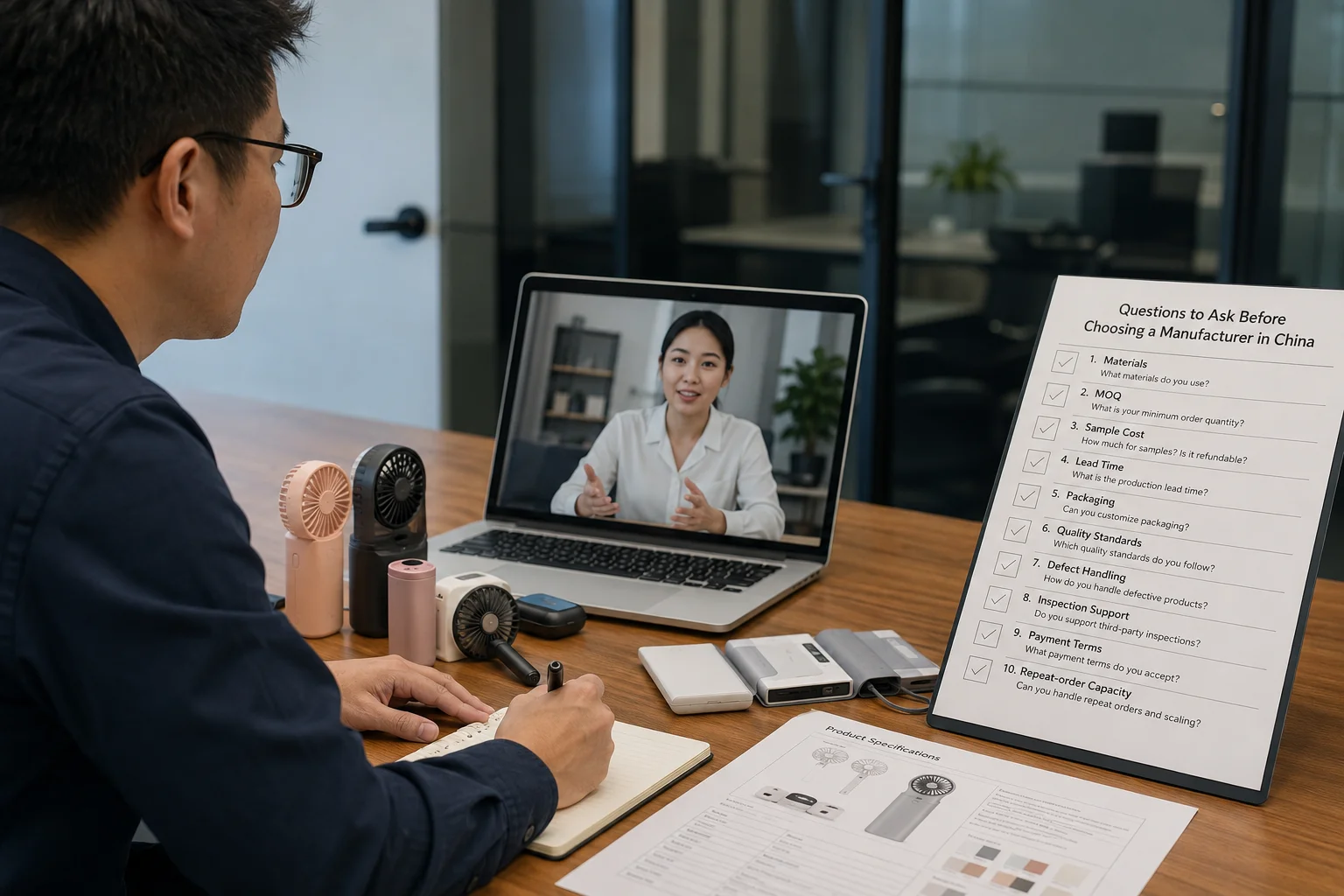
My Basic Supplier Question List
I use questions to test both capability and attitude. A good supplier does not always give perfect answers at once. That is normal. What I want to see is whether they understand the product and whether they are willing to confirm details. If I ask about material and they answer only with a price, I know the communication may become hard later.
| Question Area | Example Question | What I Learn |
|---|---|---|
| Product | Can you confirm material, size, weight, and finish? | I learn if they understand the item. |
| Sample | How do you make the sample and how long does it take? | I see if they can match my standard. |
| MOQ | What MOQ applies for plain and custom versions? | I learn order flexibility. |
| Packaging | Can you support my carton, label, or retail box? | I see if branding is possible. |
| QC | Do you accept third-party or agent inspection? | I learn if they are open to checking. |
| After-sales | What happens if defects are found? | I see problem-solving attitude. |
I also ask about production schedule. I want to know when materials are purchased, when production starts, when packaging is ready, and when inspection can happen. I ask for photos or videos at key steps. I ask who my daily contact person will be. I ask whether the supplier has made the same product for export before. These questions do not remove all risk. They make the risk more visible. If a supplier cannot answer basic questions before payment, they may become harder to manage after payment.
6. Why Do Samples, Factory Checks, and Quality Control Matter Before Bulk Orders?
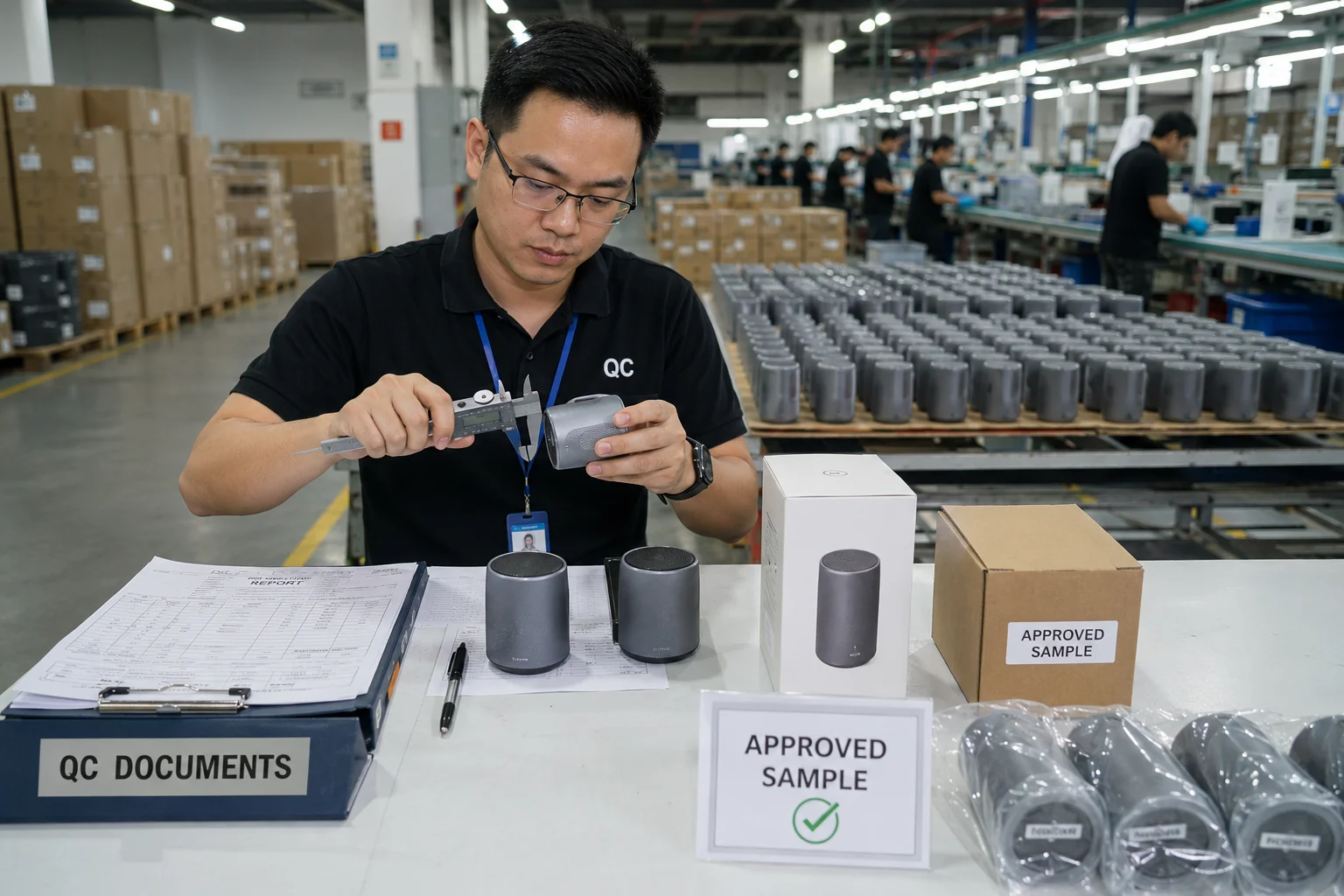
Samples show what a supplier can make once. Quality control shows whether bulk goods can follow the same standard.[^10] I always connect both steps.
I use samples, factory checks, production follow-up, packaging review, and inspection to reduce the risk that bulk goods differ from approved samples. I never treat one good sample as full proof.
Why I Do Not Stop at the Sample Stage
A sample is important, but it is not the whole story. A supplier may make one good sample by hand. Bulk production may use different workers, different materials, or faster processes.[^11] I ask the supplier to keep the approved sample as the standard. I also ask for pre-production samples when customization is involved. I check packaging because good products can still arrive damaged if cartons are weak or inner packing is poor[^12].
| Step | What I Check | Main Purpose |
|---|---|---|
| Sample review | Size, color, function, finish, packaging | Confirm the product standard |
| Factory check | Production setting and basic capacity | See if the supplier can produce |
| Production follow-up | Material, progress, photos, delays | Catch problems early |
| Pre-shipment inspection | Quantity, defects, labels, cartons | Check before balance payment |
| Defect handling | Repair, replacement, discount, remake | Protect the order result |
I often tell new importers to test with a small order first when the budget is limited. A small order can show how the supplier handles production, packing, communication, and shipping documents. It can also show whether the supplier is willing to fix problems. If the first order goes well, I can increase the quantity step by step. This path is slower than jumping into a big order, but it is often safer for small sellers. I would rather learn with a controlled order than learn after a container arrives with problems.
7. Why Should Importers Always Prepare Backup Suppliers?
One supplier can face material shortages, delays, price changes, capacity issues, or communication problems. I prepare backup suppliers before the main supplier fails.
Backup suppliers help me protect stock plans, compare prices, test new product versions, and avoid being stuck with one option. I do not use them to pressure suppliers unfairly. I use them to manage risk.

How I Build a Simple Backup Supplier Plan
I believe supplier backup is basic supply chain work. It is not a sign of distrust. It is a way to keep the business moving. Even good suppliers can become busy during peak season. A material cost can change. A factory can move production lines. A key salesperson can leave. If I only have one supplier, every small issue becomes urgent.
| Backup Type | When I Use It | What I Need to Check |
|---|---|---|
| Same product supplier | Main supplier delays | Sample match and price logic |
| Different grade supplier | I need a lower or higher version | Material and market fit |
| Packaging supplier | Main factory packaging is weak | Box strength and print quality |
| Small order supplier | I need a test batch | MOQ and flexibility |
| Large order supplier | I need scale later | Capacity and QC system |
I usually keep two or three possible suppliers for important products. I do not need to order from all of them at once. I keep their quotes, samples, contact details, and notes. If my main supplier changes price, I can compare calmly. If quality drops, I can test another option. I also avoid giving one supplier unclear threats like “I have many options.” I prefer honest business. I tell suppliers that I value long-term cooperation, but I also need stable delivery and clear quality. Backup suppliers give me room to make better decisions.
8. How Does a China Sourcing Agent Help You Find and Verify Reliable Manufacturers?
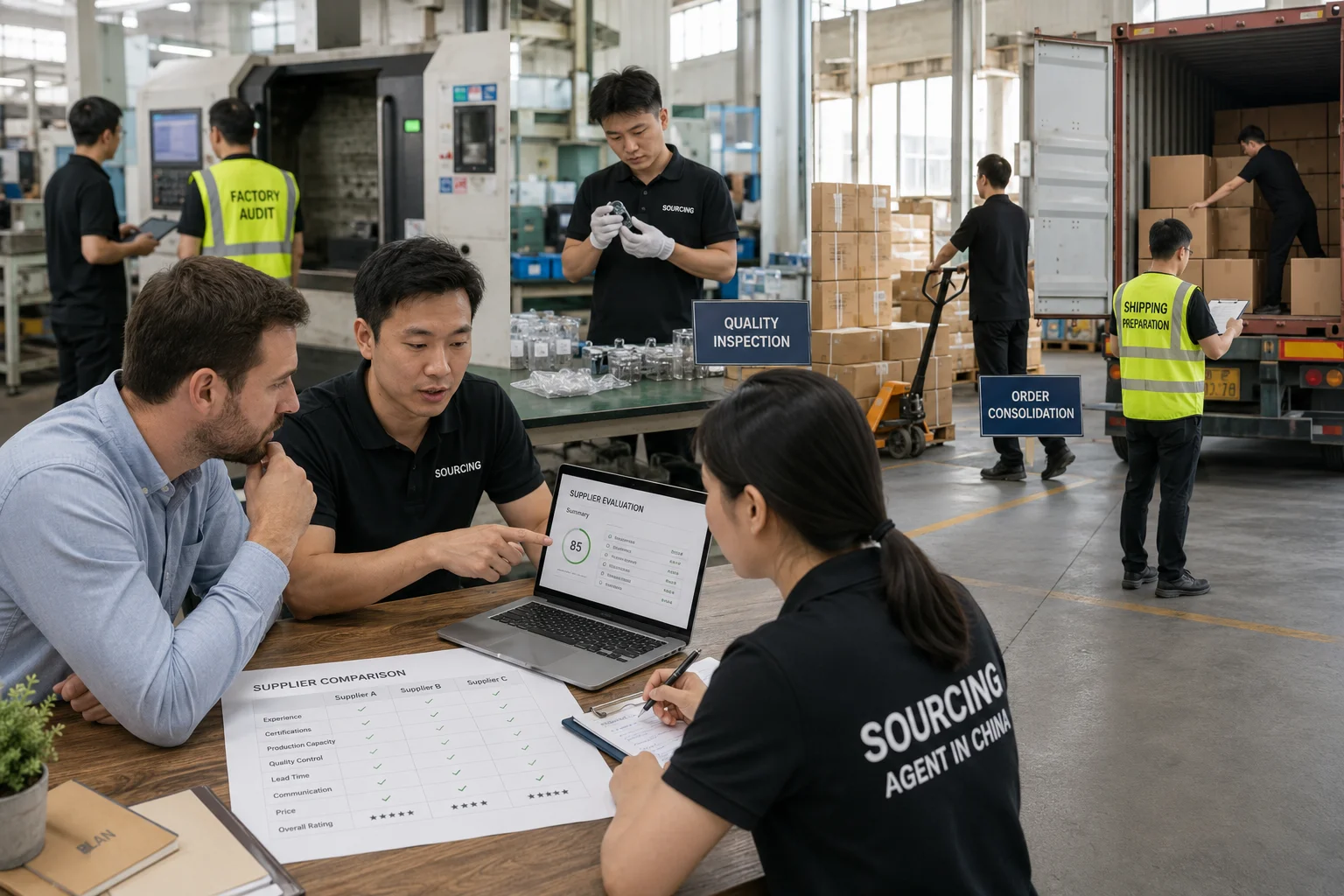
A China sourcing agent helps you search suppliers, compare quotes, confirm samples, check factories, follow production, inspect goods, consolidate orders, and arrange shipping from China.
I use a sourcing agent role as a local buyer’s office in China. The value is not only finding names. The value is daily follow-up, supplier verification, quality control, and problem handling.
Where a Sourcing Agent Adds Practical Value
Many importers can find suppliers online by themselves. The hard part starts after the first reply. The buyer needs to confirm details, compare quotes, review samples, check packaging, follow production, inspect goods, and coordinate shipping. If the buyer has no local team in China, every step can take more time. This is where I see a sourcing agent help most.
| Sourcing Step | What I Help With | Buyer Benefit |
|---|---|---|
| Supplier search | Find several possible suppliers | More options and better comparison |
| Quote review | Check price details and hidden costs | Fewer wrong price decisions |
| Sample follow-up | Arrange, receive, compare, and send samples | Better sample control |
| Factory check | Visit or verify basic supplier facts | Lower supplier mismatch risk |
| QC inspection | Check products before shipment | Fewer surprises after arrival |
| Logistics | Consolidate and ship orders | Less shipping confusion |
At KingSourcing, I see our role as a China-based sourcing office for overseas buyers. We do not simply pass supplier names to clients. We help clients turn product ideas into clear sourcing requirements. We talk with suppliers in Chinese. We compare practical details. We help confirm samples and packaging. We follow production and arrange inspection before goods leave China. We also help with warehouse, photos, order consolidation, and door-to-door logistics when needed.
A sourcing agent does not remove every risk. No one can honestly promise that. A good sourcing agent makes risks easier to see, measure, and manage before they become expensive. This matters most for small businesses and ecommerce sellers who need to start with a controlled budget and grow step by step.
Conclusion
I find reliable manufacturers in China by using sourcing channels first, then verifying suppliers through price logic, samples, checks, production follow-up, quality control, and backup planning.
[^1]: "Supplier Selection Criteria and Methods in Supply Chains: A Review", https://www.academia.edu/103872437/Supplier_Selection_Criteria_and_Methods_in_Supply_Chains_A_Review. Procurement research on supplier selection and total cost of ownership supports evaluating offers beyond quoted unit price, including quality, delivery, packaging, and service-related costs; this is general procurement evidence rather than direct proof about any individual China supplier. Evidence role: expert_consensus; source type: paper. Supports: A source should support that supplier evaluation commonly considers total cost, quality, delivery, and service rather than quoted unit price alone.. Scope note: Contextual support only; it does not verify that a specific low quote hides these problems. [^2]: "Single and Sole Source Procurements | SUNY Oswego", https://ww1.oswego.edu/purchasing/single-and-sole-source-procurements. Public procurement guidance commonly states that requests for quotation should define specifications and requirements consistently so submitted prices can be compared on a like-for-like basis; this supports the sourcing principle but not the frequency implied by 'many times.' Evidence role: general_support; source type: government. Supports: A source should support that RFQs or tenders require clear, consistent specifications so suppliers can submit comparable bids.. Scope note: Supports the need for comparable specifications, not a quantified rate of mismatched China supplier quotes. [^3]: "The future of buyer–seller interactions: a conceptual framework and ...", https://pmc.ncbi.nlm.nih.gov/articles/PMC8480456/. Academic literature on trade fairs identifies face-to-face interaction, product demonstration, and market-information exchange as central functions of exhibitions, supporting their use for initial supplier assessment. Evidence role: mechanism; source type: paper. Supports: A source should support that trade fairs facilitate face-to-face buyer-seller contact and direct product assessment.. Scope note: Does not prove that a trade-show exhibitor has reliable production quality. [^4]: "Finding Foreign Buyers Through eCommerce Sales Channels", https://www.trade.gov/feature-article/finding-foreign-buyers-through-ecommerce-sales-channels. Research on supplier search and supplier selection describes the use of multiple information sources to identify and compare potential suppliers, supporting the article's advice to treat any single sourcing channel as incomplete. Evidence role: general_support; source type: paper. Supports: A source should support that supplier search and selection often use multiple information sources to expand options and improve evaluation.. Scope note: Provides general sourcing support rather than China-specific proof. [^5]: "International Trade: Commerce among Nations", https://www.imf.org/en/publications/fandd/issues/series/back-to-basics/trade. Definitions of manufacturers and trading companies distinguish direct production from intermediary trade functions, supporting the article's practical distinction between factory production control and order coordination by a trader. Evidence role: definition; source type: encyclopedia. Supports: A source should define manufacturers as producers of goods and trading companies as intermediaries in buying, selling, or arranging trade.. Scope note: Definitions explain typical roles but do not determine the legal status or operating model of a particular supplier. [^6]: "Behind intermediary performance in export trade: Transactions ...", https://researchworks.creighton.edu/esploro/outputs/journalArticle/Behind-intermediary-performance-in-export-trade/991005930340402656. Research on trade intermediaries shows that intermediaries can reduce transaction and coordination costs in international trade, providing contextual support for the role of trading companies in managing multiple products, order consolidation, and buyer services. Evidence role: mechanism; source type: paper. Supports: A source should support that trade intermediaries can reduce coordination costs and assist buyers or sellers with market access, logistics, or order aggregation.. Scope note: Contextual support only; it does not show that all trading companies provide these services well. [^7]: "State Administration for Market Regulation - Wikipedia", https://en.wikipedia.org/wiki/State_Administration_for_Market_Regulation. Chinese market-regulation and company-registration materials describe the business license as an official registration document containing company identity and business-scope information, supporting its use as a basic legal-existence check. Evidence role: definition; source type: government. Supports: A source should support that Chinese business registration records or licenses contain company identity, registration status, and business-scope information.. Scope note: A business license confirms registration information but does not independently prove manufacturing capability or product quality. [^8]: "Know-Your-Customer Requirements and Due Diligence Standards", https://www.exim.gov/policies/due-diligence-standards. Government trade due-diligence guidance commonly advises importers to verify supplier identity, contractual parties, and payment details before remitting funds, supporting the practice of checking consistency among licenses, invoices, contracts, and bank accounts. Evidence role: general_support; source type: government. Supports: A source should support verifying supplier identity and payment details before sending funds in international trade.. Scope note: General fraud-prevention guidance; it may not prescribe this exact document-matching checklist. [^9]: "Assessing the Best Supplier Selection Criteria in Supply Chain ...", https://pmc.ncbi.nlm.nih.gov/articles/PMC9102987/. Supplier-selection studies identify communication, responsiveness, service capability, technical understanding, quality, and delivery performance as relevant evaluation criteria, supporting the article's use of detailed supplier responses as a reliability signal. Evidence role: expert_consensus; source type: paper. Supports: A source should support that supplier responsiveness, communication, service, and technical capability are recognized supplier-selection criteria.. Scope note: The evidence supports communication as one evaluation factor, not as conclusive proof of reliability. [^10]: "[PDF] ISO 2859-1 - UNT Chemistry", https://chemistry.unt.edu/~tgolden/courses/iso2859-1.pdf. Quality-management and acceptance-sampling standards describe inspection of production lots against specified requirements, supporting the article's distinction between a one-off sample and batch-level quality control. Evidence role: mechanism; source type: institution. Supports: A source should support that quality-control inspection and sampling are used to assess whether production lots conform to specified requirements.. Scope note: Supports the inspection mechanism, not the outcome of any specific inspection. [^11]: "A systematic review of decision tools for process selection ... - PMC", https://pmc.ncbi.nlm.nih.gov/articles/PMC12592300/. Manufacturing quality literature on process variation and statistical process control recognizes materials, operators, methods, equipment, and process conditions as sources of output variation, providing a mechanism for why bulk production may differ from an approved sample. Evidence role: mechanism; source type: paper. Supports: A source should support that variation in materials, operators, methods, equipment, and process conditions can affect manufacturing output quality.. Scope note: Contextual mechanism only; it does not show that a named supplier changed workers, materials, or processes. [^12]: "Importance of Packaging and Organization in Transport - NMFTA", https://nmfta.org/news/importance-of-packaging-and-organization-in-transport/. Transport-packaging standards and logistics research describe cartons and inner packaging as protective systems against distribution hazards such as compression, shock, and vibration, supporting the claim that inadequate packaging can damage otherwise acceptable goods. Evidence role: mechanism; source type: institution. Supports: A source should support that transport packaging is designed to protect goods from handling, vibration, compression, and other distribution hazards.. Scope note: Supports the general packaging mechanism, not a specific shipment outcome.