Many buyers find a product idea, contact one supplier, and then lose time when price, quality, packaging, or shipping does not match the plan.
The China product sourcing process turns a product idea into clear requirements, supplier options, samples, verified production, quality checks, packaging, warehousing, and final delivery.[^1] I treat it as a risk-control process, not only a way to find a cheap supplier.
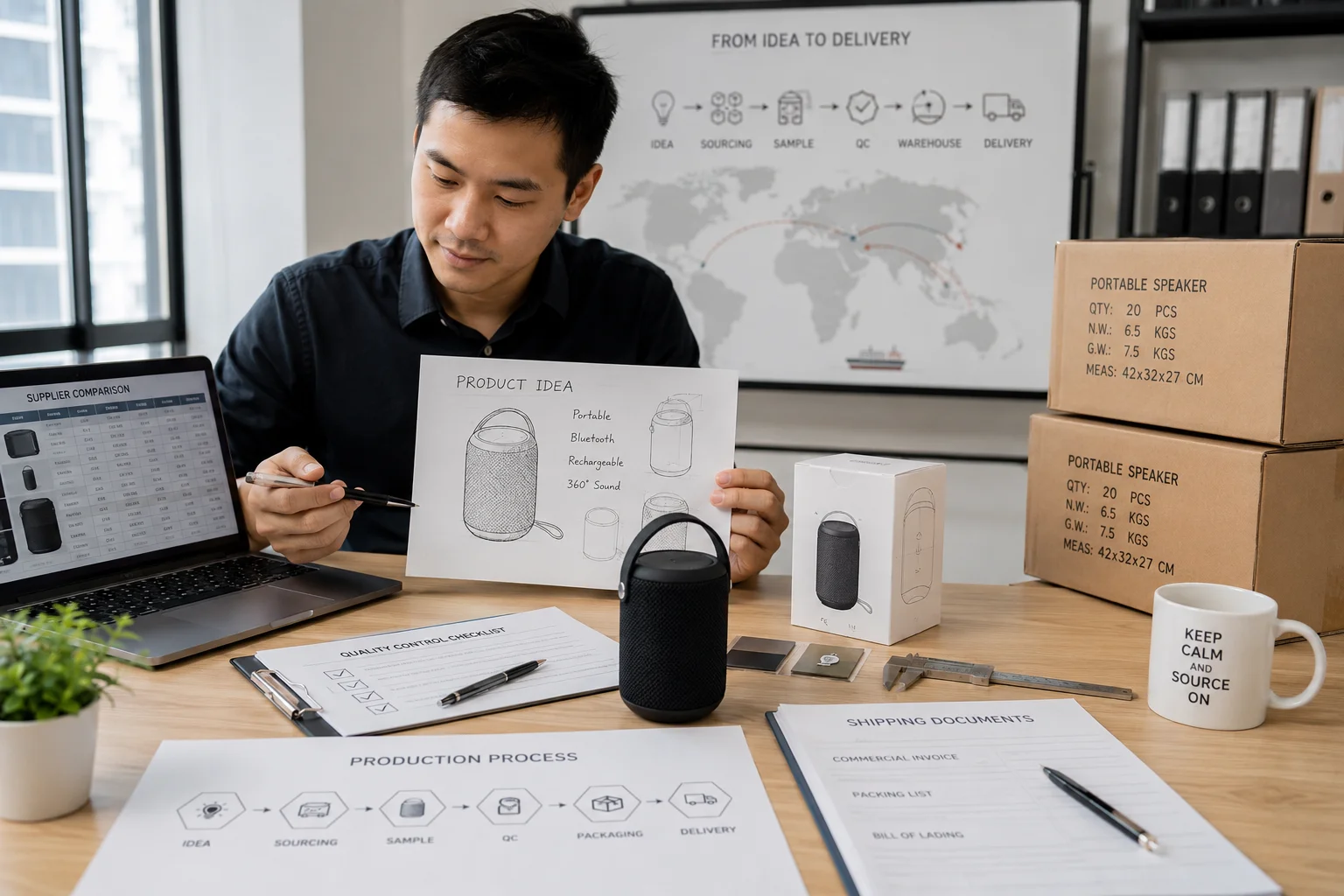
I have seen many buyers start with only a competitor link, a photo, or a rough product idea. That is normal. The real work starts when I turn that idea into something a supplier can quote, sample, produce, inspect, pack, and ship. If I skip one step, the risk does not disappear. It usually comes back later as a wrong sample, unstable bulk quality, late delivery, or a landed cost that kills the profit.
1. What Is the China Product Sourcing Process?
Many buyers think sourcing means finding a factory. I see the bigger problem. A supplier search without control can create hidden cost and quality risk.[^2]
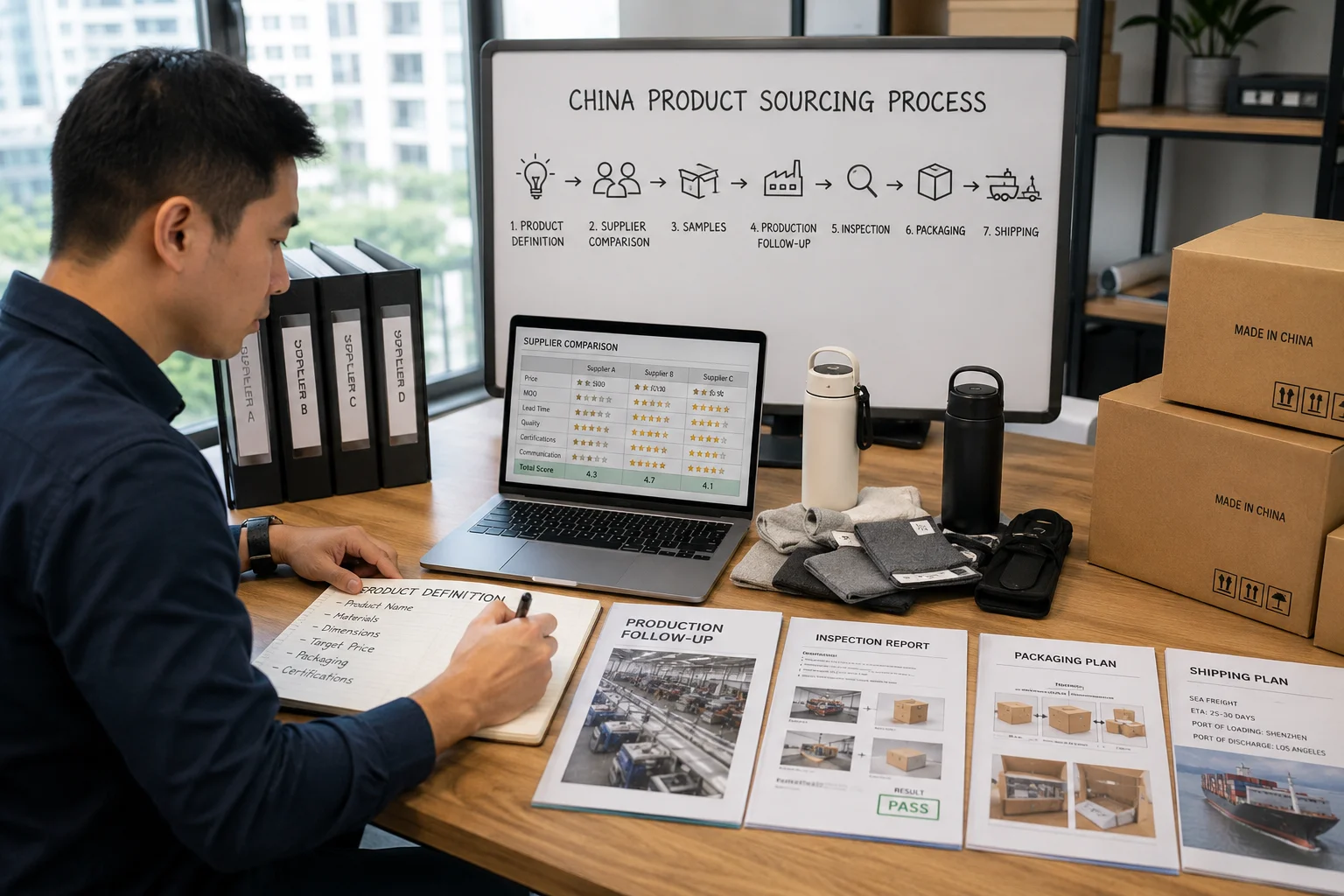
The China product sourcing process is a step-by-step system that helps buyers define the product, compare suppliers, check samples, verify production, inspect goods, arrange packaging, and deliver orders from China to the final destination.
I see sourcing as a control process
In my daily work, I do not treat China sourcing as one single action. I treat it as a chain of decisions. Each decision removes one type of risk. A buyer may ask, “Can you find this product?” I can usually start from that point. But I also need to ask what the product must do, what quality level is acceptable, what price range can work, and how the goods will be shipped.
| Step I manage | Risk I try to reduce | What I check first |
|---|---|---|
| Product requirements | Wrong product direction | Use, material, size, function |
| Supplier comparison | Choosing weak suppliers | MOQ, response, capacity, fit |
| Sampling | Bad product match | Specs, photos, tests, notes |
| Verification | Supplier risk | Business info, factory type, records |
| Production follow-up | Bulk quality gap | Timeline, materials, updates |
| Inspection | Defect risk | Quantity, function, packaging |
| Shipping | Profit and delay risk | Volume, route, landed cost |
I often tell first-time buyers that the lowest quote is not the same as the best sourcing result.[^3] A low price can be useful. But it can also hide thin materials, weak packaging, slow production, or poor after-sales support. I want the buyer to know the real cost before money is locked in.
2. Step 1: Turn Your Product Idea into Clear Sourcing Requirements?
A vague idea can create vague quotes. I have seen this many times. When suppliers guess your needs, your order becomes harder to control.
You should turn your idea into sourcing-ready requirements before asking for quotes.[^4] I usually define product use, functions, size, material, target price, order quantity, MOQ limit, packaging, branding, and reference images or links.
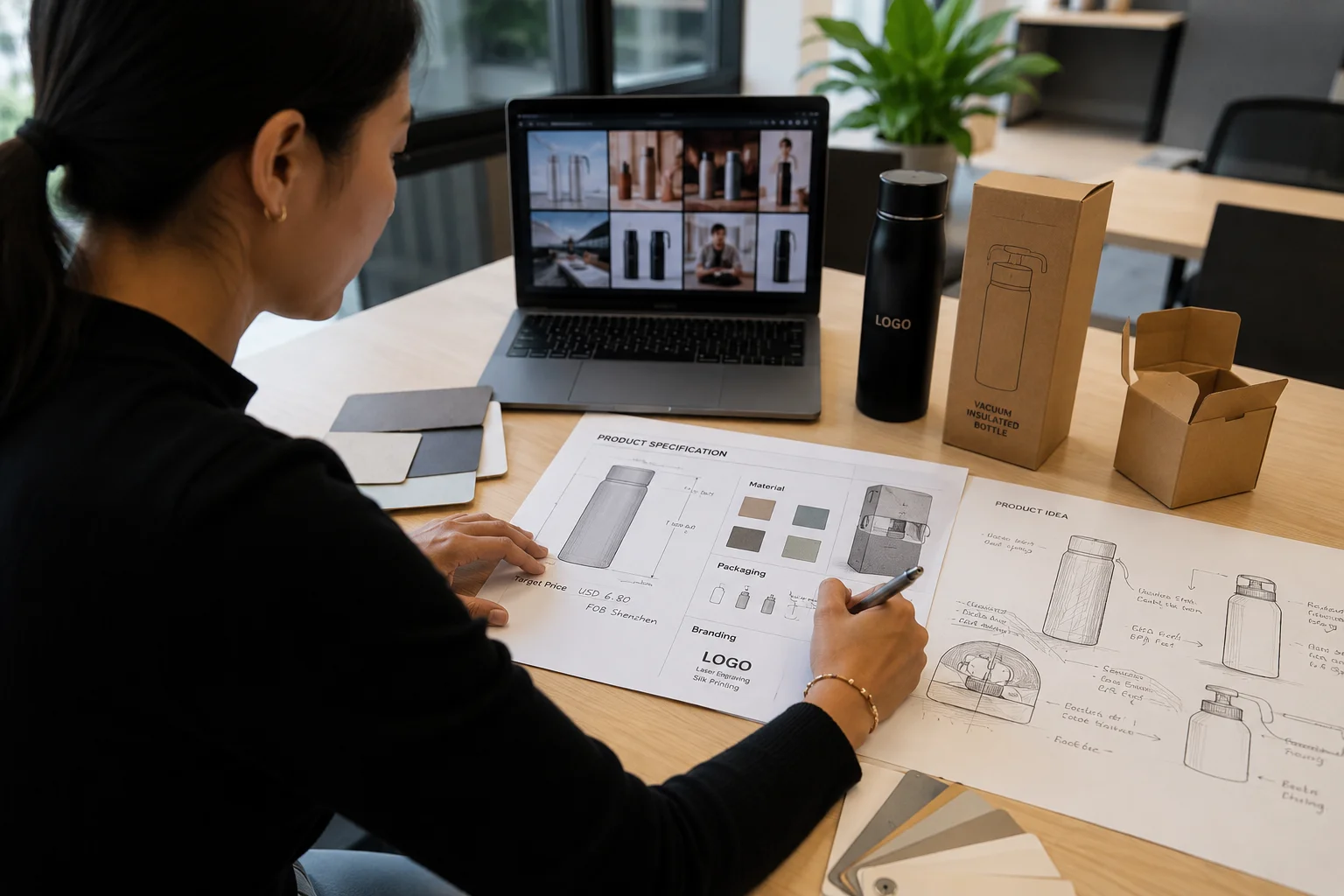
I start by making the product clear
When a buyer sends me a product photo, I do not rush to ask ten suppliers for prices. I first try to understand the product in business terms. I ask where the product will be sold. I ask who will use it. I ask what feature must not fail. I also ask what price range still leaves room for profit after shipping and platform fees.
| Requirement | Why I ask for it | Example |
|---|---|---|
| Product use | I need to match the right supplier | Home storage, pet travel, fitness use |
| Core function | I need to protect the main value | Waterproof, foldable, heat resistant |
| Non-negotiable points | I need to avoid quality disputes | No smell, strong zipper, smooth surface |
| Target price | I need to filter suppliers early | Under $3.50 per unit |
| Test quantity | I need to check MOQ fit | 200, 500, or 1,000 pcs |
| Packaging | I need to estimate cost and volume | Polybag, color box, bundle set |
| Branding | I need to check custom options | Logo print, label, insert card |
I once worked with a small ecommerce seller who only had a competitor link. The product looked simple, but the real cost changed when we added custom packaging and stronger material. The buyer was not wrong. The idea was just not ready for sourcing. After we listed the must-have points, the supplier quotes became easier to compare. The buyer could then choose based on product fit, not only price.
3. Step 2: Find and Compare Reliable Chinese Suppliers?
A supplier list can look strong on the surface. The problem starts when communication, MOQ, sample quality, or delivery ability does not match your order.
I compare Chinese suppliers by product fit, reliability, MOQ, response quality, sample ability, production capacity, packaging support, and shipping feasibility. I do not judge suppliers only by the lowest unit price.
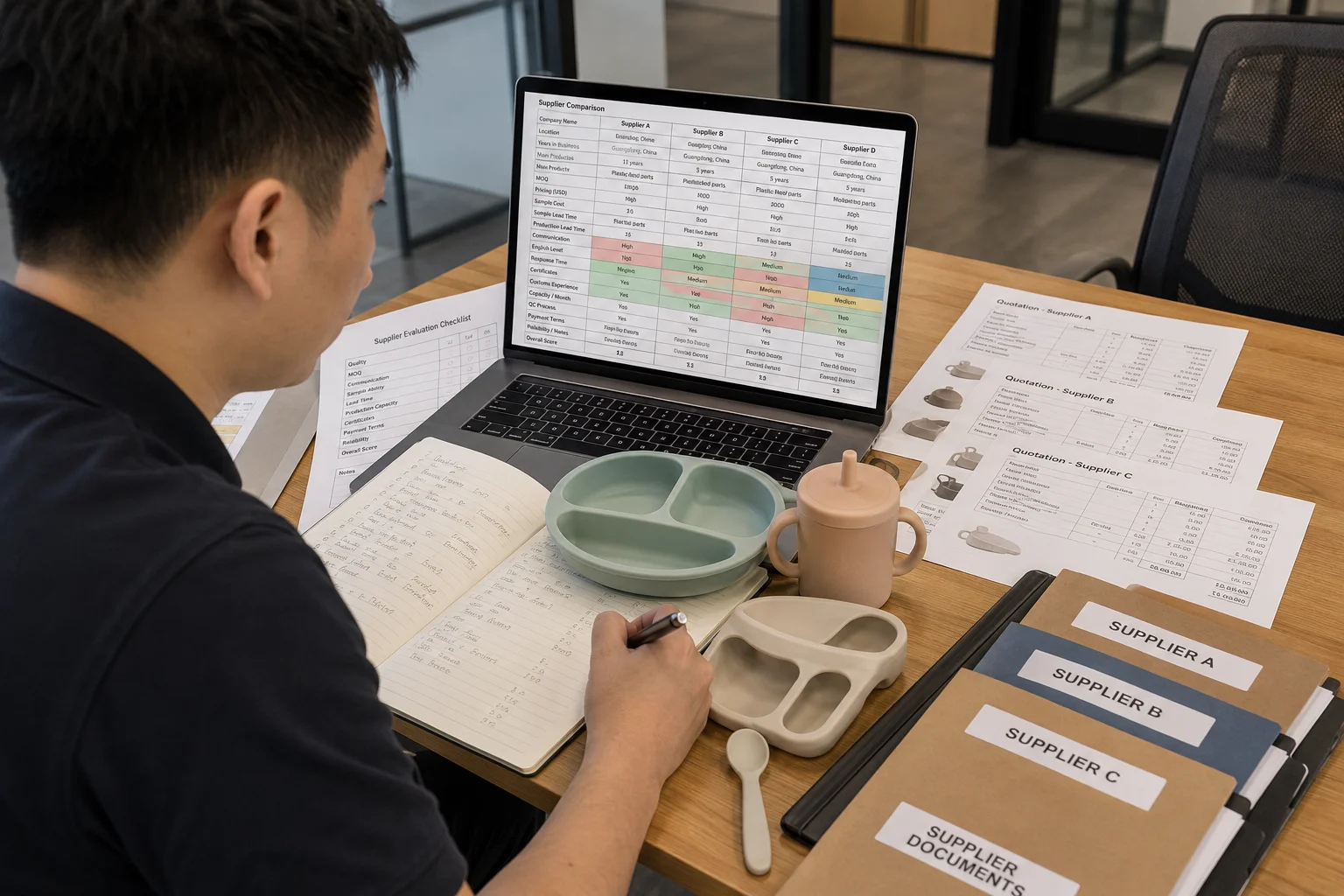
I compare the full supplier fit
I use Alibaba, 1688, direct factory contacts, trade show sources, and local networks when they fit the project. I do not treat any channel as perfect or useless. Each channel needs checking. A strong supplier for one buyer may be a poor choice for another buyer. A factory that is good for 50,000 pieces may not care about a 500-piece test order. A trading company may be better when the buyer needs small MOQ, mixed products, or packaging help.
| Supplier factor | What I look for | Why it matters |
|---|---|---|
| Product match | Similar products already made | It lowers development risk |
| MOQ | Flexible test order support | It protects cash flow |
| Communication | Clear replies and questions | It reduces mistakes |
| Quote details | Material, size, packing, lead time | It avoids hidden changes |
| Sample support | Fast and accurate sample work | It helps validation |
| Capacity | Stable production plan | It lowers delay risk |
| Packaging help | Box, label, barcode, set packing | It supports ecommerce sales |
I have seen buyers choose the lowest quote, then find out later that the supplier used a thinner material or did not include the right packaging. I do not blame the buyer. The quote looked attractive. My job is to slow the process down enough to compare what is actually included. A cheaper price is useful only when the product, quality, packaging, and delivery terms are still acceptable.
4. Step 3: Request Quotes, Samples, and Product Specifications?
A good sample can feel like proof. I still stay careful. A sample is only one piece, and bulk production can be different.
I request quotes, samples, and written specifications together. I check price, MOQ, material, size, packaging, lead time, sample cost, customization options, and the exact details that must match during bulk production.
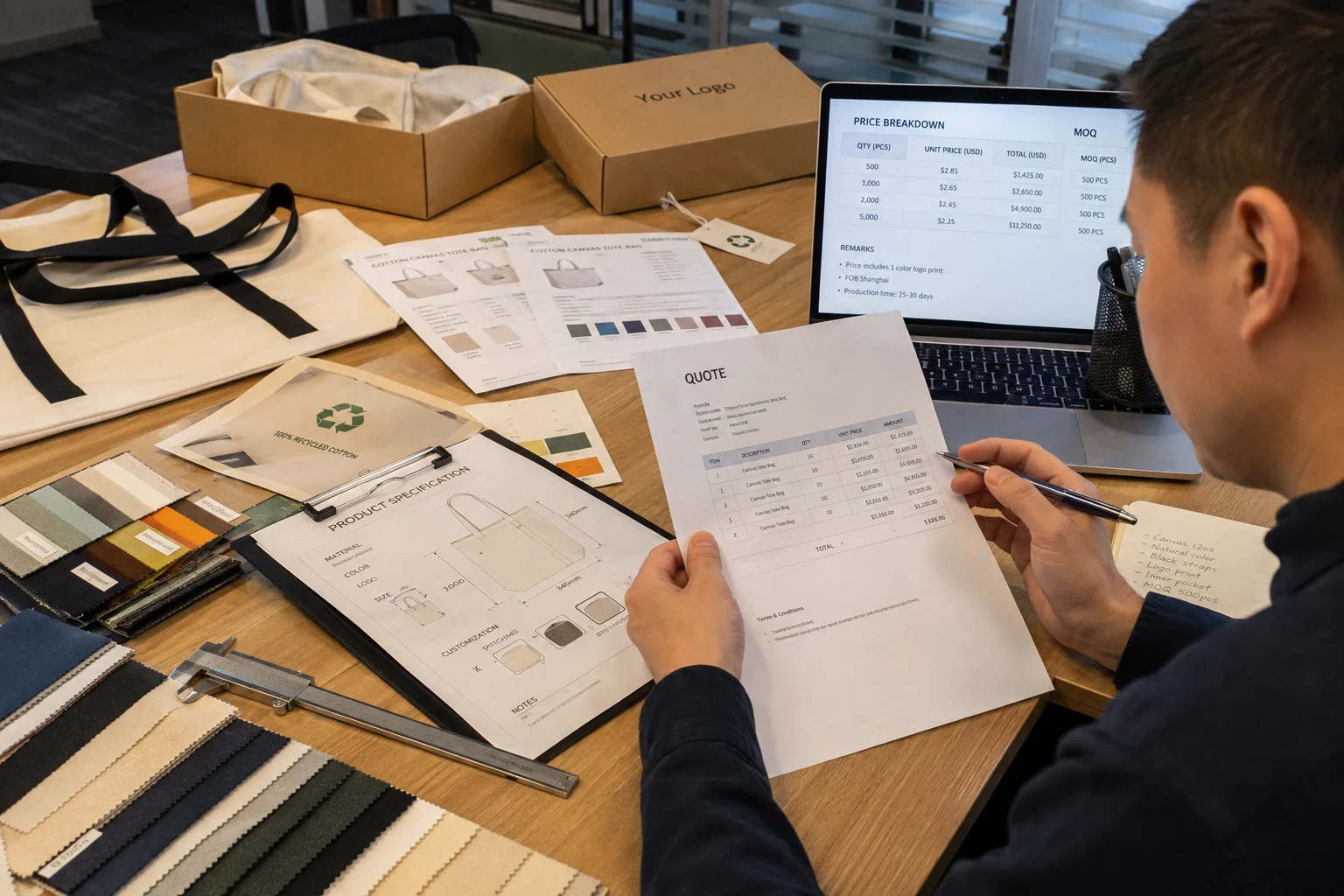
I use samples to confirm, not to assume
When I request a quote, I do not only ask, “How much?” I ask what the price includes. I ask if the material is fixed. I ask if the supplier can use the buyer’s logo. I ask how the product will be packed. I also ask how long sampling and bulk production will take. These details matter because they become the base for later inspection.[^5]
| Item I confirm | What can go wrong if I skip it |
|---|---|
| Material | The bulk product may feel cheaper |
| Size and weight | Shipping cost may increase |
| Color | Bulk color may not match the brand |
| Logo method | The logo may peel or look poor |
| Packaging | The product may arrive damaged |
| Accessories | Parts may be missing in bulk goods |
| Lead time | Launch date may be delayed |
I often remind buyers that an approved sample should create a record. I keep photos, videos, notes, packaging details, and supplier confirmations. If the buyer changes something after sample approval, I record that too. This is not paperwork for its own sake. It helps me compare the bulk goods against what was agreed. A sample reduces risk, but it does not remove the need for production follow-up and inspection.[^6]
5. Step 4: Verify Suppliers Before Placing an Order?
A supplier can sound professional online. I still need proof before a buyer sends a deposit. Trust is useful, but checking is safer.
I verify suppliers before order placement by checking business information, product experience, factory or trading role, production ability, communication records, sample result, and basic order terms.[^7] This helps reduce supplier and execution risk.
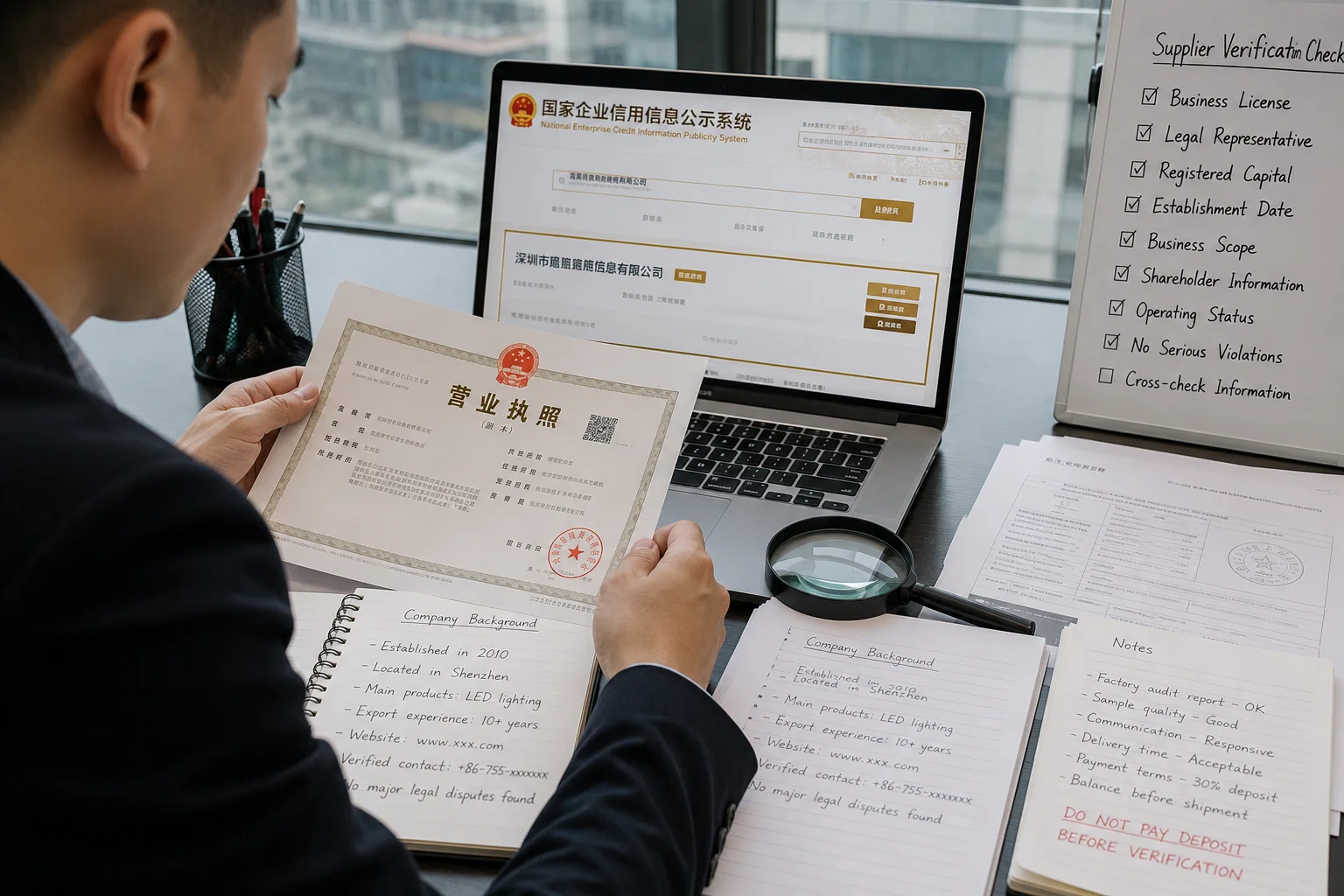
I check who will really handle the order
Supplier verification does not always mean a deep audit. The level depends on order size, product risk, and buyer budget.[^8] For a small test order, I may focus on business records, communication, product match, sample result, and payment terms. For a larger order, I may suggest a factory visit, video check, or third-party audit if the buyer needs it. I stay careful with promises because no check can remove all risk. But basic verification can stop many avoidable mistakes.
| Verification point | What I want to know | Risk reduced |
|---|---|---|
| Business license | Is the company real? | Fake or weak supplier risk |
| Product history | Have they made similar goods? | Learning curve risk |
| Factory or trader | Who controls production? | Communication and cost risk |
| Production photos | What does the workshop show? | Capacity and process risk |
| Sample result | Can they meet the request? | Quality mismatch risk |
| Payment terms | Are terms normal and clear? | Cash and dispute risk |
| Order terms | Are specs and timelines written? | Later argument risk |
I have met buyers who felt pressure to place an order quickly because a supplier said the price would rise. Sometimes that is true. Sometimes it is only a sales tactic. I prefer to check the supplier first, especially when the buyer is new to China sourcing. A short delay before payment can save a much longer delay after production problems appear.
6. Step 5: Manage Production, Quality Control, and Pre-Shipment Inspection?
Bulk production is where many small issues become expensive. If I wait until delivery, the buyer may have little room to fix problems.
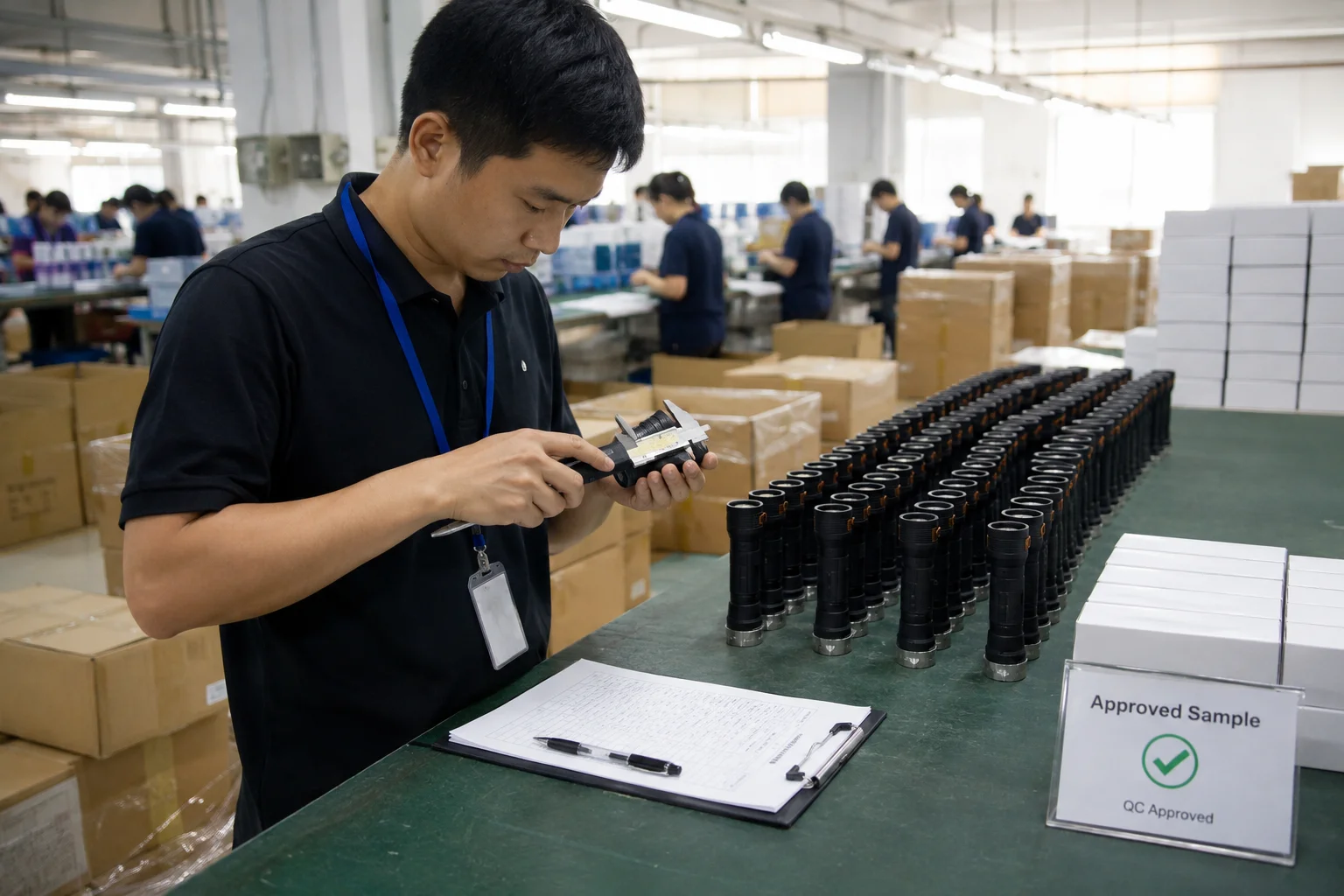
I manage production by tracking timelines, confirming materials, checking updates, setting inspection points, and arranging pre-shipment inspection.[^9] Quality control should compare bulk goods with approved samples and written specifications.[^10]
I do not let the order go silent
After the deposit is paid, I keep following the order. I check whether materials are ready. I check whether production has started. I ask for photos or videos at key points. I confirm packaging before mass packing. I also plan the inspection before the goods leave the factory. This matters because many problems are easier to fix before shipment than after the goods reach the buyer’s country.
| Production stage | What I follow | Why I follow it |
|---|---|---|
| Material purchase | Main material, color, accessories | I want early warning |
| First production | First pieces or first batch | I want to catch mistakes |
| Mid-production | Progress and common defects | I want to avoid delay |
| Final packing | Box, label, barcode, carton mark | I want shipping-ready goods |
| Pre-shipment inspection | Quantity, function, appearance, packing | I want proof before release |
I often see one wrong idea in sourcing. Some buyers think a good sample means bulk goods will be the same. In many projects, that is not safe to assume. Factory workers may use a different batch of material. The logo position may shift. The carton may be weaker than expected. The accessory count may be wrong. Inspection does not make risk zero, but it gives the buyer information before the final balance is paid and before the goods leave China.
7. Step 6: Handle Warehousing, Consolidation, Packaging, and Shipping?
Shipping problems often start before shipping. I see buyers lose profit because packaging size, carton weight, or delivery method was ignored too late.[^11]
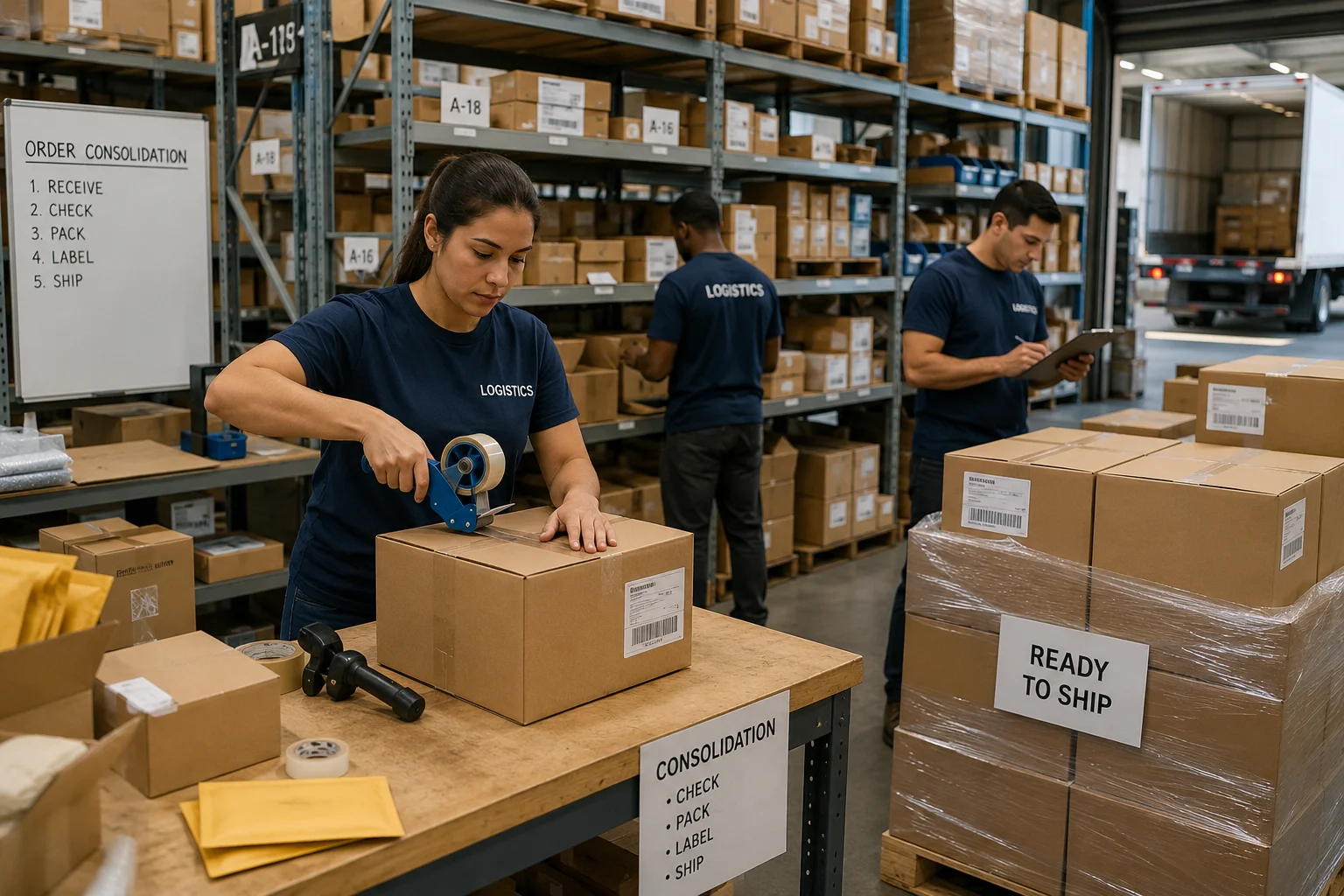
I plan warehousing, consolidation, packaging, and shipping early. I check carton size, product volume, packaging strength, labeling, mixed orders, shipping method, delivery time, and estimated landed cost before final shipment.
I treat delivery as part of the product plan
I do not wait until the goods are finished before thinking about delivery. If the product is bulky, the shipping cost can change the full business plan. If the packaging is weak, damage can create refunds.[^12] If the buyer sells on Amazon, Shopify, or wholesale channels, labeling and carton rules may also matter. I check these points early because delivery risk can start during product design and packaging design.
| Delivery factor | What I check | Business impact |
|---|---|---|
| Carton size | Length, width, height | Affects freight cost |
| Carton weight | Gross weight per carton | Affects handling and shipping |
| Packaging strength | Inner and outer protection | Reduces damage risk |
| Labels | SKU, barcode, FBA or warehouse labels | Avoids receiving issues |
| Consolidation | Goods from many suppliers | Saves handling and shipping work |
| Warehouse storage | Short-term holding in China | Helps order timing |
| Shipping method | Air, sea, rail, express, truck | Controls cost and speed |
I once helped a buyer compare two similar products. One had a lower unit cost, but the carton volume was much larger. The landed cost became higher after freight. That is why I like to estimate shipping early. A product is not truly cheap until it reaches the buyer’s warehouse, customer, or 3PL at a cost that still leaves profit. I also help combine orders from different suppliers when it makes sense. This can reduce confusion and make shipment management easier.
8. How Does a China Sourcing Agent Help Manage the Whole Process from Idea to Delivery?
A buyer without a local team must manage suppliers from far away. Time zones, language, follow-up, inspection, and logistics can slow every decision.
A China sourcing agent helps by turning product ideas into clear requirements, finding and comparing suppliers, managing samples, verifying suppliers, following production, checking quality, arranging packaging, consolidating goods, and coordinating shipping.
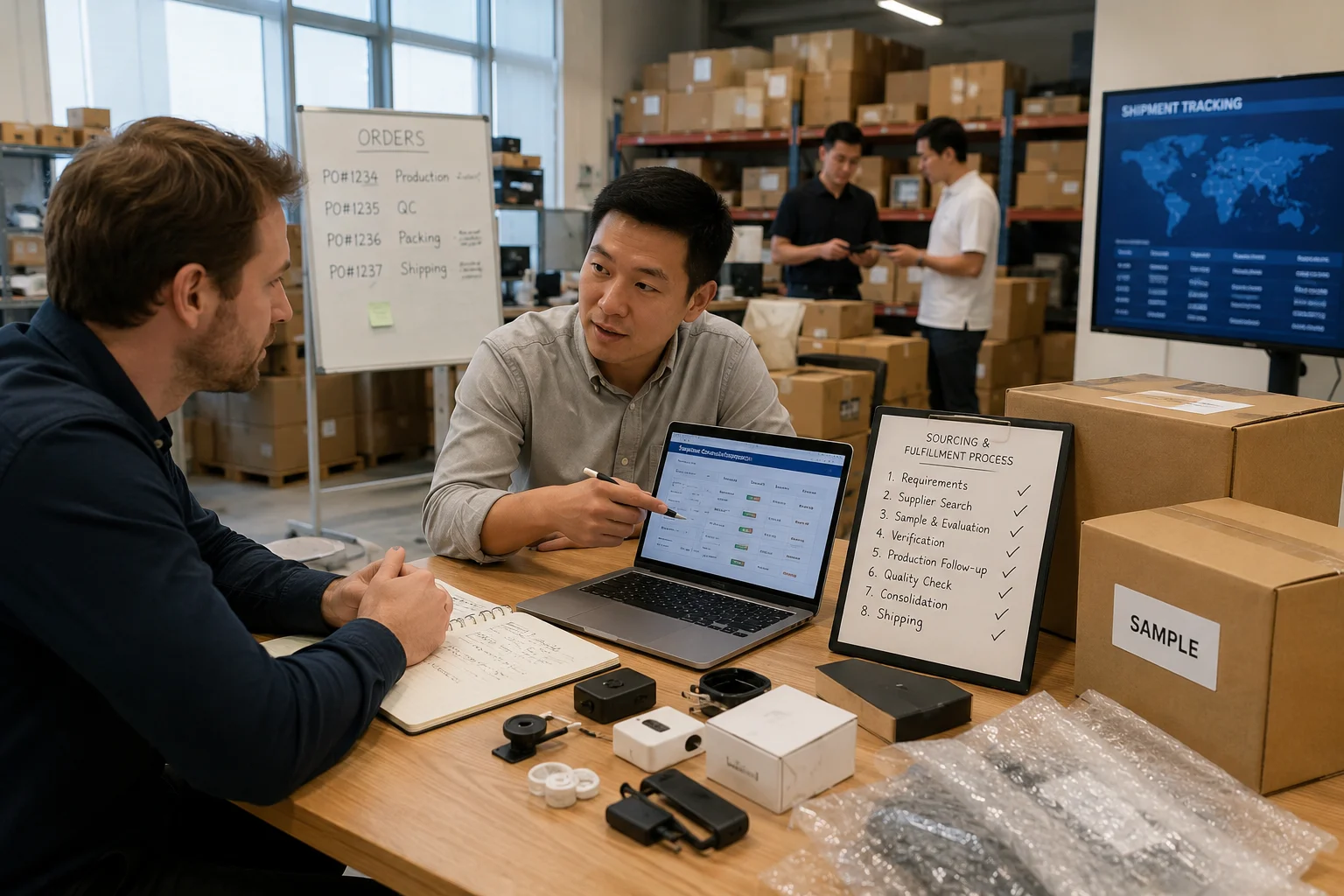
I act as the buyer’s local execution team
At KingSourcing, I do not replace the buyer’s business judgment. The buyer still decides the market, price position, brand direction, and sales plan. My role is to help execute the China side with more control. I help the buyer ask better questions, compare suppliers more clearly, and avoid moving forward based only on a low price or a nice sample photo.
| What I help with | How it helps the buyer |
|---|---|
| Requirement building | I turn ideas into supplier-ready details |
| Supplier sourcing | I find and compare options |
| Quote checking | I show what is included and missing |
| Sample follow-up | I help confirm product details |
| Supplier verification | I reduce blind trust |
| Production tracking | I keep the order moving |
| Quality inspection | I check goods before shipment |
| Packaging support | I prepare goods for selling channels |
| Warehousing and consolidation | I manage goods from many suppliers |
| Shipping coordination | I help move goods from China to destination |
I often work with first-time buyers who feel unsure about where to start. Some buyers have around a few hundred dollars for a test order. Some buyers have large yearly purchase plans and need a more stable supply chain. The process is different in size, but the logic is the same. I first make the product clear. I then find and compare suppliers. I help validate samples. I follow production. I check goods. I arrange the delivery path. This is how I help make China sourcing simpler, more transparent, and easier to manage.
Conclusion
I see China sourcing as a controlled path from idea to delivery. Each step helps reduce risk, protect profit, and make better buying decisions.
[^1]: "[PDF] EFFECTIVE METHODOLOGIES FOR SUPPLIER SELECTION AND ...", https://etda.libraries.psu.edu/files/final_submissions/419. A procurement-cycle source can be cited to show that sourcing is commonly treated as a sequence of requirements definition, supplier evaluation, purchasing controls, and fulfillment management rather than as a single supplier-search step. Evidence role: definition; source type: institution. Supports: A procurement framework should show that sourcing/procurement commonly includes need definition, specifications, supplier identification or evaluation, contracting, performance management, and delivery or fulfillment controls.. Scope note: This would support the general procurement structure, not prove that every China sourcing project follows the exact sequence described in the article. [^2]: "Risk factors in the assessment of suppliers - PMC - NIH", https://pmc.ncbi.nlm.nih.gov/articles/PMC9342744/. Research on supplier selection and total cost of ownership supports the view that inadequate supplier evaluation can expose buyers to quality, delivery, and indirect cost risks beyond the initial quoted price. Evidence role: expert_consensus; source type: paper. Supports: A peer-reviewed supply-chain management source should explain that supplier selection should consider quality, delivery, reliability, and total cost, not only supplier availability or quoted price.. Scope note: The source would support the general procurement principle rather than document the specific cases described by the author. [^3]: "15.101-2 Lowest price technically acceptable source selection ...", https://www.acquisition.gov/far/15.101-2. Best-value procurement guidance distinguishes lowest initial price from overall value, noting that quality, performance, delivery, and total cost may justify selecting an offer that is not the cheapest. Evidence role: expert_consensus; source type: government. Supports: A procurement source should support the distinction between lowest price and best value, including consideration of quality, performance, delivery, and total cost.. Scope note: Best-value procurement sources often address public contracting, so the citation would provide a transferable procurement principle rather than a China-specific rule. [^4]: "SOP-PURCH-03: Competition and Sourcing: Procedures", https://procurement.iu.edu/sop/sop-purch-03.html. Public procurement guidance generally treats clear specifications or statements of requirements as a prerequisite for obtaining comparable supplier quotations. Evidence role: mechanism; source type: government. Supports: A public procurement guide should explain that clear requirements or specifications are needed before soliciting quotes so suppliers can price comparable offers.. Scope note: Government procurement rules may be more formal than private ecommerce sourcing, but the underlying need for clear requirements is directly relevant. [^5]: "ISO 9001 and 9002 Requirements by Section", https://faculty-web.msoe.edu/tritt/be4xx/iso9000sum.html. Quality-management standards describe inspection and release activities as evaluations against specified requirements or acceptance criteria, which makes written product details central to later quality checks. Evidence role: mechanism; source type: institution. Supports: A quality-management source should support that product release and inspection are based on specified requirements and acceptance criteria.. Scope note: The citation would support the inspection principle generally and would not verify any one supplier's inspection practice. [^6]: "What kinds of Lot Acceptance Sampling Plans (LASPs) are there?", https://www.itl.nist.gov/div898/handbook/pmc/section2/pmc22.htm. Acceptance-sampling and quality-control standards treat samples as evidence for judging a lot or process, not as a guarantee that all subsequent production will conform without further controls. Evidence role: mechanism; source type: institution. Supports: A standards or quality-control source should explain that sampling and sample approval provide evidence about products but do not guarantee every unit in later production conforms.. Scope note: The source would support the general limitation of sample-based assurance, not the specific supplier behaviors listed in the article. [^7]: "[PDF] Supplier Qualification - QP-7.1 Revision 0", https://energy.gov/sites/prod/files/2015/09/f26/QP-7.1%20Supplier%20Qualification%20Rev0.pdf. Supplier-qualification guidance and quality-management standards support evaluating external providers against defined criteria such as capability, product conformity, performance history, and purchasing terms before committing orders. Evidence role: expert_consensus; source type: institution. Supports: A procurement or quality-management source should show that organizations evaluate suppliers based on capability, conformity, performance, and defined selection criteria before purchase.. Scope note: The source would support the evaluation categories in principle, not prescribe the exact checklist used by the author. [^8]: "Risk factors in the assessment of suppliers - PMC - NIH", https://pmc.ncbi.nlm.nih.gov/articles/PMC9342744/. Risk-based supplier-control frameworks state that the extent of evaluation and monitoring should reflect the supplier's effect on product conformity, operational risk, and purchasing context. Evidence role: mechanism; source type: institution. Supports: A quality or procurement standard should support applying supplier controls in proportion to the risk, criticality, or effect of externally provided goods and services.. Scope note: The source would justify scaling verification by risk, but buyer budget is a practical constraint rather than a formal criterion in many standards. [^9]: "Quality Control in Manufacturing: Overview and Best Practices", https://www.6sigma.us/manufacturing/quality-control-in-manufacturing/. Quality-management standards support controlling production through monitored processes, verification activities, acceptance criteria, and release checks before products are delivered. Evidence role: general_support; source type: institution. Supports: A quality-management source should support monitoring production conditions, verifying materials or outputs, and using inspection or release checks before shipment.. Scope note: The source would support the control logic generally and may not use the commercial term 'pre-shipment inspection' in the same way as sourcing agents. [^10]: "Conformity Assessment Basics | NIST", https://www.nist.gov/standardsgov/conformity-assessment-basics. Conformity-assessment and inspection practice evaluates goods against defined requirements; approved samples and written specifications can serve as reference criteria for judging bulk production. Evidence role: mechanism; source type: institution. Supports: An inspection or conformity-assessment source should state that products are inspected for conformity against specified requirements, and that approved samples may serve as reference standards.. Scope note: The source would support the inspection basis, but it would not prove that a particular shipment conforms. [^11]: "Volume Calculator | Aviationcargo - DHL Aviation Cargo", http://aviationcargo.dhl.com/business-tools/volume-calculator. Logistics guidance on freight pricing explains that shipment cost is affected by weight, volume or dimensional weight, and transport mode, making packaging and delivery decisions material to total sourcing cost. Evidence role: mechanism; source type: institution. Supports: A logistics or transport source should explain that freight charges may depend on shipment dimensions, weight, and transport mode, affecting total delivered cost.. Scope note: The source would explain the cost mechanism, not quantify the profit impact for the article's specific products. [^12]: "[PDF] Load Securement and Packaging Methods to Reduce Risk of ...", https://repository.rit.edu/cgi/viewcontent.cgi?article=1008&context=japr. Packaging and logistics research links inadequate protective packaging with higher risk of product damage during distribution, which can generate return, refund, or replacement costs. Evidence role: mechanism; source type: paper. Supports: A packaging or logistics study should show that inadequate transport packaging increases the likelihood of distribution damage and related return or cost consequences.. Scope note: The citation would support the damage-and-cost pathway generally, not the refund rate for a specific sales channel.