Many first-time importers feel excited first. Then supplier messages, MOQs, samples, payments, and shipping costs become stressful fast.
To work with a China sourcing agent for the first time, I should prepare clear product requirements, budget, MOQ, target market, packaging needs, and service expectations. Then I should let the agent screen suppliers, compare quotes, follow samples, track production, inspect goods, and support shipping.

I have seen many new buyers start with one simple request: “Can you find me a factory?” That sounds clear. But it is often not enough. A sourcing project only works well when the buyer and the agent agree on the product, budget, timeline, risk level, and tasks before sourcing starts[^1]. If I treat the agent as only a price finder, I may miss the real value. If I treat the agent as my local purchasing office in China, I can build a more controlled process.
1. Why Do First-Time Importers Work with a China Sourcing Agent?
Many new buyers want China prices. Then they meet language gaps, unclear factories, poor samples, and shipping surprises[^2].
A first-time importer works with a China sourcing agent to reduce trial-and-error cost, check suppliers, manage communication, follow samples and production, inspect goods, and arrange shipping with more control.

When I speak with first-time clients, I often hear the same worry. They do not know if a supplier is real. They do not know if a low quote includes the same material. They also do not know if the factory can handle their packaging, labeling, inspection, or shipping needs. A sourcing agent helps turn these unknown points into tasks that can be checked.
I do not see a good agent as a magic solution. I see the agent as a local operator. The agent helps me ask better questions, compare suppliers in a fair way, and avoid basic mistakes. The agent can also tell me when my budget, MOQ, or product idea does not match the real market.
| First-time buyer problem | How I expect a sourcing agent to help |
|---|---|
| I only have a product photo | Help turn it into clear requirements |
| I do not know the right supplier | Search, compare, and screen options |
| I fear sample mismatch | Follow sample details and confirm changes |
| I fear poor quality | Arrange inspection before shipment |
| I do not understand total cost | Check product cost, packaging, and shipping together |
The real value is not only finding one factory. The real value is creating a sourcing process that I can understand and control.
2. What Information Should I Prepare Before Contacting a Sourcing Agent?
Many buyers contact an agent too early. Then the agent cannot quote, compare, or judge suppliers in a useful way.
Before I contact a sourcing agent, I should prepare product references, specifications, target functions, quantity, budget, MOQ limit, market, sales channel, packaging needs, and expected service scope.
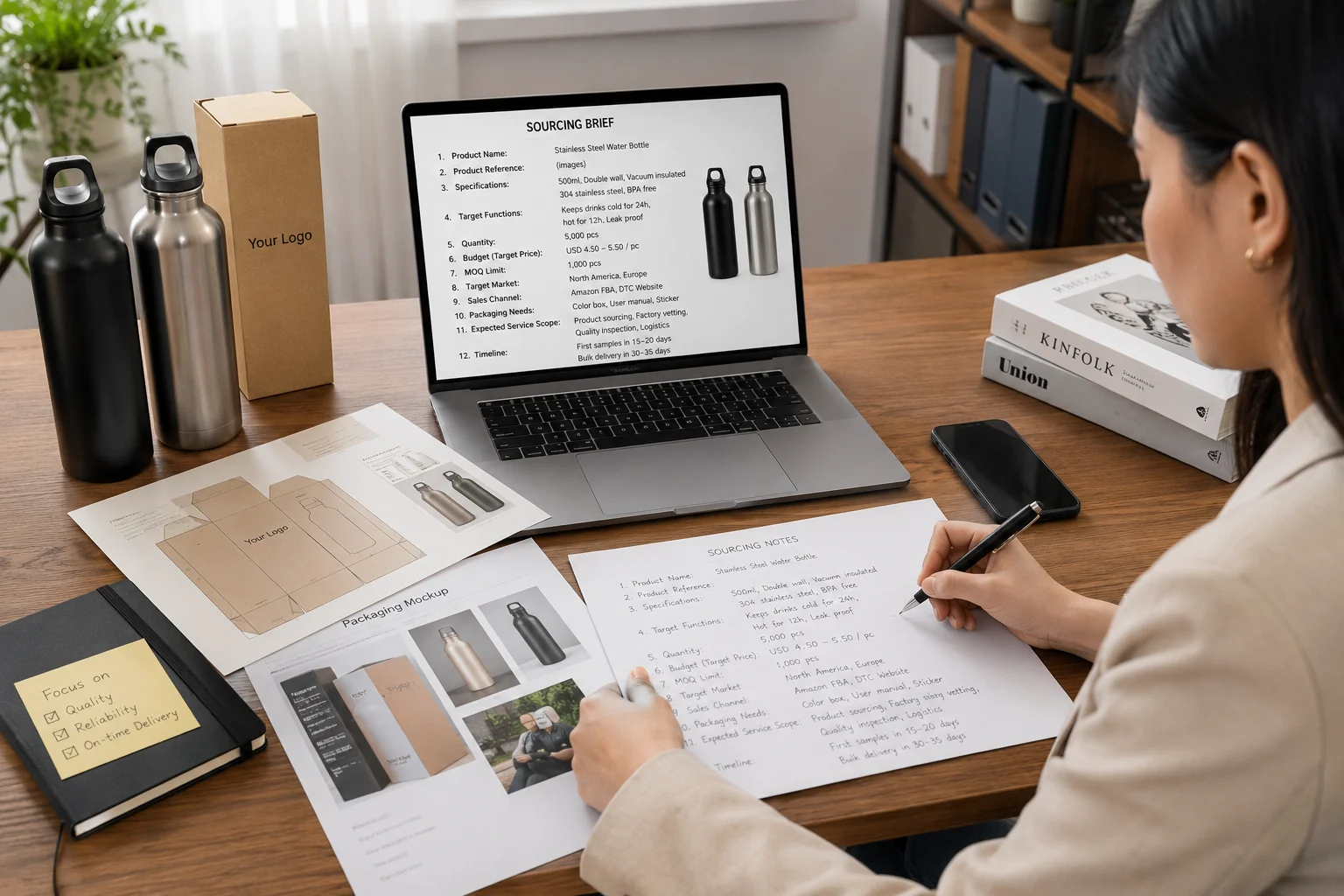
I do not need a perfect product file before I contact an agent. But I need enough information for the agent to understand what I want. A product photo alone is helpful, but it is not complete.[^3] Two products may look the same and use very different material, size, parts, coating, or packaging. The price can change a lot.
I usually suggest that first-time buyers prepare a simple sourcing brief. It can be one page. It should explain what the product is, where it will be sold, what quality level is needed, and what cost range can work. If I sell on Amazon, my packaging, barcode, carton mark, and delivery route may matter. If I sell through my own DTC store, branding and lifestyle photos may matter more.
| Information to prepare | Why it matters |
|---|---|
| Product link or photo | Gives the agent a starting point |
| Size, material, color | Prevents wrong supplier matching |
| Target order quantity | Helps check MOQ and price level |
| Budget range | Saves time on impossible options |
| [Target market | Affects labeling and packaging needs](https://www.ftc.gov/legal-library/browse/rules/fair-packaging-labeling-act-regulations-under-section-4-fair-packaging-labeling-act)[^4] |
| Sales channel | Affects packaging, photos, and logistics |
| Needed services | Clarifies agent fee and work scope |
The clearer I am at the start, the less time I waste later. Clear input does not remove every risk, but it gives the agent a real base for sourcing.
3. How Should I Share My Product Requirements, Budget, MOQ, and Target Market?
Many sourcing problems start with vague words. “Good quality” and “cheap price” do not guide factories well.
I should share specific product requirements, a realistic budget range, acceptable MOQ, and target market so the agent can match suppliers that fit my business stage and risk level.

When I ask for sourcing help, I should not only say, “I need this product.” I should explain what version I need. For example, I can share the material, size, function, color, logo position, packaging style, and safety concerns. If I do not know all details, I should say what is fixed and what is flexible.
Budget is also important. Some first-time buyers feel nervous about sharing a budget. I understand that worry. But without a budget range, the agent may compare suppliers that do not fit the project. A cheap product may fail my brand position. A premium supplier may have an MOQ I cannot accept. The goal is not to let the agent spend all my money. The goal is to guide the search.
| Item I should define | Example |
|---|---|
| Product requirement | Stainless steel bottle, 750ml, matte black |
| Function | Keeps water cold for 12 hours |
| Budget | Target landed cost under a set range |
| MOQ | Test order from 300 to 500 units if possible |
| Market | United States, online sales |
| Packaging | Custom color box with barcode |
I also need to tell the agent my tolerance for risk. If I am testing a product, I may accept a higher unit cost and lower MOQ. If I am building a long-term brand, I may need better samples, packaging, and inspection. These choices affect supplier selection from the first step.
4. How Does a Sourcing Agent Find, Compare, and Verify Chinese Suppliers?
Many suppliers can give a quote. Fewer suppliers can meet the right quality, MOQ, communication, and delivery needs.
A sourcing agent finds suppliers through local channels, compares price and capability, checks business fit, and verifies whether the supplier can handle the buyer’s product, quantity, packaging, and timeline.
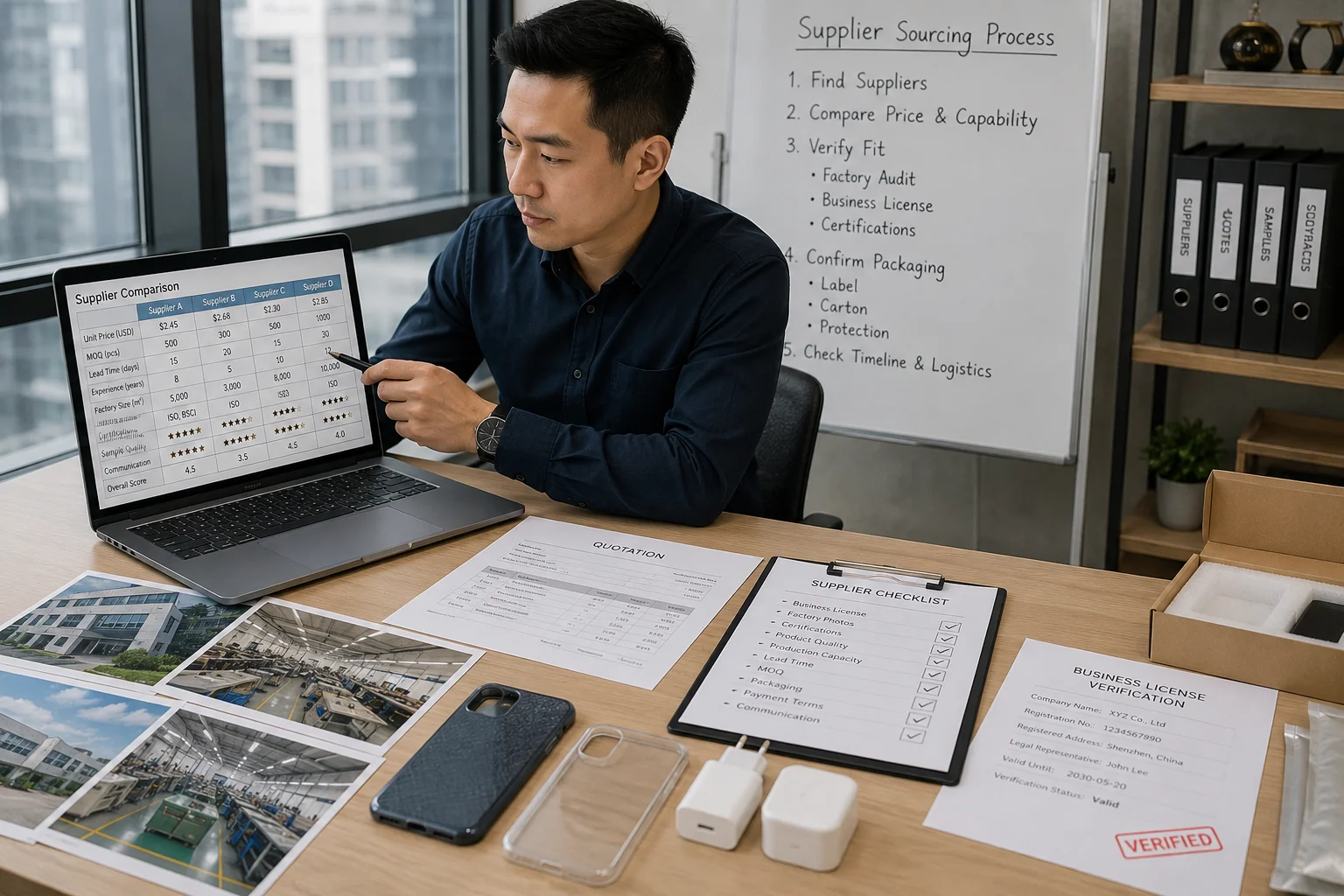
When I source from China, I do not want to choose a supplier only because the first price looks low. A low quote can hide many problems.[^5] The material may be different. The packaging may not be included. The MOQ may rise after sampling. The production time may be too long. The supplier may also be a trading company, not a factory. That is not always bad, but I should know who I am working with.
A sourcing agent can compare suppliers across several points. Price is one point. It is not the only point. I also want to look at product focus, past experience, response speed, sample quality, MOQ, payment terms, packaging ability, and production capacity. If needed, the agent can arrange deeper checks. But I should remember that normal supplier screening is not the same as legal, financial, or lab certification work.[^6]
| Supplier check point | What I want to know |
|---|---|
| Product match | Does the supplier make this type of product often? |
| MOQ | Can they support my test order? |
| Price details | What is included and excluded? |
| Sample ability | Can they make the sample I need? |
| Communication | Do they reply clearly and on time? |
| Packaging support | Can they handle my label or box needs? |
| Production timing | Can they meet my sales plan? |
I want the agent to show me comparison results in a clear way. Then I can choose with more confidence, not just with hope.
5. How Should I Review Quotes, Samples, Product Details, and Payment Terms?
Many first-time buyers compare only unit price. Then they find hidden costs after they already feel committed.
I should review quotes with product details, sample results, packaging, MOQ, payment terms, lead time, inspection plan, and shipping cost so I can compare total cost and real risk.

When I receive quotes, I should slow down. I should not choose the lowest number too fast. I need to check what the quote includes. Does it include logo printing? Does it include inner packaging? Does it include export carton? Does it include extra accessories? Does it include inspection cost or domestic freight? If the answer is not clear, I should ask before I pay a deposit.
Samples are also not just small products. They are proof of whether the supplier understands my needs. I should compare the sample with my reference, not only with my memory. I should check size, color, material, finish, function, smell, packaging, and any parts that affect customer experience.
| Review item | Question I should ask |
|---|---|
| Unit price | Is the material and version the same? |
| Sample | Does it match my approved requirement? |
| Packaging | Is custom packaging included or extra? |
| MOQ | Is the MOQ fixed or flexible? |
| Payment terms | When do I pay deposit and balance? |
| Lead time | When does production start and finish? |
| Shipping | Is freight estimated or confirmed? |
Payment terms should be clear before production starts. A common structure may include a deposit before production and a balance before shipment.[^7] The exact terms can change by supplier and order. I should also agree on how problems will be handled if samples or bulk goods do not match the approved details.
6. How Do I Manage Production, Quality Control, and Pre-Shipment Inspection?
Many buyers feel safe after paying the deposit. But the real risk often starts during production.
I should manage production by confirming approved samples, tracking key dates, checking production updates, defining quality standards, and arranging pre-shipment inspection before the goods leave China.
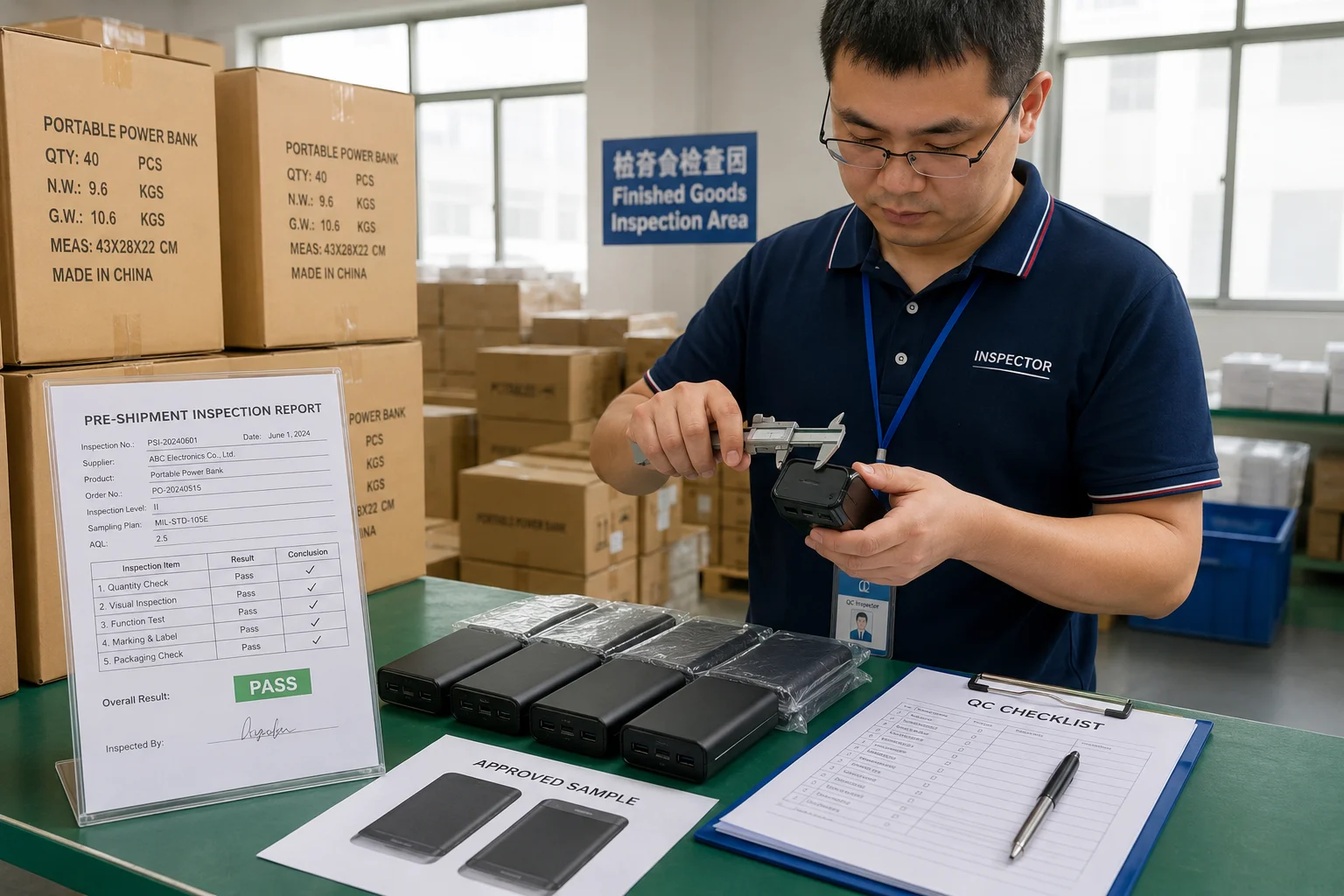
After I approve a sample and pay a deposit, I still need process control. The supplier may change material, replace parts, delay production, or misunderstand packaging. These issues do not always happen because the supplier is dishonest. Sometimes they happen because requirements were not written clearly. Sometimes they happen because no one followed up.
A sourcing agent can help track production. The agent can confirm the production plan, ask for photos or videos, follow key dates, and push for updates. For some orders, a pre-shipment inspection is very important. It gives me a chance to check product quality before the goods ship out.[^8] Inspection cannot guarantee every unit is perfect.[^9] But it can catch many visible and functional problems before I lose the chance to act.
| Production control point | Why I care |
|---|---|
| Approved sample | Gives the factory a reference |
| Written requirement | Reduces misunderstanding |
| Production schedule | Helps me plan sales and shipping |
| Mid-process update | Finds delays earlier |
| Pre-shipment inspection | Checks goods before balance payment |
| Issue report | Helps decide rework, discount, or next step |
I should define inspection points before production ends. For example, I can ask to check quantity, appearance, function, logo, packaging, carton marks, and basic measurements. If my product needs lab testing or formal certification, I should use qualified third-party bodies.[^10] A sourcing agent can coordinate, but should not pretend to replace those authorities.
7. How Should I Arrange Warehousing, Consolidation, Packaging, and Shipping?
Many new buyers think sourcing ends when goods are finished. Then warehouse, cartons, labels, and freight become new problems.
I should arrange warehousing, order consolidation, packaging checks, labeling, carton marks, photos, and shipping plans before goods are ready to avoid delays and unexpected logistics costs.
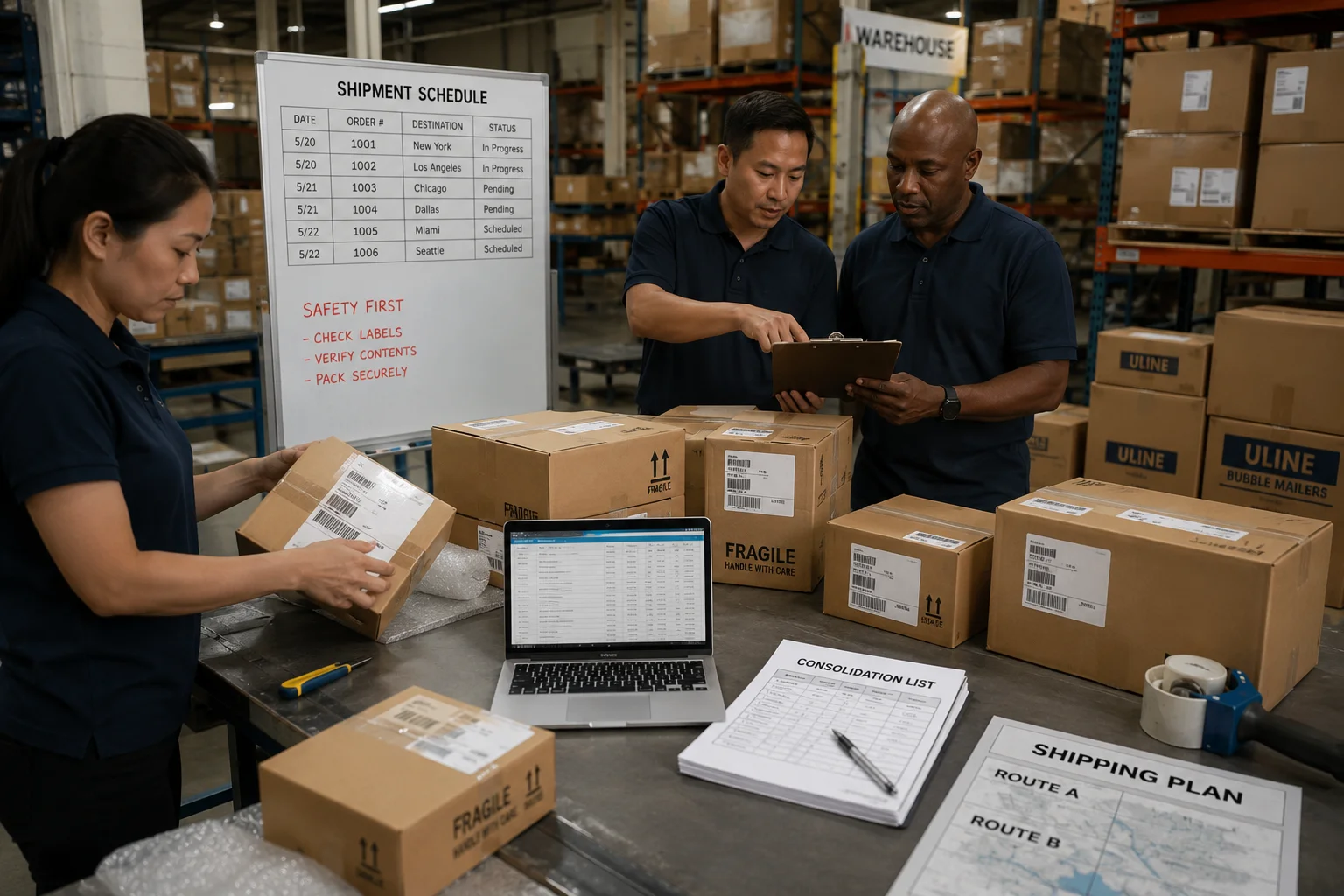
Shipping is not a small final step. It can affect my profit, customer experience, and delivery schedule. If I buy from one supplier, the process may be simple. If I buy from several suppliers, I may need consolidation. Goods may need to arrive at one warehouse, get checked, be repacked, and ship together. This can reduce freight waste and make inventory easier to handle.
Packaging also matters. Poor packaging can damage products in transit.[^11] Weak cartons, wrong labels, missing barcodes, or unclear carton marks can create problems with warehouses, Amazon FBA, customs, or local delivery. I should tell the sourcing agent early if I need custom boxes, inserts, stickers, bundles, or lifestyle product photos.
| Logistics task | What I should confirm |
|---|---|
| Warehousing | Where will goods be stored before shipment? |
| Consolidation | Will multiple suppliers ship to one warehouse? |
| Packaging | Is the packaging strong enough for transit? |
| Labeling | Are barcodes, SKU labels, and carton marks correct? |
| Photos | Do I need product or packaging photos before shipping? |
| Shipping method | Air, sea, express, rail, or door-to-door option |
| Cost estimate | What costs are included and not included? |
I should also compare shipping options by cost, speed, and risk. Express may be fast but expensive. Sea freight may be cheaper for larger volumes but slower.[^12] Door-to-door shipping may be easier for a first-time buyer, but I still need to understand what is included, such as customs handling, duties, taxes, and final delivery.
8. How Does KingSourcing Help First-Time Buyers Source from China More Safely?
Many first-time buyers need more than a supplier name. They need someone in China to manage each step with them.
At KingSourcing, I help first-time buyers clarify requirements, find and compare suppliers, follow samples, manage production, inspect goods, arrange packaging, consolidate orders, and support shipping from China.
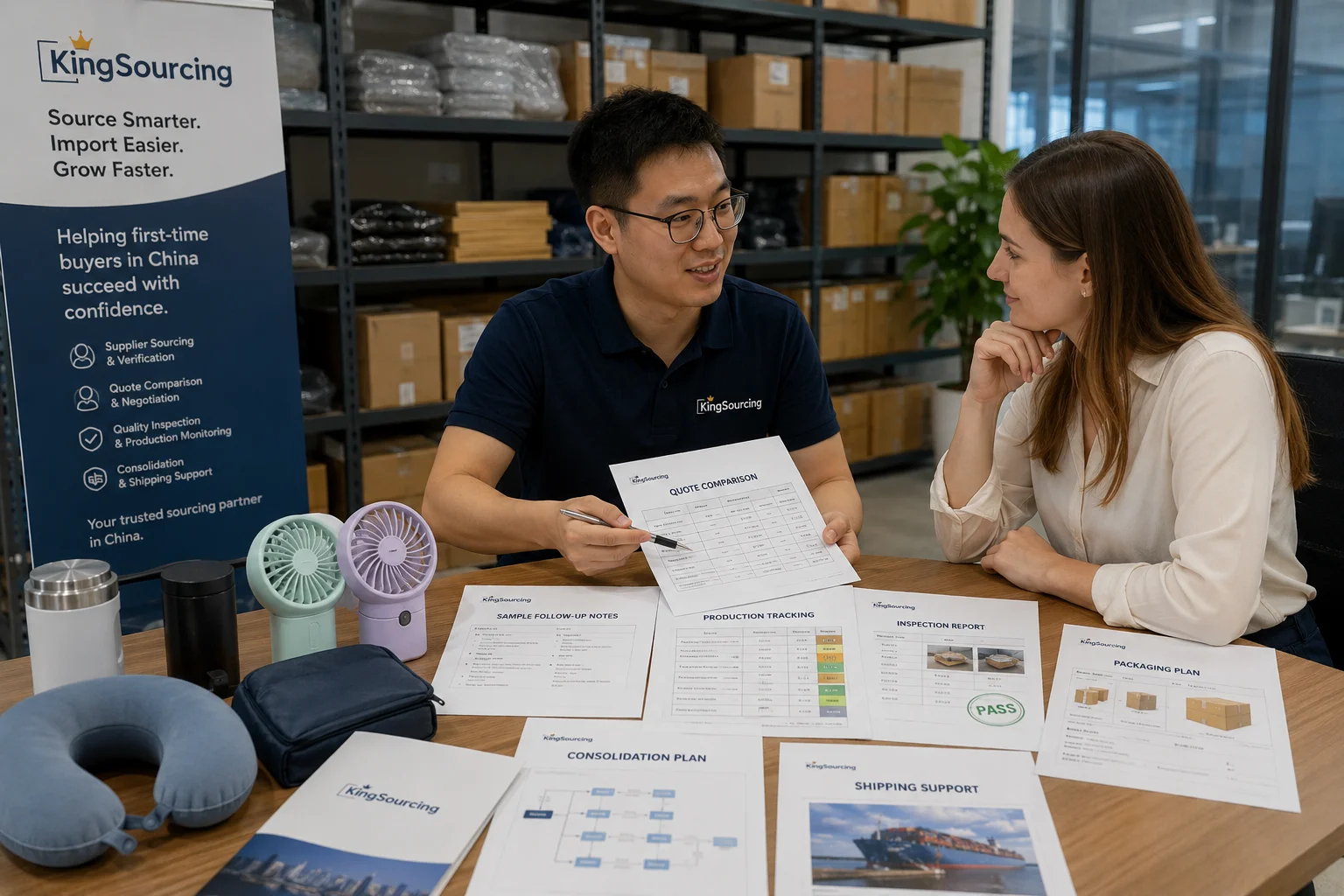
At KingSourcing, I often work with small business owners, startup brands, ecommerce sellers, dropshippers, wholesalers, and growing DTC brands. Many of them do not have a local team in China. They may have a product idea, a website, or a sales plan. But they do not have time to check suppliers, follow production, inspect goods, or manage shipping details every day.
I help by turning the sourcing project into clear steps. I first ask about the product, budget, MOQ, target market, sales channel, and expected service scope. Then I search and compare suppliers. I follow samples and help the buyer review details. If the order moves forward, I can support production tracking, quality inspection, packaging, warehousing, order consolidation, product photos, and international shipping.
| Buyer need | How I can support |
|---|---|
| Find product or supplier | Source and compare supplier options |
| Reduce supplier risk | Screen suppliers and check business fit |
| Control samples | Follow sample making and revision |
| Manage order | Track production and key dates |
| Check quality | Arrange product inspection before shipment |
| Improve packaging | Coordinate custom packaging and labeling |
| Ship goods | Support consolidation and door-to-door logistics |
I do not promise zero risk, the lowest price, or perfect results. I do not think any honest sourcing partner should make that promise. What I can do is help reduce confusion, lower trial-and-error cost, and make each step more visible. My goal is simple. I want buyers to feel that KingSourcing is their China sourcing office, quality control helper, supply chain coordinator, and logistics support team.
Conclusion
Working with a China sourcing agent works best when I prepare clearly, compare carefully, control samples and production, inspect goods, and plan shipping early.
[^1]: "[PDF] Managing risks in the public procurement of goods, services ... - OECD", https://www.oecd.org/content/dam/oecd/en/publications/reports/2023/06/managing-risks-in-the-public-procurement-of-goods-services-and-infrastructure_b0d29f96/45667d2f-en.pdf. Institutional procurement guidance generally places requirements definition, budgeting, scheduling, risk assessment, and responsibility allocation before supplier selection, supporting the article’s emphasis on agreeing the sourcing brief in advance. Evidence role: expert_consensus; source type: institution. Supports: Procurement guidance treats requirements definition, planning, risk allocation, and role clarity as important steps before supplier selection.. Scope note: The source would support procurement practice in general rather than prove outcomes for China sourcing agents specifically. [^2]: "Thailand - Distribution and Sales Channels", https://www.trade.gov/country-commercial-guides/thailand-distribution-and-sales-channels. Government trade guidance on importing and supplier due diligence identifies verification of suppliers, product quality controls, documentation, and shipping arrangements as recurring risk areas in cross-border sourcing. Evidence role: general_support; source type: government. Supports: Importer guidance identifies supplier due diligence, product quality, communication, and logistics as practical risks in international sourcing.. Scope note: Such guidance supports the general risk categories but may not quantify how often first-time China importers encounter each problem. [^3]: "Chapter 4 -Specifications | Procurement | Finance Division", https://procurement.gwu.edu/chapter-4-specifications. Procurement education materials define product specifications as documented technical and performance requirements, including attributes such as materials, dimensions, and packaging, which explains why a photograph alone is not a complete basis for supplier quotation. Evidence role: definition; source type: education. Supports: Procurement and product-development sources define specifications as written requirements covering characteristics such as materials, dimensions, performance, and packaging.. Scope note: This evidence supports the need for specifications conceptually, not the exact degree of price variation in any one product category. [^4]: "Regulations Under Section 4 of the Fair Packaging and Labeling Act", https://www.ftc.gov/legal-library/browse/rules/fair-packaging-labeling-act-regulations-under-section-4-fair-packaging-labeling-act. Government consumer-product guidance shows that labeling, packaging, warnings, and product-identification requirements are set by jurisdiction and product category, supporting the point that the target market affects sourcing requirements. Evidence role: general_support; source type: government. Supports: Government consumer-product rules show that labeling and packaging obligations vary by market and product type.. Scope note: The precise requirements depend on the product and destination market, so a general source would not replace product-specific compliance advice. [^5]: "Quoting, Bidding, and RFP Processes | Illinois Institute of Technology", https://www.iit.edu/procurement-services/purchasing/purchasing-guidance/quoting-bidding-and-rfp-processes. Procurement research on total cost of ownership treats purchase price as only one element of supplier evaluation and includes quality, logistics, transaction, and risk-related costs, supporting the warning that a low quote may not represent the lowest real cost. Evidence role: mechanism; source type: paper. Supports: Total-cost-of-ownership research explains that purchase price is only one component of supplier cost and performance.. Scope note: The evidence supports the mechanism generally and does not show that every low quote is problematic. [^6]: "Key Facts: ISO Accreditation | Food Safety and Inspection Service", http://www.fsis.usda.gov/science-data/laboratories-procedures/accredited-laboratory-program/key-facts-iso-accreditation. International conformity-assessment guidance distinguishes accredited testing, inspection, and certification activities from ordinary commercial checks, supporting the article’s caution that supplier screening is not equivalent to formal legal, financial, or laboratory assurance. Evidence role: definition; source type: institution. Supports: Accreditation and conformity-assessment sources define formal testing, inspection, and certification as specialized activities governed by standards and competent bodies.. Scope note: The source would clarify the distinction between screening and certification, not evaluate the quality of any specific sourcing agent’s screening process. [^7]: "Methods of Payment - International Trade Administration", https://www.trade.gov/methods-payment. Government trade-finance guidance describes advance payment and staged payment arrangements as common international trade practices, providing context for deposit-before-production and balance-before-shipment terms. Evidence role: general_support; source type: government. Supports: Trade-finance guidance describes advance payments and staged payment arrangements as common mechanisms in international trade.. Scope note: Payment terms vary by supplier, product, relationship, and risk profile; the source would contextualize the practice rather than establish it as universal. [^8]: "Trade Guide: WTO PSI", https://www.trade.gov/trade-guide-wto-psi. The WTO Agreement on Pre-Shipment Inspection describes pre-shipment inspection as verification of goods before export, including checks related to quality, quantity, price, and customs classification, supporting the article’s description of inspection before goods leave the origin country. Evidence role: definition; source type: institution. Supports: International trade sources define pre-shipment inspection as inspection or verification of goods before export or shipment.. Scope note: The WTO context concerns pre-shipment inspection entities and trade rules; private buyer inspections may be narrower in scope. [^9]: "What kinds of Lot Acceptance Sampling Plans (LASPs) are there?", https://www.itl.nist.gov/div898/handbook/pmc/section2/pmc22.htm. Acceptance-sampling standards such as ISO 2859 evaluate production lots through sampled units and explicitly involve producer and consumer risks, showing that inspection results are probabilistic rather than a guarantee that every item is defect-free. Evidence role: mechanism; source type: institution. Supports: Acceptance-sampling standards evaluate lots based on samples and recognize statistical risks, so inspection is not a guarantee that every unit is perfect.. Scope note: This directly supports the limitation of sample-based inspection; a full 100% inspection may reduce but still not eliminate all practical detection limits. [^10]: "Key Facts: ISO Accreditation | Food Safety and Inspection Service", http://www.fsis.usda.gov/science-data/laboratories-procedures/accredited-laboratory-program/key-facts-iso-accreditation. ISO/IEC 17025 and related accreditation guidance establish competence requirements for testing laboratories, supporting the article’s statement that formal product testing should be handled by qualified third-party bodies. Evidence role: expert_consensus; source type: institution. Supports: Accreditation standards and conformity-assessment institutions identify competence requirements for testing laboratories and certification bodies.. Scope note: The applicable laboratory, certification scheme, and legal requirement depend on the product category and destination market. [^11]: "Packaging, Handling, Storage, and Transportation (PHS&T)", https://www.waru.edu/acquipedia-article/integrated-product-support-ips-element-packaging-handling-storage-and. Packaging-logistics research describes transport packaging as a protective system against mechanical hazards such as shock, vibration, compression, and handling during distribution, supporting the claim that poor packaging can increase transit damage. Evidence role: mechanism; source type: paper. Supports: Packaging and logistics research explains that transport packaging protects goods from shocks, vibration, compression, and handling damage during distribution.. Scope note: The degree of damage risk depends on product fragility, route, handling conditions, and packaging design. [^12]: "Air Freight: A Market Study with Implications for Landlocked Countries", https://www.worldbank.org/en/topic/transport/publication/air-freight-study. International logistics sources describe air or express freight as offering shorter transit times at higher cost, while ocean freight generally provides lower per-unit costs for larger shipments at the expense of longer transit times. Evidence role: general_support; source type: institution. Supports: Transport and logistics sources describe the common tradeoff between air or express freight speed and cost versus ocean freight economy and longer transit time.. Scope note: Actual cost and speed depend on route, shipment size, season, fuel prices, customs clearance, and service level.