Many Amazon sellers lose money before the product even reaches FBA. I see this happen when price looks good, but quality, packaging, and timing fail.
A China sourcing agent is worth it for Amazon sellers when supplier mistakes, delays, quality issues, or FBA errors may cost more than the agent fee. I do not see it as necessary for every seller. I see it as a risk control choice.
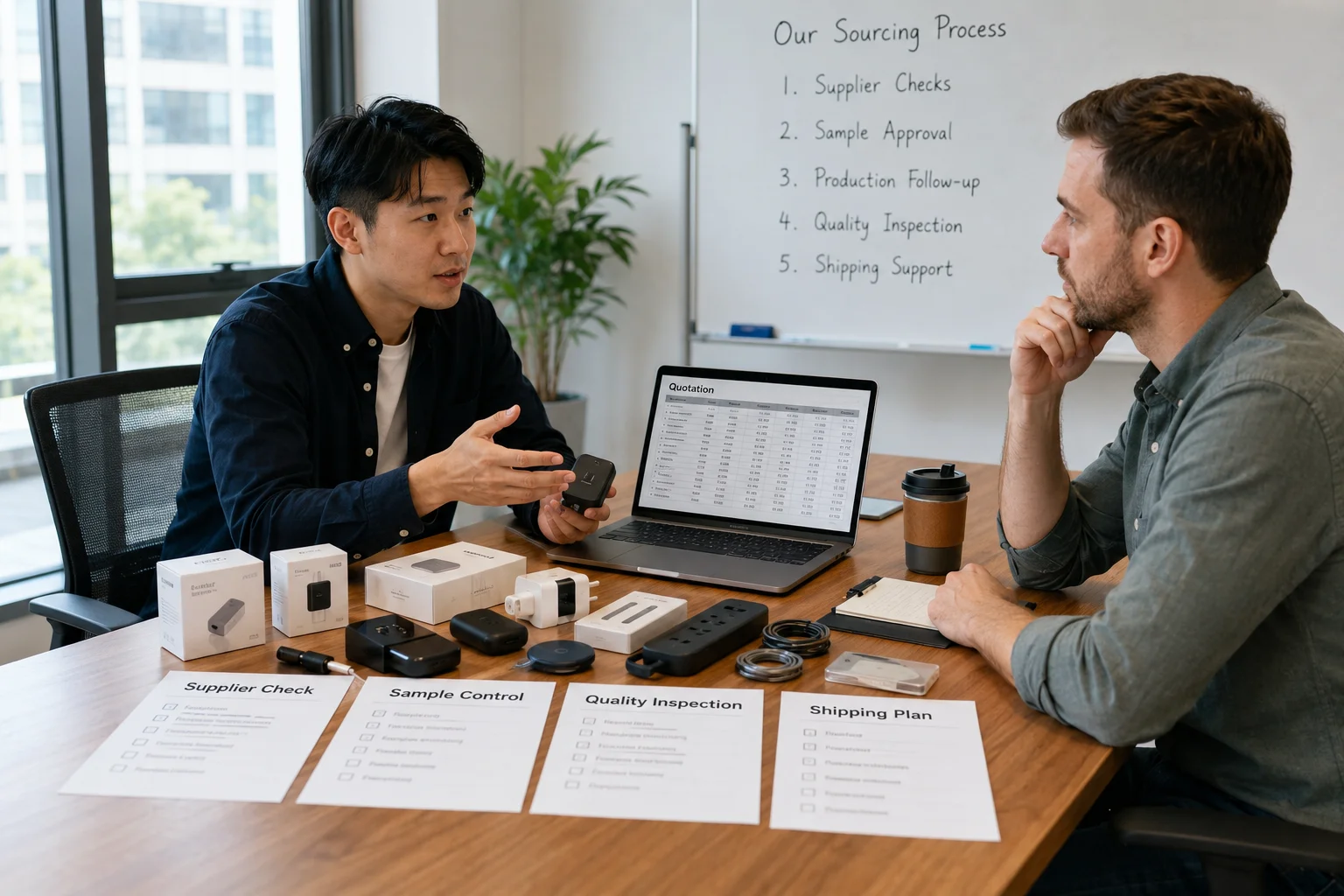
I often tell Amazon sellers to ask a better question. The real question is not, “Can I save the sourcing agent fee?” The better question is, “What will it cost me if this order goes wrong?” For Amazon sellers, one bad shipment can create returns, bad reviews, stockouts, cash flow pressure, and months of repair work[^1]. A sourcing agent cannot remove every risk. I do not promise that. But a good sourcing process can reduce many common mistakes before the goods leave China.
Why Do Amazon Sellers Source Products from China?
Many sellers chase low unit costs and miss the bigger picture. I see them save on product price, then lose money through poor planning.
Amazon sellers source from China because China offers wide product choice, flexible manufacturing, custom packaging, and strong supply chain depth[^2]. I also see sellers choose China because many factories can support both small tests and larger repeat orders.
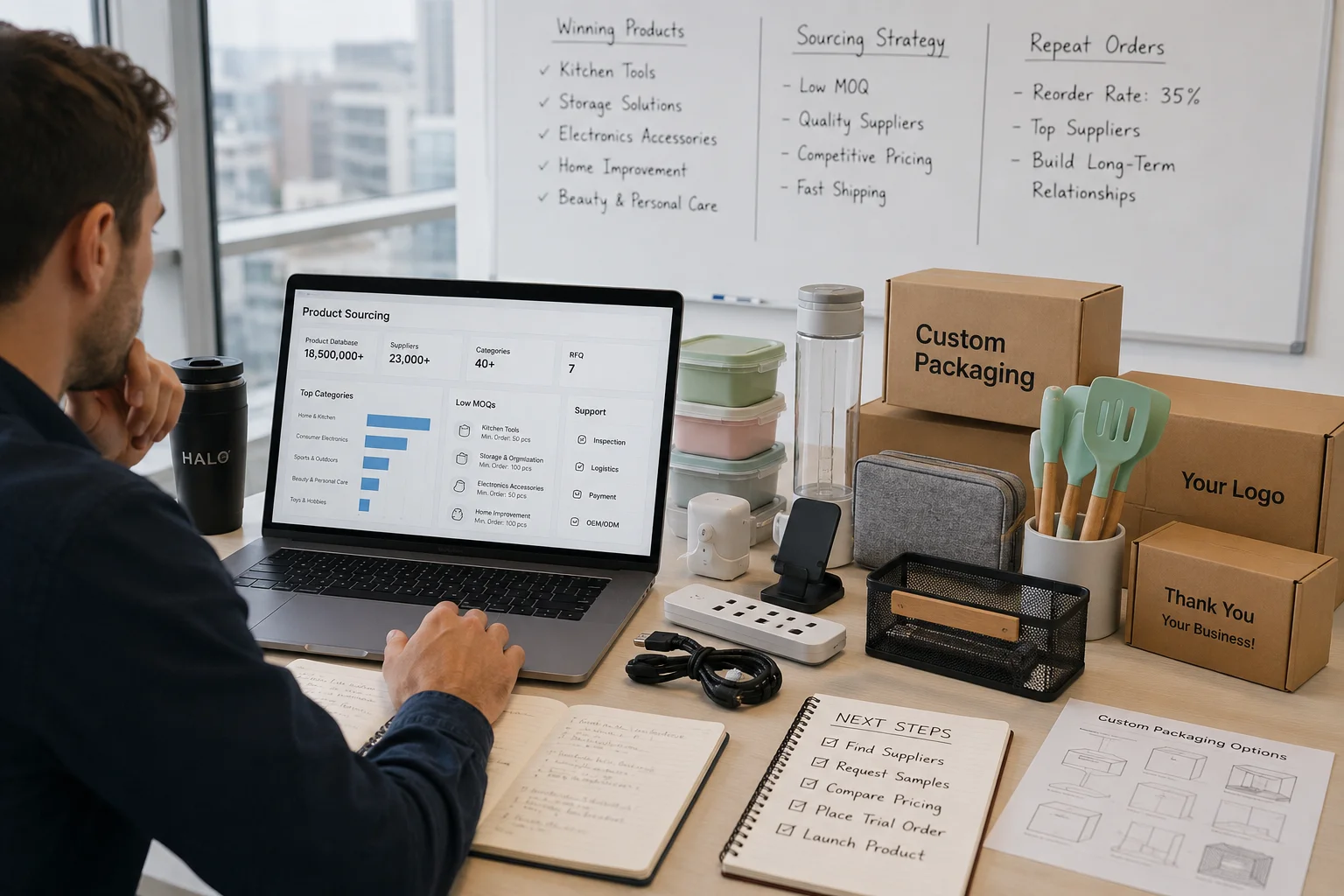
China is still one of the main sourcing markets for Amazon sellers[^3] because the supply base is very deep. I see sellers use China for private label products, accessories, home goods, pet items, beauty tools, sports products, and many other categories. The value is not only low price. The value is speed of product development, packaging options, component matching, and supplier variety.
I often explain it this way. Alibaba or another platform may help a seller find suppliers. But a platform does not build the full sourcing process. A real sourcing process includes supplier screening, product comparison, sample control, order follow-up, inspection, FBA prep checks, and shipment planning[^4].
| Reason sellers source from China | What I usually check |
|---|---|
| Lower unit cost | I check if the quote includes real specs, packaging, and export costs. |
| Many supplier choices | I compare factory ability, communication, and production focus. |
| Custom packaging | I confirm box size, material, barcode space, and Amazon needs. |
| Small and large order options | I check MOQ, sample cost, and repeat order stability. |
| Faster product development | I help compare samples and improve details before mass production. |
For Amazon sellers, China sourcing works best when the seller treats it as a system, not as a one-time message to a supplier.
What Problems Do Amazon Sellers Face When Buying from Chinese Suppliers?
Many sellers think the risk starts after shipment. I see the real risk start much earlier, when the product details are unclear.
Amazon sellers often face supplier uncertainty, wrong specs, weak samples, poor packaging, late production, bad communication, and FBA preparation mistakes[^5]. These issues can lead to returns, negative reviews, stockouts, and profit loss.
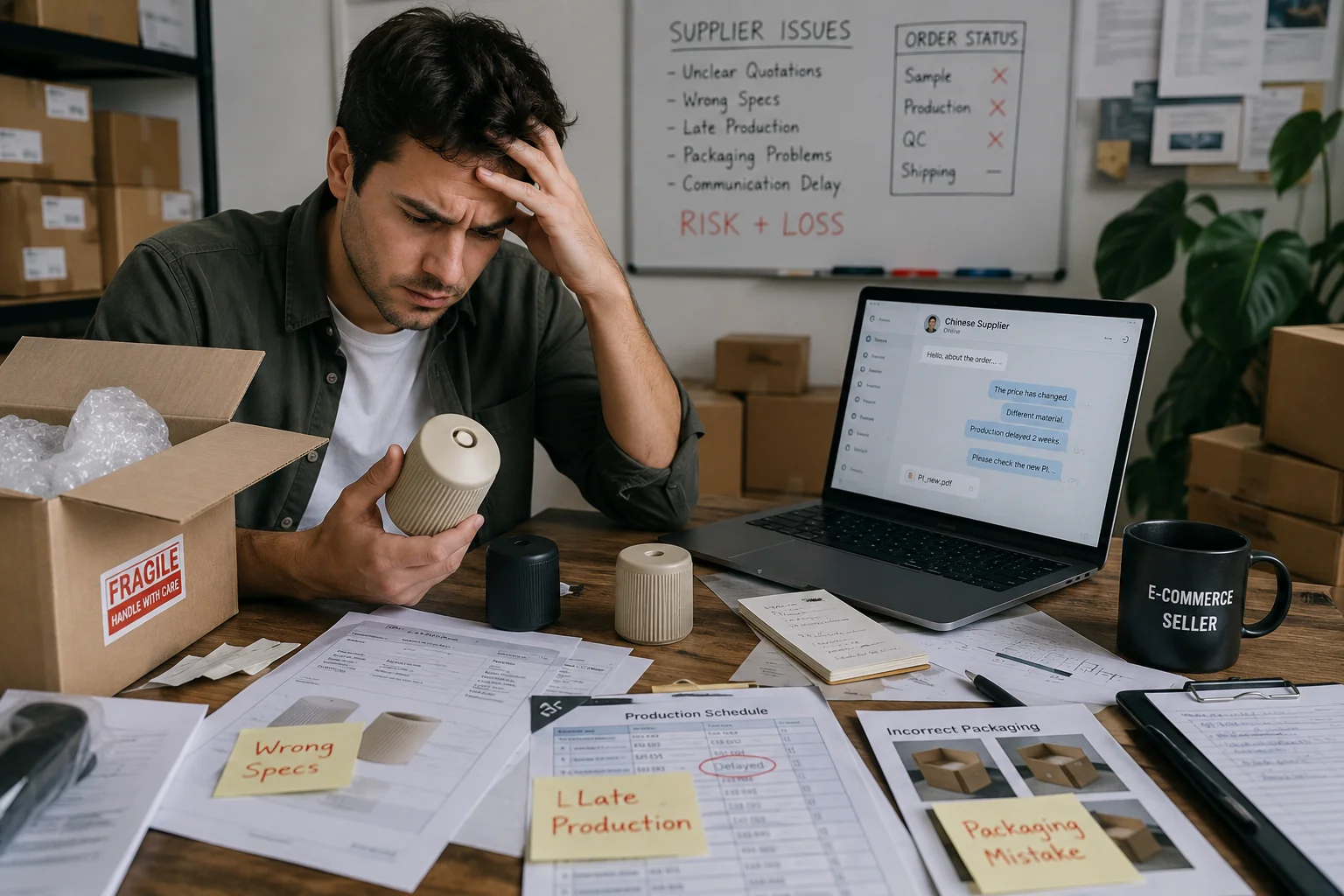
The most common problem I see is not always cheating. It is often unclear agreement. A seller asks for a product. A supplier gives a quote. Both sides think they understand the product. Then production starts. Later, the color, material, logo size, packaging, accessory count, or carton label does not match the Amazon listing plan.
Amazon sellers have less room for error than many traditional importers. A retailer may rework goods in a warehouse. An Amazon seller may ship directly to FBA. Once goods enter FBA, fixing a mistake becomes slower and more expensive.[^6]
| Problem | Why it matters for Amazon |
|---|---|
| Wrong product specs | Customers may return the item and leave bad reviews. |
| Weak packaging | Goods may arrive damaged or look cheap. |
| Late production | The seller may run out of stock and lose ranking. |
| Unchecked quality | Defective units may reach customers. |
| Wrong FBA labels | Amazon may reject, delay, or charge extra for handling[^7]. |
| Poor supplier communication | Small problems may become big problems before shipment. |
I always tell sellers that the cheapest quote can become expensive if it creates rework, delay, or account pressure. Price matters. But clear specs, stable quality, and correct shipment execution matter just as much.
What Does a China Sourcing Agent Do for Amazon Sellers?
Many sellers think an agent only finds suppliers. I see that as only the first step, and often not the hardest step.
A China sourcing agent helps Amazon sellers find and compare suppliers, verify basic supplier reliability, arrange samples, follow production, check quality, manage packaging, prepare shipment details, and reduce avoidable sourcing mistakes.

When I work on a sourcing project, I do not see the job as simply sending three factory links. The real work is to help the seller turn a product idea into a controlled order. This means I need to understand the product use, target price, packaging needs, Amazon listing needs, quantity, customization, and shipping plan.
A sourcing agent should act like the seller’s local execution team in China. This does not mean the agent replaces the seller’s business judgment. The seller still chooses the product, market, and price strategy. The agent helps with local supplier work and order control.
| Sourcing step | What I help control |
|---|---|
| Product search | I find suppliers that match the product, MOQ, and custom needs. |
| Supplier comparison | I compare price, factory focus, sample quality, and response quality. |
| Sample handling | I arrange samples, check details, and help confirm changes. |
| Production follow-up | I track timelines and confirm details before mass production. |
| Quality check | I check product appearance, function, packaging, and quantity based on order needs. |
| Shipping support | I help prepare cartons, labels, warehouse plans, and freight coordination. |
A good agent does not simply say yes to every request. I believe a useful agent should also warn the seller when a product is too risky, when a quote looks incomplete, or when packaging may fail Amazon needs.
When Is a China Sourcing Agent Worth It for Amazon Sellers?
Many sellers focus only on the agent fee. I ask them to compare that fee with the cost of a failed order.
A China sourcing agent is worth it when the order has custom specs, packaging, labels, accessories, FBA needs, supplier uncertainty, or high financial risk. It is also worth it when delays or defects would hurt reviews, ranking, and cash flow.

I usually see sourcing support become more valuable as product complexity increases. A simple off-the-shelf item may not need much help. But a product with custom color, logo, insert card, bundle parts, instruction manual, gift box, or Amazon FBA labeling has more points where mistakes can happen.
Growing sellers also have a different risk level. When a seller has stable SKUs and regular replenishment, one delayed order can cause stockout. A stockout can reduce ranking and sales momentum.[^8] In that case, the sourcing agent fee is not only a cost. It can be part of risk control.
| Seller situation | Is an agent usually worth considering? | Why I think so |
|---|---|---|
| First product with custom packaging | Yes | Many details must be checked before shipment. |
| Product has accessories or bundles | Yes | Missing parts can cause returns and complaints. |
| Seller is reordering a winning SKU | Often yes | Stockout and quality change can be expensive. |
| Supplier is new and unverified | Yes | Basic checks can reduce avoidable risk. |
| Order value is meaningful for the seller | Yes | Loss impact may be higher than service fee. |
| FBA shipment has strict prep needs | Yes | Label and carton errors can create delays. |
I do not tell every seller to use an agent. I tell sellers to compare the agent fee with hidden costs. These costs include wrong inventory, rework, storage fees, missed sales, bad reviews, and time lost in supplier communication.
When Can Amazon Sellers Source Directly Without an Agent?
Some sellers hire help too early. I think direct sourcing can work when the product is simple and the seller can accept the risk.
Amazon sellers can source directly without an agent when they buy simple products, place very small test orders, have clear specs, can communicate with suppliers, and can accept the loss if the order fails.

I want to be honest here. A sourcing agent is not always needed. If a seller is testing a very small order and the product has no customization, no special packaging, and no complex FBA needs, direct sourcing may be fine. The seller can learn from the process. The possible loss may be acceptable.
Direct sourcing can also work for sellers who already have a mature sourcing process. Some larger sellers have their own China team, QC staff, supplier database, and freight partners. In that case, an outside sourcing agent may not add enough value unless the seller needs backup support, new category sourcing, or local project execution.
| Direct sourcing may work when | What the seller must still handle |
|---|---|
| The order is a small test | The seller must accept possible loss or delay. |
| The product is simple | The seller must still confirm specs and packaging. |
| No logo or custom box is needed | The seller must check standard packaging quality. |
| The supplier is already stable | The seller must still monitor production changes. |
| The seller has sourcing experience | The seller must manage samples, QC, and freight. |
| The seller has time | The seller must handle many messages and details. |
I see many beginners use direct sourcing to learn. That is reasonable. But I also see sellers grow and then realize that their time is better used on product research, Amazon listing, ads, and brand work.
How Does a Sourcing Agent Help with Supplier Verification, Samples, QC, and Packaging?
A product can look perfect in a supplier photo. I have seen many orders fail because no one checked the real details.
A sourcing agent helps by checking supplier fit, arranging and comparing samples, confirming production requirements, inspecting goods before shipment, and reviewing packaging details before products go to Amazon customers.
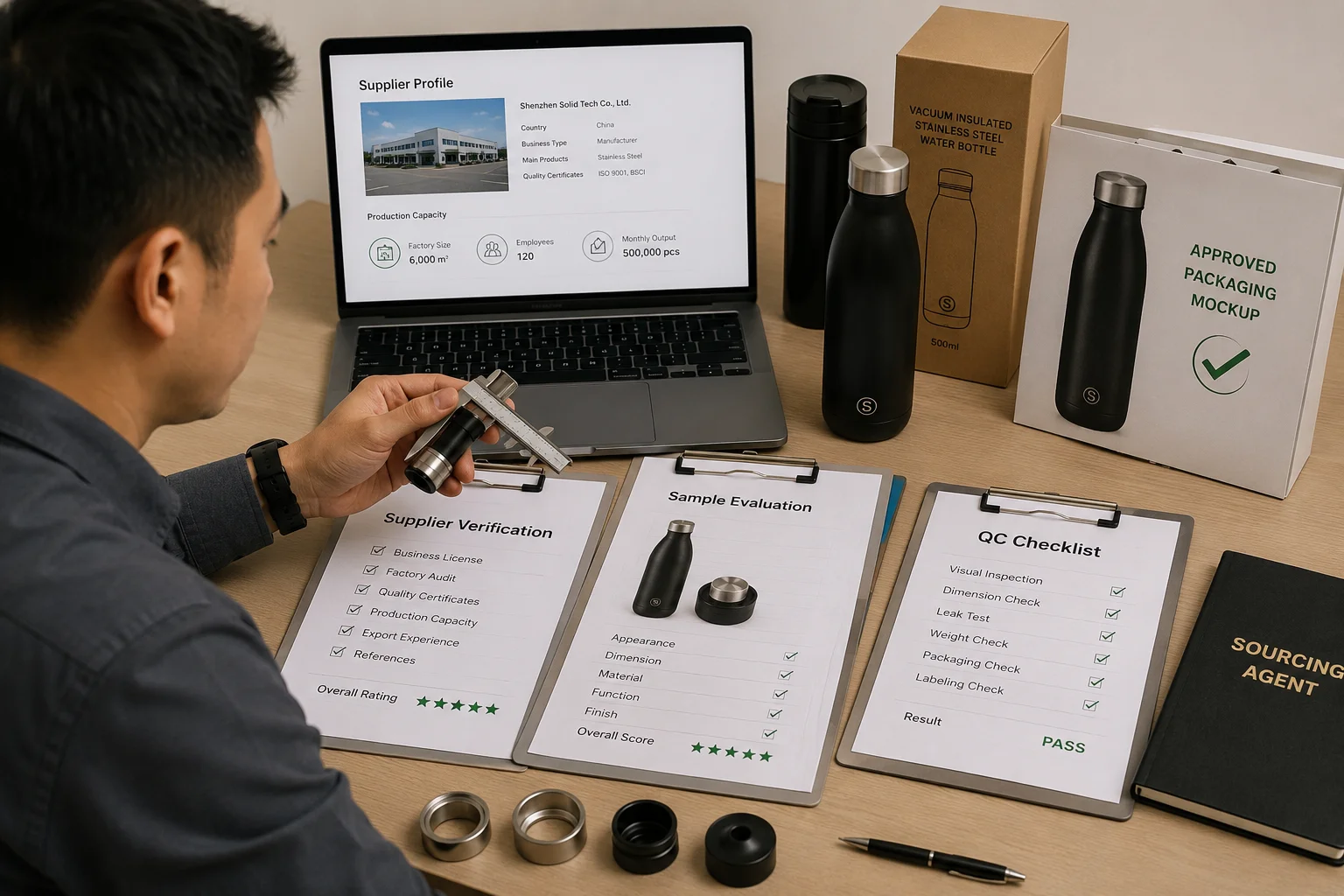
Supplier verification is not only about asking if a company exists. I want to know whether the supplier is suitable for the product and order type. A trading company may be useful for some mixed orders. A factory may be better for deeper customization. A good decision depends on product type, MOQ, price, timeline, and the seller’s future plan.
Samples are also important. I often see sellers approve a sample too quickly because the surface looks fine. I prefer to check size, color, material, function, smell, printing, accessories, packaging, and any detail linked to the Amazon listing. If the seller promises a feature on the listing, the product must support that promise.
| Work area | What I usually look at |
|---|---|
| Supplier verification | Business fit, product focus, communication quality, quote completeness. |
| Sample check | Material, size, function, color, logo, packaging, and user experience. |
| Production follow-up | Schedule, material purchase, production status, and change control. |
| Quality control | Defects, quantity, appearance, function, and packaging condition. |
| Packaging review | Retail box, carton strength, insert card, barcode area, and protection. |
| Problem handling | Rework plan, replacement plan, or shipment hold before goods leave China. |
QC does not guarantee that every unit will be perfect. I do not make that claim. But QC can find many visible and functional problems before shipment[^9]. That gives the seller a chance to fix issues while the goods are still in China.
What Should Amazon Sellers Check for FBA Prep, Labeling, Warehousing, Consolidation, and Shipping?
Many Amazon problems are not product problems. I often see sellers struggle because shipment prep was not planned early enough.
Amazon sellers should check FNSKU labels, carton labels, carton size and weight, packaging protection, warehouse address, consolidation plan, shipping method, customs documents, and delivery timing[^10] before goods leave China.
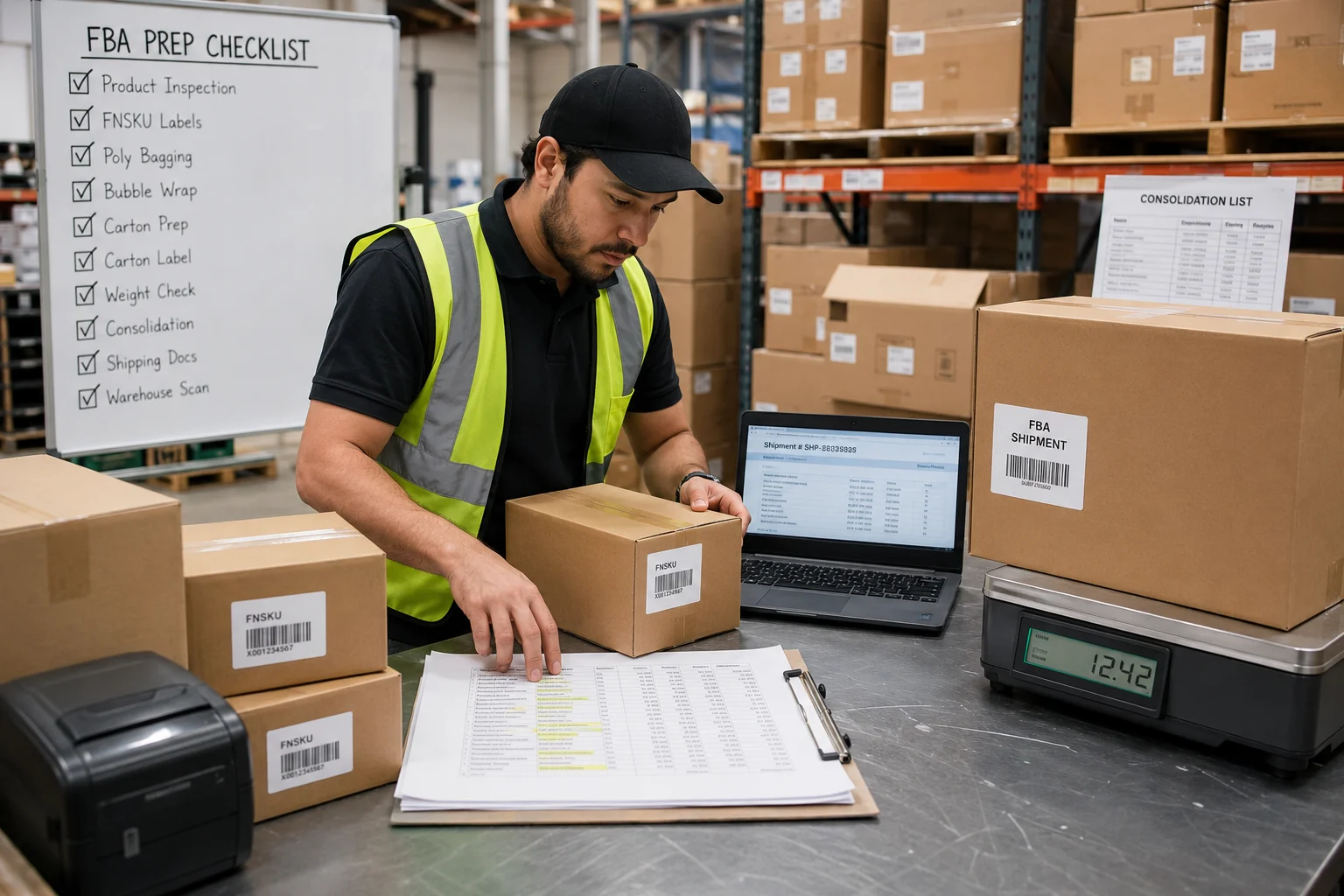
FBA shipment needs careful detail work. A seller may have a good product and still face delays if labels are wrong, cartons are overweight, or the shipment plan changes. I always suggest that sellers think about FBA needs before mass production, not after goods are packed.
Warehousing and consolidation are useful when a seller buys from several suppliers. Without consolidation, the seller may pay more freight or lose control of prep work. With a local warehouse, products can be received, checked, labeled, packed together, and shipped in a more organized way.[^11]
| FBA and shipping item | What I check |
|---|---|
| FNSKU label | I check if each sellable unit needs the correct scannable label. |
| Carton label | I check Amazon carton labels and shipping plan details. |
| Carton size and weight | I check if cartons match carrier and Amazon handling limits. |
| Packaging protection | I check if the product can survive transport and warehouse handling. |
| Warehousing | I check receiving, storage, counting, labeling, and repacking needs. |
| Consolidation | I check if goods from several suppliers can ship together. |
| Shipping method | I compare express, air, sea, rail, or truck routes based on time and cost. |
| Customs documents | I check invoice, packing list, HS code notes, and product description consistency. |
I see many sellers treat logistics as the final step. I think that is a mistake. Shipping choices affect packaging design, carton plan, cash flow, and launch timing.[^12] For Amazon sellers, late inventory can hurt as much as defective inventory.
How Does KingSourcing Help Amazon Sellers Source from China More Safely and Efficiently?
Many sellers do not need a middleman. They need a local team that can manage details when they cannot be in China.
At KingSourcing, we help Amazon sellers source products, compare suppliers, manage samples, follow production, inspect quality, handle packaging, prepare FBA needs, consolidate orders, and arrange shipping from China.
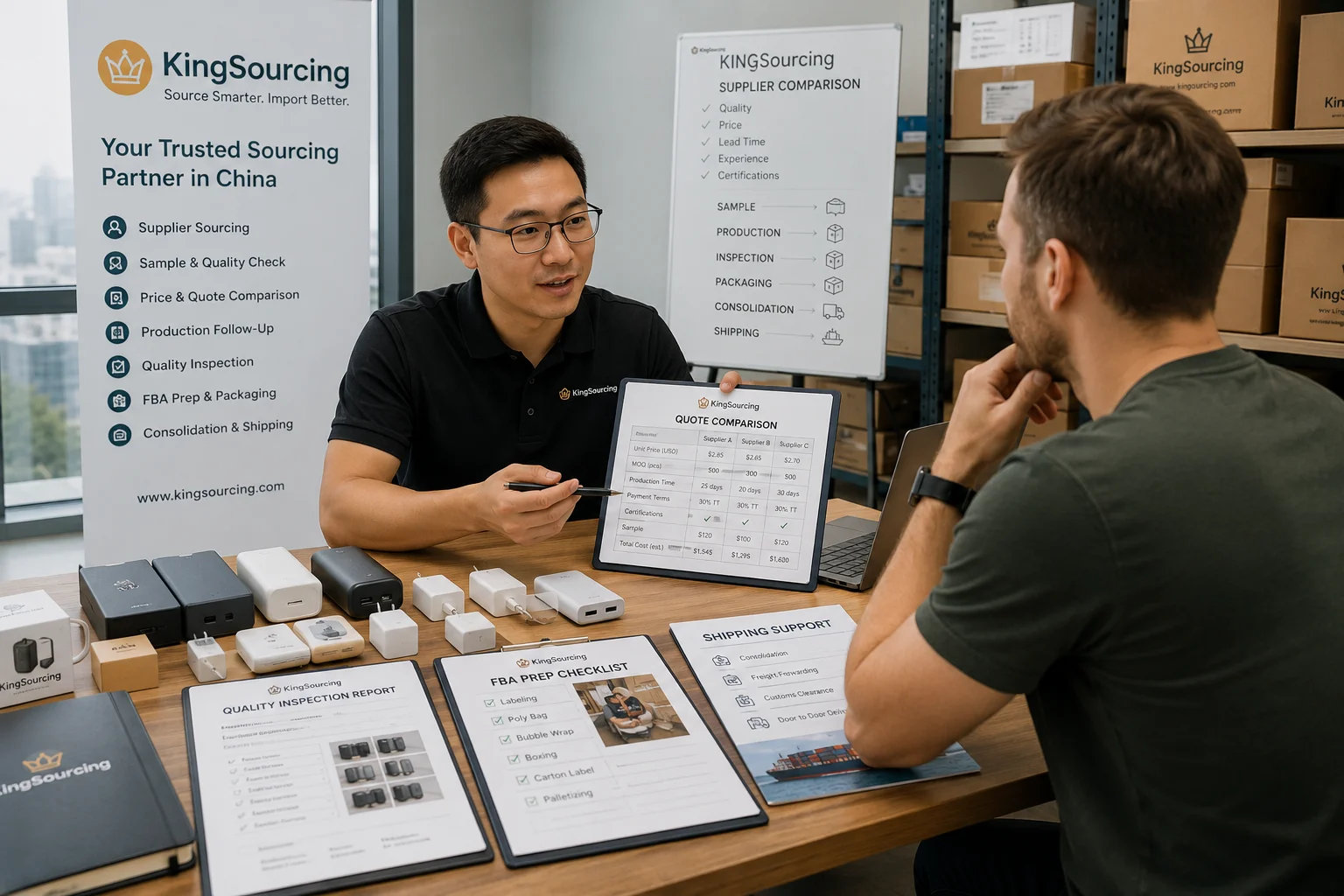
At KingSourcing, I see our role as the seller’s sourcing office in China. We are not here to make big promises. We are here to make the sourcing process clearer and easier to control. Our brand idea is simple: Making Your China Sourcing Simple.
We often work with small sellers who want to test a product with a limited budget. We also work with growing sellers who need more stable supplier management and repeat order support. The needs are different. A beginner may need help with finding the right supplier and avoiding basic mistakes. A growing seller may need better production follow-up, quality control, warehouse support, and faster issue handling.
| KingSourcing support area | How I see the value for Amazon sellers |
|---|---|
| Product sourcing | We help sellers find and compare suitable suppliers. |
| Supplier checks | We review basic supplier fit and communication quality. |
| Price comparison | We compare quotes based on specs, not only unit price. |
| Sample management | We help collect, check, and improve samples before orders. |
| Production follow-up | We track timelines and confirm key details during production. |
| 1-by-1 product checks | We can support detailed checks when the product or order needs it. |
| Custom packaging | We help manage box, label, insert, bundle, and accessory details. |
| Warehousing and consolidation | We help receive goods from different suppliers and prepare shipment. |
| Product photography | We can support lifestyle product photos when sellers need content assets. |
| Shipping coordination | We help arrange shipping options and door-to-door logistics support. |
I believe the best result comes when we join early. If we only see the product after production is finished, our options are limited. If we join during supplier selection, sampling, and packaging planning, we can help prevent more problems before they become expensive.
Conclusion
I see a sourcing agent as worth it when the risk cost is higher than the service fee, especially for custom, FBA, and repeat Amazon orders.
[^1]: "[PDF] Successful Inventory Management Strategies in the Office Supply ...", https://scholarworks.waldenu.edu/cgi/viewcontent.cgi?article=15184&context=dissertations. Research on retail inventory and e-commerce operations supports that fulfillment failures and stockouts can reduce sales, customer satisfaction, and operational liquidity; this evidence supports the general risk pathway rather than quantifying the effect for every Amazon seller. Evidence role: general_support; source type: research. Supports: Fulfillment disruptions, defective goods, and inventory shortages can negatively affect customer satisfaction, sales continuity, and seller finances.. Scope note: Contextual support; effects vary by category, seller size, and marketplace conditions. [^2]: "Manufacturing, value added (% of GDP) - World Bank Open Data", https://data.worldbank.org/indicator/NV.IND.MANF.ZS. International manufacturing and trade data describe China as one of the world’s largest manufacturing economies and a major participant in global value chains, supporting the article’s characterization of broad supplier choice and supply-chain depth. Evidence role: general_support; source type: institution. Supports: China has a large and diverse manufacturing base and a significant role in global manufacturing value chains.. Scope note: The source would support China’s manufacturing scale and diversity generally, not the specific experience of every Amazon seller. [^3]: "Want to Learn about sourcing from China. - Amazon Seller Central", https://sellercentral.amazon.com/seller-forums/discussions/t/cc594dfd-2f04-4eab-9b60-b63a65e584bf. Seller survey research indicates that China remains a common sourcing location for marketplace sellers, supporting the statement that it is a major sourcing market for Amazon-focused private-label and resale businesses. Evidence role: statistic; source type: research. Supports: A substantial share of Amazon marketplace sellers source products from China or rely on Chinese suppliers.. Scope note: Seller surveys may be sample-dependent and may not represent all Amazon regions or categories. [^4]: "Supplier Evaluation Process - UC Davis Supply Chain Management", https://supplychain.ucdavis.edu/procure-contract/supplier-evaluation. Procurement and supply-chain management references describe supplier evaluation, specification management, quality inspection, and logistics planning as core purchasing controls, supporting the article’s broader definition of sourcing beyond initial supplier search. Evidence role: definition; source type: education. Supports: Procurement and supply-chain management commonly include supplier evaluation, specification control, quality assurance, and logistics coordination.. Scope note: The cited framework would describe general procurement practice rather than Amazon-specific sourcing. [^5]: "Focus on global sourcing: Strategies for success | W. P. Carey News", https://news.wpcarey.asu.edu/20070228-focus-global-sourcing-strategies-success. Global sourcing research identifies specification ambiguity, supplier capability, quality control, lead-time uncertainty, packaging, and communication as recurring risks in cross-border purchasing, supporting the article’s list of common sourcing problems. Evidence role: general_support; source type: research. Supports: International sourcing commonly involves risks related to supplier capability, specifications, quality, packaging, lead time, and communication.. Scope note: This support is general to international sourcing and does not prove the frequency of each issue among Amazon sellers specifically. [^6]: "FBA removal and disposal fees to be charged as units are processed", https://sellercentral.amazon.com/seller-forums/discussions/t/2f4edad8-31d4-443b-8b22-12776c4f685a. Amazon FBA documentation describes required preparation, labeling, removal, and related service fees, supporting the claim that mistakes discovered after FBA receipt can require additional processing time and cost. Evidence role: case_reference; source type: other. Supports: Amazon FBA has defined prep, labeling, removal, and correction processes that can add time and fees when inventory is noncompliant or needs rework.. Scope note: Amazon documentation shows the mechanism and possible fees, but actual delay and cost depend on the error type and marketplace. [^7]: "FBA Shipment Denied Due to “Label Issue” Even Though Sent via ...", https://sellercentral.amazon.com/seller-forums/discussions/t/28fe9deb-6e5e-4e6b-a39f-ec78514337dd. Amazon’s FBA preparation and labeling guidance states that units and cartons must meet specified label requirements and that noncompliant shipments may be delayed, refused, or subject to additional service charges. Evidence role: case_reference; source type: other. Supports: Amazon requires correct FBA labels and may impose consequences when inventory or shipments do not meet prep and labeling requirements.. Scope note: The source documents Amazon’s policy framework; outcomes vary according to the specific noncompliance and fulfillment center handling. [^8]: "Stock running low? Consumers want to know - Boston College", https://www.bc.edu/bc-web/bcnews/nation-world-society/business-and-management/low-stock-announcements.html. Retail and e-commerce studies on stockouts show that inventory unavailability leads to lost sales and can affect subsequent demand signals, which provides a plausible mechanism for reduced sales momentum and marketplace visibility. Evidence role: mechanism; source type: paper. Supports: Stockouts interrupt sales and can reduce future demand or visibility in retail and online marketplace contexts.. Scope note: Direct evidence for Amazon’s proprietary ranking algorithm may be unavailable; the source would support the broader stockout mechanism. [^9]: "[PDF] ISO 2859-1 - UNT Chemistry", https://chemistry.unt.edu/~tgolden/courses/iso2859-1.pdf. Quality inspection standards such as ISO sampling inspection frameworks describe how pre-shipment checks can detect visible or functional nonconformities before goods are accepted or dispatched. Evidence role: mechanism; source type: institution. Supports: Inspection and sampling procedures are used to detect defects and assess conformity before shipment.. Scope note: Inspection reduces risk but does not guarantee detection of every defect, especially when sampling rather than 100% inspection is used. [^10]: "Commercial invoice requirements when clearing or filing entry ...", https://cbpcomplaints.cbp.gov/s/article/Article-1175?language=en_US. Amazon FBA shipment guidance and customs documentation requirements identify unit labels, carton labels, packaging specifications, shipment addresses, and import paperwork as necessary controls before inventory is dispatched. Evidence role: definition; source type: other. Supports: FBA shipment creation and international import processes require accurate product labels, carton labels, packaging, shipment details, and import documentation.. Scope note: The citation would combine platform and customs requirements; exact obligations vary by destination country, product category, and fulfillment program. [^11]: "The joint replenishment and freight consolidation of a warehouse in ...", https://www.academia.edu/113063382/The_joint_replenishment_and_freight_consolidation_of_a_warehouse_in_a_supply_chain. Logistics references describe consolidation warehouses as facilities that receive goods from multiple origins, perform handling activities such as checking and repacking, and combine loads for onward transport. Evidence role: mechanism; source type: education. Supports: Warehousing and consolidation can combine shipments, support handling tasks, and improve shipment organization.. Scope note: The source would support the logistics mechanism generally; cost savings and efficiency depend on shipment volume, handling fees, and routing. [^12]: "[PDF] Chapter 5. Inventory Systems - Logistics Systems Design", https://www2.isye.gatech.edu/~mgoetsch/cali/logistics_systems_design/inventory_systems/inventory_systems.pdf. Supply-chain management literature explains that transport-mode selection affects lead time, freight cost, inventory carrying needs, and handling requirements, supporting the claim that shipping choices influence packaging, cash flow, and launch timing. Evidence role: mechanism; source type: education. Supports: Transportation mode affects lead time, cost, inventory levels, and packaging or handling requirements.. Scope note: This is contextual support; the magnitude of the effect depends on product value, shipment size, route, and fulfillment schedule.