Are you tired of high prices on Alibaba? You want to buy direct, but searching Google feels risky. I will show you how to find real factories safely.
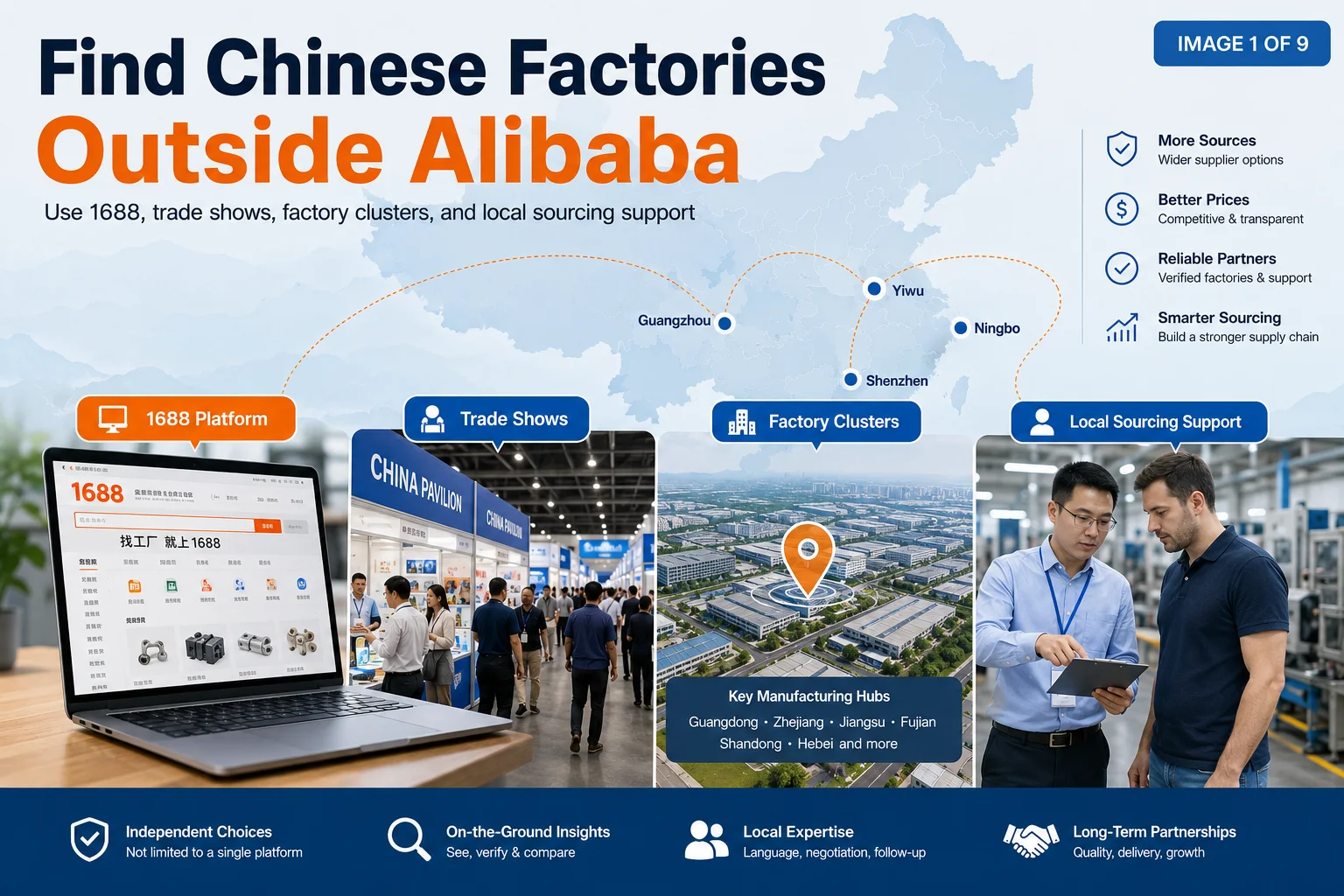
To find Chinese factories outside Alibaba, you must look where local buyers go. You can use Chinese platforms like 1688, visit industry-specific trade shows in China, find local manufacturing clusters, or hire a local sourcing agent to check the factory for you.
Many buyers think finding a factory is just a quick search online. But true Chinese manufacturers do not use English marketing. If you want better prices and unique products, you need to change how you search. If you do not learn these new methods, you will keep paying middleman fees forever. Let us explore the best ways to find reliable suppliers without using Alibaba.
1. Why Do Buyers Look for Chinese Factories Outside Alibaba?
Do you feel stuck with middleman markups? Finding a unique product is hard when everyone uses the same platform. You need a new place to source.
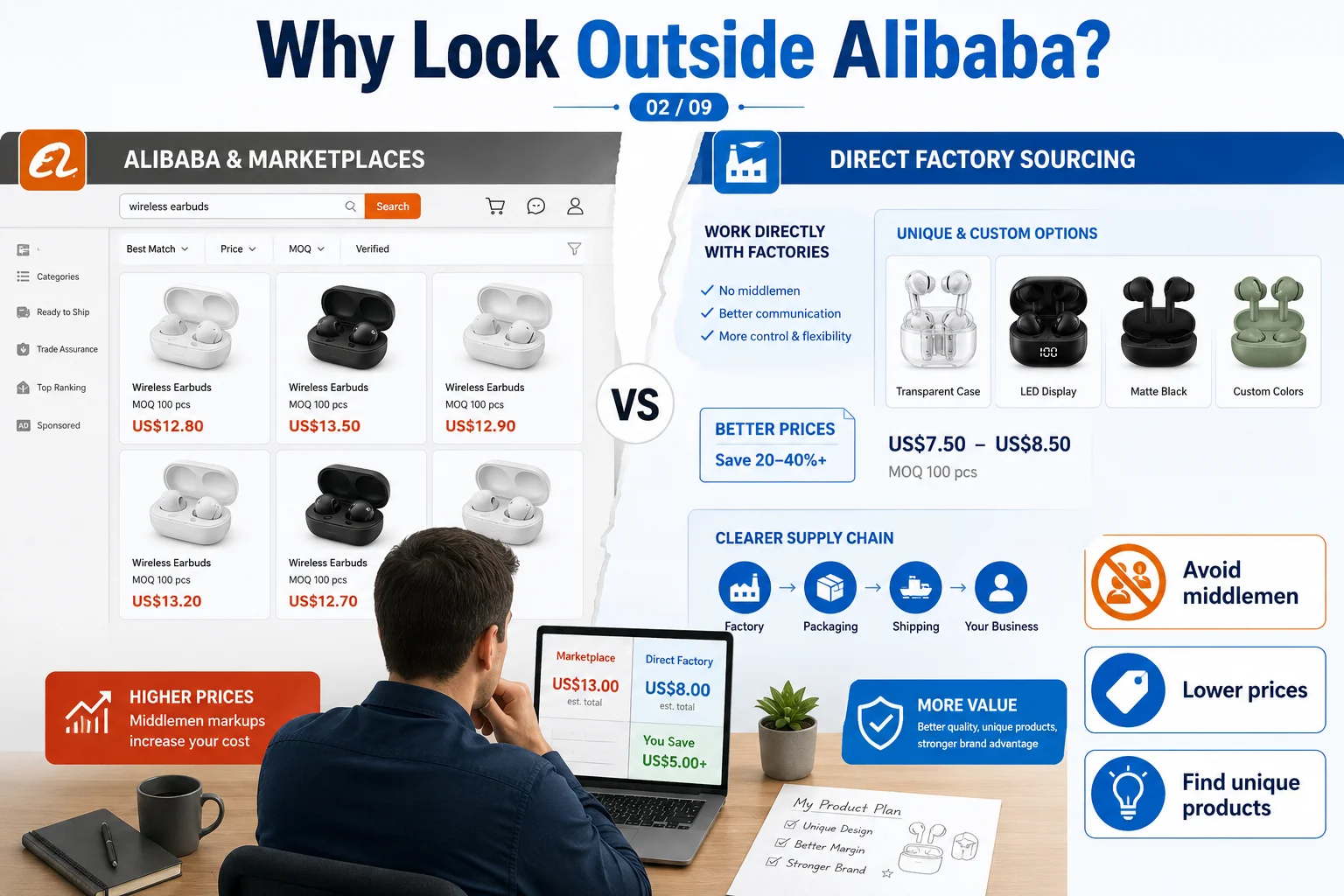
Buyers look outside Alibaba to avoid trading companies, secure lower prices, and find unique products that competitors do not sell. Real factories often focus on domestic sales and do not pay for Alibaba ads[^1], making them hidden gems for serious buyers.
The Problem with Platform Sourcing
Many of my clients at KingSourcing come to me with the same problem. They start on Alibaba, but soon they hit a wall. They find out that many so-called direct suppliers are actually just trading companies.[^2] These middlemen buy from real factories and add their own profit margin. This makes your cost higher. When you rely only on a platform, you must follow their rules. This limits your growth and your profit.
Seeking Better Margins and Unique Designs
Buyers want to grow their business. To do this, they need better margins. They also want products that are not sold by one hundred other stores on Amazon. Real Chinese factories often do not speak English.[^3] They do not have an Alibaba store. They rely on their local network to get orders. This means if you can reach them, you get the real factory price. You also get a chance to make custom products without platform rules getting in the way.
| Buyer Goal | Alibaba Reality | Off-Alibaba Reality |
|---|---|---|
| Lower Price | High fees and middleman markups | Direct factory pricing |
| Unique Product | Same items shown to all buyers | Custom options with less competition |
| Direct Control | Platform rules limit communication | Direct contact with the factory boss |
2. What Are the Main Ways to Find Factories in China?
You know you want to leave Alibaba, but where do you start? Searching blindly can lead to scams. You need safe and proven ways to look.
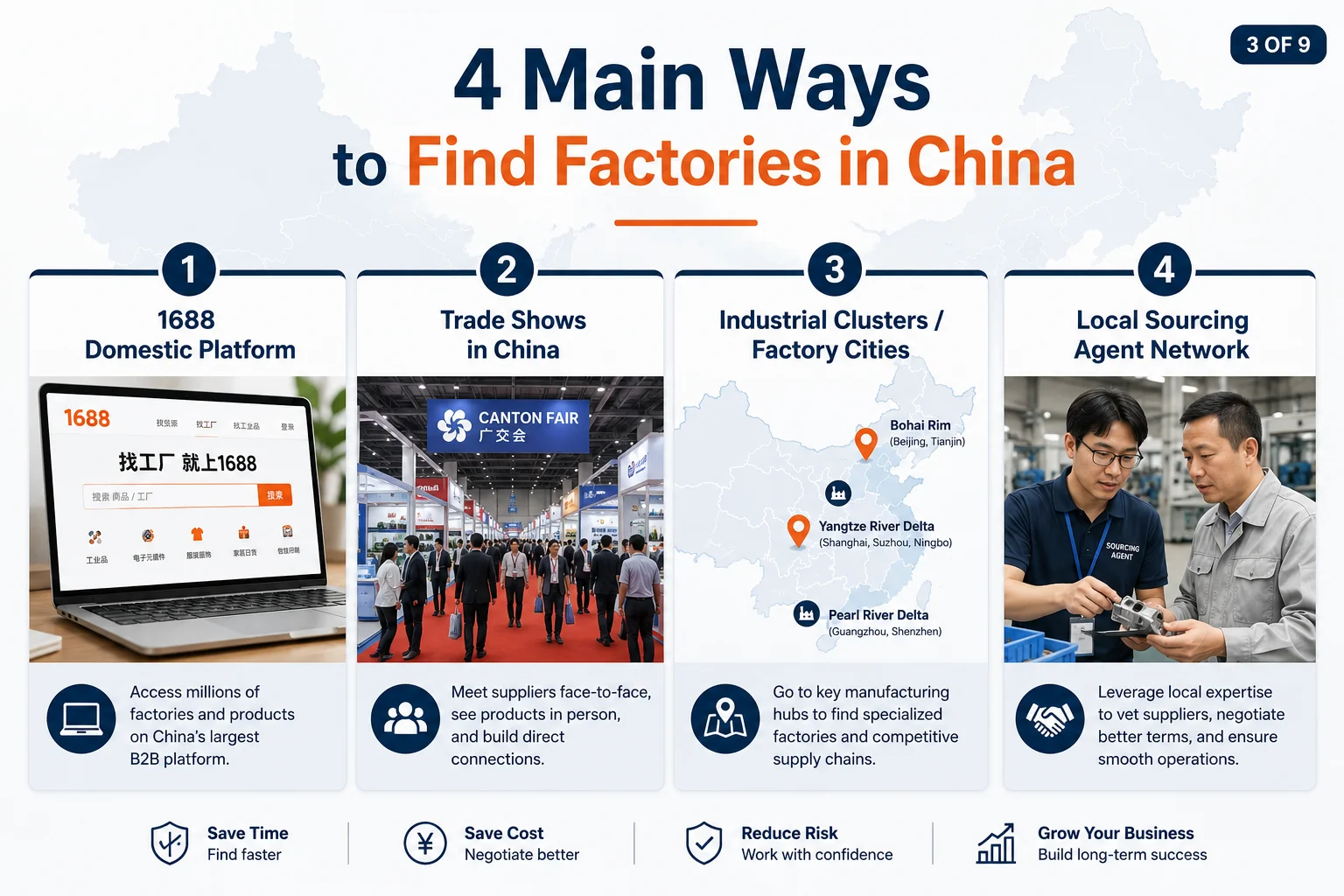
The main ways to find factories in China include using domestic platforms like 1688.com, attending local trade shows, visiting specific industrial clusters, and working with a local China sourcing agent who has a strong network.
Moving Beyond Google Searches
You cannot just type "China factory" into Google. The best factories do not care about Google SEO. They care about making products. When I talk to clients, they often say they tried Google and only found bad websites. I always tell them to look where the Chinese buyers look. You must know how to talk to them. You must know what apps they use. They mostly use WeChat to do business.
Four Proven Channels
There are four main ways to do this safely. First, you can use Chinese wholesale websites. Second, you can visit trade shows in China. Third, you can go to the exact cities where your product is made. Fourth, you can use a local team to do the hard work for you. Each way has its own rules. You must learn these rules to succeed.
| Sourcing Channel | How It Works | Best For |
|---|---|---|
| 1688.com | Chinese domestic wholesale site | Cheap items and small test orders |
| Trade Shows | Face-to-face meetings in China | Big buyers building relationships |
| Industrial Clusters | Visiting specific factory cities | Niche products and deep supply chains |
| Local Agent | Hiring a China team | Safe sourcing and quality control |
3. How to Use 1688, Industrial Clusters, Trade Shows, and Local Networks?
Do these new methods seem too hard to use? The language barrier can cause big mistakes. You need a clear plan to use these channels safely.
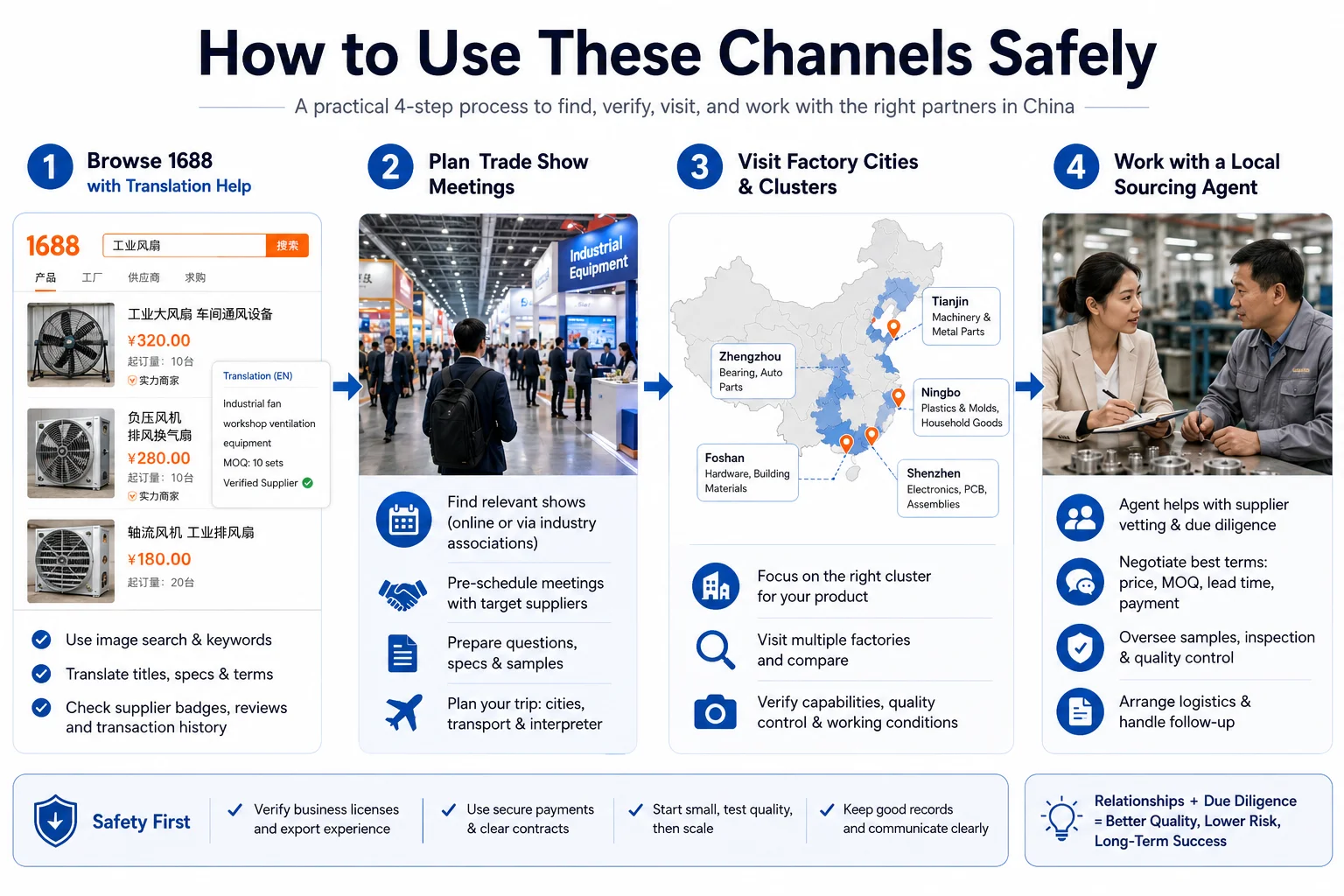
To use 1688, translate pages and use a local buyer. For trade shows, plan meetings and walk the floor. For industrial clusters, travel to specific factory cities. For local networks, hire an agent to speak Chinese and negotiate for you.
Navigating 1688 and Trade Shows
The website 1688.com is owned by Alibaba, but it is only for the Chinese market.[^4] Prices are cheaper. But you need to know Chinese to use it well. Most factories there do not export directly. You need a partner to pay in RMB and ship the goods out of China.[^5] Trade shows, like the Canton Fair or local industry shows, are great. You can touch the products. You can meet the boss face-to-face. But you must prepare well before you fly to China. You also need a good plan for shipping.
The Power of Clusters and Local Help
China is a huge country. But factories that make the same thing usually group together. We call these industrial clusters. For example, electronics are mostly in Shenzhen.[^6] Toys are mostly in Shantou.[^7] If you go to these cities, you will find many factories fast. If you cannot travel, a local network is your best choice. A China sourcing office can go to these clusters for you. They can talk to the boss directly.
| Method | Action Required | Challenge |
|---|---|---|
| 1688.com | Use translation tools and find a shipping agent | Language barrier and payment issues |
| Trade Shows | Book flights and set up meetings | High travel cost and takes a lot of time |
| Industrial Clusters | Research city maps and visit factories | Needs deep local knowledge |
| Local Networks | Share product details with your agent | Finding a trusted agent |
4. How to Tell Whether a Supplier Is a Real Factory or a Trading Company?
Are you talking to a middleman who claims to be a factory? Paying extra for a fake factory ruins your budget. You must know how to spot the difference.
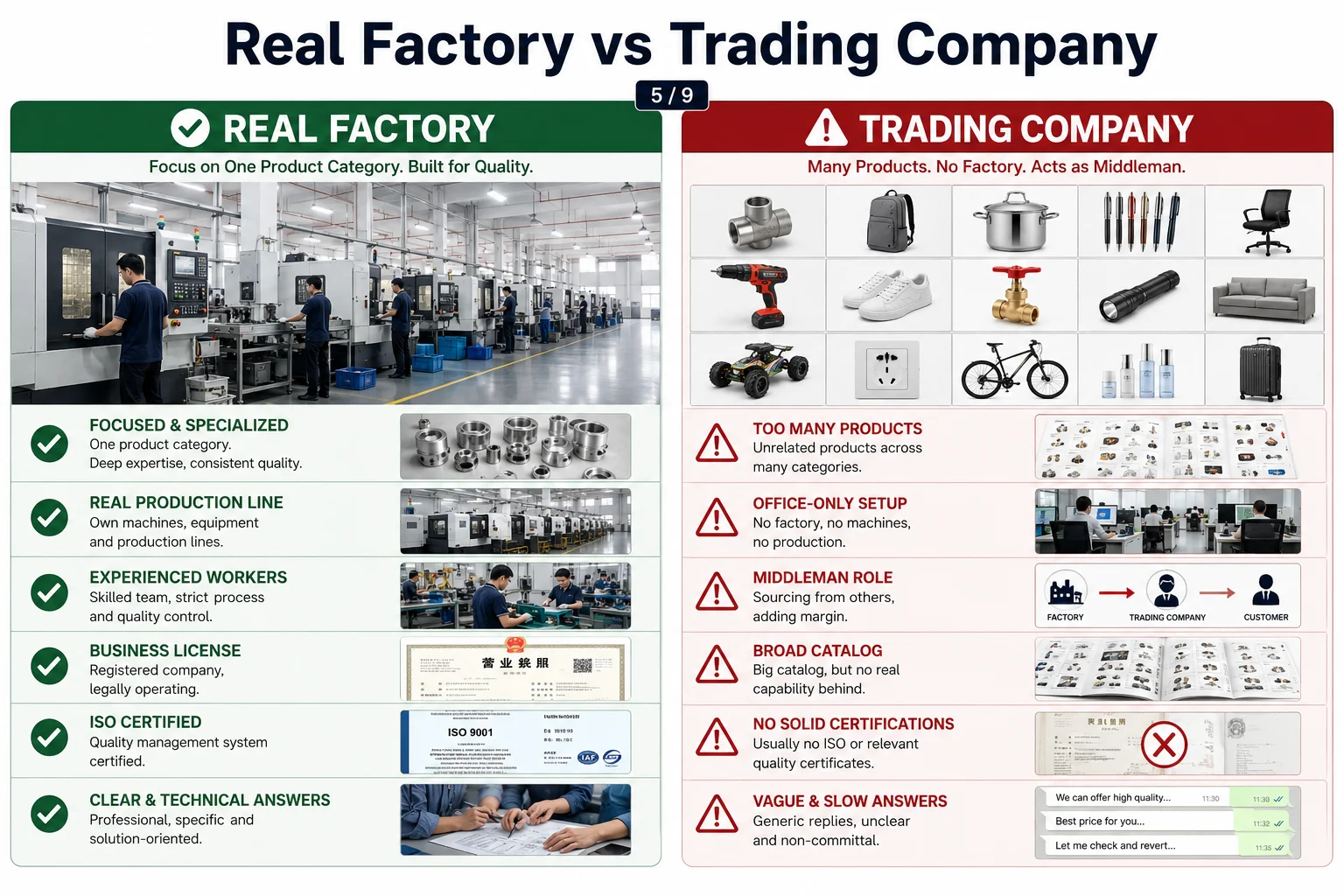
To tell if a supplier is a real factory, check their business license scope, ask for a live video tour of the production line, look at their ISO certificates, and see if they focus on one single product category instead of many.
The License Check
In my experience auditing suppliers, many middlemen lie. They will say they own the factory. To find the truth, you must look at their Chinese business license. Look at the "business scope" section. If it only says "sales" or "trading", they are a middleman.[^8] If it says "manufacturing" or "production", they are a real factory. You need to be very strict when you check this. If they give you a bad excuse, you must walk away.
Video Tours and Product Focus
Another easy test is to ask for a live video call. Ask them to walk from the office to the factory floor right now. A trading company cannot do this. A real factory will be happy to show you their machines. Also, you must look at their product catalog. A real factory makes one type of product. A trading company sells shoes, electronics, and toys all at the same time.[^9]
| Check Method | Real Factory Sign | Trading Company Sign |
|---|---|---|
| Business License | Includes "Manufacturing" | Only says "Sales" or "Trading" |
| Video Tour | Can walk to machines instantly | Makes excuses and delays the video |
| Product Catalog | Sells one specific category | Sells many random categories |
| Location Address | Located in an industrial park area | Located in a downtown office building |
5. How to Compare Factory Quotes, MOQ, Samples, and Production Capacity?
Do cheap quotes make you feel unsafe? Choosing a factory just by the lowest price can lead to bad quality. You must compare all terms carefully.
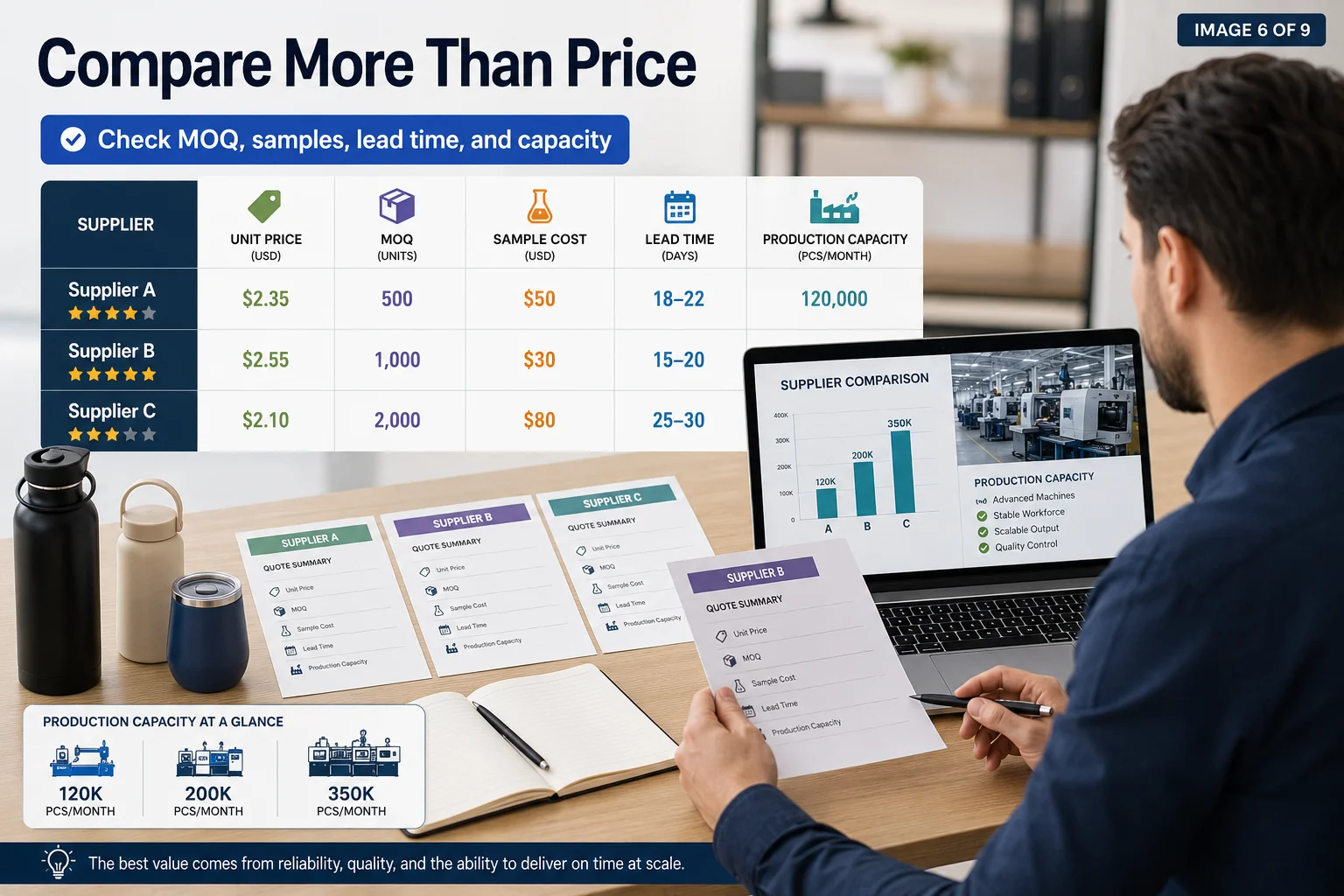
To compare factories, do not just look at the final price. You must check their Minimum Order Quantity (MOQ), sample costs, lead times, and production capacity. Always get samples from at least three different factories before you make a final choice.
Look Beyond the Price Tag
Many buyers make a big mistake. They get a quote and only look at the unit price. But in China, you get what you pay for. If a price is too low, the factory might use bad materials. I always tell my clients to ask for a full cost breakdown. You need to know the cost of the product, the packaging, and the shipping. You also need to ask about payment terms. A good factory will agree to normal payment rules. They will not ask for full payment upfront.
Evaluating the Full Package
You must also compare the MOQ. A huge factory might have a very high MOQ. A smaller factory might be more flexible for your needs. Always ask about their production capacity. Can they handle your order if your business grows fast? And never skip the sample step. Order samples from your top three choices. Touch the product. Test it. Only then can you see the real value behind the quote.
| Factor to Compare | Why It Matters | What to Ask |
|---|---|---|
| Unit Price | Low price often means low quality | What exact materials do you use? |
| MOQ | Shows if they match your business size | Can we start with a small trial order? |
| Samples | Proves their actual quality level | How much is a custom sample? |
| Capacity | Ensures they will not delay big orders | How many units can you make a month? |
6. Why Do Supplier Verification, Business License Review, and Factory Checks Matter?
Are you worried about losing your money to a scam? Sending money to someone you never met is dangerous. You must verify them first to protect your business.
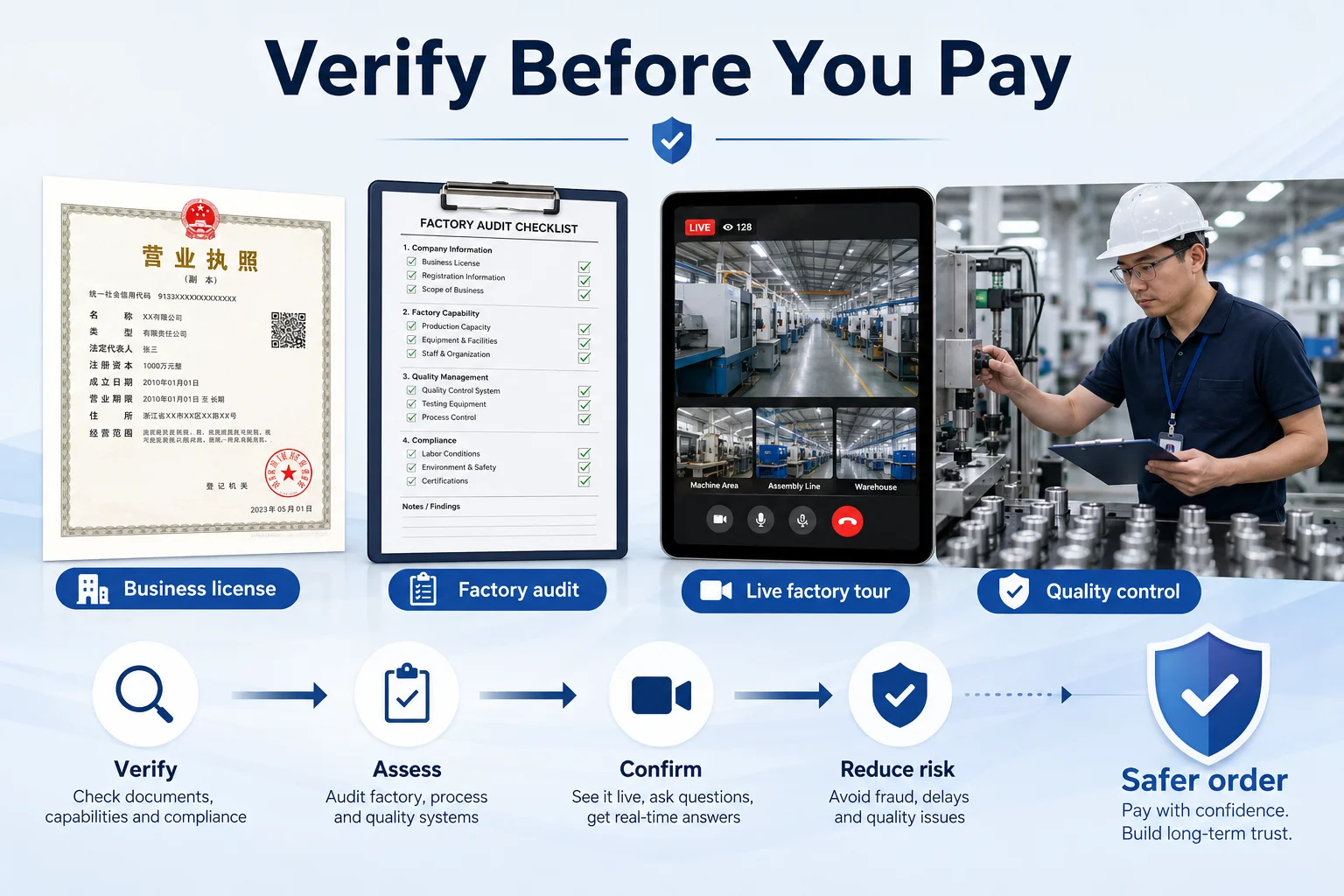
Verification matters because off-platform sourcing has no Trade Assurance.[^10] Checking business licenses and doing factory audits proves the factory exists, is legally registered, and has good quality control. This stops scams and ensures your goods will be made on time.
The Risk of No Platform Protection
When you buy on Alibaba, you have some protection. When you go outside Alibaba, you take all the risk. If you pay a bad supplier, your money is gone. This is why checking the factory is so important. We do this for our clients every day. You cannot trust a nice website. You must trust facts and legal papers. Quality control starts with knowing the factory is real. If the factory is fake, your contract means nothing.
Deep Factory Audits
Reviewing a Chinese business license is step one. It shows they are real. But a factory check does more. It looks at how they make things. Do they have a quality control team? Are their machines old or new? Are the workers happy? A deep factory check finds problems before you pay the deposit. It gives you peace of mind and keeps your money safe.
| Verification Step | What It Proves | Risk Avoided |
|---|---|---|
| License Review | Legal company status | Fake company scams |
| Bank Account Check | Money goes to the company, not a person | Money theft |
| Factory Audit | Real production power | Bad quality and late delivery |
| Social Compliance | Good worker treatment | PR issues for your brand |
7. What Are the Common Mistakes Buyers Make When Sourcing Outside Alibaba?
Are you rushing to place your first direct order? Skipping basic checks can cause total failure. You must learn from others' mistakes to save your money.
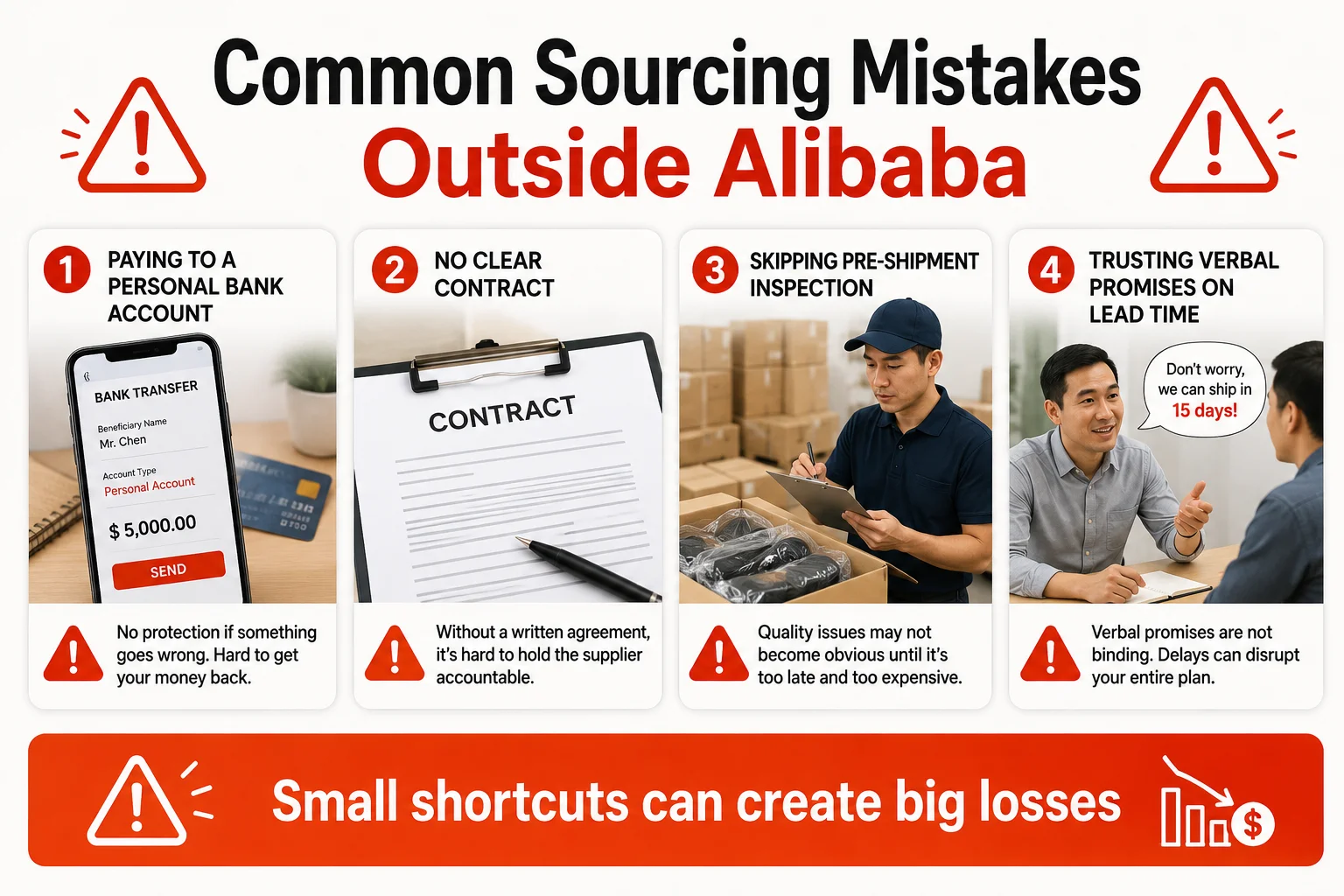
Common mistakes include paying to personal bank accounts, not signing a clear contract, skipping pre-shipment quality inspections, and trusting verbal promises about lead times. Buyers also fail because they do not have a local person to check the goods before they leave China.
The Danger of Blind Trust
I talk to many buyers who lost money before they found KingSourcing. The biggest mistake is blind trust. They find a factory, talk on WeChat, and send money. They do not write down clear rules for quality. When the goods arrive, the color is wrong. The factory says you did not specify the color. Without a clear contract, you cannot win.[^11] Many people think a small mistake will not matter. But in international trade, a small mistake can ruin your whole business.
Skipping Quality Inspections
Another huge mistake is skipping the pre-shipment inspection. Some buyers want to save a little money, so they do not hire an inspector. The factory ships bad goods. Once the goods leave China, it is too late to fix the problem. You must always check the goods while they are still in the factory. Never pay the final balance until the inspection is passed.[^12]
| Common Mistake | Consequence | How to Fix It |
|---|---|---|
| Paying a personal account | Losing all your money | Only pay official company accounts |
| No clear contract | Wrong materials or colors | Write a very detailed order sheet |
| No inspection | Receiving broken products | Always do a pre-shipment check |
| Trusting verbal dates | Selling out of stock | Put late penalties in the contract |
8. How Does KingSourcing Help Buyers Find and Verify Chinese Factories More Safely?
Sourcing alone is full of stress and hidden risks. Finding the right factory takes too much time. You need a trusted local partner to manage everything.
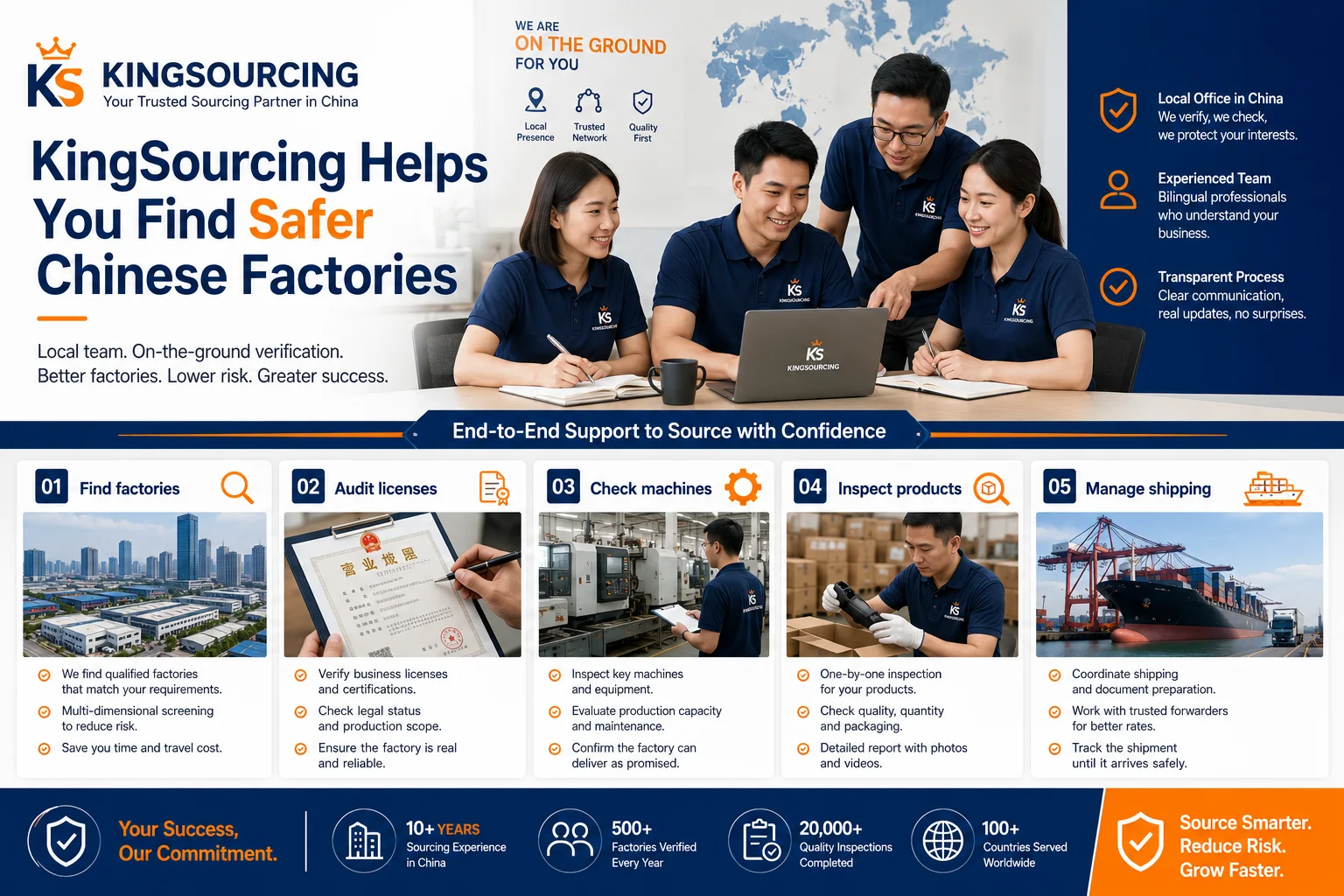
KingSourcing acts as your local China office. We find reliable factories, audit their licenses, check their machines, negotiate low prices, and do one-by-one product inspections. We lower your risk, save you time, and make your China sourcing simple and safe.
Your Local Team in China
You do not have a team in China. That is where KingSourcing comes in. We are not just a middleman. We are your sourcing office, your quality control team, and your shipping helper. When you want to move away from Alibaba, we do the hard work. We search the local markets, 1688, and industrial clusters. We talk to the factory bosses in Chinese. We want you to focus on selling your products. We will handle all the hard work in China for you.
Lowering Risks and Saving Time
We lower your trial and error costs. Before you send any money, we verify the factory. We go to their building. We do live video calls for you. We also check your products one by one before they go into the box. If there is a problem, we fix it with the factory directly. We manage the packing, the warehousing, and the shipping to your door. We make your sourcing safe and easy.
| KingSourcing Service | Your Benefit | Risk Eliminated |
|---|---|---|
| Factory Sourcing | Access real factory prices | High middleman costs |
| License & Audit | Know the supplier is real | Scams and fake factories |
| 1-by-1 Inspection | Get perfect products | Bad reviews from your customers |
| Logistics & Shipping | Easy door-to-door delivery | Custom delays and lost boxes |
Conclusion
Finding factories outside Alibaba requires careful checks and local knowledge. By verifying licenses, doing audits, and using a partner like KingSourcing, you can buy safely and grow your business.
[^1]: "China's Economic Challenges: Export vs Domestic Perspectives", https://www.linkedin.com/posts/neil-shearing-65793b13b_deflation-at-home-disruption-abroad-china-activity-7420411051051212800-vSnN. Research on Chinese manufacturing indicates that a vast majority of small to medium-sized factories focus entirely on domestic supply chains due to the high marketing and compliance costs associated with direct exporting. Evidence role: statistic; source type: paper. Supports: The proportion of Chinese manufacturers that operate exclusively in the domestic market versus those that export.. Scope note: Does not prove that no real factories use Alibaba, only that a significant portion do not. [^2]: "[PDF] E-commerce Development Experience from China", https://documents1.worldbank.org/curated/en/552791574361533437/pdf/E-commerce-Development-Experience-from-China.pdf. Supply chain analyses of cross-border e-commerce platforms reveal that a substantial percentage of listed suppliers operate as trading intermediaries rather than original equipment manufacturers (OEMs). Evidence role: statistic; source type: research. Supports: The high prevalence of trading intermediaries on global B2B platforms.. [^3]: "Dialects, motivation, and English proficiency: Empirical evidence ...", https://pmc.ncbi.nlm.nih.gov/articles/PMC9558723/. Studies on international trade communication highlight that domestic-tier manufacturing facilities in China frequently lack dedicated English-speaking sales staff, necessitating the use of export agents or trading companies. Evidence role: mechanism; source type: paper. Supports: The lack of foreign language proficiency among domestic-focused Chinese manufacturers.. [^4]: "Alibaba Group - Wikipedia", https://en.wikipedia.org/wiki/Alibaba_Group. 1688.com is a subsidiary of the Alibaba Group, established specifically to serve domestic B2B wholesale trade within China, contrasting with Alibaba.com's focus on international exports. Evidence role: definition; source type: encyclopedia. Supports: Alibaba's ownership of 1688.com and its function as a domestic wholesale marketplace.. [^5]: "China - U.S. Export Controls - International Trade Administration", https://www.trade.gov/country-commercial-guides/china-us-export-controls. Under Chinese foreign exchange and trade regulations, domestic transactions must be settled in Renminbi (RMB), and exporting goods requires a registered export license, which many domestic-only factories do not possess. Evidence role: mechanism; source type: government. Supports: Chinese foreign exchange regulations and export licensing laws.. [^6]: "A History of the Electronics Industry in Shenzhen, China | umsi", https://www.si.umich.edu/about-umsi/events/military-industrial-complex-global-supply-chain-history-electronics-industry. Economic geography studies highlight Shenzhen as a dominant industrial cluster for electronics, accounting for a significant percentage of global consumer electronics production and supply chain infrastructure. Evidence role: statistic; source type: research. Supports: Shenzhen's dominance as an electronics manufacturing cluster.. Scope note: The exact concentration fluctuates as manufacturing shifts to other regions, though Shenzhen remains a primary hub. [^7]: "How is the Biggest Toys Warehouse -- Shantou Chenghai Toys Place?", https://tonysourcing.com/shantou-chenghai-capital-toys-city-in-china/. Industry reports identify Shantou, particularly the Chenghai district, as one of China's largest toy manufacturing clusters, producing a vast majority of the country's exported plastic and electronic toys. Evidence role: statistic; source type: institution. Supports: Shantou's role as a leading toy manufacturing center.. [^8]: "China - Licensing Requirements for Professional Services", https://www.trade.gov/country-commercial-guides/china-licensing-requirements-professional-services. Under Chinese corporate law, a company's business license must explicitly state its approved business scope (经营范围), which legally distinguishes manufacturing entities from trading or wholesale enterprises. Evidence role: mechanism; source type: government. Supports: The legal function of the 'business scope' on a Chinese business license.. [^9]: "Economies of scale - Wikipedia", https://en.wikipedia.org/wiki/Economies_of_scale. Manufacturing economics dictate that factories achieve economies of scale through specialization in specific product categories, whereas trading intermediaries leverage diversified portfolios to capture broader market demand. Evidence role: mechanism; source type: paper. Supports: The economic necessity of product specialization in manufacturing.. Scope note: Some large conglomerate manufacturers may have multiple divisions producing diverse goods, though this is rare for SMEs. [^10]: "Methods of Payment - International Trade Administration", https://www.trade.gov/methods-payment. Platform-specific buyer protection programs, such as Trade Assurance, function as escrow services that hold funds until delivery conditions are met, a safeguard not inherently present in direct wire transfers used in off-platform sourcing. Evidence role: definition; source type: institution. Supports: The function of platform-based escrow services in mitigating trade risk.. [^11]: "[PDF] China's Foreign Economic Contract Law: Its Significance and Analysis", https://scholarlycommons.law.northwestern.edu/cgi/viewcontent.cgi?article=1222&context=njilb. Under international trade frameworks such as the UN Convention on Contracts for the International Sale of Goods (CISG), the enforceability of quality standards and dispute resolution relies heavily on highly specific, written contractual terms. Evidence role: mechanism; source type: paper. Supports: The necessity of detailed contracts in international trade dispute resolution.. [^12]: "Trade Guide: WTO PSI", https://www.trade.gov/trade-guide-wto-psi. Trade finance and supply chain risk management best practices recommend tying final payment milestones to the successful completion of a third-party pre-shipment inspection to ensure quality compliance before export. Evidence role: expert_consensus; source type: education. Supports: The standard practice of tying final payment to pre-shipment inspections..