Worried about sending money to an unverified Chinese supplier? It's a common fear. Losing your deposit to a scam or a bad factory can sink your business before it starts.
To check if a supplier is legit, you must go beyond their online profile. Verify their business license, analyze communication quality, order physical samples, and confirm product details. For complete confidence, an on-site factory audit before paying a large deposit is the best way to confirm they are real and capable.
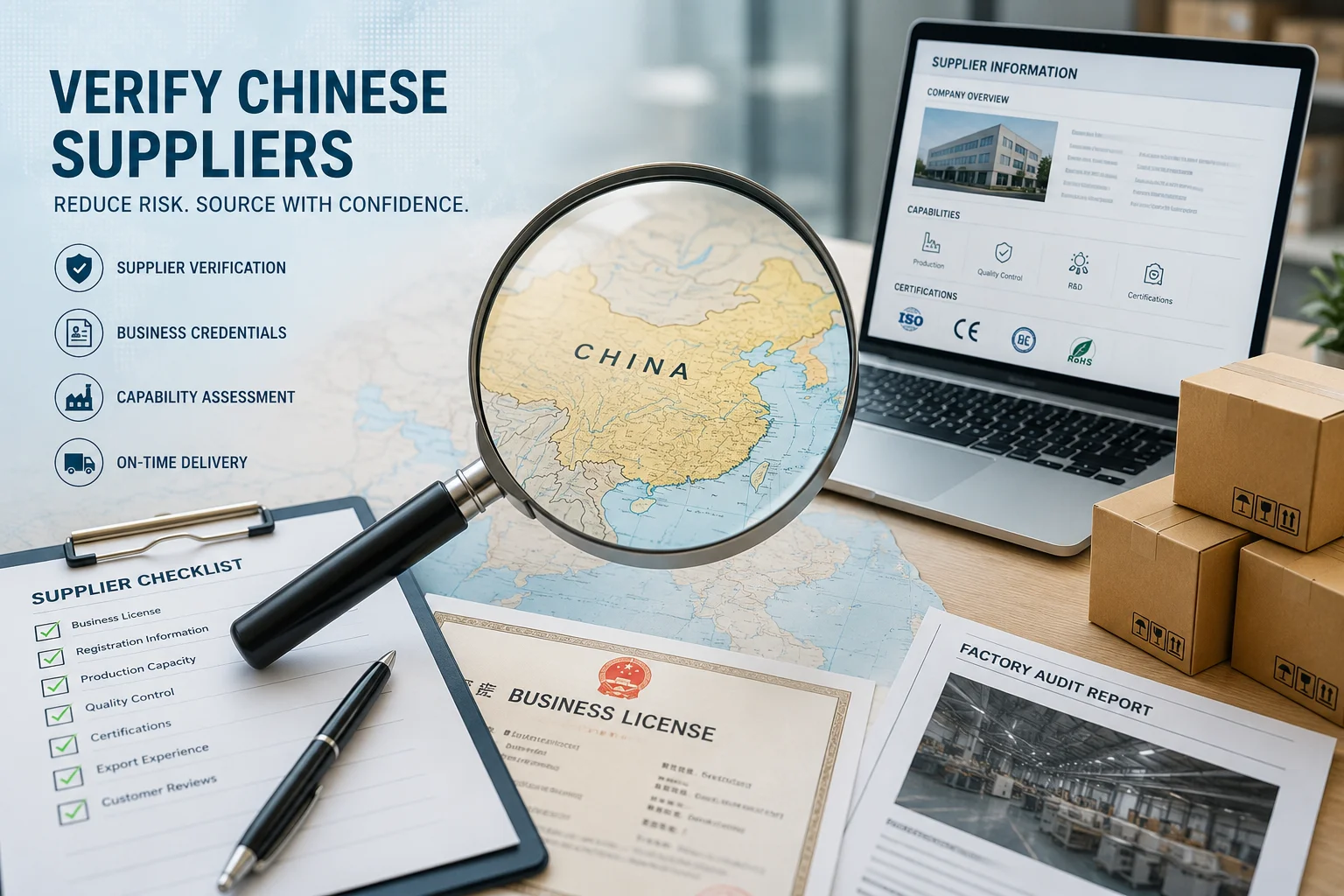
These initial online checks are a good first step, but they only scratch the surface. True verification is a process, not a single action. You need to dig deeper to truly understand who you are working with and if they are the right fit for your business. Let's break down exactly what you need to look for, step-by-step.
Why Must You Check If a Chinese Supplier Is Legit Before Ordering?
Skipping verification seems faster but often leads to disaster. You could receive low-quality goods, lose your entire deposit, or face endless delays that stall your business and frustrate your customers.
You must check a supplier's legitimacy to avoid scams, ensure product quality, and protect your investment. This simple step prevents costly mistakes, such as receiving unusable products, facing unexpected production delays, or losing your money to a fake company. It’s about minimizing risk from the very beginning.
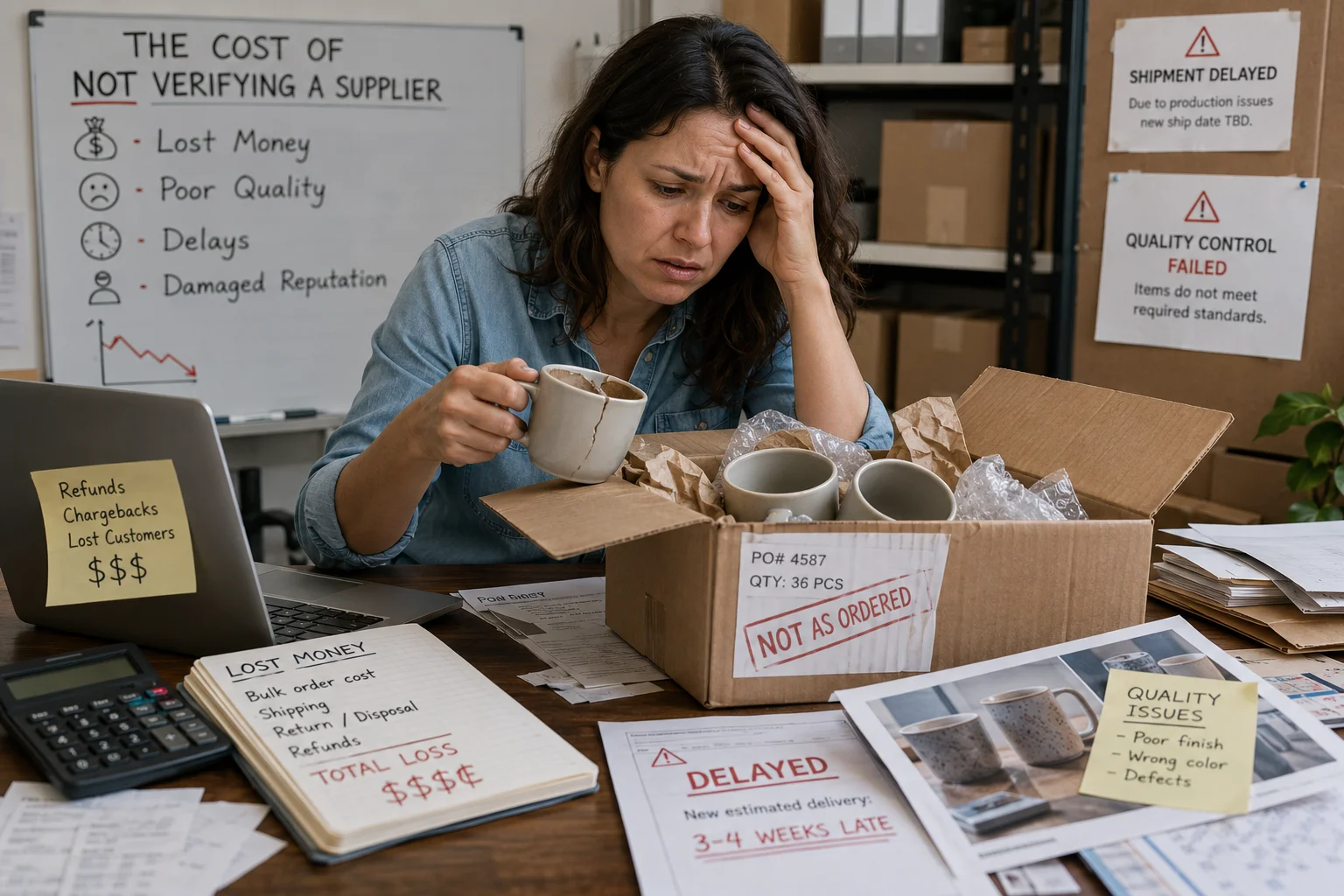
In my experience, many first-time importers are so excited to find a low-priced product that they rush the vetting process. This is the most common and expensive mistake I see. Verifying a supplier isn't just about avoiding a 100% scam where someone takes your money and disappears. That's actually rare. The more common risk is working with a supplier who is "legit" but not capable. They might be a small workshop pretending to be a large factory, or a middleman who has no control over quality.
Here’s what’s at stake:
- Financial Risk: You could lose your 30-50% deposit.[^1] Or worse, you might pay the final balance only to receive a container of junk that you can't sell, losing your entire investment.
- Quality Risk: The supplier might switch to cheaper materials after you approve the sample. Without on-site inspections, you won't know until the products arrive at your warehouse, which is too late.
- Reputational Risk: Selling bad products to your customers can destroy your brand's reputation overnight. Bad reviews and chargebacks can kill a small business.[^2]
What Does a Legit Chinese Supplier Usually Look Like?
It's hard to tell a good supplier from a bad one online. Polished websites and "verified" badges on B2B platforms can be misleading, leaving you unsure who to trust.
A legit supplier communicates professionally, provides detailed technical answers, and isn't afraid to say "no" if a request is impossible. They have a verifiable business registration, a clear product specialization, and are transparent about their processes, location, and capabilities from the start.
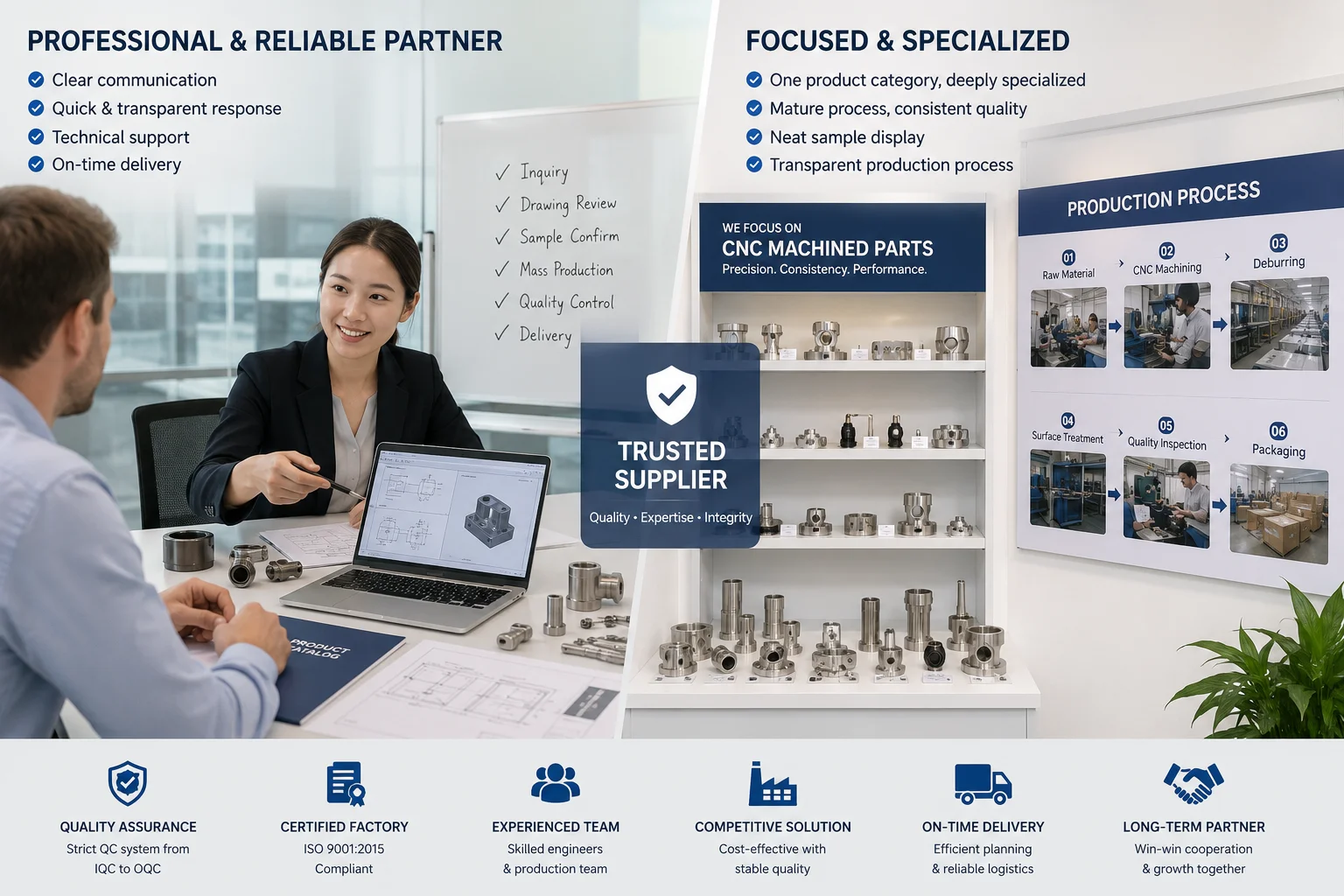
A "legit" supplier isn't just one that won't run away with your money. It's one that is professional, capable, and transparent. One of the first filters I use is communication. A risky supplier or a lazy middleman will often say "yes" to everything. "Can you do this complex design for a very low price?" "Yes, no problem." "Can you deliver in 10 days?" "Yes, no problem." This is a huge red flag.
A real factory or a professional trading company knows its limits. They will ask you clarifying questions. They might push back on your timeline or pricing, explaining the technical reasons why. This is a good sign. It shows they understand their own production process. Here is a simple comparison based on what we see every day.
| Aspect | Legit Supplier | Risky Profile |
|---|---|---|
| Communication | Asks technical questions. Provides clear specs. Admits limitations. | Says "yes" to everything. Vague answers. Poor English. |
| Product Focus | Specializes in a specific category (e.g., only stainless steel bottles). | Sells everything from electronics to textiles. |
| Business Info | Provides business license. Has a physical address that matches. | Hesitates to share documents. Address is a PO box or residential. |
| Website/Profile | Professional site with factory photos. Consistent info across platforms. | Poorly made website. Uses generic stock photos. |
How Do You Check a Chinese Supplier’s Business License and Company Background?
You found a supplier who communicates well, but how do you know their company is real? Asking for a business license feels official, but what do you even do with it?
Ask the supplier for a copy of their business license. Use China's National Enterprise Credit Information Publicity System[^3] (or a translation tool) to verify the company name, legal representative, and business scope. This confirms they are a legally registered entity in mainland China.
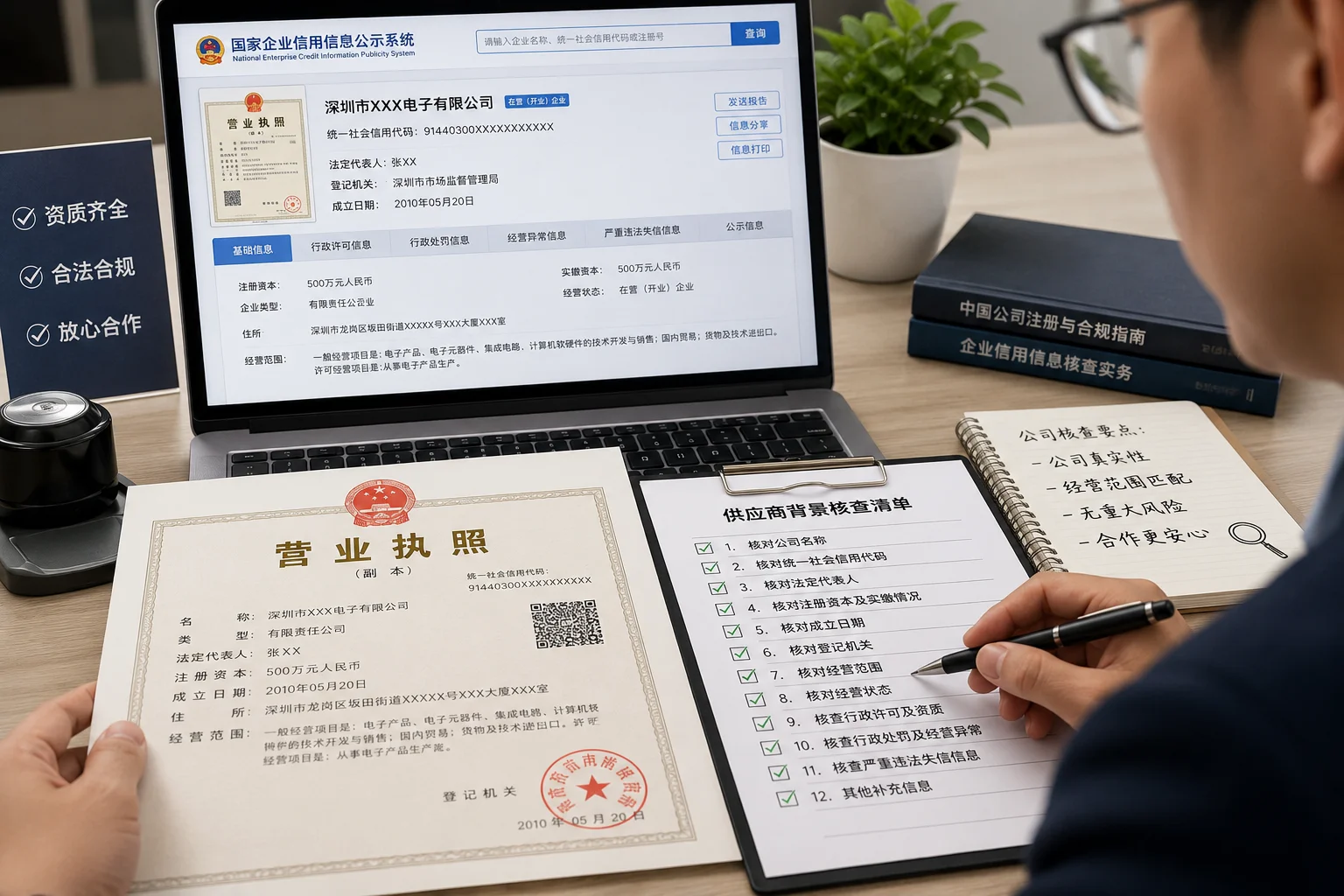
Checking a business license is a fundamental background check. Every legal company in China has one. If a supplier refuses to show it, walk away immediately. Once you have the license, you don't need to read Chinese to get valuable information from it. You are looking for a few key things.
First, identify the Company Name (公司名称). Use Google Translate to see if it matches the English name they use. Sometimes the names are different, but it should be close.
Second, look for the Business Scope (经营范围)[^4]. This section tells you what the company is legally allowed to do. Look for keywords like "production" (生产), "manufacturing" (制造), or "processing" (加工). If these words are missing, and you only see words like "sales" (销售), "trade" (贸易), or "import/export" (进出口), they are likely a trading company, not a factory.
Third, check the Date of Establishment (成立日期). A company that was established 10+ years ago is generally more stable than one that was registered last month. While not a guarantee, it shows they have been in business for a while.
How Do You Tell If the Supplier Is a Real Factory, Trading Company, or Risky Middleman?
You checked the business license and it says "production." Does that mean they are a massive, high-tech factory? Not necessarily. Distinguishing the type of supplier is key to managing expectations.
To tell the difference, ask for a virtual factory tour via video call. A real factory will gladly show you their production lines, warehouse, and sample room. Also, analyze their product catalog. Factories specialize, while middlemen often sell unrelated items.
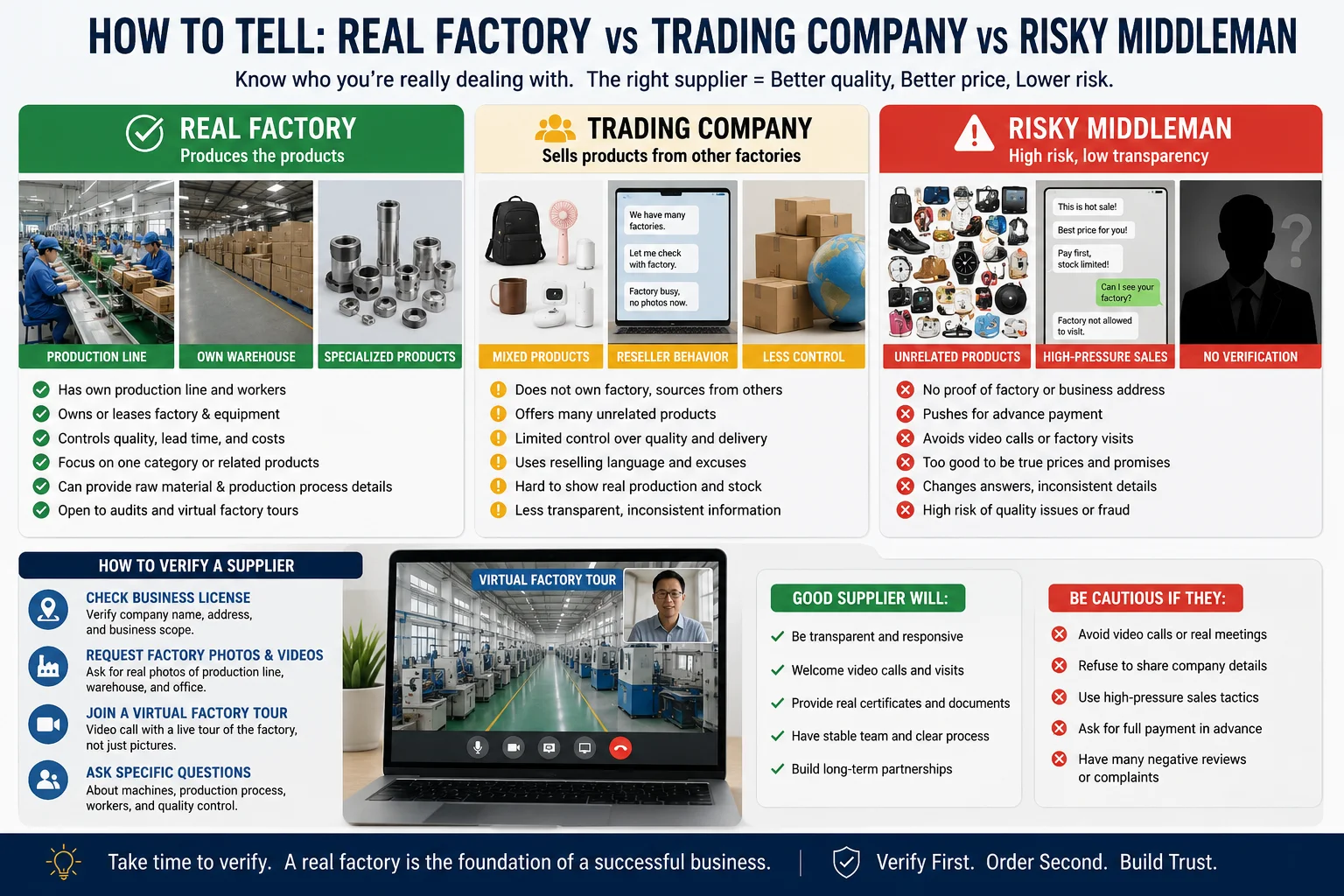
Understanding the supplier's true nature is crucial because it affects price, communication, and quality control. Each type has its pros and cons, and the "best" one depends on your needs.
1. The Real Factory
A factory physically manufactures the products. They should be able to answer deep technical questions, control production schedules, and offer the most competitive pricing. The downside is that they often have high Minimum Order Quantities (MOQs)[^5] and may have less experience with exporting.
2. The Professional Trading Company
A good trading company doesn't hide what they are. They have established relationships with multiple factories and can offer lower MOQs by combining orders. They usually have better English and more experience with logistics. The price will be slightly higher, but they add value through service.
3. The Risky Middleman (or "SOHO")[^6]
This is often a one-person operation working from an apartment. They have no real control over the factories they use, communication can be inconsistent, and quality is a gamble. They often appear on Alibaba with a wide range of unrelated products and are a major source of sourcing horror stories. A video call is the fastest way to expose them, as they will have no factory to show you.
What Documents, Samples, Product Details, and Payment Terms Should You Check?
You've done your background checks and are feeling more confident. Now, it's time to verify the most important thing: the product itself. This is where you move from theory to practice.
Request key documents like quality certifications (e.g., CE, RoHS)[^7]. Always order a pre-production sample to test quality firsthand. Confirm detailed product specifications in writing and clarify payment terms, especially the deposit percentage and final balance conditions.
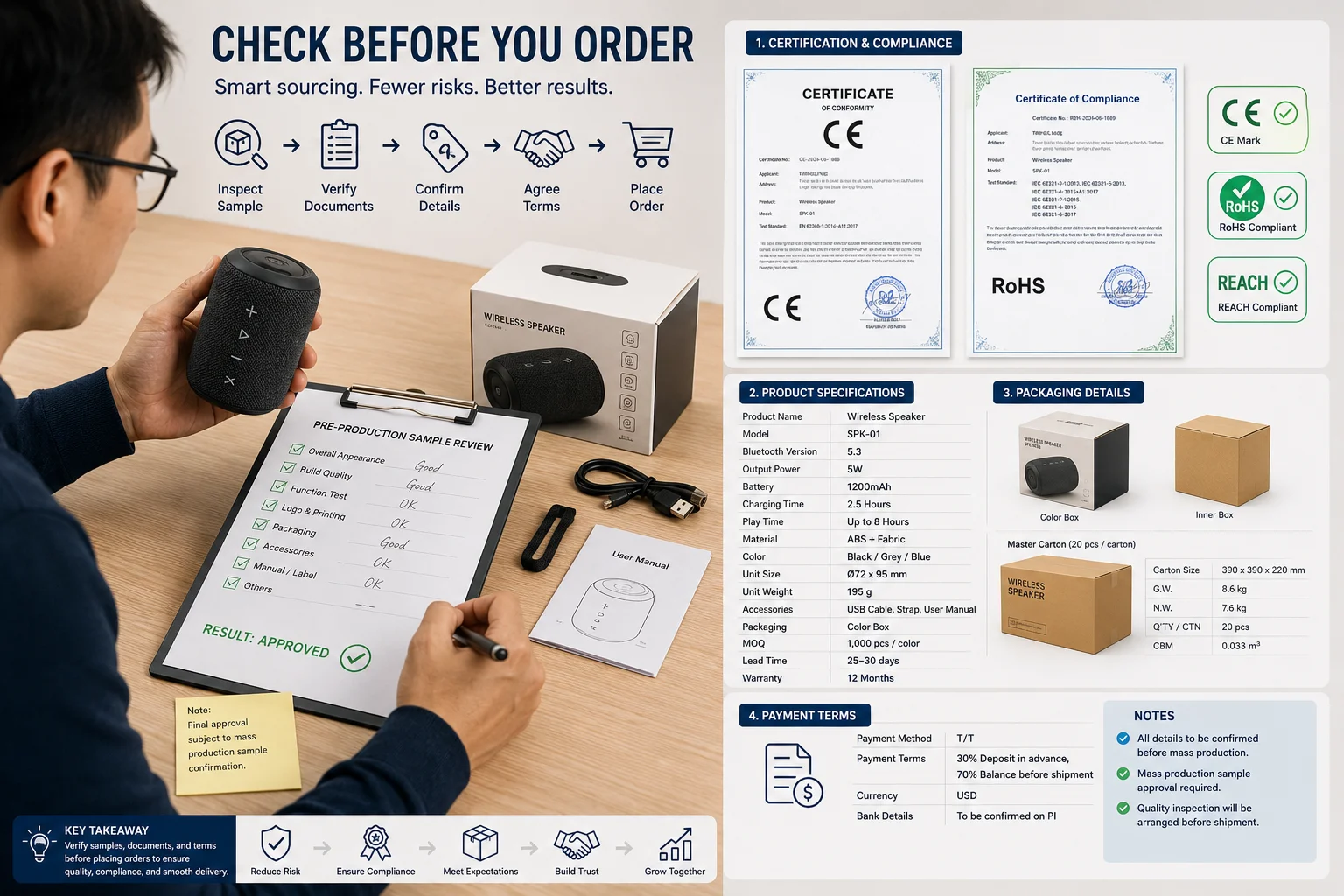
This stage is where a supplier's true professionalism shines through. Vague promises are no longer enough. You need concrete proof.
- Product Certifications: If you're selling electronics or toys, you'll need specific certifications like CE, FCC, or RoHS for legal import into your country. Ask the supplier if they have these for the exact product you want to buy. Ask for a copy of the certificate and check the validity. A professional supplier will have these ready.
- Product Samples: Never, ever skip the sample step. A photo or video is not enough. You need to hold the product in your hands. Feel the materials, test the function, and check the colors. The cost of shipping a sample (often $50-$100) is a tiny price to pay to avoid a $10,000 mistake.
- Detailed Specifications: Get everything in writing. Create a spec sheet that lists material, color (with Pantone codes), dimensions, weight, and packaging requirements. Have the supplier sign off on it. This document is your protection if the final product doesn't match.
- Payment Terms: The standard for custom orders is 30-50% deposit upfront and the remaining 50-70% balance after production is finished but before shipping. Be very wary of any supplier who asks for 100% upfront.
What Red Flags May Show a Chinese Supplier Is Not Reliable?
Sometimes, everything looks good on the surface, but a small detail feels wrong. Trusting your gut is important, but it's better to have a clear checklist of warning signs.
Major red flags include refusing a video call, demanding 100% upfront payment, having an address that points to a residential building on a map, and being unable to answer basic technical questions about the product they claim to make.
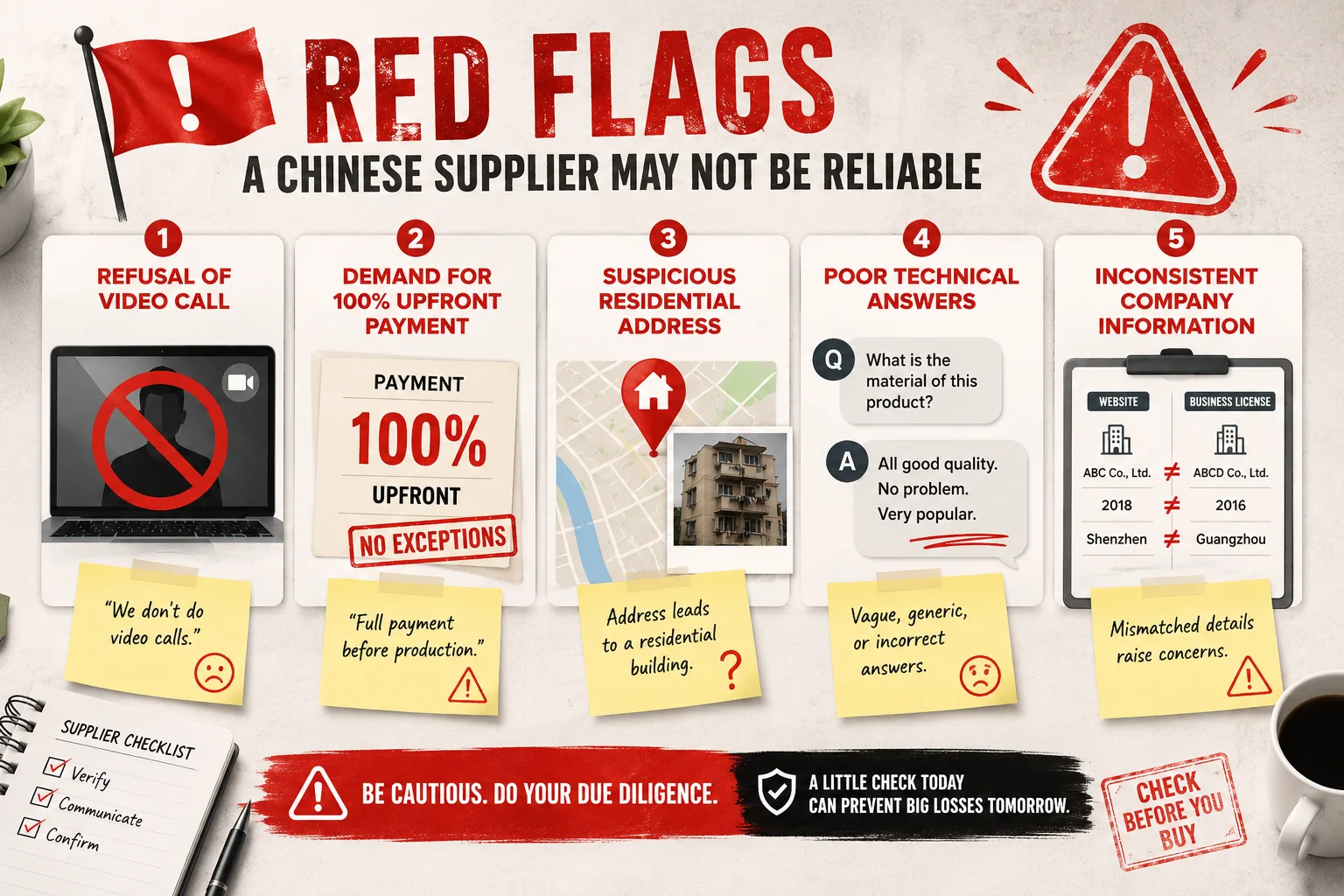
Over the years, I've seen a pattern of red flags that consistently point to unreliable or fraudulent suppliers. Spotting these early can save you a world of trouble. While one of these alone might be explainable, a combination of two or three is a clear signal to walk away.
Here are some of the most common red flags we tell our clients to watch for:
- Unprofessional Communication: Using a personal email address (@gmail.com, @hotmail.com) instead of a company domain. Poor grammar and one-word answers are also bad signs.
- Inconsistent Information: The company name on their Alibaba profile is different from their website, which is different from the name on the invoice. This suggests they are hiding something.
- Price is Too Good to Be True[^8]: If one supplier's quote is 50% lower than all the others, it's not a lucky find. It's a trap. They are likely using cheap materials or will increase the price later with fake fees.
- No Physical Address: They only provide a P.O. Box or are vague about their factory's location. A real business is proud of its facility and will share its address.
- Pressure Tactics: They pressure you to make a deposit quickly, claiming the price will go up tomorrow or that stock is running out. A professional partner gives you time to make a good decision.
Why Do Factory Checks, Supplier Verification, and Backup Suppliers Matter?
You’ve found a great supplier and the sample is perfect. Are you done? Not quite. Smart sourcing is about building a resilient supply chain, not just finding one supplier.
On-site factory checks confirm what you've been told online. Ongoing verification ensures quality doesn't slip over time. Having backup suppliers ready means one factory's problem—like a shutdown or a quality issue—won't stop your entire business.
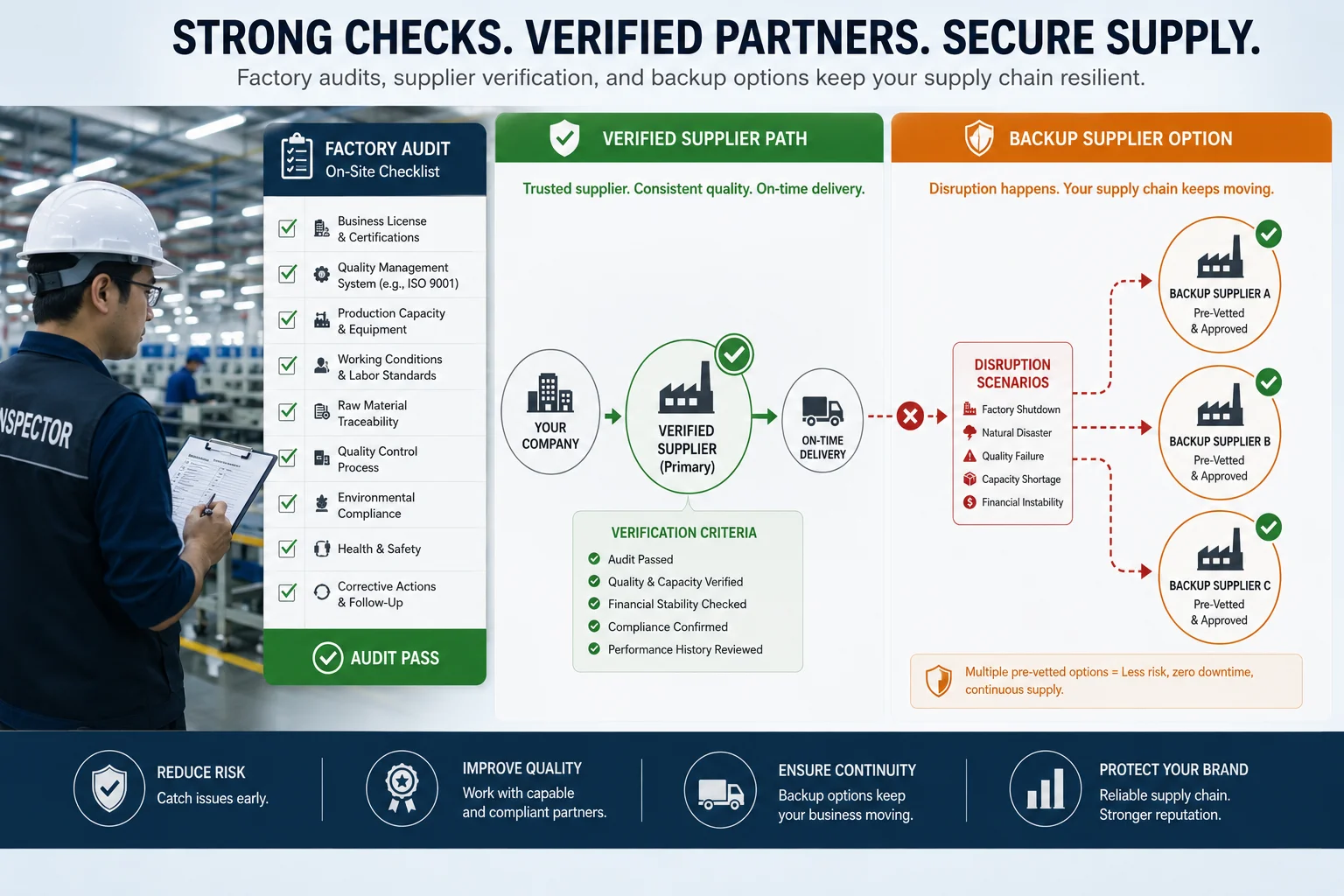
Relying on a single supplier is risky. I've seen clients' businesses grind to a halt because their only factory was shut down for environmental inspections[^9] or had a major quality failure. The goal is not just to place one safe order, but to build a system that can withstand problems.
The Importance of On-Site Checks
While a video call is good, nothing beats having someone physically visit the factory. An agent or inspector can verify the scale of the operation, check machinery conditions, and see how workers are treated. This is the ultimate level of verification and gives you true peace of mind before sending a large wire transfer.
Ongoing Verification
A supplier might perform perfectly on the first order to win your trust, but then cut corners on the second or third order to increase their profit margin.[^10] This is why ongoing quality control, like pre-shipment inspections for every order, is essential. It keeps the supplier honest and ensures consistent quality for your customers.
The Power of Backup Suppliers
During your initial sourcing phase, don't just stop when you find one good supplier. Identify two or three strong candidates. Keep in touch with them. That way, if your primary supplier suddenly raises prices or can't meet your demand, you can pivot to your backup without starting your search from scratch.
How Does KingSourcing Help Buyers Verify Chinese Suppliers and Manage Safer Orders?
Trying to verify suppliers from thousands of miles away is complex and time-consuming. You can't easily see the factory or meet the team, making it a huge gamble for your business.
KingSourcing acts as your local team in China. We verify suppliers on your behalf by checking business licenses, conducting on-site factory audits, and managing the entire order process. We ensure you work with reliable partners, making your China sourcing simple and secure.
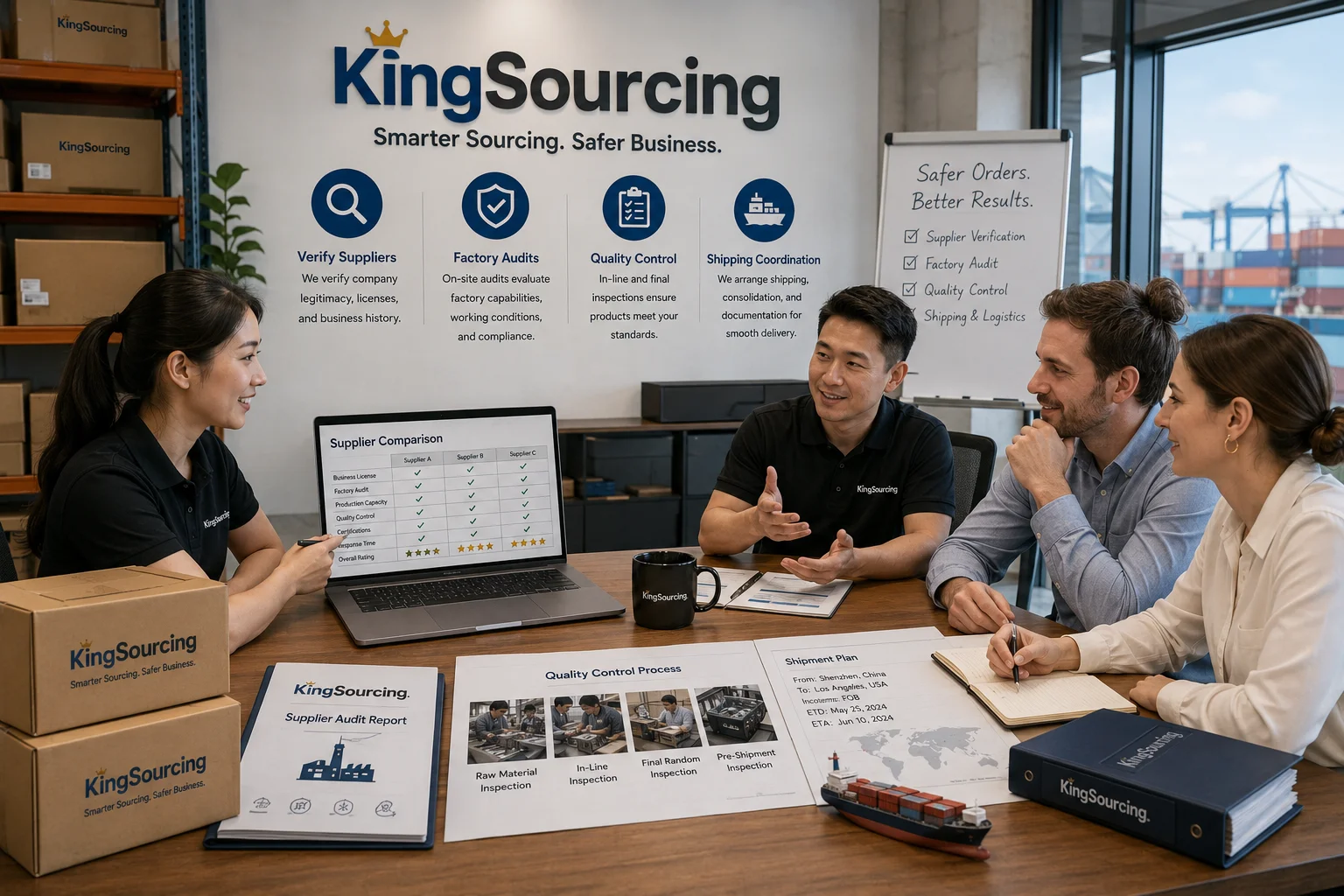
Many of our clients come to us after being burned by a bad supplier. They've learned the hard way that doing everything remotely is full of hidden risks. Our job is to be your eyes, ears, and hands on the ground in China, removing those risks so you can focus on growing your business. Instead of you spending weeks trying to figure out if a supplier is legit, we can often get you a clear answer in just a few days.
Our verification process is thorough and practical:
- Initial Screening: We filter out obvious red flags and middlemen based on their online profile and initial communication.
- Background Check: We obtain and analyze the supplier's business license and other registration documents to confirm their legal status and business scope.
- On-Site Audit: For larger or complex orders, we can visit the factory. We take photos, and videos, and provide a detailed report on their true capabilities, scale, and quality systems.
- Complete Order Management: From sample confirmation and production follow-up to 1-by-1 quality inspection and logistics, we manage every step. We make sure what you ordered is what you get.
Think of us as your dedicated sourcing office in China.
Conclusion
Verifying a Chinese supplier is a critical process, not a one-time check. It involves ongoing assessment of communication, capabilities, and quality to truly minimize risk and build a reliable supply chain.
[^1]: "Payment Methods in International Trade - World Bank Document", https://documents1.worldbank.org/curated/en/747241468329432546/pdf/402640Finance11Giovannucci01PUBLIC1.pdf. Sources on international trade finance confirm that it is a common practice for Chinese manufacturers to require an upfront deposit, often ranging from 30% to 50% of the total order value, to cover raw material costs and secure the production slot. Evidence role: general_support; source type: institution. Supports: The claim that a 30-50% upfront deposit is a standard payment term when placing custom orders with manufacturers in China.. [^2]: "Calculating The Cost Of Negative Reviews On Business Revenue", https://www.forbes.com/councils/forbesbusinesscouncil/2023/10/18/calculating-the-cost-of-negative-reviews-on-business-revenue/. Studies in consumer behavior and e-commerce consistently show a strong correlation between negative online reviews and decreased sales, with research indicating that a majority of consumers trust online reviews and will avoid businesses with poor ratings, directly impacting revenue and viability. Evidence role: statistic; source type: research. Supports: The claim that bad reviews can have a destructive impact on a small business.. [^3]: "National Enterprise Credit Information Publicity System", https://baike.baidu.com/en/item/National%20Enterprise%20Credit%20Information%20Publicity%20System/1471010. The National Enterprise Credit Information Publicity System (NECIPS) is the official, publicly accessible database maintained by the State Administration for Market Regulation (SAMR) of the People's Republic of China, allowing users to look up the registration status, business scope, and legal representatives of mainland Chinese companies. Evidence role: case_reference; source type: government. Supports: The existence and purpose of the National Enterprise Credit Information Publicity System for verifying Chinese companies.. [^4]: "China - Licensing Requirements for Professional Services", https://www.trade.gov/country-commercial-guides/china-licensing-requirements-professional-services. Legal and sourcing advisory firms explain that the 'Business Scope' (经营范围) on a Chinese business license legally defines a company's approved activities. The presence of terms like 'production' (生产) or 'manufacturing' (制造) is a key indicator that the company is legally registered as a manufacturer, whereas a scope limited to 'trade' (贸易) or 'sales' (销售) typically denotes a trading company. Evidence role: definition; source type: other. Supports: The claim that the 'Business Scope' (经营范围) section on a license distinguishes between manufacturers and trading companies.. [^5]: "Economic order quantity - Wikipedia", https://en.wikipedia.org/wiki/Economic_order_quantity. Business and manufacturing principles explain that factories often impose high Minimum Order Quantities (MOQs) to cover the significant fixed costs associated with machine setup, tooling, and raw material procurement for a production run. These economies of scale make small-batch production unprofitable for the manufacturer. Evidence role: mechanism; source type: education. Supports: The claim that factories often have high MOQs.. [^6]: "SOHO China", https://en.wikipedia.org/wiki/SOHO_China. In the context of international sourcing, 'SOHO' (Small Office/Home Office) refers to an individual or very small, often unregistered, trading operation. Sourcing experts identify these middlemen as high-risk because they typically lack direct factory relationships, financial stability, and quality control systems, leading to a higher potential for scams, communication issues, and quality failures. Evidence role: definition; source type: other. Supports: The definition and risks associated with 'SOHO' middlemen in sourcing.. [^7]: "EU - Import Requirements and Documentation", https://www.trade.gov/country-commercial-guides/eu-import-requirements-and-documentation. The CE marking is a certification mark regulated by the European Commission, indicating that a product conforms with health, safety, and environmental protection standards for products sold within the European Economic Area (EEA). The Restriction of Hazardous Substances (RoHS) directive, also from the EU, restricts the use of specific hazardous materials found in electrical and electronic products. Evidence role: definition; source type: government. Supports: The definition and legal relevance of CE and RoHS certifications for imported goods.. [^8]: "How to Avoid Scammers and Win at Exporting", https://www.trade.gov/feature-article/how-avoid-scammers-and-win-exporting. International trade commissions and anti-fraud organizations warn that an unusually low price quotation is a classic red flag for trade scams. This 'bait-and-switch' tactic may be used to secure a deposit for a non-existent product, or the supplier may later substitute substandard materials or add exorbitant hidden fees to compensate for the initial low price. Evidence role: mechanism; source type: institution. Supports: The claim that an abnormally low price is a common red flag in sourcing.. [^9]: "Winning the Blue Sky Defense War: Assessing Air Pollution ... - PMC", https://pmc.ncbi.nlm.nih.gov/articles/PMC9408037/. Reports from business media and economic analysts have documented how China's government has implemented stringent environmental inspection campaigns in recent years. These policies have resulted in temporary and permanent shutdowns of thousands of factories found to be non-compliant with pollution standards, causing significant disruptions to global supply chains. Evidence role: historical_context; source type: other. Supports: The claim that environmental inspections in China have led to factory shutdowns.. [^10]: "'Quality Fade': China's Great Business Challenge", https://knowledge.wharton.upenn.edu/podcast/knowledge-at-wharton-podcast/quality-fade-chinas-great-business-challenge/. This phenomenon is known in supply chain management as 'quality fade,' where a supplier deliberately and gradually reduces the quality of a product over successive production runs to lower their costs and increase their profit margin. It is considered a significant risk in long-term supplier relationships, especially when ongoing quality control is lax. Evidence role: definition; source type: research. Supports: The claim that suppliers may degrade quality over time after winning a buyer's trust..