Landed cost is one of the first numbers we recommend calculating before placing an order in China. A low factory price can look profitable until packaging, inspection, shipping, duties, and local delivery appear. We help buyers map these costs early, so they can choose products and suppliers with a realistic margin.
The real landed cost of products from China is the total amount you pay to buy, prepare, inspect, ship, clear, and deliver goods to their final destination, divided by the number of sellable units.[^1] It includes product cost, packaging, China-side charges, freight, insurance, import duty, taxes, customs clearance, warehousing, and local delivery.
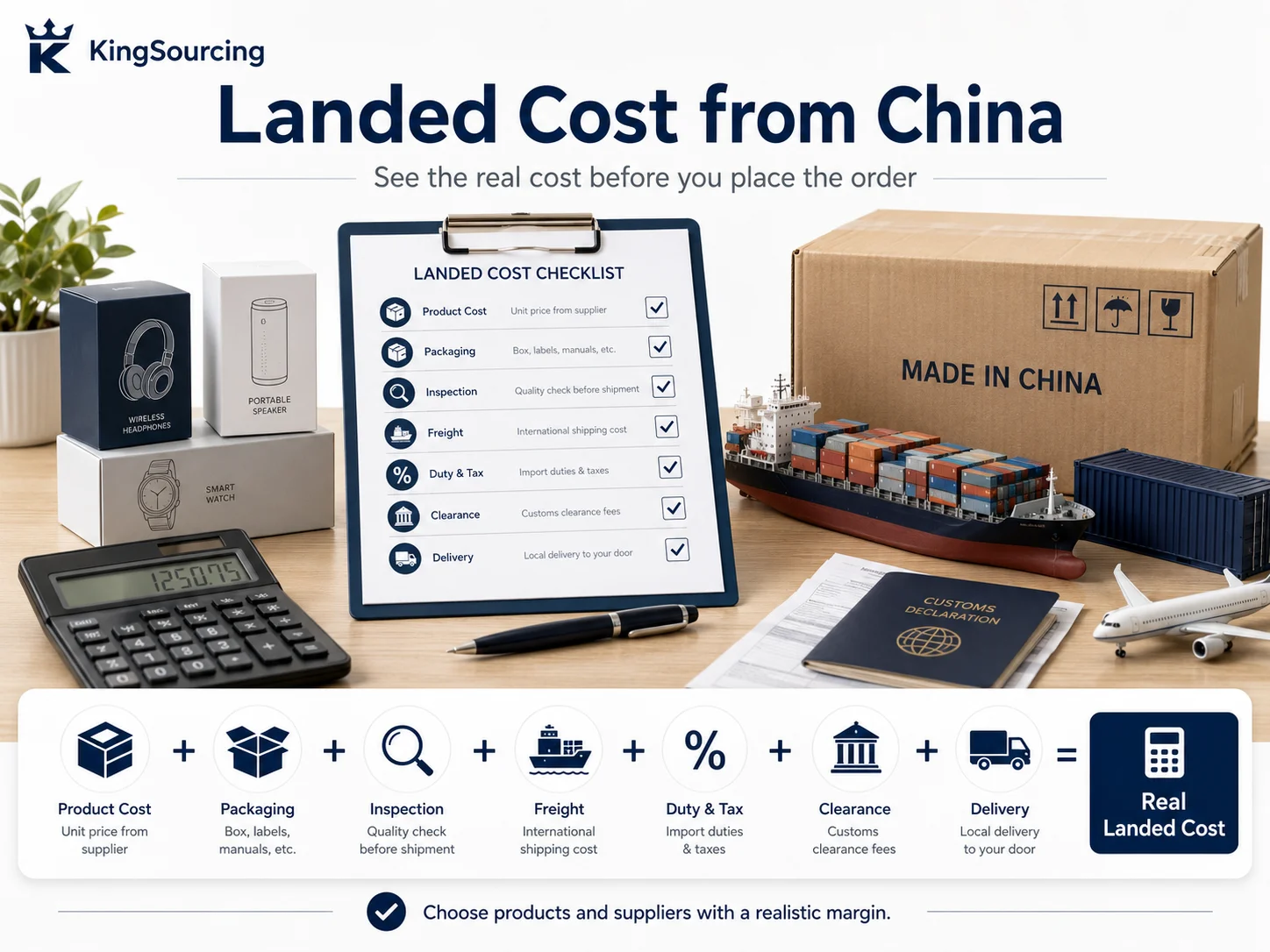
Factory price is only one line in an import budget. In our daily sourcing work, we often see buyers compare supplier quotes without comparing the full shipment setup. The better approach is to put every supplier, Incoterm, logistics option, and destination charge into one consistent calculation.
Quick Answer: How Do We Calculate Landed Cost for Products from China?
Many new importers focus on the unit price because it is easy to see. The problem is that an attractive quote can hide costs that arrive later. This can reduce margins, delay launches, and create avoidable cash-flow pressure.
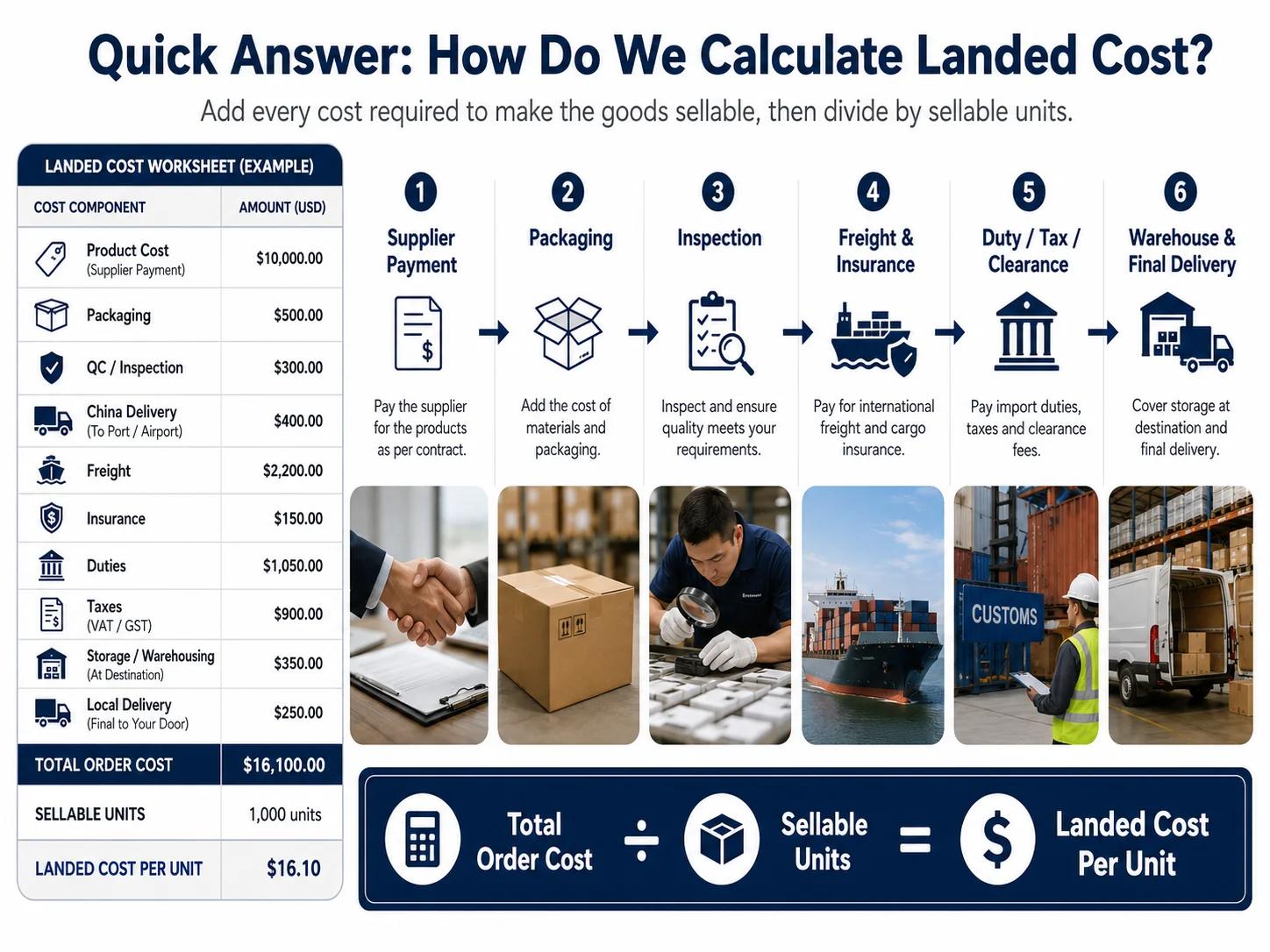
We calculate landed cost by adding every cost directly connected to making a product ready for sale at its destination, then dividing that total by sellable units. We include supplier payments, packaging, quality control, China delivery, freight, insurance, duties, taxes, clearance, storage, and final-mile delivery.
A practical landed cost formula
We use this basic formula:
Total Landed Cost = Product Cost + China-Side Costs + International Transport + Destination-Side Costs
Then:
Landed Cost Per Unit = Total Landed Cost ÷ Sellable Units
The phrase sellable units matters. If 1,000 units leave a factory but 15 are rejected during inspection or arrive damaged, your landed cost should be divided by the units you can actually sell—not simply the quantity ordered.[^2]
Four cost groups we review
| Cost group | Typical items |
|---|---|
| Product cost | Unit price, tooling, samples, product development |
| China-side costs | Packaging, inspection, labels, domestic trucking, warehouse handling |
| International transport | Ocean freight, air freight, courier charges, cargo insurance |
| Destination-side costs | Duty, tax, customs broker fees, port charges, local delivery |
We do not treat this as a fixed formula with universal freight rates or tax percentages. Shipping costs and import charges change by product type, country, shipment value, season, route, and customs classification. We use current supplier and logistics quotations for each shipment.
What Is Landed Cost When Importing From China?
Importing from China can involve several price terms that sound similar but mean different things. This creates confusion when buyers compare a factory’s EXW quote with a forwarder’s DDP quote. Without a common scope, the lowest number may not be the lowest overall cost.
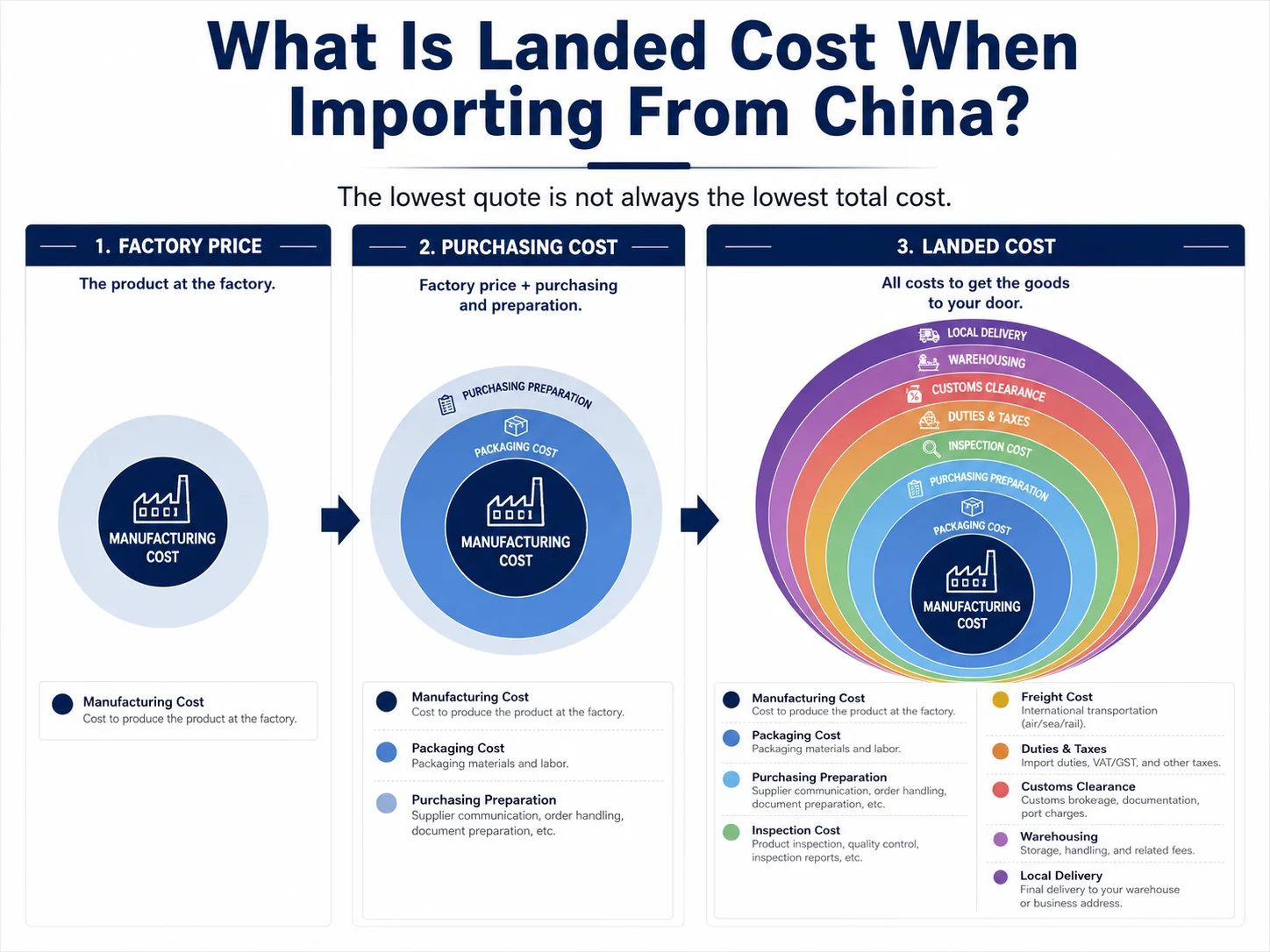
Landed cost is the complete cost of receiving inventory in a sellable location. It is broader than product price, purchasing cost, or CIF value because it can include quality control, packaging, import clearance, duties, storage, and local delivery after the goods reach the destination country.
Factory price is not landed cost
A supplier’s unit price may include only the finished product. It may exclude export cartons, barcode labels, testing, inland delivery to port, inspection, or any cost outside China.
We normally separate the following terms:
- Factory price: The amount quoted for manufacturing the product, often under EXW terms.
- Purchase cost: Factory price plus costs required to prepare the order for export, such as packaging, inspections, or China warehouse handling.
- CIF value: A shipping term that generally includes cost, insurance, and freight to the destination port. It does not automatically mean all destination charges are included.
- Landed cost: The end-to-end cost per sellable unit at the agreed destination, such as your warehouse, 3PL, fulfillment center, or retail location.
A common issue we see when reviewing import budgets is that buyers compare a $4.00 factory quote against a $5.20 delivered quote and assume the factory quote is better. That may be true, but only after adding freight, duty, inspection, and local charges to the $4.00 option.
The goal is not to avoid lower factory prices. The goal is to compare like for like. A lower quoted price can be an excellent option when the supplier meets your quality, packaging, lead-time, and delivery requirements.
How Do Incoterms Affect Landed Cost: EXW vs FOB vs CIF vs DDU vs DDP?
Incoterms affect which party arranges transport, bears risk at each stage, and pays certain charges. Buyers often assume that a quoted shipping term answers every cost question. It does not. Each term needs a written scope and a shipment-specific quotation.
EXW, FOB, CIF, DDU, and DDP can produce very different landed cost outcomes because they divide freight, export handling, customs clearance, duties, taxes, and risk differently.[^3] We advise buyers to compare total delivered costs, not Incoterms alone.
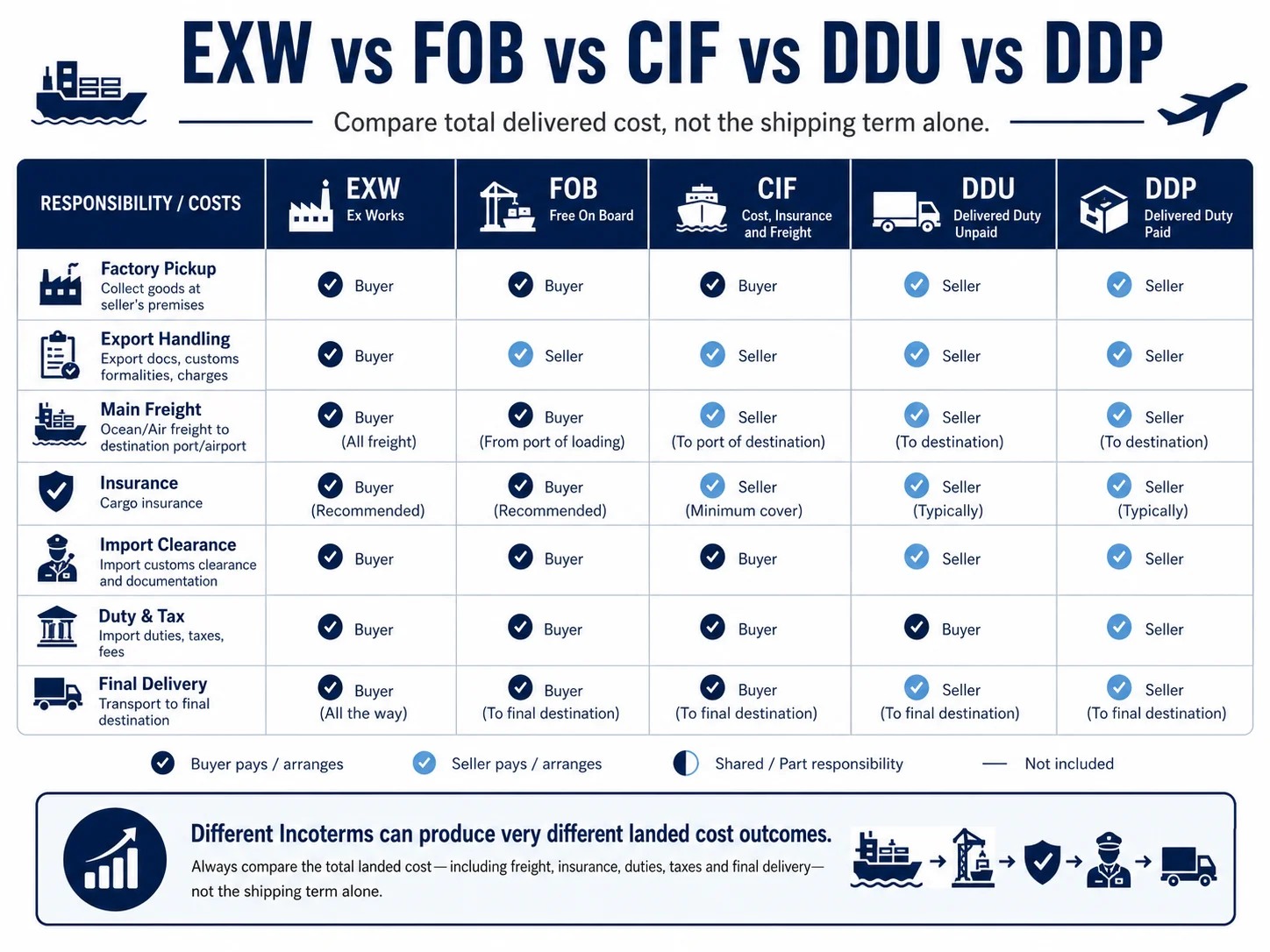
Incoterm comparison table
| Term | Seller usually handles | Buyer usually handles | Key point |
|---|---|---|---|
| EXW | Goods available at factory | Pickup, export process, freight, import, delivery | Buyer has the most coordination responsibility |
| FOB | Export clearance and delivery on board at named port | Main freight, insurance, import, destination delivery | Often useful for experienced buyers using their own forwarder |
| CIF | Freight and basic insurance to destination port | Import clearance, duty, tax, port and local charges | Freight included does not mean door-to-door delivery |
| DDU / DAP[^4] | Transport to the named destination | Import duty, tax, and usually import clearance obligations | Scope must be checked carefully by country |
| DDP | Transport and agreed import charges to destination | Usually receives goods, subject to agreed terms | Convenient, but quote transparency is essential |
What we verify before comparing terms
We ask suppliers and logistics providers to clarify:
- Named place: Which factory, port, airport, warehouse, or street address is covered?
- Export handling: Are export documents, trucking, and China customs included?
- Import responsibility: Who acts as importer of record where required?
- Taxes and duties: Are they included, estimated, prepaid, or excluded?
- Destination fees: Does the quote include terminal handling, appointment fees, residential delivery, or 3PL delivery?
- Risk transfer: At what point does responsibility for loss or damage transfer?
DDP shipping from China can simplify planning for small importers. However, we still recommend asking what the quote includes and checking whether the route is suitable for your product, compliance needs, and destination rules. Import requirements are country-specific, so buyers should confirm obligations with qualified local customs or tax professionals when needed.[^5]
What Costs Should Be Included in Landed Cost?
Missing one small line item can distort your profitability calculation. This becomes more serious when a product has a tight margin or a low average selling price. We encourage clients to build a cost checklist before they send deposits.
A complete landed cost calculation should include all costs needed to create, prepare, transport, import, receive, and sell the goods. This usually includes manufacturing, packaging, inspections, domestic freight, international shipping, insurance, duty, taxes, customs charges, storage, and final delivery.
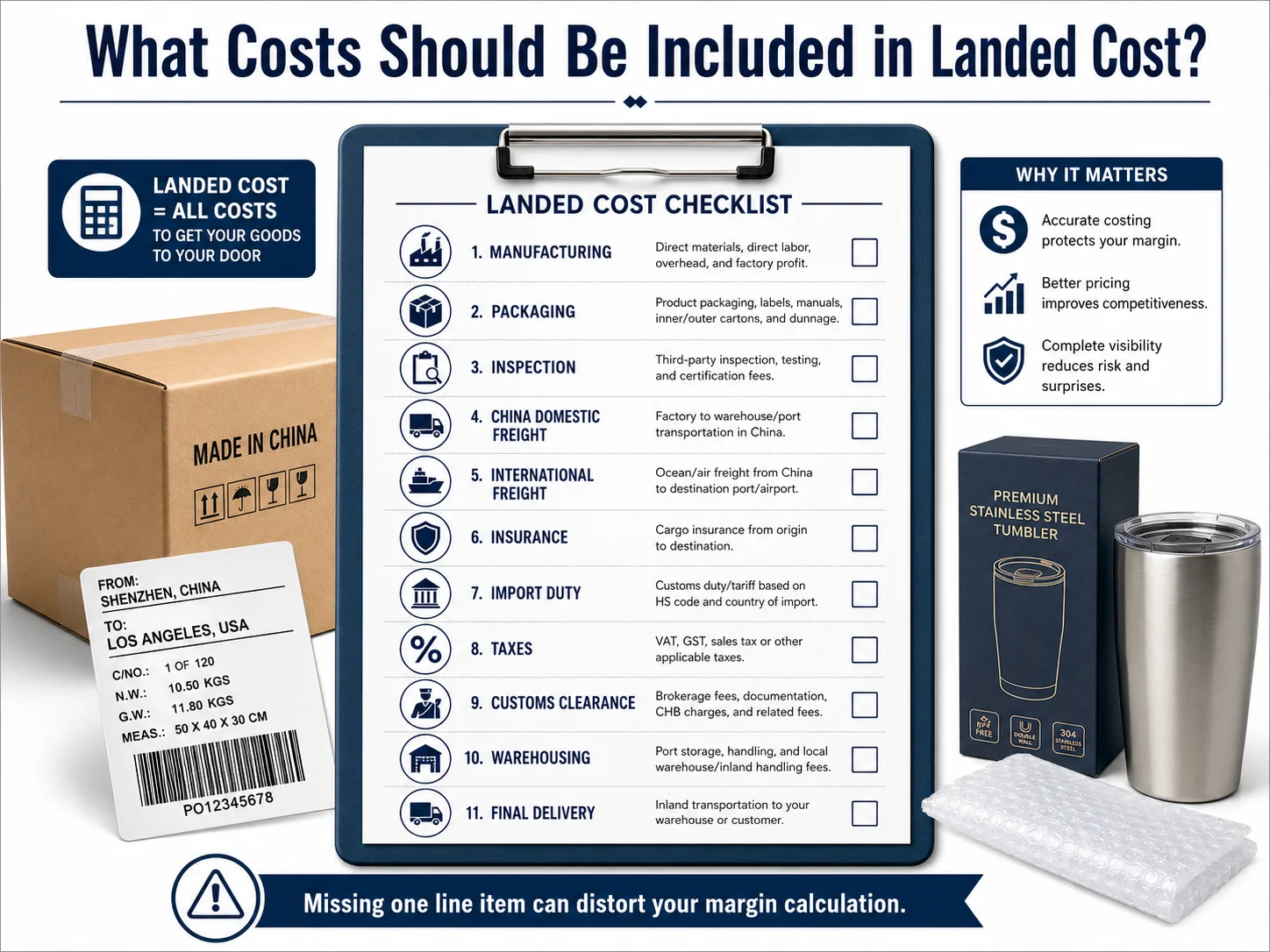
China-side order costs
China-side costs are often overlooked because they may be quoted by different parties. We review:
- Product unit price and MOQ requirements
- Sample fees and sample courier charges
- Tooling, molds, printing plates, or setup fees
- Custom colors, materials, inserts, manuals, and labels
- Retail packaging, master cartons, palletization, and carton marks
- Product testing or compliance documentation where required
- Third-party or 1-by-1 quality inspection
- Rework, replacement parts, or repacking when defects are found
- Trucking from factory to a consolidation warehouse, port, or airport
- Warehouse receiving, counting, storage, and handling fees
Transport and destination costs
The logistics section may include:
- International freight
- Fuel, peak-season, security, or remote-area surcharges
- Cargo insurance
- Customs declaration and clearance fees
- Import duty, VAT, GST, sales tax, or similar charges
- Port, terminal, documentation, or handling fees
- Customs examination costs, if an authority selects the shipment
- Demurrage, detention, or storage charges if cargo is delayed
- Delivery appointments and final-mile trucking
- Receiving fees charged by Amazon, a 3PL, or a warehouse
We also separate recoverable costs from non-recoverable costs where relevant. For example, some businesses may be able to recover certain taxes under their local tax structure, while others cannot.[^6] That is an accounting and local compliance question, so we recommend confirming it with a qualified professional.
How Can We Calculate Landed Cost Step by Step?
A calculation feels difficult when quotes arrive in different formats and currencies. One supplier may quote EXW in U.S. dollars, another may quote FOB, and a forwarder may quote only an estimated shipment charge. A structured worksheet makes the decision much easier.
To calculate landed cost per unit, we collect every confirmed or reasonably estimated order expense, convert costs into one currency, add them together, and divide the total by the expected number of sellable units. We then compare each supplier and shipping option using the same assumptions.
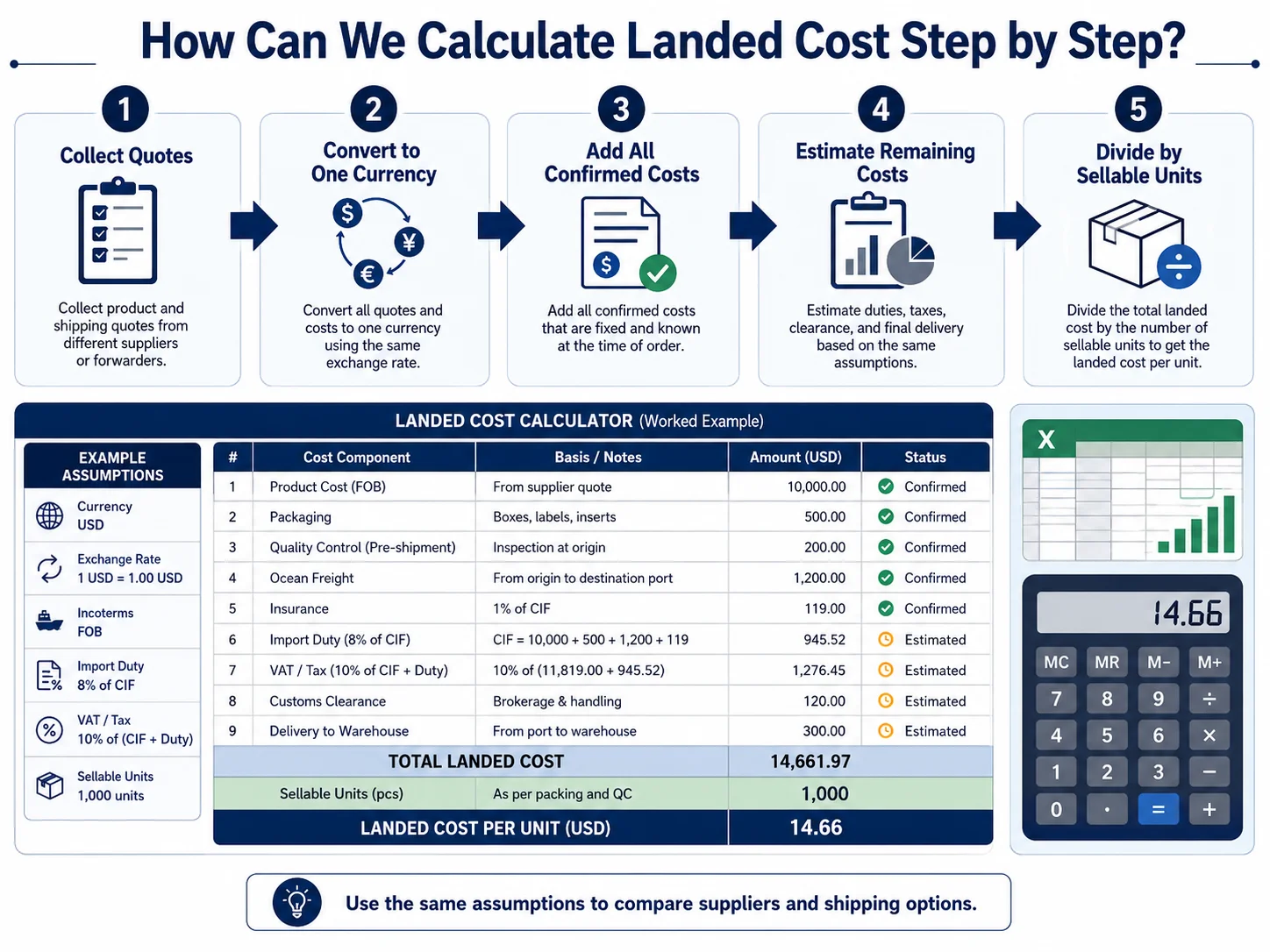
A hypothetical calculation example
This example is only for explaining the logic. It is not a customer case study, and its figures are not representative of every China import order.
Assume we plan to import 1,000 sellable home accessory units:
| Cost item | Example amount |
|---|---|
| Product cost: 1,000 units × $3.80 | $3,800 |
| Custom packaging | $420 |
| Pre-shipment inspection | $260 |
| China warehouse and domestic transport | $180 |
| International freight and insurance | $1,140 |
| Duty, tax, clearance, and local delivery | $1,200 |
| Total landed cost | $7,000 |
Landed cost per unit = $7,000 ÷ 1,000 = $7.00
If inspection identifies 20 unsellable units and no replacement is available, the calculation changes:
Adjusted landed cost per sellable unit = $7,000 ÷ 980 = $7.14
Our step-by-step process
- Define the delivery point. Decide whether the endpoint is a destination port, your warehouse, an Amazon fulfillment center, or your 3PL.
- Confirm product specifications. Product dimensions, materials, packaging, and carton size affect both manufacturing and freight.
- Collect comparable supplier quotes. Ask each supplier to quote the same quantity, quality level, packaging, and trade term.
- Add China-side services. Include inspection, labels, consolidation, domestic trucking, and warehouse handling.
- Request transport quotes using final carton data. Estimated weights can cause inaccurate freight budgets.
- Verify destination charges. Check customs requirements, duties, taxes, clearance, and local delivery with appropriate providers.
- Divide by sellable units. Account for planned samples, damaged units, or expected quality loss.
- Compare margin, not just cost. Compare landed cost with your selling price, marketplace fees, marketing spend, returns, and desired profit.
How Do Shipping Methods Affect Your Total Import Cost?
Shipping is often the largest variable after product cost. Buyers may choose the fastest method when stock is low, then discover that the freight cost removes most of the profit. On the other hand, the cheapest transport can create stockouts if lead times are not planned.
Shipping method affects landed cost through freight price, transit time, shipment size, cargo type, customs process, and destination handling. Ocean freight usually suits larger, less urgent orders, while air freight and express shipping can suit samples, launches, replenishment, or high-margin goods.[^7]
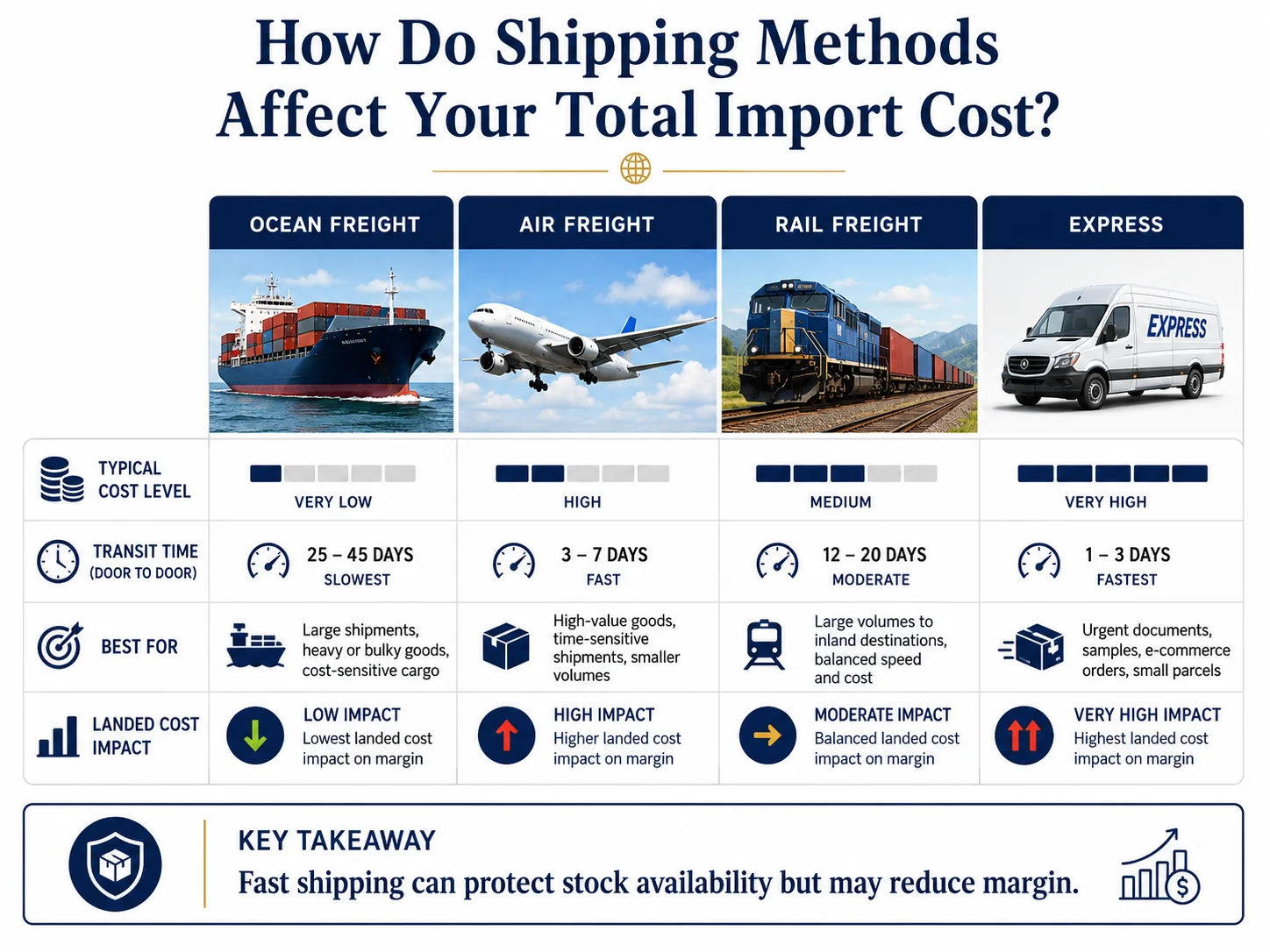
Choosing the right shipping method
| Method | Typical strengths | Typical limitations | Often suitable for |
|---|---|---|---|
| Ocean freight | Lower cost for larger volumes | Longer transit and port handling | Bulk inventory, planned replenishment |
| Air freight | Faster than ocean | Higher cost and weight limits | Urgent inventory, compact higher-value products |
| Express courier | Simple and fast door-to-door service | Usually expensive at scale | Samples, small test orders, documents |
| Rail freight | Can balance speed and cost on some routes | Route availability varies | Selected Europe-bound shipments |
| Truck / cross-border road | Useful for regional routes | Depends heavily on geography | Nearby markets and regional distribution |
Freight is not only a rate per kilogram
We review chargeable weight, carton dimensions, pallet requirements, and delivery conditions. A lightweight but bulky product may be charged by volume rather than actual weight.[^8] Poor carton design can therefore increase freight even if the product itself is inexpensive.
We also consider inventory planning. A buyer who uses ocean freight may need to place orders earlier and hold more stock. That creates a cash-flow and storage cost. A buyer who uses air freight may hold less inventory but pay more per shipment. The best option depends on product demand, margin, lead time, and available working capital.
How Can Warehouse Consolidation Reduce Landed Cost?
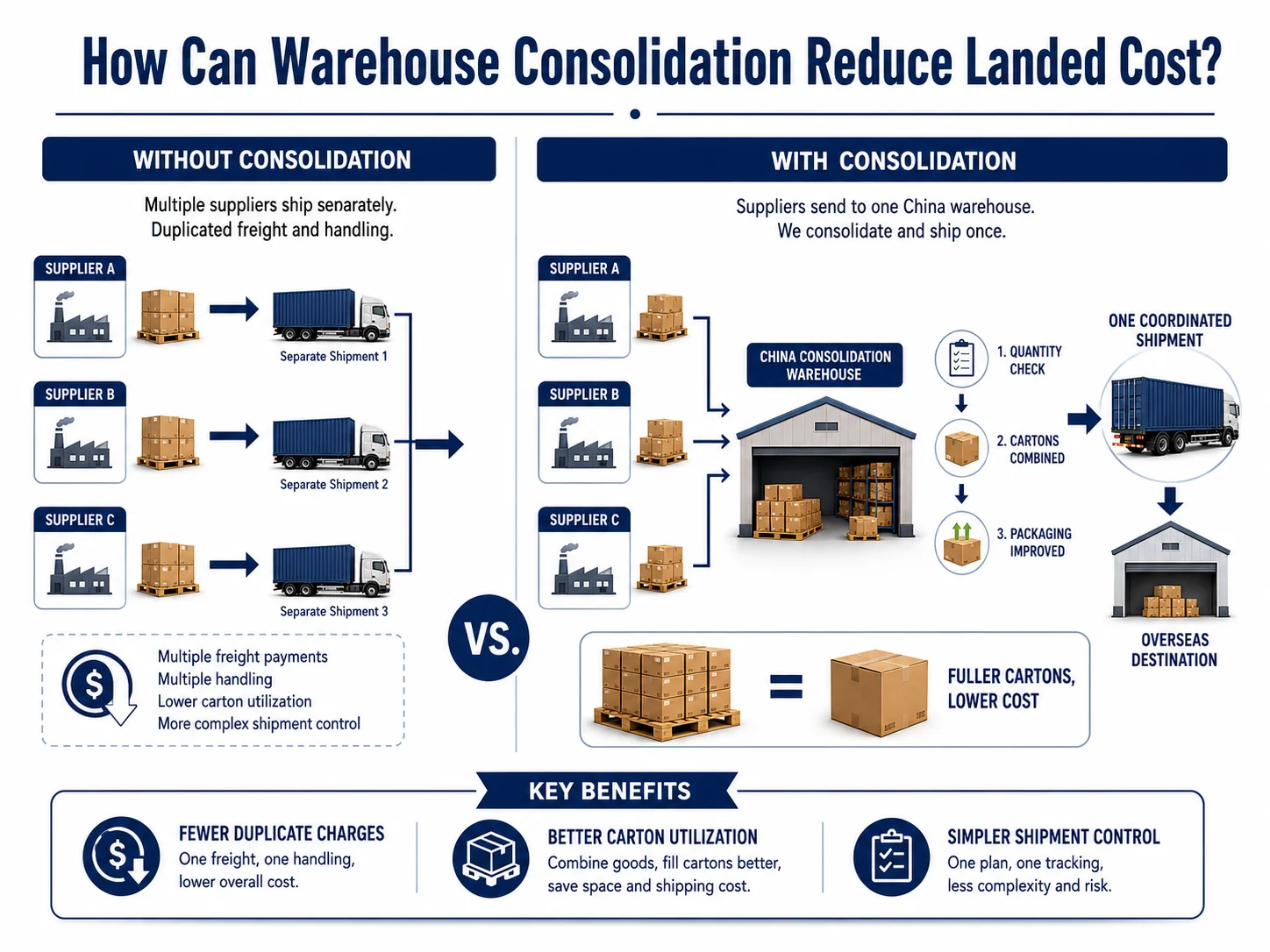
Ordering from several factories can improve product selection, but separate shipments often create duplicated freight and handling costs. Each supplier may also use different carton sizes, labeling methods, and delivery schedules. Without coordination, a multi-supplier order can become expensive and difficult to track.
Warehouse consolidation can reduce landed cost by receiving products from multiple China suppliers, checking quantities, combining cartons, improving packaging, and shipping one coordinated order.[^9] It can reduce duplicated transport and help buyers use available shipment volume more efficiently.
What happens during consolidation
At our China warehouse, we can coordinate steps such as:
- Receiving cartons from multiple approved suppliers
- Checking carton counts and visible packaging condition
- Combining products into one shipment plan
- Removing unnecessary outer cartons when appropriate
- Adding labels, inserts, bundles, or custom packaging
- Taking product or lifestyle photos before shipment
- Storing goods until all suppliers complete production
- Preparing consolidated cartons or pallets for export
Consolidation is not always cheaper
We do not assume consolidation automatically saves money. It adds receiving, storage, handling, and sometimes repacking costs. It is most useful when the savings from fewer shipments, better carton utilization, or improved order control exceed those service costs.
For example, if three suppliers each ship a few cartons separately by courier, the minimum charges can be high. Consolidating the cartons may allow one larger shipment with a lower total transport cost. However, if one supplier is delayed for several weeks, holding all finished goods could increase storage costs or delay your launch.
We normally compare at least two plans: ship separately versus consolidate. This gives buyers a clear decision based on timing and fully attributable cost.
What Hidden Costs Can Increase Landed Cost When Importing From China?
The most frustrating import costs are often not large enough to appear in an initial product quote, yet they can still damage the budget. Many of these charges arise from incomplete shipping scopes, delayed documents, inaccurate cargo data, or unexpected customs handling.
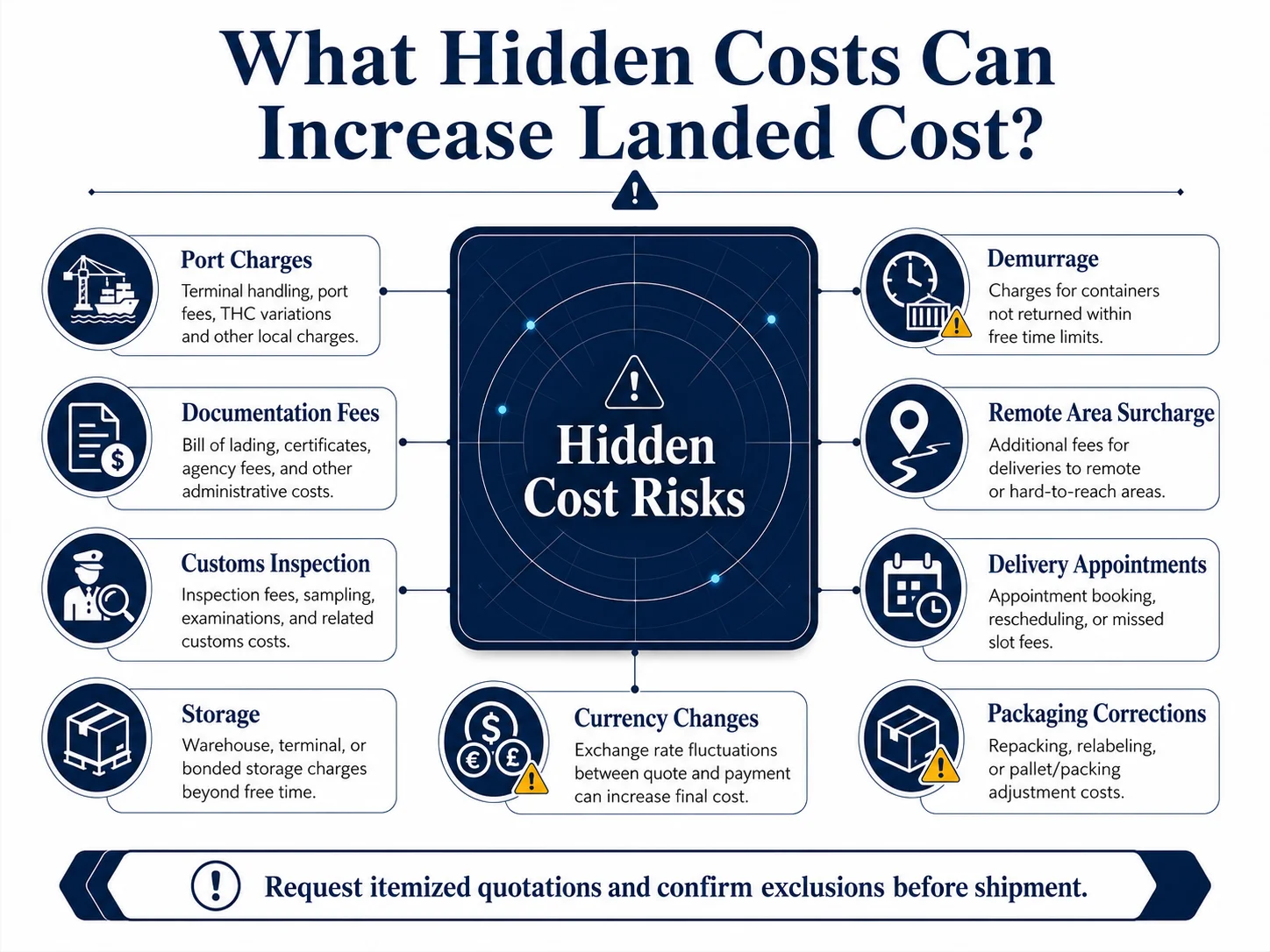
Hidden landed cost risks include port charges, documentation fees, customs inspections, storage, demurrage, remote-area surcharges, delivery appointments, currency changes, and packaging corrections. Buyers can reduce surprises by requesting itemized quotes and confirming exclusions before shipment.
Costs we ask buyers to check
Before an order ships, we flag possible charges such as:
- Port and terminal fees: Charges at origin or destination may be outside a basic freight quote.
- Customs examination fees: Authorities may inspect cargo, which can create handling and storage costs.
- Demurrage and detention: Container or equipment charges can build quickly when cargo is not collected on time.
- Warehouse storage: Free storage periods are limited in many locations.
- Documentation fees: Bills of lading, release documents, amendments, and customs paperwork may carry separate charges.
- Remote-area or residential delivery: Final-mile delivery can cost more outside standard commercial zones.
- Appointment and receiving fees: 3PLs, retailers, and fulfillment centers may charge for scheduled deliveries.
- Exchange-rate movement: Costs paid in different currencies can change between quotation and payment.
- Product compliance corrections: Relabeling, repacking, retesting, or replacing non-compliant packaging can add cost.
How we reduce avoidable surprises
We ask for written quotations with clear inclusions and exclusions. We also verify carton count, gross weight, dimensions, and delivery address before booking freight. These simple checks reduce the risk of a quote changing because the actual shipment differs from the estimated shipment.
No process can eliminate every customs inspection, port delay, or market change. However, a detailed cost sheet makes the risk visible before you commit funds.
How Does KingSourcing Help Control Landed Cost?
Managing costs across suppliers, warehouses, freight providers, and customs processes takes local coordination. Buyers without a China-based team can spend many hours chasing updates and reconciling quotes. This is where we act as a practical sourcing office and supply-chain coordinator.
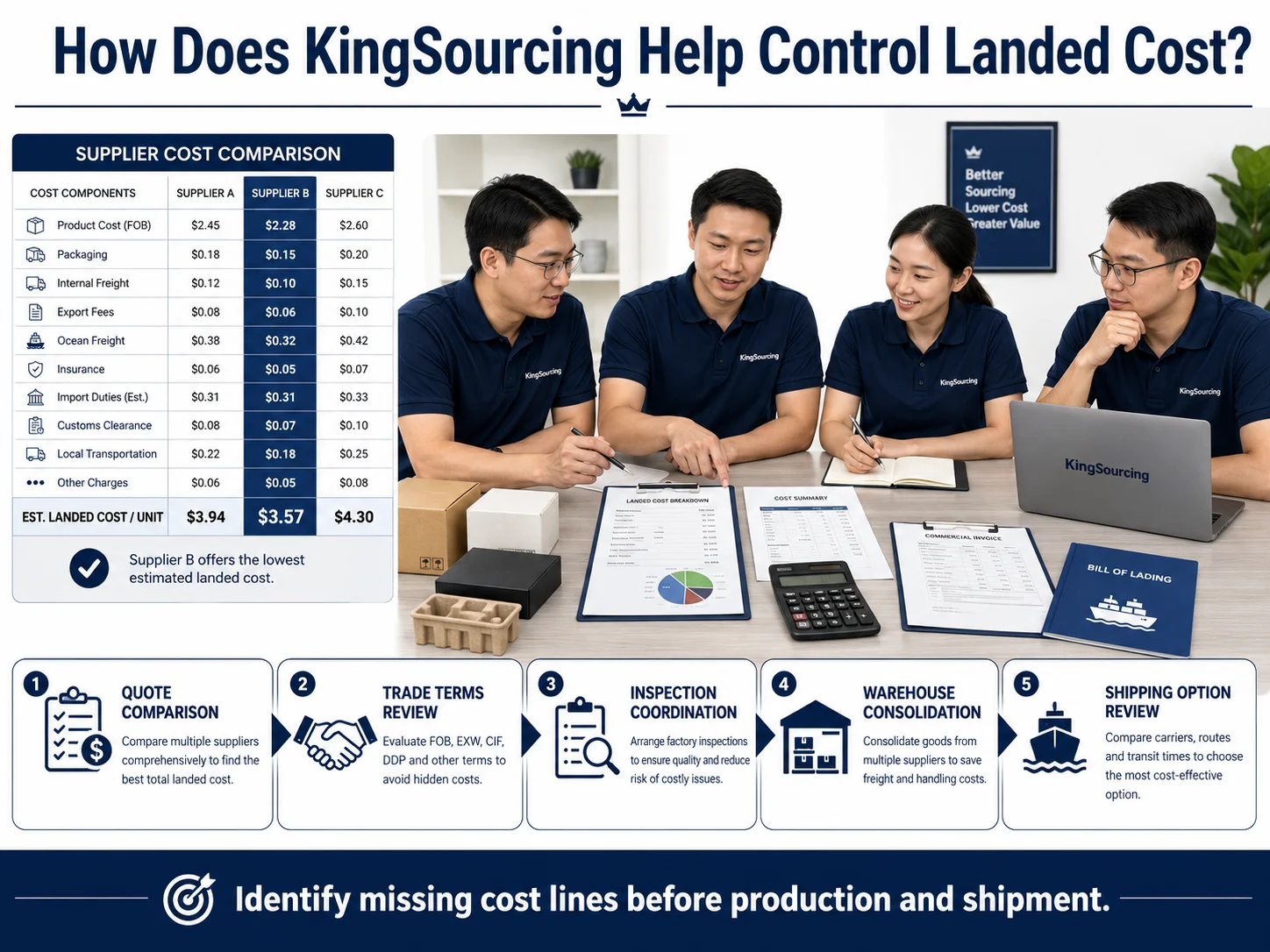
KingSourcing helps buyers control landed cost by comparing supplier quotations on a like-for-like basis, confirming trade terms, arranging inspections, coordinating warehouse consolidation, and reviewing shipping options. We help clients identify missing cost lines before orders move into production and shipment.
How we support the cost-planning process
Our support can include:
- Supplier sourcing and quote comparison based on the same product requirements.
- Factory and supplier checks to reduce reliability and communication risk.
- Sample and product-development coordination before larger commitments.
- 1-by-1 product inspection and quality control to reduce the risk of paying freight for defective goods.
- Custom packaging, labeling, and bundle preparation in China.
- Warehouse receiving and multi-supplier consolidation when it makes commercial sense.
- Shipping quote comparison across FOB, DDU/DAP, and DDP arrangements where available.
- Order tracking and issue coordination from production through delivery.
We do not present a generic shipping estimate as a final import budget. Instead, we help buyers gather current information based on actual product data, shipment size, destination, and required service level. For destination-country legal, customs, tariff, and tax requirements, buyers should also consult qualified local professionals or the relevant authorities.
Frequently Asked Questions
How do I calculate landed cost per unit?
We add all attributable costs for the order, including product price, packaging, inspection, freight, duty, taxes, clearance, and delivery. We then divide the total by the number of sellable units. We recommend excluding damaged, rejected, or non-sale sample units from the final divisor.
Does landed cost include import duty?
Yes, landed cost commonly includes import duty and non-recoverable import taxes because these affect the true cost of inventory. The exact duty and tax treatment depends on product classification, shipment value, origin, and destination-country rules.[^10] Buyers should verify current requirements locally.
Is DDP cheaper than FOB?
DDP is not automatically cheaper or more expensive than FOB. DDP can simplify coordination because delivery and agreed import charges are bundled. FOB can provide more control for buyers with their own forwarder. We recommend comparing written, itemized end-to-end costs for the same shipment.
How can warehouse consolidation reduce shipping costs?
Warehouse consolidation can combine goods from several suppliers into one shipment. This may reduce duplicate courier minimums, improve carton utilization, and simplify delivery. However, warehouse receiving, storage, and repacking costs must be included, and supplier delays can affect the shipment schedule.
What costs are usually missing from supplier quotations?
Supplier quotations may exclude custom packaging, molds, inspections, domestic China delivery, export handling, freight, insurance, customs clearance, duty, taxes, port fees, storage, and final-mile delivery. We recommend asking what is included, excluded, and estimated before paying a deposit.
Conclusion
The real landed cost of products from China is a decision tool, not just an accounting number. It helps us compare suppliers, packaging choices, shipping methods, and trade terms on the same basis before an order creates risk. Factory price matters, but it does not show the full cost of inventory at your warehouse. If you need help building a clearer import budget, KingSourcing can coordinate supplier quotes, inspections, consolidation, and shipping options to make your China sourcing simpler.
Tags: China Landed Cost, Import Cost from China, China Shipping and Logistics, Warehouse Consolidation, DDP Shipping from China, China Sourcing Agent, Import from China
Import From China With Lower Risk
Our sourcing agents help DTC brands and importers reduce supplier and logistics risk end to end. Talk to our sourcing team about your next order.
Related reading: DDP Shipping From China in 2026: How Importers Should Evaluate Landed-Cost Certainty and Risk
[^1]: "IMPROVING THE LANDED COST OF IMPORTING FOOD ...", https://jscm.au.edu/index.php/jscm/article/download/219/153/490. Landed cost is commonly used in supply-chain and inventory-cost analysis to describe the combined costs of acquiring goods and bringing them to a defined destination, rather than the supplier's unit price alone. Evidence role: definition; source type: research. Supports: A supply-chain definition of landed cost as the aggregate cost of acquiring and bringing goods to a specified destination, including relevant logistics and import charges.. Scope note: Whether inspection, warehousing, and final-mile costs are included depends on the organization's costing policy and the chosen destination point. [^2]: "CHAPTER 18", https://aast.edu/pheed/staffadminview/pdf_retreive.php?url=157_17945_EY325_2103_1__2_1_hca14_PPT_CH18.ppt&stafftype=staffcourses. Cost-accounting guidance explains that, where losses are treated as normal production or acquisition losses, their cost may be absorbed by the conforming units available for sale. Evidence role: mechanism; source type: education. Supports: How normal loss, spoilage, or defective units can be allocated to conforming inventory when determining unit costs.. Scope note: The accounting treatment differs for normal versus abnormal spoilage and may vary under applicable accounting standards and company policy. [^3]: "Know Your Incoterms", https://www.trade.gov/know-your-incoterms. Incoterms® rules allocate delivery obligations, costs, and risk between contracting parties; consequently, the expenses borne by an importer can differ materially by the term selected. Evidence role: mechanism; source type: institution. Supports: That Incoterms establish defined allocations of delivery obligations, costs, and risk between sellers and buyers.. Scope note: Incoterms do not themselves determine product price, customs tariff classification, taxes, or all contractual service charges. [^4]: "Know Your Incoterms", https://www.trade.gov/know-your-incoterms. DDU was a term in earlier Incoterms editions and was replaced in Incoterms® 2010 by Delivered at Place (DAP), which remains a current rule in Incoterms® 2020. Evidence role: historical_context; source type: institution. Supports: That DDU was removed from later Incoterms editions and DAP is the current named-place delivery term.. Scope note: Older contracts and freight quotations may still use DDU informally, so their exact allocation of obligations must be stated in the contract. [^5]: "Import Requirements & Documentation", https://www.trade.gov/country-commercial-guides/import-requirements-documentation. Customs administrations apply national import procedures, tariff schedules, and documentary requirements that vary by importing jurisdiction, product classification, origin, and transaction circumstances. Evidence role: general_support; source type: institution. Supports: That import procedures, tariff treatment, and documentary requirements are determined by the importing jurisdiction and product circumstances.. Scope note: A general customs reference cannot determine the obligations applicable to a particular import transaction. [^6]: "Untitled", https://legalinstruments.oecd.org/public/doc/350/066a17c7-cc61-48c0-a065-436815d8a823.htm. In value-added-tax systems, eligible taxable businesses may be permitted to deduct or recover import VAT as input tax when statutory registration, documentation, and business-use conditions are met. Evidence role: general_support; source type: institution. Supports: That registered businesses may in some jurisdictions deduct or recover import VAT as input tax subject to statutory conditions.. Scope note: Recoverability is jurisdiction-specific and may not apply to customs duties, exempt activities, unregistered businesses, or all categories of expenditure. [^7]: "Air Freight: A Market Study with Implications for Landlocked ...", https://www.worldbank.org/en/topic/transport/publication/air-freight-study. International transport research generally identifies maritime shipping as a lower-cost option for large-volume, time-tolerant cargo and air freight as a faster but higher-cost mode. Evidence role: general_support; source type: institution. Supports: The typical trade-off between maritime transport's economies of scale and air freight's speed.. Scope note: Actual modal suitability depends on route, cargo characteristics, service availability, inventory costs, and current market rates. [^8]: "Chargeable Weight vs Actual Weight in Air Freight", https://www.icontainers.com/chargeable-weight-vs-actual-weight-air-freight/. Air-cargo and express-carriage rating practices commonly use volumetric weight, under which low-density consignments may be charged according to occupied volume rather than physical weight alone. Evidence role: mechanism; source type: institution. Supports: That air-cargo and express pricing may use volumetric weight to account for cargo volume as well as mass.. Scope note: The dimensional-weight formula and whether it applies vary by carrier, transport mode, and service. [^9]: "Impact of Freight Consolidation on Logistics Cost and ...", https://dspace.mit.edu/entities/publication/8b8aadb2-0b8e-4fb8-8c54-f28699f51b18. Logistics research finds that shipment consolidation can reduce transportation cost by pooling consignments, increasing load utilization, and reducing the number of individual movements. Evidence role: mechanism; source type: paper. Supports: That freight consolidation can lower transport costs through higher vehicle or container utilization and fewer separate shipments.. Scope note: Consolidation can add handling, storage, and delay costs, so it is not necessarily cost-saving for every order. [^10]: "Determining Duty Rates", https://www.cbp.gov/trade/programs-administration/determining-duty-rates. Customs duty assessment is generally determined using the goods' tariff classification, customs value, country of origin, and the tariff and tax rules in force in the importing jurisdiction. Evidence role: mechanism; source type: government. Supports: That customs duty assessment is based on such factors as tariff classification, customs value, origin, and the importing country's tariff rules.. Scope note: Additional factors, including preferential-trade eligibility, trade remedies, and product-specific regulations, can also affect the final amount payable.