EXW vs FOB vs CIF vs DDP can feel confusing when you are importing from China for the first time. A supplier may offer a low price, but the quote often stops before several important costs and responsibilities begin. The right shipping term helps you avoid surprise fees, delayed cargo, and unclear problem-solving duties.
EXW, FOB, CIF, and DDP are different Incoterms that divide shipping costs, risk, and responsibilities between the supplier and buyer. EXW gives buyers the most control but requires local coordination.[^1] FOB is often practical for experienced importers using their own freight forwarder.[^2] CIF can look simple but may create destination-port cost surprises.[^3] DDP is convenient for smaller or newer buyers who need door-to-door delivery, but they must still verify customs, tax, and compliance arrangements.[^4]
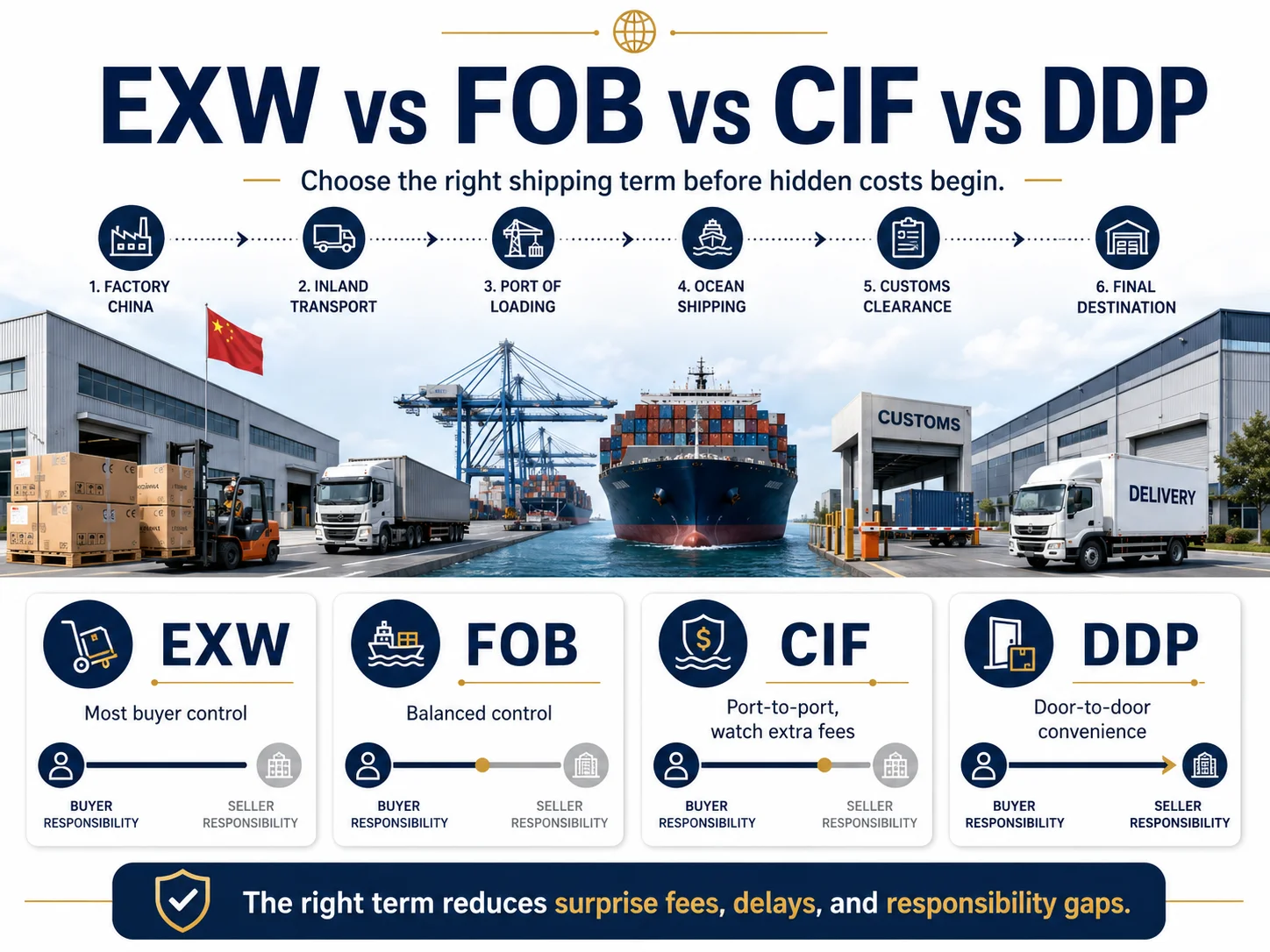
The best option is not always the lowest supplier quote. We have seen buyers save a few dollars on an EXW or CIF price, then lose far more through unplanned pickup fees, destination charges, customs issues, or late delivery. The real question is: who handles each handoff from the factory to your final warehouse?
EXW vs FOB vs CIF vs DDP: What Is the Quick Answer?
New importers often receive several shipping terms without knowing what they mean. That creates a problem because each term changes who is responsible when something goes wrong. A cheap quote can become expensive if the buyer cannot manage the next step.
EXW is best for buyers with China-based logistics support or multiple suppliers to consolidate. FOB is usually best for experienced importers who want to control international freight. CIF is suitable only when destination charges and customs responsibilities are clearly confirmed. DDP is often the easiest option for small orders and first-time buyers who want a delivered price, provided the shipping arrangement is transparent and compliant.
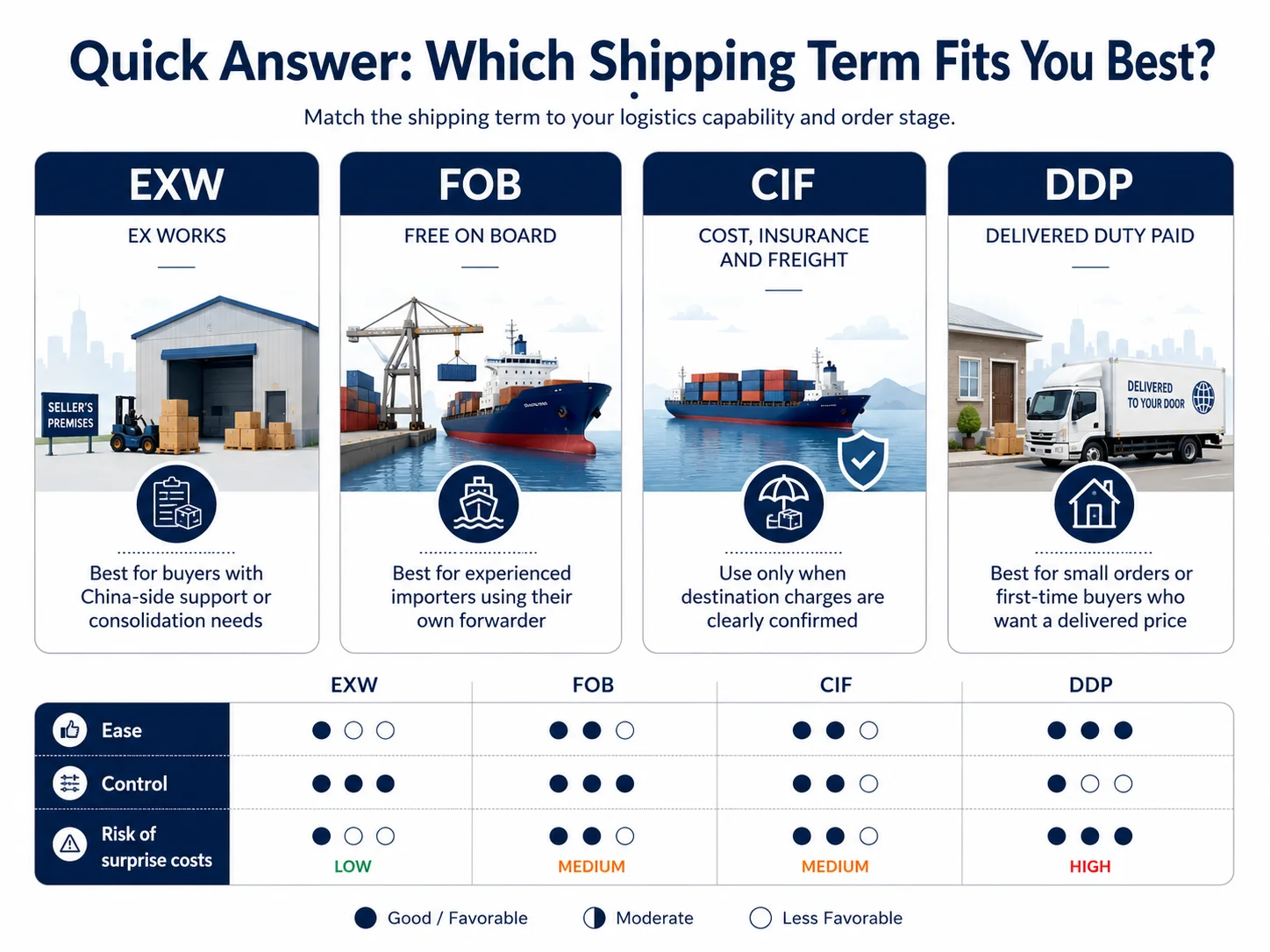
Choose based on control, not only price
In our daily coordination work, we use a simple rule: the more control you want, the more responsibility you must be prepared to manage.
| Buyer situation | Usually worth considering | Main reason |
|---|---|---|
| First order from China | DDP | Simple door-to-door planning |
| Small e-commerce test order | DDP or consolidated EXW | Lower coordination burden |
| Multiple suppliers in China | EXW | Easier pickup and warehouse consolidation |
| Established importer with forwarder | FOB | More freight control and quote comparison |
| Ocean shipment with trusted logistics partner | FOB or CIF | Depends on destination arrangements |
| Buyer with own import broker | FOB | Better visibility over the shipment |
We do not treat any Incoterm as a guarantee. A shipping term does not confirm product quality, supplier reliability, correct documentation, or on-time production. It only sets the basic framework for cost and risk handoffs.[^5]
Before accepting a quote, we recommend asking:
- Where does the supplier’s responsibility end?
- Who completes export customs clearance in China?
- Who books freight and insurance?
- Who is the importer of record at destination?
- Which local charges are excluded?
- Who pays duties, taxes, inspection fees, and final-mile delivery?
- What happens if customs holds the shipment?
Those questions matter more than a low headline price.
What Do EXW, FOB, CIF, and DDP Mean?
Shipping terms can sound technical because they are written in short abbreviations. The issue is that each abbreviation covers a different point in the journey. If that point is unclear, buyers and suppliers may both assume the other party is handling a cost.
EXW means the buyer takes responsibility from the supplier’s premises.[^6] FOB means the supplier clears the goods for export and loads them on the vessel at the named port.[^7] CIF includes ocean freight and minimum insurance to the destination port. DDP means the seller arranges delivery to the named destination, including import clearance and duties, subject to the agreed shipping arrangement.
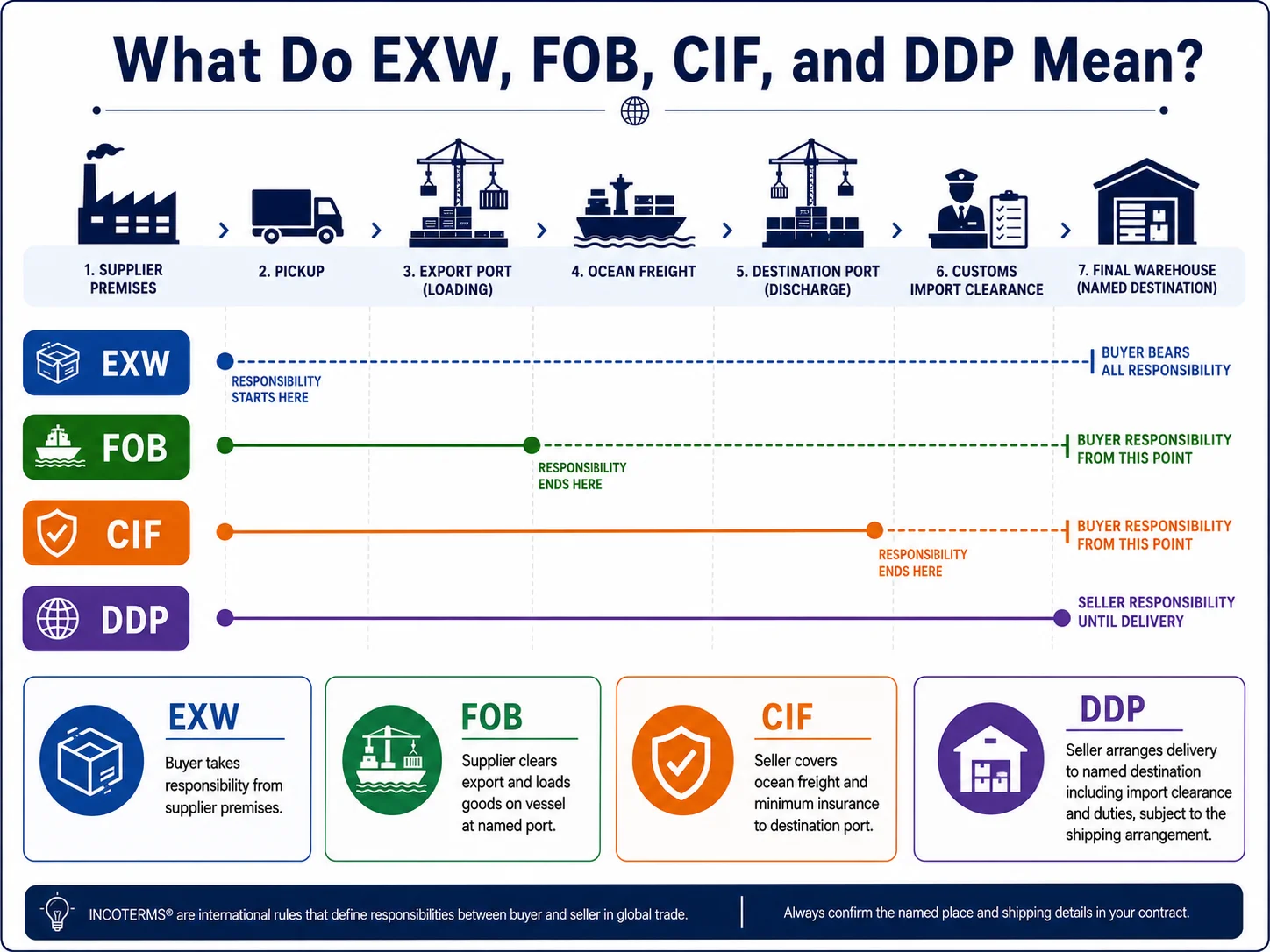
EXW: Ex Works
Under EXW (Ex Works), the supplier makes goods available at its factory, warehouse, or other named location. The buyer usually arranges pickup, China-side transport, export procedures, international freight, import customs clearance, taxes, and delivery.
In practice, some Chinese suppliers may help load cartons or assist with paperwork. However, buyers should not assume that help is included unless it appears in writing.
FOB: Free On Board
Under FOB (Free On Board), the supplier normally handles export customs clearance and delivers the cargo on board the vessel at the named port of shipment. The buyer controls freight from that point onward.
FOB is used for sea and inland waterway transport. It is not the ideal term for most air freight, express shipments, or containerized cargo where the buyer’s forwarder takes custody before vessel loading.[^8] In those cases, an alternative Incoterm may be more technically suitable, but many buyers and suppliers still use FOB commercially.
CIF: Cost, Insurance and Freight
Under CIF (Cost, Insurance and Freight), the supplier arranges ocean freight and insurance to the destination port. However, risk generally transfers once the goods are loaded on board at the origin port, not when the goods arrive at the destination.[^9]
This is one reason CIF often confuses buyers. The supplier may pay ocean freight, but the buyer can still be responsible for destination handling, import customs clearance, duties, taxes, trucking, and other local costs.
DDP: Delivered Duty Paid
Under DDP (Delivered Duty Paid), the seller arranges delivery to a named destination and takes responsibility for import clearance, duties, and taxes. It is the most convenient-looking option for many buyers.
However, DDP requires careful verification. Import rules differ by country, product category, shipment value, and consignee setup. Buyers should understand who is acting as importer, how goods are declared, what taxes are included, and whether the process fits their local compliance needs.
EXW vs FOB vs CIF vs DDP: How Do They Compare?
A side-by-side comparison helps buyers see why one quote may look cheaper than another. The problem is that suppliers often quote only the part they control. We always encourage clients to compare the total landed cost, not just the product or freight line.
EXW places most logistics responsibility on the buyer, while FOB shifts export handling to the supplier. CIF adds ocean freight and insurance but usually ends at the destination port. DDP provides the broadest delivery scope, but buyers need clear confirmation of included costs, customs arrangements, and destination delivery terms.
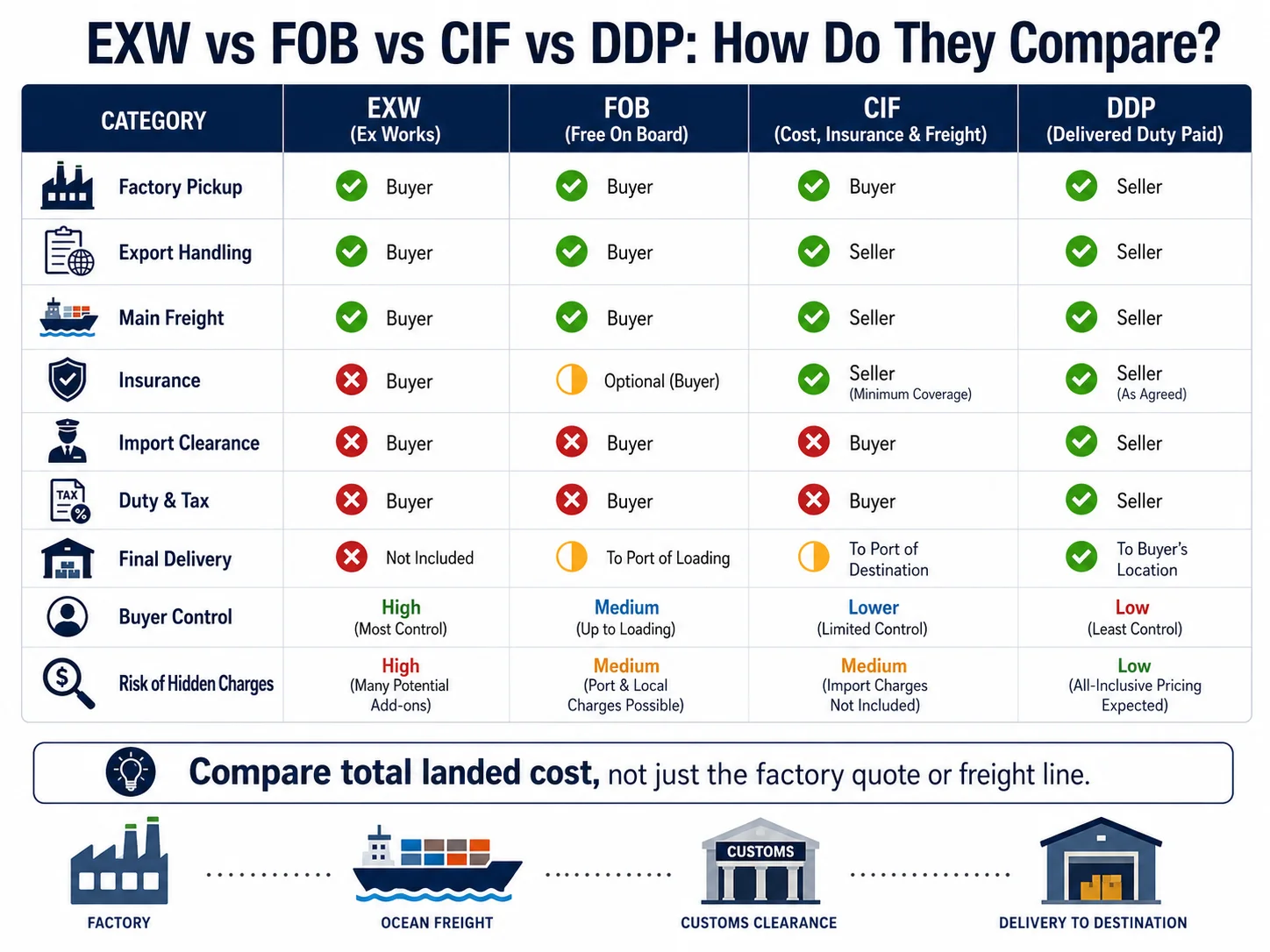
| Item | EXW | FOB | CIF | DDP |
|---|---|---|---|---|
| Supplier responsibility | Makes goods available | Export clearance and vessel loading | FOB tasks plus ocean freight and insurance | Delivery to named destination |
| Buyer responsibility | Almost all steps after factory release | Freight, insurance if needed, import, delivery | Import, destination fees, delivery | Confirm arrangement and receive goods |
| Export customs clearance | Usually buyer | Supplier | Supplier | Seller / shipping provider |
| International freight | Buyer | Buyer | Supplier | Seller / shipping provider |
| Insurance | Buyer | Usually buyer | Included at required minimum level | Usually included in transport arrangement |
| Import customs clearance | Buyer | Buyer | Buyer | Seller / provider, depending on arrangement |
| Duties and taxes | Buyer | Buyer | Buyer | Included by seller under DDP |
| Delivery destination | Supplier premises | Named origin port | Named destination port | Named final delivery place |
| Cost transparency | High only with buyer’s own quotes | Usually strong | Can be weak at destination | Depends heavily on written quote |
| Best-fit buyer | Buyer with China logistics support | Experienced importer | Buyer with trusted destination process | Newer buyer seeking convenience |
The most important comparison: responsibility gaps
We often see a gap between what a buyer thinks is included and what is actually included. For example, a CIF quote may say “freight included to Los Angeles,” but that does not automatically mean the cargo is delivered to a warehouse in California.
Possible excluded CIF destination costs can include:
- Terminal handling charges
- Port documentation fees
- Customs broker fees
- Import duty and VAT/GST
- Customs exams or inspections
- Container demurrage or detention
- Warehouse storage
- Trucking or final-mile delivery
A DDP quote can also vary widely. One provider may include delivery to a residential address, while another may price only delivery to a commercial location with a loading dock. One quote may include all normal customs costs, while another may exclude charges caused by inspections, remote-area delivery, or incorrect shipment information.
We recommend putting the named place, delivery method, charge inclusions, exclusions, and customs party in writing before payment.
When Should You Choose EXW for China Sourcing?
EXW can be attractive because suppliers often quote a lower product price. However, it creates more work for the buyer. If nobody manages pickup, export coordination, and freight booking in China, the savings can disappear quickly.
Choose EXW when you have a trusted China freight forwarder, sourcing agent, or local team that can collect goods from suppliers, inspect them, consolidate orders, and manage export shipping. EXW works especially well when you buy from multiple factories and want to combine shipments into one export order.
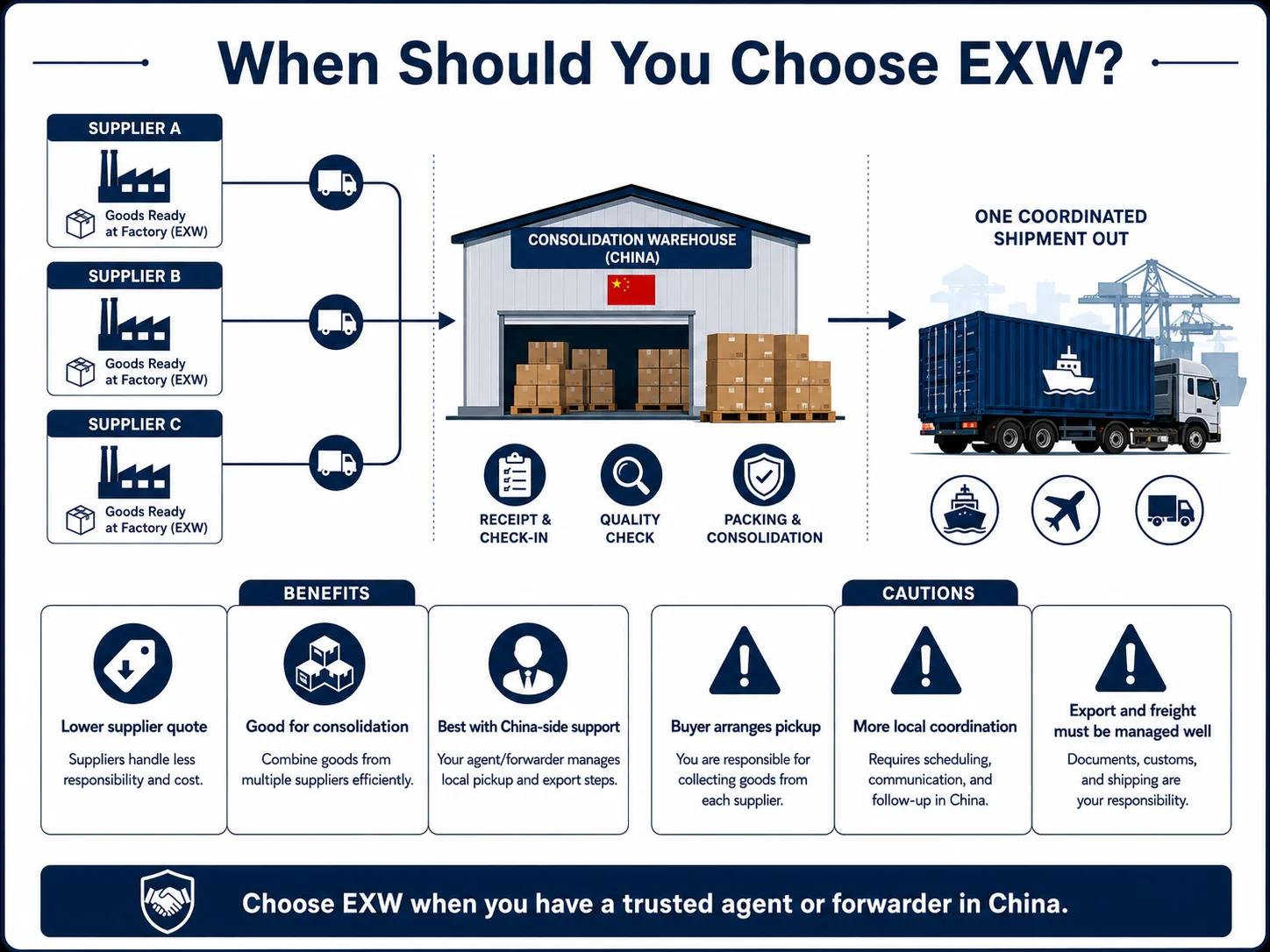
Why EXW works well for multi-supplier orders
EXW gives buyers flexibility. Instead of allowing each supplier to arrange its own shipping, we can collect goods from several factories into one warehouse. Then we can inspect products, count cartons, combine packaging, take photos, and ship the final order together.
This approach can reduce duplicated shipping costs and simplify inventory receiving.
For example, we once coordinated an order for a small e-commerce brand buying from four suppliers: a product factory, a packaging supplier, a label supplier, and an accessories vendor. If each supplier had shipped separately, the buyer would have faced four freight bookings, four clearance processes, and four deliveries. By using an EXW-style pickup and consolidation process, the buyer received one organized shipment.
EXW checklist
Before accepting EXW, confirm:
- Exact pickup address and contact person
- Cargo ready date
- Carton dimensions and gross weight
- Product export eligibility
- Loading requirements
- Pickup appointment rules
- Export customs documentation
- Whether the supplier provides commercial invoice and packing list
- Warehouse consolidation fees
- Inspection requirements before shipment
EXW is not automatically cheaper. A factory can be far from the export port, and China domestic trucking may add meaningful cost. Still, for buyers with several suppliers, it can provide excellent control and better shipment planning.
When Is FOB the Best Choice for Importing from China?
FOB is popular because it creates a clear split: the supplier manages export preparation, while the buyer controls international freight and destination handling. However, it works best when the buyer has a reliable forwarder and understands the import process.
FOB is often the best choice for established buyers who want to compare freight rates, choose their own forwarder, manage customs clearance, and avoid relying on a supplier’s logistics partner. It offers more visibility than CIF while requiring less China-side coordination than EXW.
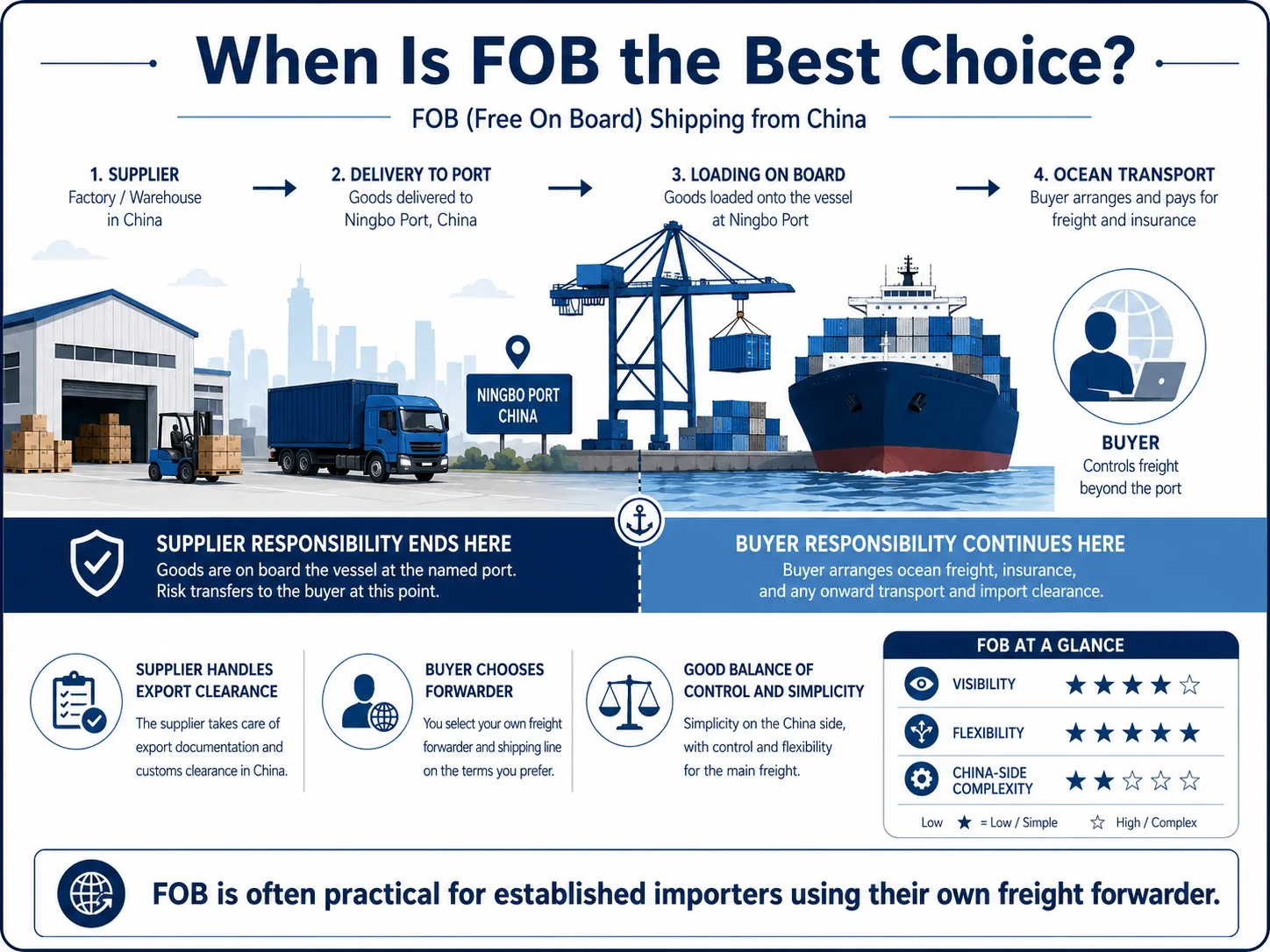
Why experienced buyers prefer FOB
With FOB, buyers can request freight quotes from different forwarders. This gives them more control over transit time, sailing schedule, insurance, destination delivery, and communication.
FOB also reduces the chance that a supplier selects a freight provider based only on its own convenience. When we support FOB orders, we coordinate production completion, inspection, carton details, booking deadlines, and export documents with the supplier and the buyer’s chosen forwarder.
A practical reminder: FOB does not mean the buyer can ignore the shipment until arrival. The buyer still needs to confirm bookings, shipping instructions, insurance, import documentation, and customs preparation.
FOB is strongest when you can manage the destination side
FOB may be a good fit if you have:
- A trusted freight forwarder
- A customs broker or in-house import process
- A commercial delivery address
- A clear understanding of local duties and taxes
- Sufficient shipment volume to compare freight options
- Time to review documents before cargo arrival
We generally recommend that buyers ask for both EXW and FOB pricing from suppliers. The difference reveals the supplier’s China-side logistics charge. Then the buyer can compare that amount against a forwarder’s pickup and export quote.
What Are the Risks of Choosing CIF Shipping?
CIF often looks easy because the supplier offers a product-and-freight price to the destination port. The problem is that the journey does not end at the port. Buyers may discover local charges only after the vessel arrives.
CIF can be useful for ocean shipments when the buyer has a trusted customs broker and knows the destination charges in advance. However, CIF can create risk when the supplier’s forwarder controls the shipment and the buyer does not receive a complete written breakdown of port fees, clearance costs, duties, and final delivery charges.
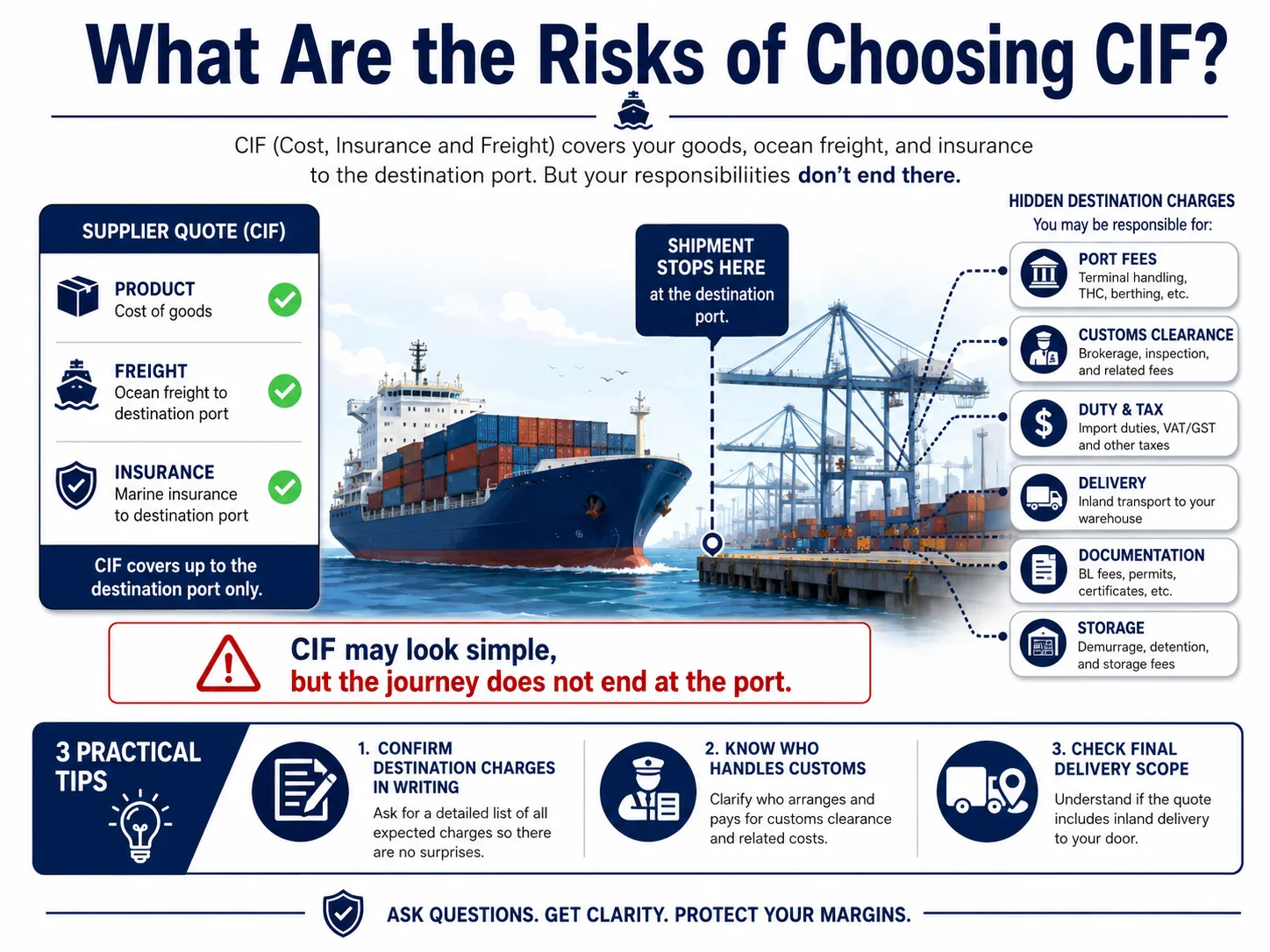
Why CIF can appear cheaper than it is
A supplier may offer a low CIF freight rate because its forwarder expects to collect more charges at destination. This does not mean the supplier is necessarily acting improperly. It means the buyer must understand the full commercial arrangement before approving the shipment.
In one anonymized case, a buyer accepted a low CIF quote because ocean freight looked far cheaper than other options. When the container arrived, the buyer faced destination handling, document charges, customs brokerage, storage pressure, and local delivery costs that had not been included in the comparison.
Questions to ask before choosing CIF
Ask the supplier or nominated forwarder for:
- Destination port and estimated arrival date
- Full destination charge schedule
- Customs clearance responsibility
- Estimated duties and taxes, where available
- Delivery quote to your final address
- Free-time allowance for containers
- Insurance coverage details
- Contact details for the destination agent
CIF insurance is often limited.[^10] If you need broader cargo coverage, ask your freight provider or insurance broker what additional protection is available.
CIF is not always bad. It simply requires a buyer who can manage the destination side confidently. If you cannot do that, a clear DDP quote or a FOB shipment with your own forwarder may be easier to control.
When Should You Choose DDP Shipping from China?
DDP is appealing because it gives buyers a door-to-door price. For a small seller testing a product, that convenience can be more valuable than managing separate freight, customs, and local delivery providers. Still, the buyer should not treat DDP as a black box.
Choose DDP shipping when you want a delivered price and do not have the resources to manage freight and import clearance independently. DDP is often suitable for small batches, samples, e-commerce testing, and early-stage buyers, but every buyer should confirm tax treatment, importer details, product restrictions, and excluded charges.
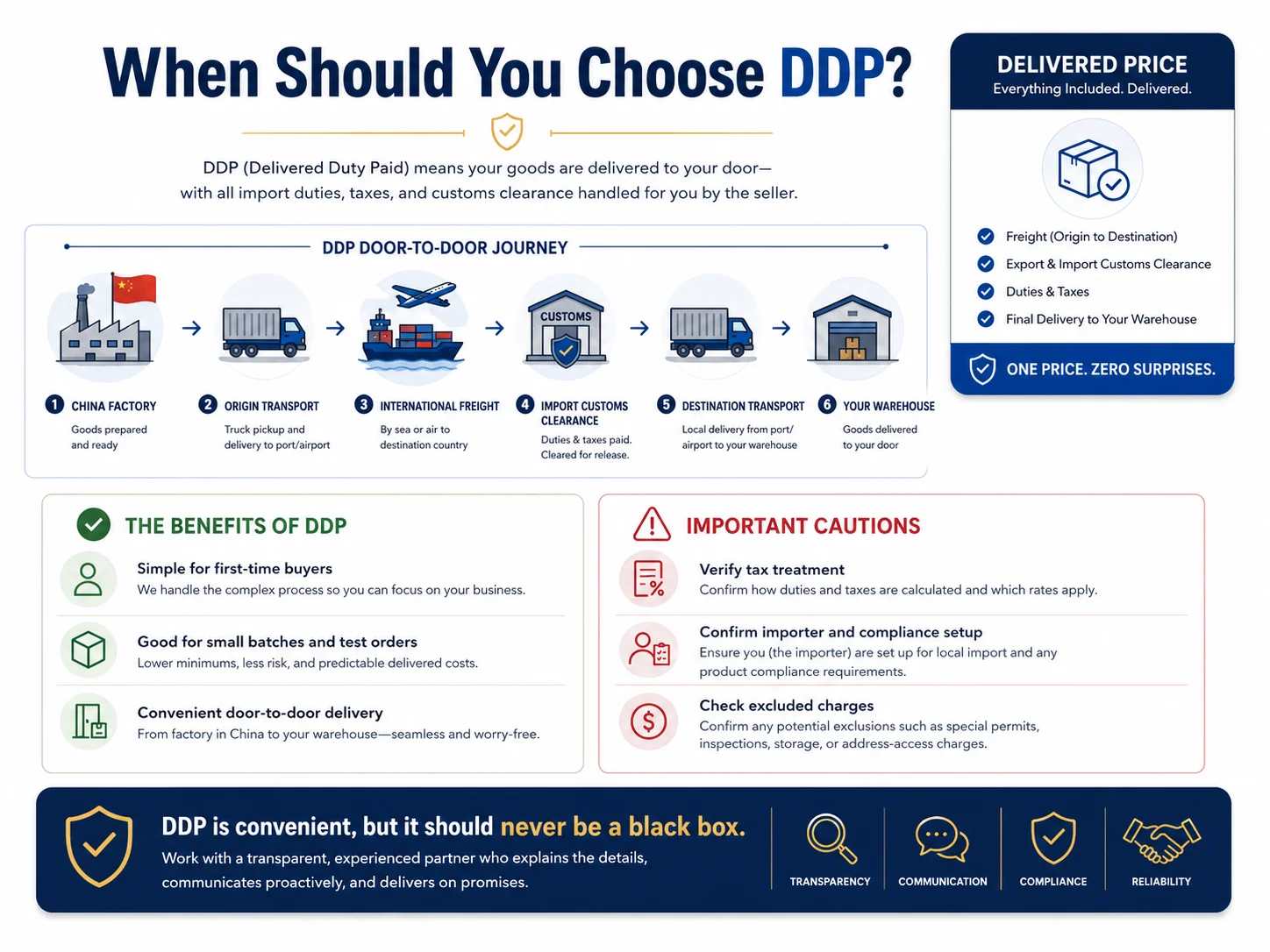
What a good DDP quote should show
A reliable DDP quote should clearly identify:
- Pickup location in China
- Delivery address and delivery conditions
- Cargo type, quantity, weight, and dimensions
- Transport method and estimated transit range
- Whether duties and taxes are included
- Whether customs clearance is included
- Any excluded inspection, remote-area, storage, or re-delivery costs
- Who handles delivery appointments
- Claim procedure for loss or damage
DDP does not remove all responsibility from the buyer. Buyers still need to provide correct product information, accurate values where required, and destination details. They also need to understand their country’s rules for the product they are importing.
DDP is about convenience, not invisibility
We often recommend DDP for clients starting around a few hundred dollars in product value, especially when they are testing demand. It lets them focus on product selection, sales, and customer feedback rather than building a full freight and customs process on day one.
However, as order volume grows, buyers may benefit from comparing DDP against FOB plus their own freight and customs arrangement. More volume can justify more logistics control and cost analysis.
How Can You Compare Shipping Quotes and Total Landed Cost?
The biggest importing mistake is comparing only factory prices. A supplier with the lowest EXW quote may not offer the lowest landed cost. The same is true for FOB, CIF, and DDP. Every shipment has costs after the product leaves the factory.
To compare EXW vs FOB vs CIF vs DDP correctly, calculate the total landed cost: product cost, China-side handling, freight, insurance, import charges, customs clearance, warehousing, and final delivery.[^11] Compare like-for-like quotes that use the same shipment details and final destination.
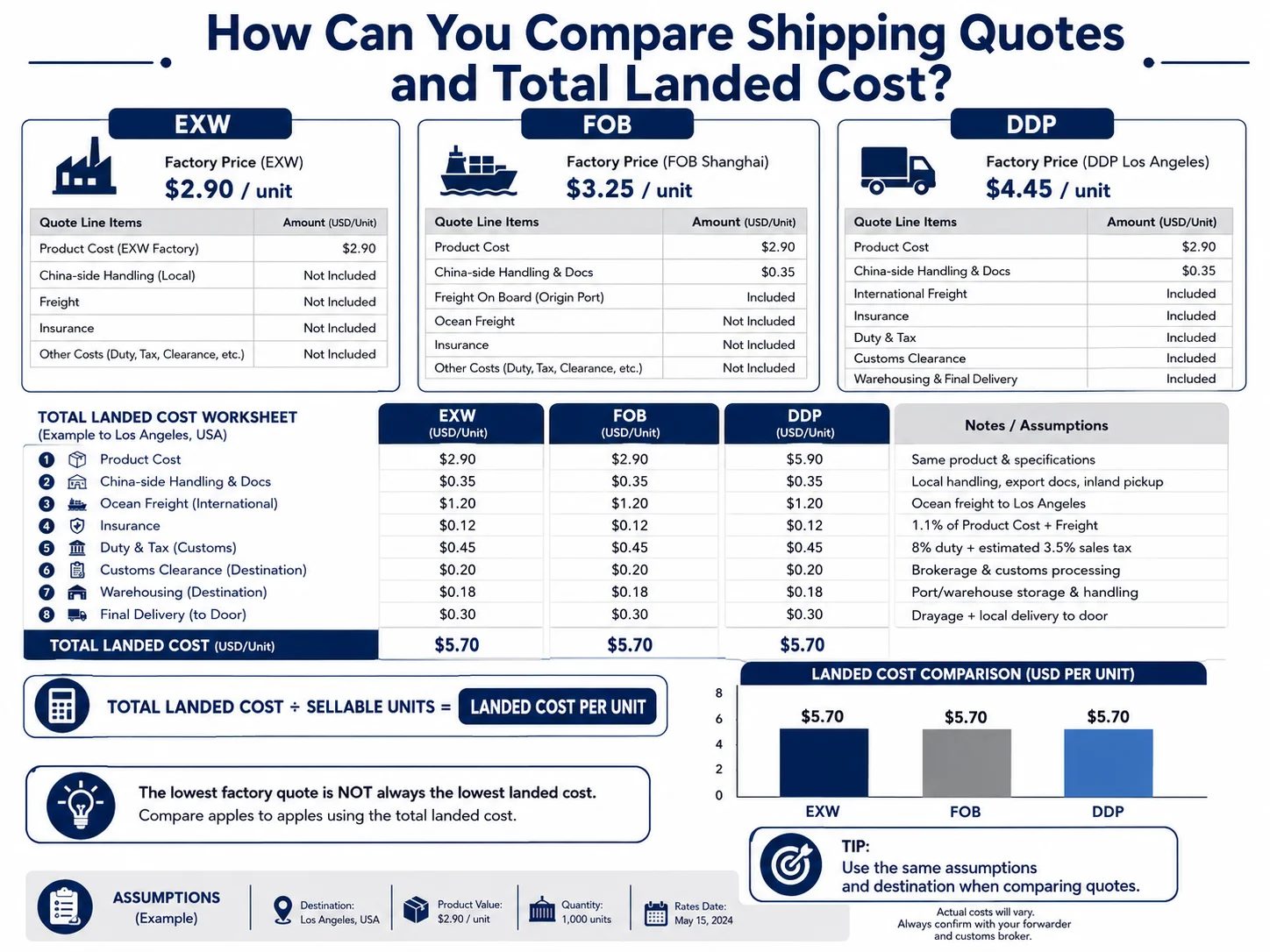
A practical landed-cost framework
Use this formula:
Total landed cost = Product cost + China local charges + International freight + Insurance + Import duty and taxes + Customs clearance + Destination charges + Final delivery + Storage or inspection costs
| Cost category | Typical examples |
|---|---|
| Product cost | Unit price, tooling, packaging, labels |
| China local charges | Pickup, export documents, warehouse handling |
| International freight | Air freight, sea freight, rail, courier |
| Import costs | Duty, VAT/GST, customs broker fees |
| Destination costs | Port handling, terminal fees, delivery |
| Risk costs | Storage, inspection, rework, delays |
Compare the same shipment assumptions
We suggest asking every forwarder to quote using the same:
- Incoterm
- Pickup address
- Final delivery address
- Cargo-ready date
- Carton count
- Dimensions and chargeable weight
- Product description
- Battery, liquid, wood, or restricted-material status
- Delivery service requirement
A freight quote is not useful if one provider quotes port-to-port and another quotes door-to-door. We also recommend keeping a written quote sheet. This makes missing items easier to spot.
How Does KingSourcing Manage EXW, FOB, CIF, and DDP Orders?
Importing from China involves more than choosing a shipping term. Buyers need somebody to coordinate suppliers, check goods, confirm packaging, track deadlines, and solve issues before cargo leaves China. That is where local support can reduce avoidable risk.
At KingSourcing, we help buyers assess EXW, FOB, CIF, and DDP options based on their order size, supplier setup, destination, and logistics capability. We coordinate supplier pickup, warehouse consolidation, quality inspection, export preparation, freight comparison, and door-to-door delivery without treating one shipping term as the right answer for every order.
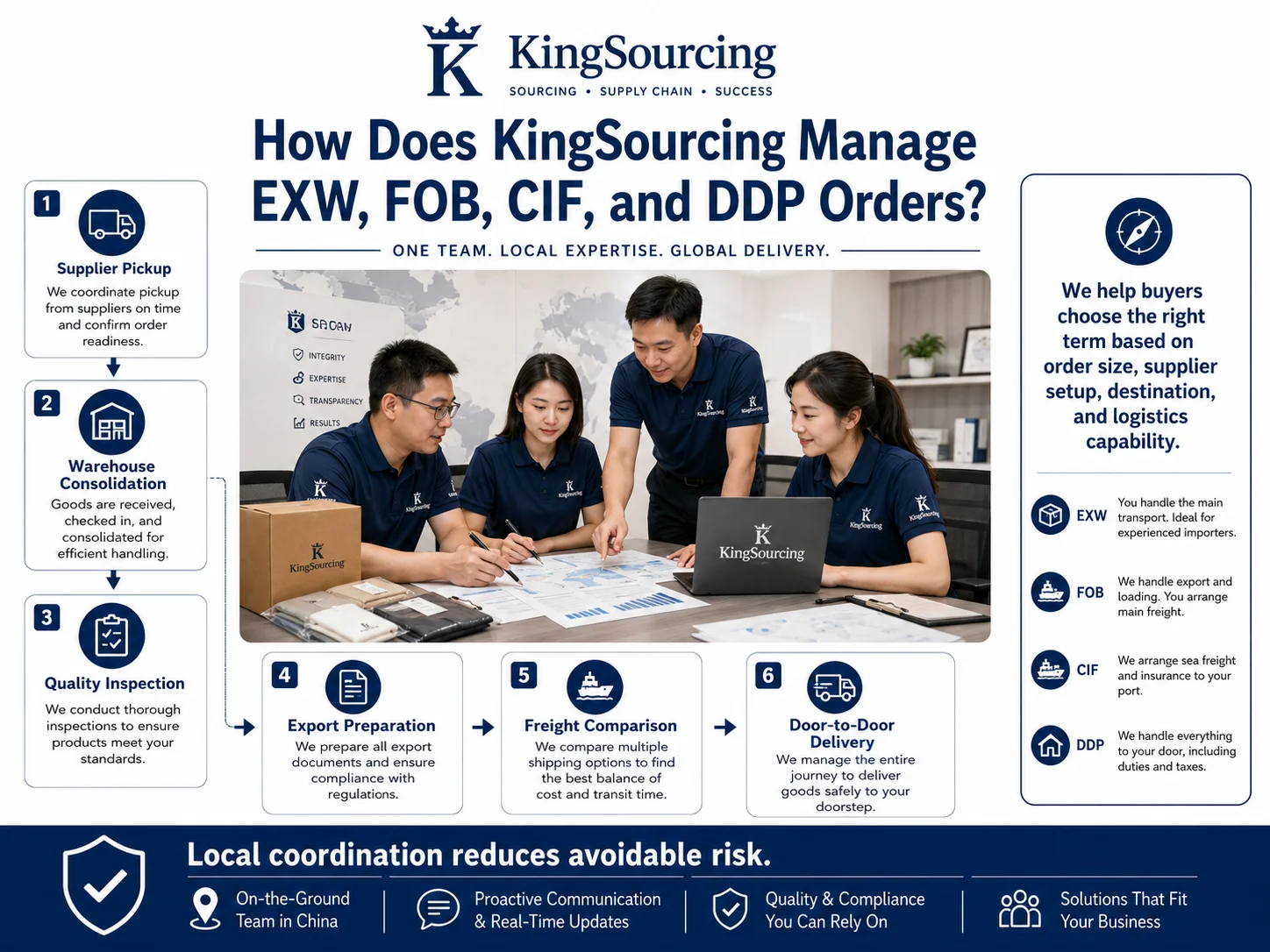
Our practical coordination process
We begin by confirming what the supplier quotation actually includes. Then we review the product, order volume, packaging needs, shipment timing, and destination requirements.
Depending on the project, our team can support:
- Supplier sourcing and price comparison
- Factory and supplier checks
- Sample coordination
- One-by-one product inspection
- Custom packaging and label preparation
- Pickup from multiple suppliers
- Warehouse consolidation and carton optimization
- Product photography and bundle assembly
- Freight quote comparison
- Export documentation coordination
- DDP or buyer-nominated freight arrangements
- Shipment tracking and issue follow-up
We have found that many problems start before shipping. A carton label may be missing. A supplier may use the wrong packaging. The final quantity may not match the packing list. A production delay may leave too little time to book freight. A local China team can identify these gaps before they become destination problems.
Country-specific taxes, customs rules, restricted-product requirements, and clearance procedures must always be verified for the destination, product, and shipping arrangement. We support coordination, but buyers should also ensure that their import structure meets local requirements.
Frequently Asked Questions About China Shipping Terms
Is FOB better than EXW when importing from China?
FOB is often easier than EXW because the supplier handles export customs clearance and delivers goods to the origin port. However, EXW can be better when you have multiple suppliers and a China-based agent or forwarder that can consolidate cargo before export.
Is CIF cheaper than FOB?
CIF may look cheaper because the supplier includes ocean freight to the destination port. However, CIF does not usually include import duty, customs clearance, destination port fees, or final delivery. Compare the complete landed cost before deciding which option is cheaper.
Does DDP include customs duties and taxes?
Under DDP, duties and taxes should be included in the seller’s delivery responsibility.[^12] However, buyers should confirm this in writing and verify who is handling customs clearance, how goods are declared, and whether any special charges or compliance requirements may apply.
Which Incoterm is best for first-time importers?
DDP is often the simplest choice for first-time importers because it provides a door-to-door shipping arrangement. Still, buyers should request a detailed quote and confirm customs, tax, delivery, and excluded-cost details before sending payment.
Can multiple EXW orders be consolidated?
Yes. Multiple EXW orders can often be collected from different Chinese suppliers and consolidated in a warehouse. This can reduce shipping costs, simplify customs processing, improve carton utilization, and allow inspection before final shipment.
Conclusion
EXW vs FOB vs CIF vs DDP is not a contest with one universal winner. EXW offers control for buyers with China-side support. FOB gives experienced importers stronger freight control. CIF can work when destination charges are fully understood. DDP offers convenience for newer buyers, but it still requires transparent documentation and compliance checks. We recommend comparing the full landed cost and every responsibility handoff before choosing. If you need a China-based team to coordinate sourcing, inspections, consolidation, and shipping, contact KingSourcing to make your China sourcing simpler.
Tags: EXW vs FOB vs CIF vs DDP, China Shipping Terms, Import from China, China Freight Forwarding, DDP Shipping from China, Landed Cost Calculation, China Sourcing Agent
[^1]: "Incoterms", https://en.wikipedia.org/wiki/Incoterms. Under Incoterms® 2020, EXW requires the seller to place goods at the buyer’s disposal at the named place, while the buyer bears the principal responsibilities for collection and subsequent transport arrangements. Evidence role: general_support; source type: institution. Supports: The source should describe EXW as placing collection, carriage, export, and import responsibilities primarily on the buyer after the seller makes goods available at the named place.. Scope note: “Most control” is a commercial interpretation of the allocation of responsibilities, rather than a defined Incoterms term. [^2]: "Know Your Incoterms", https://www.trade.gov/know-your-incoterms. For FOB under Incoterms® 2020, delivery occurs when the goods are placed on board the vessel at the named port of shipment; the buyer ordinarily arranges the subsequent main carriage. Evidence role: general_support; source type: institution. Supports: The source should explain that, under FOB, the seller delivers goods on board the vessel at the named port and the buyer arranges the main carriage thereafter.. Scope note: Whether FOB is practical for a particular importer depends on its forwarder, shipment type, and import capability. [^3]: "Know Your Incoterms", https://www.trade.gov/know-your-incoterms. Under CIF, the seller contracts and pays for carriage and specified insurance to the named port of destination, but the buyer generally remains responsible for import clearance and associated import-side obligations. Evidence role: mechanism; source type: institution. Supports: The source should establish that CIF requires the seller to arrange carriage and insurance to the named destination port while import formalities and related destination obligations generally remain with the buyer.. Scope note: The particular terminal, agency, storage, and delivery charges depend on the carrier, port, contract, and local tariff. [^4]: "Know Your Incoterms", https://www.trade.gov/know-your-incoterms. DDP places responsibility for delivery at the named destination, including import clearance and payment of applicable duties and taxes, on the seller under Incoterms® 2020. Evidence role: general_support; source type: institution. Supports: The source should describe DDP as assigning delivery, import clearance, duties, and taxes to the seller, while noting the need to ensure that this allocation is workable under destination-country law.. Scope note: Incoterms allocation does not itself establish whether the seller may lawfully act in the required import role in a particular jurisdiction. [^5]: "Know Your Incoterms", https://www.trade.gov/know-your-incoterms. Incoterms® rules define delivery-related obligations, allocation of costs, and transfer of risk between seller and buyer; they do not by themselves govern product quality, payment terms, or transfer of ownership. Evidence role: definition; source type: institution. Supports: The source should explain that Incoterms allocate delivery obligations, costs, and risk between contracting parties but do not regulate matters such as product quality, payment, or transfer of title.. [^6]: "Know Your Incoterms", https://www.trade.gov/know-your-incoterms. EXW requires the seller to make the goods available at the named place; the buyer assumes the transport-related responsibilities from that point, including loading where applicable unless otherwise agreed. Evidence role: definition; source type: institution. Supports: The source should state that EXW requires the seller to make goods available at the named place and does not require loading them onto the collecting vehicle.. Scope note: Parties may contract for additional supplier assistance, so written terms can alter the practical arrangement. [^7]: "Know Your Incoterms", https://www.trade.gov/know-your-incoterms. Under FOB, the seller delivers when the goods are placed on board the vessel nominated for shipment at the named port and is responsible for export clearance. Evidence role: definition; source type: institution. Supports: The source should confirm that FOB delivery occurs when goods are on board the vessel at the named port of shipment and that the seller handles export clearance.. Scope note: FOB is a rule for sea and inland-waterway transport and must be used with an identified port of shipment. [^8]: "Know Your Incoterms", https://www.trade.gov/know-your-incoterms. ICC guidance limits FOB to sea and inland-waterway transport and indicates that FCA is normally the more appropriate rule when goods are delivered to a carrier before loading on board a vessel, including many container shipments. Evidence role: definition; source type: institution. Supports: The source should state that FOB is for sea and inland-waterway transport and that FCA is generally more appropriate when delivery occurs at a terminal or to a carrier before on-board loading.. Scope note: The appropriate term depends on the actual contractual delivery point and carrier-handling arrangement. [^9]: "Know Your Incoterms", https://www.trade.gov/know-your-incoterms. Under CIF, the seller contracts for carriage and insurance to the named destination port, but risk of loss or damage transfers to the buyer when the goods are on board the vessel at the port of shipment. Evidence role: mechanism; source type: institution. Supports: The source should confirm the separation under CIF between the seller’s obligation to pay freight and insurance to destination and the transfer of risk at shipment.. Scope note: The parties’ sales and insurance contracts may provide additional remedies, but they do not change the default Incoterms risk-transfer point unless expressly agreed. [^10]: "Incoterms® 2020: CIP or CIF? - ICC Academy", https://academy.iccwbo.org/incoterms/article/incoterms-2020-cip-or-cif/. CIF requires the seller to obtain cargo insurance at minimum cover for the buyer’s risk during carriage, generally corresponding to Institute Cargo Clauses (C) or similar coverage unless broader insurance is agreed. Evidence role: definition; source type: institution. Supports: The source should establish that CIF requires the seller to procure cargo insurance meeting the minimum cover specified by the rule, commonly Institute Cargo Clauses (C) or similar cover.. Scope note: Actual policy exclusions, insured value, and available broader cover depend on the insurance contract and jurisdiction. [^11]: "Duty - Cost Insurance and Freight (CIF) - help.CBP.gov", https://www.help.cbp.gov/s/article/Article1126. Import-cost guidance commonly treats the delivered cost of imported goods as extending beyond the supplier price to include applicable freight, insurance, customs duties, taxes, clearance, and destination handling costs. Evidence role: definition; source type: government. Supports: The source should define landed cost or customs value components and support including freight, insurance, duties, taxes, and other import-related charges when assessing import cost.. Scope note: Which items are included in an accounting “landed cost” calculation varies by jurisdiction, Incoterm, tax treatment, and the buyer’s internal costing policy. [^12]: "Know Your Incoterms", https://www.trade.gov/know-your-incoterms. Under DDP, the seller bears the obligations to clear the goods for import and pay the duties and taxes required for importation before delivery at the named destination. Evidence role: definition; source type: institution. Supports: The source should state that DDP obliges the seller to clear goods for import and pay duties and taxes required for importation, subject to the agreed named destination.. Scope note: The allocation under Incoterms does not override national rules on importer registration, tax liability, or product-specific compliance.