China buying agent vs sourcing agent is a common question for importers who need help in China but are unsure what support they will actually receive. The wrong choice can leave you with an unverified supplier, unclear specifications, delayed production, or goods that cannot ship as planned[^1]. The practical solution is to compare the agent’s scope, process, and accountability—not just the title on its website.
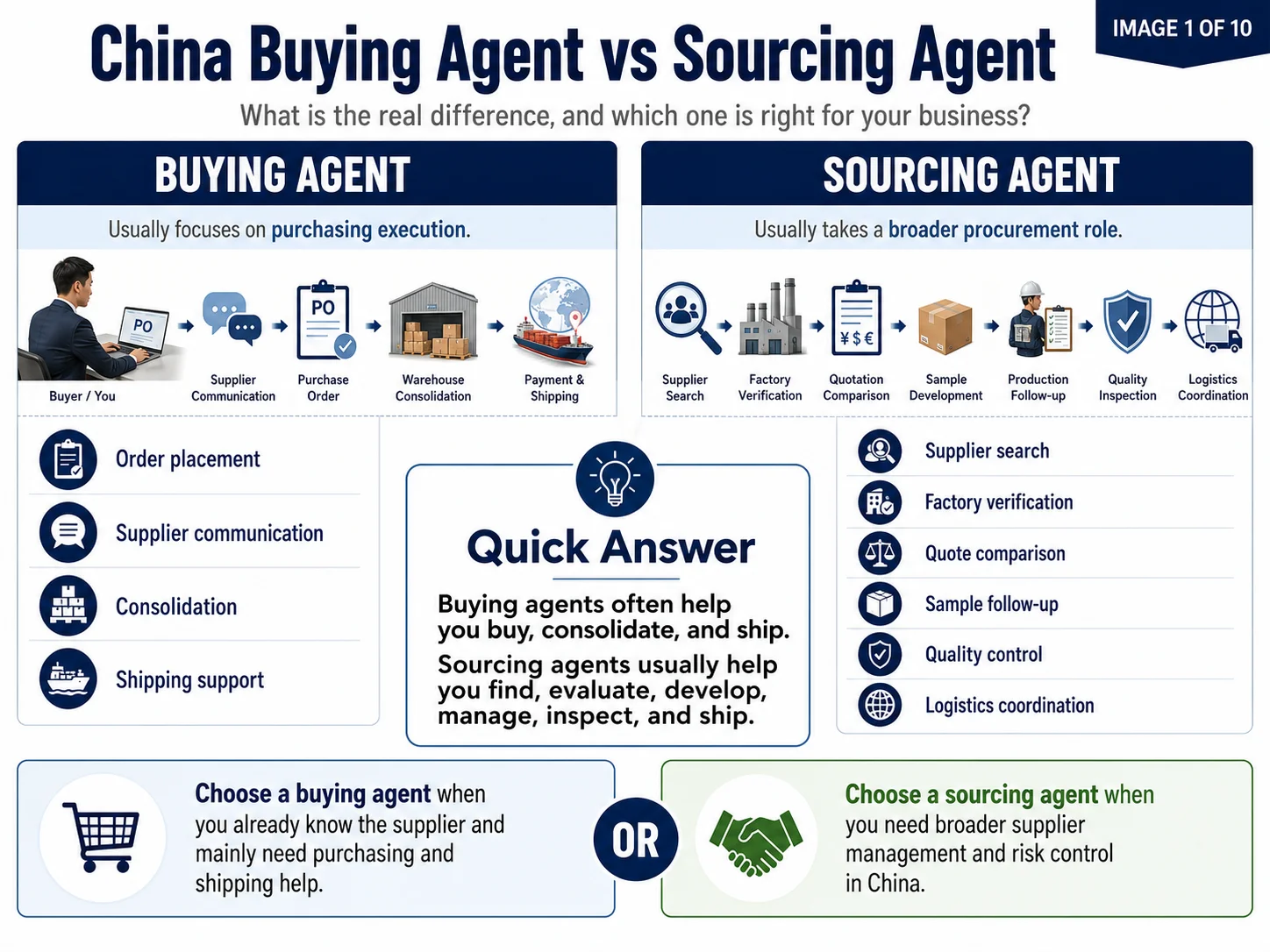
A China buying agent and a sourcing agent may perform overlapping work, but their real difference is usually the level of involvement. A buying agent often helps buyers purchase, pay for, consolidate, and ship goods. A sourcing agent may take a broader role in supplier search, factory verification, quotation comparison, sample development, production follow-up, quality control, and logistics coordination. The right option depends on how much purchasing risk you need someone in China to manage.
In our conversations with overseas buyers, we often see one key misunderstanding: buyers assume every agent using the word “sourcing” provides the same service. That is rarely true. Before you compare fees, you should understand what each provider owns, what they exclude, and how they handle problems after a supplier sends a quotation.
China Buying Agent vs Sourcing Agent: What Is the Quick Answer?
Many buyers need a quick answer because they are trying to move from product idea to order quickly. However, choosing based on a job title alone can create expensive gaps later, especially when samples, product quality, or shipping are involved.
In a China buying agent vs sourcing agent comparison, a buying agent usually focuses on purchasing execution, while a sourcing agent often supports supplier discovery and broader procurement management. However, there is no universal definition[^2]. You should confirm whether the provider handles supplier verification, quotations, samples, quality inspection, production follow-up, warehousing, and shipping before you hire them.
The titles overlap because China’s procurement service market is not standardized. One company may call itself a buying agent while offering full supplier management. Another may call itself a sourcing agent but only send supplier links and quotations.
The useful question is not, “Which title is better?” Instead, ask:
- What stage of the purchase does the agent manage?
- Who checks whether the supplier is real and suitable?
- Who confirms specifications before mass production?
- Who follows up when the factory misses a deadline?
- Who inspects goods before the balance payment or shipment?
- Who coordinates consolidation, labeling, and final delivery?
A low factory price does not guarantee a safe buying outcome.[^3] In our experience, many first-time buyers find that the difficult work starts after they identify a supplier. Product details can be misunderstood, samples can differ from bulk goods[^4], and freight arrangements can become confusing when several suppliers are involved.
The best agent is not necessarily the one that promises the cheapest quote. It is the one whose working scope matches the risks in your order.
What Is a China Buying Agent?
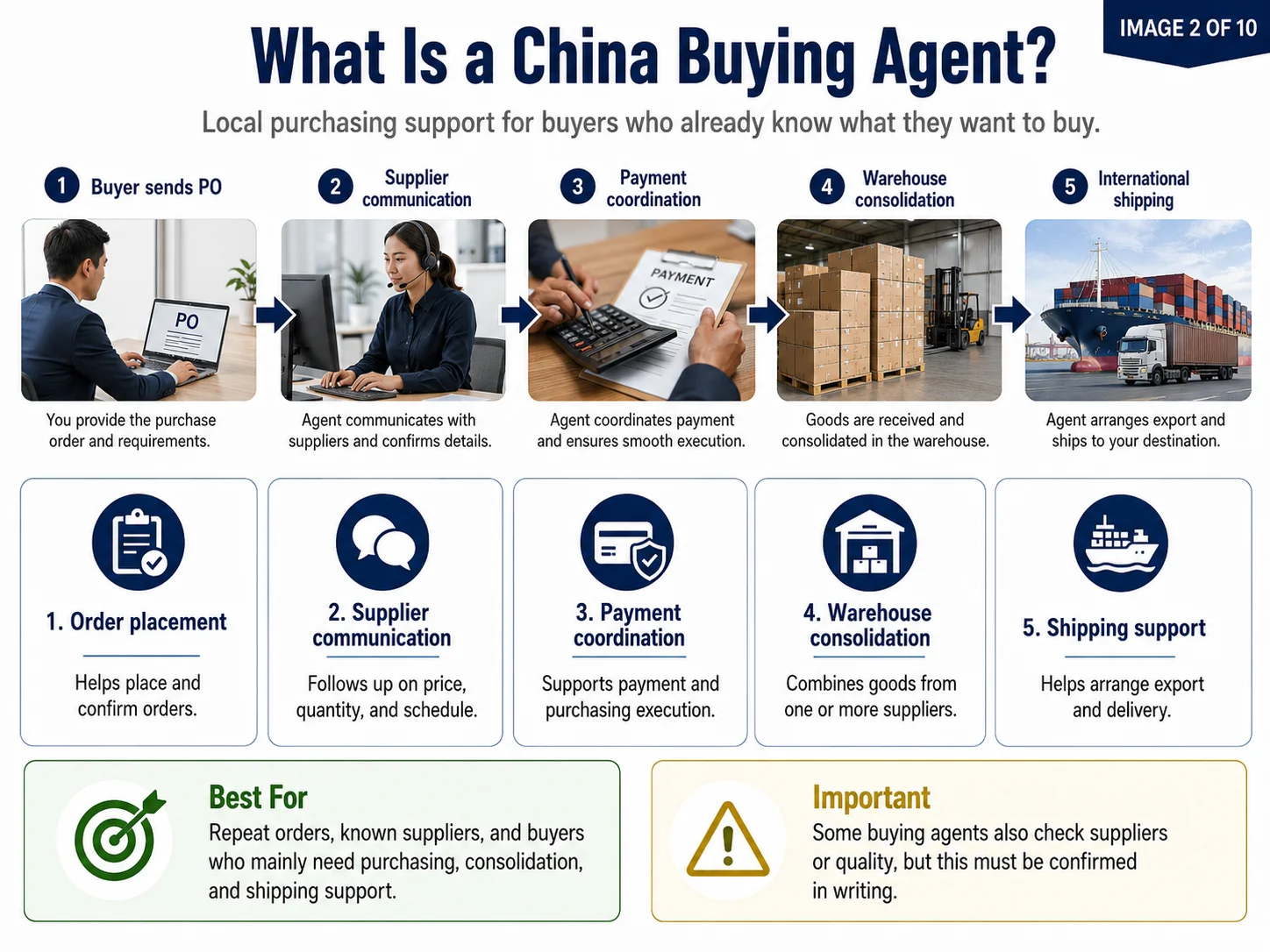
A buyer may have already found a product or supplier but still struggle with communication, payment, order consolidation, and shipping. A China buying agent can help make these purchasing steps easier, especially for smaller or repeat orders.
A China buying agent is a local representative who helps overseas buyers purchase products from Chinese suppliers.[^5] Typical services include placing orders, coordinating payments, communicating with suppliers, collecting goods, arranging warehouse consolidation, and supporting international shipping. Some buying agents also provide basic supplier checks or quality inspection, but this must be confirmed individually.
A buying agent is often most useful when the buyer knows what they want and has a reasonably clear supplier list. For example, an ecommerce seller may need to buy stock from several established suppliers, add labels or inserts, combine cartons in one warehouse, and ship everything together.
Typical buying agent responsibilities
A buying agent may support tasks such as:
- Collecting supplier quotations
- Communicating order quantities and product details
- Coordinating payment to suppliers
- Tracking order status
- Receiving products in a warehouse
- Checking quantities and visible packaging issues
- Combining products from different suppliers
- Applying labels, inserts, or simple packaging
- Booking freight or door-to-door delivery
The service can be practical for relatively straightforward purchases. However, a buyer should not assume that purchasing coordination includes factory auditing, technical product development, or full quality control.
When a buying agent may be enough
A narrower buying service can fit when:
| Buyer situation | Why it may fit |
|---|---|
| You already have trusted suppliers | You mainly need local order and shipping coordination |
| You buy standard, low-complexity products | There are fewer custom specifications to manage |
| You place repeat orders | The supplier relationship and product requirements are already established |
| You need consolidation | The main challenge is combining goods from multiple vendors |
We have spoken with buyers who only needed warehouse consolidation and shipment coordination. In those cases, a broad sourcing project may not be necessary. The buyer had already approved suppliers and products, so their primary need was smooth operational support.
Still, if you are starting with a new factory, a custom item, or a product with safety and quality requirements, you may need more than a buying agent’s basic purchasing function.
What Is a China Sourcing Agent?
Finding suppliers online can look simple until you compare different materials, quotations, minimum order quantities, and production capabilities. A sourcing agent helps buyers turn a broad product request into a more controlled supplier and purchasing decision.
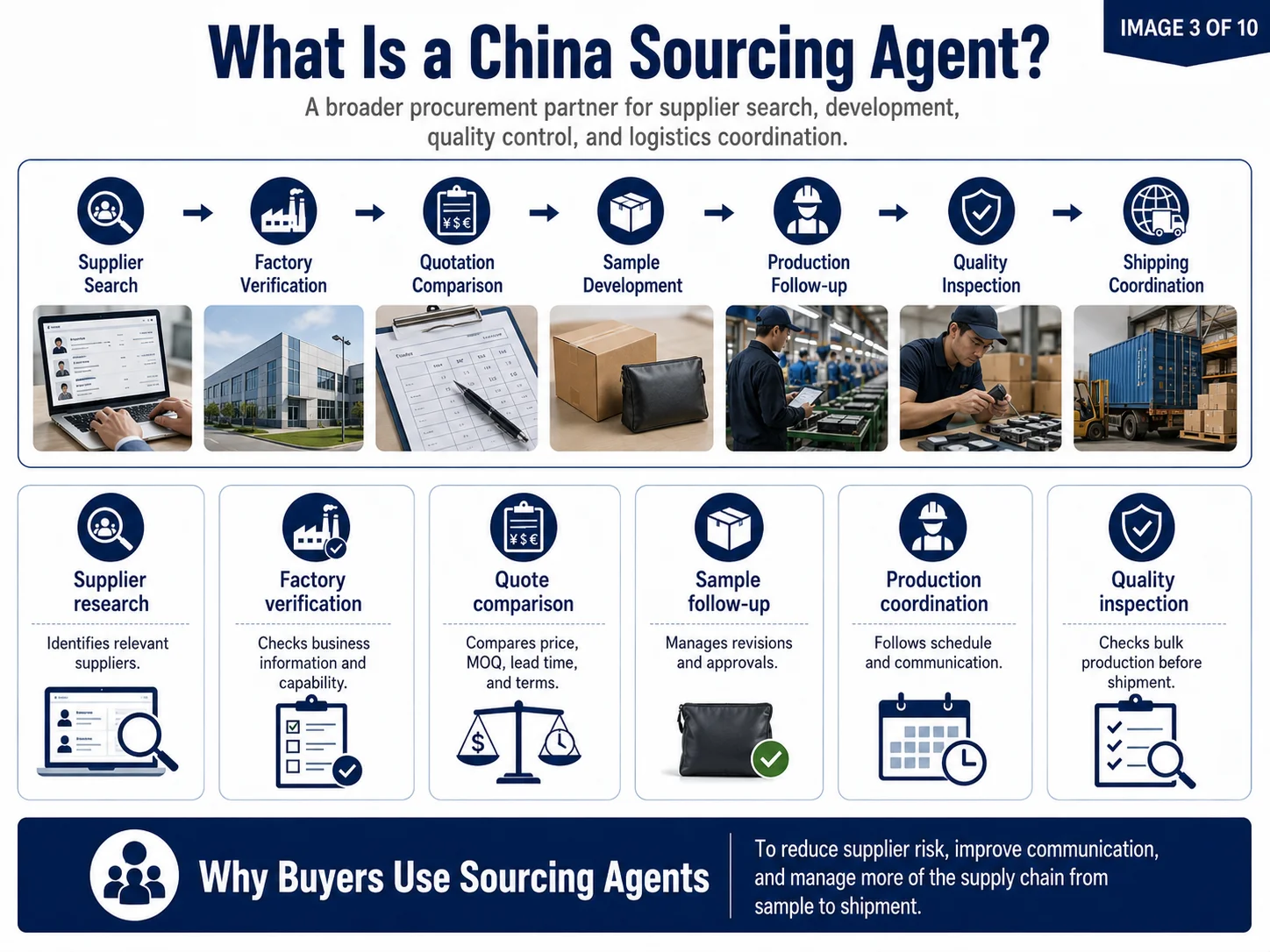
A China sourcing agent helps buyers identify, evaluate, compare, and manage suppliers for a specific product or project. The service may include supplier research, factory verification, price negotiation, sample management, specification clarification, production follow-up, quality inspection, packaging coordination, warehousing, and shipping support[^6]. The exact scope varies by provider.
A sourcing agent is especially valuable when a buyer has a product concept but does not yet know which factory can produce it consistently. We often receive product briefs that appear simple at first. Once we review the details, we find that the buyer needs decisions on material, color, logo method, packaging, accessories, compliance documents, and target price.
A sourcing agent manages more than supplier search
Supplier search is only one part of professional sourcing.[^7] The agent should help the buyer compare suppliers based on relevant factors, not just the lowest unit price.
These factors often include:
- Product specialization and production capacity
- Communication speed and technical understanding
- MOQ flexibility
- Sample quality
- Material options
- Customization capability
- Lead times
- Export experience
- Quality control process
- Payment terms and commercial reliability
A good supplier for a basic product may not be the right supplier for a branded or customized version. For instance, a factory may offer a very low initial quotation but have limited experience with your preferred packaging or logo process. If the factory cannot execute those details reliably, the low quote can become less meaningful.
Sourcing means managing decision points
The sourcing process normally includes several handoffs:
- Product brief and requirement confirmation
- Supplier search and initial screening
- Quotation comparison
- Sample development or sample purchase
- Sample approval and specification confirmation
- Purchase order and production monitoring
- Inspection before shipment
- Consolidation and logistics coordination
Each handoff can create risk.[^8] That is why a sourcing agent’s value should be measured by their workflow, documentation, communication, and ability to follow through—not by how many supplier links they send.
China Buying Agent vs Sourcing Agent: How Do Their Services Compare?
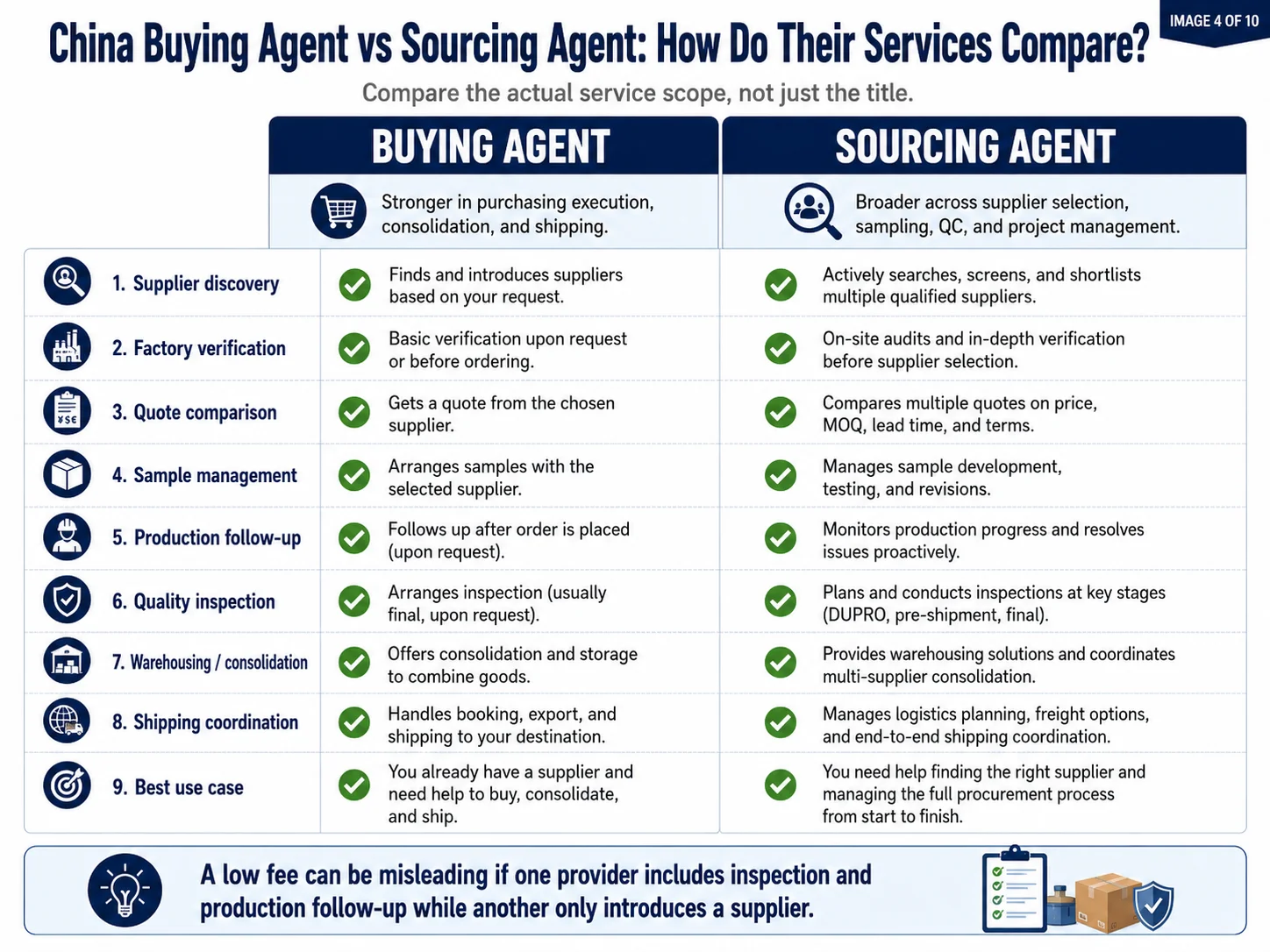
Buyers often compare agent services after receiving different fee proposals. This is sensible, but a low fee can be misleading if one provider includes inspection and production follow-up while another only introduces a supplier.
In a China buying agent vs sourcing agent comparison, sourcing agents generally offer a wider procurement scope, while buying agents may focus more on transaction handling and logistics support[^9]. The actual service package can overlap, so buyers should request a written list of included services, exclusions, reporting methods, and fees.
| Service area | China Buying Agent | China Sourcing Agent |
|---|---|---|
| Main responsibility | Purchase coordination and order execution | Supplier selection and end-to-end procurement support |
| Supplier search | May be limited | Usually a core service |
| Factory verification | Sometimes offered | Often included or available as an added service |
| Price negotiation | May coordinate | Usually compares and negotiates quotations |
| Sample management | May purchase samples | Usually manages samples and approval details |
| Quality control | May offer basic checks | Often offers inspection or QC coordination |
| Production follow-up | May track simple orders | Usually monitors milestones and delivery risks |
| Warehousing and shipping | Common service | Often included or coordinated |
| Fee structure | Commission, service fee, or margin | Commission, project fee, retainer, or service package |
| Best-fit buyer | Buyer with established suppliers | Buyer needing supplier discovery and risk management |
The table provides a useful starting point, but it should never replace direct questions. Some companies use “buying agent” because it is more familiar to customers, even though they provide full sourcing support. Other companies use “sourcing agent” as a marketing phrase but do not handle production or inspection.
What should you compare beyond the table?
Ask for clear answers to these points:
- Will the agent disclose supplier names and basic supplier details?
- Will they verify the business license or factory status?
- Will they compare at least several suitable supplier options?
- Will they manage sample revisions?
- Will they inspect finished goods based on an agreed checklist?
- Will they provide photos, reports, and progress updates?
- Will they support claims if a problem appears before shipment?
- Will they manage warehouse consolidation and shipping paperwork?
When we prepare quotations for sourcing projects, we try to define the scope early. This avoids a common problem: the buyer expects full production management, while the service provider only intended to introduce suppliers.
Which Services Should a Professional China Sourcing Agent Provide?
A sourcing project can fail when responsibilities are vague. Buyers may assume the agent checks every detail, while the agent assumes the supplier is responsible. A professional process should make ownership clear before production starts.
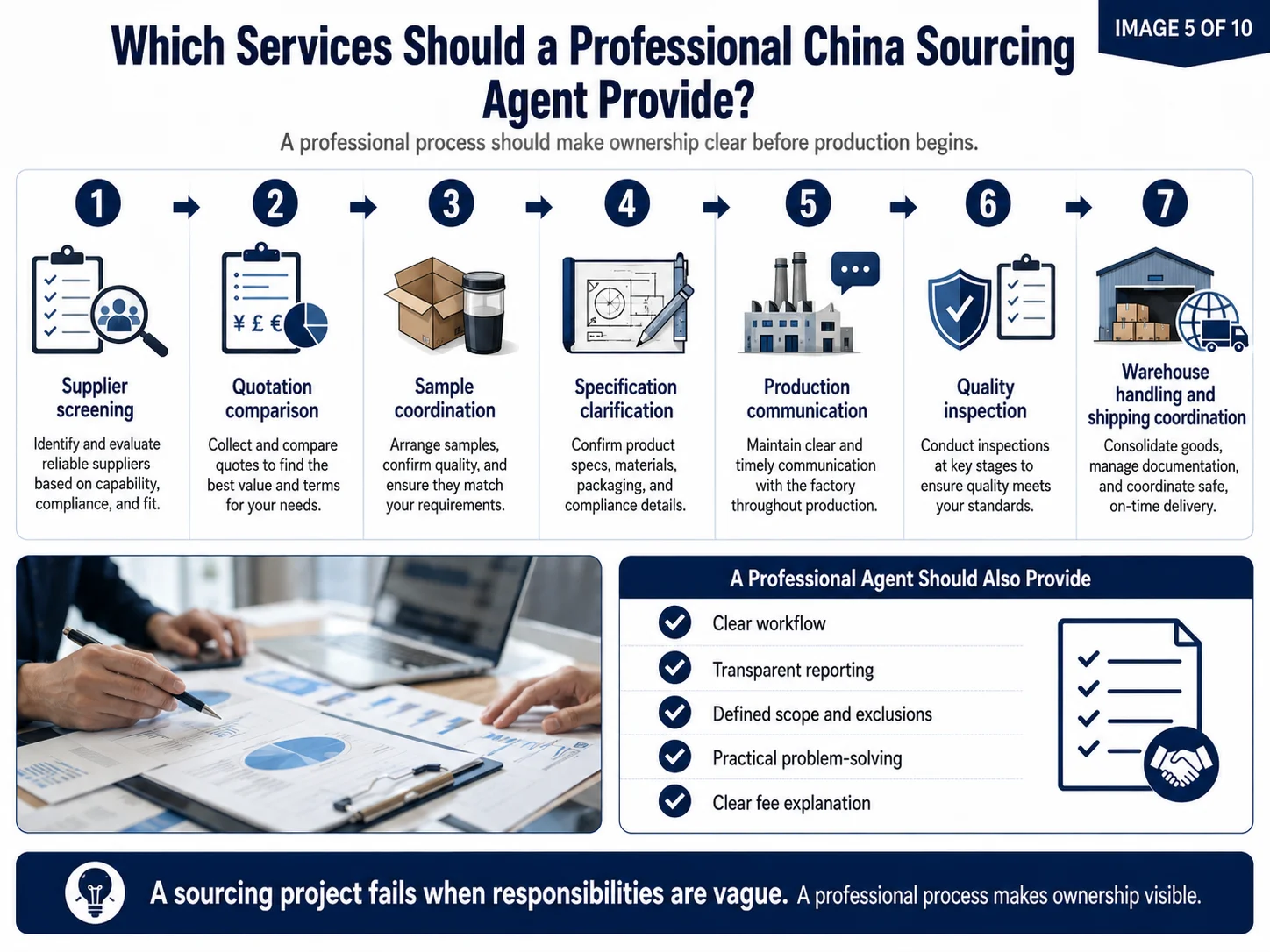
A professional China sourcing agent should provide a transparent workflow covering supplier screening, quotation comparison, sample coordination, production communication, quality inspection, warehouse handling, and shipping coordination when these services are included in the agreement. The agent should also explain what they cannot control and what fees apply.
A full-service sourcing provider does not need to perform every task in-house. However, the provider should have a clear process for managing each task and communicating with the buyer.
Core sourcing services to request
| Service | Why it matters |
|---|---|
| Supplier screening | Helps reduce the risk of working with unsuitable vendors |
| Business license review | Supports basic supplier identity checks |
| Quotation comparison | Makes price, MOQ, lead time, and specification differences visible |
| Sample management | Confirms product expectations before mass production |
| Specification documentation | Reduces misunderstandings during production |
| Production follow-up | Identifies delay or material issues earlier |
| Quality inspection | Checks goods against agreed standards before shipment |
| Packaging review | Ensures cartons, labels, inserts, and barcodes are correct |
| Warehousing and consolidation | Helps combine orders and reduce logistics complexity |
| Shipping coordination | Supports a smoother handoff from factory to destination |
Quality control needs a defined standard
“Inspection included” is not enough. You should ask what the inspection covers. For example, does the check include:
- Product quantity
- Color and size variation
- Function testing where applicable
- Logo placement
- Packaging condition
- Carton marks
- Barcode labels
- Random sampling approach
- Photo and video evidence
- Defect reporting
We recommend that buyers approve a sample and a written checklist before mass production.[^10] This gives everyone a shared reference point. Without an approved standard, it is difficult to judge whether a product issue is a factory defect, an unclear instruction, or a reasonable production variation.
For simple, low-value stock products, a basic service package may be sufficient. For custom packaging, multiple components, regulated goods, or high-value orders, the buyer should consider a more detailed sourcing and quality process.
How Do China Buying Agents and Sourcing Agents Charge?
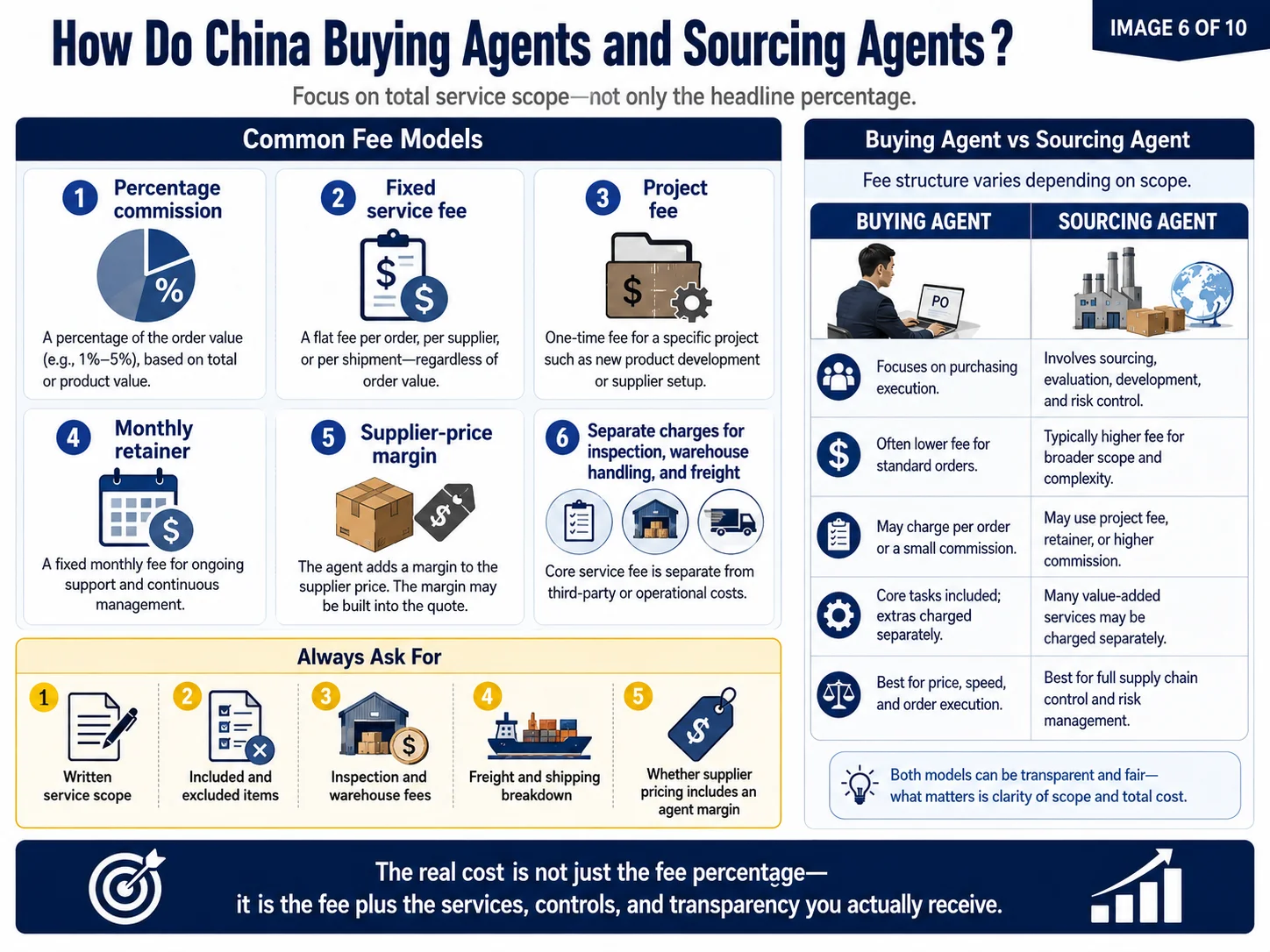
Agent fees can be confusing because providers use different models. Buyers may focus only on the stated percentage, but the total cost also depends on service scope, inspection needs, warehousing, shipping, and whether the agent adds a margin to supplier pricing.
China buying agents and sourcing agents may charge a percentage commission, a fixed service fee, a project fee, a monthly retainer, a supplier-price margin, or separate charges for inspection, warehouse handling, and freight.[^11] Buyers should ask for a written breakdown showing exactly what is included and excluded.
Common pricing structures include:
-
Commission-based fee
The agent charges a percentage of order value. This can work well for ongoing purchasing but should clearly define whether freight, taxes, and supplier deposits are included in the calculation. -
Fixed service fee
The buyer pays an agreed amount for a defined task, such as supplier research, factory verification, or purchase coordination. -
Project fee
This model is common for custom product development, complex multi-supplier orders, or a sourcing project with many moving parts. -
Monthly retainer or dedicated team fee
Growing brands and larger buyers may need regular support. A dedicated sourcing team can suit buyers with recurring orders, frequent product launches, or supplier management needs. -
Supplier margin
Some agents quote a delivered or supplier price with their margin built in. This is not automatically a problem, but the buyer should understand the arrangement and compare the total value offered.
Watch for unclear cost structures
Ask these questions before you proceed:
- Is the service fee separate from the product price?
- Are quality inspections included?
- Is warehouse storage free for a limited period?
- Are repacking, labeling, and consolidation charged separately?
- Who pays for bank fees, customs documents, and freight fluctuations?
- Are there minimum service fees for small orders?
- What happens if a supplier needs to remake defective goods?
Transparent pricing does not always mean the lowest price. It means you can understand the cost, compare options, and make a business decision without surprises.
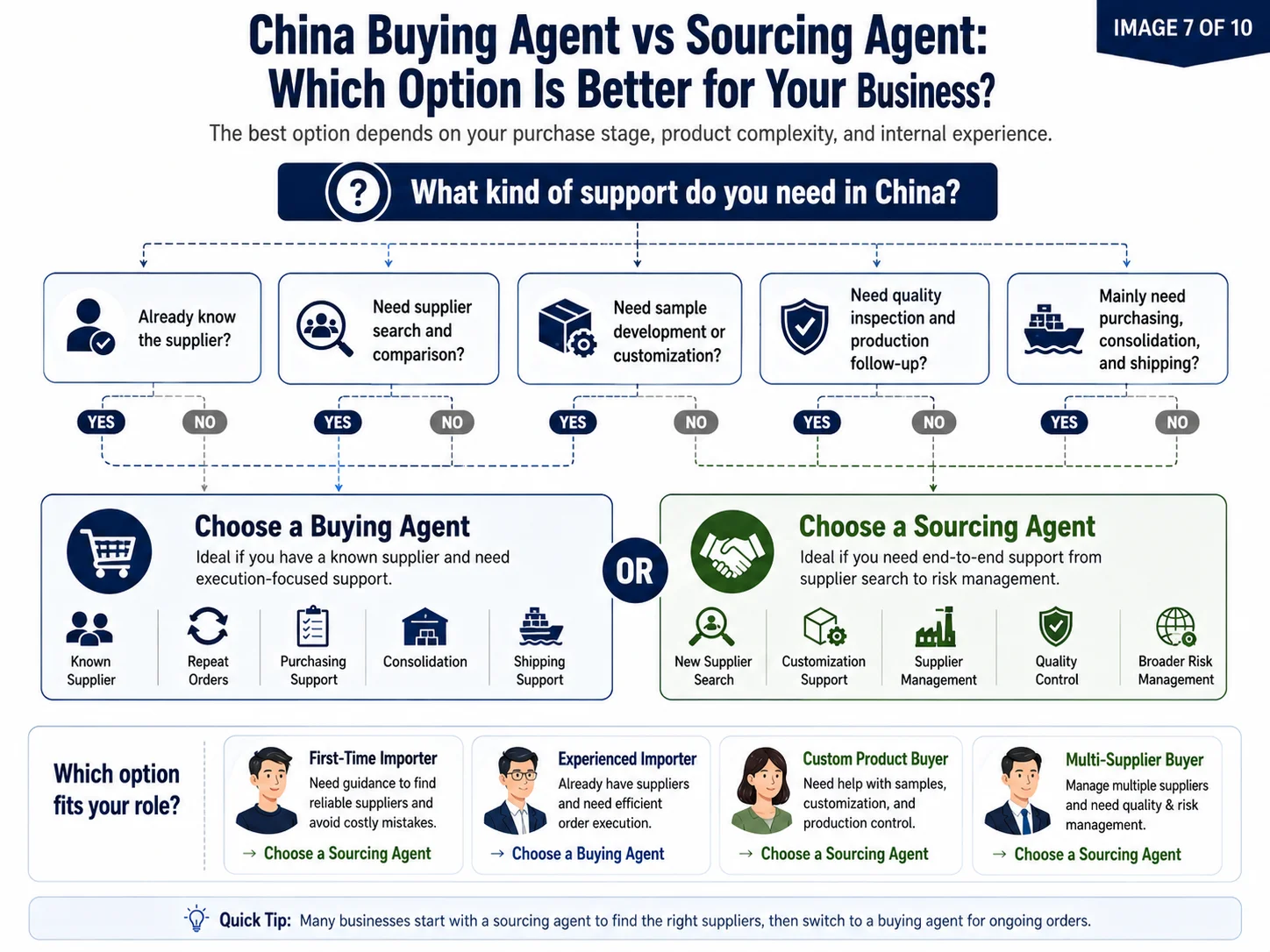
China Buying Agent vs Sourcing Agent: Which Option Is Better for Your Business?
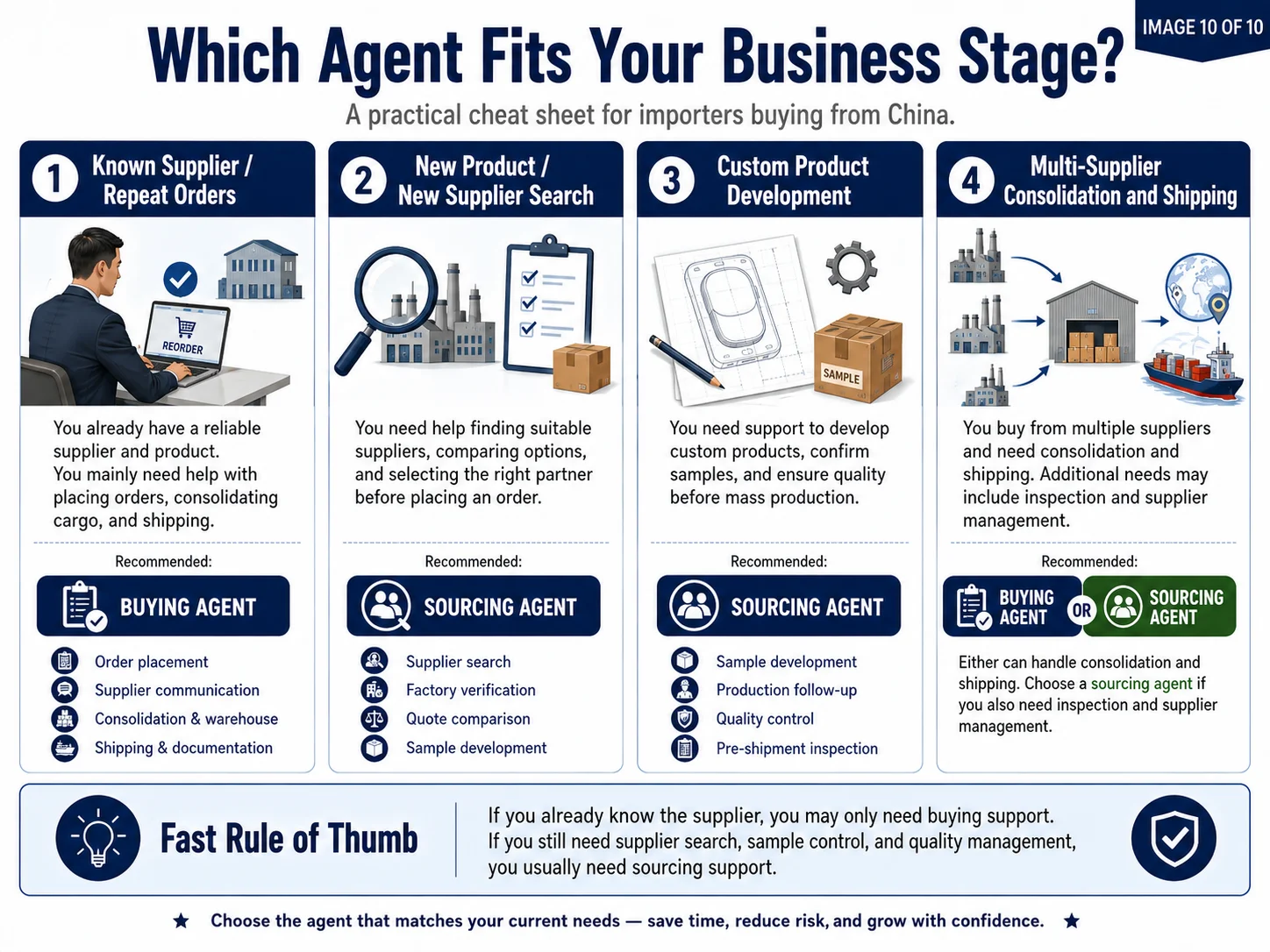
The best option depends on your purchase stage, product complexity, supplier relationships, and internal experience. A first-time buyer needs different support from an experienced importer with established factory partners.
For China buying agent vs sourcing agent decisions, choose a buying agent when you mainly need purchasing, consolidation, and shipping support for known suppliers. Choose a sourcing agent when you need help finding, evaluating, sampling, managing, and inspecting suppliers or when your order has customization and supply-chain complexity.
A buying agent may be the better fit if you:
- Already know the suppliers you want to use
- Purchase standard products with limited customization
- Need help paying, collecting, consolidating, or shipping goods
- Have your own product specifications and QC process
- Place repeat orders with stable suppliers
A sourcing agent may be the better fit if you:
- Are buying from China for the first time
- Need new supplier options
- Want to compare factories and quotations
- Need custom logos, colors, packaging, or product changes
- Are managing several suppliers and components
- Need sample follow-up and production updates
- Need pre-shipment inspection and logistics coordination
- Lack a local procurement team in China
Use a practical selection test
Before hiring anyone, write down your current gaps. You may only need one or two services now. For example, you might need supplier verification and an inspection, but not ongoing warehouse support.
Then ask the provider:
“Which stages will your team own, what will you report to us, and what remains our responsibility?”
That question usually reveals whether the service is suitable. At KingSourcing, we do not believe every buyer needs a large service package. A buyer testing a simple product with a small budget may need a focused sourcing plan. A growing brand with multiple SKUs may need deeper supplier and order management.
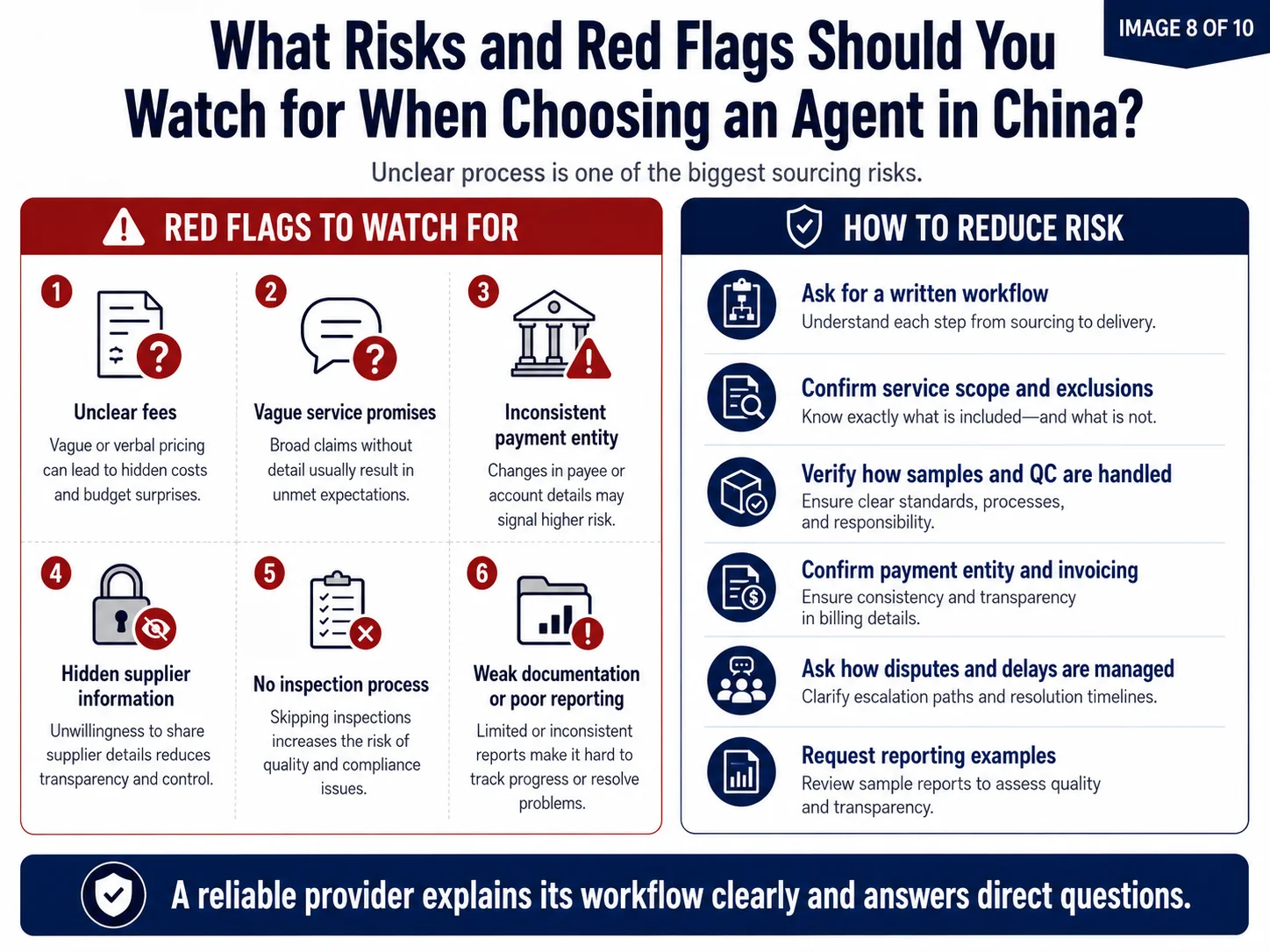
What Risks and Red Flags Should You Watch for When Choosing an Agent in China?
Choosing an agent without checking their process can create avoidable risk. Buyers sometimes discover too late that the agent does not verify suppliers, cannot inspect products, or has no clear method for handling payment and quality disputes.
When choosing a China buying agent or sourcing agent, watch for unclear fees, vague service promises, inconsistent payment entities, hidden supplier information, no inspection process, weak documentation[^12], and an inability to show how they manage orders. A reliable provider should explain its workflow clearly and answer direct questions.
Common warning signs
- The provider guarantees the “lowest factory price” without reviewing specifications.
- The provider cannot explain how suppliers are screened.
- The payment recipient does not match the company information without a clear reason.
- The agent refuses to provide any purchase records, progress evidence, or inspection reports.
- The quotation does not separate product costs, service fees, and freight.
- The company cannot explain how it handles defective goods.
- The agent pushes for a large payment before samples or requirements are confirmed.
- The provider has no warehouse address, operating process, or identifiable team contact.
- The agent says quality inspection is unnecessary because the factory is “trusted.”
No supplier or agent can eliminate every business risk. However, a structured process can reduce avoidable surprises. We encourage buyers to start with a manageable order, clear product requirements, and documented sample approval before moving to larger volumes.
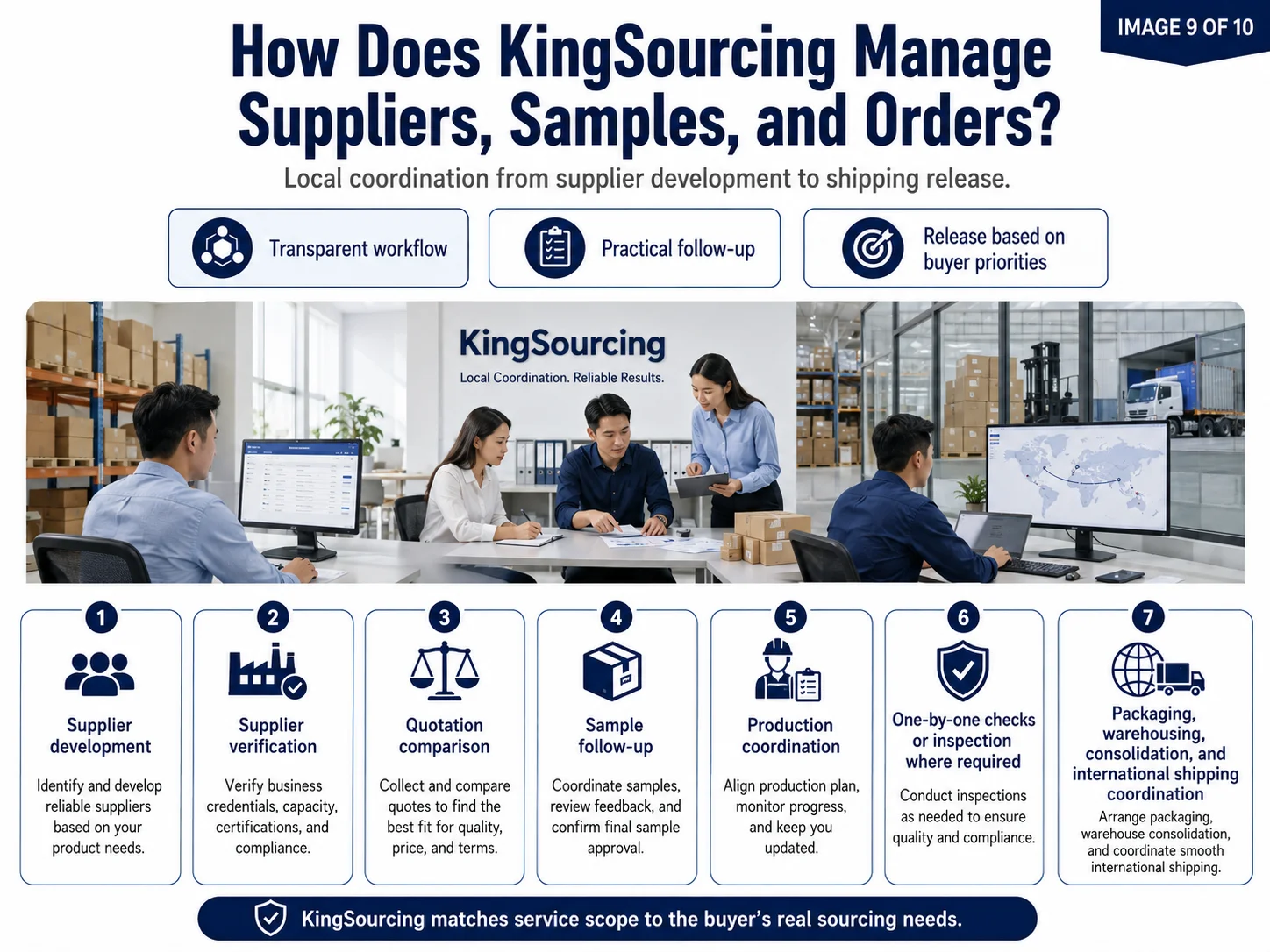
How Does KingSourcing Manage Suppliers, Samples, and Orders?
Many overseas buyers need a local partner because they do not have time to chase factories across time zones. They want clear updates, practical checks, and a team that can coordinate several moving parts without adding unnecessary complexity.
At KingSourcing, we manage sourcing projects by matching service scope to the buyer’s needs. Our team can support supplier development, supplier verification, quotation comparison, sample follow-up, production coordination, one-by-one product checks where required, packaging, warehousing, consolidation, and international shipping coordination.
Our process usually begins with a product brief. We review the product type, target quantity, expected price range, customization needs, quality expectations, packaging, and destination market. Clear information at this stage helps us identify suppliers that fit the project rather than simply collecting the cheapest quotation.
Our working approach
-
Supplier search and verification
We identify potential suppliers based on product fit and project needs. We can review basic company information, product capability, communication quality, and quotation terms. -
Quotation comparison
We compare relevant details, including unit price, MOQ, tooling or sample costs, lead time, materials, and packaging requirements. -
Sample management
We coordinate sample purchase or development. We help buyers review sample details before mass production, especially where logos, packaging, or combined accessories are involved. -
Production and quality follow-up
We communicate with suppliers during production and arrange quality checks based on the agreed scope. For suitable projects, we provide product photos, videos, and inspection information to support buyer decisions. -
Warehousing and shipping coordination
We can receive goods, combine orders from multiple suppliers, apply packaging materials, arrange product photography where needed, and coordinate international shipment.
Our role is not to promise that every order will be effortless. Our role is to give buyers a clearer process, local coordination, and more control over supplier, quality, and logistics decisions.
Frequently Asked Questions
Is a buying agent the same as a sourcing agent?
Not always. The terms often overlap, and there is no universal definition. A buying agent may focus on purchasing and shipping, while a sourcing agent may manage supplier discovery, samples, production, and quality control. You should compare actual services, not only titles.
How much does a China sourcing agent charge?
A China sourcing agent may charge a commission, fixed fee, project fee, monthly retainer, or margin included in the supplier quotation. Costs depend on order value, product complexity, supplier count, inspection needs, and logistics services. Always request a written fee breakdown.
Can a sourcing agent negotiate lower prices?
A sourcing agent can often compare quotations, clarify specifications, and negotiate terms with suppliers. However, lower pricing should not be the only goal. The agent should also evaluate material quality, MOQ, lead time, packaging, and the supplier’s ability to deliver consistently.
Should an agent reveal the supplier’s identity?
This depends on the service model and agreement. Many buyers prefer transparency, particularly for long-term supplier relationships. You should discuss supplier disclosure early and put the expectation in writing. You should also understand whether the agent remains responsible for ongoing order management.
Do sourcing agents handle quality inspection?
Many sourcing agents offer quality inspection, but the scope varies. Some provide basic visual checks, while others arrange detailed pre-shipment inspections with checklists, photos, and defect reports. Ask what is inspected, when it happens, and whether it costs extra.
When should I hire a dedicated sourcing team?
A dedicated sourcing team can make sense when you have recurring orders, multiple products, several suppliers, custom packaging, or regular product development work. It may be less suitable for a one-time, small, simple purchase. Your expected purchasing volume and operational needs should guide the decision.
Conclusion
The real China buying agent vs sourcing agent decision is about scope and accountability, not a fixed job title. A buying agent can be a practical choice for established suppliers, purchasing coordination, consolidation, and shipping. A sourcing agent is often more suitable when you need supplier research, samples, production follow-up, quality control, and broader supply-chain coordination. Before you choose, ask exactly what the provider manages, what they report, and what is excluded. Send your product brief or supplier quotation to KingSourcing, and we can help you assess the right sourcing support for your project.
Tags: China Sourcing Agent, China Buying Agent, Procurement Service China, Supplier Management, China Sourcing Company, Import from China
[^1]: "Special Documents", https://www.trade.gov/special-documents. International-trade guidance notes that incomplete documentation, customs requirements, and transport arrangements can delay or disrupt cross-border shipment of goods. Evidence role: general_support; source type: government. Supports: Official trade guidance explaining that shipping and customs documentation, transport arrangements, and regulatory requirements can affect whether international goods move as scheduled.. Scope note: Such guidance describes common trade risks and does not establish that a particular agent or supplier caused a shipment failure. [^2]: "Buying agent", https://en.wikipedia.org/wiki/Buying_agent. Commercial-agency guidance generally treats an agent's authority and duties as matters defined by the parties' agreement, rather than as consequences of a universally standardized title. Evidence role: definition; source type: institution. Supports: Authoritative material showing that commercial-agent duties are generally defined by the agency agreement and business arrangement, rather than by a globally standardized job title.. Scope note: This supports the contractual variability of agency roles but may not specifically classify the modern Chinese procurement-service labels used in the article. [^3]: "Implementing Rated Criteria Briefing", https://thedocs.worldbank.org/en/doc/0e65a0a1681af3fa7a855fce4abf53e5-0290012023/original/How-to-Implement-Rated-Criteria-Briefing.pdf. Procurement guidance recognizes that supplier evaluation can require consideration of quality, delivery capability, and risk alongside price, so the lowest quoted price alone is not necessarily the best-value outcome. Evidence role: general_support; source type: institution. Supports: Procurement guidance explaining that supplier selection may consider quality, capacity, delivery, risk, and lifecycle or total cost in addition to initial price.. Scope note: Best-value procurement frameworks are contextual and do not prove that every low-priced factory poses a greater risk. [^4]: "Trade Guide: WTO PSI", https://www.trade.gov/trade-guide-wto-psi. Quality-control practice uses production monitoring and inspection to assess whether serially produced goods conform to approved samples and documented specifications. Evidence role: mechanism; source type: institution. Supports: Quality-management guidance describing why production controls and inspection are used to verify that serial production conforms to approved requirements or samples.. Scope note: The source supports the rationale for verification; it does not quantify how often bulk goods differ from samples in a particular product category. [^5]: "880 R.I. Code R. 880-RICR-00-00-1.3 - Definitions", https://www.law.cornell.edu/regulations/rhode-island/880-RICR-00-00-1.3. Agency law defines an agent as a person authorized to act on behalf of another party; in purchasing arrangements, that role may include conducting transactions for the buyer. Evidence role: definition; source type: education. Supports: A definition of an agent as a party authorized to act on behalf of a principal, applied to purchasing activity undertaken for a buyer.. Scope note: The legal definition establishes the general agency relationship and does not prescribe the exact services offered by any China-based buying agent. [^6]: "https://www.open.edu/openlearn/88/ ...", https://www.open.edu/openlearn/money-business/risk-management/altformat-ouxml. Procurement and supply-chain literature commonly treats supplier identification, evaluation, specification management, quality assurance, and logistics coordination as connected functions in managing an external supply base. Evidence role: general_support; source type: education. Supports: Educational or institutional procurement material identifying supplier identification, evaluation, contracting, quality assurance, and logistics as related sourcing and supply-chain functions.. Scope note: The literature describes procurement functions generally and does not require every sourcing agent to provide each function. [^7]: "Design and development of a supplier evaluation process", https://dspace.mit.edu/entities/publication/0b0e87c2-0cc5-4dcd-b521-b4fd1a9bcb04. Strategic-sourcing frameworks describe sourcing as extending beyond supplier identification to evaluation, selection, contracting, and ongoing supplier-performance management. Evidence role: general_support; source type: education. Supports: A procurement framework showing that sourcing encompasses supplier evaluation, selection, contracting, and supplier-performance management in addition to supplier discovery.. Scope note: The exact process and degree of oversight vary by organization, product, and contract. [^8]: "best practices in cyber supply chain risk management", https://csrc.nist.gov/CSRC/media/Projects/Supply-Chain-Risk-Management/documents/case_studies/USRP_NIST_CommsCo_062415.pdf. Supply-chain risk research identifies coordination failures and information gaps among multiple parties as mechanisms that can increase quality, delivery, and operational risk. Evidence role: mechanism; source type: research. Supports: Research or risk-management guidance explaining that interorganizational handoffs and incomplete information can create coordination, quality, and delivery risks in supply chains.. Scope note: This provides a general mechanism and does not show that every procurement handoff will result in a problem. [^9]: "Know Your Incoterms", https://www.trade.gov/know-your-incoterms. Procurement terminology commonly distinguishes purchasing execution from broader sourcing activities that include identifying, evaluating, and managing suppliers. Evidence role: definition; source type: other. Supports: A neutral explanation distinguishing purchasing execution from broader sourcing activities such as supplier identification, evaluation, and management.. Scope note: Terminology is not standardized across commercial service providers, so the distinction should be read as a functional comparison rather than a fixed rule. [^10]: "Import Requirements & Documentation", https://www.trade.gov/country-commercial-guides/import-requirements-documentation. Quality-assurance systems rely on documented requirements and acceptance criteria, and approved reference samples can provide a practical basis for assessing production conformity. Evidence role: mechanism; source type: institution. Supports: Quality-assurance guidance supporting the use of documented specifications, acceptance criteria, and approved reference samples before or during production.. Scope note: A checklist improves clarity but cannot by itself ensure consistent manufacturing or eliminate all defects. [^11]: "Part 16 - Types of Contracts", https://www.acquisition.gov/far/part-16. Commercial-agency guidance recognizes commission as a common form of remuneration and emphasizes that payment arrangements are governed by the parties' contractual terms. Evidence role: general_support; source type: government. Supports: Guidance showing that commercial-agent remuneration may be commission-based and may be determined by contract, supporting the broader point that compensation structures vary.. Scope note: This evidence directly supports variation in agency remuneration but may not document every fee category used by China-focused sourcing providers. [^12]: "Ghana Avoiding Scams in International Trade and Business", https://www.trade.gov/market-intelligence/ghana-avoiding-scams-international-trade-and-business. Trade due-diligence guidance advises businesses to verify counterparties, payment details, and transaction records before sending funds or relying on an overseas supplier or intermediary. Evidence role: general_support; source type: government. Supports: Government trade-fraud or due-diligence guidance recommending verification of counterparties, payment details, company identity, and transaction documentation.. Scope note: These factors warrant additional verification but are not, on their own, proof that an agent is fraudulent or unreliable.