China warehousing and order consolidation can help importers control multi-supplier orders before they leave China. Without a local receiving point, separate shipments, missed quantity errors, damaged cartons, and unclear delivery schedules can quickly raise costs[^1]. We use warehouses to receive, inspect, repack, combine, and release goods based on the buyer’s real sales deadline.
China warehousing and order consolidation means sending products from multiple Chinese suppliers to one warehouse, where they are received, checked, stored temporarily, repacked if needed, and shipped together. It can reduce duplicate shipping costs and improve order visibility[^2], but it is not always the cheapest choice. Importers should compare freight, warehouse fees, supplier readiness, inspection results, and the cost of delaying inventory before consolidating.
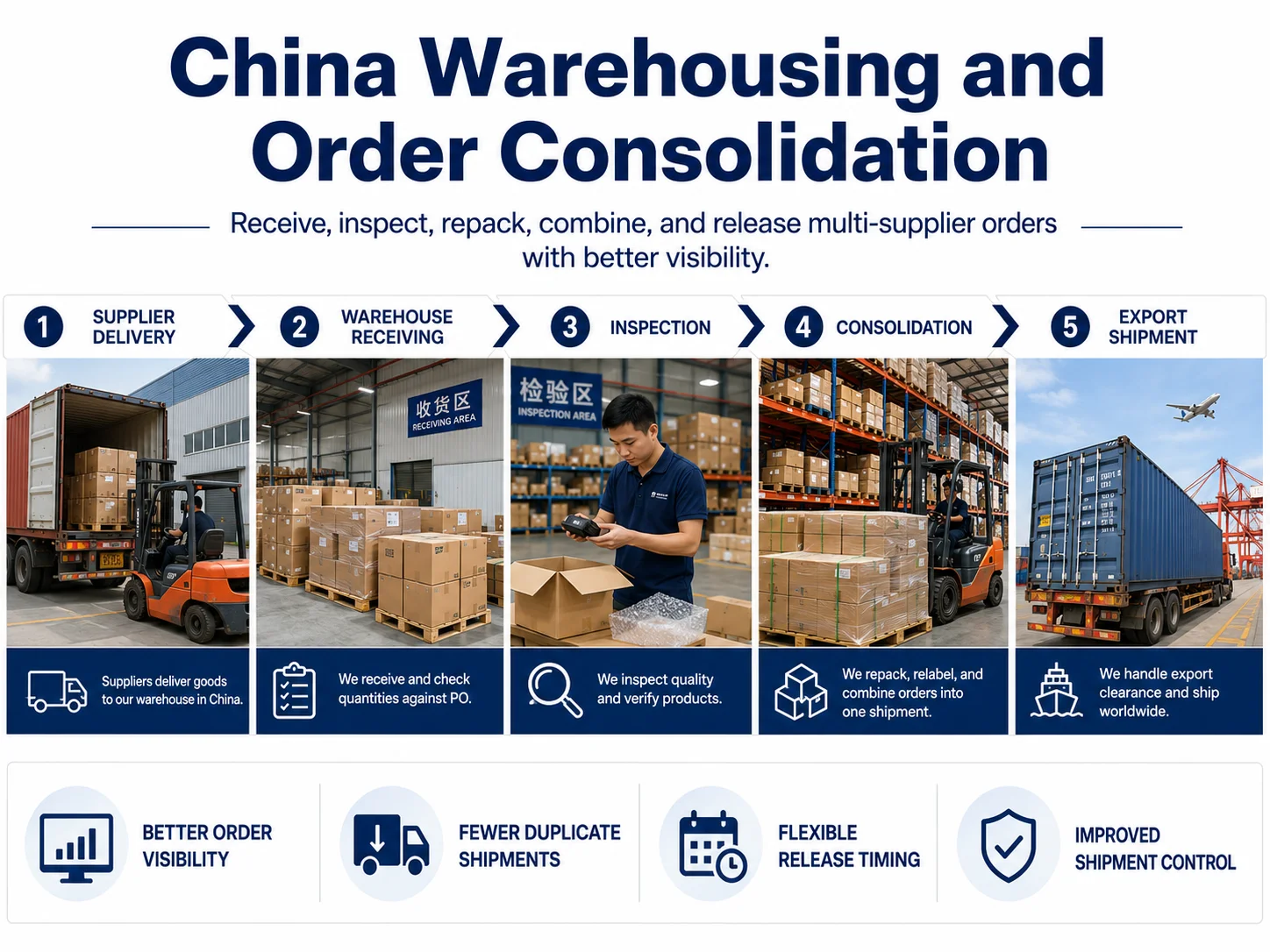
Many importers focus only on getting the lowest freight quote. We understand why. However, a lower quote does not help if one delayed supplier causes a stockout, a launch delay, or an expensive last-minute air shipment[^3]. A warehouse should be treated as a control point, not simply a place to hold cartons.
Quick Answer: Is China Warehousing and Order Consolidation Right for You?
Multi-supplier sourcing can become difficult when each factory has a different production schedule, packaging standard, and shipping process. If suppliers ship directly without coordination, you may lose visibility and receive products at different times.
China warehousing and order consolidation is usually suitable for importers buying from two or more suppliers, especially when they need inspection, custom packaging, SKU labeling, bundle assembly, or one combined shipment. It works best when the buyer sets a release deadline and does not wait indefinitely for every supplier.
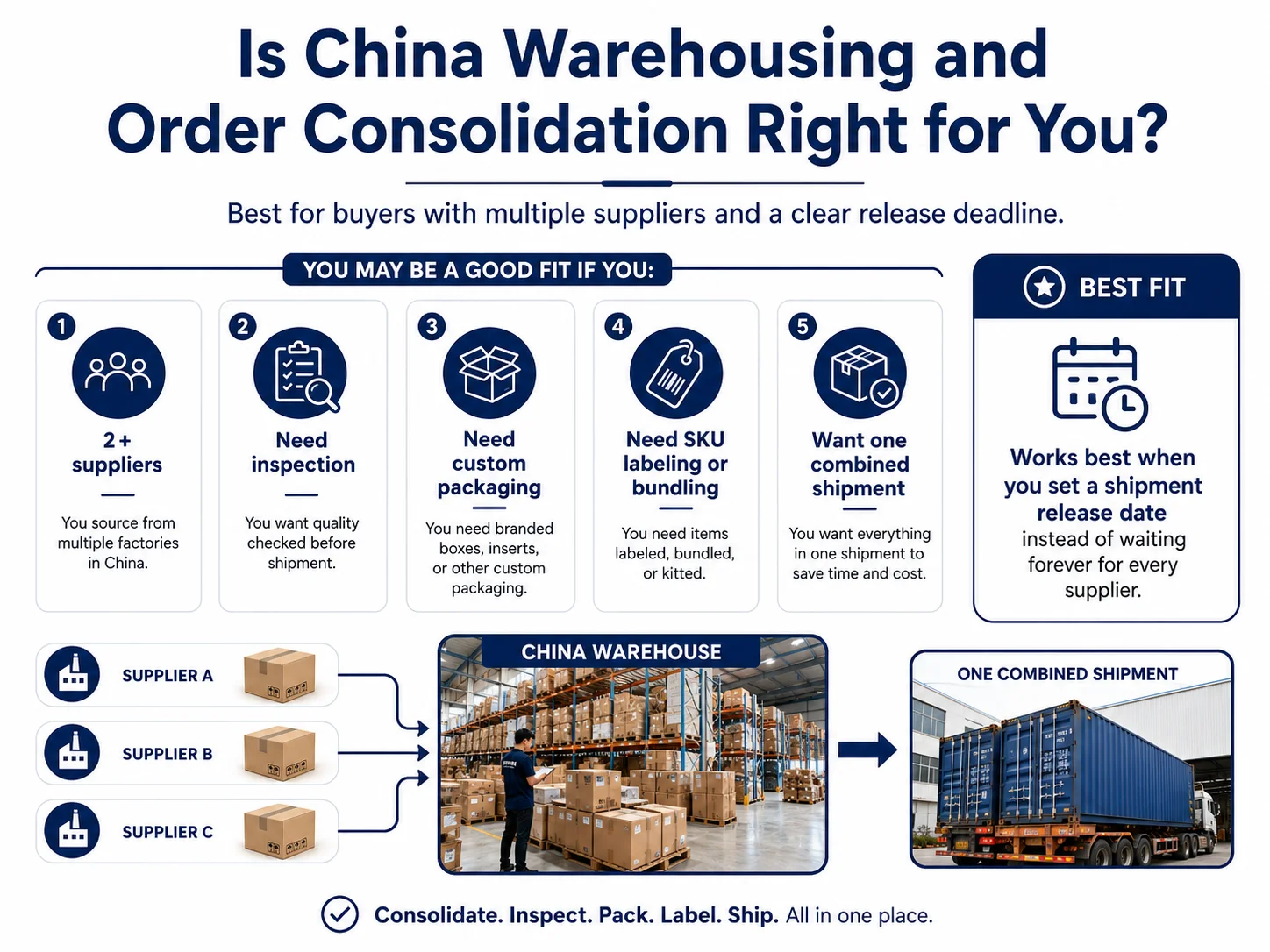
In our day-to-day coordination work, we see that the best warehouse plan starts with a practical question: What must ship first? The answer may be different for every business.
For example, a DTC brand may have:
- Core products that are almost out of stock
- New accessories that can wait for the next shipment
- Packaging from a separate supplier
- A delayed factory that has not completed final inspection
In this case, waiting for every carton may reduce the per-unit freight cost, but it may create a more expensive problem: lost sales. We often recommend separating the decision into two parts:
- What is ready, inspected, and commercially urgent?
- What can wait without hurting the business?
Consolidation is useful when it improves control. It becomes less useful when it turns into open-ended waiting.
We do not treat “fill one container” or “ship everything together” as automatic goals. We first look at arrival dates, inspection status, shipment volume, and the buyer’s inventory deadline.
What Is China Warehousing and Order Consolidation?
When suppliers send goods directly to an overseas destination, each factory manages its own cartons, export documents, and delivery timing. This can create fragmented shipments and more chances for errors to go unnoticed.
China warehousing and order consolidation is a process where goods from different suppliers are delivered to a central warehouse in China. The warehouse records arrivals, checks quantities and condition, stores goods temporarily, combines eligible orders, and arranges one or more export shipments.
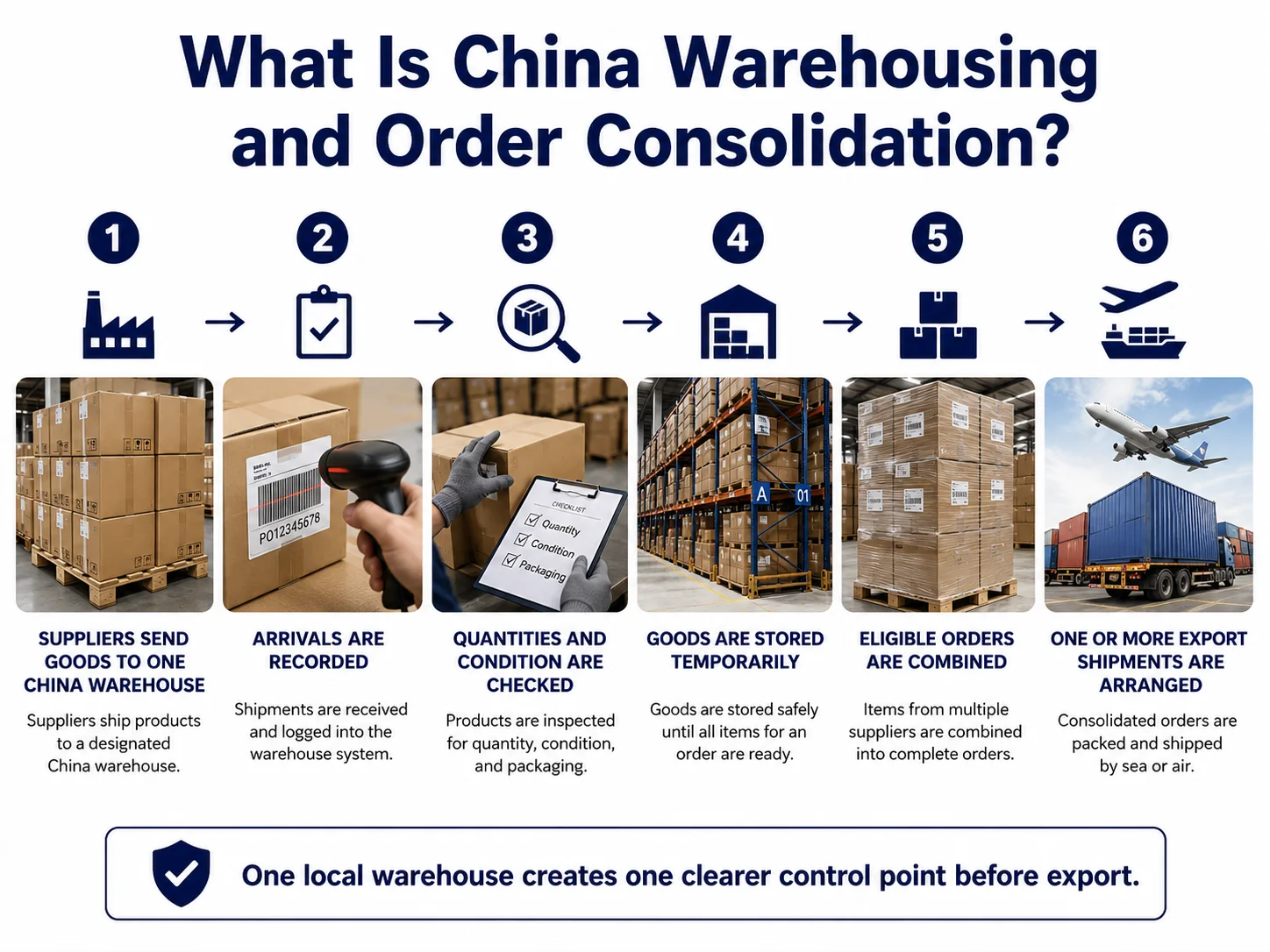
A typical warehouse consolidation workflow includes the following stages:
-
Supplier delivery coordination
Suppliers receive the warehouse address, contact person, delivery requirements, and carton-label instructions. -
Warehouse receiving
Warehouse staff count cartons, inspect exterior condition, and record the arrival against the purchase order or SKU list. -
Inspection or verification
The team may complete quantity checks, carton checks, sample checks, or 1-by-1 product inspection depending on the order. -
Temporary storage
Approved goods are stored until the release date, the next supplier arrival, or shipping instructions. -
Repacking and consolidation
The warehouse may remove unnecessary outer cartons, strengthen weak boxes, combine products, apply labels, or build product bundles[^4]. -
Freight arrangement
The shipment can move by express, air freight, rail where applicable, LCL sea freight, FCL sea freight, or DDP delivery.
This process gives importers one place to review what has actually arrived. It also makes supplier problems more visible before goods are loaded for export.
Is China Warehousing and Order Consolidation Better Than Direct Supplier Shipping?
Direct shipping sounds simple because each supplier handles its own products. In practice, it can create repeated freight bookings, inconsistent packaging, and several customs documents for the buyer to manage.
China warehousing and order consolidation is generally better than direct supplier shipping when an importer has several suppliers or needs quality control before export[^5]. Direct shipping may still be better for urgent, ready-to-ship products or high-volume orders that already fill an efficient shipment.
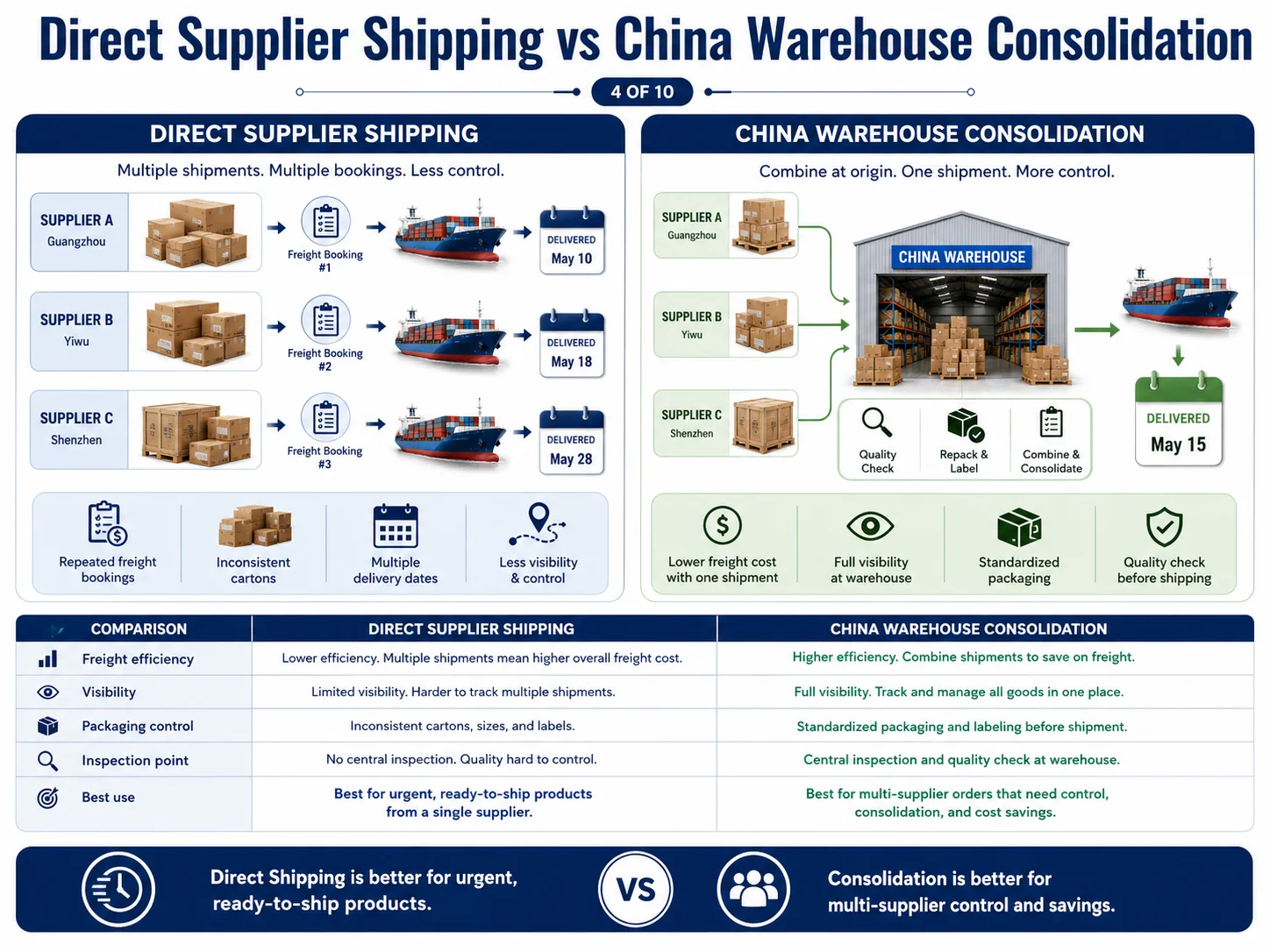
| Factor | Direct Supplier Shipping | Warehouse Consolidation |
|---|---|---|
| Freight bookings | Separate booking for each supplier | One coordinated shipment or planned split shipments |
| Order visibility | Buyer follows several suppliers | Central receiving records and inventory updates |
| Quantity checks | Depends on each supplier | Can be checked at warehouse receiving |
| Inspection | Often handled separately | Can be scheduled before final shipment |
| Packaging consistency | May vary by factory | Can be standardized or reinforced |
| Freight cost | Can be higher for small separate parcels | May improve with combined volume, but not always |
| Delivery speed | Faster for ready goods | Can be delayed while waiting for other orders |
| Documentation | Multiple invoices and packing lists | Can be coordinated into one export file where appropriate |
| Risk control | Limited visibility before dispatch | More opportunities to identify issues before shipment |
The main trade-off is clear: consolidation can improve efficiency, but it can also add waiting time.
I have seen a buyer save money by consolidating three small supplier orders into one LCL shipment. I have also seen a different buyer lose more money by waiting two extra weeks for a small accessory order while their best-selling product was ready to ship. The warehouse was not the problem. The release decision was.
Before choosing either model, we suggest comparing:
- The value of inventory that is ready now
- The expected supplier delivery date for delayed goods
- The cost of separate shipping versus combined shipping
- Warehouse receiving, handling, storage, and repacking fees
- The business impact of a delayed launch or stockout
- Whether all products have passed inspection
When Should You Use China Warehousing and Order Consolidation?
Importers often begin with separate shipments because each purchase order feels independent. The problem becomes clear later, when cartons arrive at different times and the buyer has to manage several freight bills and delivery dates.
You should use China warehousing and order consolidation when you source from multiple suppliers, need a local inspection point, want to combine small orders, require custom packaging, or need more control over shipment timing. It is especially useful for ecommerce sellers managing many SKUs.
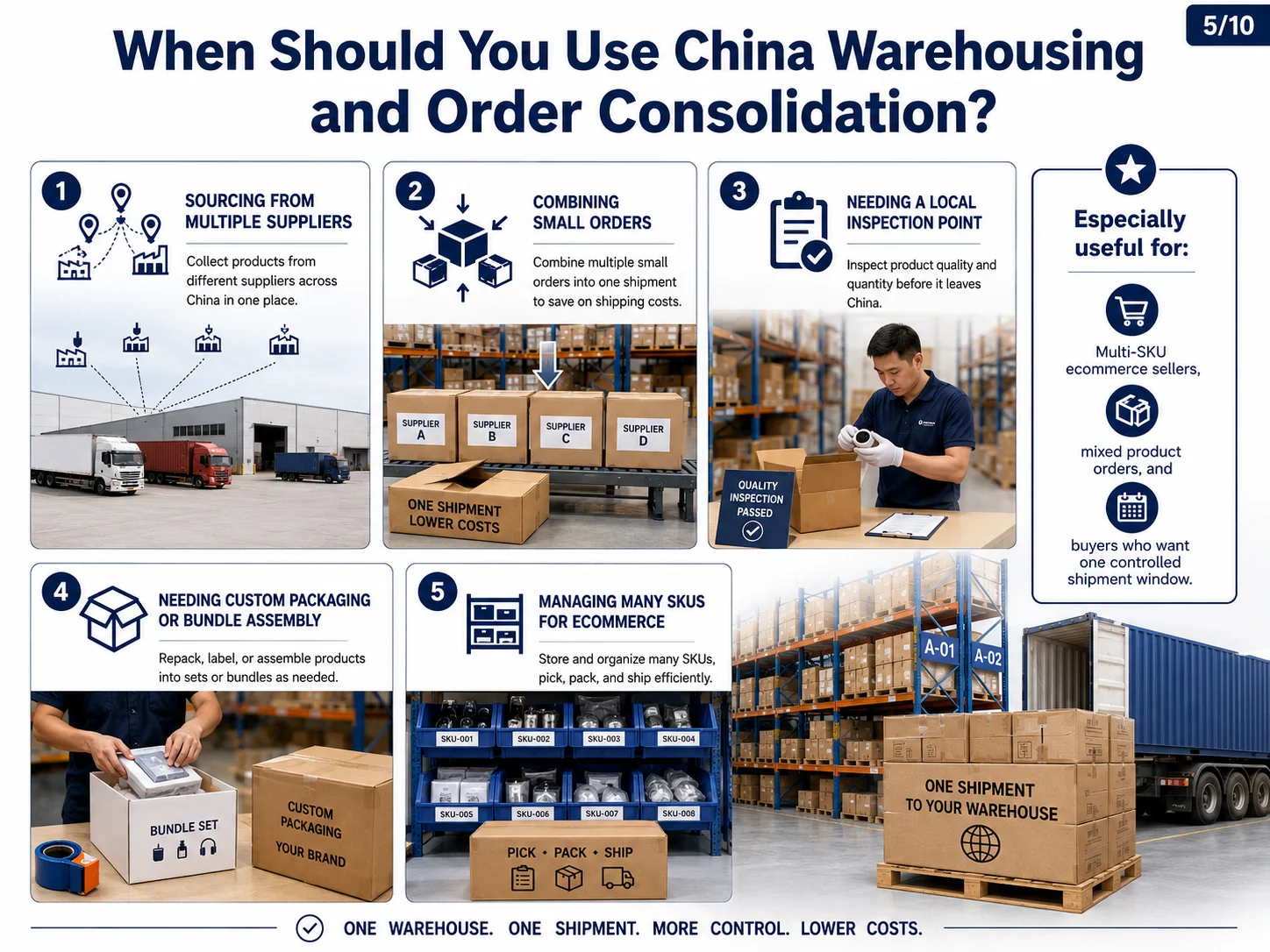
Warehouse consolidation is often a practical choice in these situations:
You Buy From Multiple Factories
A brand may purchase the main product from one factory, packaging from another, inserts from a printer, and accessories from a third supplier. Sending all items directly overseas can create confusion and added freight cost.
Your Suppliers Have Different Lead Times
Production schedules rarely line up perfectly. A warehouse allows you to receive finished products as they become available while maintaining a planned shipping deadline.
You Need Bundling or Kitting
Many sellers need products packed as ready-to-sell sets. For example, a warehouse can combine a bottle, accessory, instruction card, gift box, and barcode label before export.
You Want to Inspect Before Shipping
You Need to Compare Freight Options
Once the warehouse knows the final carton count, dimensions, and chargeable weight, freight comparisons become more meaningful. Early freight estimates are helpful, but final shipment data gives a clearer landed-cost picture.
Still, we advise importers not to use warehousing by default for every order. A single urgent order from a reliable supplier may be better shipped immediately. The goal is not to create more handling. The goal is to make the supply chain easier to control.
How Does China Warehousing and Order Consolidation Work?
The biggest challenge in consolidation is not stacking cartons. The difficult part is coordinating suppliers, inspection milestones, shipping documents, and a realistic release date without losing track of individual SKUs.
China warehousing and order consolidation works by coordinating supplier deliveries to a warehouse, verifying arrivals, inspecting goods where required, updating inventory records, repacking approved products, and booking freight when the buyer approves the shipment release.
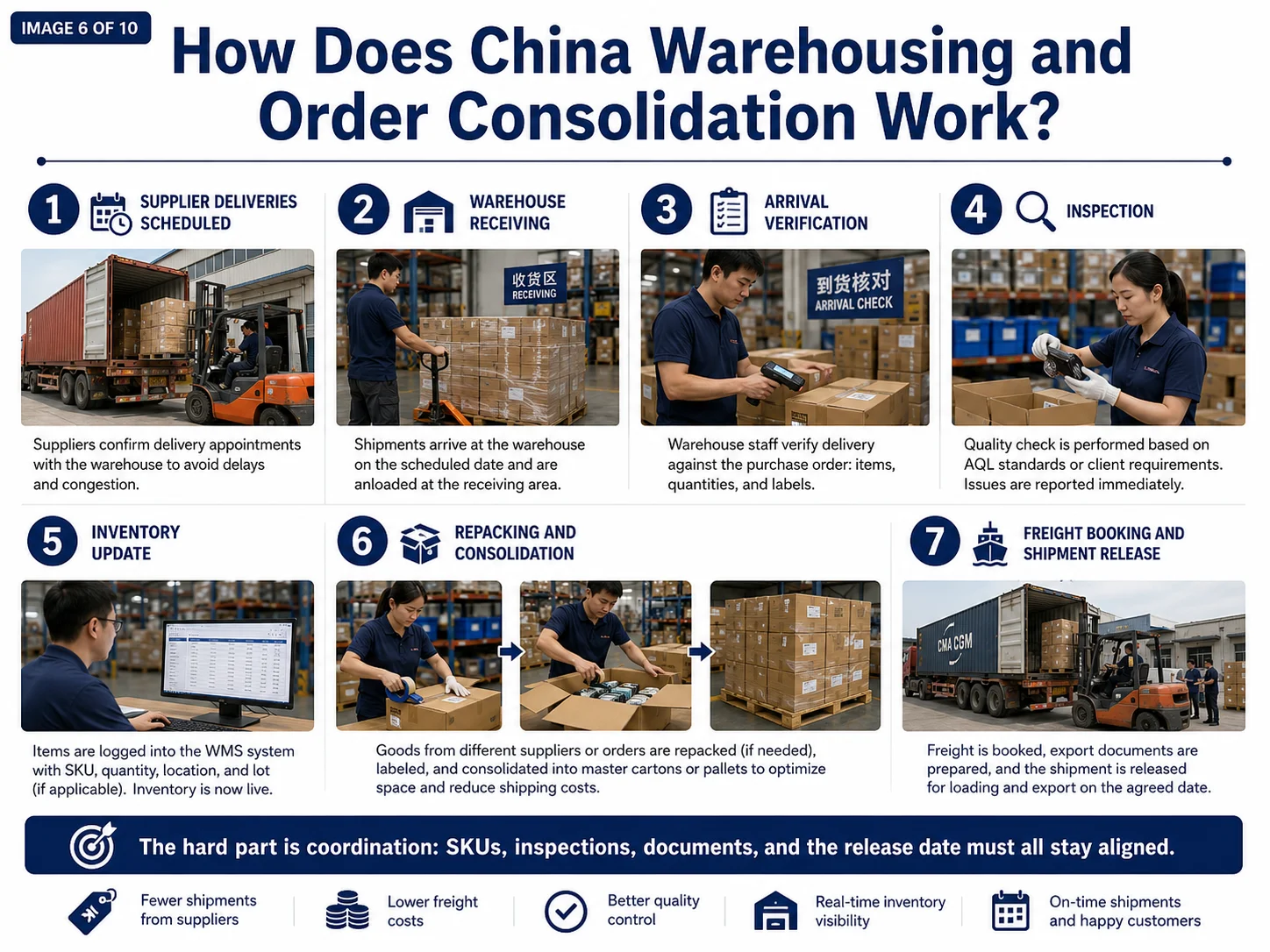
At KingSourcing, we usually manage the process with a checklist rather than assumptions.
1. Confirm the Order Plan
We collect supplier details, expected completion dates, SKU information, quantities, carton dimensions, inspection needs, and shipping requirements. This gives us a working inbound schedule.
2. Send Delivery Instructions to Suppliers
Each supplier receives clear warehouse delivery instructions. We ask suppliers to mark cartons properly so warehouse staff can identify the order, SKU, and buyer.
3. Receive and Record Goods
When goods arrive, we record carton counts and note visible damage. If a supplier sends fewer cartons than expected, we flag the discrepancy rather than allowing it to disappear inside a larger shipment.
4. Conduct Required Checks
The inspection level depends on the product and risk level. It can range from basic carton verification to sample inspection or 1-by-1 product checks.
5. Wait, Split, or Release
This is the commercial decision point. We review:
- Which goods have arrived
- Which goods passed inspection
- Which suppliers are delayed
- What inventory must ship first
- Whether a partial shipment makes financial sense
6. Repack and Book Freight
After release approval, we prepare goods for shipment, verify final measurements, compare shipping options, and arrange export documentation and delivery.
This process does not eliminate supplier mistakes. It gives the buyer more opportunities to find and address them before international shipping makes them harder and more expensive to solve.
How Do Inspection, Repacking, and Labeling Reduce Supplier Risk?
Goods can look correct in supplier photos but still arrive with wrong quantities, weak cartons, missing accessories, or labels that do not meet marketplace requirements. If these issues are found after delivery overseas, fixes can be slow and costly.
Warehouse inspection, repacking, and labeling reduce supplier risk by checking products and cartons before export, correcting packaging issues where possible, and making sure SKU labels, barcodes, inserts, and shipping marks match the buyer’s instructions.
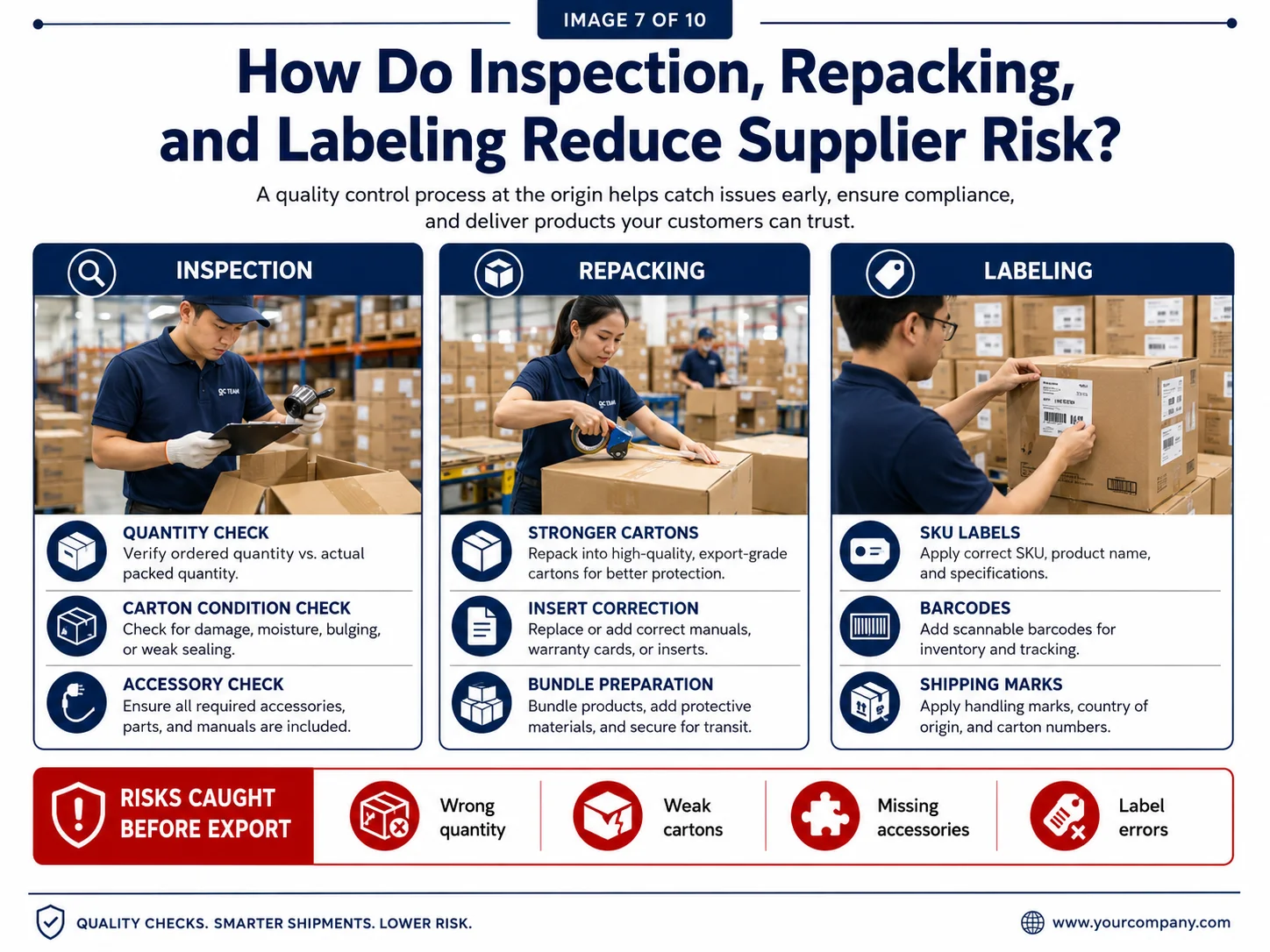
Different products need different inspection methods. A simple visual check may work for low-risk accessories. A branded product with multiple colors, sizes, or components may need more detailed verification.
| Service | What We Check or Handle | Best For |
|---|---|---|
| Carton count check | Carton quantity and external damage | All inbound orders |
| Quantity verification | Units, SKU counts, color or size allocation | Multi-SKU orders |
| Sample inspection | Appearance, function, packaging, obvious defects | Standard production runs |
| 1-by-1 inspection | Individual items against agreed criteria | Higher-risk ecommerce goods |
| Repacking | Carton replacement, reinforcement, volume reduction | Weak or oversized packaging |
| Labeling | FNSKU, barcode, carton marks, warning labels | Amazon and retail orders |
| Bundling | Combining accessories, inserts, and main products | Kits and gift sets |
We recommend that buyers provide a clear inspection standard before production is complete. Photos are useful, but they are not enough by themselves. A good inspection brief should include:
- Approved sample photos or physical sample reference
- Product dimensions and color requirements
- Functional expectations
- Packaging requirements
- Required labels and placement
- Defect tolerance or critical defect rules
One common issue we encounter is that a supplier uses a perfectly acceptable export carton, but it does not match the buyer’s retail or fulfillment requirement. Repacking at the warehouse can help, but it is better to identify this before the factory completes mass production.
How Does China Warehousing and Order Consolidation Affect Landed Cost?
Many buyers compare only the freight quotation. This creates a blind spot because freight is only one part of the total cost of getting products ready for sale in the destination market.
China warehousing and order consolidation affects landed cost through receiving fees, storage, inspection, repacking, domestic transfers, combined freight, customs charges, and final delivery. It can lower some costs, but delays and extra handling can increase the total commercial cost.
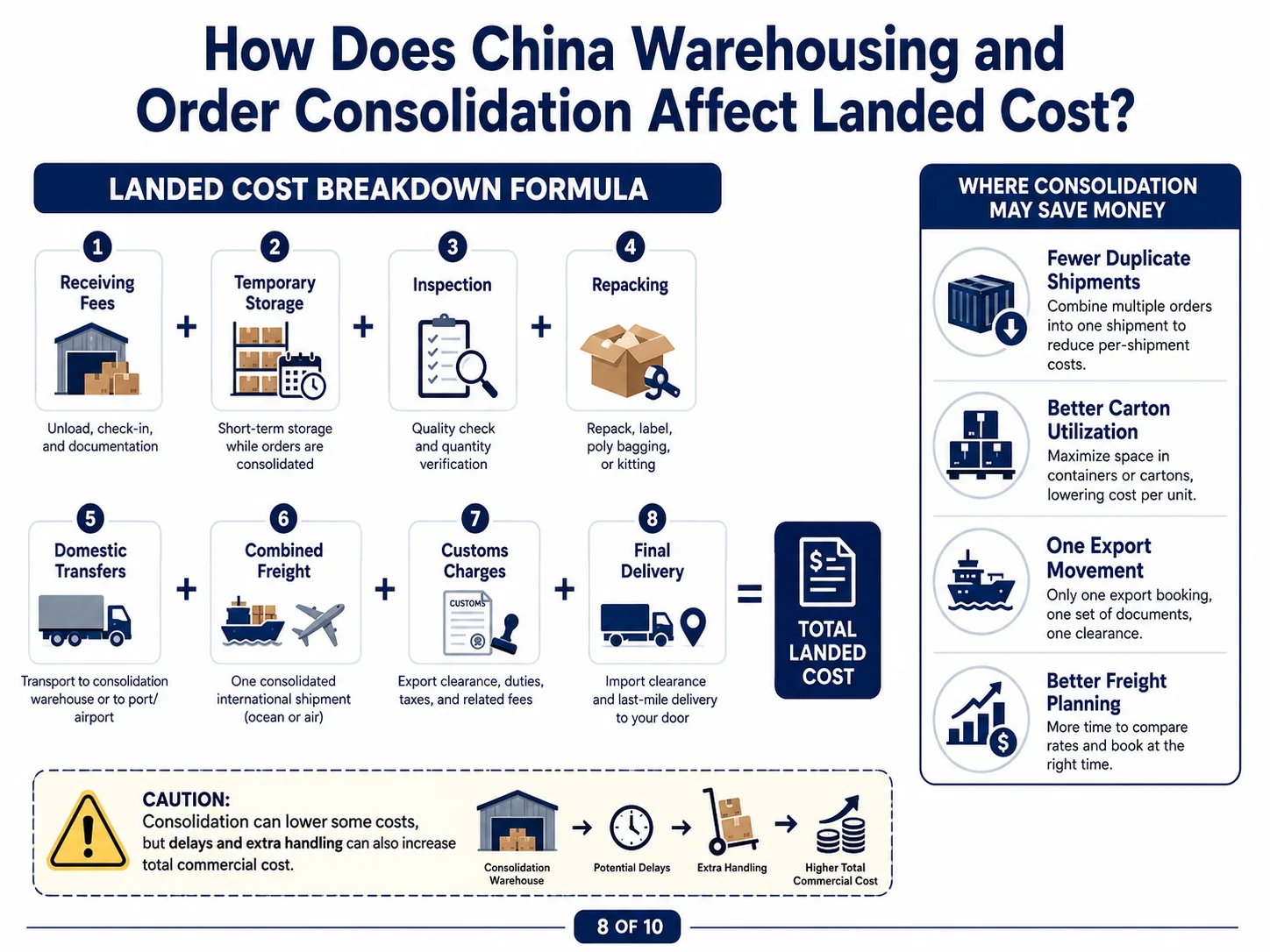
A useful landed-cost review includes more than the shipping rate:
[ text{Landed Cost} = text{Product Cost} + text{China Local Costs} + text{Freight} + text{Duties/Taxes} + text{Destination Delivery} + text{Risk and Delay Cost} ]
In practice, importers should look at these cost areas:
- Supplier-to-warehouse delivery or pickup
- Warehouse receiving and handling
- Inspection charges
- Storage fees, especially for long stays
- Repacking materials and labor
- Freight based on actual weight or volumetric weight
- Export paperwork and customs processing
- Import duty, VAT, GST, or other destination taxes
- Last-mile delivery
- The cost of a stockout or delayed product launch
Volume Optimization Matters
Air freight and express shipping often use volumetric weight[^7]. If suppliers use oversized cartons, repacking can reduce chargeable volume. However, repacking should be evaluated carefully because labor and new cartons also cost money.
For sea freight, combining smaller orders can sometimes make LCL more efficient or help a buyer reach a more practical shipment size. But consolidation does not guarantee savings. If goods sit in storage for weeks while sales demand grows, the apparent freight savings may be outweighed by lost revenue.
We encourage clients to compare at least two scenarios:
- Ship ready inventory now and send delayed goods later
- Wait and consolidate all goods into one shipment
The best choice depends on the numbers and the sales deadline, not on a general rule.
What Risks and Problems Can Happen in China Warehousing?
A warehouse improves visibility, but it does not make the supply chain risk-free. Problems can still happen when suppliers send incorrect goods, labels are unclear, cartons arrive damaged, or shipping requirements are not confirmed early.
Common China warehousing risks include mixed inventory, quantity discrepancies, damaged cartons, unexpected storage charges, document errors, delayed supplier arrivals, and restrictions for batteries, liquids, magnets, or other regulated goods[^8]. Clear receiving procedures reduce these risks.
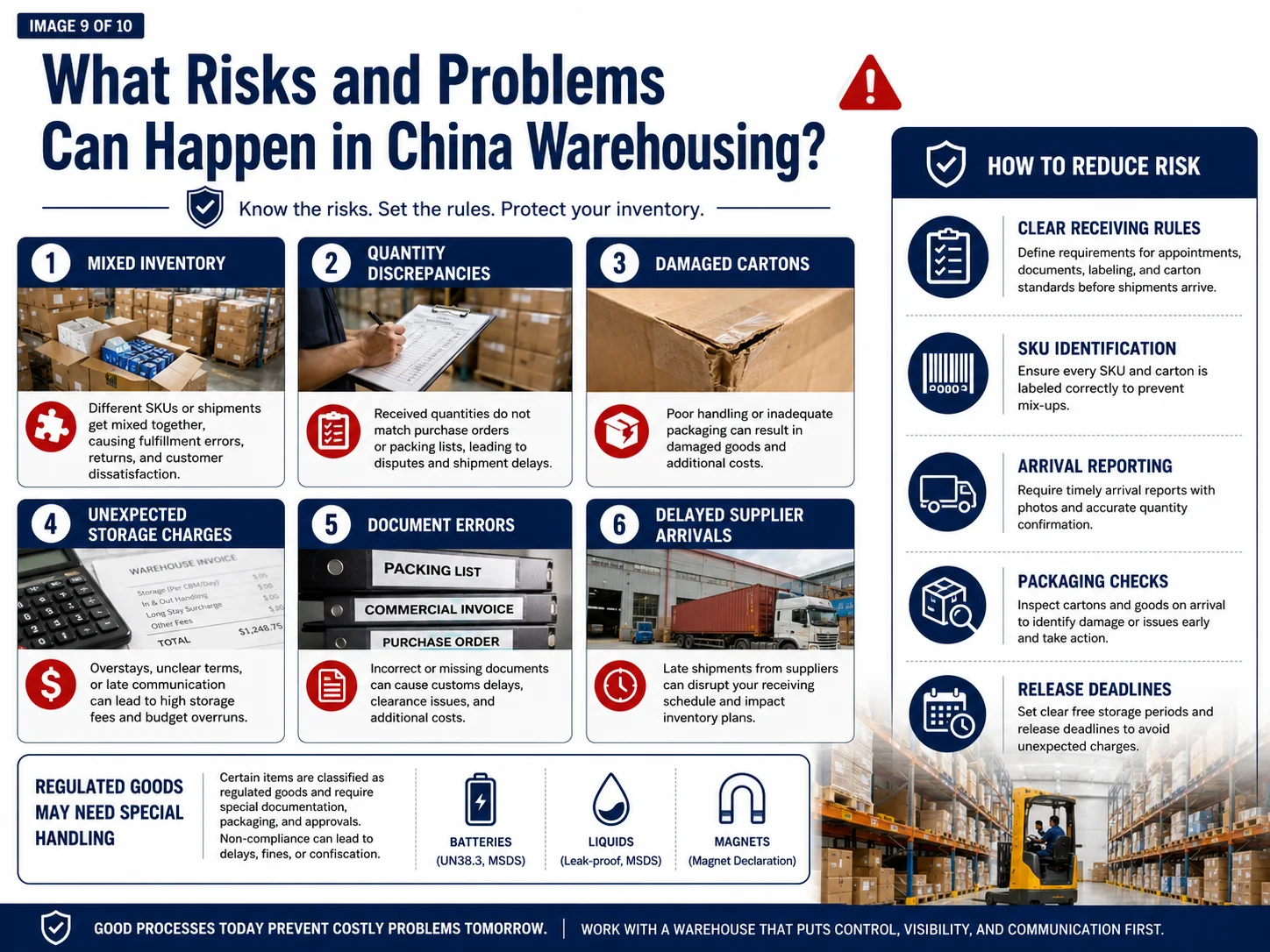
The most common problems we see include the following:
Unclear Carton Identification
If several suppliers send similar cartons without clear labels, warehouse staff can struggle to match arrivals to the correct PO or SKU. Buyers should require carton marks before delivery.
Quantity Differences
A supplier may report 100 cartons but deliver 98. Or the carton count may be correct while unit counts inside cartons are wrong. This is why receiving records and inspection standards matter.
Long Storage Periods
Temporary storage is useful. Open-ended storage is expensive and creates more risk of inventory confusion or packaging deterioration. We recommend setting a clear release date and reviewing delayed items regularly.
Documentation Mismatches
Commercial invoices, packing lists, HS codes, declared values, and consignee details must align[^9]. Inconsistent documents can cause customs delays or questions.
Regulated Products
Products with lithium batteries, liquids, powders, chemicals, magnets, wood, or branded intellectual property may require special handling or may face shipping restrictions. These issues should be checked before production and before freight booking.
A practical safeguard is a simple weekly status report showing what has arrived, what passed inspection, what remains delayed, and what decision is needed from the buyer.
How Does KingSourcing Manage China Warehousing and Consolidated Shipping?
Importers need more than warehouse space. They need someone in China who can coordinate factories, verify arrivals, communicate exceptions, and help them decide when to release goods.
At KingSourcing, we manage China warehousing and order consolidation as part of a wider sourcing workflow. We coordinate multi-supplier deliveries, receiving, inspection, repacking, inventory records, freight comparison, and international shipping based on the buyer’s priorities and release deadline.
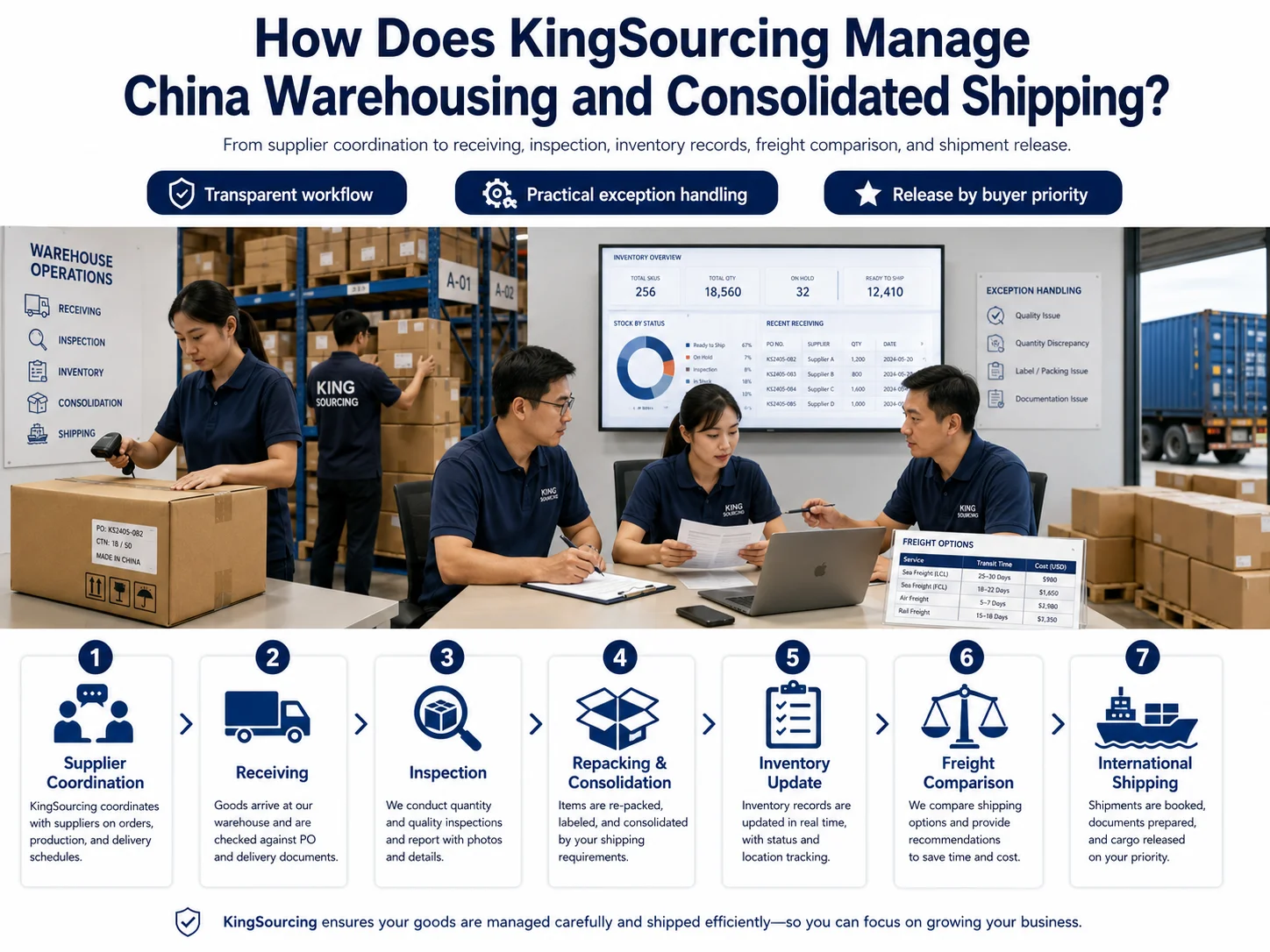
We act as a local coordination team rather than simply forwarding cartons. Our support can include:
- Supplier sourcing and factory communication
- Supplier delivery scheduling
- Warehouse receiving and inbound records
- Quantity checks and product inspection
- Custom packaging, barcode labeling, and bundle assembly
- Short-term storage and order consolidation
- Carton optimization and repacking
- Freight quote comparison
- Shipping under FOB, DDU, or DDP terms where appropriate
- Door-to-door delivery coordination
- Follow-up when supplier shortages or quality issues appear
Our process begins with visibility. We want to know what has been ordered, which supplier is responsible, when each order should arrive, and which products are urgent for your business.
For smaller sellers, this can mean consolidating a few supplier orders into a manageable shipment. For larger buyers, it can mean ongoing warehouse coordination, priority order management, and regular inventory reporting.
We do not promise that every supplier will meet every date or that inspection will catch every possible issue. Instead, we create a clearer process for identifying exceptions early, documenting them, and helping buyers make informed shipping decisions.
Frequently Asked Questions
How much does warehousing in China cost?
China warehouse costs depend on receiving volume, storage duration, inspection level, repacking requirements, and handling complexity[^10]. Short-term storage may be affordable, but long-term storage can add up. We recommend requesting a clear fee breakdown for receiving, storage, labor, labeling, and outbound handling.
Can orders from different suppliers be combined?
Yes. A China warehouse can receive products from different suppliers and combine them into one shipment if the products are compatible for shipping. The warehouse should identify each supplier order clearly and verify quantities before consolidation.
How long can products stay in a Chinese warehouse?
Storage periods vary by warehouse agreement and product type. We recommend using warehousing as a temporary control point, not indefinite inventory storage. Set a shipment release deadline and review delayed supplier orders regularly to avoid unnecessary storage charges.
Can products be inspected before consolidation?
Yes. Products can be inspected before consolidation through carton checks, quantity verification, sample inspection, or 1-by-1 inspection. The right level depends on your product value, defect risk, supplier history, and marketplace requirements.
Is consolidated shipping cheaper than separate shipments?
Consolidated shipping can be cheaper when it reduces duplicate freight charges, improves shipment volume, or lowers volumetric weight through repacking[^11]. However, it is not always cheaper after warehouse fees, storage, and delay costs are included. Compare total landed cost before deciding.
Conclusion
China warehousing and order consolidation gives importers a practical way to manage multi-supplier shipments, improve receiving visibility, inspect goods before export, and compare freight options with better data. The best approach is not always to wait for every supplier[^12]. We recommend setting clear delivery schedules, inspection milestones, and shipment release deadlines based on your sales needs. If you need a China-based team to coordinate sourcing, warehouse receiving, quality control, repacking, and consolidated shipping, contact KingSourcing to make your China sourcing simpler.
Tags: China Warehousing, Order Consolidation China, Multi-Supplier Shipping, Warehouse Consolidation, China Freight Forwarding, China Sourcing Agent, Import from China
[^1]: "OECD Supply Chain Resilience Review: Navigating Risks", https://www.oecd.org/content/dam/oecd/en/publications/reports/2025/06/oecd-supply-chain-resilience-review_9930d256/94e3a8ea-en.pdf. Supply-chain research documents that transportation disruptions, delivery delays, and inventory inaccuracies can generate additional logistics costs and lost-sales exposure for firms. Evidence role: general_support; source type: research. Supports: Evidence that shipment disruptions, delivery delays, and inventory discrepancies can create additional logistics costs and commercial losses.. Scope note: The magnitude of these costs depends on the product, contract terms, inventory position, and transport mode. [^2]: "Columbus Electronic Freight Management Evaluation", https://ops.fhwa.dot.gov/publications/fhwahop09053/benefits.htm. Freight-consolidation literature describes combining smaller consignments into fewer shipments as a means of reducing duplicated transport activity and centralizing shipment coordination. Evidence role: mechanism; source type: education. Supports: Research or instructional material explaining how freight consolidation combines loads and centralizes shipment information.. Scope note: Consolidation does not necessarily reduce total cost when additional handling, storage, or delay is material. [^3]: "Stockout Response Optimization Engine: A Tool for Strategic ...", https://ctl.mit.edu/sites/default/files/documents/marintschscott_169964_5332937_capstone_scott_marintsch_sharada_maruti_prabhu_signed_and_unsigned_covers-2_0.pdf. Operations-management studies show that supplier disruptions can increase stockout risk and may require expedited replenishment, raising the total cost of fulfillment. Evidence role: mechanism; source type: paper. Supports: Evidence that supply disruptions can lead firms to incur stockout losses or use costly expedited transportation.. Scope note: Whether expediting is justified depends on demand, margin, substitute availability, and the duration of the disruption. [^4]: "(PDF) Assessment Of Challenges Of Warehousing Practices", https://www.academia.edu/74354862/Assessment_Of_Challenges_Of_Warehousing_Practices_The_Case_Of_Ethio_Telecom_In_Addis_Ababa. Warehouse-management references classify labeling, repacking, kitting, and light assembly as value-added logistics services that may be performed before distribution. Evidence role: definition; source type: education. Supports: A definition of value-added warehousing services that includes packaging, labeling, kitting, and assembly activities.. Scope note: The specific services available and their compliance requirements vary by warehouse, product category, and destination market. [^5]: "Integrated Inventory Routing and Freight Consolidation for ...", https://www2.isye.gatech.edu/~atoriello3/IRP+Consl_paper.pdf. Logistics research finds that consolidation can improve transport utilization and coordination for dispersed orders, while direct shipment may be preferable where lead-time requirements dominate. Evidence role: general_support; source type: research. Supports: Research identifying the trade-off between freight consolidation, direct shipment, handling, lead time, and quality-control requirements.. Scope note: This evidence supports a conditional trade-off rather than a universal conclusion that consolidation is better. [^6]: "6.2.2. What kinds of Lot Acceptance Sampling Plans (LASPs ...", https://www.itl.nist.gov/div898/handbook/pmc/section2/pmc22.htm. Quality-control guidance recognizes receiving and visual inspection as methods for detecting quantity discrepancies, packaging damage, labeling errors, and observable defects before onward shipment. Evidence role: mechanism; source type: institution. Supports: Quality-control guidance explaining that receiving and visual inspections can detect count, packaging, labeling, and observable product defects.. Scope note: Visual or sampling inspection cannot establish that all units are defect-free or detect hidden functional, safety, or compliance defects. [^7]: "Air Cargo Tariffs and Rules: What You Need to Know", https://www.iata.org/en/publications/newsletters/iata-knowledge-hub/air-cargo-tariffs-and-rules-what-you-need-to-know/. Air-cargo guidance explains that chargeable weight may be calculated from actual weight or volumetric weight, with the higher applicable value used for freight rating. Evidence role: definition; source type: institution. Supports: The definition of volumetric or dimensional weight and its use in calculating chargeable weight for air cargo.. Scope note: Dimensional divisors and rating rules vary by carrier, service, route, and commercial agreement. [^8]: "Batteries", https://www.iata.org/en/programs/cargo/dgr/lithium-batteries/. International dangerous-goods transport frameworks require classification, documentation, packaging, and handling controls for regulated cargo such as lithium batteries and certain magnetized materials. Evidence role: general_support; source type: institution. Supports: International transport rules and guidance on documentation and restrictions for dangerous or regulated goods, including lithium batteries and magnetized materials.. Scope note: Not every liquid, powder, magnet, or branded product is prohibited; requirements depend on classification, transport mode, destination rules, and carrier policy. [^9]: "What value should be on the commercial invoice submitted to ...", https://www.help.cbp.gov/s/article/Article-1162?language=en_US. Customs authorities require import declarations and commercial documents to contain accurate information on the goods, valuation, classification, and parties to the transaction. Evidence role: general_support; source type: government. Supports: Customs guidance requiring accurate and consistent commercial documentation, valuation, classification, and consignee information.. Scope note: Exact documentary requirements and acceptable formats differ among importing countries and customs procedures. [^10]: "significance of wms in supply chain", https://minds.wisconsin.edu/bitstream/handle/1793/83268/Changarampat%2C%20Pradeep.pdf?sequence=1. Warehousing-cost analyses identify storage time, inbound and outbound handling, labor-intensive processing, and value-added services as principal determinants of warehouse charges. Evidence role: mechanism; source type: research. Supports: Evidence that warehousing costs are driven by storage duration, handling activity, throughput, labor, and value-added services.. Scope note: Actual charges are set by individual operators and may also reflect location, product characteristics, insurance, and minimum-fee policies. [^11]: "impact of freight consolidation on logistics cost and emissions", https://dspace.mit.edu/bitstream/handle/1721.1/121354/Mohan_So_2019.pdf?sequence=1&isAllowed=y. Transportation research indicates that consolidating compatible shipments can improve load utilization and reduce per-unit transport costs by replacing multiple small movements with fewer larger ones. Evidence role: mechanism; source type: paper. Supports: Research showing that shipment consolidation can reduce transportation cost through improved vehicle or container utilization and fewer separate movements.. Scope note: Savings may be offset by warehouse handling, storage, service constraints, and the cost of waiting for additional cargo. [^12]: "(PDF) Determinants of Input, Work-In-Process and Output ...", https://www.academia.edu/29894427/Determinants_of_Input_Work_In_Process_and_Output_Inventory_Levels_An_International_Study_of_Manufacturing_Industries. Operations-management research treats shipment consolidation as a trade-off: waiting can improve transport economies, but added lead time can increase inventory risk and reduce service performance. Evidence role: expert_consensus; source type: paper. Supports: Operations research on the trade-off between consolidation economies and delay-related inventory or service costs.. Scope note: An optimal release decision requires order-specific demand, margin, transit-time, and supplier-reliability data.