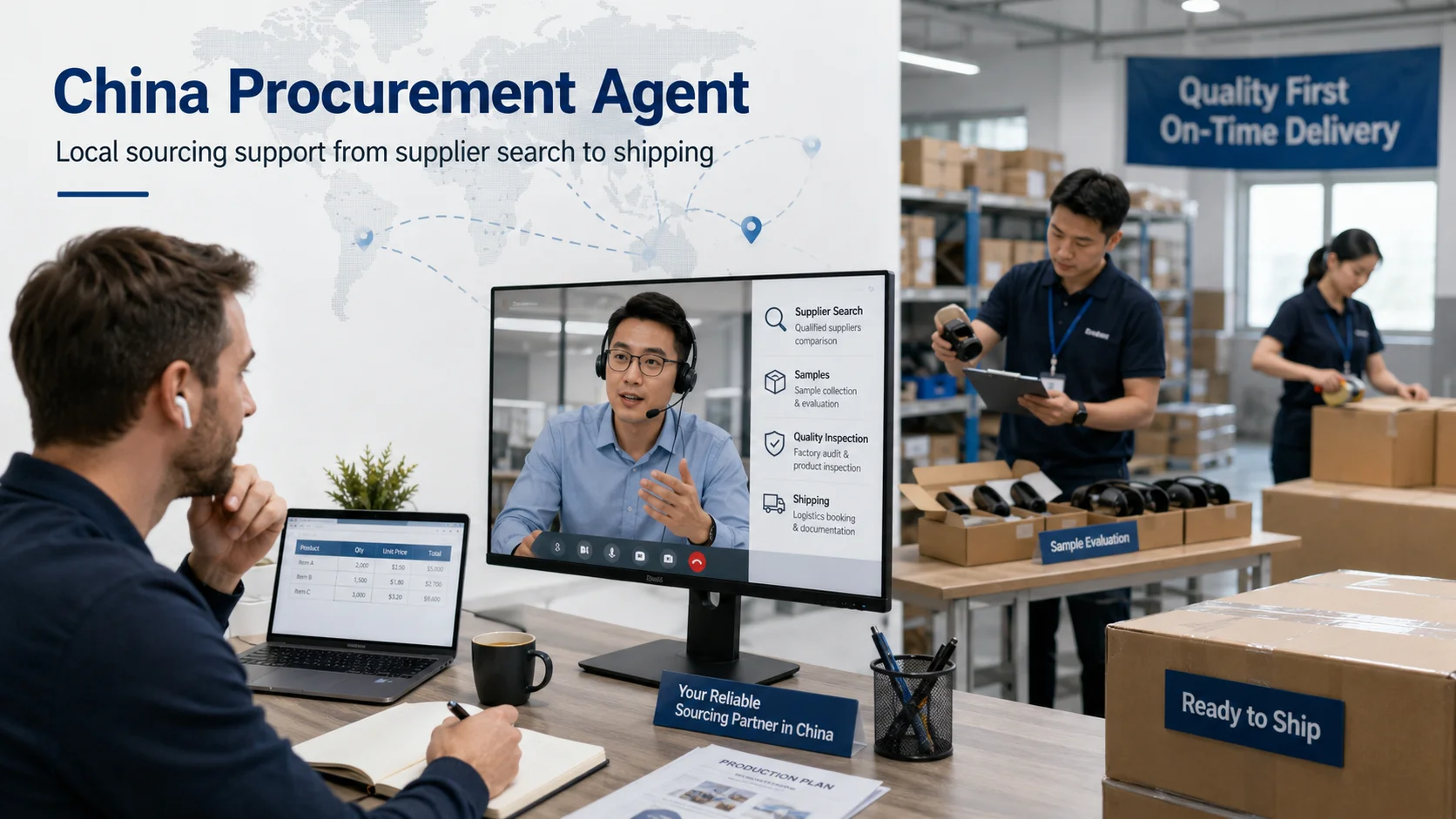
A China procurement agent can help when overseas buyers struggle to compare suppliers, manage samples, control quality, and coordinate shipping from a distance. Without local support, a seemingly simple order can involve unclear quotes, missed specifications, delayed production, or costly handoffs. We help buyers create a more controlled sourcing process.
A China procurement agent is a local service provider that helps importers source products, evaluate suppliers, compare quotations, follow up samples and production, arrange quality inspections, consolidate goods, and coordinate shipping.[^1] Costs vary by commission, fixed fees, project fees, or hybrid models. The right agent should offer clear scope, transparent charges, documented communication, and realistic responsibility boundaries—not just the lowest quoted service fee.
Many buyers first search for a supplier, then discover that selecting a factory is only one part of the work. The bigger challenge is managing the chain of decisions after the first quotation. We believe a procurement partner should make those decisions easier to evaluate, document, and control.
What Is the Quick Answer About a China Procurement Agent?
Buyers often need a fast answer because they are deciding whether to pay a supplier, request samples, or continue sourcing alone. The risk is that they may compare agents only by commission rate and miss the services that affect product quality and delivery execution.
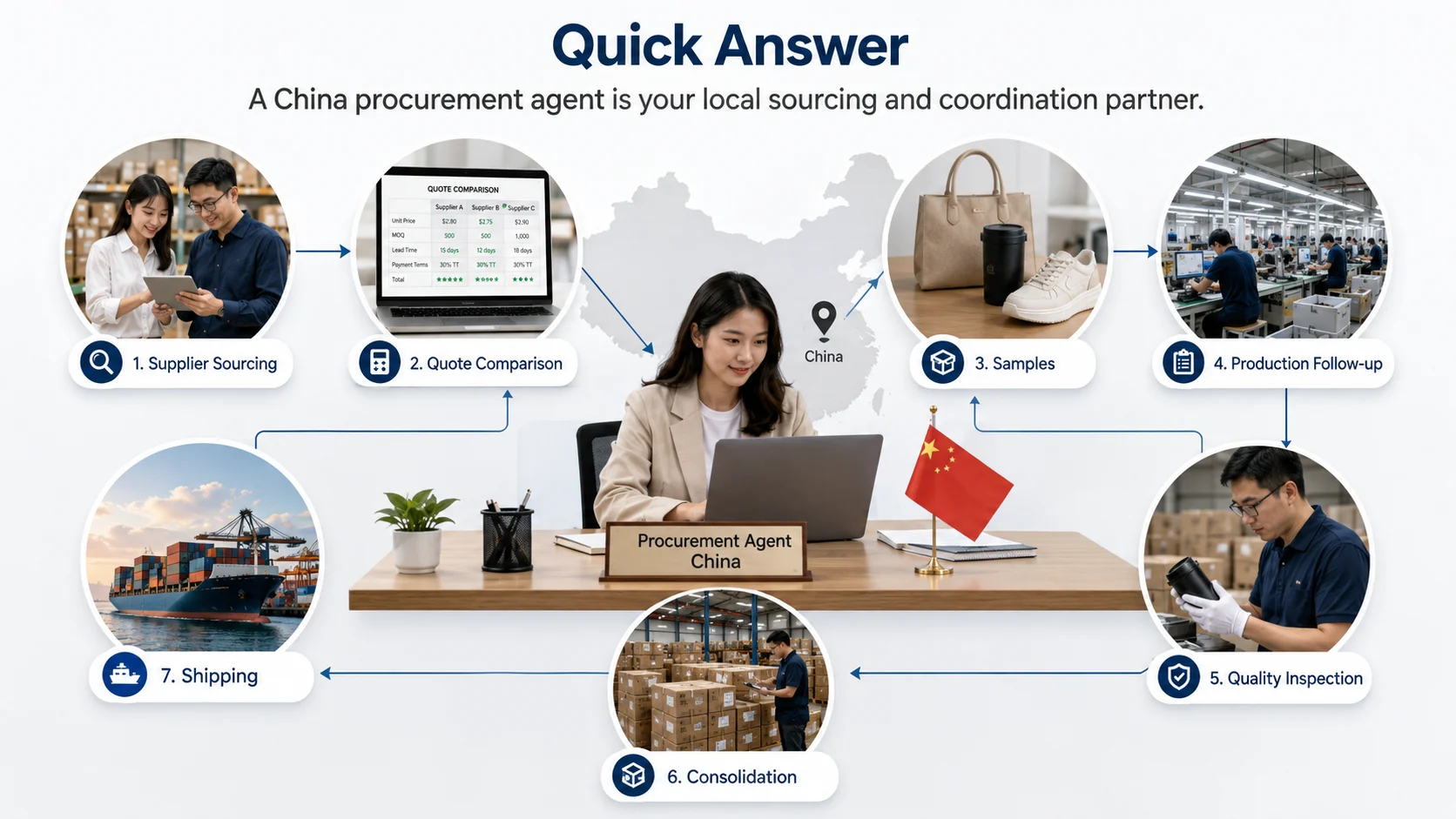
A China procurement agent acts as the buyer’s local sourcing and coordination partner. We typically support supplier sourcing, verification, price comparison, sample follow-up, order management, quality control, consolidation, and shipment coordination. This service is most useful for buyers without a China-based team, especially those managing multiple suppliers, private-label products, or quality-sensitive orders.
The best way to assess a China procurement service is to look beyond the label “agent.” Different companies use the same term while providing very different levels of involvement.
A Procurement Agent Is Not Only a Product Finder
In our work, buyers sometimes arrive with a product photo and ask us to find “the cheapest factory.” We understand the request, but we usually explain that the lowest initial quote is not enough evidence for a purchasing decision.
A useful procurement process considers:
- Whether the supplier can make the required product consistently
- Whether the quotation matches the requested materials, dimensions, packaging, and branding
- Whether the supplier communicates clearly during sampling and production
- Whether inspection standards are agreed before goods are finished
- Whether several suppliers need to be consolidated before export
- Whether the buyer understands what happens if a problem appears
A procurement agent does not remove every commercial risk. However, a local team can help buyers identify questions earlier, collect evidence, and coordinate the right parties before an issue becomes harder to solve.
What Does a China Procurement Agent Actually Do?
A supplier may respond quickly to an inquiry, but that does not mean the supplier is the right long-term choice. Buyers often face fragmented information, inconsistent specifications, and long communication cycles. We help organize the work from product brief to shipment handoff.
A China procurement agent manages the practical steps between a buyer’s request and a shipped order. The work can include supplier search, quotation collection, supplier communication, sample coordination, negotiation support, production follow-up, inspection scheduling, issue escalation, and shipping coordination. The exact service scope should always be confirmed in writing before work starts.
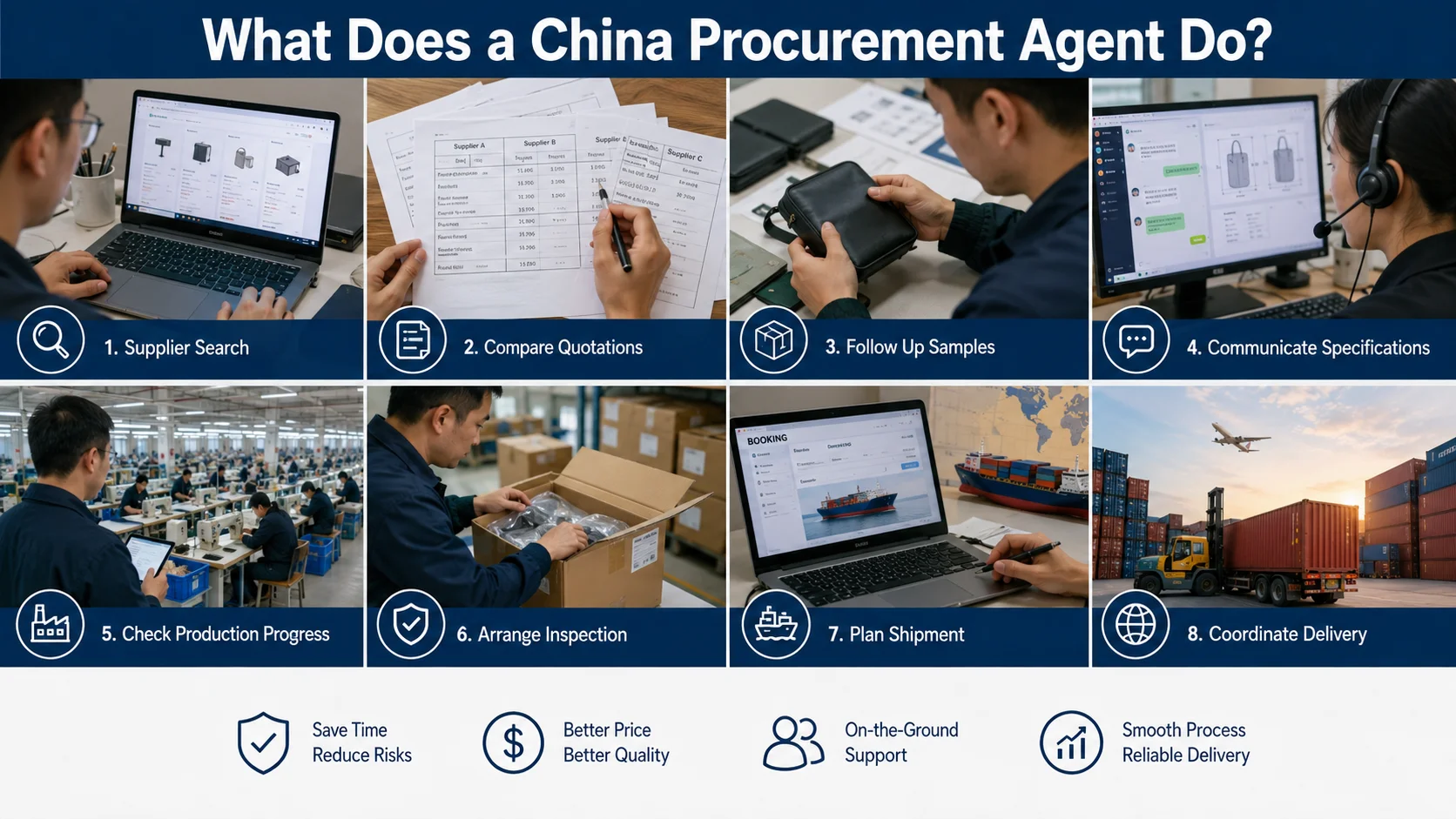
Supplier Sourcing and Initial Screening
We begin with a product brief. A useful brief may include reference images, dimensions, materials, target quantity, target market, branding requirements, packaging expectations, and required certifications or testing documents.
We then search for potential suppliers and compare their responses. Buyers should remember that a supplier’s marketplace profile, factory photos, or business registration alone does not fully establish production capability[^2]. The level of verification should match the order value, product complexity, and buyer risk tolerance.
Sample and Order Coordination
After a buyer shortlists suppliers, the next work usually involves samples. We help clarify revisions, sample costs, lead times, packaging details, and approval points. A sample can show whether the supplier understands the request, but it does not automatically prove that mass production will match it.[^3]
During production, our team can follow up on milestones, communicate buyer-approved requirements, and coordinate inspection arrangements. We also help buyers maintain a written record of decisions. This record matters when there are questions about colors, materials, logo placement, carton markings, or approved tolerances.
We treat communication records as part of procurement control. A verbal promise is harder to manage than a written specification.[^4]
What China Procurement Agent Services Should Buyers Expect?
Buyers may assume every agent covers the same tasks, but service levels differ widely. Some providers only introduce factories. Others coordinate the full purchasing process. We advise buyers to compare service scope before comparing fees.
China procurement agent services should cover the stages that create the buyer’s biggest operational risks: supplier sourcing, supplier verification, quote comparison, sample follow-up, supplier management, production monitoring, quality control, consolidation, and shipping coordination. Buyers should ask which tasks are included, excluded, or charged separately.
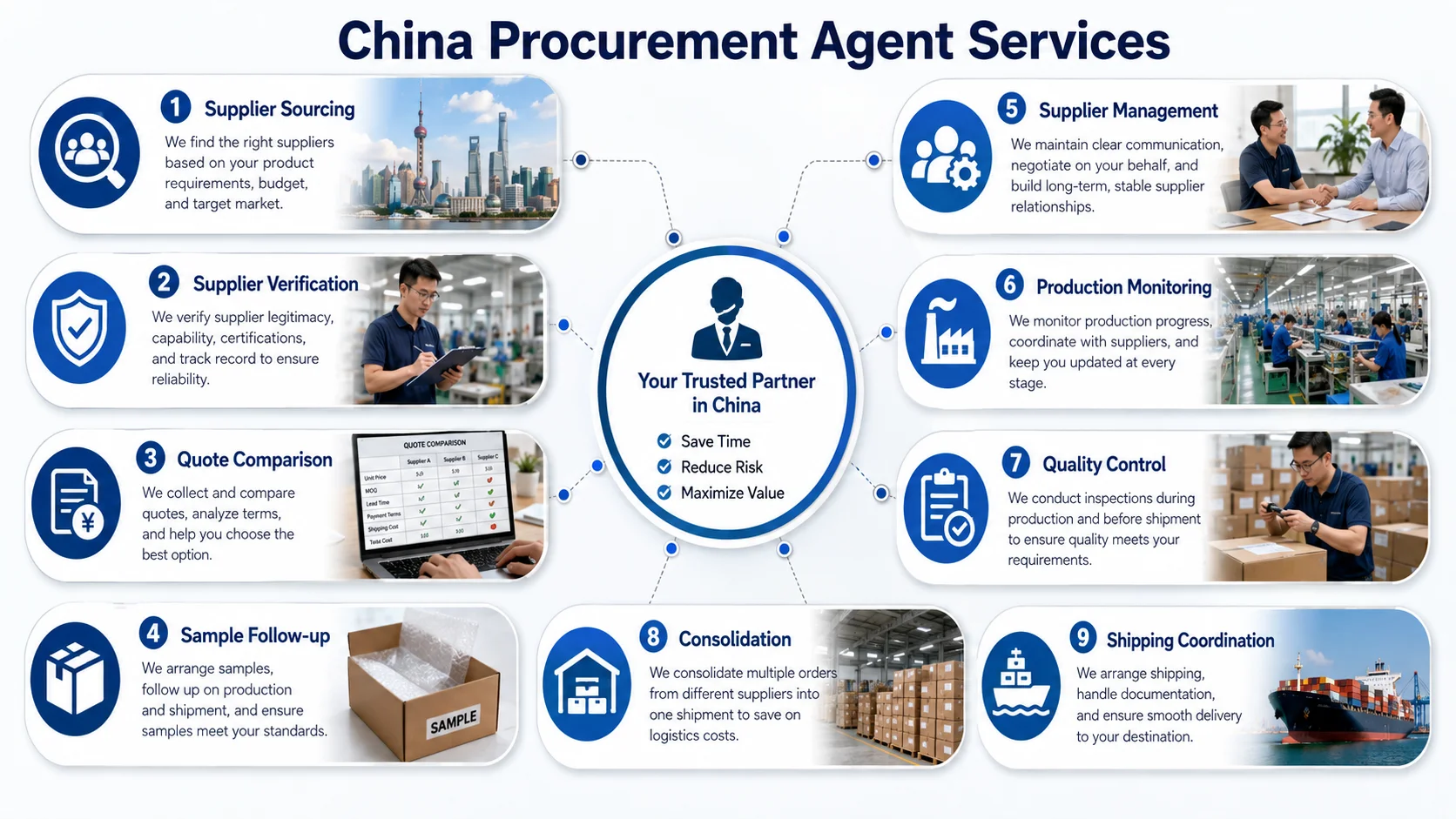
Typical Procurement Service Stages
| Procurement Stage | Typical Agent Support | Buyer Risk Addressed |
|---|---|---|
| Product brief | Clarify specifications and sourcing requirements | Incomplete requests and mismatched quotes |
| Supplier search | Identify potential factories or suppliers | Limited supplier visibility |
| Supplier verification | Review available business and capability information | Selecting an unsuitable supplier |
| Quote comparison | Compare pricing, MOQ, tooling, packaging, and lead time | Comparing unlike-for-like quotes |
| Sampling | Arrange samples and track revisions | Misunderstood product requirements |
| Negotiation support | Clarify commercial terms and product details | Unclear pricing or scope |
| Production follow-up | Track milestones and supplier communication | Late discovery of problems |
| Quality control | Coordinate pre-shipment inspection | Defects found after export |
| Consolidation | Receive and combine goods from suppliers | High shipping cost and fragmented deliveries |
| Shipping coordination | Support booking documents and handoffs | Confusing logistics execution |
Questions We Recommend Asking
Before appointing a sourcing agent in China, buyers should ask:
- How do you identify and screen suppliers?
- Will I receive supplier quotations and comparison details?
- Who follows up samples and production?
- Does the fee include quality inspection, or is inspection separate?
- Can you handle multiple suppliers and consolidate goods?
- What happens if goods fail inspection or differ from the approved sample?
- Which shipping tasks do you coordinate, and which are handled by a freight forwarder?
At KingSourcing, we structure services around the buyer’s actual workflow. Some buyers only need supplier sourcing. Others need a dedicated sourcing team to coordinate product development, supplier management, 1-by-1 product checks, packaging, warehousing, and shipping.
How Much Does a China Procurement Agent Cost?
A low service fee can look attractive, especially for a new importer with a limited budget. However, buyers can create new risks when they choose solely by commission percentage. We recommend evaluating the total cost of execution, including what the agent does not cover.
China procurement agent costs commonly use a commission based on order value, a fixed sourcing fee, a project-based fee, or a hybrid model.[^5] The right pricing model depends on order size, number of suppliers, product complexity, required quality control, and ongoing management needs. Buyers should review all included services, exclusions, and payment conditions in writing.
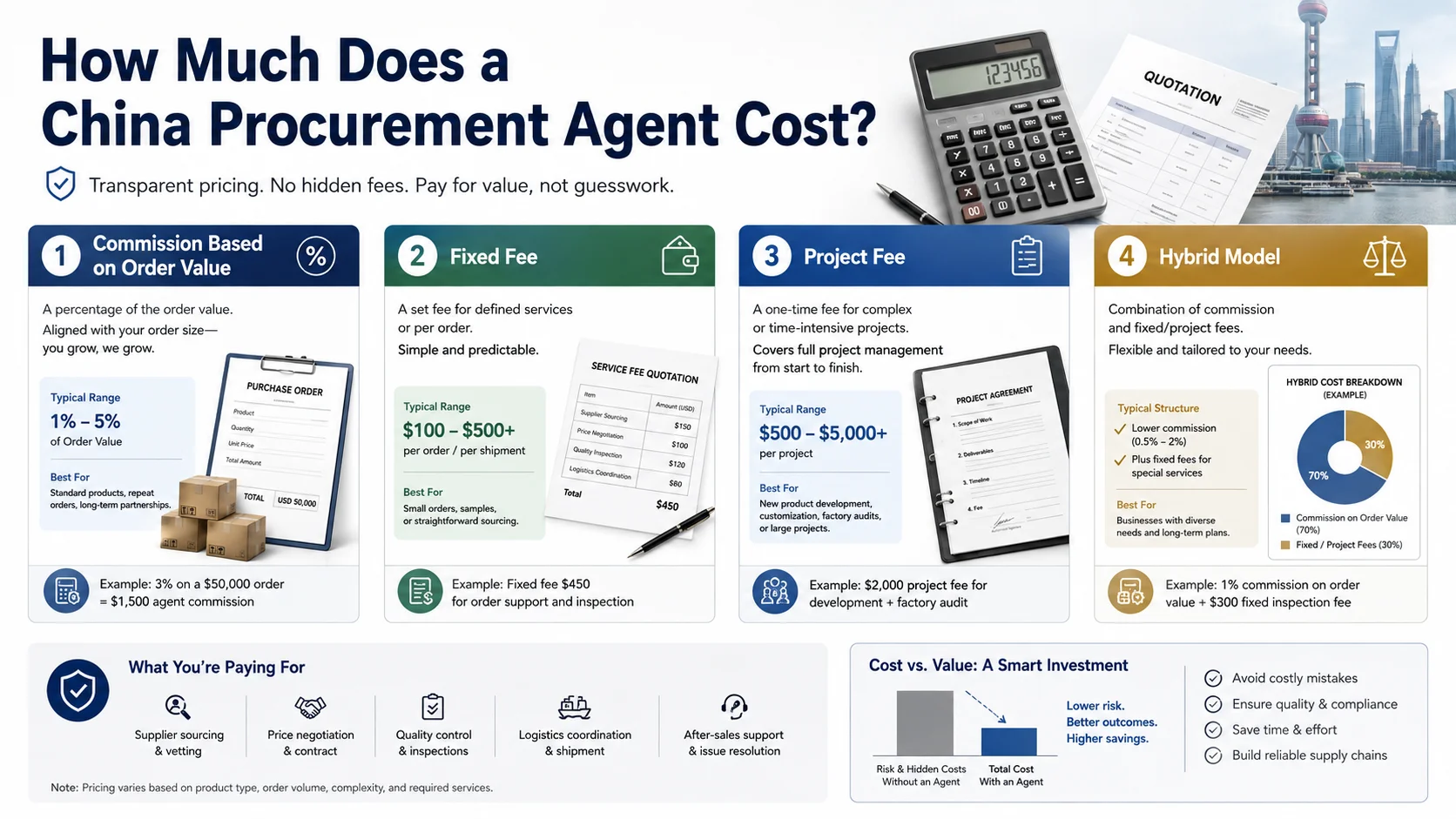
Common China Procurement Agent Fee Models
| Fee Model | How It Usually Works | Often Suitable For | What Buyers Should Clarify |
|---|---|---|---|
| Commission-based | Fee is a percentage of order value | Repeat orders and ongoing procurement | Commission rate, minimum fee, supplier disclosure |
| Fixed sourcing fee | One agreed fee for a defined sourcing task | Simple product searches | Number of suppliers, revisions, and samples included |
| Project-based fee | Fee covers a defined development or sourcing project | OEM, private label, or complex products | Deliverables, timeline, and change-request charges |
| Hybrid model | Combination of a base fee and commission | Multi-stage sourcing programs | Which tasks trigger additional charges |
Why “Cheap” May Not Mean Lower Total Cost
We do not assume that every low-fee agent is unreliable. Some agents run efficient operations, and some buyers only need limited support. However, a low price deserves careful questions if it leaves key work undefined.
For example, an agent may quote a low sourcing fee but exclude:
- Supplier verification
- Sample review or revision follow-up
- Production follow-up
- Quality inspection
- Warehousing and consolidation
- Packaging checks
- Defect claim coordination
- Shipping documentation support
A buyer may then pay separate fees later or handle the missing tasks alone. The apparent savings can disappear if the buyer receives unsuitable goods, faces repeated sample revisions, or pays for fragmented shipments.
We encourage buyers to request a written cost breakdown. The most useful comparison is not “Who has the lowest commission?” It is “What level of work, documentation, and responsibility does this fee actually buy?”
How Does a China Procurement Agent Compare With Factories and Trading Companies?
Buyers can source directly from factories, work with trading companies, appoint a China procurement agent, or manage sourcing independently. Each option can work in the right context. The best choice depends on product range, order volume, local capability, and the buyer’s willingness to manage details.
A China procurement agent is usually strongest when buyers need support across several suppliers, require local quality control, or want one coordination point for sourcing and shipping.[^6] A factory can be efficient for a stable single-product order, while a trading company may simplify buying but can offer less direct supplier visibility[^7].
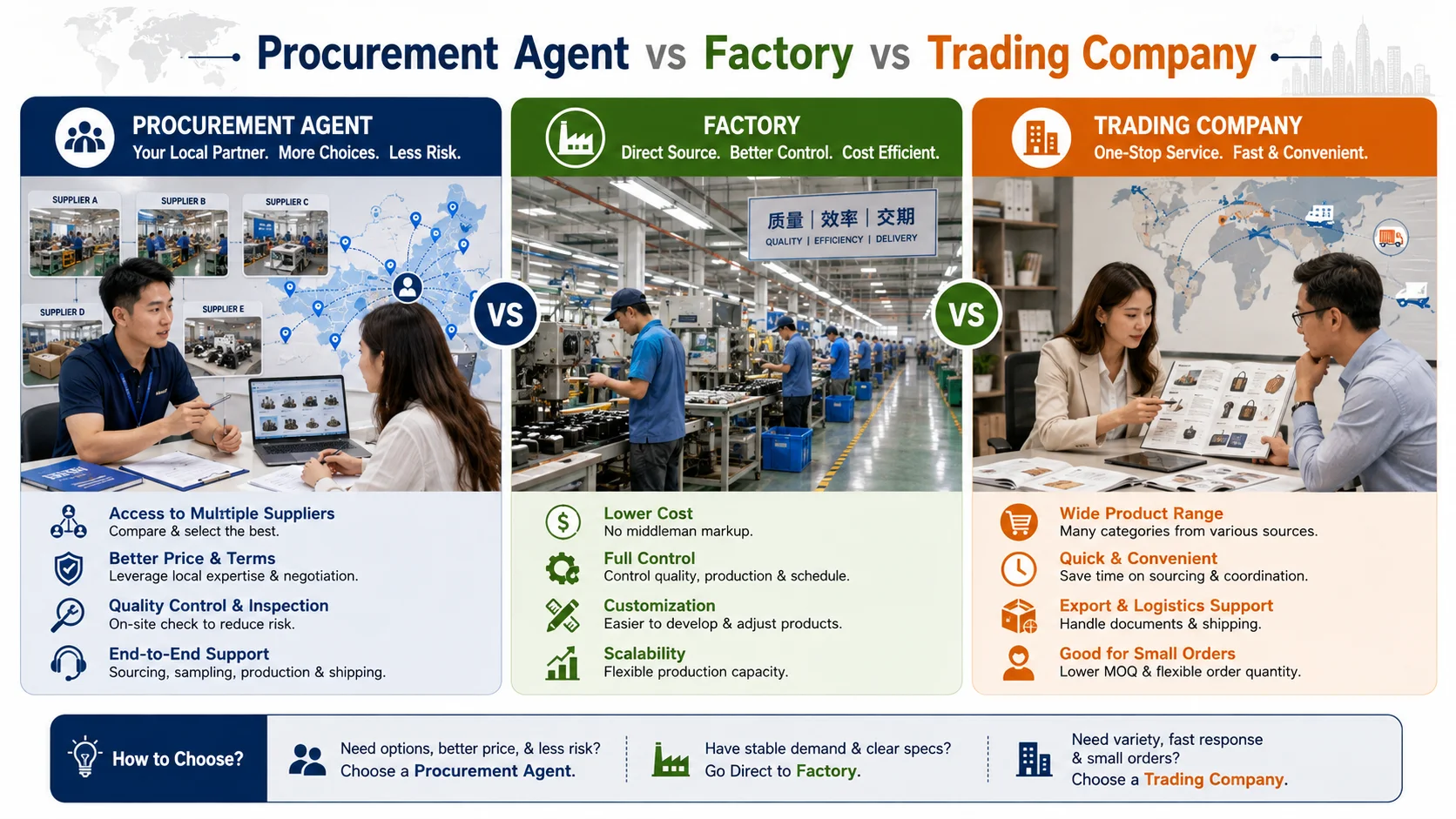
| Option | Supplier Search | Price Negotiation | QC Support | Multiple Suppliers | Consolidation | Buyer Workload | Best For |
|---|---|---|---|---|---|---|---|
| China procurement agent | Usually included | Often supported | Can be arranged or managed | Strong | Strong | Lower | Buyers needing local coordination |
| Factory | Limited to its own products | Direct with factory | Varies by factory | Limited | Usually limited | Medium to high | Repeat buyers with one clear product |
| Trading company | Often handled internally | Through the trading company | Varies | Possible | Possible | Medium | Buyers seeking a simplified catalog purchase |
| Buying direct independently | Buyer handles it | Buyer handles it | Buyer must arrange it | Possible but demanding | Buyer must arrange it | High | Experienced buyers with local resources |
The Trade-Off Is Control Versus Workload
Direct factory purchasing can offer strong product knowledge and direct communication. It can be a good route when a buyer already knows the factory, has approved samples, and maintains a stable purchase program.
However, direct sourcing becomes more demanding when a buyer has:
- Five products from five different suppliers
- Custom packaging from another vendor
- Accessories that need kitting
- Different production schedules
- A need for independent inspection
- A mixed shipment that must leave together
In these cases, we often act as the buyer’s China-based coordination point. We do not replace the buyer’s commercial judgment. We make supplier communication, documentation, and physical handling more manageable.
What Are the Main Benefits of Using a China Procurement Agent?
Buying from China can create opportunities, but distance creates information gaps. A buyer may not know whether a delayed reply is routine, whether a sample change was understood, or whether cartons match approved requirements. We help close some of those gaps through structured coordination.
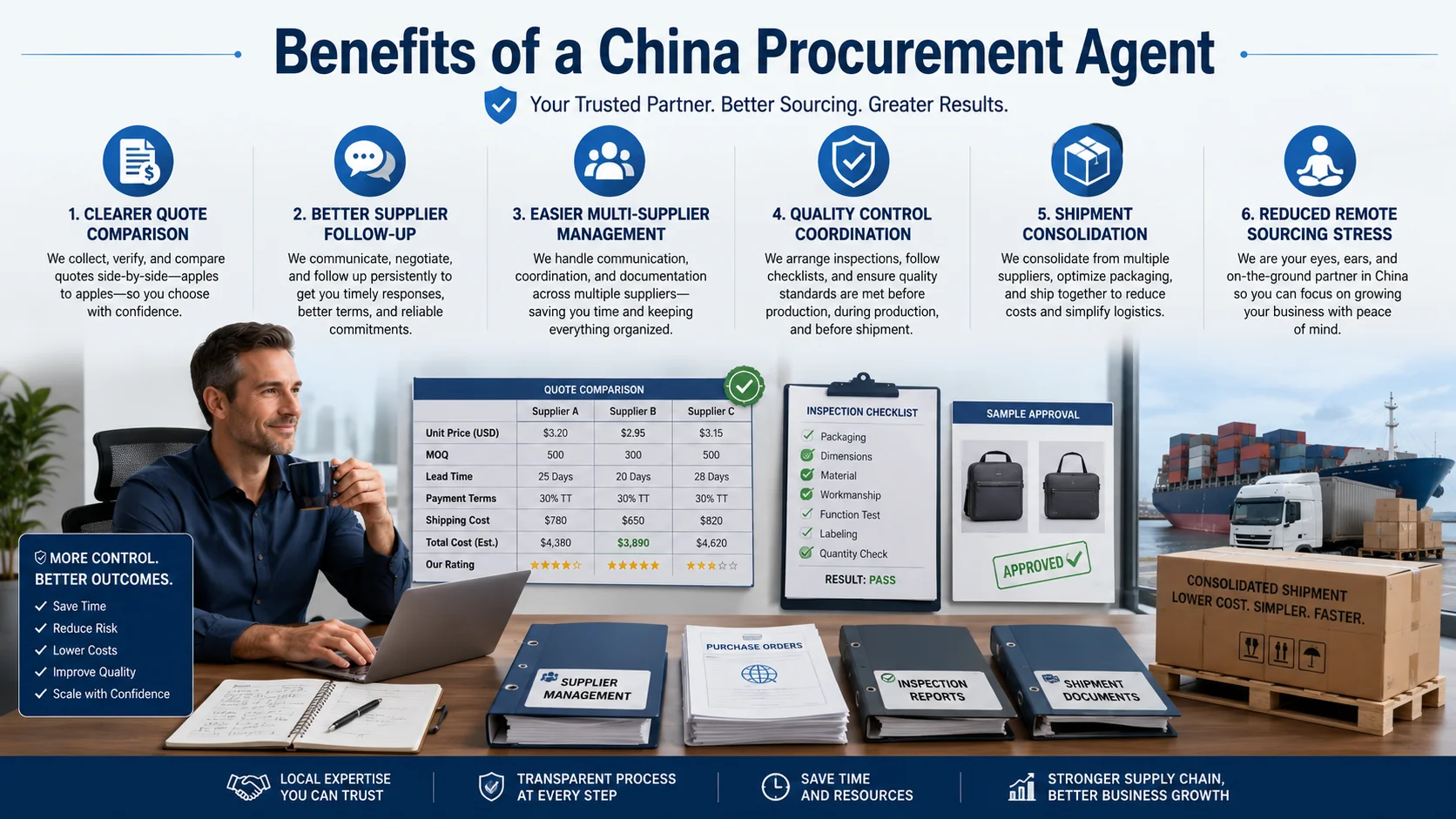
The main China sourcing agent benefits are reduced supplier-search workload, clearer quotation comparison, stronger communication follow-up, easier multi-supplier management, local quality-control coordination, and more practical shipping consolidation. These benefits depend on the agent’s actual systems, local capability, and agreed service scope.
Better Supplier Comparison
A supplier quote is only useful when the specifications match. We help buyers compare details such as material grade, size, logo method, MOQ, tooling, packaging, production time, and payment terms.
This process can reveal that a “cheaper” quote excludes important elements. For example, one quote may include individual packaging while another only includes bulk packing. One supplier may price a standard material while another prices a requested upgraded material.
Less Fragmented Procurement Work
A single procurement contact can reduce the burden of chasing several suppliers in different cities. This is especially useful for ecommerce sellers and DTC brands building a product range rather than buying one standard item.
We can support:
- Supplier communication across time zones
- Sample and packaging follow-up
- Warehouse receiving
- Product bundling or accessory matching
- Carton-label review
- Consolidated shipping arrangements
Earlier Quality and Delivery Conversations
Quality control works best when expectations are defined before inspection.[^8] We encourage buyers to establish product requirements, defect standards, packaging details, and inspection timing early.
An inspection cannot make a poor specification clear after production is complete.[^9] It can, however, provide a structured check against agreed requirements. For application-specific products, buyers should use qualified technical, regulatory, or testing professionals where appropriate.
How Can You Choose a Reliable China Procurement Agent?
Choosing a procurement partner is difficult because many service providers make similar promises. Buyers may see polished websites, fast replies, and attractive commissions. Those signals can be useful, but they are not enough. We believe written transparency is the more practical test.
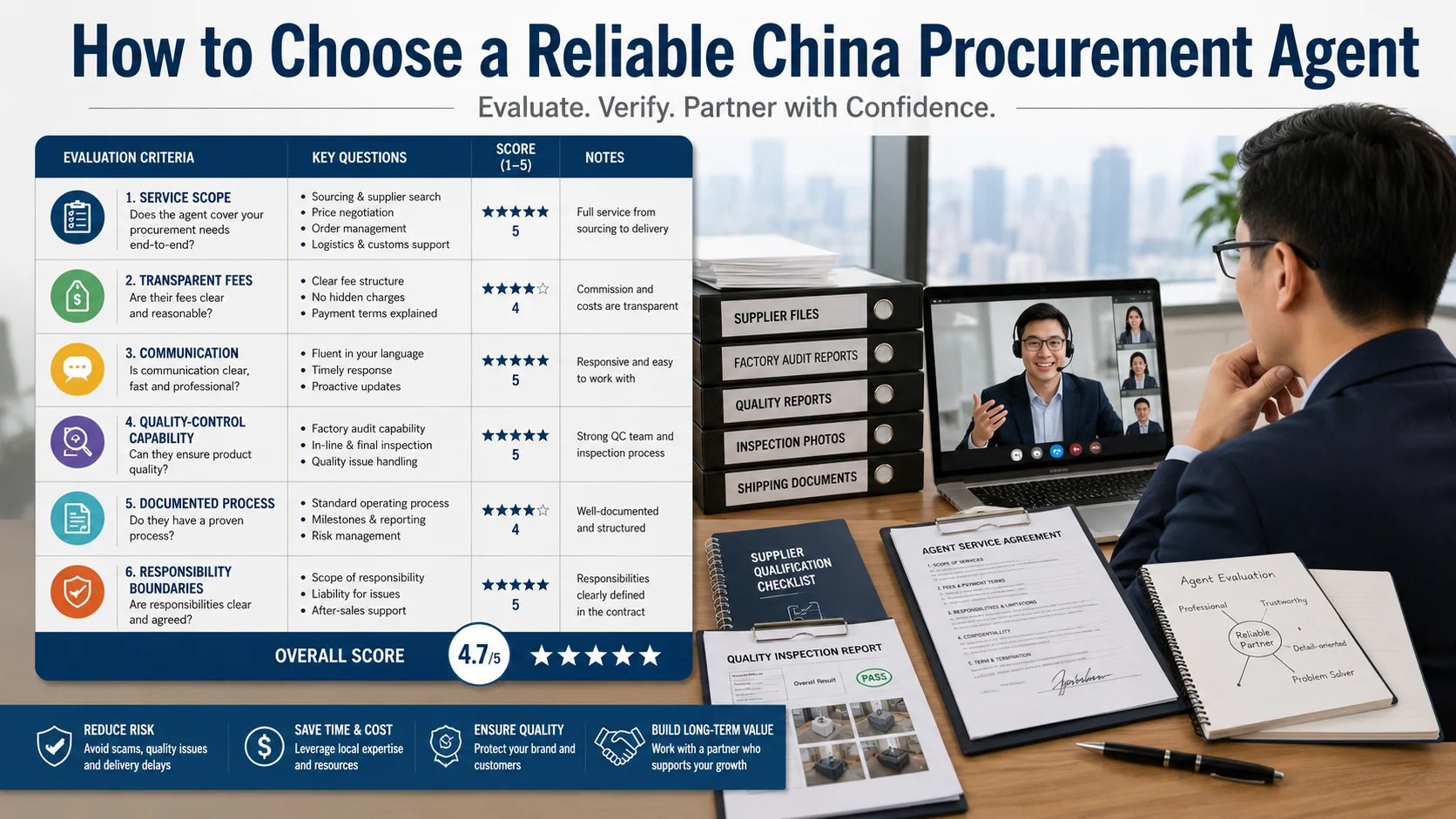
To choose a reliable China procurement agent, buyers should verify the agent’s service scope, fee structure, communication process, supplier-management approach, quality-control capability, and responsibility boundaries. A reliable provider should explain what it can do, what it cannot do, what each service costs, and how issues are documented and escalated.
Use a Written Evaluation Checklist
| Evaluation Area | Questions to Ask |
|---|---|
| Service scope | Which tasks are included from sourcing through shipment? |
| Fees | Are commissions, inspection fees, warehousing, and shipping charges separate? |
| Supplier process | How do you shortlist and verify potential suppliers? |
| Quote visibility | Will I receive comparable quotations and specification details? |
| Quality control | What type of inspection can you arrange, and what standard will be used? |
| Communication | Who is my contact, and how often will I receive updates? |
| Issue handling | How are defects, delays, packaging errors, or supplier disputes escalated? |
| Supplier relationships | Can you manage suppliers while preserving transparency for the buyer? |
Look for Clear Boundaries, Not Empty Guarantees
We recommend caution when an agent promises guaranteed lowest prices, zero defects, guaranteed delivery dates, or guaranteed customs outcomes. Suppliers, carriers, ports, and customs authorities each control parts of the supply chain.[^10]
A more credible China purchasing agent explains the process and the limits. For example, we can coordinate inspection and report findings, but we cannot guarantee that a supplier will never make an error. We can support shipping arrangements, but carriers and customs authorities control final transport and clearance outcomes.
That honesty matters. It gives buyers a realistic basis for planning and risk management.
What Does the China Procurement Workflow Look Like?
Buyers often think sourcing ends once they choose a supplier. In practice, supplier selection is the start of a chain that includes samples, specifications, production, inspection, packing, and logistics. We use a staged workflow so buyers can see what should happen next.
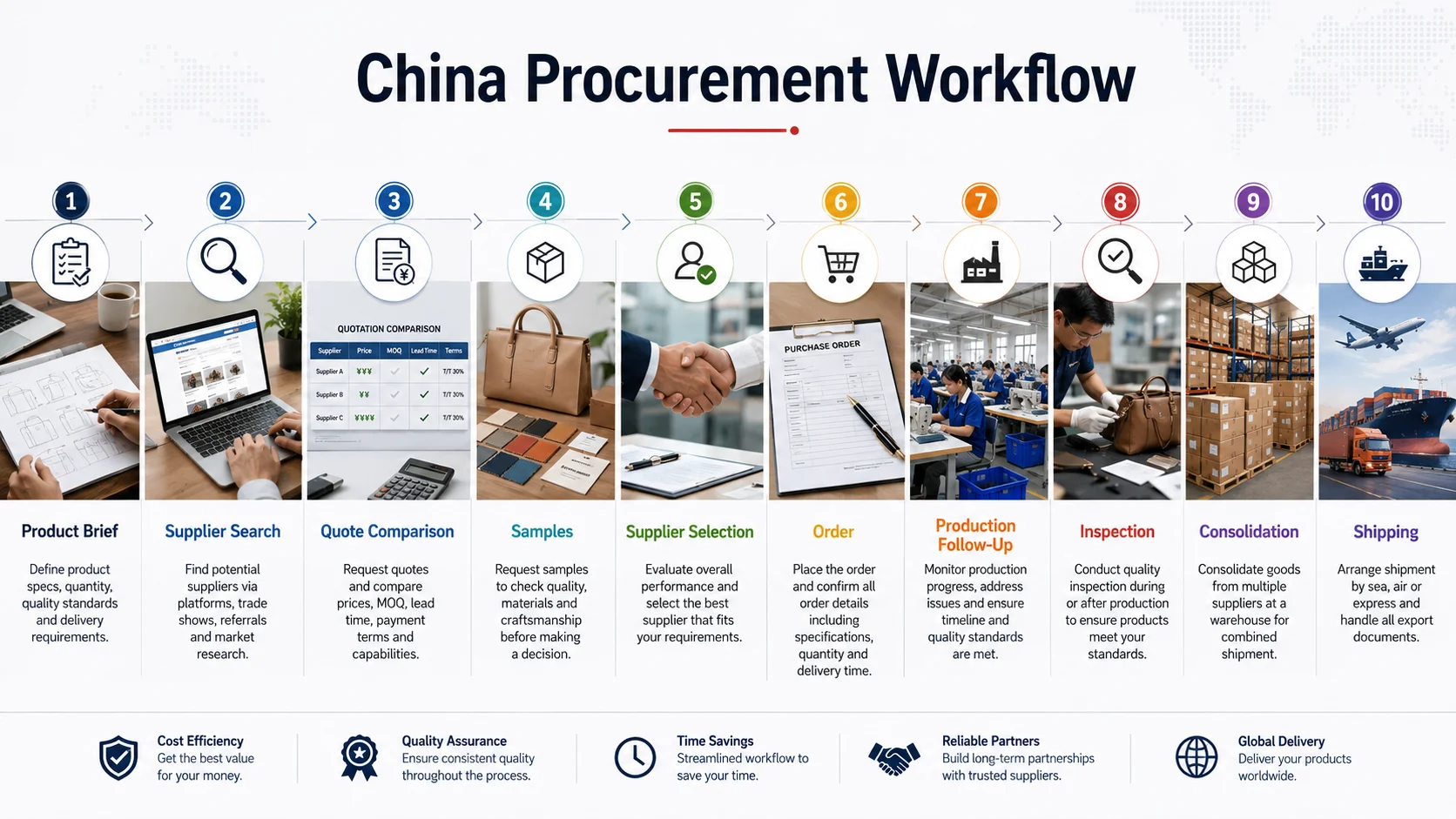
A typical China procurement workflow follows this path: Product Brief → Supplier Search → Quote Comparison → Samples → Supplier Selection → Order → Production Follow-Up → Inspection → Consolidation → Shipping.[^11] Each stage should produce clear information that supports the next purchasing decision.
A Practical Step-by-Step Process
-
Product Brief
We collect the specifications, quantity, target price range, packaging needs, and delivery expectations. -
Supplier Search
We identify potential suppliers based on product fit, location, response quality, and available capability information. -
Quote Comparison
We compare offers on a like-for-like basis. We flag differences in MOQ, materials, lead time, tooling, and packaging. -
Samples
We coordinate samples and revisions. The buyer should approve samples against written requirements. -
Supplier Selection
The buyer chooses based on the full commercial picture, not only the unit price. -
Order and Production Follow-Up
We help communicate approved requirements, milestones, packaging instructions, and key updates. -
Inspection
We can arrange quality checks based on agreed standards. Buyers should decide in advance how to handle failed or conditional results. -
Consolidation and Shipping
We receive goods where applicable, check shipment readiness, consolidate orders, and coordinate freight handoffs.
This workflow is adaptable. A simple repeat order may skip several steps. A new private-label product may require more sample rounds, packaging review, and supplier coordination.
When Should You Use a Procurement Agent Instead of Sourcing Yourself?
Some buyers can source successfully on their own. A buyer with an established factory, experienced staff, clear specifications, and an independent inspection process may not need broad agent support. However, many growing businesses reach a point where remote coordination consumes too much time.
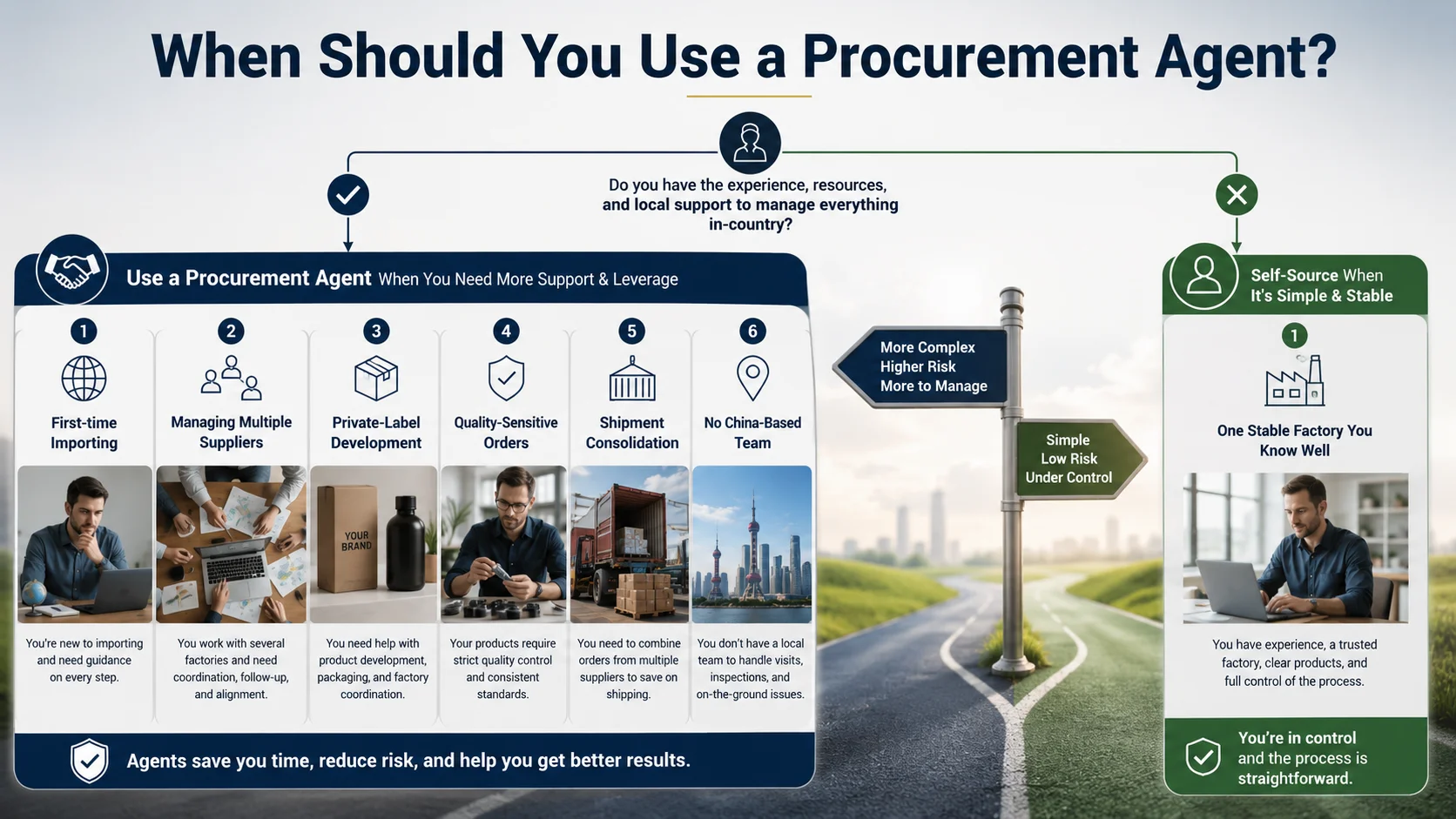
You should consider using a China procurement agent when you are sourcing for the first time, managing multiple suppliers, developing private-label products, placing quality-sensitive orders, consolidating shipments, or operating without a China-based purchasing team.[^12] An agent can reduce coordination workload, but buyers should still make informed commercial decisions.
Common Situations Where Local Support Helps
A procurement agent may be useful when:
- You are new to importing from China
- You need to compare several possible suppliers
- You have a small team and limited time for daily supplier follow-up
- You are launching an OEM or private-label product
- You need custom packaging, inserts, bundles, or accessories
- You are buying multiple SKUs from different suppliers
- You want inspection coordination before shipment
- You need warehouse receiving and shipment consolidation
- You have an existing supplier quote but want a structured comparison
At KingSourcing, we work with buyers who may begin with a relatively small test order and with larger importers who need ongoing procurement management. We tailor the level of support to the product, order structure, and buyer requirements.
If you already have a product brief, reference image, supplier quotation, or sample requirement, send it to us. We can help you compare supplier options, define the sourcing scope, and build a clearer procurement plan before you commit to an order.
Frequently Asked Questions
What is the difference between a China procurement agent and a sourcing agent?
The terms often overlap. A sourcing agent may focus mainly on finding suppliers and obtaining quotes. A China procurement agent may provide broader support, including supplier management, samples, production follow-up, quality control, consolidation, and shipping coordination. Buyers should confirm the exact scope instead of relying on the job title.
How much does a China procurement agent charge?
China procurement agent costs vary by commission, fixed sourcing fee, project fee, or hybrid model. The final cost depends on order value, product complexity, supplier count, quality-control needs, and logistics requirements. Buyers should request a written explanation of included tasks, exclusions, and payment timing.
Can a procurement agent guarantee product quality?
No responsible procurement agent can guarantee that every product will be defect-free. An agent can help define requirements, coordinate quality inspections, document findings, and communicate issues to suppliers. Buyers should set clear specifications and determine acceptable quality levels before production begins.
Should I buy directly from a factory or use a China procurement agent?
Direct factory purchasing may suit buyers with stable products, established supplier relationships, and internal sourcing experience. A China procurement agent can be more useful when buyers need supplier comparisons, multiple vendors, local inspection coordination, custom packaging, or consolidated shipping.
What should I send a procurement agent before requesting a quote?
Buyers should send product images or links, specifications, materials, sizes, quantity, target market, branding details, packaging requirements, target price range if available, and expected delivery timing. A detailed product brief helps agents obtain more comparable supplier quotations.
Conclusion
A China procurement agent should add value through transparent coordination, not vague promises or a low commission alone. We recommend comparing service scope, supplier-management methods, inspection support, fee structure, exclusions, and issue-handling procedures before choosing a partner. The best procurement model depends on your product, supplier mix, order size, and internal resources. If you need support with supplier sourcing, quotation comparison, quality control, consolidation, or shipping from China, send KingSourcing your product brief or current supplier quote for a practical procurement review.
Related terms: China procurement agent, China sourcing agent, procurement services China, sourcing agent fees, supplier sourcing China, supplier management, China purchasing agent, sourcing company China, China procurement services
[^1]: "China - Distribution and Sales Channels", https://www.trade.gov/country-commercial-guides/china-distribution-and-sales-channels. Government trade guidance describes sourcing intermediaries as parties that may assist foreign buyers with supplier identification, communication, quality assurance, and shipment-related coordination. Evidence role: definition; source type: government. Supports: That sourcing intermediaries may assist buyers with supplier identification, supplier communication, quality control, and logistics-related coordination.. Scope note: The precise scope and legal responsibility of an agent vary by contract and jurisdiction. [^2]: "China - Market Overview", https://www.trade.gov/knowledge-product/exporting-china-market-overview. Official trade due-diligence guidance notes that basic company information and online representations should be supplemented by further verification when assessing a prospective supplier’s capabilities. Evidence role: general_support; source type: government. Supports: That supplier due diligence commonly requires verification beyond online listings and basic company documents, such as capability assessment, references, audits, or site visits.. Scope note: Additional verification can reduce uncertainty but does not by itself guarantee future production performance. [^3]: "Questions and Answers on Current Good Manufacturing Practice - FDA", https://www.fda.gov/drugs/guidances-drugs/questions-and-answers-current-good-manufacturing-practice-regulations-production-and-process. Manufacturing quality-control literature explains that approval of an initial sample does not establish continuing conformity, because production output remains subject to process and material variation. Evidence role: mechanism; source type: research. Supports: That a sample is a limited observation and that process variation, materials, equipment, and production controls can cause later production output to differ from an approved sample.. Scope note: The degree of risk depends on the product, process capability, sampling plan, and controls used during production. [^4]: "Contract Management Guide", https://finance.ky.gov/eProcurement/Documents/Contract%20Management%20Guide.pdf. Commercial contracting guidance recognizes written terms and documented specifications as an evidentiary record for assessing performance and resolving disagreements. Evidence role: general_support; source type: institution. Supports: That documented contractual and technical requirements provide a clearer record for performance monitoring and dispute evaluation than undocumented oral communications.. Scope note: The enforceability of oral and written commitments depends on the governing law, contract terms, and available evidence. [^5]: "Part 16 - Types of Contracts | Acquisition.GOV", https://www.acquisition.gov/far/part-16. Research on purchasing intermediaries and agency relationships documents that intermediary compensation can be structured as commissions, fixed payments, project fees, or mixed arrangements. Evidence role: general_support; source type: paper. Supports: That procurement intermediaries may be compensated through percentage commissions, fixed fees, project fees, or combinations of these arrangements.. Scope note: Published discussions may describe general intermediary models rather than the prevailing terms of China-focused procurement agents specifically. [^6]: "Improving resilience of the healthcare supply chain in a pandemic - PMC", https://pmc.ncbi.nlm.nih.gov/articles/PMC8801975/. Supply-chain research identifies intermediaries as potential coordination points for transactions involving multiple suppliers, quality-related information, and logistics handoffs. Evidence role: general_support; source type: paper. Supports: That intermediaries can reduce coordination burdens where buyers must manage multiple suppliers, quality activities, and logistics interfaces.. Scope note: This evidence supports a coordination rationale rather than proving that an agent is the best option for every buyer or product category. [^7]: "Strategic Spot Trading Benefits Supply Chains", https://www.gsb.stanford.edu/insights/strategic-spot-trading-benefits-supply-chains. Research on international trade intermediaries describes how intermediaries can simplify transactions while mediating the relationship and information flow between overseas buyers and producers. Evidence role: general_support; source type: paper. Supports: That trade intermediaries can simplify cross-border transactions while standing between buyers and producers, which may limit direct buyer-producer information flows.. Scope note: The level of supplier visibility depends on the trading company’s disclosure practices and the buyer’s contractual access to supplier information. [^8]: "6.2.1. What is Acceptance Sampling?", https://www.itl.nist.gov/div898/handbook/pmc/section2/pmc21.htm. Conformity-assessment principles treat inspection as an evaluation against specified requirements and acceptance criteria, making prior definition of those requirements necessary for a meaningful result. Evidence role: mechanism; source type: institution. Supports: That inspection requires defined characteristics, methods, and acceptance criteria against which conformity can be assessed.. Scope note: Defined criteria improve interpretability of inspection results but do not eliminate measurement uncertainty or supplier nonconformities. [^9]: "Part 46 - Quality Assurance - Acquisition.GOV", https://www.acquisition.gov/far/part-46. Quality-management literature distinguishes inspection from quality planning: inspection can identify nonconformity against stated requirements, but it cannot retrospectively supply an unambiguous product specification. Evidence role: mechanism; source type: research. Supports: That inspection detects or evaluates conformity against requirements but does not substitute for clear design and specification controls established before production.. Scope note: Post-production inspection may still identify defects and support corrective action, even when it cannot fully cure unclear requirements. [^10]: "Global value chains in a changing world", https://www.wto.org/english/res_e/booksp_e/aid4tradeglobalvalue13_part3_e.pdf. International trade and transport guidance describes cross-border shipments as involving distinct roles for sellers, carriers, port actors, and customs authorities. Evidence role: general_support; source type: institution. Supports: That international trade movements involve separate commercial, transport, port, and customs actors with distinct operational and regulatory responsibilities.. Scope note: Specific responsibilities and liability allocations depend on contracts, transport terms, national law, and the shipment route. [^11]: "SUSTAINABLE PROCUREMENT", https://thedocs.worldbank.org/en/doc/9f82fe0c81afa84dd6c7e7c858e93c8a-0290012024/original/WB-SUSTAINABLE-PROCUREMENT-16574-CH3.pdf. Institutional procurement guidance describes a staged process that moves from defining requirements and evaluating suppliers to order administration, acceptance activities, and delivery. Evidence role: general_support; source type: institution. Supports: That procurement normally includes requirement definition, supplier identification and evaluation, contracting or ordering, performance monitoring, inspection or acceptance, and delivery.. Scope note: Consolidation and international shipping are additional operational stages that are more relevant to cross-border, multi-supplier purchasing than to every procurement process. [^12]: "[PDF] Transaction Cost Economics in the Digital Economy: A Research Agenda", https://www.hbs.edu/ris/Publication%20Files/21-009_93af5aea-aa7e-4985-8d7a-7cb65cb51c7a.pdf. International sourcing research finds that distance, information asymmetry, and supplier-monitoring demands can increase the coordination value of locally positioned intermediaries. Evidence role: general_support; source type: paper. Supports: That geographic distance, information asymmetry, supplier coordination, and monitoring needs can increase the value of local intermediaries in international sourcing.. Scope note: The evidence explains conditions under which intermediary support may be useful; it does not establish that every importer should hire an agent.