China sourcing agent vs procurement service provider is a common question for buyers who want to purchase from China without building a local team. The wrong service scope can leave gaps after a factory quote arrives, including unclear samples, missed production follow-up, quality issues, or complicated shipping coordination. The right model depends on what your team can manage.
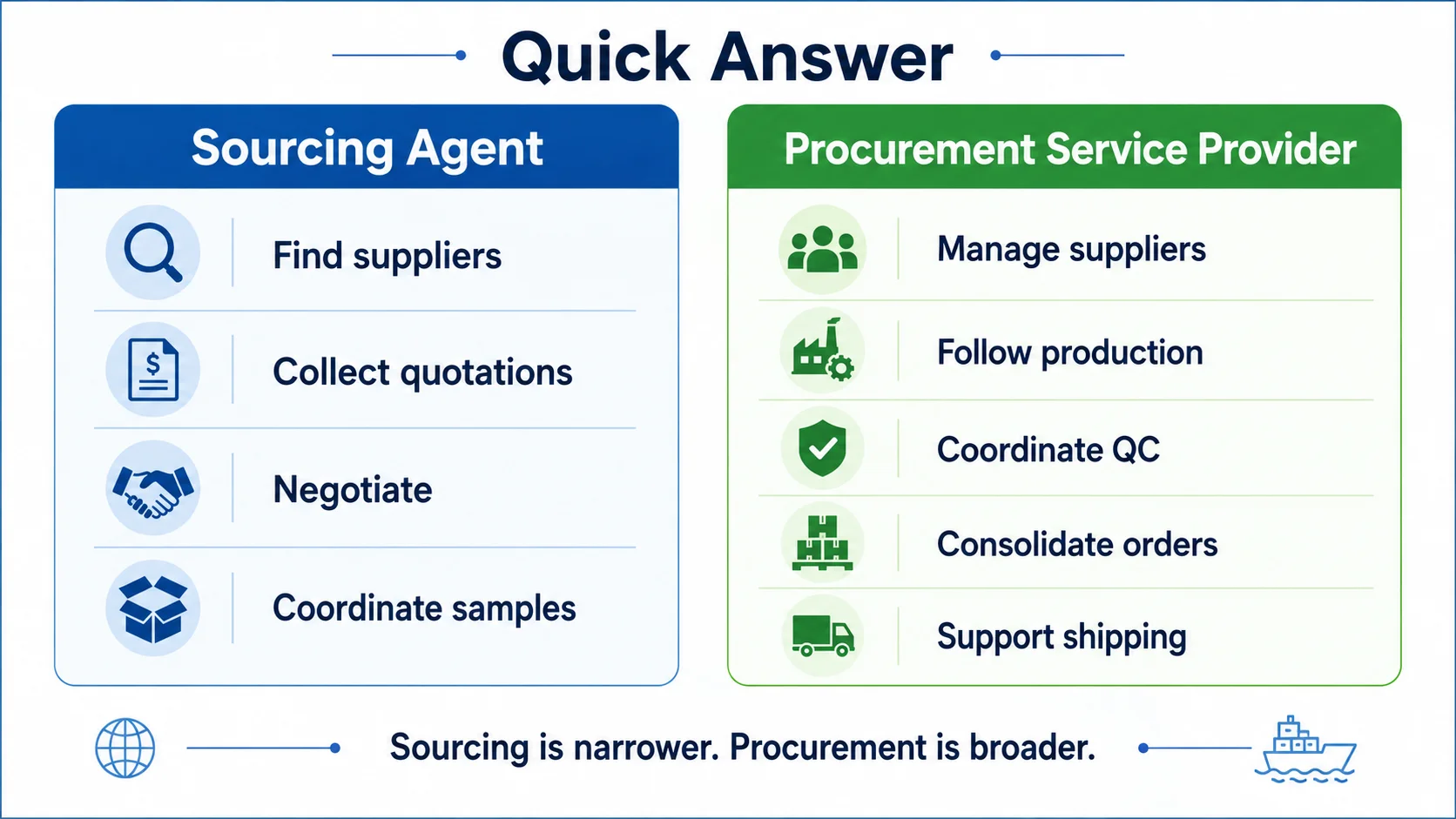
A China sourcing agent usually helps buyers find suppliers, collect quotations, negotiate, and coordinate samples. A procurement service provider usually manages a wider process, including supplier management, production follow-up, quality control coordination, multi-supplier orders, consolidation, and shipping support. Simple, one-product purchases may need sourcing help only, while repeat, multi-SKU purchasing often needs broader procurement management.
We have supported buyers at both stages. Some only need help locating a suitable factory. Others need a China-based team to keep several suppliers, samples, inspections, packaging, and shipments moving together. The important point is not the label a provider uses. It is the agreed responsibility after the first quote.
What Is the Quick Answer to China Sourcing Agent vs Procurement Service Provider?
Many buyers feel overwhelmed because both services can sound similar. A provider may call itself an agent, a sourcing company, or a procurement team while offering overlapping services. That can create confusion when you are comparing proposals and trying to control your purchasing risk.
A China sourcing agent vs procurement service provider comparison comes down to scope. A sourcing agent commonly focuses on supplier discovery and early-stage purchasing tasks. A procurement service provider commonly takes responsibility for more ongoing coordination, such as supplier communication, order tracking, QC arrangements, and shipment consolidation[^1].
The practical difference
We usually explain the difference this way:
- Sourcing support helps you identify and start working with a supplier.
- Procurement support helps you manage what happens after you choose that supplier.
- The scope can overlap, so buyers should never assume a service is included based on the company title alone.
In our experience, the risks often appear after supplier selection. A factory can provide an attractive quote, but a quote alone does not define[^2]:
- Who confirms the approved sample?
- Who documents quality requirements?
- Who follows up on raw materials and production timing?
- Who checks whether packaging matches the approved artwork?
- Who coordinates shipment readiness across several factories?
A first-time ecommerce seller with one standard product may not need a large service package. For example, if you have clear specifications, a straightforward order quantity, and time to communicate directly with one factory, basic sourcing assistance may be enough.
However, a growing DTC brand may buy from several factories and need branded boxes, bundled accessories, product photos, warehouse handling, and combined shipping. In that case, a broader China procurement service may reduce the amount of work your internal team needs to coordinate.
The better choice is the provider whose written scope covers the risks your business actually needs help managing.
What Does a China Sourcing Agent Usually Do?
Finding a reliable supplier in China can be difficult when you have limited local knowledge. Buyers may receive many quotations but still struggle to compare factories, product specifications, minimum order quantities, and communication quality. A sourcing agent helps narrow that first-stage search.
A China sourcing agent typically helps with supplier search, quotation collection, price negotiation, sample coordination, and supplier communication. The agent may also support basic order placement. However, services such as factory audits, production monitoring, quality inspections, and shipping coordination vary significantly by provider.
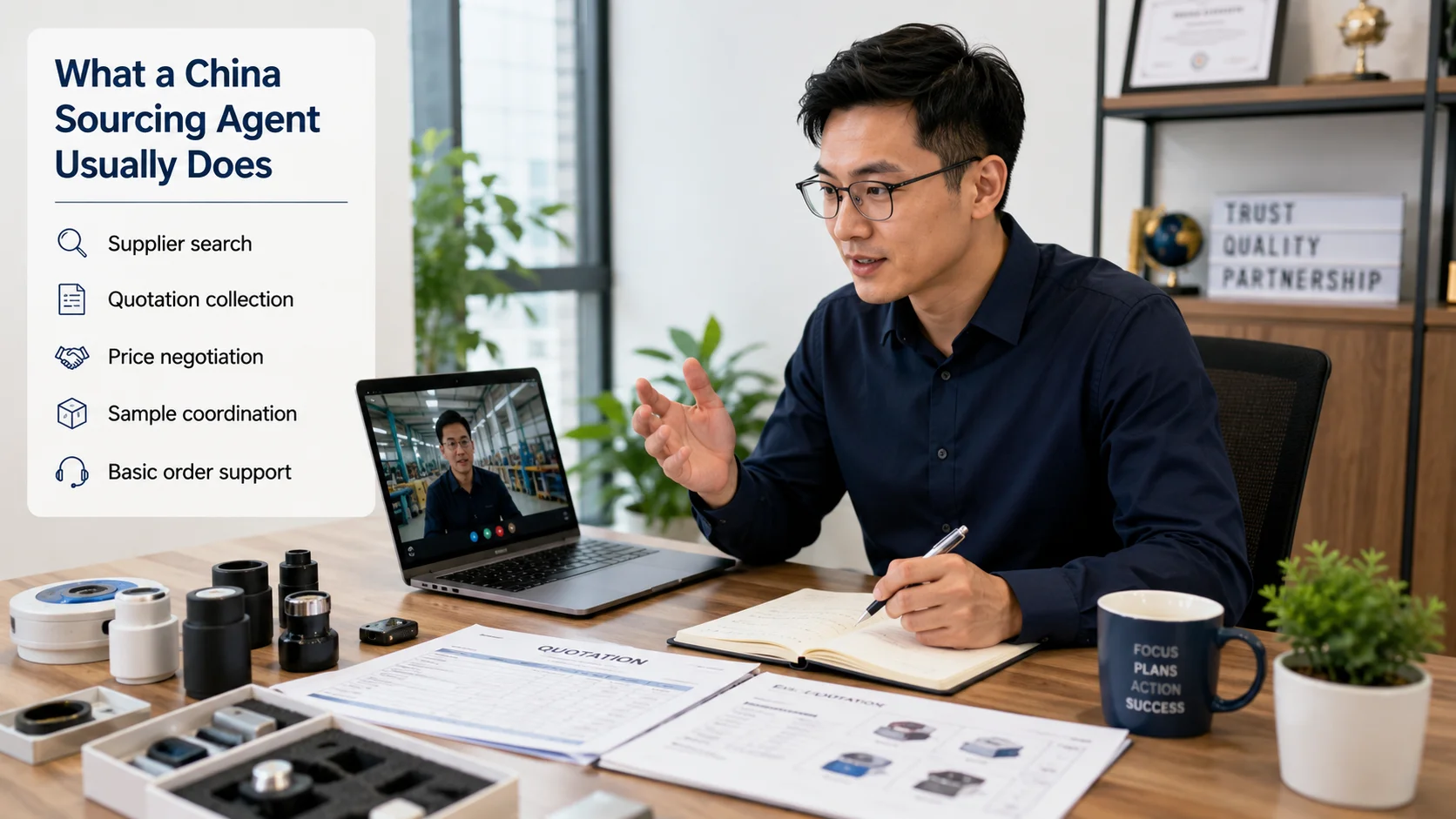
Typical sourcing-agent tasks
A sourcing agent China service can include the following activities:
-
Product and supplier research
The agent searches manufacturers, trading companies, or wholesale markets based on your product brief. -
Supplier comparison
The agent compares quotations, MOQs, lead times, customization options, and basic communication responsiveness.[^3] -
Negotiation support
The agent may negotiate unit pricing, packaging options, sample charges, or payment terms. -
Sampling coordination
The agent receives, checks, or forwards samples based on the agreed scope. -
Communication support
The agent translates requirements and helps reduce misunderstandings between buyer and supplier.
Where the boundary can become unclear
We have seen buyers request “factory sourcing and pricing,” then assume someone is also managing every later detail. In one generalized situation, a buyer had received supplier options and a workable quote. Yet no party had clearly taken ownership of sample confirmation, quality requirements, and lead-time coordination.
The issue was not that the sourcing work had failed. The original scope had simply focused on finding a supplier. The buyer needed more execution support than the initial request described.
That is why we recommend asking direct questions before you begin:
| Question | Why it matters |
|---|---|
| Does the service include sample approval follow-up? | A sample can be sent without being formally approved. |
| Does the provider track production milestones? | Lead times may change after the deposit is paid.[^4] |
| Is quality control included, optional, or excluded? | Inspection expectations should be clear before production. |
| Can the provider coordinate shipping? | This matters when goods must move from several factories. |
A sourcing agent can be a practical choice. Still, buyers should treat sourcing as the beginning of procurement, not the entire procurement process.
What Is a China Procurement Service Provider?
A factory may be easy to find, but managing orders across China can become harder as your product range grows. Buyers often lose time chasing updates from factories, checking samples, arranging inspections, and coordinating cargo from separate locations. A broader procurement service can support these moving parts.
A China procurement service provider acts more like an outsourced purchasing team or China purchasing office. Depending on the agreed scope, the provider may manage supplier relationships, samples, production follow-up, QC coordination, packaging, warehousing, order consolidation, and international shipping support.
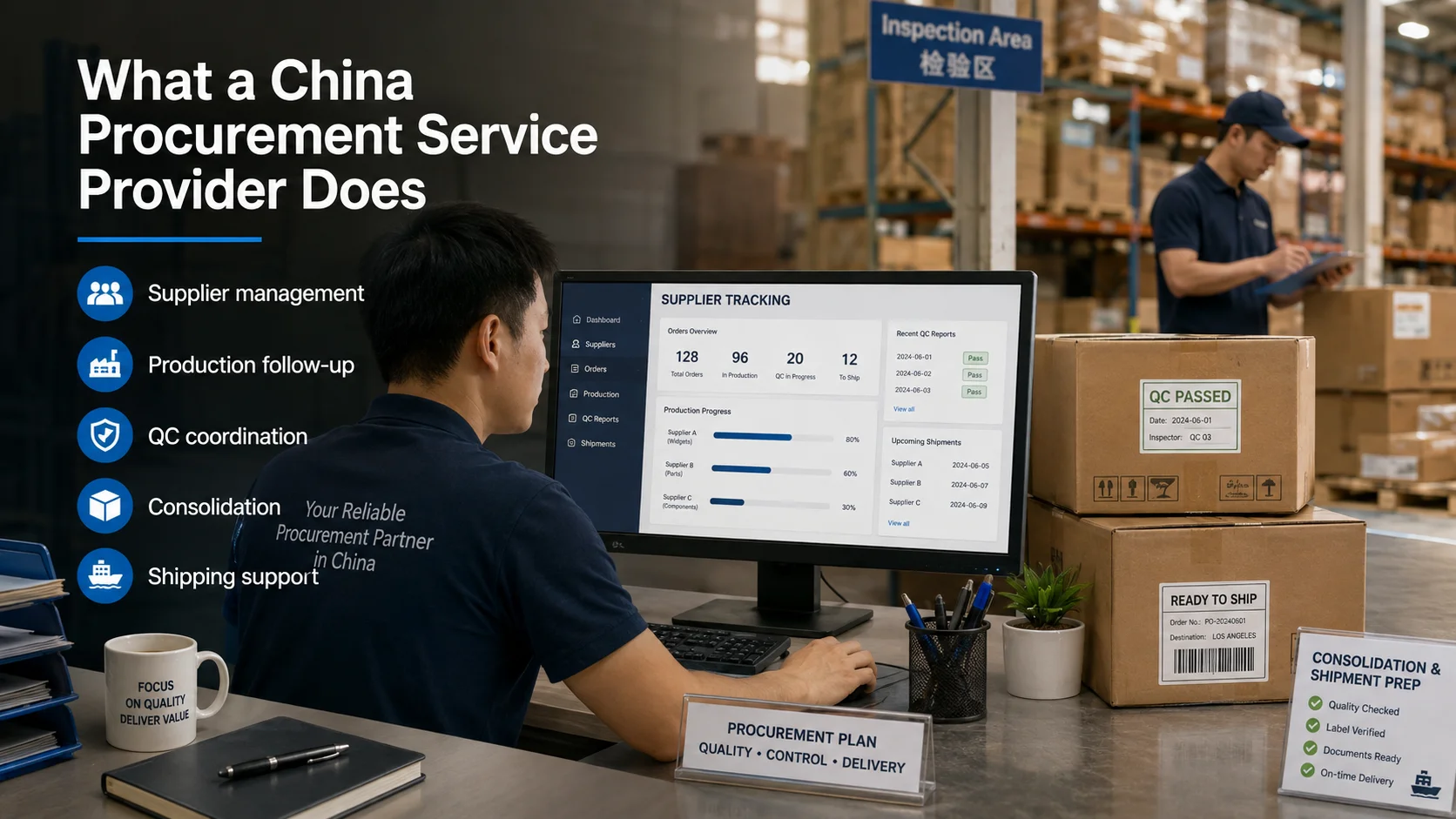
Procurement is wider than supplier search
A procurement provider may perform sourcing work too. The difference is that the service can continue through the purchasing lifecycle rather than ending once you identify a suitable factory.
At KingSourcing, we see this model as practical for buyers who do not have a China-based procurement employee. We can act as a local coordination point across the stages that the buyer chooses us to manage.
A wider procurement workflow may include:
- Reviewing supplier quotations and comparing commercial terms
- Coordinating samples and documenting feedback
- Following up on production timing
- Arranging third-party or in-house quality checks where agreed
- Checking packaging, labels, inserts, and bundled accessories
- Receiving goods into warehouse storage
- Combining products from multiple suppliers
- Supporting shipping documents and door-to-door logistics coordination
It is not automatically “better”
A procurement management China service is not automatically the right choice for every order. It can add value when it replaces work your team cannot efficiently do from overseas. But if you have one experienced supplier, stable specifications, and your own freight and QC resources, you may only need targeted support.
The key question is not, “Which title sounds more professional?” The key question is, “What does my business need managed after I receive a factory quote?”
Buyers should ask for a scope document that identifies who owns each stage. Certifications, audit reports, and test documents should also be reviewed and verified for the specific supplier, product, and market requirement.[^5] A procurement provider can coordinate documentation, but qualified professionals should assess application-specific regulatory and technical requirements.
How Does the China Sourcing Agent vs Procurement Service Provider Comparison Look?
Buyers often compare providers by commission percentage alone. That approach can miss the real difference in workload and service coverage. A clearer comparison looks at which purchasing tasks are included, optional, or left for your internal team.
The China sourcing agent vs procurement service provider comparison below is a useful starting point. It reflects common service patterns, not fixed industry definitions. Every provider should confirm its exact scope, fees, and responsibility boundaries in writing.
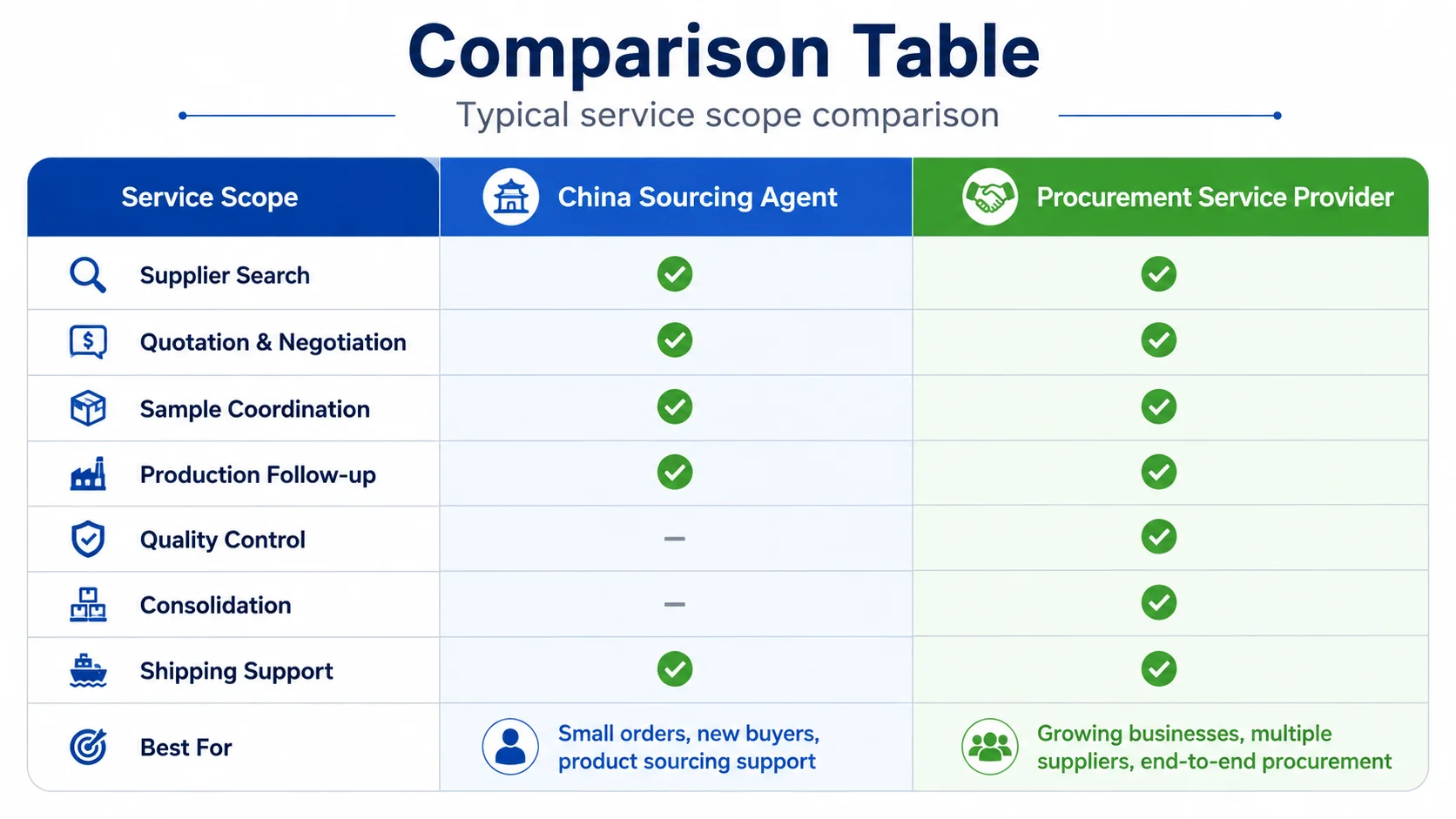
| Factor | Sourcing Agent | Procurement Service Provider |
|---|---|---|
| Supplier search | ✓ | ✓ |
| Price negotiation | ✓ | ✓ |
| Sampling | ✓ | ✓ |
| Supplier management | Limited / varies | Usually broader |
| Production follow-up | Varies | Usually included or coordinated |
| Quality control | Optional / varies | Integrated or coordinated |
| Multi-supplier orders | Limited / varies | Stronger capability |
| Consolidation | Varies | Usually available |
| Packaging coordination | Varies | Often available |
| Shipping coordination | Varies | Often available |
| Best for | Simple sourcing needs | Ongoing procurement needs |
How to use this table correctly
We suggest using the table as a checklist rather than a promise. For example, some sourcing agents offer strong inspection and logistics support. Some procurement companies only handle supplier research. The labels overlap in the real market.[^6]
Before choosing a China sourcing company, ask for answers to these operational questions:
- How many suppliers will the provider coordinate?
- Will the provider communicate directly with factories after the order is placed?
- Who approves samples and production-ready specifications?
- What type of quality inspection is available?
- Can the provider receive and consolidate finished goods?
- Who books freight, prepares documents, and handles shipment exceptions?
- What happens if a supplier misses a production date?
Compare total workload, not just provider fees
A lower commission may appear attractive, but it may leave your team responsible for tasks that require time, experience, and repeated follow-up. That does not make lower-cost sourcing support a bad option. It simply means you should calculate the complete operating workload.
For a simple purchase, handling some tasks internally can be sensible. For a complex purchase, fragmented responsibility can create avoidable delays. The best structure is the one that gives your business enough control without creating an unmanageable administrative burden.
Is a China Sourcing Agent Better for One Product or One Supplier?
A new seller may worry that a full procurement package is necessary before placing any China order. That is not always true. If your product is simple and your purchase structure is clear, a focused sourcing agent may provide the support you need without adding unnecessary layers.
A sourcing agent is often suitable for single product sourcing, one supplier, a clear product specification, and a manageable order process. It can work especially well when your team can approve samples, communicate decisions quickly, arrange QC separately if needed, and manage freight through an existing forwarder.
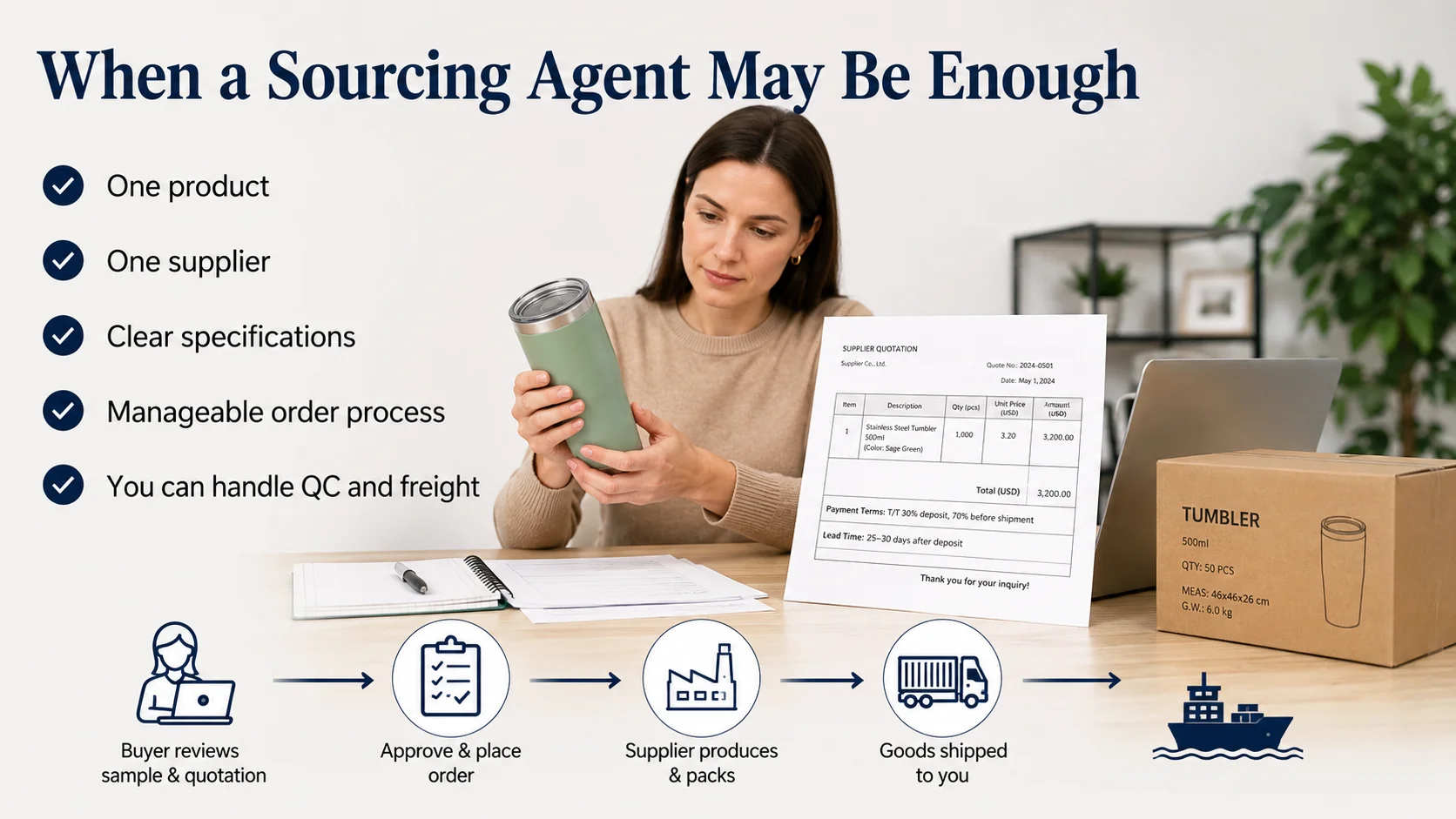
Signs that basic sourcing support may be enough
A sourcing agent for small business may fit when most of these conditions apply:
- You are buying one main SKU or a very small product range.
- The product has clear dimensions, materials, colors, and packaging requirements.
- You have no complicated assembly or multi-factory bundle.
- You can make sample decisions without long internal approval cycles.
- You already have a freight forwarder or shipping arrangement.
- You can arrange independent inspections if your order value justifies them.
- You plan to place a test order before scaling.
For example, a buyer who wants to find a supplier in China for a standard silicone kitchen accessory may need supplier screening, price comparison, and sample coordination. The buyer may not need warehouse consolidation or detailed supplier-management support if there is only one factory and one shipment.
Do not confuse simplicity with zero risk
Even a one-product order needs clear requirements. We recommend confirming these items before production begins:
- The approved sample or reference standard
- Product dimensions and material expectations
- Logo position, color, and packaging artwork
- Quantity tolerance, where relevant
- Production lead time and shipping-ready date
- Inspection method and acceptance criteria
A basic sourcing model works best when the buyer understands which responsibilities remain in-house. If no one owns sample approval, quality requirements, or shipping handoff, a simple order can still become difficult.
Does a Procurement Service Provider Fit Multiple Suppliers and Product Categories?
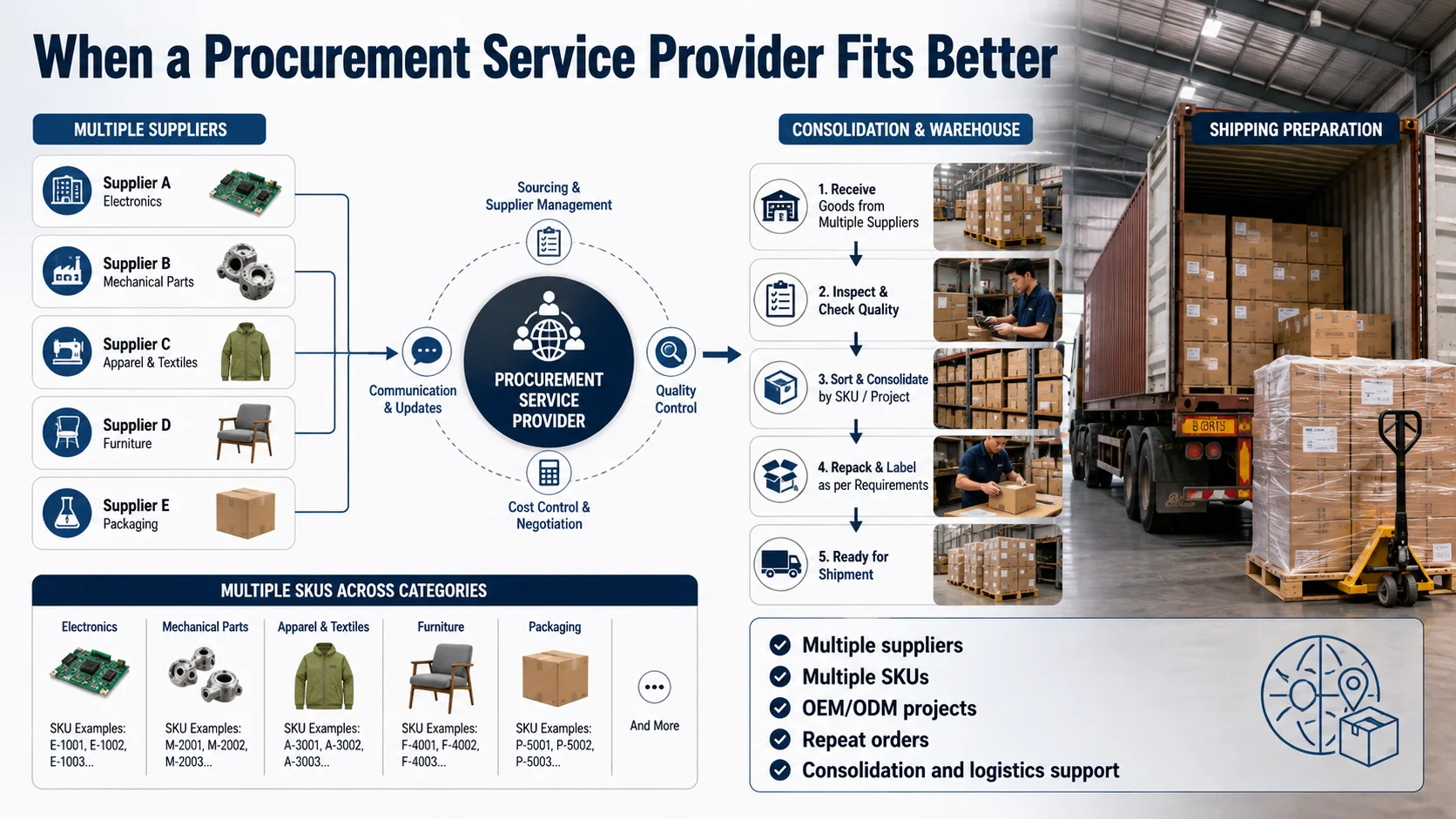
Multiple suppliers can create fast-moving operational problems.[^7] Each factory may have a different lead time, packaging requirement, payment schedule, and communication style. A buyer can spend hours every week coordinating information that a local procurement team can organize more efficiently.
A procurement service provider is usually a stronger fit for multiple suppliers, multiple SKUs, OEM or ODM projects, bundled products, repeat orders, and consolidated shipments. It provides a central point for supplier coordination, order tracking, QC arrangements, warehouse handling, and shipping preparation.
Where broader coordination helps
We often support buyers whose final retail product is not made by one supplier. A brand may buy the main product from one factory, custom packaging from another, inserts from a printing supplier, and accessories from a third source.
Without coordinated procurement, the buyer must ensure every component arrives at the right place and time. A delay from one supplier can hold up the whole shipment.[^8]
A broader China procurement service can help coordinate:
| Purchasing challenge | Procurement support approach |
|---|---|
| Several factory lead times | Track milestones and identify timing conflicts |
| Branded packaging | Confirm artwork, packaging specs, and delivery schedule |
| Product bundles | Receive, combine, and check components before shipment |
| Repeat orders | Maintain supplier communication and purchasing records |
| Mixed cargo shipments | Consolidate goods and coordinate shipment readiness |
| Quality concerns | Arrange checks against agreed standards |
Why this matters for growing brands
A DTC business often starts with one product, then adds variations, colors, accessories, and new categories. That growth can increase margin opportunities, but it also increases purchasing complexity.
A China-based coordination team cannot remove every supply-chain risk.[^9] Factories can still face material delays, capacity constraints, or production issues. However, clear follow-up and defined responsibilities can help buyers identify problems earlier and make decisions with better information.
At KingSourcing, our role can include supplier development, one-by-one product inspection, packaging coordination, warehouse handling, and shipment consolidation based on the service plan. This structure is most useful when your business needs more than an introduction to a factory.
How Do China Sourcing Agent vs Procurement Service Provider Costs Differ?
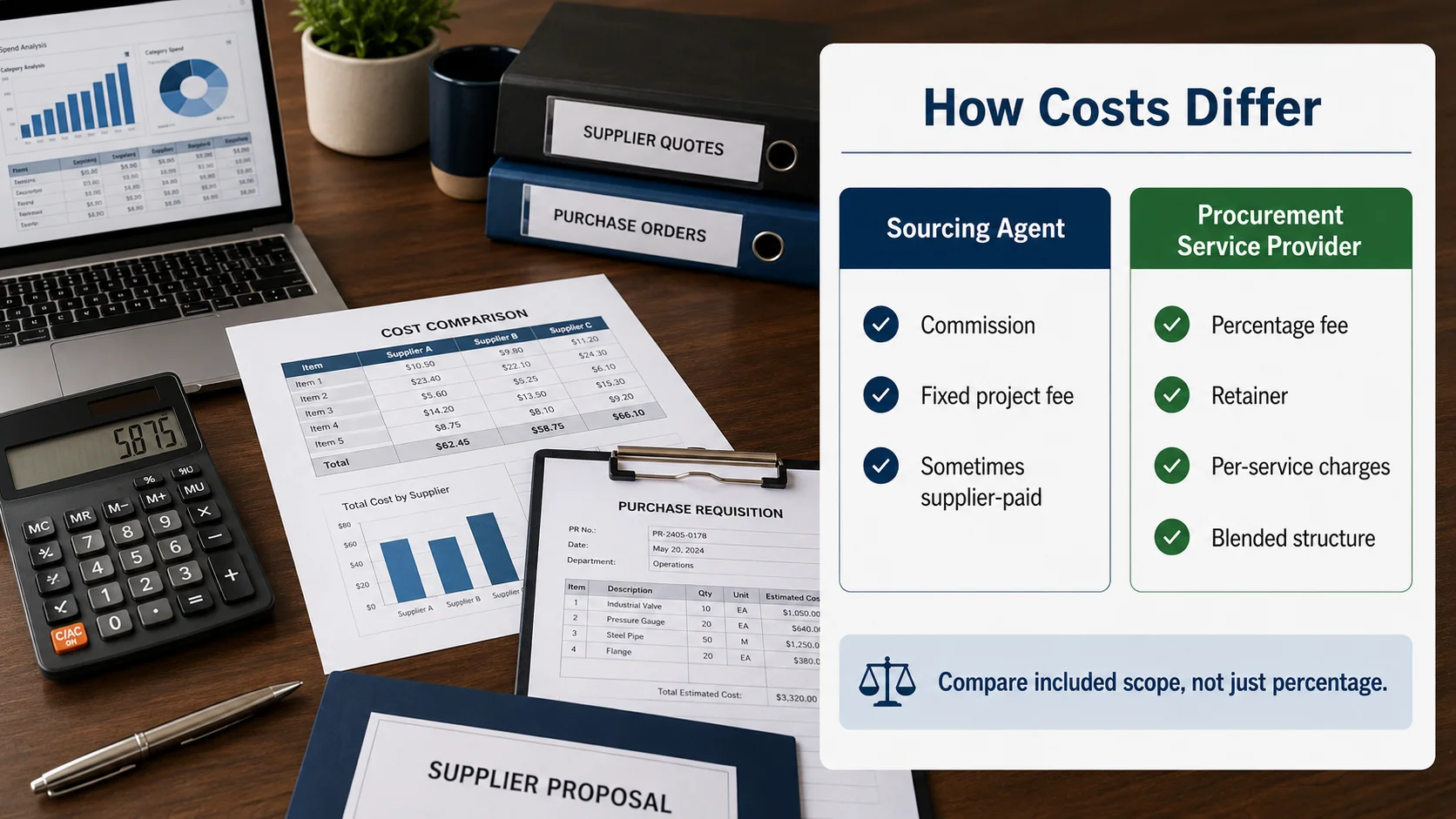
Many buyers choose a provider based on the lowest stated commission. That can be misleading because one quote may include only supplier research, while another includes supplier follow-up, inspections, warehouse work, and shipping coordination. The fee structure must be compared with the work being performed.
In a China sourcing agent vs procurement service provider cost comparison, sourcing support may use a commission, fixed project fee, or supplier-paid arrangement. Procurement services may use a percentage fee, retainer, per-service charges, or a blended structure. The important factor is the included scope.
Common pricing structures
| Fee model | Often used for | What buyers should clarify |
|---|---|---|
| Commission percentage | Sourcing and order placement | Which services are included at that rate? |
| Fixed sourcing fee | One product or defined project | How many suppliers and revisions are covered? |
| Per-inspection fee | Quality control support | What inspection standard and report are included? |
| Warehouse or handling fee | Consolidation and bundling | Is storage time limited? Are labels and assembly extra? |
| Monthly retainer | Ongoing procurement management | What team capacity and reporting are included? |
Look beyond the fee percentage
We advise buyers to consider total procurement cost[^10], which includes more than a provider’s commission:
- Unit cost and payment terms
- Product defects or rework exposure
- Your team’s time spent following up
- Inspection and testing needs
- Packaging mistakes
- Storage, consolidation, and freight costs
- Delays caused by unclear responsibility
The lowest factory quote is not always the lowest total cost. Likewise, the highest service fee is not automatically the best choice. A provider should explain what it manages, what it does not manage, and what extra charges may apply.
Ask for a written breakdown before you compare offers. If a service provider cannot explain its scope in practical terms, it will be hard to evaluate the real value of the fee.
How Much Procurement Work Does Your Team Want to Manage?
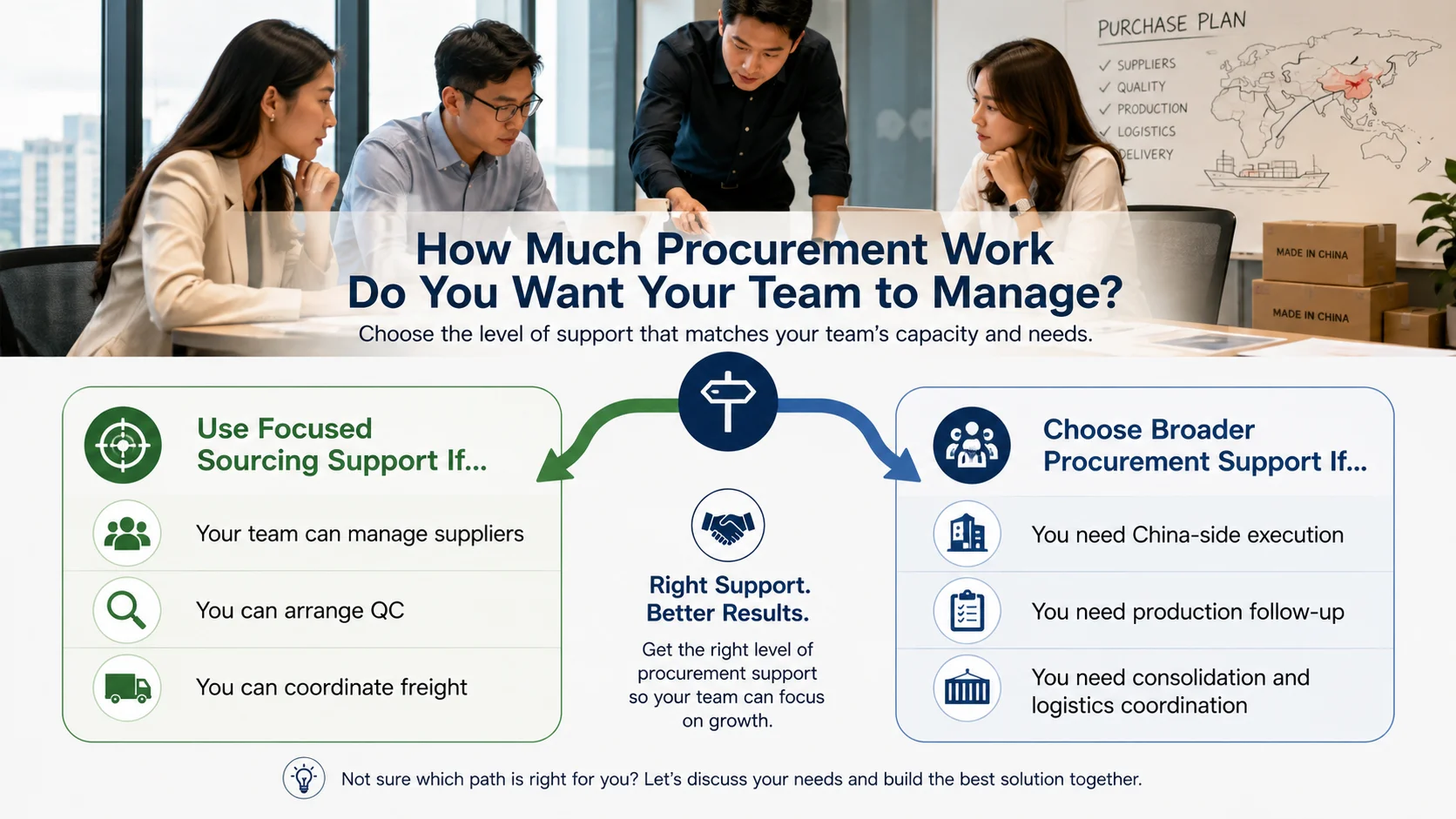
Some buyers want direct control over every supplier conversation. Others want a local team to handle routine follow-up so they can focus on sales, product strategy, and customer service. Neither approach is universally better, but each requires an honest assessment of internal capacity.
The China sourcing agent vs procurement service provider decision often depends on how much execution work your own team can handle. Choose focused sourcing support if you can manage suppliers after selection. Consider broader procurement support if you need China-side coordination across production, QC, consolidation, and logistics.
A simple internal-capacity test
A sourcing agent may fit if your team can confidently handle:
- Sample feedback and approval records
- Production schedule follow-up
- Packaging and labeling confirmation
- Inspection booking and issue resolution
- Freight booking and shipment communication
- Supplier payment and documentation follow-up
A procurement service provider may fit better if these tasks repeatedly consume time or create uncertainty.
Consider your decision speed
Procurement requires timely decisions. A China-based team can follow up locally, but it still needs your instructions on product changes, sample approval, and commercial decisions.
We recommend identifying one person on your side who can approve:
- Product specifications
- Sample changes
- Packaging artwork
- Target delivery dates
- Inspection decisions
- Supplier changes or corrective actions
This keeps the workflow clear. Outsourced procurement should not mean disconnected procurement. The buyer still owns the commercial direction and product decisions.[^11] The local service team supports execution, visibility, and communication based on the agreed plan.
For application-specific quality, safety, or regulatory needs, buyers should also involve qualified testing, engineering, legal, or compliance professionals. A sourcing or procurement provider can help coordinate documents, but it should not replace specialist evaluation.
When Should You Upgrade From a Sourcing Agent to a Procurement Service Provider?
A sourcing model that worked for your first order may become too limited as your business grows. Buyers often notice the gap when they add suppliers, expand product lines, or begin placing repeat orders. Waiting until a shipment problem occurs can make the transition more stressful.
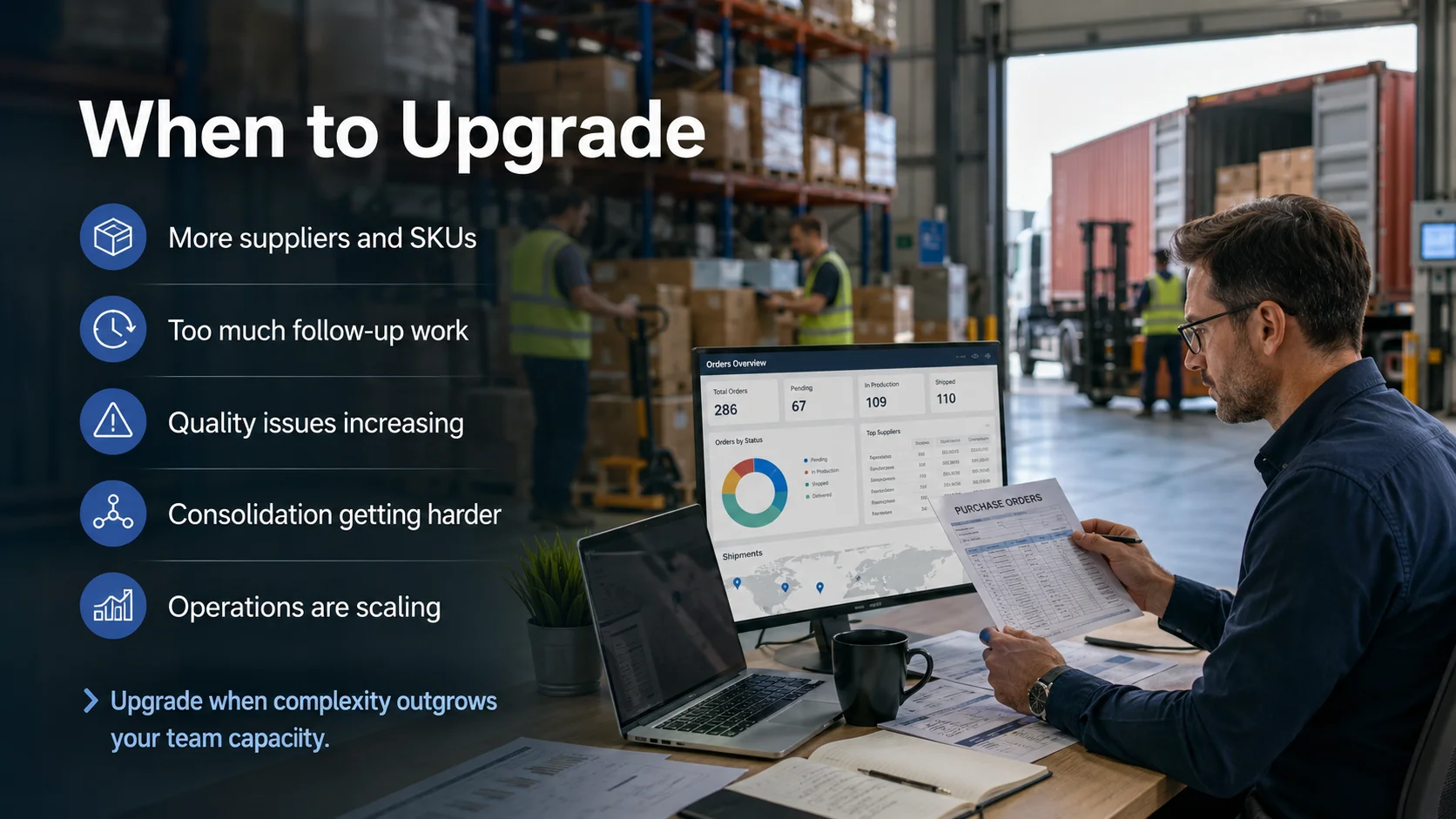
You may need to upgrade from a sourcing agent to a broader procurement service provider when supplier coordination, quality follow-up, and shipping work exceed your team’s available time. The change is usually driven by purchase complexity, not by order value alone.
Common upgrade signals
We suggest reviewing your service model when you see several of these signs:
-
Your supplier count is increasing.
Managing three to five factories takes more coordination than managing one. -
Your SKU range is expanding.
New colors, sizes, accessories, and packaging variations create more details to control. -
You place frequent repeat orders.
Ongoing purchasing benefits from organized supplier records and production tracking. -
You experience recurring quality questions.
You may need clearer standards, inspection coordination, and issue follow-up. -
You need product bundling or consolidation.
Multi-factory orders often require warehouse handling before shipment. -
Your team is spending too much time chasing updates.
This is a practical sign that outsourced procurement may be worthwhile. -
You are launching OEM or ODM products.
Custom development usually requires closer sample, specification, and production coordination.[^12]
Make the change based on scope
You do not need to replace every supplier relationship when you move to broader support. In many cases, a procurement provider can work with your existing factory list, quotations, and approved samples.
The first step is to map your current workflow. Identify where orders slow down, where information gets lost, and where no party has clear responsibility. Then define the support you actually need.
Send your product brief, supplier list, or existing quotation to KingSourcing. We can help you determine whether you need supplier sourcing only or a more complete China procurement service that supports your purchasing process from supplier selection through delivery.
Frequently Asked Questions
Is a sourcing agent the same as a procurement service provider?
No. The terms overlap, and there is no universal industry definition. A sourcing agent often focuses on finding suppliers, collecting quotes, negotiating, and samples. A procurement service provider may manage a wider process, including production follow-up, QC coordination, consolidation, and shipping support.
Can a sourcing agent handle quality control in China?
Some sourcing agents can arrange or perform quality control, but buyers should not assume it is included. Ask what inspection method is offered, when it occurs, what report you receive, what standards apply, and who handles corrective action if issues are found.
Is a procurement service provider necessary for a small business?
Not always. A small business with one simple product and one supplier may only need sourcing support. A broader service becomes more useful when the business has multiple suppliers, customized packaging, repeat orders, bundled products, or limited internal capacity to manage China-side tasks.
How should I compare China procurement service providers?
Compare written service scope, communication process, supplier-management capability, QC options, warehouse services, fee structure, and exclusions. You should also verify relevant supplier documents, test reports, and certifications for your specific product and target market instead of relying on general claims.
Conclusion
The China sourcing agent vs procurement service provider decision is really a decision about service scope and internal workload. A sourcing agent can be enough for simple supplier-finding and single-product orders. A broader China procurement service can be more suitable when you need ongoing supplier management, QC coordination, multi-factory consolidation, and shipping support. At KingSourcing, we help buyers define practical responsibilities before production begins. Contact us with your sourcing brief, existing supplier details, or purchasing challenge to discuss the right level of China-side support.
Tags: China sourcing agent, China procurement service, sourcing agent vs procurement service, procurement company China, supplier management China, China purchasing agent, outsourced procurement China, sourcing services China
[^1]: "Supply Chain vs. Procurement: A Comparison - apu.apus.edu", https://www.apu.apus.edu/area-of-study/business-and-management/resources/supply-chain-vs-procurement/. Procurement frameworks commonly describe procurement as a process extending beyond supplier identification to supplier management, purchasing administration, quality-related controls, and logistics coordination; the precise allocation of these functions varies by organization and contract. Evidence role: definition; source type: education. Supports: Procurement is commonly defined as a broader purchasing process that can include supplier management, contract or order administration, quality-related activities, and logistics coordination.. Scope note: This supports the general distinction between sourcing and procurement, not the exact services offered by every provider. [^2]: "Procurement Policy Drafting 101: Guidance for LSC Grantees", https://www.lsc.gov/i-am-grantee/grantee-guidance/procurement-policy-drafting-101-guidance-lsc-grantees. Public procurement guidance generally treats price quotations as only one element of a purchase arrangement, which also requires defined specifications, acceptance conditions, delivery obligations, and responsibility assignments. Evidence role: general_support; source type: government. Supports: Procurement guidance should show that a quotation or price offer must be supplemented by specifications, acceptance criteria, delivery terms, and assigned responsibilities.. Scope note: The source would support the contracting principle rather than establish the contents of a particular factory quotation. [^3]: "[PDF] Supply Chain Management: Supplier Performance and Firm ...", https://digitalcommons.usu.edu/context/manage_facpub/article/1277/viewcontent/auto_convert.pdf. Supplier-selection research commonly evaluates prospective suppliers using combinations of cost, quality, delivery performance, production capability, and responsiveness, with the weighting of criteria depending on the buyer's requirements. Evidence role: expert_consensus; source type: paper. Supports: Supplier-selection research should identify cost, delivery performance, quality, capability, and responsiveness among commonly used evaluation criteria.. Scope note: Minimum order quantities and customization options may not appear in every supplier-selection model. [^4]: "A study of lead time variation impact on supply chain performance", https://www.academia.edu/101568946/A_study_of_lead_time_variation_impact_on_supply_chain_performance. Supply-chain research recognizes supplier lead times as variable because capacity constraints, material availability, production scheduling, and disruptions can affect planned delivery dates after an order is placed. Evidence role: mechanism; source type: research. Supports: Supply-chain research should support that manufacturing and supplier lead times are subject to variability from capacity, material availability, scheduling, and disruption factors.. Scope note: This evidence does not show that lead times will change for every order or that payment timing is the cause of a particular delay. [^5]: "General Use Products: Certification and Testing | CPSC.gov", https://www.cpsc.gov/Business--Manufacturing/Testing-Certification/General-Use-Products-Certification-and-Testing. Product-compliance guidance generally requires conformity evidence to be relevant to the particular product and applicable market rules, rather than treating certificates or test reports as universally transferable across products or suppliers. Evidence role: general_support; source type: government. Supports: Regulatory guidance should establish that product compliance and conformity documentation must correspond to the applicable product rules, responsible economic operator, and destination market.. Scope note: Applicable obligations differ by jurisdiction, product category, intended use, and regulatory regime. [^6]: "Supply Chain vs. Procurement: A Comparison - apu.apus.edu", https://www.apu.apus.edu/area-of-study/business-and-management/resources/supply-chain-vs-procurement/. Professional procurement references commonly distinguish strategic sourcing from the wider procurement function, while noting that organizational structures and assigned activities can overlap. Evidence role: definition; source type: institution. Supports: Professional procurement references should distinguish sourcing from procurement while recognizing that their activities may overlap across organizations.. Scope note: This supports terminology overlap at a functional level and does not classify the services of any individual company. [^7]: "[PDF] Dynamic Leadtime Management in Supply Chains - MIT", https://www.mit.edu/~jnt/Papers/P-03-alp-dlm-pre.pdf. Supply-chain research indicates that broader supplier networks can increase coordination and information-management demands because suppliers may differ in lead times, capacities, schedules, and delivery dependencies. Evidence role: mechanism; source type: paper. Supports: Supply-chain research should support that increased supplier-network complexity can raise coordination requirements and information-management challenges.. Scope note: Multiple suppliers do not inevitably cause operational problems when governance, systems, and planning processes are effective. [^8]: "The Missing Links in the Supply Chain | Yale Insights", https://insights.som.yale.edu/insights/the-missing-links-in-the-supply-chain. Research on assembly and dependent supply chains shows that when a final order requires all specified components, a delay in a required input can postpone completion or shipment of the combined order. Evidence role: mechanism; source type: paper. Supports: Research on assembly and supply-chain dependencies should show that final fulfillment can be constrained by late-arriving required components.. Scope note: The effect can be mitigated through safety stock, partial shipments, substitute components, or revised fulfillment plans. [^9]: "Can supply chain risk management practices mitigate the disruption ...", https://pmc.ncbi.nlm.nih.gov/articles/PMC9759337/. Supply-chain risk literature identifies material shortages, production-capacity constraints, and operational disruptions as persistent risks that coordination and monitoring can help identify or mitigate but cannot wholly eliminate. Evidence role: expert_consensus; source type: institution. Supports: Supply-chain risk literature should support that disruptions, shortages, and capacity constraints remain sources of risk even where firms use coordination and monitoring practices.. Scope note: The degree of risk reduction depends on the provider's authority, information quality, contractual arrangements, and the nature of the disruption. [^10]: "Analyzing Costs Using Total Cost of Ownership", https://psep.smeal.psu.edu/short-courses/supply-chain-accelerator/advanced-procurement-analyzing-costs-using-total-cost-of-ownership. Total-cost-of-ownership approaches evaluate purchasing decisions using costs beyond the quoted purchase price, including logistics, administration, quality-related losses, inventory, and other downstream expenses. Evidence role: mechanism; source type: education. Supports: Total-cost-of-ownership guidance should show that acquisition decisions account for costs such as logistics, quality failures, administration, inventory, and lifecycle expenses in addition to purchase price.. Scope note: The cost categories and their relative importance depend on the product, transaction terms, and supply-chain arrangement. [^11]: "Logistics and procurement outsourcing in the healthcare sector - PMC", https://pmc.ncbi.nlm.nih.gov/articles/PMC7151401/. Outsourcing guidance in management systems generally holds that an organization remains accountable for controlling outsourced processes and for defining the requirements and decisions it delegates. Evidence role: general_support; source type: institution. Supports: Management-system or outsourcing guidance should establish that organizations retain accountability for outsourced processes and must define controls and responsibilities.. Scope note: Legal responsibility can vary according to contract terms, product regulation, and the roles of parties in the supply chain. [^12]: "Innovation Dynamics Between Original Equipment Manufacturers ...", https://dspace.mit.edu/entities/publication/57efdd12-5f94-4a95-b1c9-fed0b961abf5. Research on supplier involvement in product development indicates that customized products require coordination over specifications, prototypes, manufacturing capability, and engineering or production changes. Evidence role: mechanism; source type: paper. Supports: Research on supplier involvement and product development should show that customized manufacturing requires communication and coordination around specifications, prototypes, process capability, and change control.. Scope note: The intensity of coordination varies with product complexity, design maturity, supplier capability, and the division of design responsibility between buyer and manufacturer.