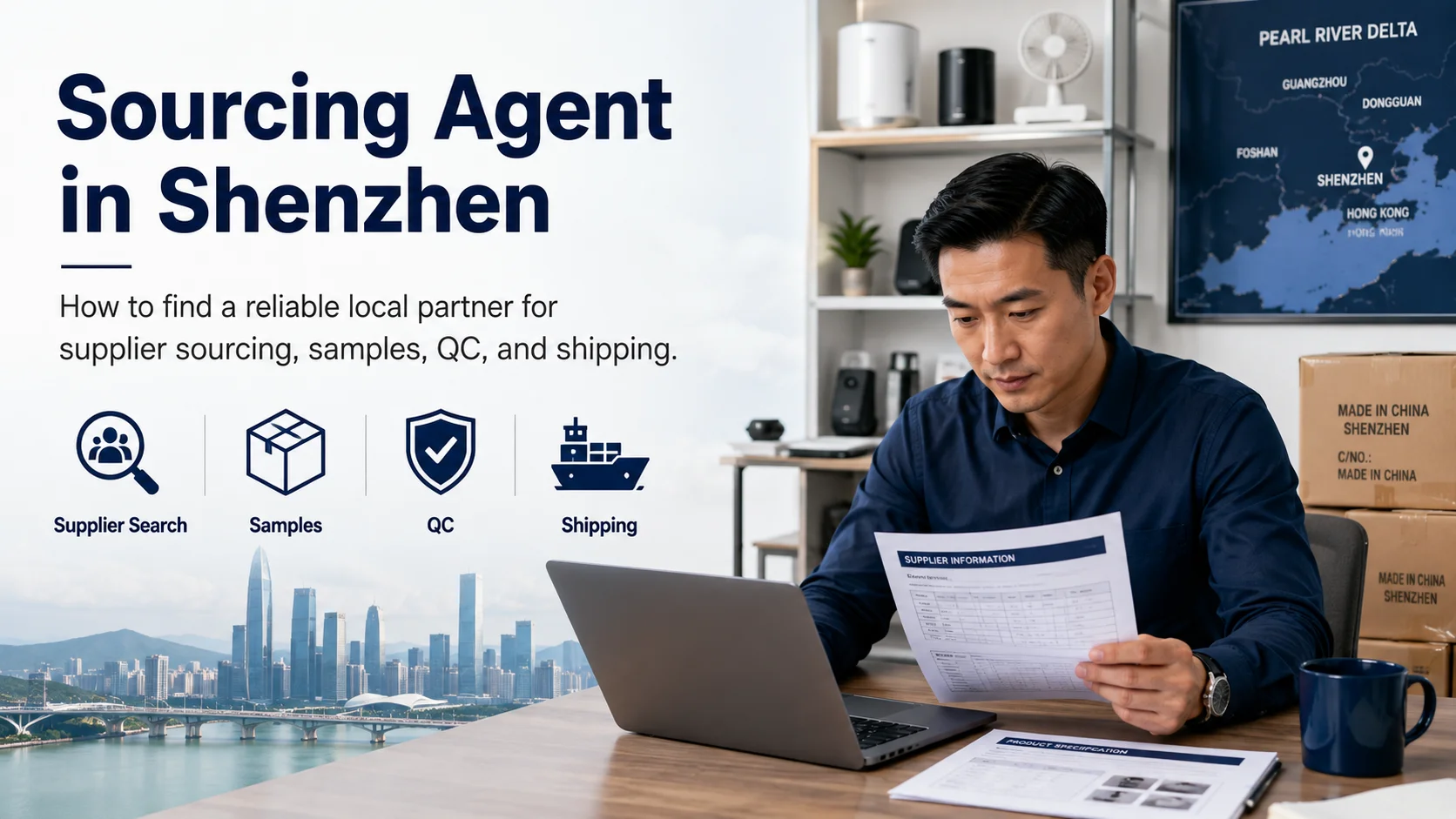
A sourcing agent in Shenzhen can help buyers access suppliers, manage samples, and coordinate production, but choosing the wrong partner can create costly delays and quality problems. Fast replies and low quotes often look convincing at first. A reliable agent should instead provide a clear, transparent process for supplier selection, samples, quality control, and shipping.
To find a reliable sourcing agent in Shenzhen, buyers should compare supplier access, industry experience, fee transparency, supplier verification, sample management, production follow-up, quality-control support, and the ability to manage suppliers across Shenzhen and the wider Pearl River Delta. Shenzhen is especially useful for electronics and 3C sourcing[^1], but an agent’s reliability depends on its working process—not simply its office location.
In my sourcing work, I have seen that the best early signal is not a promise of the “best factory price.” It is whether the agent can turn a vague product idea into an executable sourcing plan. Buyers should look for clear questions, written next steps, and verifiable outputs before they place an order.
What Is the Quick Answer for Finding a Sourcing Agent in Shenzhen?
Many buyers contact a sourcing agent in Shenzhen with only a product photo or an Alibaba link. That can start a conversation, but it often creates confusion later. Unclear specifications lead to inconsistent quotes, unsuitable samples, and disagreements about quality expectations.[^2]
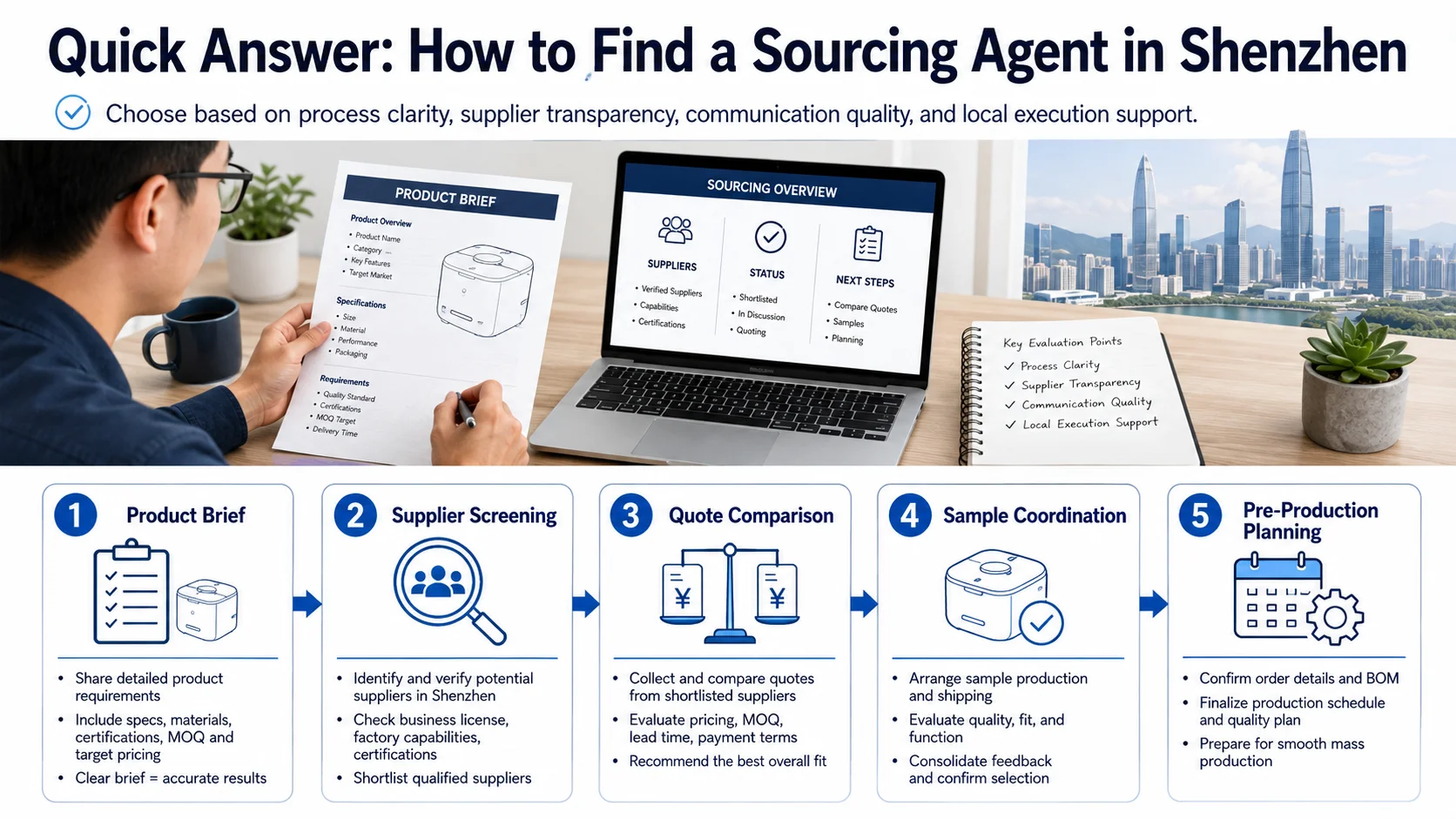
A reliable Shenzhen sourcing company should ask practical questions, explain how suppliers will be screened, compare quotations in a structured way, coordinate samples, and define what happens before production begins. Buyers should choose an agent based on process clarity, supplier transparency, communication quality, and local execution support.
Start With a Concrete Product Brief
I usually recommend that buyers begin with a short but specific product brief. The brief does not need to be perfect. However, it should give the sourcing team enough information to search for the right supplier type.
A useful product brief may include:
- Product photos, links, sketches, or reference samples
- Target dimensions, materials, colors, and packaging
- Expected order quantity
- Target market and intended sales channel
- Required certifications or testing documents, if applicable
- Target price range or budget assumptions
- Quality expectations and known product risks
- Delivery deadline or launch date
A capable sourcing agent in Shenzhen should be able to restate the assignment in writing. This simple step is more valuable than many buyers realize. It shows whether the agent understands the product, the unresolved issues, and the next actions.
For example, a buyer may ask for “a fast charger.” That request is still too broad for meaningful supplier comparison. The sourcing team may need to clarify plug type, charging protocol, output wattage, cable inclusion, packaging language, labeling, destination market, and applicable compliance requirements. A low quote without those details may not represent the same product.
A reliable agent does not pretend that every unknown detail is already solved. The agent should identify the missing information and help the buyer define workable acceptance criteria.
Shenzhen is a helpful base for this work because it connects buyers with electronics suppliers, component markets, freight infrastructure, and nearby manufacturing cities.[^3] Still, location alone does not prove capability. A repeatable workflow does.
Why Do Buyers Choose a Sourcing Agent in Shenzhen?
Buyers often feel overwhelmed by China’s supplier landscape. They may find hundreds of factories online, yet they still struggle to compare supplier capability, verify product fit, manage samples, and follow production from overseas.
A sourcing agent in Shenzhen can be useful because Shenzhen sits within the Pearl River Delta supply chain. The region connects electronics production, component sourcing, packaging, assembly, logistics, and export services across Shenzhen, Dongguan, Huizhou, Guangzhou, Foshan, and nearby cities.[^4]
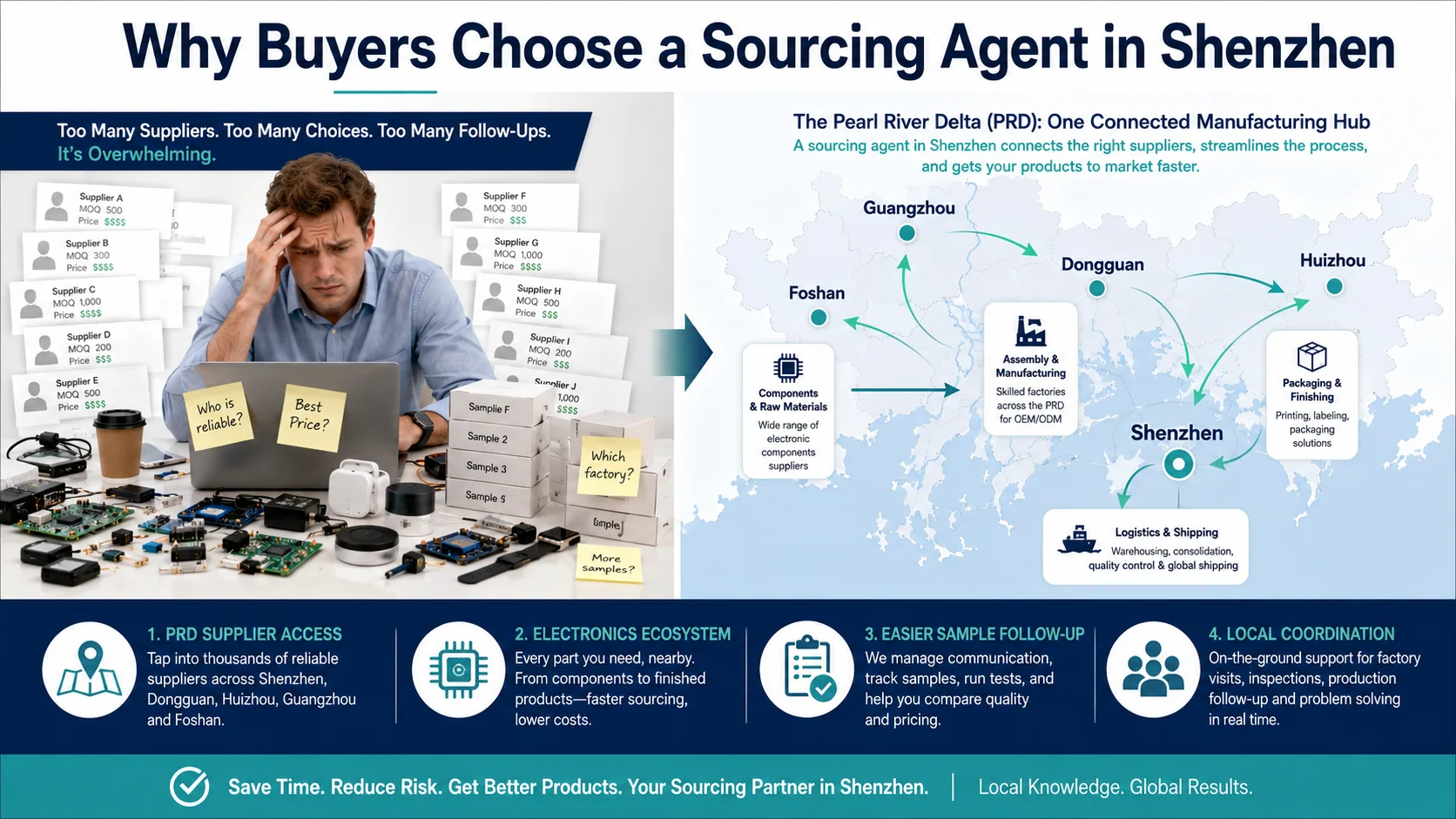
Shenzhen Is More Than One City’s Factory Base
Shenzhen is widely known for consumer electronics, smart devices, mobile accessories, charging products, cables, audio equipment, and hardware-related supply chains.[^5] However, buyers should not assume that every suitable factory is physically located in Shenzhen city.
In practice, Shenzhen often works as a commercial and coordination hub. A product may involve:
| Supply Chain Activity | Common Regional Location Examples |
|---|---|
| Electronics trading and component sourcing | Shenzhen |
| Assembly and electronics manufacturing | Shenzhen, Dongguan, Huizhou |
| Plastic molding and metal parts | Dongguan, Huizhou, Foshan |
| Packaging and printed materials | Shenzhen, Dongguan, Guangzhou |
| Consumer goods and trading suppliers | Guangzhou |
| Warehousing and export logistics | Shenzhen, Guangzhou |
This regional access can help when a product requires several suppliers. For example, one factory may produce the main device, another may supply a cable, another may print retail packaging, and another may provide a molded accessory. A local procurement agent can help coordinate those moving parts.
That said, buyers should remain practical. A Shenzhen office does not automatically mean an agent has strong relationships with every factory in the Pearl River Delta. I recommend asking how the agent identifies suppliers for your particular category and how they compare factory options.
A good answer should explain:
- Where the agent will search for suppliers.
- What criteria the agent will use to screen them.
- Whether the supplier identity will be disclosed.
- How samples will be checked against the agreed requirements.
- Who will follow production after the buyer approves a sample.
What Services Should a Sourcing Agent in Shenzhen Provide?
A buyer may find a supplier independently, but managing the full procurement cycle can still take significant time. Small mistakes in samples, packaging, inspection timing, or shipment consolidation can affect the final landed cost and customer experience.
A professional sourcing agent in Shenzhen should provide more than supplier introductions. The service should connect supplier sourcing, quote comparison, sample follow-up, production coordination, quality control, and shipping support into one documented process.
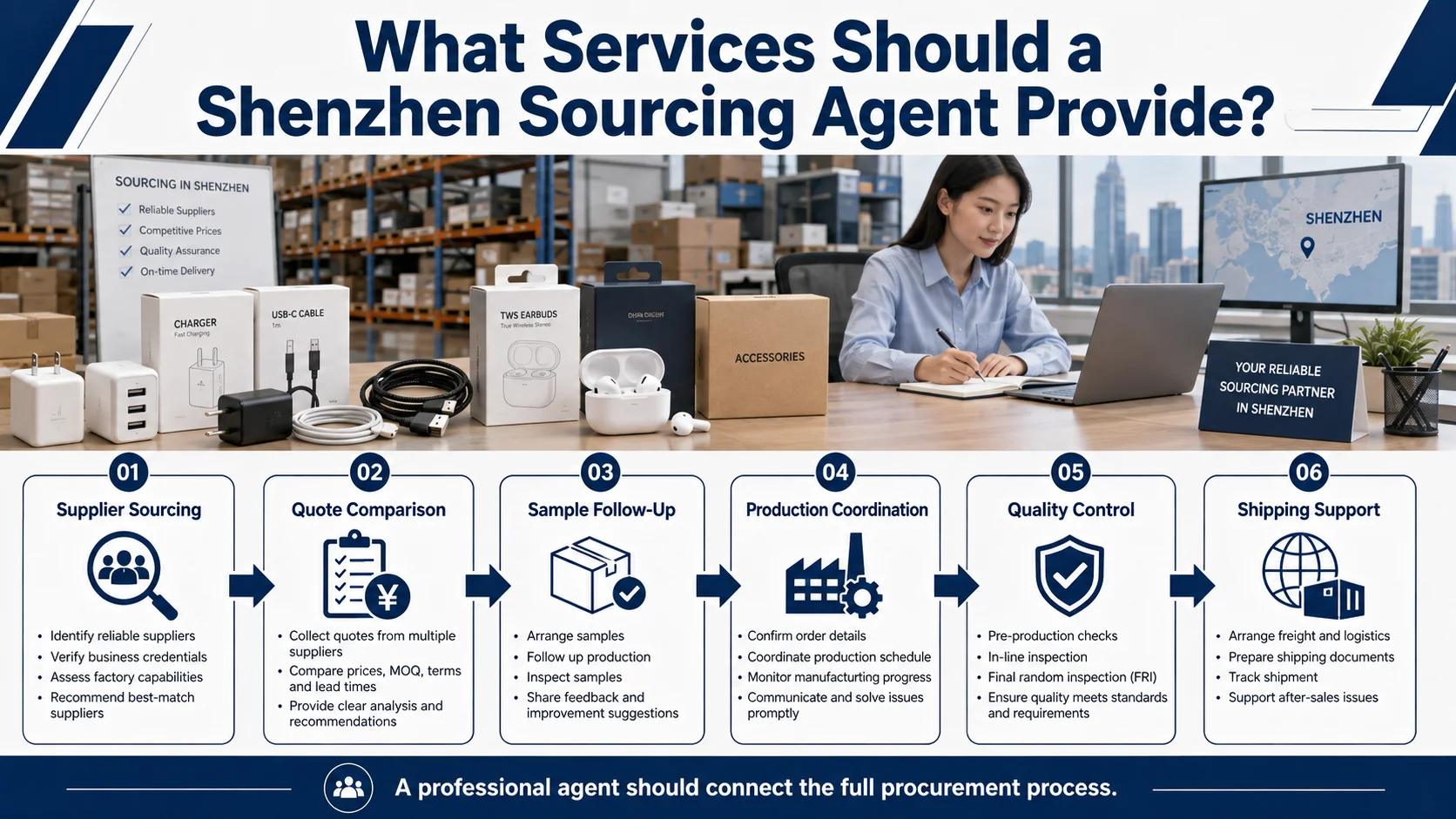
Core Services Buyers Should Expect
The exact scope depends on the project, product category, and order value. Still, buyers should understand what is included before work begins.
At KingSourcing, our work is built around helping overseas buyers manage sourcing activities that they cannot easily handle from abroad. Our support can include supplier research, sample follow-up, order coordination, inspections, consolidation, and shipping arrangements.
A typical service scope may include:
- Supplier sourcing: Identifying potential factories or trading suppliers based on the buyer’s product brief.
- Quotation comparison: Comparing pricing, MOQs, lead times, materials, packaging, and trade terms.
- Supplier verification: Reviewing available business information, product capability, communication quality, and relevant documents.
- Sample coordination: Following sample requests, revisions, packaging details, and buyer feedback.
- Negotiation support: Clarifying commercial terms, payment stages, delivery expectations, and packaging requirements.
- Production follow-up: Tracking agreed milestones and communicating with suppliers during production.
- Quality-control coordination: Arranging inspections based on defined checklists and buyer-approved standards.
- Shipping support: Consolidating goods, preparing shipping information, and coordinating freight options.
Ask What Is Included—and What Is Not
One common problem is that buyers assume all sourcing activities are covered by one fee. Another problem is that agents assume buyers understand where their service ends. Both situations can create friction.
Before you hire a Shenzhen procurement agent, ask for written clarification on:
- Sourcing or service fees
- Inspection fees and inspection scope
- Sample handling costs
- Storage and consolidation charges
- Packaging or labeling coordination fees
- Freight quotation process
- Communication channels and reporting frequency
- Responsibility for supplier disputes or defective goods
A reliable agent should not claim that sourcing has zero risk. The agent should explain how risks are identified, documented, and managed during each stage.
How Should You Evaluate a Shenzhen Sourcing Company?
Many buyers compare sourcing companies by website design, social media content, or the speed of the first reply. Those signals can be useful, but they do not show how the company performs when a supplier misses a deadline or a sample fails expectations.
To evaluate a sourcing agent in Shenzhen, buyers should test operational clarity. The best test is to submit a real product brief and review how the agent asks questions, structures the sourcing task, and explains the next steps.
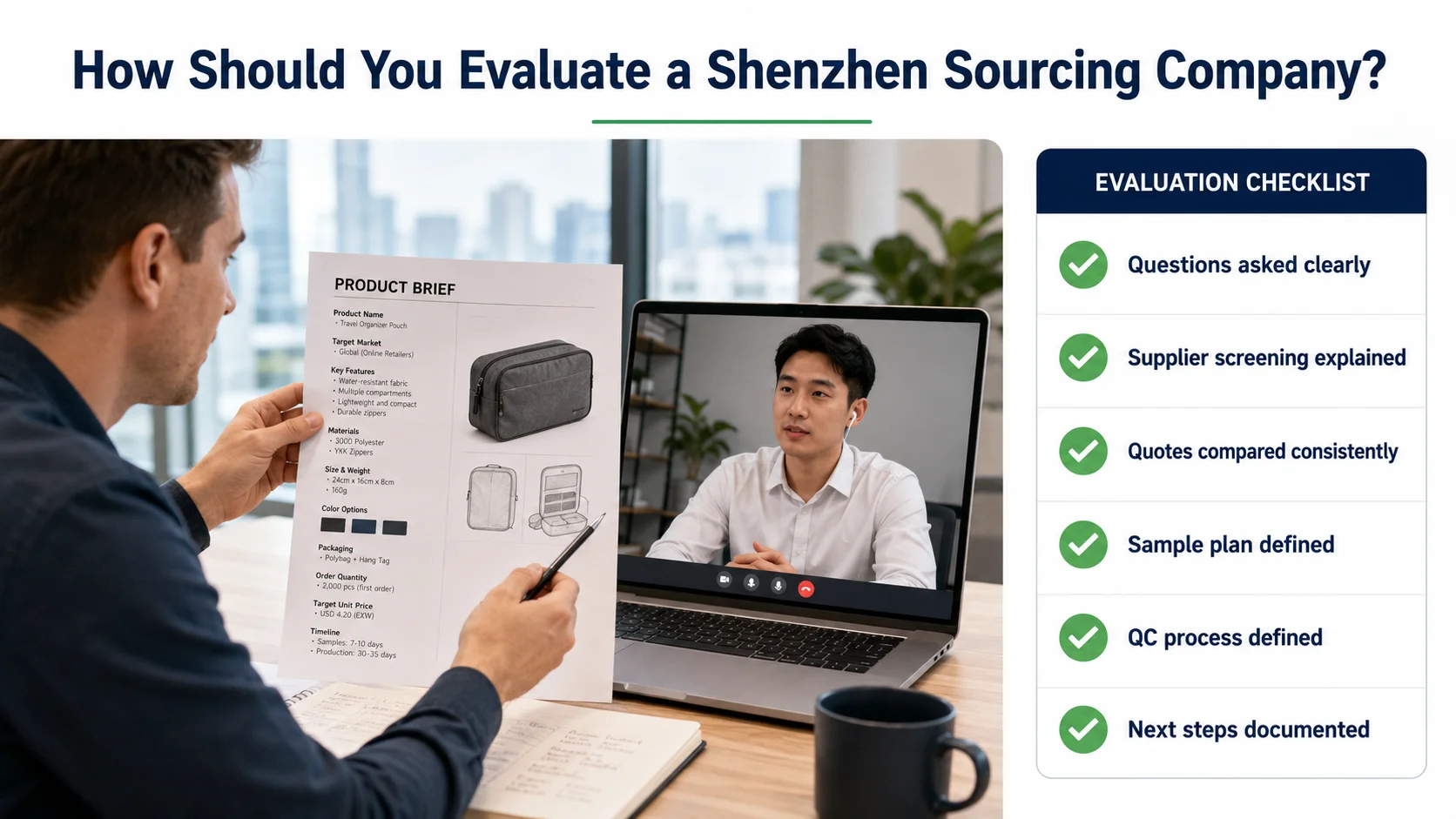
Use the First Project as a Practical Due-Diligence Test
In my experience, buyers can learn a lot before they place a large order. A serious agent should not rush directly into price promises. The agent should first identify the product requirements that affect supplier selection.
I suggest evaluating each candidate against the following areas:
| Evaluation Area | What Buyers Should Look For |
|---|---|
| Product understanding | Clear questions about specifications, materials, quality, packaging, and target market |
| Supplier transparency | A clear policy on supplier identity and factory information |
| Quotation quality | Comparable quotes with stated assumptions, MOQ, lead time, and trade terms |
| Communication | Direct answers, realistic timelines, and written follow-up |
| Sample process | Defined sample requirements, revision process, and approval stage |
| QC process | Inspection timing, checklist development, reporting format, and issue escalation |
| Fee structure | Transparent sourcing, inspection, storage, and shipping-related charges |
| Problem handling | A realistic explanation of what happens if a supplier or sample fails |
Do Not Treat One Signal as Proof
A business license, office address, review profile, or polished website may be worth checking. However, none of these items alone proves that a company can manage your order well.
Likewise, a low service fee does not necessarily mean better value. A cheap service can become expensive if it leads to poor supplier selection, incomplete sample reviews, unclear quality standards, or missed shipping deadlines.
The best Shenzhen sourcing agent for one buyer may not suit another buyer. A dropshipper testing a $500 product order has different needs from an established importer placing container-level orders. Buyers should choose an agent whose process, product experience, and service level match their current stage.
How Does a Shenzhen Sourcing Agent Compare With Direct Factory Sourcing and Online Platforms?
Buyers may wonder whether they need an agent at all. Direct factory sourcing and online platforms can work well in the right circumstances. However, each option places different responsibilities on the buyer.
A sourcing agent in Shenzhen is often most useful when buyers need local coordination across multiple suppliers, need help validating samples, or lack an in-house China procurement team. Direct factory sourcing works best when the buyer already knows and trusts the right manufacturer.
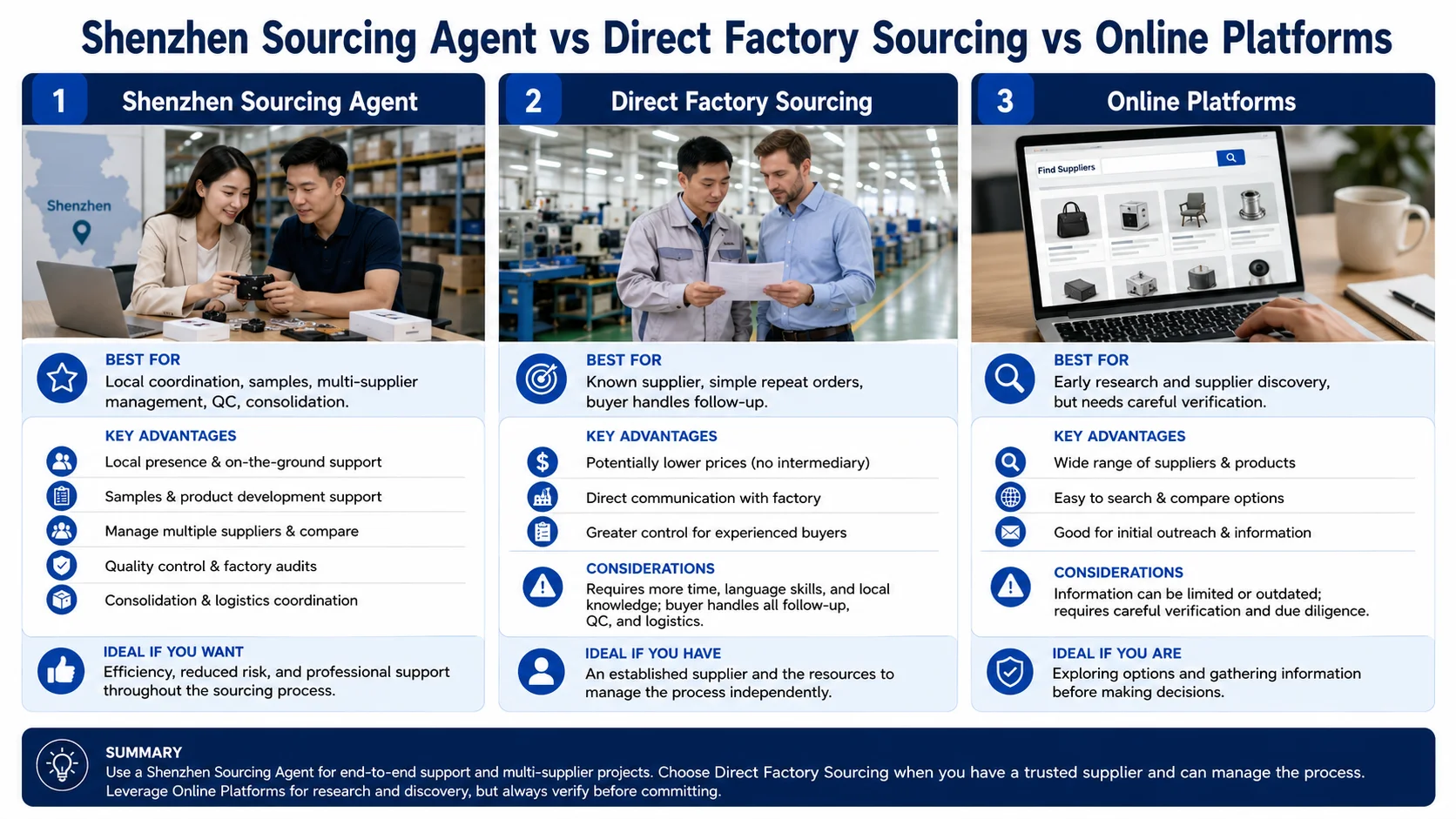
Compare the Management Burden, Not Only the Price
The right sourcing model depends on product complexity, order volume, supplier knowledge, and the buyer’s ability to manage overseas procurement.
| Factor | Shenzhen Sourcing Agent | Direct Factory | Alibaba / Online Platform |
|---|---|---|---|
| Supplier discovery | Broad supplier search | One known supplier | Broad but buyer-led |
| Local verification | Local support available | Buyer-managed or limited | Varies by seller |
| Quote comparison | Centralized comparison | Limited to one factory | Manual comparison |
| Sampling | Coordinated by agent | Managed directly | Buyer-managed |
| Production follow-up | Local support available | Buyer manages communication | Often limited |
| Multi-supplier orders | Easier to coordinate | More difficult | Buyer-managed |
| QC support | Can be arranged locally | Buyer arranges separately | Varies |
| Best for | Managed procurement | Established factory relationships | Initial product discovery |
Choose Based on Your Actual Capability
Direct factory sourcing can reduce layers in the supply chain.[^6] However, the buyer must still manage communication, supplier verification, sample specifications, production follow-up, inspection arrangements, and logistics.
Online platforms are useful for initial supplier discovery.[^7] They can help buyers understand product ranges, pricing signals, and minimum order quantities. Still, platform listings do not replace careful product evaluation or factory-level due diligence.[^8]
A reliable sourcing company in Shenzhen can add value when the buyer needs a local team to coordinate several steps. This does not mean an agent replaces buyer involvement. Buyers still need to define their target product, budget, quality expectations, and approval criteria.
What Products Are Best Sourced From Shenzhen and the Pearl River Delta?
A buyer may choose Shenzhen because the region has strong electronics visibility. However, product selection should be based on the actual supply chain, not on a city’s reputation alone. Some categories are better sourced elsewhere in China.
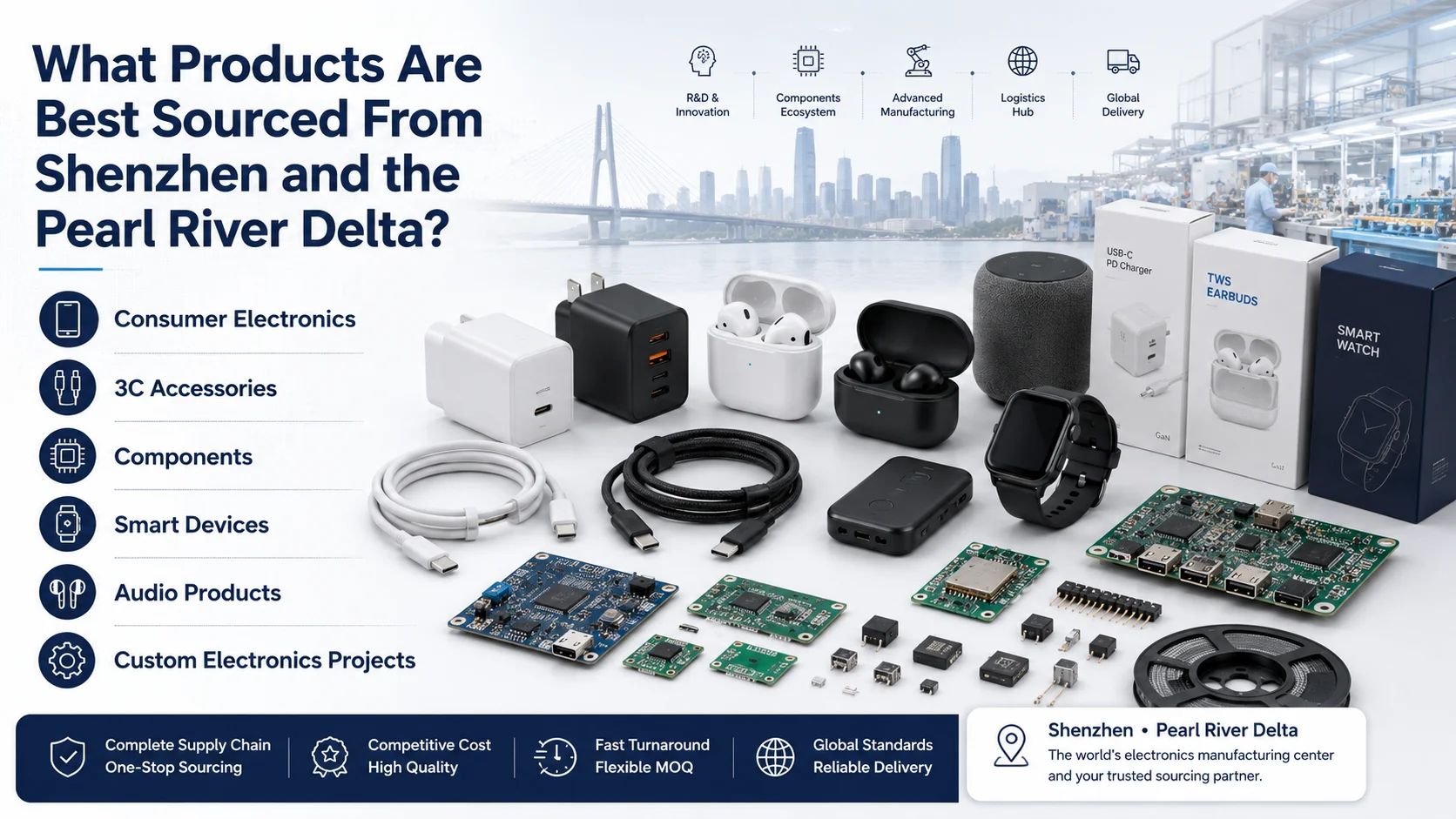
Shenzhen and the wider Pearl River Delta are often strong options for consumer electronics, 3C accessories, components, smart devices, cables, chargers, audio products, and custom electronics projects[^9] that require regional supplier coordination.
Categories That Often Fit the Region
The following categories may benefit from Shenzhen supplier sourcing and nearby Pearl River Delta manufacturing:
- Phone accessories and mobile device peripherals
- USB cables, charging cables, adapters, and power accessories
- Bluetooth speakers, earphones, and audio accessories
- Smart home accessories and connected devices
- LED products and electronic components
- Computer peripherals and gaming accessories
- Small electronic devices and customized hardware projects
- Product bundles that combine electronics, packaging, and accessories
For these products, the supply chain may involve component vendors, assembly factories, testing equipment, packaging providers, and freight partners. A local sourcing team can help connect those stages.
Still, buyers should verify factory capability for the exact product. A supplier that produces standard charging cables may not be suitable for a custom cable with specific materials, certifications, retail packaging, or performance requirements.
Verify Compliance and Quality Requirements Early
Electronics buyers should also consider compliance, safety, and market-specific requirements. Depending on the product and destination market, buyers may need relevant test reports, declarations, labeling, or certification documents.[^10]
An agent can help collect supplier-provided documents, but buyers should verify whether those documents apply to the exact product, model, factory, and target market. Qualified compliance professionals should review application-specific requirements when necessary.
What Questions Should You Ask a Sourcing Agent in Shenzhen Before Hiring?
Buyers often ask, “Can you source this product?” That question is useful, but it is not enough. A better conversation reveals how the agent will execute the project and how both sides will handle uncertainties.
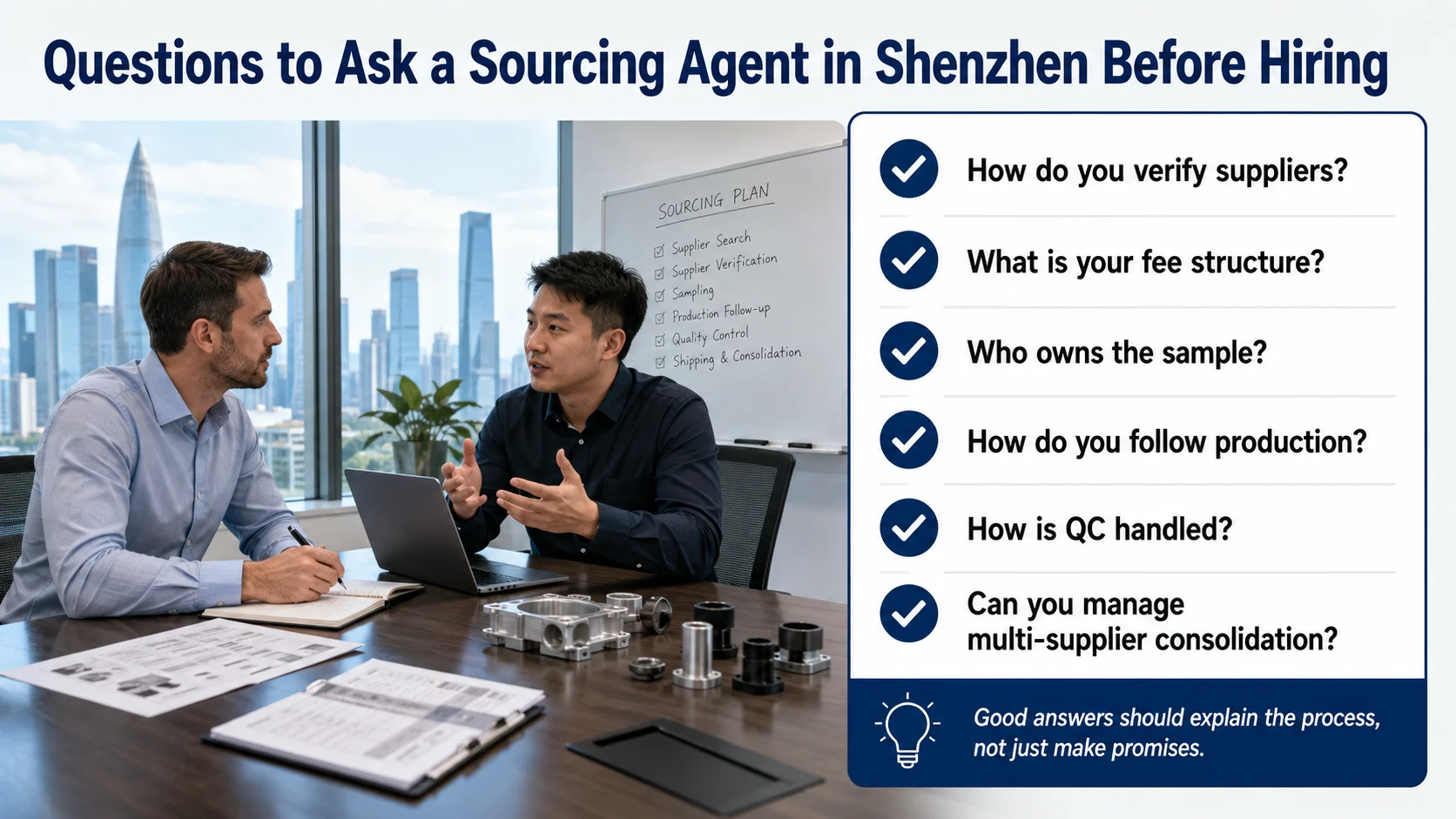
Before hiring a sourcing agent in Shenzhen, buyers should ask direct questions about supplier verification, fee structure, sample ownership, production follow-up, quality control, and multi-supplier consolidation.
Use Questions That Reveal Process
I recommend asking these questions in writing:
- How do you identify and screen potential suppliers?
- Will you share supplier names, factory information, and quotation details?
- What information do you need from me before you begin sourcing?
- How will you compare quotes beyond unit price?
- Who follows sample revisions and confirms requirements with suppliers?
- How do you manage production follow-up after sample approval?
- How is quality control arranged, and what does the inspection report include?
- Can you consolidate goods from several factories?
- How are sourcing, inspection, storage, and shipping fees charged?
- What happens if a sample does not meet the agreed requirements?
A good agent should provide specific answers. Vague statements such as “we have many factories” or “we guarantee the best price” do not explain execution.
For a more detailed question list, buyers can also review our guide to questions to ask a sourcing agent. The goal is not to interrogate every provider. The goal is to find a partner that communicates clearly before money and production risk increase.
Shenzhen Sourcing Agent vs Yiwu or Guangzhou: Which Location Fits Your Products?
Buyers sometimes search for the “best city” for China sourcing. In reality, Shenzhen, Guangzhou, and Yiwu serve different supply-chain strengths. A sourcing location should match the product category, supplier type, order requirements, and logistics plan.
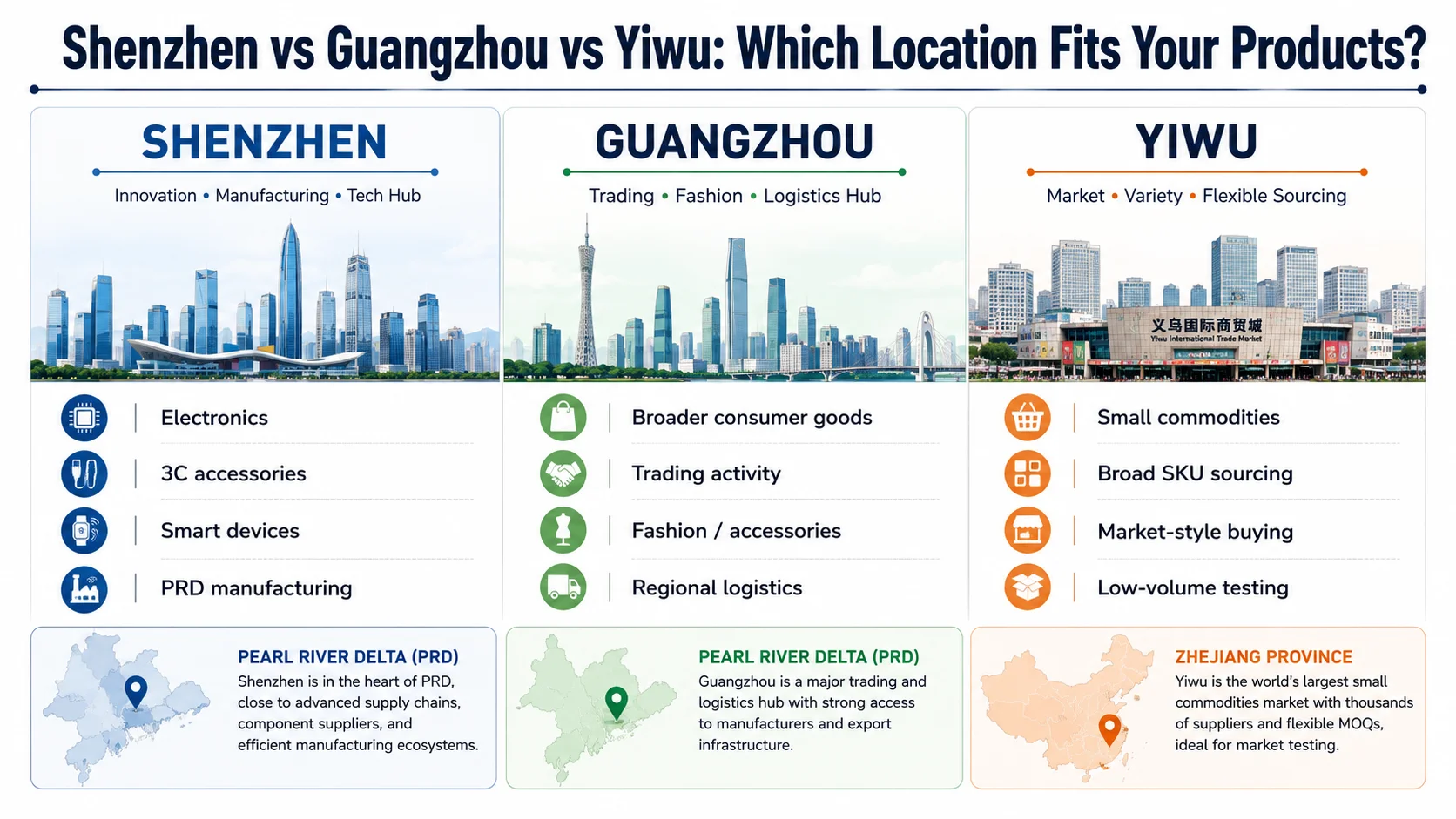
A sourcing agent in Shenzhen is often suitable for electronics and Pearl River Delta supply chains. Guangzhou can suit broader consumer goods and trading activity, while Yiwu is widely used for small commodities, broad SKU sourcing, and lower-volume product testing.[^11]
Match the City to the Product Supply Chain
| Location | Often Suitable For | Buyer Consideration |
|---|---|---|
| Shenzhen / Dongguan | Electronics, 3C accessories, components, smart devices | Strong regional manufacturing and export ecosystem |
| Guangzhou | Consumer goods, fashion-related categories, trading markets | Broad commercial and wholesale network |
| Yiwu | Small commodities, gift items, accessories, broad SKU ranges | Useful for variety and lower-volume product exploration |
These are not strict rules. A supplier in Guangzhou may offer electronics. A Shenzhen-based agent may source products from Yiwu, Zhejiang, or other regions. The most important factor is whether the agent can identify the best supply base for your specific product.
At KingSourcing, we do not treat Shenzhen as the only answer for every project. We look at product requirements, supplier concentration, sample needs, packaging, order scale, and logistics. This approach helps buyers avoid choosing a location first and discovering later that the strongest supplier base is elsewhere.
How Can You Start Working With a Sourcing Agent in Shenzhen?
Starting a sourcing project can feel complicated, especially for a first-time importer. Buyers may worry that they need final technical specifications before speaking with anyone. In many cases, buyers can begin with a structured brief and refine the details during the sample stage.
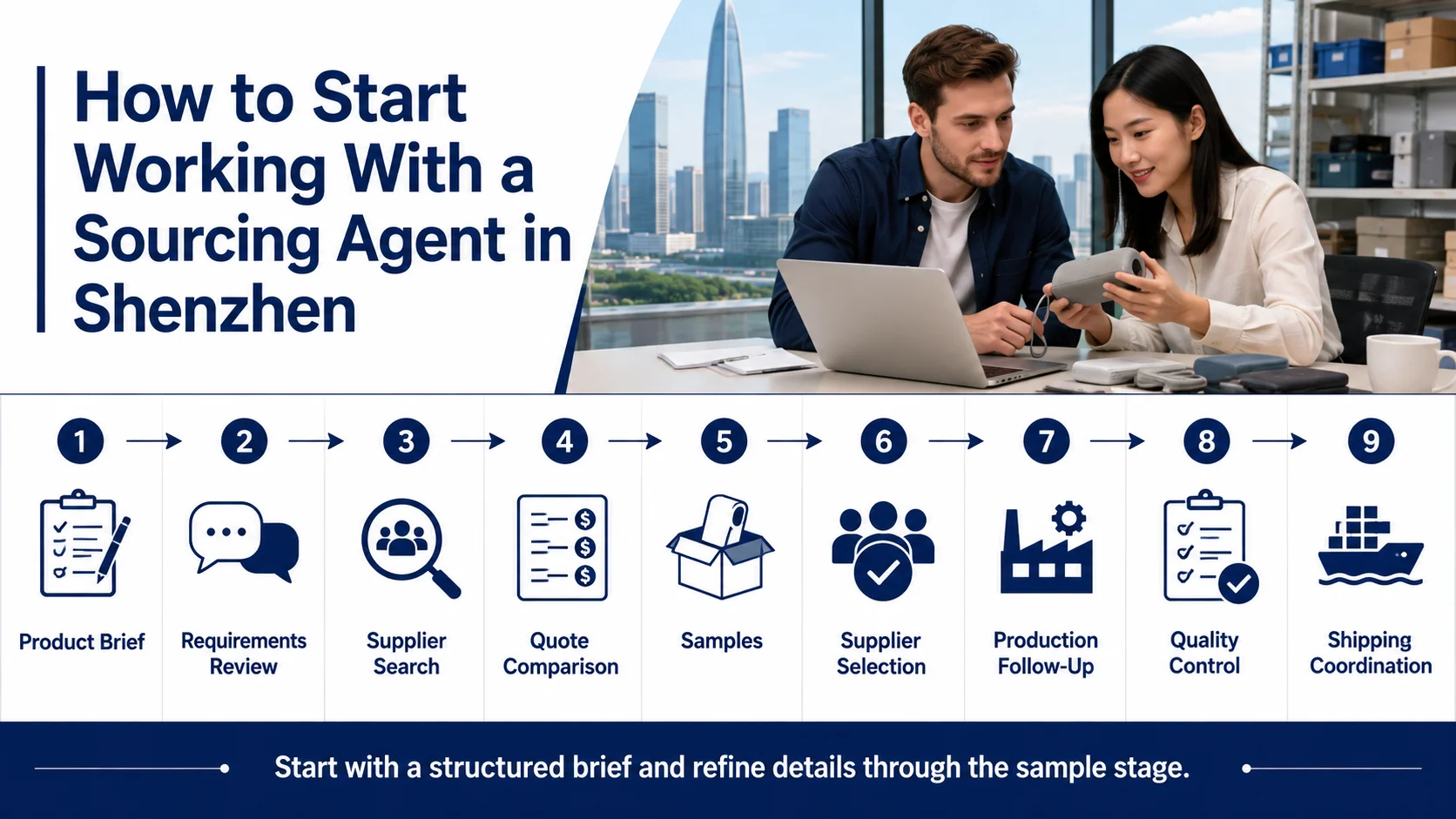
A sourcing agent in Shenzhen should guide buyers through a practical sequence: product brief, requirements review, supplier search, quote comparison, samples, supplier selection, production follow-up, quality control, and shipping coordination.
A Practical Sourcing Workflow
A typical project may follow this process:
- Product brief: The buyer sends product links, photos, specifications, quantities, packaging needs, and target price assumptions.
- Requirements review: The sourcing team identifies missing details, sourcing risks, and supplier-screening criteria.
- Supplier search: The team researches relevant factories or suppliers in Shenzhen, the Pearl River Delta, or other suitable regions.
- Quote comparison: The buyer receives comparable information on price, MOQ, lead time, materials, packaging, and terms.
- Samples: The supplier produces samples, and the buyer reviews them against agreed requirements.
- Supplier selection: The buyer selects a supplier after considering sample results, commercial terms, and capability.
- Order follow-up: The sourcing team tracks production milestones and communicates with the supplier.
- Quality control: Inspection is arranged according to the buyer’s approved checklist and acceptance standards.
- Shipping: Goods can be consolidated, packed, documented, and shipped based on the buyer’s logistics plan.
The buyer’s role remains important throughout this process. An agent can help structure an unclear request, but the buyer must still decide what quality level, product features, budget, and acceptance standards are appropriate for the market.
Frequently Asked Questions
Is Shenzhen good for electronics sourcing?
Shenzhen is often a strong sourcing location for consumer electronics, 3C accessories, components, smart devices, cables, chargers, and audio products. Buyers should still verify each supplier’s actual capability, quality system, product documents, and experience with the target market.
How much does a Shenzhen sourcing agent charge?
Fees vary by service scope, product complexity, order value, inspection needs, storage, and shipping arrangements. Buyers should request a written fee structure that separates sourcing fees, quality-control fees, warehouse charges, and logistics costs before work begins.
Can a Shenzhen sourcing agent work with Dongguan factories?
Yes, many Shenzhen sourcing agents coordinate with suppliers across the Pearl River Delta, including Dongguan, Huizhou, Guangzhou, and Foshan. Buyers should confirm the agent’s actual coverage and ask how factory visits, sample follow-up, and inspections will be handled.
Should I source directly from a factory or use a sourcing agent?
Direct factory sourcing can work well when you already know a capable supplier and can manage communication, samples, quality control, and shipping. A sourcing agent may be more useful when you need supplier comparison, local follow-up, multi-supplier coordination, or inspection support.
What is the best way to test a Shenzhen sourcing company?
Send a real product brief and ask the company to explain its sourcing process in writing. Review the questions it asks, how it defines supplier criteria, whether it explains quote assumptions, and how it plans to manage samples and quality checks.
Conclusion
Finding a reliable sourcing agent in Shenzhen is not about choosing the fastest responder or the lowest initial quote. Buyers should look for transparent supplier sourcing, structured quotation comparison, careful sample follow-up, defined quality-control support, and realistic communication about risks. Shenzhen and the Pearl River Delta can offer strong advantages for electronics and related supply chains, but the agent’s execution process matters most. Send KingSourcing your product brief, BOM, reference product, or existing supplier quotation for supplier sourcing and procurement support in Shenzhen and across China.
Work With a China Sourcing Partner
If you're planning an order from China, our sourcing team can help with supplier verification, factory audits, QC inspections, order consolidation, and shipping. Contact our sourcing team to discuss your requirements.
Related reading: How to Find a Reliable Sourcing Agent in Ningbo, China
[^1]: "[PDF] Global Value Chains in the Electronics Industry", https://openknowledge.worldbank.org/bitstreams/c631a747-7414-5a06-a7ca-c3dd60711d8a/download. Research on Shenzhen's industrial development identifies the city as a major center of electronics manufacturing and related technology supply chains. Evidence role: general_support; source type: research. Supports: Evidence that Shenzhen developed as a major electronics manufacturing, innovation, and supply-chain center.. Scope note: Industrial-cluster evidence supports the regional specialization but does not establish that every electronics supplier or sourcing project is best handled in Shenzhen. [^2]: "Specifications - Kansas State University", https://www.k-state.edu/finsvcs/purchasing/Specifications.html. Procurement and quality-management research emphasizes that clearly defined and communicated requirements are necessary for comparable supplier responses and for assessing whether delivered goods conform to buyer expectations. Evidence role: mechanism; source type: research. Supports: Evidence that clear, communicated requirements are important for supplier selection, quotation comparability, and conformity assessment.. Scope note: The evidence establishes a general mechanism and cannot predict the outcome of a particular quotation, sample, or supplier relationship. [^3]: "Pearl River Delta", https://en.wikipedia.org/wiki/Pearl_River_Delta. Regional economic analyses describe Shenzhen as an electronics and logistics hub integrated with manufacturing centers across the Pearl River Delta. Evidence role: general_support; source type: institution. Supports: Evidence describing Shenzhen's role in the Pearl River Delta's electronics, logistics, and manufacturing network.. Scope note: Such regional evidence describes aggregate connectivity and does not verify an individual agent's access to suppliers or logistics providers. [^4]: "[PDF] Pearl River Delta Regional Planning and Its Implication to Mekong ...", https://documents1.worldbank.org/curated/en/099062923033011864/pdf/P16270202a0df10c10891106f50650bc830.pdf. Studies of the Pearl River Delta describe an integrated regional production system in which manufacturing, component supply, trade, and logistics functions are distributed among multiple cities. Evidence role: general_support; source type: research. Supports: Evidence that manufacturing and service activities in the Pearl River Delta are distributed across interconnected cities.. Scope note: The evidence concerns regional production networks generally and may not confirm every activity or product category in each city listed. [^5]: "Shenzhen - Wikipedia", https://en.wikipedia.org/wiki/Shenzhen. Scholarship on Shenzhen's hardware ecosystem documents the city's concentration of consumer-electronics firms, component suppliers, manufacturers, and related service providers. Evidence role: general_support; source type: paper. Supports: Evidence that Shenzhen's manufacturing ecosystem has substantial specialization in consumer electronics and hardware-related production.. Scope note: Cluster-level specialization does not demonstrate that every listed product is manufactured locally or that individual suppliers meet a buyer's requirements. [^6]: "Disintermediation", https://en.wikipedia.org/wiki/Disintermediation. Supply-chain research describes disintermediation as reducing or removing intermediaries between producers and buyers, potentially shortening the transaction chain. Evidence role: mechanism; source type: paper. Supports: Evidence that disintermediation can reduce the number of intermediaries between buyer and manufacturer.. Scope note: Fewer intermediaries do not necessarily lower total cost or risk, since buyers may assume additional verification, coordination, and logistics responsibilities. [^7]: "[PDF] Supplier Responses to Platform Recommendations in Business-to ...", https://questromworld.bu.edu/platformstrategy/wp-content/uploads/sites/49/2026/06/1151_Cong_Supplier_Response_to_Recommendations.pdf. Research on electronic B2B marketplaces finds that these platforms can lower search and information costs by helping buyers identify and compare potential suppliers. Evidence role: mechanism; source type: paper. Supports: Evidence that online B2B marketplaces facilitate supplier discovery and information search for buyers.. Scope note: Facilitating discovery does not itself establish supplier capability, product conformity, or factory-level due diligence. [^8]: "3 supplier due diligence tips for risk management", https://www.moodys.com/web/en/us/kyc/resources/insights/three-things-to-know-performing-supplier-due-diligence.html. Supplier-management guidance treats supplier selection and monitoring as verification processes that extend beyond supplier-provided marketing or listing information. Evidence role: expert_consensus; source type: institution. Supports: Guidance that supplier evaluation requires verification beyond self-reported or marketplace information.. Scope note: General supplier-management guidance does not evaluate the reliability of any particular online platform or seller. [^9]: "A History of the Electronics Industry in Shenzhen, China", https://www.si.umich.edu/about-umsi/events/military-industrial-complex-global-supply-chain-history-electronics-industry. Regional manufacturing research identifies the Pearl River Delta as a significant concentration of electronics production, component supply, and associated assembly activities. Evidence role: general_support; source type: research. Supports: Evidence of the Pearl River Delta's concentration of electronics manufacturing, components, and related supply-chain activities.. Scope note: This evidence supports regional capability in aggregate; it does not determine the best sourcing location for a particular specification, order size, or compliance need. [^10]: "Special Documents - International Trade Administration", https://www.trade.gov/special-documents. Regulatory guidance for electrical and electronic goods requires applicable products to meet market-specific conformity, documentation, and labeling obligations before being placed on the market. Evidence role: general_support; source type: government. Supports: Official requirements showing that certain electrical and electronic products may require conformity assessment, technical documentation, declarations, and labeling before market placement.. Scope note: Requirements vary by product, jurisdiction, intended use, and applicable legislation; this does not identify the obligations for a specific item. [^11]: "Yiwu International Trade City - Wikipedia", https://en.wikipedia.org/wiki/Yiwu_International_Trade_City. Economic and institutional profiles characterize Guangzhou as a major commercial trading center and Yiwu as a major small-commodity wholesale market with a broad product assortment. Evidence role: general_support; source type: institution. Supports: Evidence that Guangzhou is an important trading center and Yiwu is internationally associated with small-commodity wholesale markets.. Scope note: These regional profiles do not prove that a given product, supplier, or order volume is best served by either location.