A China sourcing agent for wholesale buyers can help when buying from several factories starts to feel harder than selling the products. Different quotes, MOQs, sample issues, packaging details, and delivery dates can quickly create risk.[^1] We help wholesale importers organize these moving parts through one local procurement workflow.
A China sourcing agent for wholesale buyers helps importers find and compare suppliers, review quotations and MOQs, coordinate samples, follow production, arrange quality inspections, consolidate goods from different factories, and support shipping. For multi-SKU wholesale orders and repeat replenishment, the value is usually not just finding one supplier. It is reducing the management complexity across the full purchasing process.[^2]
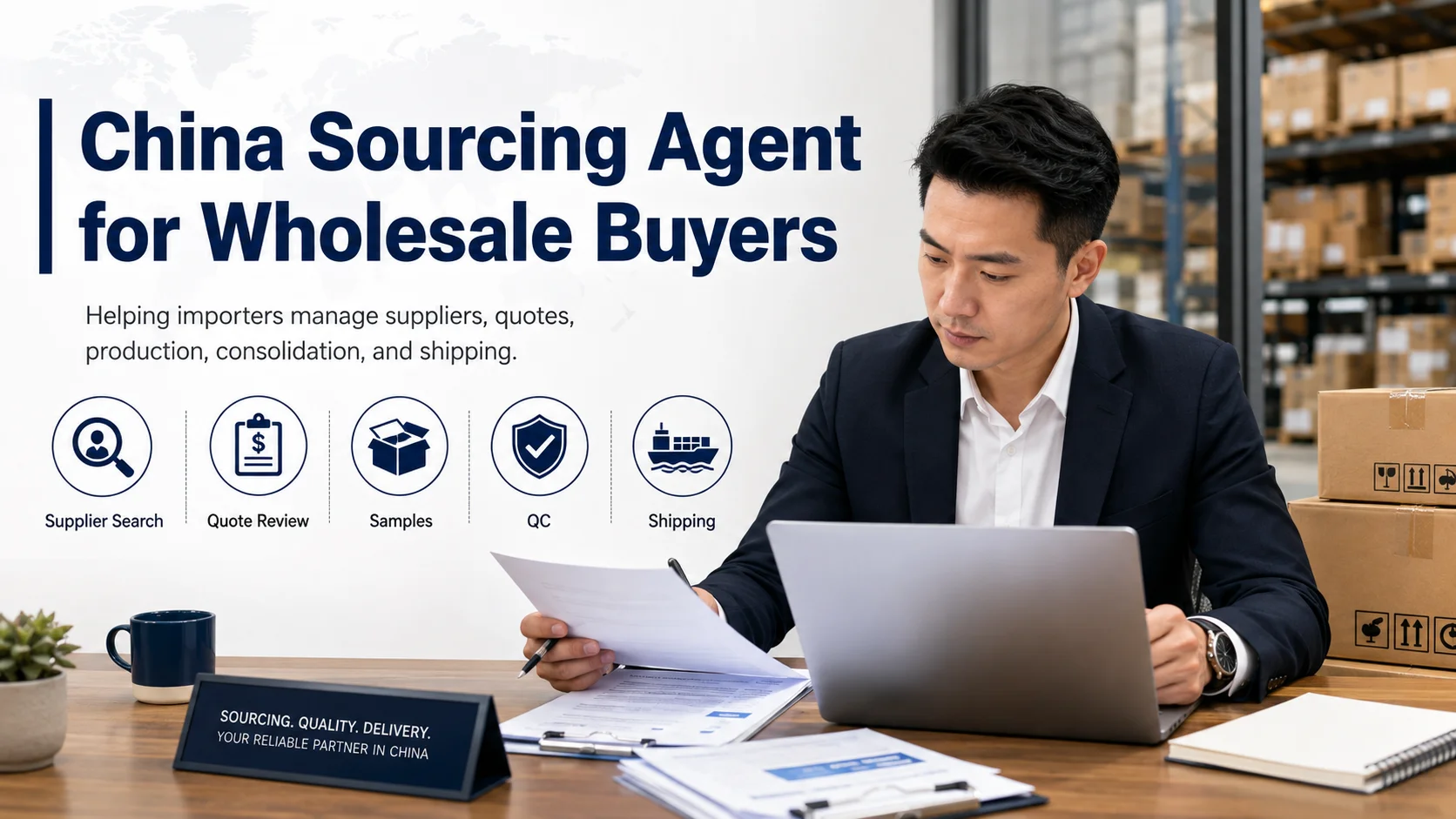
Wholesale sourcing from China can work well, but it requires more than sending inquiries and choosing the lowest price. We believe buyers need a clear process that connects product requirements, supplier evaluation, order execution, quality control, and shipment planning.
Quick Answer: What Does a China Sourcing Agent for Wholesale Buyers Do?
Wholesale buyers often lose time when they manage supplier conversations, product lists, quotes, and shipping arrangements separately. The problem becomes more serious when factories give different answers about materials, lead times, or minimum order quantities.
A China sourcing agent for wholesale buyers acts as a local procurement coordinator. We support supplier sourcing, quote comparison, sample follow-up, MOQ discussions, production monitoring, quality inspections, warehouse receiving, order consolidation, and shipping coordination. The service is most useful when buyers source multiple products or cannot easily verify supplier capability from overseas.
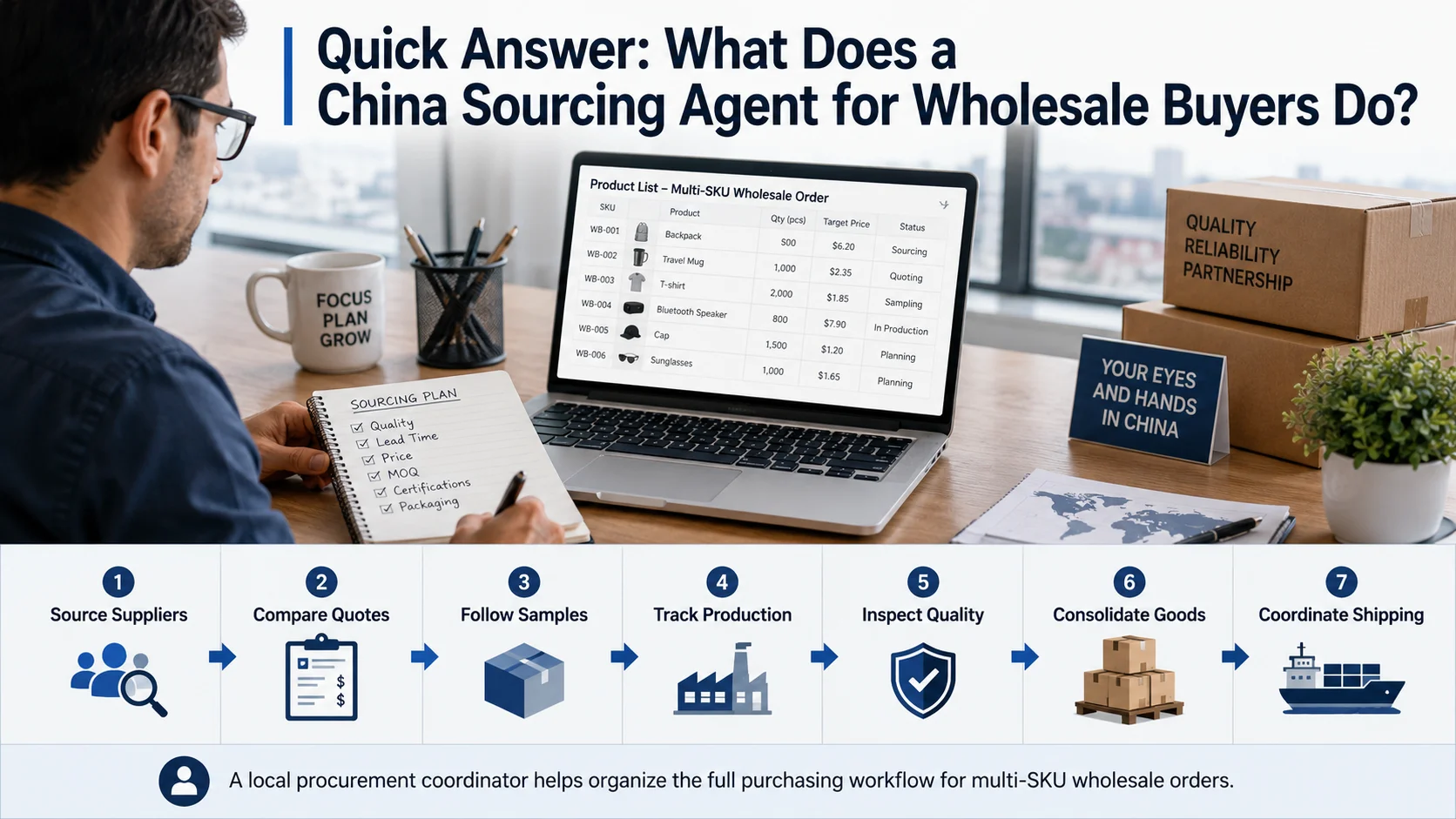
A sourcing agent should not be viewed as someone who simply finds a cheap factory. A lower unit price is only one input. It does not automatically show whether a supplier can maintain quality, meet a packaging requirement, manage a repeat order, or prepare goods correctly for export.
The Wholesale Procurement Workflow We Use
At KingSourcing, we usually begin by turning a broad request into a workable purchasing brief. That may include product photos, specifications, target markets, packaging requirements, expected order quantities, and preferred delivery timing.
A typical wholesale sourcing China workflow looks like this:
-
Product list review
We clarify specifications, materials, colors, packaging, compliance needs, and target quantities. -
Supplier search and initial screening
We identify potential factories or suitable suppliers based on the product category and order requirements. -
Quotation comparison
We compare price, MOQ, tooling or setup costs, sample charges, production time, packaging, and payment terms. -
Sample coordination
We help buyers review samples before production decisions are made. -
Order confirmation and production follow-up
We coordinate approved specifications and track key production milestones. -
Quality control and warehouse receiving
We can arrange inspection based on an agreed inspection scope and receive goods for consolidation. -
Consolidation and shipping support
We combine suitable goods from multiple suppliers and coordinate shipment preparation.
This process does not remove every commercial or production risk. However, it gives wholesale buyers a more structured way to identify issues before goods are shipped.
Why Do Wholesale Buyers Use a China Sourcing Agent?
Wholesale buyers usually face more procurement variables than buyers who order one standard product from one proven factory. A product catalog may include dozens of SKUs, seasonal items, accessories, packaging components, and replacement parts.
Wholesale buyers use a China sourcing agent because multiple SKUs and suppliers create a management problem. A local team can centralize communication, compare supplier terms, track production dates, coordinate inspection, and prepare goods for consolidated shipment. This reduces fragmented work, although buyers still need to make final commercial decisions.
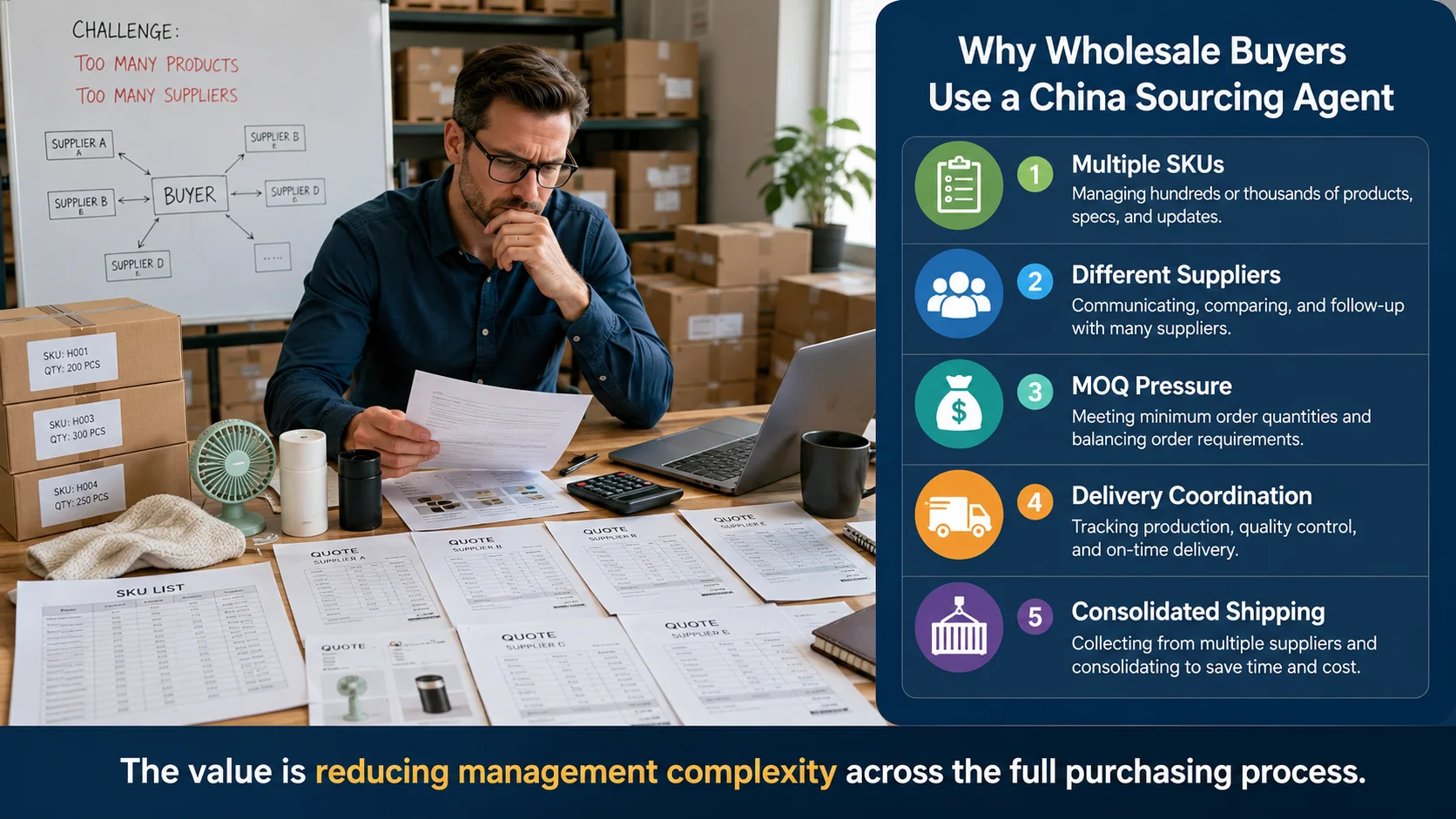
The key issue is often not the number of units. It is the number of decisions. A buyer may purchase 20 products from eight factories, each with different MOQs, carton sizes, lead times, and packaging instructions. Even a modest order can become difficult to control from overseas.
Common Wholesale Sourcing Challenges
We regularly see wholesale buyers dealing with the following issues:
- Multiple product categories that require different supplier types.
- Different MOQ requirements across factories.
- Inconsistent quotations, where one supplier includes packaging and another does not.
- Long communication cycles caused by time zones and unclear specifications.
- Different production schedules that make shipment timing difficult.
- Inventory risk when a buyer commits to too much stock before testing demand.
- Separate shipments that increase freight handling and coordination work.
A China procurement service for importers can help create one source of truth. For example, we can maintain an order list showing each SKU, supplier, quantity, status, target completion date, inspection status, and warehouse receipt status.
For wholesale purchasing, the real question is often not “Can I find a supplier?” It is “Can I control the complete order from supplier selection to final shipment?”
How Does Wholesale Sourcing From China Work?
Wholesale sourcing can become confusing when buyers jump directly from supplier search to payment. That shortcut may leave unclear specifications, untested samples, or unrealistic delivery expectations. A structured workflow makes decisions easier to review.
Wholesale sourcing from China works best as a sequence: product list, supplier search, quote comparison, samples, MOQ negotiation, order confirmation, production follow-up, quality control, consolidation, and shipping. Each stage creates information that helps buyers decide whether to continue, revise requirements, or select another supplier.
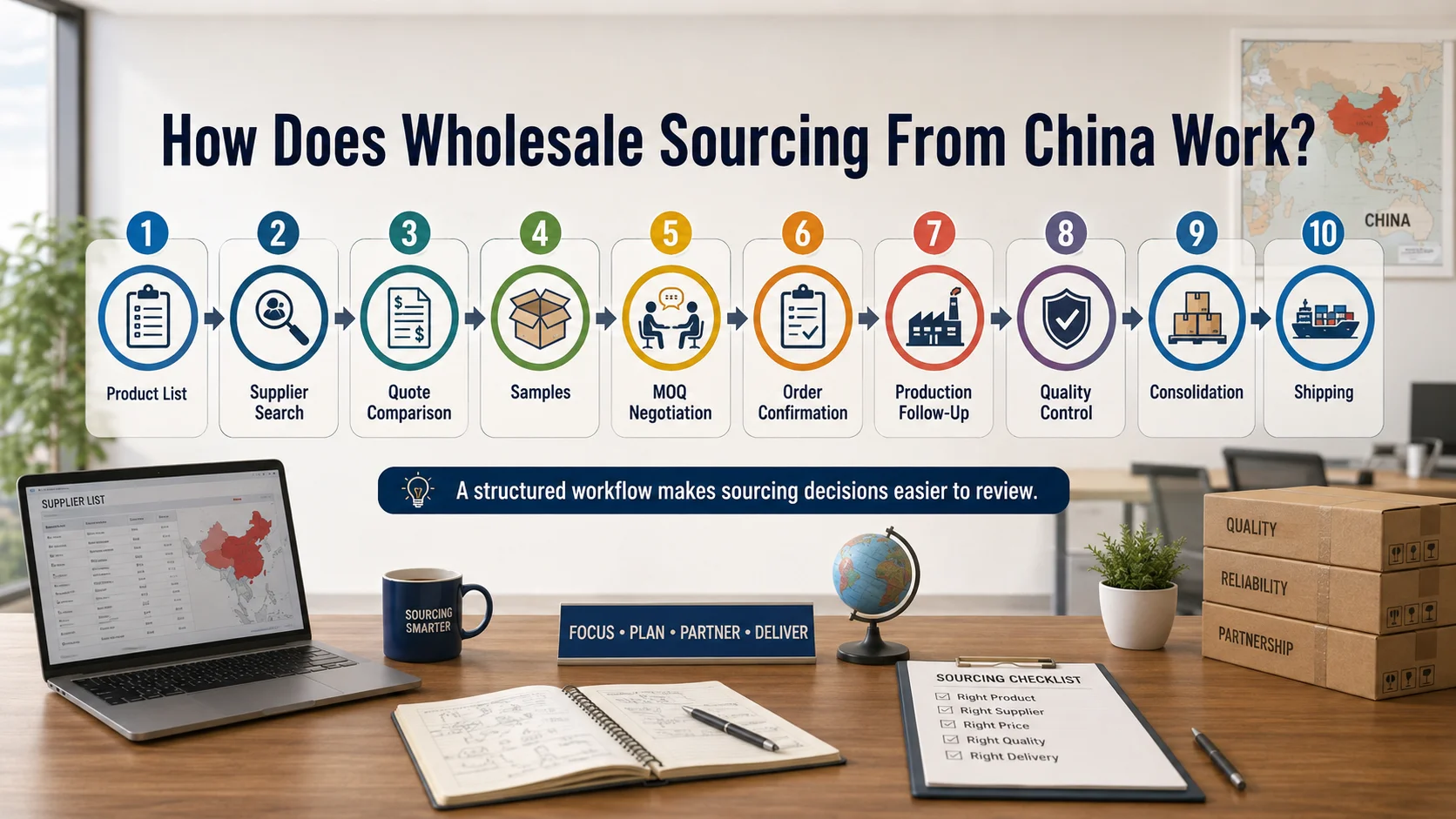
The process starts before a supplier is contacted. We encourage buyers to define what “acceptable” means for each product. A clear request helps suppliers quote accurately and helps us compare quotations on the same basis.
A Practical Step-by-Step Process
| Stage | What We Coordinate | What the Buyer Should Confirm |
|---|---|---|
| Product brief | Specifications, images, quantities, packaging | Target quality and intended market |
| Supplier sourcing | Potential factories and suppliers | Preferred supplier type or existing quotes |
| Quote comparison | Price, MOQ, lead time, packaging, terms | Cost priorities and order budget |
| Sampling | Sample requests and revisions | Product approval before mass production |
| Order placement | Purchase details and production timeline | Final specifications and payment approval |
| Production follow-up | Key milestones and supplier communication | Any design or quantity changes |
| Quality control | Inspection coordination and reporting | Agreed quality standard and tolerance |
| Consolidation | Warehouse receiving and carton checks | Final shipping plan |
| Shipping | Freight coordination and export documents | Delivery address and import requirements |
We have found that the sample stage is especially important for sourcing products from China for resale. Photos and supplier descriptions are useful, but they do not replace a physical review of material, dimensions, print quality, assembly, labeling, or retail packaging.[^3]
Buyers should also understand that lead times are not fixed promises. Raw material availability, production capacity, public holidays, design changes, and payment timing can all affect schedules.[^4] We can follow up locally and flag issues, but qualified professional review may still be needed for product-specific compliance, safety, or regulatory decisions.
How Does a China Sourcing Agent Help Compare Suppliers, Prices, and MOQs?
A low quotation can look attractive until a buyer discovers that it excludes packaging, uses a different material, requires a higher MOQ, or has a longer production timeline.[^5] Comparing suppliers requires more than putting unit prices into a spreadsheet.
A China sourcing agent for wholesale buyers compares suppliers using total purchasing factors: unit price, MOQ, product quality, production capability, lead time, packaging, communication responsiveness, and reliability indicators. The goal is not automatically the cheapest offer. The goal is to identify the supplier option that best fits the buyer’s order and replenishment plan.
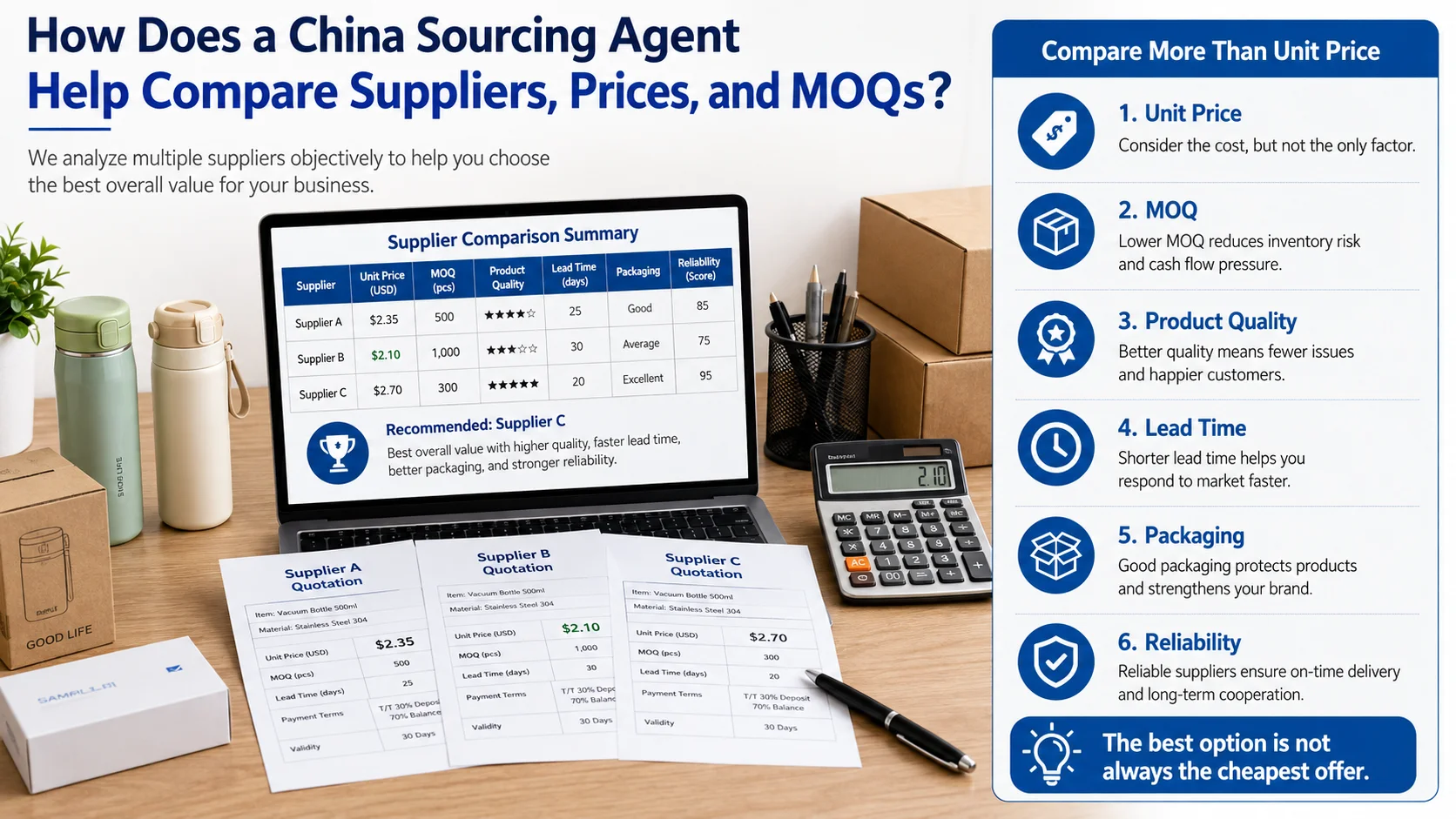
When we review quotations, we try to identify why the numbers differ. One supplier may quote based on a lighter material. Another may include custom packaging. A third may have a lower unit price but require a large production run.
What We Compare Beyond Unit Price
A useful supplier comparison should include:
- Product specification alignment: Are suppliers quoting the same dimensions, materials, colors, and accessories?
- MOQ: Is the MOQ per color, per design, per SKU, or for the full order?
- Sample cost and sample lead time: Can the buyer review the product before bulk production?
- Production lead time: Can the factory support the required replenishment schedule?
- Customization capability: Can the supplier handle logos, inserts, labels, barcodes, or custom packaging?
- Payment terms: Are payment arrangements practical for the buyer’s risk tolerance?
- Export readiness: Does the supplier understand carton marks, packaging requirements, and shipment preparation?
MOQ negotiation can sometimes be possible, especially when buyers accept fewer variations, use standard materials, or combine related products.[^6] However, we do not present a lower MOQ as automatically better. A supplier may agree to a small order but offer weaker pricing, less efficient production, or limited attention to the project.
For this reason, we advise wholesale buyers to evaluate the full commercial picture. A good purchasing decision connects price + MOQ + quality + lead time + supplier reliability.
Buying Directly vs Using a China Sourcing Agent for Wholesale: What Is the Difference?
Direct factory buying can be efficient for simple orders, especially when a buyer already has a proven supplier and strong internal purchasing systems. However, direct buying becomes harder when the buyer needs to coordinate several suppliers or manage a growing catalog.
Using a China sourcing agent for wholesale buyers adds local coordination across supplier selection, quote comparison, production follow-up, inspections, and consolidation. Buying directly may suit straightforward repeat orders, while agent support is often more useful for multi-SKU sourcing, new supplier evaluation, or orders that need local execution oversight.
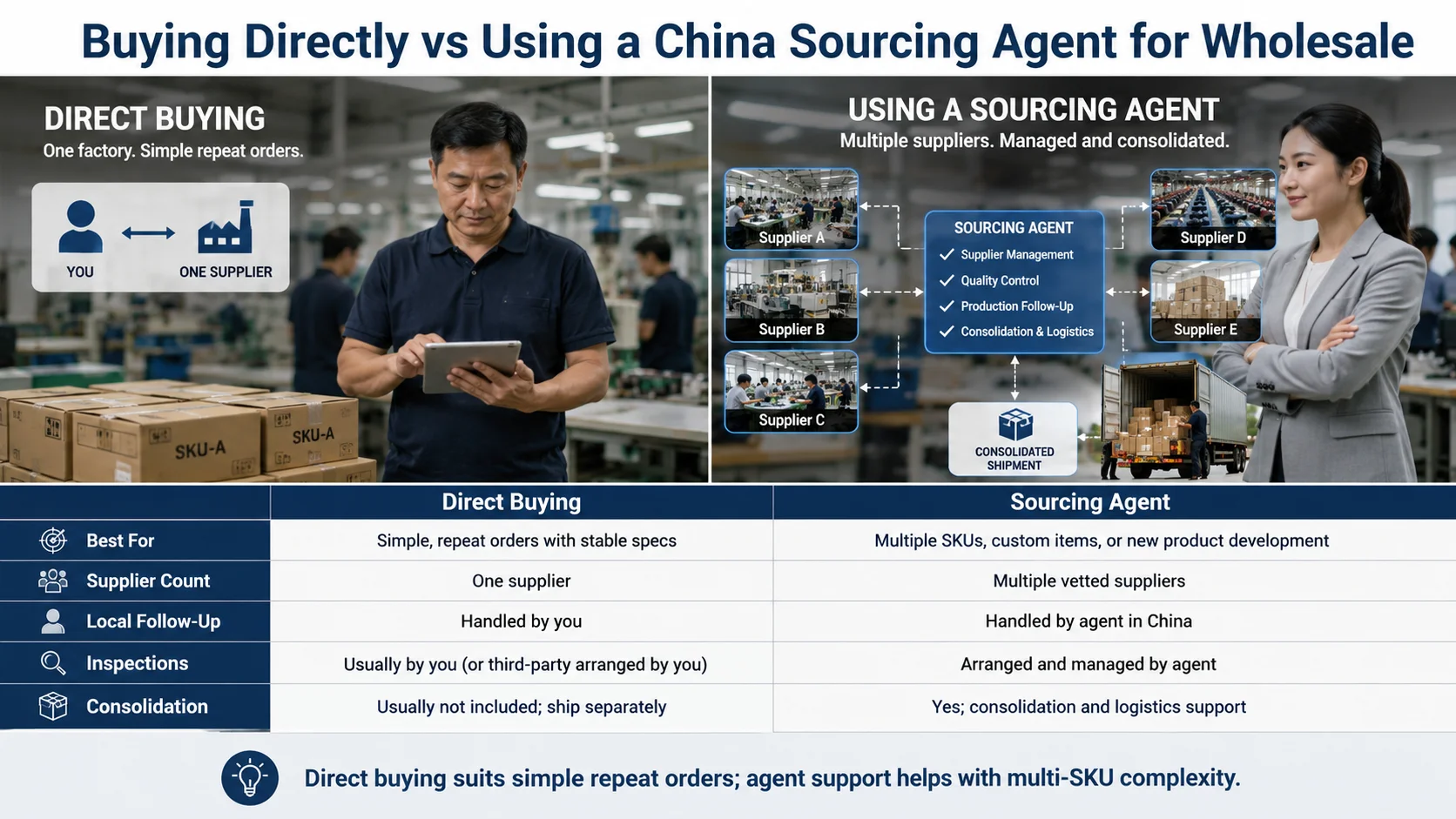
| Factor | Buying Directly | Using a Sourcing Agent |
|---|---|---|
| Supplier Search | Buyer managed | Agent supported |
| Quote Comparison | Manual and fragmented | Centralized comparison |
| MOQ Negotiation | Buyer negotiates | Agent coordinates discussions |
| Multiple Suppliers | More complex to manage | Easier to organize |
| Sample Follow-Up | Buyer managed | Coordinated locally |
| Production Follow-Up | Limited by buyer resources | Local follow-up support |
| QC | Buyer arranges independently | Inspection can be coordinated |
| Consolidation | Often separate shipments | Easier warehouse consolidation |
| Best For | Simple, proven orders | Multi-SKU wholesale purchasing |
When Direct Buying May Be Enough
We do not believe every importer needs an agent. Direct purchasing may be appropriate when:
- The product is standardized.
- The buyer has worked successfully with the supplier before.
- The buyer understands the product specifications and production requirements.
- The supplier has a reliable communication record.
- The buyer has internal staff who can manage production, inspection, and shipping remotely.
- The order involves one or two suppliers with straightforward shipping needs.
A sourcing agent is not a substitute for a buyer’s commercial judgment. We provide local support and clearer coordination, but the buyer should still approve suppliers, samples, order terms, and inspection criteria.
How Are Multiple Suppliers and SKUs Managed?
A wholesale catalog often includes products from different factory clusters.[^7] One supplier may produce the core item, another may make accessories, and a third may provide branded boxes or inserts. Without coordination, details can be missed.
A China sourcing agent for wholesale buyers manages multiple suppliers and SKUs through centralized product lists, order tracking, supplier communication, packaging instructions, production timelines, and warehouse receiving records. This gives buyers a clearer view of which goods are ready, delayed, inspected, or waiting for consolidation.
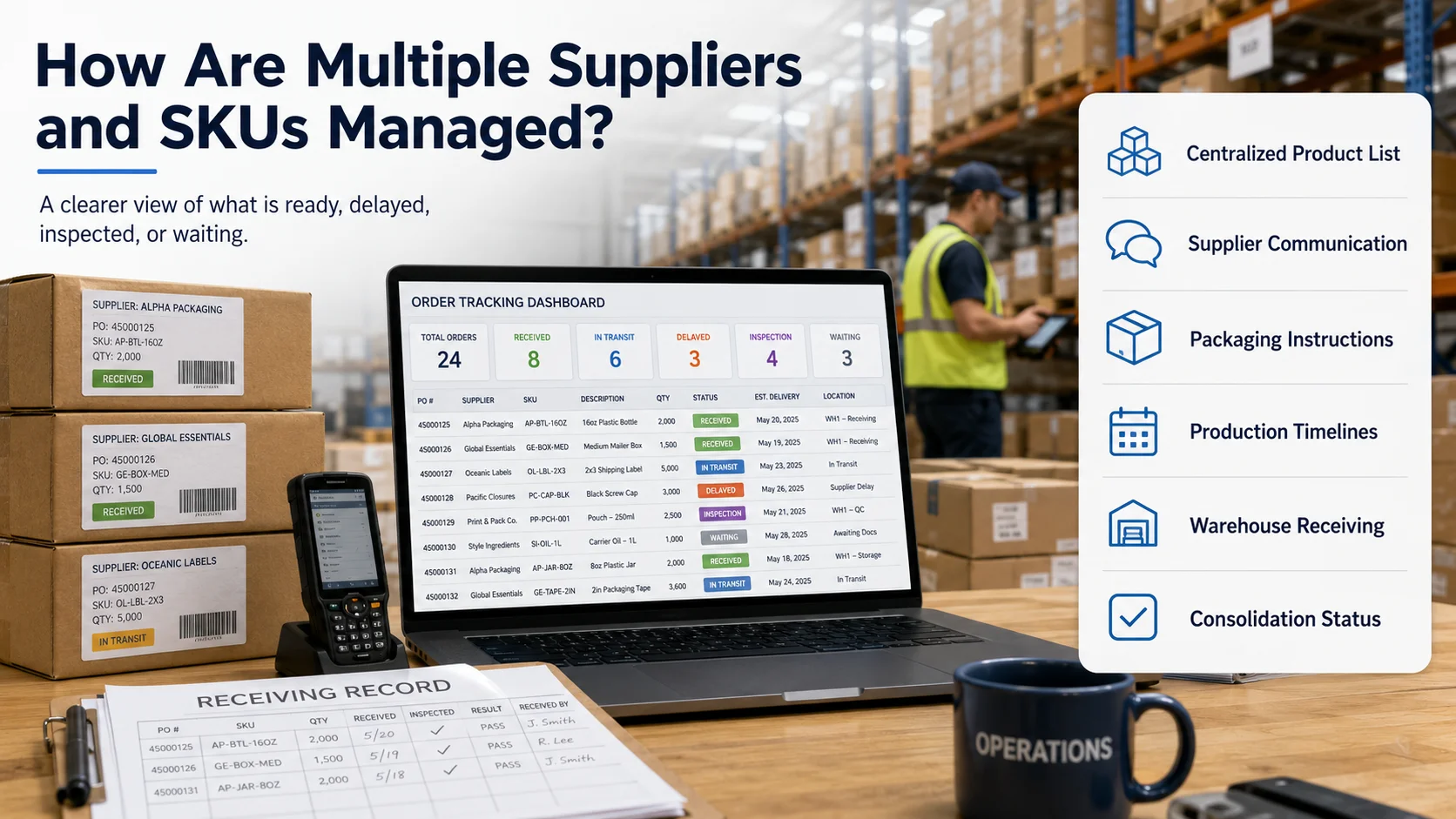
At KingSourcing, we treat multi-supplier sourcing as an operational project rather than a series of separate chats. Each SKU should have a defined supplier, approved specification, target quantity, packaging requirement, estimated completion date, and quality-control plan.
A Simple Multi-Supplier Control Sheet
For larger wholesale orders, we recommend tracking at least:
| Data Point | Why It Matters |
|---|---|
| SKU and product description | Prevents supplier and warehouse confusion |
| Supplier name | Links responsibility to each product line |
| Ordered quantity | Supports receiving and inspection checks |
| MOQ and agreed price | Helps review commercial accuracy |
| Packaging requirement | Reduces labeling and carton errors |
| Production completion date | Supports shipment planning |
| Inspection status | Shows whether goods are ready to release |
| Warehouse receipt status | Confirms goods have arrived for consolidation |
We often see problems when buyers rely only on chat records. A supplier may say an order is “finished,” but that can mean production is complete, goods are packed, cartons are waiting, or goods are actually ready for pickup.[^8] These are different milestones.
A dedicated sourcing team can help keep supplier communication organized, but the buyer should also set priorities. For example, a fast-moving SKU may need earlier inspection and shipping, while slower products can wait for a later consolidated shipment.
How Can Wholesale Buyers Reduce MOQ and Inventory Risk?
High MOQs can pressure buyers to commit too much cash to products that have not been tested in their market.[^9] At the same time, very low MOQs may come with higher pricing, limited customization, or a supplier that is not set up for repeat production.
Wholesale buyers can reduce MOQ and inventory risk by matching purchase quantities to expected sales speed and replenishment time. A China sourcing agent can support supplier discussions, mixed-product options, trial orders, and quote comparison, but the buyer should avoid treating the lowest MOQ as the only decision factor.
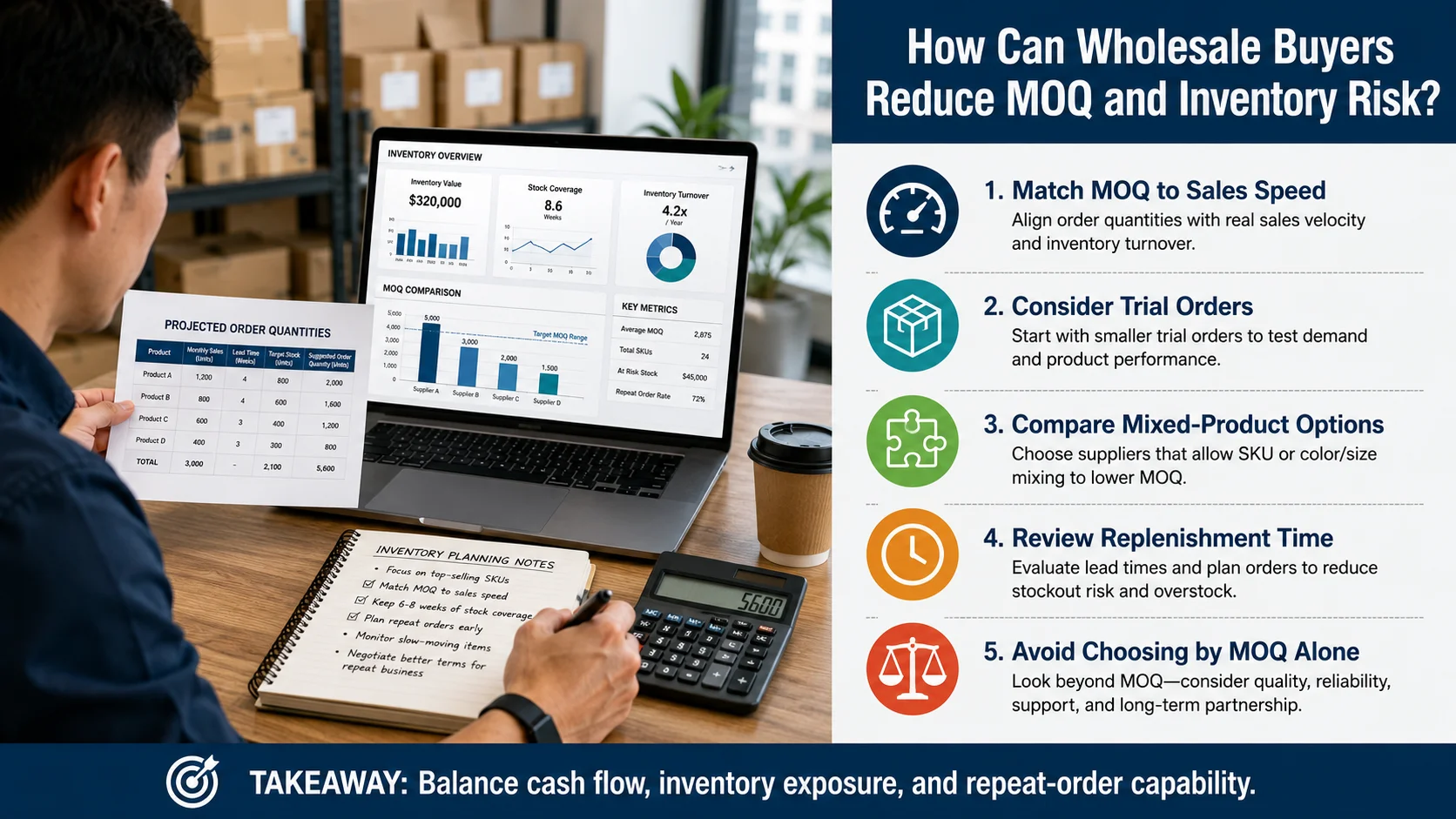
The most practical approach is to think in terms of inventory exposure. If a product takes 30 days to produce and 25 days to ship, a buyer needs enough inventory to cover demand during that period, plus a reasonable buffer.[^10] However, the right buffer depends on sales data, seasonality, cash flow, and market uncertainty.
Practical Ways to Manage MOQ Exposure
We may help wholesale buyers explore options such as:
- Ordering fewer colors or variants in the first production run.
- Using standard supplier packaging before investing in custom packaging.
- Combining related items where the supplier allows a mixed MOQ.
- Starting with a trial order before placing a larger replenishment order.
- Selecting suppliers with realistic repeat-order capability rather than only low initial MOQs.
- Planning reorder points based on actual sales and supplier lead times.
We also encourage buyers to separate product testing from full catalog expansion. A buyer does not need to launch every possible SKU at once. A smaller, controlled product range can make quality checks, warehouse management, and replenishment easier.
How Are Quality Control, Consolidation, and Shipping Coordinated?
Many wholesale sourcing problems happen after the purchase order is placed. Products may be finished at different times, cartons may not match the agreed markings, and goods may need to wait for other suppliers before shipment.
A China sourcing agent for wholesale buyers can coordinate quality inspections, warehouse receiving, carton checks, consolidation, and shipping preparation. This creates a bridge between factory completion and export shipment, which is especially useful when goods come from different suppliers and must be shipped together.
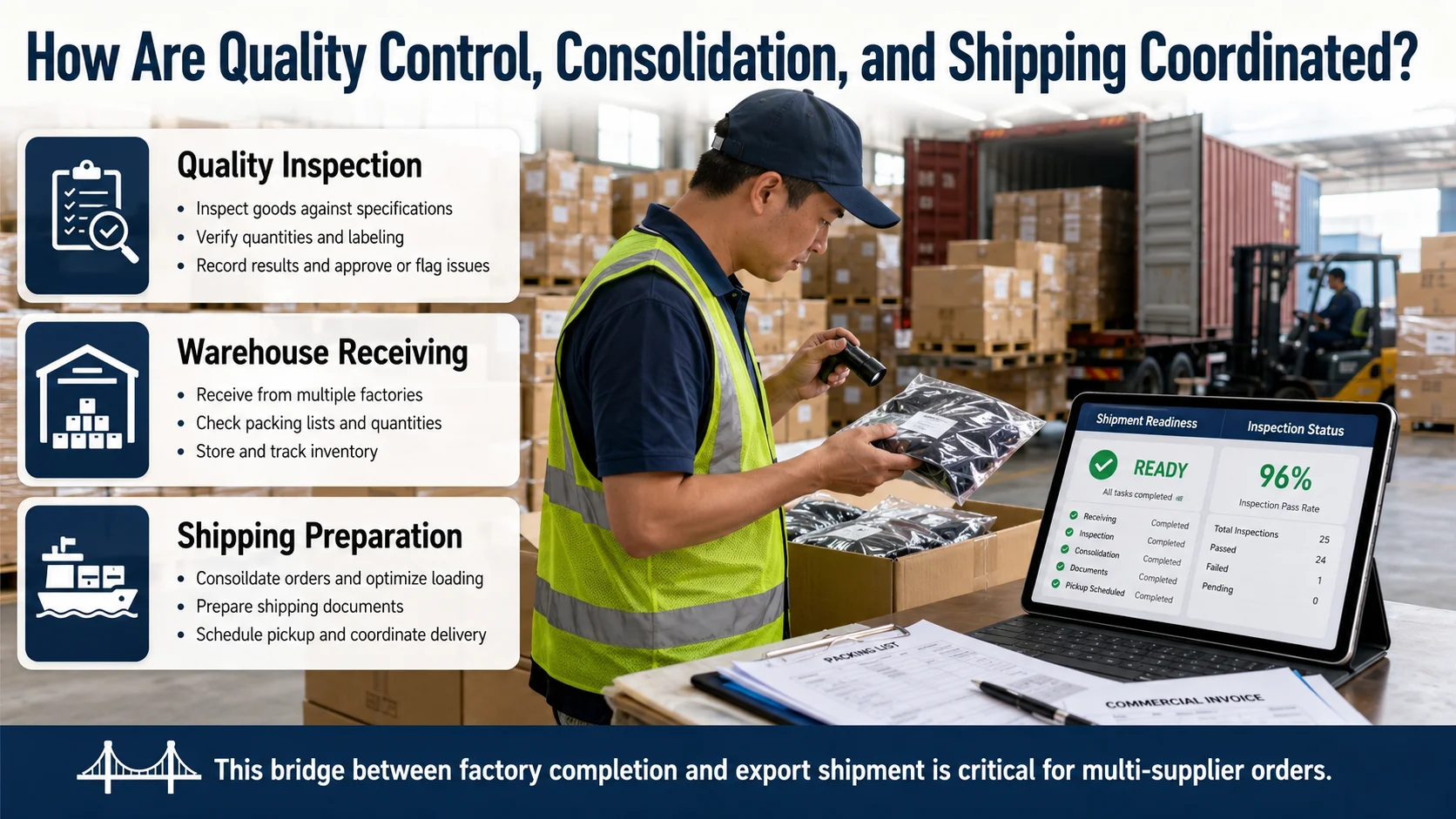
Quality control should be agreed before inspection begins. We can help buyers define an inspection scope, but each product requires its own standards. For example, a textile product may need measurements and stitching checks, while an electronic accessory may require functional testing and packaging verification.
The Post-Production Coordination Process
A typical sequence is:
- Production completion notice from the supplier.
- Inspection arrangement based on the agreed product requirements.
- Inspection findings shared with the buyer for review.
- Goods released or corrective action discussed with the supplier.
- Warehouse receiving after supplier delivery or pickup.
- Carton count and visible packaging review during receiving.
- Consolidation planning across multiple suppliers.
- Shipment coordination based on freight method, destination, and buyer instructions.
Consolidation can help buyers avoid managing many small shipments.[^11] However, it also requires planning. Goods may arrive at different times, warehouses may charge storage fees, and carton dimensions affect freight cost. We help buyers coordinate these details, but freight rates, customs requirements, and import duties should always be verified for the destination market.[^12]
When Should a Wholesale Buyer Use a China Sourcing Agent?
Many buyers wait until a sourcing problem becomes expensive before seeking local support. They may discover too late that suppliers quoted different materials, cartons were not prepared correctly, or one delayed factory is holding up the whole shipment.
A wholesale buyer should consider a China sourcing agent when supplier comparison, local verification, multi-SKU coordination, quality control, or consolidated shipping cannot be managed confidently from overseas. The decision should depend on task complexity and execution risk, not only order value or the promise of a lower price.
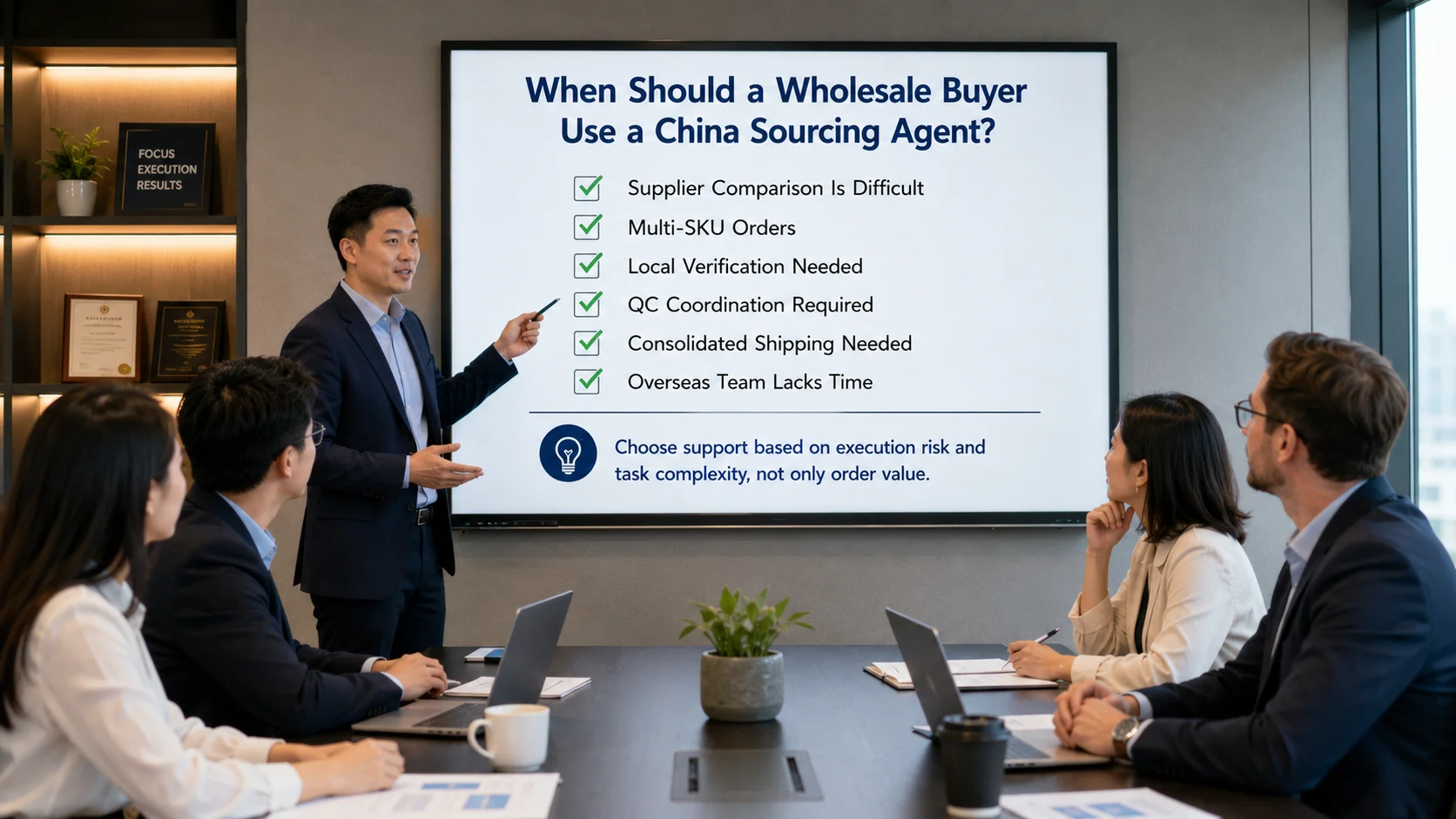
You may benefit from local sourcing support when you:
- Source from multiple factories.
- Manage a catalog with many SKUs or variants.
- Need help understanding why supplier quotations differ.
- Want to compare MOQ, lead time, packaging, and capability in one place.
- Need product samples or packaging samples coordinated.
- Have repeat replenishment orders that require better tracking.
- Need inspection support before goods leave the supplier.
- Want to combine products from different factories into one shipment.
- Do not have a China-based purchasing, QC, or logistics team.
- Need practical support without building a full local office.
We have also seen buyers successfully manage direct supplier relationships after an initial setup period. The important point is that supplier selection and supplier management are different tasks. A factory can be suitable for one product and still require careful coordination during a larger wholesale order.
Frequently Asked Questions
Do wholesale buyers need a sourcing agent in China?
Wholesale buyers do not always need an agent. Direct buying can work for simple orders from proven suppliers. A sourcing agent becomes more useful when buyers manage multiple suppliers, need local quality control, cannot compare quotations confidently, or want to consolidate goods before shipping.
How do wholesalers source products from China?
Wholesalers usually source products through supplier research, quotation comparison, sample review, MOQ negotiation, purchase orders, production follow-up, quality control, and shipping coordination. A China sourcing agent can organize these steps, especially when products come from several factories.
Can a sourcing agent help lower MOQ?
A sourcing agent can discuss MOQ options with suppliers and explore mixed products, standard packaging, or trial-order arrangements. However, lower MOQ is not guaranteed, and it may affect unit price, production priority, customization options, or supplier willingness to support repeat orders.
How can I consolidate products from different Chinese factories?
Products from different factories can be delivered to a warehouse for receiving, carton checks, storage, and consolidated shipment. Buyers should coordinate production dates, inspection timing, carton dimensions, and shipping instructions before goods are sent to the warehouse.
What should I send a China sourcing agent for a quote?
We recommend sending product photos or links, specifications, target quantities, preferred materials, packaging requirements, destination country, target timeline, and any existing supplier quotations. The clearer the product brief is, the easier it is to compare suitable suppliers accurately.
Conclusion
A China sourcing agent for wholesale buyers is most valuable when purchasing involves more than one simple factory order. Multi-SKU sourcing, supplier comparison, MOQ planning, production tracking, quality control, consolidation, and replenishment all require local coordination. We do not position sourcing as a promise of the lowest price or zero risk. We position it as a more controlled procurement process. Send your product list, supplier quotations, or wholesale sourcing requirements to KingSourcing for supplier comparison and procurement support.
Tags: China sourcing agent, wholesale sourcing China, China wholesale supplier sourcing, procurement service China, sourcing products from China, supplier management China, China purchasing agent, wholesale import from China
Work With a China Sourcing Partner
If you're planning an order from China, our sourcing team can help with supplier verification, factory audits, QC inspections, order consolidation, and shipping. Contact our sourcing team to discuss your requirements.
Related reading: China Warehousing and Order Consolidation Guide for Importers: Reduce Shipping Cost and Supplier Risk
[^1]: "Supply chain management", https://en.wikipedia.org/wiki/Supply_chain_management. Supply-chain risk research identifies supplier, quality, specification, and delivery variability as factors that can disrupt purchasing performance and increase operational uncertainty. Evidence role: general_support; source type: research. Supports: That variability in supplier performance, specifications, quality, and delivery can contribute to supply-chain and procurement risk.. Scope note: This evidence provides general procurement context and does not measure risk for a particular China sourcing transaction. [^2]: "Procurement vs. Supply Chain: How Do They Work Together?", https://www.amu.apus.edu/area-of-study/business-administration-and-management/resources/procurement-vs-supply-chain/. Research on buyer–supplier management describes multi-supplier purchasing as increasing coordination and information-processing requirements across ordering, communication, and delivery activities. Evidence role: mechanism; source type: paper. Supports: That managing multiple suppliers increases information-processing and coordination demands in purchasing and supply-chain operations.. Scope note: The source supports the coordination mechanism rather than proving the performance of any individual sourcing agent. [^3]: "Conformity assessment | NIST", https://www.nist.gov/conformity-assessment. Conformity-assessment guidance recognizes inspection and testing of actual products as methods for verifying physical characteristics and compliance with specified requirements. Evidence role: general_support; source type: institution. Supports: That conformity assessment and product inspection may require examination or testing of actual products to verify specified characteristics.. Scope note: The appropriate inspection method depends on the product, applicable standards, and the attributes being verified. [^4]: "Indonesia - Agriculture - International Trade Administration", https://www.trade.gov/country-commercial-guides/indonesia-agriculture. Operations-management research identifies material availability, capacity constraints, and changes to production requirements as common influences on manufacturing lead time and schedule reliability. Evidence role: mechanism; source type: research. Supports: That material availability, manufacturing capacity, engineering changes, and administrative conditions can affect production lead times.. Scope note: The relative effect of each factor varies by industry, supplier, product design, and contract terms. [^5]: "Total cost of ownership", https://en.wikipedia.org/wiki/Total_cost_of_ownership. Supplier-selection literature generally evaluates suppliers using multiple criteria, including cost, quality, delivery performance, and operational capability rather than purchase price alone. Evidence role: expert_consensus; source type: paper. Supports: That supplier selection commonly considers price alongside quality, delivery, capacity, and other non-price criteria.. Scope note: The literature does not prescribe a single weighting of these criteria for every wholesale order. [^6]: "Raw Material Minimum Order Quantity Optimization", https://dspace.mit.edu/entities/publication/e43f520c-9951-4e8d-b867-36c7afb5234c. Manufacturing and inventory research links minimum batch quantities to setup costs, material planning, and production efficiency, with greater product variety often increasing operational complexity. Evidence role: mechanism; source type: paper. Supports: That minimum order quantities and batch decisions are associated with setup costs, production efficiency, material requirements, and product variety.. Scope note: This evidence explains why MOQ flexibility may vary; it does not establish that a specific supplier will accept a lower MOQ. [^7]: "Next Generation Advanced Manufacturing Cluster (Canada) - OECD", https://www.oecd.org/en/publications/science-technology-and-innovation-policy-case-studies_089a31c7-en/next-generation-advanced-manufacturing-cluster-canada_264446cb-en.html. Studies of Chinese industrial development describe geographically concentrated manufacturing clusters whose firms and supporting suppliers often specialize in particular product sectors. Evidence role: historical_context; source type: institution. Supports: That Chinese manufacturing is geographically concentrated in industrial clusters with varying sectoral specializations.. Scope note: Cluster specialization is not universal and does not determine the suitability of an individual factory. [^8]: "Common Export Documents - International Trade Administration", https://www.trade.gov/common-export-documents. Export and logistics guidance distinguishes completion of production from packing, cargo pickup, and shipment preparation, which occur at separate points in the fulfillment process. Evidence role: definition; source type: government. Supports: That production completion, packing, pickup, and export shipment are separate stages in order fulfillment and logistics.. Scope note: Specific milestone labels and handoff procedures differ among suppliers, warehouses, and freight arrangements. [^9]: "[PDF] Working Paper Why are Minimum Order Quantity Contracts Popular ...", https://sites.insead.edu/facultyresearch/research/doc.cfm?did=67974. Inventory-management research shows that ordering larger quantities when demand is uncertain can increase inventory exposure, holding costs, and capital committed to unsold stock. Evidence role: mechanism; source type: paper. Supports: That larger order quantities under uncertain demand can increase inventory holding and capital-commitment risk.. Scope note: The magnitude of exposure depends on demand volatility, margins, storage costs, replenishment time, and the buyer's financing arrangements. [^10]: "[PDF] The Effect of Lead Time Uncertainty On Safety Stocks.", https://www.kellogg.northwestern.edu/faculty/chopra/htm/research/lead-timejuly31-2003.pdf. Inventory-control guidance commonly bases reorder planning on expected demand during lead time, with safety stock added to address uncertainty in demand or replenishment timing. Evidence role: mechanism; source type: education. Supports: That inventory planning commonly accounts for expected demand during replenishment lead time and may include safety stock for uncertainty.. Scope note: A suitable buffer cannot be inferred from lead time alone and should be calculated using the buyer's demand and service-level assumptions. [^11]: "Shippers Associations - International Trade Administration", https://www.trade.gov/shippers-associations. Logistics guidance describes consolidation as combining smaller consignments into fewer shipments, which can reduce the number of separate transport and handling transactions. Evidence role: general_support; source type: institution. Supports: That cargo consolidation combines separate consignments into fewer shipments and can reduce the number of shipment movements and associated handling activities.. Scope note: Consolidation may also introduce storage, timing, and handling costs, so it is not necessarily advantageous for every order. [^12]: "Import Tariffs & Fees Overview and Resources", https://www.trade.gov/import-tariffs-fees-overview-and-resources. Customs authorities state that import duties and entry requirements depend on the destination jurisdiction and on factors such as tariff classification, origin, value, and product-specific rules. Evidence role: general_support; source type: government. Supports: That import requirements and duties are determined by the destination jurisdiction and the classification and characteristics of imported goods.. Scope note: This is general compliance context; importers should consult the relevant destination authority or qualified customs professional for a specific shipment.