China sourcing agent commission is often one of the first costs overseas buyers ask about. I understand why: a vague fee can make a competitive product quote look less attractive later. The real problem is not only the percentage. It is whether buyers can see what they are paying for before production starts.
A transparent China sourcing agent commission separates the product price, agent fee, included work, optional services, third-party charges, and payment recipients. I recommend buyers review the complete cost structure instead of judging an agent by one commission percentage. A clear quote also explains which events can change costs, such as sample revisions, inspections, customization, consolidation, or shipping coordination.

I have answered many overseas buyers’ questions about commissions, quotations, and supplier payments from our Shenzhen base. In my experience, the most productive conversations begin when we move beyond “What is your rate?” and look at the full procurement workflow.
What Does a China Sourcing Agent Commission Actually Cover?
Buyers often see a commission figure but do not know what work sits behind it. That uncertainty creates frustration when an agent later refers to extra services. I believe the best way to avoid this problem is to connect the fee directly to a defined scope of work.
A China sourcing agent commission usually pays for an agreed range of procurement support, such as supplier research, quotation comparison, communication, order coordination, and production follow-up.[^1] However, the included scope varies by agent and project. I recommend buyers ask for a written service list before comparing commission rates.
Commission is not the same as product cost
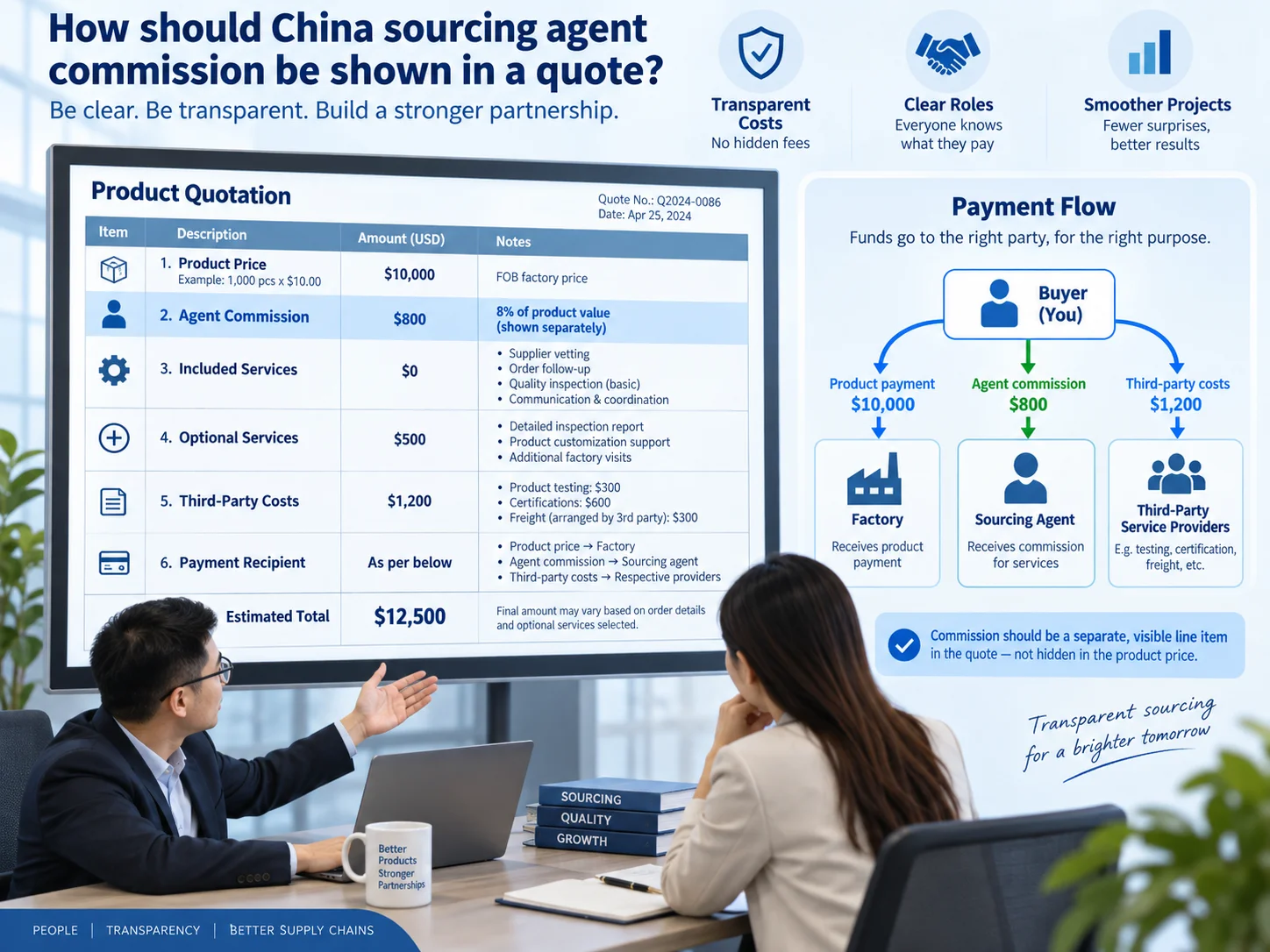
I always encourage buyers to separate what they buy from the work required to buy it. The factory’s product quotation may include materials, labor, standard packaging, and sometimes local delivery.[^2] The agent’s commission is a separate commercial charge for managing defined procurement tasks.
For example, a buyer may need help with:
- Identifying suppliers that match a product brief
- Comparing quotations and MOQ conditions
- Checking basic supplier information and factory capabilities
- Coordinating samples and revisions
- Translating product requirements into supplier communication
- Following production milestones
- Organizing quality inspections[^3]
- Consolidating cartons from multiple factories
- Coordinating export paperwork and shipping arrangements
Not every sourcing project needs every task. A buyer who already has a proven supplier may only need inspection and consolidation support. A new private-label brand may need supplier screening, sample development, packaging coordination, and ongoing production management.
That difference matters. I do not think a buyer should assume that the same China sourcing agent commission will reasonably cover a simple repeat order and a multi-factory product-development project.
Questions I suggest asking about included work
I recommend asking for direct answers to these questions:
- Which sourcing activities are included?
- How many suppliers will be approached or compared?
- Are sample coordination and sample revisions included?
- Does the fee include production follow-up?
- Is quality inspection included, limited, or charged separately?
- Does the scope include packaging, labeling, FNSKU labels, or barcode checks?
- Will the agent coordinate shipping, and is that coordination part of the fee?
- What happens if the project changes after the initial quote?
A short scope statement can prevent a long disagreement later. I have found that buyers usually feel more confident when they can match each fee to a practical deliverable.
I view transparency as a process, not a slogan. A clear commission should tell a buyer what support is included and what support requires a separate quote.
How Should China Sourcing Agent Commission Be Shown in a Quote?
A low headline rate can look appealing, but I believe the full quotation matters more than the headline. Buyers need enough detail to forecast their procurement cost and compare different service providers fairly.
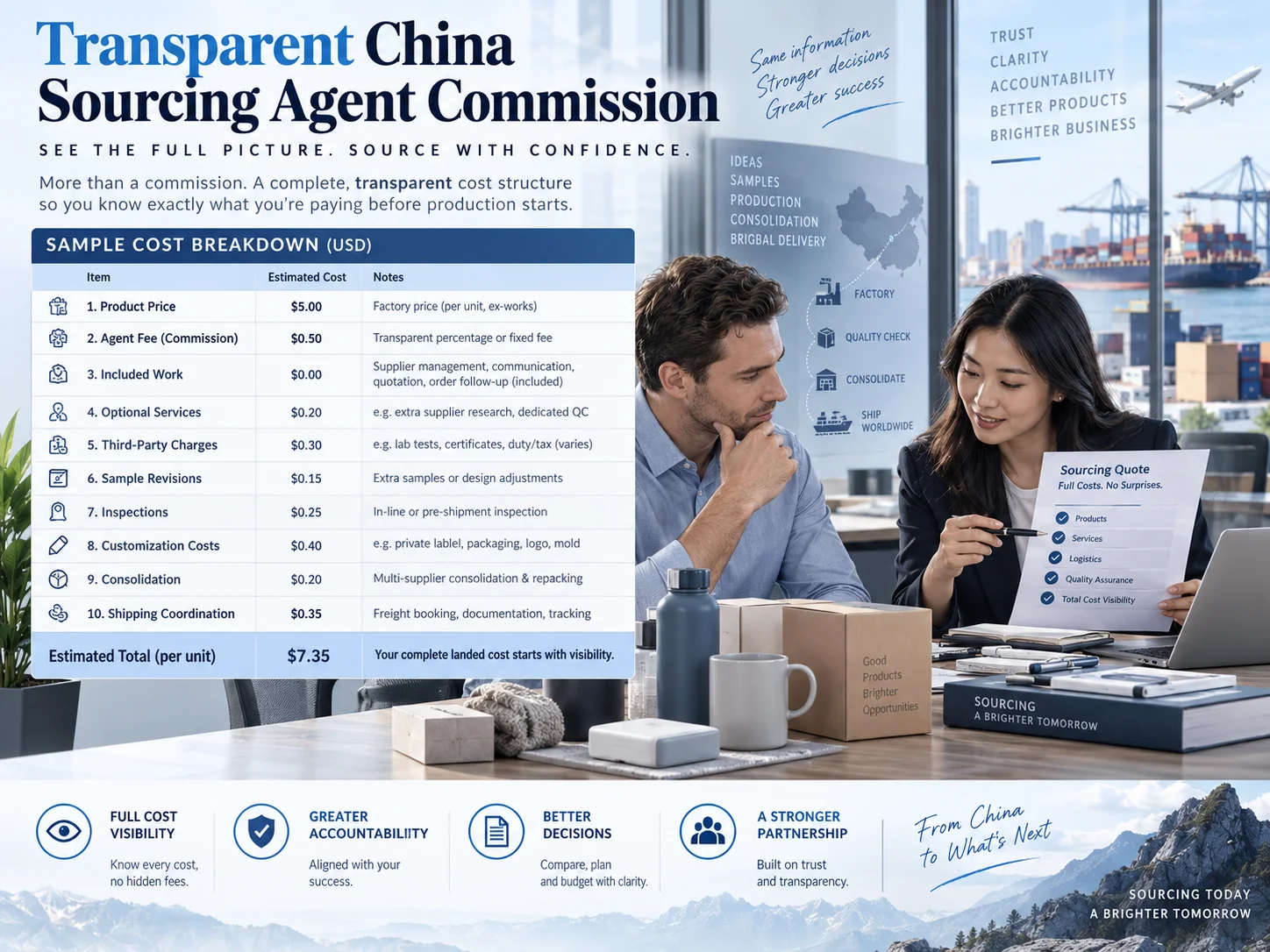
A transparent China sourcing agent commission should appear as its own line item or clearly identified calculation. I recommend that buyers receive a cost breakdown showing the product quotation, commission, included services, optional charges, third-party costs, and the recipient of each payment.
A practical fee-breakdown format
In my work, I find that a simple itemized structure makes discussions easier. It does not need to be complicated, but it should be specific enough for the buyer to understand the commercial arrangement.
| Cost component | What it should explain | Typical recipient |
|---|---|---|
| Product quotation | Unit price, MOQ, specifications, packaging assumptions, local delivery terms | Factory or supplier |
| Sourcing agent fee | Commission method, covered tasks, payment timing | Sourcing agent |
| Sample charges | Sample price, tooling if applicable, courier cost, revision conditions | Supplier, courier, or agent |
| Inspection cost | Inspection scope, inspection timing, reporting method, re-inspection terms | Inspection provider or agent |
| Custom packaging and labels | Artwork setup, printing, inserts, cartons, labels, application labor | Factory or packaging supplier |
| Consolidation and warehousing | Receiving, counting, storage period, carton handling, combined shipment preparation | Warehouse or agent |
| Shipping charges | Freight method, freight quotation validity, destination terms, local charges | Freight forwarder or logistics provider |
| [Taxes and duties | Import taxes, duties, customs-related charges where applicable](https://www.trade.gov/import-tariffs-fees-overview-and-resources)[^4] | Government authority or customs service provider |
I recommend that buyers do not accept a vague description such as “all-in cost” unless the quote lists exactly what “all-in” includes and excludes. A combined figure can be convenient, but it can also make it difficult to compare suppliers, service scopes, and logistics options.
Payment recipients matter
I also think buyers should ask a simple question that is sometimes overlooked: Who receives each payment?
For example:
- A factory payment should be clearly tied to the goods and agreed specifications.
- An agent payment should be tied to the agreed service scope or China sourcing agent commission calculation.
- A third-party inspection payment should identify the inspection provider or explain that the agent is arranging the service.
- Freight payments should state whether they go to a logistics provider, the agent, or another party.
This does not mean every project must use the same payment method. Procurement arrangements differ. However, clarity about recipients helps buyers understand the transaction flow before they send funds.
Why separated quotes support better decisions
When costs are separated, I can help buyers make more informed choices. They can compare two factories without confusing factory pricing with service charges. They can decide whether a pre-shipment inspection is worth adding. They can estimate the impact of custom color boxes or multi-supplier consolidation.
Most importantly, they can understand where cost changes come from. That is a stronger foundation for trust than a single attractive number.
What Can Change the Total Cost of a China Sourcing Project?
Buyers naturally want predictable costs. I also want projects to stay commercially manageable. Still, I have learned that procurement costs can change when the product brief, service scope, or logistics plan changes. The key issue is whether those changes are explained before new charges appear.
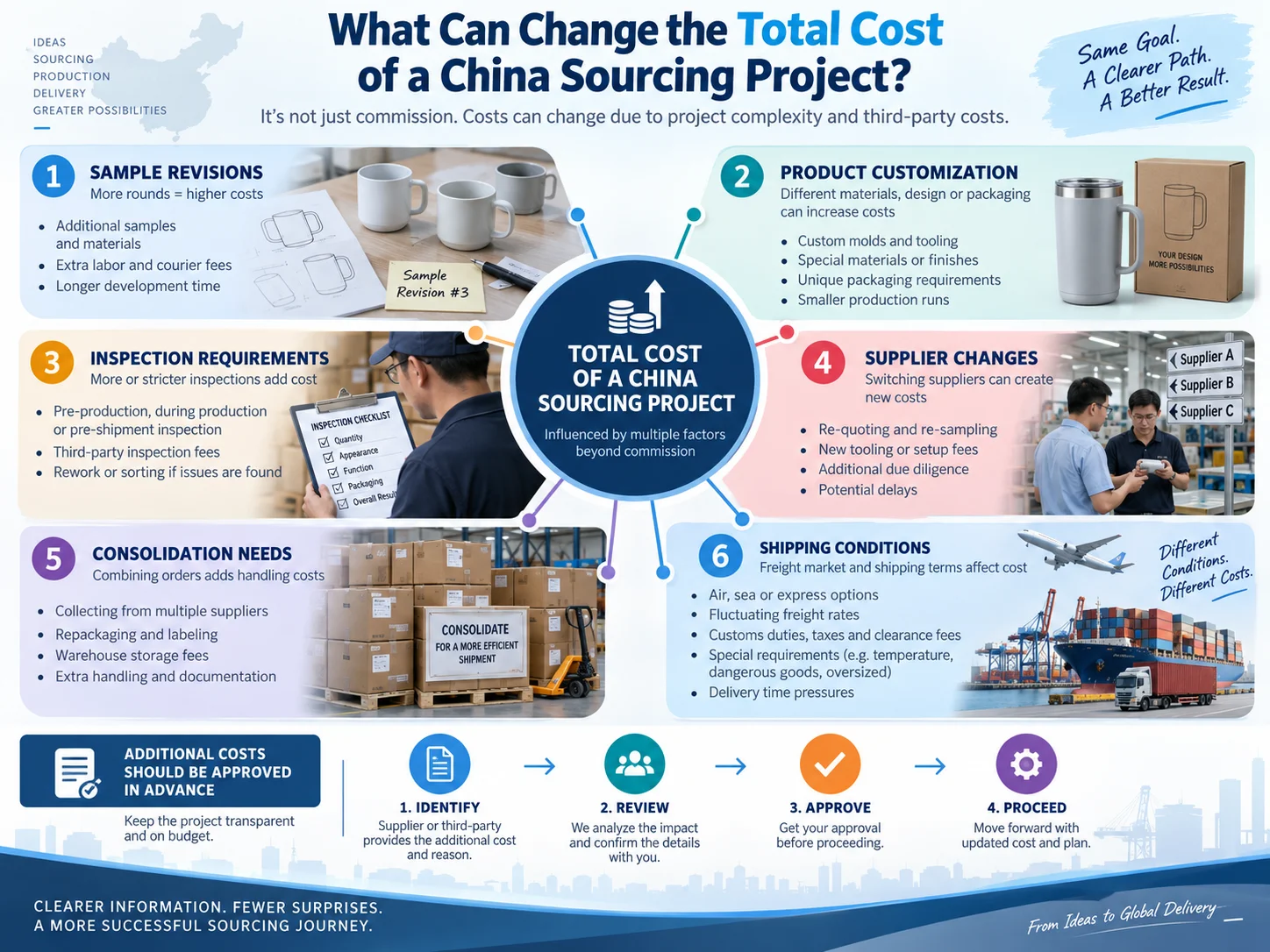
The total cost of a China sourcing project can change when the required work becomes more complex or when third-party costs change. Common drivers include sample revisions, customization, inspection requirements, supplier changes, consolidation needs, and shipping conditions. I recommend buyers agree on approval steps for additional costs in advance.
Common reasons for legitimate cost changes
I have seen several recurring patterns in buyer conversations. These are not problems by themselves. They become problems when nobody explains them clearly.
1. Product development and sample revisions
A standard off-the-shelf item is usually simpler to source than a customized product. Costs may change when a buyer requests:
- A new color or finish
- Logo printing or embossing
- Custom molds or tooling
- Different materials or components
- Retail-ready packaging
- Product inserts, instruction manuals, or compliance labels
- Multiple rounds of sample changes
I recommend treating sample development as a separate stage. The buyer should know the sample cost, courier cost, expected revision process, and approval point before moving to bulk production.
2. Quality-control requirements
Inspection needs vary widely. Some buyers need carton checks and visual review. Others need a more detailed inspection plan based on product risks, packaging rules, functional checks, or acceptable quality limits[^5].
I do not believe one inspection approach fits every product. Consumer electronics, glassware, promotional goods, and apparel can all have different defect risks.[^6] A buyer should define the inspection scope and ask whether the service includes travel, reporting, re-inspection, or 1-by-1 checking.
3. Multi-supplier consolidation
Consolidation can reduce shipping complexity, especially for e-commerce sellers and wholesalers buying many SKUs.[^7] Yet it also adds receiving, counting, storage, repacking, labeling, carton measurement, and loading tasks.[^8]
I recommend buyers confirm:
- The free storage period, if any
- Receiving and handling procedures
- Whether incoming cartons are counted or opened
- Whether outer cartons are replaced
- Who applies shipping marks and marketplace labels
- How discrepancies are reported
4. Shipping and destination conditions
Freight can move for reasons outside the sourcing agent’s direct control. Carton volume, chargeable weight, shipping method, fuel-related adjustments, seasonal demand, destination delivery area, and customs requirements may all affect logistics quotations.[^9]
A sourcing agent should not promise a final shipping total before the relevant shipment details are known. However, I believe the agent should explain quote validity, assumptions, shipping terms, and possible variables clearly.
A change-control process I recommend
A practical approach is to agree that the agent will provide a written update before charging for a material scope change. The update can state:
- What changed
- Why it affects cost
- Whether the cost is from the agent, supplier, or third party
- The available options
- The buyer approval needed to proceed
This process protects both sides. The buyer gets visibility, and the agent gets clear instructions before additional work begins.
How Can Buyers Compare China Sourcing Agent Commission Models?
Many buyers compare only commission percentages. I understand the instinct, because percentages are easy to compare. Yet a percentage alone does not show the service depth, payment structure, exclusions, or commercial incentives behind an offer.
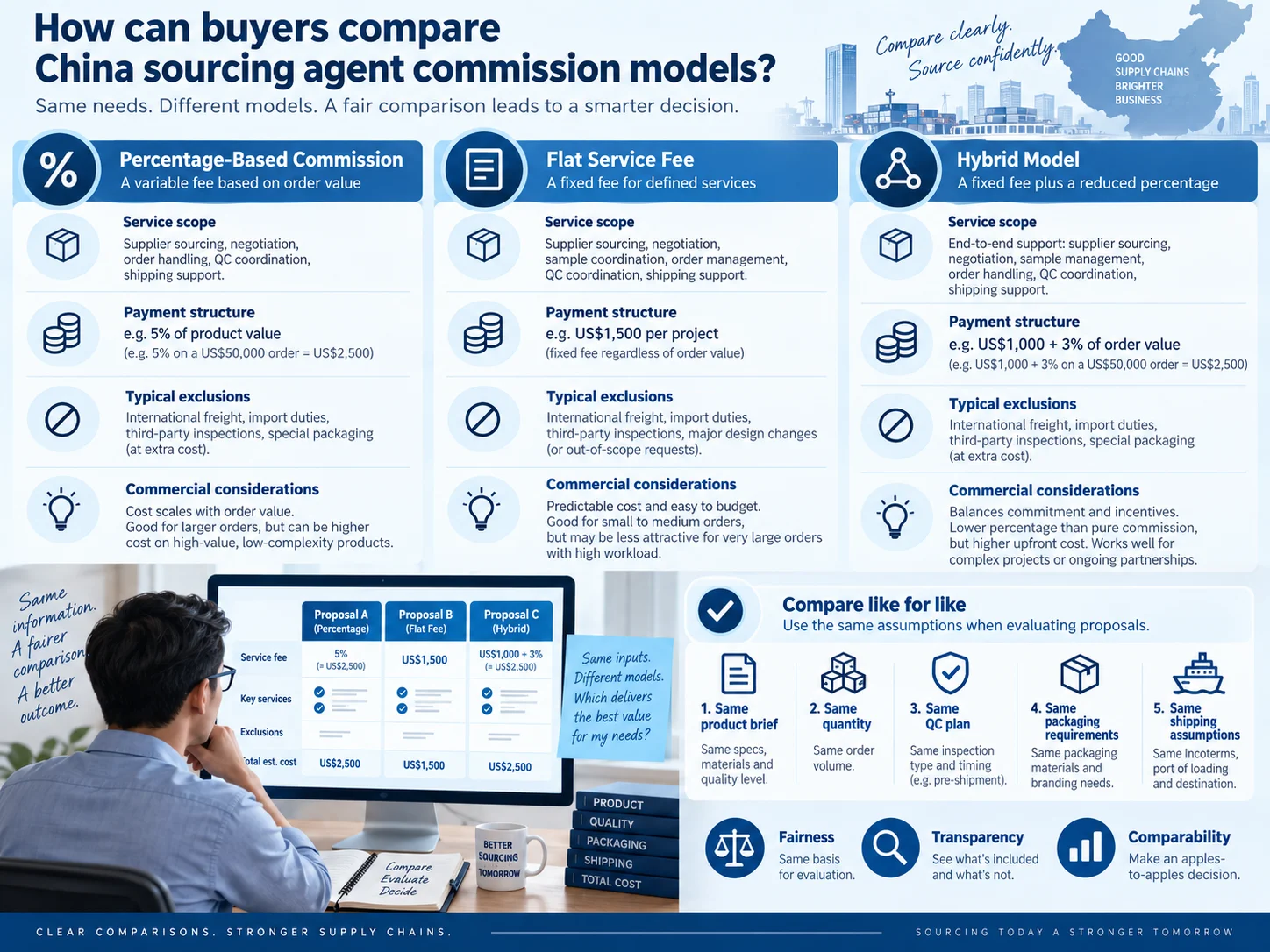
Buyers should compare China sourcing agent commission models by reviewing the full cost structure, service scope, payment flow, and change policy. I recommend comparing like for like: the same product brief, order quantity, quality-control plan, packaging requirements, and shipping assumptions.
Common fee-model approaches
I have seen several ways sourcing services may be priced. None is automatically better. The useful question is whether the model is understandable and suitable for the buyer’s order profile.
| Fee model | How it works | What I recommend buyers clarify |
|---|---|---|
| [Percentage-based commission | The fee is calculated from an agreed order value or product value](https://trerc.tamu.edu/article/commission-mythology-101-2373/)[^10] | Calculation base, minimum fee, excluded costs, payment timing |
| [Fixed project fee | The fee is agreed for a defined sourcing project or task package](https://www.suny.edu/sunypp/documents.cfm?doc_id=431)[^11] | Exact deliverables, revision limits, what happens if the brief changes |
| Per-service pricing | Services such as audits, inspections, warehousing, or labeling are quoted separately | Each unit of pricing, report scope, travel or handling charges |
| Hybrid model | A base fee combines with a commission or separate task charges | Which activities fall under each fee and whether charges overlap |
| Ongoing purchasing support | A recurring arrangement supports repeat procurement operations | Monthly scope, order volume assumptions, response time, exclusions |
Compare the total purchasing picture
I recommend creating a side-by-side comparison sheet. This helps buyers avoid choosing based only on the lowest visible rate.
| Evaluation point | Agent A | Agent B | What I would review |
|---|---|---|---|
| Factory product quote | Product specifications and trade terms | ||
| China sourcing agent commission | Calculation and included tasks | ||
| Supplier verification | Method, documents, and reporting | ||
| Sample coordination | Number of rounds and courier treatment | ||
| Inspection | Scope, timing, and re-inspection terms | ||
| Packaging and labeling | Materials, labor, and approval process | ||
| Consolidation | Storage, handling, and carton checks | ||
| Shipping coordination | Freight assumptions and destination terms | ||
| Change approval process | Written approval before additional charges |
Watch for ambiguity, not just price
I do not assume that a lower commission means hidden costs. I also do not assume that a higher commission means better service. Both assumptions can lead buyers in the wrong direction.
Instead, I look for ambiguity. A buyer should ask follow-up questions when a quote does not state:
- Whether product pricing is factory-direct or includes service charges
- What work is included in the agent fee
- Whether inspection, warehousing, labels, or repacking are extra
- Which party receives each payment
- Whether quoted freight is estimated or confirmed
- How additional work is approved
- What happens if a supplier cannot meet the approved specification
In my experience, a professional sourcing conversation does not require every future cost to be fixed on day one. It requires the buyer to understand the assumptions and have a process for approving changes.
Frequently Asked Questions
What is a China sourcing agent commission?
A China sourcing agent commission is a fee charged for agreed procurement support, such as supplier sourcing, quotation comparison, communication, production coordination, or quality-control arrangements. I recommend reviewing the service scope because different agents may include different tasks within their commission.
Should I choose the lowest sourcing agent commission?
I would not choose based on commission alone. A lower fee may suit a straightforward project, while another model may better fit a complex order. I recommend comparing the product quote, included services, optional charges, payment recipients, and change-approval process.
Is quality inspection included in a sourcing agent’s fee?
Quality inspection may be included, limited, or charged separately depending on the sourcing arrangement.[^12] I recommend asking for the inspection scope in writing, including product checks, carton checks, functional testing, reporting, travel, and any re-inspection terms.
Why are product price and agent fee shown separately?
Separate pricing helps buyers understand the cost of goods versus the cost of procurement support. I believe this structure makes supplier comparisons easier and helps buyers see whether changes come from the factory, the sourcing agent, a logistics provider, or another third party.
Can sourcing costs change after I approve a quotation?
Costs can change if the product specification, sample requirements, inspection plan, packaging, consolidation needs, or shipping conditions change. I recommend agreeing that material additional costs require written explanation and buyer approval before the related work proceeds.
Conclusion
I believe a transparent China sourcing agent commission is not simply the lowest possible fee. It is a fee structure that lets buyers separate product cost, agent services, third-party charges, and shipping-related expenses before they commit to an order. Buyers should also understand what is included, who receives each payment, and what may cause costs to change. At KingSourcing, I help overseas buyers review quotations, verify suppliers, manage quality control, and coordinate multi-supplier purchasing with clearer cost visibility. Contact us to discuss your sourcing requirements and request a structured quotation breakdown.
[^1]: "[PDF] EFFECTIVE METHODOLOGIES FOR SUPPLIER SELECTION AND ...", https://etda.libraries.psu.edu/files/final_submissions/419. Studies of international sourcing intermediaries describe supplier search, communication, quotation evaluation, and coordination as common functions performed between overseas buyers and manufacturers. Evidence role: general_support; source type: research. Supports: That intermediary sourcing services commonly include supplier identification, supplier communication, quotation evaluation, and order-management activities.. Scope note: Specific commission inclusions remain contractual and vary by agent and project. [^2]: "Know Your Incoterms - International Trade Administration", https://www.trade.gov/know-your-incoterms. International commercial-term guidance explains that the parties' agreed delivery term determines which transport, delivery, and related obligations are included in the seller's quoted price. Evidence role: definition; source type: institution. Supports: That the allocation of packaging and delivery obligations in a supplier quotation depends on the agreed sales term and contract.. Scope note: It does not establish the contents of any particular factory quotation, which must be confirmed in the purchase terms. [^3]: "[PDF] 1C. Quality Assurance vs. Quality Control", https://nvlpubs.nist.gov/nistpubs/SpecialPublications/NIST.SP.1500-28pt1C.pdf. Trade and conformity-assessment guidance describes pre-shipment inspection as an examination used to verify goods against specified requirements before shipment. Evidence role: general_support; source type: government. Supports: That inspection is used to assess whether goods conform to specified quality or contractual requirements before shipment or acceptance.. Scope note: The appropriate inspection method and timing depend on the product, contract, and importing market. [^4]: "Import Tariffs & Fees Overview and Resources", https://www.trade.gov/import-tariffs-fees-overview-and-resources. Customs authorities explain that imported merchandise may be subject to applicable duties, taxes, and customs-entry requirements assessed under the destination jurisdiction's rules. Evidence role: definition; source type: government. Supports: That imported goods may be subject to customs duties, taxes, and customs-entry requirements or charges.. Scope note: Rates, exemptions, and additional charges vary by product classification, origin, valuation, and importing country. [^5]: "6.2.3.1. Choosing a Sampling Plan: MIL Standard 105D", https://www.itl.nist.gov/div898/handbook/pmc/section2/pmc231.htm. ISO acceptance-sampling standards define the acceptable quality limit (AQL) as a quality level used in sampling plans for lot-by-lot inspection. Evidence role: definition; source type: institution. Supports: The definition and use of an acceptance quality limit in acceptance-sampling inspection.. Scope note: An AQL is a sampling-plan parameter, not a guarantee that every individual item in a shipment is defect-free. [^6]: "Recalls & Product Safety Warnings | CPSC.gov", https://www.cpsc.gov/Recalls. Risk-based quality-management literature recognizes that inspection criteria and probable failure modes should be tailored to product characteristics, materials, use conditions, and applicable requirements. Evidence role: general_support; source type: research. Supports: That likely failure modes and inspection priorities differ according to product design, materials, intended use, and applicable requirements.. Scope note: This general principle does not quantify or rank defect rates for the particular categories named. [^7]: "[PDF] Improving Transport Utilization via Proactive Consolidation and ...", https://repository.gatech.edu/bitstreams/f1155ec2-09fb-42bc-8ffa-97783a5ca732/download. Logistics research describes freight consolidation as combining multiple consignments into fewer shipments, which can reduce handling and coordination across separate deliveries. Evidence role: mechanism; source type: research. Supports: That freight consolidation combines multiple smaller consignments into a larger shipment and can reduce the number of separate shipments to manage.. Scope note: Whether consolidation lowers total cost or complexity depends on volumes, timing, storage, destinations, and handling requirements. [^8]: "Small Parts Order Picking: Design and Operation", https://www2.isye.gatech.edu/~mgoetsch/cali/Logistics%20Tutorial/order/article.htm. Warehouse-management materials characterize consolidation as a sequence of receiving, storage, handling, packing or labeling, and outbound loading operations. Evidence role: mechanism; source type: education. Supports: That warehouse consolidation requires inbound receiving, storage, order handling, packaging or labeling, and outbound loading activities.. Scope note: The precise tasks performed depend on the warehouse agreement, the condition of inbound cartons, and destination requirements. [^9]: "[PDF] Other transportation-related fees and shipping information1 - NY.Gov", https://online.ogs.ny.gov/purchase/snt/awardnotes/7901123267Surcharges.pdf. International shipping guidance notes that freight pricing and carriage arrangements can depend on shipment weight or dimensions, service selection, applicable surcharges, destination, and customs compliance requirements. Evidence role: mechanism; source type: government. Supports: That transport charges and shipment feasibility are affected by weight or dimensions, transport service, surcharges, destination, and regulatory requirements.. Scope note: The relative effect of each factor differs by carrier, route, date, commodity, and contractual rate. [^10]: "Commission Mythology 101 | Texas Real Estate Research Center", https://trerc.tamu.edu/article/commission-mythology-101-2373/. Research on commercial intermediaries documents commission arrangements in which compensation is calculated as a percentage of the value of transactions facilitated. Evidence role: general_support; source type: paper. Supports: That intermediary compensation can be structured as a commission calculated as a percentage of transaction value.. Scope note: This does not establish a standard sourcing-agent percentage or determine whether freight, taxes, tooling, or other costs are included in the calculation base. [^11]: "Construction-Related Consultant Contracting Procedures - SUNY", https://www.suny.edu/sunypp/documents.cfm?doc_id=431. Public-procurement guidance characterizes fixed-price arrangements as contracts with a set price for specified work, making clear definition of scope and deliverables important. Evidence role: definition; source type: government. Supports: That fixed-price arrangements set a price for defined work and rely on a clearly specified scope or deliverables.. Scope note: Government contracting guidance is contextual support and does not prescribe how private sourcing agents must price their services. [^12]: "Trade Guide: WTO PSI - International Trade Administration", https://www.trade.gov/trade-guide-wto-psi. Conformity-assessment guidance indicates that inspection activities are performed against an agreed scope, criteria, and reporting arrangement established for the assignment. Evidence role: general_support; source type: institution. Supports: That the scope, timing, and reporting of third-party inspection are defined by the service agreement or inspection instructions.. Scope note: It cannot determine whether inspection is included in the fee of any particular sourcing agent without reviewing that agreement.