A China sourcing agent can make overseas buying easier, but buyers often worry about hidden commissions, unreliable factories, poor-quality goods, and unclear responsibility when problems appear. The “free” versus “paid” question can feel confusing. We believe the safer choice depends less on the fee and more on how the agent manages risk.
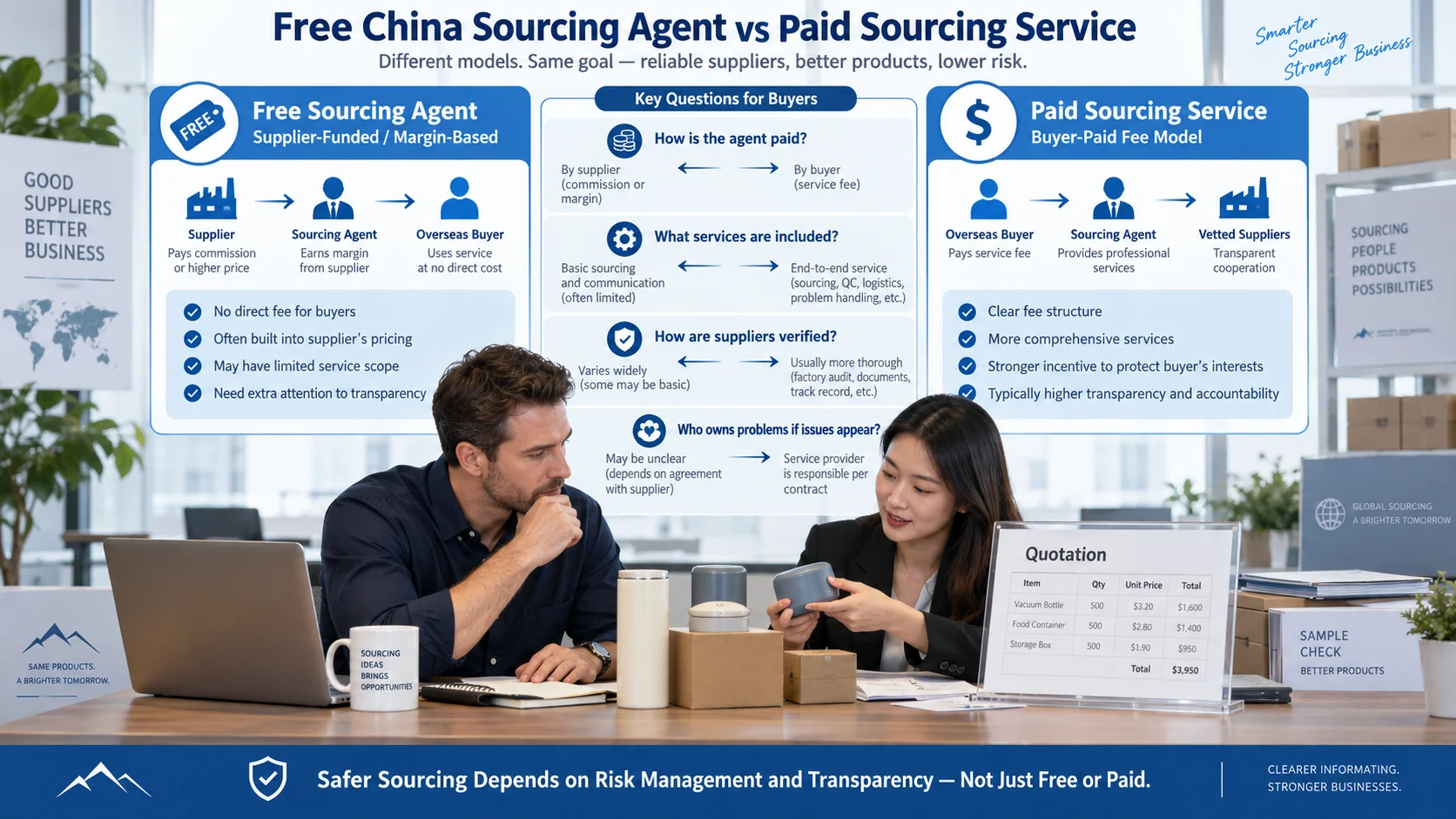
A free China sourcing agent is not automatically less safe, and a paid sourcing service is not automatically more reliable. The safer option is the provider that clearly explains how it earns money, defines its service scope, verifies suppliers, manages quality checkpoints, and accepts responsibility for agreed tasks. Buyers should match the service model to the value, complexity, and risk of their order.
The important question is not simply, “Do I pay a service fee?” The better question is, “Who controls each sourcing risk, and how is that work documented?” We use this process-focused approach when helping buyers evaluate supplier sourcing, production management, inspection, consolidation, and shipping coordination from China.
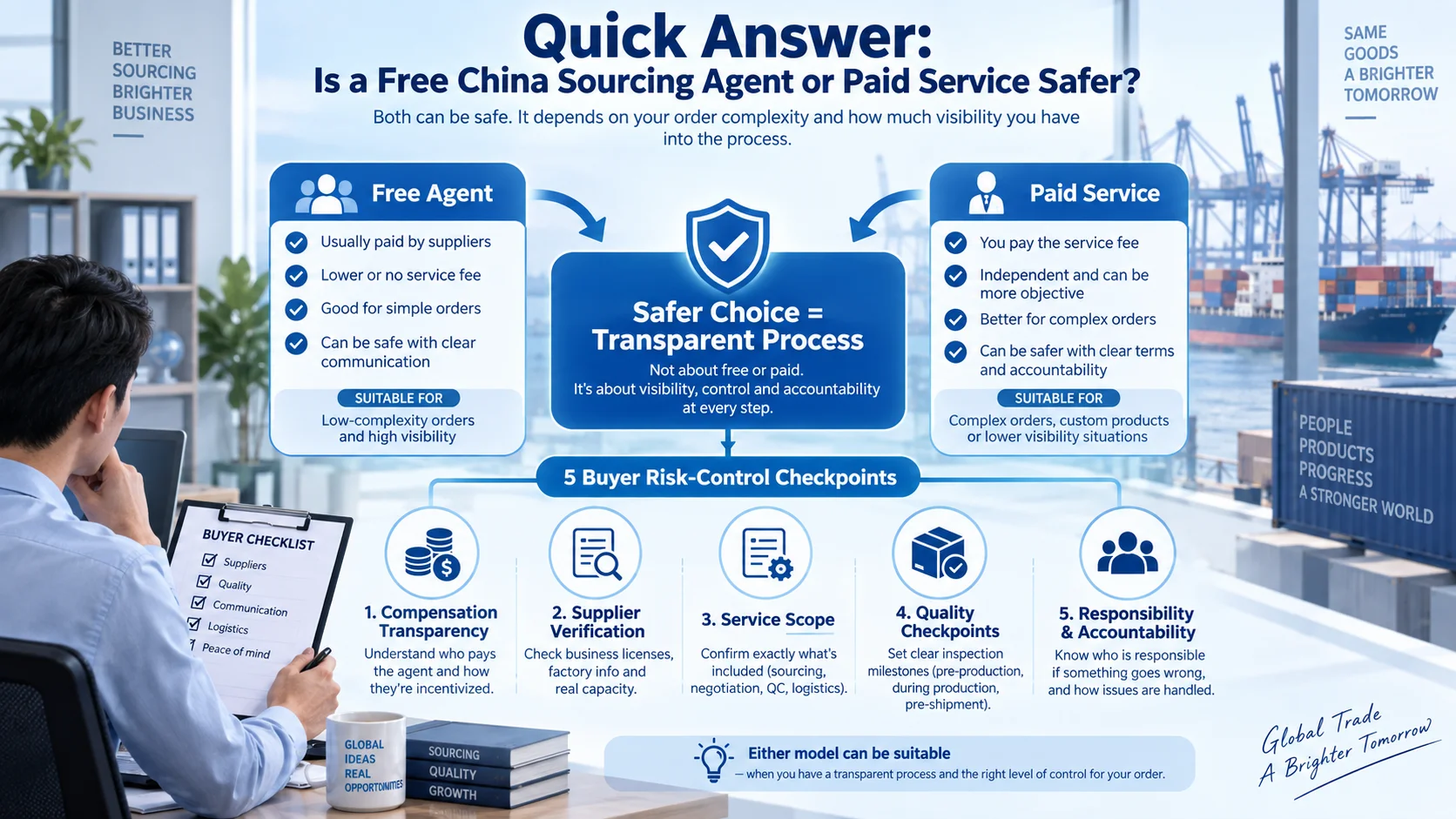
Quick Answer: Is a Free China Sourcing Agent or Paid Service Safer?
Buyers may face a problem when they judge a China sourcing agent only by whether the service looks free. A no-fee offer can sound attractive, while a paid service can sound more accountable. However, neither pricing model alone shows how carefully the provider will manage supplier, product, and shipping risks.
A free China sourcing agent may be suitable for a simple purchase if the buyer understands the agent’s compensation and independently verifies key details. A paid service may offer clearer scope and accountability, especially for customized or multi-factory orders. We recommend choosing the model that gives you the most transparent process for your specific order.
Safety Comes From Controls, Not Labels
In our view, “free” describes a pricing model, not a quality standard. Some agents earn supplier commissions, add a margin to factory pricing, receive a price difference, or combine several compensation methods.[^1] These arrangements are not automatically problematic. The concern begins when the buyer cannot understand how the provider is paid or whether that payment could influence supplier recommendations.
A paid sourcing service may charge a fixed fee, a percentage of order value, an hourly fee, or a project-based fee. This can make the cost structure easier to see.[^2] Still, a paid fee does not guarantee that a provider will conduct meaningful verification, follow production closely, or inspect finished goods correctly.
We recommend that buyers ask every provider the same practical questions:
- How do you earn money from this order?
- Will you receive supplier commissions, rebates, or price margins?
- Will I see original supplier quotations or only your final price?
- Which tasks are included in writing?
- Who approves samples, production changes, and quality decisions?
- What happens if the supplier misses an agreed requirement?
- What inspection evidence will I receive before shipment?
A reliable sourcing process should make incentives visible. Buyers do not need a perfect arrangement. They need an arrangement they can understand, compare, and manage.
A low service fee can be valuable, but unclear responsibility can become expensive when a product, supplier, or shipment issue appears.
How Does a China Sourcing Agent Get Paid?
Buyers often feel uneasy because a China sourcing agent may say the service is free without explaining what that means. The uncertainty can create concern about supplier selection, quotation fairness, and hidden markups. We believe transparent compensation is one of the first signs buyers should evaluate.
A China sourcing agent can be paid by the buyer, by the supplier, through a product margin, or through a mixed model. None of these models is automatically unsafe. Buyers should ask for a clear explanation of payment sources, quotation handling, and whether supplier recommendations could be affected by financial incentives.
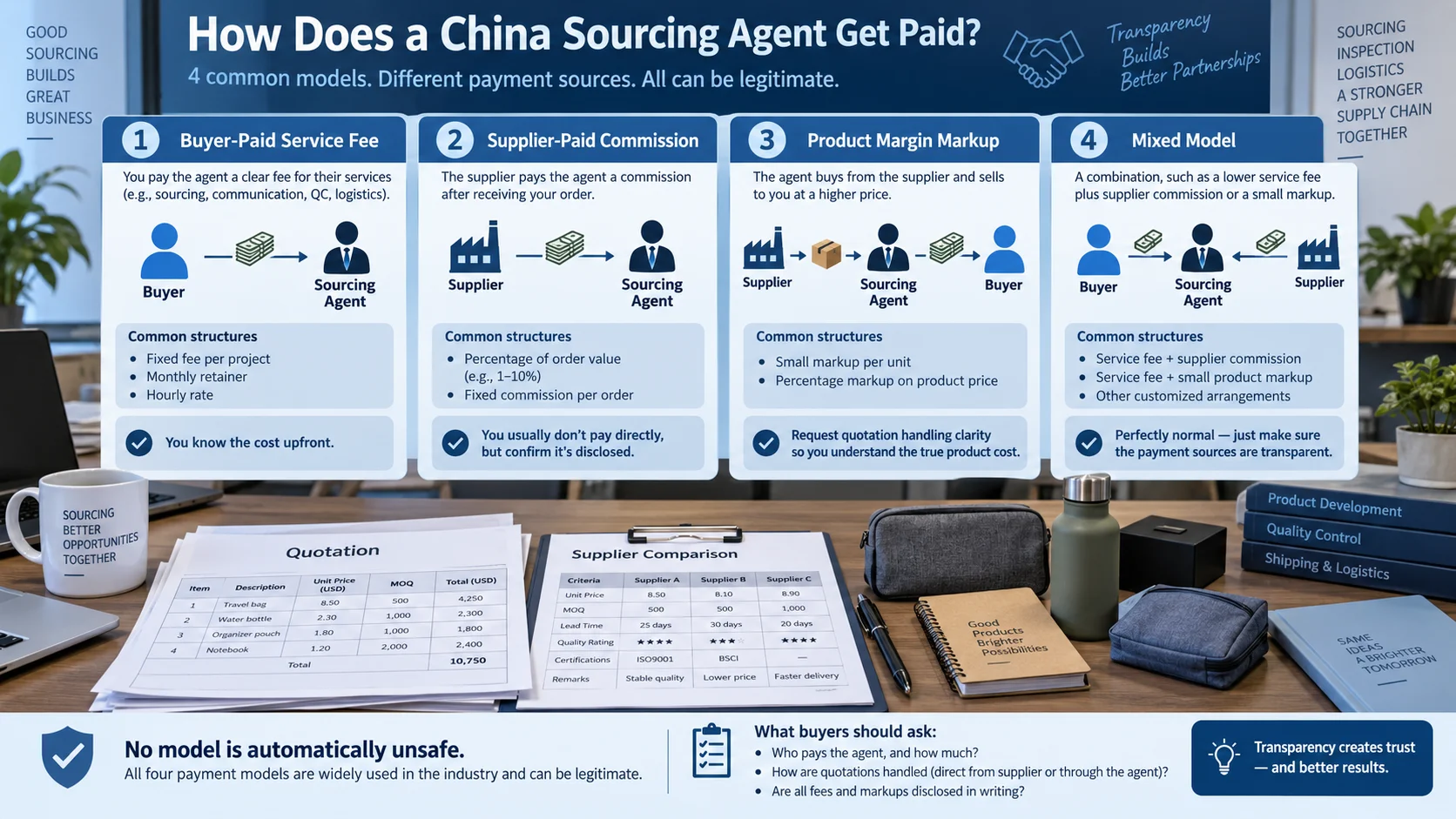
Common Pricing Models Buyers May Encounter
A provider may use one of several commercial models. Each model can work when it is disclosed and paired with a clear service scope.
| Evaluation Area | Free China Sourcing Agent | Paid Sourcing Service |
|---|---|---|
| Buyer-facing service fee | Often no separate fee | Usually fixed, percentage-based, hourly, or project-based |
| Possible revenue source | Supplier commission, product margin, or quotation spread | Buyer fee; some providers may also have supplier-side income |
| Main buyer question | Does compensation affect supplier selection or pricing transparency? | Does the fee include meaningful risk-control work? |
| Scope of work | May focus on supplier introduction or order placement | May include defined sourcing, QC, consolidation, and coordination tasks |
| Accountability | Depends on written responsibilities and reporting | Depends on contract, scope, process, and escalation method |
| Often best for | Simple, lower-risk products with informed buyers | Customized, multi-SKU, multi-factory, or repeat purchasing programs |
What We Suggest Buyers Confirm
We encourage buyers to request a written explanation before they share deposits or place orders. A clear document does not remove every risk, but it gives both sides a shared reference point.
Buyers should confirm:
- Quotation format: Is the supplier unit price separate from freight, packaging, inspection, and service charges?
- Supplier options: Will the agent compare more than one supplier when appropriate, or recommend only one factory?
- Markup disclosure: If the provider buys and resells goods, is the buyer evaluating a final trading price rather than direct factory pricing?
- Commission disclosure: If supplier compensation exists, does the provider explain whether it affects recommendations?
- Change management: If materials, packaging, MOQ, or delivery time changes, who must approve the revision?
At KingSourcing, we see quotation comparison as more than a price exercise. Buyers should compare specifications, MOQ, tooling, packaging, lead time, payment terms, and quality expectations. A low quotation can become less attractive if it excludes important requirements.
What Should a China Sourcing Agent Actually Control?
A supplier introduction may look like sourcing support, but finding a factory is only the first step. Buyers can still face sample mismatches, production changes, packaging mistakes, missing accessories, and shipment delays after the introduction. We recommend separating supplier discovery from actual order risk control.
A capable China sourcing agent should define which checkpoints it manages from supplier verification through shipping coordination. Buyers should not assume that “sourcing” includes factory audits, sample review, production follow-up, quality inspection, or problem resolution unless those duties are clearly agreed in writing.
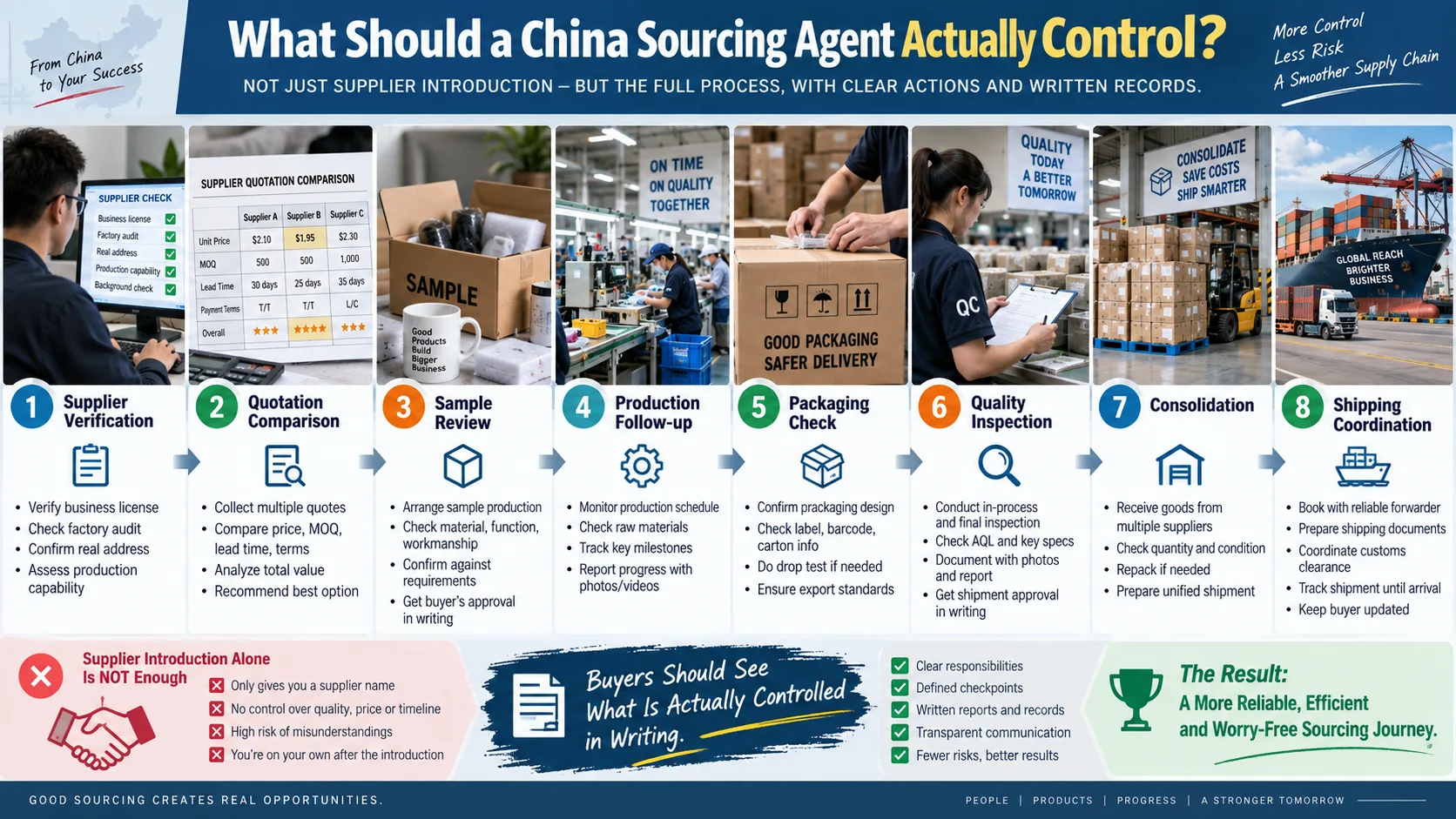
Supplier Verification Reduces Identity and Capability Risk
Supplier verification helps buyers confirm that a business exists, has relevant operations, and appears capable of producing the requested product.[^3] The depth of verification should match the order risk.
For example, buyers may need to confirm:
- The supplier’s business identity and contact details
- Whether it is a factory, trading company, or a combination of both
- Product category experience and production capabilities
- Available equipment, workforce, and quality processes
- Export experience relevant to the destination market
- Documents or test reports that buyers should independently verify when needed
A verification step does not guarantee future performance.[^4] It helps buyers avoid making decisions based only on marketplace listings, attractive photos, or quick chat responses.
Production and QC Reduce Execution Risk
Production follow-up helps identify issues before all goods are completed. We consider this especially important when products involve custom colors, logos, packaging, labels, bundled accessories, or product variations.
Quality inspection can reduce the risk of shipping goods that do not match agreed requirements.[^5] A buyer should define inspection criteria in advance, including product appearance, quantity, functionality, packaging, labeling, and critical defects.[^6] For some products, a qualified independent professional should assess application-specific safety, compliance, or technical requirements.
The core lesson is simple: supplier selection is not the same as supplier management.[^7]
Which China Sourcing Agent Checkpoints Protect Buyers Most?
Many buyers focus on factory price first, then discover later that the order contains several unassigned responsibilities. A China sourcing agent becomes more useful when the provider identifies these checkpoints early and explains how each one reduces a particular risk.
The most valuable checkpoints depend on the order, but buyers should usually confirm supplier verification, quotation comparison, sample handling, production follow-up, quality inspection, consolidation, and shipping coordination. Each task should have a named responsible party, a timing requirement, and a documented output.
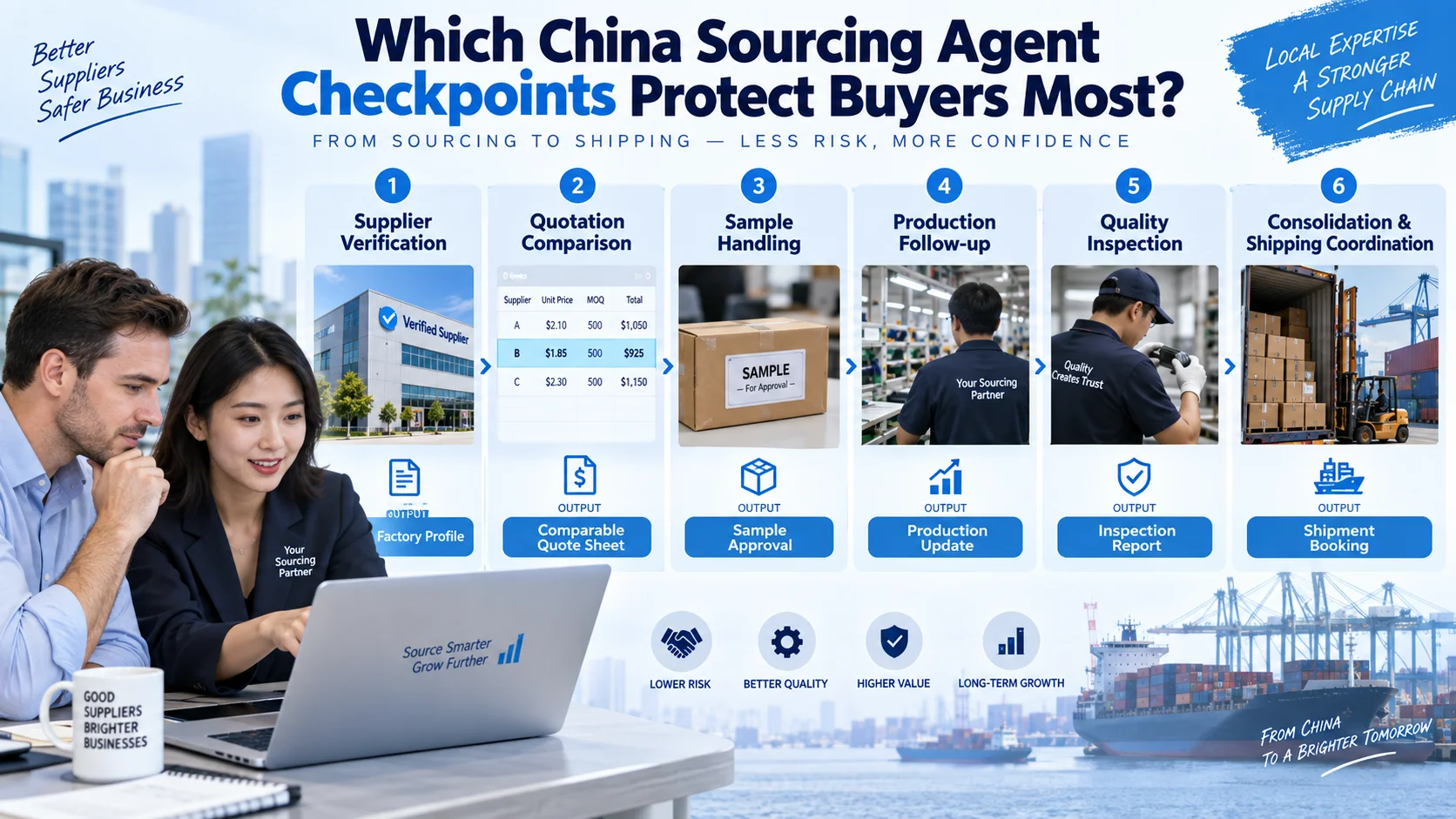
A Practical Procurement Checkpoint Checklist
We suggest buyers use the following checklist during evaluation calls. It helps reveal whether a provider offers real operational support or only supplier contact details.
Before Payment
- Supplier verification: Reduces the risk of dealing with a supplier that cannot be reasonably identified or assessed.
- Quotation comparison: Reduces the risk of comparing incomplete prices with different specifications.
- Specification review: Reduces confusion around materials, dimensions, colors, logos, accessories, and packaging.
- Sample coordination: Reduces the chance that bulk production begins without a confirmed reference standard.
During Production
- Production follow-up: Reduces the risk that changes, delays, or misunderstandings remain hidden until shipment.
- Approval control: Reduces unauthorized changes to product details, carton marks, labeling, or components.
- Issue escalation: Creates a defined path for handling defects or supplier communication problems.
Before and After Shipment
- Quality inspection: Reduces the risk of shipping obvious quantity, appearance, function, or packaging issues.
- 1-by-1 checking where appropriate: Can support higher-control orders, especially where each unit or variation needs individual handling.
- Consolidation: Reduces the complexity of receiving goods from multiple factories and coordinating combined shipments.
- Shipping coordination: Reduces confusion around carton counts, delivery readiness, shipping documents, and handover timing.
Buyers should ask for examples of reports, checklists, photos, or progress updates that the provider normally supplies. We recommend evaluating the evidence format, not just the verbal promise.
When Is a Paid China Sourcing Agent Usually Worth It?
A low-value, standard product can sometimes be managed with limited support, especially when the buyer has clear specifications and experience with the supplier. However, risk rises quickly when customization, multiple suppliers, product compliance, or tight delivery requirements enter the project.
A paid China sourcing agent is often worth considering when the order needs defined management across several stages. The fee may support clearer work allocation, reporting, quality checks, and coordination. Buyers should still assess the actual scope instead of assuming a paid provider covers every risk.
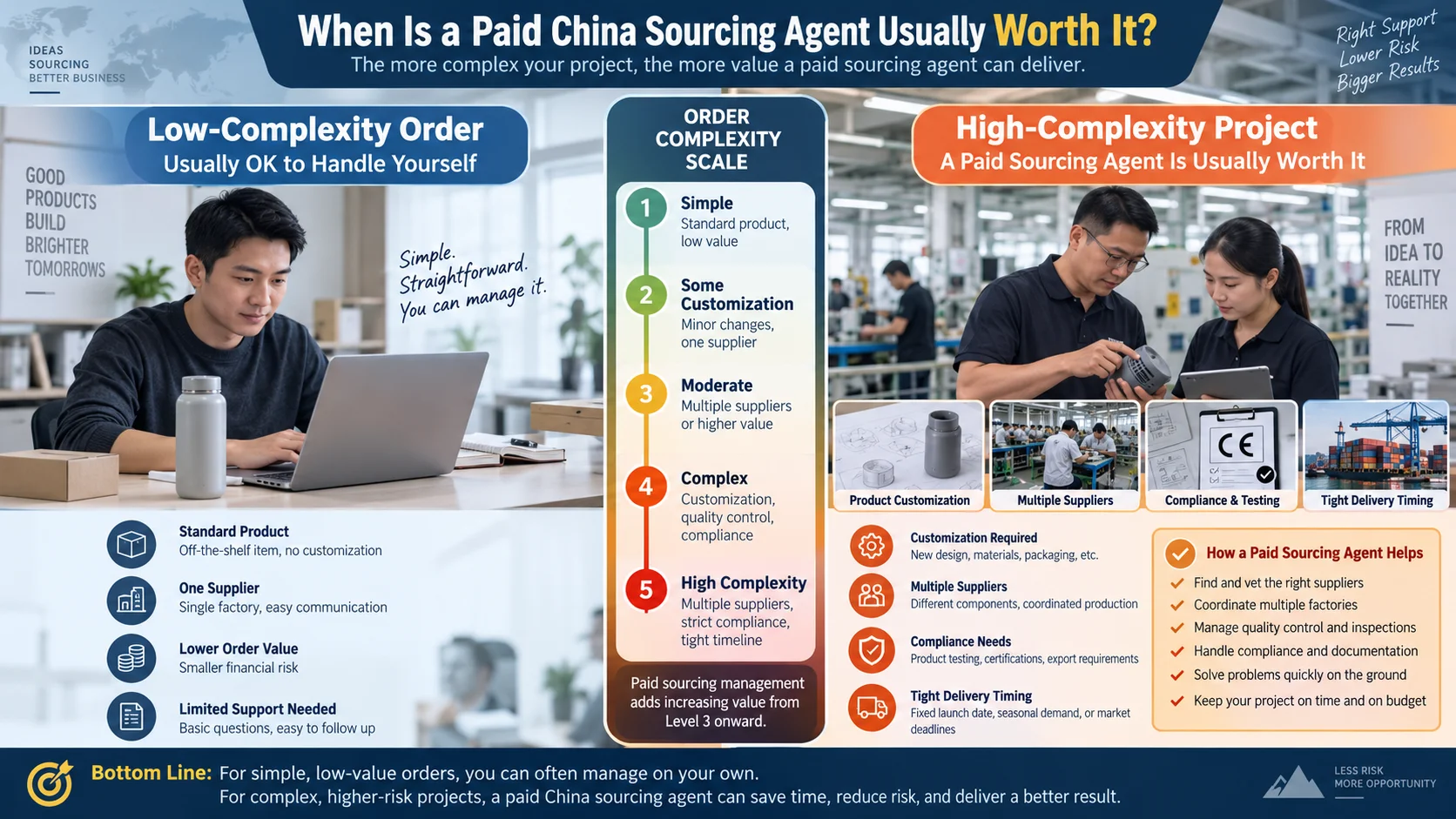
Orders That Usually Need More Structured Support
We believe buyers should consider stronger controls when an order includes one or more of these conditions:
- Custom OEM or private-label products: Small misunderstandings in artwork, color, mold details, or packaging can affect the full batch.[^8]
- Multiple SKUs: Each variation can introduce separate labeling, quantity, packing, and inspection requirements.
- Multiple factories: A buyer must coordinate delivery dates, carton data, consolidation, and shipment readiness across suppliers.
- New supplier relationships: Buyers may have limited evidence of how the supplier performs during production.
- Higher-consequence products: Products with safety, regulatory, technical, or end-user performance implications may need qualified professional review and verified documentation.
- Time-sensitive launches: A delay in one component or supplier order can affect the complete shipment.
A paid service can be a sensible choice when it gives the buyer more control over these moving parts. However, buyers should not pay simply because a provider offers a long list of service names. They should ask what the provider will check, when it will check it, and what action it will take if it finds an issue.
At KingSourcing, our role can range from supplier sourcing and sample coordination to production follow-up, inspection, consolidation, and shipping support. The right level of support depends on the buyer’s product and purchasing program.
How Can You Compare a China Sourcing Agent Before Committing?
Choosing a China sourcing agent can feel difficult because most providers can promise competitive pricing and reliable suppliers. The real challenge is comparing their process before your money, product specifications, and delivery timeline are committed. We recommend asking operational questions that require clear answers.
Buyers should compare sourcing providers by compensation transparency, supplier verification methods, reporting, quality-control scope, communication speed, and responsibility for each checkpoint. A good provider should explain limitations clearly rather than promise that every supplier or order will be risk-free.
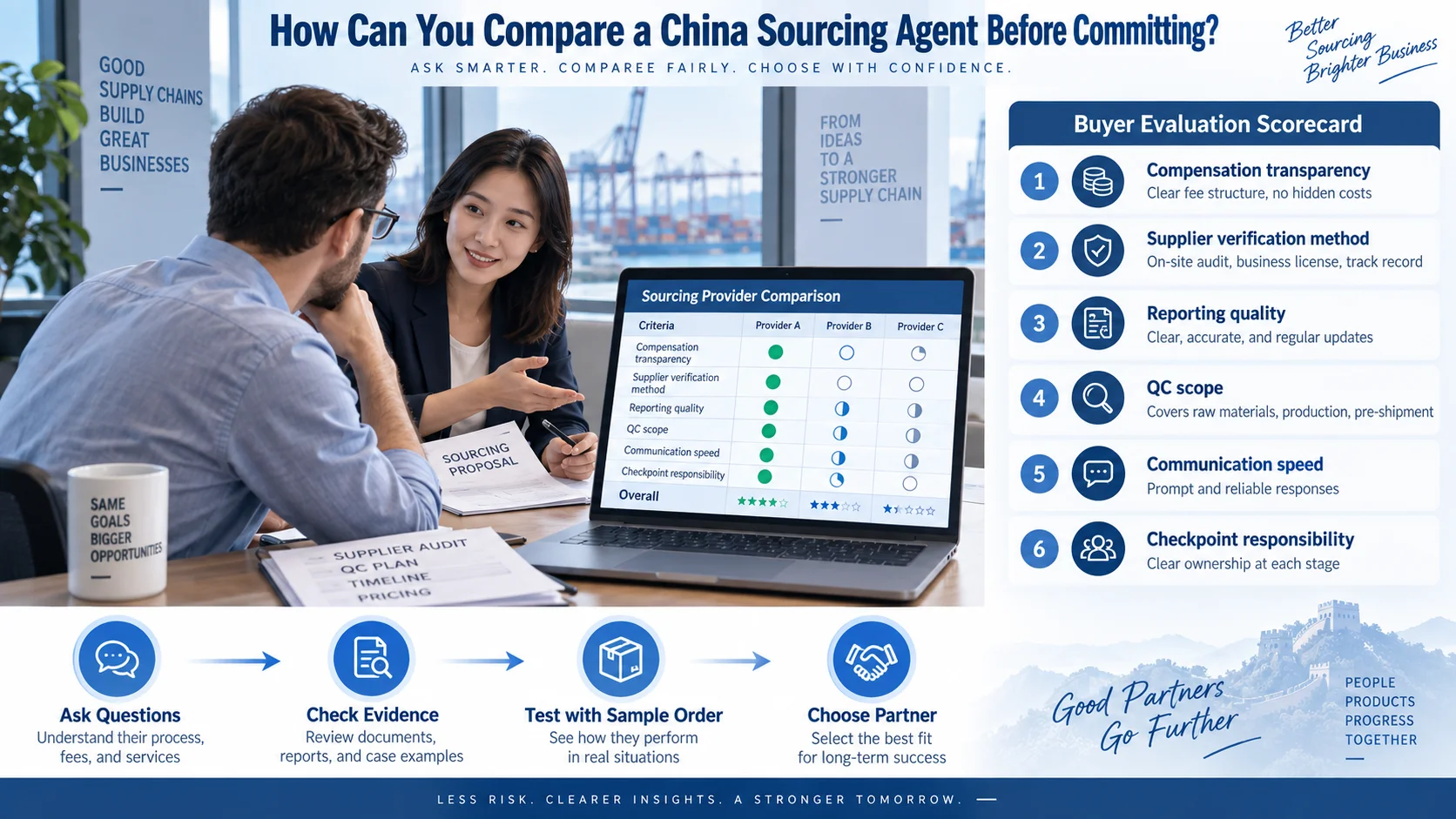
Questions We Recommend Asking Before You Start
Use this short evaluation process before appointing an agent:
-
Ask for the workflow.
Request a step-by-step outline from product brief to shipping handover. You should know when supplier verification, samples, production follow-up, inspection, and consolidation occur. -
Ask what is excluded.
This question is just as important as asking what is included. For example, inspection may be limited to a certain stage, location, or product quantity. -
Ask who communicates with suppliers.
Buyers should know whether they will communicate directly, through the agent, or through both channels. Clear communication can reduce conflicting instructions. -
Ask how quality standards are recorded.
A provider should work from approved samples, product specifications, defect criteria, packaging requirements, and buyer instructions. -
Ask how problems are handled.
Buyers should understand who gathers evidence, contacts the supplier, proposes corrective actions, and confirms whether the issue has been resolved. -
Start with a manageable order when possible.
A smaller test order may help buyers evaluate communication, reporting quality, sample control, and execution before expanding a purchasing program.[^9]
We encourage buyers to treat sourcing support as a procurement decision, not just a search for the lowest visible fee. The most suitable provider is the one whose working method matches your internal capabilities and order risk.
Frequently Asked Questions
Is a free China sourcing agent trustworthy?
A free China sourcing agent can be trustworthy if the compensation model, supplier recommendation process, and service scope are transparent. Buyers should ask how the agent earns money and what risk-control tasks are included. Trust should come from clear processes, evidence, and accountability rather than a “free” label.
Do paid sourcing services guarantee better quality?
No. A paid sourcing service does not guarantee better quality. Quality depends on clear specifications, approved samples, supplier capability, production control, inspection criteria, and corrective action. Buyers should confirm exactly what quality-control work the paid service performs and what reports they will receive.
Should I work directly with a Chinese factory or use an agent?
Direct factory sourcing may work for experienced buyers with strong supplier-management and quality-control capabilities. An agent can help when buyers need local verification, communication support, sample management, inspection, consolidation, or shipping coordination. The best choice depends on your order complexity and internal resources.
What should be included in a sourcing service agreement?
A sourcing service agreement should define pricing, payment method, supplier verification scope, sample handling, production follow-up, inspection standards, reporting, consolidation, shipping coordination, confidentiality, and responsibility for approved tasks. Buyers should also identify exclusions and escalation procedures before placing orders.
Conclusion
A China sourcing agent is safer when the provider’s incentives, responsibilities, and risk-control steps are visible from the start. Free support can work for straightforward purchases, while paid sourcing services may be more appropriate for custom products, multiple suppliers, quality-sensitive goods, and repeat procurement programs. We recommend that buyers compare providers through their actual workflow, not their pricing label alone. If you need clearer supplier verification, production follow-up, quality inspection, consolidation, or shipping coordination from China, we at KingSourcing can help you build a more controlled sourcing process.
[^1]: "Procurement", https://en.wikipedia.org/wiki/Procurement. Procurement-intermediary research describes commissions and resale markups as recurring ways agents and trading intermediaries can be compensated in cross-border transactions. Evidence role: general_support; source type: research. Supports: That purchasing intermediaries can be remunerated by commissions, markups, or other transaction-linked compensation arrangements.. Scope note: Compensation practices vary by contract, industry, and jurisdiction; the source would not establish how any particular China sourcing agent is paid. [^2]: "Conflict of interest: Anti-Corruption and Integrity Outlook 2026", https://www.oecd.org/en/publications/2026/03/anti-corruption-and-integrity-outlook-2026_d8f55b04/full-report/component-7.html. Guidance on procurement integrity identifies transparent disclosure of remuneration and conflicts of interest as a mechanism for evaluating incentives and strengthening accountability. Evidence role: mechanism; source type: institution. Supports: That transparent disclosure of remuneration and conflicts of interest helps principals assess incentives in procurement relationships.. Scope note: Disclosure can improve visibility of incentives but does not by itself demonstrate service quality or eliminate conflicts. [^3]: "Due diligence in electronics and vehicle manufacturing - OECD", https://www.oecd.org/en/publications/responsible-business-conduct-spotlights_03a75bf9-en/due-diligence-in-electronics-and-vehicle-manufacturing_993bb959-en.html. Public procurement due-diligence guidance describes verification of supplier identity, business information, and relevant capability as part of assessing a supplier before engagement. Evidence role: general_support; source type: government. Supports: That supplier due diligence commonly includes checking legal identity, business information, and capability relevant to contract performance.. Scope note: Such checks provide evidence for an initial assessment and do not guarantee future production performance. [^4]: "Supplier Evaluation Model Procurement and Contracting", https://www.academia.edu/11846445/Supplier_Evaluation_Model_Procurement_and_Contracting. Supplier-management literature distinguishes initial qualification from ongoing performance monitoring, recognizing that pre-engagement assessment cannot assure later delivery or quality outcomes. Evidence role: mechanism; source type: paper. Supports: That supplier prequalification and initial assessment must be supplemented by ongoing monitoring because supplier performance can change over time.. Scope note: The degree to which future performance is predictable depends on the product, supplier history, and monitoring method. [^5]: "8.7 Non-conforming Outputs", https://www.iso9001help.co.uk/8.7-Nonconforming-Outputs.html. ISO quality-management guidance treats inspection and control of nonconforming outputs as measures designed to prevent the unintended release of products that do not meet specified requirements. Evidence role: mechanism; source type: institution. Supports: That inspection and control of nonconforming outputs are quality-management measures intended to prevent unintended release of products that fail specified requirements.. Scope note: Inspection reduces rather than eliminates nonconformance risk, and its effectiveness depends on sampling, criteria, timing, and inspector competence. [^6]: "Science-Based Risk Assessment for the Categorization ... - PMC", https://pmc.ncbi.nlm.nih.gov/articles/PMC12473576/. Conformity-assessment guidance frames acceptance inspection around predefined product requirements and acceptance criteria, including relevant characteristics, quantities, and packaging or labeling conditions. Evidence role: definition; source type: institution. Supports: That acceptance inspection requires predefined requirements and acceptance criteria, which may include product characteristics, quantity, packaging, and labeling.. Scope note: The appropriate criteria and defect classifications are product- and contract-specific. [^7]: "Not quite alike: Supplier relationship management in B2B ...", https://www.sciencedirect.com/science/article/pii/S0019850125000240. Supply-chain management scholarship differentiates supplier selection from ongoing supplier relationship and performance management after a supplier has been chosen. Evidence role: expert-consensus; source type: paper. Supports: That supplier selection is an initial decision process, whereas supplier management includes ongoing performance evaluation, relationship management, and corrective action.. Scope note: Terminology varies across procurement frameworks, but the distinction between initial selection and ongoing management is widely used. [^8]: "[PDF] Inventory difference calculations: Problems and possibilities", https://nvlpubs.nist.gov/nistpubs/Legacy/IR/nbsir81-2219.pdf. Manufacturing-quality research links incomplete or miscommunicated specifications to systematic production deviations, which can affect multiple units produced under the same process settings. Evidence role: mechanism; source type: research. Supports: That unclear or incorrect product specifications can propagate through manufacturing processes and generate systematic defects across production output.. Scope note: The scale of impact depends on when the error is detected, batch size, process controls, and the product design. [^9]: "Supplier evaluation and selection criteria in business ...", https://www.academia.edu/34667754/Supplier_evaluation_and_selection_criteria_in_business_performance_of_small_and_medium_scale_enterprise. Research on supplier relationships and contracting describes staged commitments and trial transactions as ways to obtain performance information before increasing the scale of engagement. Evidence role: mechanism; source type: paper. Supports: That staged commitments and trial transactions can provide performance information before buyers expand a supplier relationship.. Scope note: A small order may not fully represent performance on larger, more complex, or time-sensitive production programs.