China sourcing agencies can look similar on a website, yet their actual responsibilities may differ sharply once sampling, production delays, quality issues, or shipment changes arise. I have seen overseas buyers focus on a low service fee, only to discover later that inspections, consolidation, or issue follow-up were outside the quoted scope.
Quick Answer
China sourcing agencies should be compared by the visibility of their process, the evidence behind their supplier recommendations, the services included in their quotation, and their ownership when exceptions occur. A useful comparison asks what the agency delivers at every stage-from supplier inquiry and sample review to inspection, consolidation, and shipping coordination-not simply what percentage fee it charges.
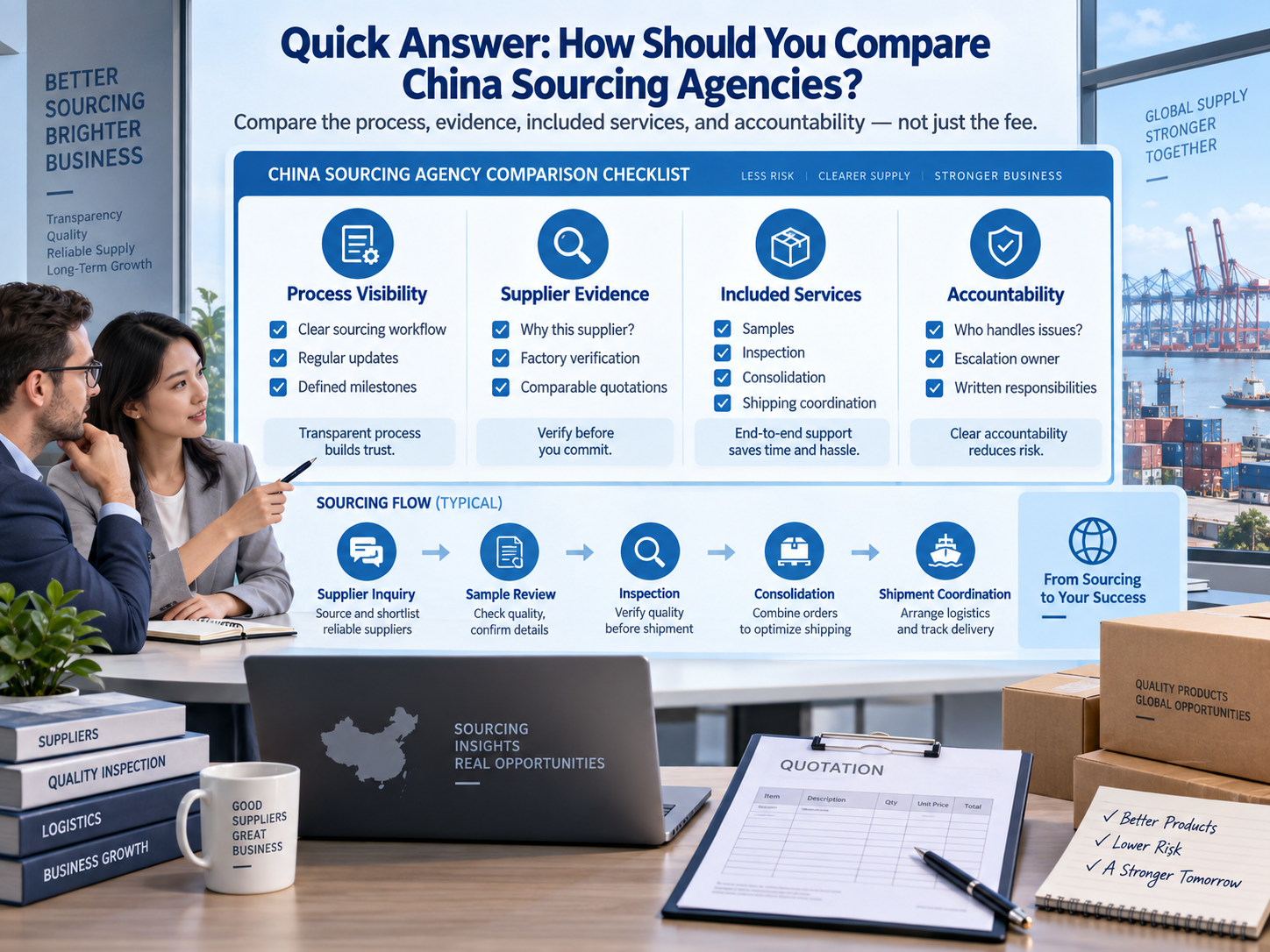
I approach agency comparison as a procurement due-diligence exercise. The goal is not to find a universally “best” partner or the lowest product price. The goal is to understand which team can make remote purchasing from China more transparent, manageable, and accountable for your specific order.
A Practical Checklist for Comparing China Sourcing Agencies: Scope, Evidence, and Accountability
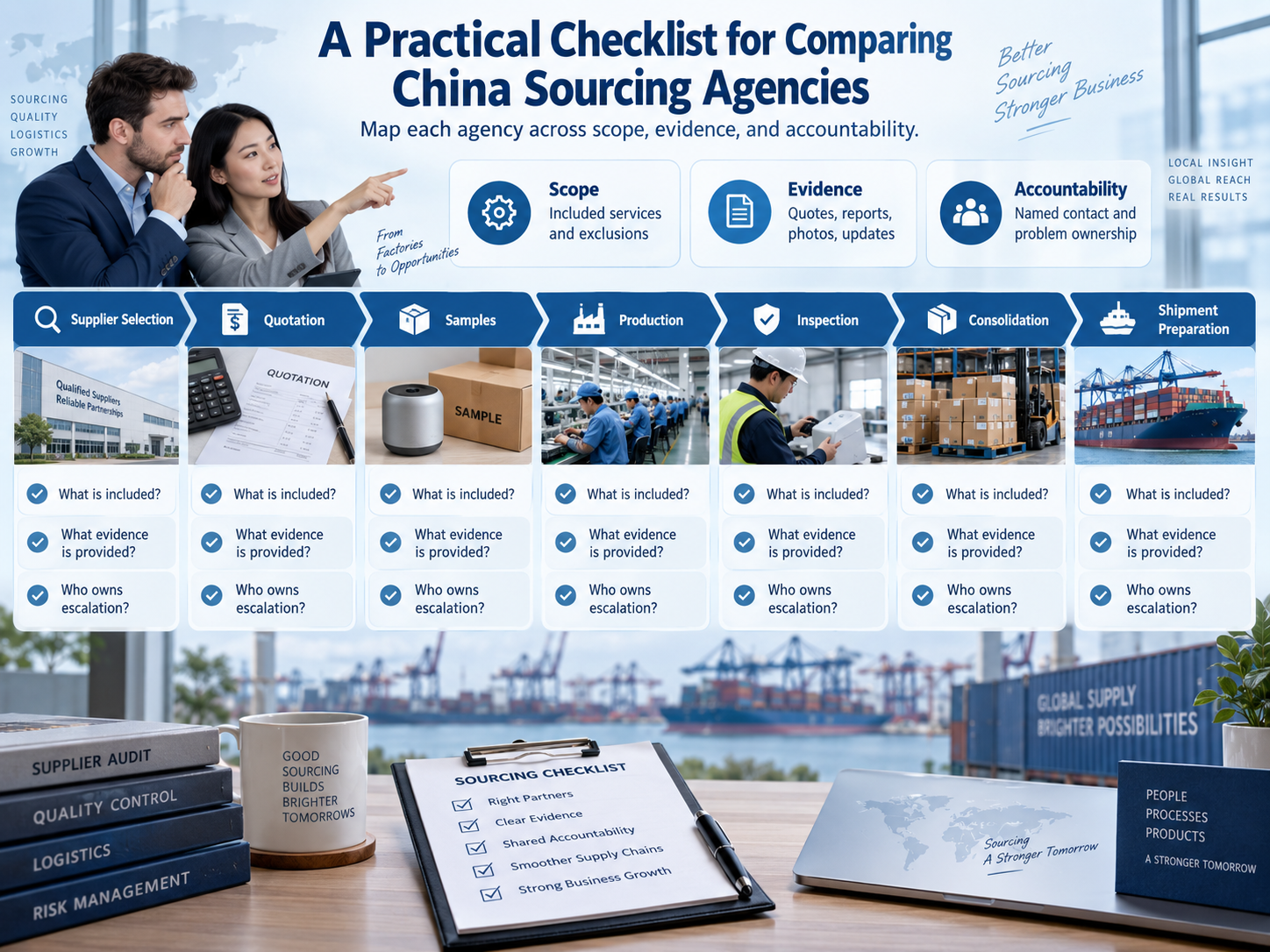
When I compare China sourcing agencies, I start with a simple concern: a broad promise such as “full service” does not explain what the buyer will receive. Without written scope, evidence, and named responsibility, a low initial quote can become difficult to evaluate once the order becomes more complex.
A practical way to compare China sourcing agencies is to map each agency’s process across supplier selection, quotation, samples, production, inspection, consolidation, and shipment preparation. Buyers should ask what is included, what documents or updates are provided, what is excluded, and who owns escalation if a supplier misses an agreed requirement.
1. Compare the Scope Before Comparing the Fee
I have found that many quotation misunderstandings begin with one phrase: “sourcing service included.” That phrase can mean very different things.
One agency may only identify suppliers and relay quotations. Another may coordinate samples, negotiate packaging details, arrange inspections, manage multi-factory consolidation, and support shipping documentation. Neither model is automatically wrong. However, the buyer needs to know which model they are buying.
A service fee should be evaluated alongside the operational tasks covered by that fee.
| Procurement stage | Questions I suggest buyers ask | Evidence or deliverable to request |
|---|---|---|
| Product inquiry | Will the agency clarify specifications with suppliers? | Inquiry sheet, product brief, supplier responses |
| Supplier sourcing | How many suppliers will be approached, and why? | Supplier comparison table |
| Supplier verification | What checks are included beyond finding a contact? | Registration details, location evidence, audit records if available |
| Quotation comparison | Are product, tooling, packaging, and shipping costs separated? | Itemized quotation comparison |
| Sample development | Who follows revisions, testing, and sample approval? | Sample photos, revision log, courier details |
| Production follow-up | How often will the agency update the buyer? | Production schedule and progress reports |
| Quality control | Is inspection included, and what inspection level applies? | Inspection report, defect photos, checklists |
| Consolidation | Are receiving, counting, labeling, and storage included? | Warehouse receiving records and carton counts |
| Shipping coordination | Does the agency coordinate documents and booking? | Shipping quote, carton data, document checklist |
In my Shenzhen-based work, I have seen a buyer receive an attractive product quote that did not include receiving goods from multiple factories, checking carton labels, or preparing the final consolidated shipment. Those services may still be available, but they need to be priced and agreed in advance.
This may matter especially for:
- E-commerce sellers buying from several suppliers
- Brands using custom packaging from a separate factory
- Wholesalers managing many SKUs
- Buyers with Amazon FBA preparation requirements
- Importers that need product inspection before final payment
- Startups placing a small test order before a larger purchase program
I recommend asking each agency to quote against the same written product brief and service checklist. If one agency receives a vague inquiry while another receives detailed specifications, the resulting price comparison will not be meaningful.
A low agency fee is not necessarily low total procurement cost.[^1] The relevant figure is the total cost of obtaining compliant, checked, properly packed, and shippable goods.
2. Separate Supplier Access From Supplier Verification
Many China sourcing agencies can locate suppliers quickly. Shenzhen, Dongguan, Guangzhou, Foshan, Yiwu, Ningbo, and other manufacturing clusters offer broad supplier access across consumer products, electronics, accessories, promotional goods, and wholesale categories.
However, supplier access is not the same as supplier verification[^2].
A supplier may have a professional catalog, fast replies, and competitive pricing. Those signals can be useful, but they do not alone confirm manufacturing capability, ownership of production, quality consistency, export experience, or capacity for a specific order.[^3]
When I assess a prospective supplier, I consider the buyer’s product category, order quantity, customization level, and quality expectations. A capable agency should be able to clarify what it checked and what it did not check.
What Should Supplier Verification Include?
The appropriate level of verification depends on the project. For a low-risk stock item and small trial order, buyers may need a lighter review. For a custom electronic product, private-label launch, or high-value order, a more structured factory evaluation may be appropriate.
Buyers should ask whether the agency can provide or explain:
- The supplier’s legal company name and registered location
- Whether the party is a factory, trading company, or mixed operation
- Product-category relevance and apparent production capability
- Factory photos, video evidence, or a site-visit report where applicable
- Previous export-market experience, if relevant to the product
- Sample quality and responsiveness during technical clarification
- Production capacity and expected lead time
- Quality-control procedures described by the supplier
- Documentation related to required compliance or testing
If a product requires certification, safety testing, chemical compliance, battery documentation, food-contact compliance, or market-specific labeling, I recommend that buyers treat every document as something to verify. An agency can help collect and organize documents, but buyers should confirm that the documents apply to the exact product, variant, factory, destination market, and current production version[^4].
For application-specific technical decisions, qualified compliance, legal, laboratory, or engineering professionals may also be necessary.
3. Evaluate Quotation Quality, Not Only the Unit Price
A useful quotation should make costs visible. When I review supplier quotations, I look for missing assumptions because those gaps often become expensive later.
For example, a unit price may exclude customized packaging, printed manuals, logo setup, molds, batteries, export cartons, inspection, domestic transport, warehousing, or freight[^5]. A quote may also be based on a different material, thickness, accessory configuration, or quality standard than the buyer expected.
I recommend that buyers ask prospective China sourcing agencies to present quotations in a comparable format.
| Cost category | What should be clarified |
|---|---|
| Product unit price | Material, dimensions, version, accessories, color, MOQ |
| Customization | Logo method, artwork setup, mold/tooling, print locations |
| Packaging | Individual box, inserts, master carton, labeling, barcode requirements |
| Sample charges | Sample cost, revisions, courier charges, refund conditions if any |
| Domestic logistics | Factory-to-warehouse transport and receiving costs |
| Inspection | Inspection type, timing, reporting, reinspection fees |
| Warehousing | Free storage period, handling charges, inventory controls |
| Consolidation | Carton relabeling, palletizing, repacking, multi-supplier handling |
| International shipping | Incoterm, freight method, destination charges, customs responsibility |
I once handled an inquiry where two supplier prices initially appeared far apart. After we aligned packaging, accessory content, carton specifications, and inspection expectations, the difference became much smaller. The initial comparison was not wrong; it was incomplete.
A transparent sourcing partner should not claim that every low price is suspicious. There are legitimate reasons for price differences, including factory scale, material grade, production method, order quantity, and included services. The practical task is to identify which differences are commercial and which reflect a mismatch in scope.
4. Ask Who Owns Each Handoff in the Procurement Workflow
The strongest question I use when comparing China sourcing agencies is operational:
From inquiry through shipment, who does what, what is delivered, and who drives resolution when something goes wrong?
Remote sourcing involves handoffs.[^6] The buyer hands a brief to the agency. The agency communicates with suppliers. A factory produces goods. An inspector checks output. A warehouse receives cartons. A freight provider moves cargo. Problems often occur between these steps, where responsibility becomes unclear.[^7]
A capable agency should be able to describe its workflow in plain language.
A Clear Ownership Map
| Handoff | Common risk | Accountability question |
|---|---|---|
| Buyer brief to supplier inquiry | Specifications are misunderstood | Who confirms critical specifications before quotation? |
| Supplier quote to sample | Sample differs from quoted configuration | Who tracks approved sample details and revisions? |
| Sample to mass production | Factory changes material or process | Who confirms production against the approved standard? |
| Production to inspection | Defects are found late | Who arranges inspection and follows corrective action? |
| Factory to warehouse | Wrong quantities or labels arrive | Who checks receiving counts and carton markings? |
| Warehouse to forwarder | Carton data or documents are incomplete | Who verifies shipping marks, dimensions, and handover records? |
In real sourcing work, I have seen a shipment delay because one factory completed goods on time but did not apply the agreed carton labels. The issue was not necessarily difficult to correct. The real difficulty was determining who would identify the error, request correction, verify the result, and update the buyer before the consolidation deadline.
That is why generic promises such as “we handle everything” are less useful than a written process.
I suggest asking an agency:
- Who is my day-to-day contact?
- Who approves supplier selection recommendations internally?
- Who follows up with the factory during production?
- Who reviews inspection findings with me?
- Who communicates corrective actions to the supplier?
- Who checks goods when they arrive at the warehouse?
- Who coordinates shipment preparation and final carton information?
- What happens if the assigned coordinator is unavailable?
The answers do not need to be elaborate. They do need to be specific.
5. Review How the Agency Handles Quality Control and Exceptions
Quality control is not simply a final inspection report. It is a decision process that begins with defining what “acceptable” means for the order.
For some products, a basic appearance and quantity inspection may be enough. For others, buyers may need functional testing, dimensions, packaging checks, barcode verification, or an agreed acceptable quality limit (AQL) sampling plan[^8]. Product-specific requirements should be reviewed by suitably qualified professionals where necessary.
I recommend that buyers ask prospective agencies how they manage these checkpoints:
- Pre-production: Are specifications, golden samples, artwork, and packaging requirements confirmed?
- During production: Is there progress monitoring for longer or more complex orders?
- Pre-shipment: Is inspection arranged before the balance payment or final release, where commercially practical?
- After defects are found: Who communicates the defect list, requests rework, a nd verifies corrective action?
- At warehouse receiving: Are quantities, carton condition, labels, and visible product issues checked?
A well-designed inspection report should generally show the inspection date, order quantity, sampling basis, checks performed, defect classification, photos, and conclusion. Buyers should also understand the report’s limits. An inspection is a sample-based activity unless the service specifically includes 1-by-1 product checking.[^9] It does not eliminate every possible quality risk.
For high-risk, regulated, safety-sensitive, or technically complex products, I suggest buyers consider independent third-party inspection, laboratory testing, or specialist technical review[^10] in addition to agency coordination.
6. Use a Weighted Scorecard to Compare China Sourcing Agencies
I do not recommend choosing among China sourcing agencies based on an online star rating, a headline claim, or the lowest quoted commission. Reviews can provide context, but they rarely reveal whether an agency’s scope fits your specific product and operating model.[^11]
Instead, I suggest using a weighted scorecard. This helps procurement teams compare agencies against the same criteria.
| Evaluation area | Suggested weight | What I would look for |
|---|---|---|
| Scope clarity | 20% | Itemized services, exclusions, workflow explanation |
| Supplier verification evidence | 15% | Clear methodology and documented findings |
| Quotation transparency | 15% | Comparable pricing, assumptions, and cost breakdown |
| Quality-control process | 15% | Inspection options, reporting format, corrective-action handling |
| Communication and reporting | 10% | Named contact, update frequency, escalation route |
| Multi-supplier coordination | 10% | Consolidation process, receiving checks, warehouse controls |
| Shipping coordination | 5% | Carton data, document support, freight coordination boundaries |
| Relevant product experience | 10% | Demonstrated familiarity with the category and requirements |
A scorecard does not replace judgment. It does, however, make trade-offs visible. An agency with a higher fee may offer stronger production follow-up, better reporting, or more practical support for multi-SKU consolidation. Another agency may be ideal for simple product sourcing but not structured enough for customized OEM work.
I also suggest running a small paid project, sample order, or limited-SKU trial when feasible. During that process, observe whether the agency asks useful clarification questions, records decisions, identifies risks early, and follows through on commitments. These behaviors can be more informative than a sales presentation.
Frequently Asked Questions About China Sourcing Agencies
What should I ask before hiring a China sourcing agency?
I suggest asking about scope, supplier verification, quotation format, sample management, inspection procedures, warehouse handling, shipping coordination, and escalation responsibility. You should also ask what is excluded from the fee and request examples of the reports, comparison tables, or updates you would receive.
How do China sourcing agencies charge for their services?
China sourcing agencies may charge a percentage of order value, a fixed project fee, a per-service fee, or a combination of these methods.[^12] I recommend comparing the total service scope rather than the percentage alone, because inspections, consolidation, warehousing, and shipping coordination may be priced separately.
Is supplier verification the same as a factory audit?
No. Supplier verification can range from basic business and capability checks to a more detailed on-site factory audit. Buyers should ask what verification method is being offered, what evidence will be provided, and whether the level of review suits the product risk, order value, and compliance requirements.
Should I use an agency for a small test order?
A sourcing agency may still be useful for a small test order if you need supplier communication, sample coordination, product checking, or consolidation support. I recommend confirming minimum service fees and choosing a scope that matches the order’s commercial value and risk level.
Can a sourcing agency guarantee product quality or delivery dates?
No responsible agency should guarantee zero defects, supplier performance, or delivery outcomes beyond its direct control. I believe buyers should look for clear quality-control processes, early risk reporting, documented corrective-action follow-up, and realistic production and shipping planning instead of absolute promises.
Conclusion
Comparing China sourcing agencies should be a structured procurement decision, not a quick fee comparison. I recommend reviewing each agency’s service scope, supplier verification evidence, quotation detail, quality-control process, warehouse capability, and escalation ownership. The right partner for your business is the one that makes critical decisions and handoffs visible from inquiry to shipment. If you are sourcing from multiple Chinese suppliers or planning a customized purchasing program, I encourage you to build a written comparison checklist before committing to any agency.
[^1]: "Determine Total Export Price - International Trade Administration", https://www.trade.gov/determine-total-export-price. Procurement guidance on total cost of ownership explains that purchasing decisions should account for costs incurred across acquisition, logistics, handling, and use rather than relying only on an initial quoted price. Evidence role: general_support; source type: government. Supports: Total procurement or landed cost can include costs beyond an initial quoted price or service fee, such as logistics, inspection, handling, and risk-related costs.. Scope note: Such guidance establishes the general costing principle; it does not measure the fees or total costs of any particular China sourcing agency. [^2]: "[PDF] OECD Due Diligence Guidance for Responsible Supply Chains of ...", https://www.oecd.org/content/dam/oecd/en/publications/reports/2016/04/oecd-due-diligence-guidance-for-responsible-supply-chains-of-minerals-from-conflict-affected-and-high-risk-areas_g1g65996/9789264252479-en.pdf. Supply-chain due-diligence guidance distinguishes supplier identification from the subsequent assessment of supplier operations, capabilities, and risk controls. Evidence role: definition; source type: institution. Supports: Supplier due diligence involves evaluating supplier identity, operations, capabilities, and relevant risks, which is more extensive than locating a supplier.. Scope note: The source describes a general due-diligence process and may not prescribe a single verification standard for every product or order size. [^3]: "Supply Chain Management - NIST", https://www.nist.gov/mep/supply-chain. Research on supplier evaluation identifies operational capability, capacity, quality performance, and documented assessment as criteria that cannot be inferred reliably from supplier marketing or price quotations alone. Evidence role: general_support; source type: research. Supports: Supplier qualification commonly requires evidence about production capability, quality systems, capacity, and performance rather than relying on marketing materials or quoted prices.. Scope note: The evidence supports the general assessment principle rather than proving that any individual supplier represented by an agency is unsuitable. [^4]: "Special Documents - International Trade Administration", https://www.trade.gov/special-documents. Product-safety and conformity-assessment guidance states that technical documentation and evidence of compliance must relate to the product placed on the relevant market and to its applicable regulatory requirements. Evidence role: general_support; source type: government. Supports: Product compliance documentation and conformity assessment must correspond to the relevant product and applicable market requirements.. Scope note: Requirements vary by jurisdiction and product category; the source does not replace product-specific legal, laboratory, or regulatory review. [^5]: "Cost-Ins.-Freight (CIF) | BETA - International Trade Administration", https://beta.trade.gov/article?id=Cost-Insurance-and-Freight-CIF. International-trade guidance recognizes that the commercial price of goods may be separate from packing, transport, handling, and other transaction costs that affect the buyer's total expenditure. Evidence role: general_support; source type: government. Supports: Import and procurement costs can include charges for packing, transportation, handling, and other services in addition to the product price.. Scope note: Which charges are included in a quotation depends on the contract terms, Incoterm, supplier, and service provider. [^6]: "[PDF] Supply Chain Management Guidance - Public Documents", https://thedocs.worldbank.org/en/doc/1c3b517f003b53a2e2e170e93124be84-0290032023/original/World-Bank-Supply-Chain-Management-Guidance.pdf. International logistics literature describes cross-border supply chains as coordinated sequences involving suppliers, warehousing and handling operations, carriers or forwarders, and trade-document processes. Evidence role: mechanism; source type: institution. Supports: International supply chains involve coordinated transfers of goods and information among production, inspection, warehousing, transport, and border-processing actors.. Scope note: The exact number and allocation of handoffs depend on the transaction structure and chosen logistics arrangements. [^7]: "Sharing Supply Chain Risk Information to Increase ...", https://www.cisa.gov/resources-tools/resources/sharing-supply-chain-risk-information-increase-resilience-fact-sheet. Supply-chain coordination research finds that incomplete information sharing and unclear interorganizational responsibilities can contribute to delays, errors, and other disruptions at organizational interfaces. Evidence role: mechanism; source type: paper. Supports: Breakdowns in interorganizational coordination and information sharing can increase operational risk at supply-chain interfaces.. Scope note: This literature supports a general risk mechanism and does not establish that every sourcing delay results from unclear agency responsibility. [^8]: "What kinds of Lot Acceptance Sampling Plans (LASPs) are there?", https://www.itl.nist.gov/div898/handbook/pmc/section2/pmc22.htm. ISO acceptance-sampling standards define acceptance quality limit procedures as sampling methods used to assess lots against specified quality criteria. Evidence role: definition; source type: institution. Supports: AQL-based acceptance sampling uses inspection of a sample from a lot to determine whether the lot meets a specified acceptance criterion.. Scope note: An AQL plan must be selected and applied appropriately for the product, inspection level, lot size, and contractual quality requirements. [^9]: "What kinds of Lot Acceptance Sampling Plans (LASPs) are there?", https://www.itl.nist.gov/div898/handbook/pmc/section2/pmc22.htm. Quality-control references explain that acceptance sampling draws conclusions about a lot from inspected units, in contrast to 100 percent inspection of every unit. Evidence role: mechanism; source type: education. Supports: Acceptance sampling evaluates a selected sample from a production lot, whereas 100 percent inspection is a separate inspection approach.. Scope note: Sampling design can reduce but cannot eliminate the possibility that defects in uninspected units remain undetected. [^10]: "Conformity assessment - Internal Market, Industry, Entrepreneurship ...", https://single-market-economy.ec.europa.eu/single-market/goods/building-blocks/conformity-assessment_en. Product-safety regulatory guidance describes circumstances in which conformity assessment, technical testing, and qualified assessment of compliance are required or appropriate for regulated goods. Evidence role: expert_consensus; source type: government. Supports: Regulated and safety-relevant products may be subject to conformity assessment, testing, inspection, or technical documentation requirements before market placement.. Scope note: The applicable assurance method and legal requirement depend on the product category, destination market, and governing regulations. [^11]: "Should we trust online reviews? - FTC Consumer Advice", https://consumer.ftc.gov/consumer-alerts/2022/09/should-we-trust-online-reviews. Research on online reviews notes that review content and ratings may be subject to selection effects and limited contextual detail, constraining their use as a complete measure of provider fit or performance. Evidence role: general_support; source type: paper. Supports: Online reviews can be affected by selection, manipulation, and context limitations and may not fully represent service performance for a particular use case.. Scope note: This does not mean that all reviews are unreliable; their usefulness depends on authenticity, relevance, volume, and the decision context. [^12]: "Part 31 - Contract Cost Principles and Procedures", https://www.acquisition.gov/far/part-31. Research on procurement intermediaries and sourcing-service arrangements describes compensation structures that can include transaction-linked commissions, fixed fees, and separately charged service activities. Evidence role: general_support; source type: research. Supports: Intermediary sourcing and procurement services may be compensated through commissions, fixed project fees, task-based charges, or combinations of these arrangements.. Scope note: Fee structures are contractual and vary substantially by agency, order value, product category, and included scope.