A sourcing agent cannot quote accurately from a product photo alone. If the request is vague, suppliers may quote different materials, sizes, packaging, or quality levels[^1], which makes the “best price” misleading. The solution is to send a clear product brief before quotation, so every supplier prices the same purchasable requirement.
Before quotation, send your sourcing agent the product name, specifications, photos or reference links, target quantity, material and quality requirements, packaging needs, certification requirements, destination country, target price if available, sample needs, and expected delivery time. This helps the agent prepare a supplier-ready RFQ and compare quotations fairly.
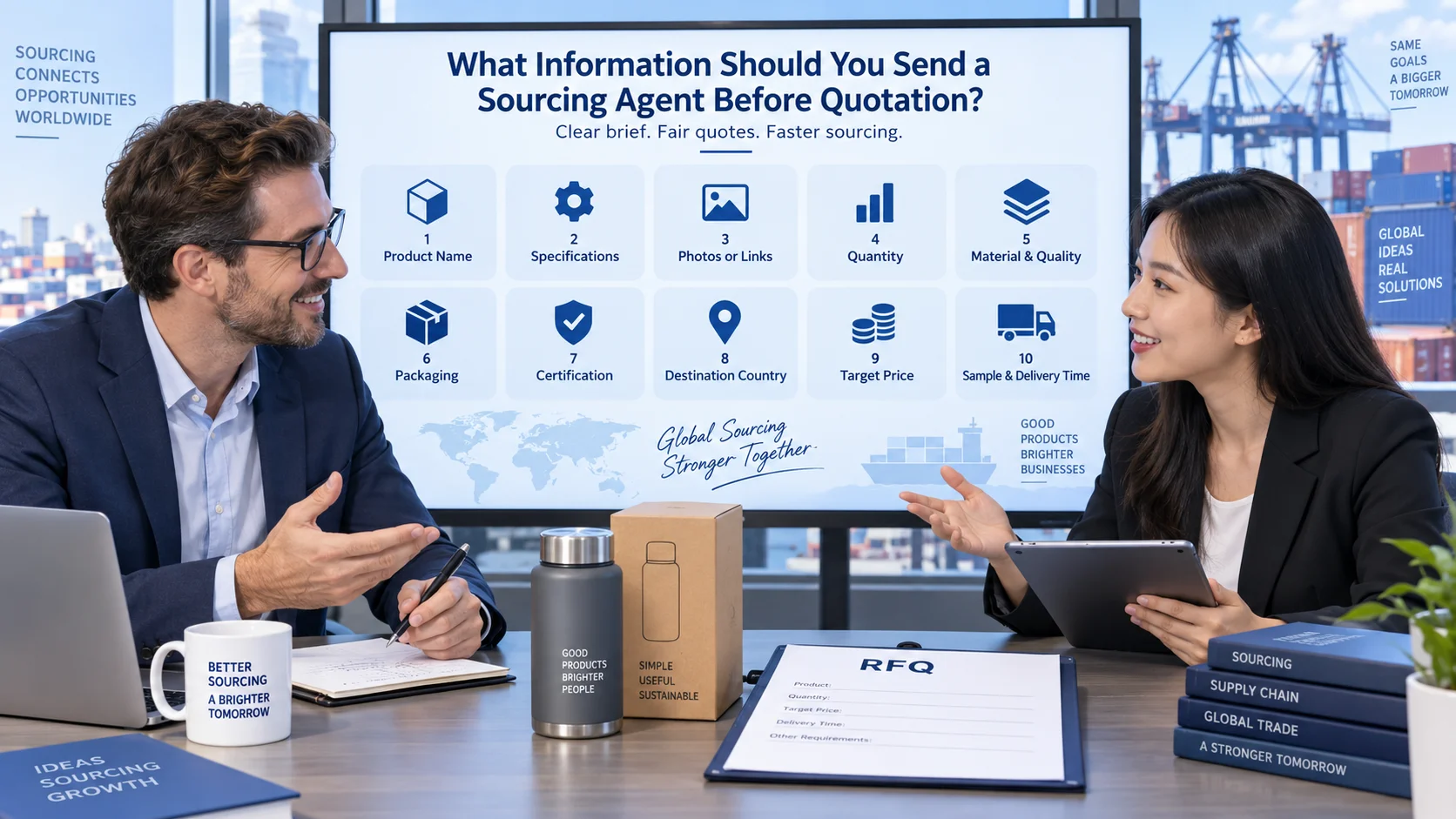
A good inquiry does not need to be perfect. I often help buyers turn rough ideas, Amazon links, Alibaba references, or existing supplier quotes into clearer RFQs. However, the more complete your first message is, the faster your sourcing agent can identify suitable suppliers and avoid cheap-looking, non-comparable offers.
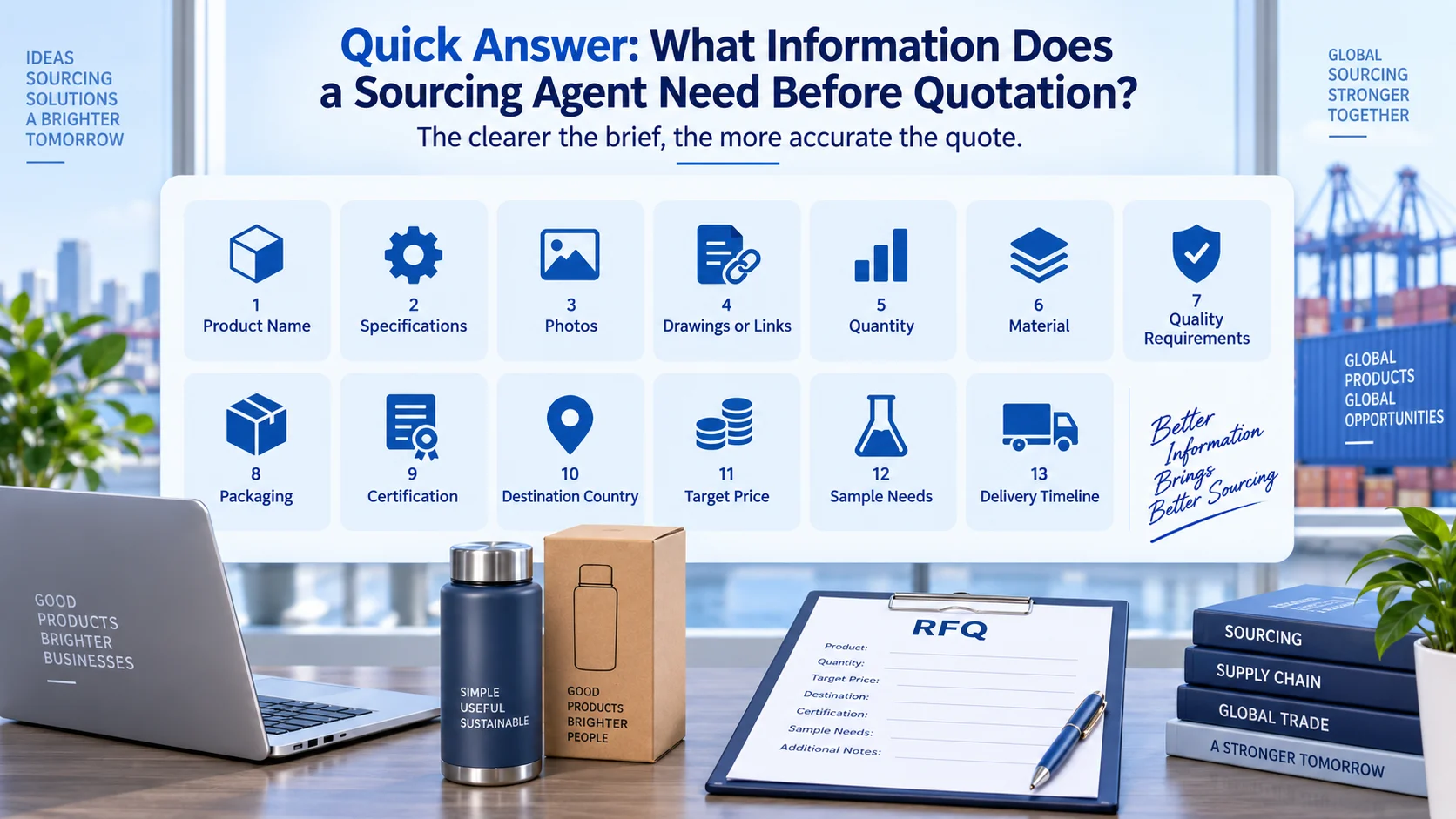
Quick Answer: What Information Does a Sourcing Agent Need Before Quotation?
Many buyers want a fast price, but a sourcing agent first needs enough detail to define what is being quoted. Without that detail, a low price may simply reflect a cheaper version, smaller size, weaker material, or missing packaging and testing costs.
A sourcing agent usually needs: product name, specifications, photos, drawings or links, target quantity, materials, quality requirements, packaging, certification needs, destination country, target price, sample requirements, and delivery timeline. These details allow the agent to contact the right suppliers and request comparable quotations.
The basic information list
When I receive an inquiry at KingSourcing, I do not treat a photo or link as a final specification. I treat it as the starting point. The actual quotation depends on many details that are often invisible in a picture.
Here is the basic information I suggest every buyer sends:
- Product name and category
- Model, size, function, or version
- Material and color requirements
- Photos, drawings, reference links, or samples
- Trial order quantity and expected repeat volume
- Packaging requirements
- Logo, barcode, manual, or private-label needs
- Destination country or market
- Required certifications or marketplace rules
- Target price or budget range, if available
- Expected sample and production timeline
- Preferred Incoterms, such as EXW, FOB, CIF, or DDP[^2]
These details matter because suppliers do not always quote the same product, even when the images look almost identical. For example, two phone stands may look similar online, but one may use aluminum alloy, one may use plastic, and one may include retail packaging while another ships in a plain polybag.
A quotation is only useful when the buyer, sourcing agent, and supplier are talking about the same product under the same conditions.
That is why follow-up questions are not a delay. They are risk control. Clear information helps your China sourcing agent avoid matching you with the wrong supplier type, wrong quality grade, or wrong compliance level.
Quotation Request Checklist: What Should You Send to a Sourcing Agent at a Glance?
A quotation request can feel complicated when you are sourcing from China for the first time. If you miss key details, your sourcing agent may need several rounds of clarification before factories can quote. That slows down comparison and increases misunderstanding.
Use a simple RFQ checklist before contacting a sourcing agent. Include product details, specifications, quantity, reference files, packaging, certification needs, destination, target price, and lead time. This gives the agent a structured brief for supplier sourcing and quotation comparison.
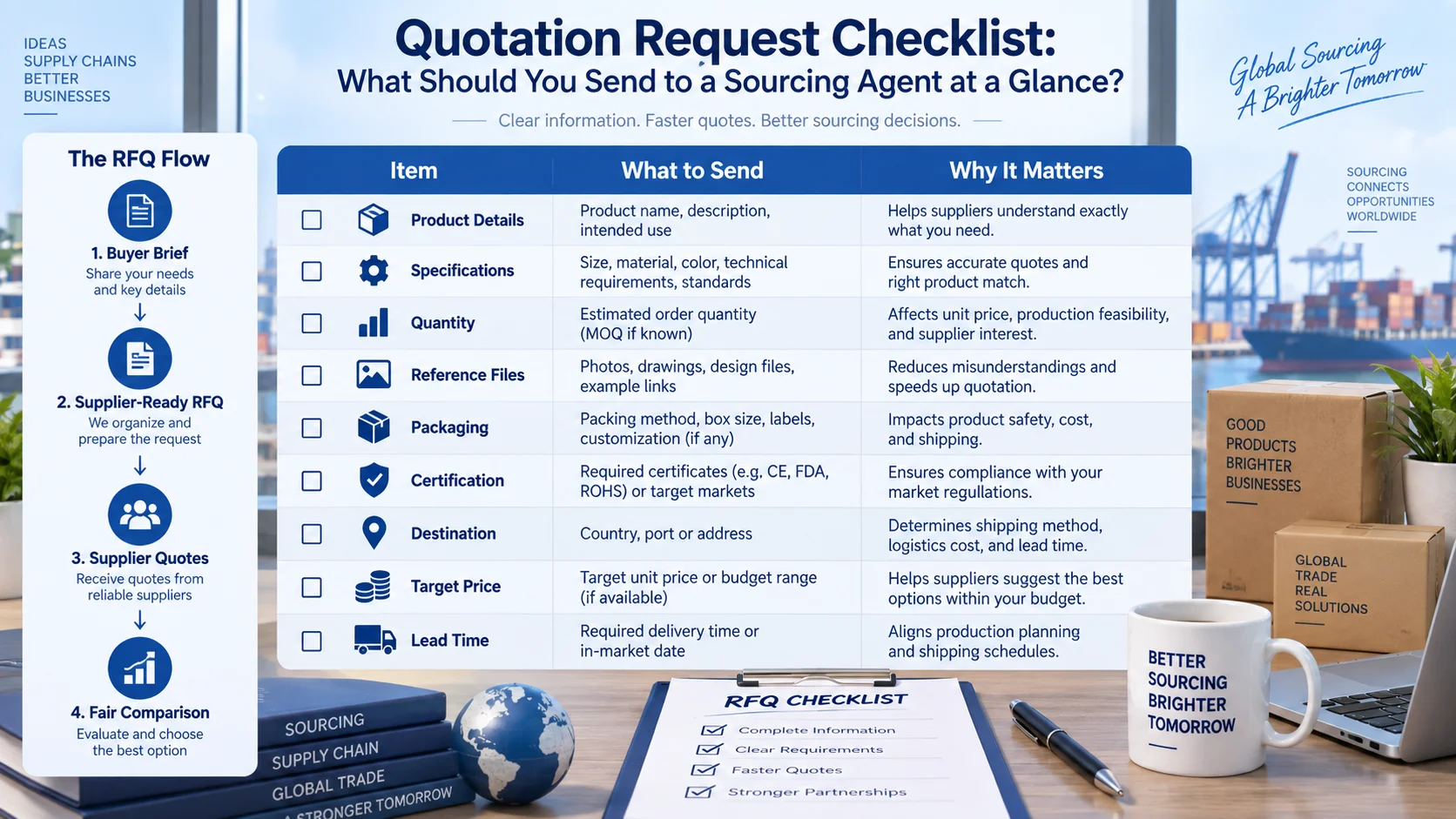
RFQ checklist table
| Information | What to Provide | Why It Matters |
|---|---|---|
| Product Details | Name, model, size, function | Helps identify the correct supplier |
| Specifications | Material, color, dimensions, features | Improves quotation accuracy |
| Quantity | Trial order and expected volume | Affects MOQ and unit price[^3] |
| Reference Files | Photos, links, drawings, samples | Reduces misunderstanding |
| Packaging | Retail box, logo, carton requirements | Affects total cost |
| Certification | CE, FCC, RoHS, etc. | Determines supplier suitability |
| Destination | Country or delivery location | Helps evaluate compliance and shipping |
| Target Price | Budget or expected price range | Helps filter suppliers |
| Lead Time | Required production or delivery date | Confirms production feasibility |
How I use this checklist in practice
I use this kind of checklist to turn a buyer’s idea into a supplier-ready RFQ. The goal is not to make the buyer do the sourcing agent’s job. The goal is to avoid asking five suppliers five different questions and then receiving five quotations that cannot be compared.
For example, if a buyer says, “I need a custom USB-C cable,” that is not enough. The quotation can change based on:
- Cable length
- Charging wattage
- Data transfer speed
- Outer material, such as PVC, TPE, or braided nylon
- Connector shell material
- Logo printing method
- Packaging type
- Certification or test expectations
- Order quantity
- Destination market
A low quote may exclude packaging, testing, or customization. A higher quote may include better materials or stricter quality control. Without the checklist, the buyer may choose the wrong quote for the wrong reason.
For China supplier sourcing, I prefer to create a comparison sheet that lists the same assumptions for every supplier. That way, the buyer can review unit price, MOQ, tooling cost, sample fee, production time, packaging, and Incoterms side by side.
Product Specifications: Why Are They the Most Important Part of a Sourcing Request?
A sourcing agent can find suppliers faster when the specifications are clear. If specifications are missing, suppliers may quote based on guesswork. That can create a wide price range, and the buyer may not know whether the difference comes from margin, quality, material, or missing requirements.
Product specifications are the most important part of a sourcing request because they define what the supplier must make or provide. Include dimensions, materials, colors, functions, performance requirements, model version, accessories, and quality expectations before asking for a quotation.
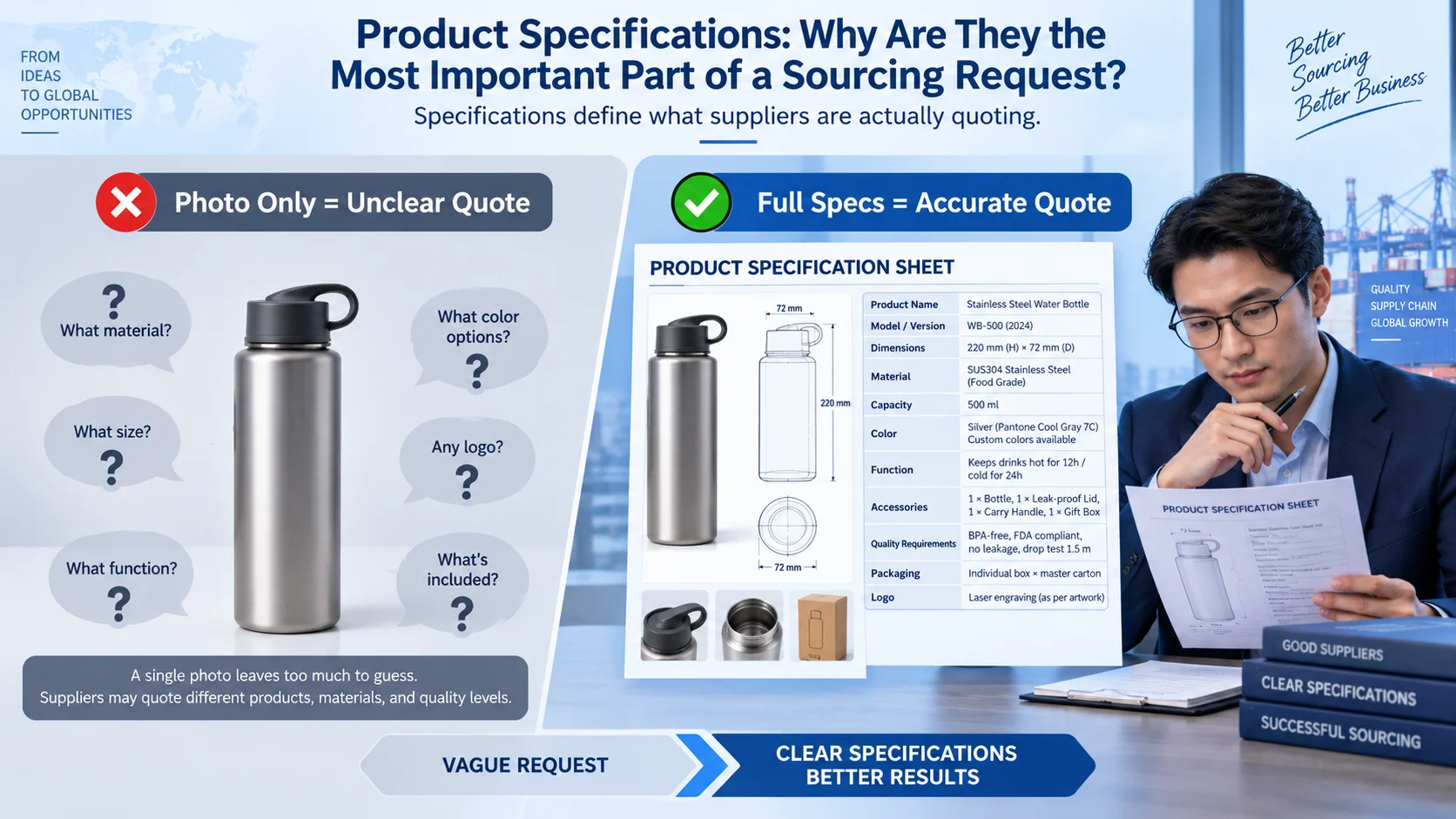
What product specifications should include
A good product specification does not need to be an engineering document for every product. However, it should define the features that affect price and usability.
Common specification fields include:
- Dimensions: length, width, height, thickness, capacity, or weight
- Materials: plastic type, metal grade, fabric type, silicone grade, coating, finish
- Functions: operating modes, compatibility, load capacity, power, battery capacity
- Colors: standard colors, Pantone colors, surface finish
- Version: standard model, upgraded model, private mold, existing SKU
- Accessories: cables, screws, adapters, tools, straps, batteries
- Performance requirements: water resistance, heat resistance, strength, speed, runtime
- Quality expectations: acceptable finish, defect limits, inspection level, packaging condition
Why vague specifications create bad quotations
When buyers send only a photo, I usually need to ask basic questions before requesting quotes. The reason is simple: suppliers may quote different versions of the same visual product.
For example, a visually similar backpack could differ in:
| Feature | Lower-Cost Version | Higher-Cost Version |
|---|---|---|
| Fabric | 300D polyester | 900D waterproof fabric |
| Zipper | Generic zipper | Branded or heavy-duty zipper |
| Lining | Thin lining | Reinforced lining |
| Packaging | Polybag | Retail-ready packaging |
| Logo | No logo | Embroidery or woven label |
| Quality Check | Basic factory check | Buyer-defined inspection |
Both suppliers may appear to quote “the same backpack,” but they are not quoting the same product. This is why clear product sourcing China requests need specifications, not just images.
A sourcing agent can help refine incomplete specs, but the buyer still needs to define the intended use and expected quality level. For technical or regulated products, a qualified engineer, test lab, or compliance professional should review performance and regulatory requirements. A sourcing agent can coordinate supplier communication, but product safety and formal compliance decisions need proper professional evaluation.
Quantity, MOQ, and Expected Order Volume: What Should You Tell Your Sourcing Agent?
Quantity is one of the first questions suppliers ask, but many buyers avoid giving it. They worry that sharing a small trial quantity will weaken their position. In reality, no quantity makes the quotation less useful and often delays supplier matching.
Tell your sourcing agent your sample quantity, first order quantity, estimated future volume, and acceptable MOQ. Quantity helps the agent decide whether to approach factories, trading companies, stock suppliers, or low-MOQ private-label suppliers for the best fit.
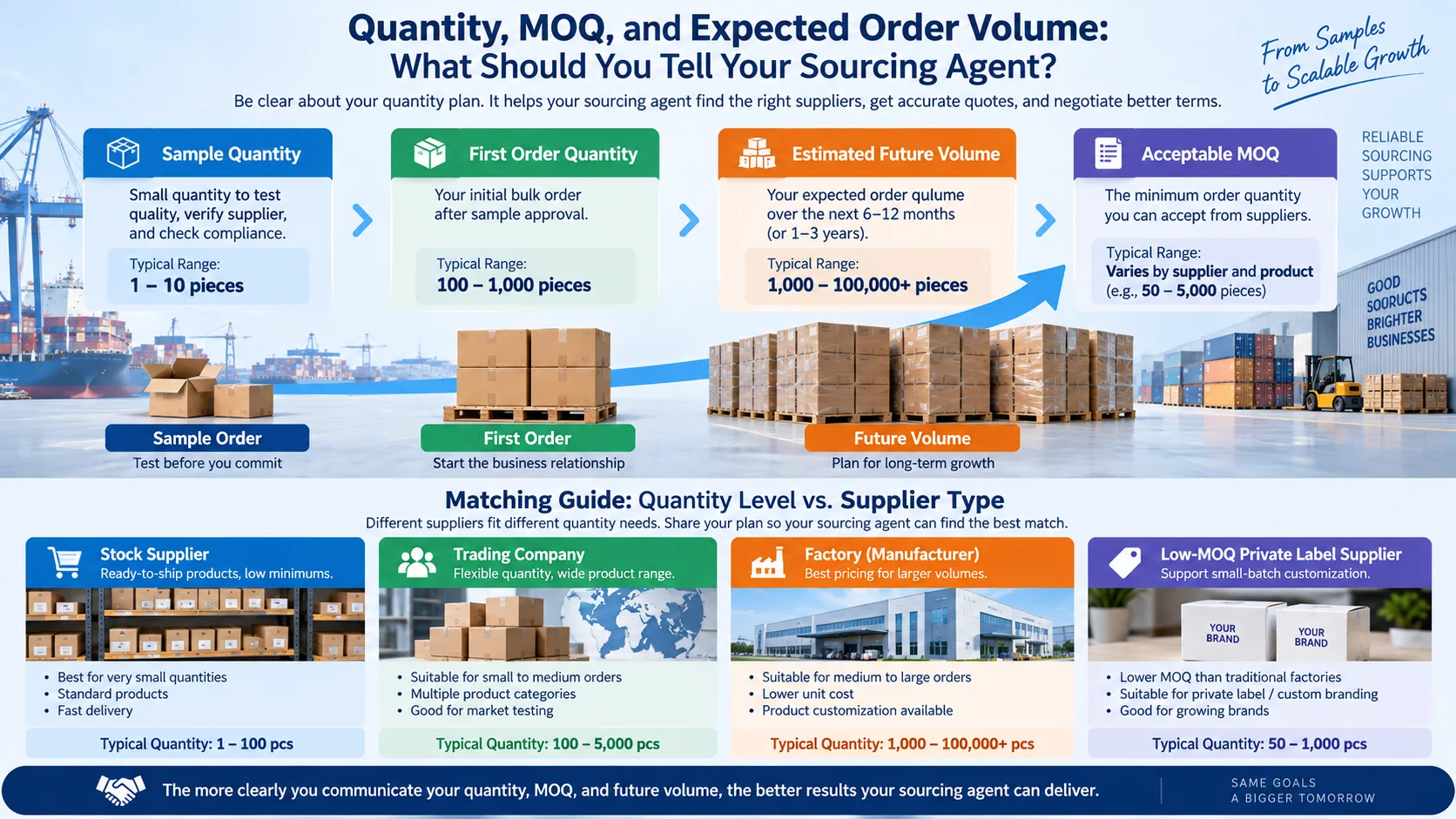
Why quantity changes supplier selection
MOQ is not just a number. It affects which suppliers are willing and suitable to work with you.
A factory may be best for larger repeat orders, but it may not be flexible for a 100-piece test order[^4]. A trading company or stock supplier may be better for a small first order, but the unit price may be higher. A private-label supplier may accept lower MOQ if the product is standard and only the logo or packaging changes.
Here is how I usually think about quantity:
| Buyer Situation | Suitable Supplier Type | Notes |
|---|---|---|
| 1–20 pcs sample check | Sample supplier or stock seller | Good for evaluation, not final landed cost |
| 50–300 pcs test order | Stock supplier or flexible trader | Useful for e-commerce testing |
| 500–3,000 pcs first order | Factory or strong trader | Better price and customization options |
| Repeat monthly orders | Factory-direct sourcing | More room for planning and negotiation |
| Multi-SKU wholesale | Consolidation support needed | MOQ varies by SKU and supplier |
What quantity details to send
I suggest sending four numbers if possible:
- Sample quantity
- First order quantity
- Estimated repeat order volume
- Maximum acceptable MOQ
If you are not sure, say so. For example: “I want to test 300 pieces first, but if the product sells well, I may reorder 1,000–2,000 pieces monthly.” That context helps the sourcing agent filter suppliers that can support both a test phase and future growth.
Quantity also affects packaging, production scheduling, raw material purchasing, and freight cost. A quote for 100 pieces by air shipment cannot be compared with a quote for 3,000 pieces by sea shipment. If the goal is supplier quotation comparison, all quantity assumptions must be clear from the beginning.
Photos, Drawings, Samples, and Reference Products: How Much Detail Should You Send?
Photos and links are useful, but they are not complete product requirements. A sourcing agent can use them to understand your direction, but visually similar products may have different dimensions, materials, functions, and compliance levels. This is where many quotation errors begin.
Send product photos, Amazon or Alibaba links, technical drawings, existing samples, competitor references[^5], and notes about what you like or dislike. However, use reference products as communication tools, not as a substitute for full specifications and quality requirements.
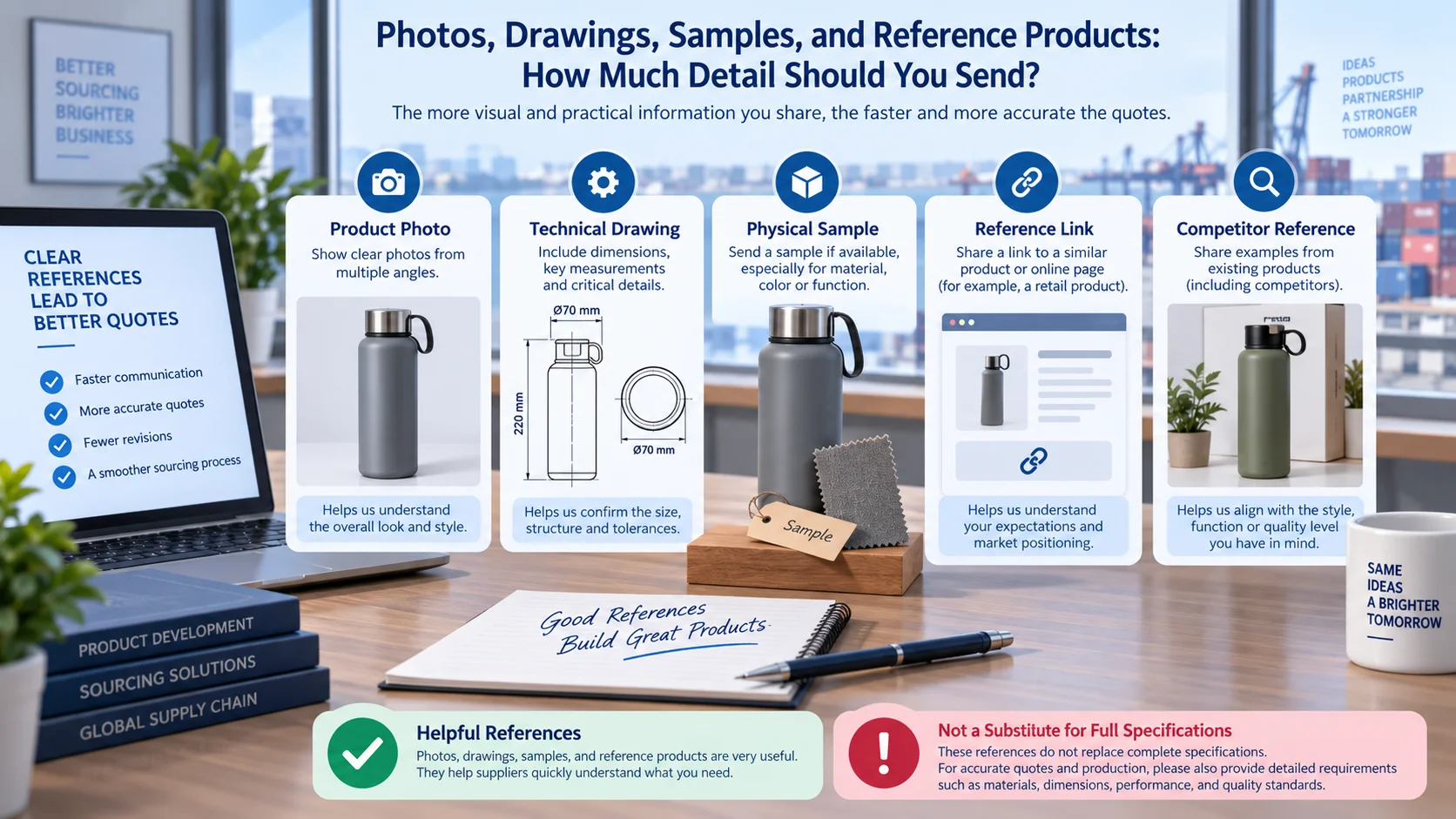
How each reference type helps
Different reference materials solve different problems. I often ask buyers to send more than one type when possible.
- Product photos: show appearance, shape, finish, and general style
- Marketplace links: show positioning, customer expectations, and visible features
- Alibaba links: help identify a supplier category or common model
- Technical drawings: define dimensions, tolerances, structure, and components
- Physical samples: help suppliers check material, workmanship, and construction
- Competitor references: show target quality level and market benchmark
Why references still need written notes
A link can be helpful, but it can also be misleading. For example, an Amazon listing may include marketing claims that the supplier cannot verify. An Alibaba page may show several versions under one listing. A product photo may hide internal structure or actual material.
That is why I recommend adding notes such as:
- “I want the same size, but with a different color.”
- “I like the packaging style, but I need my own logo.”
- “This reference is only for appearance. I need better material.”
- “I do not need the accessories shown in the link.”
- “The product must fit the EU market, so please check suitable suppliers.”
For OEM sourcing China or custom products, drawings and samples are especially important. Still, even with drawings, suppliers may need clarification about tolerance, finishing, testing, and packaging. If the product involves safety, electronics, children’s use, food contact, or medical claims, formal testing and professional compliance review should be planned separately.
A good sourcing agent can translate your references into an RFQ, but the buyer should always confirm whether the quoted product truly matches the intended use before approving samples or mass production.
Branding, Packaging, and OEM/ODM Requirements: What Should You Tell a Sourcing Agent?
Branding and packaging are often treated as small details, but they can change the quotation quickly. Logo printing, custom colors, retail boxes, barcodes, manuals, and carton markings all affect cost, MOQ, lead time, and supplier suitability.
Tell your sourcing agent whether you need logo printing, custom colors, private label sourcing, OEM or ODM changes, packaging design, barcode labels, instruction manuals, carton requirements, or marketplace-ready packaging. These details should be quoted before production, not added later.
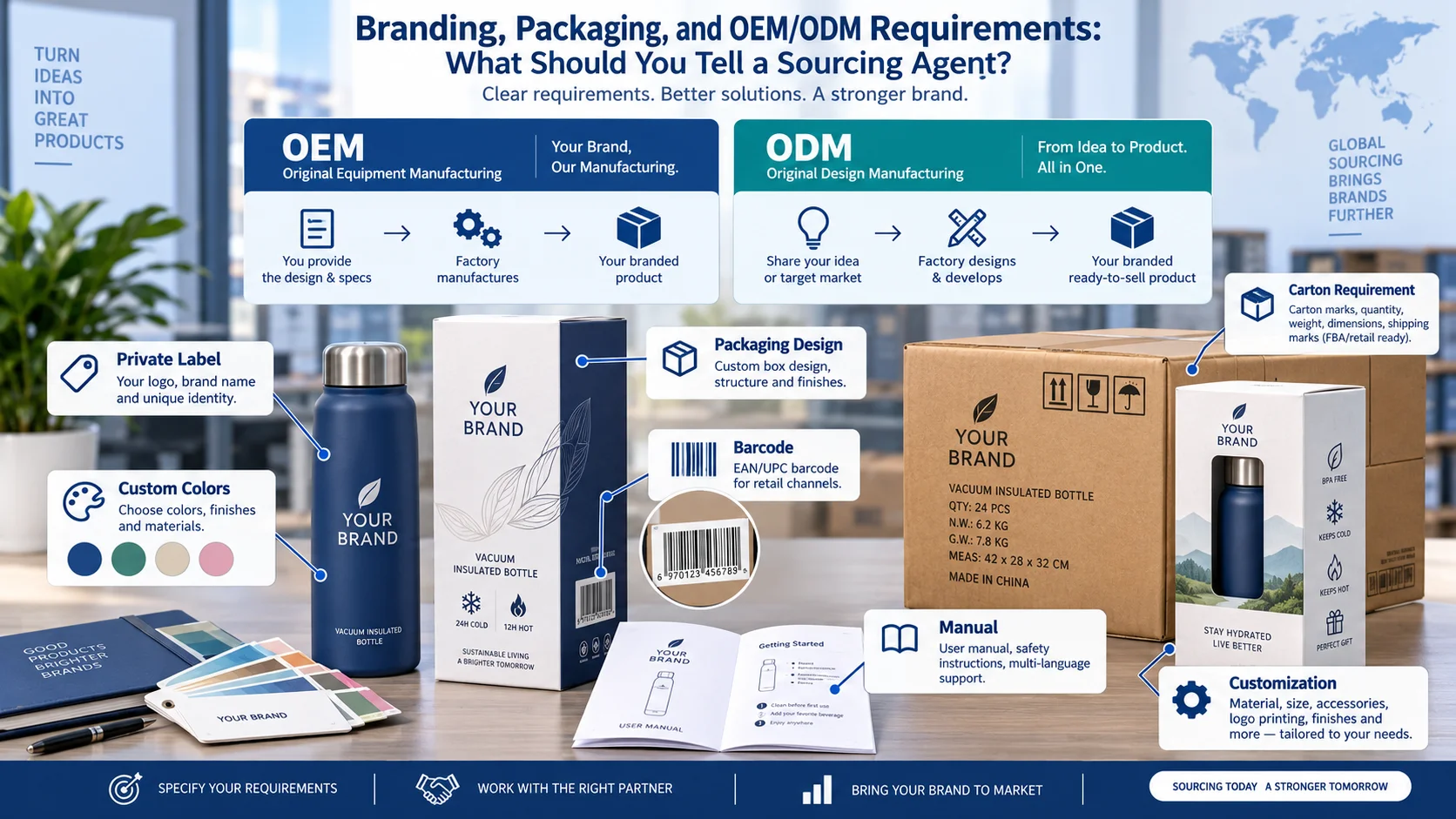
Common branding and packaging requirements
If you plan to sell under your own brand, send the details early. Suppliers may need artwork, print files, color references, or packaging dimensions before they can quote properly.
Key items include:
- Logo position and size
- Printing method, such as silk screen, laser engraving, heat transfer, embroidery, or sticker
- Custom product color
- Private label packaging
- Retail box design
- Barcode or FNSKU label
- Instruction manual
- Warning labels
- Inner carton and master carton requirements
- Amazon, retailer, or warehouse labeling rules
Why packaging affects more than appearance
Packaging affects product cost, carton size, shipping weight, damage rate, and customer experience. A plain polybag may be cheap, but it may not fit retail or DTC brand positioning. A rigid color box may look better, but it can increase unit cost and shipping volume.
For e-commerce sellers, packaging also affects fulfillment. If products need barcodes, warning labels, suffocation labels, or carton marks, those details should be included in the RFQ. If the requirement is added after quotation, the supplier may revise the price or extend the lead time.
OEM and ODM requirements need even more care. Small changes, such as color and logo, are usually easier. Structural changes, new molds, firmware changes, or special materials may require tooling fees, engineering review, longer sample cycles, and higher MOQ[^6].
At KingSourcing, I try to separate standard product sourcing from customization needs early. This helps avoid one common mistake: comparing a standard stock quote with a private-label quote that includes custom packaging and logo work. Those two prices are not directly comparable.
Quality Standards, Certifications, and Target Market: What Should a Sourcing Agent Know?
Quality and compliance depend heavily on the destination market. A product that is acceptable for one market may need different documents, labels, tests, or supplier qualifications for another. If your sourcing agent does not know the target market, supplier selection can go in the wrong direction.
Tell your sourcing agent the destination country, required certifications, testing standards, quality expectations, and retailer or marketplace requirements. For markets such as the United States, European Union, United Kingdom, Canada, and Australia, compliance expectations may differ by product category[^7].
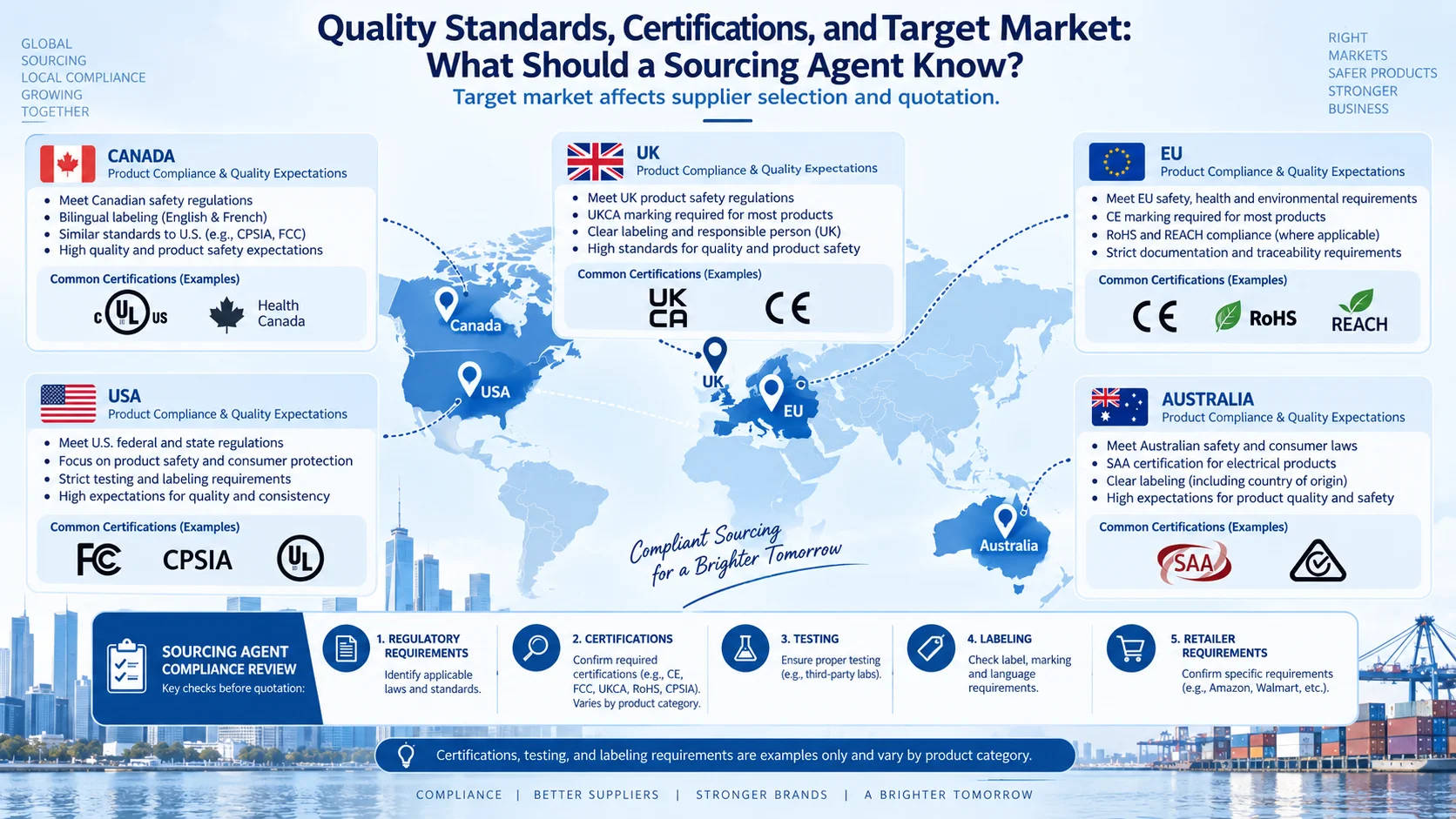
What to provide for quality and compliance
For many consumer products, buyers should share:
- Destination country or region
- Sales channel, such as Amazon, retail, wholesale, or DTC website
- Required certifications, such as CE, FCC, RoHS, UKCA, or other category-specific documents
- Testing expectations
- Retailer packaging and labeling rules
- Material restrictions
- Quality inspection criteria
- Acceptable defect limits
- Warranty or after-sales expectations
Why certification claims must be verified
Suppliers may say they have CE, FCC, RoHS, or other certificates. However, buyers should verify whether the documents are real, current, product-specific, and suitable for the target market[^8]. A sourcing agent can help collect documents from suppliers, but certification review should not be treated as complete legal or regulatory advice.
I usually encourage buyers to see certificates as documents to verify, not promises to accept blindly. The buyer may need a testing lab, compliance consultant, customs broker, or qualified professional depending on the product and market.
Quality standards also need written definition. “Good quality” means different things to different suppliers. A better brief may say:
- “No visible scratches on front surface.”
- “Retail box must not be crushed.”
- “Color should match approved sample.”
- “Function must be tested before packing.”
- “Battery product must include required shipping documents.”
- “Inspection should follow AQL level agreed before production[^9].”
This information helps your sourcing agent find suppliers that match your risk level. It also helps later during sample approval, production follow-up, and quality inspection. Without clear standards, buyers and suppliers may argue after production because both sides had different expectations from the start.
Target Price, Incoterms, and Delivery Requirements: What Should You Send Before Quotation?
Many buyers ask for the “best price,” but price only makes sense when the trade terms are clear. A supplier’s EXW price cannot be fairly compared with another supplier’s FOB or DDP price[^10]. Delivery terms can change the total cost more than the unit price difference.
Send your sourcing agent your target price if available, preferred Incoterms, destination country or port, delivery deadline, and preferred shipping method. Comparable quotations must use the same trade terms, quantity, packaging, and delivery assumptions.
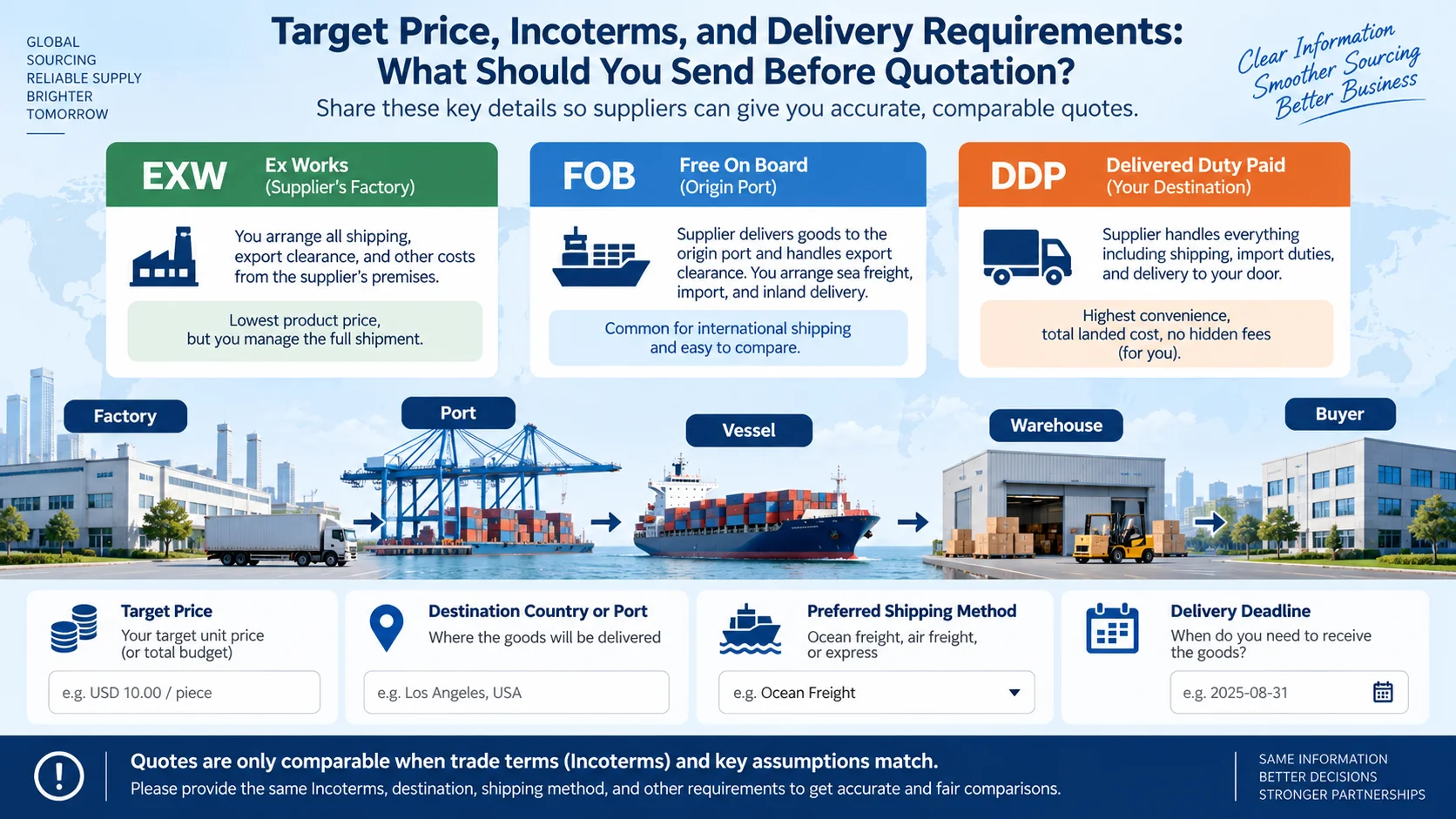
Why Incoterms matter
Incoterms define what is included in the quotation. If you compare prices without checking Incoterms, you may choose a quote that looks cheaper but excludes important costs.
| Term | What It Usually Means for Buyers | Common Use |
|---|---|---|
| EXW | Buyer pays from factory pickup onward | Useful for buyers with own forwarder |
| FOB | Supplier covers export delivery to port | Common for sea freight |
| CIF | Supplier includes cost and insurance to port | Needs careful comparison |
| [DDP | Includes delivery to destination address, duties/taxes often included depending on quote](https://www.trade.gov/know-your-incoterms)[^11] | Common for small e-commerce shipments |
The exact scope should always be confirmed in writing because suppliers and freight forwarders may quote differently.
How target price helps supplier filtering
Some buyers do not want to share a target price. I understand the concern. However, a budget range can help your sourcing agent avoid wasting time on suppliers that are clearly too expensive or too low-end.
A target price does not guarantee the final price. It simply gives direction. For example:
- “My target is around USD 3.00 FOB for 2,000 pieces.”
- “I can accept a higher price if packaging and quality are better.”
- “I need a low-MOQ test order first, even if unit price is higher.”
- “I already received a quote at USD 4.20 EXW, but I want comparison.”
Delivery timing is also important. If you need goods before a holiday season, a promotion, or an Amazon restock deadline, the sourcing agent should know early. Production capacity, material availability, sample approval, inspection, and freight options all affect timing[^12].
A quotation without delivery context is incomplete. It may look attractive but fail your business schedule.
Common Mistakes Buyers Make When Requesting a Quotation from a Sourcing Agent?
Most quotation problems start before suppliers quote. The buyer sends too little information, asks only for the lowest price, or compares offers based on different assumptions. This makes sourcing feel confusing, even when suppliers are responding normally.
Common mistakes include sending only a photo, giving no quantity, missing specifications, omitting the destination country, comparing different product versions, and asking only for the “best price.” A sourcing agent can reduce these issues by clarifying the RFQ before supplier outreach.
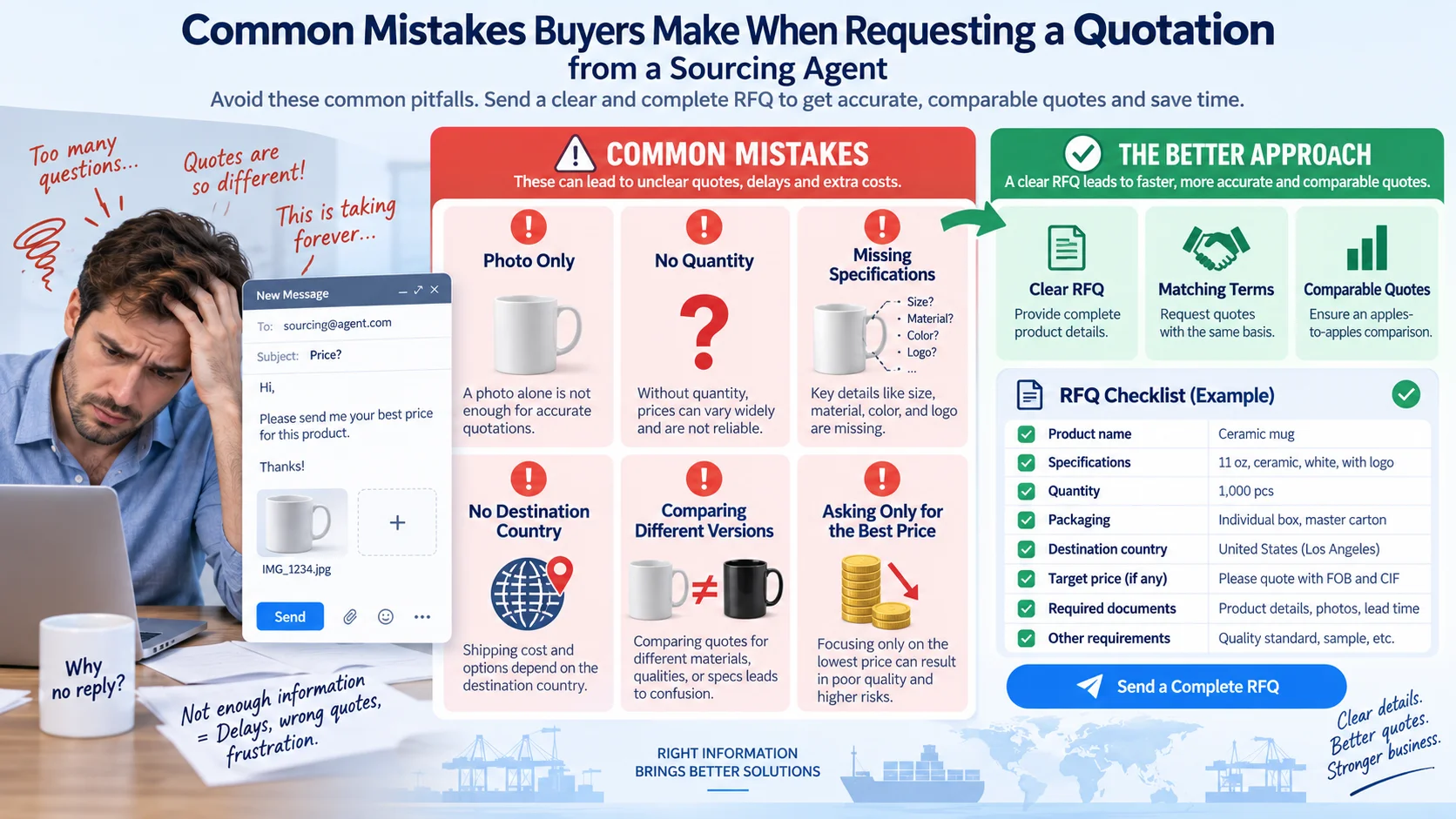
Mistake 1: Sending only a product photo
A product photo is useful, but it does not show material, size, internal structure, quality level, packaging, or certification needs. If I receive only a photo, I usually need to ask several follow-up questions before contacting suppliers.
Mistake 2: Giving no quantity
No quantity means no meaningful price. Suppliers may quote high to protect themselves, ignore the inquiry, or assume a random MOQ. Quantity affects raw materials, packaging, tooling, labor planning, and shipping.
Mistake 3: Comparing different specifications
This is one of the biggest problems. One supplier may quote a basic version. Another may quote a premium version. A third may include packaging and certification documents. The prices look different because the products are different.
Mistake 4: Ignoring destination country
Destination country affects compliance, labeling, shipping, documentation, and sometimes supplier suitability. If you sell in the EU, UK, or US, this information should be in the RFQ.
Mistake 5: Asking only for “best price”
“Best price” can push suppliers to quote the cheapest possible version. That may not match your quality expectations. A better question is: “Please quote based on these specifications, this quantity, this packaging, and this delivery term.”
A better way to request a quote
Instead of writing:
“Please find this product and give me best price.”
Write:
“I want to source this product for the US market. Please quote 1,000 pieces, black color, retail box packaging, logo printing, FOB Shenzhen, with available compliance documents for review. I also need sample cost and lead time.”
That second request gives your sourcing agent a much stronger starting point.
How Can KingSourcing Turn Your Product Brief Into Comparable Supplier Quotations?
A buyer may have a rough idea, a product link, an existing supplier quote, or a sample in hand. The hard part is turning that information into comparable supplier quotations. That is where a local China sourcing agent can add practical value.
KingSourcing helps turn your product brief into comparable supplier quotations by clarifying requirements, matching suitable suppliers, preparing RFQs, collecting quotes, comparing terms, coordinating samples, and following up production, inspection, consolidation, and shipping support in China.
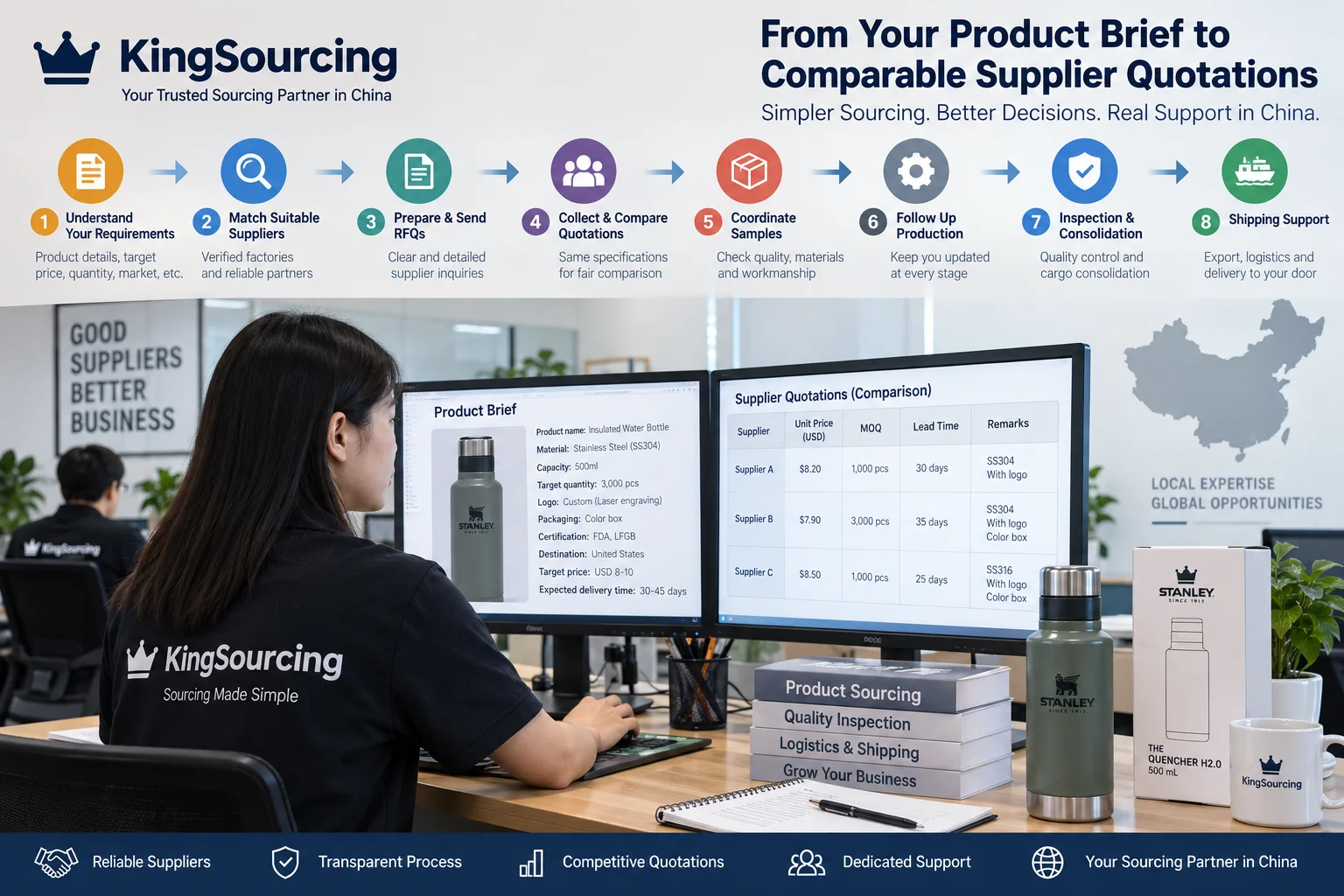
How I usually handle a sourcing request
When a buyer sends a request to KingSourcing, I do not simply forward a photo to random suppliers. I first look for missing information that could change the quote. Then I help organize the request into a clear RFQ.
The workflow often looks like this:
-
Requirement clarification
I review the product brief, reference links, photos, quantity, packaging, and destination market. -
Supplier matching
I identify suitable supplier types, such as factories, trading companies, stock suppliers, OEM suppliers, or private-label suppliers. -
RFQ preparation
I prepare a clear request so suppliers quote the same product under the same assumptions. -
Supplier quotation comparison
I compare unit price, MOQ, sample cost, lead time, payment terms, packaging, customization, and Incoterms. -
Sample coordination
I help arrange samples so the buyer can check appearance, function, and basic workmanship before mass production. -
Procurement follow-up
For confirmed orders, KingSourcing can support production follow-up, quality inspection, 1-by-1 product checking, packaging, labeling, warehousing, consolidation, and shipping coordination.
Why comparable quotations matter
The cheapest quote is not always the best quote. A quote only becomes useful when you understand what is included and what is excluded.
A proper supplier quotation comparison should check:
- Are the materials the same?
- Are the dimensions the same?
- Is the logo included?
- Is packaging included?
- Are certificates available for review?
- What is the MOQ?
- What is the sample fee?
- What is the production lead time?
- Which Incoterm is used?
- Is the supplier suitable for the buyer’s target market and order size?
KingSourcing is based in Shenzhen, with sourcing access across Shenzhen, Dongguan, Guangzhou, Foshan, Yiwu, Ningbo, and other China manufacturing clusters. I work with many types of consumer products, especially electronics accessories, 3C products, customized items, e-commerce products, promotional products, and multi-SKU wholesale sourcing.
Send your product brief, product photos, supplier link, or existing quotation to KingSourcing for supplier matching and quotation comparison in China.
Frequently Asked Questions
Can I ask a sourcing agent for a quotation with only a product photo?
Yes, you can start with a product photo, but you should expect follow-up questions. A photo does not define material, size, function, packaging, quality level, or compliance needs. A sourcing agent can use it as a reference, not as a complete RFQ.
Should I share my target price with a China sourcing agent?
Yes, if you have a realistic target price or budget range. It helps filter suppliers and avoid unsuitable options. A target price does not guarantee the final quote, but it gives your sourcing agent useful direction for supplier matching.
What if I do not know the exact product specifications yet?
You can still contact a sourcing agent. Send your product idea, reference links, photos, intended use, quantity, target market, and quality expectations. The agent can help clarify the brief before sending an RFQ to suppliers.
Why do suppliers quote different prices for similar-looking products?
Similar-looking products may use different materials, dimensions, components, packaging, production processes, or quality standards. One quote may also include customization or certificates while another excludes them. That is why comparable specifications are essential.
Do I need certifications before asking for a quotation?
You do not always need certificates before asking, but you should tell your sourcing agent the destination market and expected compliance requirements. Supplier-provided certificates should be collected and verified by the buyer or a qualified professional when needed.
Conclusion
A sourcing agent can quote faster and more accurately when your first inquiry includes clear product specifications, quantity, reference materials, packaging needs, target market, certification expectations, price direction, and delivery terms. Better information does not guarantee the lowest price, but it reduces confusion and helps suppliers quote comparable conditions. If you are preparing to source from China, send your product brief, photos, links, or existing quotation to KingSourcing, and I can help turn it into a supplier-ready RFQ.
[^1]: "3.0 sourcing - University Procurement Services |", https://procurementservices.rutgers.edu/files/chapter-3-university-procurement-services-procedures-manualpdf. Procurement guidance generally treats complete specifications as necessary for obtaining responsive, comparable supplier bids, because unspecified requirements can produce offers based on differing assumptions. Evidence role: general_support; source type: research. Supports: Research or procurement guidance showing that clear specifications are necessary for suppliers to prepare responsive and comparable bids.. Scope note: This supports the procurement principle generally; it does not measure quotation variation for every product category. [^2]: "Know Your Incoterms", https://www.trade.gov/know-your-incoterms. The International Chamber of Commerce’s Incoterms rules define standardized trade terms that allocate delivery obligations, costs, and risk between sellers and buyers in international sales contracts. Evidence role: definition; source type: institution. Supports: The International Chamber of Commerce description of Incoterms and the allocation of delivery, cost, and risk obligations under named rules.. [^3]: "Economies of scale", https://en.wikipedia.org/wiki/Economies_of_scale. Operations-management literature explains that setup, purchasing, and other fixed production costs can be spread across more units as order volume rises, which can change feasible minimum quantities and quoted unit prices. Evidence role: mechanism; source type: education. Supports: Economic and operations-management explanations that fixed setup costs and scale can cause unit costs to vary with production quantity.. Scope note: Actual MOQ and pricing remain supplier-, product-, and capacity-specific. [^4]: "Modeling the flexibility of order quantities and lead-times in ...", https://www.sciencedirect.com/science/article/abs/pii/S0925527303001087. Supply-chain research indicates that production setup, batching, and scheduling constraints can make very small orders less economical for manufacturers than recurring or higher-volume orders. Evidence role: general_support; source type: research. Supports: Supply-chain research on how setup costs, batch sizes, and production scheduling affect manufacturers' willingness to serve low-volume orders.. Scope note: This is a general operational pattern and does not establish that every factory will reject or price a 100-piece order unfavorably. [^5]: "Dimensioning and Tolerancing", https://engineering.tcnj.edu/wp-content/uploads/sites/194/2012/02/dimensioning_and_tolerancing.pdf. Engineering documentation standards describe technical drawings as a means of communicating dimensions, tolerances, materials, and construction requirements needed for manufacturing and inspection. Evidence role: mechanism; source type: education. Supports: Engineering guidance explaining that drawings communicate dimensions, tolerances, materials, and other manufacturing requirements not reliably conveyed by images.. Scope note: A drawing may still require supplementary specifications, test methods, or approved samples for complete product definition. [^6]: "Why Focusing on Lead Time, Not Just Efficiency and Cost ...", https://interpro.wisc.edu/lead-time-drives-manufacturing-success/. Manufacturing literature recognizes that product changes requiring new tooling or engineering validation can create non-recurring costs and extend development and production lead times. Evidence role: mechanism; source type: research. Supports: Manufacturing research or engineering guidance showing that design changes and tooling development can add engineering work, non-recurring costs, and development lead time.. Scope note: The effect of firmware changes, special materials, and minimum order quantities varies by manufacturing process and supplier. [^7]: "Consumer Product Safety Commission", https://www.cpsc.gov/. Official product-safety and market-access guidance indicates that applicable conformity, labeling, and documentation requirements depend on both the product category and the jurisdiction where the product is marketed. Evidence role: general_support; source type: government. Supports: Official regulatory guidance showing that product compliance requirements depend on the product type and market in which it is placed.. Scope note: This general principle does not identify the specific legal requirements for any particular product. [^8]: "FCC ID Search | Federal Communications Commission", https://www.fcc.gov/oet/ea/fccid. Regulatory guidance emphasizes that compliance evidence must correspond to the relevant product and applicable rules, and that economic operators remain responsible for ensuring required conformity documentation is available and appropriate. Evidence role: expert_consensus; source type: government. Supports: Official regulator guidance on verifying applicable conformity assessment, declarations, test evidence, or authorization records for products placed on a market.. Scope note: The required documents and verification methods differ among regulatory systems, product categories, and conformity-assessment routes. [^9]: "What kinds of Lot Acceptance Sampling Plans (LASPs) are ...", https://www.itl.nist.gov/div898/handbook/pmc/section2/pmc22.htm. Acceptance-sampling standards use the acceptable quality limit (AQL) as a parameter in inspection plans for deciding whether a production lot is accepted or rejected on the basis of a sample. Evidence role: definition; source type: government. Supports: A recognized explanation of AQL and acceptance-sampling inspection plans, such as ISO 2859 or NIST quality-control guidance.. Scope note: An agreed AQL does not itself guarantee product safety, fitness for purpose, or the detection of every defect. [^10]: "Know Your Incoterms", https://www.trade.gov/know-your-incoterms. Because Incoterms rules allocate transport, delivery, customs, cost, and risk responsibilities differently, quoted prices under EXW, FOB, and DDP do not represent the same scope of supply without further cost normalization. Evidence role: mechanism; source type: institution. Supports: ICC Incoterms material showing that EXW, FOB, and DDP allocate transport, export/import, delivery, and risk responsibilities differently.. Scope note: The precise commercial scope also depends on the sales contract and any services expressly included or excluded by the parties. [^11]: "Know Your Incoterms", https://www.trade.gov/know-your-incoterms. Under the ICC Delivered Duty Paid (DDP) rule, the seller delivers the goods at the named destination and generally assumes responsibility for export and import formalities, including applicable duties and taxes. Evidence role: definition; source type: institution. Supports: The ICC definition of Delivered Duty Paid (DDP), including the seller's delivery and import-clearance responsibilities.. Scope note: The named place, contract wording, local tax treatment, and practical customs arrangements must be confirmed for the individual transaction. [^12]: "Why Focusing on Lead Time—Not Just Efficiency—Drives Success", https://interpro.wisc.edu/lead-time-drives-manufacturing-success/. Supply-chain research identifies production capacity, material availability, process and quality-control stages, and transportation as contributors to manufacturing and order-fulfillment lead times. Evidence role: mechanism; source type: research. Supports: Supply-chain research showing that manufacturing lead time and order fulfillment depend on capacity, input availability, process delays, quality activities, and transportation.. Scope note: The relative importance of these factors depends on the product, supplier network, mode of transport, and disruption conditions.