Choosing the wrong agent can waste money, delay orders, and hide problems.[^1] I have seen small sourcing mistakes become expensive business lessons.
I choose a reliable China sourcing agent by checking process, transparency, communication, supplier verification, quality control, warehousing support, and fee structure. I do not judge reliability by the lowest price alone.[^2] I judge it by whether the agent can reduce risk across the full order process.
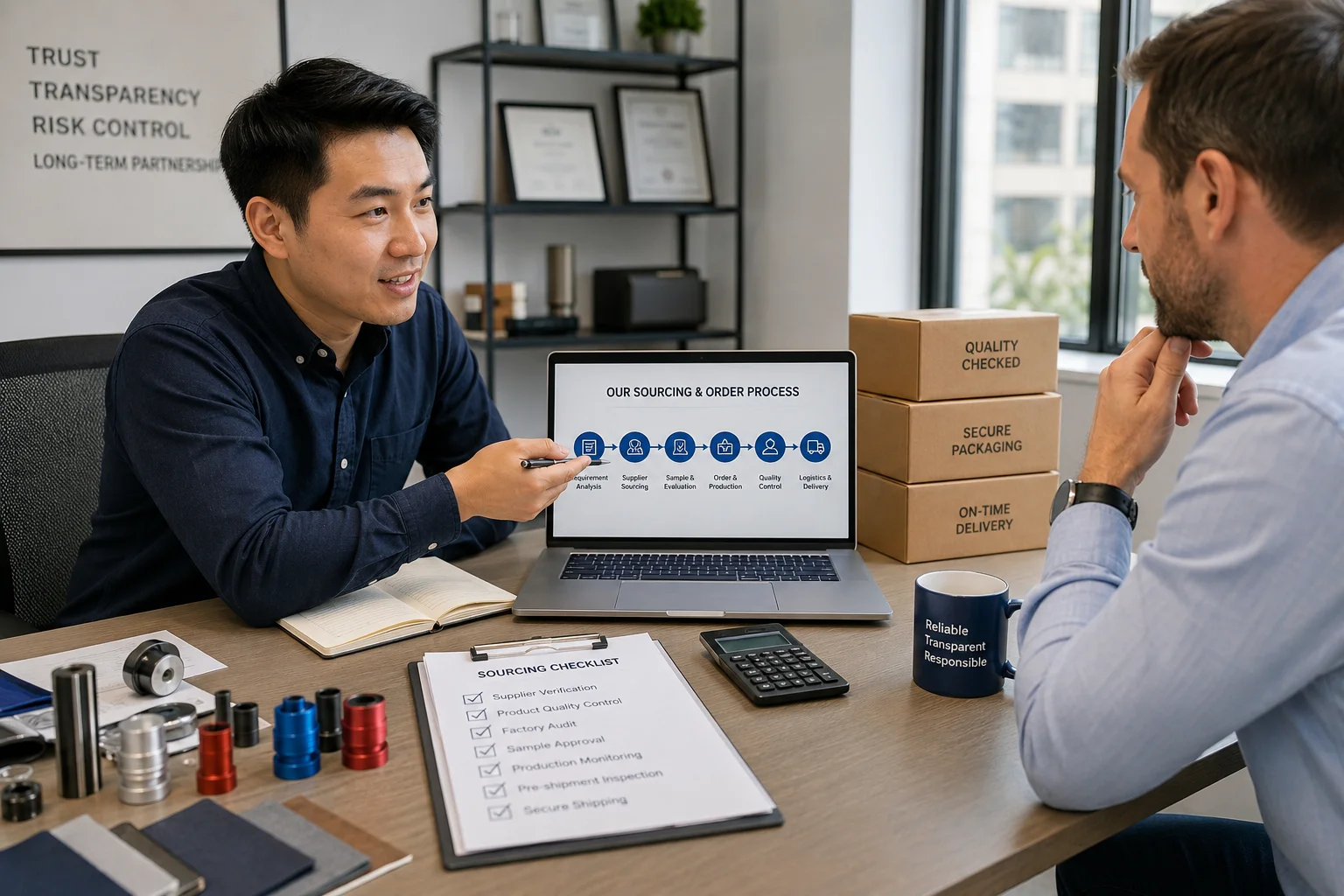
I have worked with many overseas buyers who came to China sourcing with hope, pressure, and a tight budget. Some had never imported before. Some already had suppliers, but they faced slow replies, unstable quality, unclear costs, or late shipments. I learned one thing from these cases. A sourcing agent is not only a person who sends factory names. A reliable agent becomes your local execution partner in China. If that partner has no clear process, the buyer still carries most of the risk alone.
Why Choosing the Right China Sourcing Agent Matters?
Many buyers lose money because they choose speed or low price first. I understand that pressure, but I also know this choice can create hidden risk.
A reliable China sourcing agent matters because the agent affects supplier choice, quote clarity, sample approval, production control, inspection, shipping, and problem solving.[^3] I use the agent to reduce sourcing risk, not to chase the cheapest number.
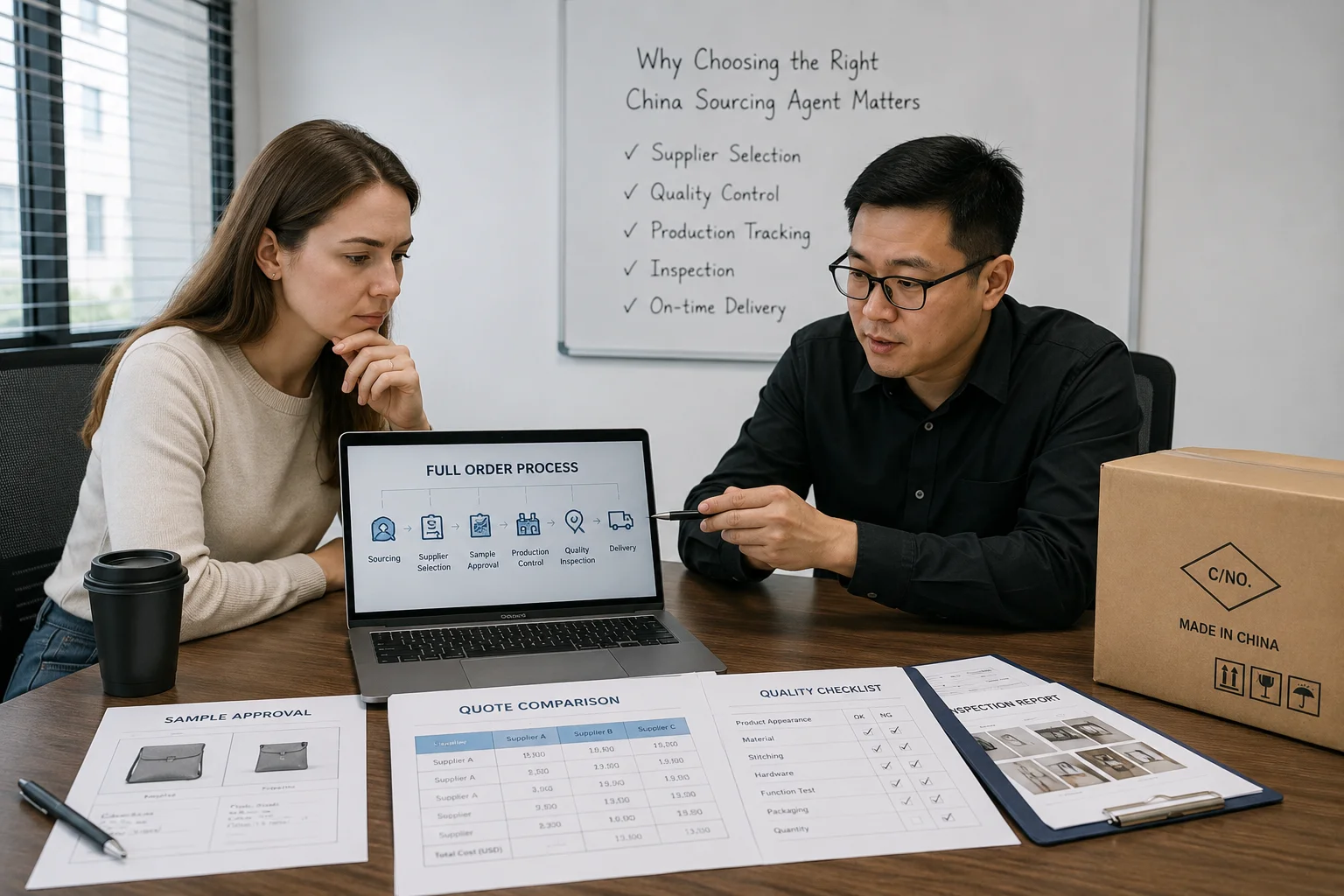
I see sourcing risk as a chain
When I help a buyer source from China, I do not see one single task. I see a chain. Each step can create cost, delay, or quality issues.[^4] If one step is weak, the next step becomes harder.
| Sourcing Step | Common Risk | What I Check |
|---|---|---|
| Product definition | Wrong supplier quotes wrong product | Use, size, material, packaging, target price |
| Supplier search | Middlemen or weak factories appear | Business scope, product match, response quality |
| Quotation | Low price hides missing details | MOQ, packing, sample fee, lead time, shipping terms |
| Sampling | Sample differs from bulk order | Sample standard, photos, video, written approval |
| Production | Delay or material change happens | Timeline, update frequency, issue reporting |
| Inspection | Defects are found too late | Pre-shipment check, clear defect criteria |
| Shipping | Cost or customs issue appears | Weight, volume, delivery term, destination need |
I often tell buyers that a sourcing agent cannot remove every risk. No agent can honestly promise perfect suppliers, zero defects, and lowest price at the same time.[^5] A good agent reduces surprises. I want problems found early, explained clearly, and handled before they become expensive. That is why choosing the right agent matters more than choosing the lowest offer.
What Services Should a Reliable China Sourcing Agent Provide?
Some agents only send product links and collect payment. I think this is not enough for buyers who need real China sourcing support.
A reliable sourcing agent should provide supplier search, quotation comparison, sample handling, factory checks, production follow-up, inspection, packaging support, warehousing, consolidation, shipping coordination, and after-sales communication. I look for a full process, not one isolated service.
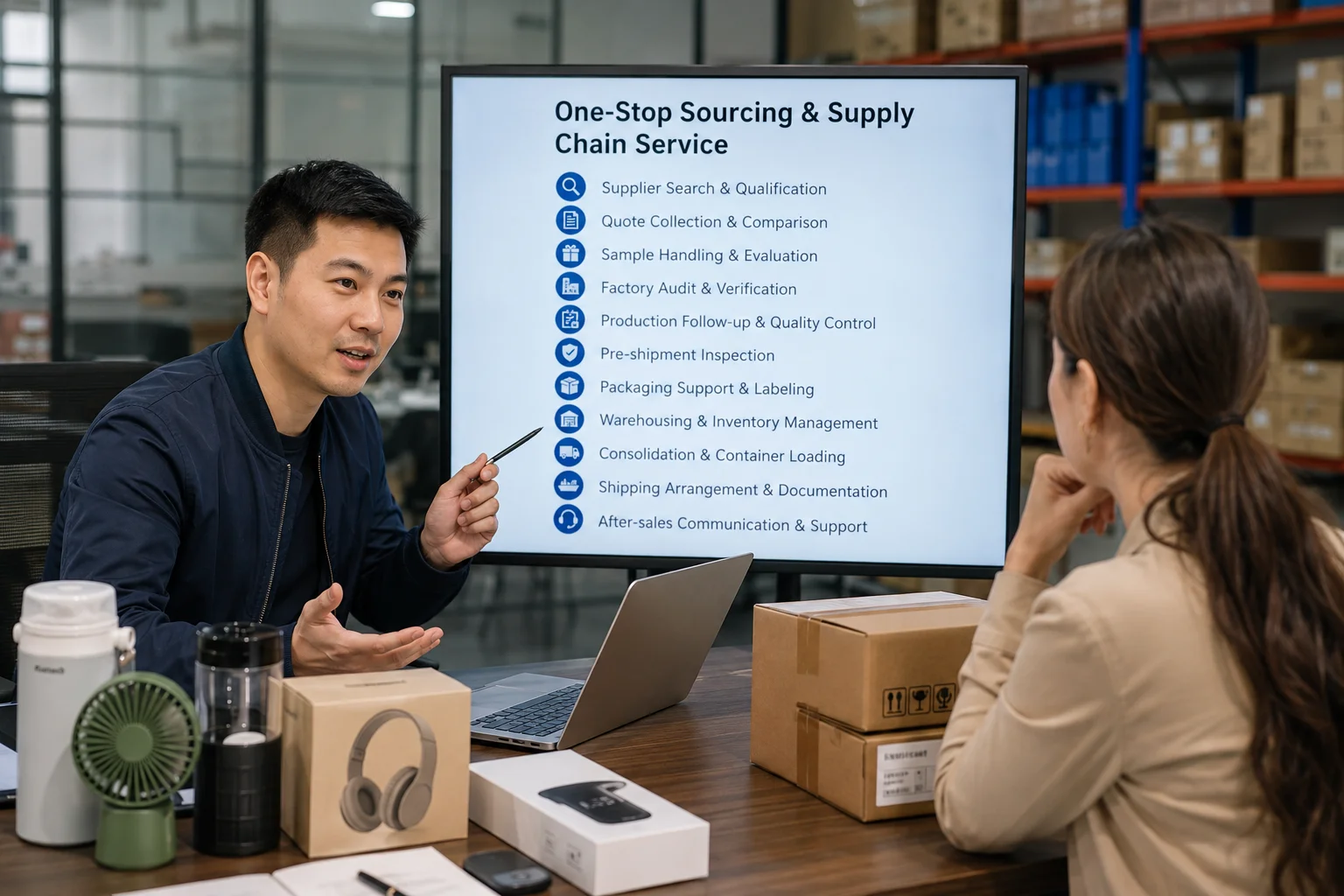
I expect services that cover the full order path
When I review a sourcing agent, I ask one simple question. Can this agent support the buyer after the quote is accepted? Many sourcing problems appear after payment, not before payment. A cheap quote is easy to send. A late production issue is harder to manage.
| Service Area | Why I Need It | Red Flag |
|---|---|---|
| Product sourcing | I need suitable supplier options | Agent gives one option with no explanation |
| Supplier comparison | I need to compare more than price | Agent only says “this is cheapest” |
| Sampling | I need to confirm real product quality | Agent does not check sample details |
| Customization | I need logo, packaging, or product changes | Agent cannot explain MOQ or mold cost |
| Production follow-up | I need timeline control | Agent only asks factory after delay happens |
| Inspection | I need basic quality visibility | Agent ships without checking |
| Warehouse support | I need combine orders or repack goods | Agent has no storage or handling process |
| Logistics support | I need shipping options | Agent cannot explain air, sea, or courier choices |
I have seen buyers work with agents who only handled payment and supplier chat. That can work for very simple goods, but it is risky for custom products, mixed orders, and brand packaging. I prefer an agent who can act like a small China purchasing office. The agent should not only find products. The agent should help move the order through each step with clear records and fast communication.
How to Check a Sourcing Agent’s Experience, Team, and Product Knowledge?
A polished website does not prove sourcing ability. I always check how the agent asks questions before I trust the agent’s answer.
I check a sourcing agent’s experience by looking at their questions, workflow, team roles, category knowledge, case logic, supplier network, and ability to explain limits. A good agent asks about product use, budget, quantity, quality standard, customization, packaging, timeline, and shipping need before quoting.

I judge experience by the first conversation
In my experience, serious sourcing starts before supplier search. If I ask only for “a water bottle” or “a pet toy,” the agent should not jump straight to price. The agent should ask what the product is used for, which market it will enter, what material is required, what packaging is needed, what quantity I plan to order, and what my target landed cost is.
| Question From Agent | Why It Matters |
|---|---|
| What is the product use? | It affects material, strength, and supplier type |
| What is your order quantity? | It affects MOQ, price, and factory interest |
| What is your target market? | It affects labeling, packaging, and compliance needs |
| Do you need customization? | It affects sample time, tooling, and MOQ |
| What quality level do you expect? | It prevents wrong factory matching |
| What is your delivery timeline? | It affects supplier selection and shipping plan |
| Do you need door-to-door shipping? | It affects quote structure and import planning |
I also look for team structure. One person can help with small projects, but larger orders need coordination. I want to know who talks to suppliers, who checks samples, who follows production, who inspects goods, and who handles shipping. I do not expect every agent to be an expert in every product category. I do expect the agent to admit limits and find the right supplier type. Honest limits are a good sign. Overconfident promises are not.
How a Good Sourcing Agent Finds and Verifies Chinese Suppliers?
Many suppliers look similar online. I have learned that supplier search is only the start, and supplier verification is where real work begins.
A good sourcing agent finds Chinese suppliers through product-based search, industry knowledge, factory contacts, platforms, markets, and referrals. The agent should verify business scope, product match, production ability, communication quality, sample quality, pricing logic, and order risk before recommending a supplier.
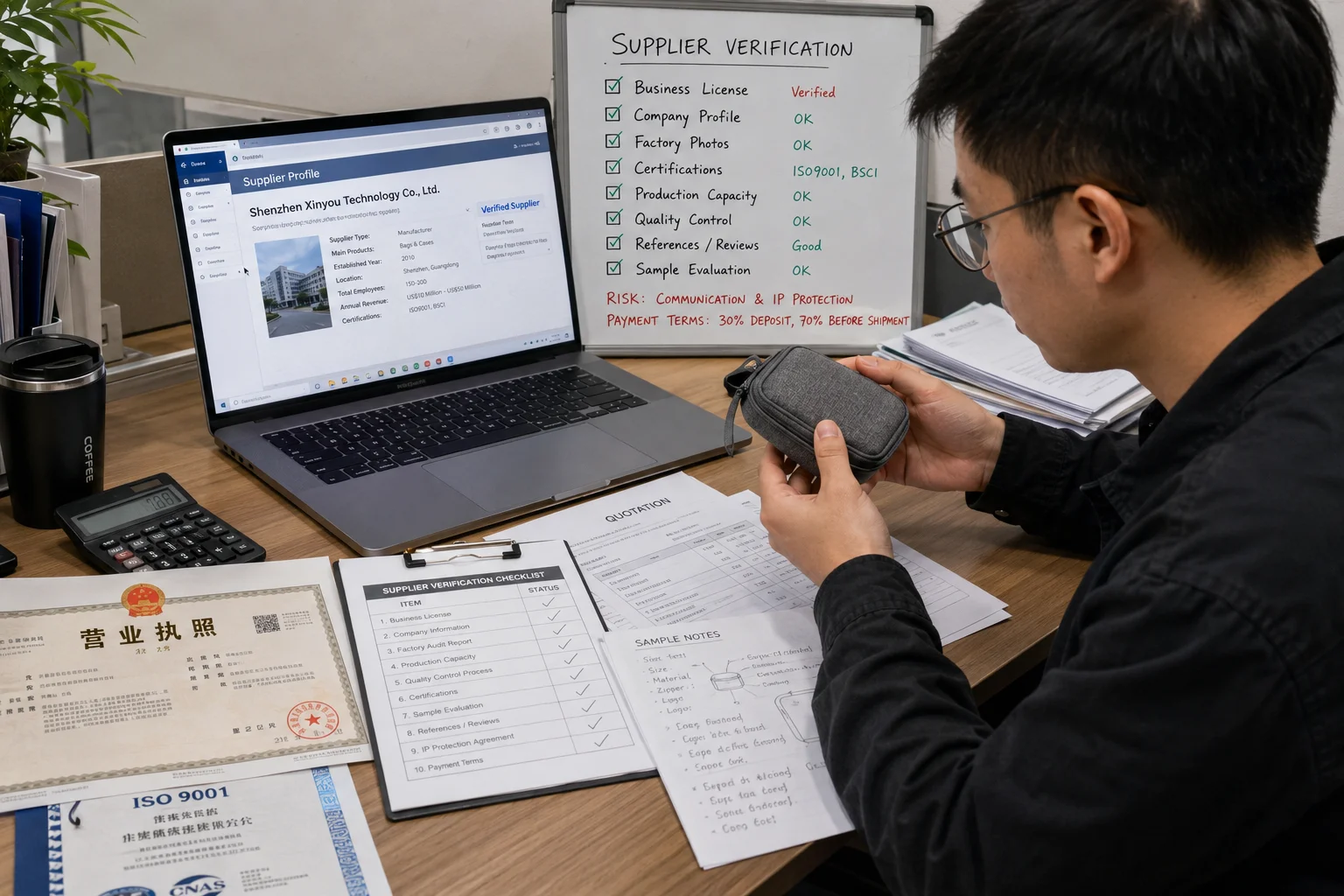
I do not treat every supplier reply as proof
When I source in China, I know that a quick reply does not always mean reliable production. Some trading companies reply fast, but they may not control the factory.[^6] Some factories have strong production, but weak English communication. Some suppliers offer very low prices, but they may reduce material quality later.
| Verification Point | What I Want to Know | Why It Helps |
|---|---|---|
| Business license and scope[^7] | Can the supplier legally operate in this area? | It filters some weak or unrelated sellers |
| Product match | Has the supplier handled similar goods? | It reduces learning risk |
| Production ability | Can the supplier make the required quantity? | It protects delivery time |
| Sample quality | Does the sample match my standard? | It confirms real product ability |
| Quote details | What is included and excluded? | It avoids hidden cost |
| Communication | Does the supplier answer clearly? | It predicts future issue handling |
| Lead time | Is the timeline realistic? | It avoids false promises |
I also watch how a supplier reacts to details. If I ask about material thickness, packaging size, carton weight, logo method, and production time, a real supplier should answer with useful detail. If the supplier keeps saying “no problem” without specifics, I become careful. I want the sourcing agent to compare suppliers with a clear reason. I do not want one random supplier name. I want to know why this supplier is suitable for this order, this budget, and this quality level.
What to Ask About Quotes, Fees, MOQ, Samples, and Payment Terms?
Many buyers feel confused because quotes from China are not always easy to compare. I think a reliable agent must make the quote structure clear.
I ask about product unit price, MOQ, sample fee, mold fee, packaging cost, service fee, inspection cost, inland freight, international shipping, payment terms, delivery terms[^8], and what is included in the quote. Clear quotes reduce payment opacity and wrong price comparison.[^9]
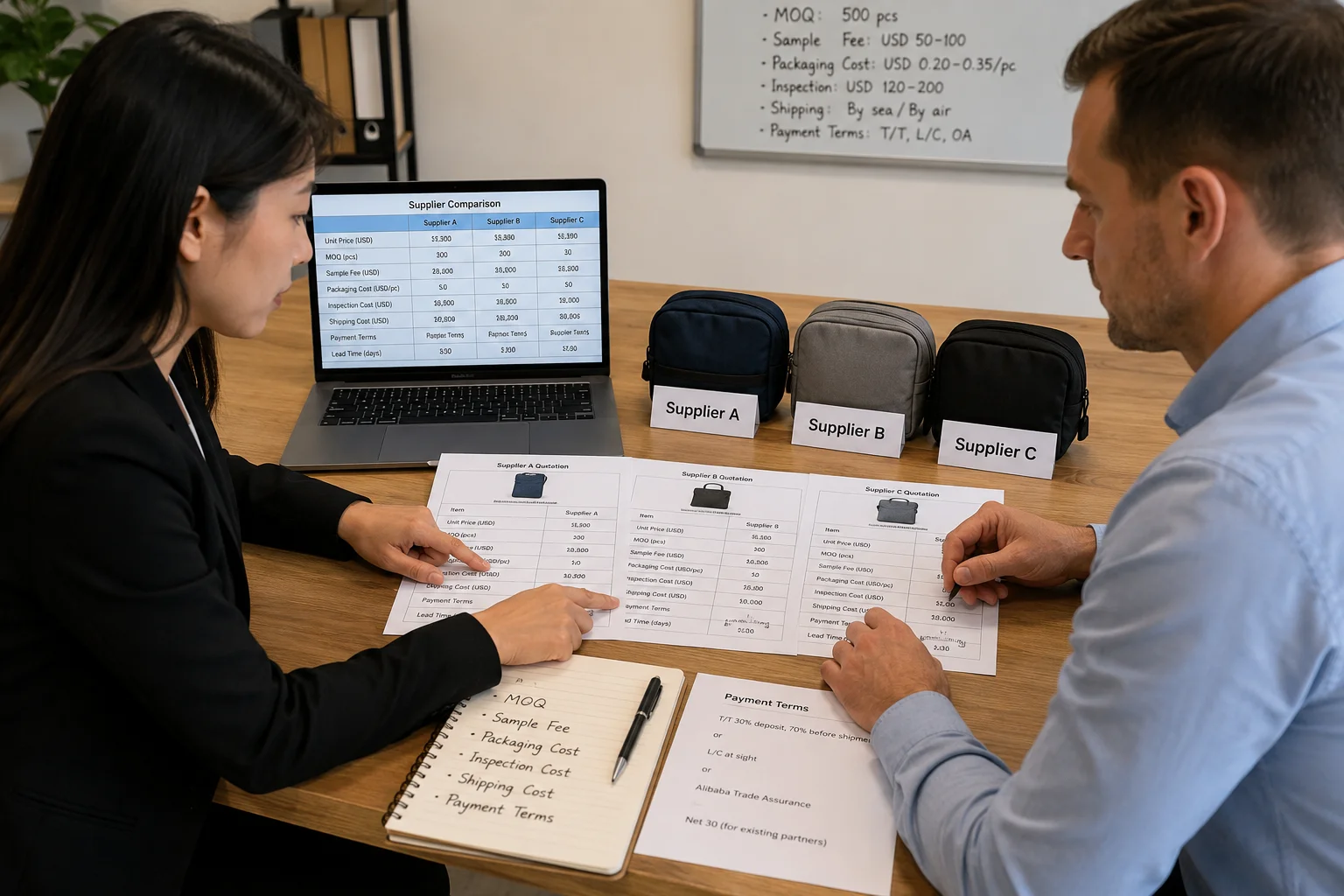
I separate cheap price from clear price
A low unit price can be useful, but only when I understand what it includes. I have seen cases where one quote looked cheaper because packaging was excluded. Another looked higher because it included stronger cartons, logo printing, and inspection handling. If I compare only unit price, I may choose the wrong supplier.
| Quote Item | Question I Ask | Why It Matters |
|---|---|---|
| Unit price | What specification is this based on? | Small changes can change cost |
| MOQ | Is MOQ fixed or negotiable? | It affects testing budget |
| Sample fee | Is it refundable after bulk order? | It affects first-step cost |
| Mold or tooling fee | Is it one-time or repeated? | It affects custom products |
| Packaging cost | Is retail packaging included? | It affects brand presentation |
| Service fee | How does the agent charge? | It tests transparency |
| Payment terms | What deposit and balance are required? | It affects cash flow and risk |
| Shipping cost | Is it estimated or final? | It affects landed cost |
I also ask how the agent avoids hidden markups. Some agents earn through service fees. Some add a margin to supplier prices. Some do both. I do not think one model is always wrong. I think unclear models are the problem. I prefer a sourcing agent who explains how fees work, when fees are charged, and what the buyer gets in return. I also ask whether payment goes to the supplier, the agent, or both. This is a basic trust issue. If the agent avoids all fee questions, I treat that as a warning sign.
How Quality Control, Production Follow-Up, and Inspection Should Be Managed?
Quality problems are painful because buyers often find them after goods arrive. I always prefer early checks over late arguments.
Quality control should start with clear product standards, approved samples, production milestones, supplier updates, defect criteria, and pre-shipment inspection.[^10] A good sourcing agent cannot guarantee zero defects, but the agent should help find problems early and report them clearly.
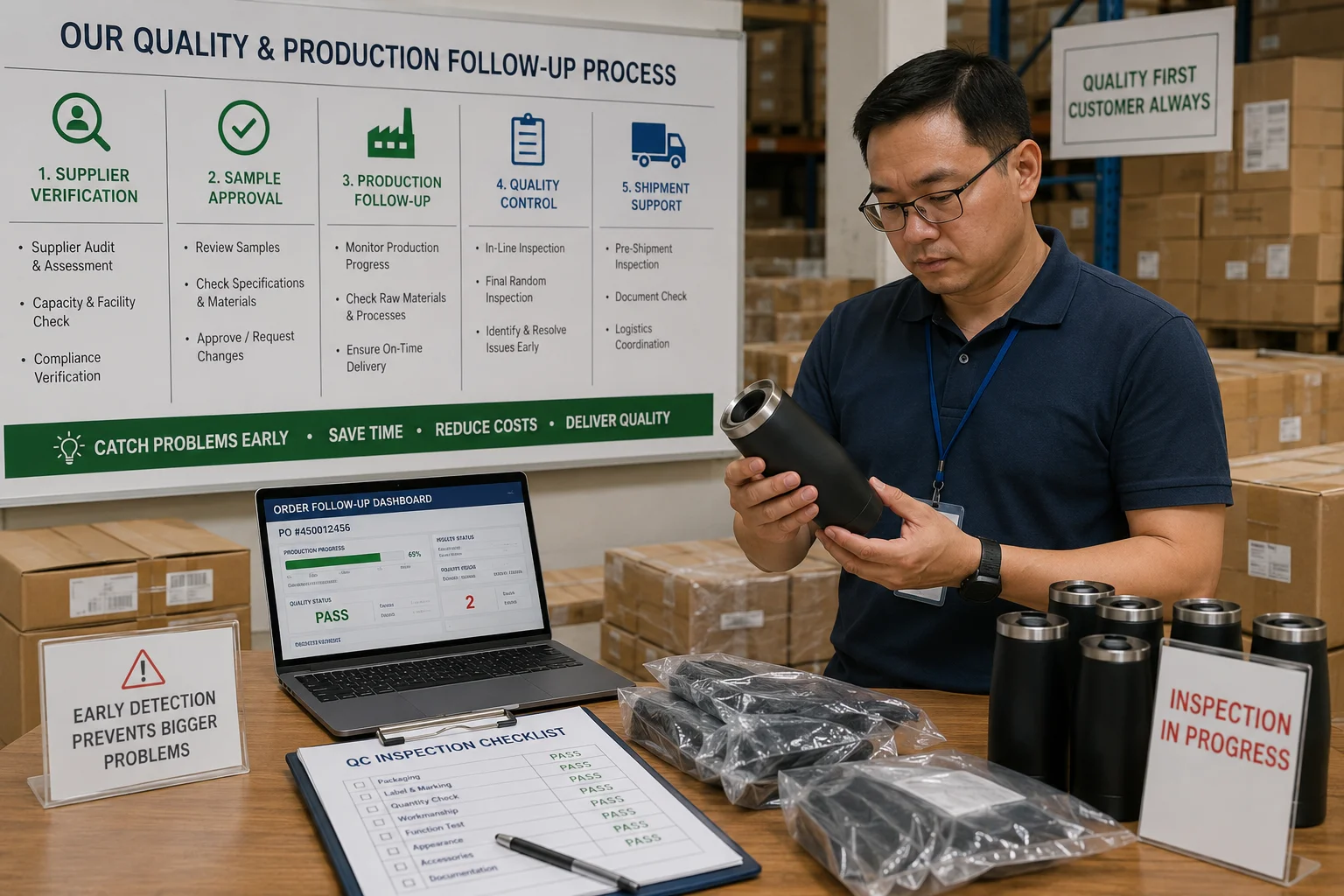
I manage quality before the goods leave China
I do not see inspection as one final step only. I see it as part of a full quality process. If the product standard is unclear, the inspection team has no strong basis.[^11] If the sample is not approved in writing, the factory may use a different understanding. If production updates are missing, delay or material changes may appear too late.
| Quality Step | What I Do | Risk Reduced |
|---|---|---|
| Confirm product details | I list size, material, color, logo, packing | Wrong specification |
| Approve sample | I keep photos, videos, and written notes | Sample-bulk mismatch |
| Follow production | I check progress and timing | Late delivery |
| Check packaging | I confirm carton, label, and retail box | Damaged or unprofessional goods |
| Inspect before shipping | I check quantity, appearance, function basics | Defective shipment |
| Report issues | I send photos and clear problem notes | Poor decision making |
For some orders, a simple visual check may be enough. For other orders, the buyer may need a more formal inspection plan. I do not claim that a sourcing agent is a laboratory or engineering authority. I do believe a sourcing agent can provide practical checks, supplier pressure, and local communication. If defects appear, the agent should help discuss rework, replacement, discount, or shipment hold. The goal is not to blame the factory after everything is finished. The goal is to catch problems while there is still time to fix them.
Why Warehousing, Consolidation, Packaging, and Shipping Support Matter?
Many buyers focus only on factory price and forget the steps after production. I have seen logistics and packaging problems damage profit quickly.
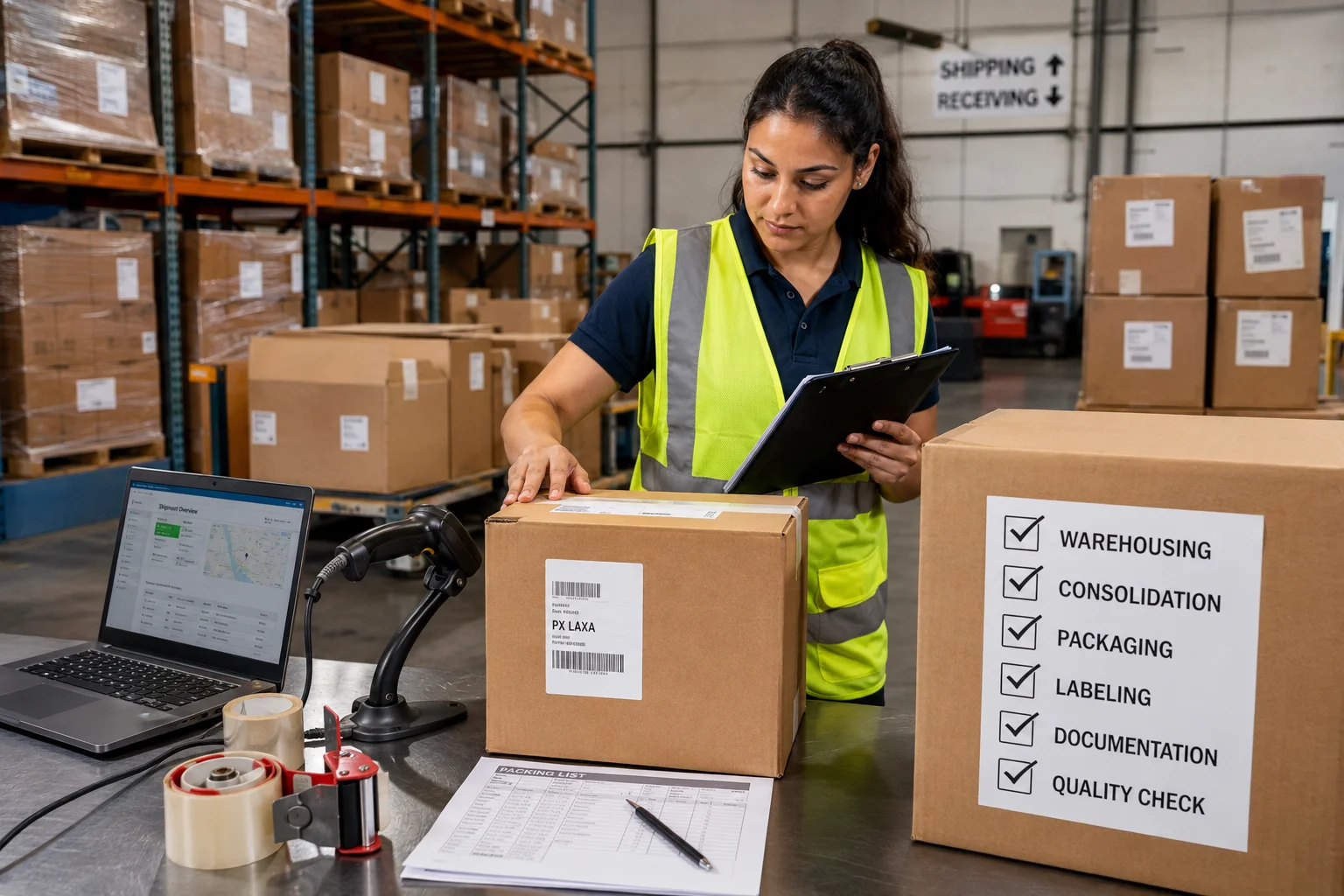
Warehousing, consolidation, packaging, and shipping support matter because buyers often source from multiple suppliers, need repacking, need label work, and need cost-effective delivery. A sourcing agent with warehouse and logistics support can reduce handling problems before goods leave China.
I treat post-production handling as part of sourcing
When goods finish production, the order is not finished. The products still need to be collected, checked, stored, packed, labeled, consolidated, photographed, and shipped. This is very important for e-commerce sellers, DTC brands, small wholesalers, and buyers who work with several suppliers.
| Support Area | What It Solves | Example Need |
|---|---|---|
| Warehousing | Goods need short-term storage | One supplier finishes earlier |
| Consolidation | Multiple supplier orders need one shipment | Lower shipping complexity |
| Repacking | Factory packaging is weak or not retail-ready | Better customer experience |
| Labeling | Products or cartons need barcodes or marks | Marketplace or warehouse rules |
| Product photos | Buyer needs content before stock arrives | Online listing preparation |
| Shipping coordination | Buyer needs air, sea, courier, or door delivery | Cost and speed balance |
I have seen small importers struggle because they buy from three suppliers, and each supplier ships separately with different documents and packaging. The buyer pays more and loses control. A sourcing agent with warehouse support can receive goods first, check basic condition, combine cartons, and arrange a cleaner shipping plan. This does not remove every logistics risk. Customs, weather, peak season, and carrier delays can still happen. But it gives the buyer more control before the goods leave China. I think that control is often worth more than a slightly cheaper factory quote.
How KingSourcing Helps Importers Source from China More Safely and Efficiently?
Choosing an agent is personal because trust takes time. I want buyers to understand how I work before they decide to work with KingSourcing.
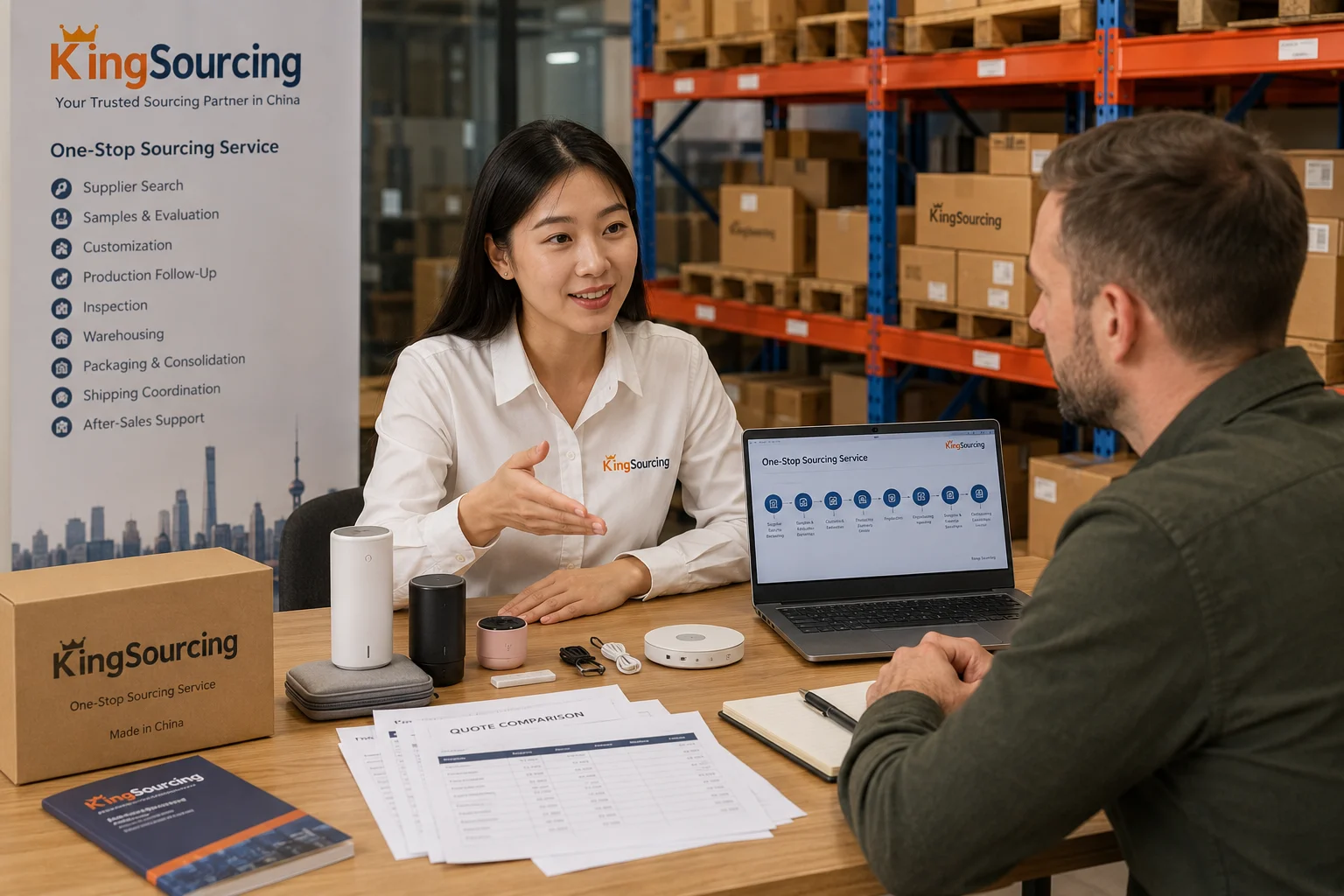
KingSourcing helps importers source from China by acting as a local sourcing and supply chain execution team. I support supplier finding, quote comparison, samples, customization, production follow-up, inspection, warehousing, packaging, consolidation, shipping coordination, and after-sales communication.
I focus on clear execution, not big promises
At KingSourcing, I do not want to present sourcing as magic. I see it as structured work. The buyer gives the target product, budget, order quantity, quality needs, customization plan, packaging idea, and delivery goal. My team helps turn those needs into supplier search, quote comparison, sample checking, order follow-up, and shipping support.
| Buyer Problem | How I Help |
|---|---|
| Buyer does not know where to find suppliers | I search and compare suitable supplier options |
| Buyer worries about unreliable suppliers | I check supplier fit, communication, and order details |
| Buyer has unclear product cost | I break down product, packaging, fee, and shipping items |
| Buyer needs small-batch testing | I look for realistic MOQ options when possible |
| Buyer needs branding | I coordinate logo, packaging, accessories, and sample confirmation |
| Buyer worries about quality | I support sample review, production updates, and inspection |
| Buyer buys from many suppliers | I support warehousing, consolidation, and shipping coordination |
| Buyer has no China team | I act as a local execution contact in China |
I serve small sellers who want to test products and larger buyers who need more order management. I also work with DTC brands, e-commerce sellers, dropshippers, wholesalers, and importers who need better control over communication, packaging, and delivery. I cannot promise perfect suppliers, guaranteed profit, or zero defects. I can help reduce trial-and-error cost, improve visibility, and move each order through a clearer process. That is the real value I want KingSourcing to provide. I want China sourcing to feel less confusing and more manageable.
Conclusion
I choose a China sourcing agent by checking process, transparency, communication, quality control, and local execution support, not only the lowest quoted price.
[^1]: "Due diligence for responsible business conduct - OECD", https://www.oecd.org/en/topics/sub-issues/due-diligence-guidance-for-responsible-business-conduct.html. OECD and similar supply-chain due diligence guidance treats business-partner selection and monitoring as a source of operational, compliance, and reputational risk, supporting the article’s general claim that poor sourcing-agent choice can create cost and delay exposure. Evidence role: general_support; source type: institution. Supports: Supplier and intermediary selection is a recognized source of cost, delivery, quality, and visibility risk in supply-chain management.. Scope note: This would support the general risk mechanism, not quantify losses from China sourcing agents specifically. [^2]: "Life-cycle costing as a tool in mainstreaming green public procurement", https://www.oecd.org/en/publications/life-cycle-costing-in-public-procurement-in-hungary_8d90f627-en/full-report/component-5.html. Procurement scholarship on total cost of ownership explains that supplier evaluation should include costs and risks beyond the quoted unit price, such as quality, logistics, service, and failure costs. Evidence role: expert_consensus; source type: education. Supports: Procurement evaluation commonly considers total cost, quality, delivery, risk, and service rather than purchase price alone.. Scope note: This is contextual procurement evidence and does not directly rank sourcing-agent pricing models. [^3]: "Assessing the Best Supplier Selection Criteria in Supply Chain ...", https://pmc.ncbi.nlm.nih.gov/articles/PMC9102987/. Research on international purchasing intermediaries describes their role in reducing search, coordination, and monitoring burdens across supplier selection, order follow-up, quality checks, and logistics. Evidence role: mechanism; source type: paper. Supports: Sourcing and purchasing intermediaries can participate in supplier search, negotiation, quality monitoring, and logistics coordination.. Scope note: The source would support the general function of intermediaries, not the effectiveness of any individual agent. [^4]: "[PDF] Cybersecurity Supply Chain Risk Management Practices for ...", https://nvlpubs.nist.gov/nistpubs/SpecialPublications/NIST.SP.800-161r1.pdf. Government supply-chain risk-management guidance identifies supplier, production, quality, and logistics vulnerabilities as sources of cost, schedule, and performance impacts. Evidence role: mechanism; source type: government. Supports: Supply-chain risk management frameworks identify risks across supplier selection, production, quality assurance, and logistics that can affect cost, schedule, and performance.. Scope note: This supports the process-risk framework broadly, rather than the specific checklist used in the article. [^5]: "[PDF] Statistical Quality Control", http://csbapp.uncw.edu/janickit/ops370/modules/Module6.pdf. Quality-inspection standards such as ISO 2859 are based on statistical sampling and acceptance criteria, illustrating that inspection can control risk but does not establish that every unit is defect-free. Evidence role: expert_consensus; source type: institution. Supports: Quality-control systems and sampling inspections manage defect risk but cannot prove the absence of all defects in a shipment.. Scope note: This supports the zero-defect limitation; it does not directly address pricing promises. [^6]: "China - Market Overview - International Trade Administration", https://www.trade.gov/knowledge-product/exporting-china-market-overview. International-trade literature defines intermediaries as firms that connect buyers and producers and may handle communication or transactions without being the actual manufacturer. Evidence role: definition; source type: paper. Supports: Trading companies and export intermediaries can facilitate sales between buyers and producers without owning or controlling the production facility.. Scope note: This supports the structural distinction between intermediaries and factories, not the response speed or reliability of any specific trading company. [^7]: "China's National Enterprise Credit Information Publicity System - QCC", https://www.qcckyc.com/blog-detail?id=b59372e8832b4baebc3252d5698aa516. China’s official enterprise-credit publicity system records registered company information, including business scope and registration status, which can provide a baseline check when verifying a supplier’s legal identity. Evidence role: case_reference; source type: government. Supports: Chinese company registration systems record enterprise status, registered information, and business scope that can be used in basic supplier due diligence.. Scope note: Registration data confirms formal company information but does not prove production capability, product quality, or commercial reliability. [^8]: "Know Your Incoterms - International Trade Administration", https://www.trade.gov/know-your-incoterms. The International Chamber of Commerce’s Incoterms rules define how delivery terms allocate transport responsibilities, costs, and risk transfer between buyers and sellers in international trade. Evidence role: definition; source type: institution. Supports: International delivery terms allocate responsibilities, costs, and risks between buyer and seller.. [^9]: "Landed Cost: Complete Guide to Calculating Total Import and ...", https://www.finaleinventory.com/blog/guides/landed-cost/. Procurement and import-cost guidance explains that landed-cost comparison requires separating product price from packaging, freight, duties, fees, and other charges, supporting the need for transparent quotations. Evidence role: mechanism; source type: education. Supports: Comparing suppliers requires identifying included and excluded cost components, such as product price, packaging, freight, duties, and service fees.. Scope note: This supports the comparison method generally and does not verify any particular agent’s quotation practices. [^10]: "[DOC] EQA_Exh5.docx - DOE Office of Science", https://science.osti.gov/-/media/SCMS/Management-Systems/QUAL/EQA/EQA_Exh5.docx. ISO-style quality-management guidance emphasizes defining product requirements, monitoring production processes, controlling nonconforming outputs, and retaining evidence of conformity, supporting the article’s staged quality-control approach. Evidence role: expert_consensus; source type: institution. Supports: Quality management uses defined requirements, monitoring, inspection criteria, and documented acceptance evidence to control nonconforming outputs.. Scope note: This supports the quality-management principle; implementation details vary by product risk and inspection standard. [^11]: "[DOC] Chapter 10 - Receiving, Inspecting, Acceptance Testing and ...", https://www.dgs.ca.gov/-/media/Divisions/PD/PTCS/OPPL/SCM/v2Chapt10.docx. Inspection and quality-assurance standards require products to be evaluated against specified requirements or acceptance criteria, which supports the claim that unclear product standards weaken inspection conclusions. Evidence role: mechanism; source type: institution. Supports: Inspection decisions require defined specifications or acceptance criteria against which products are evaluated..