Customize products with Chinese manufacturers sounds simple until you need to turn a logo, reference image, or product idea into a quote that a factory can actually produce. Unclear details can cause wrong samples, rising costs, missed deadlines, and bulk goods that differ from expectations.[^1] We use a staged sourcing process to reduce those risks.
To customize products with Chinese manufacturers, start with a clear product specification, choose a supplier experienced with similar items, confirm customization options and MOQ, approve samples in writing, finalize packaging, and inspect production before shipment. The safest path is usually to begin with an existing product and make controlled changes before investing in full OEM development or new molds.[^2]
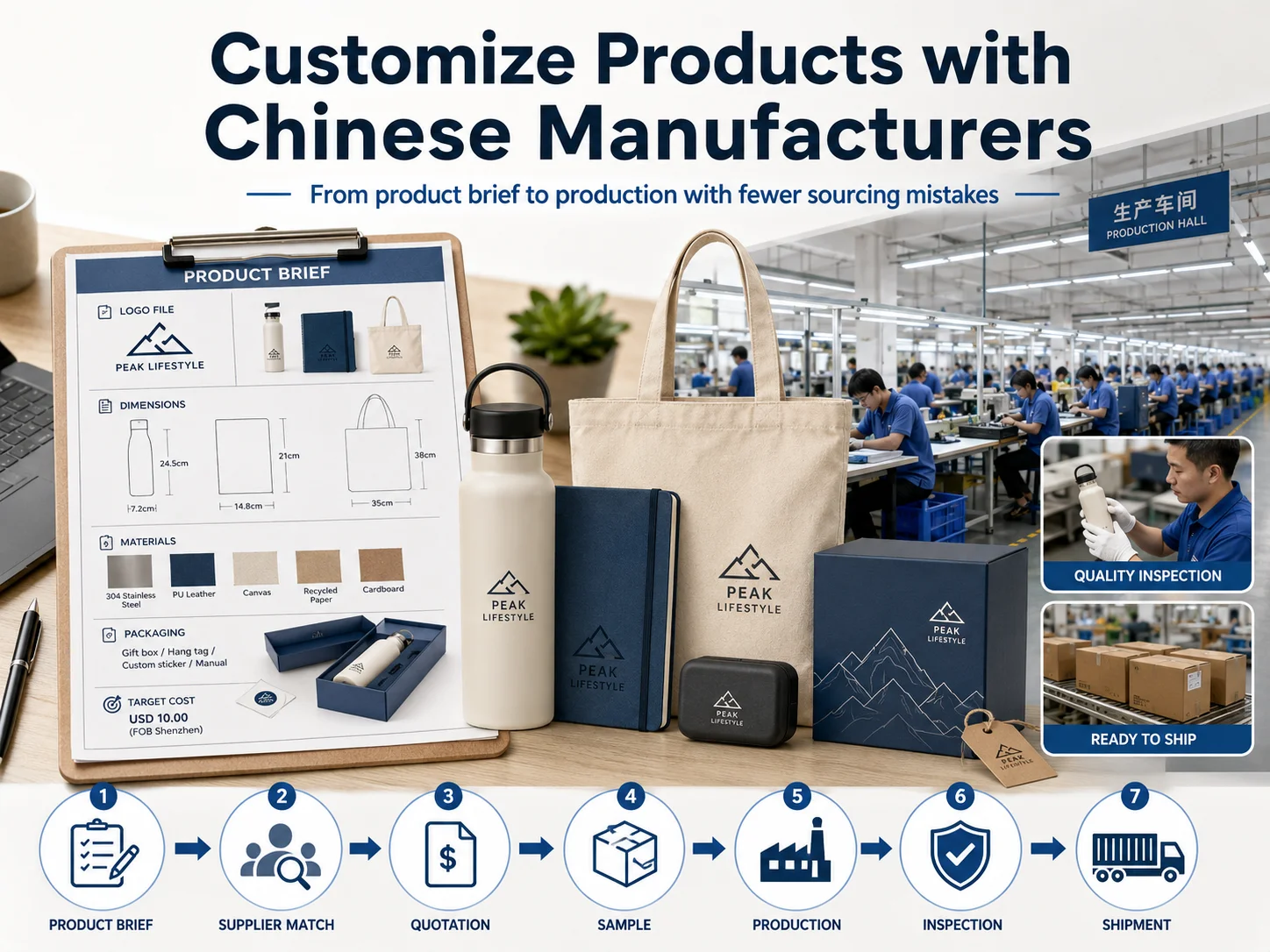
At KingSourcing, we see that successful customization is rarely completed in one message to a factory. It is a sequence of commercial decisions. The buyer defines the product goal and priorities, while our China-based team helps translate those priorities into supplier discussions, samples, quality standards, and production follow-up.
How Can You Customize Products with Chinese Manufacturers Successfully?
Many buyers begin with a product image and ask, “Can a Chinese factory make this?” That question is understandable, but it is too broad for reliable sourcing. A supplier may say yes before it fully understands your material, dimensions, quality level, quantity, target price, and market requirements.
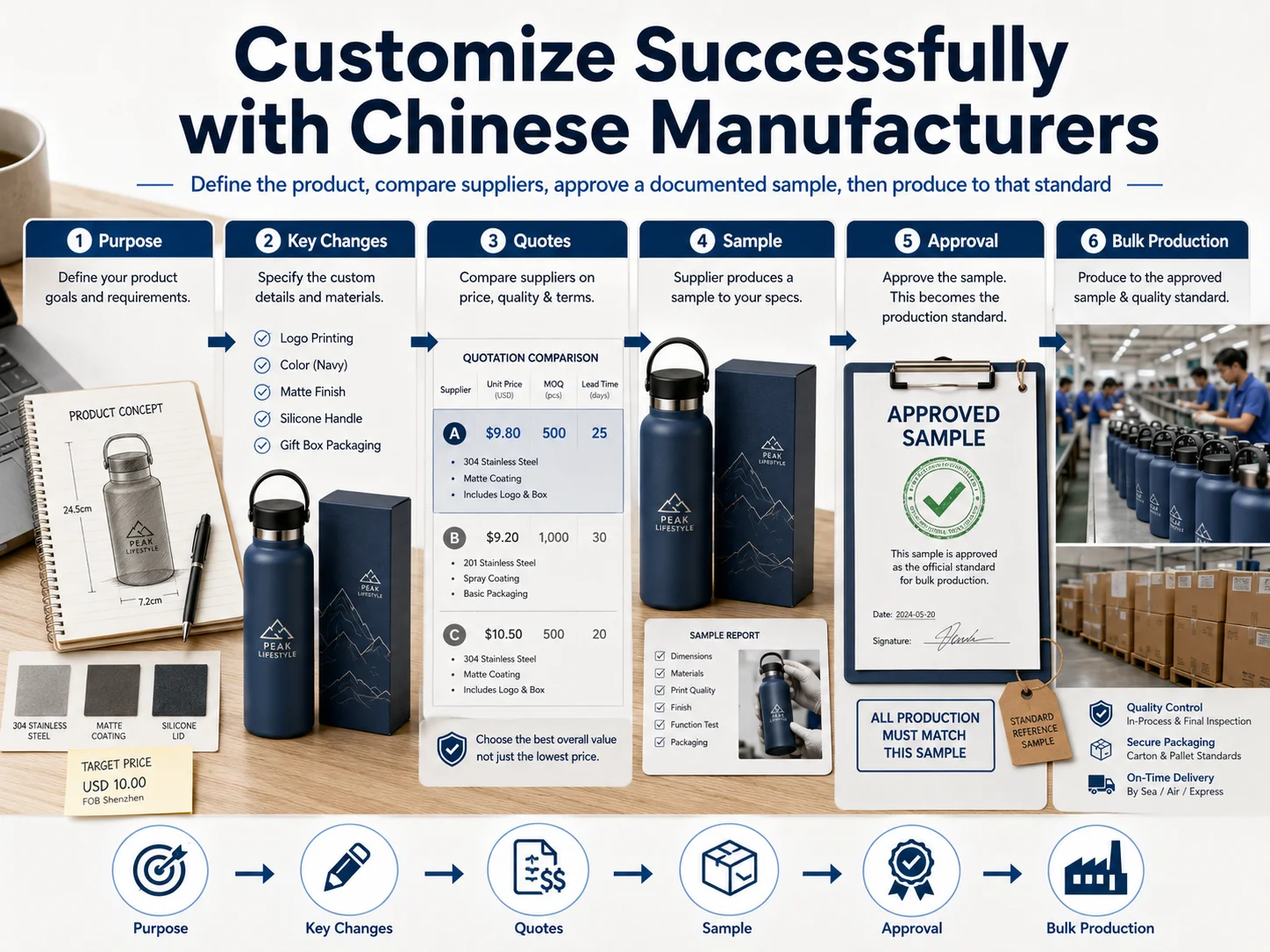
The most reliable way to customize products with Chinese manufacturers is to define the product’s purpose, identify the changes that matter most, request quotes from relevant suppliers, approve a documented sample, and use that approved sample as the standard for bulk production.
Start with the product task
Before we contact factories, we usually ask three practical questions:
- Who will use the product?
- What job must the product perform?
- Which details must be different from an existing product?
These questions keep a project grounded. A fitness accessory for premium retail packaging has different requirements from the same accessory sold as a low-cost online bundle. The material, finish, packaging, compliance needs, and target cost can all change.
Build customization in stages
For first orders, we often recommend a lower-risk path:
| Stage | Typical Changes | Best for |
|---|---|---|
| Existing product | Logo, label, insert card | Small test orders |
| Controlled customization | Color, material, accessory, packaging | Growing brands |
| Deep customization | Structure, function, tooling, unique design | Validated high-volume products |
We once worked with a buyer who initially wanted a completely new version of an existing household product. After we clarified the expected first order quantity and target retail price, the practical route became a custom color, upgraded material, branded packaging, and a useful accessory bundle. The buyer could test demand without committing to expensive development too early.
A reference image is useful, but it is not a complete sourcing brief.[^3]
What Product Customization Options Do Chinese Manufacturers Offer?
A factory may offer several levels of customization, but the available options depend on its equipment, product category, existing materials, and production schedule. A supplier that can print a logo may not be able to redesign a product structure or develop a new mold.
Chinese manufacturers commonly offer logo printing, color changes, material upgrades, size adjustments, accessories, private-label packaging, and OEM or ODM product development.[^4] The right option depends on your budget, order volume, product complexity, and willingness to manage development risk.
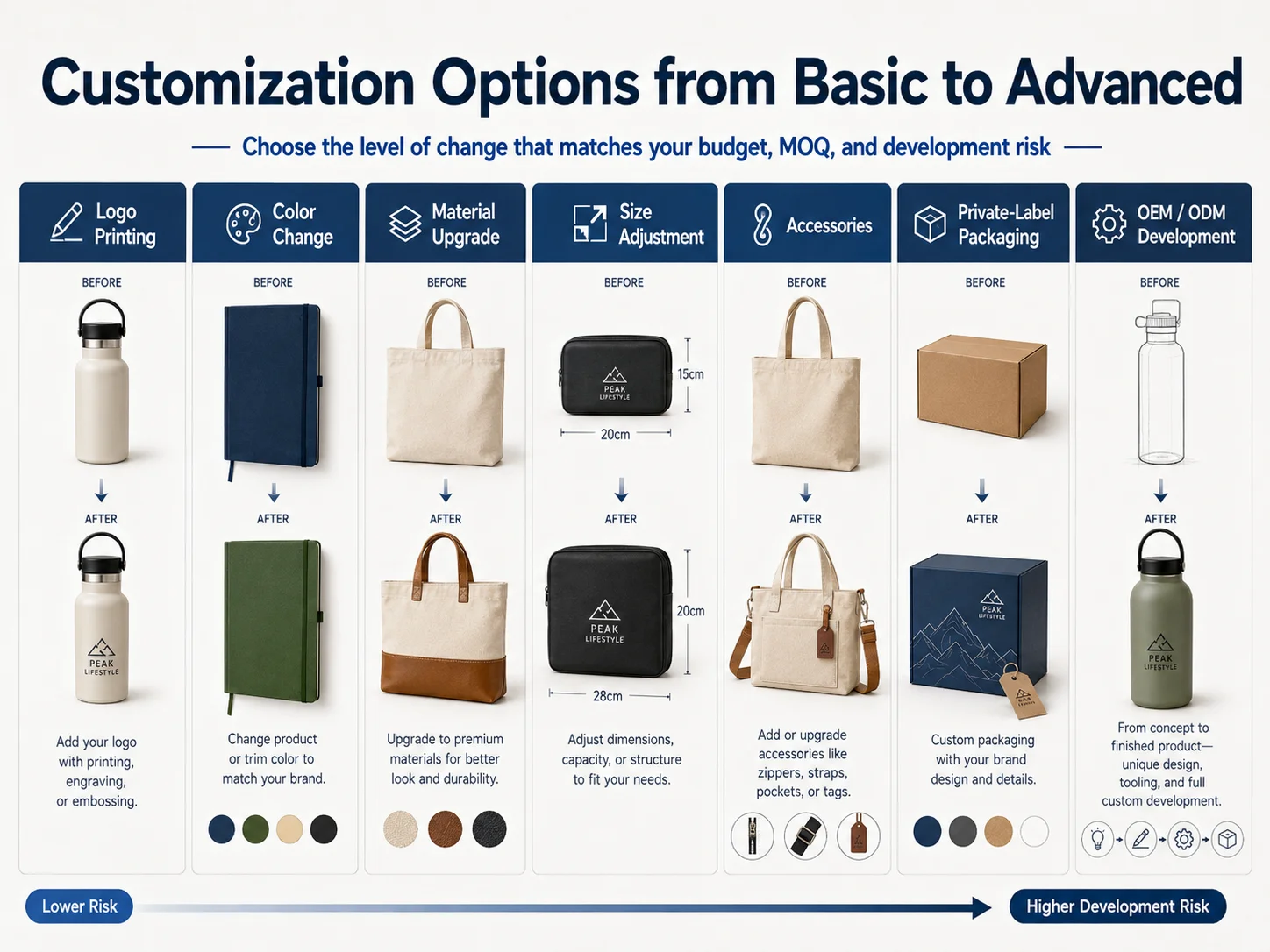
Common customization levels
Here are the options we most often discuss with buyers:
- Logo customization: Printing, embossing, engraving, embroidery, heat transfer, laser marking, or woven labels.
- Color customization: Standard color selection or a custom Pantone color, subject to material and MOQ requirements.
- Material changes: Different fabric weight, silicone grade, metal finish, plastic type, or recycled material option.
- Size and dimension changes: Length, thickness, capacity, or component sizing.
- Accessory combinations: Bundling existing items into a kit or adding replacement parts.
- Packaging customization: Color boxes, mailer boxes, inserts, labels, manuals, barcodes, and carton marks.
- ODM adjustments: Changing an existing factory design with limited functional or visual changes.
- OEM development: Creating a product based on your design, specifications, or new tooling.
Choose the simplest viable solution
For example, a custom color may require a material color match and a new production batch. A new size may require revised cutting tools or molds. A redesigned electronic function may need component sourcing, engineering review, and additional testing. We recommend that buyers identify their non-negotiable features first, then separate them from “nice-to-have” ideas.
That approach helps suppliers quote more accurately. It also gives you a clearer way to compare offers instead of choosing a factory based only on the lowest unit price.
Which Customization Model Is Right: Private Label, ODM, or OEM?
Choosing between private label, ODM, and OEM is one of the most important decisions when you customize products with Chinese manufacturers. Buyers sometimes use these terms interchangeably, but they involve different costs, lead times, intellectual-property considerations, and control levels.
Private label is usually the fastest and lowest-risk option because it uses an existing product with your branding.[^6] ODM modifies an existing factory product, while OEM generally involves producing a product to your own design or detailed specifications.
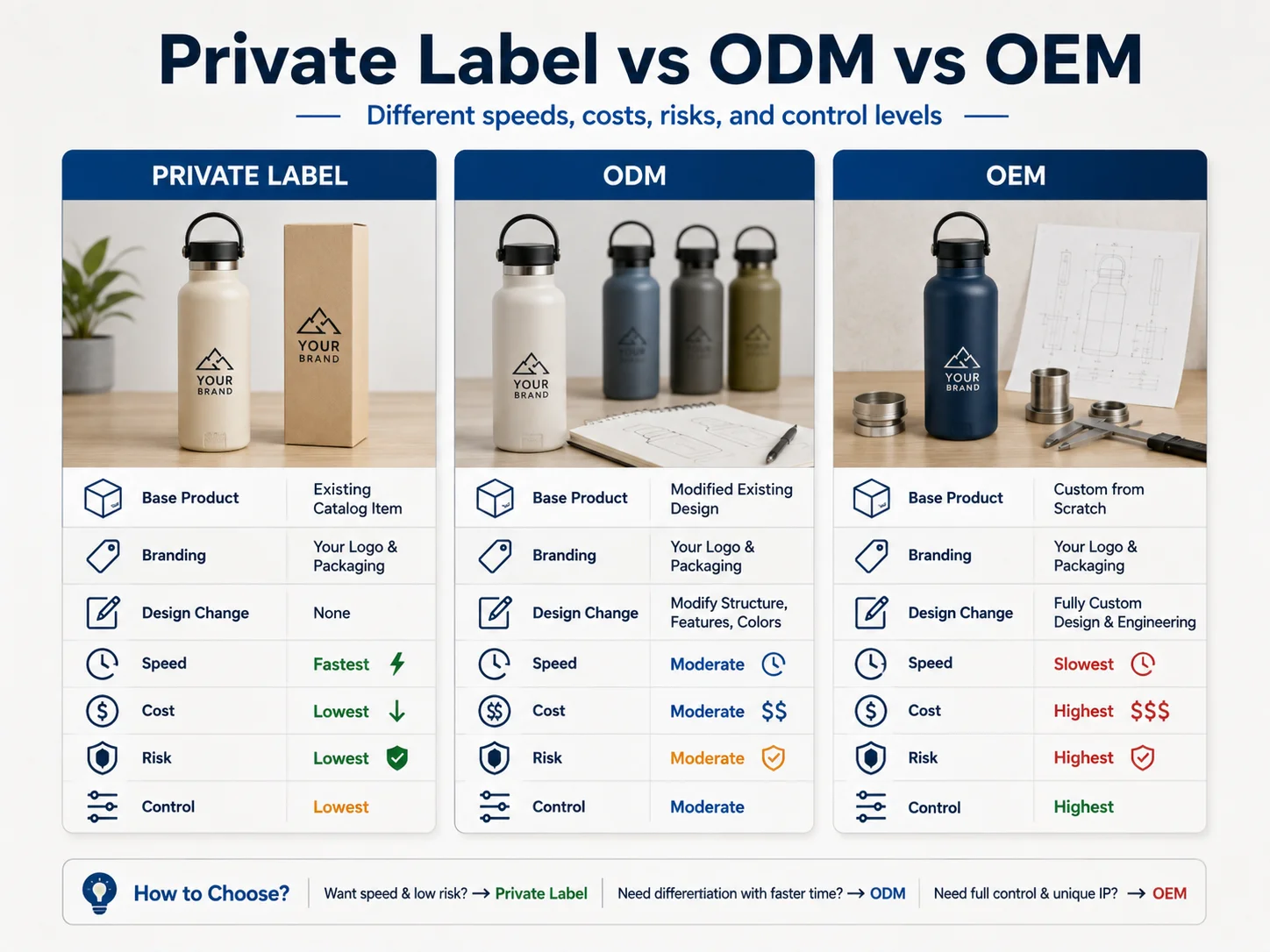
| Factor | Private Label | ODM Customization | OEM Customization |
|---|---|---|---|
| Product base | Existing factory item | Existing design with changes | Buyer-led design or specification |
| Customization level | Low | Medium | High |
| Typical investment | Lower | Moderate | Higher |
| MOQ | Often lower, but varies | Usually moderate | Often higher |
| Mold requirement | Usually no | Sometimes | Often possible or required |
| Development timeline | Shorter | Medium | Longer |
| Best for | Testing a brand or market | Differentiating a proven product | Established product strategy |
Private label: a practical starting point
Private label products usually involve an existing item plus your logo, packaging, label, or insert. This approach is often suitable for early-stage ecommerce sellers because the factory already understands the product and has an established production process.
However, buyers should still verify:
- The exact product version being quoted
- Material and dimensions
- Logo method and placement
- Packaging specifications
- Product and carton quality standards
- Whether the factory can support the requested order quantity
ODM and OEM: more control, more responsibility
ODM can work well when an existing model is close to your vision. You may change the color, dimensions, materials, components, or selected functions without developing every part from zero.
OEM gives you greater control, but it requires stronger documentation and a realistic budget. If a product needs a new mold, the tooling ownership, maintenance, storage location, modification rights, and release conditions should be discussed in writing before payment.[^7]
We do not advise treating OEM as a shortcut to instant exclusivity. Product differentiation comes from execution: a clear design, supplier capability, quality management, packaging, and consistent delivery.
How Do You Prepare a Clear Product Specification for Chinese Manufacturers?
When buyers ask us to source a custom item, the quality of the initial brief directly affects the quality of the supplier response. A vague brief creates vague quotes. Factories may fill in missing details with their own assumptions, which can lead to revisions later.[^8]
A clear product specification should state the product dimensions, materials, colors, functions, quality expectations, target quantity, target cost, packaging needs, target market, and required delivery window. It gives suppliers enough information to quote and sample accurately.
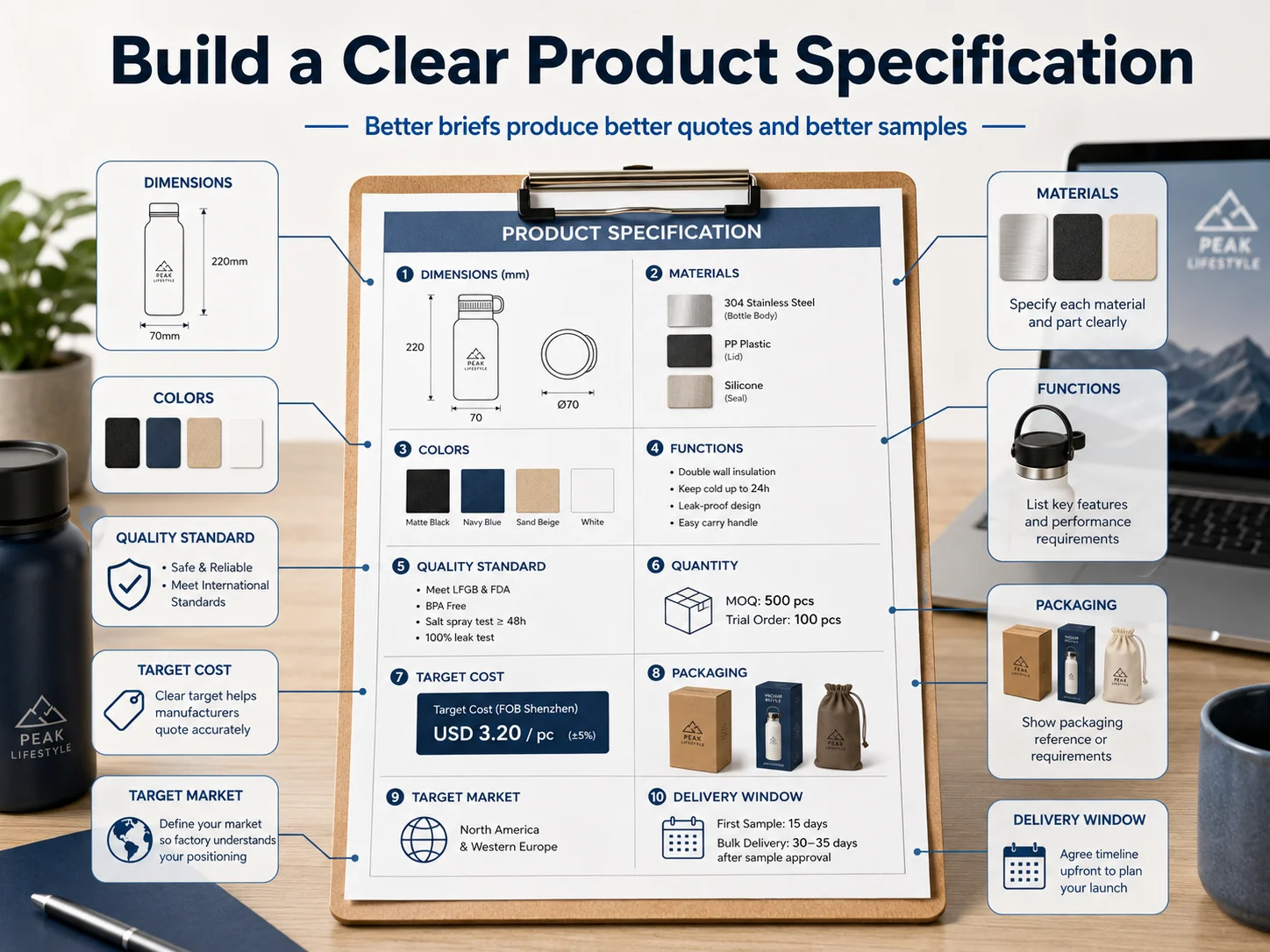
Include the information suppliers need
A workable sourcing brief does not need to be a perfect engineering document. It needs to be clear enough for comparison and clarification.
| Specification Area | What to Include |
|---|---|
| Product reference | Photos, links, sketches, or competitor examples |
| Dimensions | Length, width, height, thickness, tolerances if known |
| Materials | Required material, finish, color, texture, durability needs |
| Function | How the item should work and who will use it |
| Branding | Logo file, placement, size, and preferred method |
| Packaging | Box type, inserts, label, barcode, carton requirements |
| Quantity | Sample quantity, first order quantity, expected reorders |
| Commercial target | Target unit cost, budget range, target retail channel |
| Market | Country or region where the product will be sold |
| Timeline | Required sample date and delivery deadline |
Explain what matters most
We encourage buyers to rank their priorities. You may need the lowest possible price, but you may also need premium packaging, a specific material, and a fast delivery date. Those objectives can conflict.
In one anonymized project, a buyer requested a “premium” travel accessory based only on an image. The first supplier quotes varied widely because each supplier assumed a different fabric, zipper grade, lining, and packaging level. Once the buyer clarified the product’s intended use, target price range, and desired material feel, we could narrow the supplier list and request comparable samples.
A clear specification does not eliminate every issue. It does make revision cycles shorter and decisions more transparent.
How Do You Find the Right Chinese Manufacturer for Custom Products?
The right manufacturer is not always the supplier with the cheapest quote or the fastest reply. When you customize products with Chinese manufacturers, you need to assess whether a supplier has relevant product experience, suitable machinery, stable material sourcing, and the ability to meet your order requirements.
Find the right Chinese manufacturer by looking for factories with experience in similar products, checking their production and customization capabilities, verifying business information, reviewing samples, and comparing quotations based on the same written specification.
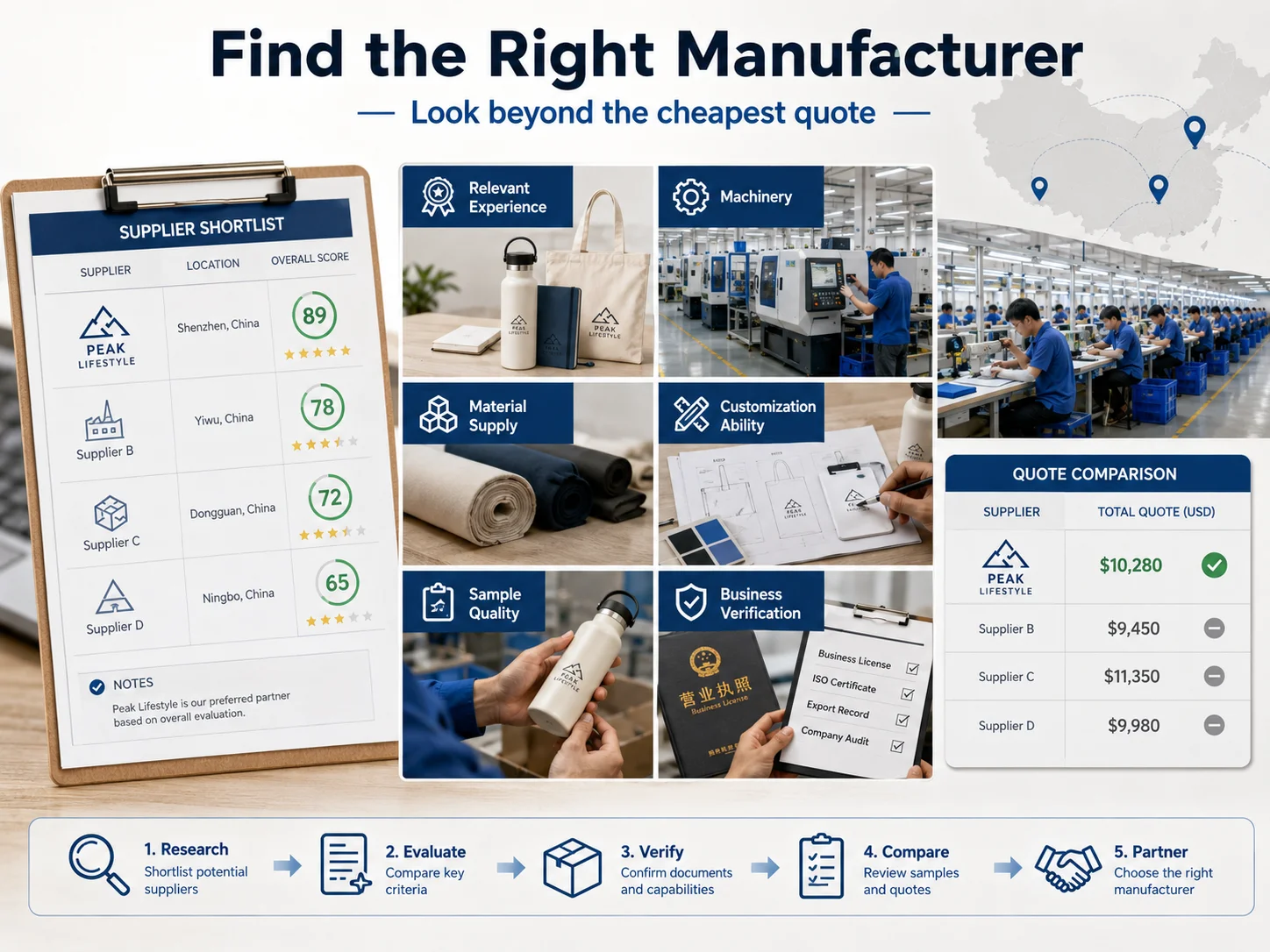
Look beyond marketplace listings
Online platforms can be useful starting points, but they do not replace supplier verification.[^9] Some sellers are trading companies, some operate as factories, and some use a mix of both. Neither model is automatically bad, but you should understand who controls production and who will manage your order.
We normally review factors such as:
- Product category experience
- Factory location and relevant industrial cluster
- Customization equipment and processes
- Existing product range
- Production capacity and current schedule
- Quality-control procedures
- Export experience for your target market
- Business license and available certifications
- Sample responsiveness and communication quality
Compare comparable quotes
A low quote can hide missing details. One supplier may quote a thinner material, standard packaging, or a different logo method. Another may include a higher-grade component and custom color box.
Before comparing prices, we make sure each supplier is quoting the same basis:
- Same product specifications
- Same order quantity
- Same logo method
- Same packaging requirements
- Same quality standard
- Same shipping terms where relevant
Supplier verification reduces risk, but it does not make a supplier perfect. We still recommend samples, written approvals, production follow-up, and inspection because supplier performance can change across seasons, raw-material batches, and production schedules.
How Does Product Sample Development and Approval Work?
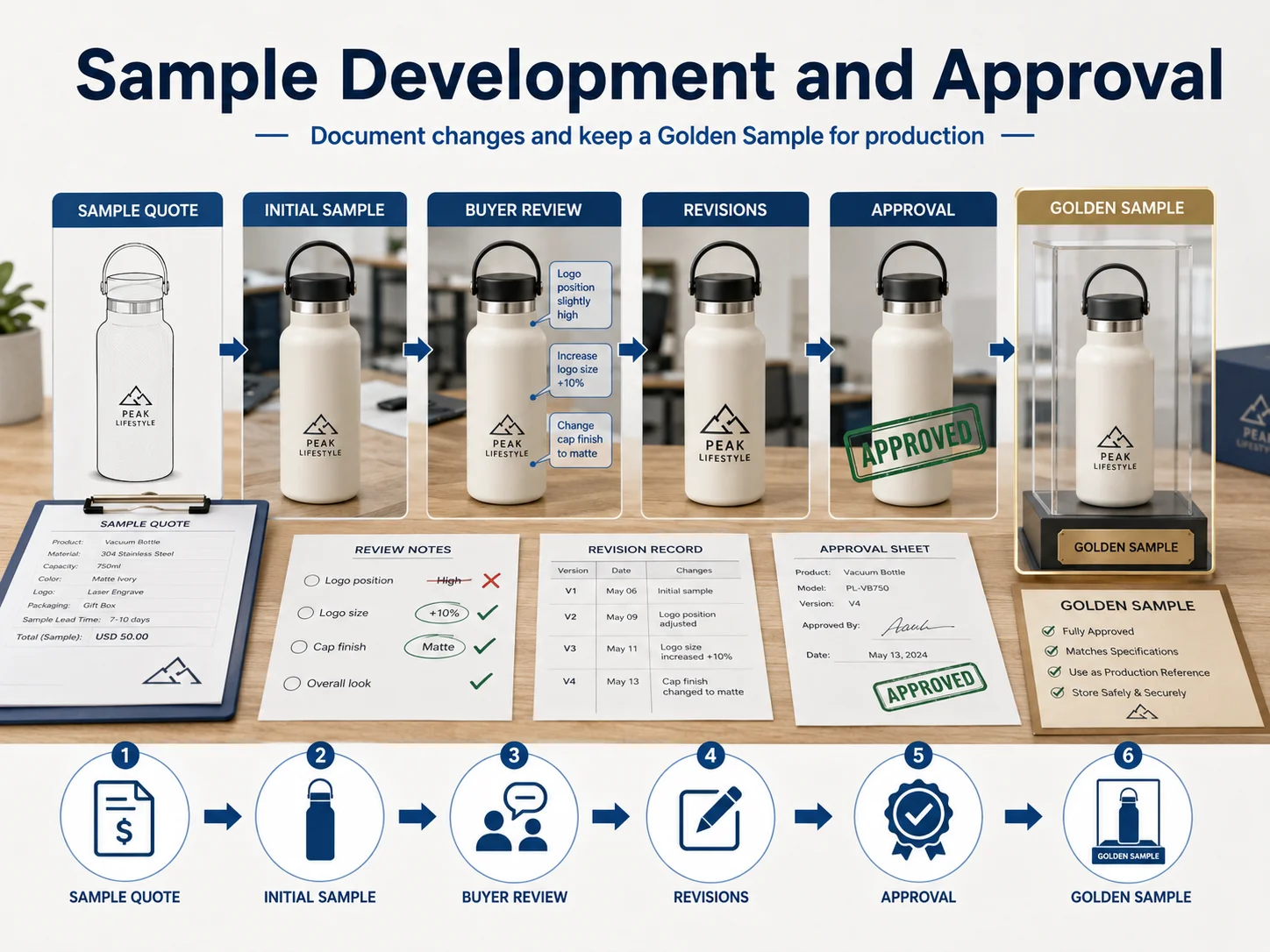
A product sample is a decision tool, not simply a photo opportunity. Buyers need to review whether the sample meets the agreed product brief, and they need to record what must change before mass production. An approved sample alone also does not guarantee consistent bulk goods.[^10]
The sample development process typically includes sample quotation, initial sample production, buyer review, revisions, confirmation sample approval, and Golden Sample retention. Each stage should document changes so the factory can follow the same standard during production.
Manage revisions carefully
A typical sampling workflow looks like this:
- Confirm product specifications and quotation basis.
- Pay the agreed sample and development charges, if applicable.
- Receive photos, videos, measurements, or the physical first sample.
- Review the sample against the written requirements.
- Send consolidated revision feedback.
- Approve a revised confirmation sample.
- Keep a signed or clearly identified Golden Sample as the production reference.
We advise buyers to consolidate feedback rather than send scattered messages over several days. A single revision document helps prevent factories from applying only part of the requested changes.
Check more than appearance
During sample approval, assess the product from the customer’s perspective:
- Does it perform its intended task?
- Are the dimensions and weight correct?
- Is the material consistent with the agreed standard?
- Is the logo readable and correctly placed?
- Are sharp edges, stains, loose threads, odor, scratches, or weak joints present?
- Does the packaging protect the item?
- Are labels, instructions, and barcodes correct?
At KingSourcing, we have seen samples that looked acceptable in photos but had practical issues once handled. For example, a component fit loosely after repeated use, even though its appearance was correct. A physical review and clear revision note gave the supplier a specific issue to address before production.
How Can You Customize Logo, Packaging, and Branding?
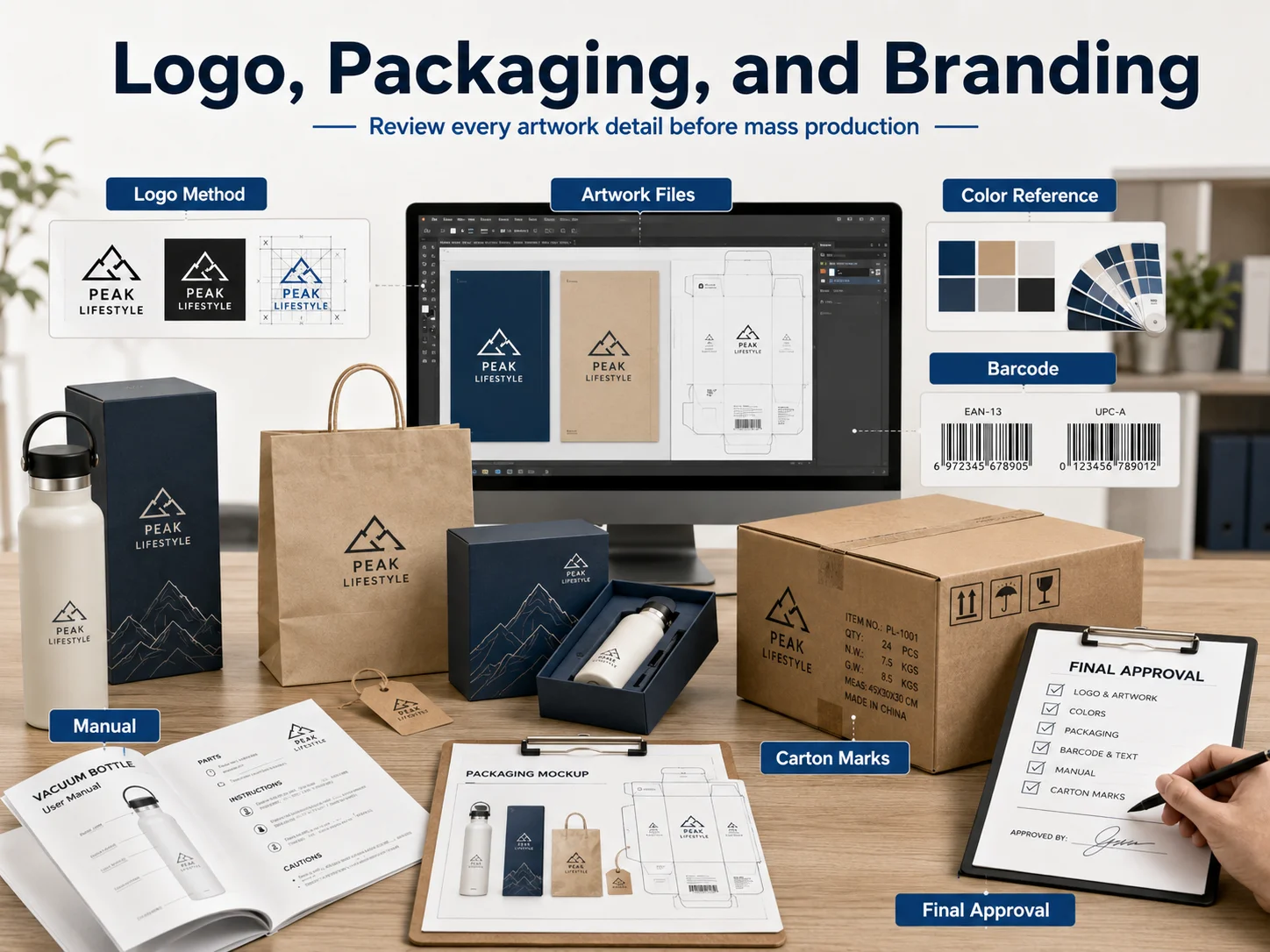
Branding can turn an existing product into a more coherent customer experience, but it also adds details that must be checked carefully. A logo file, packaging artwork, barcode, instruction manual, and shipping carton marks can each create separate errors if they are not reviewed before production.
Logo and packaging customization should be managed as part of the product specification. Confirm the logo method, artwork files, color references, packaging dimensions, barcode placement, language, carton marks, and final approval process before mass production begins.
Match branding to the product and channel
Common logo methods include:
- Screen printing: Often suitable for simple designs and flat surfaces.
- Laser engraving: Often used on metal, wood, leather-like materials, or coated surfaces.
- Embossing or debossing: Creates a premium tactile effect on selected materials.
- Heat transfer: Useful for certain fabrics and complex color artwork.
- Woven labels or patches: Common for apparel, bags, and textile items.
Packaging can include color boxes, kraft boxes, polybags, hang tags, stickers, thank-you cards, instruction leaflets, and master cartons. The correct choice depends on your sales channel. A product sold through retail may need barcode-ready packaging and shelf presentation. A product sold primarily online may prioritize protection, dimensional weight, and unboxing experience.
Check artwork before printing
We recommend confirming:
- Final AI, PDF, or other print-ready files
- Pantone or agreed color references
- Text language and spelling
- Barcode format and scan test where required
- Packaging dieline and dimensions
- Warning labels or market-specific marks
- Inner pack and outer carton quantity
A beautiful product can still create returns if the manual is wrong, the barcode does not scan, or the carton fails during transit.[^11] Branding is not only design. It is also operational accuracy.
What Do Custom Product Costs, MOQ, and Lead Times Include?
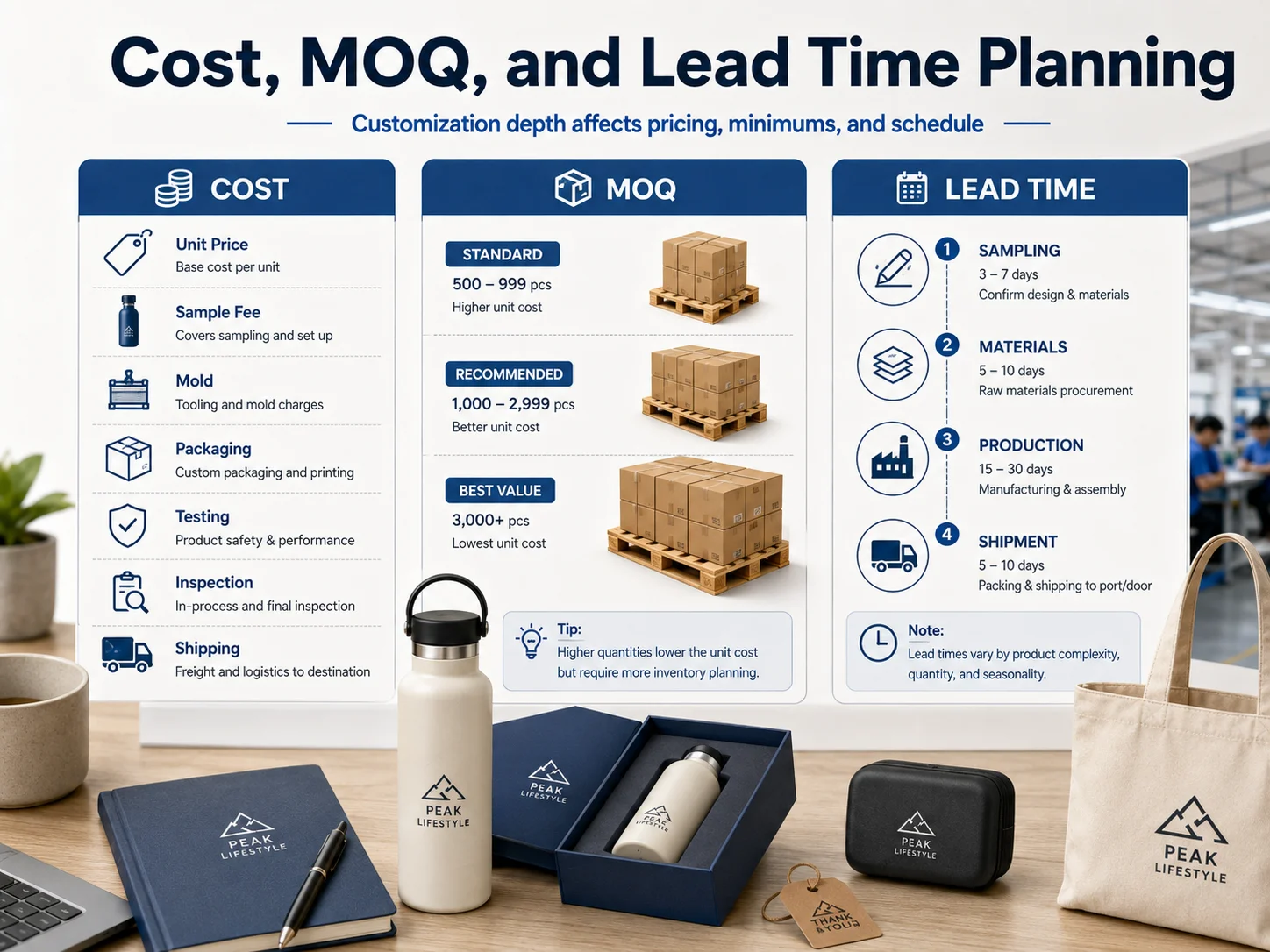
Cost, MOQ, and lead time are connected. Buyers often ask for low MOQ, deep customization, low unit price, and fast delivery at the same time. In practice, manufacturers must balance setup work, material purchases, production efficiency, tooling, and scheduling.
Custom product costs can include unit price, sample fees, development charges, molds, logo setup, packaging, testing, inspection, and shipping. MOQ and lead time vary by product complexity, material availability, customization depth, factory schedule, and order quantity.
Main cost drivers
| Cost Area | Why It Changes |
|---|---|
| Product unit cost | Material, labor, complexity, order volume |
| Sample fee | New setup, manual work, custom components |
| Mold or tooling | New shape, structure, or production process |
| Logo setup | Printing screens, plates, embroidery files, engraving setup |
| Packaging | Box material, printing colors, inserts, finishes |
| Quality control | Inspection scope and product risk level |
| Freight | Volume, weight, shipping method, destination |
Plan for a realistic first order
A small order may be suitable for existing products with branding or packaging changes. A fully custom product may require a higher MOQ because the factory needs to purchase materials, set up production, and recover development costs.
We advise buyers to request a quote with clear cost separation. This makes decisions easier. For example, you can compare the impact of using a standard box versus a custom color box, or an existing material color versus a custom color match.
Lead times also require confirmation, not assumptions. Sampling may take days or weeks depending on the item. Production time can change based on order size, supplier capacity, raw-material availability, and seasonal demand. Buyers should build buffer time for revisions, quality checks, and international shipping.
How Does KingSourcing Manage Custom Product Development in China?
Coordinating a custom order from overseas can take time because suppliers need clear decisions, and buyers need reliable information before approving costs. KingSourcing acts as an on-the-ground sourcing and supply-chain coordination team, but buyers remain responsible for product positioning and final approvals.
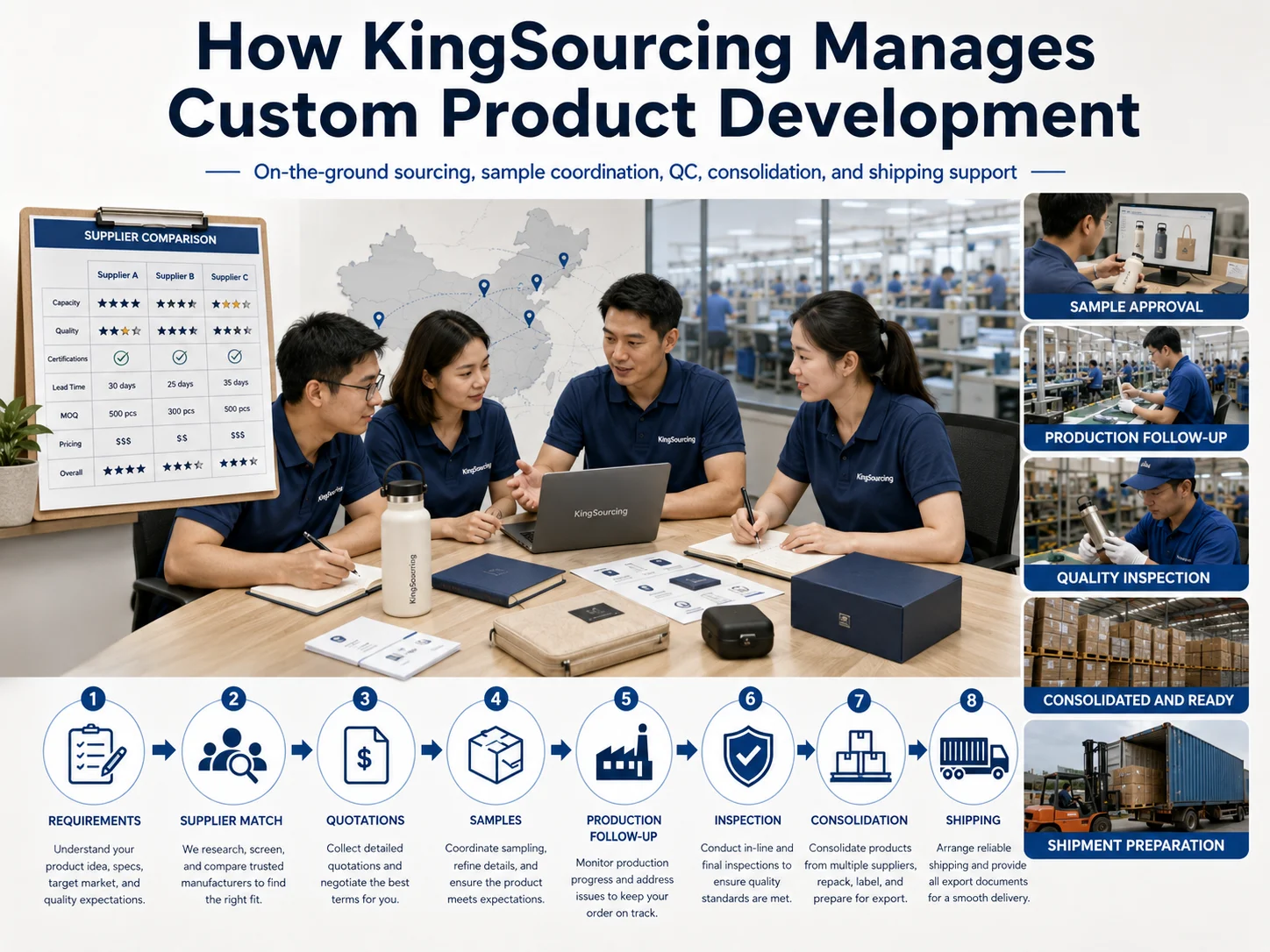
KingSourcing manages custom product development by organizing buyer requirements, identifying relevant suppliers, comparing quotations, coordinating samples and packaging, following production, arranging quality inspections, consolidating goods, and supporting international shipping.
Our practical workflow
Our work commonly includes:
- Reviewing your product idea, images, specifications, budget, and quantity.
- Identifying suppliers with relevant product capabilities.
- Comparing supplier quotes and customization options.
- Coordinating samples, revisions, and approval records.
- Supporting logo, packaging, accessories, and product bundles.
- Following production milestones with suppliers.
- Arranging 1-by-1 product inspection or other appropriate quality-control checks.
- Supporting warehousing, product photography, consolidation, and shipment coordination.
We focus on reducing avoidable surprises
We do not promise that every product idea can be produced cheaply, quickly, and at a low MOQ. Instead, we help buyers see the trade-offs before they commit.
For a new seller, that may mean starting around a manageable test order and using private-label packaging. For a growing DTC brand, it may mean developing a stronger product specification, coordinating a custom accessory set, and using a Golden Sample to control bulk quality. For larger buyers, it may involve dedicated supplier follow-up and priority order management.
Our role is to make China sourcing more transparent and manageable. We help you ask better questions, compare options on a fair basis, and maintain control from first inquiry through delivery.
Frequently Asked Questions
How much does product customization in China cost?
Custom product costs vary by product category, material, order quantity, logo method, packaging, tooling, and development work. Simple private-label changes may require limited setup costs, while OEM development can involve samples, molds, engineering changes, and higher MOQ. Always request a detailed quotation.
What is the typical MOQ for custom products?
There is no universal MOQ for custom products in China. Existing products with a logo or label may support smaller orders than products requiring new materials, custom colors, packaging, or molds. Factories set MOQ based on production efficiency, material requirements, and customization complexity.
Can I customize an existing factory product?
Yes. Customizing an existing factory product is often the most practical starting point. You may be able to add a logo, choose available colors, upgrade packaging, add accessories, or make limited adjustments. Confirm exactly which changes the supplier can support before paying for samples.
How long does sample development take?
Sample development time depends on the product, customization depth, material availability, revision cycles, and supplier schedule. A simple branded sample may move faster than a product requiring new molds or components. Ask the supplier for a project-specific timeline and allow buffer time for revisions.
Who owns the mold and product design?
Mold and design ownership must be confirmed in a written agreement. Payment for a mold does not automatically guarantee unrestricted ownership or transfer rights.[^12] Buyers should clarify who owns the tooling, where it is stored, who pays maintenance costs, and whether it can be moved.
How can I protect my product idea in China?
Protect your idea by sharing only necessary information, using clear agreements where appropriate, documenting your design files and communication, selecting suppliers carefully, and controlling access to sensitive details. Practical protection also comes from supplier management, packaging differentiation, speed, and consistent brand execution.
Conclusion
To customize products with Chinese manufacturers successfully, we recommend starting with commercial reality rather than a broad idea. Define the product task, prepare clear specifications, select suppliers with relevant experience, and use samples and written approvals to control risk. Start with the closest viable existing product when possible, then increase customization as your sales volume, budget, and confidence grow. If you need an on-the-ground team to coordinate suppliers, samples, inspections, packaging, and shipping, contact KingSourcing to make your China sourcing simpler.
Tags: Custom Products from China, Chinese Manufacturers, OEM Manufacturing, ODM Product Development, Private Label Products, China Sourcing Agent, Import from China
[^1]: "Software Requirements Specification to Distribute ...", https://nvlpubs.nist.gov/nistpubs/ams/NIST.AMS.300-2.pdf. Research on requirements quality supports the general finding that ambiguous or incomplete specifications can produce downstream errors, rework, and schedule or cost consequences in development and production processes. Evidence role: mechanism; source type: research. Supports: That incomplete or ambiguous requirements increase the likelihood of errors, rework, delays, and quality problems in product development or manufacturing.. Scope note: The evidence may address engineering and manufacturing broadly rather than cross-border consumer-product sourcing specifically. [^2]: "Navigating new product development: Uncovering factors and overcoming ...", https://pmc.ncbi.nlm.nih.gov/articles/PMC10788447/. Product-development literature describes platform reuse and incremental modification as approaches that can reduce design uncertainty, development effort, and initial tooling exposure compared with wholly new product development. Evidence role: general_support; source type: paper. Supports: That reuse of existing product platforms or designs can reduce development uncertainty and upfront investment relative to new-product and new-tooling development.. Scope note: This support is contextual; the lower-risk choice depends on product category, intellectual-property constraints, demand, and the supplier's capabilities. [^3]: "MIL-STD-31000 - Technical Data Packages in Acquisition", https://www.nist.gov/document/2024-mbe-summit-windham-mil-std-31000-technical-data-packages-acquisition. Technical-data guidance defines a manufacturing-ready product description as more than an image, typically requiring documented dimensions, materials, performance requirements, and acceptance criteria. Evidence role: definition; source type: government. Supports: That manufacturing and procurement require documented technical requirements beyond a visual reference, such as dimensions, materials, performance requirements, and acceptance criteria.. [^4]: "(PDF) Outsource to an OEM or an ODM? Profitability and ...", https://www.researchgate.net/publication/326535152_Outsource_to_an_OEM_or_an_ODM_Profitability_and_Sustainability_Analysis_of_a_Fashion_Supply_Chain. Trade and industrial analyses of China describe a manufacturing ecosystem that includes contract production, OEM and ODM arrangements, and varying degrees of product and packaging customization. Evidence role: general_support; source type: institution. Supports: That China's manufacturing sector includes firms engaged in contract manufacturing, OEM production, ODM activities, and related customization services.. Scope note: Sector-level evidence does not establish that every factory offers every listed customization method. [^5]: "Implementation of mass customization for competitive ... - PMC", https://pmc.ncbi.nlm.nih.gov/articles/PMC9120808/. Operations-management research finds that greater product variety and customization can increase coordination and process complexity, which may lengthen development and create additional quality-control demands. Evidence role: mechanism; source type: paper. Supports: That increased product variety or customization can raise operational complexity, coordination demands, and quality-management challenges.. Scope note: MOQ effects are supplier- and process-specific and may not be measured directly in all studies. [^6]: "OEM Agreement", https://www.sec.gov/Archives/edgar/data/1112683/000119312507269405/dex1031.htm. Industry and supply-chain literature distinguishes private labeling of existing products from ODM and OEM arrangements, with the latter typically requiring greater design participation and development coordination. Evidence role: definition; source type: research. Supports: That private-label arrangements generally market an existing manufacturer product under the buyer's brand, whereas ODM and OEM involve progressively greater design involvement.. Scope note: “Fastest” and “lowest-risk” are comparative judgments that vary with the product, supplier, regulatory requirements, and contract terms. [^7]: "ETCA - Export Trade Certificate - NTMA 04/02/03", https://legacy.trade.gov/mas/ian/etca/tg_ian_002329.asp. Procurement and contract guidance supports documenting tooling ownership, custody, maintenance responsibilities, and disposition rights to reduce disputes over supplier-held production assets. Evidence role: general_support; source type: government. Supports: That manufacturing contracts should clearly allocate ownership and control of tooling and related responsibilities.. Scope note: The required terms and enforceability depend on the governing law, contract language, and jurisdiction. [^8]: "A semi-automated approach to identify and clarify ambiguity in large- ...", https://www.sciencedirect.com/science/article/abs/pii/S0360835220305313. Requirements-engineering guidance explains that incomplete or ambiguous requirements can be interpreted differently by project participants, increasing the likelihood of clarification cycles and rework. Evidence role: mechanism; source type: education. Supports: That incomplete or ambiguous requirements invite differing interpretations and can cause rework or later changes.. Scope note: The principle is general and does not quantify the frequency of such revisions in factory sourcing transactions. [^9]: "Perform Due Diligence", https://www.trade.gov/perform-due-diligence. Trade due-diligence guidance advises importers to independently verify prospective suppliers and relevant business information rather than rely solely on online listings or marketing claims. Evidence role: general_support; source type: government. Supports: That buyers should conduct due diligence and independently verify prospective overseas suppliers rather than rely solely on online representations.. Scope note: Verification reduces, but cannot eliminate, performance, fraud, or quality risks. [^10]: "Process or Product Monitoring and Control | NIST", https://www.nist.gov/publications/nistsematech-engineering-statistics-handbook-chapter-6-process-or-product-monitoring. Quality-control guidance explains that acceptance of an initial sample does not substitute for process monitoring and verification needed to maintain conformity across production output. Evidence role: mechanism; source type: government. Supports: That product conformity in production depends on ongoing process control and verification, not solely on acceptance of an initial sample.. Scope note: The appropriate controls depend on the process capability, product risk, lot size, and agreed acceptance criteria. [^11]: "Guidance for Industry: Food Labeling Guide", https://www.fda.gov/regulatory-information/search-fda-guidance-documents/guidance-industry-food-labeling-guide. Standards and packaging guidance identify barcode print quality, accurate consumer information, and transport-package testing as factors relevant to reliable scanning, correct use, and protection against distribution damage. Evidence role: general_support; source type: institution. Supports: That barcode quality, accurate product information, and transport-package performance are operational requirements affecting scanning, use, and shipment protection.. Scope note: These sources establish the operational importance of these controls but do not directly measure return rates for a particular product. [^12]: "Know Your Incoterms", https://www.trade.gov/know-your-incoterms. Manufacturing-contract guidance notes that payment for tooling does not by itself settle ownership, possession, or transfer rights; those rights should be specified in the agreement and assessed under applicable law. Evidence role: general_support; source type: other. Supports: That ownership and removal rights for customer-funded tooling are determined by contract terms and applicable law rather than payment alone.. Scope note: This is general legal information, not legal advice, and the outcome depends on the contract and the relevant jurisdiction.