Questions to ask a China sourcing agent matter because a low fee or attractive factory quote can hide major execution gaps. We have seen buyers compare commissions first, then discover that sampling, inspection, packaging checks, or delay follow-up were not included. The result can be unsellable inventory, missed sales windows, and more expensive fixes later.[^1]
Before hiring a China sourcing agent, we recommend that buyers verify the agent’s service scope, fee structure, supplier verification method, factory transparency policy, sample process, quality-control procedure, production follow-up, communication system, shipping support, and problem-handling responsibility. The goal is not simply to find an agent with suppliers; it is to confirm how that agent documents, checks, escalates, and manages each sourcing risk.
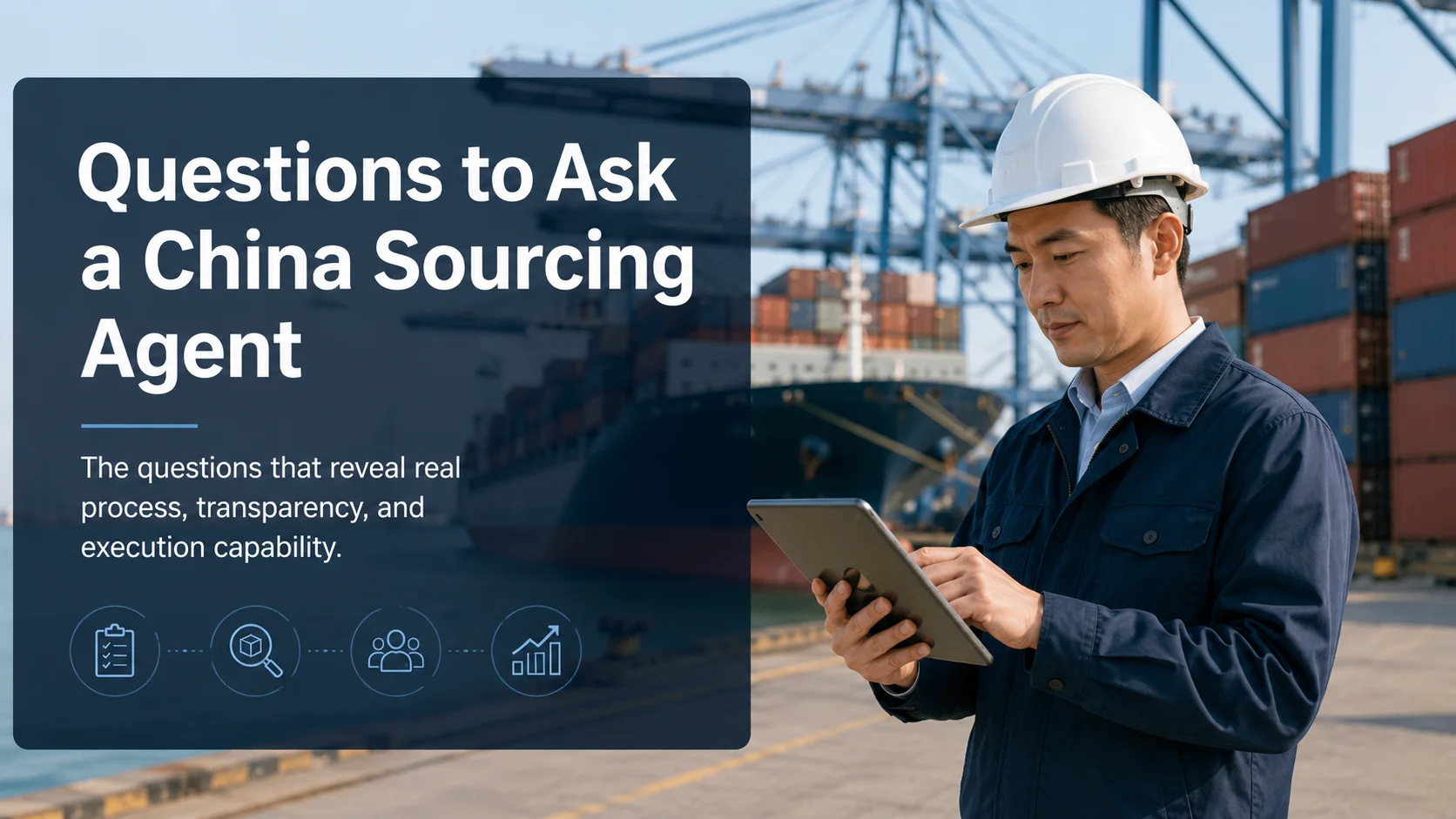
We believe the best sourcing conversations move beyond “Can you find this product?” A capable local partner should explain what happens after a supplier is found. The practical questions below help buyers compare sourcing companies based on process, evidence, accountability, and total sourcing cost.
What Is the Quick Answer to Questions to Ask a China Sourcing Agent?
Many buyers face the same problem: agents can make similar promises, while their actual processes differ widely. We have found that vague claims such as “we handle everything” create uncertainty when a product defect, production delay, or supplier disagreement appears.
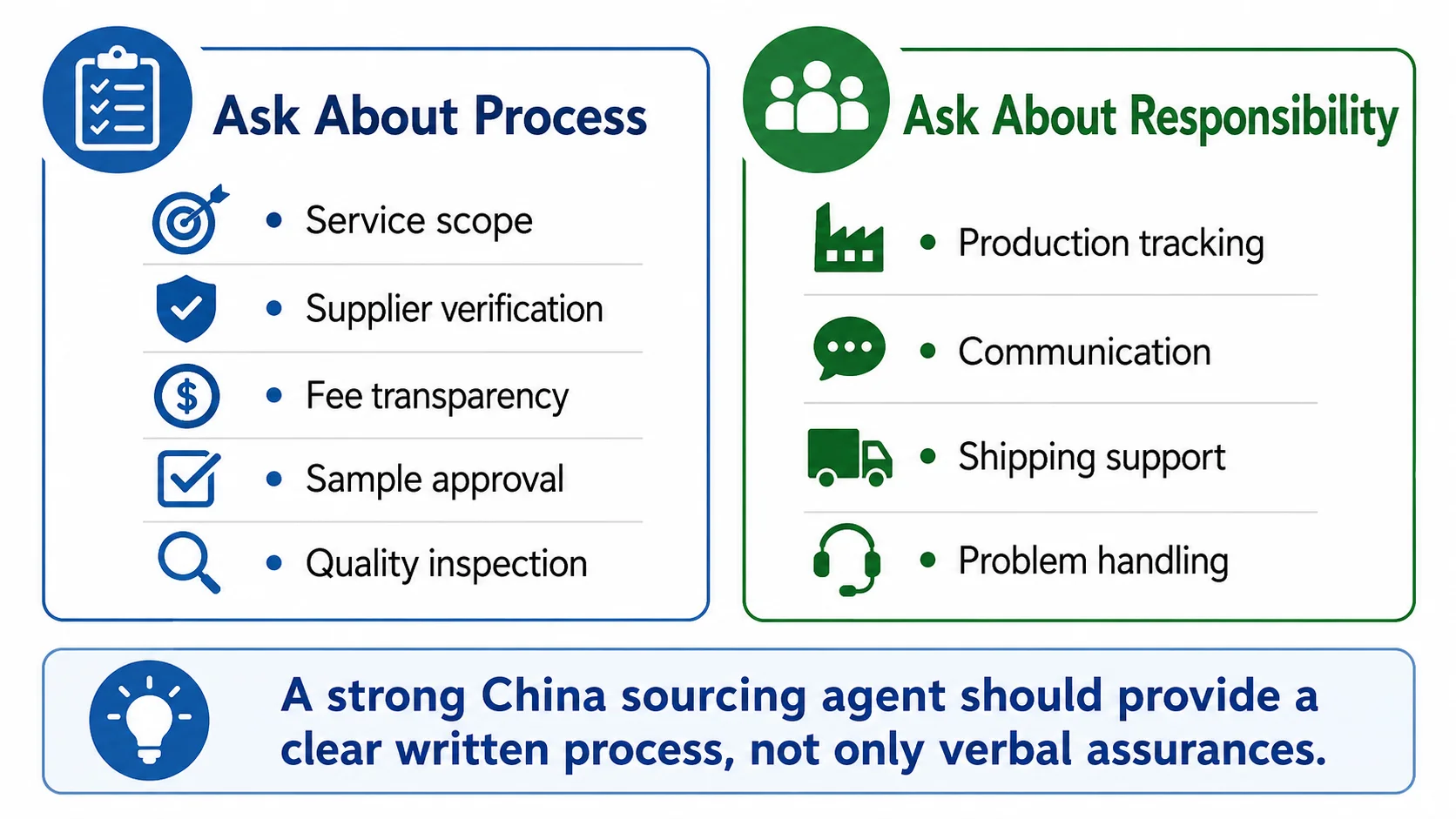
The most important questions to ask a China sourcing agent cover included services, supplier verification, fee transparency, sample approval, quality inspection, production tracking, communication, logistics coordination, and responsibility when something goes wrong. A strong agent should provide a clear written process, not only verbal assurances.
Focus on execution, not supplier lists
An agent’s supplier network can be useful, but it is not enough by itself. Most product categories in China have many potential factories, trading companies, and middlemen.[^2] The real value comes from selecting suitable suppliers and controlling the work after selection.
When we support overseas buyers, we encourage them to assess whether the agent can manage the full chain:
- Product sourcing and quotation comparison
- Supplier background checks and capability review
- Sample coordination and specification confirmation
- Price, MOQ, lead-time, and packaging negotiation
- Production follow-up
- Pre-shipment quality inspection
- Warehouse consolidation and shipping coordination
- Issue escalation and corrective-action follow-up
A buyer should also ask who owns each task. For example, “quality control” could mean anything from receiving factory photos to arranging a structured inspection with a written report. Those are not equivalent services.
We do not think buyers should reject every low-commission agent. We think buyers should ask what the fee includes, what it excludes, and how the agent handles the risks that remain.
What Services Are Included in Your China Sourcing Agent Fee?
A low sourcing fee can look appealing until additional charges appear during sampling, inspections, warehousing, or shipping preparation. We have spoken with buyers who assumed that order follow-up was included, only to learn that it was treated as an extra service.
A reliable China sourcing agent should explain its fee model in writing and identify included services, excluded services, third-party costs, and payment timing. Buyers should compare the total operating scope rather than comparing commission percentages alone.
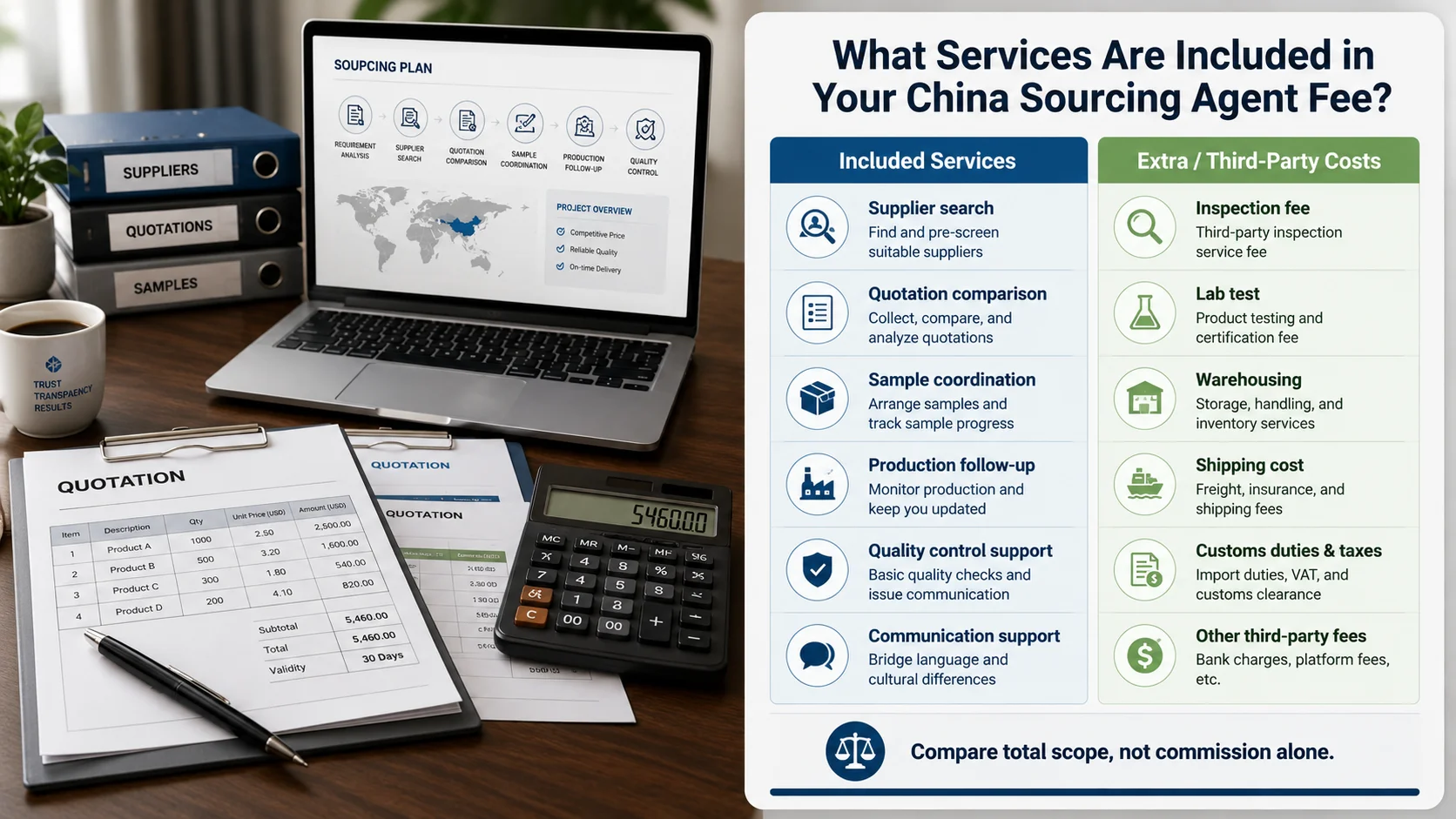
Ask for an itemized service map
We recommend asking an agent to provide a simple scope document before you pay a deposit. It does not need to be a long legal contract, but it should make the process understandable.
A useful service map may include the following:
| Service Area | Questions to Ask | Why It Matters |
|---|---|---|
| Supplier sourcing | How many suppliers will you compare? | It shows whether the agent will benchmark options. |
| Quotation review | Will you compare MOQ, tooling, packaging, and lead time? | Unit price alone does not show total cost. |
| Sampling | Is sample coordination included? | Samples often require revisions and follow-up. |
| Quality control | Is inspection included, and how many times? | Inspection scope affects quality-risk management. |
| Warehousing | Are storage and consolidation charged separately? | These costs can matter for multi-supplier orders. |
| Shipping | Do you arrange freight, or only provide a referral? | Buyers need clarity on responsibility boundaries. |
Separate agent fees from third-party costs
We believe transparent agents should distinguish their own service charge from external expenses. Common third-party costs can include:
- Product samples and sample shipping
- Laboratory testing, where required
- Independent factory audits
- Third-party inspections
- Tooling or molds
- Packaging artwork and printing
- Freight, insurance, duties, and customs-related charges
At KingSourcing, we aim to explain the sourcing process and cost categories before an order moves forward. We cannot promise that every project will have the same cost structure, because products, order values, compliance needs, and shipping methods differ. However, we believe buyers deserve to know what they are paying for at each stage.
How Do You Find and Verify Suppliers in China?
Supplier selection is often the first major sourcing risk. A supplier may offer a competitive quote but lack the equipment, quality system, capacity, export experience, or material control needed for your specific product. We have seen that a polished online listing is not enough evidence.
A credible answer should explain how the agent searches for suppliers, distinguishes factories from trading companies, verifies business information, reviews production capability, and compares suppliers against the buyer’s product requirements. China supplier verification should be evidence-based and appropriate for the order’s risk level.
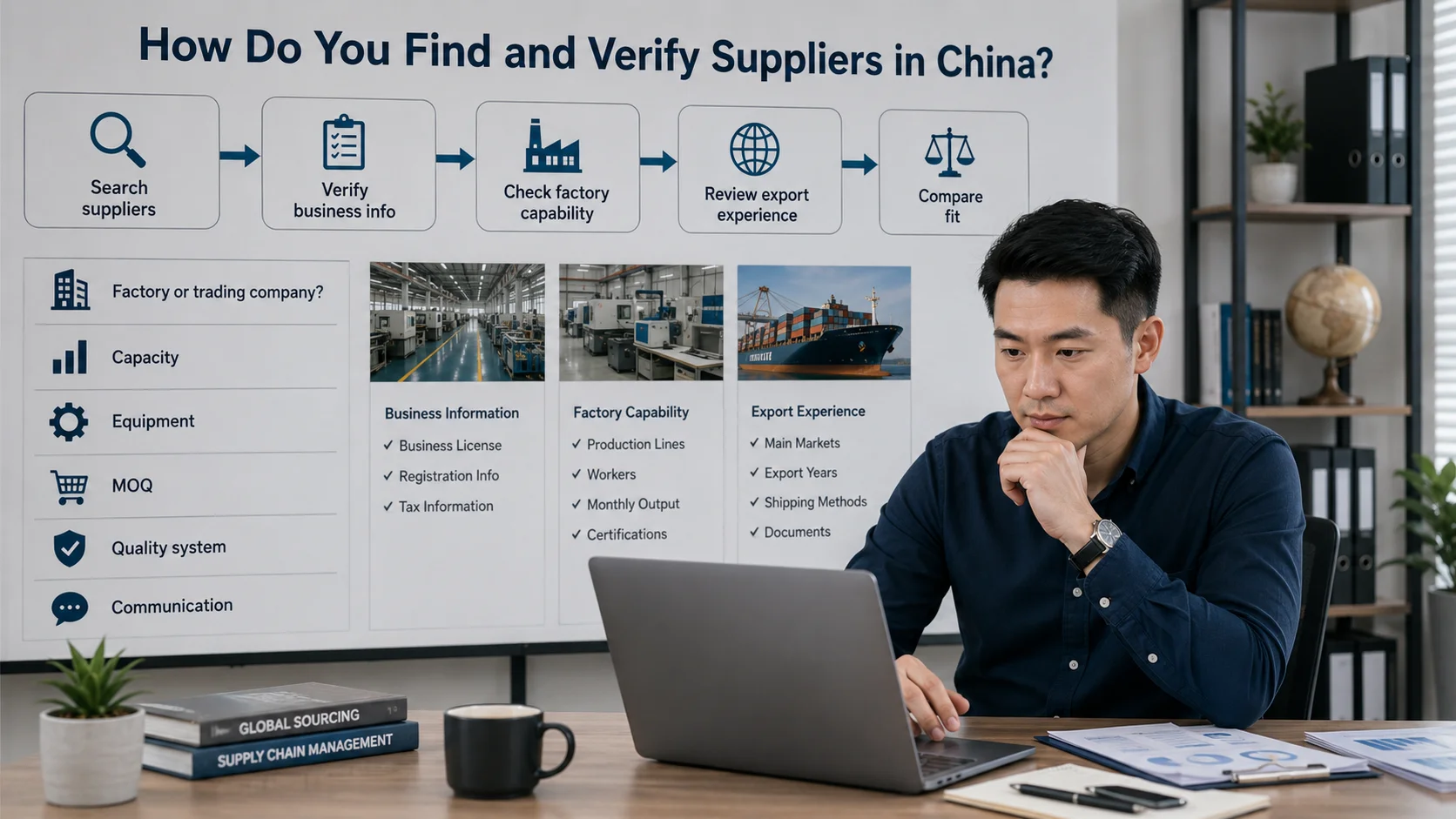
Ask how the agent matches suppliers to your order
We start by looking at the buyer’s actual requirements. A suitable supplier for a basic stock product may not be suitable for a custom-branded product with strict materials, retail packaging, or compliance requirements.
A sourcing agent should be able to discuss selection criteria such as:
- Product specialization and relevant manufacturing experience
- MOQ flexibility and sample capability
- Production equipment and workforce capacity
- Export history and target-market experience
- Quality-control practices and traceability
- Packaging capability
- Lead-time consistency
- Communication responsiveness
- Required certificates or test reports
Verify documents, but do not treat them as guarantees
A buyer may ask whether the agent checks business registrations, export records, audit reports, product test reports, and certifications. That is a reasonable question. However, we recommend that buyers treat these materials as documents to verify, not automatic proof that a supplier will meet every future requirement.[^3]
For regulated, safety-sensitive, or application-specific products, we recommend qualified professional review of the relevant standards, testing requirements, and supplier documentation.[^4] A sourcing agent can coordinate document collection and supplier communication, but the buyer still needs to confirm that the product is appropriate for its intended market.
Will I Know Which Factory or Supplier Is Making My Products?
Some buyers worry that a sourcing agent will hide supplier details, inflate prices, or make it difficult to compare quotations. This concern is understandable, especially when the buyer plans to develop a long-term product line. At the same time, transparency can take different forms depending on the agent’s business model.
A reliable sourcing agent in China should state its supplier-transparency policy clearly. Buyers should know whether they can see factory names, business details, quotations, production evidence, and the reasons a supplier was selected, even if the agent retains a role in managing the supplier relationship.
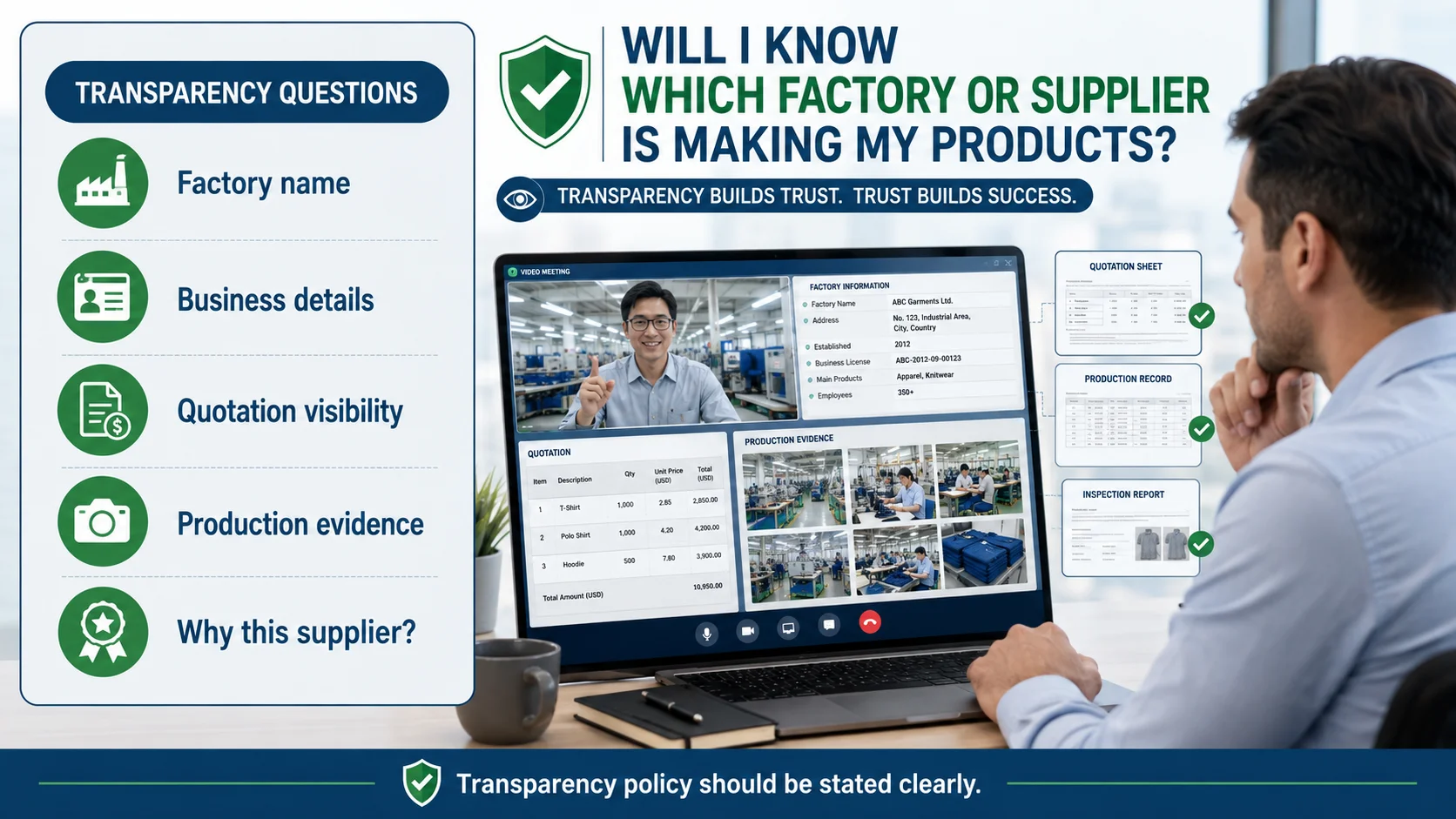
Look for useful transparency, not only a factory name
A factory name alone does not protect a buyer. The more useful question is whether the agent can provide enough information for the buyer to understand the sourcing decision.
We recommend asking for:
- Supplier name and location, where the service model permits disclosure
- Whether the supplier is a factory, trading company, or hybrid business
- Comparable quotations from more than one source when practical
- Product specification differences between quotes
- MOQ, lead-time, and packaging assumptions
- Factory photos, video calls, or audit evidence when appropriate
- Sample records and production updates tied to the selected supplier
A warning sign is not always “we do not disclose every contact immediately.” Some agents manage supplier relationships as part of their service model. The more serious warning sign is an agent that refuses to explain pricing, supplier type, product differences, or how it validates supplier capability.
Which Questions to Ask a China Sourcing Agent Reveal Real Capability?
Buyers often receive confident but generic answers during early discussions. The challenge is to identify whether an answer describes an actual operating process. We recommend asking follow-up questions that require evidence, examples of workflow, and clear responsibility.
The best questions to ask a China sourcing agent produce specific answers about process, documents, reporting, timing, and corrective action. Strong answers explain how work is done; weak answers rely mainly on broad statements such as “we know many factories” or “we handle quality.”
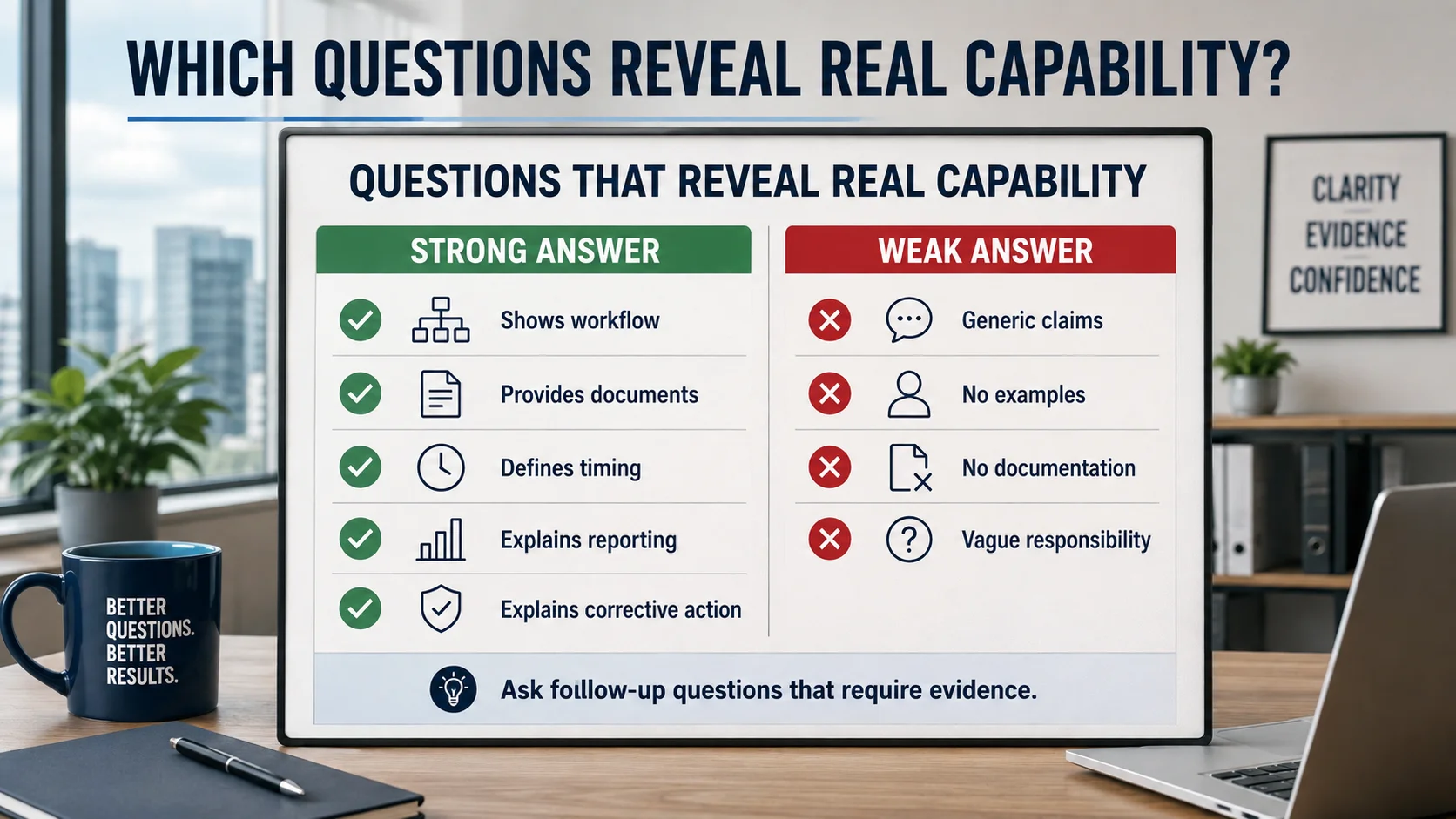
| Question | Strong Answer | Warning Sign |
|---|---|---|
| How do you verify suppliers? | Explains screening steps, capability review, and evidence collected. | “We know many good factories.” |
| How are your fees charged? | Provides an itemized fee structure and exclusions. | “We can discuss charges later.” |
| Can I review supplier details? | States a clear transparency policy and quotation process. | Refuses basic sourcing information. |
| How do you manage samples? | Uses approved specifications, revision records, and buyer sign-off. | “The factory will make it correctly.” |
| How is QC handled? | Defines inspection timing, standards, reports, and escalation. | “The factory checks everything.” |
| What happens if production is delayed? | Explains status reporting, escalation, and recovery options. | “Delays rarely happen.” |
| Who is my daily contact? | Identifies an account owner or dedicated sourcing team. | No clear point of responsibility. |
Use the “show me the workflow” test
We often suggest one simple follow-up question: “Can you show me what this looks like in practice?”
For example:
- Ask to see a redacted quotation comparison format.
- Ask for a sample quality-inspection report template.
- Ask how the agent records approved product changes.
- Ask how a failed inspection is reported.
- Ask what the buyer receives during production follow-up.
An agent should not need to reveal confidential client information. Still, it should be able to show a representative format, a documented workflow, or a clear explanation of the controls it uses.
How Do You Manage Samples, Specifications, and Product Changes?
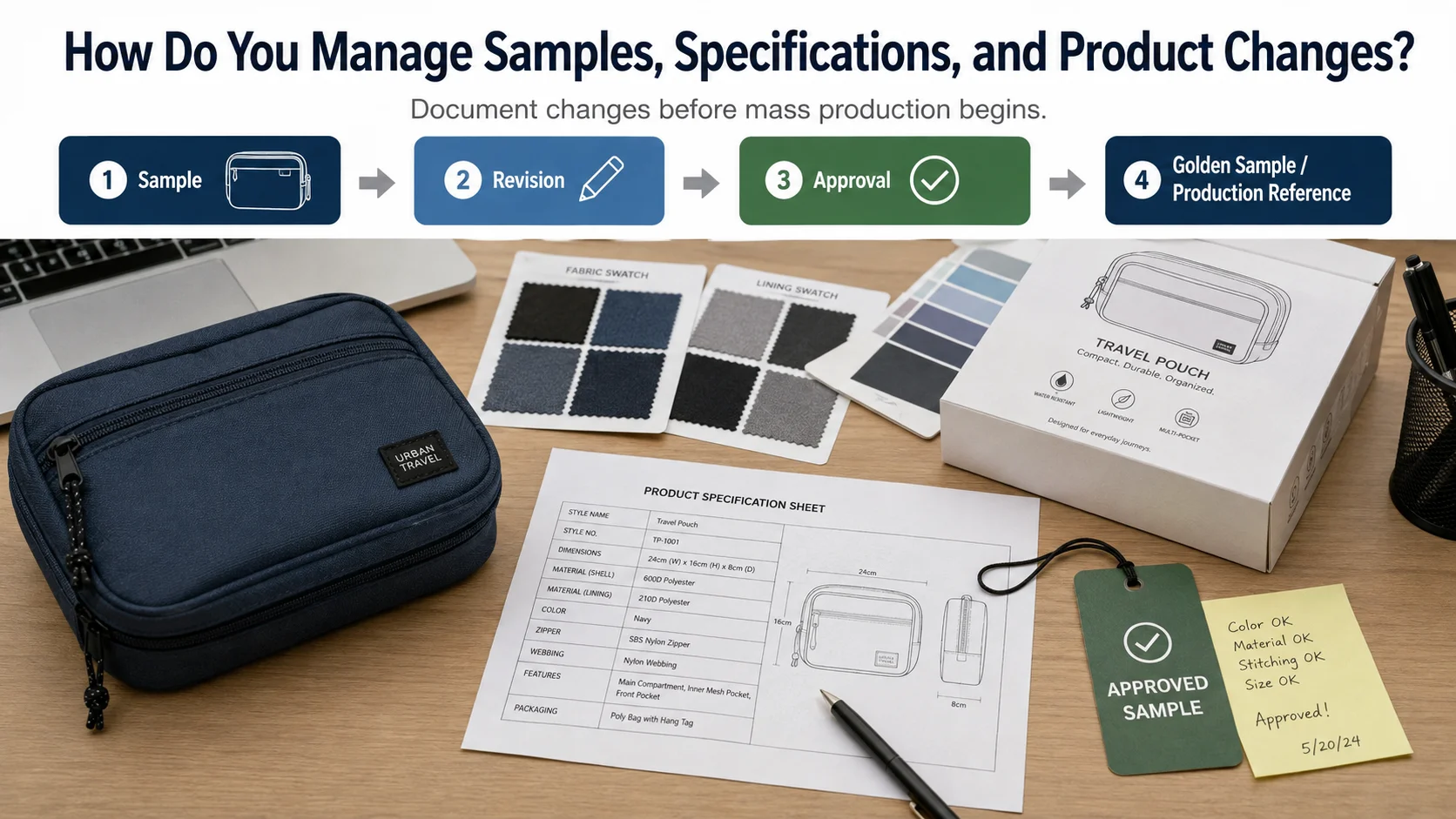
A production order can fail even when the supplier is legitimate and the unit price is reasonable. Problems often begin when a buyer’s expectations are not converted into a clear, approved specification.[^5] We have seen small changes in color, dimensions, logo placement, materials, and packaging create major downstream confusion.
A capable sourcing agent should manage sample approvals through documented specifications, revision records, buyer confirmation, and a clear reference sample or “golden sample” process[^6]. Buyers should know how changes are communicated before mass production begins.
Build a usable approval trail
We recommend that buyers avoid approving samples with only a quick message such as “looks good.” Instead, the approval should connect to a specific version of the product and packaging requirements.
A practical sample process may include:
- Product brief: dimensions, materials, functions, colors, logo, packaging, and target price.
- Pre-production sample: a physical sample for buyer review.
- Revision record: a list of changes requested after sample review.
- Final approved sample: the reference for production and inspection.
- Production confirmation: confirmation that the factory understands the approved version.
- Inspection reference: quality checks based on agreed requirements.
At KingSourcing, we can support sample and order follow-up by helping buyers organize these records across suppliers and production stages. We believe this process is especially important for private-label sellers and new brands. It reduces ambiguity, although it cannot eliminate every manufacturing variation.
How Do You Handle Quality Control and Production Follow-Up?
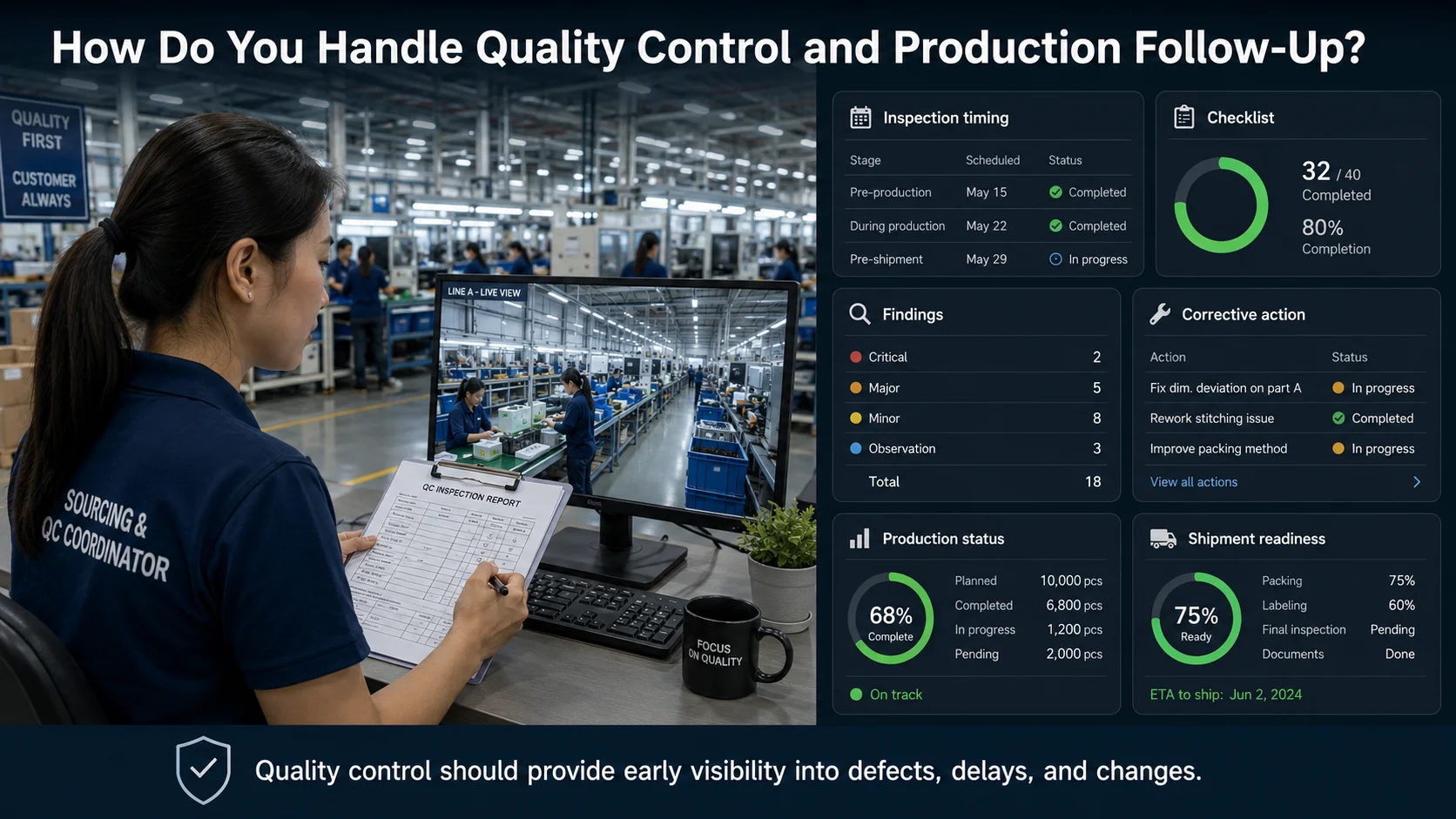
Quality control is where many buyers learn whether their agent is a true execution partner or simply a product finder. A factory’s internal check may be useful, but it is not the same as an independent review based on the buyer’s agreed requirements.[^7]
China sourcing agent quality control should include defined inspection timing, a documented checklist, clear reporting, and a process for handling nonconforming goods. Production follow-up should provide early visibility into delays, material changes, and issues before shipment.
Ask five quality-control questions
We recommend that buyers ask these questions directly:
-
When will inspection happen?
Common options include pre-production checks, during-production inspections, and pre-shipment inspections.[^8] -
Who performs the inspection?
The agent may use an in-house team, a third-party inspection provider, or a combination. Buyers should understand the arrangement. -
What standard will be used?
The inspection should refer to approved specifications, packaging requirements, critical defects, and agreed sampling methods where relevant. -
What will the report include?
A useful report may include photos, quantity findings, defect descriptions, measurements, packaging observations, and a pass/fail recommendation. -
What happens if goods fail inspection?
The agent should explain how it communicates findings, requests corrective action, follows rework, and confirms any re-inspection plan.
Quality control reduces risk; it does not create certainty
We do not present inspection as a guarantee of zero defects. An inspection is a risk-control activity based on a defined sample, timing, checklist, and accessible inventory.[^9] Still, it can give buyers much better evidence before final payment or shipment.
A good sourcing agent should be realistic about this limit. It should also help buyers decide when more intensive controls are appropriate, especially for high-value, safety-sensitive, or highly customized products.
How Do You Communicate Problems, Delays, and Supplier Issues?
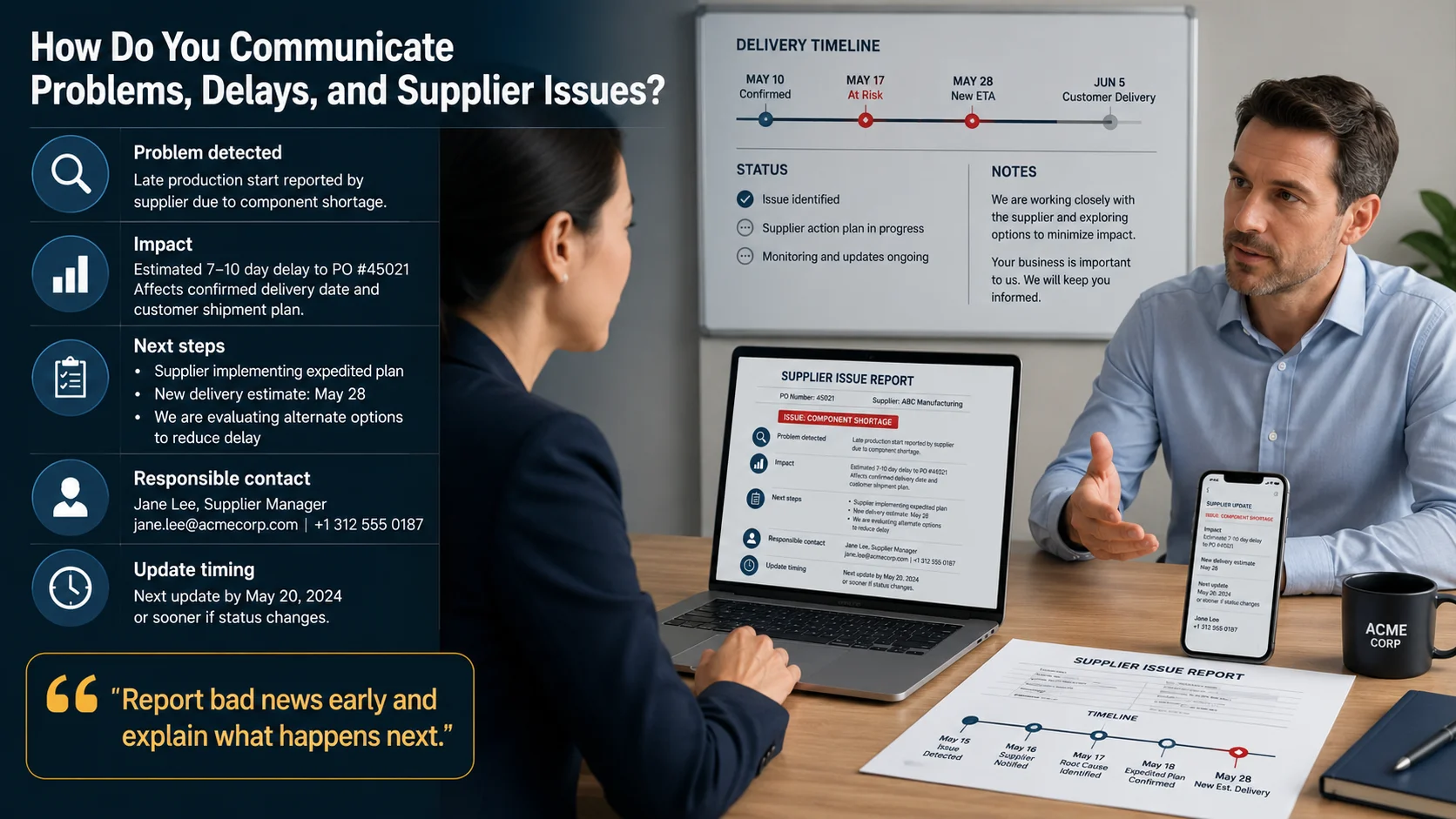
Many buyers ask, “How quickly do you reply?” That question matters, but we believe the better question is: “How will you communicate bad news and what will you do next?” Delays and supplier issues can happen in any supply chain.[^10]
A reliable sourcing agent in China should provide regular status updates, identify a responsible contact, report problems early, explain the operational impact, and outline available next steps. A dependable partner does not promise that no problem will occur; it shows how it manages exceptions.
Look for ownership and escalation
We recommend that buyers ask about communication before placing an order:
- Who is the main day-to-day contact?
- How often will I receive order updates?
- How will you report a missed production milestone?
- Will you notify me before or after a delivery date is affected?
- Who communicates with the supplier when there is a defect dispute?
- What decisions require my written approval?
- Can you coordinate packaging, warehousing, consolidation, and freight updates?
A good response should explain the communication rhythm. For example, an agent may provide updates at sampling approval, production start, mid-production, inspection, warehouse receipt, and shipping dispatch. The exact frequency depends on the order, but the responsibility should be clear.
What Should You Check Before Choosing a China Sourcing Agent?
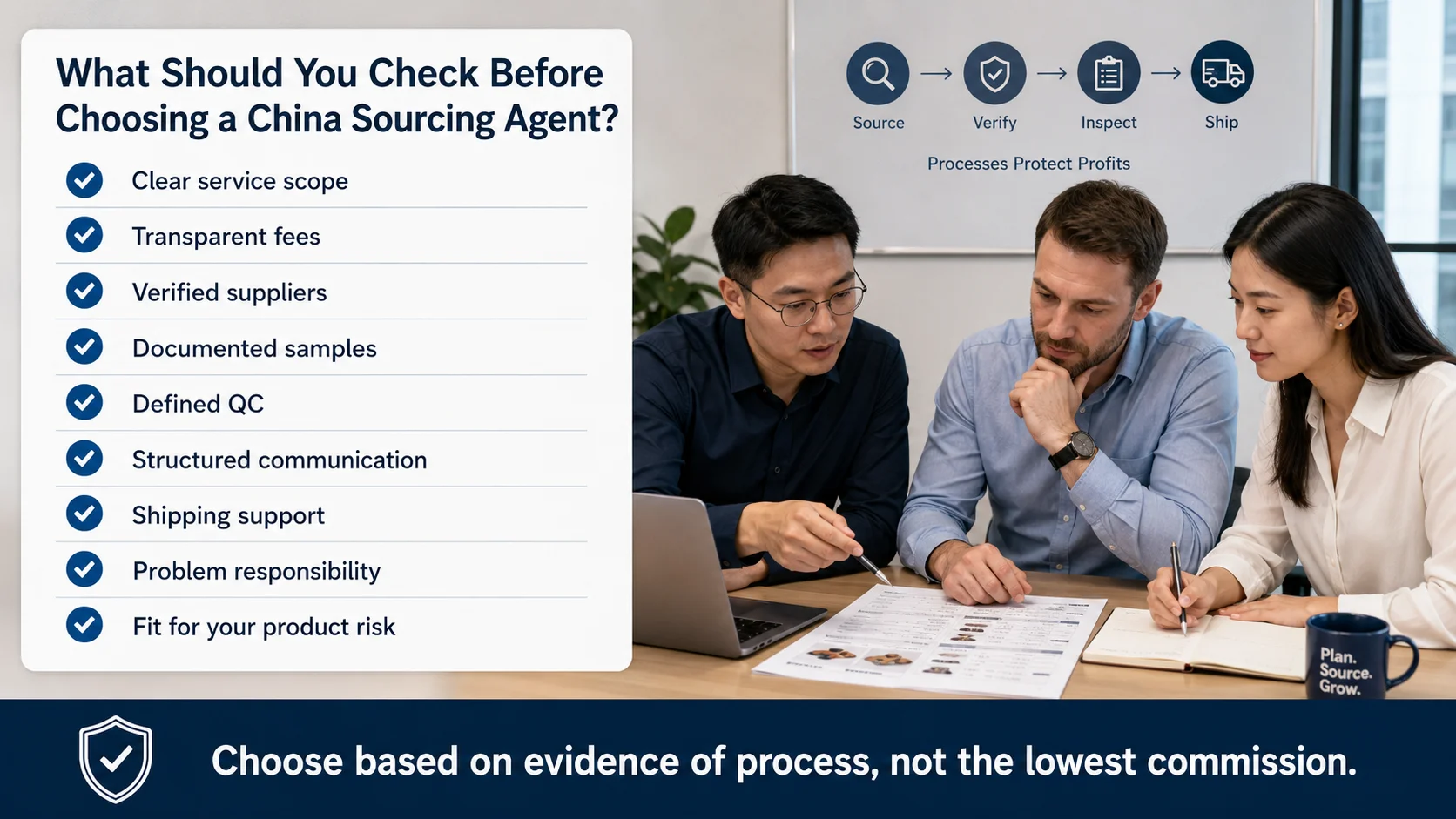
Choosing an agent can feel difficult because every provider may describe itself as experienced, connected, and quality-focused. We encourage buyers to make the decision based on evidence of process rather than the lowest commission or the most confident sales language.
Before choosing a China sourcing agent, check whether the service scope is clear, fees are transparent, suppliers can be verified, samples are documented, QC is defined, communication is structured, and responsibility for problems is understood. The right partner should fit your product risk, order size, and long-term sourcing goals.
Final China sourcing agent checklist
Before you move forward, we suggest confirming the following:
- [ ] The agent has provided a written explanation of included and excluded services.
- [ ] You understand all service fees and likely third-party charges.
- [ ] The supplier-selection process fits your product category.
- [ ] You know how supplier details and quotations will be shared.
- [ ] Sample approvals and revisions will be documented.
- [ ] Quality-control timing, scope, and reporting are defined.
- [ ] The process for failed inspections and rework is clear.
- [ ] The agent has a named contact or dedicated sourcing team.
- [ ] Production delays and supplier issues have an escalation process.
- [ ] Shipping, consolidation, customs support, and delivery responsibilities are clear.
We believe this sourcing agent due diligence process helps buyers make a more informed decision. It also helps agents understand your expectations before production begins.
Frequently Asked Questions
How do I choose a reliable sourcing agent in China?
We recommend that buyers compare service scope, supplier verification methods, fee transparency, sample handling, quality-control procedures, communication structure, and problem ownership. A reliable sourcing agent in China should explain its workflow clearly and provide evidence of how it manages sourcing risks.
Should I hire a sourcing agent or contact factories directly?
Direct factory contact can work when you have supplier knowledge, clear specifications, and internal resources for quality control and order management. We believe a sourcing agent can be useful when you need local supplier research, communication support, production follow-up, inspection coordination, or multi-supplier consolidation.
Can a sourcing agent guarantee product quality?
No sourcing agent can reasonably guarantee zero defects or eliminate every production risk.[^11] We recommend asking how the agent defines inspection standards, performs checks, reports findings, and handles corrective action. A documented quality-control process offers stronger risk management than a general promise.
What are common red flags when hiring a China sourcing agent?
Common red flags include unclear fees, refusal to explain supplier-selection methods, no documented sample process, vague claims about quality control, no inspection reporting format, and no clear answer about delays or failed goods. We recommend asking follow-up questions before paying deposits.
What documents should I ask a sourcing agent for?
Buyers may request quotation comparisons, sample records, product specifications, supplier background information, inspection reports, packaging approvals, production updates, and shipping documents. The exact documents depend on the product, order value, target market, and service scope.
Conclusion
The right questions to ask a China sourcing agent are not designed to find the cheapest provider. They help buyers determine whether an agent can manage supplier selection, samples, quality checks, production follow-up, communication, and exceptions with clear accountability. We recommend comparing written processes, not only quotes or commissions. If you are evaluating China sourcing support, send your product brief, supplier quotation, or current sourcing requirements to KingSourcing. We can explain our process so you can compare it fairly before making a decision.
Tags: China sourcing agent, questions to ask sourcing agent, China sourcing agent checklist, reliable sourcing agent China, supplier verification China, China procurement service, supplier management China, sourcing agent selection
[^1]: "Supply chain disruptions and resilience: a major review and future ...", https://pmc.ncbi.nlm.nih.gov/articles/PMC7792559/. Supply-chain research identifies quality failures and delivery disruptions as sources of rework, inventory-related losses, and lost sales when products cannot be supplied or sold as planned. Evidence role: general_support; source type: research. Supports: Research or institutional analysis showing that product-quality failures and supply-chain disruptions can generate rework costs, inventory losses, and lost sales.. Scope note: The magnitude of these effects depends on the product category, contract terms, inventory strategy, and market timing. [^2]: "[PDF] Is US Trade Policy Reshaping Global Supply Chains?", https://openknowledge.worldbank.org/bitstreams/bac39b6e-90ef-442a-959a-83d5d6cc7b48/download. Trade analyses of China's export economy describe supply networks that include manufacturing enterprises as well as trading firms and other intermediaries. Evidence role: general_support; source type: institution. Supports: An international economic or trade source documenting the roles of manufacturers, trading firms, and intermediaries in China's export economy.. Scope note: Such sources describe the broader export economy and do not establish the supplier mix in every individual product category. [^3]: "General Use Products: Certification and Testing | CPSC.gov", https://www.cpsc.gov/Business--Manufacturing/Testing-Certification/General-Use-Products-Certification-and-Testing. Conformity-assessment documents generally attest to a defined product, process, system, scope, or point in time; they do not by themselves guarantee continuing supplier performance or conformity of all future production. Evidence role: general_support; source type: institution. Supports: Standards or conformity-assessment guidance explaining that certifications and reports have defined scope and do not guarantee ongoing performance or conformity in all future circumstances.. Scope note: The evidentiary value of a document depends on its issuer, scope, validity, testing method, and relation to the specific product being ordered. [^4]: "General Use Products: Certification and Testing | CPSC.gov", https://www.cpsc.gov/Business--Manufacturing/Testing-Certification/General-Use-Products-Certification-and-Testing. Product-safety regulators commonly require economic operators to identify applicable technical requirements and to maintain or assess supporting testing and compliance documentation before products are placed on the market. Evidence role: expert_consensus; source type: government. Supports: Government product-safety or market-surveillance guidance describing the need to identify applicable requirements and maintain or assess technical documentation and testing evidence.. Scope note: Applicable obligations differ by destination market, product type, intended use, and the party's legal role in the supply chain. [^5]: "(PDF) Does Software Process Improvement Reduce the Severity of ...", https://sites.pitt.edu/~ckemerer/SoftwareProcessImprovement2011-03-21.pdf. Quality and requirements-management literature recognizes that ambiguous or incomplete specifications can cause inconsistent interpretation, production variation, and product nonconformities. Evidence role: mechanism; source type: research. Supports: Research or quality-management guidance linking unclear requirements and specifications to misinterpretation, process variation, and product nonconformity.. Scope note: Specification clarity reduces one source of error but does not eliminate defects caused by materials, process capability, or handling. [^6]: "Quality Assurance Benchmarks - GIA", https://www.gia.edu/quality-assurance-benchmark. In manufacturing quality assurance, an approved reference or 'golden' sample is commonly retained as a physical benchmark against which subsequent production or inspection observations can be compared. Evidence role: definition; source type: other. Supports: A credible quality-assurance source defining an approved reference or golden sample as a benchmark for production and inspection comparison.. Scope note: A reference sample must be controlled, identified, and paired with written specifications to provide a complete acceptance basis. [^7]: "Understanding First-Party, Second-Party, and Third-Party ...", https://www.smithers.com/resources/2024/june/first-party-second-party-third-party-audits. Quality-management guidance distinguishes first-party assessments performed by or for an organization from independent third-party assessments conducted by an external body. Evidence role: definition; source type: institution. Supports: A quality-management standard or professional body defining first-party and third-party audits or inspections and their differing independence.. Scope note: Audit terminology may not map exactly to every commercial pre-shipment inspection arrangement. [^8]: "Trade Guide: WTO PSI", https://www.trade.gov/trade-guide-wto-psi. Commercial quality-control practice commonly distinguishes checks before production, inspections during production, and final or pre-shipment inspections conducted before goods are dispatched. Evidence role: definition; source type: government. Supports: Trade or quality-inspection guidance describing inspections conducted before production, during production, and before shipment.. Scope note: The names, timing, and scope of these inspections vary by industry, buyer requirements, and inspection provider. [^9]: "What kinds of Lot Acceptance Sampling Plans (LASPs) are there?", https://www.itl.nist.gov/div898/handbook/pmc/section2/pmc22.htm. Acceptance-sampling methods evaluate a defined lot through inspection of a specified sample under predetermined acceptance criteria, so the result is evidence about the inspected lot rather than proof that every unit is defect-free. Evidence role: mechanism; source type: institution. Supports: Statistical quality-control guidance explaining that acceptance inspection relies on a defined sampling plan, acceptance criteria, and the lot available for inspection.. Scope note: Sampling plans can reduce risk but cannot provide certainty about all units, especially when defects are rare, intermittent, or not observable at inspection. [^10]: "[PDF] Supply-chain disruptions and new investment policies in the post ...", https://www.oecd.org/content/dam/oecd/en/publications/reports/2023/07/supply-chain-disruptions-and-new-investment-policies-in-the-post-covid-19-world_e4ec7543/5fcc2892-en.pdf. International supply-chain analyses identify supplier, production, logistics, and external disruptions as potential causes of delivery delays and operational exceptions. Evidence role: general_support; source type: institution. Supports: International institutional analysis documenting that supply chains can be disrupted by supplier, transport, production, and other operational risks.. Scope note: The likelihood and severity of disruption differ across sectors, geographies, transport modes, and supplier networks. [^11]: "[PDF] Automatic Localization of Casting Defects with Convolutional Neural ...", https://tsapps.nist.gov/publication/get_pdf.cfm?pub_id=924455. Quality-control principles recognize that manufacturing variation and the limits of inspection mean that control activities can reduce and detect risk but cannot demonstrate the absence of every possible defect in all units. Evidence role: expert_consensus; source type: research. Supports: Quality-control literature explaining that process variation and sampling limitations prevent inspection systems from proving the absence of all defects.. Scope note: Highly controlled processes may achieve extremely low defect rates, but this does not constitute a universal guarantee of zero defects.