Many buyers think China sourcing is only about finding a cheap supplier. I see the real pain later, when details, quality, and delivery start to go wrong.
A China sourcing agent helps overseas buyers find suppliers, compare offers, verify details, manage samples, follow production, check quality, and coordinate delivery. I see the main value as risk control, not only price hunting.[^1] The agent works on the buyer’s side to make China sourcing easier and safer.
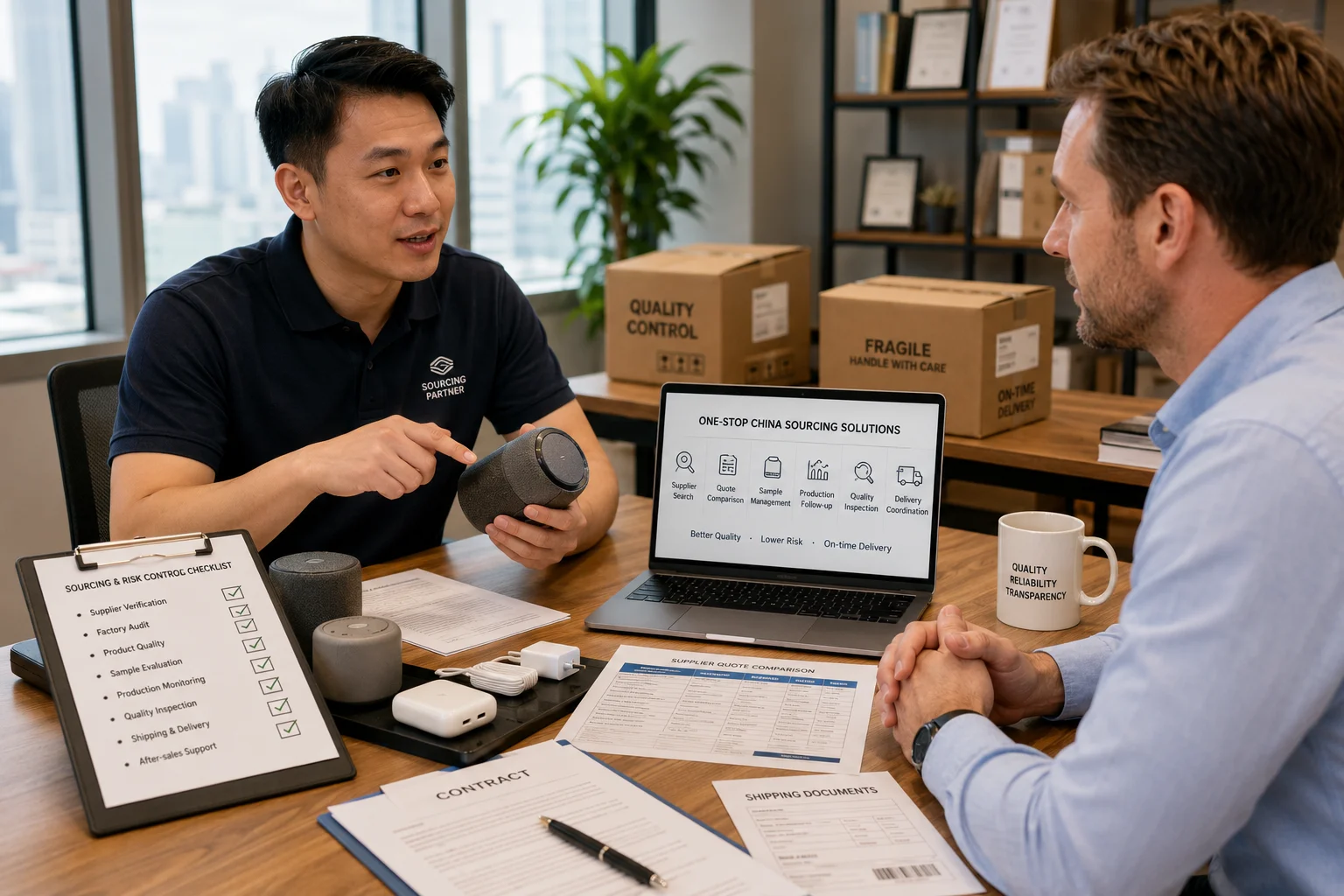
I often meet importers after they already found a supplier online. The first message sounds simple. They say the price looks good, the product photo looks right, and the supplier replies fast. Then the hard work begins. The sample may not match the photo. The quote may miss packaging. The factory may change material without clear notice. The shipment may be delayed because carton marks, labels, or documents were not confirmed early. This is why I do not see a sourcing agent as only a person who “finds a factory.” I see a sourcing agent as a process manager for purchasing risk.
1. What Is a China Sourcing Agent?
Many buyers use the word “agent” in a loose way. I see confusion because factories, traders, and sourcing agents may all look similar online.
A China sourcing agent is a local purchasing partner who helps overseas buyers source products from China and manage buying steps. I see the role as representing the buyer’s process, not the seller’s sales target.

The basic role
I explain a China sourcing agent as a local buying support team. I help the buyer turn a product idea into a controlled buying process. This process may include supplier search, supplier comparison, sample follow-up, quote checking, production updates, inspection planning, packaging checks, and shipping coordination. I do not own every factory. I do not control every risk. I help the buyer ask better questions, check more details, and avoid blind decisions.
| Option | Who they usually represent | What I think they are best for |
|---|---|---|
| Alibaba | Search and first contact | Finding many possible suppliers fast |
| Factory sales | The factory | Direct production questions and factory pricing |
| Trading company | Their own supply chain | Simple buying when the trader has strong product knowledge |
| Sourcing agent | The buyer’s buying process | Risk control, comparison, follow-up, and coordination |
The wrong idea
I often hear buyers say, “I only need someone to get the lowest price.” I understand this. Price matters. Yet I also see cheap orders become expensive when quality fails, cartons break, accessories are missing, or the supplier ships late. A good sourcing agent should help the buyer compare the total buying result. Unit price is one part. Product quality, packaging, defect rate, lead time, communication, and after-sale support also matter.[^2]
2. What Does a China Sourcing Agent Actually Do for Importers?
Importing looks easy at the search stage. I see the real problems appear when the buyer must confirm details with people who are far away.
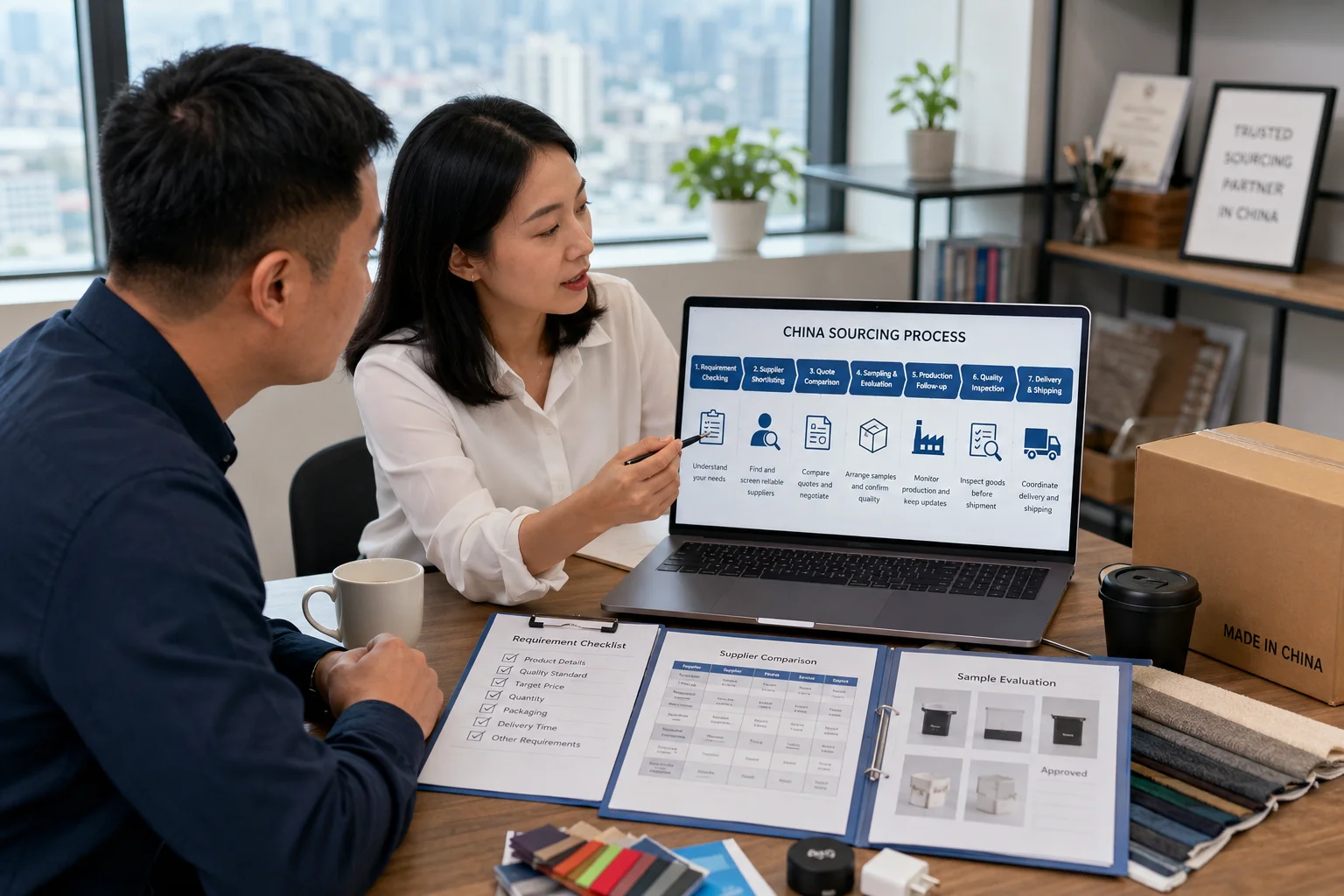
A sourcing agent helps importers move from product idea to shipped goods. I usually support requirement checking, supplier shortlisting, quote comparison, sampling, production follow-up, quality checks, and delivery communication.
The work is a chain
I do not view sourcing as one task. I view it as a chain. If the first link is weak, the later links become harder. If the product requirement is vague, suppliers quote different versions. If the sample is not recorded well, production may follow a different standard. If packaging is ignored, the shipment may arrive with damage or poor shelf appeal.
| Stage | What I do | What risk I try to reduce |
|---|---|---|
| Product requirement | I clarify material, size, function, and target price | Wrong product direction |
| Supplier search | I find and filter possible suppliers | Weak supplier choice |
| Quote comparison | I compare more than unit price | Hidden cost and wrong comparison |
| Sample follow-up | I check sample details and feedback | Production based on wrong sample |
| Production follow-up | I track schedule and key details | Delay and detail changes |
| Quality control | I arrange checks based on order needs | Defects and missing parts |
| Shipping support | I coordinate carton, documents, and logistics details | Delivery confusion |
The buyer risk behind each task
In our work with first-time importers and ecommerce sellers, I often see the same issue. The buyer asks for “the same product as the photo.” The supplier says “yes.” Both sides think the detail is clear. It is not clear. The material grade, color tolerance, logo method, accessory list, packing method, and carton strength may all be open.[^3] A sourcing agent helps make these points visible before money and time are wasted.
3. How a Sourcing Agent Finds and Compares Chinese Suppliers?
Many buyers think supplier search is the whole job. I see it as only the first filter, because many suppliers can look good at first glance.
A sourcing agent finds suppliers through online platforms, local supplier networks, factory databases, trade contacts, and product category knowledge. I then compare them by capability, price structure, MOQ, lead time, communication, and risk.
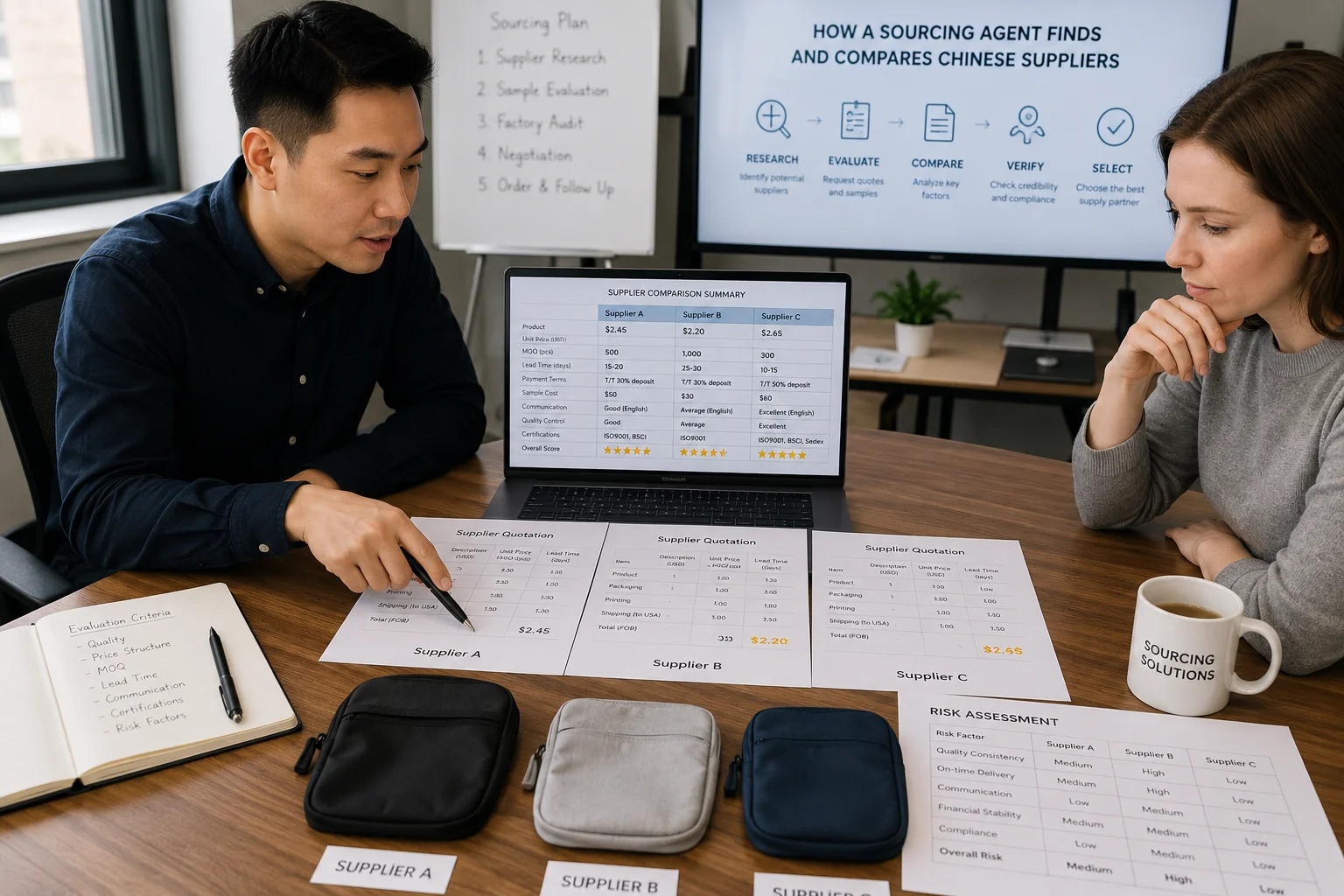
Supplier search is not supplier selection
I may use Alibaba, 1688, factory contacts, exhibitions, industrial clusters, and referrals. Alibaba is useful. I do not attack it. It gives buyers access to many sellers. Yet search results are not the same as a purchasing decision. Some sellers are factories. Some are traders. Some are strong in one product but weak in another. Some prices are real only under a large order quantity. Some photos are shared across many listings.
| Check point | Why I check it | What I look for |
|---|---|---|
| Product focus | I want a supplier with real category experience | Similar products, real cases, clear specs |
| MOQ | I need to match buyer budget | Flexible test order or realistic bulk MOQ |
| Quote basis | I need fair comparison | Material, packaging, Incoterms, accessories |
| Response quality | I need workable communication | Specific answers, not only “yes” |
| Lead time | I need delivery planning | Sample time and production time |
| Custom ability | I need to match brand needs | Logo, mold, packaging, color options |
I compare total cost, not only unit price
I often see a buyer compare three prices and choose the lowest. I understand the habit. It feels clear. Yet I ask what is included. Does the quote include retail box? Does it include inner packing? Does it include a manual, barcode label, or spare parts? Is the material the same? Is the product weight the same? Is the price EXW, FOB, or delivered to a warehouse? A sourcing agent should slow this step down, because a fast low-price decision can create a higher total cost later.[^4]
4. How Supplier Verification, Quote Checking, and Sample Follow-Up Work?
A supplier can sound professional before payment. I see buyers get safer results when they verify basic facts and test the sample process early.
Supplier verification checks whether a supplier is suitable for the order.[^5] Quote checking confirms what the price includes. Sample follow-up tests product quality, communication, timing, and the supplier’s ability to follow requirements.
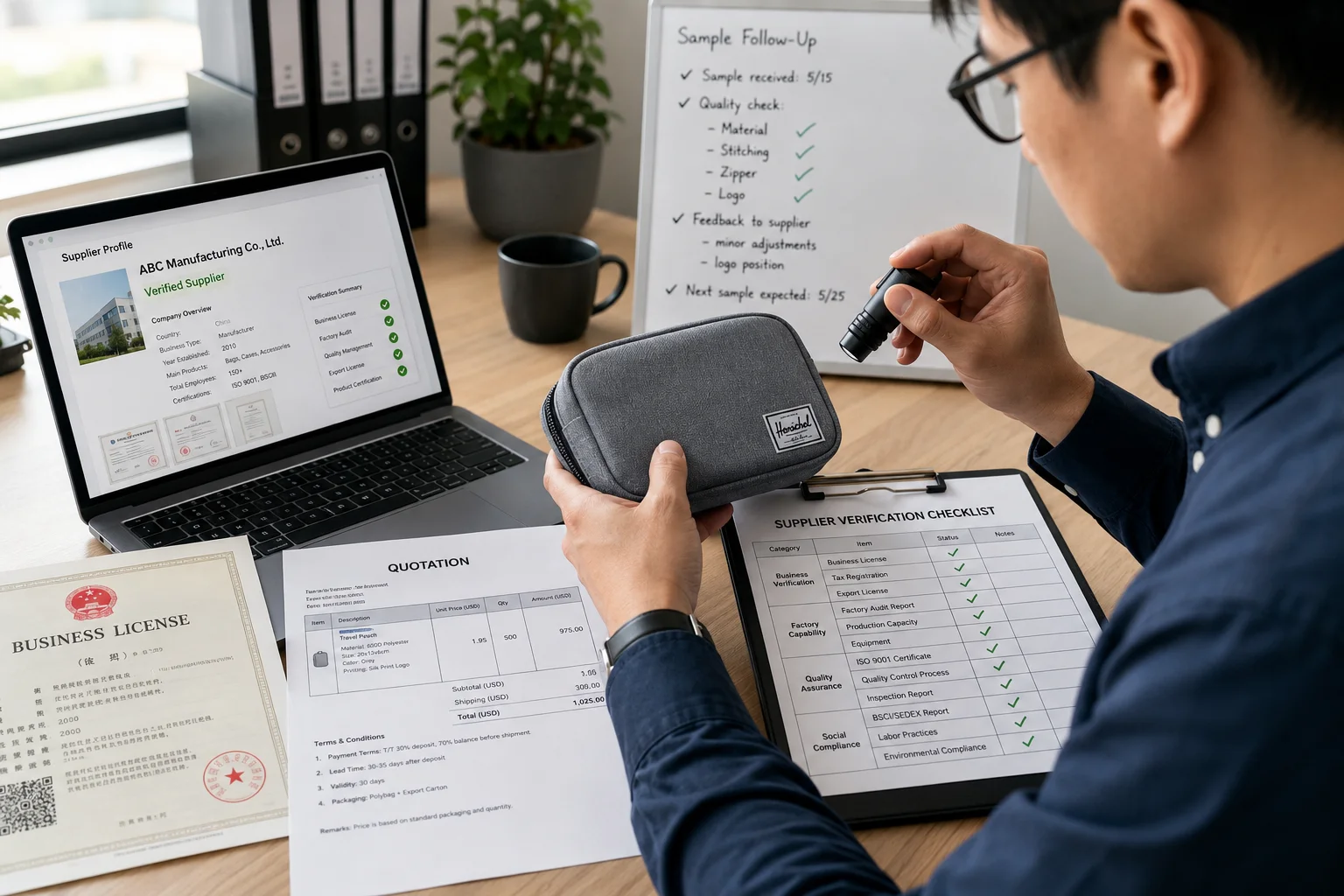
Verification is practical, not magic
I do not present verification as a guarantee. It is a practical risk check. I may review business information, product category fit, factory photos, past cases, certificates when needed, communication records, and basic production ability. For larger or more sensitive orders, I may suggest a factory audit or on-site visit.[^6] I also make clear that a sourcing agent is not a customs lawyer, tax advisor, or lab testing body. If a product needs legal compliance testing, I tell the buyer to use the right third-party testing service.[^7]
| Step | What I check | Why it matters |
|---|---|---|
| Supplier identity | Business scope and basic company information | I want to avoid unclear seller identity |
| Product match | Similar products and production experience | I want to avoid learning on the buyer’s order |
| Quote content | Material, packaging, MOQ, lead time, terms | I want real comparison |
| Sample order | Speed, quality, and detail control | I want to test execution |
| Feedback loop | How supplier handles changes | I want to see future cooperation quality |
Samples show more than the product
I see samples as a small test of the whole supplier. A sample tells me about product quality. It also tells me how the supplier reads instructions, packs goods, handles changes, and communicates delays. I like to record sample details with photos, videos, measurements, and written notes. If the buyer approves the sample, I try to keep the approval standard clear. This matters because production can drift when no one writes down what “approved” means.[^8]
5. How a China Sourcing Agent Manages Production and Quality Control?
Production risk is not always dramatic. I see many problems come from small detail changes that no one notices until cartons arrive.
A sourcing agent manages production by confirming order details, checking schedules, following key production points, and arranging quality checks. I use quality control to catch problems before shipment, not after the buyer receives goods.[^9]
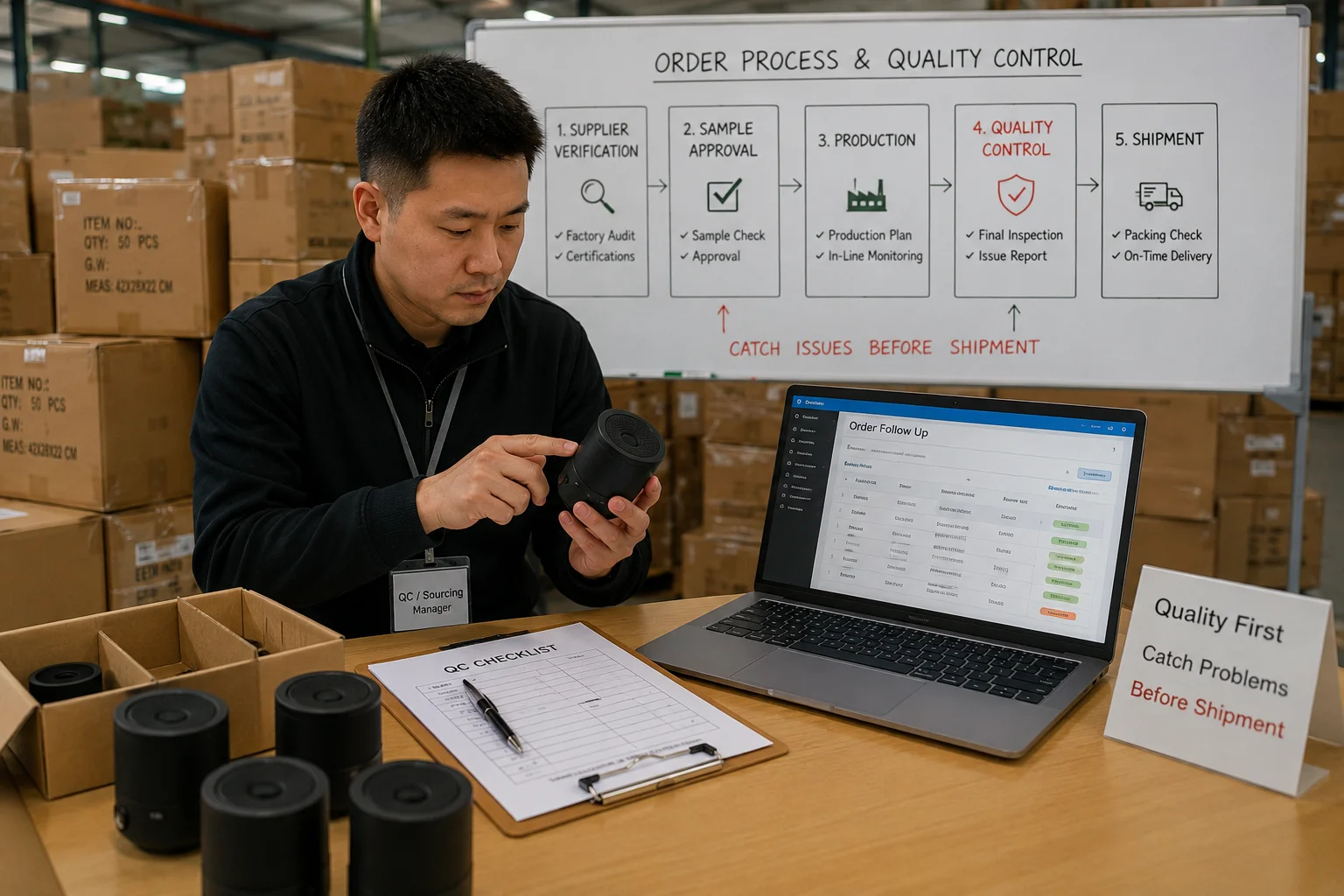
Production follow-up keeps the order visible
After the deposit is paid, some buyers wait until the supplier says the goods are ready. I see that as risky, especially for custom products or first orders. I prefer to confirm a production checklist. This checklist can include product specs, logo position, color, packaging, carton size, labels, accessories, manuals, and inspection standard. I then follow production time points. I ask whether materials arrived. I ask when mass production starts. I ask when packing begins. I ask when inspection can happen.
| Production point | What I follow | What risk I control |
|---|---|---|
| Pre-production | Final specs, sample, packaging file | Wrong start |
| Material stage | Main material and key parts | Wrong material or shortage |
| Mass production | Schedule and changes | Delay or silent adjustment |
| Packing stage | Retail box, carton, labels | Wrong packaging |
| Pre-shipment check | Quantity, defects, function, appearance | Bad goods leaving China |
Quality control must match the order
I do not say every order needs the same inspection plan. A standard low-value product may need a basic check. A custom product may need more detailed inspection. A fragile product may need carton and drop-related attention. A product with many parts may need 1-by-1 checking or accessory counting.[^10] In our work, ecommerce sellers often care about customer reviews. One missing part can create a refund and a bad review. A sourcing agent helps the buyer choose a practical quality control method based on risk, order value, and product type.
6. Warehousing, Consolidation, Packaging, and Shipping: What Happens After Production?
Many buyers relax when production ends. I see new problems start when goods move between factory, warehouse, freight forwarder, and final delivery.
After production, a sourcing agent may help with warehousing, order consolidation, packaging checks, labeling, product photos, carton handling, and shipping coordination. I focus on making goods ready for the next sales or delivery step.
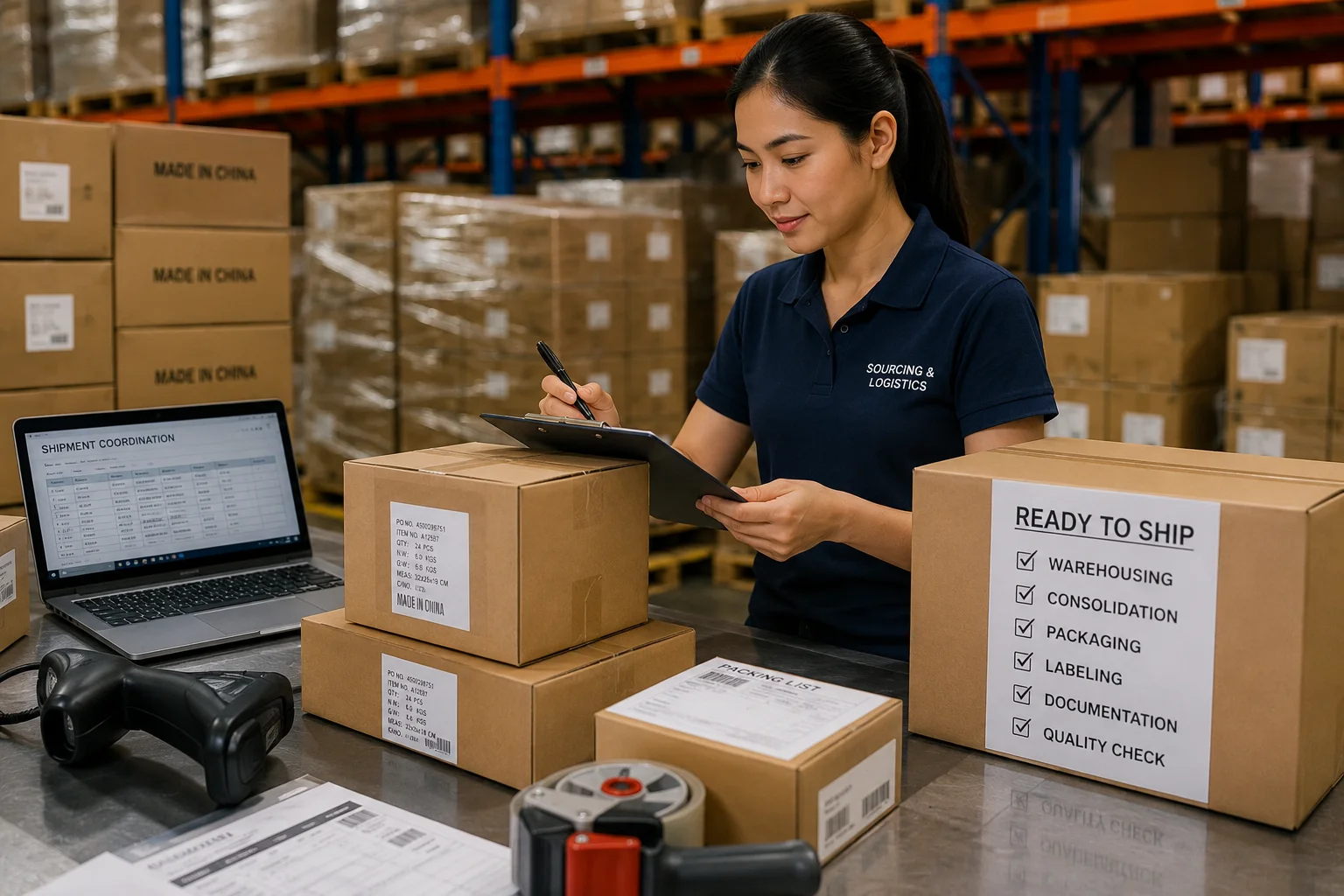
The work after production affects profit
I often work with buyers who source from more than one supplier. One supplier makes the main product. Another supplier makes packaging. A third supplier makes accessories. If each supplier ships alone, the buyer may pay more freight and lose control of the full set. A local warehouse can receive goods, check quantities, combine items, replace packaging, apply labels, and prepare shipping.[^11] This is not glamorous work. Yet it can protect the final customer experience.
| After-production task | What I may help with | Why the buyer cares |
|---|---|---|
| Warehousing | Receive and store goods | I help keep items controlled in China |
| Consolidation | Combine orders from several suppliers | I help reduce shipping waste |
| Packaging | Check boxes, inserts, labels | I help protect brand image |
| Kitting | Combine product, accessory, and manual | I help prevent missing parts |
| Photos | Take simple product or lifestyle photos | I help ecommerce listings move faster |
| Shipping coordination | Work with forwarders and suppliers | I help reduce communication gaps |
Shipping is coordination, not only freight price
I do not see shipping as just asking for the cheapest freight quote. The shipping plan depends on product weight, volume, value, delivery deadline, destination, and sales channel. Air, sea, rail, express, and truck delivery all have trade-offs.[^12] I may help the buyer compare options and prepare basic shipment information. I also remind buyers that customs rules, taxes, and import compliance need proper advice from qualified parties when needed. My job is to coordinate the practical China-side steps and help the buyer avoid avoidable delays.
7. When Do You Really Need a China Sourcing Agent?
Not every order needs an agent. I believe buyers should use help when the risk, time cost, or coordination load becomes too high.
You may need a sourcing agent when you buy custom products, manage several suppliers, need packaging work, require inspection, face communication problems, or plan repeat orders. Simple standard samples may be handled by yourself.
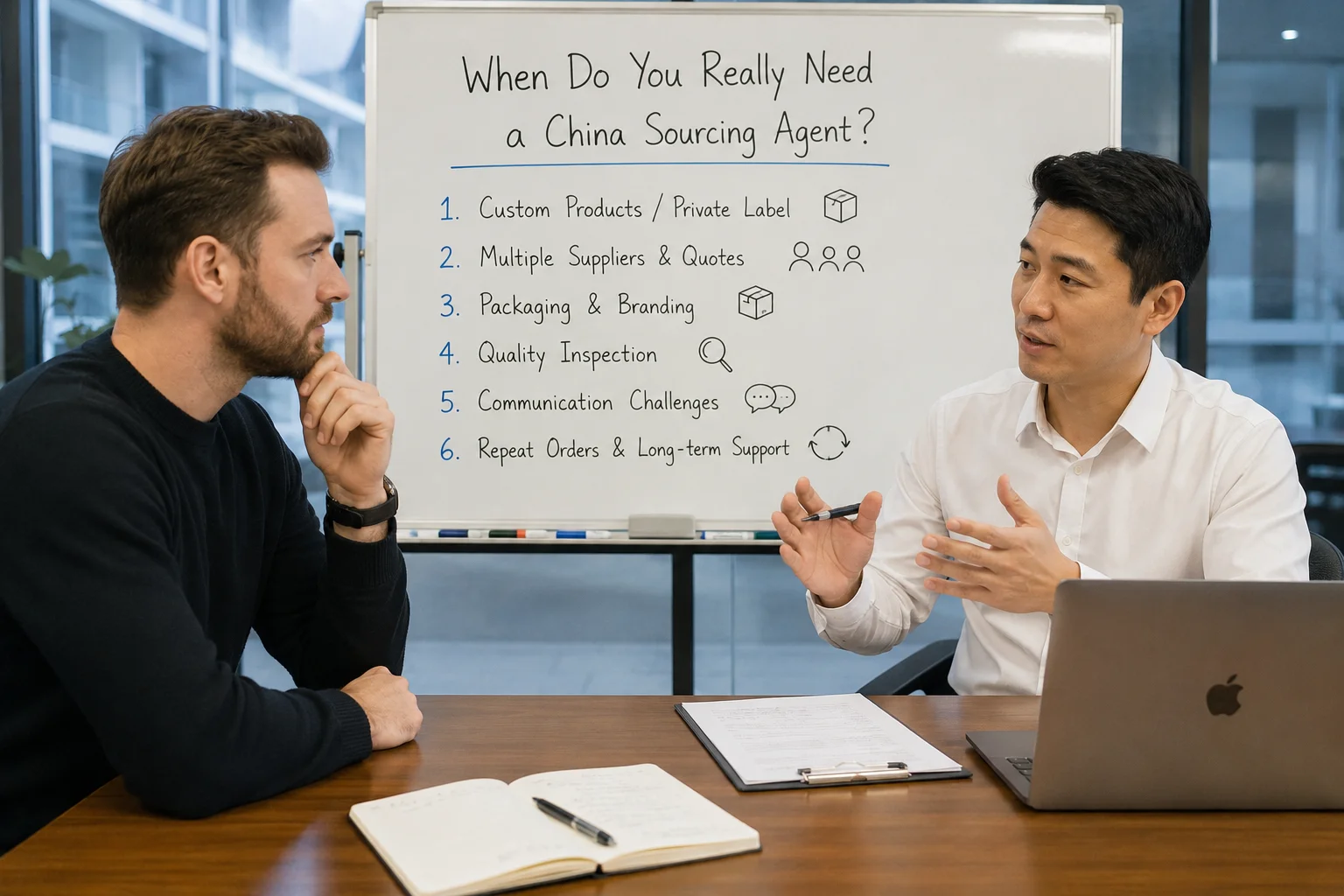
I use a simple decision rule
I tell buyers to look at three things. First, look at product complexity. Second, look at order value and repeat potential. Third, look at your own time and China-side experience. If you buy one simple standard item from a clear supplier, you may manage it yourself. If you need private label packaging, product changes, several suppliers, strict delivery timing, or ongoing replenishment, a sourcing agent can save time and reduce mistakes.
| Situation | Can you handle it yourself? | When I think an agent helps |
|---|---|---|
| One standard sample | Often yes | If communication is unclear |
| Small test order | Sometimes yes | If quality or packaging matters |
| Private label order | Riskier | When logo, box, and labels must match |
| Multiple suppliers | Harder | When goods need consolidation |
| Custom product | High risk | When specs and samples need control |
| Repeat replenishment | Time-heavy | When you need stable follow-up |
I also compare the common choices fairly
Alibaba is good for discovery. Factory sales are good when the factory is truly suitable and responsive. Trading companies can be useful when they have strong product knowledge and ready supply. A sourcing agent makes sense when the buyer needs someone to represent their buying process. I do not replace every tool. I connect tools, people, and steps. I also do not guarantee the lowest price. I try to help the buyer make a better buying decision. Sometimes a slightly higher unit price from a more reliable supplier is the lower-risk choice.
8. How KingSourcing Helps with One-Stop Product Sourcing from China?
A buyer may not need a big China office. I see many growing sellers need a practical local team that can execute step by step.
KingSourcing helps overseas buyers source products from China through supplier search, quote comparison, samples, production follow-up, inspection, packaging, warehousing, consolidation, and shipping coordination. I focus on making China sourcing simple and controlled.
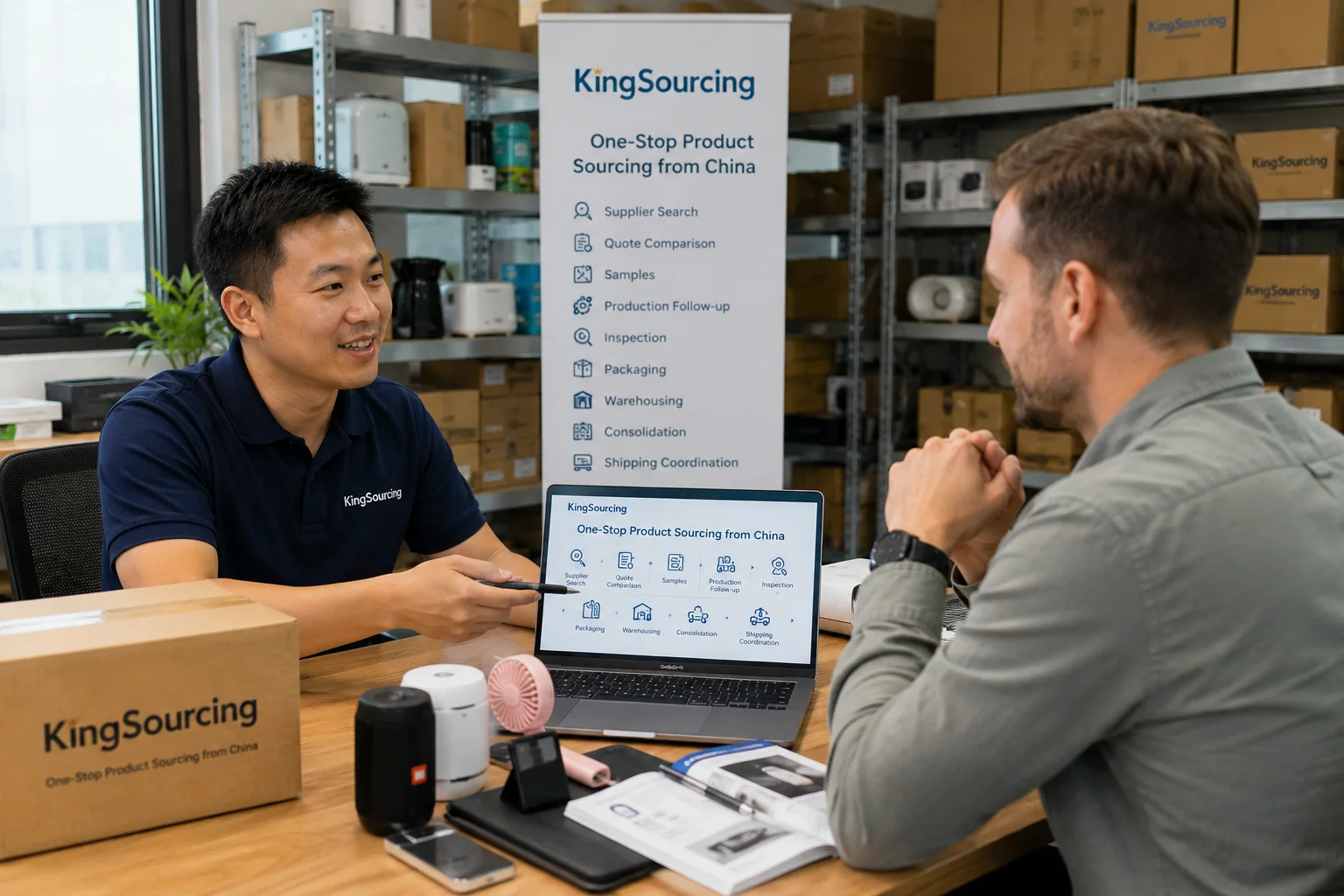
The way I like to support buyers
At KingSourcing, I try to act like the buyer’s China-side purchasing office. I do not want to sell a dream. I want to make the process clearer. I start by understanding the product, target market, budget, packaging needs, and order plan. Then I help find suitable suppliers and compare offers. If the buyer wants to test, I help with samples and feedback. If the buyer moves to production, I help confirm details and follow the order. If the goods need checking, I help arrange suitable quality control. If several items need to ship together, I help with warehousing and consolidation.
| Buyer need | How I may help | What result I aim for |
|---|---|---|
| Find products | Search and shortlist suppliers | Better options with less wasted time |
| Lower risk | Check supplier and order details | Fewer blind decisions |
| Build a brand | Support logo, packaging, and kitting | More professional presentation |
| Control quality | Arrange inspection or 1-by-1 checks | Fewer customer complaints |
| Ship goods | Coordinate warehouse and freight steps | Smoother delivery process |
| Scale orders | Manage repeat sourcing and follow-up | More stable supply work |
Boundaries are important
I believe trust grows when I explain limits. I cannot remove all risk. I cannot promise every supplier will be perfect. I cannot promise the lowest price in China. I can help buyers ask better questions, compare suppliers more clearly, check details earlier, and manage the process with more control. In our work with first-time importers, small business owners, DTC brands, and ecommerce sellers, this often makes the difference between a stressful one-time purchase and a repeatable sourcing system. That is the real meaning behind “Making Your China Sourcing Simple.”
Conclusion
I see a China sourcing agent as a buyer-side risk manager who helps turn supplier search into a controlled, practical, and repeatable sourcing process.
[^1]: "Assessing the Best Supplier Selection Criteria in Supply Chain ...", https://pmc.ncbi.nlm.nih.gov/articles/PMC9102987/. A peer-reviewed study on supplier selection should be cited to show that procurement decisions are commonly assessed across cost, quality, delivery performance, capability, and risk, supporting the article’s framing of sourcing as risk control rather than price hunting alone. Evidence role: expert_consensus; source type: paper. Supports: Supplier selection and sourcing are commonly treated as multi-criteria risk-management decisions rather than simple lowest-price choices.. Scope note: The source would support the general procurement principle, not prove the specific value delivered by this particular sourcing agent. [^2]: "Supplier Selection Using Multi-Criteria Decision-Making Methods", https://www.academia.edu/14244725/Supplier_Selection_Using_Multi_Criteria_Decision_Making_Methods. A scholarly review of supplier-selection criteria should be cited to document that purchasing decisions are typically evaluated using multiple criteria, including quality, delivery reliability, service capability, and cost, rather than purchase price alone. Evidence role: expert_consensus; source type: paper. Supports: Supplier selection frameworks commonly include quality, delivery, service, communication, and cost-related criteria.. Scope note: The source would validate the general criteria, not the article’s specific ordering or weighting of those criteria. [^3]: "A semi-automated approach to identify and clarify ambiguity in large ...", https://www.sciencedirect.com/science/article/abs/pii/S0360835220305313. A quality-management source such as ISO guidance should be cited to support the principle that documented product requirements and specifications are used to define acceptance criteria and reduce ambiguity in supplier-controlled production. Evidence role: mechanism; source type: institution. Supports: Clear documented product specifications help define requirements and reduce ambiguity in production and supplier control.. Scope note: The source would support the quality-management mechanism generally, not confirm that these exact specification fields are always open in every China sourcing case. [^4]: "Analyzing Costs Using Total Cost of Ownership", https://psep.smeal.psu.edu/short-courses/supply-chain-accelerator/advanced-procurement-analyzing-costs-using-total-cost-of-ownership. A peer-reviewed source on total cost of ownership in purchasing should be cited to show that supplier decisions based solely on quoted price can overlook quality, logistics, and performance costs that affect the final economic outcome. Evidence role: mechanism; source type: paper. Supports: Total cost of ownership in procurement includes costs beyond unit price, such as quality, logistics, service, and failure-related costs.. Scope note: The source would establish the purchasing-cost concept, not quantify the likely added cost for the article’s examples. [^5]: "Supplier Qualification: Definition, Process, and Guidelines", https://simplerqms.com/supplier-qualification/. A quality-management or procurement-standard source should be cited to define supplier evaluation as the process of determining whether an external provider is capable of meeting specified requirements for the intended purchase. Evidence role: definition; source type: institution. Supports: Supplier verification or qualification involves evaluating whether external providers can meet specified purchasing and quality requirements.. Scope note: The source would define the general function of supplier evaluation, not prescribe the exact verification checklist used by the article’s author. [^6]: "Supplier Audits: A Complete Guide - Deltek", https://www.deltek.com/en/manufacturing/qms/supplier-quality-management/supplier-audit. A supplier-quality or audit guidance source should be cited to show that on-site supplier audits are commonly used to assess production capability, quality controls, and compliance risks before or during procurement. Evidence role: general_support; source type: institution. Supports: Supplier audits and site visits are recognized methods for assessing supplier capability, quality systems, and compliance risks.. Scope note: The source would support the audit practice generally, not prove that every large or sensitive order requires an audit. [^7]: "Third-Party Testing Laboratory Accreditation & Small Entity ...", https://www.cpsc.gov/Business--Manufacturing/Testing-Certification/Lab-Accreditation. A government product-safety or conformity-assessment source should be cited to explain that regulated products may require testing by qualified or accredited laboratories to demonstrate compliance with applicable safety or legal requirements. Evidence role: definition; source type: government. Supports: Certain regulated products may require conformity testing by qualified or accredited laboratories, and third-party testing is a recognized compliance mechanism.. Scope note: The source would support the need for qualified testing in regulated contexts, not identify which laws apply to every product mentioned by the article. [^8]: "Q7A Good Manufacturing Practice Guidance for Active ... - FDA", https://www.fda.gov/regulatory-information/search-fda-guidance-documents/q7a-good-manufacturing-practice-guidance-active-pharmaceutical-ingredients. A quality-management source should be cited to support the principle that documented requirements and acceptance criteria help control production processes and verify whether output conforms to the approved standard. Evidence role: mechanism; source type: institution. Supports: Documented specifications and acceptance criteria are used in quality management to control production and verify conformity.. Scope note: The source would support the general quality-control mechanism, not directly measure production drift in the article’s sourcing cases. [^9]: "Pre-shipment inspection - Wikipedia", https://en.wikipedia.org/wiki/Pre-shipment_inspection. An inspection-standard or international trade source should be cited to define pre-shipment inspection as a quality-control activity performed before dispatch to verify quantity, workmanship, specification conformity, or defects. Evidence role: definition; source type: institution. Supports: Pre-shipment inspection is a recognized quality-control activity used to check goods before dispatch or export.. Scope note: The source would explain the purpose of pre-shipment inspection, not guarantee that such inspections detect every defect. [^10]: "[PDF] Automated Quality Control in Manufacturing Production Lines", https://scholarworks.utrgv.edu/cgi/viewcontent.cgi?article=1947&context=etd. A university or quality-control source should be cited to explain that inspection methods may range from sampling to full inspection depending on product complexity, defect risk, and the cost or consequence of nonconformance. Evidence role: mechanism; source type: education. Supports: Inspection plans may vary by product risk, complexity, and the consequences of defects, with sampling or full inspection selected according to quality objectives.. Scope note: The source would support the inspection-planning logic, not establish a universal rule that all multi-part products require one-by-one checks. [^11]: "Value-added warehousing services: beyond storage & distribution", https://www.commonwealthinc.com/insights/value-added-warehousing-services-beyond-storage-distribution. A logistics or supply-chain education source should be cited to document that warehouses may perform value-added services such as receiving, quantity checking, consolidation, packaging, labeling, and outbound shipment preparation. Evidence role: definition; source type: education. Supports: Modern warehousing and fulfillment operations commonly include receiving, inventory checks, consolidation, packaging, labeling, and shipment preparation.. Scope note: The source would support these as common warehouse functions, not verify that any specific local warehouse offers all of them. [^12]: "[PDF] Analysis of Freight Movement Mode Choice Factors - FDOT", https://www.fdot.gov/docs/default-source/rail/publications/studies/planning/modechoicefactors.pdf. A logistics textbook or university source should be cited to show that air, ocean, rail, road, and express transport modes differ in speed, cost, capacity, flexibility, and reliability, requiring shippers to balance trade-offs. Evidence role: general_support; source type: education. Supports: Freight modes differ in cost, transit time, capacity, flexibility, and reliability, creating practical trade-offs for shippers.. Scope note: The source would support the general transport-mode comparison, not determine the best shipping option for any individual shipment.