I see many small buyers find suppliers fast, then get stuck. A low quote feels safe, but unmanaged sourcing can turn into delays, defects, and stress.
Small businesses need a China sourcing partner because Alibaba helps with supplier discovery[^1], while a sourcing partner helps verify suppliers, compare quotes, confirm samples, monitor production, inspect quality, and manage shipment before money and time are at risk.
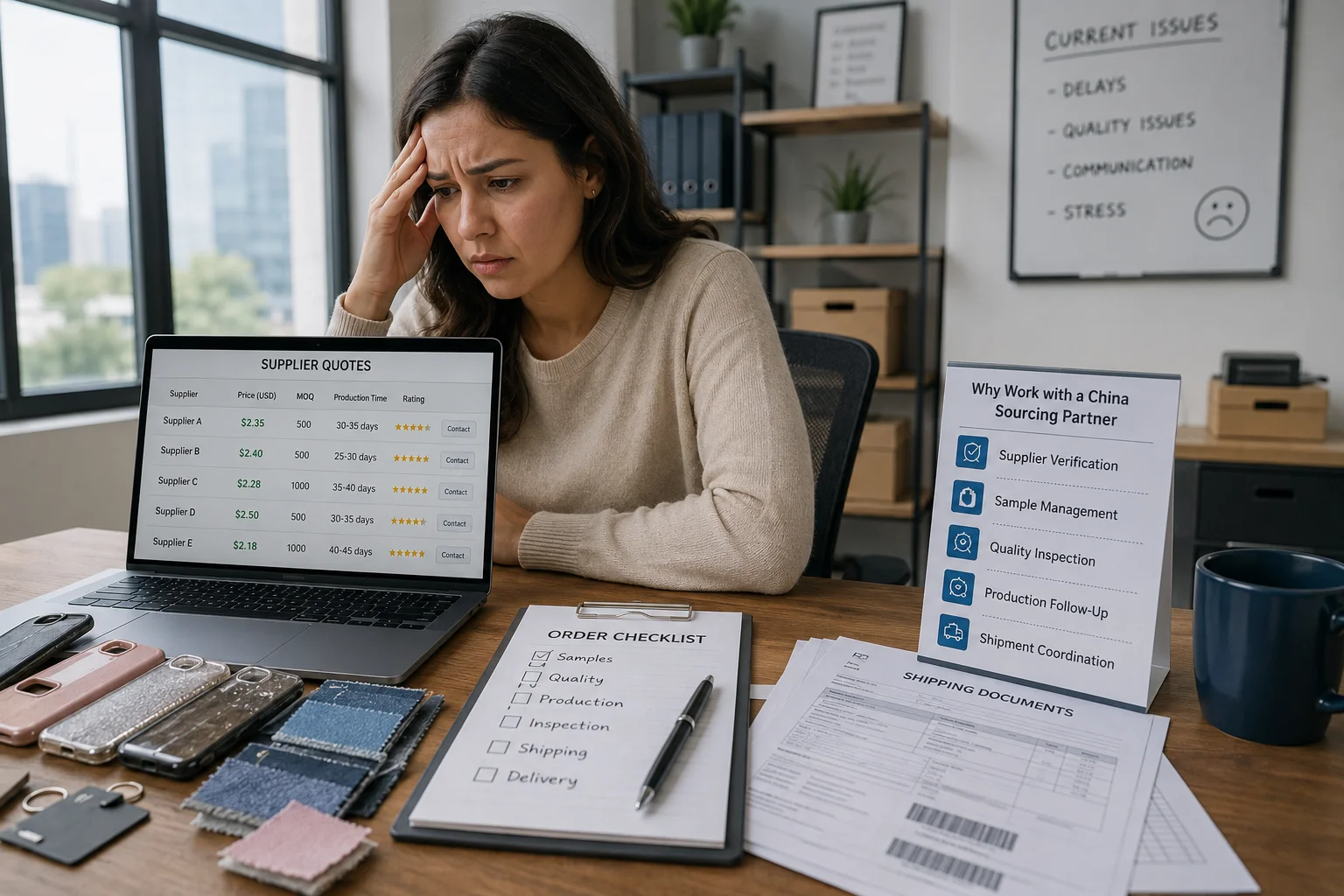
I respect Alibaba as a useful starting point. I use it as one channel to see supplier options, price ranges, and product ideas. But I also know that finding a supplier is not the same as completing procurement[^2]. Many buyers come to me after they already found several suppliers online. They do not ask, “Can I find someone?” They ask, “Can I trust this quote, this product, this factory, and this delivery plan?” That is where the real sourcing work starts.
1. Why Small Businesses Often Start with Alibaba?
I understand why small buyers begin with Alibaba. It is easy, fast, and familiar. But easy search can hide hard buying decisions.
Small businesses often start with Alibaba because it gives quick access to many China suppliers, product photos, price ranges, and direct messages. I see it as a strong discovery tool, but not a full sourcing system.
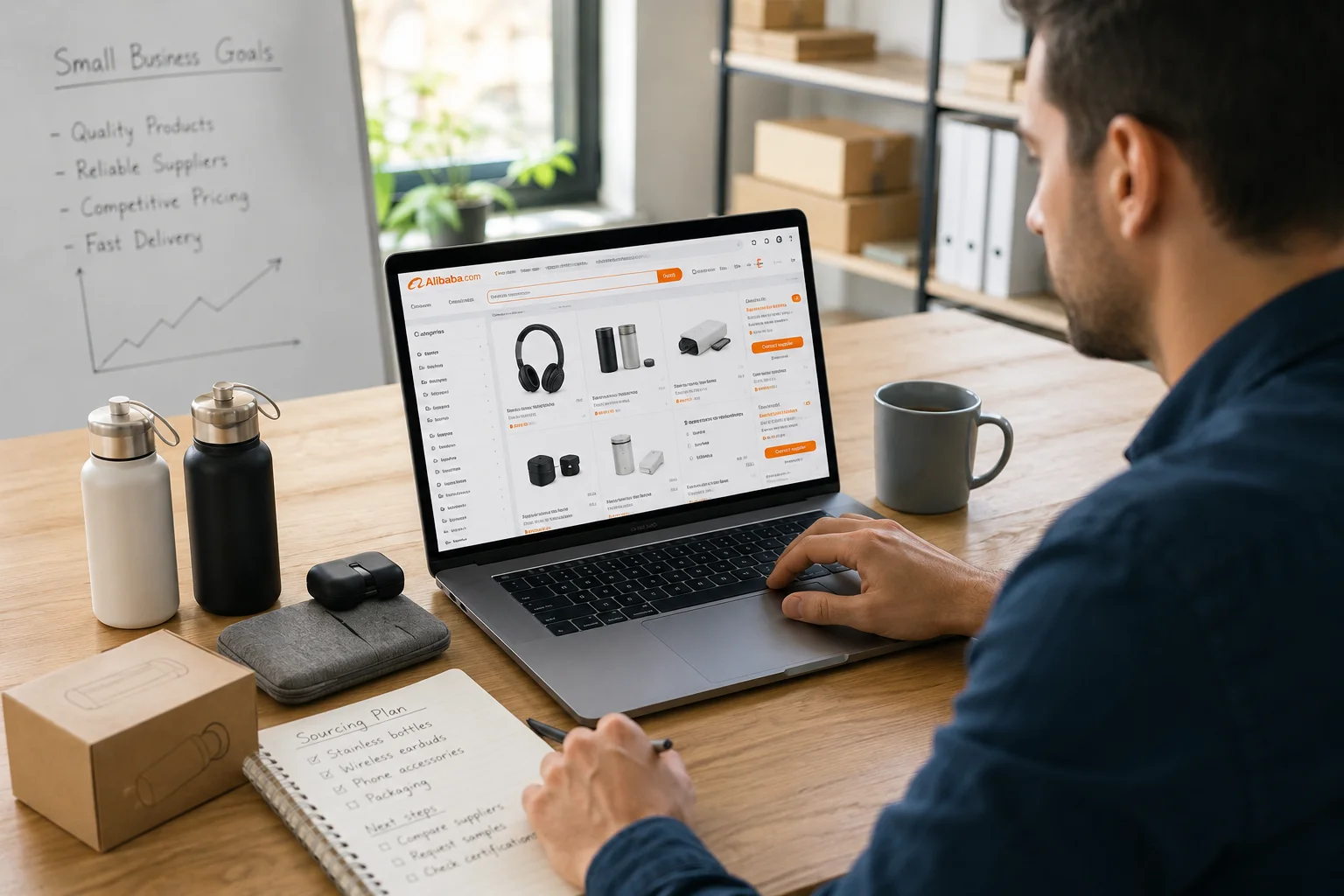
The search stage feels simple
I often speak with new importers who feel excited after one evening of supplier searching. They find ten suppliers. They receive fast replies. They see low minimum order quantities. They compare product photos. At that moment, the process feels simple. I understand that feeling because Alibaba reduces the first barrier. It lets a small business see what China manufacturing can offer without flying to China or hiring a full team.
The buying stage is different
The challenge starts after the first reply. I need to know whether the supplier understands the exact material, size, color, function, packaging, logo, and testing need. I also need to know whether the quote includes the same product version as the photo. Many small buyers compare prices too early. They do not compare the full buying conditions.
| What I can see online | What I still need to check |
|---|---|
| Product photos | Real product quality and material |
| Supplier response speed | Communication accuracy and stability |
| Listed price | Full specification behind the price |
| MOQ | Real production and customization limits |
| Trade terms | Final landed cost and delivery risk |
My practical view
I do not treat Alibaba as the problem. I treat incomplete checking as the problem. A platform can open the door, but I still need someone to walk through the door, check the room, ask the hard questions, and make sure the order can be produced as expected.
2. What Alibaba Can and Cannot Do for Small Business Buyers?
I see buyers expect too much from a platform. That creates risk. A platform can show options, but it cannot manage every order detail.[^3]
Alibaba can help small buyers find suppliers, request quotes, compare product ideas, and start communication. It cannot fully replace supplier verification, sample checking, production follow-up, quality control, and local order management in China.
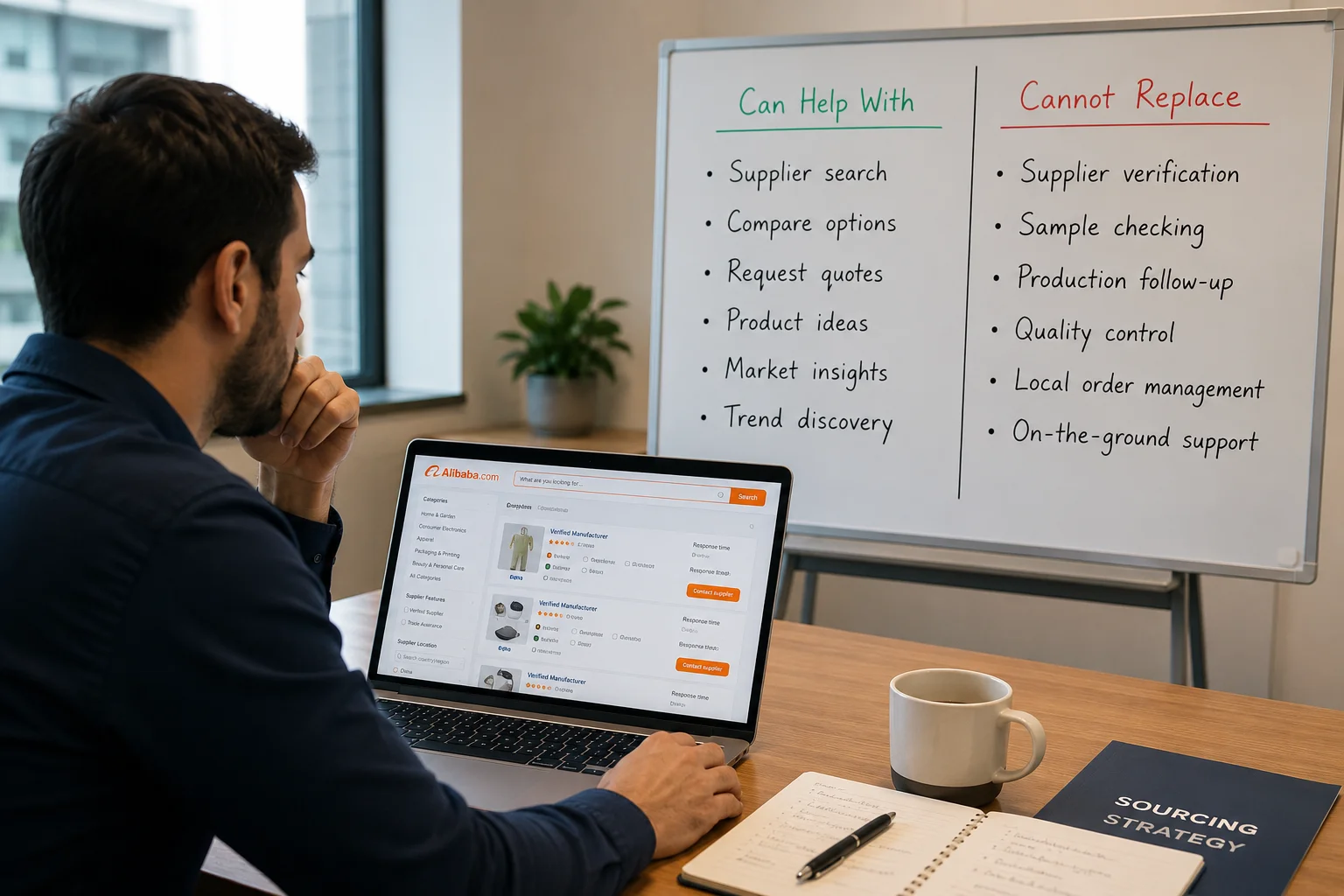
What I use Alibaba for
I use Alibaba as one tool in the sourcing process. It helps me check product categories, supplier concentration, price levels, and possible factory types. It also helps me see how suppliers present themselves to overseas buyers. This information has value. I do not ignore it. I use it as a first layer.
What I do not expect Alibaba to do
I do not expect any online platform to fully judge whether a supplier can make a buyer’s exact order well. I still need to ask detailed questions. I still need to compare specifications. I still need to check sample quality. I still need to follow production. I still need to inspect the goods before shipment.
| Buying task | Alibaba can help | I still need sourcing work |
|---|---|---|
| Find supplier names | Yes | Sometimes |
| Receive quotes | Yes | Yes |
| Confirm exact specifications | Partly | Yes |
| Verify factory reality | Partly | Yes |
| Check samples | No | Yes |
| Monitor production | No | Yes |
| Inspect finished goods | No | Yes |
| Combine shipments | No | Yes |
The real limit is execution
A small buyer often needs execution more than search. I have seen buyers collect many supplier contacts, but they still cannot decide who is reliable. They also cannot visit the factory, check cartons, confirm packaging, or solve production issues in real time. This is why a sourcing partner matters. I help turn online supplier options into a controlled buying process.
3. Why Online Supplier Platforms Still Require Careful Verification?
I see buyers trust listings too fast. A nice page can look professional. But real reliability must be checked before I place an order.
Online supplier platforms still require verification[^4] because listings, photos, fast replies, and low prices do not prove production ability, material accuracy, quality control, stable communication, or shipment readiness[^5].
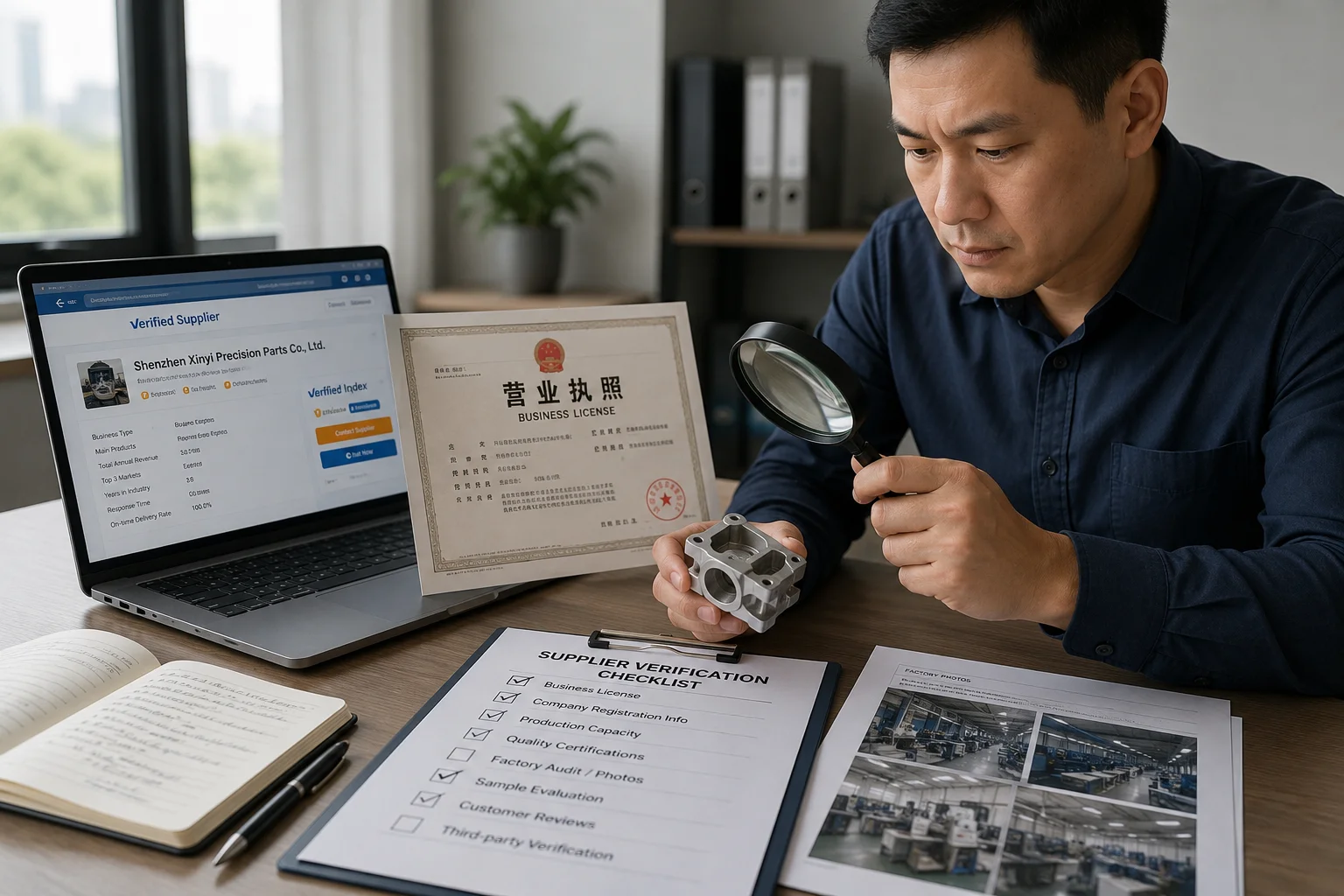
A listing is not a full proof
I never treat a supplier page as the full truth. A listing can show product range, company years, certificates, and export claims. But I still need to connect those points to the exact product that the buyer wants. A supplier may be strong in one product but weak in another. A trading company may communicate well but have limited control over production. A factory may produce well but answer slowly in English. Each situation needs a different check.
I check the quote behind the number
Many small buyers ask me, “Is this price good?” I usually ask, “Good for which specification?” A low price can mean thinner material, weaker parts, simple packaging, lower grade finish, or missing accessories.[^6] It can also be a real good price from an efficient supplier. I cannot know until I compare the details.
| Risk sign | What I check |
|---|---|
| Quote much lower than others | Material, size, accessories, packaging, and terms |
| Very fast promise | Real production schedule and capacity |
| Vague product description | Full specification sheet |
| Only beautiful photos | Real sample and video check |
| Poor answer consistency | Communication history and technical clarity |
Verification protects decisions
I do not verify suppliers because I expect every supplier to be bad. I verify because remote buying has information gaps[^7]. A small business may not have room for one bad container, or even one bad batch.[^8] Verification helps me reduce guesswork. It helps the buyer make a decision based on facts, not only on price, reply speed, or product photos.
4. How a China Sourcing Partner Helps Screen Quotes and Compare Suppliers?
I often see buyers compare only unit prices. That is dangerous. The cheapest quote may hide missing details, weak materials, or poor service.
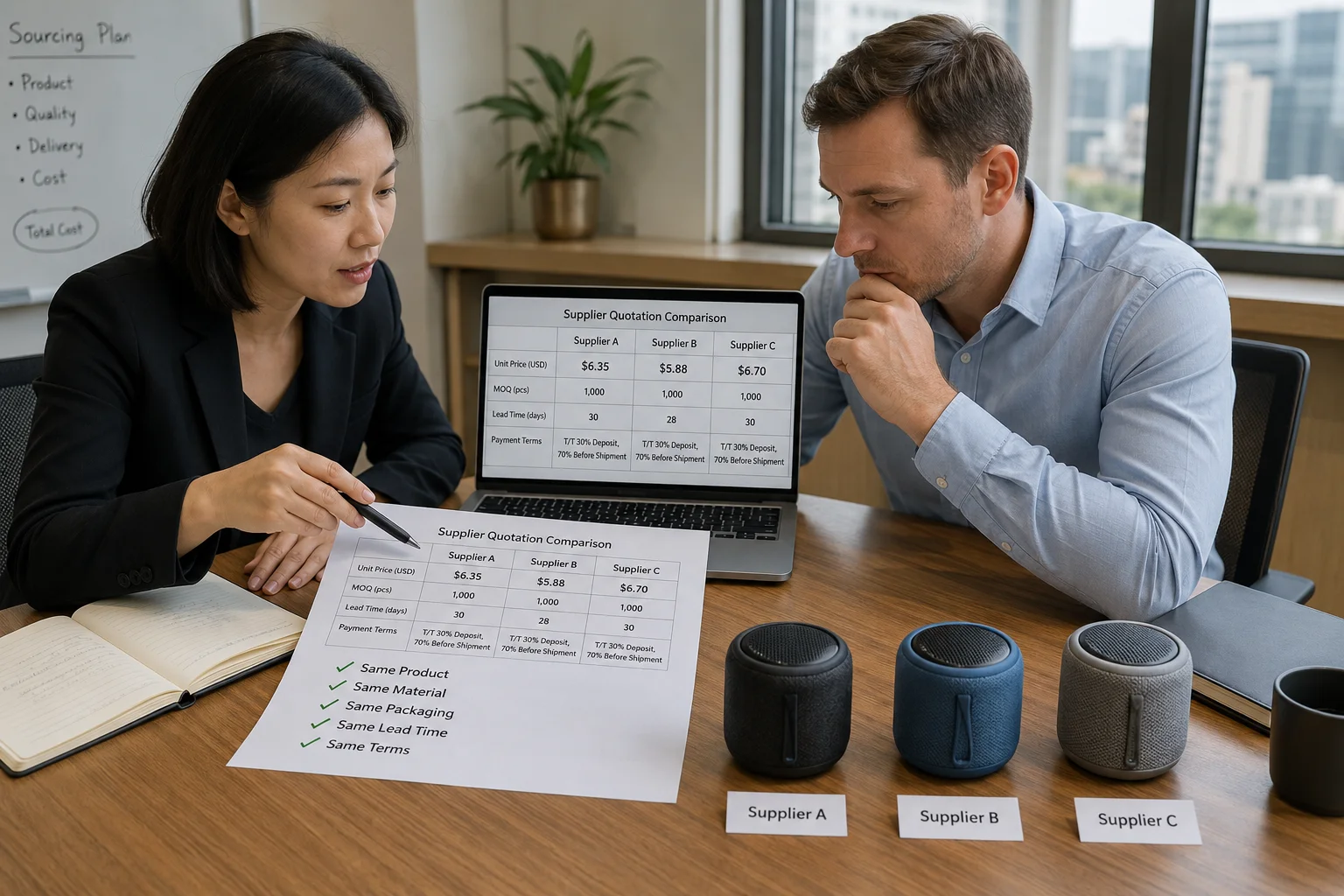
I compare quotes line by line
When I compare suppliers, I do not only put prices in a spreadsheet. I ask what each supplier has included. I check the product size, weight, material, finish, accessories, spare parts, logo method, packaging, carton size, payment terms, lead time, and shipping term. I also check whether the supplier can explain the product clearly. A supplier that cannot explain the product may create problems later.
I look for the reason behind each price
A price difference always has a reason. Sometimes the reason is good. One factory may have better machines, local material supply, or larger output. Sometimes the reason is risky. One supplier may quote a lower grade product, skip packaging, or ignore testing needs. I need to find the reason before the buyer sends a deposit.
| Quote item | Why I check it |
|---|---|
| Material grade | It changes durability and customer satisfaction |
| Product size and weight | It affects quality, shipping, and customer use |
| Packaging method | It affects damage rate and brand image |
| Lead time | It affects launch date and stock planning |
| MOQ | It affects cash flow and test order plan |
| Payment term | It affects buyer risk and supplier commitment |
I help buyers make a cleaner choice
I do not tell buyers to choose the lowest or the highest price. I help them choose the best fit for their business stage. A new seller may need a small test order with stable quality. A DTC brand may need better packaging and consistent finish. A wholesaler may need stronger cost control and repeat production. Quote screening helps match the supplier to the real business need.
5. Supplier Verification, Samples, QC, and Order Follow-Up: What Small Buyers Often Miss?
I see buyers focus on placing the order. But many problems happen after the deposit. Missed follow-up can turn small mistakes into costly failures.
Small buyers often miss supplier verification, sample approval, production updates, quality inspection, packaging checks, and shipment preparation. These steps help reduce wrong specifications, delays, defects, and after-sales problems.
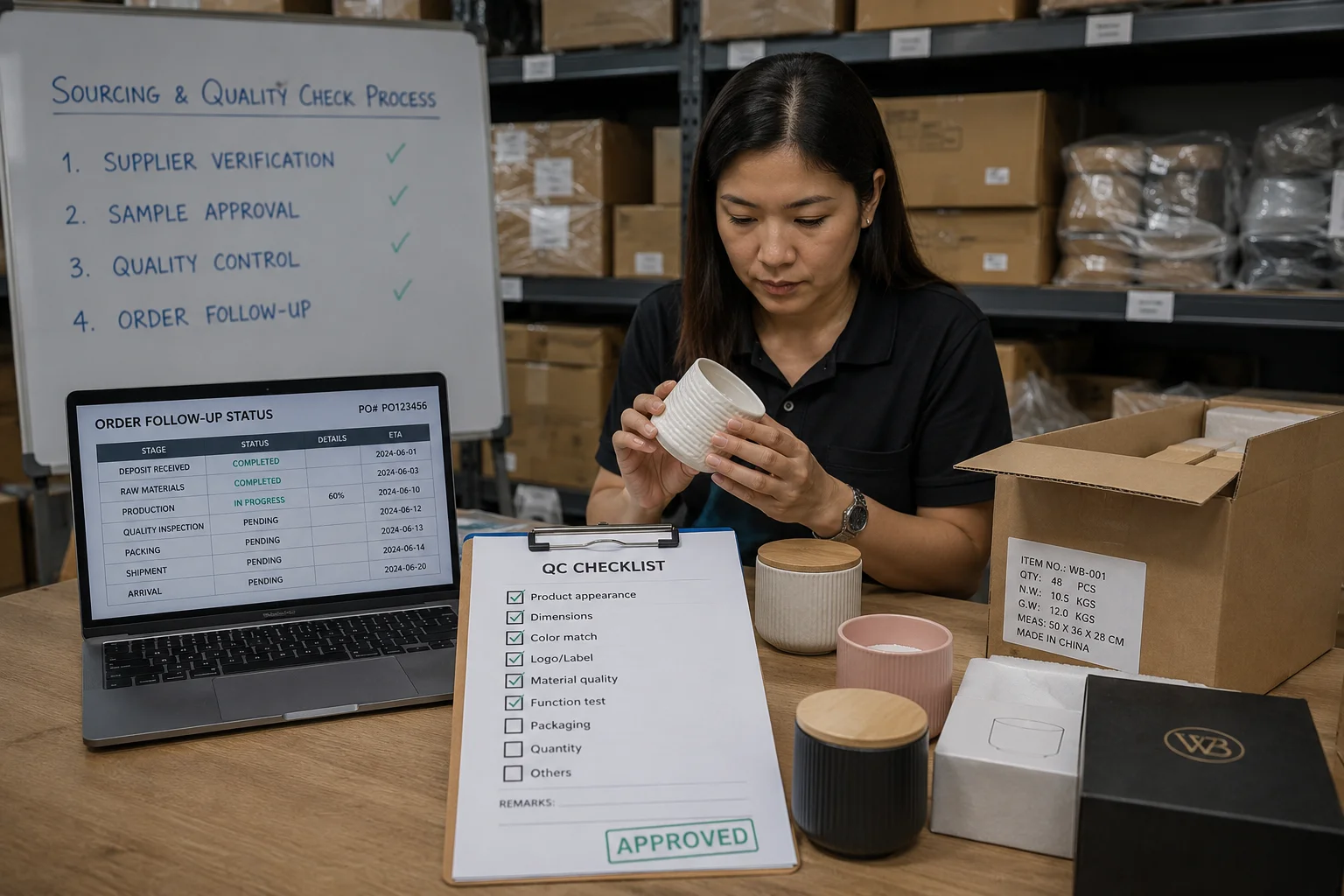
Sample confirmation is not a small step
I always treat the sample as the buyer’s first real checkpoint. A sample shows whether the supplier understands the requirement.[^10] It also shows the real material, color, function, finish, packaging idea, and workmanship. But a sample only helps if I check it against clear standards. I cannot approve a sample only because it looks “okay.” I need written notes, photos, measurements, and approved changes.
Production follow-up keeps problems visible
After the buyer pays a deposit, the supplier begins material purchase and production planning. This is where delays can happen. I follow up on material readiness, production start time, logo process, packaging progress, and estimated finish date. I also ask for photos or videos when needed. This does not remove all risk, but it makes problems visible earlier.
| Step I manage | Buyer risk it reduces |
|---|---|
| Supplier check | Paying an unsuitable supplier |
| Sample review | Approving the wrong product |
| Pre-production confirmation | Misunderstood details |
| Production follow-up | Hidden delays |
| QC before shipment | Receiving defective goods |
| Packaging check | Damage and poor brand image |
| Shipment coordination | Confusing export and delivery process |
QC protects the final decision
I see many buyers think QC is only for large orders. I disagree. A small order can still damage a small business if it arrives with defects. QC helps me check quantity, appearance, function, packaging, labeling, and carton condition before shipment.[^11] It gives the buyer a chance to fix problems before the goods leave China.
6. Alibaba vs China Sourcing Partner: Which Is Better for Your Business Stage?
I do not see this as a simple choice. Alibaba and a sourcing partner serve different stages. The right choice depends on risk, order size, and control needs.
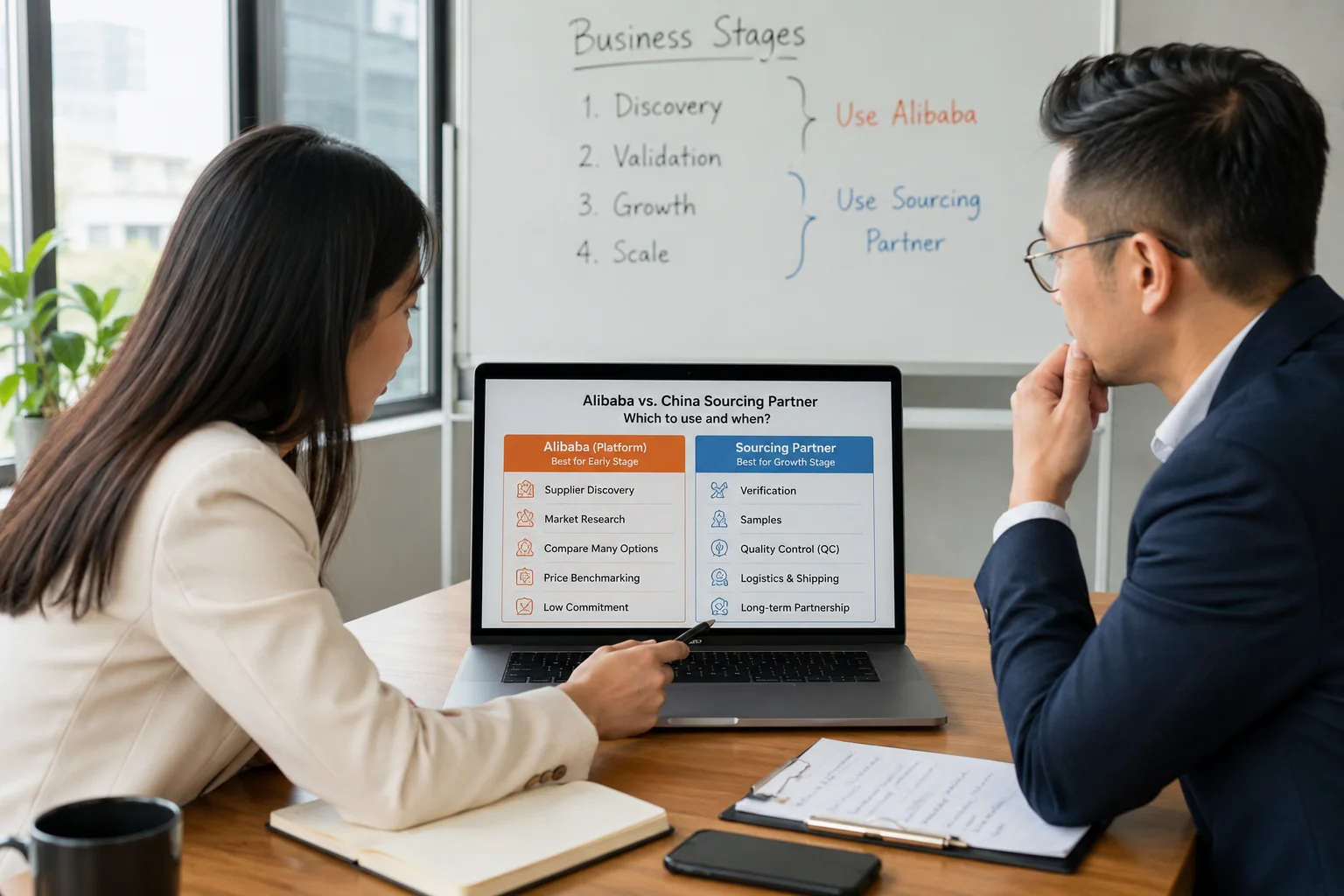
Alibaba is better for early supplier discovery and market research. A China sourcing partner is better when a buyer needs verification, quote screening, sample control, production follow-up, QC, and logistics support.
I match the tool to the stage
If I only want to see whether a product exists in China, Alibaba is useful. If I want to understand rough price ranges, it is also useful. If I want to place a real order with custom packaging, exact specs, and a delivery deadline, I need more control. That is where a sourcing partner becomes more useful.
I think about risk, not only cost
A small buyer often asks whether a sourcing partner adds cost. I understand that concern. But I also ask what a bad order costs. The cost is not only the product cost. It can include delayed launches, wrong colors, weak packaging, customer refunds, marketplace complaints, storage problems, and weeks of remote messages. A sourcing partner does not make risk disappear. It helps manage risk before it becomes expensive.
| Business stage | Better starting tool | Reason |
|---|---|---|
| Product idea research | Alibaba | I can see many options fast |
| First supplier list | Alibaba and sourcing partner | I can collect options and screen them |
| First paid sample | Sourcing partner | I need product checking and clear feedback |
| Custom order | Sourcing partner | I need specification control |
| Repeat order | Sourcing partner | I need consistency and follow-up |
| Multi-supplier buying | Sourcing partner | I need consolidation and coordination |
I choose based on control needs
I do not tell every buyer to stop using Alibaba. I often tell buyers to use Alibaba wisely. When the order is simple, low-risk, and easy to check, direct buying may work. When the order has customization, tight timing, multiple parts, or brand packaging, local sourcing support becomes more important.
7. Common Mistakes Small Businesses Make When Buying from China Online?
I see the same mistakes again and again. Buyers move fast, trust too early, and check too late. Then they pay for avoidable problems.
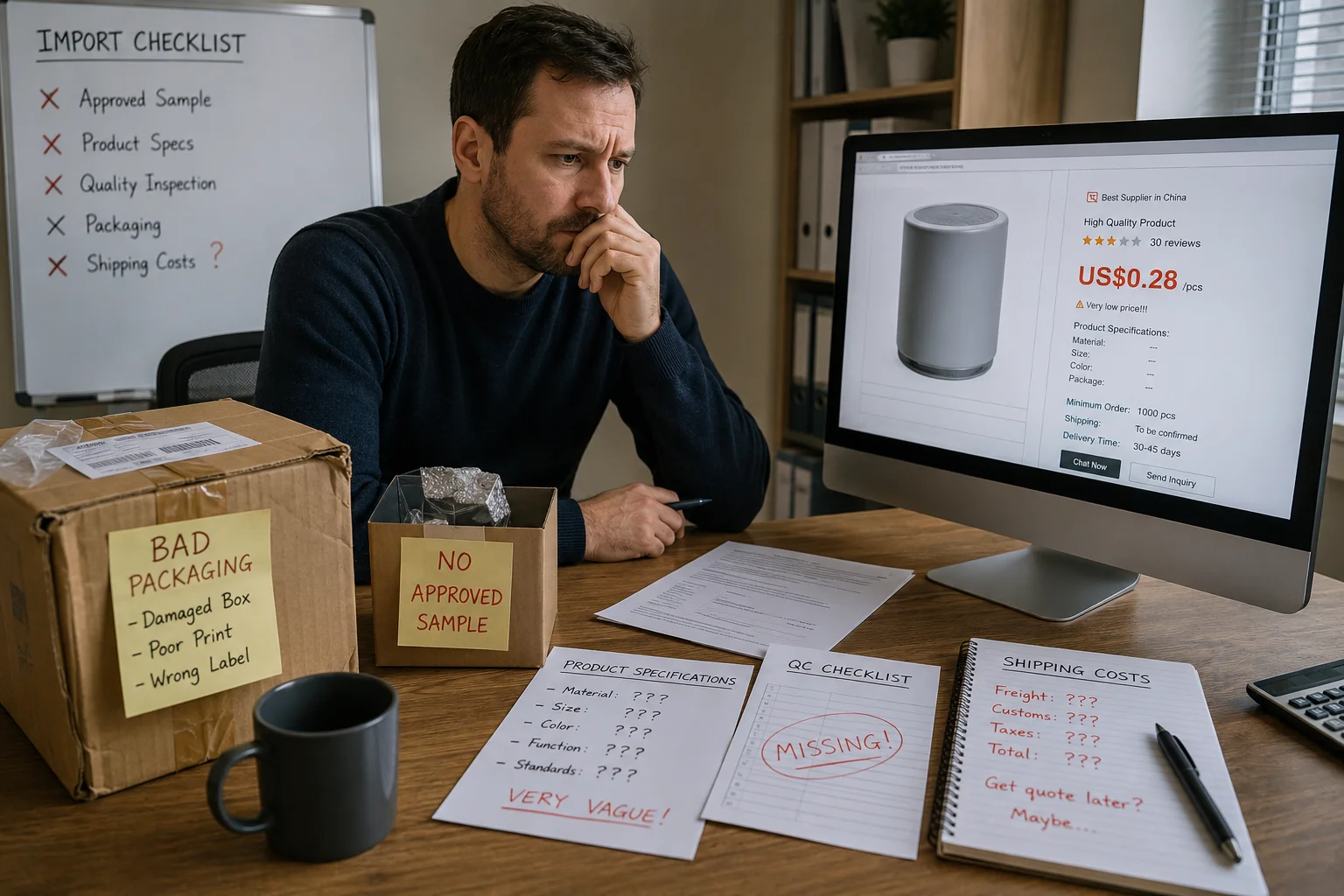
Common mistakes include choosing only by price, skipping samples, using vague specifications, ignoring packaging, failing to verify suppliers, missing QC, and arranging shipment without a clear cost plan.
Mistake one: I compare prices before I define the product
A clear product definition should come before supplier comparison. If I ask five suppliers for “a yoga mat,” I may receive five different quotes for five different products. One may quote thin material. One may quote better surface texture. One may include a carry strap. One may use better packaging. If I only compare the unit price, I may choose the wrong supplier for the wrong reason.
Mistake two: I skip the sample to save time
I understand why small buyers want to skip samples. They want to move fast. They also want to save courier fees. But skipping samples can create bigger losses. A sample can reveal bad smell, wrong color, weak stitching, poor print, wrong size, or cheap accessories. These issues are easier to fix before mass production.
| Mistake | Why it hurts |
|---|---|
| Choosing the lowest quote | The product may not match the required quality |
| No written specification | The supplier may follow its own standard |
| No sample approval | The buyer loses the first real checkpoint |
| No packaging check | Products may arrive damaged or look unprofessional |
| No QC | Defects may only be found after arrival |
| No logistics plan | Final cost may be higher than expected |
Mistake three: I ignore the full landed cost
Many buyers look only at the product price. I always include packaging, inland transport, export handling, shipping, duty, tax, delivery, and possible storage[^12]. A product with a low unit price may not be profitable after shipping. A sourcing partner helps the buyer see the whole cost picture before ordering.
8. How KingSourcing Helps Small Businesses Source Products More Safely from China?
I see small buyers need more than supplier names. They need local execution. I help turn online options into checked, managed, and deliverable orders.
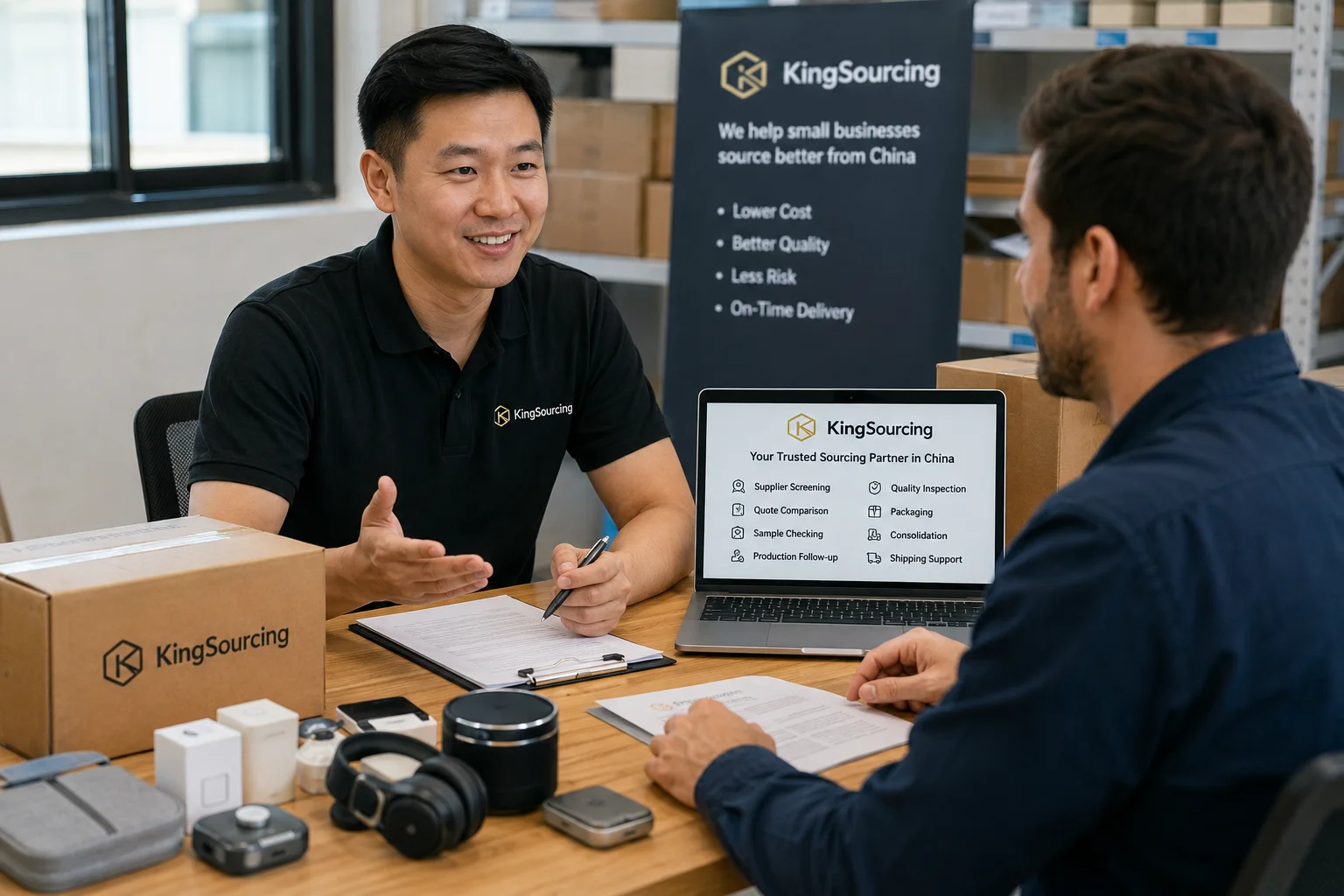
KingSourcing helps small businesses source from China by screening suppliers, comparing quotes, checking samples, following production, inspecting quality, managing packaging, consolidating orders, and arranging shipping support.
I start with the buyer’s real goal
At KingSourcing, I do not start by pushing a supplier list. I first ask what the buyer wants to achieve. I ask about product use, target customer, selling channel, budget, order quantity, packaging needs, quality level, and delivery plan. This helps me avoid a common problem. Many buyers search too broadly, then receive quotes that do not match their real business.
I connect each service to a risk
I see sourcing as risk management and execution support. Supplier development reduces the risk of limited options. Supplier verification reduces the risk of paying the wrong company. Quote comparison reduces the risk of comparing different product levels. Sample checking reduces the risk of mass-producing the wrong item. QC reduces the risk of shipping defects. Warehousing and consolidation reduce the risk of scattered orders and high shipping cost.
| KingSourcing support | Buyer problem I help reduce |
|---|---|
| Supplier sourcing | Too many unknown supplier options |
| Supplier screening | Unclear reliability and capability |
| Quote comparison | Hidden differences in specs and terms |
| Sample confirmation | Wrong product before production |
| Production follow-up | Delays and poor communication |
| 1-by-1 product inspection | Defective items reaching customers |
| Packaging support | Weak brand image and damage risk |
| Order consolidation | Complex multi-supplier shipments |
| Door-to-door logistics support | Confusing freight and delivery steps |
I act as the buyer’s China-side team
Many small buyers do not have a local office, buyer, inspector, warehouse, or logistics coordinator in China. I help fill that gap. I cannot promise that every supplier or order will be perfect. No serious sourcing partner should promise that. But I can help reduce guesswork, improve communication, check details earlier, and give the buyer more control before goods leave China. That is why many buyers use Alibaba for search, then use KingSourcing for execution.
Conclusion
I use Alibaba to find options, and I use sourcing work to control risk. Small businesses need both search and local execution to buy better from China.
[^1]: "Alibaba Group - Wikipedia", https://en.wikipedia.org/wiki/Alibaba_Group. Alibaba.com is generally described as a business-to-business e-commerce marketplace that connects buyers with suppliers, which supports the article’s characterization of Alibaba as a supplier-discovery channel rather than a complete procurement-control system. Evidence role: definition; source type: encyclopedia. Supports: Alibaba.com functions as a business-to-business online marketplace connecting buyers with suppliers and product listings.. Scope note: This supports the platform’s general function, not the effectiveness of any specific supplier found through it. [^2]: "Procurement & Purchasing Management", https://careertraining.uno.edu/training-programs/procurement-purchasing-management/. Procurement frameworks commonly distinguish supplier identification from later activities such as evaluation, contracting, delivery management, and supplier performance control, supporting the article’s distinction between finding a supplier and completing procurement. Evidence role: definition; source type: institution. Supports: Procurement includes multiple stages beyond identifying suppliers, such as evaluation, negotiation, contracting, delivery, and performance management.. Scope note: The source would describe standard procurement practice generally, not China-specific sourcing outcomes. [^3]: "[PDF] An Adaptive Supplier Selection Mechanism in E-Procurement ...", https://scholarworks.lib.csusb.edu/cgi/viewcontent.cgi?article=1309&context=jitim. Studies of e-procurement and B2B electronic marketplaces indicate that such platforms can reduce search and communication costs, while supplier qualification, contract execution, and operational control remain separate procurement-management tasks. Evidence role: expert_consensus; source type: paper. Supports: Research on e-procurement and B2B marketplaces often treats marketplaces as tools for search, communication, and transaction support, while supplier evaluation and order execution still require management controls.. Scope note: This provides contextual support for platform limitations rather than evidence about Alibaba’s internal service boundaries in every transaction. [^4]: "Perform Due Diligence - International Trade Administration", https://www.trade.gov/perform-due-diligence. Government and trade-agency guidance on overseas purchasing commonly recommends supplier due diligence, including checks on legitimacy, capability, contract terms, and product conformity before payment or shipment. Evidence role: expert_consensus; source type: government. Supports: Public trade or import guidance often advises buyers to check supplier legitimacy, capability, and terms before committing funds to overseas suppliers.. Scope note: The support is general to international sourcing and does not prove that every online supplier platform listing is unreliable. [^5]: "Assessing the Best Supplier Selection Criteria in Supply Chain ...", https://pmc.ncbi.nlm.nih.gov/articles/PMC9102987/. Supplier-selection literature treats price as only one evaluation criterion and also emphasizes quality capability, delivery reliability, technical competence, and communication performance, supporting the article’s warning that online listings and low prices are not sufficient proof of supplier reliability. Evidence role: expert_consensus; source type: paper. Supports: Supplier-selection research identifies capability, quality, delivery reliability, and communication as evaluation criteria that cannot be inferred from price or promotional material alone.. Scope note: The source would support the general evaluation principle, not the accuracy of any individual online listing. [^6]: "Impact of Lowest Bid Procurement Syndrome on Quality: Case Study ...", https://www.academia.edu/12147044/Impact_of_Lowest_Bid_Procurement_Syndrome_on_Quality_Case_Study_of_Public_Sector_in_Developing_Nations. Purchasing research on total cost of ownership notes that supplier quotes should be compared against equivalent specifications and included services, because a lower unit price may be offset by differences in quality, components, packaging, or downstream costs. Evidence role: mechanism; source type: paper. Supports: Procurement research on total cost of ownership and supplier selection explains that nominal price comparisons can be misleading when specifications, quality levels, and service inclusions differ.. Scope note: This supports the mechanism by which low quotes can hide differences, not the specific examples in every product category. [^7]: "Information Asymmetry and Host Country Institutions in Cross ... - PMC", https://pmc.ncbi.nlm.nih.gov/articles/PMC7790036/. Supply-chain research describes information asymmetry as a recurring problem in buyer-supplier relationships, particularly where geographic distance and limited monitoring make it harder for buyers to observe supplier capability and product quality directly. Evidence role: mechanism; source type: paper. Supports: Research on supply chains and international purchasing discusses information asymmetry between buyers and suppliers, especially when distance, language, and monitoring limitations are present.. Scope note: The source would provide a general theoretical basis rather than measuring the author’s specific buyer cases. [^8]: "Impacts of COVID-19 on Global Supply Chains - PMC - NIH", https://pmc.ncbi.nlm.nih.gov/articles/PMC8768947/. Research on small and medium-sized enterprises notes that limited financial, inventory, and managerial resources can make smaller firms more vulnerable to supply-chain disruptions and quality failures than larger firms. Evidence role: general_support; source type: paper. Supports: SME research commonly notes that smaller firms have fewer financial and operational buffers to absorb supply-chain failures or quality problems.. Scope note: This supports the vulnerability of small firms generally, not a specific threshold at which one container or batch becomes damaging. [^9]: "Glossary of Procurement Terms | The George Washington University", https://procurement.gwu.edu/glossary-procurement-terms. Procurement guidance commonly states that supplier quotations should be evaluated against the same technical specifications, quality requirements, delivery conditions, and contractual terms before price comparisons are meaningful. Evidence role: expert_consensus; source type: government. Supports: Procurement guidance typically requires bids or quotes to be evaluated against defined specifications, quality requirements, delivery terms, and contractual conditions.. Scope note: Public-procurement guidance may not map perfectly to private small-business sourcing, but it supports the underlying comparison principle. [^10]: "[PDF] QUALITY CONTROL PROCUREMENT REQUIREMENTS (QCPRs)", https://applied-ad.com/wp-content/uploads/2020/07/01-BSF-7.4-3.0-1-Rev-AF-dated-7-24-20.pdf. Quality-control practice uses samples or first-article inspections to verify that a product conforms to specified requirements before full production, supporting the article’s description of samples as an early checkpoint for supplier understanding. Evidence role: mechanism; source type: institution. Supports: Quality-management and inspection practices use samples, prototypes, or first-article inspections to check whether supplied goods meet specified requirements before full production.. Scope note: The evidence supports the quality-control function of samples generally, not the adequacy of any single sample review. [^11]: "Pre-Shipment Inspection (PSI) Explained - ECQA", https://ecqa.com/comprehensive-guide-to-pre-shipment-inspection/. Pre-shipment inspection frameworks commonly include checks of quantity, workmanship or appearance, functional conformity, packaging, labeling, and shipping-carton condition before goods are released for shipment. Evidence role: definition; source type: institution. Supports: Inspection standards and trade-inspection descriptions define pre-shipment inspection as checking quantity, workmanship, conformity, packaging, labeling, and related shipment conditions.. Scope note: This supports what QC can examine; it does not guarantee that inspection will detect every defect. [^12]: "Determine Total Export Price - International Trade Administration", https://www.trade.gov/determine-total-export-price. Trade-agency and customs guidance defines landed cost as the total cost of imported goods after adding transport, insurance, duties, taxes, handling fees, and related logistics expenses to the purchase price. Evidence role: definition; source type: government. Supports: Trade and customs guidance defines landed cost as the total cost of imported goods including product cost, freight, insurance, duties, taxes, fees, and other logistics expenses.. Scope note: Specific cost components vary by country, Incoterm, product classification, and logistics arrangement.