OEM vs ODM vs Private Label can feel confusing when you are preparing to source from China. Many new buyers ask factories for “OEM pricing” before they have defined the product, packaging, quantity, or target customer. That often leads to unclear quotes, expensive samples, and slow decisions. The right model starts with product readiness.
OEM is best when you already own or control a detailed product design; ODM works when you want to adapt an existing supplier design; and private label is usually the fastest route for adding your brand to a proven, ready-made product. Your best choice depends on your budget, required differentiation, minimum order quantity, timeline, and how much product-development risk you can accept.
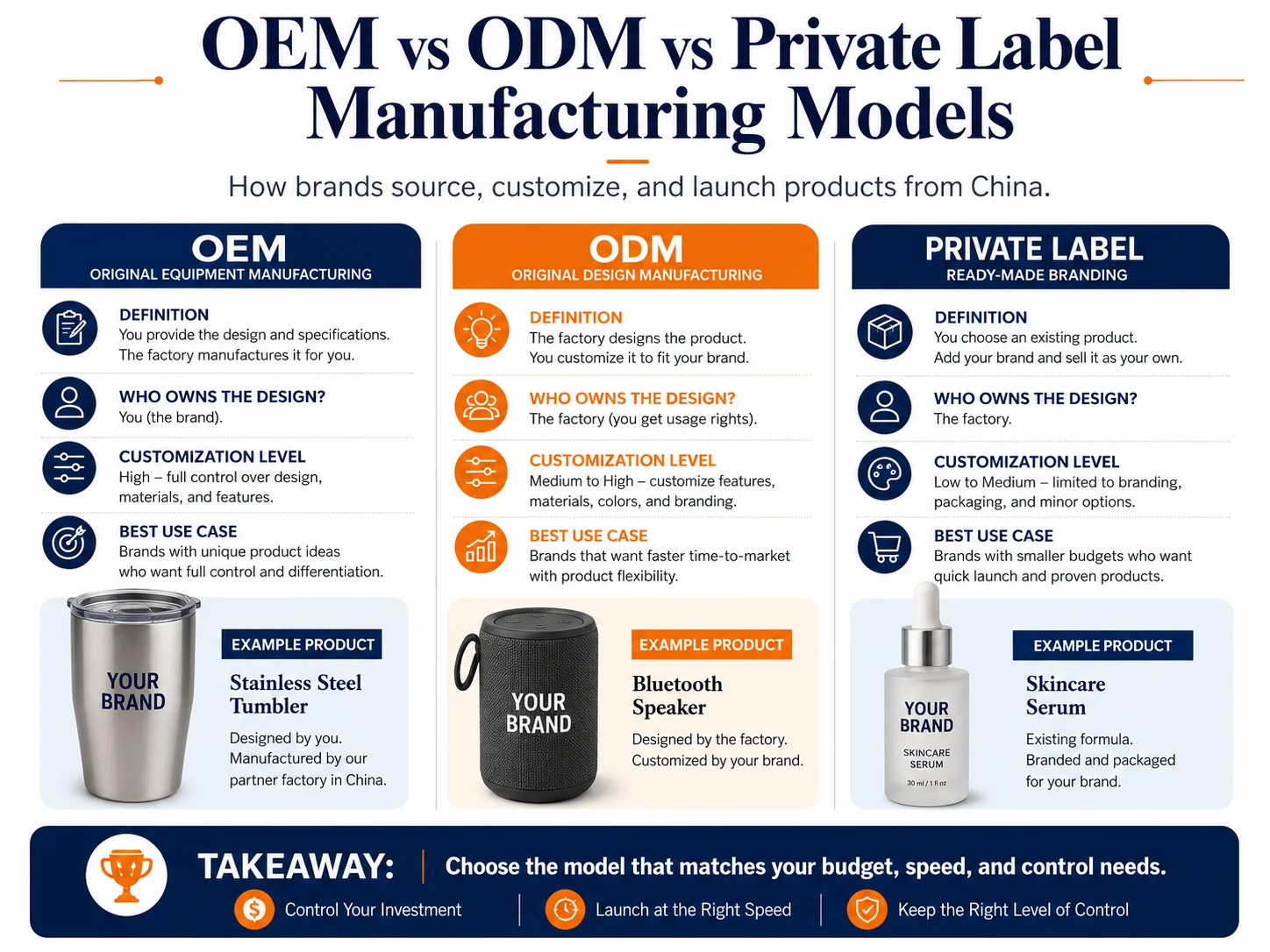
In our sourcing work, we see that these labels are not always used consistently by factories. One supplier’s “ODM service” may include color changes and packaging only, while another may offer product adjustments, tooling support, and engineering input. That is why we focus on the actual scope of work, not only the label.
Quick Answer: How Do OEM vs ODM vs Private Label Differ?
Many buyers want a simple answer because they need to choose a manufacturing route quickly. However, choosing too early can create a bigger problem: a buyer may invest in customization before validating whether customers actually want the product.
OEM means a factory produces a product based on your specifications. ODM means you adapt a supplier’s existing design. Private label means you sell an existing product under your own brand[^1], usually with customized logos, labels, packaging, colors, or product bundles. OEM provides the most control, while private label usually offers the fastest and lowest-risk starting point.
Start With Product Readiness, Not Manufacturing Terms
We recommend that buyers answer four practical questions before contacting suppliers:
-
What is already defined?
Do you have drawings, dimensions, materials, performance requirements, and reference samples? -
What must be different?
Does your product need a new function, a different material, custom sizing, or only branded packaging? -
What needs market validation?
Are you testing a product category, or do you already have proven sales data? -
What can your business accept?
Consider development cost, MOQ, sample timelines, inventory exposure, and cash flow.
A first-time seller with a $500–$2,000 testing budget usually needs a different path from an established DTC brand launching a proprietary product. Private label may help the first seller test demand. ODM may help a growing brand create visible differentiation without building a product from zero. OEM may suit a brand that already has a finished design and needs reliable production execution.
In our experience, unclear requirements create more sourcing delays than supplier response time. A factory cannot provide a meaningful quote when the buyer has not confirmed what they actually want produced.
What Do OEM, ODM, and Private Label Mean?
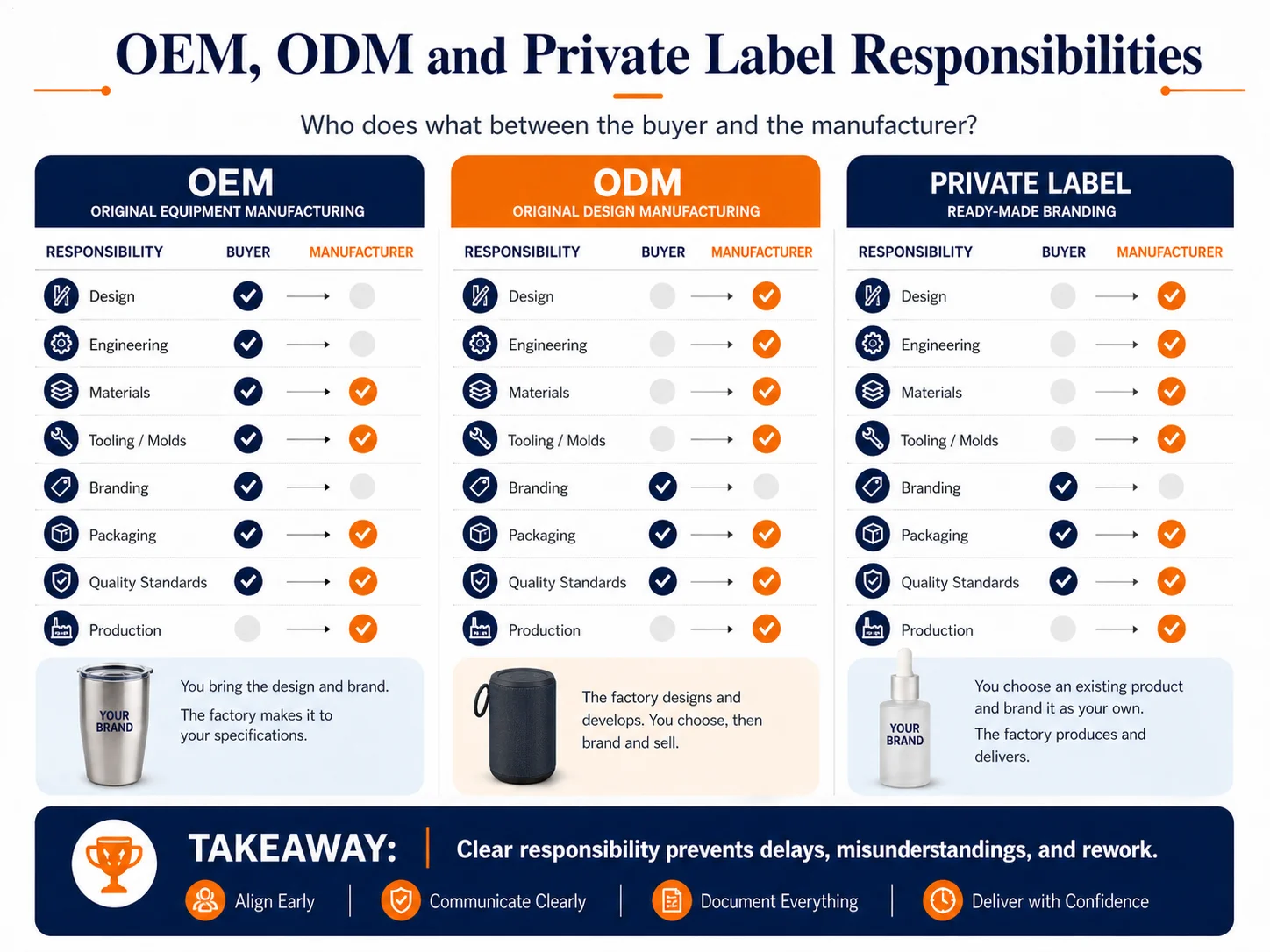
The terms OEM, ODM, and private label sound like fixed manufacturing categories. In practice, they are better understood as working arrangements between a buyer and a supplier. The exact responsibilities should always be confirmed in writing.
OEM manufacturing generally means the buyer provides the product requirements and the factory manufactures accordingly. ODM manufacturing generally starts with a supplier’s existing product design that the buyer modifies. Private label usually means branding an existing product with limited changes to logos, packaging, labels, color options, or bundles.
OEM: Buyer-Led Product Requirements
In an OEM project, the buyer normally provides more of the product direction. This may include:
- Technical drawings or CAD files
- Material specifications
- Product dimensions and tolerances
- Performance expectations
- Required certifications or test standards
- Brand artwork and packaging files
- A reference sample or “golden sample”
The factory may still provide engineering suggestions, production feedback, and material alternatives. However, the buyer usually needs to make key product decisions.
ODM: Supplier-Led Starting Point
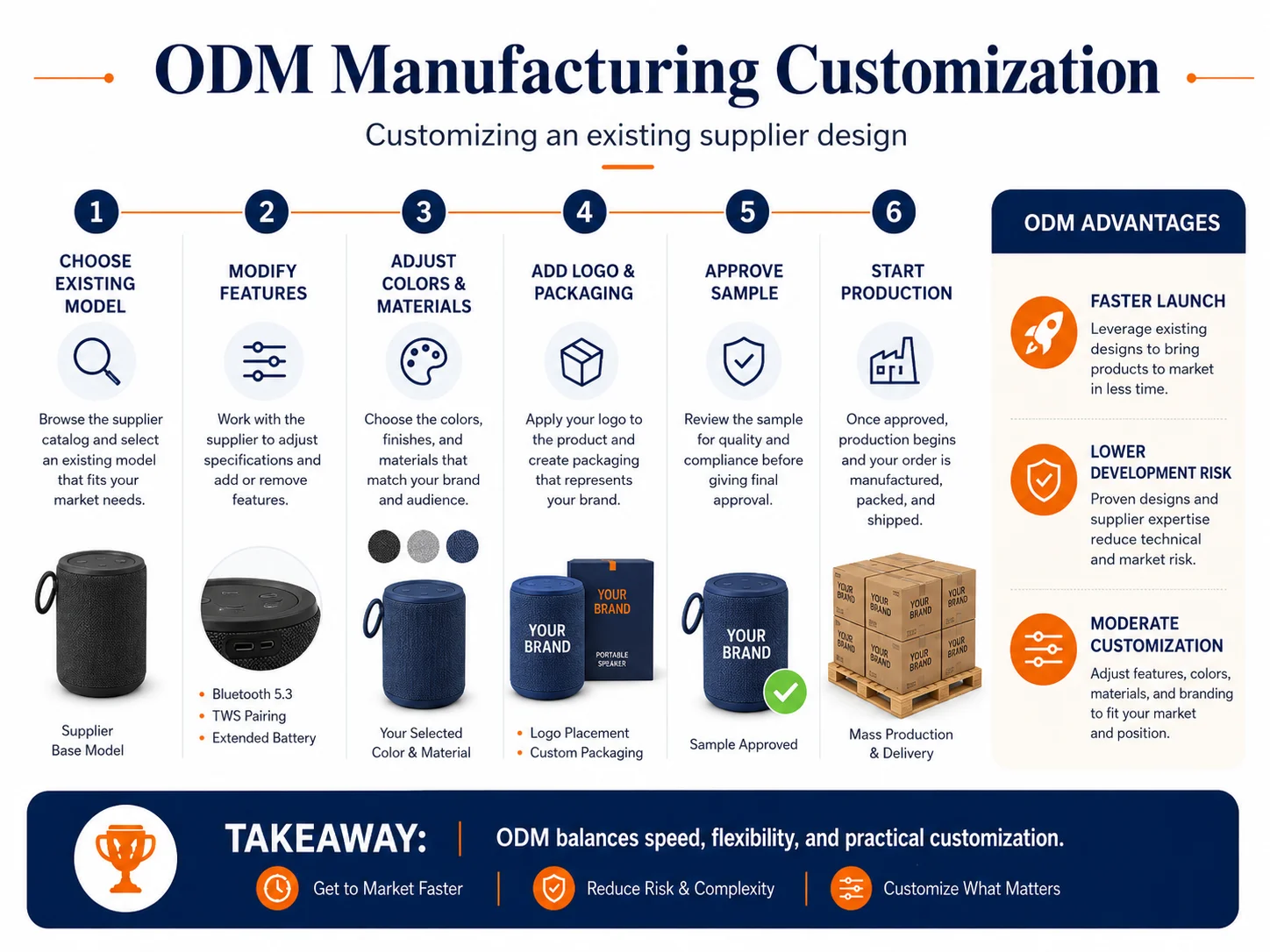
In an ODM project, the supplier already has a design, product structure, or production platform. The buyer can often adjust selected elements, such as:
- Color and finish
- Material grade
- Product size
- Functional configuration
- Accessories
- Surface printing
- Packaging design
The level of customization varies. Some factories can make meaningful changes. Others may only support simple branding. We always ask suppliers to list exactly what is included in their ODM offer.
Private Label: Brand-Led Presentation
Private label usually focuses on the commercial presentation of an existing item. You may add your logo, branded box, instruction leaflet, barcode label, inserts, or bundle components.
Private label does not automatically mean that you own the design, have exclusivity, or can prevent other buyers from selling a similar product.[^2] Those issues need separate discussion, documentation, and professional legal advice where appropriate.
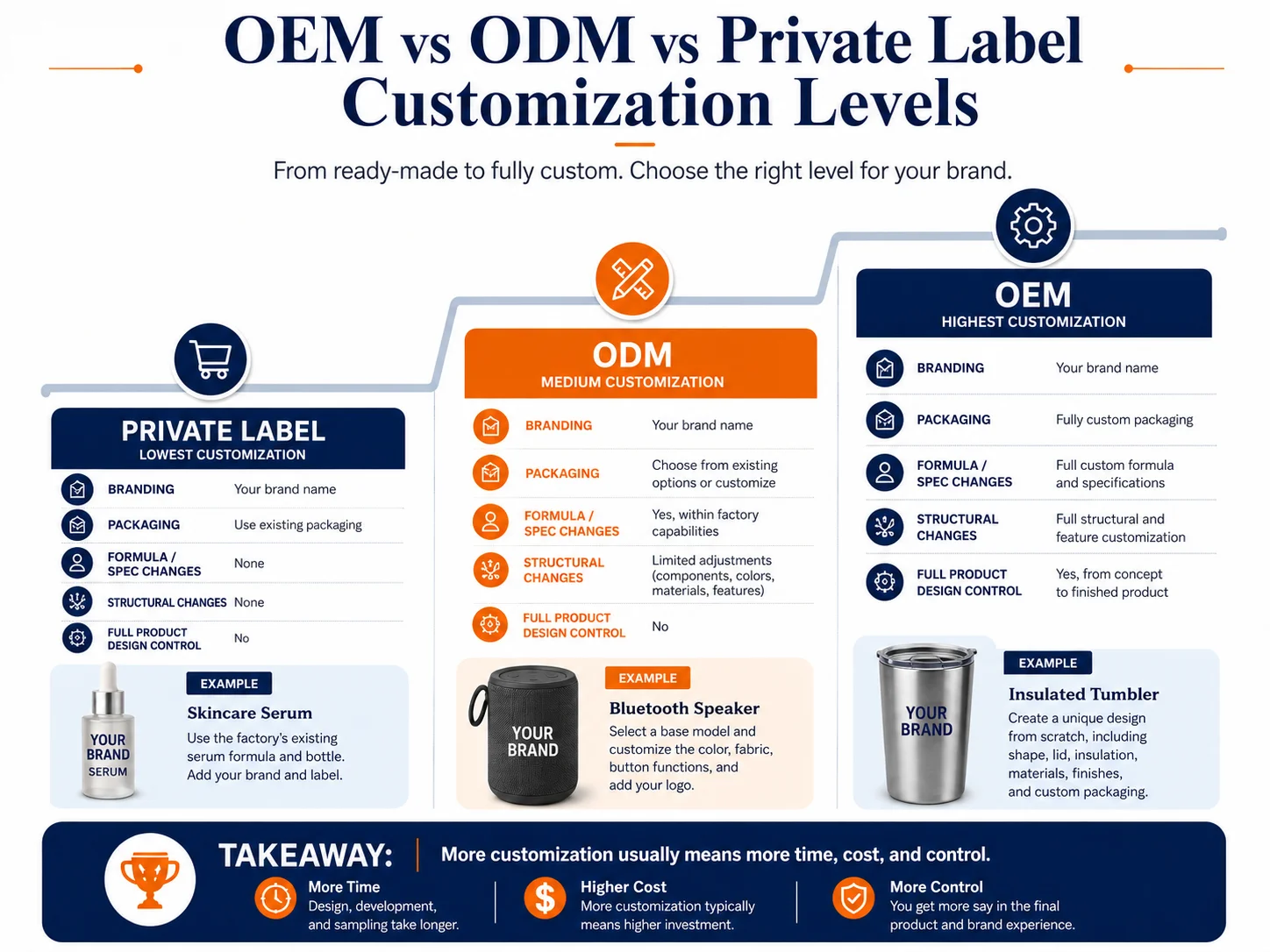
OEM vs ODM vs Private Label: Which Model Offers the Most Customization?
Customization sounds attractive, but it can increase cost, MOQ, complexity, and time before launch. Buyers often assume that more customization always creates a better brand. We have seen the opposite happen when a product becomes too complicated before demand is proven.
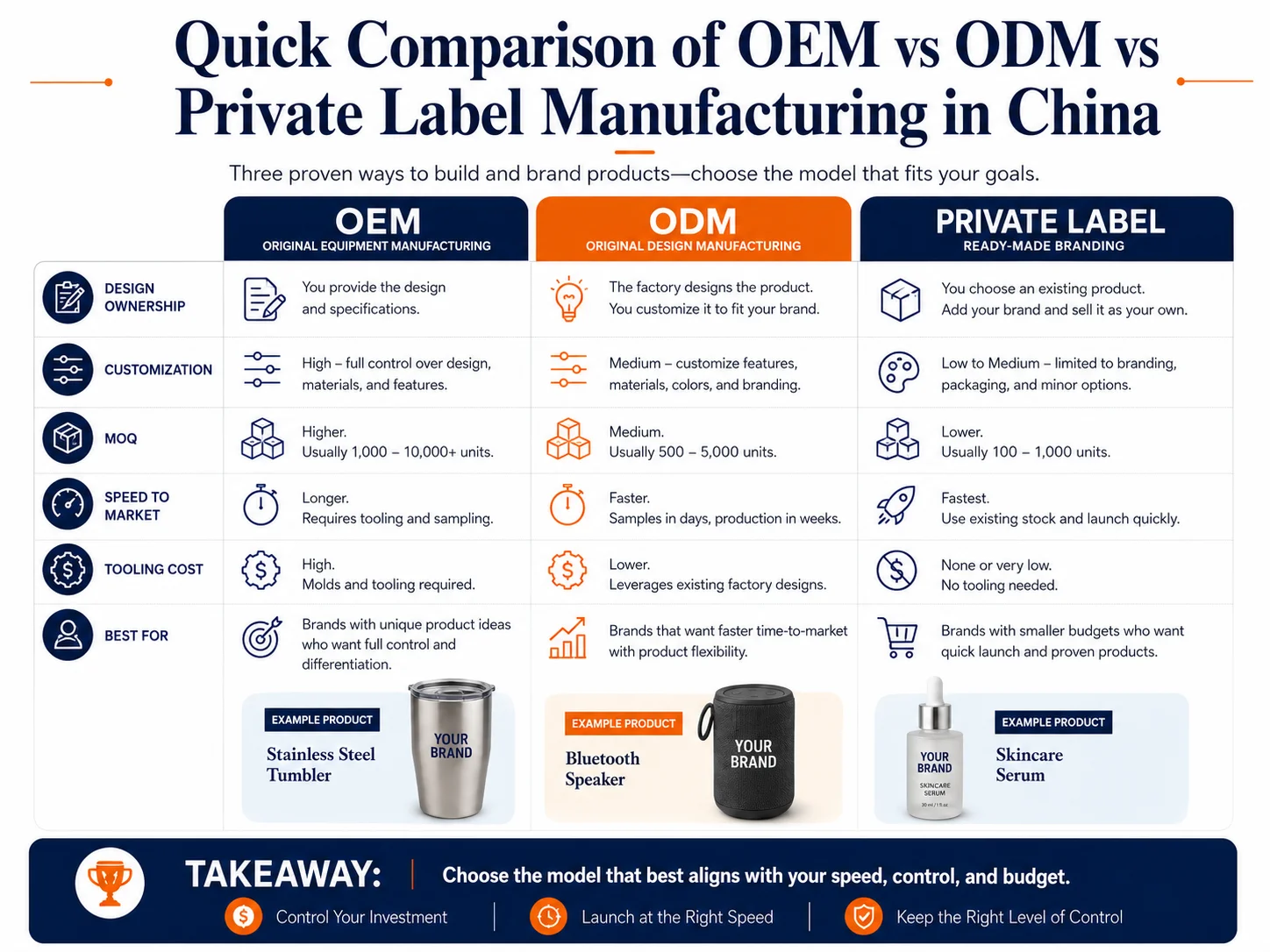
OEM usually offers the highest customization level because the product can be made to buyer specifications. ODM offers moderate customization based on an existing supplier design. Private label offers the least product-level customization[^3] but can still create a strong branded customer experience through packaging, positioning, and bundles.
| Factor | OEM | ODM | Private Label |
|---|---|---|---|
| Product ownership | Depends on agreement and development inputs | Often supplier-led starting design | Usually supplier’s existing product |
| Product customization | High | Moderate | Low |
| Development cost | Usually higher | Moderate | Usually lower |
| MOQ | Often higher | Moderate to high | Often lower |
| Lead time | Usually longer | Moderate | Usually faster |
| Tooling needs | More likely | Sometimes needed | Rarely needed |
| Packaging customization | Available | Available | Common |
| Best fit | Established product concept | Brands seeking faster differentiation | New brands testing a market |
Customization Is Not Only About the Product
A buyer can create differentiation in several ways without immediately changing product tooling or internal structure. For example, a kitchen-product seller may build a stronger offer through:
- A better product bundle
- Clearer instructions
- More durable packaging
- A more useful accessory
- Improved color selection
- Better lifestyle photography
- A niche-specific product position
For example, we once worked on a basic product category where the buyer initially wanted a fully custom mold. After reviewing the market position, the buyer decided to test a private label version with improved packaging and a bundled accessory first. That approach helped reduce pre-launch risk while the buyer collected real customer feedback.
The key is to separate what customers truly value from what simply sounds innovative during product development.
When Should You Choose OEM Manufacturing?
OEM manufacturing can give your business more control, but it requires better preparation. Many buyers request OEM production when they actually need a standard product with custom branding. That mismatch can make suppliers quote high MOQs or development fees that do not fit the project.
You should consider OEM manufacturing when you have clear product specifications, a differentiated product concept, sufficient budget for development, and a realistic plan for testing samples and managing production. OEM is usually most suitable when product details—not just branding—must be controlled.
Signs That OEM May Be the Right Route
OEM can be appropriate when you already have:
- A detailed product specification sheet
- Product drawings, 3D files, or physical references
- Defined materials and quality requirements
- A unique function, structure, or size requirement
- Confirmed packaging requirements
- Enough projected volume to support MOQ
- A clear approach to samples and revision rounds
Prepare a Factory-Ready OEM Request
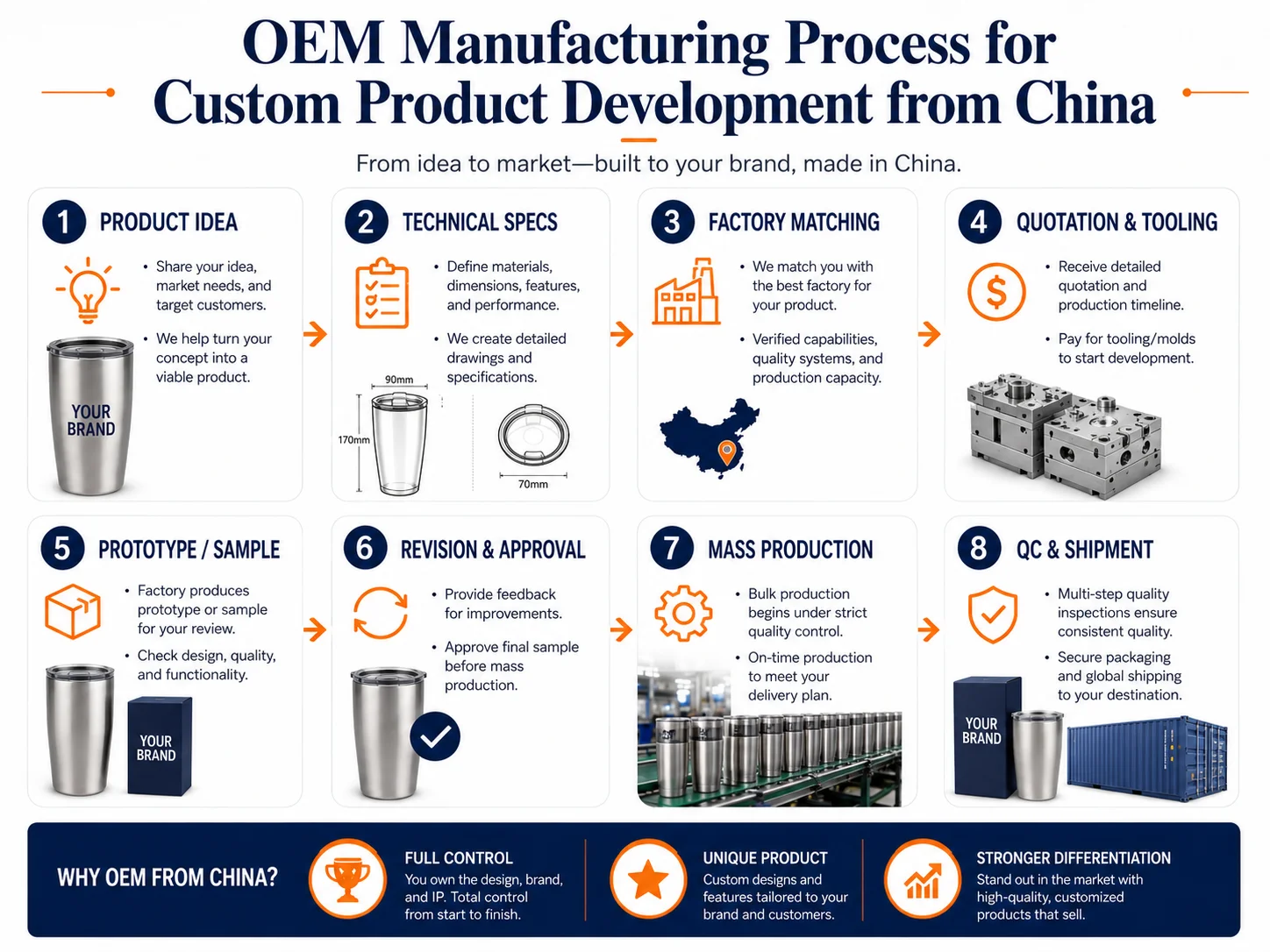
A useful OEM inquiry should include more than a product photo. We help buyers turn early concepts into supplier-ready documents by organizing:
| Information Needed | Why It Matters |
|---|---|
| Product dimensions | Helps suppliers assess materials and production methods |
| Material requirements | Prevents incomparable quotations |
| Color and finish | Affects raw material and surface-treatment options |
| Target quantity | Determines MOQ and unit-price range |
| Packaging details | Affects carton size, labor, and total cost |
| Target market | Helps identify labeling and compliance considerations |
| Sample expectations | Clarifies timing and development scope |
OEM projects can involve tooling, prototype revisions, new packaging structures, or new production processes.[^4] These are not reasons to avoid OEM. They are reasons to plan carefully.
We recommend that buyers avoid treating an early factory quote as a final cost commitment. If the product is still changing, the quote is usually only an estimate based on incomplete information. A confirmed sample and finalized specifications normally create a more reliable production quotation.
When Should You Choose ODM Manufacturing?
ODM can be a practical middle ground for brands that need more than a logo but do not want the cost and uncertainty of building a product from the ground up. The risk is assuming that every supplier’s ODM capacity is the same.
You should choose ODM manufacturing when you want to build on a supplier’s existing product platform while changing selected features, materials, colors, functions, or configurations. ODM can reduce development work compared with OEM[^5], but buyers still need to confirm exactly which modifications the supplier can make.
Ask Suppliers What “ODM” Actually Includes
When we coordinate ODM supplier discussions, we avoid asking only, “Do you offer ODM?” Nearly every factory may say yes. Instead, we ask practical questions:
- Which product components can be changed?
- Can the size, material, color, or function be modified?
- Is a new mold required for the requested change?
- What is the MOQ for each customization option?
- Is there a development fee or sample fee?
- Can the supplier provide previous customization examples?
- What lead time applies after sample approval?
- What packaging formats can the factory support?
Common ODM Scenarios
ODM is often useful for products such as consumer accessories, home goods, fitness products, pet products, small electronics, and lifestyle items where a supplier has an existing structure but can offer selected variations.
For example, a supplier may have a standard travel bottle set. An ODM buyer might request:
- A different bottle capacity
- A custom silicone color
- A revised lid configuration
- A branded storage pouch
- A retail-ready gift box
- A selected accessory combination
That is more differentiated than simple private label, but it is less complex than designing every part from the beginning.
ODM can make sense when your product idea is clear enough to guide changes but not mature enough to justify deep engineering investment. It can also help a growing brand test which features customers value before committing to a fully custom OEM version.
When Is Private Label the Best Choice?
Private label is often misunderstood as a low-quality shortcut. It is not. A well-managed private label product can be a smart way to test demand, launch a focused catalog, and learn how customers respond before committing more capital.
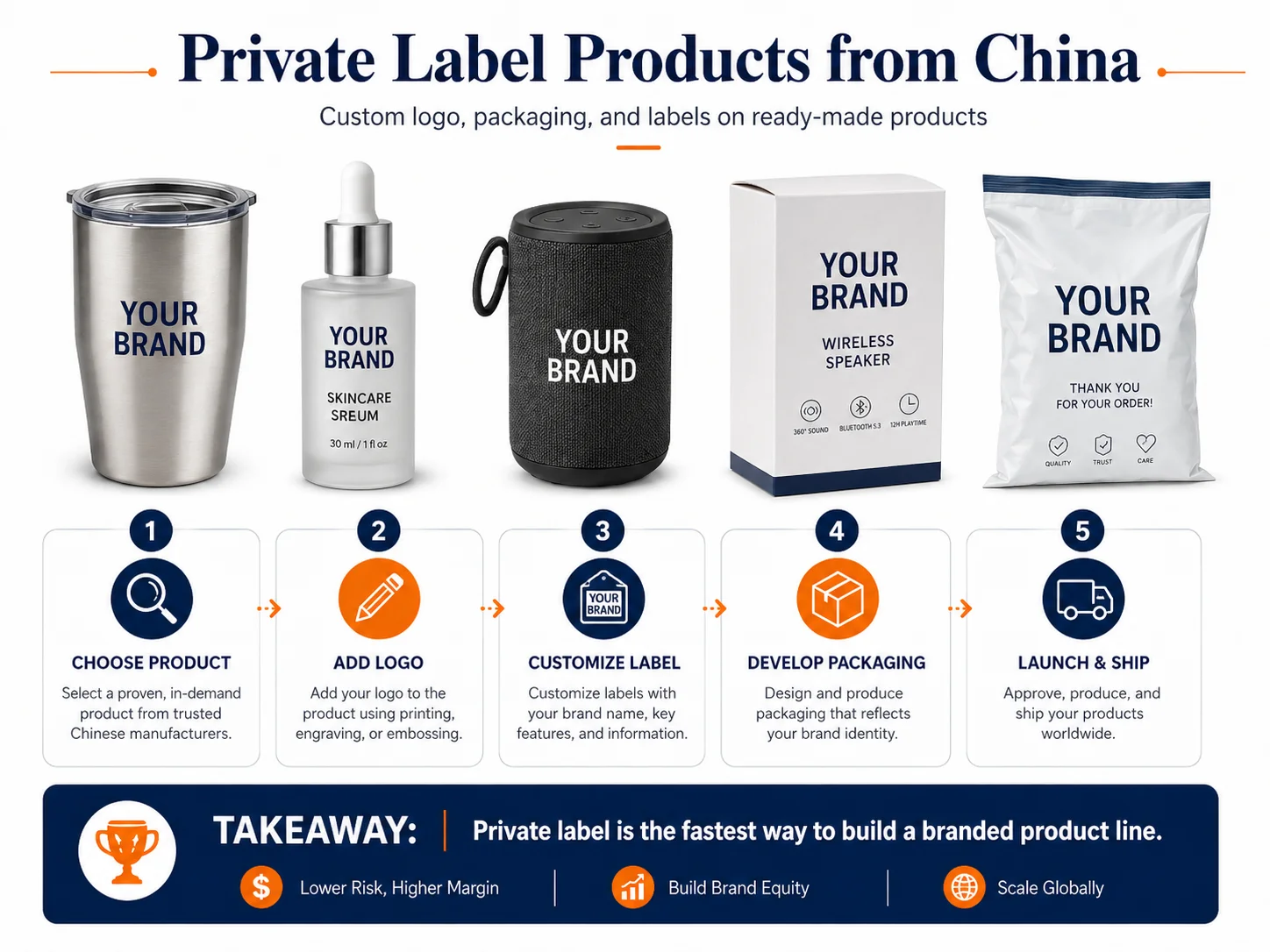
Private label is often the best choice for new brands, retailers, and online sellers that want to launch quickly using an existing product[^6] while customizing branding, packaging, labels, inserts, colors, or product bundles. It usually requires less development work than OEM or ODM.
Private Label Works Best When Speed Matters
Private label is worth considering when you want to:
- Test a new category with lower upfront risk
- Launch a branded product faster
- Avoid major product-development costs
- Use an existing, proven supplier item
- Focus resources on marketing and customer acquisition
- Build a branded bundle rather than a new invention
However, buyers should still evaluate the product carefully. A standard item can still fail if the material quality is poor, the packaging is weak, or the supplier cannot maintain consistency.
Your Brand Experience Still Needs Control
Even for private label products, we recommend confirming:
- Product quality standard
- Product color and appearance
- Logo placement and printing method
- Label content
- Instruction manual language
- Packaging artwork
- Carton marking
- Barcode requirements
- Inspection criteria
- Shipping method and delivery terms
A private label item becomes more credible when every customer-facing detail is aligned. A clean package, readable instructions, reliable labeling, and a consistent product finish can matter more than a minor technical feature that customers never notice.
Private label does not provide automatic exclusivity. If exclusivity matters to your business, you should discuss it directly with the supplier and seek professional legal guidance for agreements, trademarks, and intellectual-property protection.
How Do Cost, MOQ, and Lead Time Differ Across OEM vs ODM vs Private Label?
Cost is not only the unit price. Buyers often compare supplier prices without including samples, tooling, packaging, inspection, freight, defects, and inventory risk. That can make a low unit-price quote look cheaper than it really is.
Private label often has the lowest development cost and may allow lower MOQs because it uses an existing product.[^7] ODM may require additional sample work or modification costs. OEM can involve the highest upfront investment because custom materials, tooling, engineering, and testing may be needed. Actual cost and lead time depend on the product and supplier.
Typical Cost Areas to Review
| Cost Item | OEM | ODM | Private Label |
|---|---|---|---|
| Product development | Often required | Sometimes required | Usually limited |
| Tooling or mold cost | More likely | Possible | Less common |
| Sample fee | Often higher | Moderate | Usually lower |
| Custom packaging | Common | Common | Common |
| MOQ | Often higher | Varies | Often more flexible |
| Unit cost | Can improve at scale | Depends on changes | Based on standard product |
| Quality inspection | Recommended | Recommended | Recommended |
Look at Total Landed Cost
A useful sourcing comparison includes:[^8]
- Factory product cost
- Custom packaging cost
- Sample and development cost
- Tooling or mold cost
- Inspection cost
- Warehousing or consolidation cost
- International shipping
- Import duties, taxes, and destination charges
- Expected cost of slow-moving inventory
We often advise smaller buyers to protect cash flow first. If you have not validated demand, a lower MOQ and simpler product may create a stronger business position than a heavily customized item with a large inventory commitment.
A faster launch is not always better, either. A rushed order with unconfirmed packaging, unclear logo artwork, or no approved sample can create expensive problems after production starts.
How Should You Manage Specifications, Samples, and Packaging Development?
Many sourcing problems appear after the buyer and supplier believe they have agreed. The buyer may expect one material, while the factory uses another acceptable alternative. The buyer may expect premium packaging, while the supplier quotes a basic box. Clear confirmation prevents these gaps.
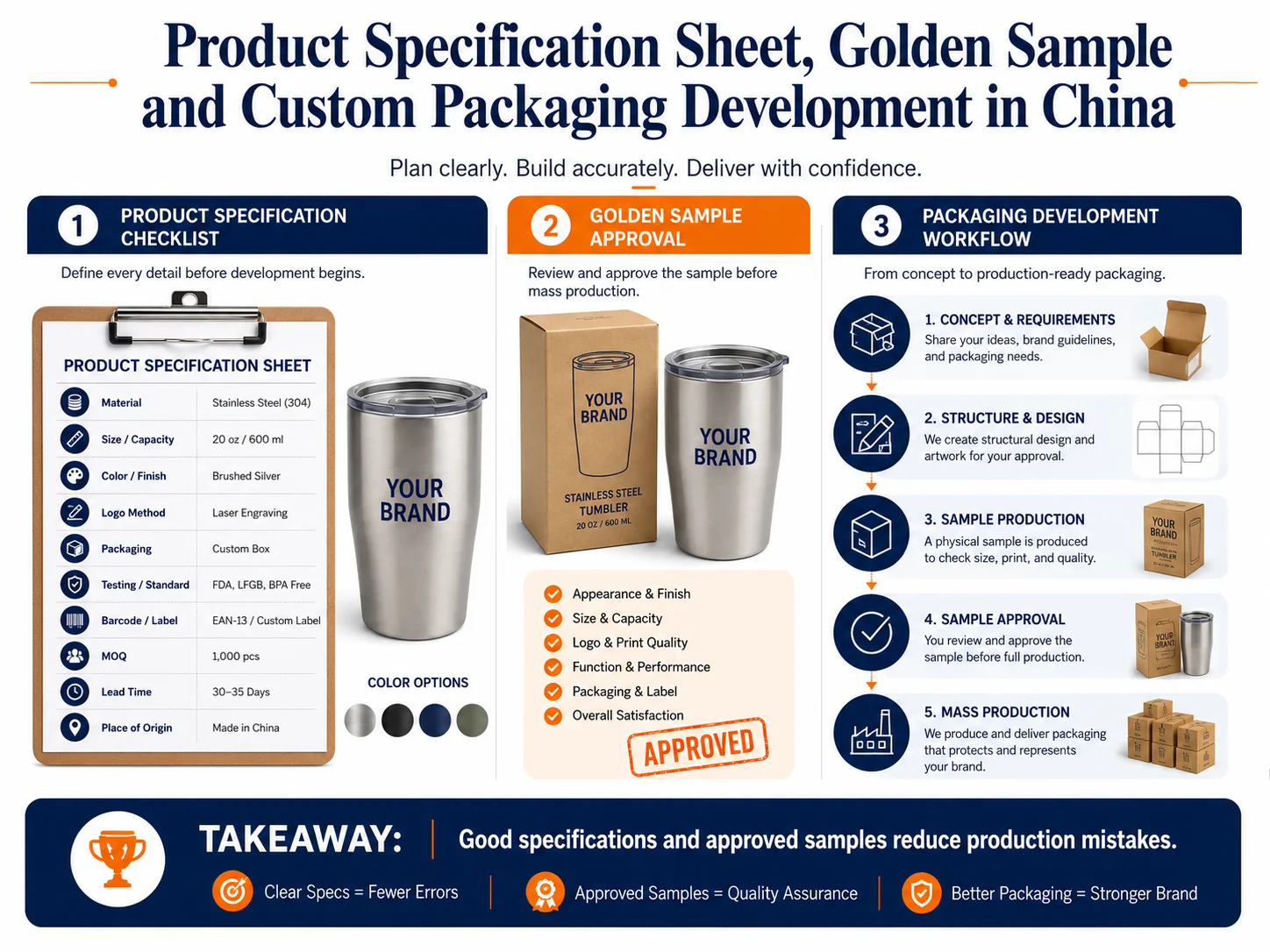
For OEM, ODM, and private label projects, buyers should confirm written specifications, approved samples, logo artwork, packaging files, labeling requirements, and inspection standards before mass production.[^9] A signed or clearly approved golden sample gives both sides a practical production reference.
Build a Clear Specification Pack
A practical specification pack may include:
- Product name and SKU
- Product photos or drawings
- Dimensions and tolerances
- Materials and colors
- Functional requirements
- Required accessories
- Logo size and placement
- Packaging dielines and artwork
- Label, barcode, and warning text
- Carton requirements
- Quality acceptance criteria
Why the Golden Sample Matters
A golden sample is an approved reference sample that guides production and quality inspection.[^10] It should reflect the agreed product as closely as possible, including the product, color, finish, logo, accessories, and packaging where available.
For a private label project, the golden sample may focus on logo application and packaging. For an ODM project, it may include the approved modified feature. For OEM, it may be especially important because more product details are new or buyer-defined.
We also recommend checking the sample against the final purchase order and specification sheet. A sample alone may not include every requirement. For example, it may not show carton marks, instruction wording, barcode placement, or final packing quantity.
At KingSourcing, we help buyers coordinate sample feedback in a structured way. Instead of sending scattered messages, we organize comments by issue, photo, requested change, and approval status. This makes supplier communication clearer and helps prevent the same mistake from reaching mass production.
How Can KingSourcing Help You Choose the Right Manufacturing Model?
Choosing between OEM, ODM, and private label requires local supplier communication, careful comparisons, and disciplined follow-up. Buyers without a China-based team can struggle to compare factories because each supplier may quote a different scope.
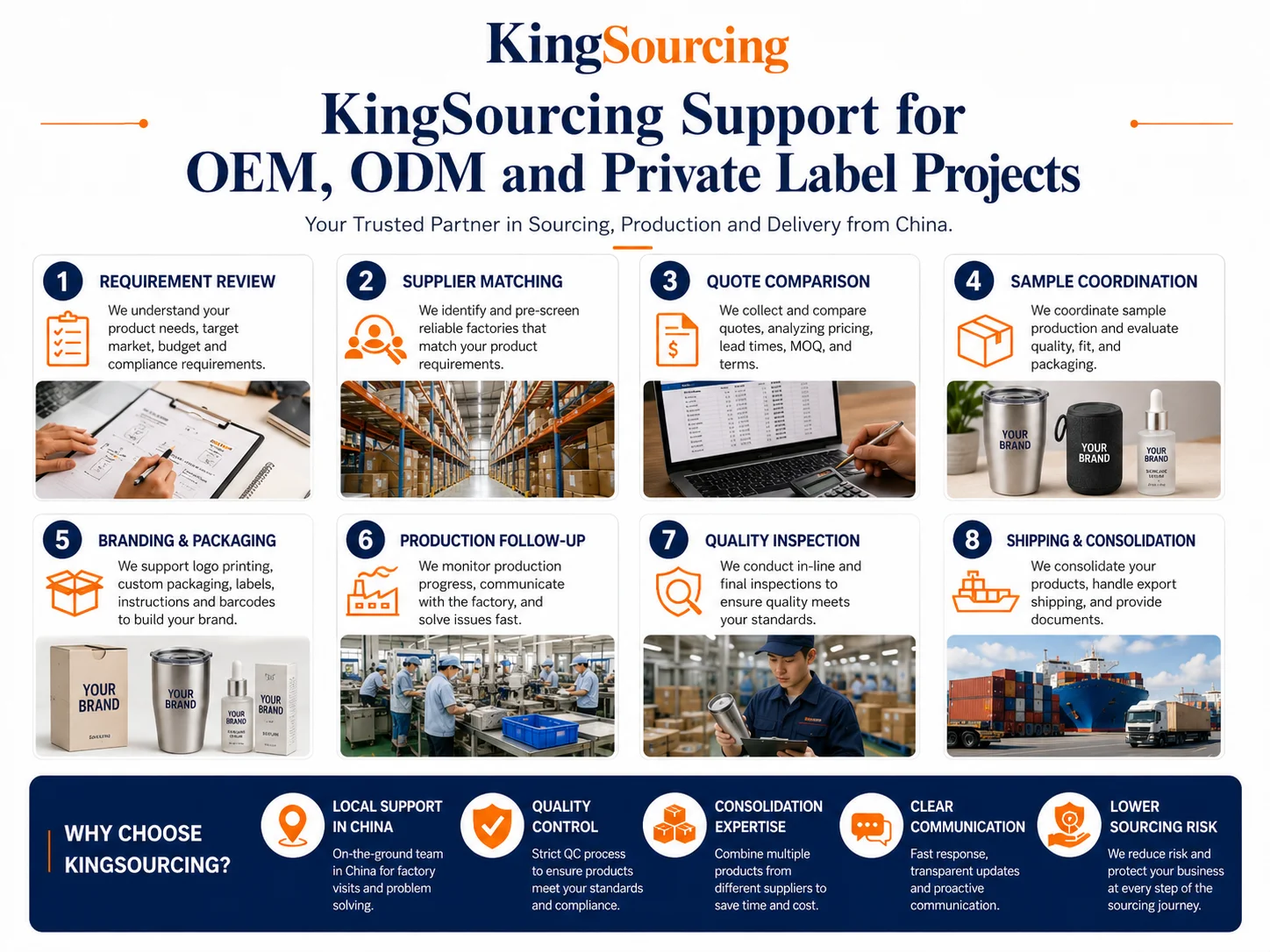
KingSourcing helps buyers evaluate OEM, ODM, and private label options by clarifying product requirements, finding suitable suppliers, comparing quotations, managing samples, coordinating packaging, monitoring production, conducting quality checks, and arranging international shipping. We act as your practical sourcing and supply-chain coordination team in China.
Our Practical Sourcing Workflow
We support clients through steps such as:
-
Requirement review
We clarify the product concept, budget, quantity, target market, packaging needs, and desired customization. -
Supplier research and screening
We identify suppliers that match the product category and project stage. -
Comparable quotation collection
We help make sure suppliers quote against the same core requirements. -
Sample coordination
We organize sample requests, feedback, revisions, and approval records. -
Packaging and branding support
We coordinate logo files, labels, inserts, boxes, and product bundles. -
Production follow-up and quality control
We monitor key stages and can arrange 1-by-1 product inspection where needed. -
Warehousing and shipping
We can consolidate products, arrange product photography, prepare shipments, and coordinate door-to-door logistics.
We Help Buyers Avoid False Comparisons
A supplier quote is only useful when the scope is comparable. One supplier may include a color box, while another quotes a polybag. One may quote a standard material, while another includes a higher-grade version. One may include logo printing, while another treats it as an extra charge.
Our role is to help buyers see these differences before they place an order. We do not recommend a manufacturing model simply because it sounds more advanced. We help you choose the route that fits your product maturity, budget, timeline, and market-validation plan.
Frequently Asked Questions About OEM vs ODM vs Private Label
Is OEM more expensive than ODM?
OEM can be more expensive than ODM because it may involve product development, custom materials, engineering work, tooling, and higher MOQs. However, this depends on the product. A simple OEM project may cost less than a heavily modified ODM product. Buyers should compare the full scope, not only unit prices.
What is the difference between ODM and private label?
ODM usually involves modifying a supplier’s existing product design, such as changing materials, features, size, or configuration. Private label usually focuses on branding an existing product with a logo, packaging, labels, or bundle. The actual boundary varies by supplier, so confirm the customization scope in writing.
Which model has the lowest MOQ?
Private label often has the lowest MOQ because the supplier uses an existing product and production setup. However, custom logo printing, color boxes, or special packaging can increase the required quantity. MOQ depends on the factory, product category, material, and customization details.
Can I customize an ODM product?
Yes, many suppliers allow ODM customization. You may be able to adjust color, finish, material, accessories, packaging, or selected functions. You should ask which changes require new tooling, sample fees, higher MOQs, or longer lead times before committing to the project.
Who owns the product design and tooling?
Ownership depends on the project facts, supplier agreement, design inputs, payments, and applicable laws.[^11] Buyers should not assume ownership simply because they pay for samples, molds, or private label packaging. Discuss ownership terms clearly and seek qualified legal advice when intellectual property is important.
Which manufacturing model is best for a new brand?
Private label is often the most practical starting point for a new brand because it can reduce development risk and speed up market testing.[^12] ODM may suit a brand that needs moderate differentiation. OEM can be appropriate when the brand has validated demand and clear, factory-ready product specifications.
Conclusion
OEM vs ODM vs Private Label is not a choice of “best” versus “worst.” It is a decision about how defined your product is, how much customization your market needs, and how much development risk your business can carry. Private label can help you test quickly. ODM can create practical differentiation. OEM can support deeper product control when your specifications are ready. If you are sourcing from China and need help turning a product idea into clear supplier questions, comparable quotes, approved samples, and controlled production, contact KingSourcing to make your China sourcing simpler.
Tags: OEM vs ODM, Private Label Manufacturing, China Product Development, Custom Product Manufacturing, Private Label Products from China, China Sourcing Agent, Import from China
[^1]: "Original equipment manufacturer", https://en.wikipedia.org/wiki/Original_equipment_manufacturer. OEM commonly denotes manufacture to another party’s specifications or brand, ODM denotes supplier-developed designs marketed by another firm, and private-label goods are marketed under the purchaser’s brand; contractual practice can vary by industry and jurisdiction. Evidence role: definition; source type: encyclopedia. Supports: Definitions of OEM, ODM, and private-label production as buyer-specification manufacturing, supplier-developed designs, and goods marketed under a reseller’s brand.. Scope note: Terminology is not applied uniformly in every supply contract or manufacturing sector. [^2]: "Trademarks", https://www.wipo.int/en/web/trademarks. Trademark branding, ownership of product designs, and exclusive supply or distribution rights are legally distinct interests; use of a private label alone does not ordinarily establish all of them without applicable rights or contractual terms. Evidence role: general_support; source type: institution. Supports: That trademark rights, design rights, and contractual exclusivity are distinct legal interests that generally require separate legal bases or agreements.. Scope note: The precise outcome depends on the governing law, registrations, contract language, and underlying design facts. [^3]: "FDI Manufacturers and Their Upgrading Strategies - PMC", https://pmc.ncbi.nlm.nih.gov/articles/PMC7152134/. Descriptions of OEM, ODM, and private-label arrangements generally distinguish buyer-specified production from adaptation of a supplier design and branding of an existing product, implying progressively less product-level customization in typical cases. Evidence role: general_support; source type: education. Supports: The usual relationship between these production models and the degree of buyer control over product design and branding.. Scope note: Individual suppliers may offer atypical customization packages, so the hierarchy is not a contractual rule. [^4]: "Development of Functional Rapid Prototyping for the ...", https://scholarworks.uni.edu/cgi/viewcontent.cgi?article=4828&context=grp. Manufacturing product-development guidance describes prototyping, tooling, iterative design refinement, and process planning as common activities when a product or its packaging is newly developed for production. Evidence role: mechanism; source type: government. Supports: That product development and manufacturing transfer commonly involve prototyping, tooling, design iteration, and process development.. Scope note: Whether each activity is needed depends on the product design, manufacturing process, and extent of customization. [^5]: "Why Vietnam Is the Ideal Destination for OEM & ODM ...", https://pressbooks.cuny.edu/inspire/part/why-vietnam-is-the-ideal-destination-for-oem-odm-garment-manufacturing/. Because ODM arrangements typically use a manufacturer’s pre-existing design or product platform, they can reduce the buyer’s initial design and engineering workload compared with developing a wholly new specification. Evidence role: mechanism; source type: research. Supports: That ODM arrangements begin from supplier-developed designs or platforms, potentially reducing the buyer’s initial design and engineering work.. Scope note: Reduced development work does not necessarily mean lower total cost, faster approval, or less technical risk for a particular modification. [^6]: "How Should National Brands Think about Private Labels?", https://sloanreview.mit.edu/article/how-should-national-brands-think-about-private-labels/. Private-label strategies commonly use existing supplier products and production capabilities, which can shorten development and launch time relative to creating a new product design. Evidence role: general_support; source type: paper. Supports: That private-label strategies commonly rely on existing products or supplier capabilities and can shorten product-development time to market.. Scope note: A faster launch remains contingent on supplier capacity, packaging approval, regulatory obligations, order quantities, and logistics. [^7]: "Private Label Introduction: Does it Benefit the Supply Chain ...", https://www.iese.edu/media/research/pdfs/DI-0832-E.pdf. Using an established product and production process can avoid portions of new-product development expenditure and may make smaller initial orders more feasible than a fully custom development project. Evidence role: general_support; source type: research. Supports: That reliance on established products and processes can avoid some new-product development expenditures and may affect supplier order requirements.. Scope note: Minimum order quantities and total costs are set by product economics, materials, decoration, packaging, and supplier policy; they are not inherent features of private labeling. [^8]: "Know Your Incoterms", https://www.trade.gov/know-your-incoterms. Landed-cost guidance treats the supplier price as only one component of import cost and commonly includes transportation, duties, taxes, insurance, handling, and other transaction-specific charges. Evidence role: definition; source type: government. Supports: The concept of landed cost as a broader measure than supplier unit price that includes transportation, duties, taxes, and related import costs.. Scope note: The applicable cost elements and their amounts vary by Incoterm, destination, tariff classification, tax treatment, and supply-chain arrangement. [^9]: "Use of quality assurance systems in the fastener industry", https://nvlpubs.nist.gov/nistpubs/Legacy/IR/nistir6001.pdf. Quality-management guidance emphasizes defining and controlling product requirements, documented information, and acceptance criteria before production so that conformity can be verified consistently. Evidence role: expert_consensus; source type: institution. Supports: The quality-management principle that production requirements and acceptance criteria should be defined and controlled before production and inspection.. Scope note: The exact documents and approval process should be adapted to the product, applicable regulations, and supplier quality system. [^10]: "Quality Control and Quality Acceptance of Concrete Airport ...", https://www.intrans.iastate.edu/wp-content/uploads/2026/03/ACPTP-2022-4_QC_QA_of_concrete_airfield_pvmt_w_cvr_508.pdf. In manufacturing quality control, an approved reference sample—often called a golden sample—serves as a visual and functional benchmark against which production output and inspection results can be compared. Evidence role: definition; source type: other. Supports: The industry use of an approved reference sample as a benchmark for production conformity and inspection comparison.. Scope note: A reference sample may not capture every contractual, dimensional, safety, labeling, or packaging requirement and should be used with written specifications. [^11]: "Negotiating Technology Licensing Agreements", https://www.wipo.int/edocs/pubdocs/en/licensing/906/wipo_pub_906.pdf. Ownership of designs, tooling, and related intellectual property may be allocated by contract and governed by jurisdiction-specific legal rules, rather than determined solely by who paid for development or samples. Evidence role: general_support; source type: institution. Supports: That intellectual-property and ownership outcomes in collaborative or commissioned development depend on legal rights, contractual allocation, and jurisdiction-specific rules.. Scope note: This is a general legal principle and not a determination of ownership in any individual transaction. [^12]: "How Should National Brands Think about Private Labels?", https://sloanreview.mit.edu/article/how-should-national-brands-think-about-private-labels/. By relying on existing products rather than financing a wholly new design, private-label entry can reduce initial product-development commitment and may be used to test market response before deeper investment. Evidence role: general_support; source type: paper. Supports: That using existing products in private-label strategies can reduce upfront product-development commitments and support testing of market response.. Scope note: This does not establish that private label is the best strategy for every new brand; product differentiation, quality, competition, and channel economics remain material.