Private label products from China can look simple at first: choose a product, add a logo, and start selling. In reality, unclear requirements, weak supplier communication, unexpected MOQs, and poor packaging decisions can quickly turn a promising idea into an expensive lesson. I recommend treating private labeling as a structured sourcing project from day one.
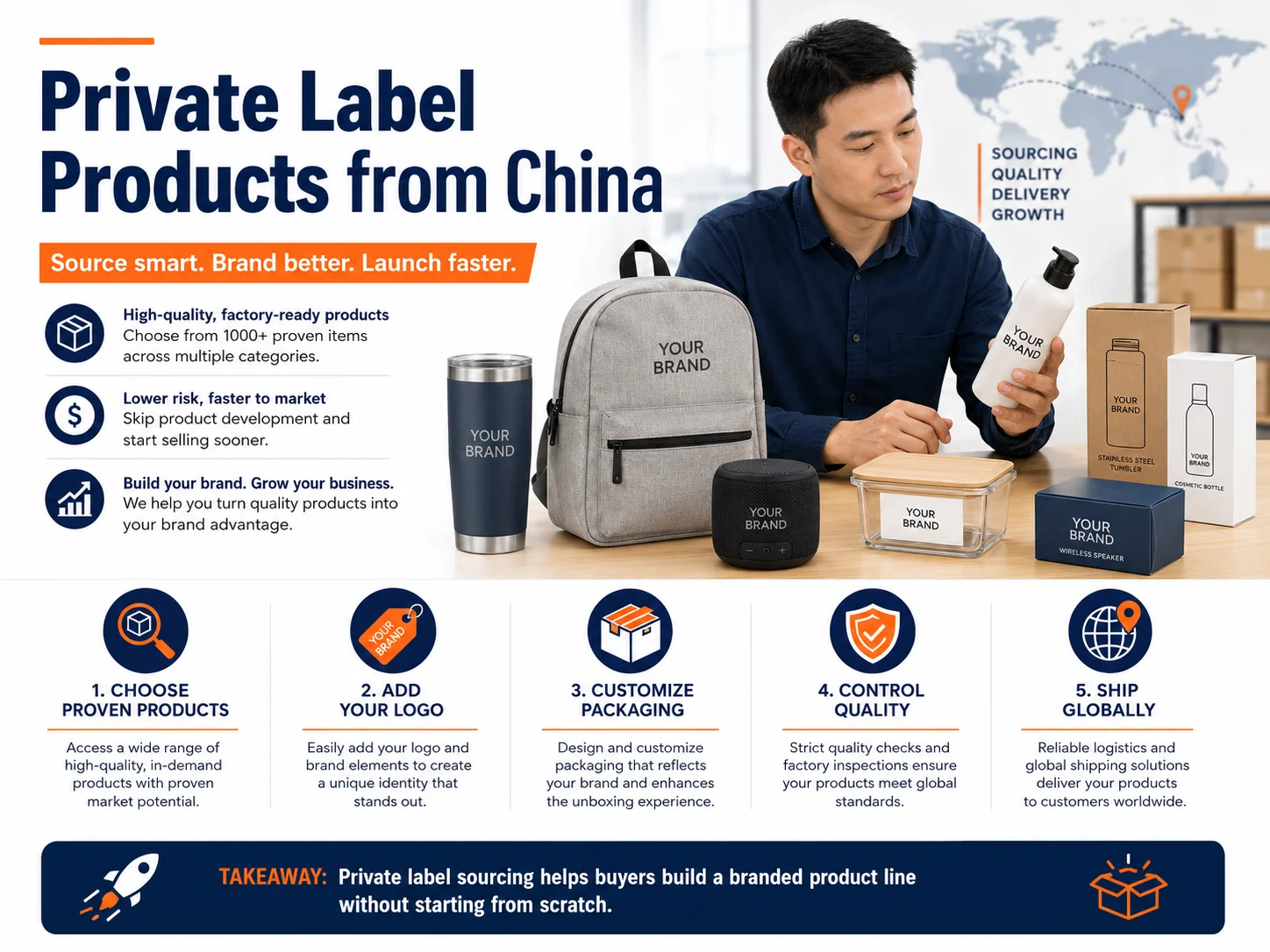
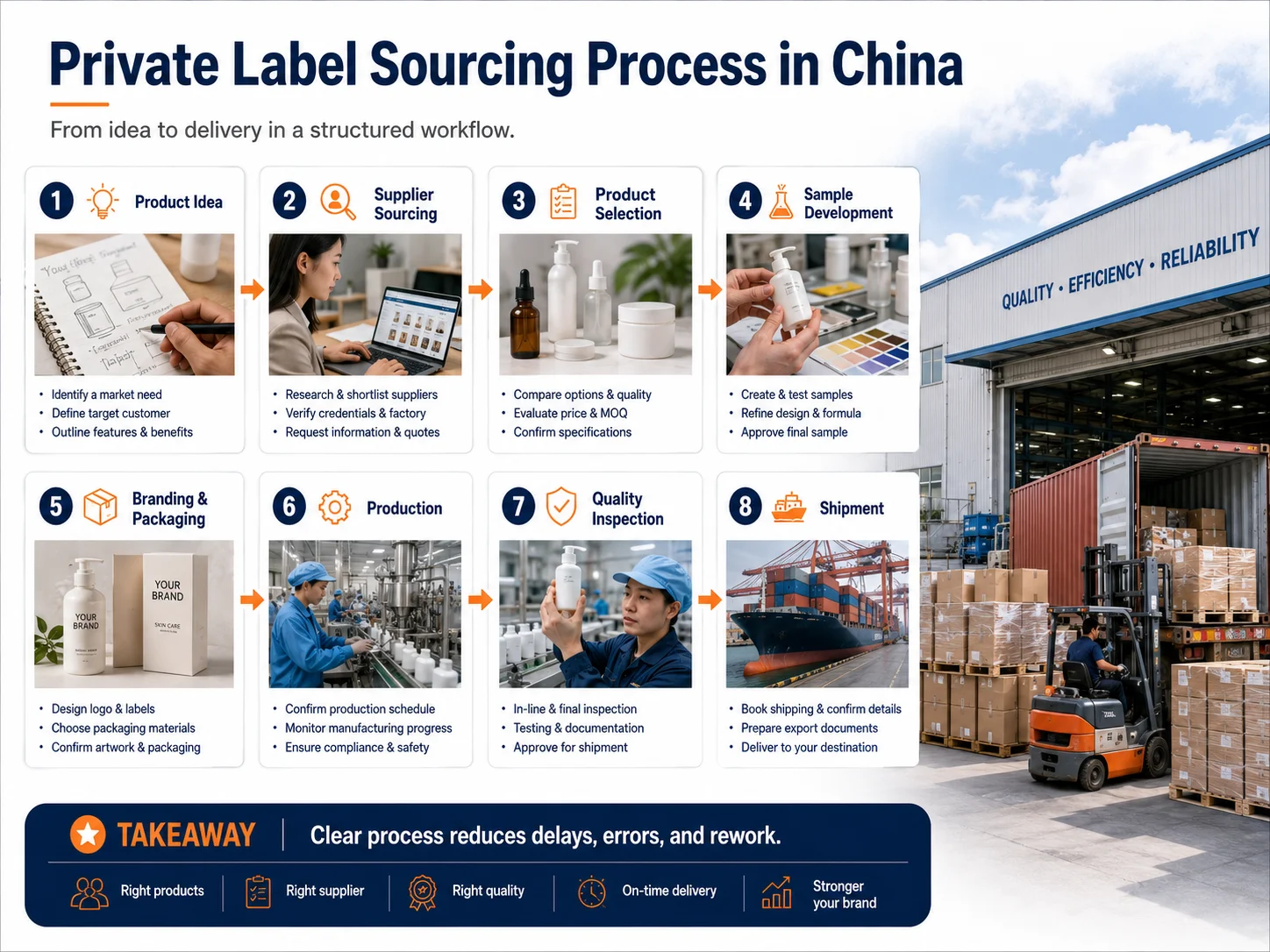
Private label products from China are products made by Chinese suppliers and sold under your own brand name.[^1] The process usually includes choosing a product, defining specifications, selecting a capable supplier, approving samples, developing packaging, monitoring production, inspecting quality, and arranging shipping. This model suits e-commerce sellers, DTC brands, wholesalers, and retailers that have a clear customer need, realistic budget, and workable order quantity.
I have seen first-time buyers focus too heavily on the logo while leaving the product, quality standard, and packaging details open to interpretation. The stronger approach is to first define why a customer would choose your version, then build a sourcing plan around that answer.
Quick Answer: How Do Private Label Products from China Work?
New buyers often want a fast path to launching a brand, but they may not know where private labeling begins or where factory responsibility ends. That uncertainty can lead to vague requests, mismatched quotations, and samples that do not support the intended market position.
I see private label products from China as a staged process. You choose a commercially viable product, create a clear sourcing brief, find suppliers that can support your required customization level, approve samples and packaging, confirm production standards in writing, inspect the order, and arrange shipment to your destination.
Who Is Private Labeling Best For?
In sourcing coordination, I find that private labeling is most suitable for buyers who can answer a few basic commercial questions before they contact factories:
- Who is the target customer?
- What problem does the product solve?
- Why would that customer choose this product over an existing alternative?
- What level of customization is actually necessary?
- What budget, MOQ, and lead time can the business support?
A beginner can start with a relatively simple project, such as an existing product with branded packaging, an instruction insert, a color selection, or a bundled accessory set. This approach usually requires less development work than changing a mold, redesigning electronics, or creating a completely new product.
However, small orders do not automatically mean every factory can offer deep customization. A supplier may accept a low MOQ for a logo sticker or polybag, yet require a much higher quantity for custom color, printed retail packaging, or product modification.[^2] I encourage buyers to see customization as a spectrum:
| Customization level | Typical example | Complexity |
|---|---|---|
| Basic branding | Logo sticker, hangtag, insert card | Lower |
| Packaging customization | Printed box, label, barcode, manual | Moderate |
| Product variation | Color, material, accessory, size change | Moderate to high |
| OEM development | Product changes based on your specification | High |
| ODM development | Supplier develops a new solution around your concept | Highest |
Your brand does not need to begin with a revolutionary product. It does need a clear reason to exist. Better convenience, stronger presentation, a more useful bundle, a niche audience, or more consistent quality can all be meaningful starting points.
What Are Private Label Products from China?
Many sellers use “private label,” “white label,” “OEM,” and “ODM” as if they mean the same thing. This creates confusion when factories quote different prices or explain different MOQs. I recommend learning these terms before comparing suppliers.
I define private label products from China as existing or semi-custom products manufactured by a supplier and sold under your own brand. The supplier makes the item, while you control the brand identity, sales channel, customer positioning, and often the packaging presentation.
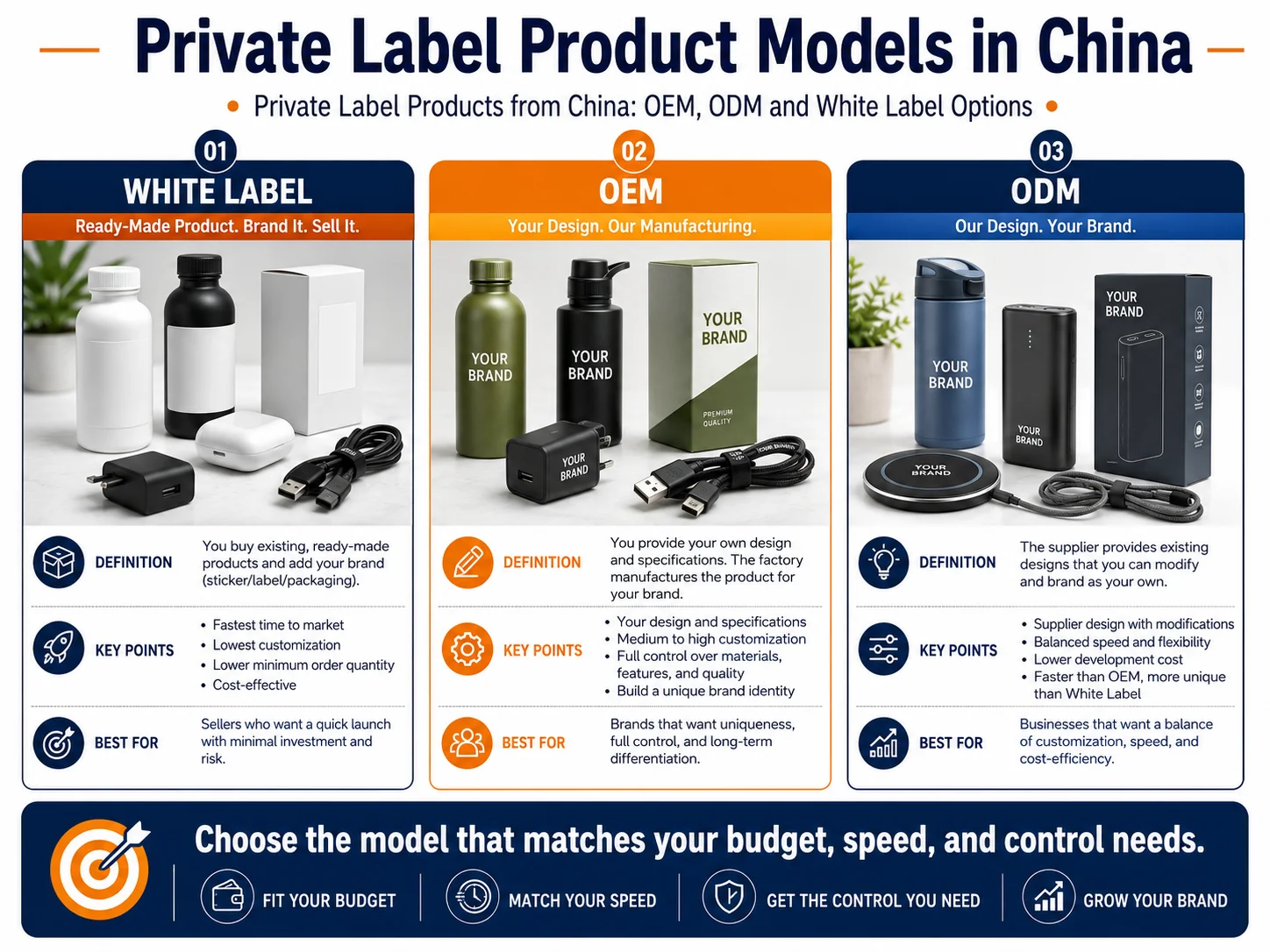
Private Label, White Label, OEM, and ODM Explained
Private label usually means you sell a product under your brand. The product may be standard, lightly modified, or customized depending on the supplier’s capability and your budget.
White label usually refers to a standard product that several buyers can brand and sell. It is often the fastest route, but it offers limited differentiation.
OEM, or Original Equipment Manufacturing, commonly involves a product made according to the buyer’s specifications. The buyer may request different materials, components, dimensions, features, or packaging. This can involve higher MOQs, tooling, and development work.
ODM, or Original Design Manufacturing, generally involves more supplier-led product development. A supplier may adapt an existing design platform or help develop a new product concept. The exact ownership and design rights should always be clarified contractually and verified with qualified legal support when necessary.[^3]
From my experience, most beginner projects fall between white label and basic private label. Buyers often start with a proven item, then improve the customer experience through packaging, a bundle, a color option, or a more focused product position.
A logo is not a product strategy. Your product, packaging, pricing, and customer experience should work together.
I also advise buyers not to claim exclusivity just because a supplier prints their logo. If exclusivity matters, discuss it early, document the arrangement clearly, and seek appropriate legal advice for your situation.
How Do Private Label Products from China Compare With White Label, OEM, and ODM?
Choosing the wrong product-development model can create unrealistic expectations. A buyer may want a fully custom product but only have the budget and order quantity for branded packaging. I prefer to make those trade-offs visible before sampling begins.
Private label products from China typically offer a middle path between simple white-label branding and fully customized OEM or ODM development. The right option depends on your differentiation goal, budget, MOQ tolerance, timeline, technical needs, and ability to manage a more complex supply chain.
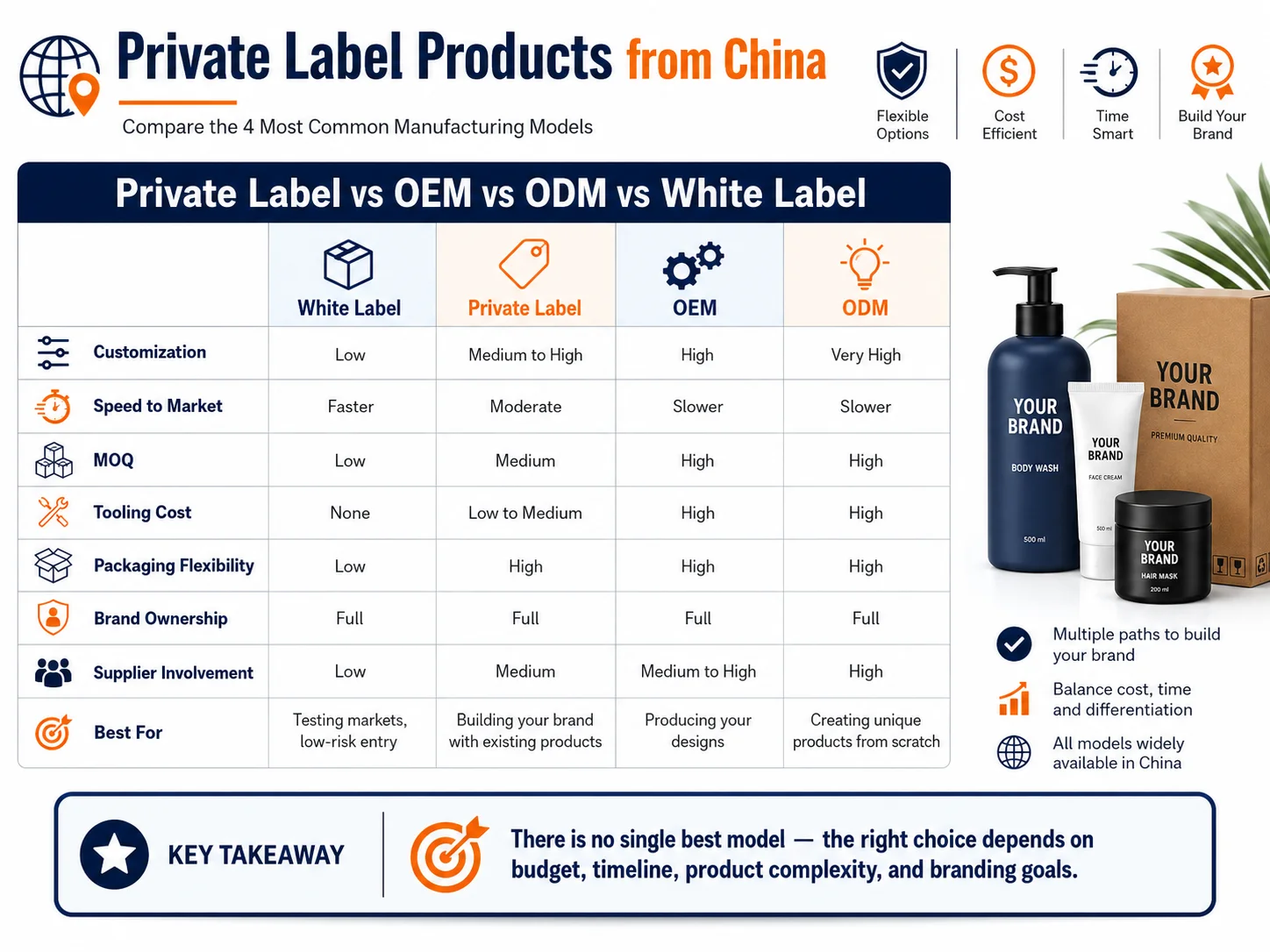
| Model | Customization | Typical MOQ | Development cost | Lead time | Best for |
|---|---|---|---|---|---|
| White label | Logo or simple label | Lower | Lower | Faster | Testing a market |
| Private label | Branding, packaging, selected variations | Low to medium | Low to medium | Moderate | Building a focused brand |
| OEM | Product made to buyer specifications | Medium to high | Higher | Longer | Established brands |
| ODM | Supplier-supported product development | Often higher | Higher | Longest | Buyers with a distinct concept |
How I Would Choose Between These Models
I would start by asking what customers will notice and value. If the main advantage is brand presentation, clearer instructions, a better bundle, or a niche-specific use case, private labeling may be enough.
If the product itself has a real weakness that affects user experience, then an OEM approach may be worth considering. For example, a buyer might need a more durable material, a different size range, a revised accessory set, or a change to how the product is assembled.
ODM can be useful when a supplier already has design and development resources that match the category. However, I would not assume every supplier has the same engineering capability or development process. Buyers should verify previous projects, sample quality, production experience, and who controls design files, tooling, and intellectual-property terms.
In practice, I often recommend a phased approach:
- Launch a simpler private-label version.
- Collect customer feedback and sales data.
- Improve packaging, bundles, or product details.
- Consider deeper OEM development once demand is proven.
This approach can reduce early risk. It also gives you more time to understand what customers truly want instead of investing heavily in assumptions.
How Do You Choose the Right Private Label Products from China?
A product can look popular online and still be a poor private-label opportunity. Crowded listings, expensive shipping, thin margins, and strict compliance requirements can make a product difficult for a new seller to manage. I encourage buyers to assess the business case before requesting quotations.
The right private label products from China have clear market demand, a defined target customer, enough margin to cover product and logistics costs, manageable competition, and realistic compliance and shipping requirements. I suggest validating the full landed-cost picture, not only the factory unit price.
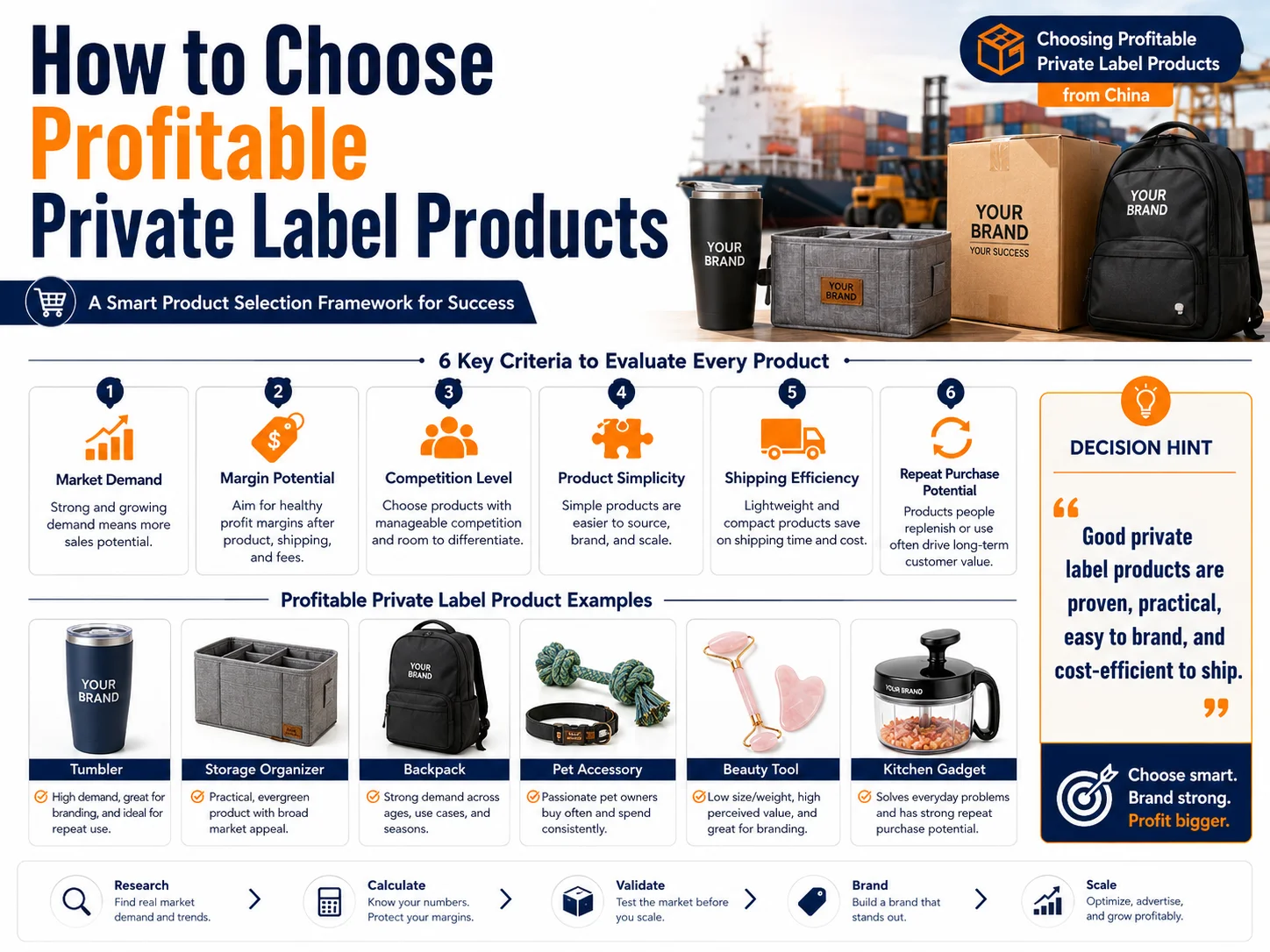
Evaluate the Product Beyond the Trend
I recommend starting with customer behavior. Read marketplace reviews, social comments, competitor feedback, and product questions. These sources can reveal recurring complaints that your brand may solve.
Look for issues such as:
- Weak packaging or poor unboxing experience
- Missing accessories
- Confusing instructions
- Poor material feel
- Limited color or size options
- Products that are hard to store, clean, or transport
- Features that customers repeatedly request
Then assess the commercial reality. A product with a low factory cost may still have poor profit potential if it is bulky, fragile, heavy, or expensive to return. A low-priced item can also leave little room for advertising costs, marketplace fees, and customer support.
| Evaluation area | Questions to ask |
|---|---|
| Demand | Is there evidence that customers actively buy this type of product? |
| Differentiation | What will make my offer more useful or more appealing? |
| Competition | Can I compete without relying only on a lower price? |
| Margin | Does the landed cost leave room for sales and operating costs? |
| Shipping | Is the item light, durable, and practical to ship? |
| Compliance | Does the category require product- or market-specific checks? |
For regulated categories such as children’s items, electronics, cosmetics, food-contact products, or products with safety claims, requirements may vary by country and product.[^4] I recommend working with qualified testing, compliance, customs, or legal professionals before placing an order.
How Do You Create a Clear Specification for Private Label Products from China?
Factories cannot quote or produce consistently when requirements are incomplete. A vague request such as “high quality, black color, premium box” leaves too much room for interpretation. I have seen many sample revisions happen because the buyer’s expectations were never written clearly.
A clear specification for private label products from China describes the product’s dimensions, materials, colors, functions, accessories, performance expectations, quality standards, packaging, and labeling requirements.[^5] It helps suppliers quote accurately, helps buyers compare offers fairly, and creates a reference for sample approval and quality inspection.
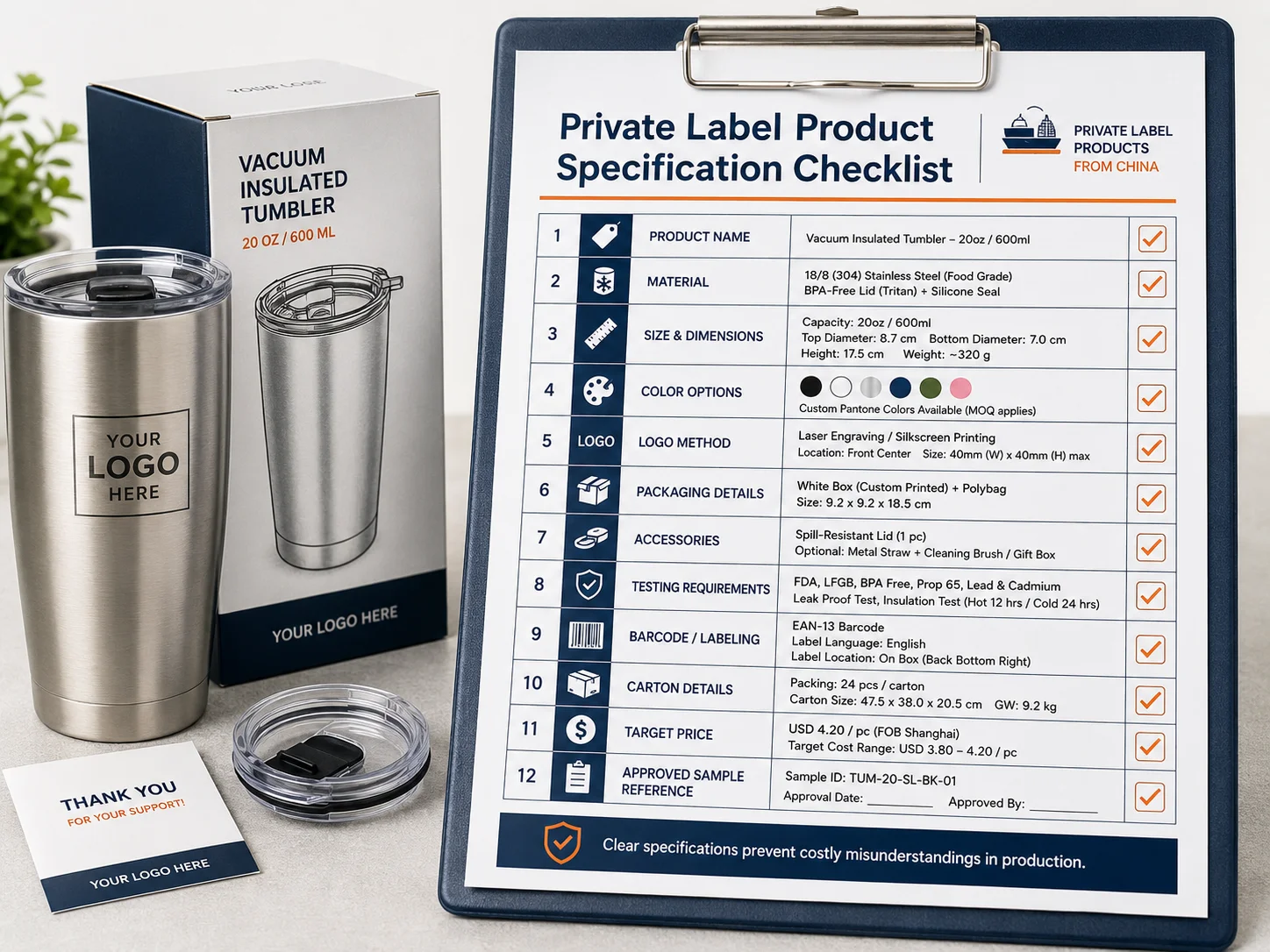
Build a Sourcing Brief Before Requesting Quotes
Your specification does not need to be a complex engineering document for a simple project. It does need to be specific enough that two suppliers would understand the same request.
I usually encourage buyers to include the following:
- Product name and intended use
- Reference photos, links, or sketches
- Dimensions and tolerances where relevant
- Materials, finishes, and color codes
- Required functions or features
- Accessories and bundle contents
- Branding location and logo file format
- Packaging type and artwork requirements
- Barcode, labels, warnings, and manual needs
- Target quantity and delivery destination
- Quality expectations and known defect concerns
Define “Quality” in Measurable Terms
“Good quality” is not a usable production instruction.[^6] I suggest identifying what quality means for the product category. For example, a buyer may need to define acceptable scratches, stitching consistency, color variation, print alignment, odor, assembly, fit, or package condition.
Where appropriate, you can also discuss an inspection plan with your sourcing partner or third-party inspection provider. This may include visual checks, quantity checks, packaging checks, basic function checks, and carton marking verification.
A strong specification improves supplier communication, but it does not eliminate all production risk. It simply gives everyone a clearer baseline for decisions.
How Is Private Label Packaging Developed in China?
Packaging often becomes an afterthought, even though it shapes first impressions, protects the product, and affects shipping cost. Poorly planned packaging can cause damage, delayed artwork approval, barcode errors, or cartons that are too large for economical freight.
Private label packaging development includes logo placement, retail boxes, labels, inserts, barcodes, manuals, protective materials, carton markings, and shipping-carton design. I recommend developing packaging alongside the product sample, because packaging affects cost, dimensions, assembly time, and customer experience.
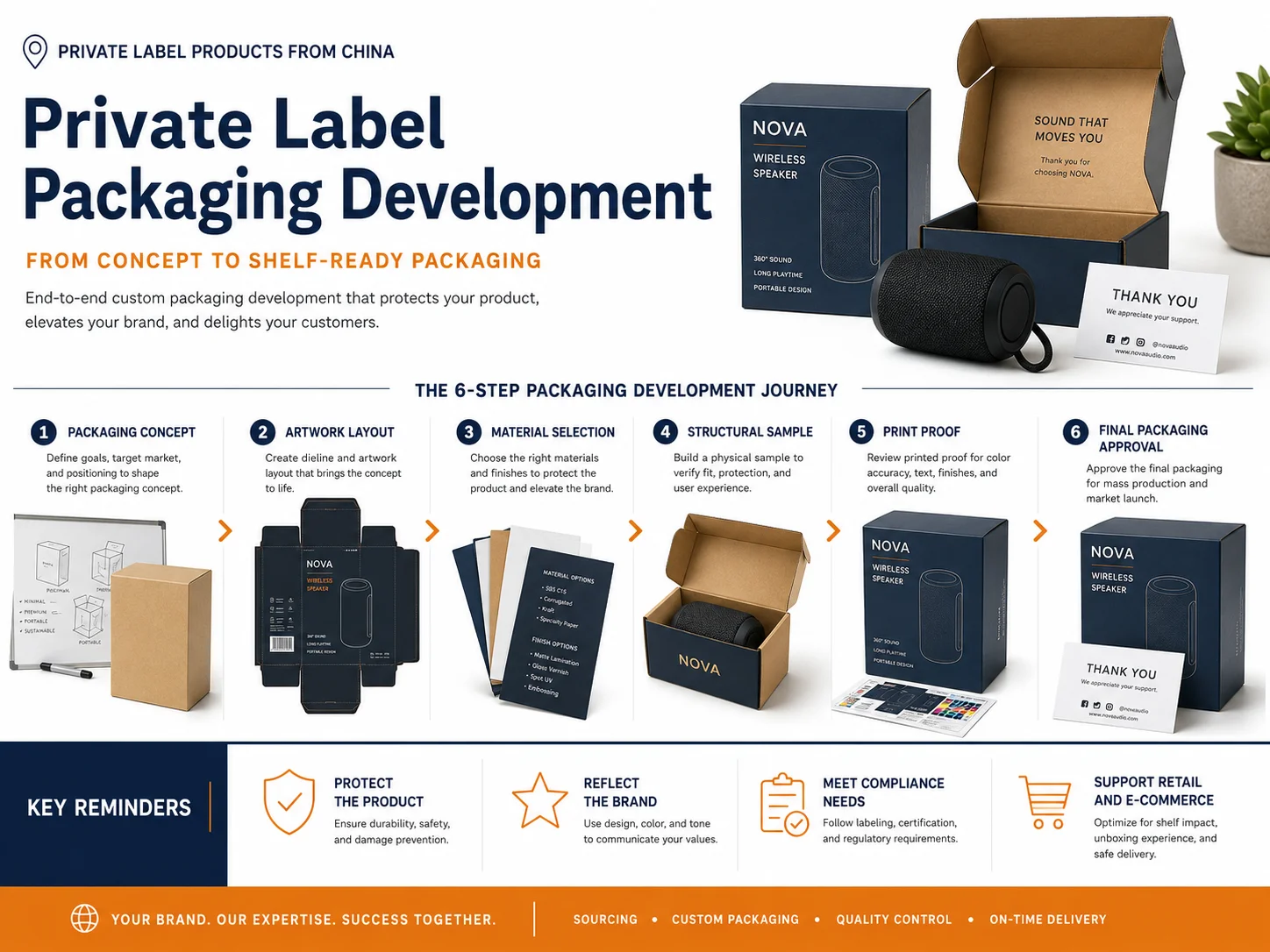
Separate Retail Packaging From Transport Packaging
Retail packaging is what your customer sees. It may include a color box, polybag, pouch, sleeve, hangtag, insert card, or instruction manual. Transport packaging protects products during warehouse handling and international shipment.
I ask buyers to consider both layers early:
| Packaging element | Main purpose |
|---|---|
| Logo and artwork | Brand recognition |
| Product label | Identification and required information |
| Barcode | Inventory and sales-channel management |
| Insert card | Usage guidance or brand story |
| Retail box | Shelf presentation and product protection |
| Inner protection | Reduce scratches, breakage, or movement |
| Master carton | Protect goods during bulk shipment |
Packaging customization can have its own MOQ, especially for printed boxes or custom molded inserts. A supplier may offer a low MOQ for plain boxes with stickers but require a higher quantity for full-color retail packaging.
I also recommend confirming the final packaging dimensions and gross weight before booking freight. Small changes in box size can affect storage, fulfillment, and international shipping costs.[^7] If you sell through a marketplace, check its labeling, carton, and prep requirements before artwork goes to print.
How Do You Find and Verify Private Label Suppliers in China?
Finding suppliers is easy. Finding suppliers that can understand your requirements, support samples, maintain consistency, and communicate clearly is harder. A low quote can be attractive, but it rarely tells the full story about production capability or long-term cooperation.
To source private label products from China responsibly, I recommend screening suppliers based on product experience, factory capability, communication quality, business documentation, sample performance, quality process, and ability to support your required packaging and delivery plan.
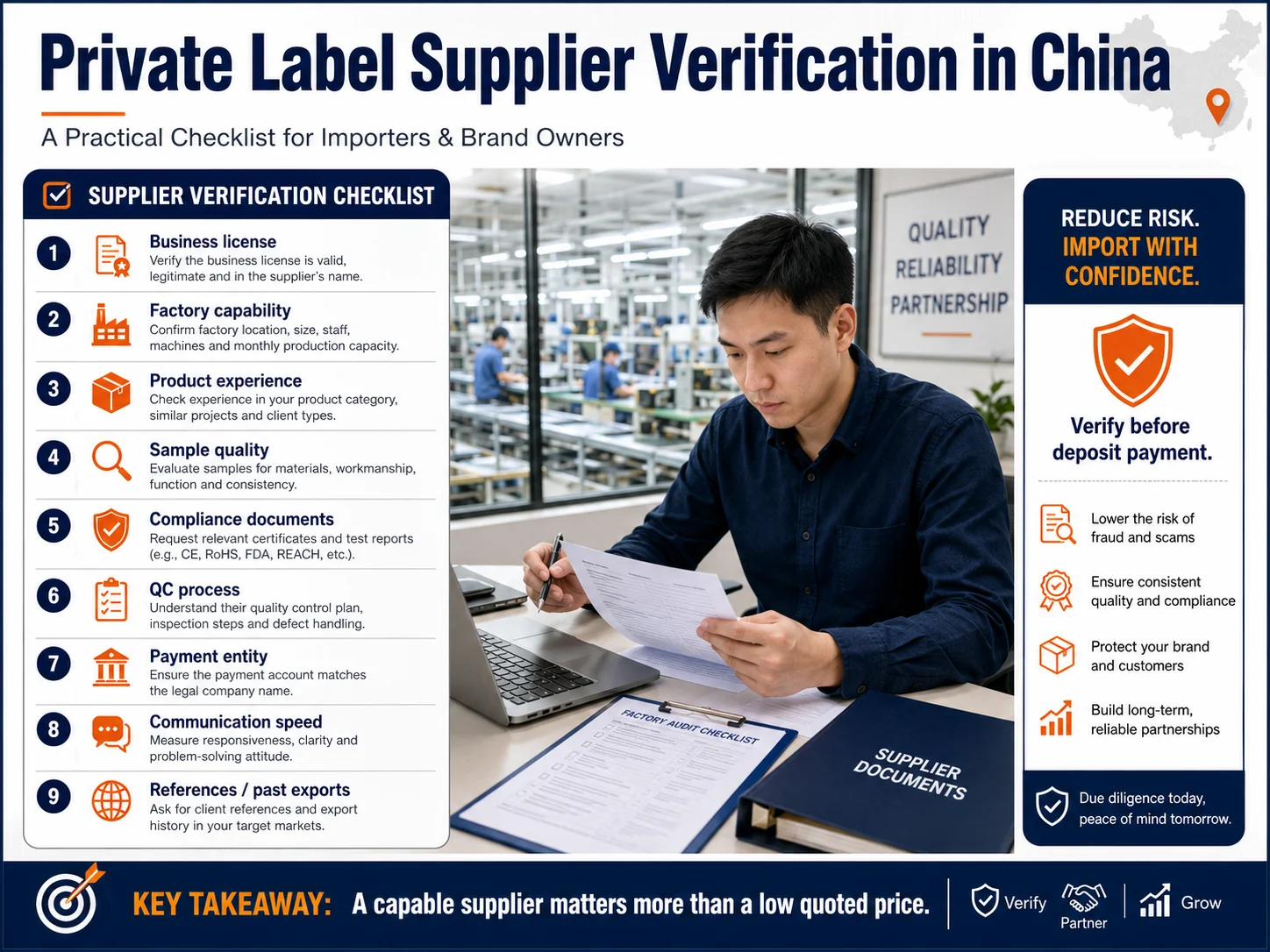
What I Look For During Supplier Screening
I do not treat supplier verification as a one-time checkbox. It is an ongoing evaluation that starts before quotation and continues through samples, production, inspection, and shipment.
Useful screening points include:
- Is the supplier a manufacturer, trading company, or both?
- Have they made similar products before?
- Can they explain material and production options clearly?
- Do they understand the required packaging level?
- Can they provide relevant business documents?
- Do they have a workable quality-control process?
- Are their quotations complete and transparent?
- Do they respond consistently to questions and revisions?
Factory visits or third-party audits can add useful information, especially for larger orders or higher-risk product categories.[^8] However, a factory visit alone does not guarantee that every future order will be problem-free. I see it as one part of broader supplier evaluation.
Compare More Than Unit Price
When I compare quotations, I look beyond the headline price. I check materials, included accessories, logo method, packaging, tooling, sample charges, MOQ, lead time, payment terms, and shipping-carton details.
A lower quote may exclude items that another supplier includes. It may also reflect different material quality, thinner packaging, or an incomplete understanding of the request. The best supplier is usually the one that can deliver the agreed product reliably within your commercial constraints.
How Do Samples and Golden Samples Protect Private Label Products from China?
Many buyers assume a good sample guarantees a good production order. Unfortunately, sample approval is only one checkpoint. Production materials, workers, assembly conditions, and packaging processes can still create variation at scale.
For private label products from China, I recommend using samples to confirm product details, branding, packaging, and user experience before mass production. The final approved sample, often called a golden sample, should be documented and used as a reference during production and pre-shipment inspection.[^9]
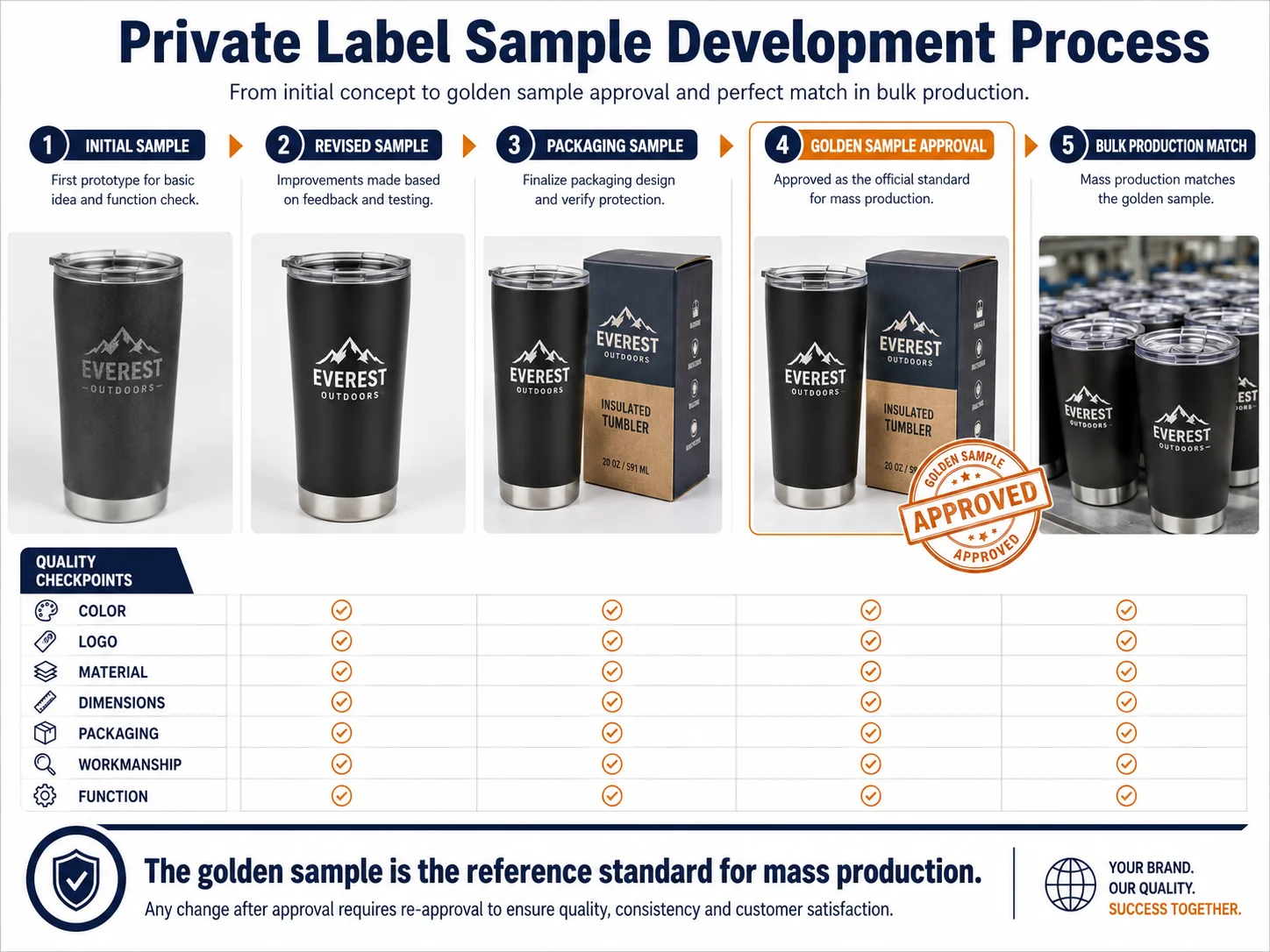
A Practical Sample Approval Process
I usually see this sequence work best:
- Initial sample: Review the supplier’s basic product capability.
- Revised sample: Correct product, color, material, or branding details.
- Packaging sample: Approve box artwork, labels, inserts, and barcode placement.
- Pre-production sample: Confirm the version intended for mass production.
- Golden sample: Keep an approved reference with clear written comments.
When reviewing samples, I encourage buyers to inspect them as customers would. Open the packaging, test the product’s basic function, review branding, check accessories, and compare the item against the specification.
You should also document your approval. Email comments, marked photos, revision lists, and final signed specifications can reduce ambiguity later. I recommend recording even small points, such as logo size, box finish, color tone, accessory placement, and instruction language.
Pre-shipment inspection remains valuable because production consistency can vary.[^10] In sourcing coordination, I have found that problems are easier to address before goods leave the factory than after they arrive in another country.
How Does KingSourcing Manage Private Label Product Development?
Private-label projects involve many moving parts, and buyers without a local team can struggle to coordinate factories, samples, packaging vendors, inspections, and freight providers. I built KingSourcing’s process to give overseas buyers a practical sourcing office in China.
At KingSourcing, we help manage private label products from China from the early product brief through supplier sourcing, quotation comparison, sample coordination, packaging development, production follow-up, quality inspection, order consolidation, and door-to-door shipping support.
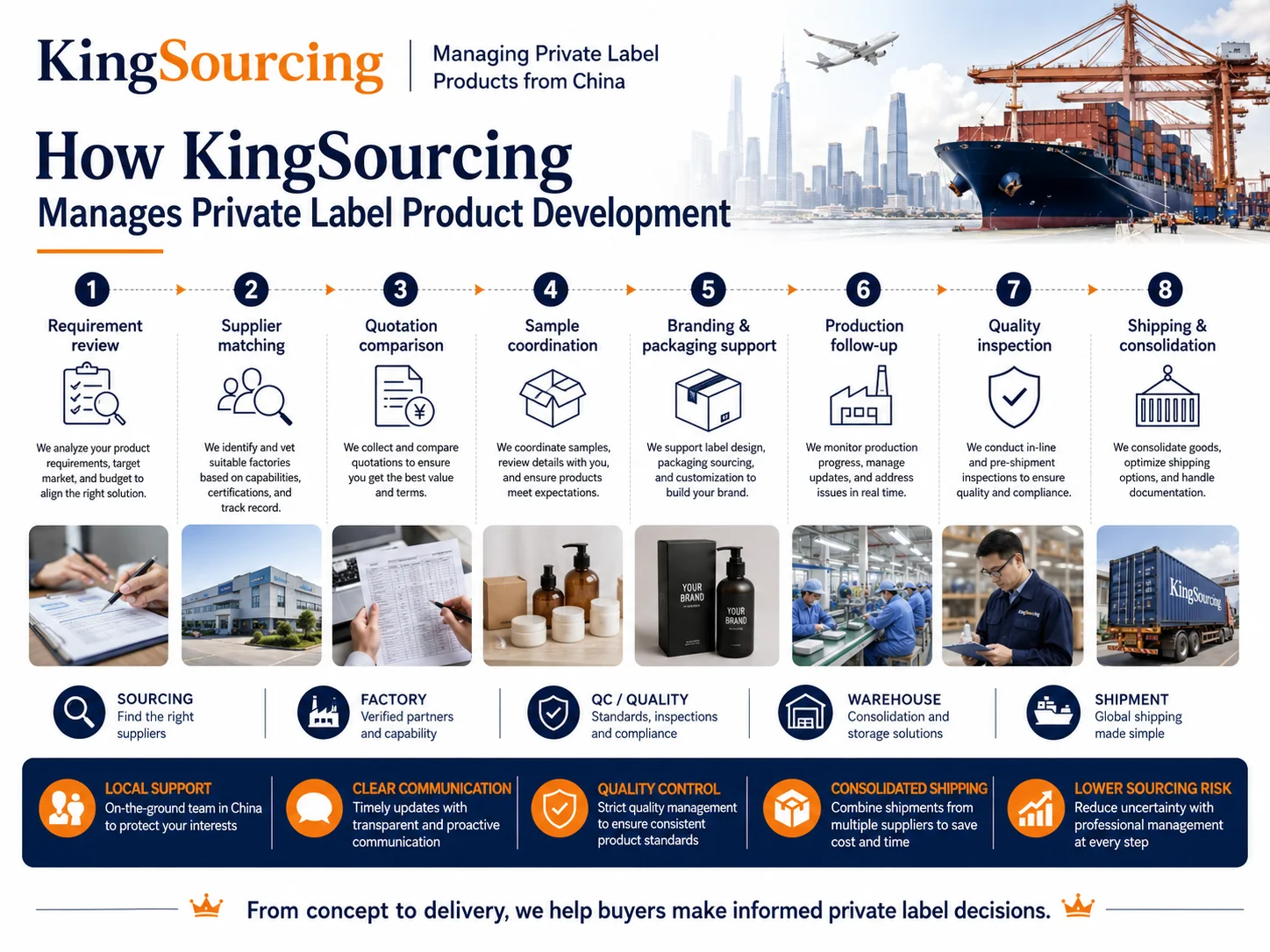
Our Role in Your Sourcing Process
Our work starts by understanding what you want to sell, who you want to serve, and what level of customization is realistic. We then help turn broad ideas into clearer supplier requirements.
Our support can include:
- Supplier research and factory screening
- Product specification organization
- Quotation collection and comparison
- Sample development and revision coordination
- Logo, label, and packaging communication
- Production follow-up and timeline coordination
- One-by-one product checks or agreed quality inspections
- Warehousing, product photography, and order consolidation
- International shipping and after-sales issue support
I do not present our service as a guarantee that sourcing has no risk. Every product, supplier, market, and shipment has variables. Our role is to improve visibility, reduce communication gaps, and help buyers make better decisions before problems become expensive.
For smaller buyers, we can help create a workable route from a test order to a more developed product line. For larger buyers, we can support dedicated sourcing coordination and priority order management. In both cases, the goal remains the same: making China sourcing simpler, more transparent, and easier to control.
Frequently Asked Questions
How much does private labeling in China cost?
Private-label costs depend on the product, order quantity, logo method, packaging, sample revisions, tooling, inspection, and freight. I recommend calculating the full landed cost rather than focusing only on the factory unit price. Simple branding costs less than deep product customization.
What is the typical MOQ for private label products?
MOQ varies by product and customization level. Some suppliers can support smaller orders for stock products with simple labels or inserts. Custom colors, printed boxes, molds, and product changes usually require higher quantities. I recommend asking for MOQ options at different customization levels.
Can beginners start with a small private-label order?
Yes, beginners can often start with a small test order, especially with standard products and basic branding. However, I advise keeping the first project focused. A small budget may not support custom molds, complex packaging, or multiple product variations at the same time.
How long does private label development take?
The timeline depends on supplier selection, sampling, revisions, packaging approval, production capacity, inspection, and shipping method. A simple branded product may move faster than an OEM project. I recommend building time for sample revisions and artwork confirmation into your launch plan.
Who owns the logo and packaging design?
You should normally own your original logo and packaging artwork, subject to the agreements with your designer and suppliers. I recommend keeping original design files, confirming usage rights in writing, and seeking qualified legal advice for trademarks or intellectual-property protection.
Conclusion
Private label products from China can help you build a real brand, but success requires more than putting a logo on an existing item. I recommend starting with a clear customer reason to buy, a realistic product brief, a suitable customization level, and suppliers that can support consistent execution. Samples, written approvals, packaging planning, inspection, and freight coordination all matter. If you need a China-based team to support your next private-label project, contact KingSourcing and let us help make your China sourcing simpler.
Tags: Private Label Products from China, China Product Sourcing, Private Label Manufacturer, Custom Product Development, Packaging Development, China Sourcing Agent, Import from China
[^1]: "Property law | Definition, History, Examples, & Facts", https://www.britannica.com/topic/property-law. Private-label goods are generally products manufactured for sale under the brand of a retailer or other purchasing business rather than under the manufacturer's own brand. Evidence role: definition; source type: encyclopedia. Supports: The standard meaning of private-label goods as products made by one company for sale under another company's brand.. [^2]: "Raw Material Minimum Order Quantity Optimization", https://dspace.mit.edu/bitstream/handle/1721.1/121302/1240293813-MIT.pdf?sequence=1. Manufacturing and inventory research describes minimum order quantities as a response to fixed setup and changeover costs; this helps explain why bespoke colors, printing, or product changes may require larger production runs. Evidence role: mechanism; source type: research. Supports: Production setup, tooling, and batch costs can make customized variants economically viable only at larger order quantities.. Scope note: The exact MOQ is supplier-, product-, and manufacturing-process-specific. [^3]: "Technology Transfer Agreements", https://www.wipo.int/en/web/technology-transfer/agreements. World Intellectual Property Organization guidance explains that commercial agreements should clearly address ownership, licensing, confidentiality, and use of intellectual property created or shared in a business relationship. Evidence role: general_support; source type: institution. Supports: Intellectual-property rights, ownership, confidentiality, and licensing can be allocated by contract in commercial collaborations.. Scope note: Such guidance is general; enforceability and the appropriate contractual terms depend on the jurisdictions, facts, and legal advice involved. [^4]: "Children's Product Certificate | CPSC.gov", https://www.cpsc.gov/Business--Manufacturing/Testing-Certification/Childrens-Product-Certificate. Government product-safety authorities impose category-specific requirements for goods such as children's products, electrical equipment, cosmetics, and food-contact materials, and the applicable requirements depend on the market where the goods are placed. Evidence role: general_support; source type: government. Supports: Product-safety, labeling, testing, and conformity obligations differ among categories and markets.. Scope note: This does not identify every requirement for a particular product or country; importers must determine the rules applicable to their specific goods and destination. [^5]: "Formal Representation of Product Design Specifications for ...", https://nvlpubs.nist.gov/nistpubs/Legacy/IR/nistir7626.pdf. Quality-management and engineering practice treat specifications as documented requirements for a product's characteristics and performance, providing a basis for production and conformity assessment. Evidence role: general_support; source type: institution. Supports: Specifications communicate defined requirements that can be used for procurement, production, and quality evaluation.. Scope note: The necessary level of technical detail depends on the product, its risks, and applicable regulatory requirements. [^6]: "An overview of computer software acceptance testing", https://nvlpubs.nist.gov/nistpubs/Legacy/SP/nbsspecialpublication500-136.pdf. Quality-management guidance emphasizes defining objective acceptance criteria and measurable requirements so that conformity can be evaluated consistently rather than relying on subjective descriptions of quality. Evidence role: mechanism; source type: institution. Supports: Objective acceptance criteria are needed to assess conformity and reduce ambiguity in quality control.. Scope note: Appropriate criteria and tolerances must be tailored to the product and the intended use. [^7]: "Package Dimensions, Size Limits and Weight Guide", https://www.ups.com/us/en/support/shipping-support/shipping-dimensions-weight. Major carriers use dimensional-weight calculations for many shipments, meaning that package volume as well as physical weight can affect transportation charges. Evidence role: mechanism; source type: institution. Supports: Carriers may calculate charges using dimensional weight, making package size relevant even when actual weight changes little.. Scope note: Actual rates, dimensional divisors, and fulfillment fees vary by carrier, service, route, and commercial agreement. [^8]: "Quality Management System Implementation | NIST", https://www.nist.gov/mep/successstories/2023/quality-management-system-implementation. Quality-management standards describe audits as systematic evaluations used to obtain evidence about whether an organization's management system and processes conform to specified requirements. Evidence role: general_support; source type: institution. Supports: Audits are used to evaluate whether a supplier's management system and processes meet specified requirements.. Scope note: An audit assesses conditions and evidence at a given time; it cannot guarantee the quality or consistency of every future production order. [^9]: "Guide to Inspections of Quality Systems", https://www.fda.gov/files/Guide-to-Inspections-of-Quality-Systems.pdf. Manufacturing quality-control practice uses approved reference samples to provide a documented comparison point for evaluating production appearance, assembly, and relevant functional characteristics. Evidence role: mechanism; source type: research. Supports: Approved reference samples can support consistent visual and functional comparison during manufacturing quality control.. Scope note: A reference sample must be accompanied by written specifications and acceptance criteria, since it may not capture every measurable requirement or production variation. [^10]: "Key considerations - CASCO toolbox - ISO", https://casco.iso.org/key-considerations.html. Conformity-assessment practice recognizes inspection as an examination of products against specified requirements; conducting it before shipment can identify nonconformities while corrective action may still be possible. Evidence role: general_support; source type: institution. Supports: Inspection before shipment is a conformity-assessment activity that can detect specified defects or nonconformities before goods are dispatched.. Scope note: Inspection is sampling- and scope-dependent and cannot assure that every unit is defect-free or that goods will remain unaffected during transit.