Custom packaging in China can feel simple when you only see a logo on a box. In reality, many brands lose time and money because their artwork does not match the product, their packaging supplier cannot meet the required MOQ, or the final cartons fail during transport. I help clients turn packaging ideas into practical, quote-ready specifications.
Custom packaging in China requires a clear process: define the product and protection needs, prepare packaging specifications, select suitable materials and printing methods, verify suppliers, approve samples, and inspect mass production. I recommend treating packaging as both a branding tool and a product-protection system, not just a printed box.
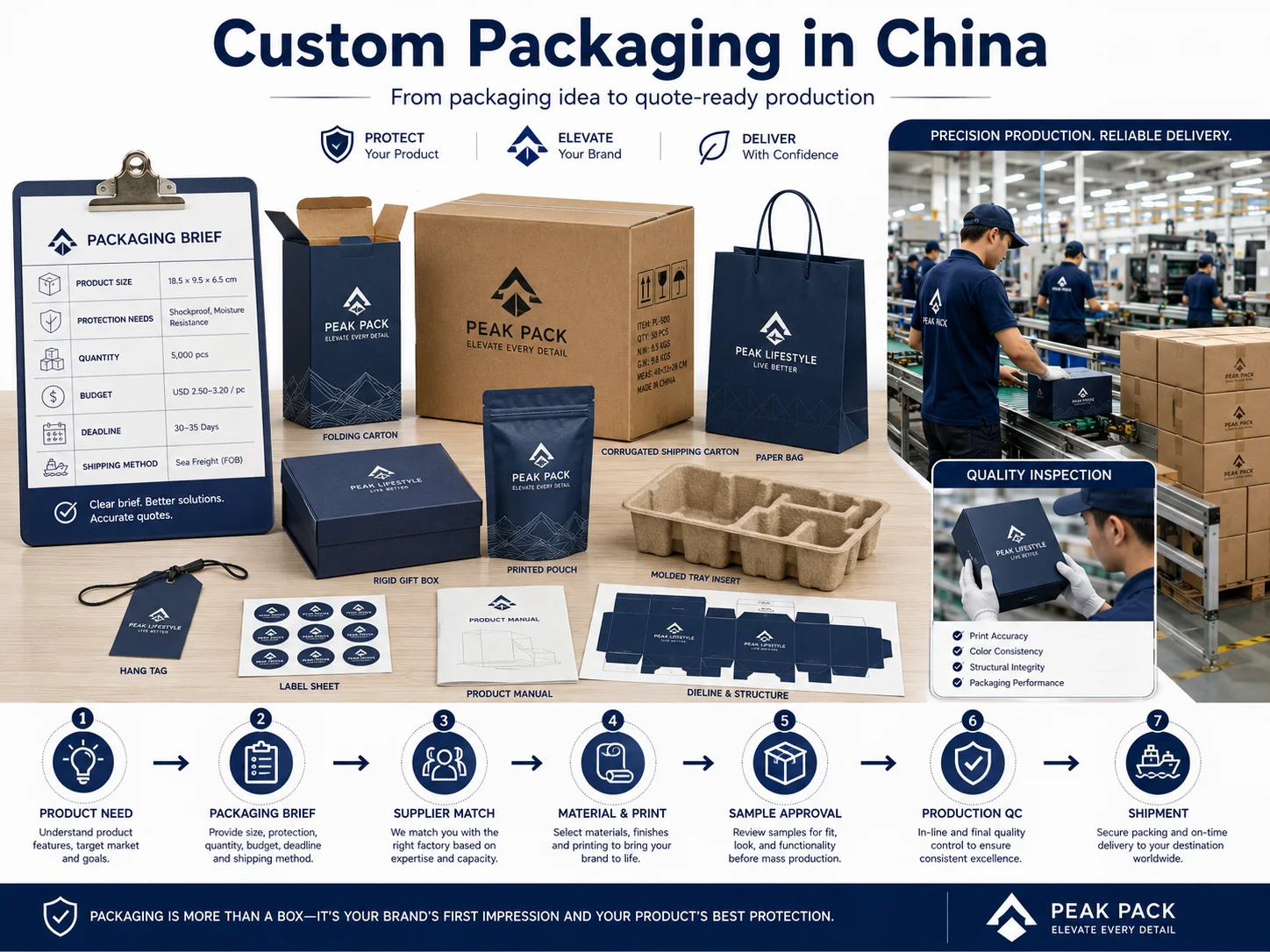
When I coordinate packaging projects, I usually start with a few practical questions: What is the product size and weight? How fragile is it? How many units are needed? What is the target launch date? These answers shape every later decision, from material choice to printing cost.
Quick Answer: How Do I Create Custom Packaging in China?
Many first-time importers have a product design and logo but no production-ready packaging plan. This gap creates delayed quotes, confusing supplier communication, and samples that look good but do not protect the product. I recommend building the packaging project around clear specifications before requesting prices.
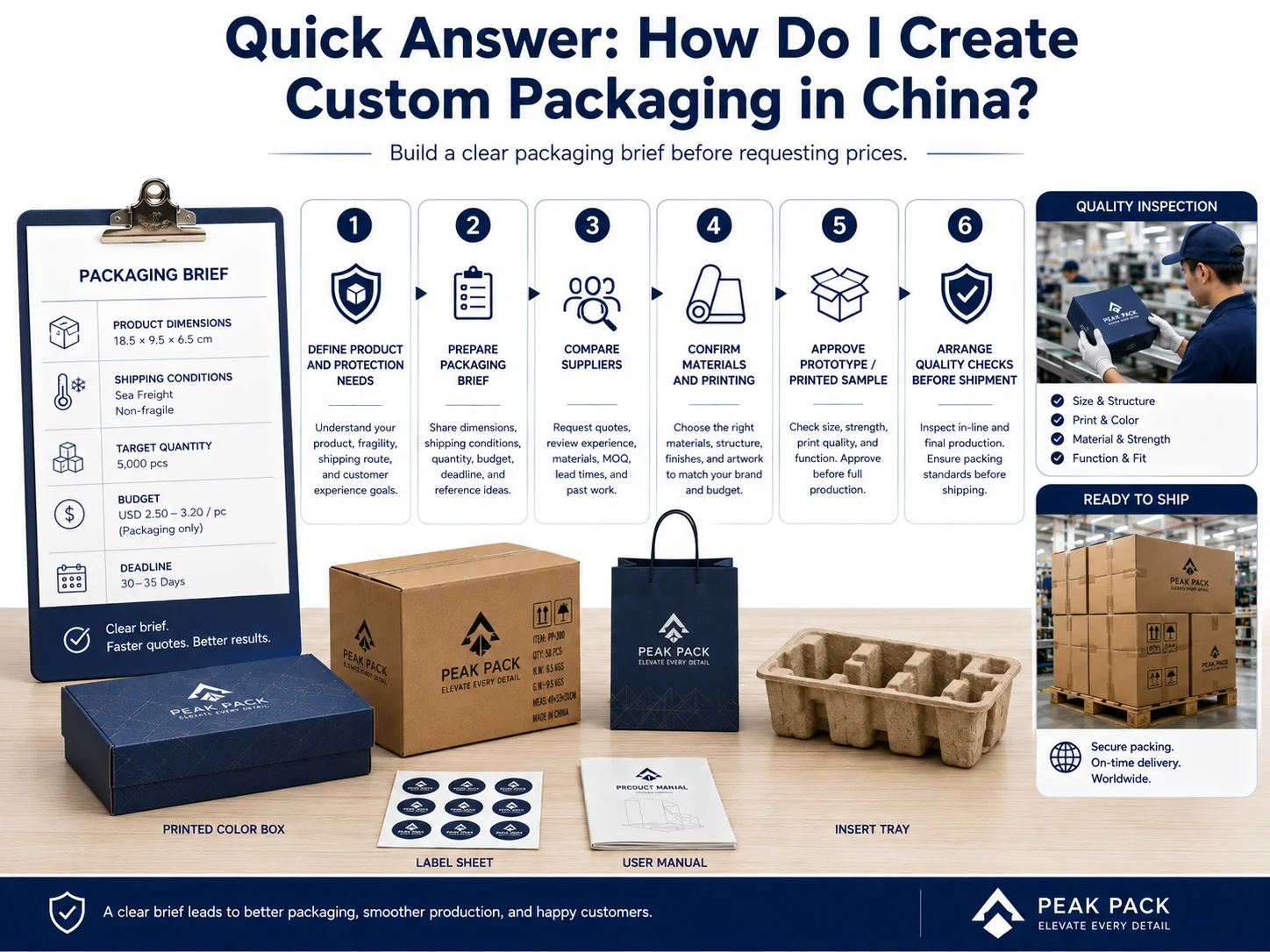
To create custom packaging in China, I first define the product dimensions, shipping conditions, target quantity, budget, and deadline. Then I prepare a packaging brief, compare qualified suppliers, confirm materials and printing, approve a prototype or printed sample, and arrange quality checks before shipment.
Start With the Product, Not the Artwork
I often see clients send a beautiful packaging render and ask for an immediate quote. The render is helpful, but it rarely answers the questions a packaging factory needs to price the job accurately.
A quote-ready request should include:
- Product dimensions, weight, and fragile areas
- Required box or bag dimensions
- Whether the packaging will ship individually or inside a master carton
- Desired material, thickness, and finish
- Estimated order quantity
- Target delivery date
- Budget range, if available
- Product photos or a physical sample when possible
For example, a skincare jar may need a rigid gift box with an insert to prevent movement. A lightweight garment may only need a polybag, branded sticker, and mailer. A ceramic product may need an EPE foam insert, inner box, and export carton. These are completely different sourcing projects.
I do not assume that the most expensive packaging is the best choice. The right option is the one that protects the product, fits the brand, and works with the client’s order volume and logistics plan.
A clear process cannot eliminate all packaging or delivery risk. However, it gives suppliers measurable requirements and gives the buyer a stronger basis for sample approval and inspection.
What Types of Custom Packaging in China Can I Source?
Brands often think of packaging as a custom printed color box. However, Chinese packaging suppliers can produce a much wider range of retail, protective, promotional, and shipping packaging. Choosing the wrong format can increase cost, damage rates, warehouse space, and shipping volume.
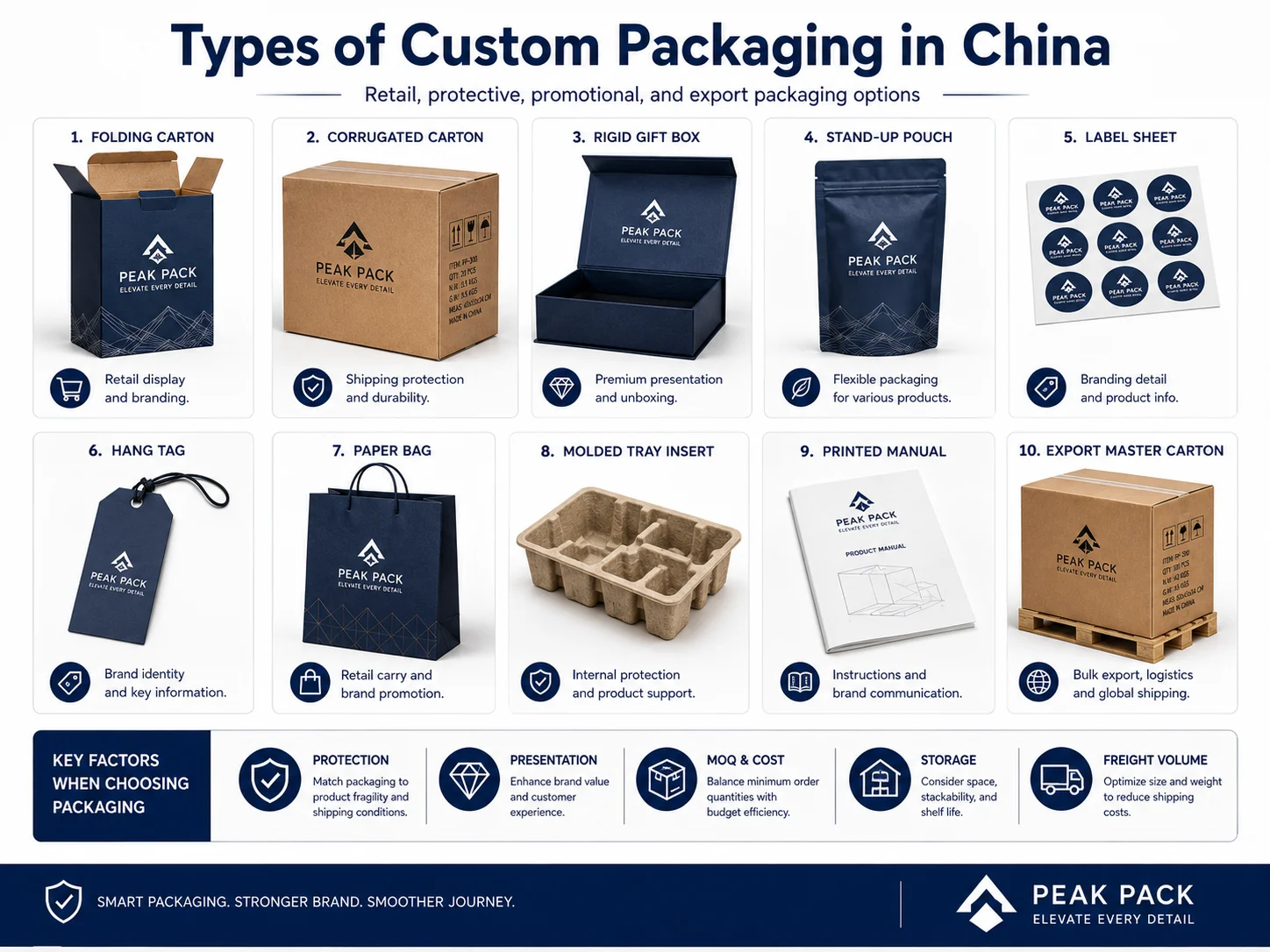
I can source custom packaging in China across retail boxes, corrugated cartons, gift boxes, flexible pouches, labels, inserts, manuals, paper bags, molded trays, and export packaging. The best format depends on product protection, presentation needs, order quantity, and transport method.
Common Packaging Formats
Here are the packaging categories I see most often in ecommerce and private-label projects:
| Packaging Type | Common Use | Main Benefit | Main Consideration |
|---|---|---|---|
| Folding carton | Cosmetics, electronics, small retail goods | Good branding at moderate cost | Can be crushed if not protected |
| [Corrugated box | Shipping, subscription boxes, heavier products | Stronger protection | More bulky in freight](https://pmc.ncbi.nlm.nih.gov/articles/PMC10054506/)[^1] |
| Rigid gift box | Premium products and gift sets | High perceived value | Higher cost and storage volume |
| Polybag or pouch | Clothing, accessories, food, small items | Lightweight and economical | Limited impact protection |
| Paper tube | Candles, tea, cosmetics, gifts | Premium and distinctive | Can have higher MOQ |
| Labels and stickers | Bottles, jars, simple private label | Flexible for smaller runs | Application quality matters |
| Molded insert | Electronics, fragile products, gift sets | Holds products in place | Tooling and design may add cost |
| Instruction manual | Consumer goods, electronics, toys | Supports compliance and use | Needs accurate translation and layout |
Retail Packaging Versus Shipping Packaging
I encourage clients to separate retail packaging from transport packaging. A branded retail box may impress the customer, but it may not survive international shipping alone.[^2] In many projects, we use:
- A product box or bag for the customer-facing experience
- A protective inner layer, such as bubble wrap or an insert
- A master carton for warehouse handling and international transport
Which Custom Packaging Options in China Fit My Product?
A packaging option that works for a lightweight beauty product may not work for a heavy kitchen item. I see brands make costly mistakes when they choose based on appearance alone. They later find that the box is too weak, the MOQ is too high, or the freight cost is unreasonable.
I compare custom packaging in China by protection level, customization, MOQ flexibility, unit cost, and shipping efficiency. Folding cartons and labels often suit simpler retail projects, while corrugated boxes, rigid boxes, and custom inserts may suit heavier, premium, or fragile products.
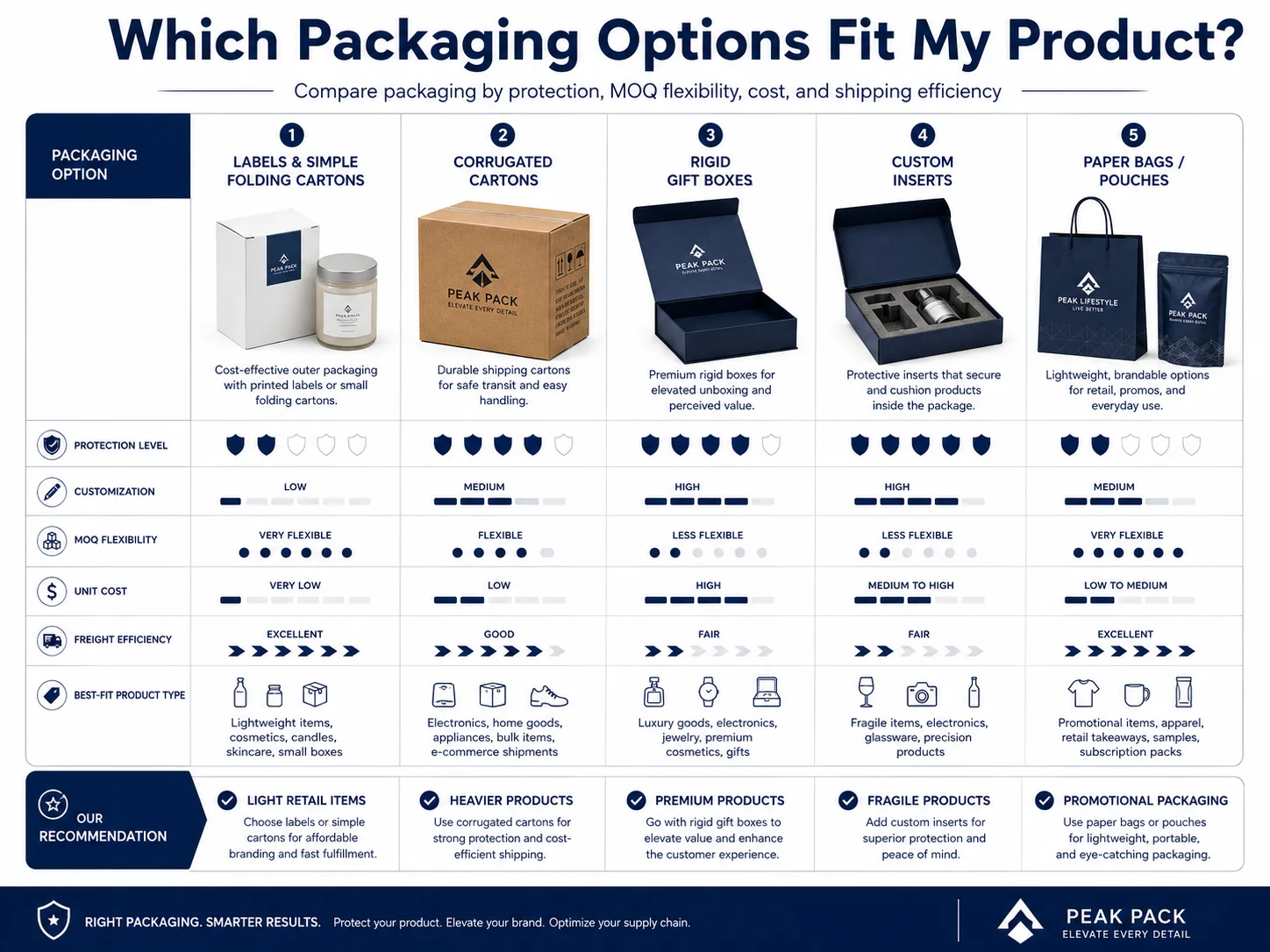
Comparison Table: Custom Packaging Options in China
| Option | Relative Cost | Typical MOQ Pattern* | Protection | Customization | Freight Efficiency | Best For |
|---|---|---|---|---|---|---|
| Printed labels | Low | Often lower than boxes | Low | Moderate | Excellent | Bottles, jars, test launches |
| Folding cartons | Low to medium | Depends on size and print run | Medium | High | Good when flat-packed | Cosmetics, accessories |
| Corrugated mailers | Medium | Depends on board and printing | Medium to high | Moderate | Good | Ecommerce shipments |
| Rigid boxes | Medium to high | Often higher | Medium | Very high | Lower due to volume | Luxury gifts, premium sets |
| Flexible pouches | Low to medium | Can vary by film and printing | Low to medium | High | Excellent | Snacks, clothing, consumables |
| Custom inserts | Medium | Depends on material and tooling | High | High | Depends on design | Fragile or premium items |
*MOQ should always be confirmed with the supplier. It changes based on size, material, structure, printing process, surface finish, and current production schedule.
How I Help Clients Select a Format
I usually ask clients to decide what packaging must accomplish first:
- Protect: prevent breakage, scratches, moisture, or movement
- Sell: communicate a premium or recognizable brand image
- Inform: include instructions, warnings, ingredients, or product details
- Ship efficiently: control dimensional weight and carton space
- Support operations: make packing, labeling, and fulfillment easier
For a new ecommerce seller, I may suggest starting with a stock-size box plus custom labels, inserts, or sleeves. This can be more commercially realistic than developing a fully custom rigid box for a small first order. Once sales volume is proven, the brand can move toward more complex private-label packaging.
How Do I Prepare a Custom Packaging Specification?
Without a written packaging specification, suppliers may quote different materials, dimensions, or finishing methods. This makes comparison difficult and increases the chance of misunderstandings. I have seen two suppliers quote what appears to be the same box, while one uses thinner board and another includes a more expensive finish.
I prepare a custom packaging specification by defining dimensions, structure, material, thickness, artwork, colors, print method, surface finish, inserts, assembly requirements, and acceptance criteria. This document gives suppliers a consistent basis for quotation, sampling, and production.
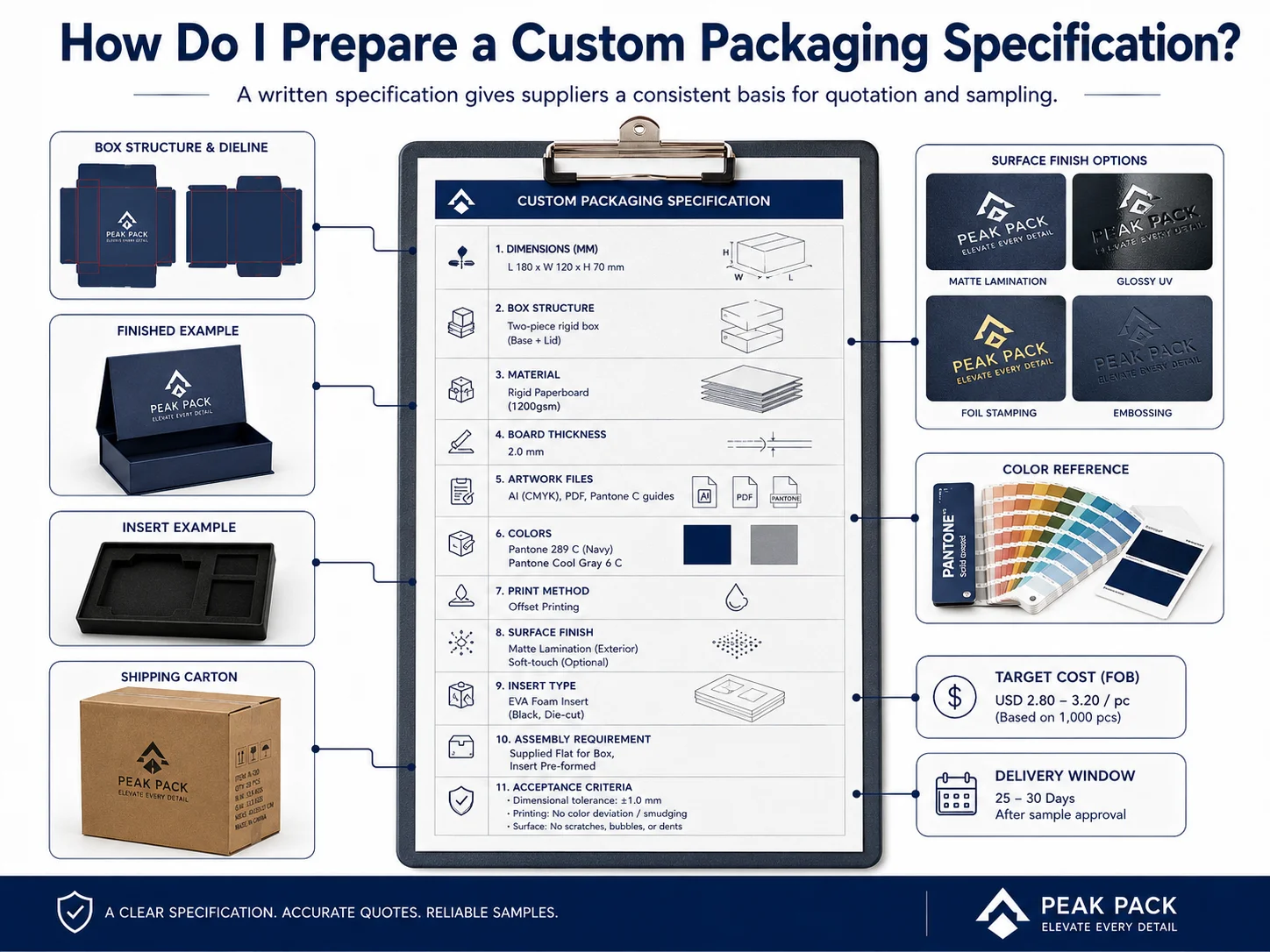
Essential Details for a Packaging Brief
A practical specification does not need to be overly technical. It does need to be specific enough for a supplier to understand what must be made.
| Specification Area | What I Clarify |
|---|---|
| Product fit | Internal dimensions, product weight, tolerance |
| Structure | Tuck-end box, drawer box, mailer, pouch, tube, sleeve |
| Material | Paperboard, corrugated board, kraft paper, PET, biodegradable film |
| Thickness | Paper GSM, board grade, corrugated flute type |
| Printing | CMYK, Pantone colors, one-color, inside or outside print |
| Finish | Matte lamination, gloss lamination, foil, UV, embossing |
| Insert | EVA, paper, pulp, foam, blister, folded card |
| Assembly | Flat-packed, pre-assembled, adhesive requirements |
| Testing | Drop test, compression expectation, fit check |
| Compliance | Recycling marks, warnings, food-contact or market labels |
Artwork Is Not a Full Production File
I tell clients that a logo file or visual mockup is not automatically a packaging production file. A factory may need a dieline, print-ready artwork, color references, bleed settings, and clear placement instructions.
When a client does not have final files, I recommend getting the supplier’s dieline first. Then the client’s designer can place artwork on the actual production layout. This reduces the risk of text being too close to fold lines, barcodes being distorted, or important graphics being hidden after assembly.
For brand colors, I suggest confirming whether the project requires Pantone matching or whether standard CMYK printing is acceptable. Exact color consistency can be affected by paper type, coating, ink, and print process.[^4] A digital screen render should never be treated as final proof of printed color.[^5]
How Do I Find and Verify Packaging Suppliers in China?
Finding a packaging supplier is easy. Finding one that fits the product, order volume, quality expectation, and timeline takes more work. I avoid choosing suppliers only because they offer the lowest quotation, since a low price may reflect different materials, limited finishing capability, or a structure that does not match the brief.
I verify packaging suppliers in China by checking their relevant product experience, production equipment, business documentation, sample quality, communication clarity, lead time, and capacity. I also compare quotations against the same written specification instead of comparing prices alone.
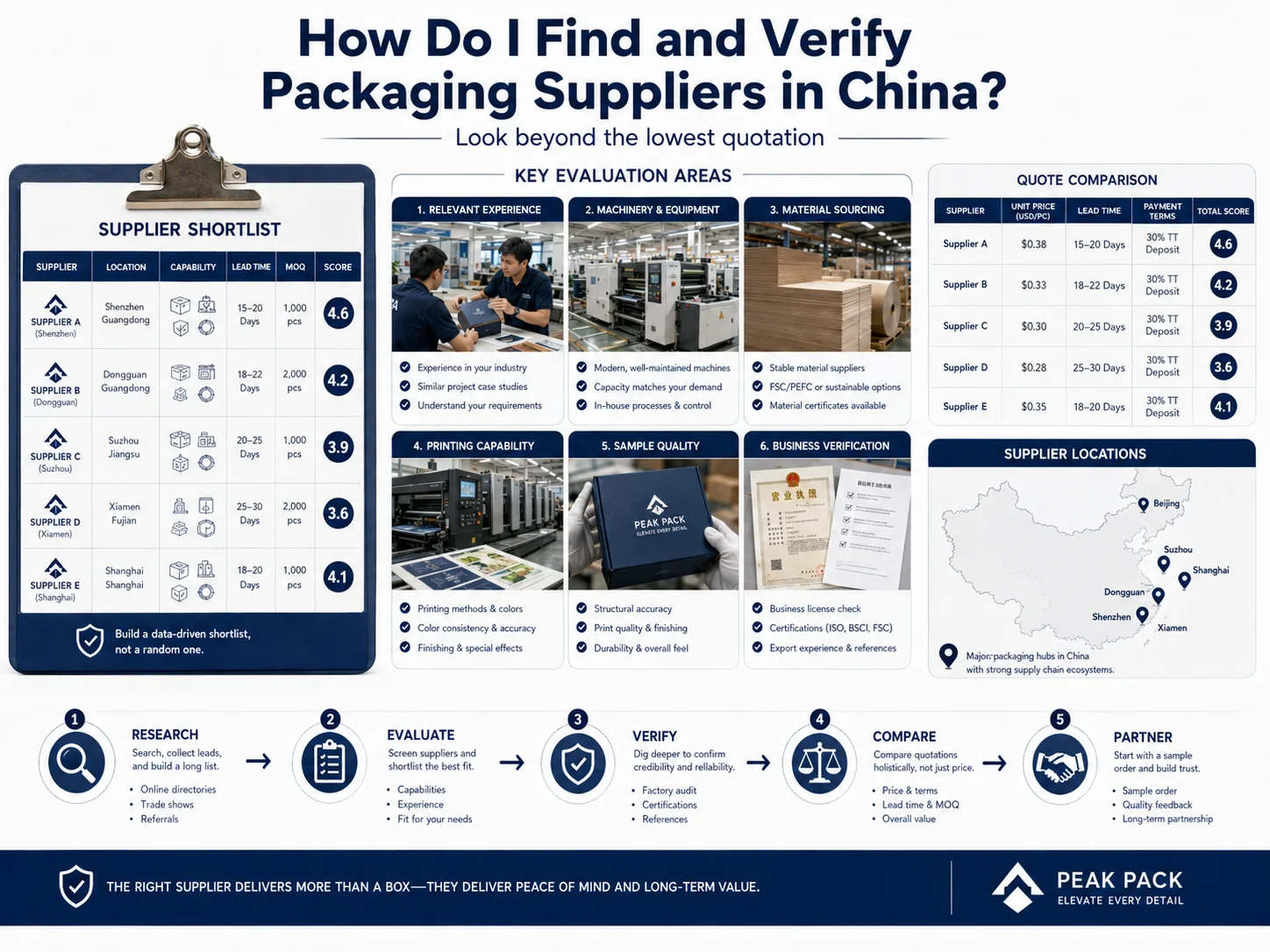
What I Review Before Recommending a Supplier
A supplier does not need to be the largest factory to be a suitable partner. The key issue is capability matching. For example, a label supplier may be excellent for small sticker orders but not suitable for rigid gift boxes.
I typically review:
- Relevant packaging category and export experience
- Photos or videos of machinery and production lines
- Ability to handle requested printing and finishing
- Sample workmanship and material consistency
- Business license and company details
- Production capacity during the required period
- Communication speed and willingness to clarify details
- Quality-control process and packing standards
Packaging Industry Clusters
China has strong regional packaging supply networks. For example, I may find different strengths in areas serving consumer goods, printing, corrugated packaging, gift boxes, or flexible packaging. Still, location alone is not proof of quality. I use it as a sourcing starting point, then verify the individual supplier.
In many projects, I request quotations from more than one suitable supplier. I compare not only unit price but also tooling charges, sample fees, plate fees, material details, lead times, packing method, and payment terms. A transparent comparison helps clients understand why one quote is lower or higher.
Which Materials and Printing Methods Work for Custom Packaging in China?
Material and printing choices strongly affect appearance, durability, cost, MOQ, and environmental claims. A premium finish may make a box look impressive, but it may also increase lead time, reduce recyclability, or create a higher setup cost. I help clients choose options that fit their actual commercial stage.
For custom packaging in China, I commonly source paperboard, corrugated board, kraft paper, plastic films, molded pulp, and specialty materials. Printing can include offset printing, digital printing, screen printing, flexographic printing, foil stamping, spot UV, embossing, and debossing.
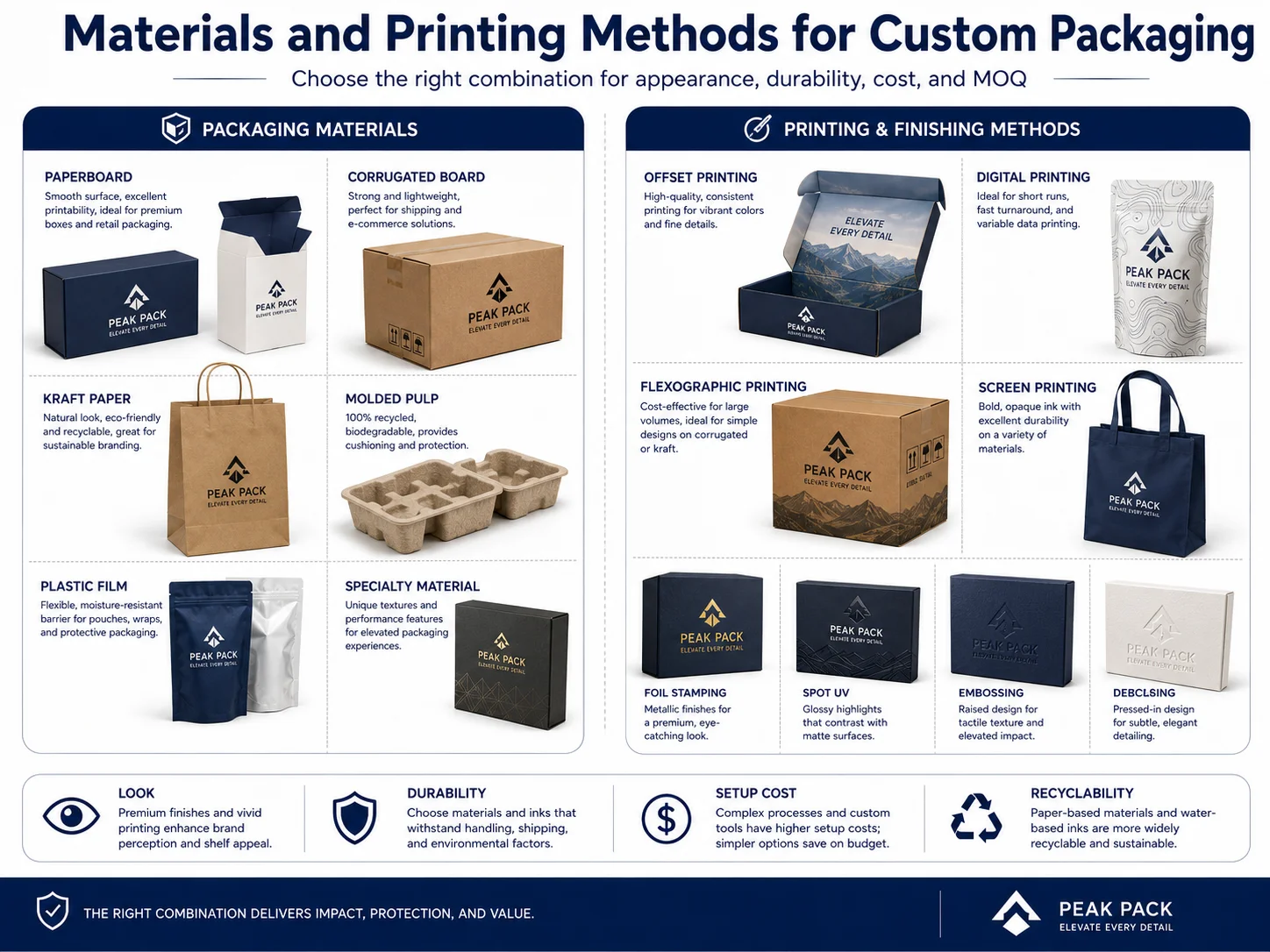
Common Material Choices
- Paperboard: Common for folding retail boxes. It offers good print quality and can be cost-effective.
- Corrugated board: Better for shipping cartons and protective mailers. Flute type and board strength should match product weight.
- Kraft paper: Often used for a natural or eco-focused look. Color consistency should be confirmed.
- Flexible film: Used for pouches, polybags, and food-related packaging. Barrier needs may affect material selection.
- Molded pulp: Useful for inserts and protective trays. It can support reduced-plastic packaging goals.[^6]
- EVA or foam: Often used for premium or fragile products, though it may not suit every sustainability target.
Printing and Finishing Choices
Offset printing is widely used for high-quality paper packaging, especially when volume supports the setup. Digital printing can be useful for smaller runs or rapid revisions, but supplier capability and color results should be confirmed. Screen printing may suit specific materials and simpler color designs.
Finishes can include matte lamination, gloss lamination, soft-touch film, hot foil, embossing, debossing, and spot UV. I advise clients to use finishes selectively. A simple matte box with one foil logo can look more premium than a design that uses every available effect.
For food, cosmetics, toys, or products entering regulated markets, I recommend verifying market-specific labeling and material requirements with the appropriate compliance professional or testing provider.[^7] Packaging suppliers can provide material information, but buyers should not assume every material automatically meets every destination-market requirement.
What Are the MOQ, Cost, and Lead Time for Custom Packaging in China?
MOQ questions are important, but there is no universal answer. I have seen clients expect a highly customized box at the same MOQ as a plain stock carton. The structure, material, printing colors, tooling, and finishing all affect whether a supplier can offer a commercially workable order quantity.[^8]
Custom packaging MOQ, cost, and lead time in China depend on the packaging type, material, dimensions, printing method, tooling, finishing, and supplier schedule. I recommend confirming all one-time charges, production timing, and packing details before approving a sample or deposit.
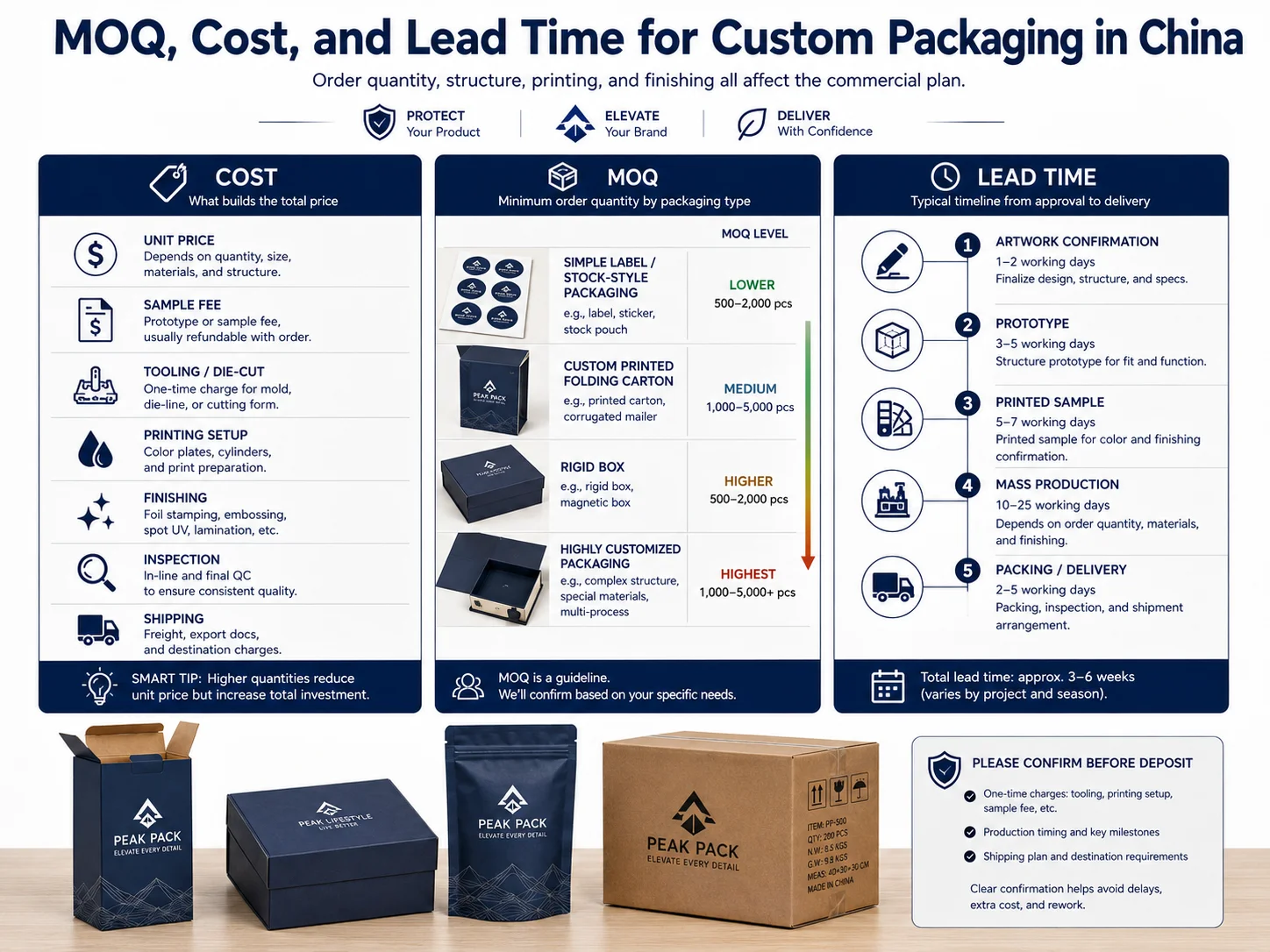
Main Cost Drivers
The unit price is only one part of the packaging budget. I ask suppliers to separate charges where possible:
- Unit packaging price
- Printing plate or setup fee
- Die-cut mold or tooling fee
- Sample development cost
- Insert or accessory cost
- Assembly and packing cost
- Local delivery to the product factory or warehouse
A packaging project may have a lower unit price at a higher quantity, but that does not always make it the best decision.[^9] Excess inventory uses cash and storage space. It can also become unusable if product dimensions, branding, or compliance labels change.
Lead-Time Planning
Packaging sampling and mass production should be planned alongside product production. In a typical project, a client may need time for artwork adjustment, structural sampling, print confirmation, mass production, and delivery to the product factory.
I recommend adding buffer time for revisions. A late packaging approval can delay the entire shipment because products cannot be packed, labeled, or inspected properly.[^10] If the packaging factory and product factory are separate, I also confirm who will receive the packaging, assemble it, and pack the finished goods.
How Do I Approve Packaging Samples and Prevent Errors?
A good-looking sample is a useful checkpoint, but it is not a guarantee that every mass-produced unit will be identical.[^11] I see this misunderstanding often. The sample should be used to create measurable standards that can be checked later during production and before shipment.
I approve custom packaging samples in stages: structural prototype, digital or color proof, printed sample, product fit test, and a final golden sample. I use each stage to confirm size, material, color, finishing, assembly, and protection requirements before mass production begins.
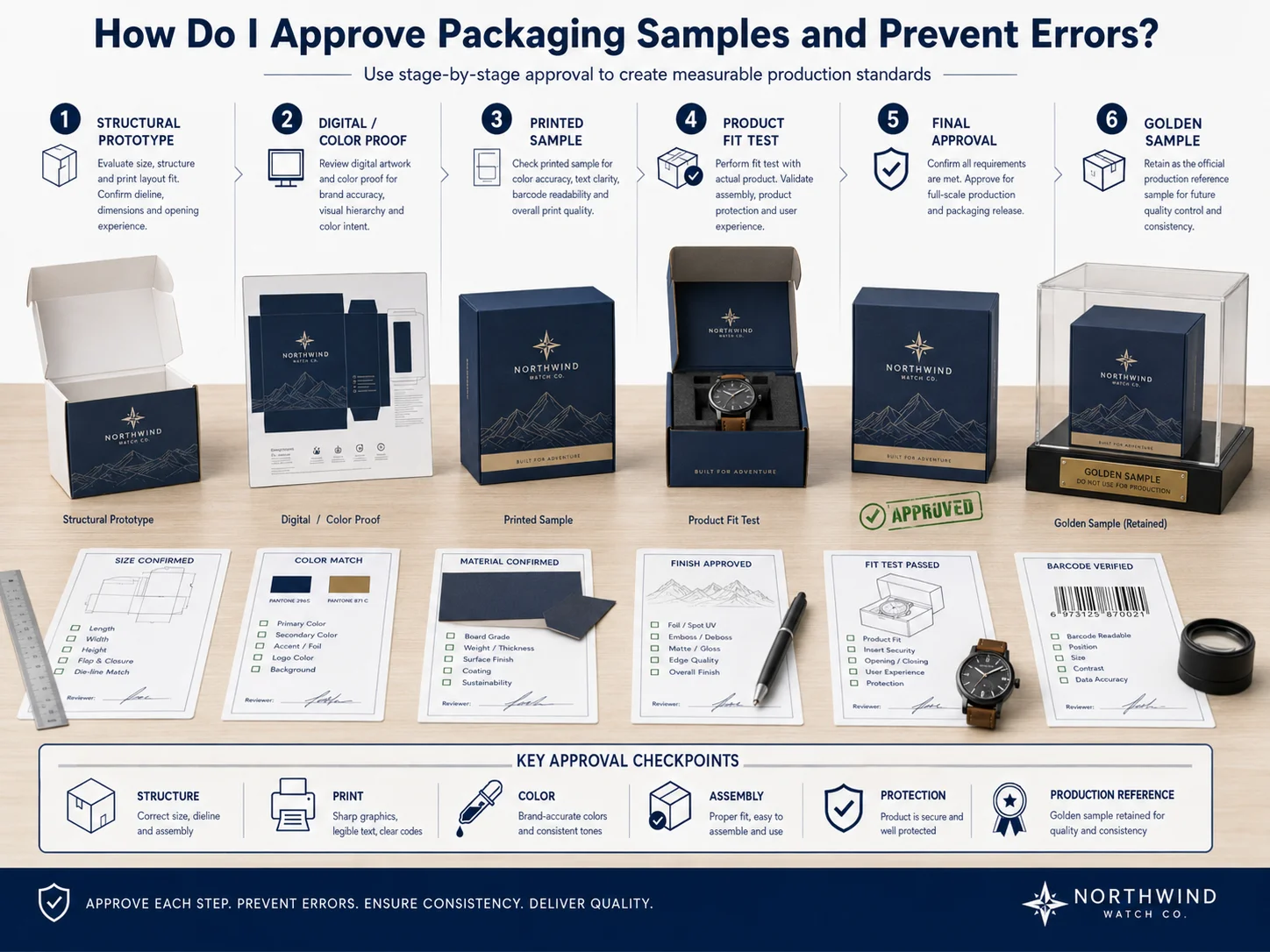
Common Sample Stages
| Sample Type | Main Purpose |
|---|---|
| White sample | Confirms size, structure, folds, and product fit |
| Digital mockup | Reviews artwork placement and general appearance |
| Printed sample | Checks print, color, finish, and material |
| Pre-production sample | Confirms the intended mass-production standard |
| Golden sample | Retained approved reference for inspection |
What I Check During Sample Approval
I check more than whether the packaging looks attractive. For example, I look at:
- Internal and external dimensions
- Product fit and ease of removal
- Folding accuracy and glue position
- Print alignment and text readability
- Barcode placement and scan quality
- Color consistency against approved reference
- Surface scratches, marks, dents, and lamination defects
- Insert fit and product movement
- Carton packing quantity and protection
I remember one project where a client approved a box based on photos, but the physical product had not been placed inside the sample. When the first physical sample arrived, the insert was slightly too shallow and the lid did not close correctly. Catching that issue during sampling was much less expensive than discovering it after mass production.
For color-sensitive brands, I recommend retaining an approved physical sample whenever practical. Photos can change based on lighting and camera settings.[^12] A physical golden sample gives the supplier, sourcing team, and inspector a clearer reference.
How Does KingSourcing Manage Custom Packaging in China?
Packaging development involves designers, packaging suppliers, product factories, warehouses, inspectors, and freight teams. Without coordination, a small error can affect the final shipment. I help clients manage these moving parts through a practical sourcing and quality-control workflow.
At KingSourcing, I manage custom packaging in China by organizing specifications, screening suppliers, comparing quotes, reviewing files, coordinating samples, following production, inspecting quality, and aligning packaging delivery with product factory schedules and international shipping plans.
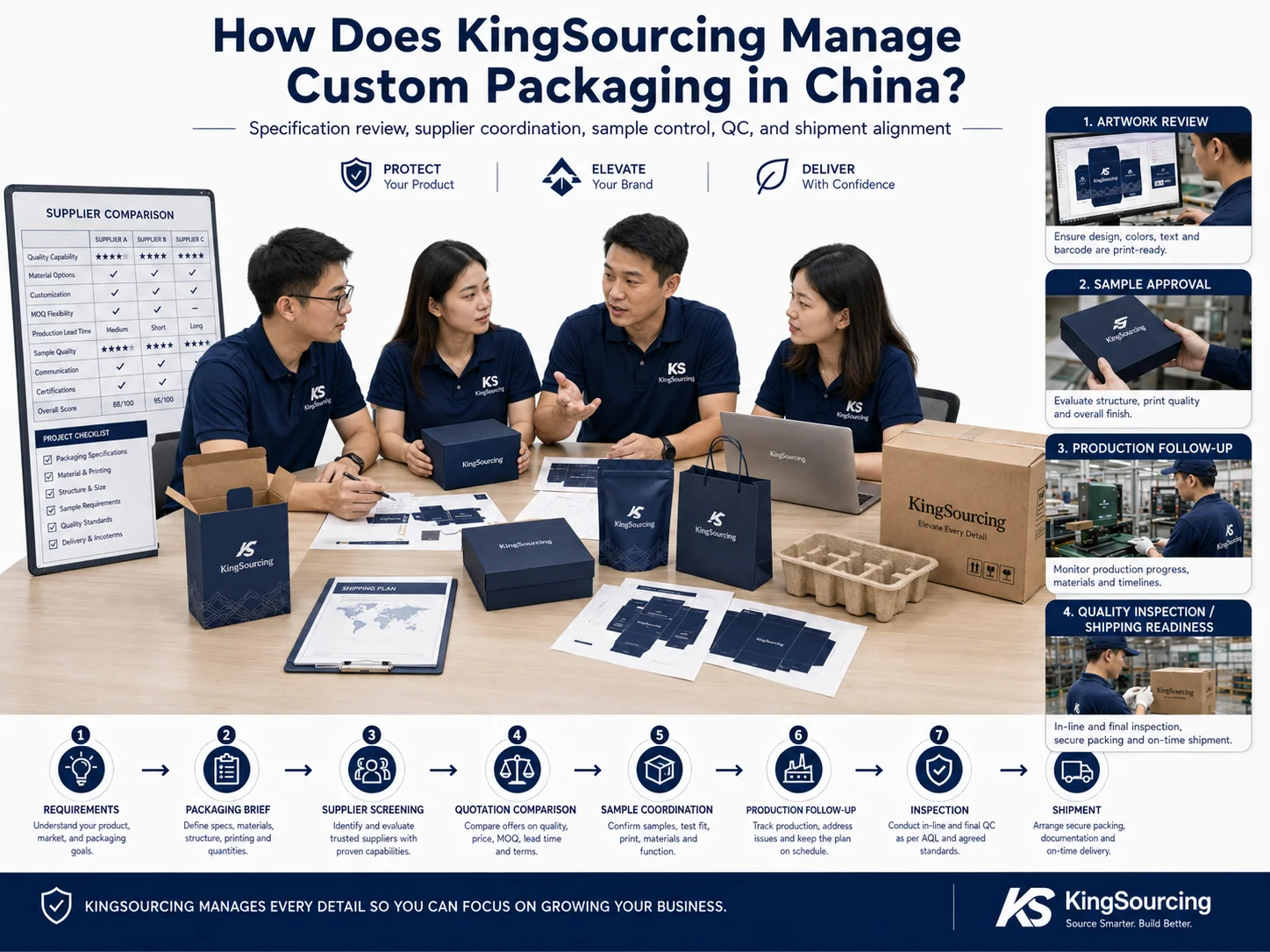
Our Packaging Project Workflow
I work as the client’s local sourcing and supply-chain coordinator. Depending on the project, our process can include:
- Reviewing the product, target market, quantity, budget, and deadline
- Turning ideas into a clear packaging specification
- Identifying and communicating with suitable packaging suppliers
- Comparing material, MOQ, cost, and lead-time options
- Checking design files and supplier dielines
- Coordinating prototypes, printed samples, and revisions
- Managing packaging delivery to the product factory or warehouse
- Inspecting packaging appearance, dimensions, assembly, and packing
- Coordinating final product packing, consolidation, and shipping
Packaging Quality Control in Practice
Our inspection approach depends on the product and agreed standards. For packaging, I may check printing defects, color variation, dimensions, material consistency, glue issues, dents, scratches, inserts, barcodes, carton marks, and packing quantity.
I do not present inspection as a way to eliminate all risk. Instead, it is a practical control point. Clear specifications, approved samples, and written acceptance criteria make inspections more useful because the team knows what to compare against.
KingSourcing can also coordinate packaging separately from the product factory. This can be useful when a specialist packaging supplier offers better capability or pricing. However, I make sure the packaging size, delivery timing, assembly method, and factory handling responsibilities are confirmed in advance.
Frequently Asked Questions About Custom Packaging in China
How much does custom packaging cost in China?
Custom packaging cost depends on material, dimensions, structure, print colors, finish, order quantity, and tooling. I recommend comparing complete project cost, including sample fees, plates, die-cut molds, assembly, local delivery, and freight impact, rather than looking only at the unit price.
What is the typical MOQ for custom boxes?
MOQ varies widely by box type, material, printing method, size, finishing, and supplier. A simple printed label or stock box modification may work at a lower quantity than a fully customized rigid box. I always request supplier confirmation for the specific project.
Can I order packaging separately from the product factory?
Yes, I can source packaging from a specialist supplier and deliver it to the product factory for packing. This requires careful coordination of box dimensions, delivery dates, assembly instructions, packing labor, and responsibility for damaged or missing packaging.
How long does packaging sample development take?
Sample development time depends on structure complexity, artwork readiness, material availability, and revision cycles. A simple sample may move faster than a complex rigid box with custom inserts and special finishing. I recommend allowing time for physical fit testing and revisions.
What files do I need for custom packaging?
I usually request editable vector logo files, such as AI, PDF, or EPS, plus brand colors, fonts, product information, barcode files, and artwork. The supplier should provide a dieline before final print artwork is prepared. I also recommend confirming text and compliance labels before printing.
Conclusion
Custom packaging in China works best when I treat it as a supply-chain project, not only a design task. The right packaging protects the product, supports the brand, fits the budget, and moves efficiently through factories, warehouses, and international shipping. Clear specifications, suitable suppliers, approved samples, and practical quality checks can reduce expensive surprises. If you need help sourcing, developing, inspecting, or coordinating branded packaging with your products, contact KingSourcing and let us make your China sourcing simpler.
Tags: Custom Packaging in China, Packaging Manufacturer China, Private Label Packaging, Custom Boxes, Packaging Design and Development, China Sourcing Agent, Import from China
[^1]: "Compressive Strength of Corrugated Paperboard Packages ...", https://pmc.ncbi.nlm.nih.gov/articles/PMC10054506/. Packaging education materials describe corrugated fiberboard as a fluted, structural material used for shipping containers because it provides cushioning and compression resistance; container volume remains relevant to transportation utilization. Evidence role: general_support; source type: education. Supports: Corrugated fiberboard's fluted structure provides stiffness and compression performance for shipping containers, while its dimensions affect freight volume.. Scope note: Protection varies substantially with flute, linerboard, box design, load, moisture exposure, and palletization. [^2]: "Ista", https://en.wikipedia.org/wiki/Ista. International Safe Transit Association distribution-test guidance describes drop, vibration, and compression hazards that packaging may need to withstand in transit, supporting the need to evaluate retail packs separately from their shipping protection. Evidence role: general_support; source type: institution. Supports: Distribution testing standards distinguish product packaging from protective shipping packaging and evaluate hazards such as drops, vibration, and compression during transport.. Scope note: The guidance does not establish that every retail box will fail in international shipping; performance depends on the package design and distribution environment. [^3]: "Damage prevention in the transportation environment", https://nvlpubs.nist.gov/nistpubs/Legacy/SP/nbsspecialpublication652.pdf. Packaging-engineering research explains that cushioning and outer-container systems can reduce the transmission of transport shocks and compression loads to products, providing a mechanism for layered packaging protection. Evidence role: mechanism; source type: research. Supports: Packaging-engineering literature explains how cushioning, containment, and outer shipping containers distribute or attenuate transport loads.. Scope note: The degree of damage reduction and the cost trade-off must be validated for the specific product, package, and distribution route. [^4]: "The influence of printing substrate properties on color ...", https://www.academia.edu/80245608/The_influence_of_printing_substrate_properties_on_color_characterization_in_flexography_according_to_ISO_specifications. Printing color-management guidance recognizes that substrate and ink characteristics, print process controls, and viewing conditions influence printed color reproduction and consistency. Evidence role: mechanism; source type: institution. Supports: Printing color-management standards and research document that substrates, inks, process conditions, and surface characteristics influence measured and perceived printed color.. Scope note: The relative effect of each factor depends on the press, ink system, substrate, and approved color target. [^5]: "Color Proof - Difference between Monitor Proof and no Proof", https://community.adobe.com/questions-712/color-proof-difference-between-monitor-proof-and-no-proof-1081888. International Color Consortium color-management guidance explains that monitors and printing processes have different color characteristics and profiles, so a calibrated print proof is needed to assess final printed color. Evidence role: mechanism; source type: institution. Supports: Color-management standards explain that display appearance and printed output use different device profiles and viewing conditions, requiring calibrated proofing for print verification.. Scope note: Calibrated soft proofing can be useful in controlled workflows, but it does not by itself guarantee production color on every substrate and press. [^6]: "Molded pulp products for sustainable packaging - BioResources", https://bioresources.cnr.ncsu.edu/resources/molded-pulp-products-for-sustainable-packaging-production-rate-challenges-and-product-opportunities/. Studies of molded-fiber packaging identify it as a fiber-based alternative that can replace certain plastic protective components and thereby reduce plastic content in a packaging system. Evidence role: general_support; source type: paper. Supports: Life-cycle and materials studies assess molded fiber or pulp packaging as a substitute for some plastic packaging components.. Scope note: Reduced plastic content is not equivalent to lower total environmental impact, which depends on fiber sourcing, energy, transport, reuse, and end-of-life conditions. [^7]: "Food Contact Materials - Food Safety - European Commission", https://food.ec.europa.eu/food-safety/chemical-safety/food-contact-materials_en. European Commission regulatory guidance sets category-specific requirements for areas including food-contact materials, cosmetic labeling, and toy safety warnings, supporting the need to verify destination-market rules before packaging is finalized. Evidence role: general_support; source type: government. Supports: Regulatory authorities set product- and market-specific rules for food-contact materials, cosmetics labeling, and toy safety information.. Scope note: Applicable obligations vary by destination, product classification, claims, materials, and the responsible economic operator. [^8]: "Printing Charges | U-M Information and Technology Services", https://its.umich.edu/computing/computers-software/campus-computing-sites/printing/printing-charges. Graphic-communications teaching materials explain that fixed prepress, press-setup, and tooling costs are spread across a production run, which helps explain why customization choices can affect economically viable order quantities. Evidence role: mechanism; source type: education. Supports: Printing-production resources explain that fixed setup, plate, and tooling costs influence economical run lengths and minimum production quantities.. Scope note: A supplier's stated MOQ also reflects its scheduling, capacity, commercial policy, and inventory, not only technical setup costs. [^9]: "Economic Order Quantity (EOQ) | www.waru.edu", https://www.waru.edu/acquipedia-article/economic-order-quantity-eoq. Inventory-management literature treats purchase price as only one component of total cost, alongside holding costs, storage needs, capital commitment, and obsolescence risk. Evidence role: mechanism; source type: education. Supports: Inventory-management models account for holding costs, storage, capital tied up in stock, and obsolescence when evaluating order quantities.. Scope note: The optimal quantity requires project-specific demand forecasts, storage costs, supplier pricing, and the probability of design or regulatory changes. [^10]: "Material requirements planning with a novel lot sizing method ...", https://pmc.ncbi.nlm.nih.gov/articles/PMC12307884/. Production-planning research recognizes that downstream packing, labeling, and quality-release activities depend on the timely availability and approval of required materials, so late packaging decisions can affect shipment readiness. Evidence role: mechanism; source type: research. Supports: Supply-chain and production-planning literature describes how dependencies among materials, labeling, packing, and quality release can affect shipment schedules.. Scope note: The actual delay depends on inventory buffers, whether packaging is sourced separately, and the ability to rework or expedite the affected operations. [^11]: "Process or Product Monitoring and Control | NIST", https://www.nist.gov/publications/nistsematech-engineering-statistics-handbook-chapter-6-process-or-product-monitoring. Quality-control standards for acceptance sampling and process control recognize that manufacturing output can vary within and between lots, so approval of an initial sample is not proof that every production unit conforms. Evidence role: expert_consensus; source type: institution. Supports: Quality-control standards use sampling and process controls because production lots can vary from an approved first article or sample.. Scope note: The amount of variation depends on process capability, material control, inspection plans, and the supplier's quality system. [^12]: "White Balance | College of Communication & Information", https://ci.uky.edu/about/faculty-and-staff-resources/ci-technology-services/tutorials/white-balance. Color-science guidance explains that photographic color reproduction is influenced by illumination, white balance, exposure, and camera processing, so images may not faithfully represent a package's physical color. Evidence role: mechanism; source type: education. Supports: Color-science resources explain that illumination, white balance, exposure, and camera processing affect recorded and displayed photographic color.. Scope note: Controlled lighting, calibration targets, and color-managed workflows can improve comparability but do not make ordinary photographs equivalent to a physical approval sample.