China sourcing agent red flags can be difficult to spot before an order is placed. A low quote, quick replies, or a polished website may look reassuring, but unclear responsibilities can create expensive surprises later. We help buyers reduce this uncertainty by showing them what evidence, documents, and answers they should request before committing funds.
China sourcing agent red flags usually include hidden supplier details, unclear fee structures, unexplained quote changes, poorly documented samples, weak production updates, vague quality-control processes, and resistance to independent verification. One issue does not automatically mean an agent is unreliable, but several warning signs together justify a deeper review before a buyer places or expands an order.
In our conversations with early-stage ecommerce sellers and DTC brands, we often hear the same question: “How do I know whether an agent is actually protecting my interests?” The answer is not to assume every low-cost service is risky. Instead, buyers should compare transparency, documentation, scope, and accountability.
What Are the Most Important China Sourcing Agent Red Flags?
Buyers often feel pressure to choose an agent quickly because they want to launch a product, test a trend, or secure a lower factory price. That urgency can make basic verification feel slow. However, skipping verification can make later disputes harder to manage[^1].
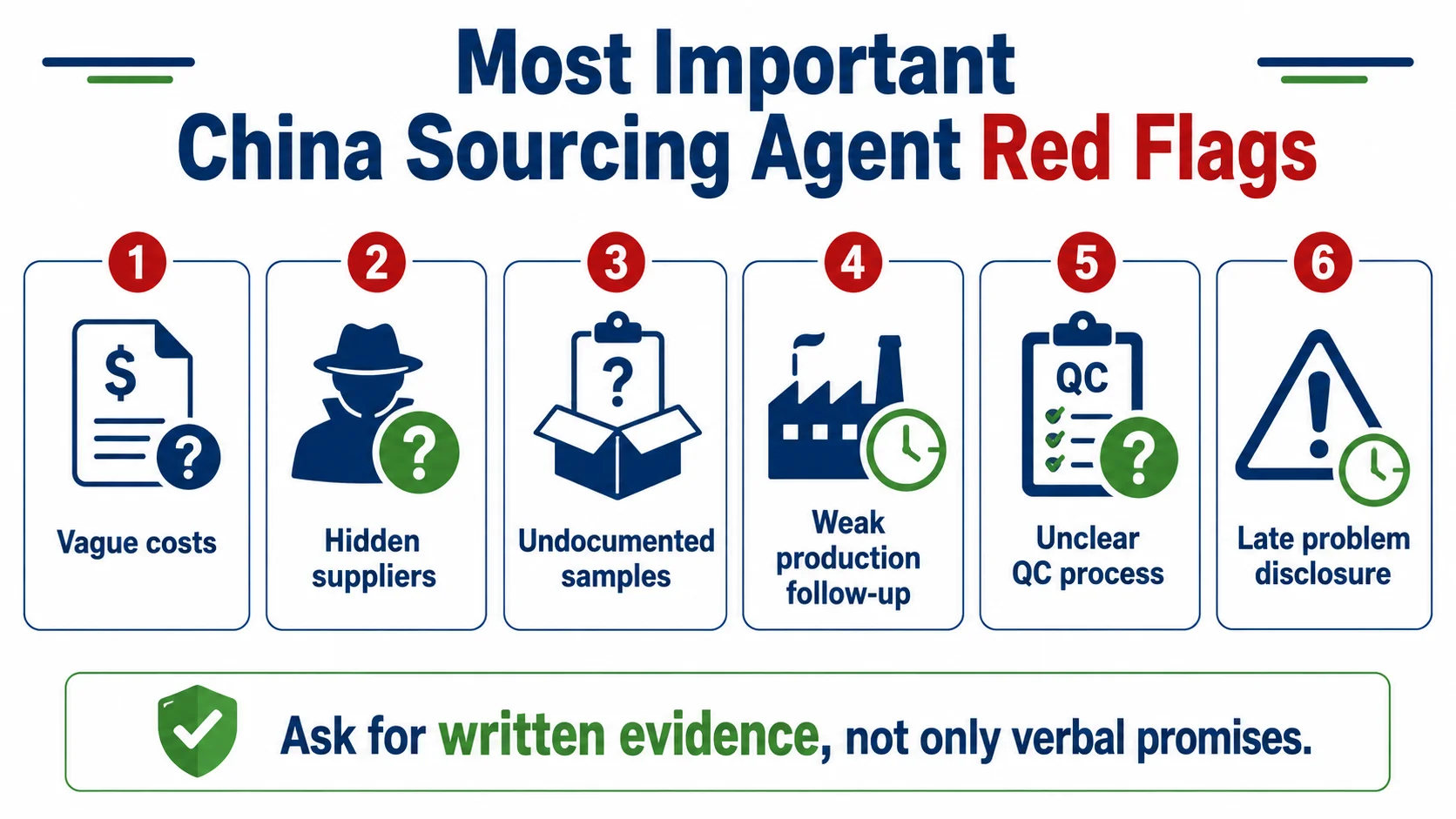
The most important China sourcing agent red flags are vague costs, hidden supplier information, undocumented product approvals, weak production follow-up, unclear QC procedures, and delayed disclosure of problems[^2]. Buyers should ask for written evidence for each area, rather than relying only on verbal promises or chat messages.
Why several small warning signs matter
A single issue can have an ordinary explanation. For example, a factory may be reluctant to disclose every commercial detail at an early stage[^3], or a quotation may change because raw-material costs moved[^4]. Those facts alone do not prove bad intent.
The concern grows when an agent repeatedly avoids clear answers or provides inconsistent information. We encourage buyers to look for patterns across the complete sourcing process:
- Can the agent explain the supplier selection process?
- Can the agent show what the quote includes and excludes?
- Can the agent document the approved sample and specifications?
- Can the agent confirm who performs inspection and when?
- Can the agent explain what happens if goods fail inspection or production is delayed?
In our buyer consultations, we have seen that many concerns begin with a seemingly simple question about price. A buyer may receive a product quote that looks attractive, but the quote does not state whether it includes packaging, inland delivery, inspection, export documentation, warehousing, or international freight coordination.
The low figure is not necessarily the problem. The missing explanation is the problem.
A reliable sourcing decision compares the total cost, service scope, and responsibility boundaries, not only the first product quote.
Before paying a deposit, we recommend creating a simple written comparison file. Ask each candidate agent to answer the same questions and provide the same categories of information. This approach makes differences easier to identify and reduces avoidable surprises.
Why Do China Sourcing Agent Red Flags Matter Before You Place an Order?
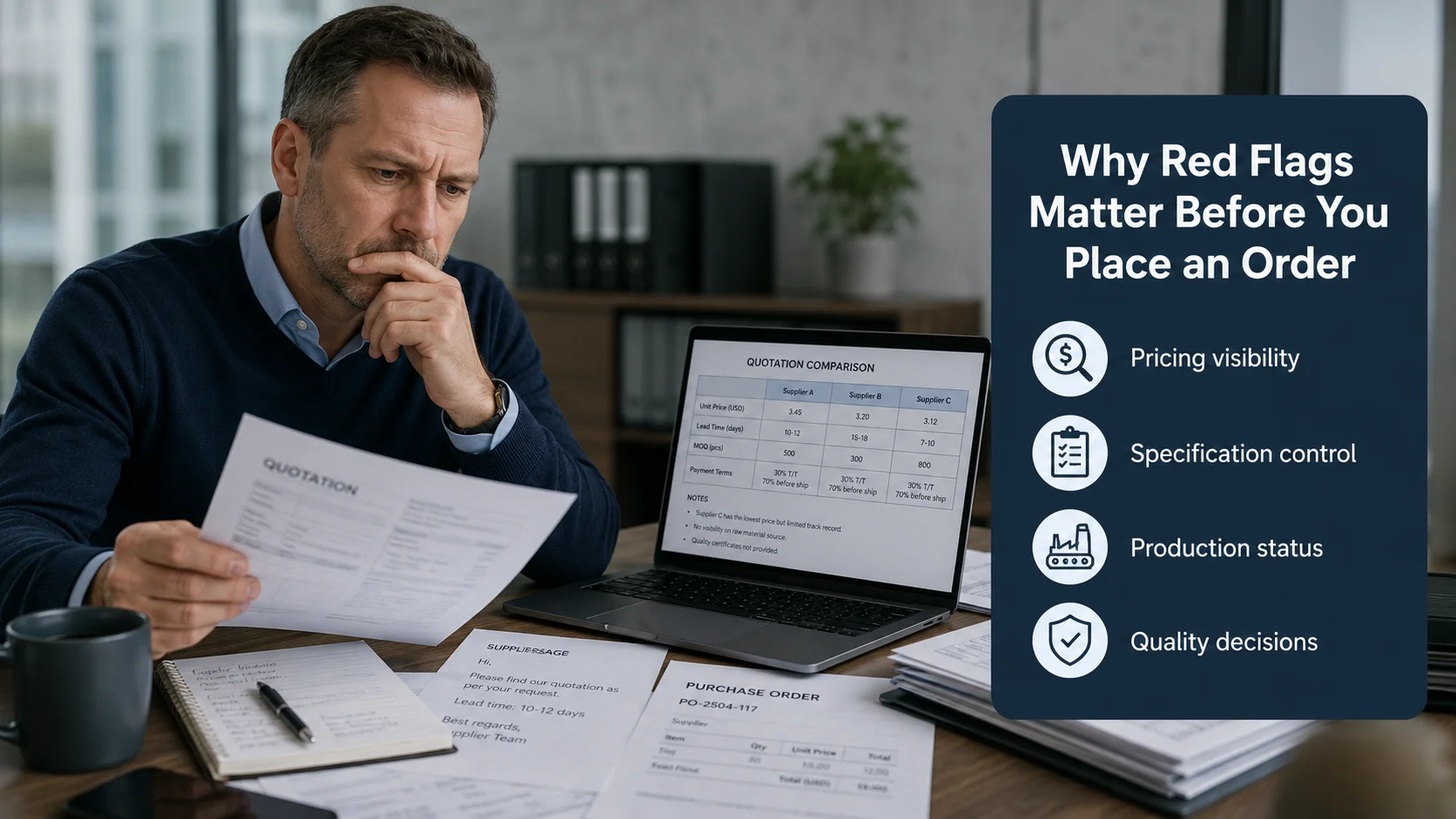
An agent sits between the buyer and the supplier, so unclear processes can affect more than communication. If the agent does not manage information carefully, a buyer may lose visibility over pricing, product specifications, production status, and quality decisions.
China sourcing agent red flags matter because an agent can influence supplier selection, quotations, sample approval, factory communication, order follow-up, and QC reporting[^5]. When these activities are not transparent, buyers have less ability to verify decisions or respond early when problems develop.
The agent’s role creates a need for accountability
A sourcing agent does not need to control every part of manufacturing to provide value. Suppliers remain responsible for making goods, and freight providers remain responsible for transport execution. Still, a professional procurement service should define its role clearly.
We believe buyers should understand where responsibility starts and ends. For example:
| Area | Questions buyers should ask |
|---|---|
| Supplier development | How were suppliers found and compared? |
| Price negotiation | Is the supplier quote traceable and current? |
| Product development | Who confirms specifications and revisions? |
| Production follow-up | What milestones will be reported? |
| Quality control | What inspection standard and sampling method apply? |
| Problem handling | Who communicates defects, delays, or changes? |
| Logistics | Which charges are included and which are separate? |
Without these answers, buyers can face several types of exposure:
- Pricing exposure: A low product quote may omit services or expected add-on costs.
- Quality exposure: A supplier may use a different material, finish, component, or packaging method than the approved sample.
- Delivery exposure: Production delays may only be disclosed when there is little time left to respond.
- Communication exposure: Important changes may be discussed informally but never confirmed in writing.
- Supplier exposure: The buyer may not know whether the selected party is a factory, trading company, or subcontracting network.
We do not suggest that every buyer needs complete access to every supplier relationship. Some agents protect commercial relationships for understandable reasons. However, an agent should still be able to provide enough verifiable information for the buyer to assess capability, location, product category experience, and relevant compliance documents where needed.
Is the Sourcing Agent Hiding Supplier or Factory Information?
Many buyers worry that an agent will hide the factory identity. This concern is understandable, especially when buyers need to assess production capability or verify whether a supplier is suitable for their product category.
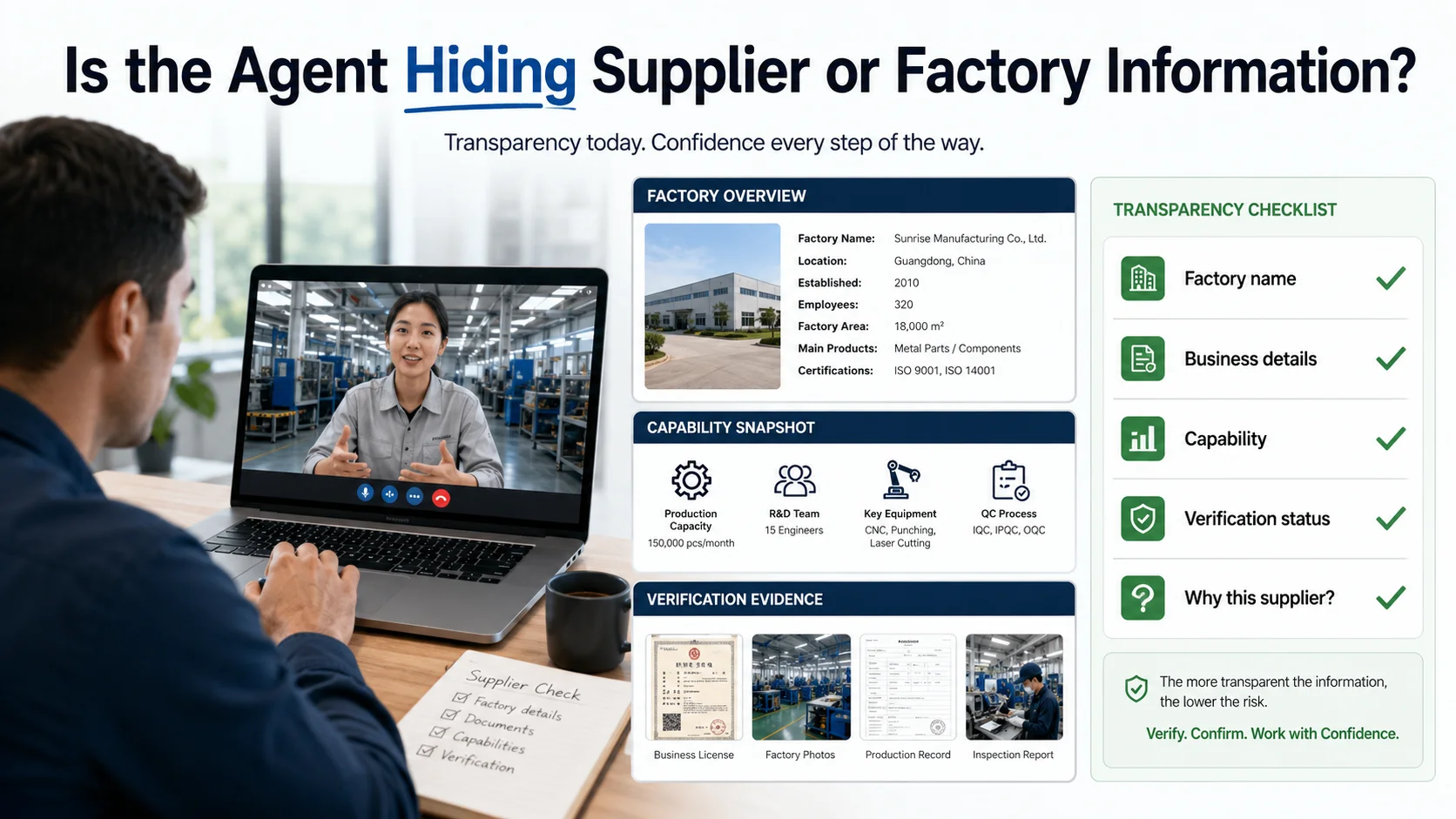
A sourcing agent should be able to explain the supplier’s basic identity, role, capabilities, and verification status. A red flag appears when an agent refuses to provide reasonable information, gives inconsistent details, or cannot explain why a supplier is appropriate for the order.
What supplier transparency should look like
Supplier transparency does not always mean an agent must immediately hand over every direct contact detail. The practical standard is whether the buyer receives enough information to make an informed procurement decision.
We recommend asking for:
-
Supplier name and location
Confirm the legal entity name where appropriate, city, and manufacturing region. -
Supplier role
Ask whether the supplier is a manufacturer, trading company, wholesaler, or a business using subcontractors. -
Relevant product capability
Request information that connects the supplier to your product, such as production equipment, product range, material expertise, or past category experience. -
Verification evidence
Ask what checks were completed. This may include business registration review, factory visit records, video calls, production photos, customer references where available, or document checks. -
Reason for selection
A useful answer should explain why the supplier was shortlisted: price, MOQ, quality level, customization capability, lead time, or export experience.
Factory versus trading company is not always the main issue
Some buyers assume that every trading company is a bad sourcing option. We do not agree with that assumption. A capable trading company can coordinate several specialized factories and may be useful for mixed-product orders.[^6] A factory can also be unsuitable if it lacks export experience, has weak communication, or does not match the buyer’s quality requirements.
The key question is whether the agent is clear about the supplier’s role. If an agent calls every supplier a “factory” but cannot explain the production setup, that is a sourcing agent warning sign.
Buyers can also request a video call, factory photos with date references, or an independent factory audit for higher-value or technically sensitive orders. Documents and visits should be verified by qualified professionals when application-specific compliance, safety, or technical performance is involved.
Are the Fees and Supplier Quotations Transparent?
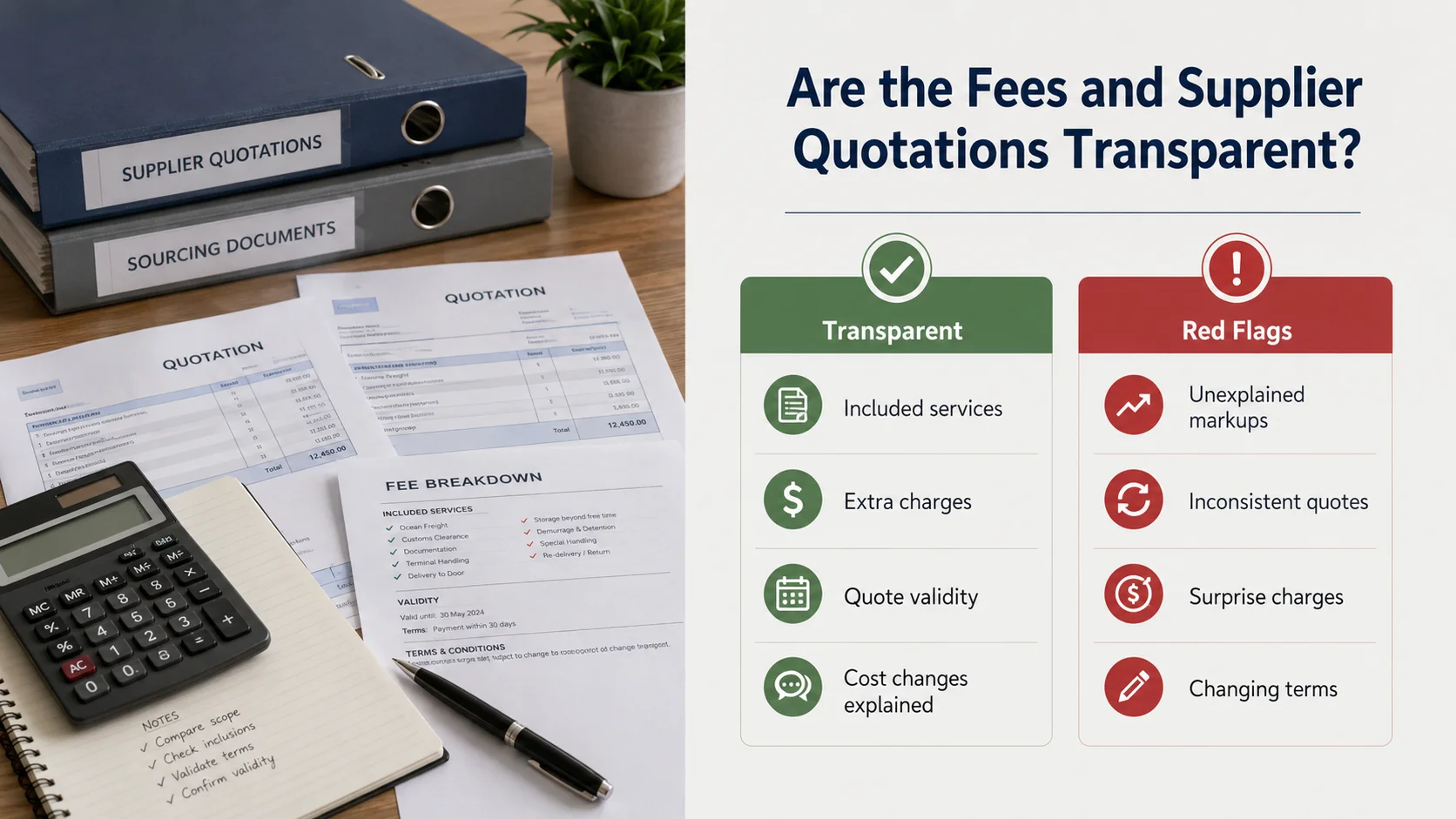
A very low service fee can attract buyers who are trying to control startup costs. The issue is not that an agent charges a low fee. The issue is whether the agent can explain the complete financial structure before the buyer sends money.
Transparent sourcing fees should show what is included, what may be charged separately, and which events can change the final cost. Unexplained markups, inconsistent quotations, and surprise charges are stronger red flags than a low quote or low commission by itself.
Compare total sourcing cost, not headline price
In our team’s conversations with new buyers, we often hear an assumption that the lowest product quote represents the best deal. In reality, a quote may cover very different scopes.
A buyer should request a written fee breakdown that identifies:
| Cost category | What to clarify |
|---|---|
| Product unit price | Product version, material, MOQ, currency, Incoterm |
| Tooling or mold fees | Ownership, revisions, maintenance, refund conditions |
| Sample fees | Number of revisions, shipping, sample approval process |
| Packaging | Standard packaging, custom inserts, labels, cartons |
| QC fees | Inspection type, timing, report format, reinspection costs |
| Warehouse fees | Storage period, handling, consolidation charges |
| Shipping | Freight basis, destination, duties/taxes, insurance, exclusions |
| Agent fees | Commission, fixed fee, service package, or embedded margin |
| Exceptions | Delays, defects, repacking, returns, split shipments |
A clear quote does not need to guarantee that every future cost will remain unchanged. Freight rates, raw materials, exchange rates, and buyer-requested changes can all affect final expenses.[^7] Still, the agent should identify these variables in advance.
Questions that reveal responsibility boundaries
We recommend asking each candidate agent:
- Which services are included in this quote?
- Which services are excluded?
- Are there likely add-on fees after the purchase order is issued?
- How do you earn your service fee?
- Can supplier quotations be compared on the same product specification?
- Who approves added costs before they are charged?
- What happens if the order needs rework, repacking, or reinspection?
If the answers stay vague, the buyer should pause. A fee dispute is much easier to prevent before payment than to resolve after goods are already in production.
How Does a Reliable China Sourcing Agent Compare With Red Flags?
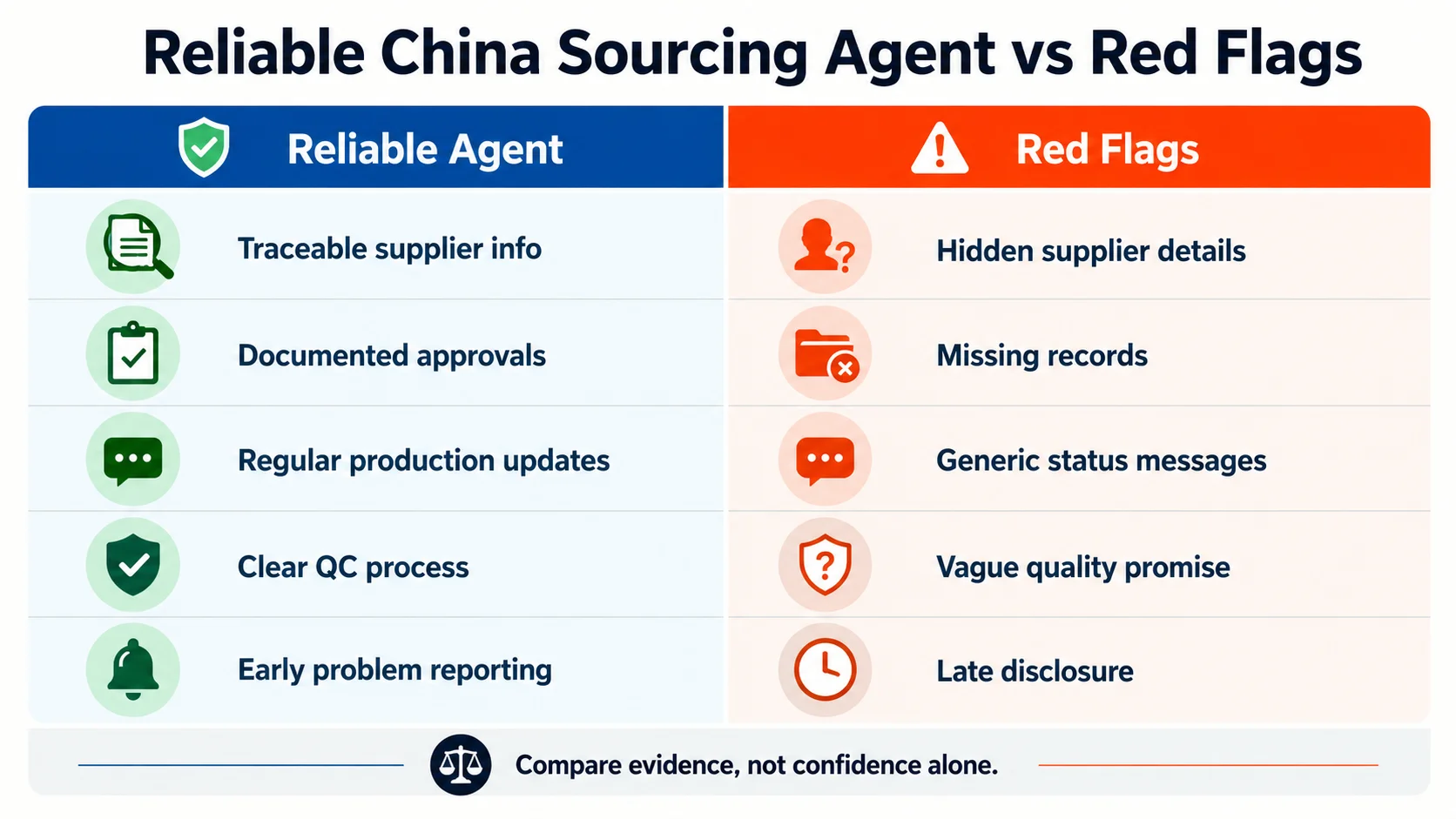
Buyers can avoid many poor decisions by comparing evidence instead of relying on confidence, speed, or a friendly sales conversation. The table below gives a practical starting point for China sourcing agent due diligence.
A reliable China sourcing agent provides traceable information, documented approvals, regular updates, and early problem reporting. Red flags appear when the process depends on vague reassurance, missing records, or explanations that change after the buyer has paid.
| Area | Reliable Sourcing Agent | Red Flag |
|---|---|---|
| Supplier information | Clear, consistent, and reasonably verifiable | Hidden, incomplete, or inconsistent |
| Fees | Explained upfront with inclusions and exclusions | Unexpected charges or unclear margins |
| Quotations | Traceable to specifications and comparable | Unexplained price changes |
| Samples | Approved with records and photos | Samples change without explanation |
| Production updates | Regular milestone reports | Long periods without updates |
| QC | Defined inspection process and report | Vague claim that “the factory checked it” |
| Problems | Reported early with options | Disclosed too late to respond |
| Documentation | Purchase order, specs, and revisions are organized | Key decisions remain only in chat messages |
Use the table as a comparison tool, not a verdict
We recommend assigning each agent a simple score of 1 to 5 in every area. Then ask for supporting evidence before giving a high score. For example, an agent should not receive a strong QC score merely because they say they “guarantee quality.” Instead, buyers should request a sample inspection report, a checklist, or an explanation of the inspection method.
This process does not eliminate sourcing risk. Manufacturing always involves variables. However, it helps buyers distinguish between an agent with a defined system and an agent who relies mainly on assurances.
Are Samples, Specifications, and Product Changes Properly Documented?
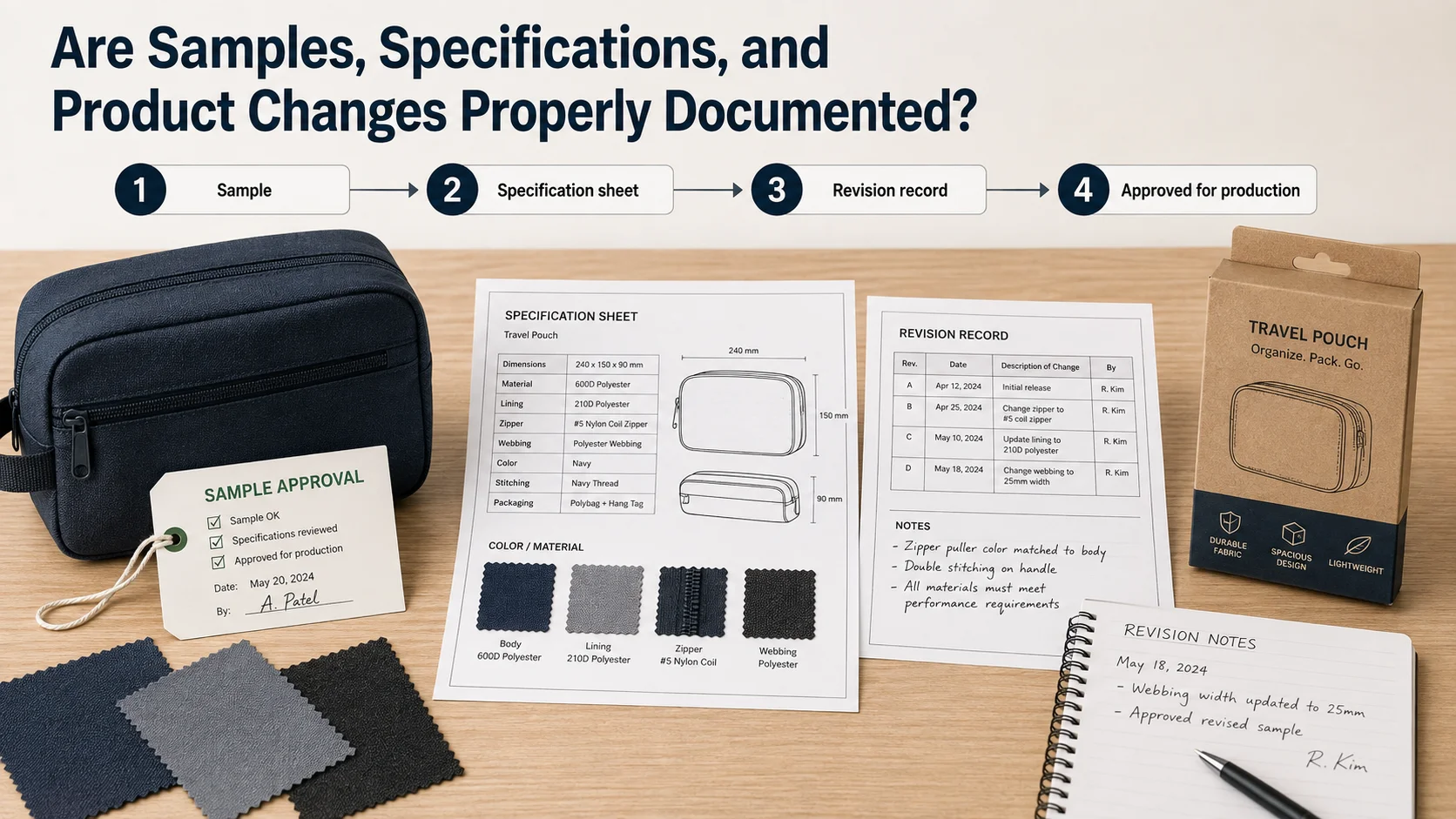
Buyers often discover quality problems because the approved sample was never translated into a clear production standard[^8]. A supplier may believe it is following instructions, while the buyer expects a different material, color, dimension, or packaging detail.
Samples and specifications should be documented through approved reference samples, specification sheets, photos, revision records, and packaging instructions. A major red flag is when an agent cannot show which version was approved for mass production or why production differs from the sample.
Turn the sample into a production reference
A sample is useful only when everyone agrees on what it represents. We suggest that buyers create a written sample approval record before mass production starts.
The record can include:
- Product name, SKU, and revision number
- Dimensions and tolerances
- Materials, colors, finishes, and components
- Functional requirements
- Logo placement and artwork version
- Packaging, labels, inserts, and carton marks
- Approved sample photos from multiple angles
- Known deviations or accepted limitations
- Date and name of the approving person
For more complex products, buyers may need a detailed bill of materials, technical drawings, test requirements, or compliance documentation. A qualified professional should evaluate requirements for regulated, safety-related, electrical, food-contact, medical, or child-related products.
Control product changes
Changes happen in production. A material may become unavailable, a logo file may need adjustment, or a carton size may change to improve shipping efficiency. The problem is not the change itself. The problem is an unapproved change.
We recommend a basic rule: no material, component, packaging, or specification change should move forward without written buyer approval[^9].
An agent should keep a revision log that shows:
- What changed.
- Why it changed.
- How it affects cost, quality, lead time, or compliance.
- Whether the buyer approved it.
- Which production batch the change affects.
This record makes it much easier to investigate problems and avoids the frustrating situation where the sample looked correct but the bulk goods arrived differently.
Is Production Follow-Up Weak or Difficult to Verify?
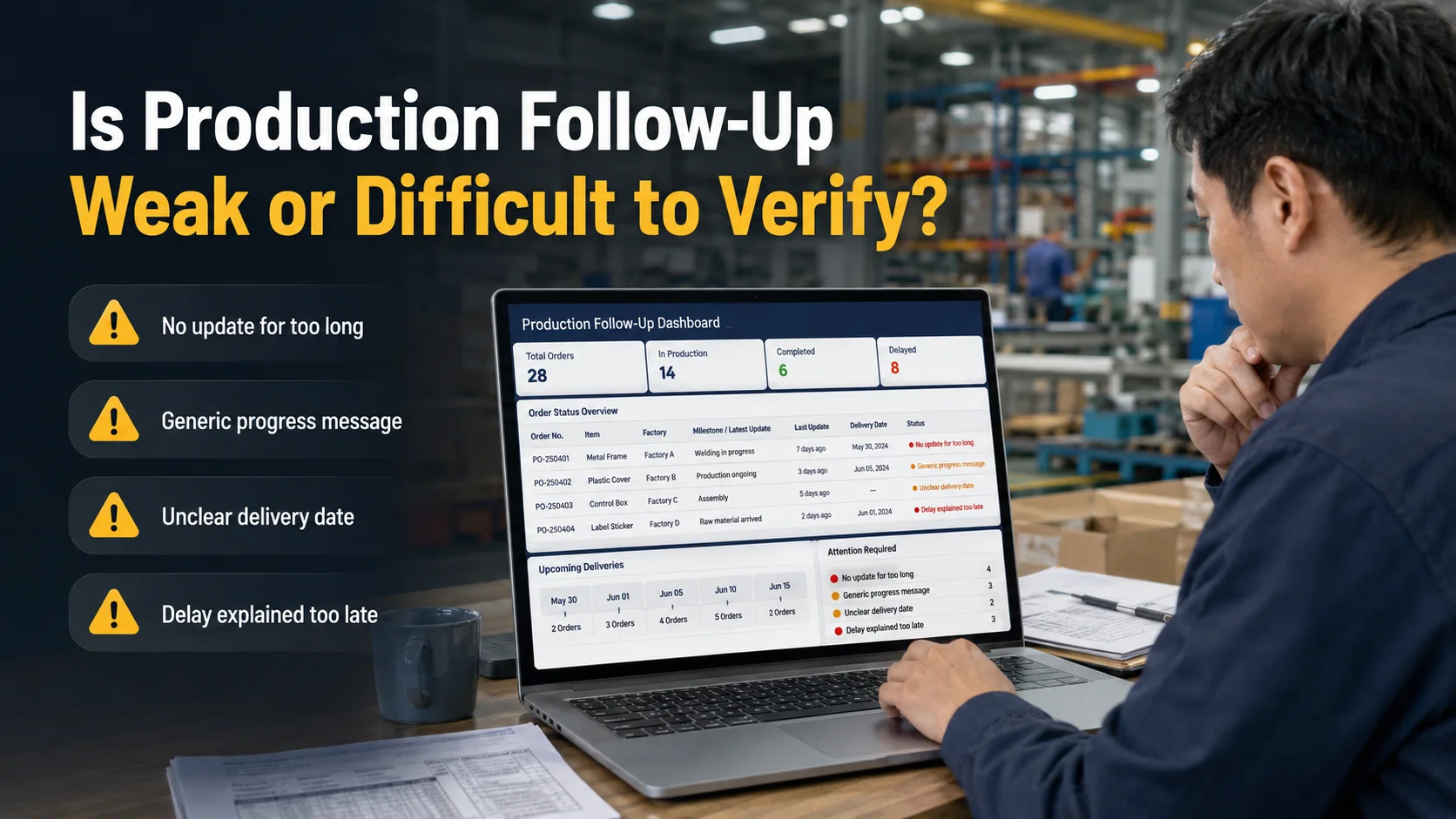
Some agents are highly responsive before a deposit is paid but provide few meaningful updates once production begins. This can leave buyers without enough time to address delays, material substitutions, or packaging errors.
A sourcing service should provide verifiable production follow-up after the purchase order is issued. Red flags include long periods without updates, generic status messages, unclear delivery dates, and delay explanations that arrive only when the goods are already late.
Ask for milestone-based reporting
We believe progress reports should follow production milestones rather than random chat updates. The exact schedule depends on the product and lead time, but a buyer can request reporting around key stages:
| Production stage | Evidence a buyer can request |
|---|---|
| PO confirmation | Signed order details and delivery target |
| Material preparation | Material confirmation or production plan |
| Start of production | Dated factory photos or video |
| Mid-production | Quantity progress and issue report |
| Packaging | Packaging photos and carton details |
| Pre-shipment | Inspection report and final quantity |
| Dispatch | Packing list, shipping documents, pickup confirmation |
A good update should answer specific questions. It should state what has been completed, what is pending, whether the timeline is still realistic, and what decision the buyer needs to make.
Look for early communication when problems occur
Production delays can occur even with experienced suppliers. Equipment can fail, materials can arrive late, and seasonal demand can affect capacity. We do not view every delay as proof of a bad sourcing agent.
We do view late disclosure as a serious concern. If an agent learns about a delay but waits until the original ship date has passed, the buyer loses options. Early reporting gives the buyer time to adjust marketing plans, split shipments, approve alternatives, or seek another supplier.[^10]
At KingSourcing, we treat production follow-up as a continuing procurement activity, not a task that ends when a purchase order is sent.
Is Quality Control Treated as an Afterthought?
Many buyers hear “the factory checked everything” and assume this means the goods meet requirements. Factory self-checking can be useful, but it is not the same as a defined, buyer-focused inspection process.[^11]
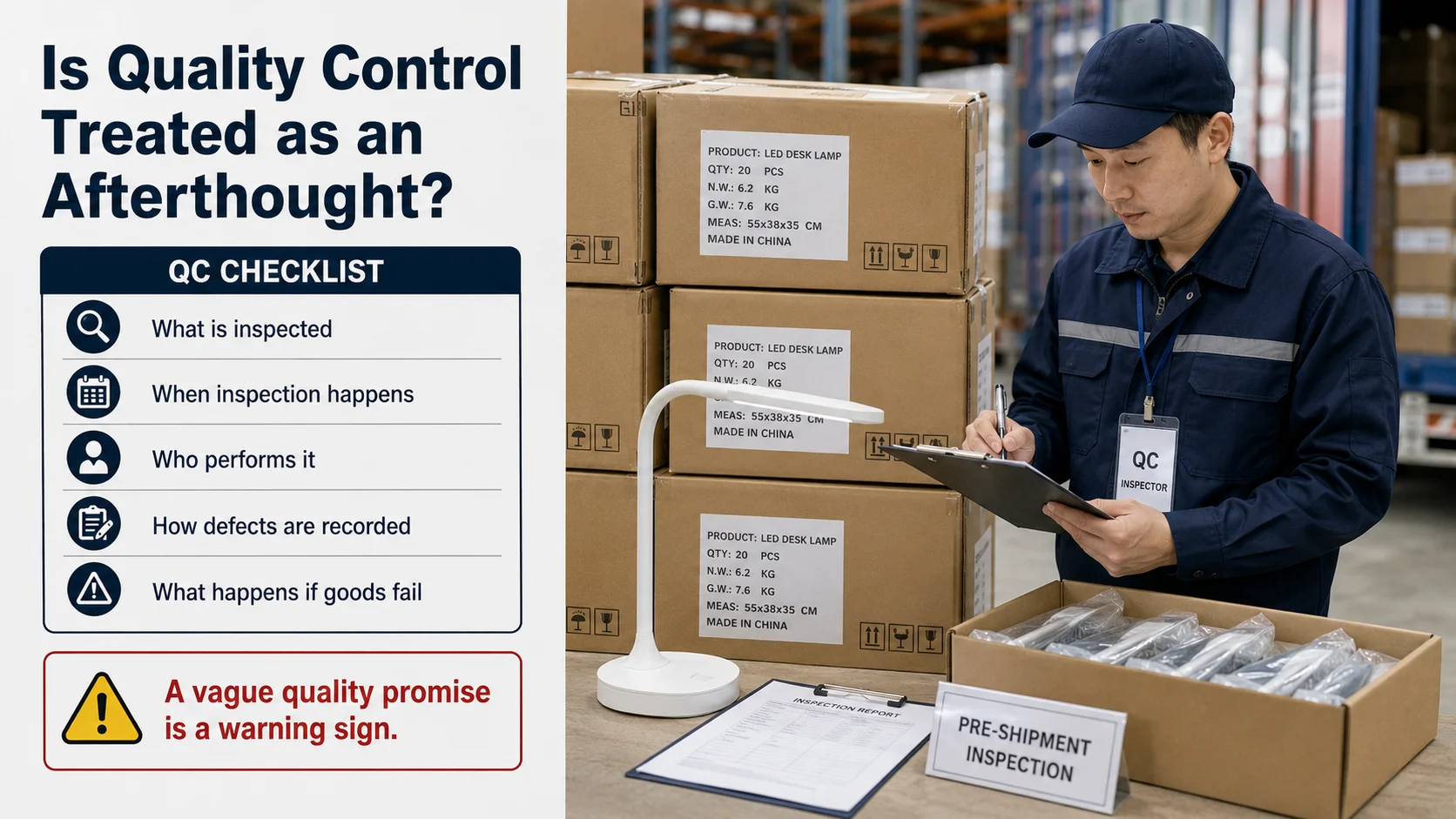
China sourcing agent quality control should define what will be inspected, when inspection will happen, who performs it, how defects are recorded, and what happens when goods fail. A vague promise of quality checking without a report or standard is a significant warning sign.
What to request before production begins
Before placing an order, buyers should ask the agent to explain the QC plan in writing:
- Will there be a pre-production check?
- Will an inspection occur during production or only before shipment?
- What quantity will be inspected?
- Which standard or defect classification will be used?
- Will the buyer receive photos, videos, and a written report?
- Who decides whether defects are acceptable?
- What corrective action is possible if the goods fail?
- Who pays for reinspection, rework, or replacement?
For many consumer products, buyers may use an AQL-based inspection approach[^12]. The appropriate AQL level depends on the product, its risk profile, and customer expectations. It is not a universal guarantee of quality. Buyers should define critical, major, and minor defects for their own product.
Pre-shipment inspection is not the entire quality system
A pre-shipment inspection in China can identify visible defects, quantity issues, packaging problems, and selected functional checks before dispatch. However, it cannot repair a product that was designed incorrectly or manufactured with an unapproved material from the start.
That is why we encourage buyers to combine:
- Sample approval
- Clear specifications
- Production monitoring where appropriate
- Pre-shipment inspection
- Documented corrective-action decisions
For high-value, technical, or regulated products, independent testing and qualified technical review may be necessary. Buyers should verify certifications and test reports with the issuing body or a qualified expert rather than relying only on a supplier-provided file.
When Should You Replace or Re-Evaluate Your China Sourcing Agent?
Changing an agent can interrupt supplier relationships and delay orders, so buyers should not make the decision based on one minor frustration. Still, continuing with a poorly documented process can create greater financial exposure over time.
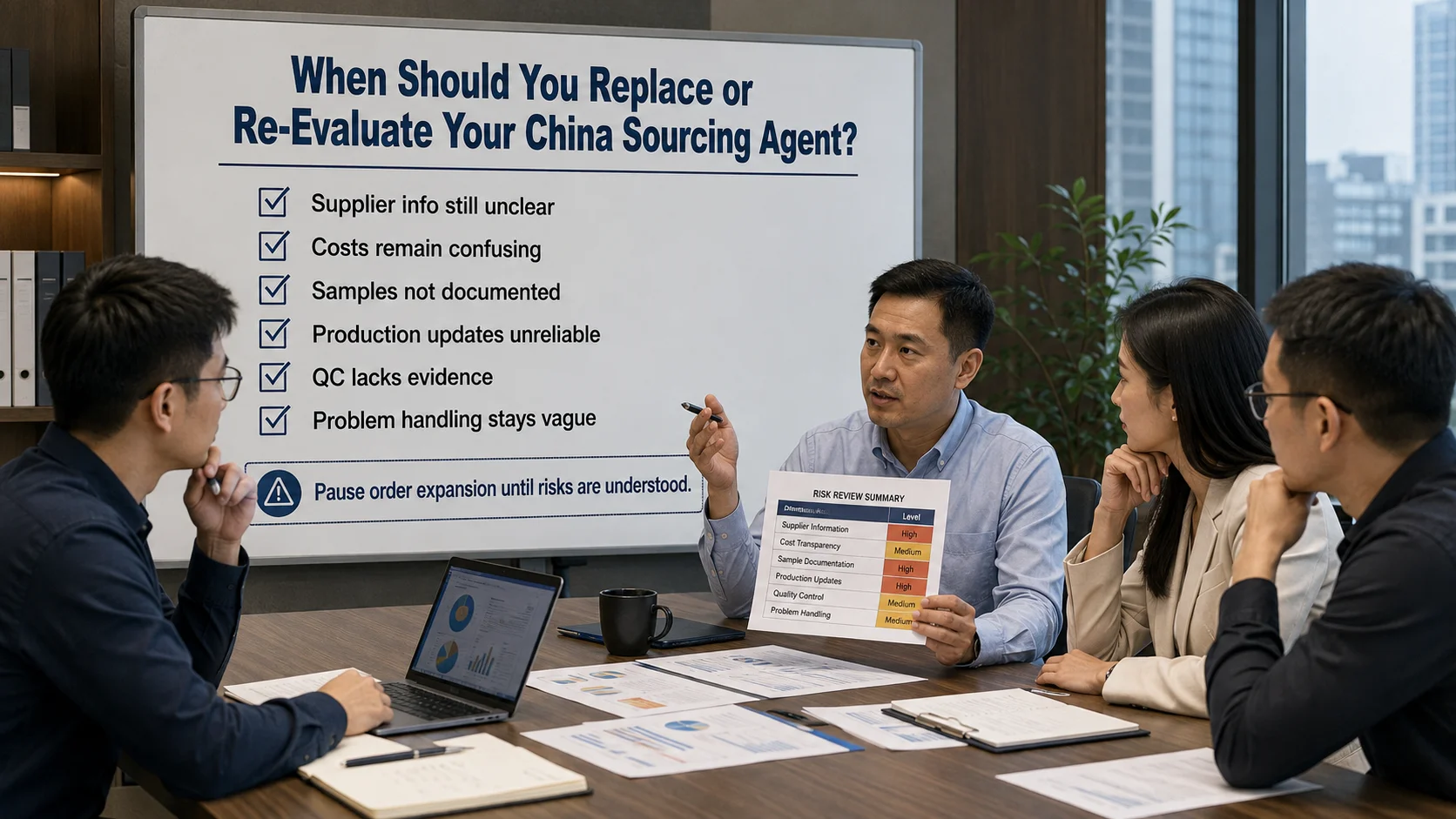
Buyers should re-evaluate or replace a China sourcing agent when supplier information, costs, samples, production progress, QC, or problem handling remain unclear after reasonable requests for written clarification. Buyers should pause order expansion until they understand the risks and responsibility boundaries.
A practical decision framework
We recommend escalating concerns in stages:
-
Request clarification in writing
State the missing information clearly. Ask for documents, deadlines, and named responsibilities. -
Review the response quality
A useful response gives facts, records, and next steps. A weak response changes the subject, blames others without evidence, or creates new ambiguity. -
Limit financial exposure
Avoid increasing order quantities or making large new deposits until key issues are resolved. -
Conduct an independent review
Consider a third-party factory audit, QC inspection, supplier comparison, or procurement review. -
Plan an orderly transition if needed
Secure product specifications, approved artwork, sample records, order history, and shipping documents before moving to another provider.
The strongest reason to change is usually not a single late shipment or a single quote revision. It is a repeated lack of transparency after the buyer asks reasonable questions.
If you already have a supplier quotation or feel uncertain about your current sourcing process, send the details to KingSourcing for an independent comparison and procurement review. We can help you clarify scope, costs, supplier information, and practical next steps before you expand an order.
Frequently Asked Questions
Is a low sourcing agent fee always a red flag?
No. A low fee does not automatically mean an agent is unreliable or dishonest. Buyers should ask how the agent earns revenue, which services the fee includes, what costs are excluded, and what events may create additional charges. Transparency matters more than the headline fee.
Can a sourcing agent refuse to share factory details?
An agent may have valid commercial reasons to limit direct supplier contact, but they should still explain the supplier’s role, location, capabilities, and verification process. Buyers should be cautious if an agent cannot provide consistent basic information or resists reasonable verification requests.
How can I verify a China sourcing agent?
Buyers can review the company’s registration information, website, references, service agreement, sample reports, supplier-selection process, and written fee structure. A video call, office or factory visit, and independent third-party review can add confidence for larger or higher-risk orders.
What should a pre-shipment inspection report include?
A useful report should state the inspected quantity, product condition, defect findings, photos, packaging checks, selected functional tests, carton details, and the inspection conclusion. Buyers should also know the inspection standard used and what action will follow if defects are found.
Should I change agents after one quality problem?
Not necessarily. First, assess whether the problem was reported early, documented clearly, and handled responsibly. A single issue can occur in manufacturing. Repeated quality failures, vague explanations, missing records, or refusal to improve the process are stronger reasons to reconsider the relationship.
Conclusion
The most important China sourcing agent red flags are not always dramatic. They often appear as missing documents, unclear fees, inconsistent supplier details, unapproved changes, weak production reporting, and vague QC promises. We recommend comparing agents on total sourcing cost, service scope, evidence, and accountability—not only on the lowest quote. A written verification process cannot remove every sourcing risk, but it can reduce avoidable surprises. If you need a clearer China procurement process, KingSourcing can help review your quotation, supplier options, and quality-control plan.
China sourcing agent, sourcing agent red flags, reliable sourcing agent China, China sourcing agent scam, supplier transparency China, supplier verification China, China procurement service, sourcing agent due diligence
[^1]: "ICC Model Contracts and Clauses", https://iccwbo.org/business-solutions/model-contracts-clauses/. International commercial-practice guidance explains that clear written terms and retained transaction records help establish parties' obligations and provide evidence if a dispute arises. Evidence role: mechanism; source type: institution. Supports: Written contractual terms, records, and due diligence help establish obligations and evidence in commercial disputes.. Scope note: Documentation can improve dispute handling but cannot prevent all disputes or guarantee a favorable outcome. [^2]: "[PDF] Supply Chain Management Guidance - The World Bank", https://thedocs.worldbank.org/en/doc/1c3b517f003b53a2e2e170e93124be84-0290032023/original/World-Bank-Supply-Chain-Management-Guidance.pdf. Supplier-management and quality-management guidance identifies documented requirements, supplier evaluation, monitoring, and corrective action as core controls for reducing procurement and quality risks. Evidence role: general_support; source type: institution. Supports: Supplier evaluation and quality-management systems commonly rely on documented requirements, supplier monitoring, traceability, and corrective action to manage procurement risk.. Scope note: Such guidance supports the risk-management rationale but does not by itself establish that every individual warning sign proves misconduct by an agent. [^3]: "Frequently Asked Questions on Trade Secrets - WIPO", https://www.wipo.int/en/web/trade-secrets/tradesecrets_faqs. Guidance on confidential business information recognizes that firms may protect commercially valuable information during business dealings where disclosure could affect competitive interests. Evidence role: general_support; source type: institution. Supports: Businesses may protect commercially valuable confidential information, including information that can affect competitive position or negotiating leverage.. Scope note: Commercial confidentiality does not justify misleading statements or prevent a buyer from requesting sufficient evidence for due diligence. [^4]: "The Commodity Markets Outlook in eight charts - World Bank Blogs", https://blogs.worldbank.org/en/developmenttalk/the-commodity-markets-outlook-in-eight-charts3. Research on commodity-price transmission finds that changes in raw-material and other input prices can alter manufacturers' production costs and contribute to changes in quoted or selling prices. Evidence role: mechanism; source type: research. Supports: Volatility in commodity and raw-material prices can affect manufacturers' input costs and, consequently, quoted prices.. Scope note: A general relationship between input costs and prices does not verify the reason for any specific supplier's quotation change. [^5]: "Purchasing Agent (General) - NC State Online", https://online-distance.ncsu.edu/career/purchasing-agent/. Occupational and procurement references describe purchasing functions as including supplier evaluation, price and contract review, order coordination, and communication concerning delivery and product requirements. Evidence role: definition; source type: government. Supports: Purchasing and procurement professionals commonly evaluate suppliers, negotiate or compare terms, manage orders, and coordinate delivery and quality-related information.. Scope note: The precise responsibilities of a particular sourcing agent depend on its contract and may not include every listed activity. [^6]: "Export Intermediaries | BETA - International Trade Administration", https://beta.trade.gov/article?id=Using-Export-Intermediaries. Trade references describe trading intermediaries as entities that can organize transactions and source goods from more than one producer, a structure that may be relevant where buyers require multiple product categories. Evidence role: definition; source type: government. Supports: Trading intermediaries may aggregate goods or coordinate transactions among multiple producers and buyers.. Scope note: This functional role does not establish the capability, reliability, or suitability of any particular trading company. [^7]: "[PDF] PASS-THROUGH OF COMPETITORS' EXCHANGE RATES TO US ...", https://openknowledge.worldbank.org/bitstreams/8b9dde8d-fb54-5752-8957-33b8666b03d0/download. International trade research identifies transport costs, exchange-rate movements, and production-input prices as factors that can affect the cost of imported or internationally sourced goods. Evidence role: mechanism; source type: institution. Supports: Transport rates, exchange-rate movements, and production-input costs can affect the delivered cost of internationally sourced goods.. Scope note: The size and timing of these effects vary by currency terms, Incoterms, product category, contract terms, and market conditions. [^8]: "[PDF] Design Controls - FDA", https://www.fda.gov/media/116762/download. Quality-system guidance requires product requirements and production specifications to be documented so that manufacturing can be performed and assessed against defined standards. Evidence role: mechanism; source type: government. Supports: Quality systems use documented product requirements and production specifications to ensure that manufacturing outputs conform to approved designs or requirements.. Scope note: Requirements differ across industries, and a formal design-transfer process may be disproportionate for simple, low-risk consumer products. [^9]: "[PDF] Guidance for Industry: CMC Postapproval Manufacturing Changes ...", https://www.fda.gov/media/79182/download. Manufacturing quality-system guidance describes change control as a documented process in which proposed changes are evaluated, authorized, and recorded before they are implemented. Evidence role: mechanism; source type: government. Supports: Formal change-control systems document proposed changes, assess their effects, and require authorization before implementation.. Scope note: The exact approval authority and documentation level should be defined by the contract and product risk; not every operational change necessarily requires direct buyer approval. [^10]: "OECD Supply Chain Resilience Review", https://www.oecd.org/en/publications/oecd-supply-chain-resilience-review_94e3a8ea-en.html. Supply-chain resilience research finds that timely visibility into disruptions can increase the time available for firms to evaluate alternatives and implement mitigation measures. Evidence role: mechanism; source type: research. Supports: Timely supply-chain visibility and early warning can enable firms to assess disruptions and implement mitigation actions before delivery commitments are missed.. Scope note: Early notification expands available options but does not ensure that alternatives such as split shipments or substitute suppliers will be feasible. [^11]: "[PDF] Use of quality assurance systems in the fastener industry", https://nvlpubs.nist.gov/nistpubs/Legacy/IR/nistir6001.pdf. Conformity-assessment terminology distinguishes supplier self-assessment from assessment performed by a customer or an independent third party, which may use separately defined acceptance criteria. Evidence role: definition; source type: institution. Supports: Conformity assessment distinguishes first-party assessment by the supplier from second-party or third-party assessment conducted by customers or independent bodies.. Scope note: An independent inspection can improve objectivity but is not inherently more effective unless its scope, competence, sampling, and acceptance criteria are appropriate. [^12]: "What kinds of Lot Acceptance Sampling Plans (LASPs) are there?", https://www.itl.nist.gov/div898/handbook/pmc/section2/pmc22.htm. ISO acceptance-sampling standards describe AQL-based plans as statistical procedures for inspecting lots against specified acceptance and rejection criteria. Evidence role: definition; source type: institution. Supports: AQL sampling plans use statistical acceptance-sampling procedures for lot-by-lot inspection and require defined inspection levels and acceptance criteria.. Scope note: An AQL sampling plan assesses a sample rather than every unit and therefore does not guarantee that an accepted lot contains no defects.