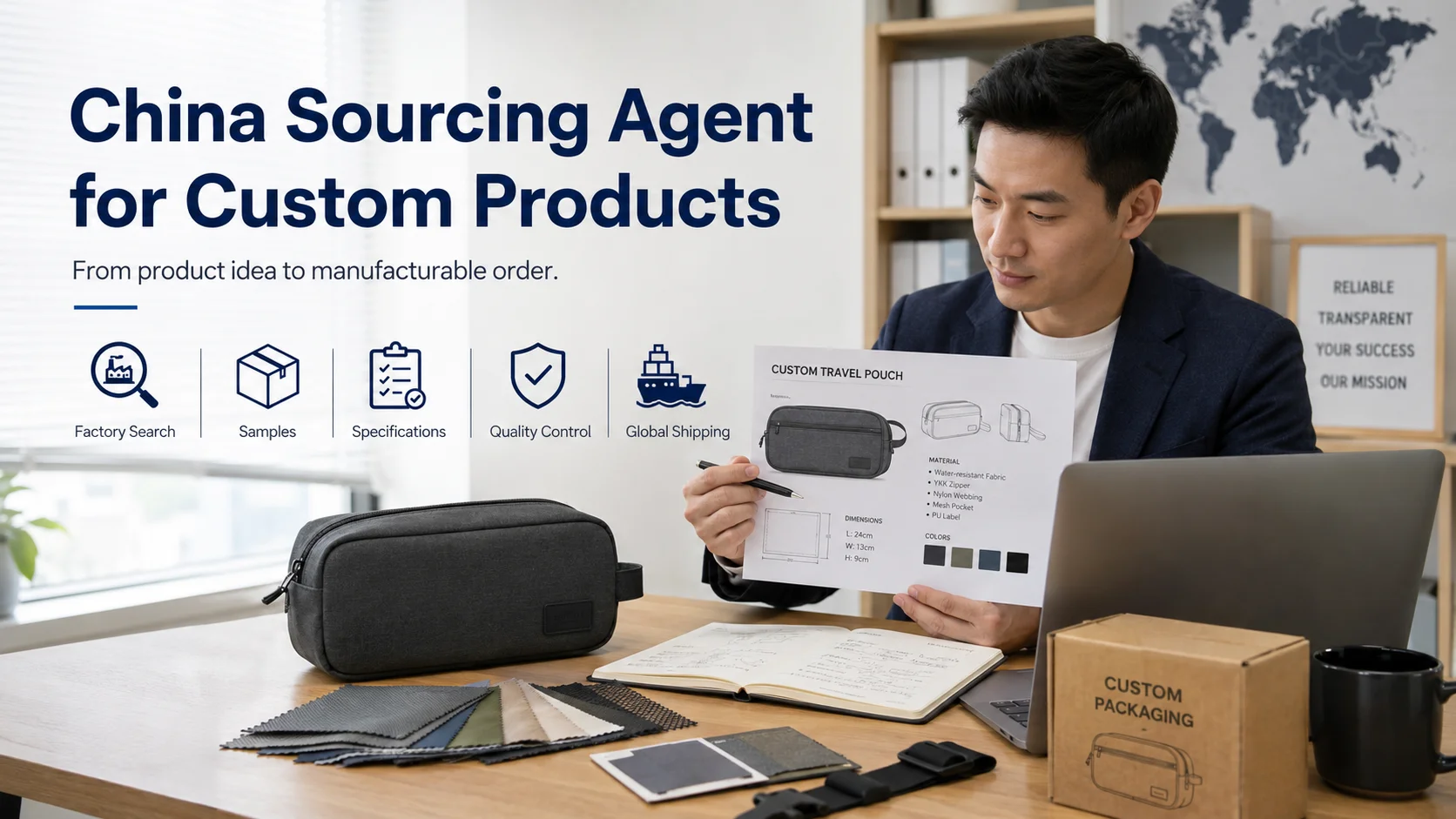
A China sourcing agent for custom products can help when a product idea looks simple but becomes difficult once factories ask for drawings, materials, packaging files, minimum order quantities, and approval standards. Without local coordination, unclear requirements can lead to wasted samples, inconsistent production, and expensive delays. We help buyers turn product briefs into manageable sourcing projects.
A China sourcing agent for custom products helps buyers move from an idea or product brief to a manufacturable order. The work usually includes finding suitable factories, checking capabilities, comparing quotations, managing samples, confirming specifications, following production, coordinating quality control, and arranging shipment. OEM, ODM, and private label projects need more control than standard stock-product purchases because every custom variable can affect cost, quality, timing, and consistency[^1].
The key point is simple: finding a supplier is only the first step. A successful custom manufacturing project depends on whether the buyer, factory, and sourcing team can agree on what should be made, how it should perform, what quality level is acceptable, and how production will be checked.
What Does a China Sourcing Agent for Custom Products Do?
Custom product projects often fail because the buyer expects the factory to “figure it out” from a few reference photos. That creates uncertainty. The supplier may quote based on assumptions, while the buyer expects details that were never formally confirmed.
A China sourcing agent for custom products acts as a local project coordinator between the buyer and potential manufacturers. We help translate a commercial product concept into supplier questions, comparable quotations, sample requirements, production checkpoints, and quality expectations.
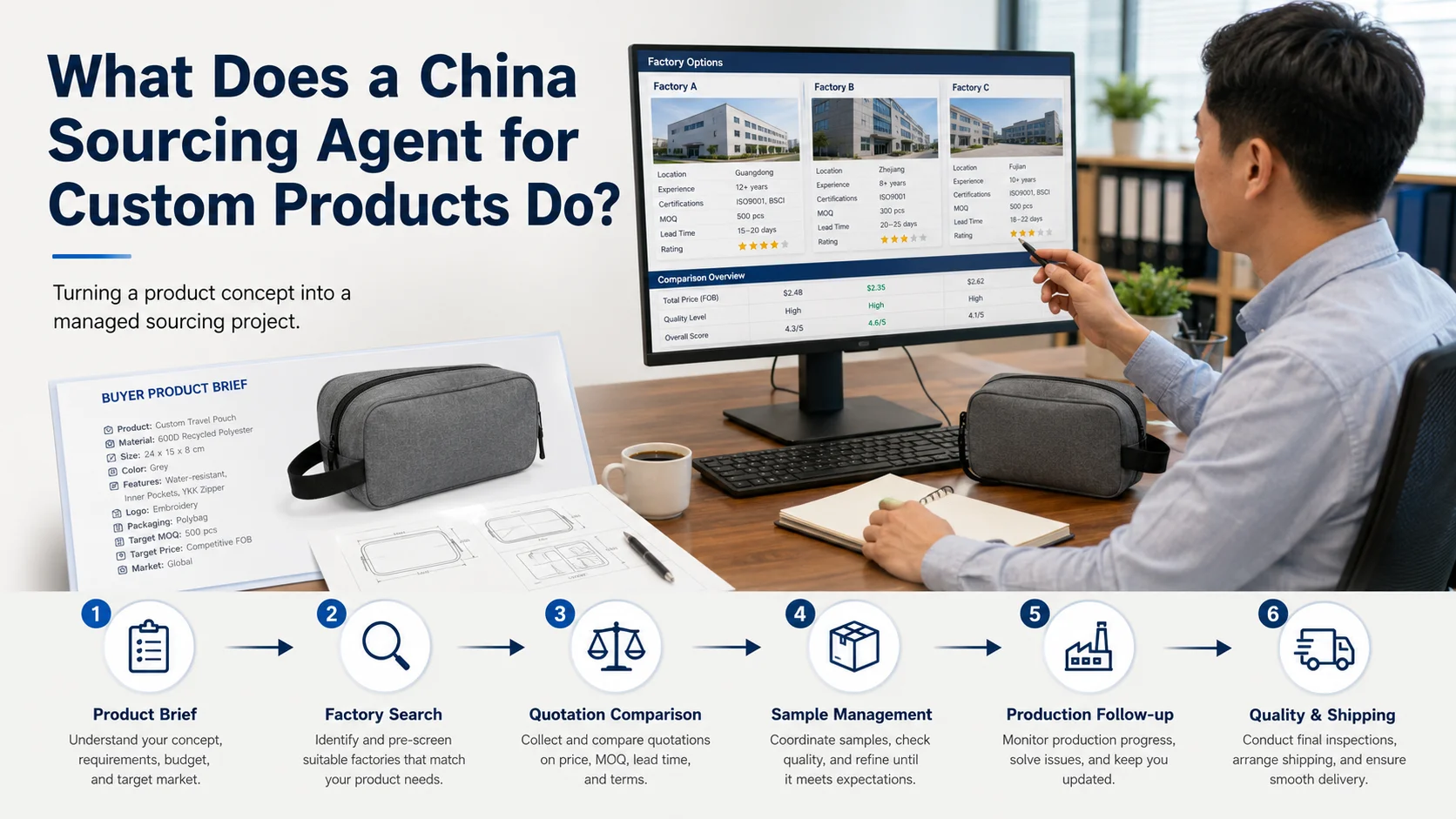
From product brief to shipment
In projects we support, the process often follows this sequence:
-
Product brief review
We collect available information, such as reference images, dimensions, target materials, expected order volume, logo files, packaging needs, and target market. -
Factory sourcing and screening
We look for suppliers whose machinery, product category experience, capacity, and customization scope appear relevant to the project. -
Quotation comparison
We compare more than unit price. We also review MOQ, tooling, sample charges, material assumptions, packaging costs, lead times, and payment terms. -
Sample development and revision
We follow prototype samples, revised samples, pre-production samples, or packaging samples, depending on the project. -
Production follow-up and quality control
We help confirm production milestones and organize inspections based on the agreed quality standard. -
Shipping coordination
We can consolidate goods, arrange packaging checks, support export documentation coordination, and organize international shipping options.
A sourcing agent should not replace product engineers, legal advisers, safety laboratories, or compliance specialists. However, a local team can help ensure that questions reach the factory clearly and that documents, samples, and approvals are tracked. For regulated or safety-critical products, buyers should use qualified professionals to assess application-specific testing and compliance requirements.
Why Is Sourcing Custom Products From China More Complex?
Many buyers assume custom manufacturing means adding a logo to a standard item. That can be true for some private label orders, but many projects involve changes that affect materials, tooling, assembly, packaging, quality tolerances, or production time.
Custom product sourcing becomes more complex because each decision can create a new variable. A small change in size, color, finish, insert card, or accessory may affect MOQ, price, production method, or inspection criteria.
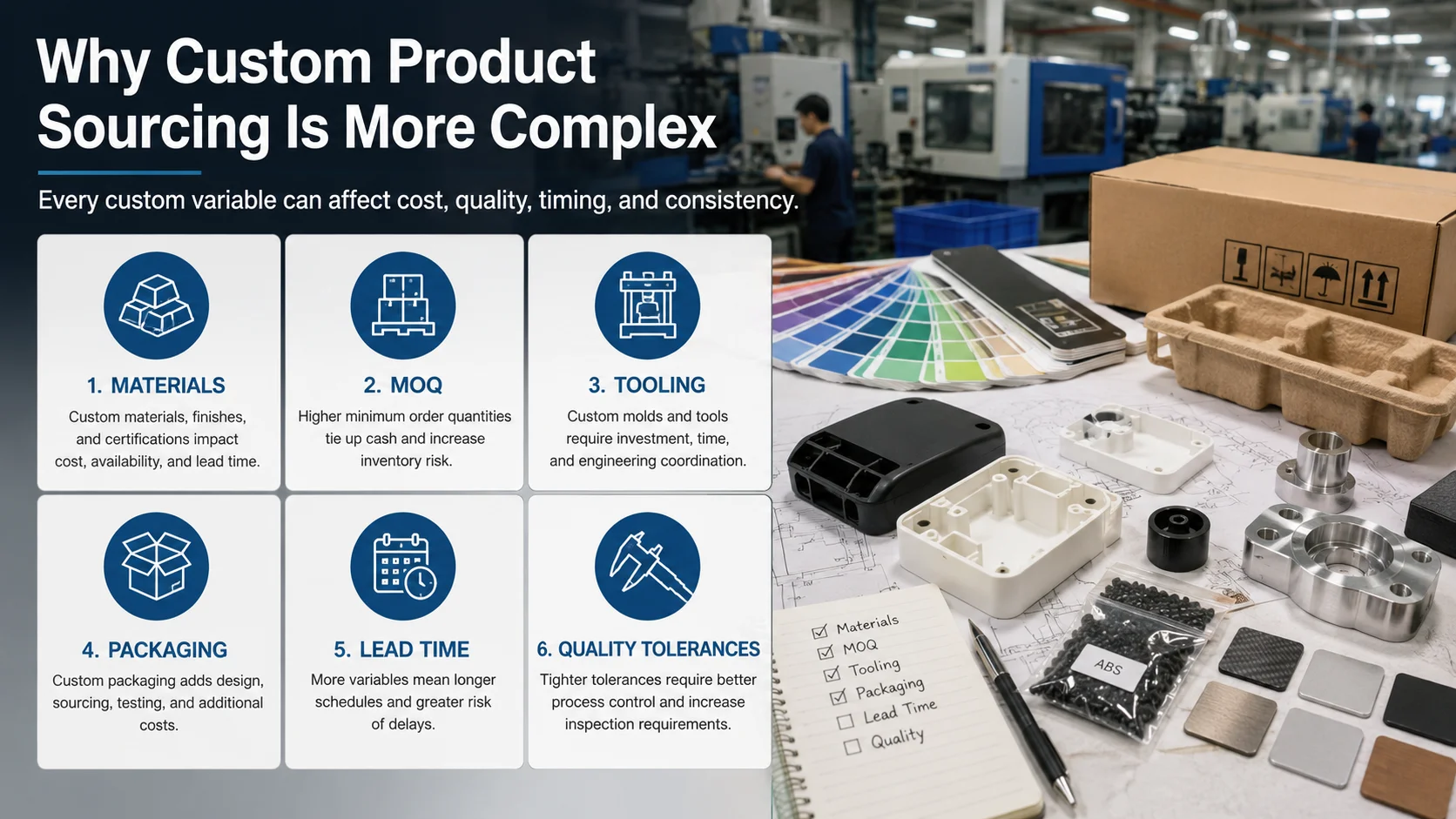
The factory search is only the beginning
A common issue we see is that buyers focus heavily on identifying a factory, then assume the rest of the project will be straightforward. In reality, supplier selection is just one part of custom manufacturing China.
A factory may be strong at producing an existing product but not equipped for your specific customization.[^2] For example, the supplier may:
- Accept a logo but not custom dimensions.
- Produce the main product but outsource packaging.
- Offer a color option but not accurate Pantone matching.
- Handle injection molding but not silicone overmolding.
- Make a similar item but lack experience with your target market’s quality expectations.
- Quote a low price based on a different material grade than the buyer expects.
The project becomes easier when the buyer can separate must-have requirements from nice-to-have requests. We often suggest organizing a request into four areas:
| Requirement Area | Examples |
|---|---|
| Product | Dimensions, materials, weight, function, finish |
| Branding | Logo method, color, label, user manual |
| Packaging | Box size, inserts, barcode, carton marks |
| Commercial | Target MOQ, budget range, delivery window |
This does not need to be a perfect engineering package at the beginning. It does need enough detail for factories to respond with meaningful assumptions. The more vague the request, the less reliable the quote comparison will be.
How Does a China Sourcing Agent for Custom Products Screen Factories?
A factory can look credible online and still be unsuitable for a specific custom order. Buyers may see professional product photos, broad catalogs, or attractive certificates, yet those items do not prove the supplier can consistently make the requested product.
A China sourcing agent for custom products screens factories against the actual project requirements, not just their marketplace profile. We look at relevant product experience, manufacturing process, communication quality, commercial fit, and the supplier’s willingness to clarify details before production.
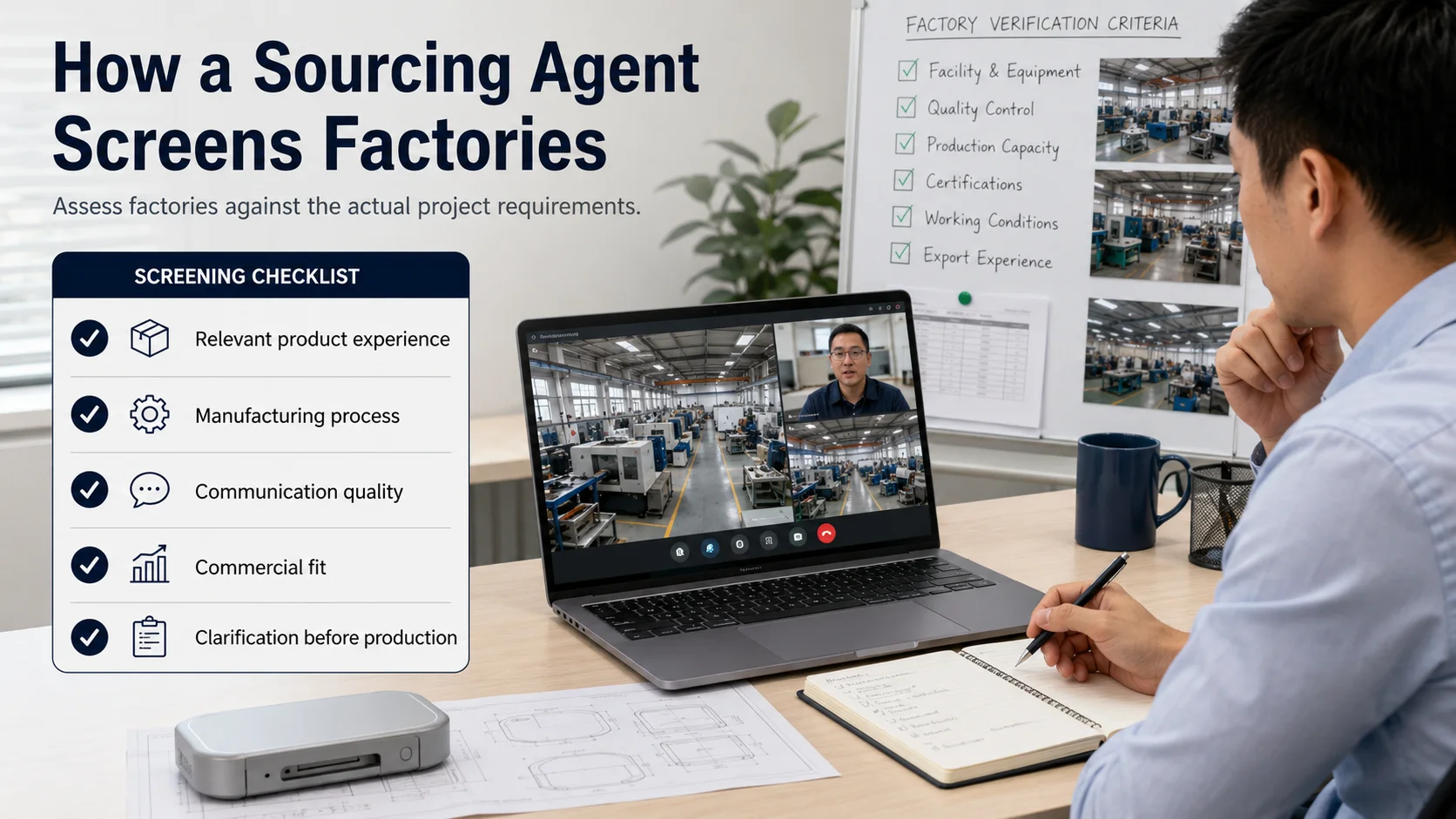
Capability matters more than catalog size
When we evaluate an OEM manufacturer China buyers may consider, we ask practical questions. The answers help determine whether the supplier is a realistic candidate or only a general trading option.
Important screening points include:
- What products does the supplier make repeatedly?
- Which parts are made in-house, and which are outsourced?
- Does the factory have machinery suited to the required material and process?
- Can it provide samples that show comparable customization?
- What is the normal MOQ for this type of order?
- Does it offer engineering support or only execute buyer-ready files?
- How does it manage raw materials and incoming components?
- What production capacity and lead-time assumptions does it have?
- Can the supplier explain quality controls in a specific, practical way?
We also recommend that buyers verify business registrations, audit reports, test reports, and certifications directly[^3] when those documents matter to their product or market. A document may be relevant, expired, product-specific, or unrelated to the exact factory entity. It should not be treated as a universal guarantee of quality.
At KingSourcing, our role is to support supplier sourcing China projects with local communication, supplier management, and order follow-up. We do not assume that one supplier is automatically the right supplier because it offers the lowest quotation or the fastest initial response.
How Do You Find the Right OEM or ODM Manufacturer?
Choosing between an OEM manufacturer China buyers can develop with and an ODM supplier China buyers can adapt depends on how defined the product already is. The wrong path can create unnecessary cost, slow development, or limit the differentiation you wanted.
The right manufacturer is the one whose capabilities match your product-definition stage, budget, customization needs, MOQ tolerance, and development timeline. OEM, ODM, and private label are different execution paths[^4], not a ranking from basic to advanced.
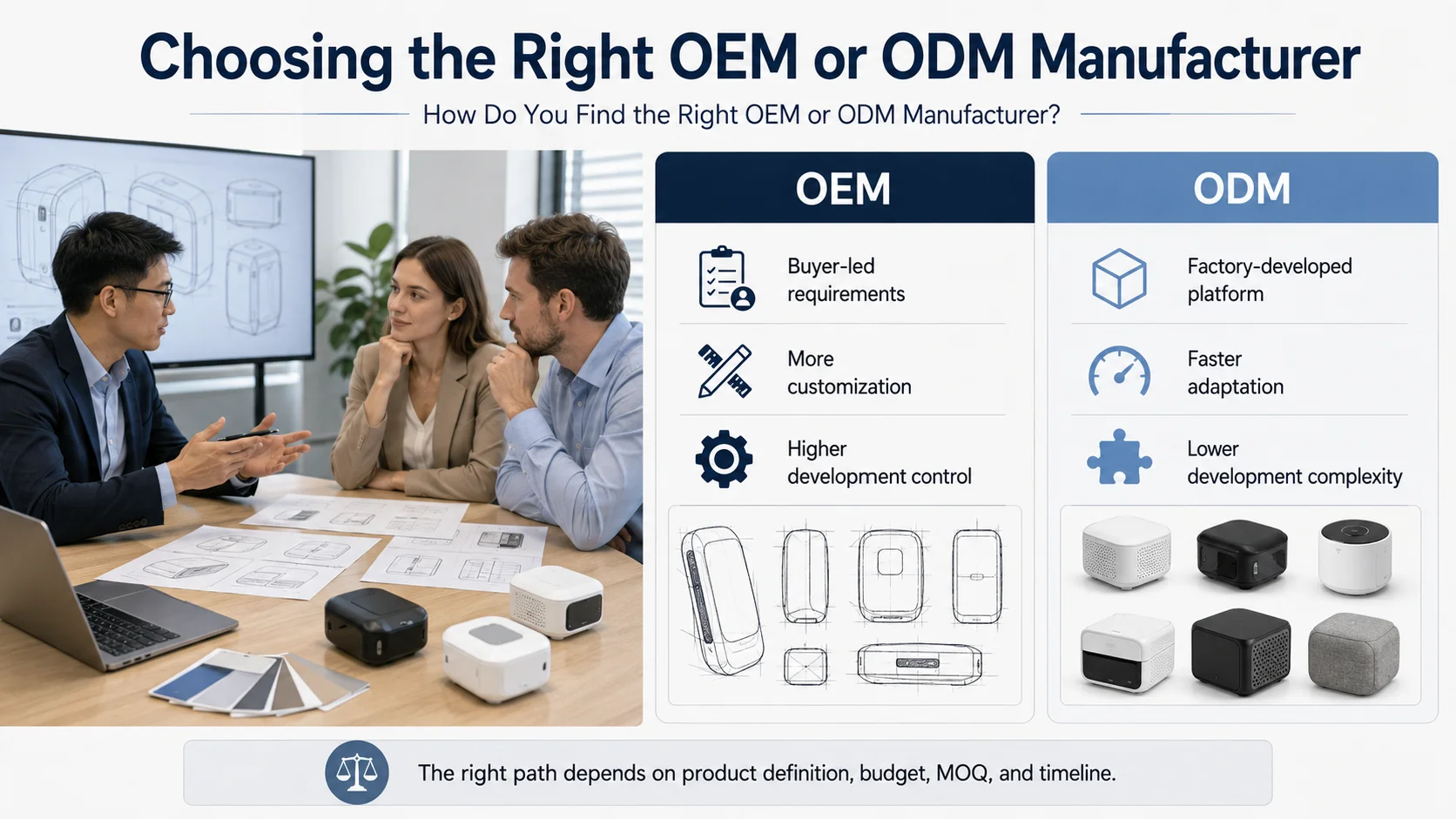
Start with your product readiness
Before requesting quotes, we encourage buyers to answer these questions:
- Do you have technical drawings, measurements, or a physical reference sample?
- Are you changing the structure, materials, function, or only branding?
- Do you need new tooling or molds?
- Can you accept an existing factory platform with selected changes?
- What is your expected first-order quantity?
- What level of product differentiation is commercially necessary?
- How many sample rounds can your budget and timeline support?
A practical manufacturer-matching framework
| If your situation is... | A likely path is... | What you need to prepare |
|---|---|---|
| You have a unique product concept and clear requirements | OEM | Specifications, drawings, materials, acceptance standards |
| You want to modify a proven supplier design | ODM | Reference product, requested changes, branding requirements |
| You want a faster launch with your own branding | Private label | Logo files, packaging artwork, product selection, order quantity |
| You need a mix of existing and new components | ODM or partial OEM | Detailed list of modifications and sample expectations |
In our experience, early-stage brands sometimes expect private label to create a fully unique product. Usually, private label starts with an existing item and changes the branding, packaging, bundle, or presentation. Meanwhile, buyers planning OEM projects sometimes underestimate the preparation needed to make production consistent.
A good custom manufacturer sourcing process starts with an honest assessment of what is ready today—not just what the brand hopes to build later.
How Do OEM, ODM, and Private Label Sourcing Compare?
Buyers often use OEM, ODM, and private label as if they mean the same thing. That can confuse supplier communication. Each model places a different level of responsibility on the buyer and manufacturer.
OEM usually involves buyer-led product requirements. ODM generally adapts a manufacturer-developed platform. Private label commonly applies the buyer’s brand to an existing product with limited product changes.[^5]
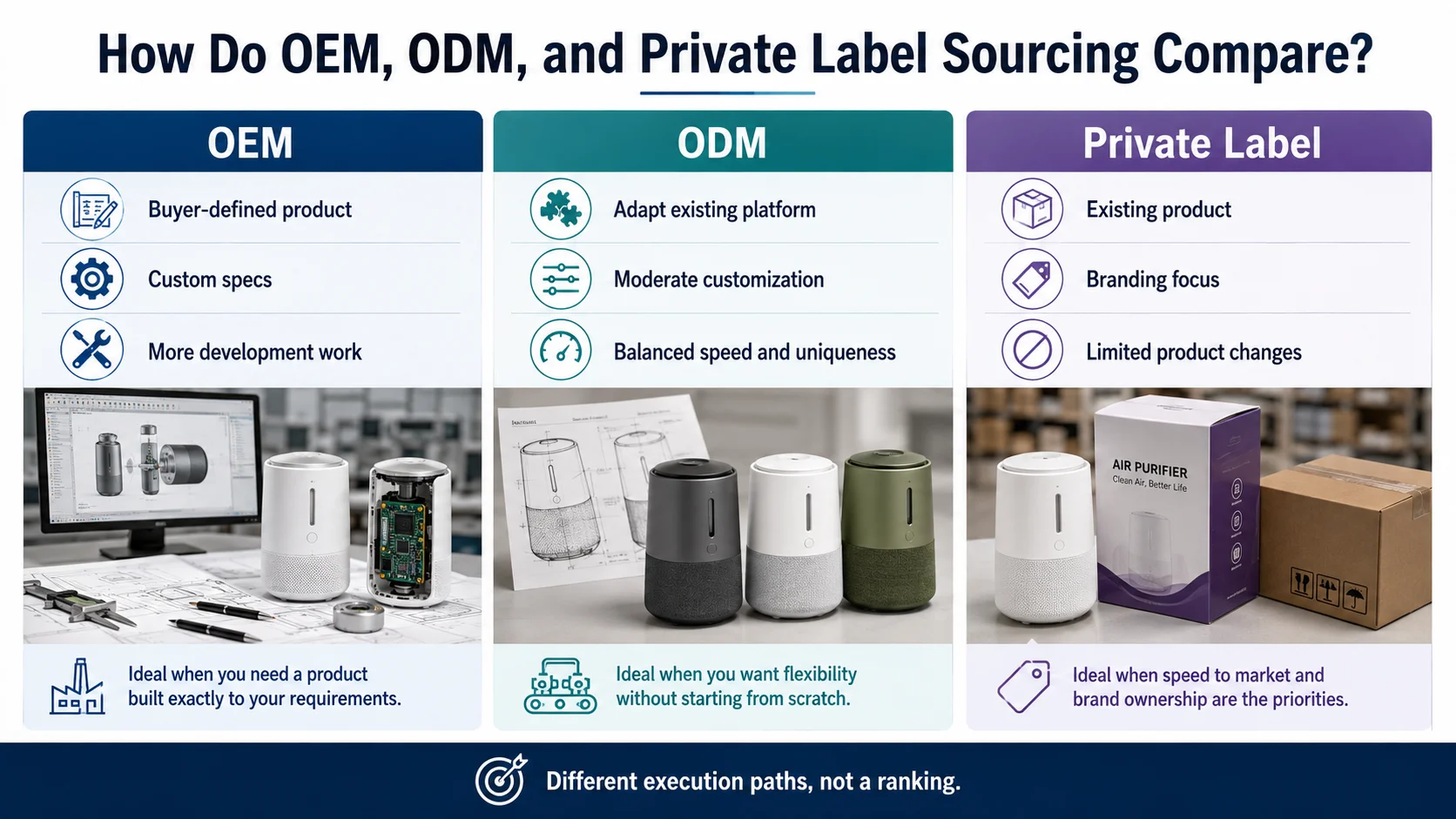
| Sourcing Model | Product Design | Customization Level | Development Time | MOQ | Buyer Involvement | Best For |
|---|---|---|---|---|---|---|
| OEM | Buyer-led or jointly finalized | High | Longer | Often higher | High | Distinct products |
| ODM | Supplier platform | Medium to high | Medium | Medium | Medium | Faster product adaptation |
| Private Label | Existing product | Low to medium | Shorter | Often lower | Lower | Faster market entry |
Choosing based on risk, not status
We do not see OEM as automatically better than ODM or private label. A private label product can be the right commercial decision when a buyer needs to test demand, control launch spending, or build a product range quickly. An ODM route can offer useful differentiation without the full time and cost of new product development.
OEM becomes more suitable when the buyer has a clear reason to change the product itself. That reason may involve function, user experience, dimensions, material selection, component quality, or product-market positioning.
The most practical model is the one your team can define, fund, test, and manage responsibly.
A China sourcing agent for custom products can help buyers compare these routes before they commit to tooling, large MOQs, or multiple sampling rounds. This early evaluation can prevent a project from becoming over-customized before the buyer has validated demand.
How Should Samples and Specifications Be Managed?
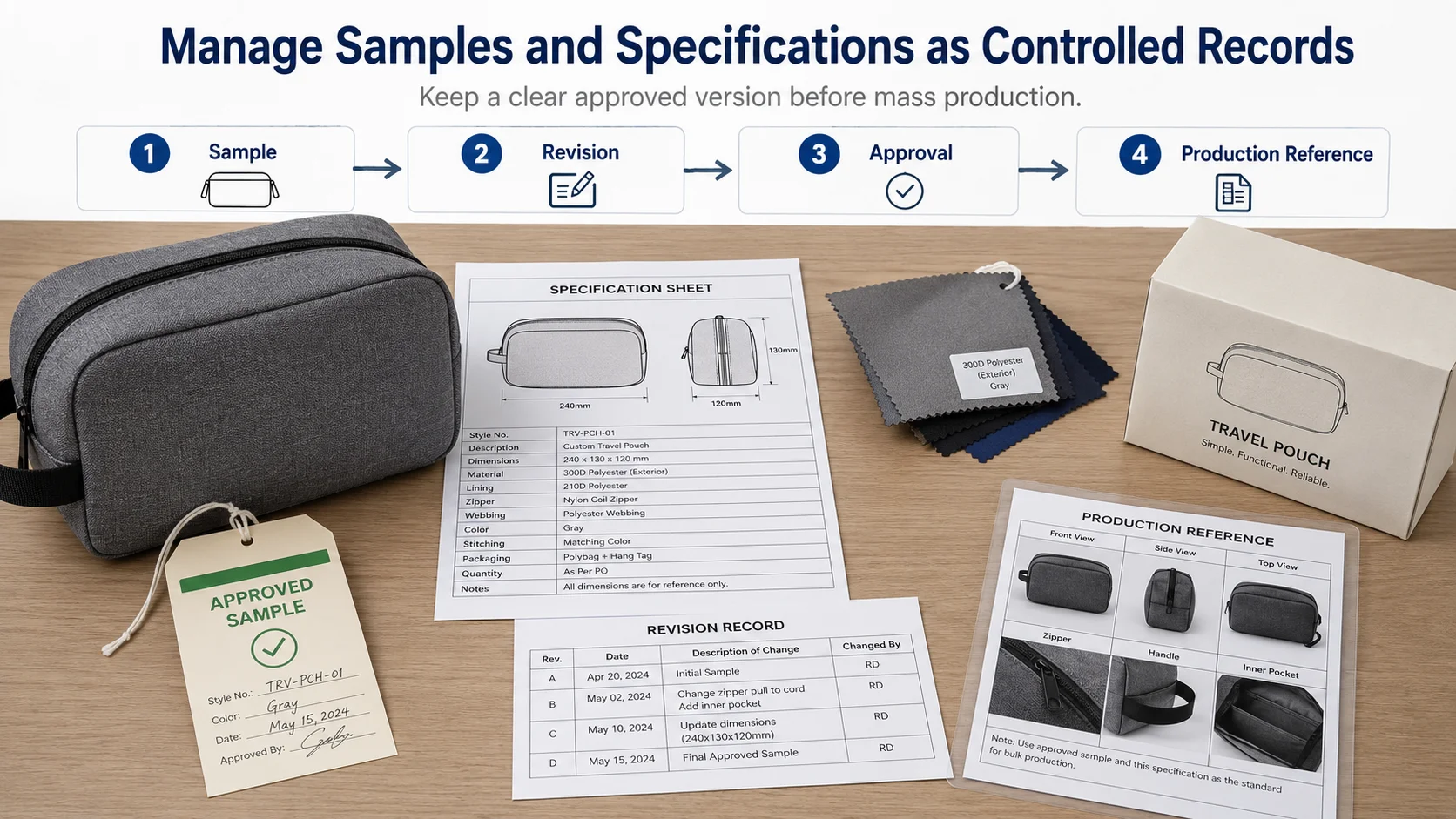
A beautiful sample can create false confidence.[^6] Buyers may approve a sample based on appearance, then discover that mass production differs in material feel, assembly, dimensions, printing, packaging, or finish.
Samples and specifications should be managed as controlled approval records. A buyer needs a clear version of what was approved, what changed, what remains open, and what the factory must follow during bulk production.
Build a workable approval trail
For many projects, we help organize the following items:
- Prototype sample: Tests the basic concept or structure.
- Revised sample: Confirms agreed modifications after feedback.
- Golden sample[^7]: A reference sample approved for production comparison.
- Specification sheet: Records dimensions, materials, colors, functions, logos, and packaging requirements.
- Packaging approval: Covers box artwork, insert cards, labels, barcode placement, and carton marks.
- Revision log: Records what changed, when it changed, and which version is current.
The phrase “approved sample” needs caution. An approved sample does not automatically mean mass production will match it.[^8] Samples may be made by a different team, using more time, different materials, or hand-finished processes that are not repeated at production speed.
That is why the approved sample should be supported by measurable standards where possible. Instead of saying “good quality,” define what can be checked:
- Dimension tolerance: for example, within an agreed range.
- Color reference: approved Pantone code or physical reference.
- Material: named grade, thickness, finish, or composition.
- Function: test method and expected result.
- Cosmetic standard: acceptable versus unacceptable marks or defects.
- Packaging: approved artwork version and assembly instructions.
For complex products, an engineer, product designer, or qualified third-party testing professional may need to help create the technical requirements. Our sourcing team can coordinate communication, but we encourage buyers to obtain specialist input where performance or compliance is important.
How Does a China Sourcing Agent for Custom Products Manage Cost and MOQ?
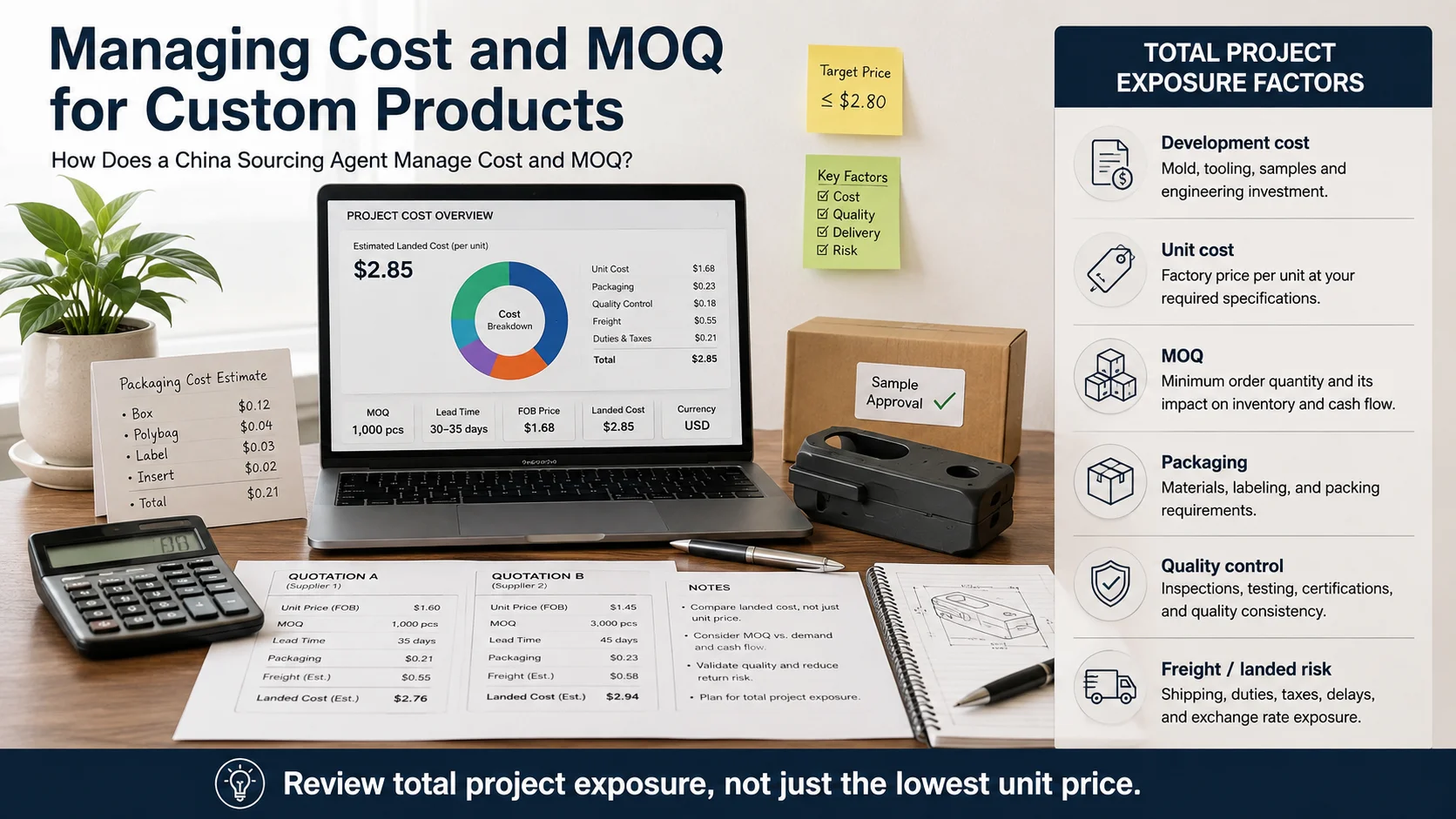
A low unit price can look attractive until tooling, packaging, samples, quality control, freight, and rework costs appear later. Many buyers compare only supplier quotations, even though the real exposure comes from the full development and supply-chain process.
A China sourcing agent for custom products helps buyers review total project exposure, including development cost, unit cost, MOQ, quality requirements, production timing, and landed-risk considerations. The goal is not simply to negotiate the lowest figure.
Look beyond the first quote
A custom product budget may include:
| Cost Area | Common Examples |
|---|---|
| Development | Design refinement, samples, revisions, testing |
| Tooling | Molds, jigs, printing plates, custom dies |
| Product | Materials, labor, components, assembly |
| Branding | Logo application, labels, manuals, inserts |
| Packaging | Custom box, protective inserts, cartons |
| Quality | Inspection, rework, sorting, replacement parts |
| Logistics | Storage, consolidation, export handling, freight |
MOQ is also not one fixed number. A supplier may quote one MOQ for the product, another for a custom color, another for packaging, and another for a custom component. The practical order quantity is often determined by the highest requirement among those parts.[^9]
In one common workflow, a buyer asks for a low MOQ on a highly customized product. The factory may agree in principle but charge higher tooling, use less efficient production, or offer limited material choices. That does not make the supplier unreasonable. It simply shows that customization and low-volume production often pull in opposite directions[^10].
We help buyers ask better questions: What changes reduce MOQ? Can packaging be simplified? Can an existing component be used? Is a staged launch possible? Those choices can improve project control without pretending that every custom feature is affordable at every volume.
How Are Production Follow-Up and Quality Control Managed?
The biggest risk in custom manufacturing is often the gap between an approved sample and mass production. Materials can change, operators can interpret instructions differently, and packaging teams may use outdated artwork if revisions are not controlled.
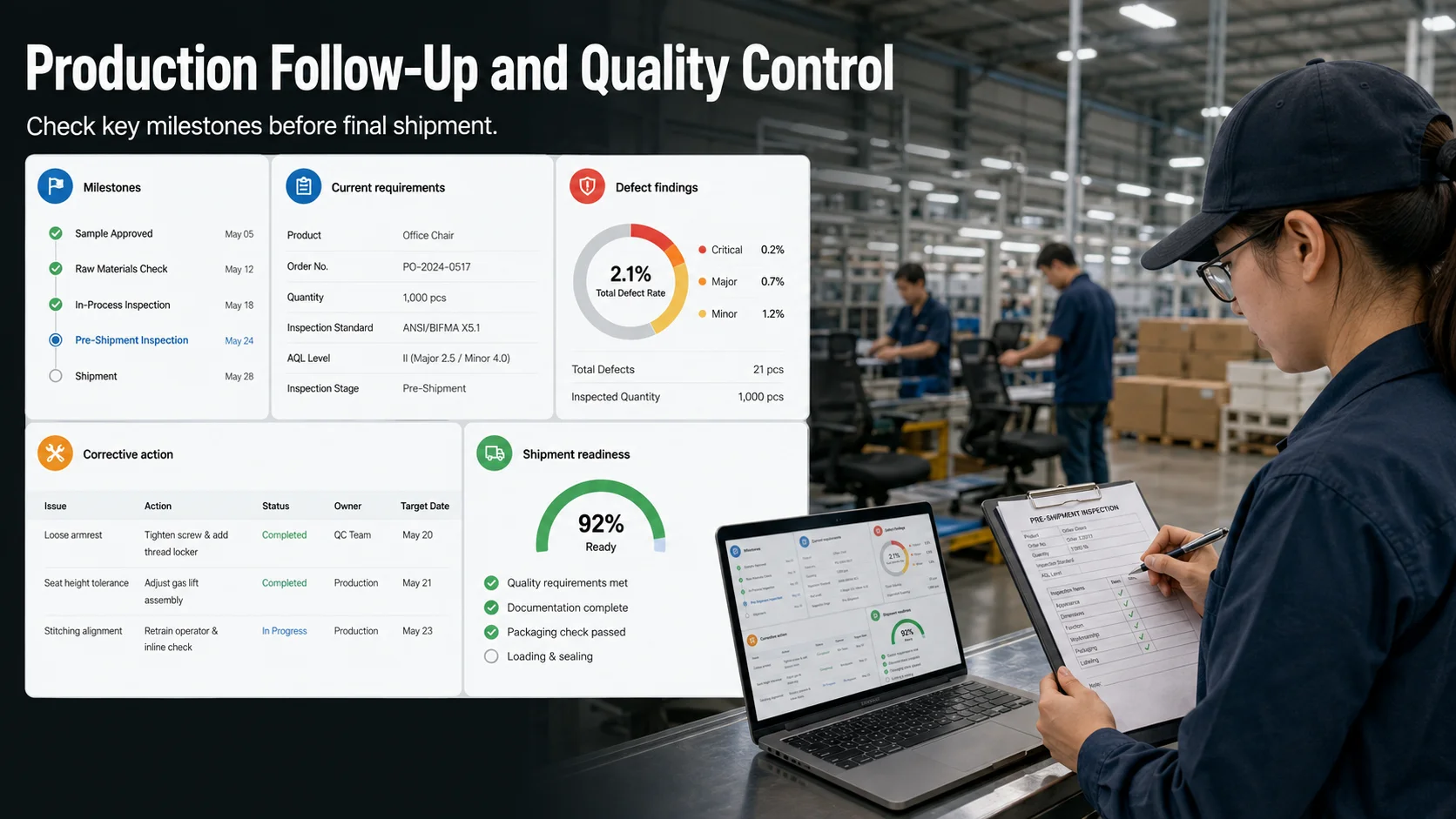
Production follow-up and quality control should start before final shipment. A structured process checks key milestones, confirms current requirements, identifies defects early, and gives the buyer a clearer basis for supplier communication.
Use checkpoints, not assumptions
A practical quality control plan may include:
-
Pre-production confirmation
Confirm the approved sample, specifications, materials, logo files, packaging files, and order details before bulk work begins. -
Material and component checks
Review important materials or components where practical, especially when they affect appearance, function, or safety. -
In-process follow-up
Check production status and raise issues before the full order is completed. -
Pre-shipment inspection
Review finished goods against agreed standards before shipment, using an inspection level and sampling approach suitable for the order[^11]. -
Defect handling
Document findings, clarify whether goods need sorting, rework, replacement, discount discussion, or additional verification.
At KingSourcing, we can support 1-by-1 product checks when the product type, order volume, and project requirements justify that approach. Other orders may use a sampling-based inspection plan. The right method depends on the product, defect risk, buyer standard, and commercial reality.
Inspection reduces uncertainty, but it does not guarantee a perfect outcome.[^12] Buyers should define acceptable quality standards early, maintain realistic timelines for corrections, and avoid making late changes once production is underway.
When Should You Use a China Sourcing Agent for Custom Products?
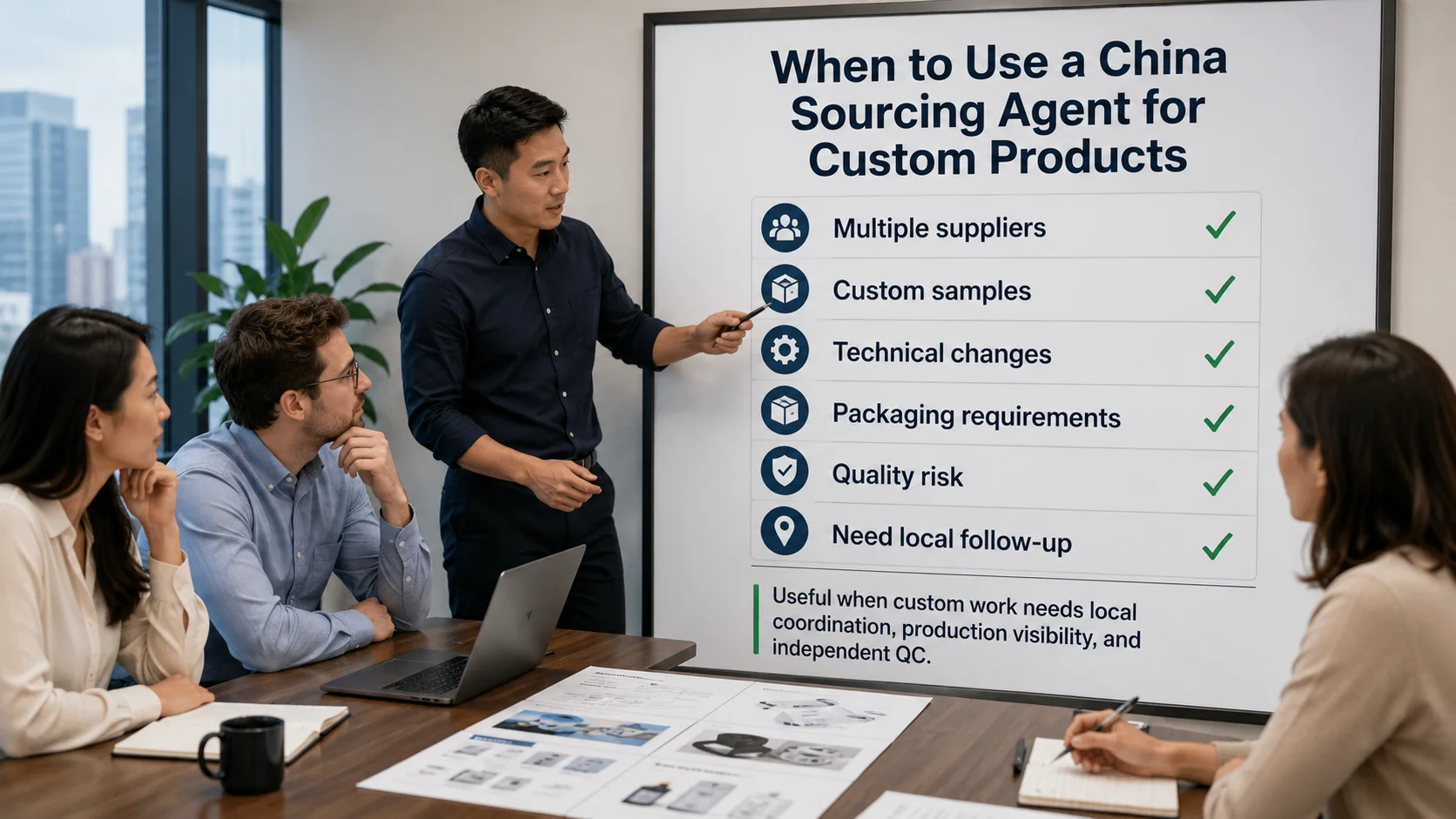
Some private label orders are simple enough for an experienced buyer to manage directly. However, custom work becomes harder when multiple suppliers, samples, technical changes, packaging requirements, or quality risks must be coordinated across time zones.
A China sourcing agent for custom products is especially useful when you need local supplier communication, structured sample follow-up, production visibility, and an independent quality-control process before goods leave China.
Consider support if your project includes these conditions
You may benefit from a local sourcing and supply-chain partner when:
- You are developing your first branded product.
- You need OEM, ODM, or custom manufacturing China support.
- Your product has multiple parts or suppliers.
- You are coordinating custom packaging, labels, inserts, or bundles.
- You are comparing several factory quotations.
- You need repeated sample revisions.
- You lack an in-house China purchasing team.
- You need pre-production follow-up and pre-shipment quality checks.
- You expect repeat orders and want a more stable supplier-management process.
- You need warehousing, order consolidation, product photography, or international shipping coordination.
We see the best results when buyers involve us before they commit to a factory or approve an unclear quotation. Early involvement gives more room to compare manufacturing paths, identify open questions, and set a realistic development plan.
KingSourcing works as a China-based sourcing office, quality-control coordinator, and supply-chain partner for overseas sellers, DTC brands, wholesalers, and growing importers. If you have a product brief, drawing, reference sample, existing supplier quotation, or customization request, send it to our team for supplier matching and sourcing evaluation.
Frequently Asked Questions
What is the difference between OEM, ODM, and private label?
OEM usually follows buyer-led product requirements. ODM adapts an existing supplier-developed product platform. Private label generally uses an existing product with the buyer’s branding or packaging. The right choice depends on your product readiness, budget, MOQ, timeline, and differentiation needs.
Do I need a sourcing agent for OEM products in China?
You may not need one if you have an experienced China purchasing team and strong product specifications. However, an OEM sourcing agent China buyers use can support factory screening, sample management, supplier communication, production follow-up, quality checks, and shipping coordination.
How do I find an OEM manufacturer in China?
Start with a quote-ready brief that explains materials, dimensions, functions, target volume, packaging, and quality requirements. Then compare manufacturers based on relevant capabilities, not price alone. A sourcing team can help screen suppliers and clarify assumptions before sampling begins.
Can private label products be customized?
Yes, but the scope varies. Private label commonly includes logos, labels, packaging, inserts, or bundles. Some suppliers also allow color, material, or accessory changes. Larger structural changes may move the project toward ODM or OEM manufacturing.
Does an approved sample guarantee bulk production quality?
No. An approved sample is an important reference, but it does not guarantee mass-production consistency. Buyers should also use written specifications, revision control, pre-production confirmation, in-process follow-up, and suitable pre-shipment quality inspections.
Conclusion
A China sourcing agent for custom products helps buyers manage the full path from idea and supplier selection to sampling, specifications, production, quality control, and shipment. OEM, ODM, and private label each serve different commercial needs. The strongest choice depends on how defined your product is, how much customization you need, and how much development risk you can support. If you are planning custom product sourcing China, send KingSourcing your brief, reference sample, drawing, or supplier quotation for a practical sourcing evaluation.
Tags: custom product sourcing China, China sourcing agent, OEM sourcing China, ODM sourcing China, private label sourcing, custom manufacturing China, supplier sourcing China, China procurement service
[^1]: "[PDF] Collaborative Evolution of Process Plans in Distributed Manufacturing", https://tsapps.nist.gov/publication/get_pdf.cfm?pub_id=822092. Manufacturing research describes how product-design requirements and process variation can affect production cost, lead time, quality performance, and process consistency. Evidence role: mechanism; source type: research. Supports: Manufacturing design choices and process variation influence cost, production lead time, quality, and repeatability.. [^2]: "[PDF] Empowering Small and Medium-Sized Enterprises Through ...", https://tsapps.nist.gov/publication/get_pdf.cfm?pub_id=957527. Procurement and quality-management guidance indicates that supplier qualification should assess relevant technical capability and process capacity against the purchaser's stated requirements, rather than relying solely on general supplier credentials. Evidence role: general_support; source type: government. Supports: Supplier assessment should evaluate whether a supplier's specific technical and process capabilities match the purchaser's requirements.. Scope note: Such guidance supports the assessment principle but does not evaluate any individual factory. [^3]: "IAF CertSearch", https://iaf.nu/en/certsearch/. Accreditation and conformity-assessment guidance emphasizes verifying the validity, scope, and issuing body of certificates and reports, because documentation may apply only to a particular organization, product, site, or period. Evidence role: general_support; source type: institution. Supports: Certification and test documentation should be checked for validity, scope, issuing body, and applicability to the relevant product or organization.. Scope note: Document verification alone does not establish ongoing product quality or legal compliance. [^4]: "Original equipment manufacturer", https://en.wikipedia.org/wiki/Original_equipment_manufacturer. Reference definitions distinguish original equipment manufacturing from original design manufacturing by the party that develops or specifies the product design; private-label arrangements commonly apply a retailer or buyer brand to goods supplied by another producer. Evidence role: definition; source type: encyclopedia. Supports: OEM and ODM are distinct manufacturing arrangements, with OEM generally producing to another party's requirements and ODM supplying manufacturer-developed designs for adaptation.. Scope note: Terminology and commercial practice may vary by industry and contract. [^5]: "Private Label : Definition, Example, Pros & Cons - Retail Dogma", https://www.retaildogma.com/private-label/. Marketing and retail references define private-label goods as products manufactured by a supplier for sale under a retailer's or buyer's own brand, often using an existing product platform. Evidence role: definition; source type: education. Supports: Private-label products are generally produced by one manufacturer and sold under another company's brand.. Scope note: The degree of permitted customization differs across suppliers and product categories. [^6]: "[PDF] End-to-End Quality Information Framework (QIF) Technology Survey", https://nvlpubs.nist.gov/nistpubs/ir/2016/NIST.IR.8127.pdf. Quality-management literature recognizes that prototype or pre-production samples may not fully represent serial output unless production materials, processes, controls, and acceptance criteria are qualified for routine manufacture. Evidence role: mechanism; source type: research. Supports: Prototype and pre-production samples may differ from serial production because production conditions, materials, equipment, and operators can change.. Scope note: The extent of any difference depends on the product, process maturity, and production controls. [^7]: "What Is a Golden Sample & Why It's Essential for QC - Silq", https://www.onesilq.com/blog/what-is-a-golden-sample-in-manufacturing-for-quality-assurance. In manufacturing quality practice, a golden sample is a retained approved reference unit used to compare subsequent production output against agreed visual, functional, or dimensional characteristics. Evidence role: definition; source type: other. Supports: A golden sample functions as a retained approved reference for comparison during manufacturing or inspection.. Scope note: The term is not universally standardized, and its formal control requirements vary by quality system. [^8]: "Questions and Answers on Current Good Manufacturing Practice", https://www.fda.gov/drugs/guidances-drugs/questions-and-answers-current-good-manufacturing-practice-regulations-production-and-process. Process-validation guidance explains that product conformity in routine production depends on controlled and validated manufacturing processes; approval of an individual unit alone does not demonstrate that all future output will conform. Evidence role: mechanism; source type: government. Supports: Consistent production conformity requires validated and controlled manufacturing processes, not only approval of an individual sample.. Scope note: Formal validation requirements are especially developed in regulated sectors, though the underlying quality-control principle is broadly applicable. [^9]: "Building the Intelligent Supply Chain", https://scm.ncsu.edu/scm-articles/article/building-the-intelligent-supply-chain. Supply-chain research on lot sizing and component procurement shows that minimum order quantities for individual materials or components can constrain feasible production quantities and inventory decisions for a finished product. Evidence role: mechanism; source type: research. Supports: Component-level minimum order quantities and lot sizes can constrain production planning for assembled or customized products.. Scope note: Actual order constraints also depend on supplier negotiations, inventory availability, and whether components can be shared across orders. [^10]: "Supply Chains Built for Speed and Customization", https://sloanreview.mit.edu/article/supply-chains-built-for-speed-and-customization/. Operations-management research finds that customization may introduce setup, design, tooling, and coordination costs, while smaller production volumes provide fewer units over which to spread those fixed costs. Evidence role: mechanism; source type: paper. Supports: Customization can add setup, engineering, tooling, and coordination costs that are harder to spread across small production runs.. Scope note: Flexible manufacturing technologies and standardized modular components can reduce this trade-off in some settings. [^11]: "ISO 2859-1:1999(en), Sampling procedures for inspection ...", https://www.iso.org/obp/ui/#iso:std:iso:2859:-1:ed-2:v1:en. ISO 2859-1 sets out acceptance-sampling procedures for lot-by-lot inspection by attributes, including inspection levels and sampling plans selected according to the applicable quality and inspection context. Evidence role: definition; source type: institution. Supports: Acceptance sampling standards provide inspection levels and sampling plans for lot-by-lot inspection by attributes.. Scope note: Use of a sampling standard does not guarantee that every defective unit in a shipment will be detected. [^12]: "6.2.2. What kinds of Lot Acceptance Sampling Plans (LASPs) are there?", https://www.itl.nist.gov/div898/handbook/pmc/section2/pmc22.htm. Acceptance-sampling guidance explains that inspection decisions are statistical: a sampling plan can reduce risk and estimate conformity, but it cannot establish that every unit in an accepted lot is defect-free. Evidence role: mechanism; source type: government. Supports: Sampling inspection makes decisions with statistical uncertainty and can accept lots containing defects or reject lots that meet the intended quality level.. Scope note: The residual risk depends on the sampling plan, lot size, defect prevalence, and inspection accuracy.