A sourcing agent can help buyers avoid a common procurement problem: accepting a low quotation that later brings weaker materials, unclear quality standards, or unexpected order conditions[^7]. When you buy from China remotely, price discussions can become risky if product details and production expectations are not clearly connected. We help turn supplier discussions into requirements that buyers can review and follow.
Quick Answer
A sourcing agent helps with supplier negotiation by comparing quotations on an equivalent basis[^8], clarifying specifications, discussing MOQ and payment terms, and documenting agreed conditions before production begins. The goal is not simply to secure a lower unit price[^9]. A capable sourcing agent helps buyers assess total purchasing exposure so that price, materials, functions, quality expectations, packaging, and delivery requirements remain commercially workable and verifiable.

We believe effective supplier negotiation is less about aggressive haggling and more about reducing uncertainty. A factory may offer an attractive number, but overseas buyers still need to know what that number includes, what it excludes, and whether the supplier can maintain the agreed conditions after an order is placed.
Sourcing Agent’s Negotiation Value Is Not Simply Getting a Lower Unit Price
A low supplier quote can look like a clear win, especially when several factories offer similar-looking products. However, the lowest number can create problems if the product specification is incomplete or if suppliers are not quoting the same scope. We see buyers face this issue when they compare price lists without comparing the details behind them.
A sourcing agent’s negotiation value comes from making supplier quotations comparable and converting general promises into documented purchase conditions. We focus on whether the quoted product matches the buyer’s required materials, functions, finish, packaging, labeling, quality expectations, and delivery arrangement. A lower price may be useful, but only when the buyer understands exactly what they are receiving.
At KingSourcing, we communicate with Chinese factories on behalf of overseas buyers during quotation, sample, order confirmation, and production follow-up. Our role is not to promise the lowest factory price. Our role is to help buyers make more informed decisions by asking practical questions before a quote becomes an order.
A unit price only has meaning when the scope is clear
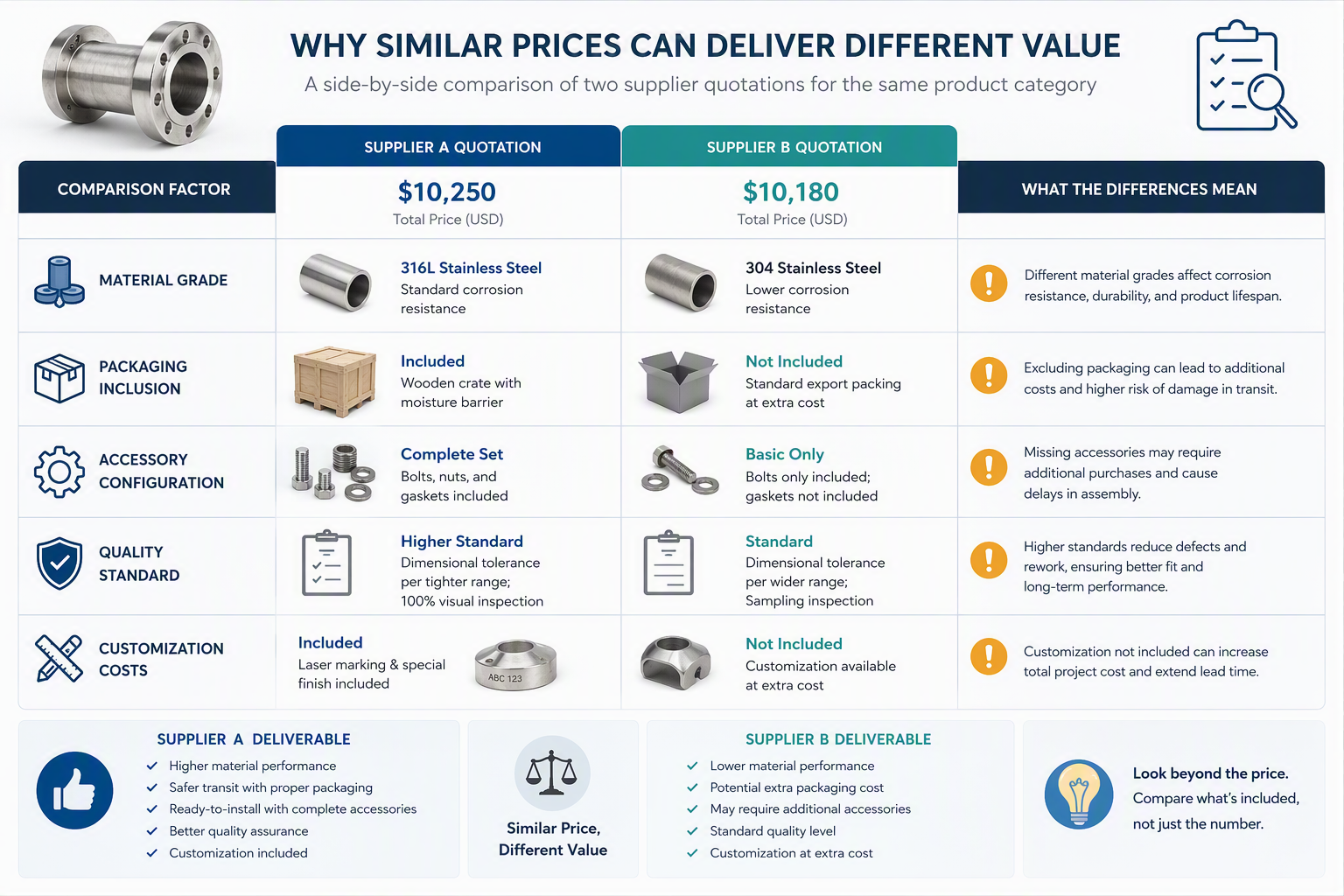
A supplier’s unit price is only one line in a larger purchasing decision. It does not automatically show the final cost, product quality, or operational risk. For example, two suppliers may both quote for the same consumer electronics accessory, but their offers may differ in important ways:
- One supplier may quote a lower-grade material.
- One supplier may exclude customized packaging.
- One factory may quote a different accessory configuration.
- One supplier may assume a different inspection standard.
- One quotation may include export packaging, while another does not.
- One factory may use a lower-cost component that changes performance or durability.
- One supplier may accept a low MOQ but add setup or logo charges later.
We do not assume that a lower quote is misleading. Many factories have legitimate differences in production capacity, supply-chain access, automation, order preference, or product positioning. Still, we believe buyers should verify whether quotations are genuinely comparable before treating one supplier as the better commercial choice.
Questions we ask when a quotation appears unusually low
When our team receives a noticeably lower quotation, we generally ask the supplier to clarify the commercial and product basis of the offer. The exact questions depend on the category, but they often include:
-
Which material grade is included in the price?
We ask for material descriptions, component information, thickness, weight, finish, or other relevant details. -
Are the stated functions the same as the buyer’s requirement?
For electronic or functional products, we may ask about included features, compatibility, operating modes, or component configuration. -
What accessories and packaging are included?
We confirm inserts, cables, manuals, inner boxes, labels, barcode placement, master cartons, and protective packing where relevant. -
What is the quoted quality level?
We ask how the supplier understands cosmetic standards, assembly expectations, functional checks, and defect handling. -
Does the quote include customization costs?
We clarify logo printing, tooling, molds, color changes, artwork setup, custom packaging, and other OEM or private-label requirements. -
What are the order conditions?
We review MOQ, payment terms, lead time, sample charges, production capacity assumptions, and shipping terms[^3].
This process does not replace technical testing, legal review, or application-specific professional evaluation[^1]. For regulated, safety-critical, or technically complex products, buyers should use qualified specialists and verify relevant documents independently. However, structured clarification can help reduce the risk of comparing incomplete offers.
Price negotiation should consider total purchasing exposure
We encourage buyers to assess total purchasing exposure, not only the unit price. Total exposure includes the possibility that a low quote could lead to specification substitution, quality inconsistency, delays, additional charges, or difficult communication after a deposit is paid.
| Negotiation area | Price-only approach | Procurement-focused sourcing agent approach |
|---|---|---|
| Unit price | Select the lowest quoted number | Compare price against equivalent specifications and scope |
| Materials | Accept general descriptions | Clarify material grade, finish, dimensions, components, and alternatives |
| MOQ | Focus only on the minimum quantity | Review MOQ alongside setup costs, customization needs, and future reorder potential |
| Quality | Rely on broad promises such as “good quality” | Define practical quality expectations and inspection points |
| Packaging | Treat packaging as a later detail | Confirm labeling, inserts, carton requirements, and protection before ordering |
| Payment and delivery | Accept standard terms without review | Clarify deposit, balance timing, production lead time, and shipping handover requirements |
| Production follow-up | Assume the quote controls the order | Carry confirmed conditions into order documentation and follow-up |
A sourcing agent cannot eliminate all purchasing risk. Factories can face capacity changes, raw-material changes, communication gaps, or production challenges. Still, we find that buyers are better positioned when they negotiate from a complete product brief rather than from a single target price.
How a Sourcing Agent Compares Supplier Quotations Before Negotiation
Buyers often receive several quotations that seem easy to compare because every supplier provides a unit price and MOQ. The problem is that quotation sheets can use different assumptions. If those assumptions are not exposed early, the buyer may negotiate the wrong issue.
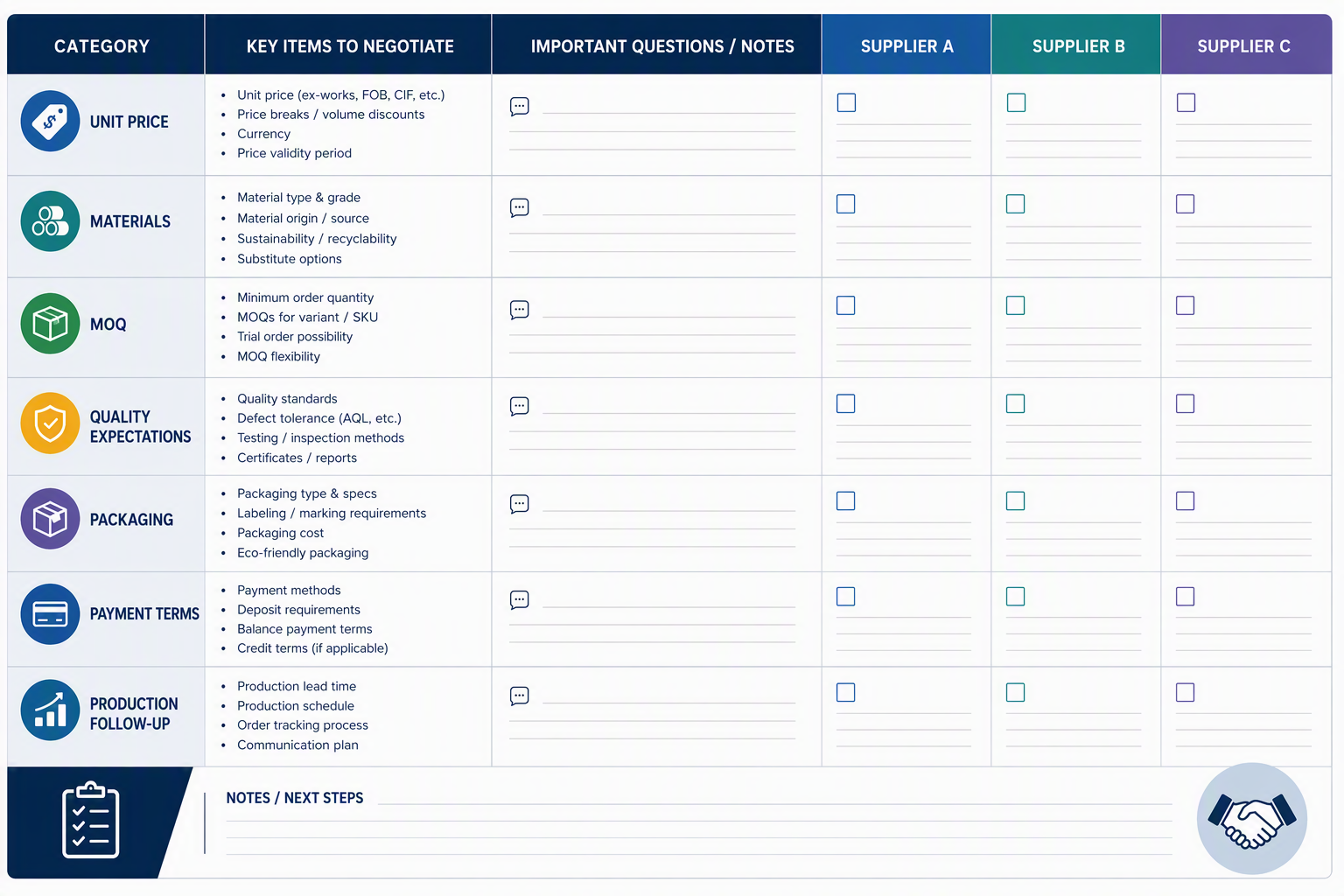
We compare supplier quotations by reviewing the specification behind each offer before pushing for revised terms. This approach helps us identify whether suppliers are offering equivalent products and whether a price difference is commercially reasonable. It also gives buyers a clearer basis for choosing which factories deserve further sampling, verification, or negotiation.
We start with a usable product brief
Negotiation is stronger when the buyer’s requirements are specific. A factory cannot reliably quote an unclear product request[^10], and a buyer cannot fairly compare offers that respond to different interpretations.
We usually encourage buyers to define as much of the following as possible:
- Product photos, reference links, drawings, or existing samples
- Dimensions, colors, materials, and finish requirements
- Required functions and compatibility details
- Required accessories and included components
- Branding, private-label, or packaging requirements
- Target order quantity and expected reorder pattern
- Preferred inspection approach and acceptable quality level
- Destination market and shipping considerations
- Required timeline for samples and production
A complete brief does not need to be perfect. Many buyers begin with a concept, a competitor reference, or an existing product that needs customization. In those cases, we help organize the available details into questions that factories can answer.
We separate confirmed facts from assumptions
A supplier may provide a fast quotation based on assumptions. That is not necessarily a problem at the early inquiry stage, but assumptions should not remain hidden once the buyer moves toward an order.
For example, a supplier may quote based on a standard product while the buyer expects custom branding. Another supplier may include a basic retail box while the buyer needs Amazon-ready labeling or a more protective package. The price gap may be real, but it may not represent the same deliverable.
We try to separate information into three categories:
- Confirmed requirements: Details that the supplier has clearly accepted.
- Supplier assumptions: Details used for the quote but not yet confirmed by the buyer.
- Open points: Details that require sample review, artwork confirmation, technical input, or further negotiation.
This distinction can prevent an early quote from being treated as a final commercial commitment.
We negotiate beyond the initial price
Once the product basis is clear, price can be discussed more responsibly. However, negotiation may also involve other conditions that affect the buyer’s cash flow, operations, and risk.
Depending on the product and supplier, we may help buyers discuss:
- MOQ for a trial order or initial launch
- Sample cost and sample lead time
- Tooling or customization charges
- Payment structure and payment milestones
- Production lead time
- Packaging and labeling requirements
- Spare parts, replacement units, or accessory inclusion
- Carton packing and consolidation readiness
- Inspection timing before final payment
- Communication and approval points during production
We do not present these terms as universally available. Each supplier has its own cost structure, production schedule, and willingness to support different order sizes. The practical value is in identifying which terms matter most to the buyer and then discussing them clearly with the supplier.
How a Sourcing Agent Carries Negotiated Terms into Production
A negotiated quotation can lose value if the agreed details do not follow the order into production. Buyers may believe that a factory “agreed” to a requirement in chat messages or an email thread, while the production team works from a different version of the order details. This gap can create avoidable disputes later.
A sourcing agent helps carry negotiated terms into execution by aligning quotations, product details, purchase documents, samples, packaging requirements, and production follow-up. We aim to make the key conditions visible and checkable as the order moves forward. This does not create legal enforceability by itself, but it can improve clarity and reduce operational misunderstandings.
Documentation supports more consistent execution
In our work with overseas buyers, we see that supplier communication is most useful when important details are consolidated rather than scattered across messages. A factory may have sales staff, merchandising staff, production personnel, packaging teams, and warehouse staff involved at different stages. Each handoff can create room for misunderstanding[^5].
We therefore encourage buyers to keep critical requirements connected to the order record. Depending on the product, this may include:
- Approved product photos or reference samples
- Product specifications and dimensions
- Material or component descriptions
- Color references and logo artwork
- Packaging layout and labeling instructions
- Required quantities by SKU, color, or variation
- Carton marks and shipping labels
- Quality expectations and inspection checkpoints
- Production schedule and final confirmation points
For customized products, sample approval is often especially important. A sample can help buyers and suppliers confirm what a written description cannot fully show[^4], such as color appearance, printing placement, assembly feel, packaging presentation, or functional behavior. Buyers should still evaluate samples carefully and seek qualified testing or technical review when their product category requires it.
Local communication matters after confirmation
Negotiation does not end when a supplier accepts an order. Production conditions can change, and questions can arise during material purchasing, artwork setup, assembly, packaging, or final packing. Local follow-up can help buyers receive timely updates and ask for clarification before issues become more difficult to correct.
At KingSourcing, we can support communication between overseas buyers and Chinese suppliers throughout the procurement workflow. We can help with supplier sourcing and verification, quotation comparison, sample development, OEM/ODM coordination, factory audits, production follow-up, quality inspection, one-by-one product checking where appropriate, packaging, labeling, warehousing, consolidation, and shipping coordination.
We do not treat message forwarding as negotiation expertise. Effective follow-up requires understanding what was agreed, which details are commercially important, and what questions need to be raised when a supplier proposes a change.
A practical buyer checklist before confirming an order
Before you approve a purchase, we recommend reviewing these points:
-
Is the product specification sufficiently clear?
Check materials, dimensions, functions, colors, components, accessories, and customization details. -
Are quotations being compared on the same basis?
Confirm that suppliers included the same product version, packaging, quality level, and scope. -
Are the negotiated terms recorded in an order-ready format?
Important conditions should not exist only in scattered chat messages[^2]. -
Has the buyer reviewed the sample where needed?
A sample may reveal gaps that cannot be seen in a quotation. -
Are quality expectations practical and inspectable?
Avoid vague language where possible. Define key appearance, function, packaging, or quantity requirements. -
Does the supplier’s production plan fit the required timeline?
Lead time should be discussed with the real order scope in mind, including customization and packaging. -
Is there a plan for follow-up and inspection?
Buyers should decide how they will monitor production and verify goods before shipment.
A sourcing agent can coordinate these steps, but the buyer should remain involved in decisions that affect brand positioning, product performance, regulatory obligations, and acceptable commercial risk.
Frequently Asked Questions
Can a sourcing agent get a lower price from Chinese suppliers?
A sourcing agent may help buyers discuss price and commercial terms, but lower price should not be the only goal. We first compare materials, functions, quality expectations, packaging, MOQ, and other conditions. A lower quote is more meaningful when the buyer can verify that the offered product is genuinely equivalent.
What should I send a sourcing agent before supplier negotiation?
We recommend sending product images, links, drawings, specifications, target quantity, customization needs, packaging requirements, destination market, and desired timeline. The clearer your product brief is, the easier it is to compare supplier quotations and identify which terms need clarification before order confirmation.
Is supplier negotiation only about unit price?
No. Supplier negotiation can also involve MOQ, sample costs, customization charges, payment terms, production lead time, packaging, labels, inspection arrangements, and shipping readiness. We view negotiation as the process of making purchase conditions workable, documented, and aligned with the buyer’s actual requirements.
How can I tell whether two supplier quotations are comparable?
You should check whether both suppliers quote the same materials, dimensions, functions, accessories, packaging, branding scope, quality expectations, order quantity, and shipping terms. If these elements differ, the unit prices may not represent the same product or purchasing commitment.
Can a sourcing agent ensure that a factory follows every agreed term?
No sourcing agent can guarantee every production outcome[^6]. However, a sourcing agent can help document key requirements, maintain communication during production, coordinate follow-up, and arrange appropriate inspection support. Buyers should also use qualified technical, regulatory, or legal professionals when their product or market requires specialized evaluation.
Conclusion
A sourcing agent helps with supplier negotiation by looking beyond the lowest quoted price. We believe the stronger outcome is a purchase arrangement where product specifications, materials, quality expectations, packaging, MOQ, payment terms, and production requirements are clearly understood and carried into execution. At KingSourcing, we help overseas buyers communicate with Chinese suppliers, compare quotations transparently, verify suppliers, follow production, inspect goods, consolidate orders, and coordinate shipping. Contact us if you need practical China sourcing support for your next purchase program.
[^1]: "Conformity assessment - NIST", https://www.nist.gov/conformity-assessment. Conformity assessment may require testing, inspection, certification, or other technical evaluation to determine whether a product meets specified requirements; commercial clarification alone is not equivalent to such assessment. Evidence role: general_support; source type: government. Supports: Conformity-assessment guidance distinguishing testing, inspection, and certification activities from ordinary commercial supplier communication.. Scope note: The required assessment method depends on the product, destination market, and applicable legal or technical requirements. [^2]: "[PDF] managing the configuration of information systems with a focus on ...", https://tsapps.nist.gov/publication/get_pdf.cfm?pub_id=909644. Quality and configuration-management guidance emphasizes maintaining controlled documented information so that approved requirements and changes remain identifiable, available, and traceable during execution. Evidence role: general_support; source type: institution. Supports: Quality-management and configuration-management guidance supporting controlled documentation of requirements and changes.. Scope note: Document control improves traceability and consistency but does not itself create contractual enforceability or guarantee supplier compliance. [^3]: "Know Your Incoterms - International Trade Administration", https://www.trade.gov/know-your-incoterms. Incoterms rules define how named delivery terms allocate transportation responsibilities, costs, and risk between the seller and buyer in international trade. Evidence role: definition; source type: institution. Supports: Incoterms guidance explaining that trade terms allocate responsibilities, costs, and risk between buyers and sellers.. Scope note: Incoterms govern delivery allocations but do not by themselves settle product specifications, payment disputes, or all contractual obligations. [^4]: "Establishing a framework for best practices for quality assurance and ...", https://pmc.ncbi.nlm.nih.gov/articles/PMC10861687/. Quality-control practice commonly uses approved reference samples to compare observable product characteristics and support communication of acceptance expectations that may not be fully captured in written specifications. Evidence role: general_support; source type: research. Supports: Quality-control practice recognizing reference or approved samples as aids for evaluating visible, tactile, assembly, and functional attributes.. Scope note: A sample may not represent all production units and does not replace appropriate testing, inspection plans, or regulatory assessment. [^5]: "Shift-to-Shift Handoff Research: Where Do We Go From Here?", https://pmc.ncbi.nlm.nih.gov/articles/PMC3312531/. Supply-chain coordination research shows that incomplete, delayed, or distorted information sharing across organizations and functions can degrade planning and execution decisions. Evidence role: mechanism; source type: paper. Supports: Research on supply-chain coordination showing that incomplete or distorted information sharing can impair operational decisions and coordination.. Scope note: This evidence supports the general handoff risk, not the frequency or severity of misunderstandings at any particular factory. [^6]: "Supply chain disruptions and resilience: a major review ... - PMC", https://pmc.ncbi.nlm.nih.gov/articles/PMC7792559/. Supply-chain resilience guidance recognizes that supplier performance can be affected by operational disruptions, capacity constraints, and external uncertainties, so oversight cannot eliminate all execution risk. Evidence role: general_support; source type: institution. Supports: Supply-chain resilience literature documenting that supplier operations are exposed to disruptions and uncertainties that can affect performance.. Scope note: The evidence concerns general supply-chain uncertainty and does not assess the capability or contractual responsibility of a specific sourcing agent. [^7]: "[PDF] EVALUATING BIDS AND PROPOSALS - Public Documents", https://thedocs.worldbank.org/en/doc/9dcb7971706bf29b2732779c39922b77-0290012025/original/Evaluating-Bids-and-Proposals-with-Rated-Criteria-Feb-4-2025.pdf. Procurement guidance recognizes that a bid price must be assessed together with compliance with specifications and other commercial conditions, since price alone may not establish the value or scope of an offer. Evidence role: general_support; source type: institution. Supports: Procurement guidance explaining that evaluation of offers should consider conformity with specifications and relevant commercial conditions, rather than price alone.. Scope note: This support addresses formal procurement principles and does not prove that every low supplier quotation results in weaker materials or unexpected conditions. [^8]: "[PDF] EVALUATING BIDS AND PROPOSALS - Public Documents", https://thedocs.worldbank.org/en/doc/9dcb7971706bf29b2732779c39922b77-0290012025/original/Evaluating-Bids-and-Proposals-with-Rated-Criteria-Feb-4-2025.pdf. Tender-evaluation guidance requires offers to be assessed consistently against specified requirements and evaluation criteria, supporting like-for-like comparison of commercial proposals. Evidence role: general_support; source type: government. Supports: Public-procurement guidance on evaluating tender responses against stated requirements and applying consistent evaluation criteria.. Scope note: Public tender procedures are more formal than private supplier negotiation, but the comparison principle is applicable context. [^9]: "Public procurement - OECD", https://www.oecd.org/en/topics/public-procurement.html. International procurement guidance characterizes value for money as an assessment that may include quality, life-cycle cost, risk, and fitness for purpose rather than the lowest initial price alone. Evidence role: expert_consensus; source type: institution. Supports: International procurement guidance describing value for money as a broader assessment than the lowest initial purchase price.. Scope note: Value-for-money frameworks do not prescribe identical weighting of price and non-price factors for every private purchase. [^10]: "[PDF] Technical Specifications - World Bank Documents", https://documents1.worldbank.org/curated/en/099710507092534067/pdf/IDU-2f5f55a5-f19b-41cb-bf5e-601fd69cce52.pdf. Procurement guidance treats clear, complete specifications as necessary for suppliers to understand requirements and prepare offers that can be evaluated against the same intended scope. Evidence role: mechanism; source type: institution. Supports: Procurement guidance explaining that clear specifications communicate required characteristics and enable suppliers to prepare responsive offers.. Scope note: Clear specifications improve comparability but cannot ensure that a supplier's eventual performance will match its quotation.