A sourcing agent can appear helpful because they reply quickly, forward factory messages, and arrange basic quotations. However, fast communication alone does not protect your budget, timeline, or product requirements. I believe buyers need visible evidence that someone is actively managing decisions, risks, and supplier follow-up on their behalf.
A sourcing agent is really working for you when their communication shows ownership: they clarify requirements, compare supplier options, assign next steps, set deadlines, follow up on production milestones, and raise problems with practical solutions. Quick replies matter, but they only create value when they lead to accountable procurement action and documented progress.
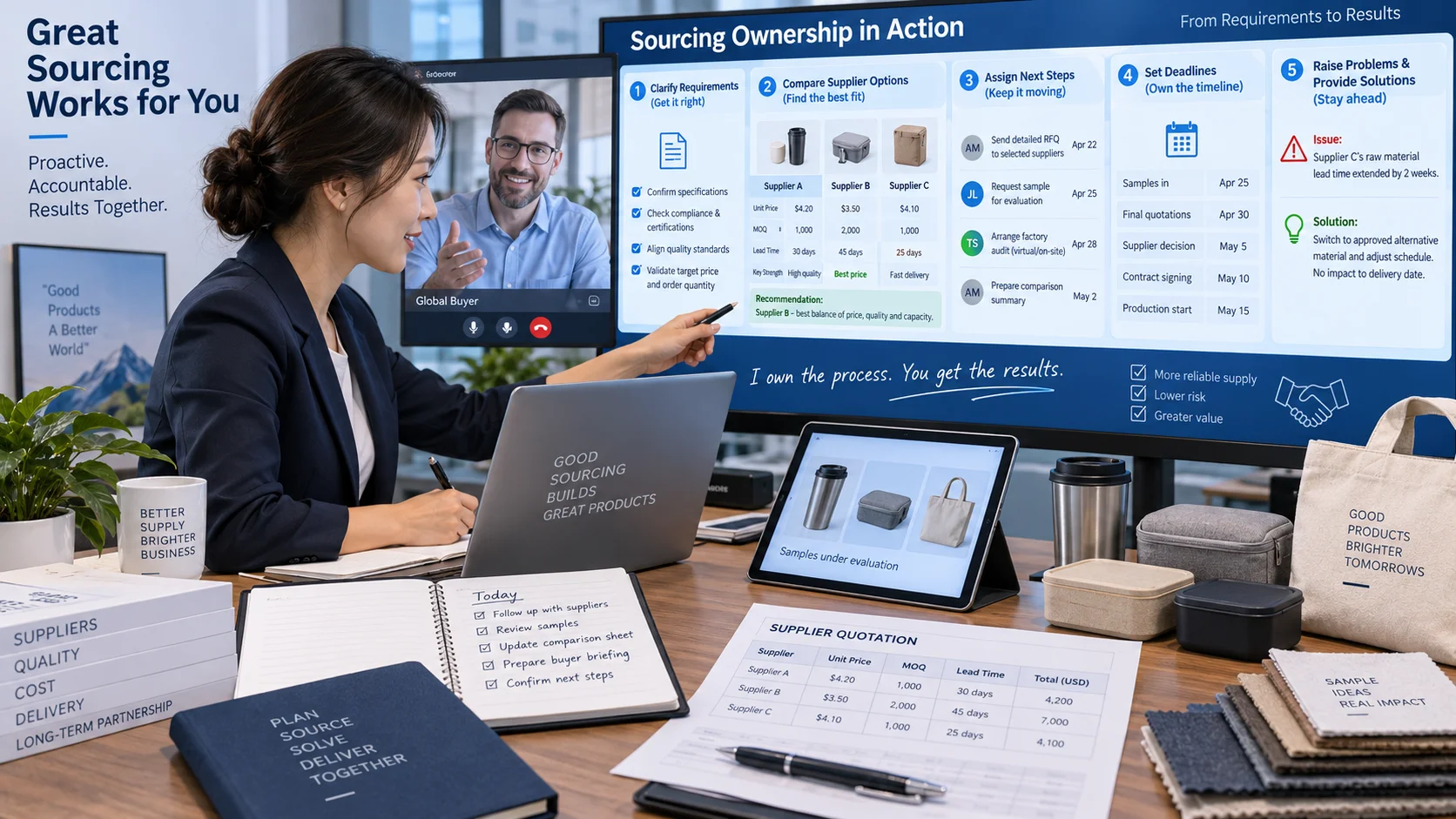
When I support buyers through a managed sourcing workflow, I look beyond whether a supplier has replied. I focus on what must happen next, who is responsible, what could delay the order, and what information the buyer needs to make a sound decision. Those are the records you should inspect when evaluating your own agent.
Quick Answer
A buyer should judge a sourcing agent by the work that happens between supplier messages. I recommend checking whether the agent converts updates into clear decisions, tracks open items, documents product and quality requirements, compares quotations on like-for-like terms, and follows through when suppliers miss a milestone or raise a concern.
Responsiveness is still important. An agent who takes days to answer an urgent question can create avoidable delays. Yet a responsive agent who only says, “Factory says okay,” may not be managing the underlying risk. A useful update should help you understand what is confirmed, what remains uncertain, and what action is required.
I encourage buyers to review the last 20 to 30 messages, emails, and order updates from their agent. The pattern is often clearer than any sales promise.
In my experience, procurement management becomes visible at the points where uncertainty enters the order: supplier selection, sample approval, price comparison, production scheduling, quality inspection, packaging confirmation, and shipment coordination. A capable China sourcing agent should make those stages easier to control from overseas.
Practical Signals to Check if Your China Sourcing Agent Is Truly Managing Your Procurement Process?
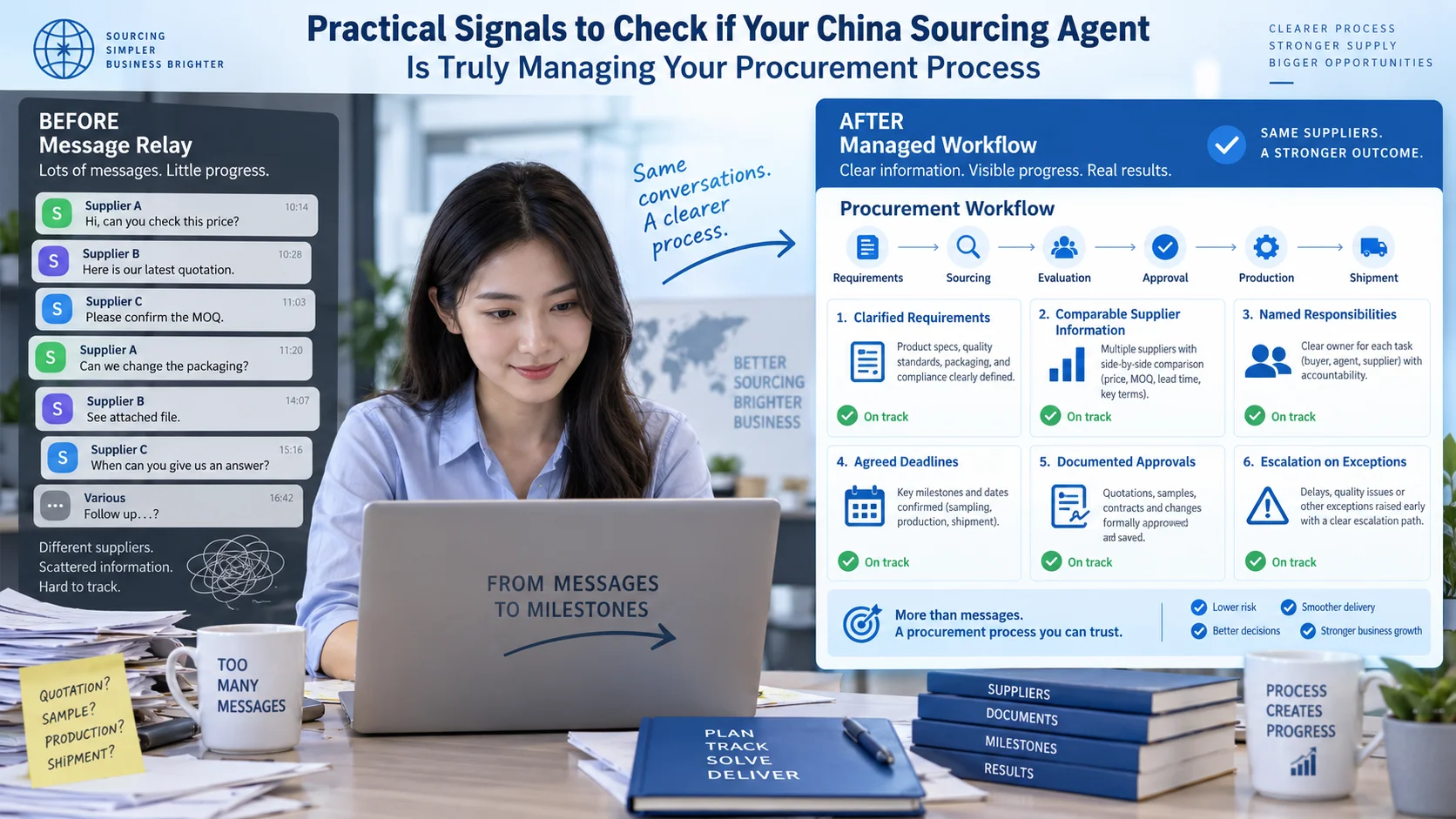
A China sourcing agent may be busy every day, but activity is not always the same as progress. Buyers can become frustrated when they receive many supplier screenshots yet still do not know what has been agreed, what is delayed, or who is fixing the problem. I suggest looking for operational signals, not just message volume.
A sourcing agent is actively managing procurement when they turn supplier communication into an organized workflow. You should see clarified requirements, comparable supplier information, named responsibilities, agreed deadlines, documented approvals, and escalation when an exception occurs. These details show that the agent is moving the order forward rather than acting only as a message relay.
They clarify your product brief before requesting quotations
The first signal appears before you even select a supplier. A working agent should identify gaps in your request before sending it to factories. For example, a buyer may ask for “wireless earbuds with custom branding,” but that description leaves many questions open:
- Which Bluetooth version or required functions matter?
- What material, color, dimensions, and packaging style are needed?
- Is the target price based on EXW, FOB, or delivered cost[^1]?
- What logo method is acceptable: printing, engraving, embossing, or a custom mold?
- What quantity, target market, and compliance documents may apply?
- Which defects would make the product unacceptable?
I do not expect every buyer to arrive with a complete technical specification. Many startups and e-commerce sellers are developing a product while sourcing it. Still, the sourcing agent should help convert an early idea into a usable request for quotation (RFQ)[^2].
Without this step, different factories may quote different products. One may include retail packaging, another may quote only a basic polybag, and a third may use a lower-capacity battery or different material grade. The lowest price then becomes misleading because the offers are not comparable.[^3]
They provide quotation comparisons rather than isolated prices
A supplier quotation is not a procurement decision by itself. Buyers should expect a sourcing agent to organize the commercial details so they can compare options fairly.
Here is a practical way to distinguish passive forwarding from active quotation management:
| Procurement activity | Message-forwarding approach | Managed sourcing approach |
|---|---|---|
| Supplier quote | Sends a screenshot or a single unit price | Presents pricing with specifications, MOQ, tooling, packaging, and trade terms |
| Supplier comparison | Says one supplier is “better” | Explains key differences, strengths, limits, and unresolved questions |
| Price negotiation | Reports that the factory “cannot reduce” | Tests quantity breaks, packaging alternatives, payment terms, or specification changes |
| Sample planning | Says the factory will make a sample | Confirms sample cost, lead time, approval criteria, shipping method, and revision process |
| Production update | Forwards “production is ongoing” | Tracks milestones, identifies possible delays, and requests a recovery plan if needed |
| Quality issue | Shares photos after inspection | States the defect, affected quantity, decision options, and corrective-action follow-up |
A transparent comparison does not require the agent to promise the lowest possible price. In fact, the cheapest quote may create higher risk if the materials, workmanship, packaging, or factory capability differ[^4]. What matters is whether the buyer can see the basis for the recommendation.
For multi-SKU sourcing, I find that a simple comparison sheet is particularly useful. It can show each supplier’s unit price, MOQ, sample charge, production lead time, packaging inclusion, payment terms, factory location, and open questions. This record makes future negotiations easier and reduces confusion when a supplier changes a detail later.
They create visible next steps, owners, and deadlines
One of the clearest signs that a sourcing agent is working for you is their use of action-oriented updates. I believe every important update should answer four basic questions:
- What happened?
- What needs to happen next?
- Who owns the next action?
- When is the expected deadline?
For example, compare these two messages:
- “Factory is checking the packaging.”
- “The supplier is checking whether the revised insert card fits the current carton size. The supplier will confirm the dieline by Thursday. I will review the dieline against the approved dimensions and send it to you for approval before printing.”
The second update is longer, but it gives the buyer control. It identifies the open issue, the responsible party, the expected timing, and the approval point.
This matters because cross-border procurement often involves several moving parts[^5]. A factory may need artwork approval before printing packaging. A packaging supplier may need the final carton dimensions. An inspection may need to happen before the balance payment or booking deadline. If no one manages the sequence, small omissions can become expensive delays.
In a managed sourcing workflow, I would normally expect to see a tracker or regular update covering items such as:
- Supplier confirmation and quotation status
- Sample development and revision stage
- Approved specifications and reference photos
- Deposit status and planned production dates
- In-process production milestones
- Inspection timing and issue resolution
- Packaging, labeling, carton marks, and barcode checks
- Consolidation readiness and shipping documentation
The format can be a spreadsheet, email summary, project-management tool, or shared document. The tool is less important than the discipline behind it.
They manage exceptions instead of hiding uncertainty
No sourcing agent can guarantee that every supplier will perform perfectly. Factories can face material shortages, changing production schedules, sample differences, artwork misunderstandings, or quality variation. The stronger test is how the agent handles those situations.
I consider it a positive sign when an agent raises an issue early, even when the update is inconvenient. A useful exception report should include:
- The problem: What is different from the agreed requirement?
- The impact: Could it affect cost, quality, production timing, or shipping?
- The evidence: Photos, measurements, supplier confirmation, sample comparison, or inspection findings where available.
- The options: What practical alternatives exist?
- The recommendation: Which option appears most suitable and why?
- The decision deadline: When does the buyer need to respond to avoid further delay?
For example, if a supplier says a selected color material is unavailable, a passive agent may simply ask, “What color do you want instead?” A managing agent should investigate whether the original material can be sourced with a longer lead time, whether a close alternative matches the approved color standard, whether the color affects unit cost, and whether a partial production plan is possible.
This approach does not remove uncertainty. It helps the buyer make a decision before uncertainty becomes a larger commercial problem.
They protect approvals with written records
Verbal agreements and informal chat messages can be difficult to interpret later[^6], especially when several people are involved. Buyers should ask whether their sourcing agent is keeping a usable record of approvals.
The documentation does not need to be overly formal for every order. Still, important elements should be confirmed in writing:
- Final product specifications and approved sample reference
- Logo artwork, placement, color, and size
- Packaging design and labeling requirements
- Order quantity and acceptable over- or under-production terms, if applicable
- Unit pricing, tooling charges, sample charges, and trade terms
- Production lead time and major checkpoints
- Inspection standard or critical quality requirements
- Shipping marks, carton dimensions, and destination details
For regulated, safety-sensitive, or application-specific products, buyers should seek qualified professional guidance and verify any required testing reports, declarations, and certifications directly[^7]. A sourcing agent can help collect supplier documents, but buyers should not treat a document alone as proof that a product is suitable for every market or use case.
They remain involved through inspection and shipping coordination
Some agents become less visible once the deposit is paid. In my view, the period after production starts is when procurement management becomes especially important.
Production follow-up should not mean asking the factory, “Is it finished yet?” A more useful process checks whether material preparation, assembly, packaging, and final readiness align with the agreed schedule. If the project needs a third-party inspection or 1-by-1 product checking, the inspection timing should be planned before the goods are fully packed or dispatched.[^8]
Quality control also requires clear boundaries. An inspection can identify issues based on an agreed standard and sampling approach, but it cannot guarantee that every unit will be perfect[^9] or that problems will never occur after shipment. Buyers should define critical requirements early and review inspection findings before release decisions.
For buyers purchasing from several factories, the sourcing agent should also coordinate practical consolidation details:
- Which suppliers are ready and which are outstanding?
- Are cartons correctly labeled for warehouse receiving?
- Do carton sizes and weights affect freight planning?[^10]
- Are accessories, inserts, and spare parts matched to the right SKU?
- Have product labels, shipping marks, and final quantities been checked?
- Is the shipment booking aligned with production completion and document deadlines?
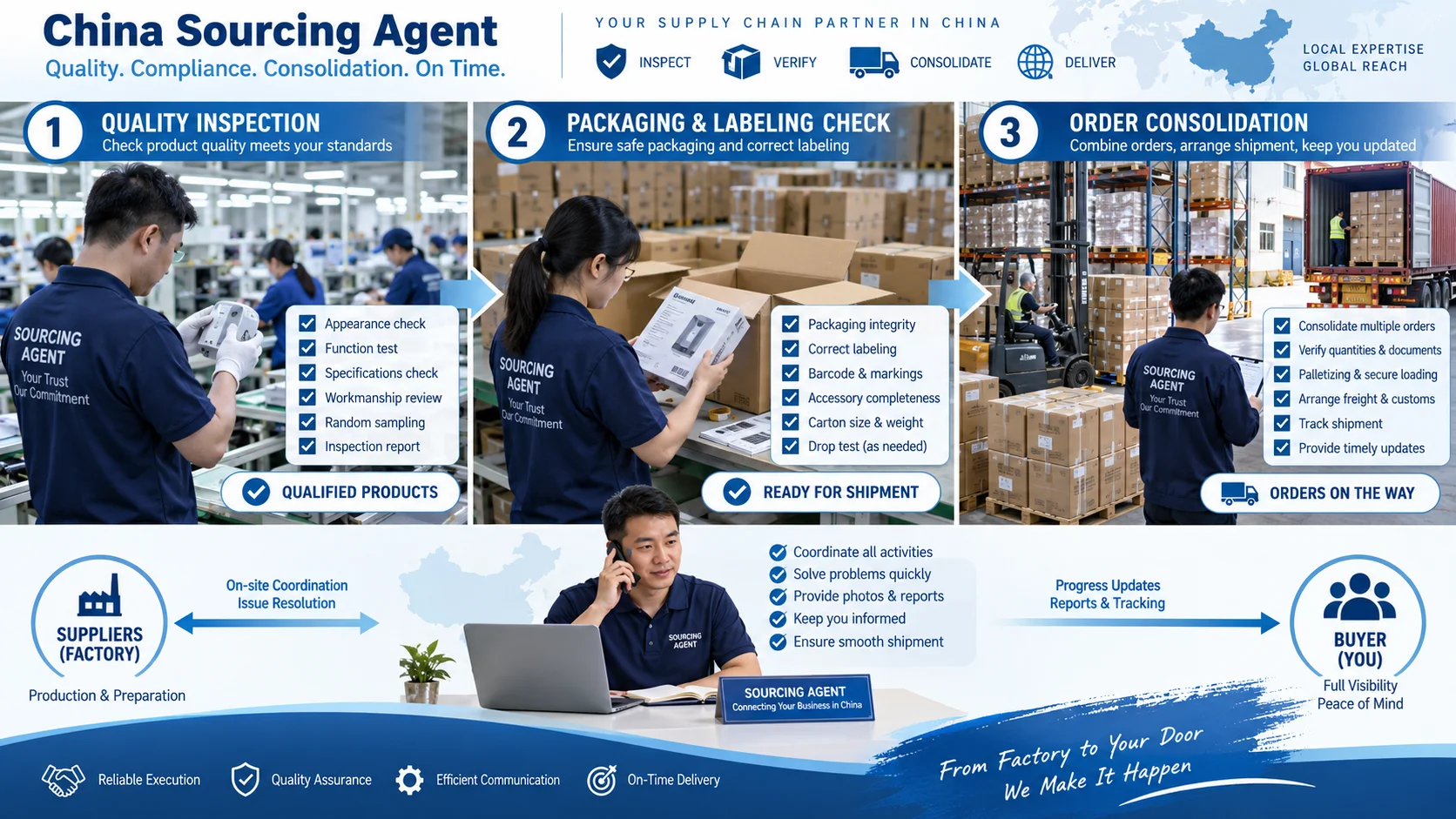
A sourcing agent does not need to control every external variable to add value. However, they should make the status of each variable visible and push the responsible party toward the next required action.
Frequently Asked Questions
How often should a sourcing agent update me?
I suggest agreeing on an update rhythm that matches the order stage. Weekly updates may be suitable during normal production, while samples, inspections, artwork approvals, and delays may require faster communication.[^11] The best updates explain status, open actions, deadlines, and decisions needed from you.
Is a fast response a sign of a good sourcing agent?
A fast response is useful, particularly when an issue is urgent. However, I would not judge a sourcing agent on speed alone. Strong service combines responsiveness with accurate information, supplier follow-up, clear recommendations, and confirmation that agreed actions were actually completed.
What documents should my sourcing agent share with me?
Buyers should normally receive relevant quotations, comparison summaries, sample photos or records, approved specifications, production schedules, inspection reports where arranged, packaging details, and shipping information. The exact documents depend on the product and service scope, but critical decisions should not rely only on informal chat messages.
Can a sourcing agent guarantee product quality or on-time delivery?
No responsible sourcing agent should guarantee outcomes that depend on factories, logistics providers, materials, or other external parties.[^12] A good agent can reduce risk by verifying suppliers, documenting requirements, monitoring progress, arranging quality checks, and escalating problems early. Buyers should still make final decisions based on their own risk tolerance.
Should I replace my sourcing agent if they only forward supplier messages?
I recommend first requesting a clearer operating method. Ask for a quotation comparison, action tracker, production milestones, and issue-escalation format. If the agent cannot provide visibility after a reasonable trial period, you may need to consider a sourcing partner with stronger procurement management capabilities.
Conclusion
A sourcing agent is truly working for you when you can see accountable management behind the communication. I recommend reviewing whether your agent clarifies requirements, makes quotations comparable, records approvals, tracks production milestones, and brings options when problems arise. These signals matter more than polished messages or constant supplier screenshots. At KingSourcing, we help overseas buyers build a more visible China procurement workflow through supplier verification, quotation comparison, production follow-up, quality inspection, consolidation, and shipping coordination.
[^1]: "Know Your Incoterms", https://www.trade.gov/know-your-incoterms. Incoterms rules define EXW and FOB as distinct delivery terms that allocate transport, export, cost, and risk responsibilities differently between seller and buyer. Evidence role: definition; source type: institution. Supports: Definitions of EXW and FOB and the differing allocations of delivery, export clearance, transport, cost, and risk.. [^2]: "BPD - Terms and Conditions - Missouri State Highway Patrol", https://apps.mshp.dps.mo.gov/MSHPWeb/PatrolDivisions/BPD/Purchasing/termsConditions.html. Procurement guidance describes a request for quotation as a solicitation that specifies the goods or services and commercial conditions on which suppliers submit prices. Evidence role: definition; source type: government. Supports: Public-procurement guidance explaining that RFQs state specifications and commercial requirements for supplier quotations.. [^3]: "MCC Procurement Guidance Note: Price-Reasonableness Analysis", https://www.mcc.gov/resources/doc/guidance-price-reasonableness/. Procurement evaluation guidance generally requires bids to be assessed against common specifications and stated criteria, since a quoted price is meaningful only in the context of the offer's scope and terms. Evidence role: general_support; source type: institution. Supports: Procurement guidance that bids should be evaluated against common specifications and stated evaluation criteria rather than headline price alone.. Scope note: Such guidance often addresses formal procurement, but the comparison principle is applicable to commercial supplier quotations. [^4]: "Optimized sourcing strategies using total cost of ownership", https://www.academia.edu/10480111/Optimized_sourcing_strategies_using_total_cost_of_ownership_the_Vatman_case_at_3M. Supplier-selection research commonly treats price as one criterion among quality, delivery performance, and supplier capability, rather than as a sufficient measure of purchasing value or risk. Evidence role: general_support; source type: paper. Supports: Research on supplier selection showing that price is commonly assessed together with quality, delivery, and supplier capability criteria.. Scope note: This literature supports multi-criteria evaluation generally; it does not establish that any particular low-priced quotation is unsuitable. [^5]: "Trade Facilitation, Logistics & Connectivity", https://www.worldbank.org/ext/en/topic/trade/trade-facilitation-logistics-connectivity. International trade and logistics guidance recognizes that cross-border transactions depend on coordinated production, transport, documentation, and border-related processes, any of which can affect delivery timing. Evidence role: general_support; source type: institution. Supports: International trade guidance describing the role of transport, documentation, border procedures, and supply-chain coordination in cross-border transactions.. Scope note: The support concerns cross-border trade processes broadly and does not measure the performance of sourcing agents specifically. [^6]: "[PDF] Contract Management Guide - Finance and Administration Cabinet", https://finance.ky.gov/eProcurement/Documents/Contract%20Management%20Guide.pdf. Commercial-law guidance recognizes electronic communications and records as capable of preserving information about transactions and agreements, supporting later review of what was communicated. Evidence role: general_support; source type: institution. Supports: Legal and commercial guidance recognizing electronic records and written communications as records of contractual or commercial information.. Scope note: The legal effect of a particular chat message or verbal agreement depends on the governing law, contract terms, and evidentiary circumstances. [^7]: "Testing & Certification", https://www.cpsc.gov/Business--Manufacturing/Testing-Certification. Product-safety regulators explain that declarations, testing, and certification obligations depend on the applicable product rules and market requirements and must be supported by appropriate technical documentation. Evidence role: general_support; source type: government. Supports: Regulatory guidance explaining that product compliance documentation is tied to applicable legal requirements, product categories, and responsible parties.. Scope note: The applicable requirements vary by jurisdiction, product category, intended use, and route to market. [^8]: "Control of Components and Drug Product Containers and Closures", https://www.fda.gov/drugs/guidances-drugs/questions-and-answers-current-good-manufacturing-practice-requirements-control-components-and-drug. Quality-management guidance treats inspection and control of nonconforming outputs as planned activities intended to identify and address problems before product release or delivery. Evidence role: general_support; source type: institution. Supports: Quality-management principles requiring planned verification and control of nonconforming outputs before release or delivery.. Scope note: The appropriate inspection point and whether 100-percent checking is warranted depend on product risk, process capability, and contractual requirements. [^9]: "What kinds of Lot Acceptance Sampling Plans (LASPs) are ...", https://www.itl.nist.gov/div898/handbook/pmc/section2/pmc22.htm. Acceptance-sampling methods evaluate a selected sample to make a decision about a production lot; because not every unit is examined, such inspection does not demonstrate that every unit is defect-free. Evidence role: mechanism; source type: government. Supports: How acceptance-sampling plans inspect samples from lots and use results to make lot-acceptance decisions rather than verify every unit.. Scope note: The strength of the conclusion depends on the sampling plan, acceptance criteria, lot formation, and inspection execution. [^10]: "Ports and Shipping - Talking Freight - Federal Highway Administration", https://www.fhwa.dot.gov/Planning/freight_planning/talking_freight/june16transcript.cfm. Air-cargo guidance uses volumetric weight alongside actual weight, illustrating why carton dimensions and weights can affect transport capacity calculations and freight charges. Evidence role: mechanism; source type: institution. Supports: Freight-industry rules describing volumetric or dimensional weight and the role of package dimensions in transport planning and charges.. Scope note: Rating methods differ by transport mode, carrier, route, and contract. [^11]: "The Importance of a Communication Plan in Project Management", https://www.snhu.edu/about-us/newsroom/business/communication-plan-in-project-management. Project-management guidance recommends tailoring communications to stakeholder information needs, project conditions, and the urgency of decisions rather than applying one fixed reporting frequency. Evidence role: general_support; source type: education. Supports: Project-management guidance that communication plans should reflect stakeholder information needs, project conditions, and decision urgency.. Scope note: Such guidance does not prescribe a universal weekly schedule for procurement orders. [^12]: "Cybersecurity Supply Chain Risk Management Practices ...", https://nvlpubs.nist.gov/nistpubs/SpecialPublications/NIST.SP.800-161r1.pdf. Supply-chain risk-management guidance identifies supplier, transportation, and material dependencies as external sources of disruption that can affect continuity, quality, and delivery performance. Evidence role: general_support; source type: government. Supports: Supply-chain risk guidance recognizing dependencies on suppliers, transportation, and materials as sources of disruption and performance risk.. Scope note: This supports the existence of external risks, not a conclusion about the competence or contractual liability of any individual sourcing agent.