Many buyers fear overpaying a sourcing agent, but the bigger risk is paying less for work that does not protect the order.
I see the right China sourcing agent fee as the total cost of the work included, not only a commission rate. A fair fee should match supplier search, quote checking, sampling, production follow-up, quality control, packaging, warehousing, and logistics needs.
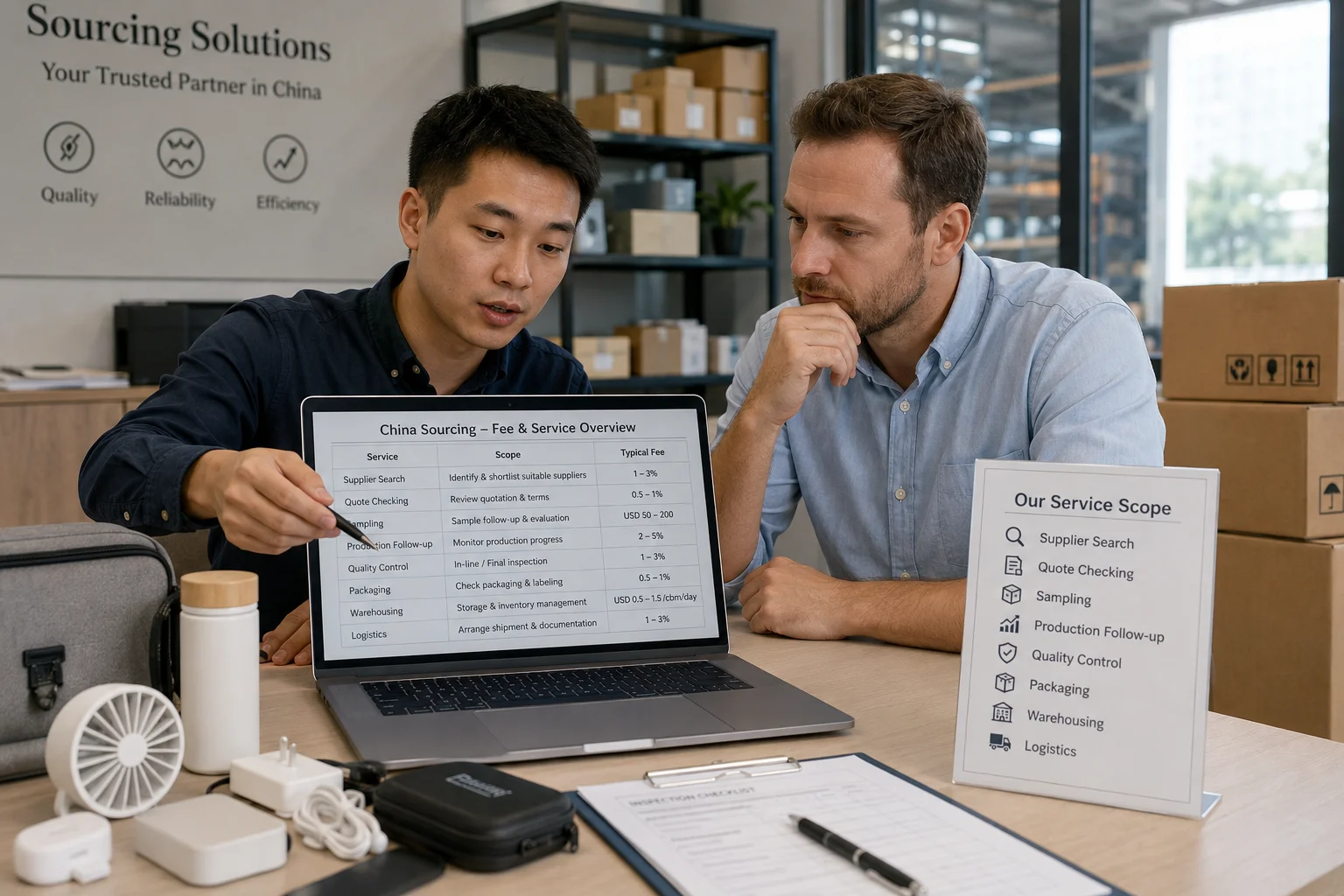
I often speak with first-time importers who ask one simple question: “How much should I pay a China sourcing agent?” I understand the question. Cash flow matters. Margins matter. But I also know this question can lead buyers to compare the wrong thing. A low service fee can look good at the start, then become expensive when supplier checks, sample follow-up, inspection, or logistics control are missing.[^1] So I prefer to ask a better question: “What work am I paying for, and what risk does this work reduce?”
1. What Are China Sourcing Agent Fees?
Many buyers feel confused when one agent says commission and another says service package. I see this confusion create weak cost decisions.
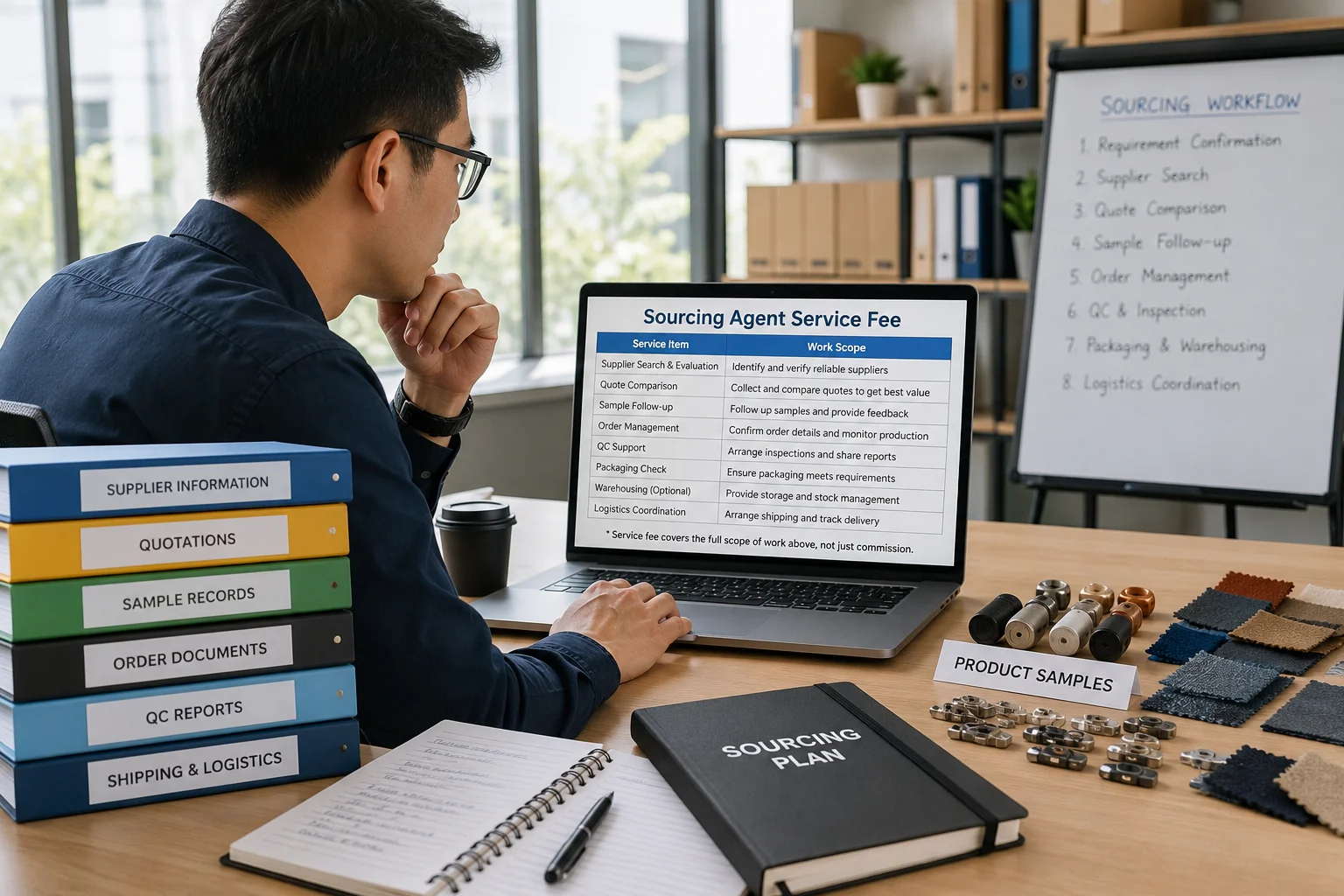
China sourcing agent fees are charges paid for sourcing and supply chain work in China. I normally see these fees cover supplier search, quote comparison, sample follow-up, order management, quality control support, packaging, warehousing, and logistics coordination[^2], depending on the agreed service scope.
The fee is not only a number
I define a sourcing agent fee as payment for local execution. The agent does not only send supplier names. The real work starts when a buyer needs to know whether the supplier is suitable, whether the quote is complete, whether the sample matches the request, and whether production will stay under control.
A common mistake I see is comparing two agents by percentage only. One agent may charge a low percentage but only help place the order. Another agent may charge more but handle supplier search, sample checks, production updates, product inspection, packaging work, and shipping support. These two fees are not the same product.
| Fee item I check | What it may include | Why it matters |
|---|---|---|
| Sourcing work | Supplier search, shortlisting, basic checks | I need better options before I choose |
| Order work | Quote review, sample follow-up, production tracking | I need fewer delays and surprises |
| Risk work | QC support, packaging checks, issue handling | I need fewer costly mistakes |
| Logistics work | Consolidation, warehouse, shipping coordination | I need clear landed cost control |
I always tell buyers that the fee should connect to the work. If the work is not clear, the fee is not clear either. I would rather see a higher but clear fee than a cheap fee with many missing tasks.
2. Why Do Different China Sourcing Agents Charge Different Fees?
Many buyers feel that fee differences mean someone is overcharging. I see a more basic reason: agents often do different work.
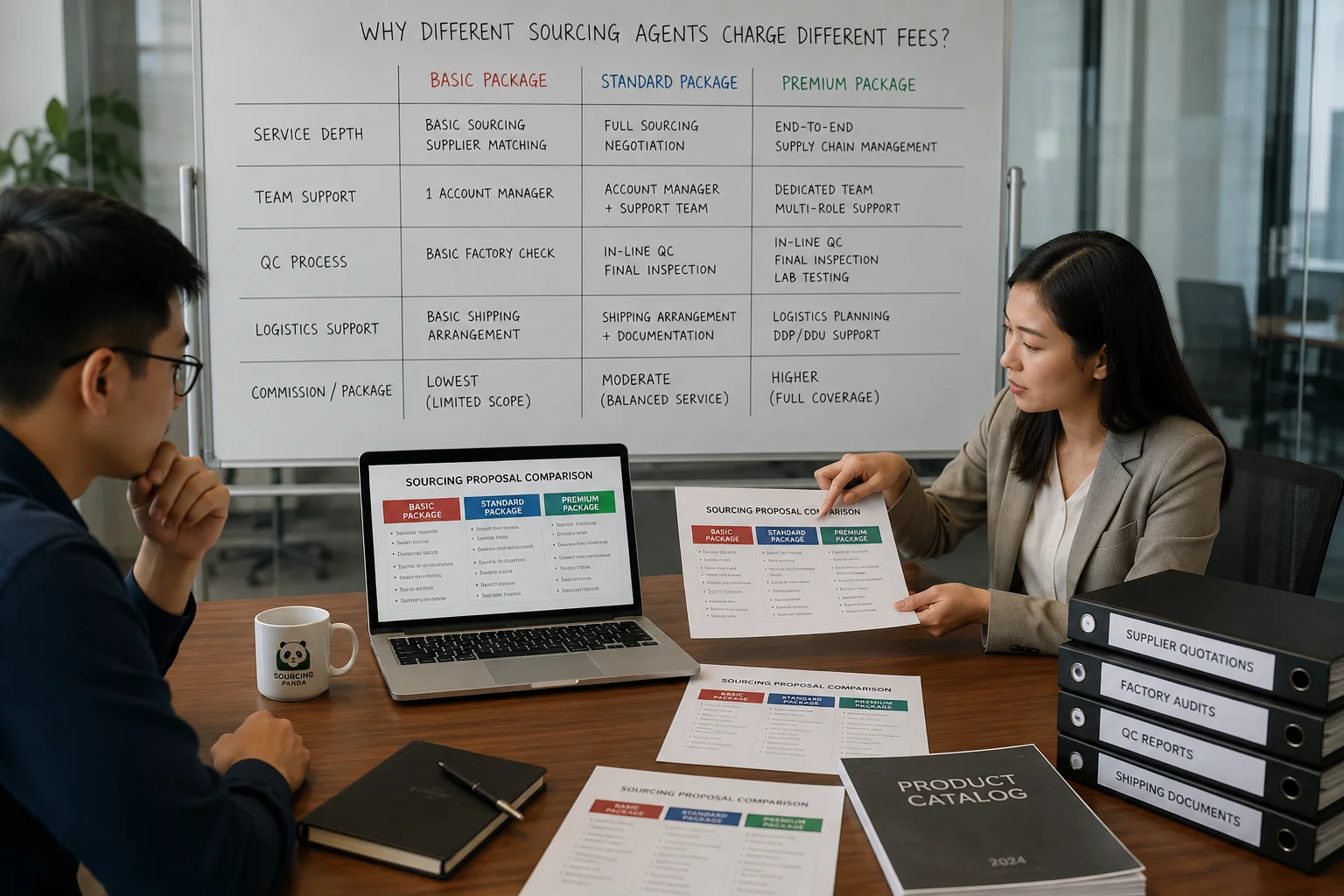
Different China sourcing agents charge different fees because their service depth, team structure, order control, supplier network, QC process, and logistics support are not the same. I compare fees by responsibility, not only by the rate shown on a quote.
Different fees often mean different service depth
I often see three agents give three very different quotes for the same product request. This can look strange at first. But when I review the details, I usually find that the work scope is different. One agent may only forward supplier prices. One may call factories, compare specs, check packaging, and manage samples. One may also offer inspection, warehouse, and shipping support.
This is why I do not treat a sourcing fee as a simple market price. I treat it as a service design. The order size, product type, customization level, supplier difficulty, and inspection need all affect the fee.[^3]
| Reason fees differ | Simple example | Cost impact |
|---|---|---|
| Product complexity | Standard item vs custom item | Custom work needs more time |
| Supplier control | Trading company list vs factory screening | Better checks take more labor |
| Order size | Small test order vs container order | Workload does not always follow value |
| QC need | No inspection vs item-by-item check | More control needs more cost |
| Logistics need | Supplier ships alone vs agent coordinates | Door-to-door work adds responsibility |
I do not think every higher fee is better. I also do not think every lower fee is bad. I look at the gap between price and duty. If an agent takes real responsibility for many steps, the fee will usually reflect that work. If the agent only introduces a supplier, the fee should not be judged like a full supply chain service.
3. Common China Sourcing Agent Fee Models: Commission, Fixed Fee, and Service Package?
Many buyers get stuck because fee models use different names. I see better decisions when buyers match the model to the order.
The most common China sourcing agent fee models are percentage-based commission, fixed project or stage fees, and service packages. I choose the better model by checking order value, product complexity, customization needs, inspection needs, and the amount of hands-on work required.
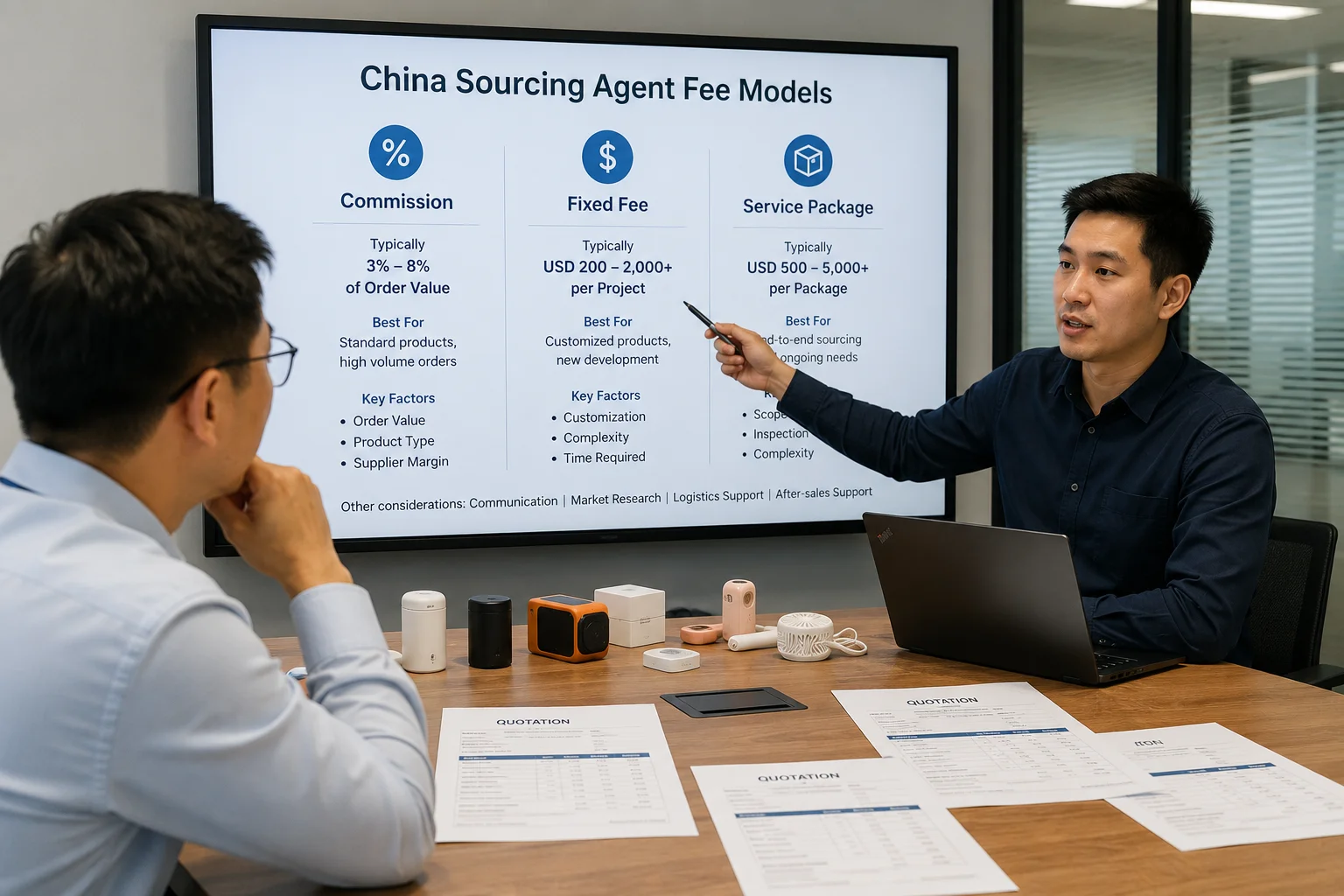
Each model fits a different type of work
I see commission fees used often because they are easy to understand. The agent charges a percentage based on product value or order value. This can work when the order is clear and the service scope is defined. But I also see fixed fees used for product research, supplier audits, sample projects, or short-term tasks. These can work when the buyer wants one clear job done. Service packages can work when the buyer needs a set of services across sourcing, QC, warehousing, and shipping.
No model is always best. I judge the model by how well it matches the workload.
| Fee model | I usually see it fit | Main risk to check |
|---|---|---|
| Commission | Ongoing orders or clear product buying | The included work must be written |
| Fixed fee | Supplier search, audit, sample project | Extra work may cost more |
| Service package | Buyers needing full supply chain support | Package limits must be clear |
| Hybrid model | Custom products or mixed order types | Both fixed and variable parts must be explained |
For example, if I handle a small test order with many SKUs, the work may be high even though the order value is low. A pure percentage may not cover enough labor. If I handle a repeat order with stable suppliers, a commission model may be simple. If I handle a new custom product, a stage-based model can make sense because sourcing, sampling, and production each need separate control.
4. What Services Are Usually Included in a Sourcing Agent Fee?
Many buyers assume all sourcing agent fees include everything. I see this assumption cause disputes when the order starts moving.
A sourcing agent fee may include supplier search, quote comparison, sample coordination, production follow-up, quality inspection support, packaging checks, warehouse handling, and logistics coordination. I always ask for a written list of included and excluded services[^4] before I compare prices.

I check the work list before I check the rate
I like to break the service into stages. This makes the fee easier to judge. In the sourcing stage, I want to know how many suppliers will be checked and what kind of checks will be done. In the sample stage, I want to know who talks to the supplier, who checks sample details, and who gives feedback. In production, I want updates, issue tracking, and deadline control. Before shipment, I want QC, packaging checks, and shipping coordination.
If the fee is low but the agent does not manage these steps, the buyer may still need to pay later through delays, rework, or poor product quality.
| Stage | Work I expect to clarify | Common question I ask |
|---|---|---|
| Sourcing | Supplier search, quote comparison, basic checks | How many supplier options will I get? |
| Sampling | Sample order, photos, feedback, revision follow-up | Who checks if the sample matches my request? |
| Production | Deposit follow-up, production updates, issue handling | How often will I receive updates? |
| QC | Inspection, defect report, packaging check | Is inspection included or billed separately? |
| Logistics | Warehouse, consolidation, shipping help | Who controls shipment timing and documents? |
I do not expect every agent to include every service in one basic fee. But I do expect the scope to be clear. A transparent agent should say what is included, what is not included, and when extra charges apply. This protects both sides.
5. How to Compare Sourcing Agent Fees Without Ignoring Hidden Costs?
Many buyers choose the cheapest fee and later pay in other ways. I see hidden costs appear when duties are unclear.
I compare sourcing agent fees by total cost and execution responsibility. I check included services, excluded services, extra charges, QC support, supplier screening, warehouse handling, communication load, and logistics control before I judge whether a fee is fair.
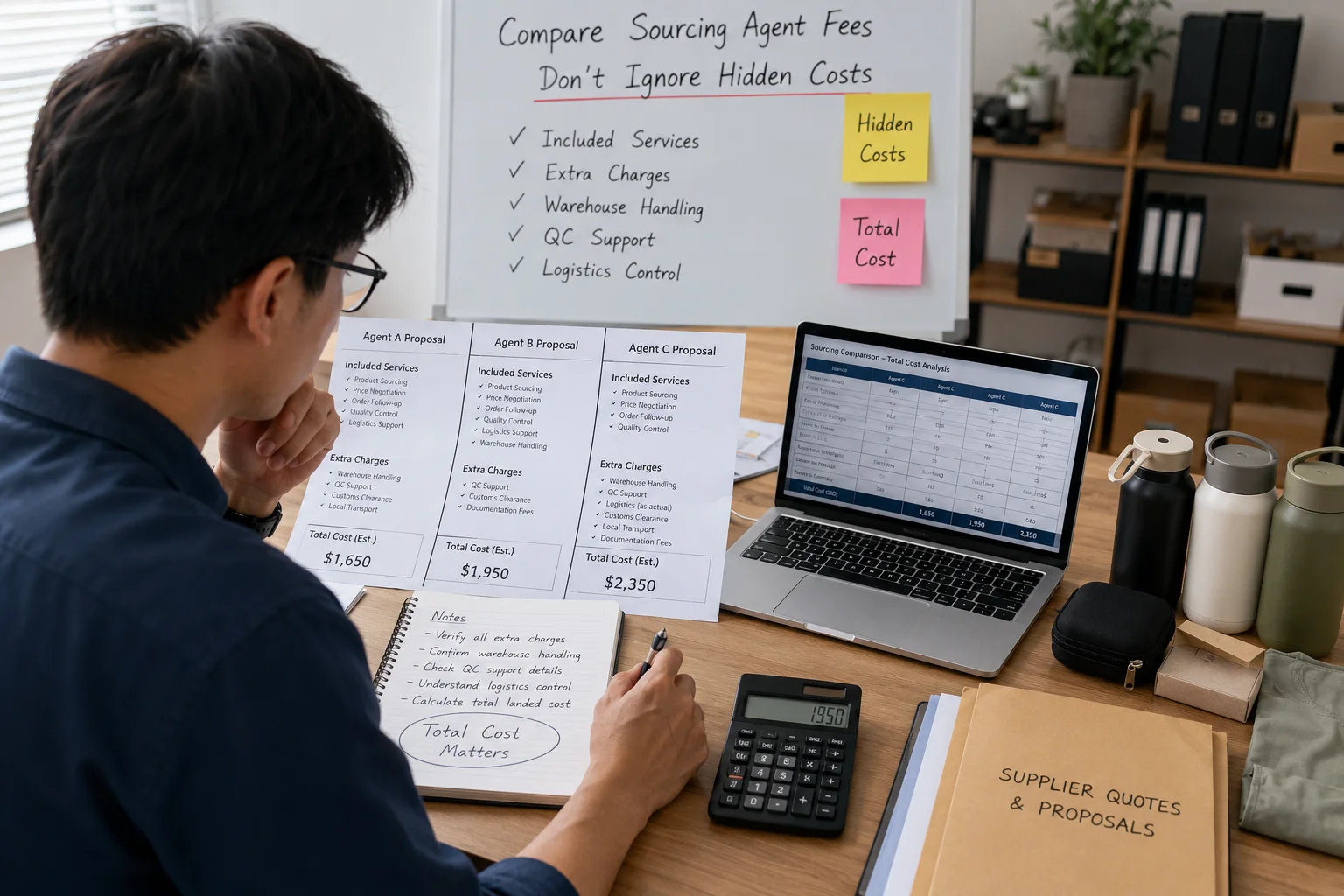
Hidden cost is often a missing task
I do not see hidden cost only as a secret charge. I also see hidden cost as work that nobody controls. If no one checks the supplier carefully, the buyer may face wrong specs.[^5] If no one follows production, the buyer may face late delivery. If no one checks packaging, the buyer may face damaged goods or bad customer reviews.[^6] If no one compares freight options, the buyer may pay more shipping than needed.[^7]
So I compare agent fees with a simple checklist.
| Cost area | Low visible fee may miss | Possible real cost |
|---|---|---|
| Supplier screening | Factory ability, response quality, trading layer | Wrong supplier choice |
| Quote checking | Spec details, packaging, MOQ, shipping terms | Unfair price comparison |
| Sample follow-up | Revision control, photos, detail checks | More sample rounds |
| Production tracking | Lead time, material status, issue alerts | Late shipment |
| QC | Defect check, size check, function check | Returns and complaints |
| Logistics | Consolidation, documents, freight choice | Higher landed cost |
I also ask when the agent charges extra fees. Some extra charges are fair. For example, factory audits, detailed inspections, product photography, repacking, or long-term storage may need extra labor. The issue is not the extra charge itself. The issue is whether I know it before I start. I trust a quote more when it shows the base service, possible add-ons, and the reason for each charge.
6. How Low-MOQ Negotiation, Quote Comparison, and QC Affect Your Real Cost?
Many small sellers focus on MOQ and unit price. I see real cost change when negotiation and QC are handled well.
Low-MOQ negotiation, quote comparison, and quality control affect real cost because they change cash risk, defect risk, and reorder speed. I do not only look for the lowest unit price. I look for a workable supplier, clear specs, and stable production control.
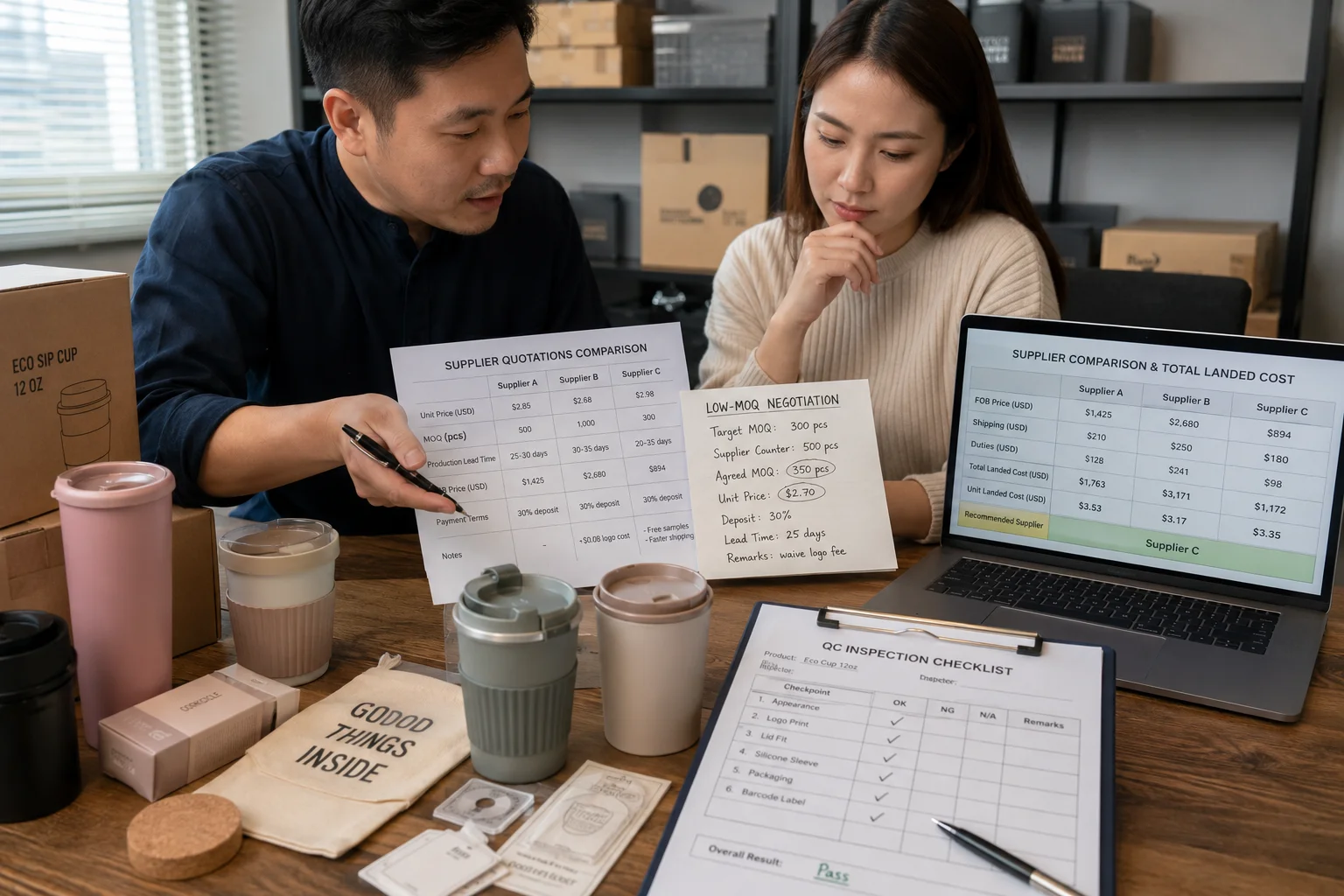
Low MOQ can save cash but still needs control
I work with many buyers who want to test products with smaller budgets. Low-MOQ negotiation can be useful because it lets the buyer test demand before ordering too much stock.[^8] But low MOQ is not always simple. Some suppliers raise the unit price. Some suppliers reduce packaging options. Some suppliers accept low MOQ but give less production priority.
Quote comparison is also more than picking the lowest price.[^9] I need to compare the same spec, same material, same packaging, same incoterm, same sample rule, and same lead time. If not, the quote comparison is not fair.
| Cost factor | What I check | Why it changes real cost |
|---|---|---|
| MOQ | Minimum order, color MOQ, packaging MOQ | It affects cash tied in stock |
| Quote | Material, size, packaging, terms | It affects true price comparison |
| Sample | Cost, time, revision rule | It affects speed before production |
| QC | Defect level, inspection method, fix plan | It affects returns and rework |
| Supplier priority | Lead time and order position | It affects launch timing |
QC matters because the cheapest order can become expensive after delivery. If defects are found before shipment, I still have options.[^10] I can ask for repair, replacement, sorting, or discount discussion. If defects are found after the goods arrive overseas, the options become harder and more costly.[^11] This is why I see QC as cost control, not only quality control.
7. Payment Risk, Deposit Control, and Order Management: What Are You Really Paying For?
Many buyers think they only pay for finding suppliers. I see a larger value in payment control and order follow-up.
When I pay a sourcing agent fee, I am often paying for risk control. This includes deposit tracking, supplier communication, production schedule follow-up, document checking, issue handling, balance payment control, and shipment coordination before goods leave China.
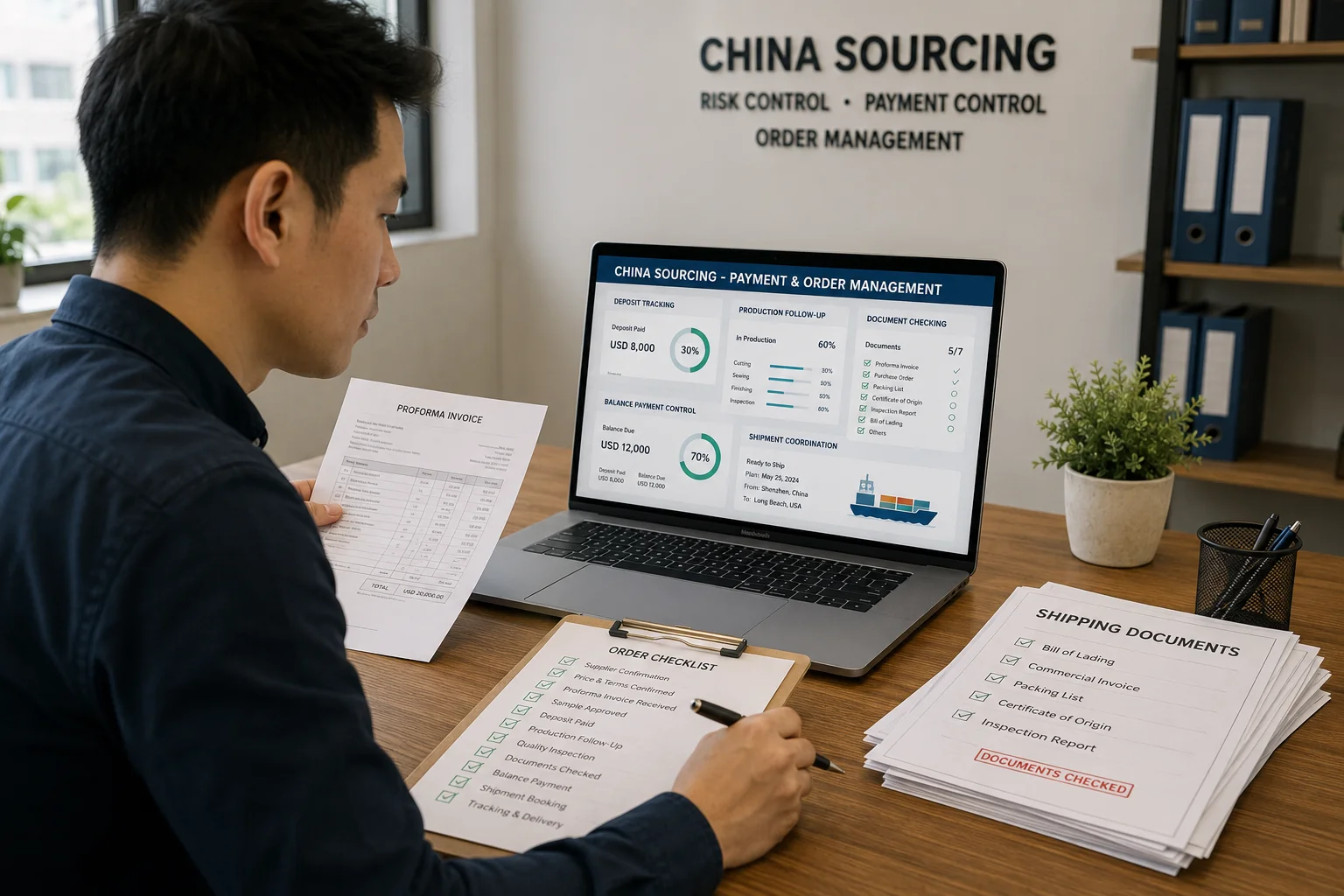
Money control matters after the supplier is chosen
Supplier sourcing is only the first part. After the buyer pays a deposit, the risk becomes more real.[^12] The supplier has money, the goods are not finished, and the buyer may be far away. I see many buyers need help at this point because they do not have a local person to push production, check progress, and ask the right questions.
A sourcing agent cannot remove all risk. But good order management can reduce blind spots. I want to know whether materials are purchased, whether production has started, whether the finish date is realistic, whether the packaging is ready, and whether inspection can happen before balance payment.
| Order control point | What I want managed | Risk reduced |
|---|---|---|
| Deposit | Payment record and order confirmation | Wrong start or unclear terms |
| Production schedule | Start date, finish date, delay alerts | Missed shipping window |
| Spec control | Product details, logo, packaging files | Wrong goods |
| Balance payment | QC result before final payment when possible | Weak leverage after payment |
| Documents | Invoice, packing list, shipping details | Customs and delivery problems |
I see this as one of the most important parts of a sourcing fee. The buyer is not only paying for communication. The buyer is paying for local pressure, order visibility, and practical follow-up. This work is not exciting, but it often protects the order more than the first supplier list.
8. How to Choose a China Sourcing Agent with Transparent Fees and Reliable Service?
Many buyers want a simple answer, but I see the best choice depends on order needs and service clarity.
I choose a China sourcing agent by checking fee transparency, service scope, supplier control, QC process, communication habits, logistics support, and how clearly the agent explains extra charges. A reliable agent should help me understand both cost and risk before I pay.
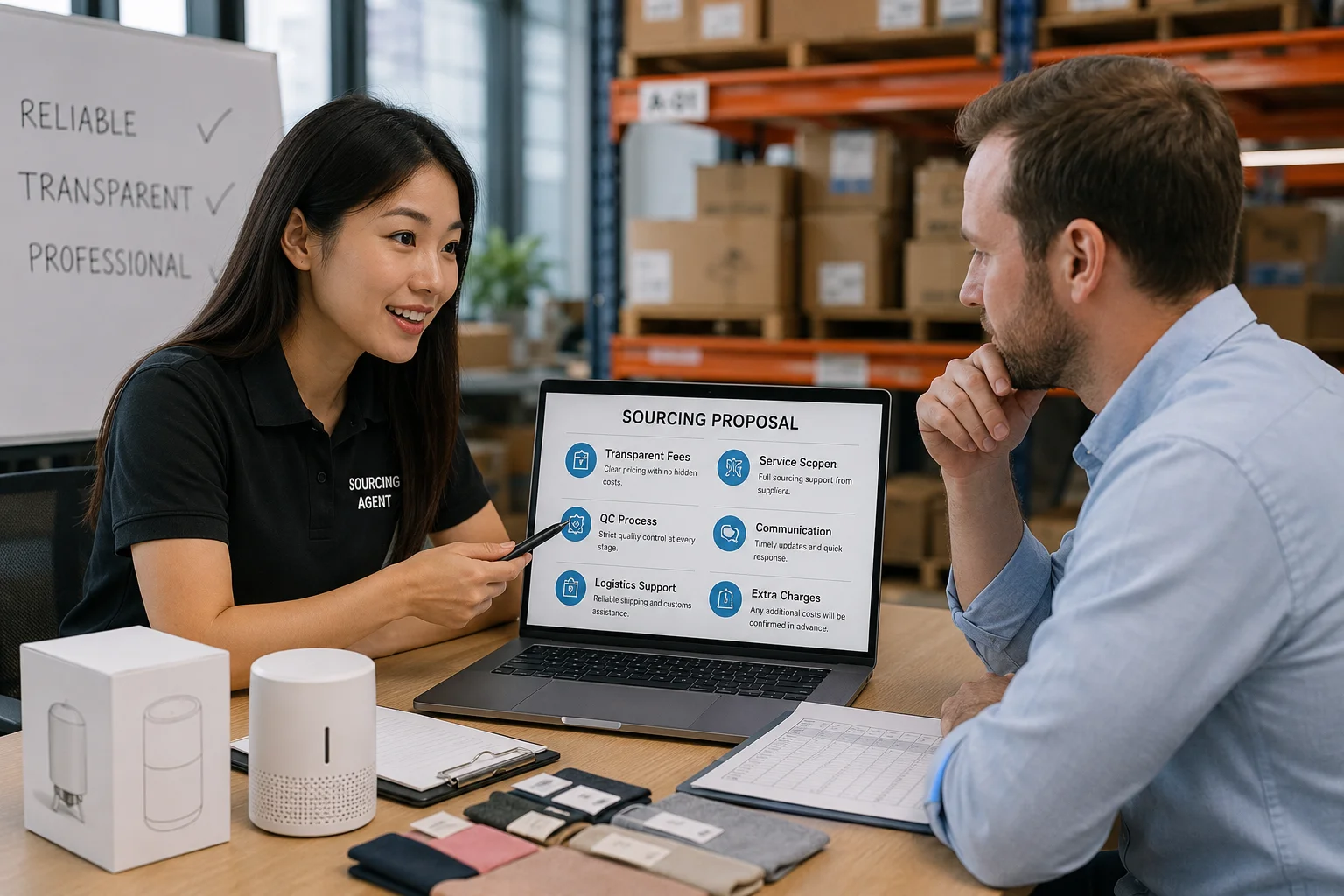
I look for clear responsibility before I look for the lowest rate
When I review a sourcing agent quote, I do not start with the percentage. I first ask what problem the agent will solve for me. If I need only a supplier introduction, I should not pay for a full supply chain package. If I need sourcing, samples, customization, QC, warehousing, and shipping, I should not expect a very small fee to cover all of that work.
I also look at how the agent answers questions. A good answer is not vague. It should explain the process, the service boundary, and the buyer’s responsibility. I prefer an agent who tells me what is not included because this helps me plan the real budget.
| Question I ask | Good sign | Warning sign |
|---|---|---|
| What is included? | A clear service list | Only a low percentage |
| What is excluded? | Clear add-on items | “Everything included” with no detail |
| How do you screen suppliers? | Practical steps explained | Only says “trusted factories” |
| How do you handle QC? | Inspection scope and report method | No clear process |
| How do you manage shipping? | Options and document support | Supplier handles everything alone |
| When do extra fees apply? | Rules are explained early | Fees appear after work starts |
I believe a fair sourcing fee should make the order easier to manage. It should also make the risk easier to see. I do not need the cheapest agent. I need the right level of service for the order I am placing.
Conclusion
I judge China sourcing agent fees by service scope, risk control, and total cost, not by the lowest rate alone.
[^1]: "[PDF] Cybersecurity Supply Chain Risk Management Practices for ...", https://nvlpubs.nist.gov/nistpubs/SpecialPublications/NIST.SP.800-161r1.pdf. The cost-of-quality framework distinguishes prevention and appraisal costs from internal and external failure costs, supporting the mechanism that omitted supplier checks or inspections can shift costs to later rework, returns, or logistics problems; the framework is general quality-management evidence rather than sourcing-agent-specific proof. Evidence role: mechanism; source type: institution. Supports: A quality-management source should explain that prevention and appraisal activities can reduce later internal or external failure costs.. Scope note: Contextual support only; it explains the cost mechanism but does not quantify savings from a particular sourcing agent. [^2]: "[PDF] The Coffee Guide - International Trade Centre", https://www.intracen.org/file/itccoffee4threport20210930webpagespdf. The International Trade Centre describes procurement as a multi-step function involving supplier identification, quotation evaluation, contract or order management, quality requirements, and delivery coordination; this supports the listed activities as recognized procurement functions, although it does not prove that every China sourcing-agent fee includes all of them. Evidence role: general_support; source type: institution. Supports: A neutral procurement source should support that sourcing work can include supplier identification, quotation evaluation, quality requirements, order coordination, and delivery or logistics activities.. Scope note: Contextual support only; the source would substantiate the procurement functions, not the pricing practices of every China sourcing agent. [^3]: "[PDF] Transaction Cost Economics* - Meet the Berkeley-Haas Faculty", https://faculty.haas.berkeley.edu/stadelis/tce_org_handbook_111410.pdf. Transaction-cost and procurement-complexity research links customization, asset specificity, uncertainty, supplier evaluation, and monitoring intensity with higher governance effort, supporting the claim that these factors can affect sourcing-service fees; the evidence is theoretical and cross-industry rather than specific to China sourcing agents. Evidence role: mechanism; source type: paper. Supports: Research on transaction costs or procurement complexity should support that customization, uncertainty, supplier evaluation, and monitoring needs increase governance effort and service cost.. Scope note: Contextual support only; it supports why these factors affect workload, not a specific fee schedule. [^4]: "[PDF] design statement of work template | gsa", https://buy.gsa.gov/api/system/files/documents/furniture-design-statement-worktemplate.pdf. Government contracting guidance on statements of work treats defined tasks, deliverables, responsibilities, and scope boundaries as core elements of service procurement, supporting the practice of documenting included and excluded services before price comparison; the guidance is general contracting evidence, not specific to sourcing agents. Evidence role: expert_consensus; source type: government. Supports: A government contracting source should support that a statement of work or service scope should define tasks, deliverables, responsibilities, and boundaries.. Scope note: Contextual support only; it validates scope documentation as a contracting practice. [^5]: "SP 800-161 Rev. 1, Cybersecurity Supply Chain Risk Management ...", https://csrc.nist.gov/pubs/sp/800/161/r1/final. ISO 9001 requires organizations to evaluate and control external providers so that externally provided products and services conform to specified requirements, supporting the link between supplier checks and reduced specification errors; the standard establishes a management requirement rather than measuring the probability of wrong specifications. Evidence role: mechanism; source type: institution. Supports: A quality-management standard or institutional guide should support that organizations evaluate and control external providers to ensure products meet specified requirements.. Scope note: Contextual support only; it supports the quality-control rationale, not a specific defect rate. [^6]: "Package performance tests", https://www.canr.msu.edu/packaging/learn-collaborate/testing_services/package_performance_tests. Packaging-testing standards such as ISTA procedures evaluate whether packaged products can withstand distribution hazards including shock, vibration, compression, and handling, supporting the claim that unchecked packaging can increase damage risk; the standards do not directly measure customer-review outcomes. Evidence role: mechanism; source type: institution. Supports: Packaging-testing standards should support that packages are evaluated against distribution hazards such as shock, vibration, compression, and handling risks.. Scope note: Contextual support only; it supports the damage-prevention mechanism, not the customer-review consequence. [^7]: "International transport costs: Why and how to measure them?", https://blogs.worldbank.org/en/transport/international-transport-costs-why-and-how-measure-them. International logistics guidance shows that freight costs depend on transport mode, route, shipment size, consolidation, and service level, supporting the claim that comparing freight options can affect shipping expense; this does not prove that every comparison will find a cheaper option. Evidence role: mechanism; source type: institution. Supports: A logistics source should support that freight costs vary according to transport mode, route, shipment size, consolidation, and service requirements.. Scope note: Contextual support only; it explains why comparison can matter but not the savings in any individual shipment. [^8]: "Economic order quantity - Wikipedia", https://en.wikipedia.org/wiki/Economic_order_quantity. Inventory-management literature explains that larger lot sizes increase inventory holding costs and capital commitment, especially when demand is uncertain, supporting the claim that lower order quantities can help test demand before committing to larger stock; it does not directly evaluate MOQ negotiation in China sourcing. Evidence role: mechanism; source type: education. Supports: An inventory-management source should support that larger order quantities tie up capital and increase holding or obsolescence risk under uncertain demand.. Scope note: Contextual support only; it supports the inventory-risk logic, not the negotiation outcome. [^9]: "(PDF) Total Cost Of Ownership - Academia.edu", https://www.academia.edu/25629804/Total_Cost_Of_Ownership. Total-cost-of-ownership research in procurement argues that supplier selection should account for acquisition, quality, logistics, service, and transaction costs in addition to purchase price, supporting the claim that quote comparison is more than choosing the lowest unit price; the evidence is general procurement research, not a China-specific pricing rule. Evidence role: expert_consensus; source type: paper. Supports: Procurement research should support that supplier selection and quote evaluation should consider total cost of ownership, not only purchase price.. Scope note: Contextual support only; it supports the evaluation principle rather than a specific quote-comparison checklist. [^10]: "[PDF] ISO 2859-1 - UNT Chemistry", https://chemistry.unt.edu/~tgolden/courses/iso2859-1.pdf. Acceptance-sampling and pre-shipment inspection frameworks are designed to identify nonconforming goods before lot acceptance or shipment, supporting the claim that defects discovered before shipment can be addressed while the goods are still under supplier control; the standards do not guarantee that a supplier will accept any particular remedy. Evidence role: mechanism; source type: institution. Supports: A quality-control or acceptance-sampling source should support that inspection before lot acceptance or shipment identifies nonconforming goods before release.. Scope note: Contextual support only; it supports timing and control logic, not contractual enforceability of remedies. [^11]: "The Cost of Quality: Calculate & Reduce Hidden Costs - QT9 Software", https://qt9software.com/blog/cost-of-quality. Cost-of-quality models distinguish internal failure costs found before delivery from external failure costs found after delivery, including returns, warranty claims, complaint handling, and replacement costs, supporting the claim that overseas post-delivery defects are harder and costlier to resolve; the model does not quantify costs for a particular product or shipment. Evidence role: mechanism; source type: institution. Supports: A cost-of-quality source should support that external failures discovered after delivery can add return, warranty, complaint, replacement, and reputation costs.. Scope note: Contextual support only; it supports the general cost pattern, not a product-specific estimate. [^12]: "Trade Finance Guide - International Trade Administration", https://www.trade.gov/report/trade-finance-guide. The U.S. International Trade Administration explains that cash-in-advance payment terms place more risk on the importer because payment is made before goods are received, supporting the claim that risk increases after a deposit is paid; the exact level of risk depends on the contract, payment method, and supplier reliability. Evidence role: expert_consensus; source type: government. Supports: A government trade-finance source should support that advance payment or deposits shift risk toward the importer because funds are paid before goods are received.. Scope note: Direct support for the payment-risk principle, with transaction-specific variation.