Shipping products from China can feel complicated when you are comparing freight rates, customs rules, delivery promises, and supplier deadlines. A cheap quote can quickly become expensive if it excludes taxes, destination fees, or proper handling. We help buyers simplify the process by matching the shipping plan to their cargo, budget, and delivery needs.
Shipping products from China involves preparing the goods, choosing a transport method, completing export and import documents, clearing customs, and arranging final delivery.[^1] The best option depends on your product type, shipment size, chargeable weight, destination, urgency, and who is responsible for duties and taxes.[^2] Always compare the total landed cost—not only the freight rate—before booking.
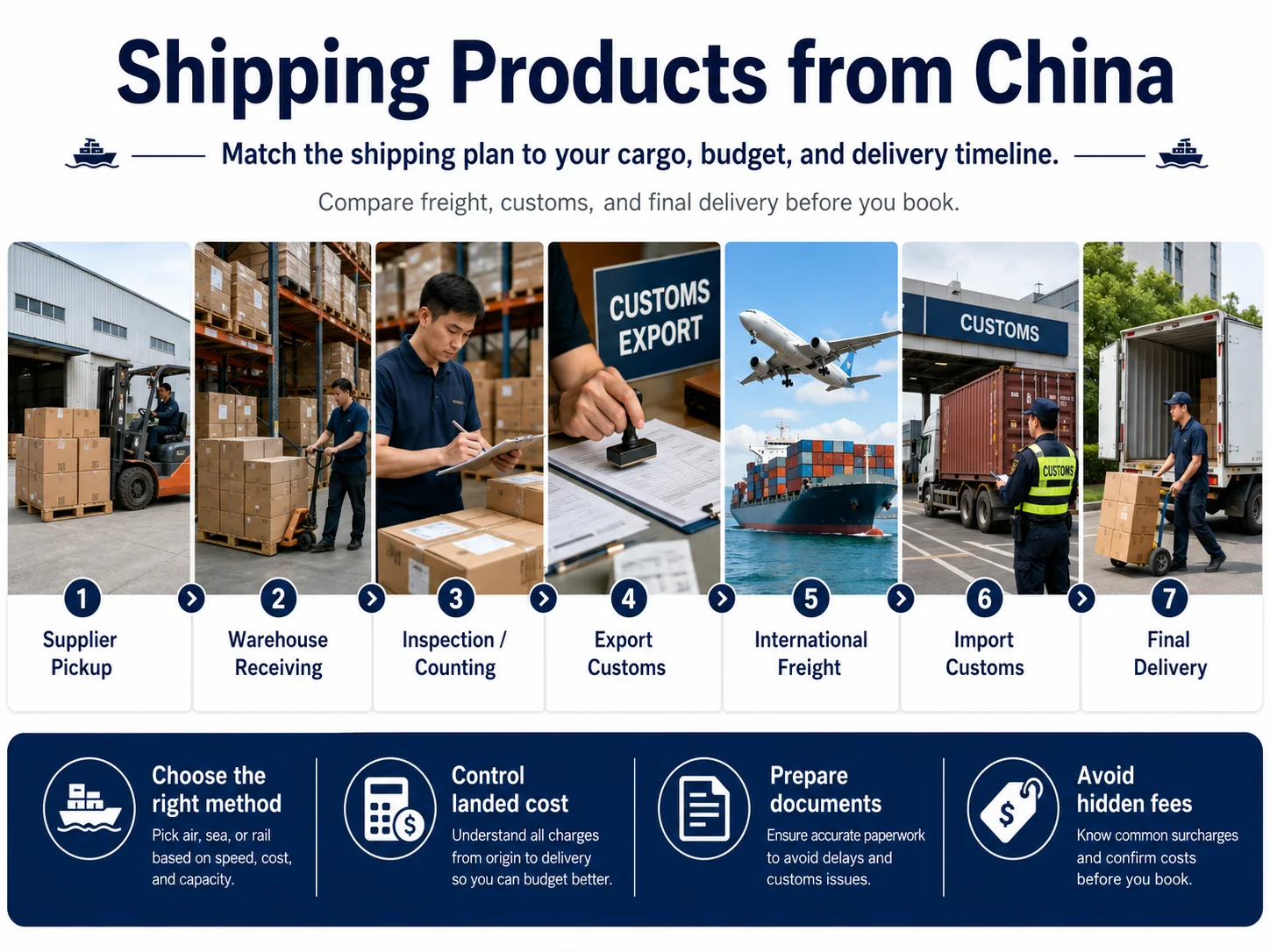
The route from a Chinese factory to your warehouse or customer is not one single service. It is a chain of decisions. Below, we explain how we assess shipments, compare quotes, consolidate cargo, and reduce avoidable surprises for importers.
Quick Answer: What Is the Best Way to Ship Products from China?
Many first-time buyers ask for the “cheapest” way to ship, but that question misses important details. A low freight rate may come with slow delivery, high destination charges, or customs responsibilities that were never clearly explained.
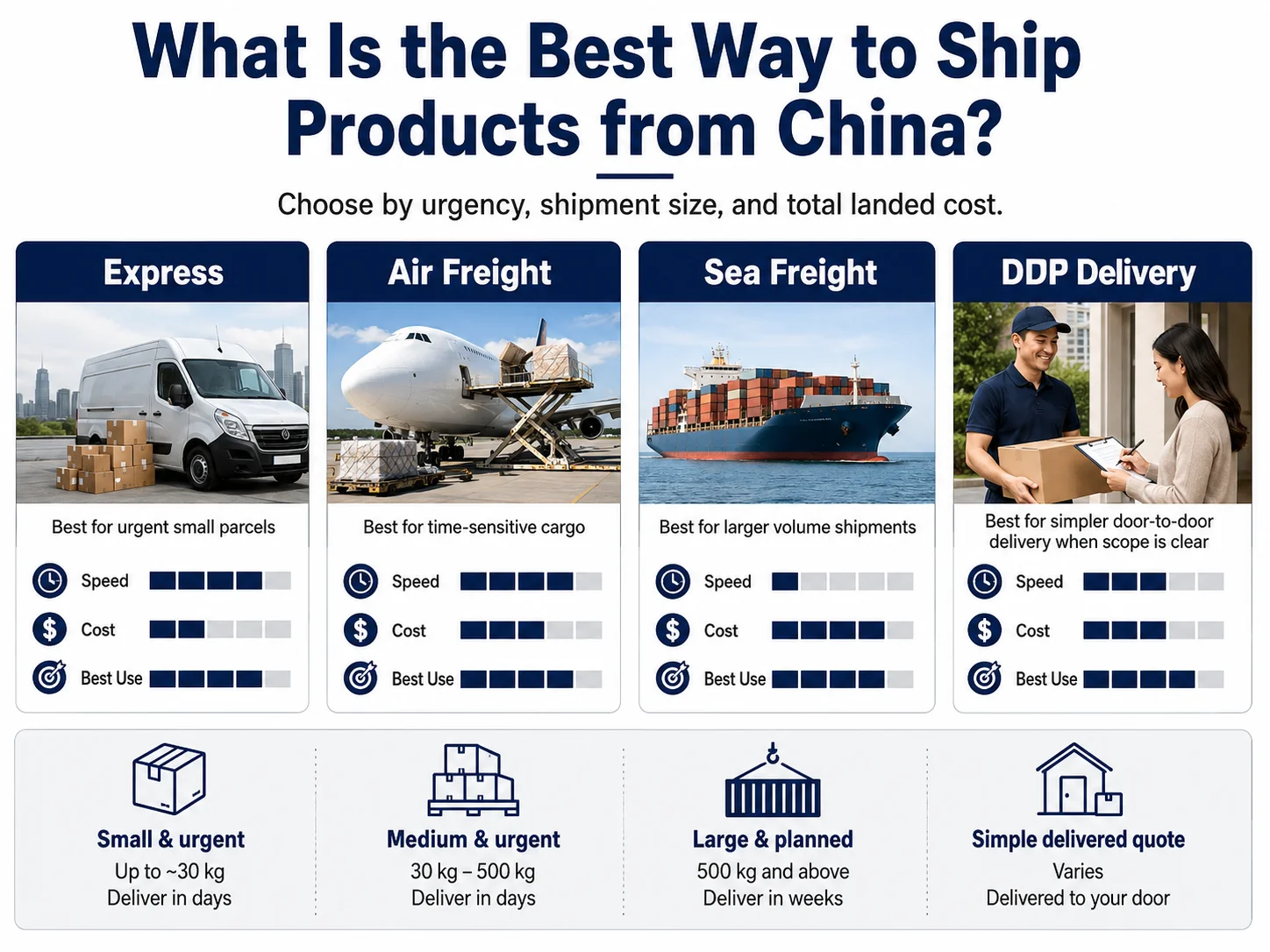
The best way to ship products from China is the method that delivers your goods within your required timeline at the lowest predictable landed cost. Express suits urgent small parcels, air freight suits time-sensitive cargo, sea freight often suits larger volumes[^3], and DDP can simplify delivery when its scope is clearly confirmed.
When we review a shipment, we first ask about the actual cargo—not just the number of cartons. Two orders with the same weight can have very different freight costs if one shipment has large, lightweight packaging.
Start With a Shipment Profile
Before requesting quotes, prepare these details:
- Product name and intended use
- Quantity, carton count, carton dimensions, and gross weight
- Total cargo value
- Pickup city or factory address in China
- Destination country, city, and postal code
- Required delivery date
- Whether batteries, liquids, magnets, food-contact materials, or branded goods are involved
- Whether you need port-to-port, airport-to-airport, or door-to-door service
- Whether you can act as the importer of record
We have seen buyers spend days comparing freight quotes that were never comparable. One quote may include delivery, while another ends at the destination port. One may use actual weight, while another uses volumetric weight. The right comparison starts with the same shipment profile and the same delivery scope.
A freight quote is only useful when you know exactly what it includes, excludes, and who handles customs responsibility.
How Does Shipping Products from China Work?
It is easy to focus only on the international transport leg. However, shipping products from China starts before a carton reaches an airport or seaport. Weak coordination at the factory stage can cause delays, missing cartons, damaged packaging, or incomplete export documents.
Shipping products from China normally follows this sequence: supplier pickup, warehouse receiving, inspection or counting, consolidation, export customs declaration, international transport, destination customs clearance, and local delivery. Each stage needs clear ownership and accurate documents.
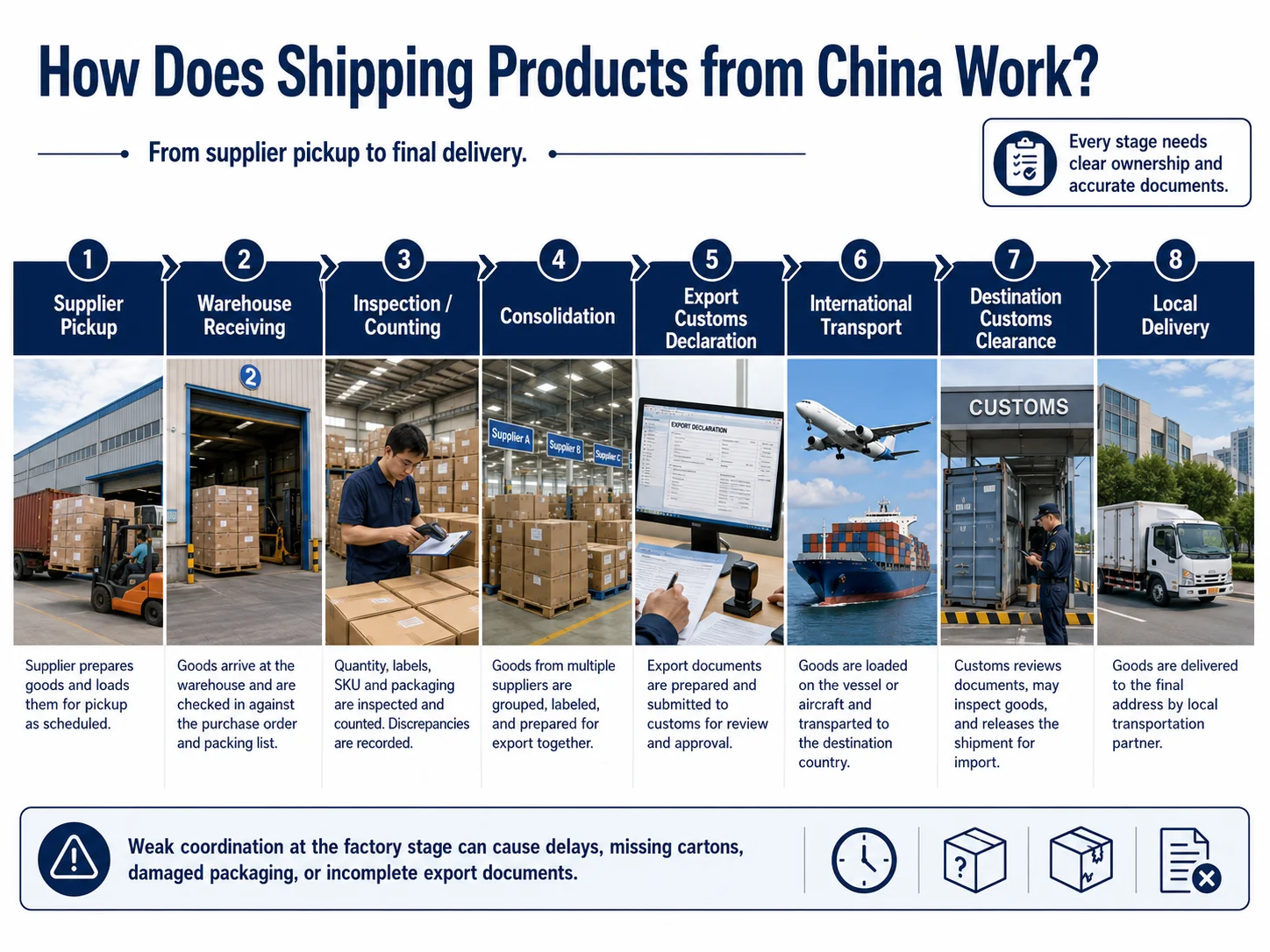
We coordinate this workflow as a practical supply-chain process, not simply as a freight booking.
A Typical China Shipping Workflow
- Supplier confirms goods are ready. We verify carton counts, dimensions, and pickup details before collection.
- Cargo is picked up or delivered to a warehouse. Multiple suppliers can send goods to one receiving location.
- Warehouse receiving takes place. Cartons are counted, labels are checked, and visible damage can be recorded.
- Inspection and repacking are completed if needed. This may include product checks, barcode labels, bundle assembly, or carton reinforcement.
- Cargo is consolidated. We combine compatible goods to reduce duplicated shipment costs.
- Export declaration is arranged. China export paperwork must match the products and shipment details.
- International freight departs. The cargo moves by courier, air, sea, rail, or truck, depending on the route.
- Import clearance takes place. Customs authorities may review documents, product classification, declared value, certifications, and tax obligations.
- Final-mile delivery is arranged. The shipment reaches your warehouse, fulfillment center, office, or other delivery address.
In our experience, the biggest preventable issues happen before departure. For example, a supplier may quote a carton size before final packing, then use cartons that are much larger. That can increase chargeable weight on air shipments. We therefore recommend checking final carton dimensions before approving the freight method.
Comparison Table: Which Shipping Method From China Fits Your Order?
Choosing between freight methods can feel overwhelming because every provider presents a different strength. Some focus on speed. Others focus on a low headline rate. The problem is that your business may need reliability more than either one.
Shipping methods from China differ mainly in speed, cost structure, shipment-size suitability, and customs responsibility. Express is practical for urgent small cargo, air freight works for medium time-sensitive orders, sea freight often fits larger shipments, and DDP may offer a simpler delivery structure when properly defined.
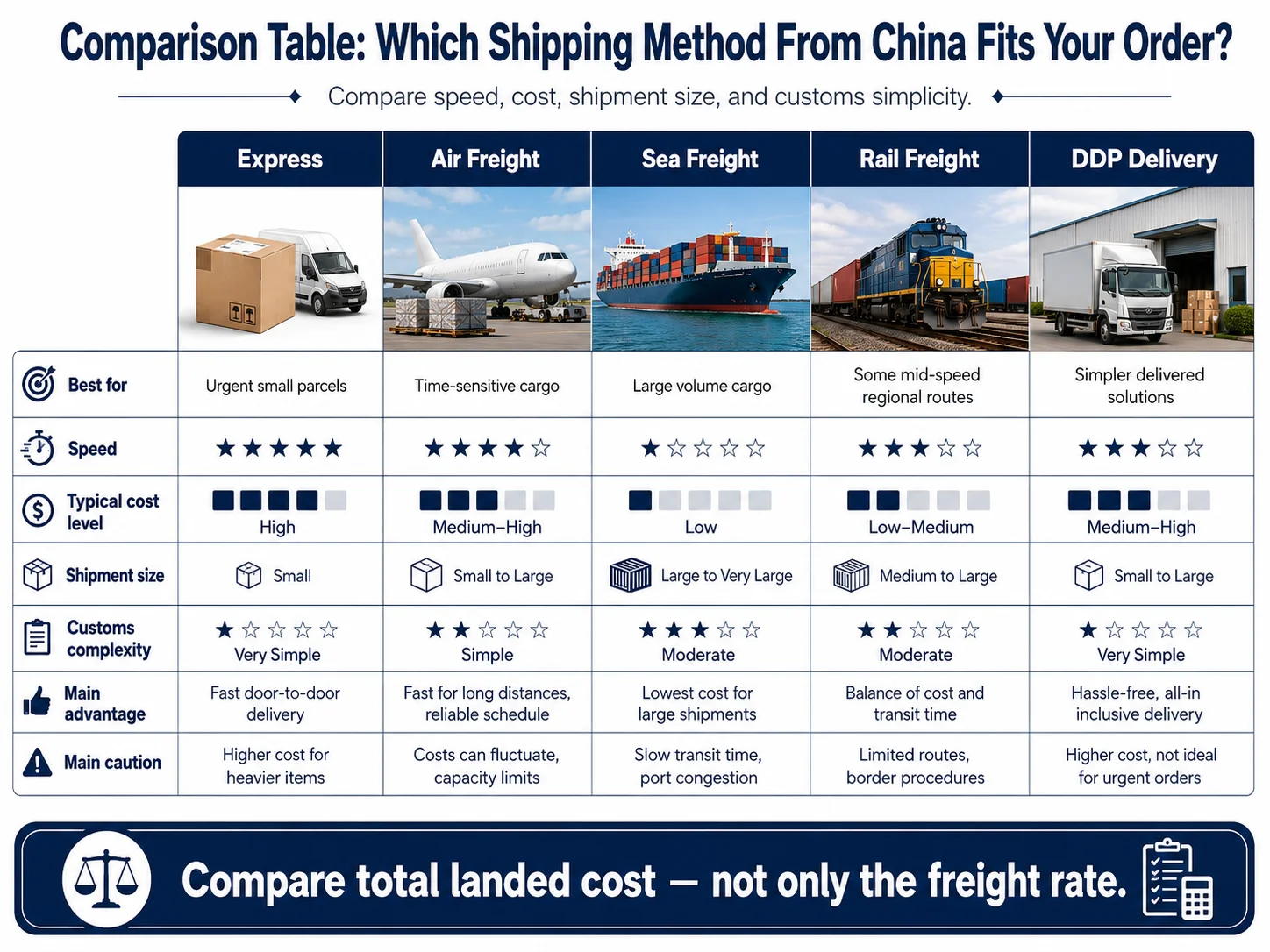
The following table gives a general planning framework. Actual rates and transit times vary by destination, season, carrier capacity, cargo type, route, and local customs conditions.
| Shipping method | Typical shipment fit | Relative cost | Relative speed | Best use case |
|---|---|---|---|---|
| Express courier | Small parcels and samples | High | Fast | Urgent samples, small replenishment orders |
| Air freight | Medium-weight cargo | Medium to high | Fast | Time-sensitive inventory and higher-value goods |
| Sea freight | Larger cartons, pallets, or containers | Often lower per unit at scale | Slow | Bulk orders and planned inventory |
| Rail freight | Selected China-Europe routes | Medium | Medium | Europe-bound cargo with flexible timing |
| Truck freight | Regional cross-border routes | Varies | Medium | Nearby Asian or Eurasian destinations |
| DDP shipping | Door-to-door shipments where available | Varies | Varies | Buyers needing a managed delivery solution |
Important Differences Behind the Table
Express courier usually provides the simplest tracking experience, but it can become expensive when carton volume is high. Couriers often calculate based on volumetric weight for lightweight but bulky goods.[^4]
Air freight may involve airport handling, customs brokerage, and local delivery as separate charges. It is not always door-to-door unless that scope is stated in writing.
Sea freight can be used as LCL (less than container load) or FCL (full container load). LCL allows smaller shipments to share a container, but destination handling charges can affect the final cost. FCL gives more control for large cargo volumes.
DDP shipping means Delivered Duty Paid under Incoterms rules, but in the market, some providers use “DDP” loosely. We always ask who is the importer of record, whether duties and taxes are included, and what happens if customs requests additional documentation.
How Do You Choose the Best Method for Shipping Products from China?
A shipping method that worked for your last order may not work for the next one. Product dimensions change, sales velocity changes, and carrier conditions change. Choosing by habit can hurt your margin or create a stockout.
To choose the best method for shipping products from China, compare chargeable weight, cargo value, product restrictions, delivery deadline, destination, and full landed cost. Use a faster route for urgent inventory and a lower-cost route for planned bulk replenishment when the timing risk is acceptable.
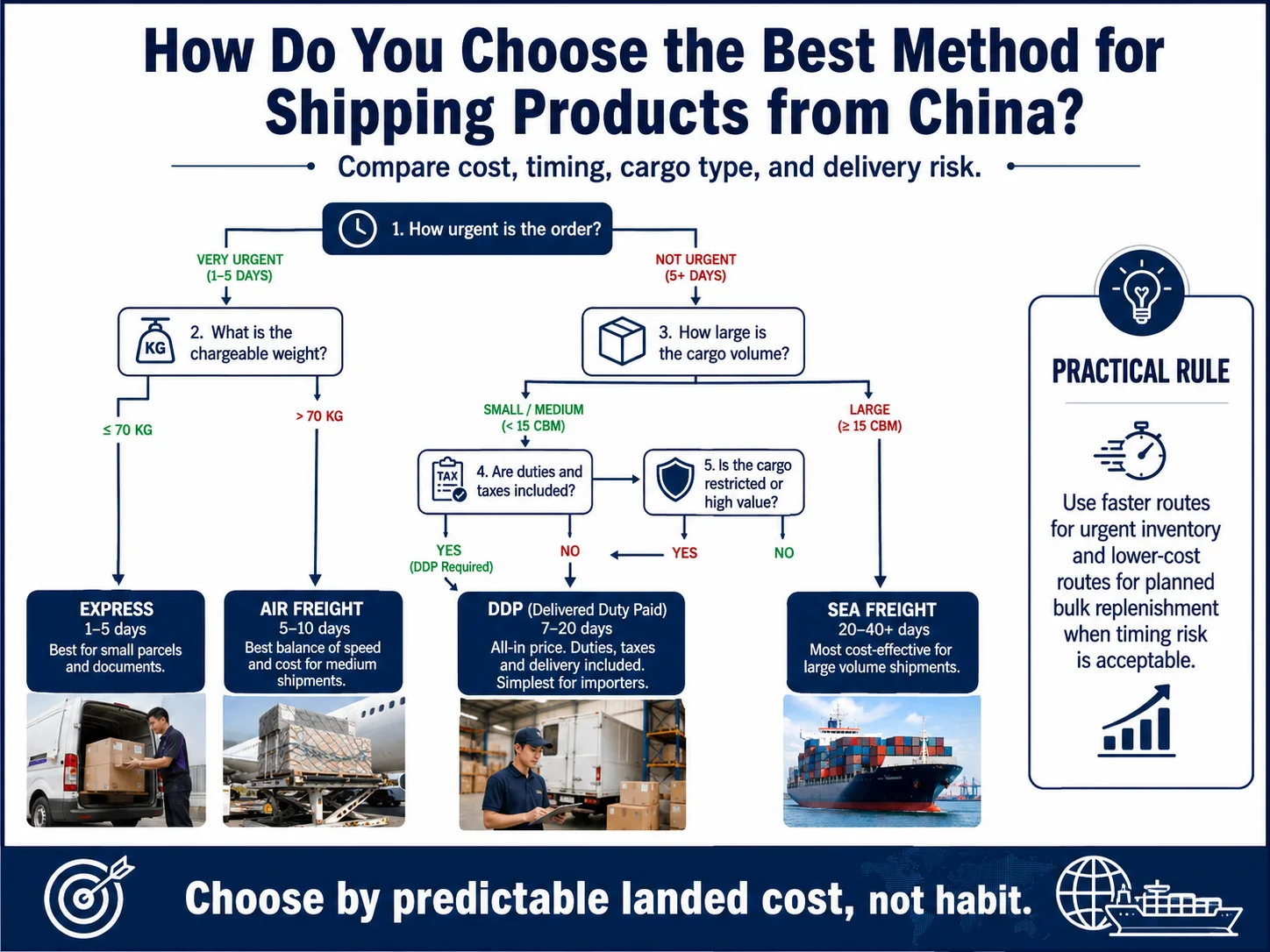
We usually help clients make the decision by separating the commercial problem from the freight problem.
Use These Five Decision Factors
| Factor | What to check | Why it matters |
|---|---|---|
| Weight and volume | Actual weight and carton dimensions | Freight may use chargeable or volumetric weight |
| Product value | Value per carton or per kilogram | High-value goods may justify faster transport or insurance |
| Urgency | Stockout date and launch date | Slow freight can cost more through lost sales |
| Destination | Postal code, local infrastructure, customs rules | Delivery cost and available routes vary widely |
| Product category | Batteries, liquids, cosmetics, electronics, etc. | Restricted goods may need special handling or documents |
Consider Inventory Risk, Not Only Freight Cost
We once worked on an anonymized order where sea shipping looked much cheaper than air. However, the buyer had less than three weeks of stock remaining. A delayed sea route would have created an inventory gap during an active sales period. The buyer chose a split shipment instead: a small air shipment for immediate replenishment and the balance by sea.
That approach is often practical:
- Send a small urgent quantity by express or air.
- Send the main volume by sea or rail.
- Keep enough safety stock to avoid repeated emergency freight.
- Use sales forecasts to plan production and departure dates earlier.
The lowest freight cost per kilogram is not automatically the best business decision. Your goal is to protect cash flow, product availability, customer experience, and margin at the same time.
EXW, FOB, DDU, and DDP Shipping Terms Explained
Trade terms can sound technical, but they affect who pays, who arranges transport, and who carries risk at different stages. When terms are unclear, buyers can receive unexpected bills or discover too late that they must handle import customs themselves.
EXW, FOB, DDU, and DDP define different responsibilities for the supplier and buyer.[^5] EXW gives the buyer the most responsibility, FOB shifts export handling to the supplier, DDU generally leaves import taxes to the buyer, and DDP is intended to include delivery with duties paid by the seller or arranged provider.
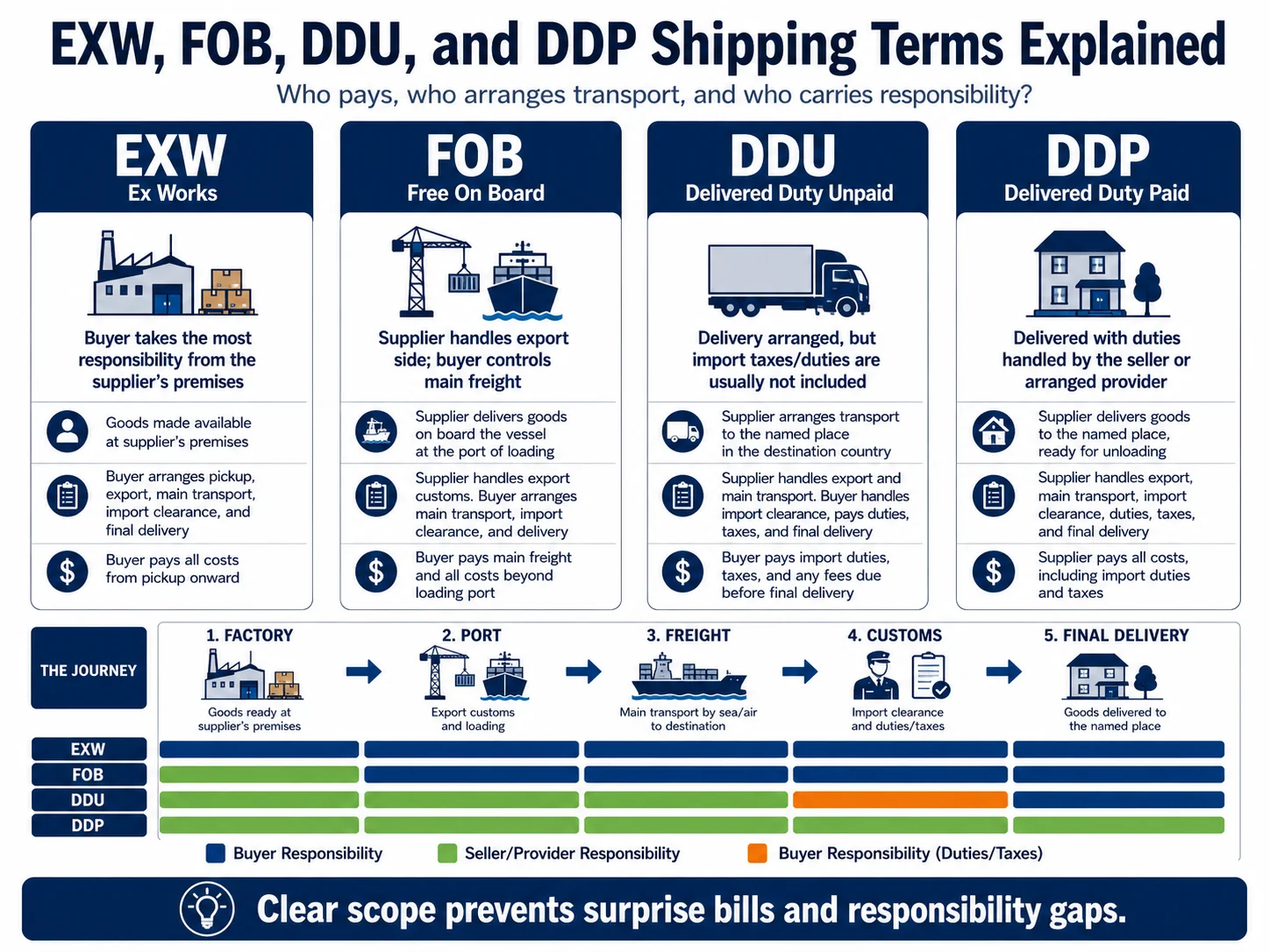
The exact legal and operational details should be confirmed for every order. Incoterms do not replace a clear freight agreement.
A Practical Comparison
| Term | Supplier typically handles | Buyer typically handles | Best for |
|---|---|---|---|
| EXW | Makes goods available at factory | Pickup, export, freight, import, delivery | Experienced buyers with a China-side logistics partner |
| FOB | Export preparation and delivery to port | Main freight, insurance, import, local delivery | Buyers booking their own ocean or air freight |
| DDU / DAP-style delivery | Transport to destination | Import clearance, duties, taxes | Buyers with an import account or broker |
| DDP | Delivery arranged with duties paid scope | Often receives cargo, subject to agreed conditions | Buyers seeking a managed door-to-door option |
Avoid Assumptions About “Door-to-Door”
“Door-to-door” describes where the cargo is collected and delivered. It does not automatically prove that every cost or legal responsibility is included.
Before booking, we recommend asking:
- Is customs clearance included at destination?
- Are import duties and VAT/GST included or excluded?
- Who is listed as the importer of record?
- Are destination inspection fees or storage charges excluded?
- What product documents are required?
- What happens if customs rejects, delays, or reclassifies the cargo?
For early-stage importers, DDP may reduce coordination work. Still, it must be suitable for the product, the country, and the importer’s business model. We do not treat it as a universal solution.
How Do You Calculate Shipping and Landed Cost From China?
Many sellers calculate product cost plus freight and believe they have their final cost. Then customs duties, local delivery, packaging, or destination handling reduce their expected profit. This is one of the most common planning mistakes we see.
The landed cost of shipping products from China includes product cost, China-side transport, international freight, insurance, customs duties, import taxes, clearance charges, storage risks, and final delivery.[^6] Divide the complete amount by sellable units to understand your true cost per product.
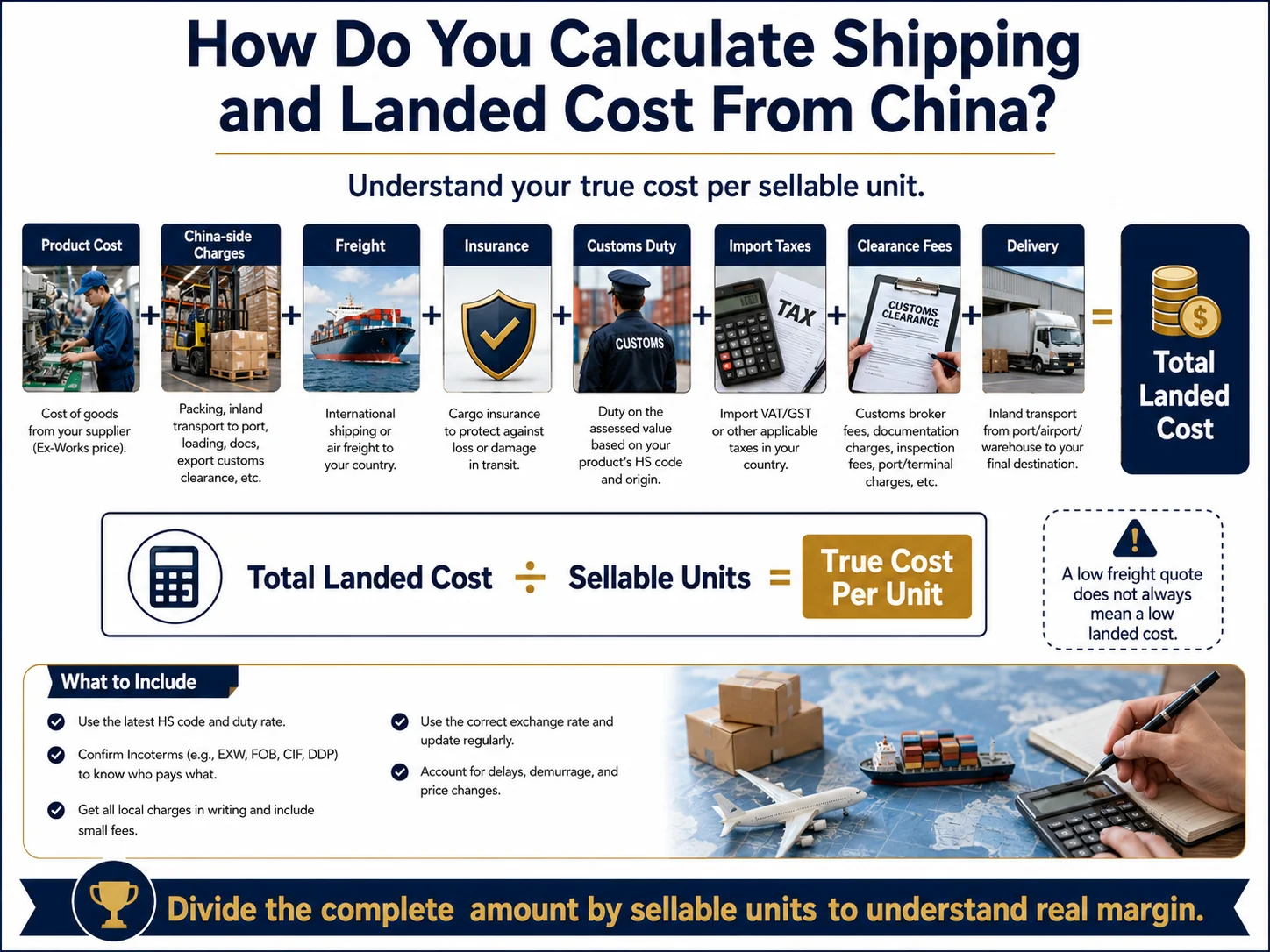
A basic landed-cost formula is:
Landed Cost = Product Cost + China Local Charges + International Freight + Insurance + Duties/Taxes + Customs Clearance + Destination Charges + Final Delivery
Costs to Include in Your Spreadsheet
| Cost category | Examples |
|---|---|
| Product cost | Unit price, mold fees, customization charges |
| China-side costs | Pickup, warehouse receiving, inspection, repacking |
| Freight | Courier, air, sea, rail, truck, fuel or security surcharges |
| Customs costs | Duties, VAT/GST, brokerage, examination charges |
| Destination costs | Port handling, terminal fees, delivery appointment fees |
| Risk costs | Cargo insurance, storage, demurrage, delays, damaged goods |
Watch for Chargeable Weight
Air and express providers often compare actual weight with volumetric weight. They charge the higher figure. A common formula uses carton length × width × height divided by a carrier-specific divisor, but the divisor can vary.
This means a shipment of lightweight plastic products can cost more than expected if the cartons are oversized. We often ask suppliers whether packaging can be optimized safely. Reducing empty space can lower freight costs, but it must not increase damage risk.
We also recommend calculating cost at the SKU and unit level. If a shipment contains several products, allocate freight based on weight, volume, or carton space. This gives you a more accurate view of which products can support their shipping costs.
What Documents Are Needed for Customs Clearance When Shipping Products From China?
Customs delays often happen because paperwork does not match the cargo. A product name that is too vague, an incorrect declared quantity, or missing compliance information can create avoidable questions at the border.
Customs clearance for shipping products from China usually requires a commercial invoice, packing list, transport document, accurate product description, declared value, and any destination-specific certifications.[^7] Requirements vary by product and country, so importers should verify rules before production and shipment.
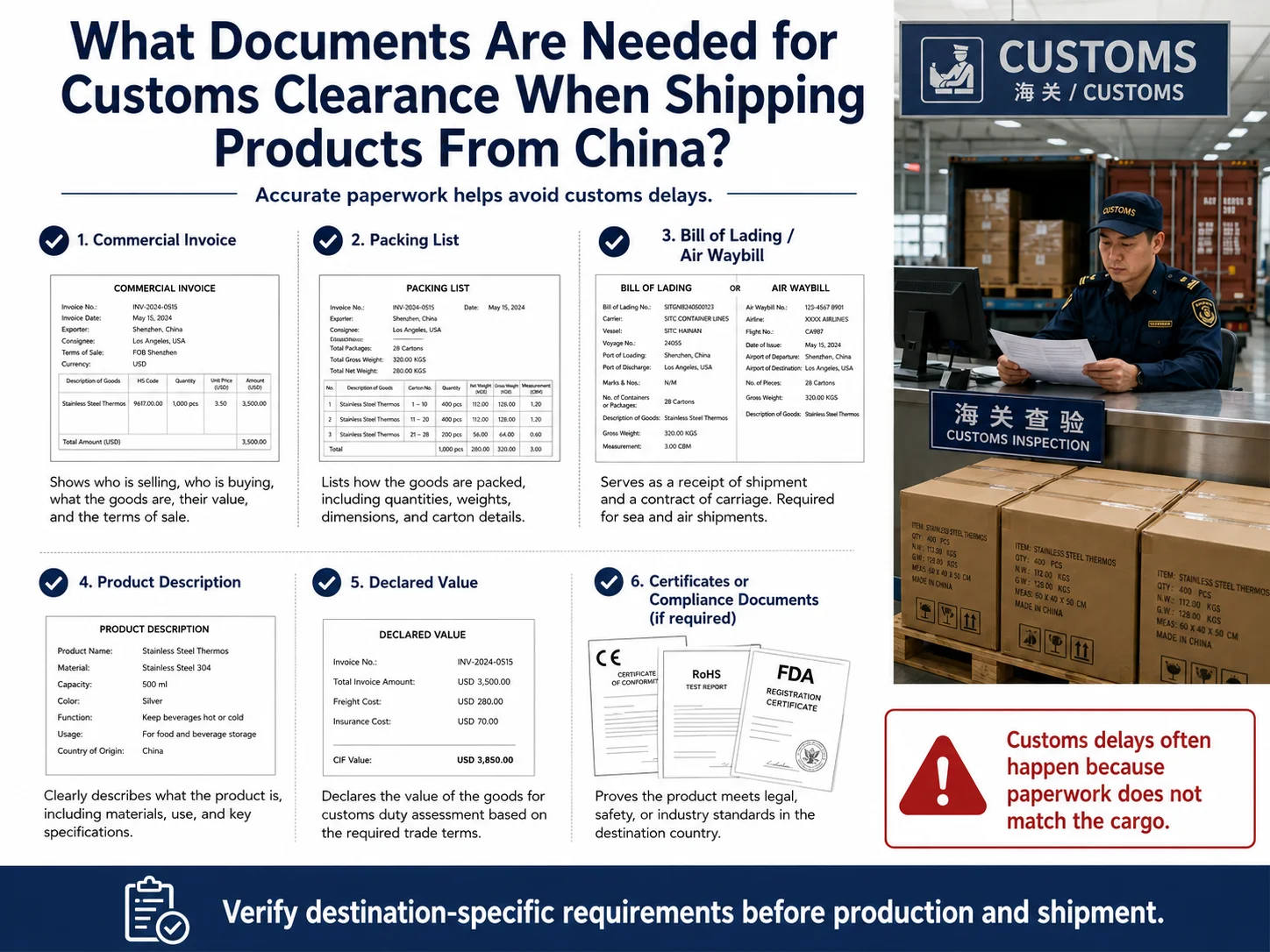
We encourage clients to prepare compliance early, especially for regulated product categories.
Common Shipping and Customs Documents
- Commercial invoice: Lists buyer, seller, product description, value, quantity, currency, and trade terms.
- Packing list: Shows carton count, dimensions, net weight, gross weight, and packing details.
- Bill of lading or air waybill: Serves as the transport document.
- Certificate of origin: May be needed for customs purposes or trade preference claims.
- Product test reports or certificates: May apply to electronics, toys, cosmetics, food-contact goods, medical-related products, and other regulated categories.
- Import licenses or registrations: May be required in some countries for specific products.
Product Descriptions Matter
Avoid descriptions such as “gift,” “accessories,” or “samples” when they do not accurately explain the goods. A stronger description identifies the product, material, intended use, and model where relevant.
For example:
- Weak: “Kitchen item”
- Better: “Stainless steel reusable water bottle, 750 ml”
- Weak: “Electronic product”
- Better: “USB rechargeable LED desk lamp, non-medical use”
We are not customs lawyers, and customs decisions are never guaranteed. However, we can help coordinate accurate shipment information, review document consistency, and flag common compliance questions before goods leave China.
How Can Warehouse Consolidation Reduce China Shipping Costs?
Ordering from several Chinese suppliers creates a common problem: every supplier ships separately, every parcel has its own freight charge, and you lose control of how the final order is packed. Small mistakes add up quickly.
Warehouse consolidation combines goods from multiple Chinese suppliers into one managed shipment.[^8] It can reduce duplicated freight charges, improve carton utilization, allow product checks, support custom packaging, and make international shipping more efficient.
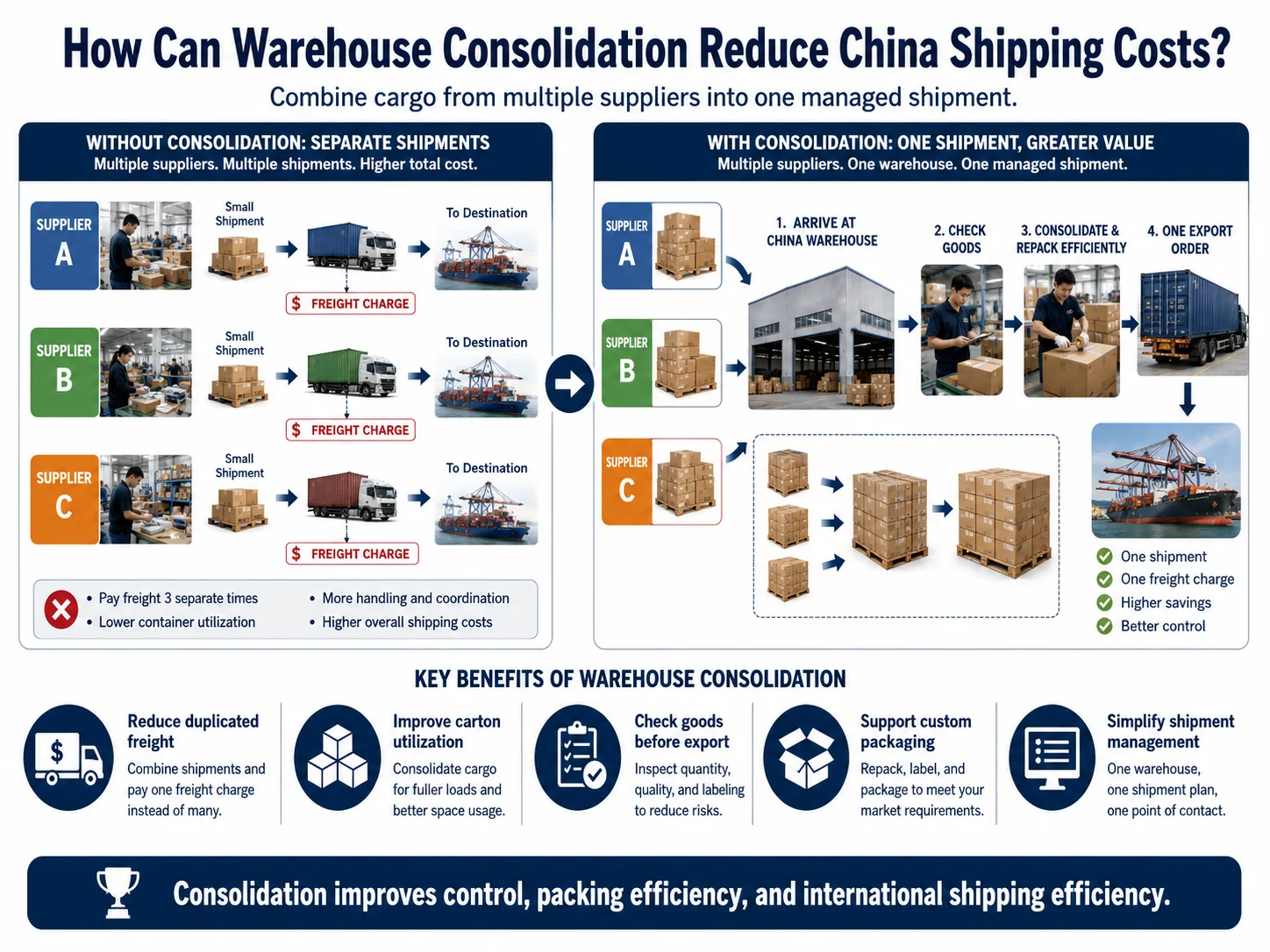
Our warehouse process gives buyers a practical control point between suppliers and international delivery.
What We Can Do Before Consolidation
Depending on the order requirements, we can coordinate:
- Supplier pickup or inbound receiving
- Carton counting and basic condition checks
- 1-by-1 product inspection
- Removal of unnecessary supplier packaging
- New export carton packing
- Barcode labels, inserts, and warning labels
- Product bundles and accessory kits
- Storage while waiting for other suppliers
- Photo updates for shipment confirmation
Why Consolidation Helps
If three suppliers each send separate small shipments to the same country, you may pay three minimum freight charges and receive three separate deliveries. Combining the goods can reduce duplicated handling and may unlock a better freight option.
However, consolidation is not always free savings. It adds warehouse handling and can delay departure if one supplier is late. We recommend setting a clear cut-off date. If one supplier misses it, you can decide whether to wait, ship part of the order, or arrange a separate shipment.
For DTC brands and Amazon sellers, consolidation also improves presentation. Instead of receiving mixed supplier cartons, you can receive standardized, labeled, and better-protected inventory ready for onward fulfillment.
How Does KingSourcing Manage Shipping Products From China?
Importers need more than a shipping label. They need someone in China who can coordinate suppliers, verify cargo readiness, compare logistics options, and communicate clearly when something changes. That is the role we play for our clients.
At KingSourcing, we manage shipping products from China by coordinating supplier pickup, warehouse receiving, inspection, consolidation, quote comparison, export arrangements, and delivery options such as FOB, DDU, and DDP where suitable. We focus on transparent scope, practical risk control, and reliable communication.
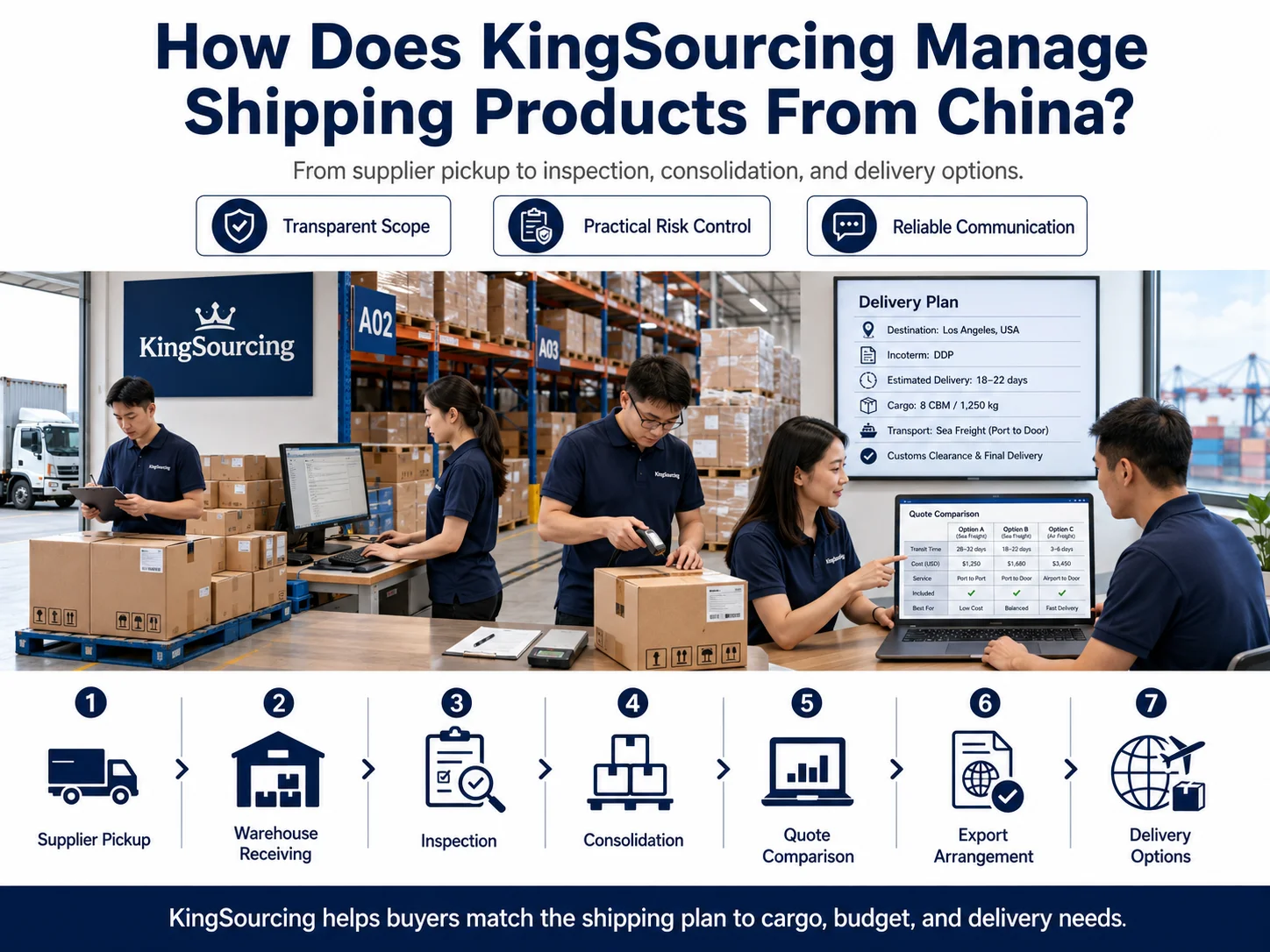
We act as your China-side sourcing office, quality-control team, warehouse coordinator, and logistics assistant.
Our Shipping Coordination Approach
Before we recommend a route, we ask questions such as:
- What is the product, and does it have shipping restrictions?
- What are the final carton dimensions and weights?
- When do you need inventory at your destination?
- Do you need delivery to a warehouse, fulfillment center, or residential address?
- Can you handle import clearance, or do you need a managed delivery solution?
- Are there multiple suppliers to consolidate?
- What costs must be included in the quote for your budgeting process?
We then compare available options based on the same shipment scope. We help clarify whether a quote includes China pickup, export documentation, customs handling, duties, taxes, delivery, and destination fees.
Our service can include supplier development, factory coordination, quality inspection, packaging work, storage, product photography, consolidation, and international delivery support. This gives you fewer handoffs and a clearer view of your order from factory completion to final delivery.
We do not promise that customs will always be simple or that every route will be the cheapest. Instead, we help you make an informed shipping decision with fewer unknowns.
Frequently Asked Questions About Shipping From China
What is the cheapest way to ship products from China?
Sea freight is often cost-effective for larger, non-urgent shipments, especially when cargo volume is high enough to support LCL or FCL shipping. However, the cheapest method depends on total landed cost. Small or urgent shipments may be better suited to express or air freight.
How long does shipping from China take?
Shipping time varies by method, destination, customs clearance, carrier capacity, season, and final-mile delivery conditions. Express is generally faster than standard air freight, while sea freight usually takes longer. Always request an estimated transit window for your specific shipment rather than relying on generic timelines.
Is DDP shipping suitable for beginners?
DDP shipping can be suitable for beginners because it may simplify delivery coordination. However, buyers should confirm the exact scope, including duties, taxes, customs clearance, destination charges, product eligibility, and importer-of-record responsibilities. Door-to-door service does not automatically mean every cost is included.
Who pays import duties and taxes on products from China?
The responsible party depends on the agreed trade term and the import arrangement. Under many DDU or DAP-style shipments, the buyer pays import duties and taxes. Under a properly structured DDP shipment, these may be included. Confirm this in writing before the goods depart.
Can I consolidate products from different Chinese suppliers?
Yes. A China warehouse can receive goods from multiple suppliers, count cartons, inspect products, repack cargo, add labels, and combine compatible goods into one shipment. This can reduce duplicated freight charges and improve shipment control[^9], although warehouse handling and timing should be planned.
Conclusion
Shipping products from China is a landed-cost and delivery-risk decision, not simply a search for the lowest freight quote. Start with accurate cargo details, compare transport methods based on your deadline and volume, confirm Incoterms responsibilities, and verify every included and excluded charge. If you need a China-based team to coordinate suppliers, inspect goods, consolidate orders, and arrange practical shipping options, contact KingSourcing. We make your China sourcing simple.
Tags: Shipping from China, China Freight Forwarding, DDP Shipping from China, Warehouse Consolidation, China Shipping Cost, China Sourcing Agent, Import from China
[^1]: "Common Export Documents", https://www.trade.gov/common-export-documents. U.S. trade guidance describes international commercial shipments as requiring transport arrangements, shipping documentation, customs entry procedures, and delivery arrangements. Evidence role: general_support; source type: government. Supports: The standard stages and documentation involved in international movement of commercial goods, including customs clearance.. Scope note: Specific export and import procedures differ by country, transport mode, and product category. [^2]: "Shipping Options", https://www.trade.gov/shipping-options. Government export guidance identifies shipment characteristics, destination, transit time, and cost as central considerations when selecting an international transport method. Evidence role: general_support; source type: government. Supports: Freight-mode selection is influenced by shipment size, weight, value, destination, transit-time requirements, and logistics responsibilities.. Scope note: The relative importance of each factor depends on the shipment and commercial agreement. [^3]: "Fathoming Shipping Costs: An Exploration", https://documents1.worldbank.org/curated/en/099436104042241280/pdf/IDU0c20d2ae90046304ca009ab508217e50747bd.pdf. Trade guidance characterizes air freight as a faster option for time-sensitive goods and ocean freight as a lower-cost mode for larger or less urgent shipments. Evidence role: general_support; source type: government. Supports: Air transport generally offers faster transit at higher cost, while ocean freight is commonly used for larger and less time-sensitive cargo.. Scope note: Actual suitability varies with route, rates, cargo restrictions, and service availability. [^4]: "Parcel Postage Cost", https://jfd.jacksonms.gov/browse/JrWcWT/276038/parcel__postage_cost.pdf. Air-cargo guidance defines volumetric weight as a dimension-based measure used to determine chargeable weight when a shipment occupies more space than its actual weight would suggest. Evidence role: definition; source type: institution. Supports: Volumetric weight is a chargeable-weight measure based on package dimensions and may exceed actual weight for low-density shipments.. Scope note: The conversion divisor and billing rules vary among carriers and services. [^5]: "Incoterms", https://en.wikipedia.org/wiki/Incoterms. ICC Incoterms materials distinguish the obligations under EXW, FOB, and DDP and note that Delivered Duty Unpaid (DDU) is a legacy term rather than an Incoterms 2020 rule, for which DAP is generally the relevant current rule. Evidence role: historical_context; source type: institution. Supports: EXW, FOB, and DDP are current Incoterms rules with different allocations of obligations, while DDU was removed from later Incoterms editions and replaced in practice by DAP terminology.. Scope note: Commercial providers may still use “DDU” informally, but that usage does not create a current ICC rule. [^6]: "Import Tariffs & Fees Overview and Resources", https://www.trade.gov/import-tariffs-fees-overview-and-resources. Trade guidance describes landed cost as the total cost of obtaining imported goods, including the purchase price and applicable transport, insurance, customs, duty, tax, and delivery expenses. Evidence role: definition; source type: government. Supports: Landed cost incorporates the product price together with freight, insurance, duties, taxes, customs-related charges, and other costs incurred in bringing goods to destination.. Scope note: The precise cost components and tax treatment vary by jurisdiction, Incoterm, and supply contract. [^7]: "Importing into the United States A Guide for Commercial ...", https://www.cbp.gov/sites/default/files/documents/Importing%20into%20the%20U.S.pdf. Customs and trade guidance identifies commercial invoices and transport records as core import documents and requires sufficient information to establish the goods' description, value, classification, and admissibility. Evidence role: general_support; source type: government. Supports: Commercial invoices, transport documents, accurate goods descriptions and values, and product-specific documentation can be required for customs processing.. Scope note: Document and certification requirements are determined by the importing country and the particular product. [^8]: "Cargo Consolidation, Routing, and Location Optimization ...", https://rosap.ntl.bts.gov/view/dot/76421/dot_76421_DS1.pdf. Logistics teaching materials define freight consolidation as combining separate smaller consignments into a larger shipment to be transported together. Evidence role: definition; source type: education. Supports: Freight consolidation is the combining of smaller consignments into a larger shipment for onward transportation.. Scope note: Consolidation can add warehouse handling, scheduling dependencies, and additional handling risk. [^9]: "Innovative Consolidation Techniques for Improved ...", https://dspace.mit.edu/entities/publication/57a23f6e-c8f8-4092-b5a2-ab95c6e007a1. Transportation research finds that consolidating compatible shipments can reduce logistics costs by improving vehicle or container utilization and pooling shipments that would otherwise move separately. Evidence role: mechanism; source type: research. Supports: Shipment consolidation can lower transportation cost by pooling loads and reducing underutilized capacity or repeated minimum charges.. Scope note: Savings are not guaranteed because consolidation may introduce handling costs, waiting time, and service-level trade-offs.