The Chinese trading company vs factory question matters because the wrong supplier can cause unclear pricing, missed delivery dates, weak quality control, and expensive rework. Many buyers focus too much on the “factory” label. I recommend a better approach: verify the company, test its execution ability, and confirm who takes responsibility before payment.
A Chinese factory usually owns or controls production equipment, workers, and workshop operations, while a trading company coordinates suppliers, quotations, exports, and order management.[^1] However, company type alone does not determine price, quality, or reliability.[^2] To tell the difference, buyers should review the Chinese business license, registered address, product range, live factory evidence, technical knowledge, audit reports, payment entity, and quality-control process.
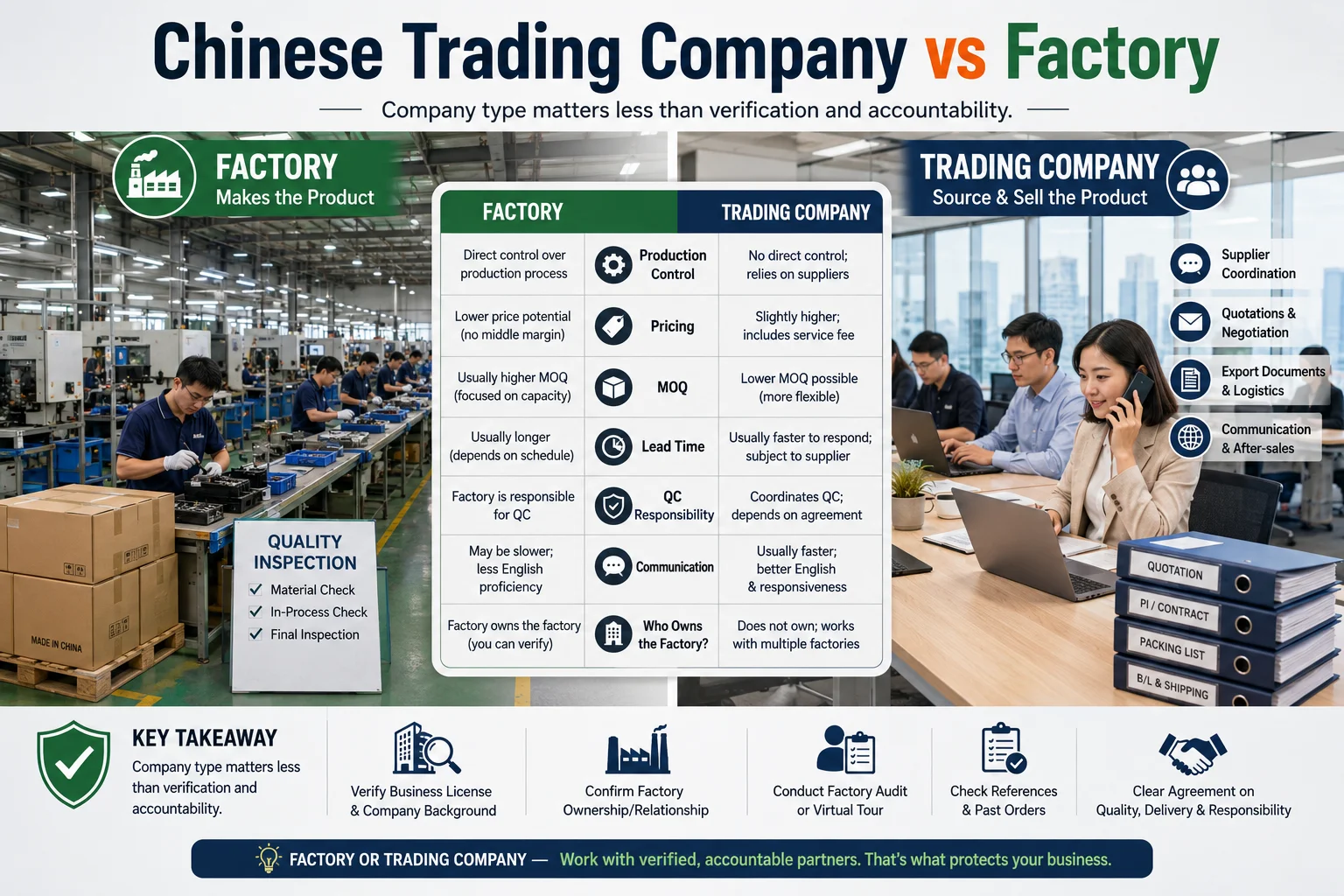
The important question is not simply, “Is this supplier a factory?” The more useful question is, “Can this supplier deliver my product correctly, on time, with clear accountability?” I have seen both factories and trading companies work well when buyers use a structured verification process.
Quick Answer: How Can I Tell a Chinese Trading Company vs Factory Apart?
Buyers often feel pressure to identify a factory quickly, especially after finding a supplier on Alibaba, Made-in-China, or a social media platform. That pressure can lead to rushed decisions based on badges, photos, or a low quote.
A factory normally controls its production line, workshop staff, machinery, and manufacturing schedule. A trading company normally sources from one or more factories and manages communication, exporting, consolidation, and order coordination. I would never rely on one clue alone. I would compare the business license, address, business scope, product specialization, factory video, quotation structure, and inspection evidence.
In practical sourcing work, the supplier’s legal identity is only the starting point. A registered manufacturing company may outsource some processes.[^3] A trading company may have excellent supplier relationships and stronger export communication than a small factory.
What I would verify first
Before we move to samples or payment, we usually ask for:
- The Chinese business license
- The full legal company name in Chinese
- The registered and actual operating address
- Factory photos or a live video call
- Product specifications and production capability details
- A formal quotation with MOQ, lead time, packaging, and payment terms
- Quality-control procedures and relevant reports
- Bank account details matching the contracting entity
A supplier that answers clearly is not automatically safe. Still, clear and consistent information is a useful signal.
Chinese Trading Company vs Factory: What Is the Real Difference?
The basic definitions sound simple, but real Chinese supply chains are more mixed than many first-time importers expect. A supplier may manufacture one category, outsource another category, and use a separate export company for overseas sales.
The real difference is not simply the company name. It is who controls production, quality, lead time, pricing, and supplier relationships. I encourage buyers to map those responsibilities before they compare prices.
A Chinese factory generally owns or manages the manufacturing operation. It may purchase raw materials, employ production workers, operate machinery, schedule production, and inspect finished goods. A factory may quote directly to you, but it may also use a separate trading or export entity to handle foreign currency, customs declarations, and international sales.[^4]
A Chinese trading company usually acts as the coordinator. It may source from several factories, combine products, manage samples, communicate in English, organize packaging, and arrange exports. It earns a margin or service fee through the supply chain.
Why company names can mislead buyers
Many buyers search a supplier’s English name and assume that words such as “Industrial,” “Manufacturing,” or “Technology” prove factory ownership. They do not. Likewise, a company with “Trading” in its name may work closely with stable factories and provide a very capable export service.
I look for evidence rather than labels:
| Question | What it helps reveal |
|---|---|
| Who owns the machinery? | Production control |
| Who employs workshop workers? | Manufacturing responsibility |
| Who purchases core materials? | Supply-chain control |
| Who sets the production schedule? | Lead-time authority |
| Who handles defects after inspection? | Quality accountability |
| Which entity receives payment? | Legal and financial consistency |
| Which entity issues export documents? | Export structure |
A mixed structure is not automatically a problem. It becomes a problem when the supplier hides the production factory, cannot explain responsibility, or gives inconsistent information.
Chinese Trading Company vs Factory: Which Supplier Type Fits Your Order?
Buyers often assume factory-direct sourcing always produces the lowest cost. That assumption is understandable, but it ignores order size, product complexity, communication needs, and logistics requirements.
A factory is often a strong fit for a stable, high-volume order in one specialized category. A trading company can be a better fit for small trial orders, mixed product sourcing, supplier consolidation, and export coordination.[^5] I would choose based on the work that needs to be done, not on the supplier’s marketing language.
| Factor | Chinese Factory | Chinese Trading Company |
|---|---|---|
| Main role | Manufacturing | Supplier sourcing and order management |
| Product range | Usually narrower | Usually broader |
| MOQ flexibility | Depends on production line | Often more flexible |
| Pricing | May offer factory-direct pricing | May include service margin |
| Customization | Strong in its own category | Depends on partner factories |
| Communication | Varies significantly | Often stronger for export communication |
| Quality control | Controls its own production | Must coordinate multiple suppliers |
| Small mixed orders | Often difficult | Usually easier |
| Supplier backup | Limited | Can offer alternatives |
| Best for | Large or specialized orders | Multi-product and managed sourcing |
A factory is not automatically cheaper, and a trading company is not automatically less reliable. The better choice depends on your order size, product complexity, quality requirements, and sourcing experience.
A simple decision guide
I would generally consider a factory when:
- You buy one specialized product category.
- Your volume is large and repeatable.
- You need deep customization or tooling.
- You have clear technical specifications.
- You can manage production follow-up and inspection.
I would consider a trading company when:
- You need several unrelated products.
- You are testing a product with a smaller budget.
- You need low-MOQ options.
- You want one point of contact for consolidation.
- You need help with export documents, warehousing, or shipping.
In many cases, a sourcing company offers a third option. We can independently compare factories, verify company identity, manage samples, inspect goods, consolidate orders, and coordinate shipment without asking buyers to depend entirely on one supplier’s claims.
How Can You Tell Whether a Chinese Supplier Is a Factory or Trading Company?
A supplier can look professional online and still be difficult to verify. Buyers need a staged process that moves from low-cost checks to deeper due diligence when order value, customization, or risk increases.
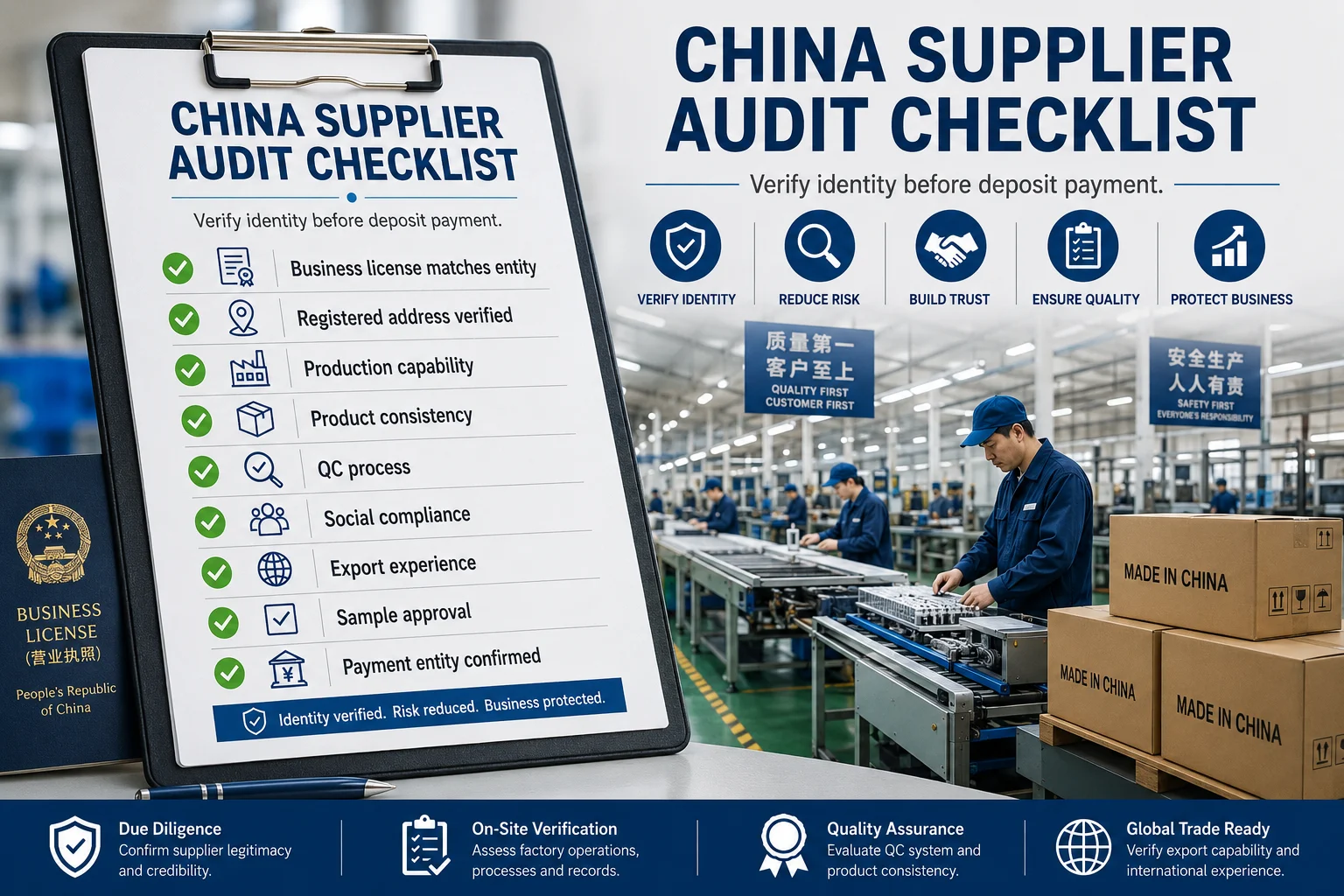
Here are 12 practical ways I would use to identify whether a Chinese supplier is a factory or trading company.
-
Check the Chinese business license. Ask for the license in Chinese, not only an English certificate. Look for the legal name, unified social credit code, address, and business scope. A refusal is a risk signal. A license alone is not proof of capability.
-
Review the registered business scope. Manufacturing-related wording can support a factory claim, but it does not prove the company owns a workshop today. Trading, import-export, wholesale, or e-commerce wording may indicate a trading role. I would compare this information with other evidence.
-
Compare the registered address with the factory address. A different office and production address can be normal. Many factories have sales offices in another city. However, the supplier should explain the relationship and provide the actual production location.
-
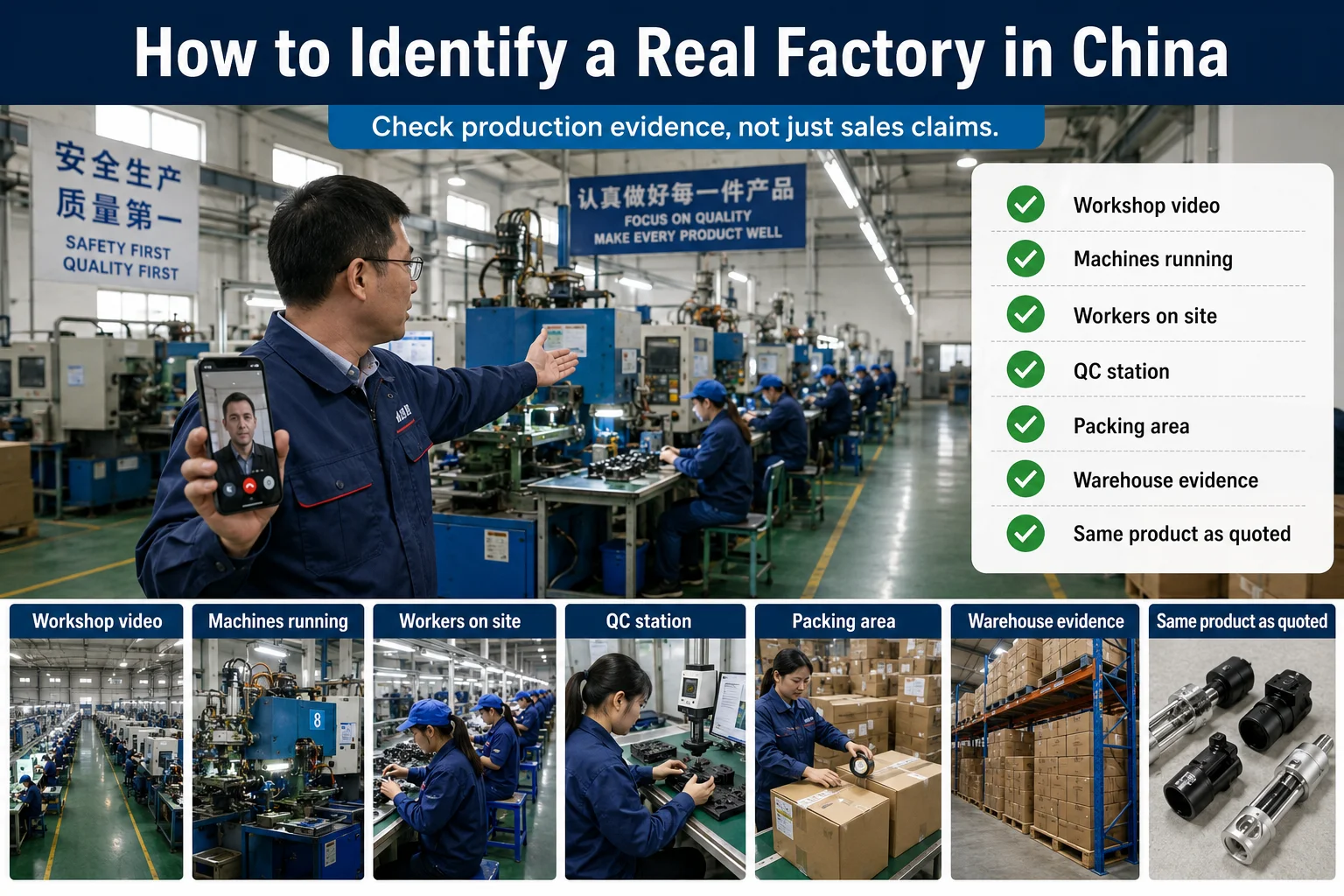
Ask for a live factory video call. A genuine live walkthrough can show machinery, workers, materials, production stages, warehouse areas, and QC stations. Pre-recorded video is less useful because it may show another company’s facility.[^6]
-
Check product consistency. Factories usually focus on related products using similar materials, production processes, or machinery.[^7] A supplier selling kitchen tools, LED lights, pet clothing, and auto parts may be a trading company. That is not necessarily negative, but it needs explanation.
-
Review the overall product range. A broad catalog can indicate supplier integration rather than manufacturing. I would ask which items are made in-house and which items come from partner factories.
-
Ask technical production questions. Questions about materials, tolerances, mold costs, printing methods, packaging, defect standards, and lead times reveal operational understanding. Vague answers are a signal to investigate further.
-
Request machinery and production-line details. A factory should normally explain the type of machinery it uses, production capacity, key processes, and bottlenecks. I do not expect every salesperson to be an engineer, but I expect them to bring in the right person when needed.
-
Check workshop and employee information. Ask about workshop size, worker count, production shifts, seasonal capacity, and quality-control staffing. A supplier may not disclose every detail, but it should be able to describe its operation consistently.
-
Compare quotation structure and MOQ. Factory quotes may reflect material cost, setup, production efficiency, and line capacity. Trading companies may offer more flexible MOQs by combining suppliers. Extremely low pricing without clear specifications is a warning sign, not a bargain.[^8]
-
Review audit and inspection reports. A real factory audit can verify ownership, location, capability, and quality systems at a specific time.[^9] Buyers should check who performed the audit, when it occurred, and whether the legal entity matches the supplier.
-
Arrange independent supplier verification or a factory audit. For meaningful orders, custom products, or regulated categories, independent verification provides stronger evidence. It does not eliminate all risk, but it gives buyers a clearer basis for approval, negotiation, and production control.
The key is consistency. If the license, factory address, bank account, quotation, video call, and audit report all point to different entities, I would pause and ask for clarification before payment.
How Do You Check a Chinese Company Business License?
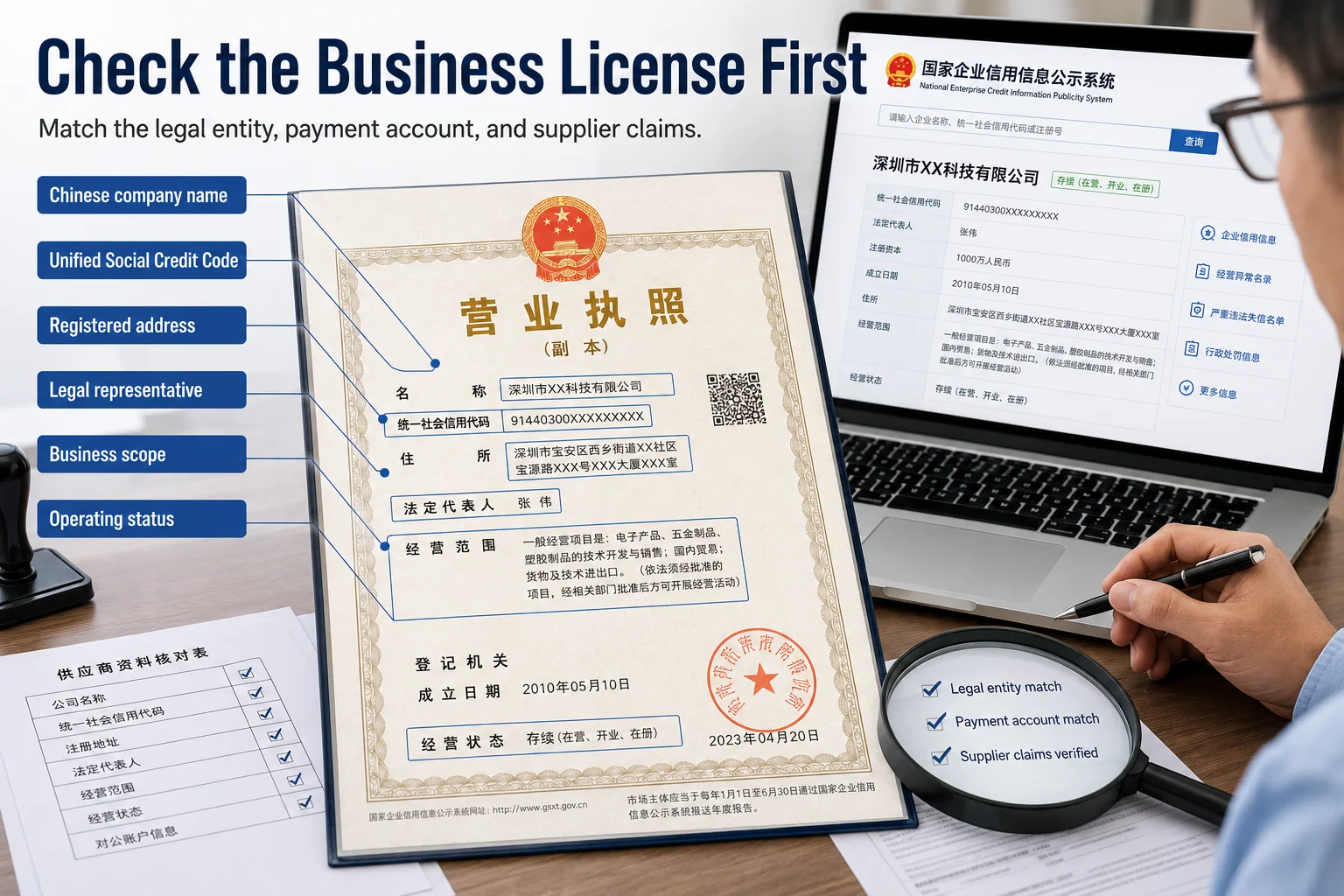
A Chinese business license is one of the most useful documents for a Chinese supplier verification process. However, it is a company-registration document, not a guarantee of product quality, financial health, or production capability.
When we review a license, we look at the details below and compare them with the supplier’s quotation, contract, invoice, and bank account.
| License field | What to check |
|---|---|
| Unified Social Credit Code | The unique 18-digit company identifier[^10] |
| Registered company name | Must match contracts and payment details |
| Legal representative | A useful identity reference |
| Establishment date | Shows how long the entity has existed |
| Registered address | Compare with office and factory locations |
| Registered capital | Context only; not proof of capacity |
| Business status | Confirm the company is active |
| Business scope | Look for manufacturing, trading, export, or relevant activities |
Important limits of a license check
A high registered capital amount does not prove a company has strong production capacity.[^11] Manufacturing wording does not prove the business owns a factory. An office address does not automatically mean the supplier is dishonest, especially if the company uses a separate production site.
I also remind buyers that the English company name may differ from the Chinese legal name. This is common, but the supplier should clearly explain which legal entity will sign the contract, receive payment, manufacture the goods, and export the shipment.
For higher-risk orders, I would request additional evidence:
- Factory address and contact person
- Photos or live video of the actual facility
- Product test reports where relevant
- Sample approval records
- Quality-control plan
- Bank account confirmation
- Audit report or independent verification
What Supplier Red Flags Should Make You Pause or Stop Payment?
Not every unusual detail means fraud. Some suppliers use export agents, outsource part of production, or operate through related companies. Still, several signals together can indicate serious supplier risk.
I separate red flags into two groups: issues that need clarification and issues that should stop payment until resolved.
Signals that need more verification
These do not automatically disqualify a supplier, but I would investigate them:
- The supplier has a very broad, unrelated product catalog.
- The office address differs from the production address.
- The supplier uses a separate export company.
- The supplier cannot answer technical questions immediately but brings in factory staff later.
- The quote changes after specifications become clearer.
- The supplier has limited English but communicates accurately through a structured process.
Serious payment red flags
I would stop and verify before sending funds when a supplier:
- Refuses to provide a Chinese business license.
- Uses different company names on the quotation, contract, invoice, and bank account.
- Requests payment to an unrelated personal account.
- Cannot explain where production will occur.
- Sends factory photos that appear on unrelated websites.
- Provides certificates belonging to another company.
- Changes its factory address repeatedly without explanation.
- Claims every product is made in-house despite unrelated categories.
- Avoids discussions about inspection, defects, or quality responsibility.
A reliable supplier does not need to be perfect. It does need to be transparent enough for you to understand who is responsible if something goes wrong.
Is It Better to Buy Directly from a Factory or Use a Trading Company?
The best sourcing route depends on your order, not on a simple factory-versus-trading-company rule. I have seen buyers lose money by insisting on “factory direct” when they actually needed coordination, consolidation, and experienced order management.
A factory may be the better option when you have one established product, stable demand, clear specifications, and enough volume to justify direct production management. It can offer deeper category knowledge and stronger control over its own production process.
A trading company can be a practical option when you need multiple suppliers, lower trial quantities, flexible order combinations, or stronger export support. The service margin may be worth paying if it prevents errors, reduces communication time, or improves logistics efficiency.
When a sourcing company adds value
I recommend an independent sourcing partner when buyers need:
- Factory candidates compared objectively
- Supplier identity checks before sampling or payment
- Product specifications translated into clear factory requirements
- Sample comparison and approval management
- On-site factory audits or video verification
- Production follow-up and pre-shipment inspection
- Multi-supplier consolidation and shipping coordination
A trading company represents its own supplier network. A factory represents its own production interests. A sourcing company should represent the buyer’s requirements and help make responsibilities visible.
How Does KingSourcing Verify Chinese Factories and Suppliers?
At KingSourcing, we treat supplier identity as one part of a wider execution review. We do not assume a factory label, an Alibaba badge, or a business license can answer every risk question. We focus on whether the supplier can produce the right product and accept clear quality responsibility.
Our local sourcing and inspection team includes approximately 180 people who support supplier search, verification, sample coordination, production follow-up, quality inspection, consolidation, and shipping across different Chinese industrial regions.
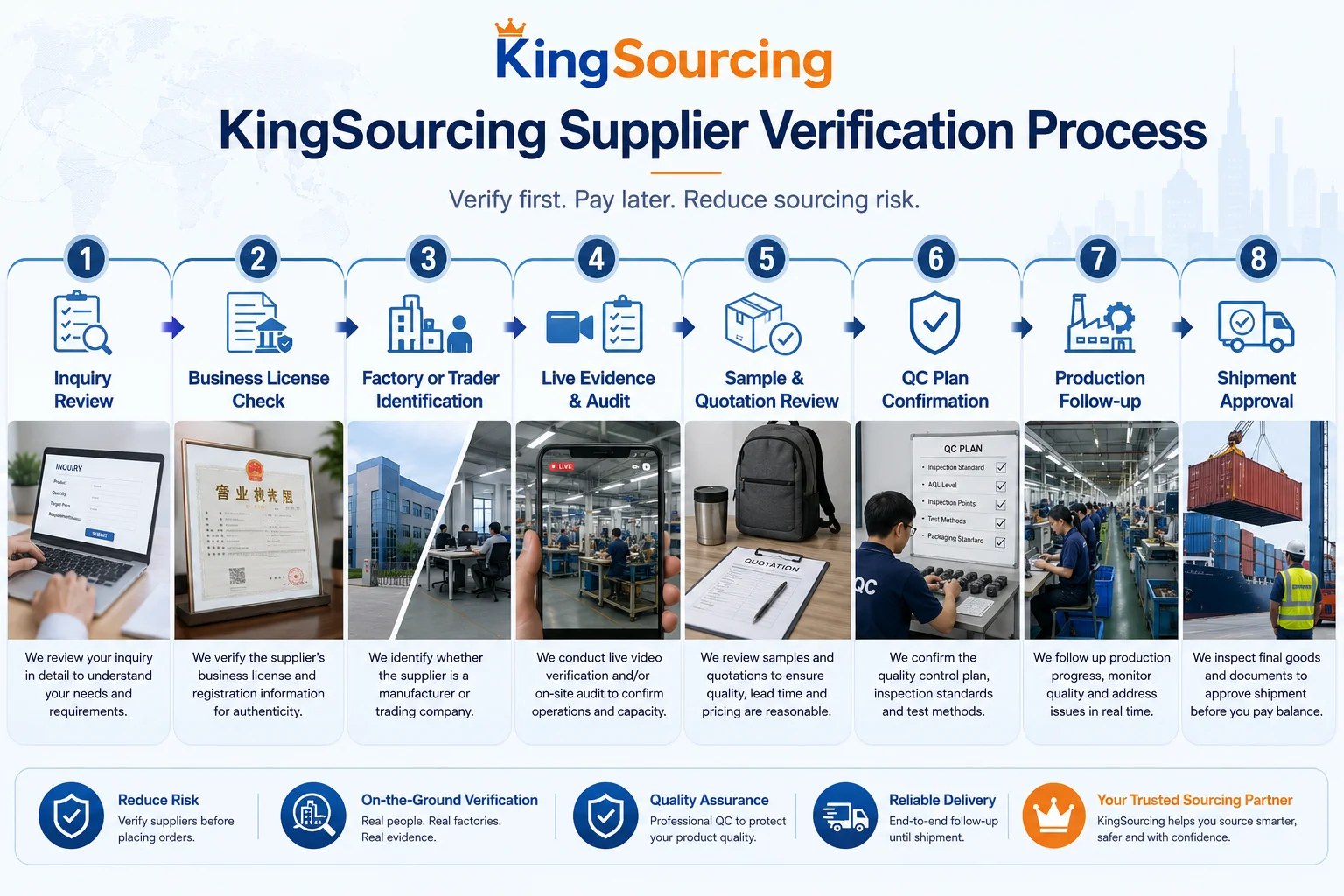
Our process commonly includes:
- Confirming the buyer’s product requirements, budget, quantity, and target market.
- Searching for suitable factory or supplier candidates.
- Verifying Chinese company registration and business identity.
- Comparing the company name, payment entity, export entity, and factory location.
- Reviewing product specialization, technical capability, MOQ, and lead time.
- Coordinating live video checks or on-site factory audits when appropriate.
- Requesting and evaluating samples before bulk production.
- Comparing quotation details, packaging, material requirements, and quality standards.
- Following production and arranging quality inspections.
- Preparing alternative supplier options when the first choice cannot meet requirements.
In one anonymized case, a buyer believed an Alibaba supplier was a factory. Our verification found that the supplier was an export trading entity using a partner factory in another city. We did not reject that supplier automatically. Instead, we clarified the production factory, payment entity, sample standard, and quality responsibilities before the order moved forward.
That is the point of verification. We do not try to force every supplier into one label. We help buyers make informed decisions with clearer evidence.
Frequently Asked Questions About Chinese Trading Companies and Factories?
How do I know if an Alibaba supplier is a factory?
I would not rely only on an Alibaba “manufacturer” label. Ask for the Chinese business license, actual factory address, live workshop video, machinery details, product specialization, and audit reports. Then compare those details with the quotation, payment entity, and sample quality.
Can a trading company offer factory-direct prices?
A trading company can sometimes offer competitive pricing because it has volume relationships with partner factories or combines orders. However, it usually includes a margin or service value somewhere in the supply chain. I would compare total landed cost, communication quality, MOQ, quality support, and delivery reliability.
Is it risky to buy from a Chinese trading company?
Buying from a Chinese trading company is not automatically risky. The main risk is unclear accountability.[^12] A good trading company can manage multiple suppliers, communicate well, support exports, and coordinate quality control. Buyers should verify who manufactures the goods and who accepts responsibility for defects.
Can a Chinese company be both a factory and a trading company?
Yes. Many factories manufacture some products directly while trading or exporting other products through related entities. Some use separate export companies for customs and foreign currency settlement. I would ask which entity produces the goods, which entity signs the contract, and which entity receives payment.
How can I verify a Chinese supplier without visiting China?
You can request the Chinese business license, conduct a live factory video call, review product samples, check certificates, compare company and bank details, and order an independent factory audit or supplier verification. These steps reduce uncertainty, but no process can eliminate every supplier risk.
What documents should I request from a Chinese factory?
I would request the Chinese business license, formal quotation, product specification sheet, sample confirmation record, bank details, relevant test reports, audit reports where available, and quality-control information. The documents should match the legal company entity involved in your order.
Should the supplier’s bank account match its business license?
Ideally, the beneficiary name should match the company signing your contract. A separate export entity can be legitimate, but the supplier should explain the relationship in writing. I would not send payment to an unrelated personal account or an unexplained third-party company.
Conclusion
The Chinese trading company vs factory decision should not be treated as a shortcut for judging price, quality, or trust. I recommend checking the supplier’s legal identity, actual production role, technical understanding, sample performance, payment entity, quality process, and willingness to accept accountability. A factory can be ideal for stable specialized orders, while a trading company can be valuable for flexible, multi-supplier sourcing. If you need support, KingSourcing can help verify suppliers, audit factories, manage inspections, consolidate goods, and coordinate shipping from China.
Not sure whether your Chinese supplier is a real factory?
KingSourcing can verify business licenses, company identity, production location, factory capability, certificates, payment details, and quality-control processes before you place an order.
Verify My Chinese Supplier
Find a Reliable Factory in China
Tags: Chinese Supplier Verification, Chinese Trading Company vs Factory, China Factory Audit, Find Manufacturers in China, China Sourcing Agent, Supplier Risk Management, Import from China
[^1]: "China - Market Challenges", https://www.trade.gov/country-commercial-guides/china-market-challenges. Official trade guidance distinguishes manufacturers, which undertake production activities, from trading intermediaries, which may arrange procurement, sales, and export services without operating the underlying production facility. Evidence role: definition; source type: government. Supports: The source should distinguish manufacturing enterprises from trading intermediaries according to their roles in production, procurement, and export transactions.. Scope note: Business structures can overlap, and individual Chinese firms may perform both manufacturing and trading functions. [^2]: "The role of supplier performance evaluations in mitigating risk", https://digitalcommons.bryant.edu/cgi/viewcontent.cgi?article=1117&context=mark_jou. Supplier-selection research evaluates vendors using multiple performance dimensions—including cost, quality, delivery, capability, and risk—rather than treating a supplier's organizational type as a standalone indicator of performance. Evidence role: general_support; source type: paper. Supports: The source should show that supplier selection and performance assessment commonly use multiple criteria, such as quality, delivery, cost, technical capability, and financial or operational risk.. Scope note: Multi-criteria supplier-selection studies do not directly compare every Chinese factory and trading company. [^3]: "A Review of Production and Operations Management ...", https://giesbusiness.illinois.edu/josephm/Publications/Papers/Tsay_et_al-2018-Production_and_Operations_Management.pdf. Research on industrial supply chains documents that manufacturing firms may subcontract particular processes or components while retaining responsibility for other stages of production and commercial coordination. Evidence role: general_support; source type: institution. Supports: The source should document that manufacturing supply chains can involve subcontracting or outsourced production stages while a lead firm retains other production responsibilities.. Scope note: Evidence of subcontracting as a general practice does not establish that any particular registered manufacturer outsources its production. [^4]: "Standards on Completion of Customs Declaration Forms ...", http://english.customs.gov.cn/statics/7d65e215-13ed-4a3e-baa1-797f01e5e902.html. Chinese customs and foreign-exchange rules recognize export declarations and export-payment settlement through registered entities and authorized arrangements, helping explain why production and export functions may be held by separate legal entities. Evidence role: mechanism; source type: government. Supports: The source should explain Chinese requirements or practices for export declarations and foreign-exchange receipts that may involve an exporter of record or authorized agent.. Scope note: The regulatory framework does not by itself verify that a supplier's separate export entity is affiliated with, or authorized by, the production factory. [^5]: "Exporting Through Intermediaries: Impact on Export Dynamics ...", https://www.elibrary.imf.org/view/journals/001/2019/302/article-A001-en.xml. Supply-chain research indicates that sourcing choices depend on order scale, product specialization, and coordination costs; intermediaries can reduce transaction and consolidation burdens when buyers manage multiple suppliers or products. Evidence role: general_support; source type: research. Supports: The source should explain how order volume, specialization, coordination costs, and supplier consolidation affect the choice between direct sourcing and an intermediary.. Scope note: This provides a decision framework rather than proving that one supplier type will be preferable for every order. [^6]: "Remote video auditing with real-time feedback in an academic surgical ...", https://pubmed.ncbi.nlm.nih.gov/26658775/. Remote-audit guidance emphasizes the need to establish the authenticity and traceability of information and communications technology evidence, making interactive, directed observation more verifiable than uncontextualized prerecorded material. Evidence role: mechanism; source type: institution. Supports: The source should explain that remote audits require controls over the authenticity, traceability, and timing of audiovisual evidence.. Scope note: A live video call can also be manipulated or incomplete and does not replace an appropriately scoped on-site audit where risk warrants one. [^7]: "The relationship between mass customization and sustainable ...", https://pmc.ncbi.nlm.nih.gov/articles/PMC10950661/. Industrial-organization research finds that manufacturers' product scope is commonly linked to related capabilities, technologies, inputs, and economies of scope, so product coherence can provide contextual information about a firm's operations. Evidence role: general_support; source type: paper. Supports: The source should show that firms' product scope is commonly shaped by related production capabilities, technologies, inputs, and economies of scope.. Scope note: A broad or unrelated catalog is not proof that a supplier is a trading company, because diversified manufacturers and multi-entity business groups also exist. [^8]: "Tender Design Checklist: OECD Guidelines for Fighting Bid Rigging ...", https://www.oecd.org/en/publications/2025/09/oecd-guidelines-for-fighting-bid-rigging-in-public-procurement-2025-update_127880ea/full-report/component-4.html. Public-procurement guidance cautions that price comparisons are unreliable when requirements are inadequately specified, because low bids may omit quality, performance, delivery, or lifecycle-cost elements required for successful fulfillment. Evidence role: general_support; source type: institution. Supports: The source should establish that procurement decisions based primarily on the lowest price can create performance risk when requirements and quality criteria are insufficiently specified.. Scope note: A low quotation is not inherently improper; it requires comparison against a complete and equivalent specification. [^9]: "How to do a Supplier Quality Audit: A Strategic 5-Step Guide", https://www.kodiakhub.com/blog/how-to-do-supplier-quality-audits?hs_amp=true. Management-system auditing guidance describes audits as evidence-based assessments of documented and observed processes, controls, and conformity at the audited organization during a defined audit period. Evidence role: mechanism; source type: institution. Supports: The source should describe how on-site supplier or quality-management audits collect evidence about a facility's processes, controls, and conformance at the time assessed.. Scope note: An audit is time-bound and scope-bound; it cannot guarantee future production performance or detect matters outside the audit scope. [^10]: "Unified Social Credit Identifier", https://en.wikipedia.org/wiki/Unified_Social_Credit_Identifier. China's Unified Social Credit Code is an 18-character identifier assigned to legal entities for unified registration and identification across administrative systems. Evidence role: definition; source type: government. Supports: The source should confirm the format and administrative purpose of the Unified Social Credit Code used for Chinese legal entities.. [^11]: "Laos - Distribution and Sales Channels", https://www.trade.gov/country-commercial-guides/laos-distribution-and-sales-channels. Corporate-law and business-due-diligence literature distinguishes registered capital from a firm's current assets, operating performance, and production capacity; it should therefore not be treated as conclusive evidence of manufacturing capability. Evidence role: general_support; source type: research. Supports: The source should distinguish registered or subscribed capital from a firm's actual assets, cash flow, operational capacity, or creditworthiness.. Scope note: Registered capital may still provide limited contextual information when assessed alongside verified financial and operational evidence. [^12]: "OECD Due Diligence Guidance for Responsible Supply ...", https://www.oecd.org/en/publications/2016/04/oecd-due-diligence-guidance-for-responsible-supply-chains-of-minerals-from-conflict-affected-and-high-risk-areas_g1g65996.html. Supply-chain governance research emphasizes that multi-party commercial arrangements require clearly assigned responsibilities, information flows, and remedial obligations to manage quality and performance risks across organizational boundaries. Evidence role: general_support; source type: research. Supports: The source should explain that multi-tier supply chains require clear allocation of responsibilities and contractual controls to manage quality, compliance, and remediation risks.. Scope note: Clear accountability reduces ambiguity but does not ensure that a supplier will perform or that remedies will be enforceable in every jurisdiction.