The cheapest Chinese supplier can look like the fastest way to improve your margins. However, a low quote can create expensive problems when materials, packaging, quality checks, delivery terms, or compliance requirements are missing. We help buyers compare the full offer so they can reduce avoidable sourcing risk before paying a deposit.
The cheapest Chinese supplier is not always the lowest-cost supplier. A low quotation may exclude tooling, packaging, testing, certification, quality control, shipping, or after-sales costs. Buyers should compare total landed cost[^1], confirmed specifications, sample quality, factory capability, defect risk, and delivery reliability before choosing a supplier in China.
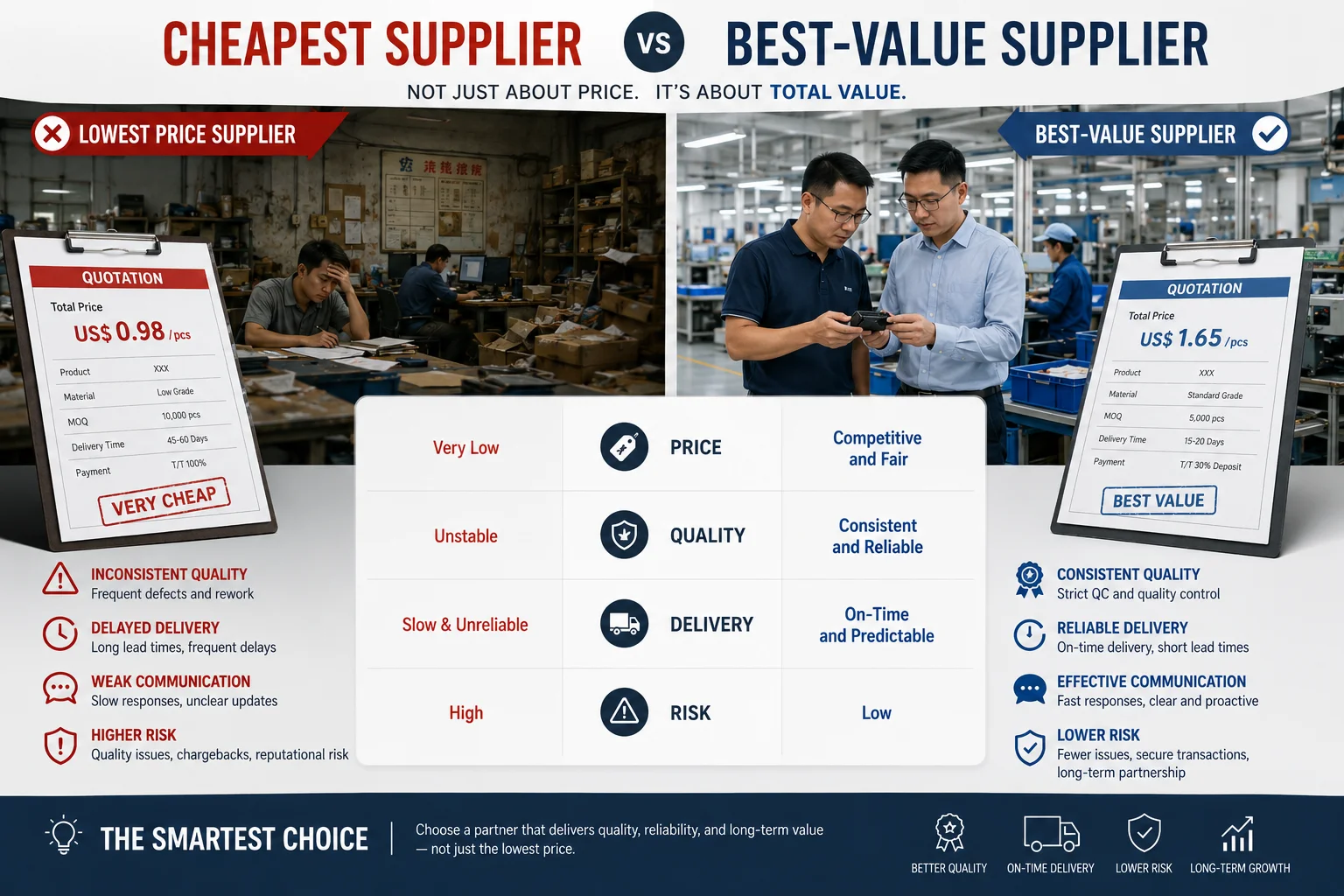
A cheap quote is not automatically a bad quote. Some factories genuinely have better production efficiency or lower material costs. The key is to understand why the price is lower, what is included, and what could change after production starts.
Why Is One Chinese Supplier Much Cheaper Than the Others?
A large price gap can make any buyer feel uncertain. You may worry that the higher-priced suppliers are overcharging, or that the low-cost Chinese manufacturer is hiding something. We see this question often when buyers compare Alibaba suppliers or factory quotations.
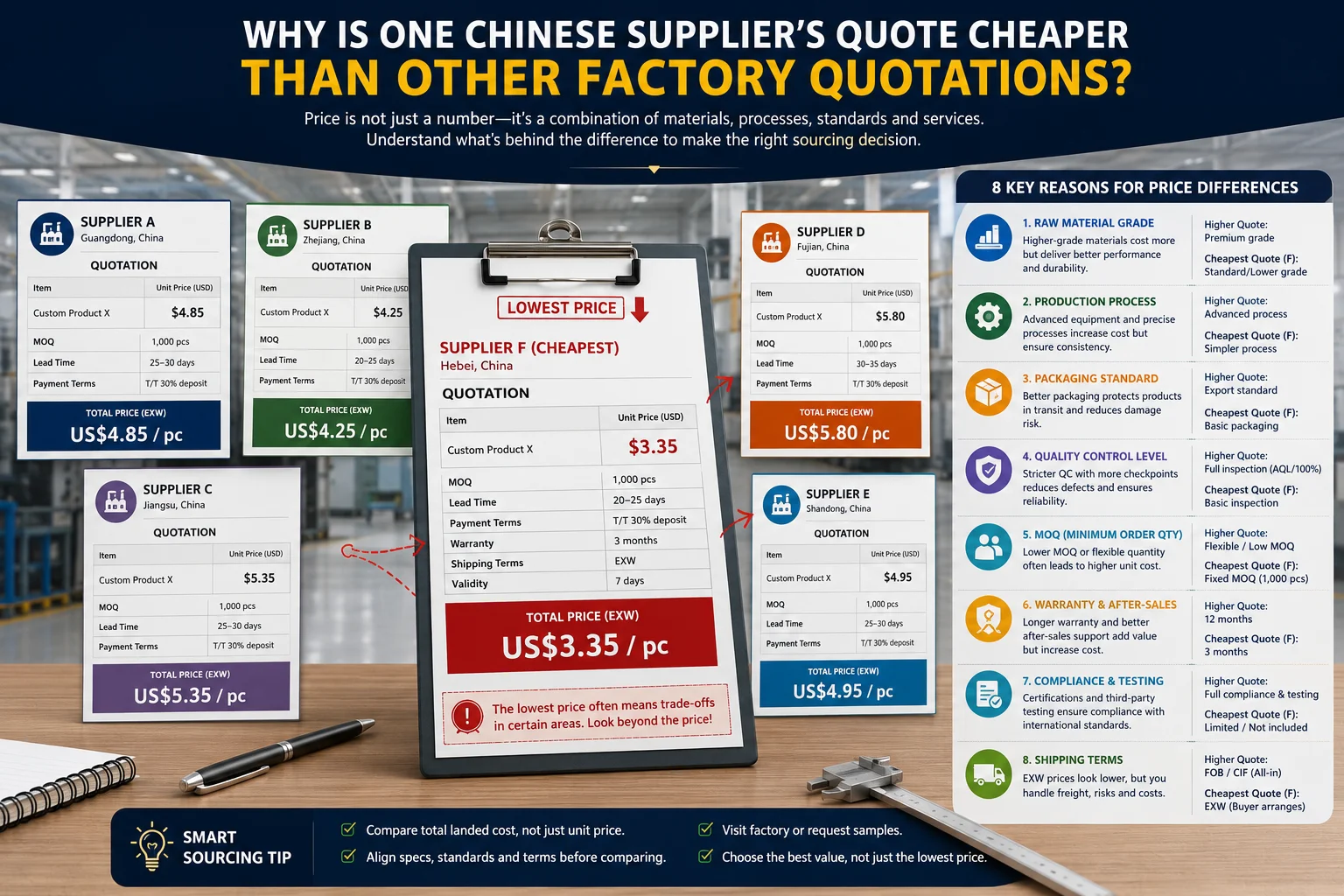
One Chinese supplier may be much cheaper because it uses different materials, excludes services, has spare capacity, sells standard products, or intentionally gives a low initial quote. A lower quotation does not always mean fraud, but a price far below the market should always be investigated before payment.
The product may not be exactly the same
Suppliers can use the same product photos while quoting very different specifications. One factory may quote for stainless steel, while another quotes for plated iron.[^2] One supplier may use a branded battery cell, while another uses a lower-capacity generic cell.
In our supplier comparison work, we often find that the biggest differences are hidden in details such as:
- Material grade and thickness
- Component brands and internal parts
- Product dimensions and tolerances
- Color matching requirements
- Surface finishing
- Packaging quality
- Included accessories
- Testing requirements
- Defect acceptance standards
A supplier can also quote a lower price because it assumes a simpler product version than the buyer expects. For example, a quotation may cover plain packaging, while your ecommerce brand needs custom inserts, barcode labels, warning labels, and retail-ready boxes.
The quote may exclude important costs
Some Chinese supplier quotations only show an EXW unit price. That figure may not include:
- Mold or tooling charges
- Sample fees
- Custom printing
- Product testing
- Certification support
- Pre-shipment inspection
- Export packaging
- Freight to your destination
The quote is not necessarily misleading. However, it is incomplete if the supplier does not clearly state what is included and excluded.
Lower pricing can be legitimate
We do not treat every low-price supplier as unreliable. A factory may offer a genuinely competitive price when:
- The product matches its main production line
- The factory purchases raw materials at scale
- The factory is close to component suppliers
- The supplier has unused production capacity
- The order uses existing molds and packaging
- The supplier is clearing genuine surplus inventory
The question is simple: Can the supplier prove that the lower price still meets your required specification, quality level, and delivery plan?
How Does the Cheapest Chinese Supplier Compare With the Best-Value Supplier?
Buyers often focus on unit price because it is easy to compare. However, the best-value supplier in China usually provides a more complete and predictable offer. We recommend comparing price, product quality, communication, compliance, and fulfillment risk together.
The cheapest supplier offers the lowest visible price. The best-value supplier offers the most reliable combination of product quality, pricing, delivery, compliance, and total sourcing cost. The best choice is the supplier that can deliver sellable products consistently within your actual budget.
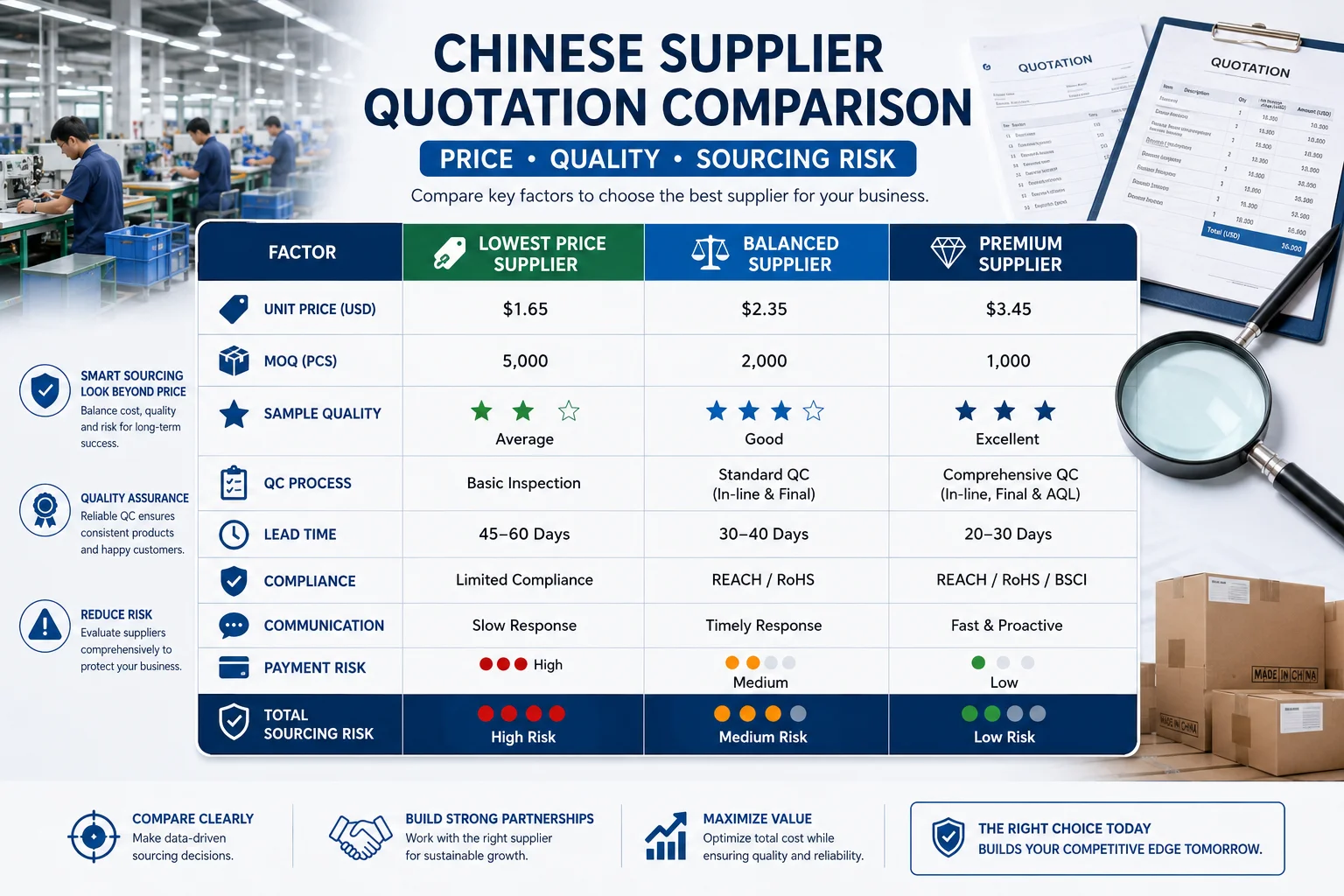
| Comparison Factor | Cheapest Supplier | Best-Value Supplier |
|---|---|---|
| Unit price | Lowest initial quote | Competitive and clearly explained |
| Product specification | May be incomplete or downgraded | Confirmed in writing |
| Material quality | Often uncertain until verified | Materials and components verified |
| Sample consistency | Sample may differ from bulk production | Approved sample used as a reference |
| Defect risk | Potentially higher or undefined | Quality requirements are documented |
| Packaging | May be excluded | Clearly included in quotation |
| Testing and certification | May be missing | Reviewed for destination market needs |
| Lead time | May be optimistic | Based on confirmed capacity |
| Communication | Focused mainly on winning the order | Includes technical and production details |
| After-sales support | Limited or unclear | Responsibility is discussed before ordering |
| Total landed cost | Can rise after production begins | More predictable |
| Supply risk | Usually higher if unverified | Assessed and managed |
The real metric: cost per sellable unit
We encourage buyers to think beyond the initial factory price. A product is only profitable when it arrives in acceptable condition, meets the required rules, and can be sold to the end customer.
A useful decision metric is:
Cost per sellable, compliant, and successfully delivered unit
That cost includes more than production. It may include inspection, replacement units, packaging, shipping, duty, returns, customer support, and delays.
For example, Supplier A may quote $4.20 per unit, but exclude retail packaging and final inspection. Supplier B may quote $4.75 per unit with better packaging, confirmed materials, and a pre-shipment quality process. Supplier B may appear more expensive at first, but it can become the better commercial choice if it reduces defects, rework, and customer complaints.
A higher quote does not automatically mean better quality either. We still ask suppliers to explain each line item. Clear documentation matters more than assumptions.
What Hidden Costs Can Be Behind a Cheap Chinese Supplier Quote?
A low unit price can become expensive when essential costs appear later. Many of these costs are manageable when they are identified before sampling, production, and payment. The problem starts when the buyer discovers them after committing to an order.
Chinese supplier hidden costs can include downgraded materials, tooling, packaging, printing, testing, certification, inspection, defect replacements, delays, airfreight, duties, and returns. Buyers should request a written quotation scope and confirm all exclusions before placing an order.
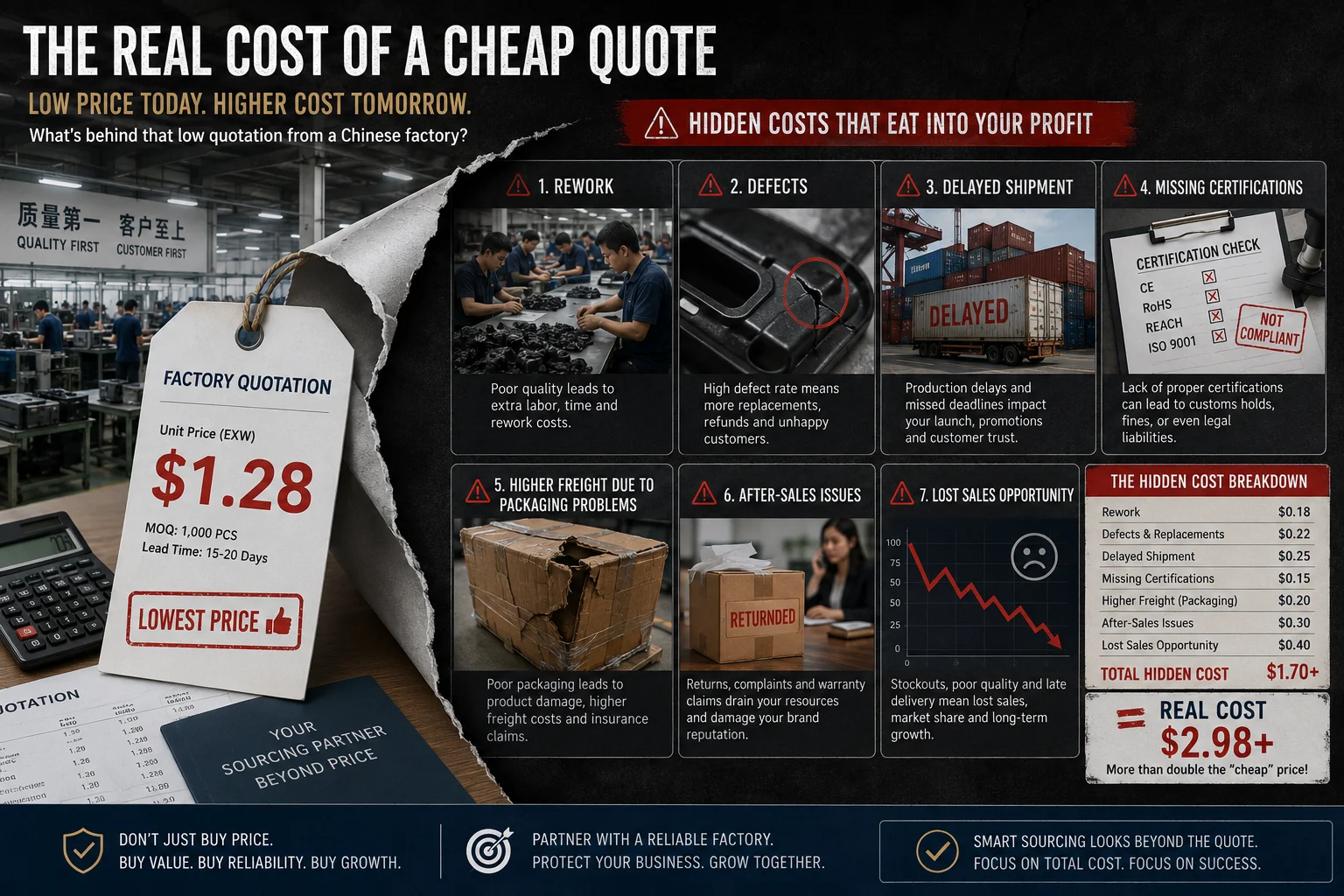
12 costs to check before you compare prices
-
Lower-grade raw materials
Ask for material names, grades, thicknesses, and color references. Put approved material requirements into the purchase order. -
Cheaper internal components
This is especially important for electronics, appliances, toys, and products with moving parts. Request component specifications and test samples where relevant. -
Tooling or mold charges
A factory may quote a low unit price while excluding mold development, setup, or fixture costs. Confirm whether tooling belongs to you and who can use it. -
Custom packaging costs
Plain cartons cost far less than branded retail boxes. Confirm box dimensions, inserts, labels, protective materials, and master carton requirements. -
Printing and labeling fees
Barcodes, warning labels, instruction manuals, logo printing, and country-of-origin marks may be charged separately. -
Product testing expenses
Some products need lab testing before sale. Ask which tests are included, which laboratory will conduct them, and whether reports apply to your exact model. -
Certification and compliance costs
Certification requirements vary by product and market.[^3] A supplier’s existing certificate may not cover your product version, brand, or destination.[^4] -
Inspection and reinspection fees
Third-party or in-house inspection may cost extra, but skipping it can create a larger risk. Define the inspection standard and who pays for rework. -
Defect and replacement costs
A lower upfront price can lose value if the defect rate is higher. Agree on acceptable quality limits and remedies for nonconforming goods.[^5] -
Production delays and airfreight
A missed launch date can force buyers to use expensive air shipping. Ask for a realistic production schedule based on confirmed capacity. -
Customs, duties, and logistics costs
Compare trade terms carefully. EXW, FOB, CIF, DDP, and DAP quotes cover different responsibilities and costs.[^6] -
Returns, warranty, and customer-service costs
A product that fails after delivery can damage your brand and consume your team’s time. Ask what after-sales support the supplier offers.
We do not assign a fixed percentage to these risks because costs vary by product, order quantity, country, and shipping method. Instead, we recommend building each item into a quotation comparison sheet.
How Can You Compare Chinese Supplier Quotations Correctly?
Comparing quotations is difficult when every supplier quotes a different product version. A buyer may think they are comparing three factories, but they may actually be comparing three different specifications, packaging levels, and trade terms.
You can compare Chinese supplier quotations correctly only when every supplier quotes the same confirmed product specification, quality standard, packaging, order quantity, and Incoterm. Create one comparison sheet and request written confirmation from every supplier.
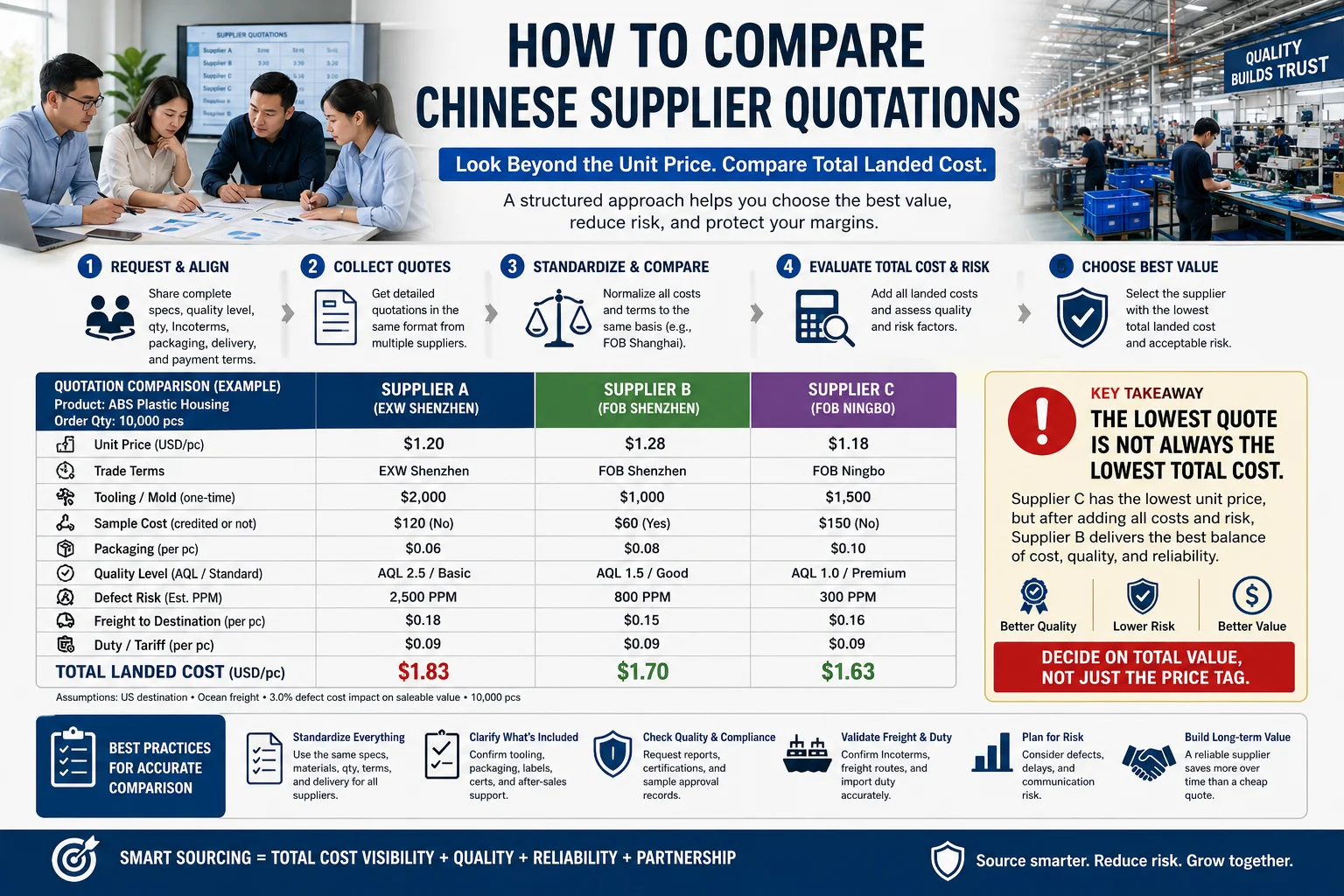
Build one quotation comparison sheet
We recommend sending the same request document to every shortlisted supplier. Your sheet should include:
| Item | What to Confirm |
|---|---|
| Product model | Product photos, drawings, dimensions, and version |
| Materials | Grade, thickness, finish, and component details |
| Unit price | Currency and quantity breakpoints |
| MOQ | Minimum order quantity by color, size, or variation |
| Sample cost | Sample timeline, revision process, and shipping |
| Tooling cost | Mold, fixture, setup, and ownership terms |
| Customization | Logo, colors, accessories, inserts, and design files |
| Packaging | Retail box, master carton, labels, and protective materials |
| Testing | Required tests, reports, and responsibility |
| Certifications | Applicable market requirements and document validity |
| Incoterm | EXW, FOB, CIF, DDP, or another agreed term |
| Payment terms | Deposit, balance payment, and payment method |
| Lead time | Sample timing and bulk production timing |
| Quality standard | Inspection level, tolerances, and defect criteria |
| Warranty | Replacement or credit policy for confirmed issues |
| Shipping estimate | Volume, weight, and delivery options |
Compare the scope, not just the price
Consider three suppliers quoting for the same consumer product:
- Supplier A offers the lowest unit price but excludes packaging, testing, and inspection.
- Supplier B has the highest unit price but includes custom packaging and a defined final quality check.
- Supplier C has a mid-range price, a more flexible MOQ, and a stable production schedule.
Supplier A may still be the right choice. However, that decision should only happen after you add the excluded costs and verify the product specification.
When we review quotes, we ask one practical question: What exactly will each supplier deliver for this price? If the answer is unclear, the quotation is not ready for a purchasing decision.
How Do You Verify a Low-Price Chinese Supplier Before Paying?
A very low quote can be a useful opportunity, but it should trigger a deeper verification process. Buyers should not rely only on platform badges, polished product photos, or fast replies. Supplier identity, production capability, and quotation scope all need review.
To verify a low-price Chinese supplier, check the business license, registered company name, bank account, factory identity, production address, equipment, quality process, certificates, export experience, and current production capability. The quotation entity, contract entity, and payment entity should match.[^7]
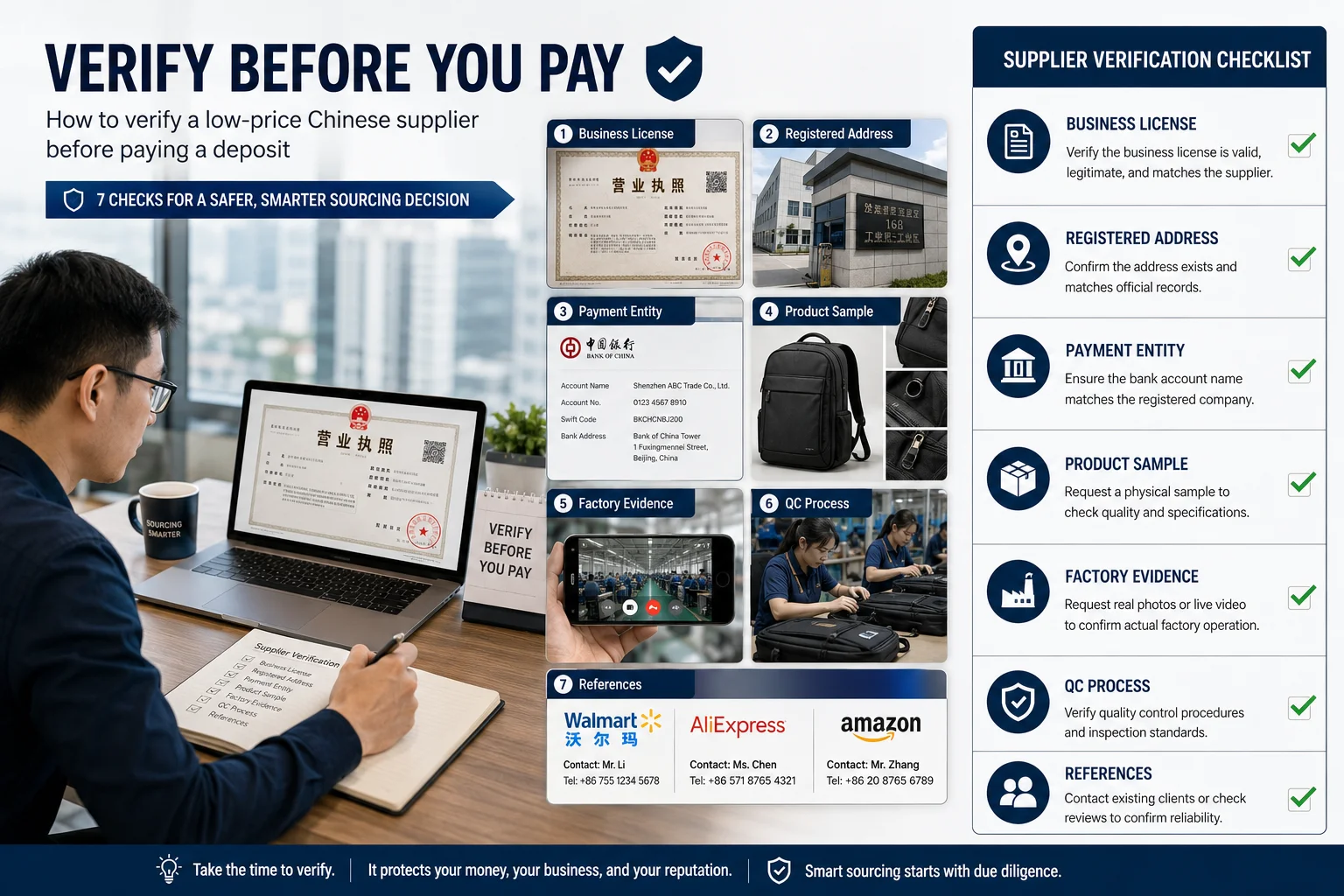
A practical supplier verification checklist
Before paying a deposit, we recommend checking:
- Chinese business license and registered company name
- Business scope and legal representative
- Registered address and actual production address
- Company bank account name
- Whether the supplier is a factory or trading company
- Main product categories and relevant production experience
- Workshop, equipment, and production lines
- Quality-control process and inspection records
- Product-specific test reports and certificates
- Previous export experience for your destination market
- Factory audit reports, if available
- Live factory video or on-site inspection
- Sample quality and documented sample approval
- Production lead time based on real capacity
Check whether documents match
A common issue is inconsistent company information. For example:
- The quotation comes from Company A.
- The contract names Company B.
- The bank account belongs to Company C.
- The factory video shows an unrelated facility.
There may be a legitimate explanation, especially when a trading company works with partner factories. Still, the buyer needs to understand the relationship before paying.
We also recommend checking whether certificates apply to the current product model and production company. A certificate for a different model, expired report, or unrelated factory does not confirm compliance for your order.
For deeper guidance, you can review our resources on how to verify a Chinese supplier, how to check a Chinese business license, and our China factory audit checklist.
When Can the Cheapest Chinese Supplier Still Be a Good Choice?
Some buyers assume that the cheapest Chinese supplier must be risky. That is not always true. A factory with the right product focus, strong capacity, and efficient sourcing can offer a lower price without cutting important corners.
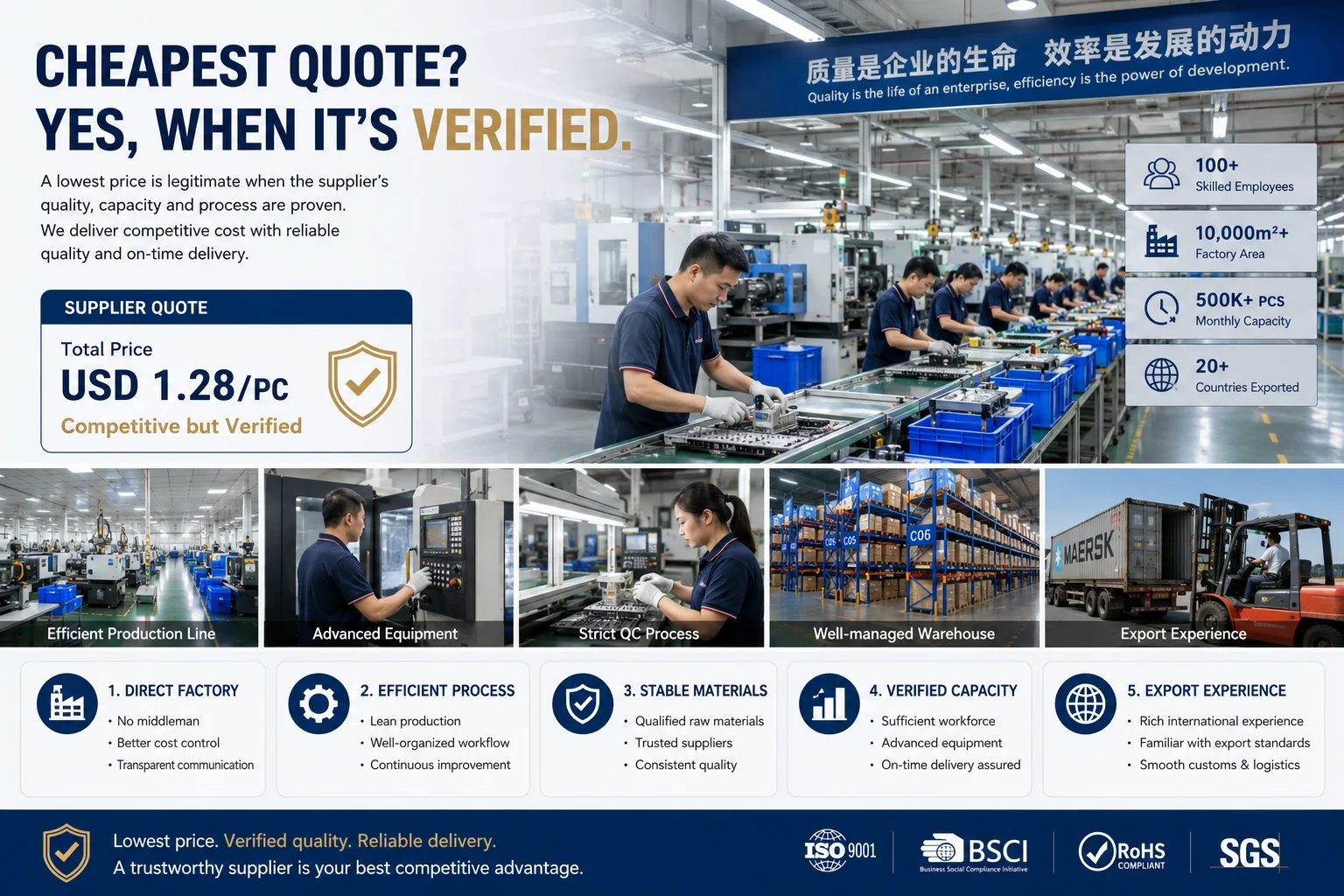
The cheapest Chinese supplier can be a good choice when the product specification is identical, the company is verified, the sample meets requirements, the price scope is clear, production capacity is real, and quality standards are written into the order. Low price becomes safer after verification, not before it.
Signs that low pricing may be reasonable
We consider a low quotation more credible when the supplier can demonstrate that:
- The product is part of its regular production line
- The factory has relevant machinery and skilled workers
- The product uses standard, readily available materials
- The supplier has high-volume purchasing power
- The quoted MOQ matches normal factory operations
- The supplier has available production capacity
- Existing molds, packaging, or components can be used
- The price breakdown is clear and consistent
- The approved sample matches the production specification
- The supplier accepts realistic inspection requirements
A low price is also more understandable for simple, standard products. Custom products with special materials, detailed branding, tight tolerances, or regulatory requirements need more careful comparison.
Protect the order in writing
Samples are important, but samples alone do not guarantee stable bulk production. Buyers should document the approved sample, specification, packaging requirements, and quality standards in the purchase order.
We recommend including:
- Product drawings or approved photos
- Material and component requirements
- Color references
- Packaging instructions
- Quantity tolerance
- Production lead time
- Inspection standard
- Defect remedy process
- Shipping terms
- Payment milestones
The supplier does not need to be perfect. The buyer needs clear evidence that the supplier can fulfill the agreed requirements consistently.
How Do Backup Suppliers Reduce China Sourcing Risk?
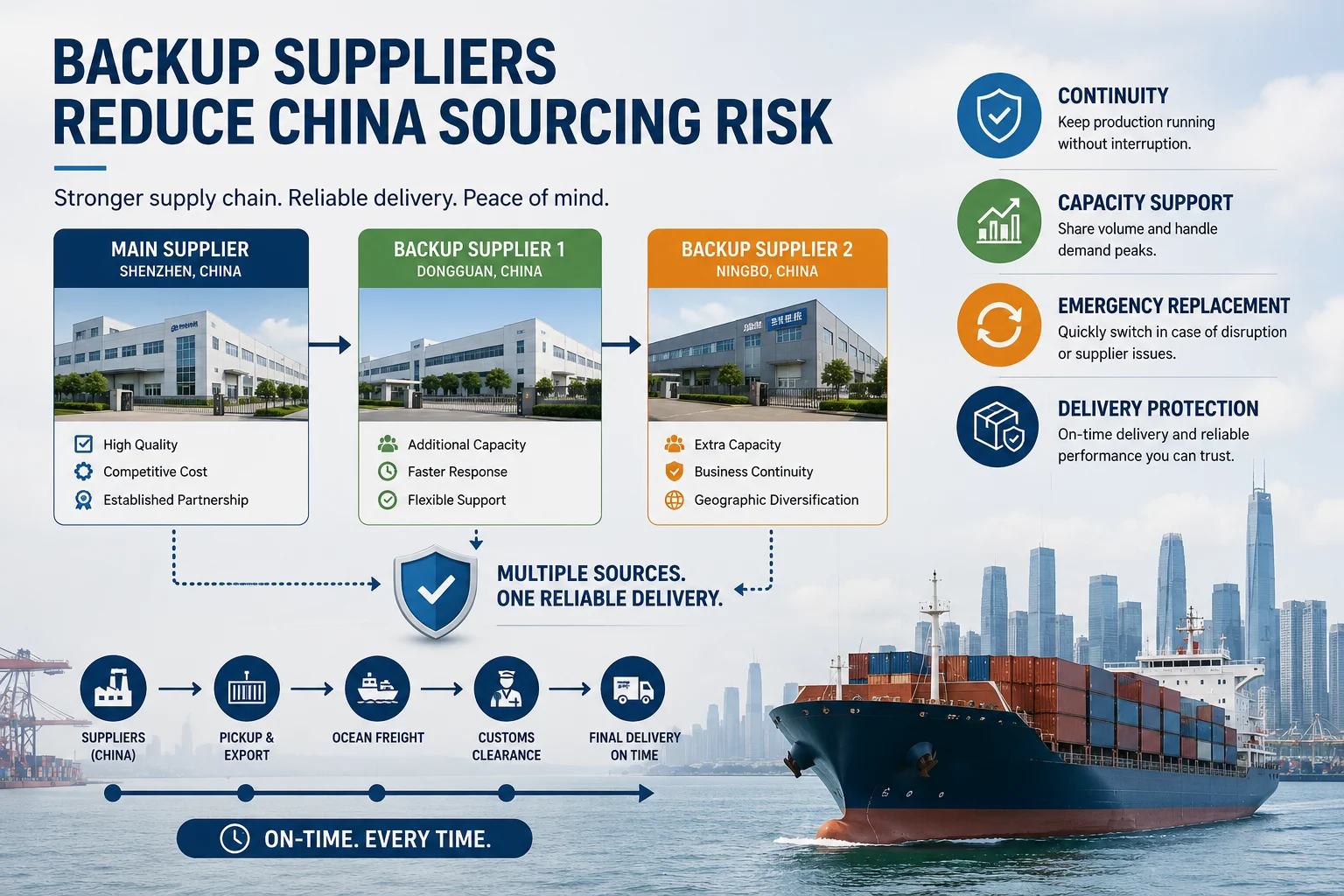
A single supplier can become a weak point in your supply chain.[^8] Capacity shortages, material changes, quality problems, holidays, and shipping disruptions can all affect production. A backup supplier gives buyers more options before an urgent problem occurs.
Backup suppliers reduce China sourcing risk by giving buyers a verified alternative when the main factory has quality failures, capacity shortages, delays, or pricing changes. A backup supplier should be identified and evaluated in advance, not only after the primary supplier fails.
A backup supplier is not a duplicate order
You do not need to place the same order with several factories. Instead, you can prepare an alternative supplier through a basic qualification process:
- Identify suitable factories or suppliers
- Verify company identity
- Compare quotations under the same specifications
- Evaluate samples where appropriate
- Review capacity and lead time
- Check basic compliance capability
- Keep communication channels active
This approach helps buyers understand whether the primary supplier’s price is realistic. It also gives the buyer more negotiating leverage and a practical contingency plan.
In our experience, backup suppliers are especially useful for products with seasonal demand, fast-moving ecommerce sales, or long production cycles. If the main supplier has a delay, the buyer does not need to restart the search process from zero.
A backup supplier also supports better decision-making. You can compare material suggestions, packaging solutions, and production timelines across several qualified options instead of relying on one supplier’s explanation.
How Does KingSourcing Find the Best-Value Supplier in China?
Finding the best-value supplier requires more than collecting quotes. Buyers need local support to confirm specifications, identify reliable suppliers, manage samples, inspect production, and coordinate shipping. We act as an extension of your sourcing and quality-control team in China.
KingSourcing helps buyers find verified, best-value suppliers in China by comparing quotations against the same specifications, checking supplier identities, reviewing samples, monitoring production, arranging inspections, and coordinating consolidation and shipping. We focus on reducing sourcing risk and improving total cost visibility.
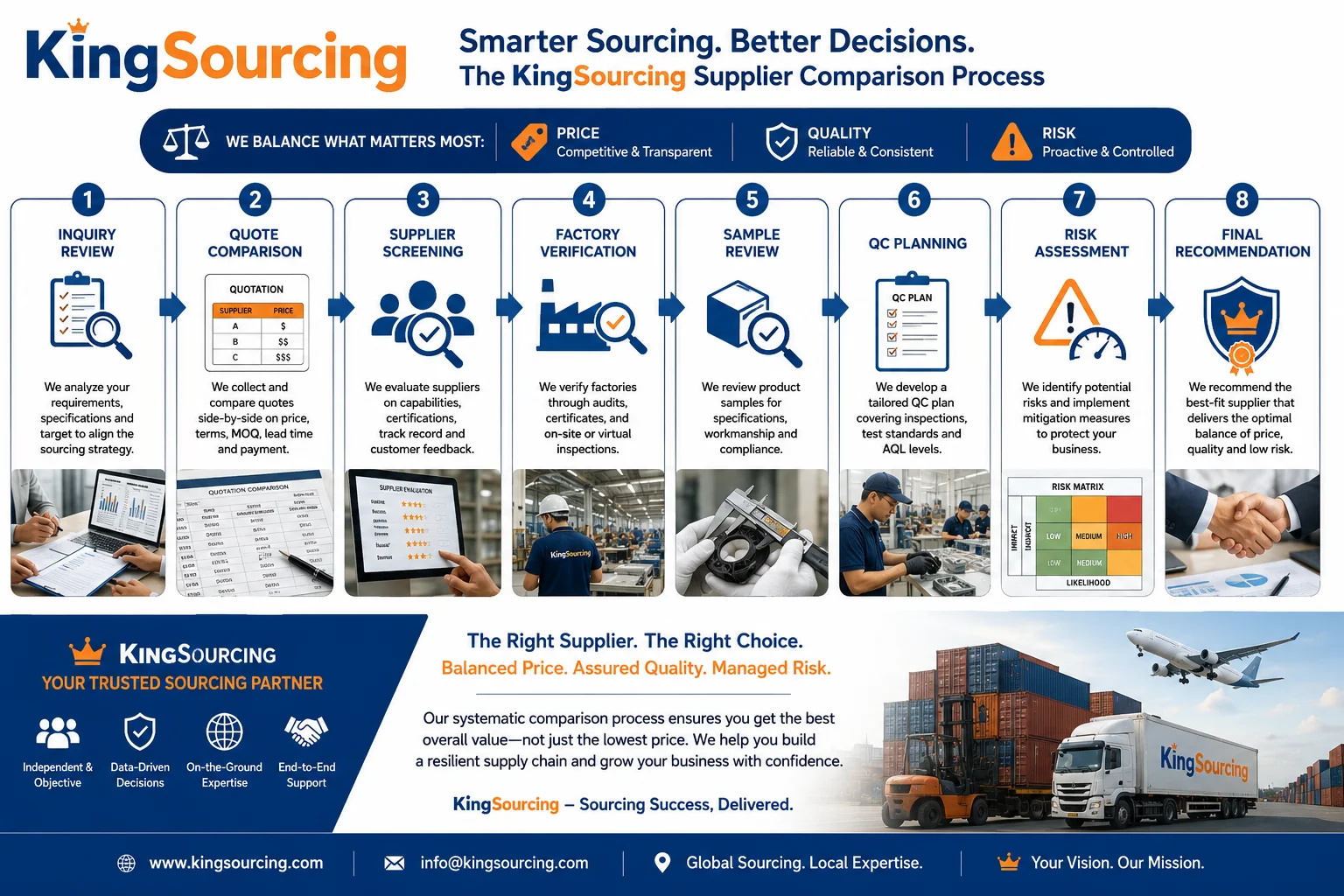
Our supplier comparison process
We usually support buyers through a structured process:
-
Define the exact product requirements
We clarify product details, materials, target quantity, packaging, destination market, and quality expectations. -
Identify suitable manufacturing regions
Different Chinese regions specialize in different product categories.[^9] We search where the relevant supply chain is strongest. -
Shortlist multiple suppliers
We do not depend on one initial quote. We compare suitable factory and supplier options. -
Verify supplier identity
We review company registration, business information, and the relationship between the supplier and production site. -
Compare quotations fairly
We ask suppliers to quote against the same confirmed requirements. -
Review samples and specifications
We help manage sample feedback and identify differences before bulk production. -
Check factory capability
We can arrange video checks, factory audits, or on-site visits based on the order’s needs. -
Follow production and quality control
We support production follow-up and pre-shipment inspection to identify problems before goods leave China. -
Coordinate consolidation and shipping
We can combine goods from multiple suppliers, manage packaging needs, store inventory, and support international delivery.
A recurring quotation pattern we see
In supplier comparison work, we sometimes see a low quote for a consumer electronics product that appears attractive at first. After reviewing the details, the low price may use a lower-capacity battery, generic packaging, and no defined pre-shipment testing.
A slightly higher-priced supplier may provide the required battery specification, confirmed packaging, and clearer quality procedures. The second supplier is not automatically better, but the comparison becomes meaningful because the buyer can see what each offer actually includes.
The goal of China sourcing is not to find the lowest unit price. It is to find the lowest total cost for a product that meets your required quality, compliance, and delivery standards.
If you have received a quotation that looks unusually low, we can help you compare Chinese supplier quotations, verify a Chinese supplier, and review the real sourcing cost before you place an order.
Frequently Asked Questions
Should I always choose the lowest Chinese supplier quotation?
No. You should choose the supplier that offers the best combination of confirmed product quality, price, delivery reliability, compliance support, and manageable risk. The lowest quotation may be suitable, but only after you verify its specification, price scope, supplier identity, and production capability.
Why do Chinese suppliers quote different prices for the same product?
Suppliers may use different materials, components, packaging, quality standards, order quantities, and trade terms. Some quotations also exclude tooling, testing, certification, inspection, or logistics. You can compare prices fairly only when every supplier quotes the same documented requirements.
How can I tell whether a supplier quotation is too low?
A quotation may be too low if it is far below other comparable offers and the supplier cannot explain the difference clearly. Ask for a full breakdown of materials, components, packaging, testing, lead time, and exclusions. Then verify the supplier and review samples before payment.
Is a factory always cheaper than a trading company?
No. A factory may offer lower prices for products it makes regularly, but a trading company can sometimes offer better pricing through volume, supplier relationships, product consolidation, or access to multiple factories. The important issue is whether the supplier can meet your requirements reliably.
How many Chinese suppliers should I compare before ordering?
We usually recommend comparing at least three suitable suppliers[^10] when time and product complexity allow. This gives you a clearer view of market pricing, available specifications, quality levels, and lead times. For complex or high-value orders, a broader shortlist may be useful.
Conclusion
The cheapest Chinese supplier is not necessarily the wrong choice, but it should never be selected based on unit price alone. We recommend comparing every quotation against the same specifications, packaging, quality standards, delivery terms, and compliance requirements. Verify the supplier’s identity, review samples carefully, define inspection standards, and calculate total sourcing cost. If you need a local team to compare suppliers, inspect products, and manage your China supply chain, contact KingSourcing to make your China sourcing simpler.
Tags: China Supplier Verification, Chinese Supplier Comparison, China Sourcing Agent, Supplier Risk Management, China Factory Audit, Product Quality Inspection, Import from China
[^1]: "Determine Total Export Price", https://www.trade.gov/determine-total-export-price. Trade guidance defines landed cost as the cumulative cost of bringing goods to their destination, commonly including the product price and applicable transport, duty, insurance, and handling charges. Evidence role: definition; source type: government. Supports: That landed cost is a cumulative import cost measure that can include product price, transportation, duties, insurance, and related charges.. Scope note: The precise cost components depend on the transaction, destination, and agreed Incoterm. [^2]: "A Manual of Stainless Steel - Data for Meat and Poultry", https://nvlpubs.nist.gov/nistpubs/Legacy/IR/nbsir76-1185.pdf. Materials-science references explain that stainless steel's corrosion resistance arises from a chromium-rich passive surface, while plated ferrous products rely on a coating whose damage or degradation can expose the underlying metal. Evidence role: mechanism; source type: research. Supports: That stainless steels derive corrosion resistance from chromium-containing passive films, whereas coated or plated ferrous materials depend on the integrity of their surface coating.. Scope note: Actual product durability also depends on alloy grade, coating type and thickness, environment, and manufacturing quality. [^3]: "Mexico - Import Requirements and Documentation", https://www.trade.gov/country-commercial-guides/mexico-import-requirements-and-documentation. Government and regulatory guidance states that product-safety, conformity-assessment, labeling, and documentation obligations vary according to product type and the market in which goods are placed on sale. Evidence role: general_support; source type: government. Supports: That market-access and product-safety requirements are product-specific and may differ across jurisdictions.. Scope note: A general regulatory source cannot determine the complete compliance obligations for a particular product, configuration, or destination. [^4]: "Conformity assessment", https://single-market-economy.ec.europa.eu/single-market/goods/building-blocks/conformity-assessment_en. Product-compliance guidance requires manufacturers and importers to maintain documentation demonstrating conformity for the relevant product and applicable market rules; documents for another model or configuration may therefore be insufficient. Evidence role: general_support; source type: government. Supports: That conformity documentation must correspond to the relevant product and applicable legal requirements, rather than being treated as a universal approval.. Scope note: Whether a particular report covers a product depends on its stated model scope, standards, test conditions, and the destination's legal framework. [^5]: "united states – singapore free trade agreement", https://www.trade.gov/sites/default/files/2023-09/Sing1.pdf. International quality-control standards describe acceptance sampling using specified acceptance criteria, while international sales-law materials address remedies when delivered goods fail to conform to contractual requirements. Evidence role: general_support; source type: institution. Supports: That acceptance sampling can use defined acceptance-quality limits and that international sales law provides buyer remedies for nonconforming goods subject to contractual and legal conditions.. Scope note: The appropriate inspection plan and available remedy depend on the contract, governing law, notice requirements, and the nature of the alleged nonconformity. [^6]: "Know Your Incoterms", https://www.trade.gov/know-your-incoterms. The International Chamber of Commerce explains that Incoterms allocate defined delivery obligations, costs, transport arrangements, customs responsibilities, and risk-transfer points between contracting parties. Evidence role: definition; source type: institution. Supports: That Incoterms specify distinct obligations for delivery, carriage, costs, export or import formalities, and transfer of risk.. Scope note: Incoterms do not determine all commercial terms, such as product quality, payment, title transfer, or remedies for defective goods. [^7]: "Minimizing Fraud", https://www.trade.gov/minimizing-fraud. Trade-fraud and payment-security guidance advises businesses to verify counterparties and independently confirm changes or instructions involving bank-account details before sending funds. Evidence role: general_support; source type: government. Supports: That counterparty due diligence includes confirming the legal entity and independently verifying payment details to reduce business-payment fraud risk.. Scope note: Different legal entities can participate legitimately in a supply transaction, so an inconsistency is a due-diligence signal rather than proof of fraud. [^8]: "Reducing the Risk of Supply Chain Disruptions", https://sloanreview.mit.edu/article/reducing-the-risk-of-supply-chain-disruptions/. Supply-chain resilience research identifies supplier concentration as a potential disruption exposure and examines sourcing diversification as one means of reducing dependence on a single source. Evidence role: general_support; source type: paper. Supports: That supplier concentration can expose firms to disruption risk and that sourcing diversification is commonly analyzed as a resilience strategy.. Scope note: Multiple sourcing can also add qualification, coordination, quality-control, and volume-cost trade-offs. [^9]: "How Do Special Economic Zones and Industrial Clusters ...", https://documents1.worldbank.org/curated/en/310891468018256346/pdf/WPS5583.pdf. Research on China's industrial development documents geographically concentrated manufacturing clusters in which related firms, suppliers, labor, and supporting services develop sector-specific specializations. Evidence role: historical_context; source type: research. Supports: That Chinese manufacturing development has involved geographically concentrated industrial clusters and regionally specialized production networks.. Scope note: Cluster patterns change over time, and an identified regional specialization does not establish that every supplier there has suitable capability. [^10]: "ProcurementGuidanceonShopping.docx", https://thedocs.worldbank.org/en/doc/76601458316701482-0290022000/original/ProcurementGuidanceonShopping.docx. Procurement guidance commonly calls for obtaining and evaluating multiple written quotations to support comparison of price, specifications, delivery conditions, and supplier responsiveness. Evidence role: general_support; source type: institution. Supports: That procurement procedures often use multiple written quotations to support price comparison and supplier selection.. Scope note: A three-quotation threshold is a procedural rule in some procurement contexts, not a universal optimum for every private-sector sourcing decision.