Pre-shipment inspection in China is often the last practical chance to catch problems before your goods leave the factory. If you release the balance payment too early, wrong colors, missing accessories, weak packaging, or uneven quality can become expensive problems after arrival. We use inspection as a clear release decision: ship, correct, recheck, or pause.
A pre-shipment inspection in China is a quality-control check performed when production is substantially complete and goods are packed or ready for packing[^1]. It verifies whether the bulk order matches the approved sample, purchase order, product specifications, quantity, functionality, labels, packaging, and shipping requirements. Based on the findings, buyers can approve shipment, request rework, arrange a re-inspection, or hold the order until the supplier resolves critical issues.
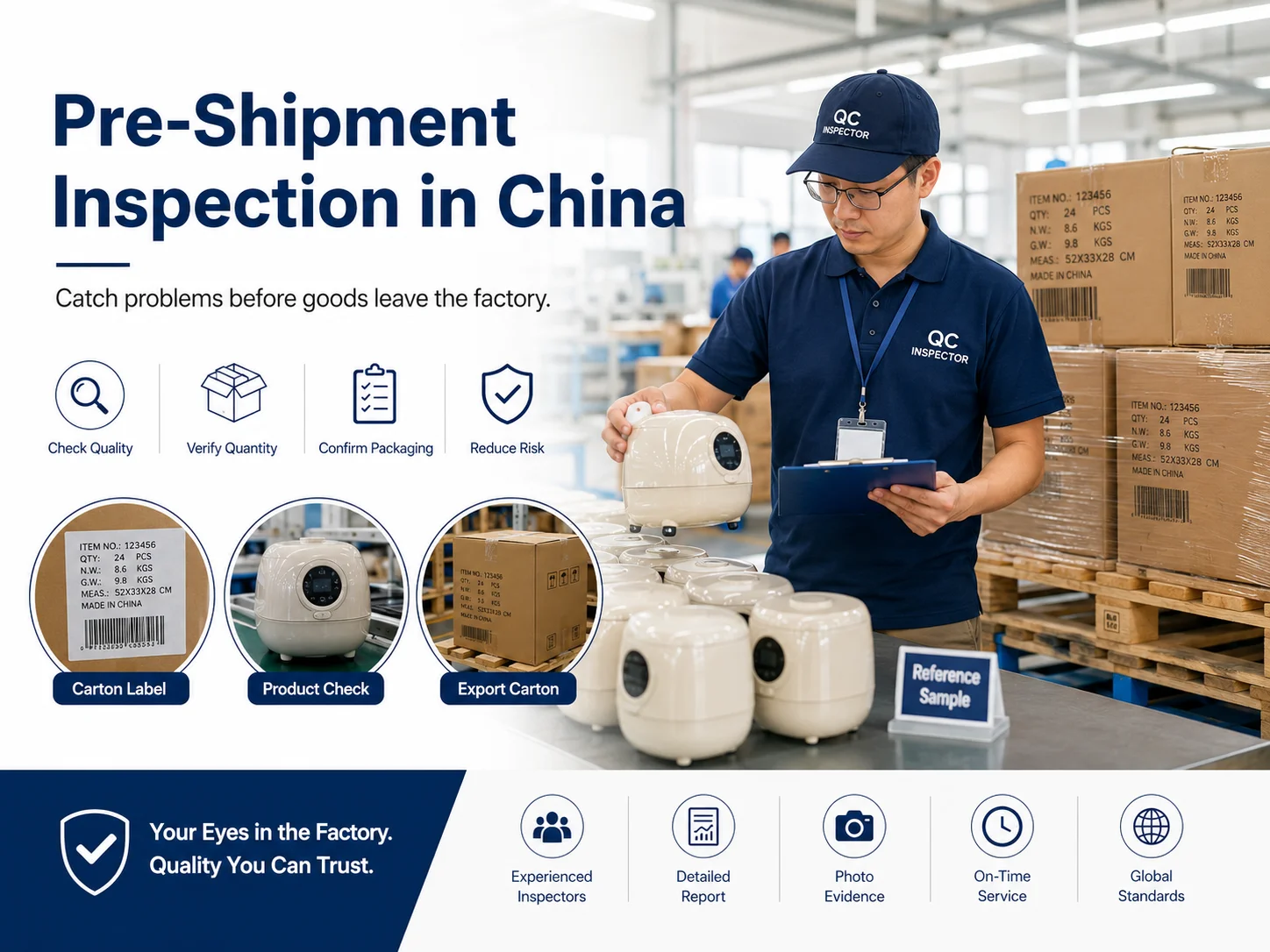
Factory photos and videos can be useful, but they are not proof that an entire order is ready to ship.[^2] A few good-looking units may hide inconsistent production, incomplete sets, incorrect labels, or damaged cartons. We treat the inspection process as a structured comparison between what the buyer approved and what the factory actually produced.
Quick Answer: What Does a Pre-Shipment Inspection in China Check?
A shipment can look finished from a distance while still carrying costly risks. Many importers only discover those risks after the goods reach a warehouse, marketplace fulfillment center, or customer. At that point, corrections are slower, more expensive, and sometimes impossible.
A pre-shipment inspection in China checks finished goods before they are released for export. The inspector normally reviews a representative sample of the production lot[^3], compares it with the approved sample and written requirements, and records defects or mismatches. The buyer then uses the report to decide whether to approve shipment, request corrections, require a re-inspection, or delay release.
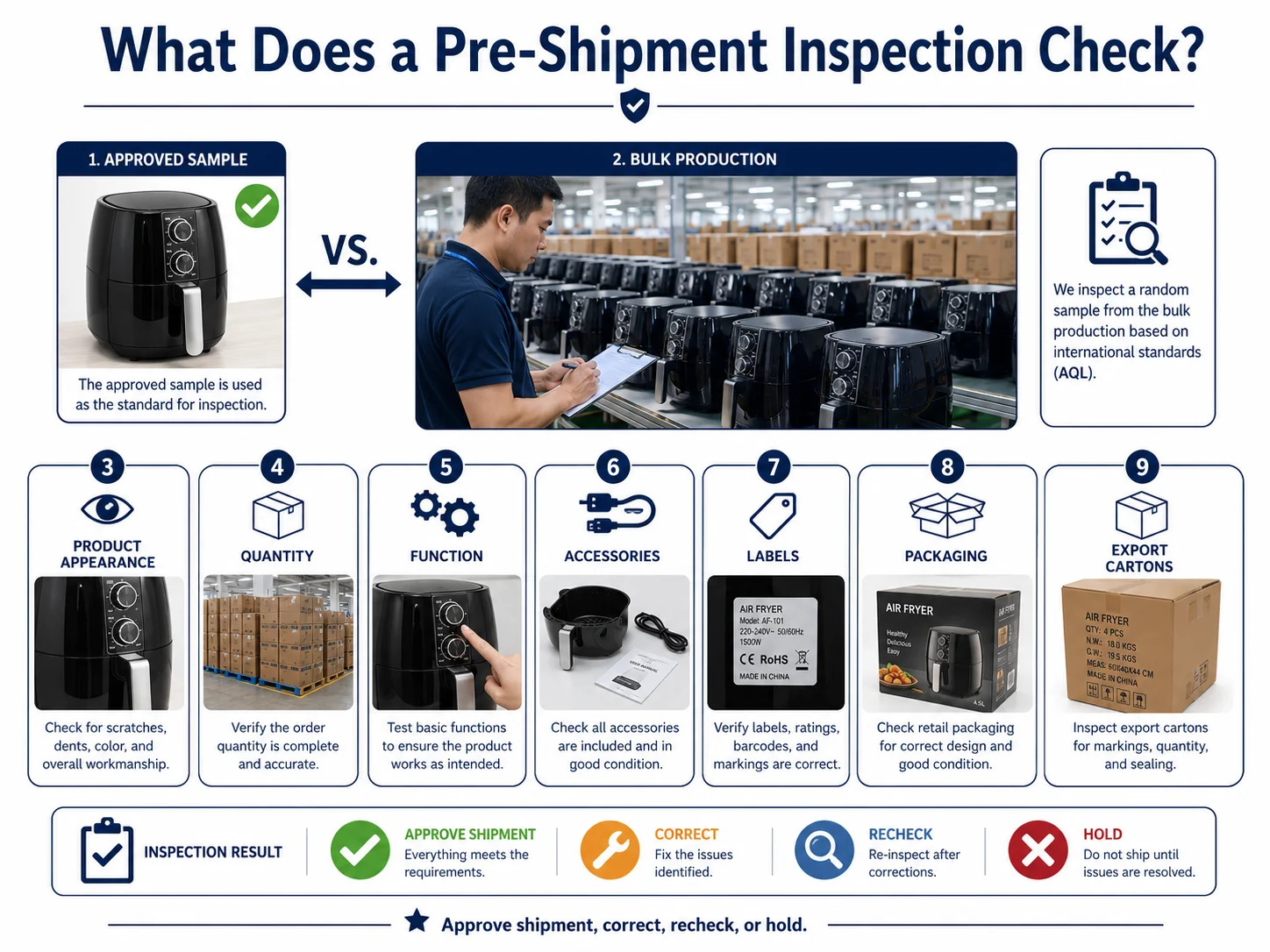
In our day-to-day coordination work, the most useful inspection reports do not simply say “pass” or “fail.” They explain what was checked, what was found, how serious each issue is, and whether the result changes the buyer’s shipment decision.
A practical release review usually covers:
- Product appearance and workmanship
- Product dimensions, color, material, and construction
- Functions, components, and accessories
- Order quantity and SKU assortment
- Logo, artwork, labels, barcodes, and warnings
- Inner packaging and retail packaging
- Outer cartons, carton marks, and shipping readiness
The important point is simple: the checklist should come from the agreement with the supplier. We start with the approved sample, product specification sheet, purchase order, packaging files, and buyer-defined acceptance criteria. A generic checklist alone cannot tell us whether a product is acceptable for your particular brand.
An inspection report is evidence for a commercial decision. It is not a guarantee that every unit is defect-free or that every market compliance requirement has been met.
What Is a Pre-Shipment Inspection in China?
Buyers can feel confident after receiving production updates, then find that bulk goods do not match the sample they approved. This happens because production consistency, packaging, assembly, and final handling can change between sampling and mass production. A final check creates a clearer picture before shipping.
A pre-shipment inspection in China, often called PSI or final random inspection, takes place when production is generally complete—commonly when at least 80% to 100% of goods are finished and available for checking[^4]. Its purpose is to assess whether the finished order is sufficiently aligned with agreed requirements before the buyer releases the balance and authorizes shipment.
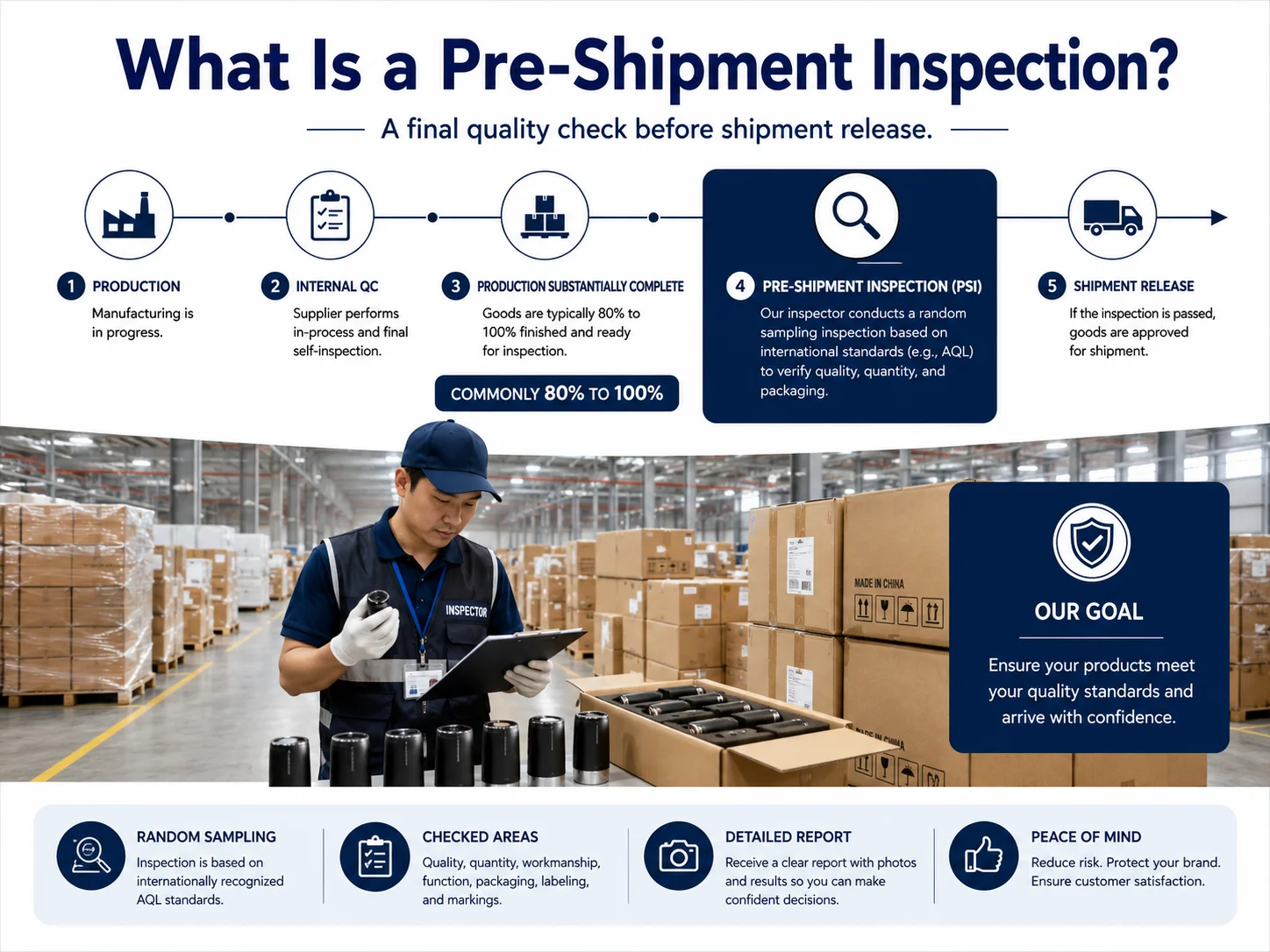
We normally recommend this step for ecommerce sellers, DTC brands, wholesalers, and first-time importers who do not have a local team at the factory. It is especially useful for products with customized packaging, branding, multiple variants, accessories, or a meaningful risk of returns.
How PSI differs from other quality-control steps
Pre-shipment inspection is not the same as every other inspection service. Each stage answers a different question.
| Inspection type | Typical timing | Main purpose | Best use case |
|---|---|---|---|
| Pre-production inspection | Before mass production | Confirm materials, components, and factory understanding | New products, custom orders |
| During-production inspection | During production | Catch problems before the full order is completed | Larger or higher-risk orders |
| Pre-shipment inspection | After production, before shipping | Verify finished bulk goods against requirements | Most export orders |
| Container loading inspection | During loading | Check loading condition, carton count, and container handling | Full-container shipments |
| 1-by-1 inspection | Every unit before packing or shipment | Identify defects unit by unit | High-return-risk or premium products |
A factory audit focuses on supplier capability and systems. A during-production inspection helps identify issues while there is still time to adjust the process. Container loading supervision focuses on the loading stage. A 1-by-1 inspection checks every item rather than a sample.
We do not assume one step replaces another. For example, a buyer may need a production-stage review for a new customized item, then a final inspection before shipment. The right approach depends on product complexity, order value, supplier history, and the cost of getting it wrong.
When Should Buyers Arrange a Pre-Shipment Inspection in China?
Skipping inspection can seem like a way to save money or move faster. However, a problem found after goods are loaded can cause delayed launches, chargebacks, expensive air freight, marketplace complaints, and lost customer trust. The right timing protects both the order and the launch plan.
Buyers should arrange a pre-shipment inspection in China when goods are substantially completed but before final payment and shipment release. It is particularly valuable for first orders, custom products, large purchase orders, products with high return risk, and orders with strict launch or delivery deadlines.
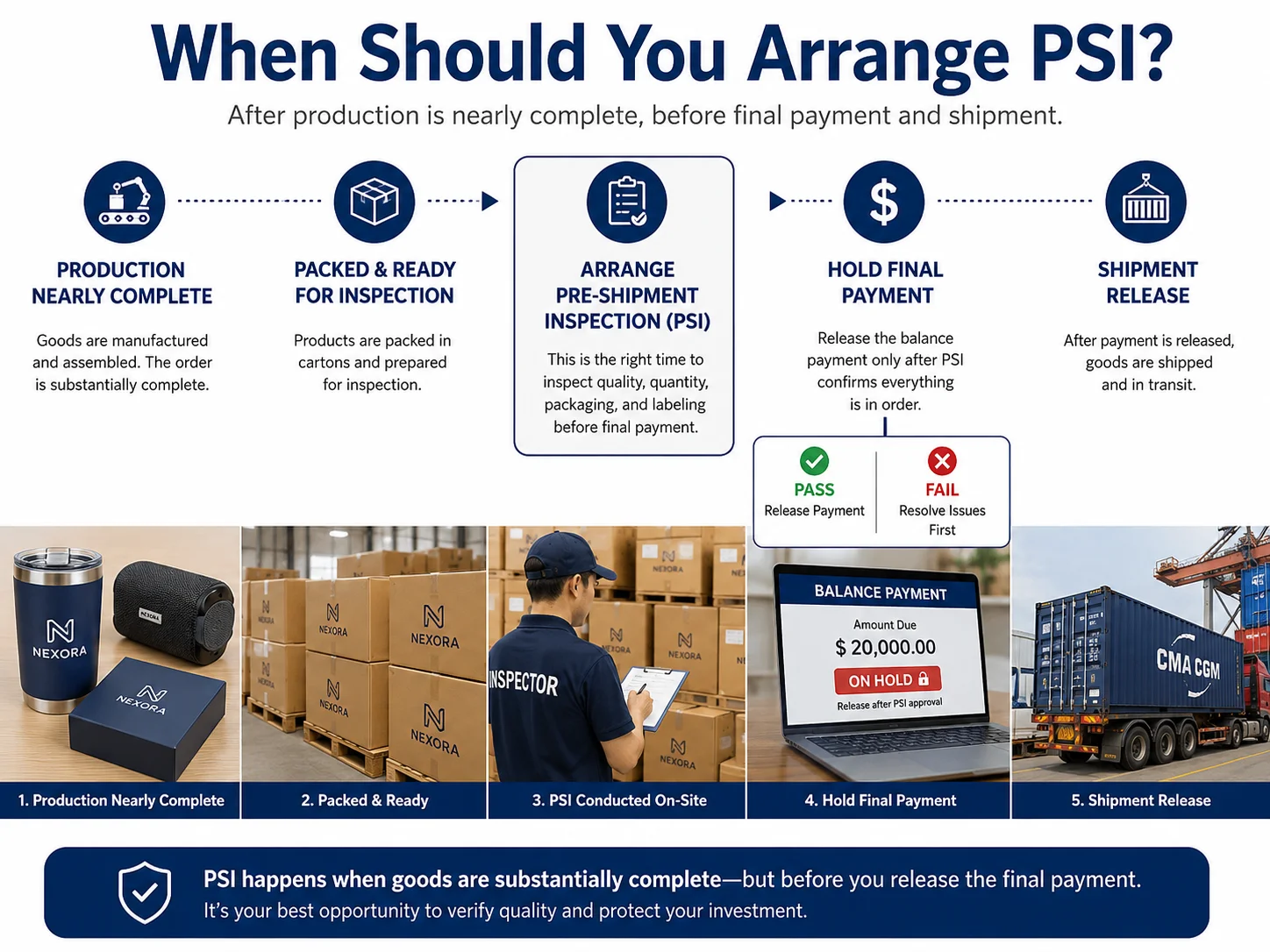
In our experience, buyers gain the most from PSI when they use it before their leverage disappears. Once the supplier receives the full balance and the goods are on the water, it becomes harder to negotiate rework, replacement quantities, or responsibility for defects.[^5]
Consider arranging final inspection when:
- You are working with a new supplier. A supplier may communicate well and provide good samples, but bulk production still needs verification.
- The product is customized. Custom colors, logos, molds, inserts, packaging, and bundles create more opportunities for mismatch.
- The order value is significant. The financial impact of a bad shipment can exceed the inspection cost many times over.[^6]
- The product has a high return risk. Apparel, consumer electronics, fragile goods, children’s products, beauty tools, and multi-component sets often need closer attention.
- You have strict retail or marketplace requirements. Incorrect FNSKU labels, carton marks, warning labels, or packaging dimensions can create fulfillment delays.[^7]
- The supplier has changed materials or processes. A new production line, new subcontractor, or revised component should trigger additional caution.
We also recommend booking early. Inspectors need access to the right products, approved sample, packaging files, and production records. If the factory tells you the order is complete only one day before collection, there may be little time to correct issues without delaying shipment.
What Should a Pre-Shipment Inspection in China Include?
A product may pass a quick visual glance but still fail the buyer’s actual requirements. Missing accessories, wrong carton labels, poor assembly, or incorrect dimensions can all create downstream problems. That is why a final check needs to go beyond taking photos of a few cartons.
A pre-shipment inspection in China should check the finished product, order quantity, key specifications, workmanship, functionality, accessories, branding, packaging, labels, and export cartons. Every check should be tied to the approved sample, purchase order, and written requirements rather than an inspector’s personal preference.
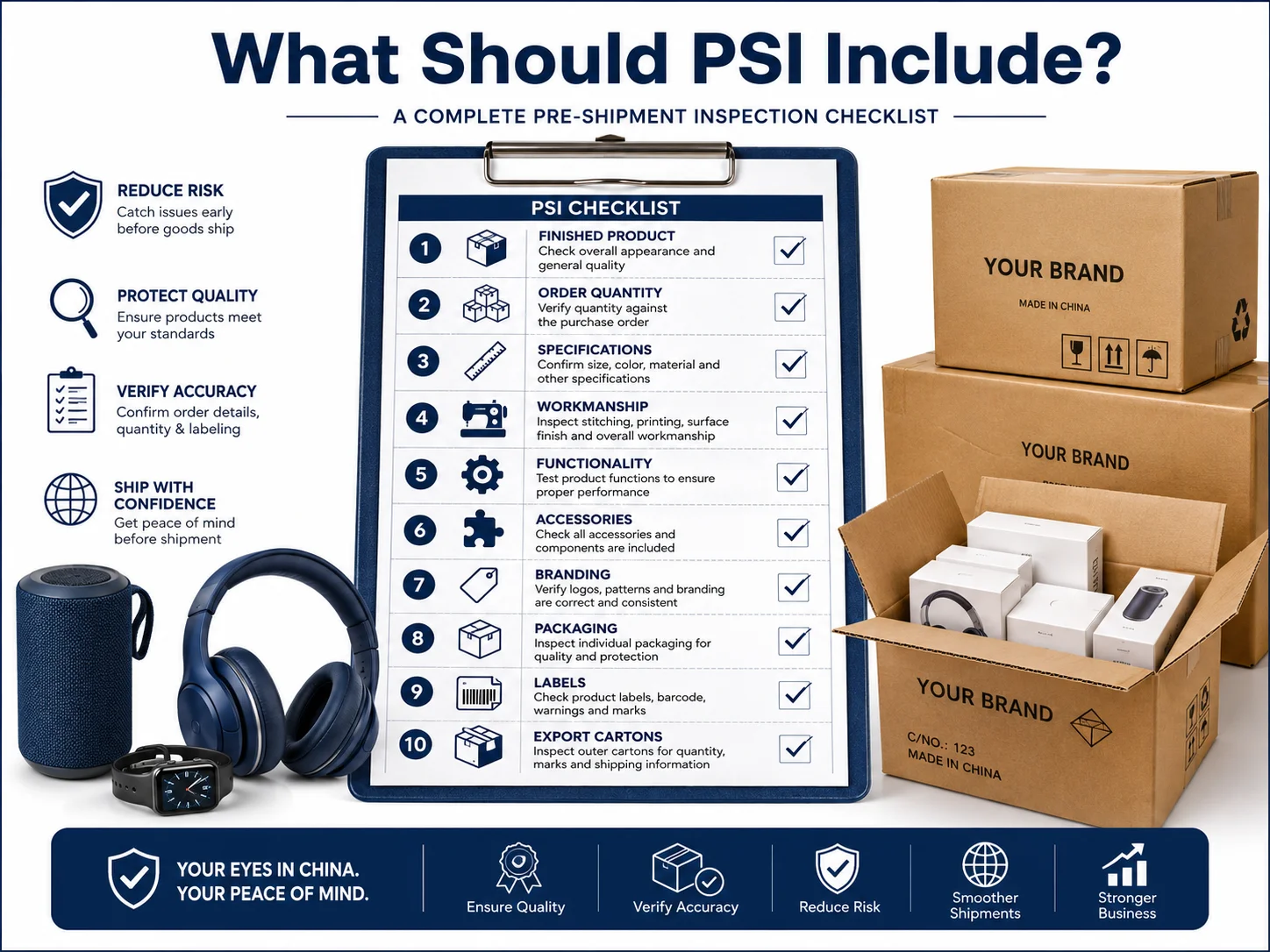
We build checklists around release risk. In other words, we ask: “What could make this shipment unsellable, unprofitable, delayed, or difficult to fix after arrival?”
Core inspection areas
| Area | What we compare or verify |
|---|---|
| Quantity | Total units, SKU breakdown, color and size assortment |
| Appearance | Scratches, stains, cracks, dents, loose threads, uneven finishing |
| Dimensions | Product size, weight, fit, tolerances where specified |
| Materials | Fabric, metal, plastic, finishes, components, buyer-approved details |
| Function | Basic operation, assembly, moving parts, charging or switches where applicable |
| Branding | Logo placement, color, spelling, artwork, print quality |
| Accessories | Manuals, cables, inserts, spare parts, bundles, promotional items |
| Packaging | Box quality, inserts, sealing, barcode labels, warning labels |
| Outer cartons | Carton count, carton marks, moisture damage, dimensions, gross weight |
For example, a branded drinkware order may require checks for logo alignment, color consistency, lid fit, accessory count, retail box artwork, and carton markings. A home storage product may need assembly checks, dimensions, material thickness, hardware completeness, and drop-risk packaging review.
We do not present a visual inspection as laboratory testing. If your product requires regulated safety testing, chemical testing, electrical certification, food-contact verification, or destination-market compliance documents, those requirements should be confirmed separately for the specific product and market. A PSI can help verify visible labels and agreed product features, but it does not replace accredited testing or legal compliance review.[^8]
Random Sampling vs. 1-by-1 Inspection: Which Is Better?
Some buyers expect an inspector to check every unit, while others only want a fast general review. Both approaches can work, but they solve different problems. Choosing the wrong method can leave you under-protected or add costs that do not match the actual risk.
Random sampling checks a selected portion of the finished lot to estimate overall consistency.[^9] A 1-by-1 inspection checks each individual unit against defined criteria. Random sampling is usually faster and more economical, while full inspection offers stronger defect detection for unit-level issues but requires more time and labor[^10].
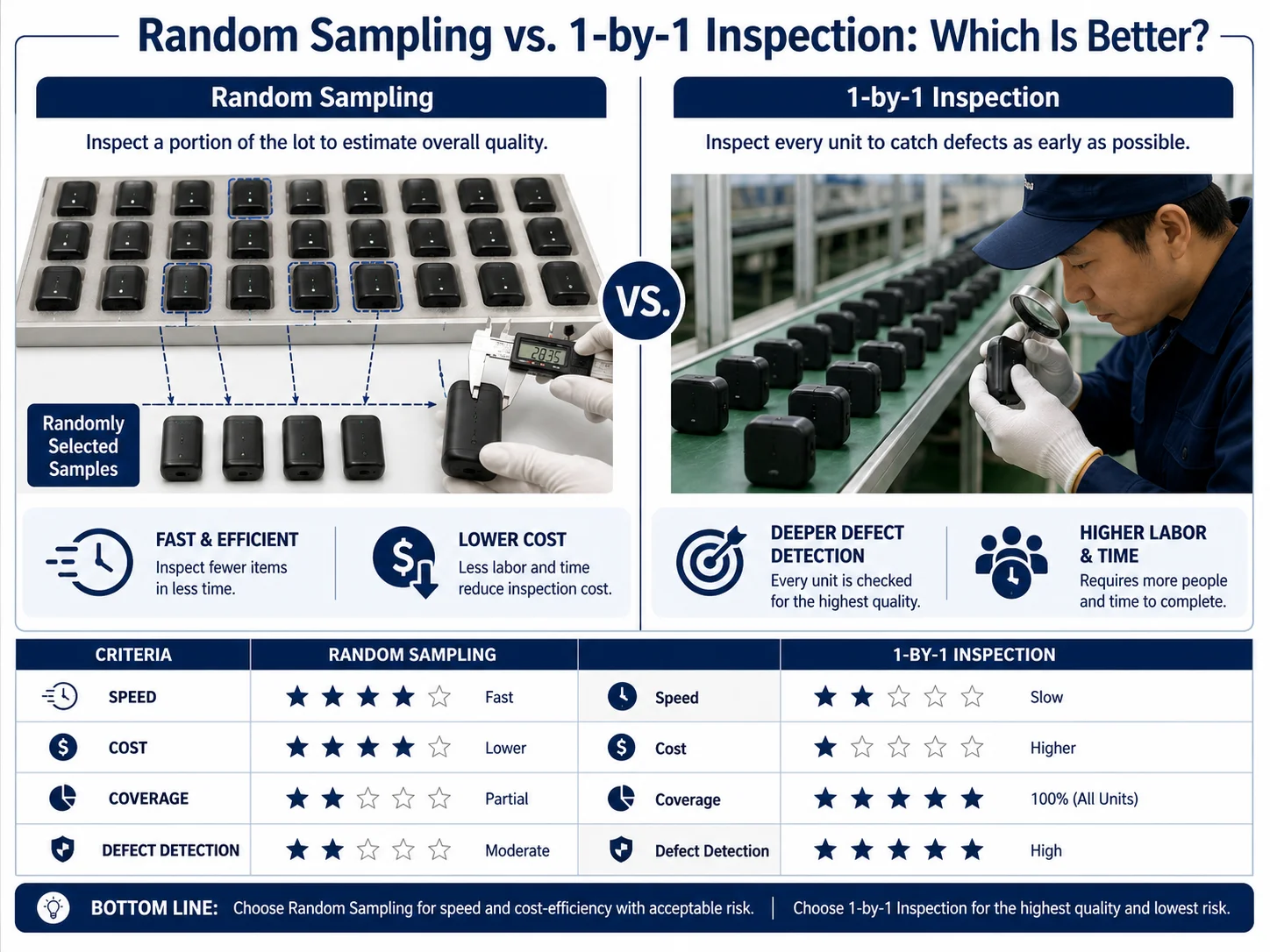
A common sampling approach uses an agreed inspection standard, often described using AQL terminology.[^11] However, the sample size and acceptable defect threshold should be agreed for the product, the order, and the buyer’s risk tolerance. We do not treat a default AQL setting as a universal answer.
| Factor | Random sampling inspection | 1-by-1 inspection |
|---|---|---|
| Units checked | A defined sample from the lot | Every available unit |
| Cost | Lower | Higher |
| Time required | Faster | Longer |
| Defect detection | Identifies patterns and major quality concerns | Finds more individual defects |
| Best for | Stable suppliers, standard products, lower-risk orders | High-value goods, fragile items, strict ecommerce standards |
| Limitation | Some defects may exist outside the sample | Does not replace proper specifications or production control |
We often suggest random sampling for standard goods from a proven supplier, especially when the buyer has clear specifications and a practical tolerance for minor issues. We may recommend 1-by-1 inspection for products with a high customer return rate, expensive components, sensitive cosmetic appearance, or complex packaging sets.
For example, a simple unbranded storage basket may be suitable for random sampling. A premium gift set with several accessories, custom inserts, fragile surfaces, and marketplace labeling may justify checking each unit before final packing.
The key is not to ask, “Which method is best?” Instead, ask, “What is the cost if one defective unit reaches my customer?” That answer usually makes the right inspection level clearer.
How Do Buyers Compare Bulk Production With an Approved Sample?
A good sample can create false confidence if nobody uses it as the reference point for bulk production. Suppliers may interpret colors, finishes, packaging, or small construction details differently during mass production. Without a fixed benchmark, discussions can become subjective and slow.
Buyers should compare bulk production against an approved sample—or golden sample—plus written specifications and packaging requirements. The comparison should cover appearance, dimensions, materials, function, workmanship, logos, components, and packaging. The approved sample should be clearly identified and available during inspection whenever possible.
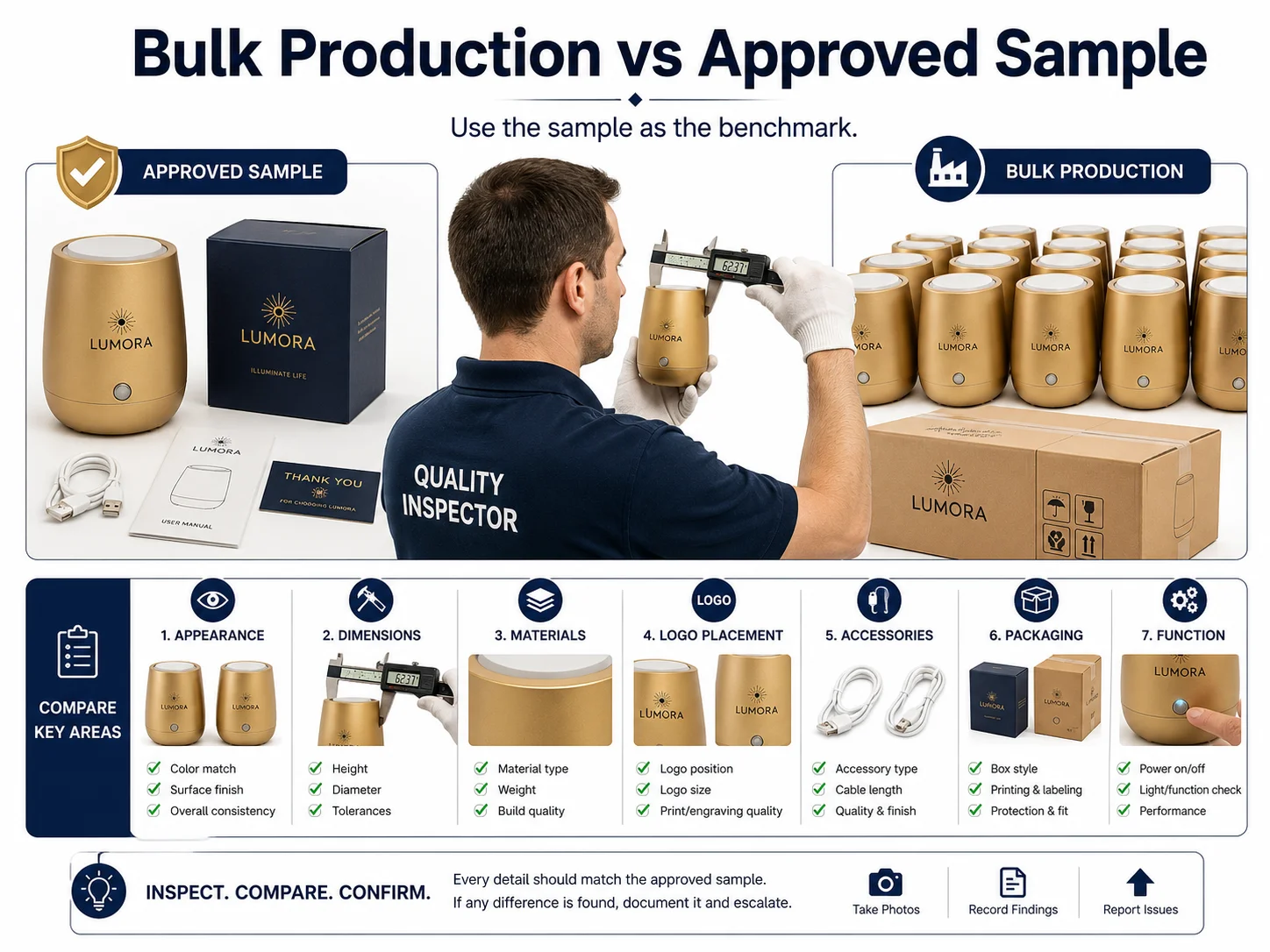
In our team, we have seen small details become major commercial issues. A logo may be technically present but printed in the wrong position. A product may work but use a thinner material than the approved version. A retail box may contain the correct item but use outdated artwork or an incorrect barcode.
Make the approved sample usable
A “looks good” sample approval is not enough. We encourage buyers to document what they approved:
- Product photos from multiple angles
- Color references or Pantone codes, where relevant
- Measurements and permitted tolerances
- Material descriptions and component lists
- Functional expectations
- Logo artwork and placement files
- Packaging layout and text
- Required accessories and inserts
- Carton marks, shipping labels, and barcode details
We also recommend keeping a signed or clearly labeled golden sample where practical. The sample should state the approval date, version, SKU, and any changes agreed after sampling.
If a requirement is important, write it down before production. For instance, “black logo” is vague. “Matte black logo, centered 25 mm below the top edge” is easier to inspect. The same principle applies to carton labels, zipper quality, battery capacity claims, and accessory combinations.
This documentation protects both sides. It gives the supplier a clearer production target, and it gives the buyer a more objective basis for deciding whether the shipment is ready.
What Happens If a Pre-Shipment Inspection in China Fails?
A failed inspection can feel alarming, especially when a launch date is approaching. However, the worst response is often to ignore unclear findings and ship anyway. A structured response can protect the buyer while keeping the supplier focused on specific corrective actions.
If a pre-shipment inspection in China finds unacceptable issues, buyers should review the defect details, classify their severity, ask the supplier for a correction plan, confirm responsibility, and arrange a re-inspection if needed. Buyers should normally avoid releasing the final balance or authorizing shipment until critical issues are resolved or an informed commercial decision is made.
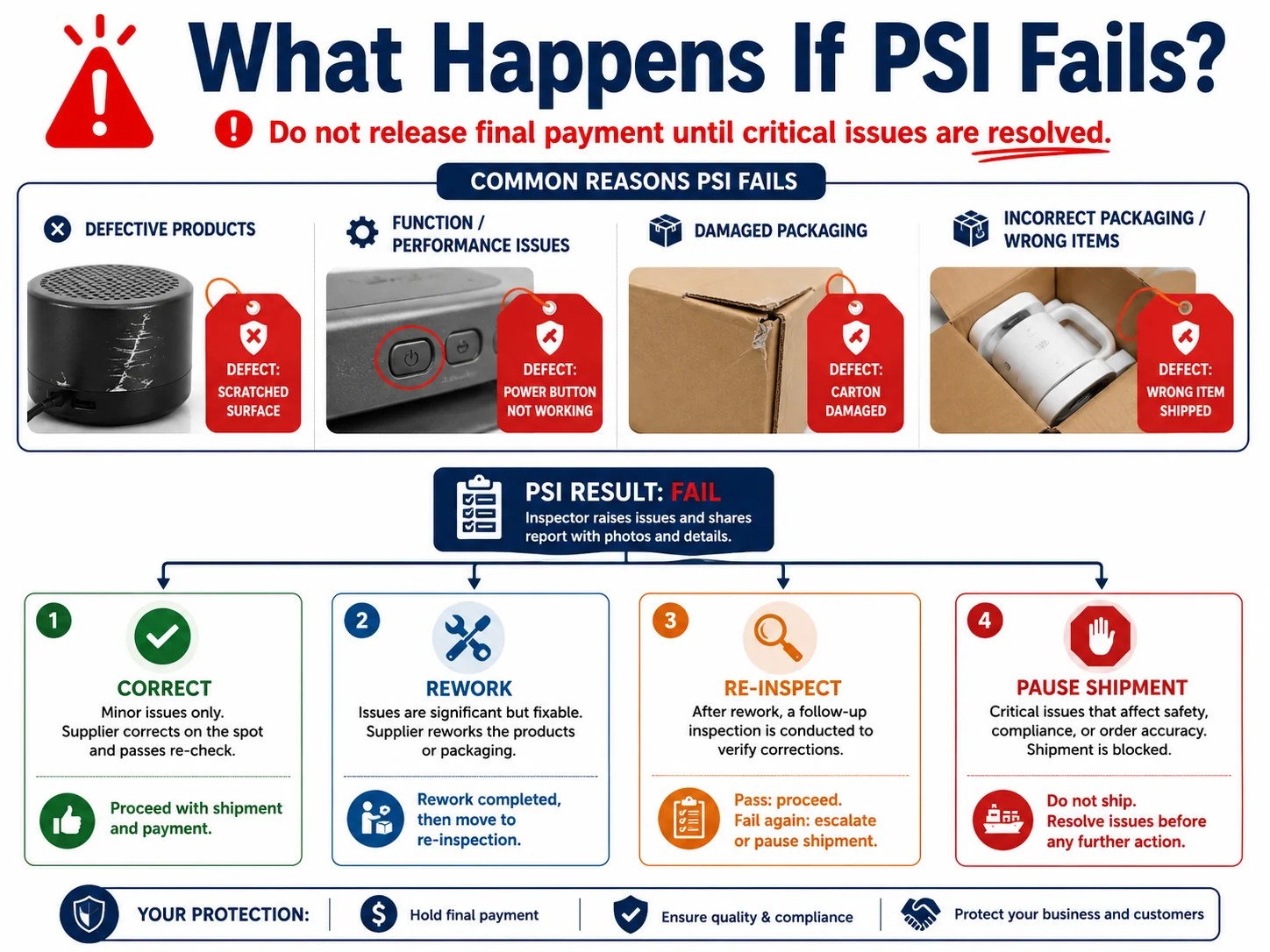
Not every issue deserves the same response. We usually separate findings into practical categories:
- Critical defects: Issues that may create safety concerns, legal risk, unusable products, or severe customer harm. These normally require immediate escalation and clarification.
- Major defects: Problems likely to cause returns, customer complaints, or significant loss of product value.
- Minor defects: Cosmetic or small issues that may be tolerable within an agreed threshold, depending on the product and sales channel.
A useful corrective-action process looks like this:
- Review the inspection report, photos, videos, and quantity details.
- Compare findings with the approved sample and written requirements.
- Ask the supplier to confirm the root cause and rework plan.
- Confirm whether affected goods will be repaired, replaced, repacked, relabeled, or removed.
- Verify that short quantities are made up where required.
- Arrange a re-inspection for corrected goods, especially after major defects.
- Release payment and shipping instructions only after the result is acceptable.
We have found that clear evidence matters. Instead of saying “quality is bad,” we report measurable or visible findings such as “12 of 80 checked units had loose handles,” “carton marks used the old SKU code,” or “the blue shade differs from the approved reference.”
Sometimes the right decision is not a full rejection. A buyer may accept a minor issue with a negotiated discount, sort goods at a warehouse, or reserve certain units for a lower-priced channel. The point is that the decision should be deliberate—not forced by a container already in transit.
How Does KingSourcing Manage Pre-Shipment Inspections in China?
Managing an inspection from overseas can be difficult when the factory, sample, specifications, and shipping timeline are all moving at once. Buyers need more than a generic report. They need someone to convert requirements into practical checks and coordinate the next step when issues appear.
At KingSourcing, we manage pre-shipment inspection in China as part of the buyer’s sourcing and shipment-release process. We help define the checklist, compare bulk goods with approved references, review product and packaging findings, provide photo-based reporting, follow up on corrections, arrange re-inspection when needed, and coordinate the next shipping stage.
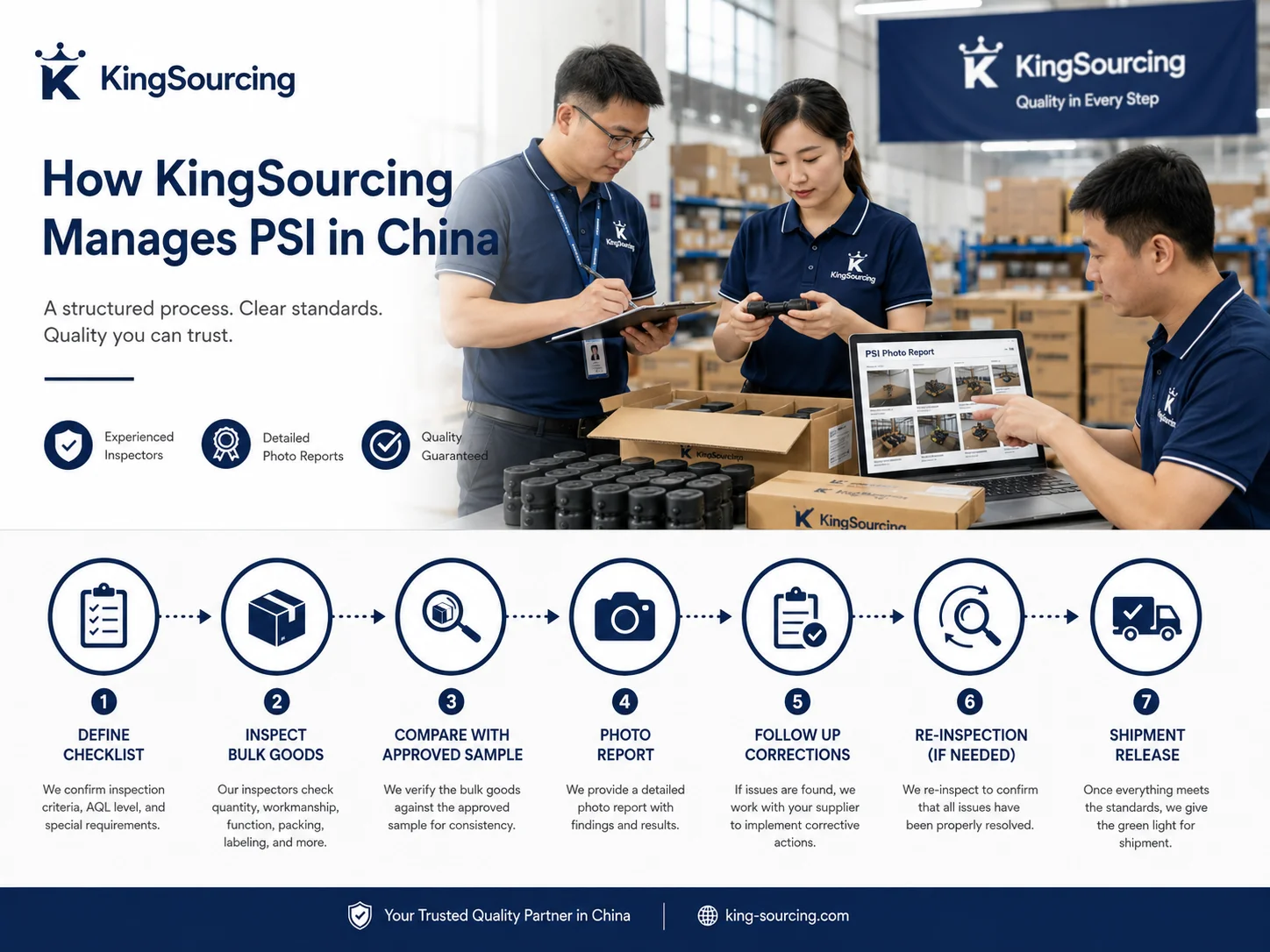
Our process typically includes:
- Requirement review: We collect the purchase order, approved sample details, product specifications, packaging files, labels, and special buyer requirements.
- Inspection planning: We confirm when goods will be ready, what SKUs need checking, and whether random sampling or 1-by-1 inspection is more suitable.
- On-site product review: We check the agreed product, quantity, workmanship, components, functions, packaging, and carton condition.
- Evidence-based reporting: We provide practical findings with photos, quantities, and clear descriptions.
- Correction follow-up: We communicate issues to the supplier and track agreed rework, replacement, relabeling, or repacking.
- Re-inspection support: We can arrange another check when corrections are complete.
- Shipment coordination: Once goods are ready for release, we can support warehousing, consolidation, container loading coordination, customs documentation, and door-to-door shipping arrangements.
We do not promise that an inspection removes every quality or supply-chain risk. No practical inspection can see every future issue, especially with hidden defects or product-specific regulatory requirements. What we can do is give buyers clearer evidence before they commit the final payment and shipment.
For many clients, that clarity is the real value. We act as their local sourcing office, quality-control coordinator, and logistics support team in China—so they can make better decisions without needing to be at the factory themselves.
Frequently Asked Questions About Pre-Shipment Inspection
When should a pre-shipment inspection be arranged?
A pre-shipment inspection should be arranged when production is substantially complete, ideally before final payment and before goods are loaded for export. We recommend booking early enough to allow time for supplier corrections and a possible re-inspection without disrupting the shipping schedule.
How much does inspection in China cost?
Inspection cost in China depends on the city, factory location, product complexity, number of SKUs, inspection method, and required time. Random sampling is usually less expensive than 1-by-1 inspection. Buyers should compare the fee with the potential cost of returns, rework, freight, and delayed sales.
How many products are checked during PSI?
The number depends on the agreed sampling plan, order quantity, product type, and buyer risk tolerance. A standard PSI usually checks a random sample rather than every unit. For fragile, high-value, or high-return-risk products, buyers may choose a larger sample or full 1-by-1 inspection.
What is an acceptable defect rate?
An acceptable defect rate is not universal. It should reflect the product category, price point, customer expectations, sales channel, and agreed standards. Buyers should define critical, major, and minor defect expectations before production. We recommend confirming any formal sampling rules for your product and destination market.
Should buyers pay the balance before inspection?
Buyers should generally avoid paying the full balance before reviewing the inspection result, unless their commercial agreement requires otherwise. Keeping a balance payment outstanding gives the buyer more leverage to request corrections, replacement quantities, or re-inspection before shipment release.
Is 1-by-1 inspection better than random sampling?
1-by-1 inspection detects more individual defects because every unit is checked. However, it costs more and takes longer. Random sampling may be sufficient for stable products and reliable suppliers. The better option depends on the cost of defects, product complexity, and your customer return risk.
Conclusion
A pre-shipment inspection in China is not just a defect hunt or a factory photo exercise. It is the final release process that helps buyers confirm whether finished goods match their approved sample, specifications, packaging requirements, quantity, and shipping needs. The best inspection plan reflects your actual commercial risk—not a generic checklist. If you need a China-based team to coordinate supplier checks, product inspection, rework follow-up, re-inspection, and shipment preparation, contact KingSourcing to make your China sourcing simpler.
Tags: Pre-Shipment Inspection China, China Product Inspection, Quality Control in China, 1-by-1 Inspection, Product Defect Prevention, China Sourcing Agent, Import from China
[^1]: "Special Documents", https://www.trade.gov/special-documents. Pre-shipment inspection is generally described as a final quality-control activity conducted after production is complete and before goods are dispatched. Evidence role: definition; source type: institution. Supports: That final or pre-shipment inspections are generally conducted after production is completed and before dispatch.. Scope note: Exact readiness thresholds and packing status vary by product, contract, and inspection provider. [^2]: "Precision and Bias", https://www.nist.gov/document/astmwk70035geocolor190806pdf. Quality-control sampling principles recognize that observations of limited units cannot by themselves demonstrate conformance of every unit in a production lot. Evidence role: mechanism; source type: research. Supports: That evidence from a limited number of observed units cannot establish conformance of every item in a production lot.. Scope note: This supports the general inference; it does not evaluate the evidentiary value of any particular factory photograph or video. [^3]: "Sampling (statistics)", https://en.wikipedia.org/wiki/Sampling_(statistics). Acceptance-sampling standards use inspection of a sample from a lot to inform an acceptance decision for the lot under defined procedures. Evidence role: definition; source type: institution. Supports: That acceptance sampling inspects a sample drawn from a lot to determine whether the lot meets specified acceptance criteria.. Scope note: A sampling plan can estimate lot quality but does not establish that every individual unit conforms. [^4]: "Trade Guide: WTO PSI", https://www.trade.gov/trade-guide-wto-psi. Operational guidance for final inspection commonly requires production to be substantially or fully completed and available for inspection before the visit. Evidence role: general_support; source type: other. Supports: That final inspections are commonly scheduled only when a large majority or all of the order has been produced and is available for review.. Scope note: The stated 80% to 100% range is an operational convention rather than a universal standard. [^5]: "Know Your Incoterms", https://www.trade.gov/know-your-incoterms. International-trade guidance notes that inspection and clearly defined acceptance terms should be addressed before payment and shipment, when remedies can be more readily implemented. Evidence role: general_support; source type: government. Supports: That payment timing and shipment status affect a buyer's practical ability to address quality disputes in international transactions.. Scope note: The parties' contractual terms, governing law, and payment instrument ultimately determine available remedies. [^6]: "The Hidden Cost of a Product Recall | Working Knowledge - Baker Library", https://www.library.hbs.edu/working-knowledge/the-hidden-cost-of-a-product-recall. Research on the cost of poor quality identifies downstream costs such as rework, returns, warranty claims, delays, and customer-related losses that can exceed the immediate cost of detecting defects. Evidence role: general_support; source type: research. Supports: That the cost of poor quality can include rework, returns, warranty claims, delays, and other downstream losses beyond the immediate defect.. Scope note: Whether those costs exceed a particular inspection fee depends on the product, order size, defect rate, contractual remedies, and logistics conditions. [^7]: "Importing into the United States A Guide for Commercial ...", https://www.cbp.gov/sites/default/files/documents/Importing%20into%20the%20U.S.pdf. Government product-compliance guidance indicates that missing or incorrect required marking and labeling can prevent or delay goods from being placed on a market or cleared through relevant procedures. Evidence role: general_support; source type: government. Supports: That nonconforming labeling, marking, or product-information requirements can impede customs clearance or market placement.. Scope note: This does not specifically establish the rules of any individual marketplace fulfillment program, which may impose additional private requirements. [^8]: "Conformity assessment", https://www.iso.org/conformity-assessment.html. Conformity assessment distinguishes inspection from testing and certification; visual or documentary inspection alone may not establish compliance with product-specific regulatory requirements. Evidence role: definition; source type: institution. Supports: That inspection and testing are distinct conformity-assessment activities, and product compliance may require testing, certification, or other regulatory evidence.. Scope note: The required compliance evidence depends on the product category and the destination market's applicable law. [^9]: "6.2.1. What is Acceptance Sampling?", https://www.itl.nist.gov/div898/handbook/pmc/section2/pmc21.htm. Acceptance-sampling methods inspect selected units from a lot and use the observed results to support an accept-or-reject decision for that lot. Evidence role: mechanism; source type: government. Supports: That acceptance sampling uses results from inspected sample items to make decisions about a larger lot.. Scope note: Sampling results are probabilistic and do not measure every unit or guarantee the absence of defects outside the sample. [^10]: "6.2.2. What kinds of Lot Acceptance Sampling Plans (LASPs ...", https://www.itl.nist.gov/div898/handbook/pmc/section2/pmc22.htm. Compared with sample inspection, 100% inspection examines every available unit and therefore provides greater unit coverage while requiring substantially more inspection resources. Evidence role: mechanism; source type: research. Supports: That 100% inspection provides complete unit coverage but entails greater inspection effort than sample-based inspection.. Scope note: Greater coverage does not eliminate human error, ambiguous criteria, or defects that cannot be detected by the chosen inspection method. [^11]: "6.2.3.1. Choosing a Sampling Plan: MIL Standard 105D", https://www.itl.nist.gov/div898/handbook/pmc/section2/pmc231.htm. Acceptable quality level (AQL) terminology is used in acceptance-sampling plans to specify quality levels and associated sampling procedures for lot acceptance decisions. Evidence role: definition; source type: government. Supports: The meaning of acceptable quality level terminology within acceptance-sampling plans.. Scope note: An AQL is a parameter of a sampling plan, not a promise that a shipment contains no defects.