I have seen buyers lose money because they rushed, trusted a low quote, and skipped checks. The pain gets worse when bad goods arrive late.
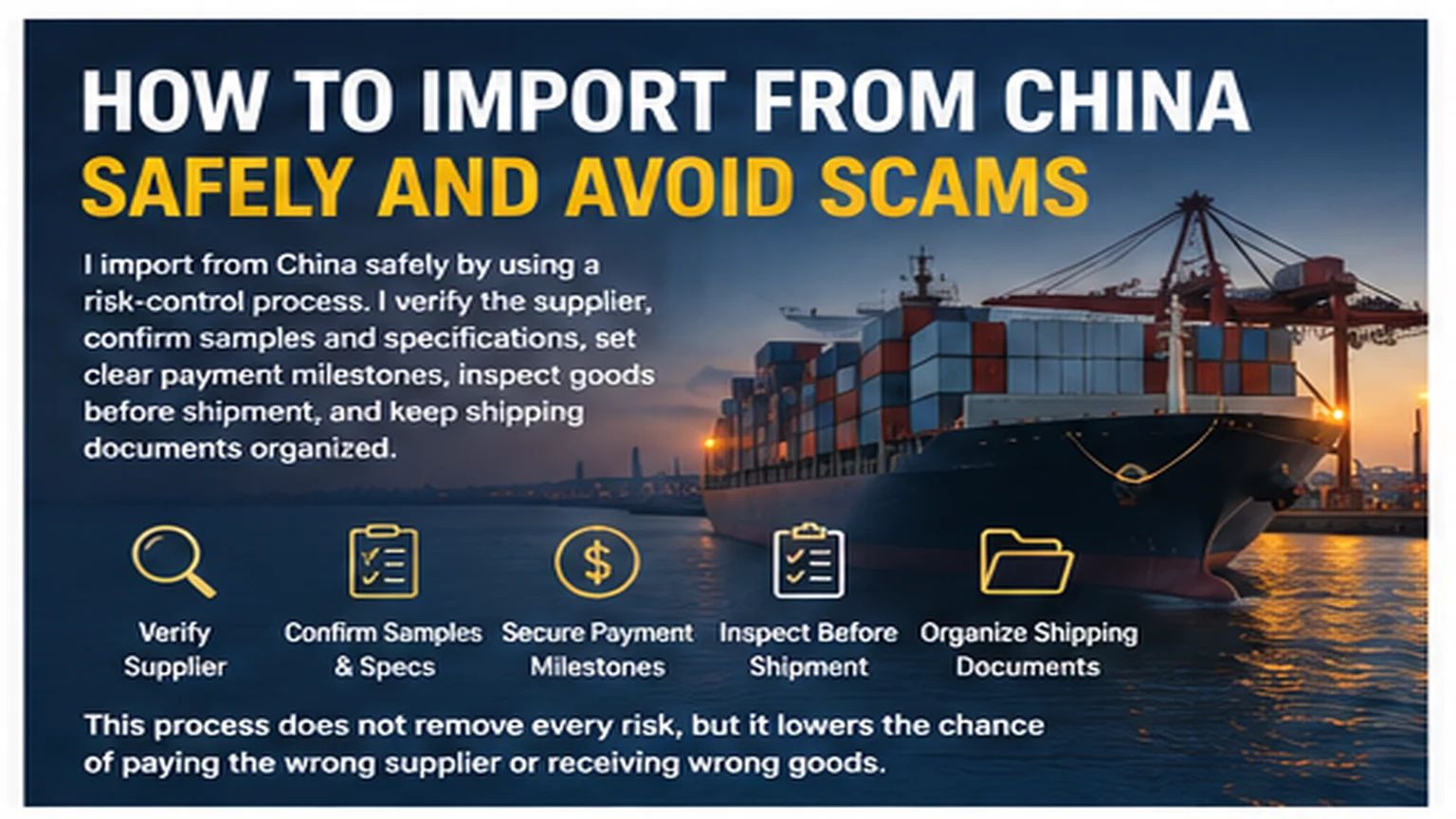
I import from China safely by using a risk-control process. I verify the supplier, confirm samples and specifications, set clear payment milestones, inspect goods before shipment, and keep shipping documents organized.[^1] This process does not remove every risk, but it lowers the chance of paying the wrong supplier or receiving wrong goods.
I have worked with many first-time importers who thought the main danger was a supplier taking money and disappearing. That can happen, but I see a more common problem. The supplier ships goods that look cheaper than promised, use the wrong material, or fail basic quality checks. Importing from China is not about fear. It is about control. When I build a buying process, I do not start with the cheapest price. I start with proof, samples, written standards, staged payments, and inspection.
1. Why Do Importers Get Scammed When Buying from China?
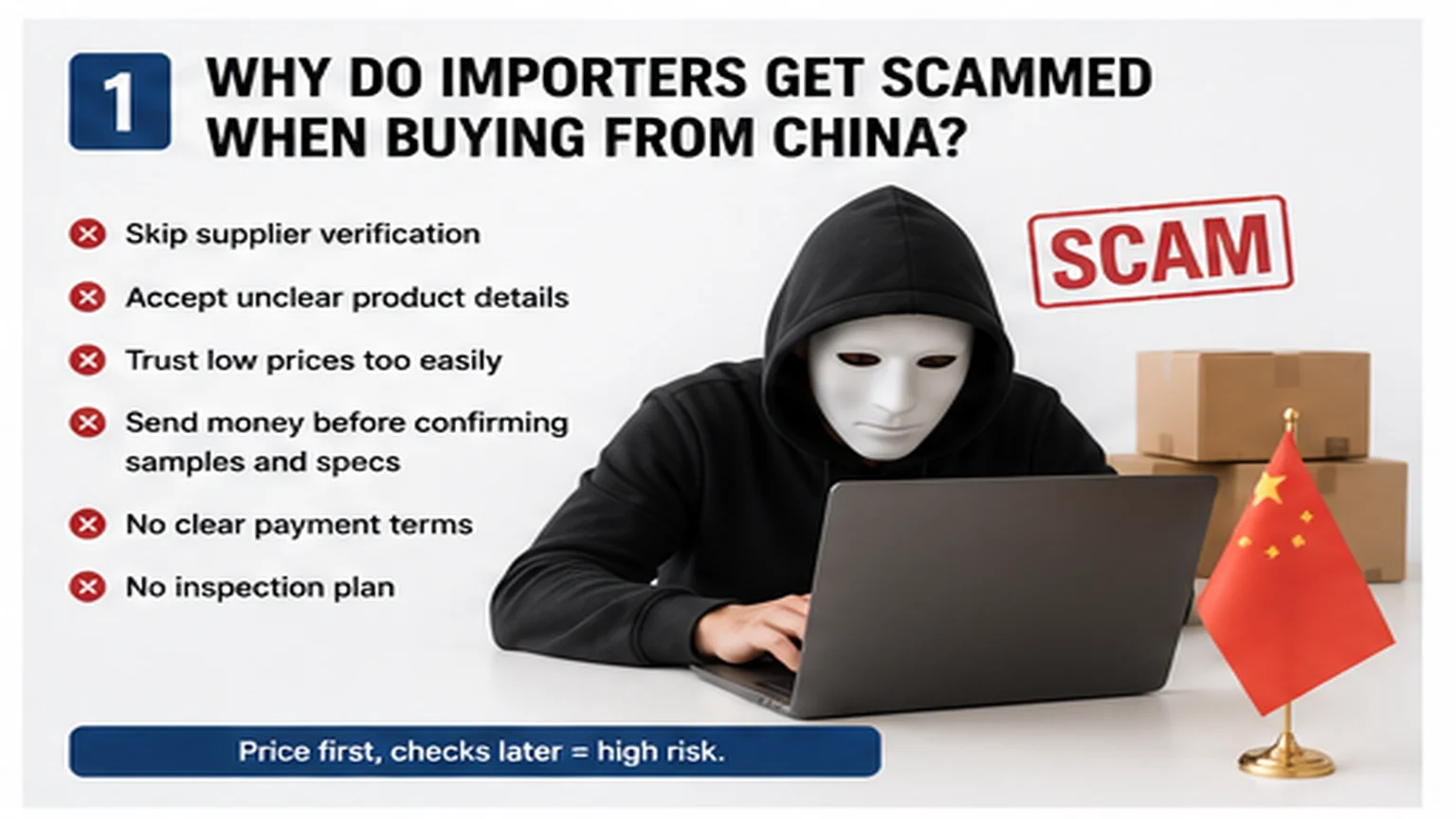
I see beginners get trapped when they treat supplier selection like online shopping. They compare price first, then check details after payment.
I look at risk before I look at price
When I help a buyer source from China, I try to understand what the supplier is really offering. A cheap quote may be real, but it may also leave out the correct material, packaging, test standard, accessories, or shipping term.[^3] I have seen suppliers quote a low price because they assumed a thinner material or a smaller size. I have also seen buyers assume that a platform badge means the supplier can produce the exact item. That is not enough.
| Beginner action | Hidden risk | What I do instead |
|---|---|---|
| I choose the lowest price | The supplier may cut material or quality | I compare specs line by line |
| I trust profile photos | The supplier may be a trader or poor fit | I check business scope and product match |
| I pay fast to secure stock | I lose control before inspection | I use staged payment |
| I accept vague terms | I cannot prove what was promised | I write clear specs and standards |
I treat every order as a process. I first shortlist suppliers. I then verify background and product ability. I request samples. I define quality rules. I inspect before final payment or shipment. This does not make import risk zero, but it gives me control points before money and goods move too far.
2. What Common China Sourcing Scams Should Beginners Know?
I do not believe every bad order is a scam. Some losses come from weak checks, poor fit, and unclear expectations.
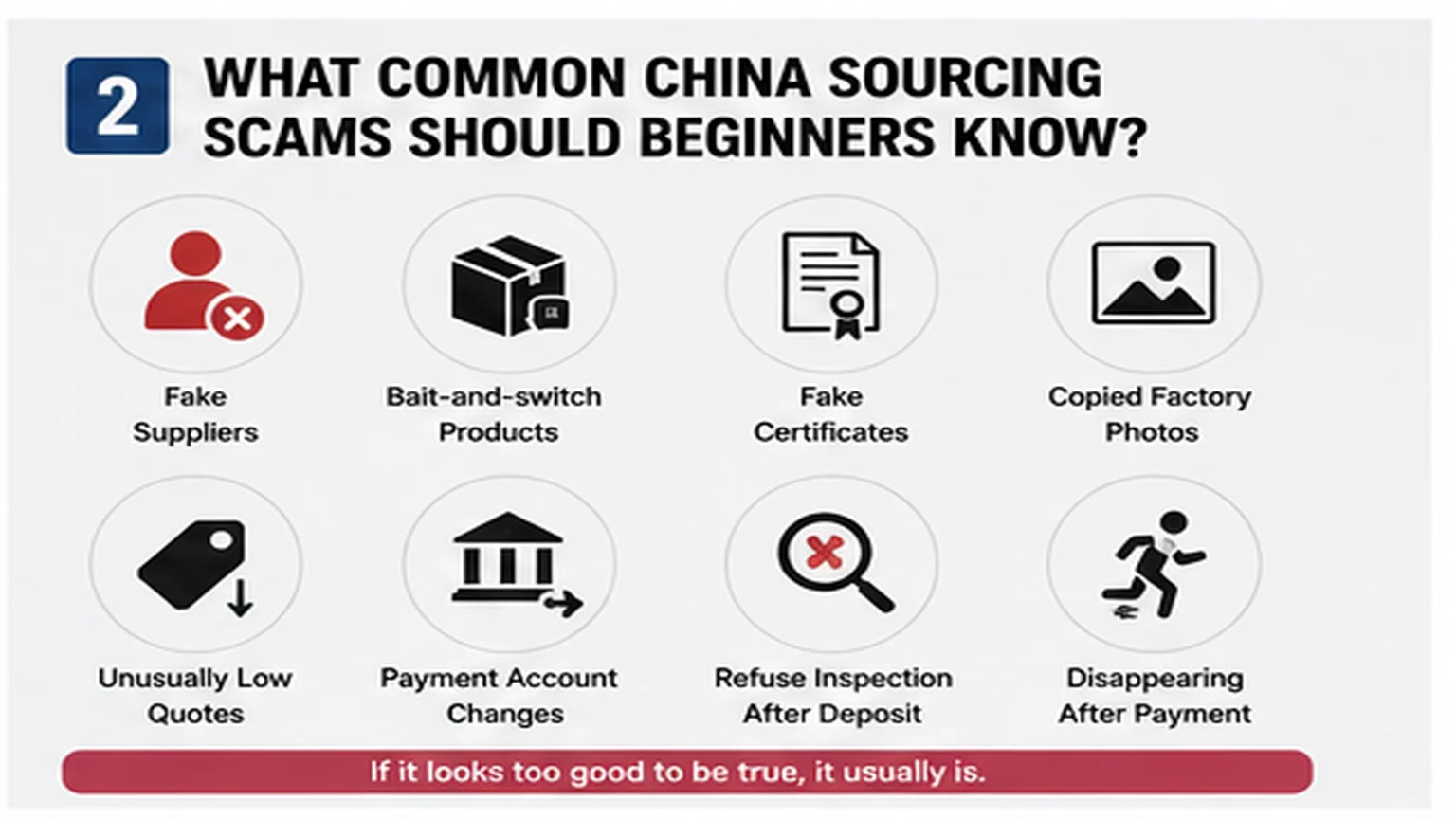
I separate real fraud from unmanaged sourcing risk
In my daily sourcing work, I see different types of problems. Some are clear scams. A fake company may copy product images, collect payment, and stop replying. Some are not full scams, but they still hurt the buyer. A supplier may ship a cheaper version of the product because the buyer never locked the material and size. A factory may accept an order that is outside its real ability. A trader may claim to be a factory but cannot control production well.
| Red flag | What it may mean | My next step |
|---|---|---|
| Price is far below market | Missing specs or fake offer | I request a full cost breakdown |
| Bank account name changes | Possible payment risk | I stop and verify ownership |
| Supplier avoids video call | Weak proof or no real office | I ask for live proof and documents |
| Certificates look unclear | Copied or unrelated files | I check certificate details |
| Supplier refuses inspection | They may hide quality issues | I do not release final payment |
I also pay attention to communication. A serious supplier usually asks detailed questions. They confirm quantity, material, packaging, logo, delivery date, and quality points. A risky supplier may only push for payment. I do not judge only by friendly messages. I judge by consistency, proof, and whether the supplier can answer practical production questions.
3. How Do I Verify Chinese Suppliers Before Sending Money?
I never treat a business license as the final answer. It is only one starting point for supplier verification.
I verify Chinese suppliers by checking business registration, company name consistency, product scope, address, bank account match, communication quality, production ability, sample history, and willingness to accept inspection.
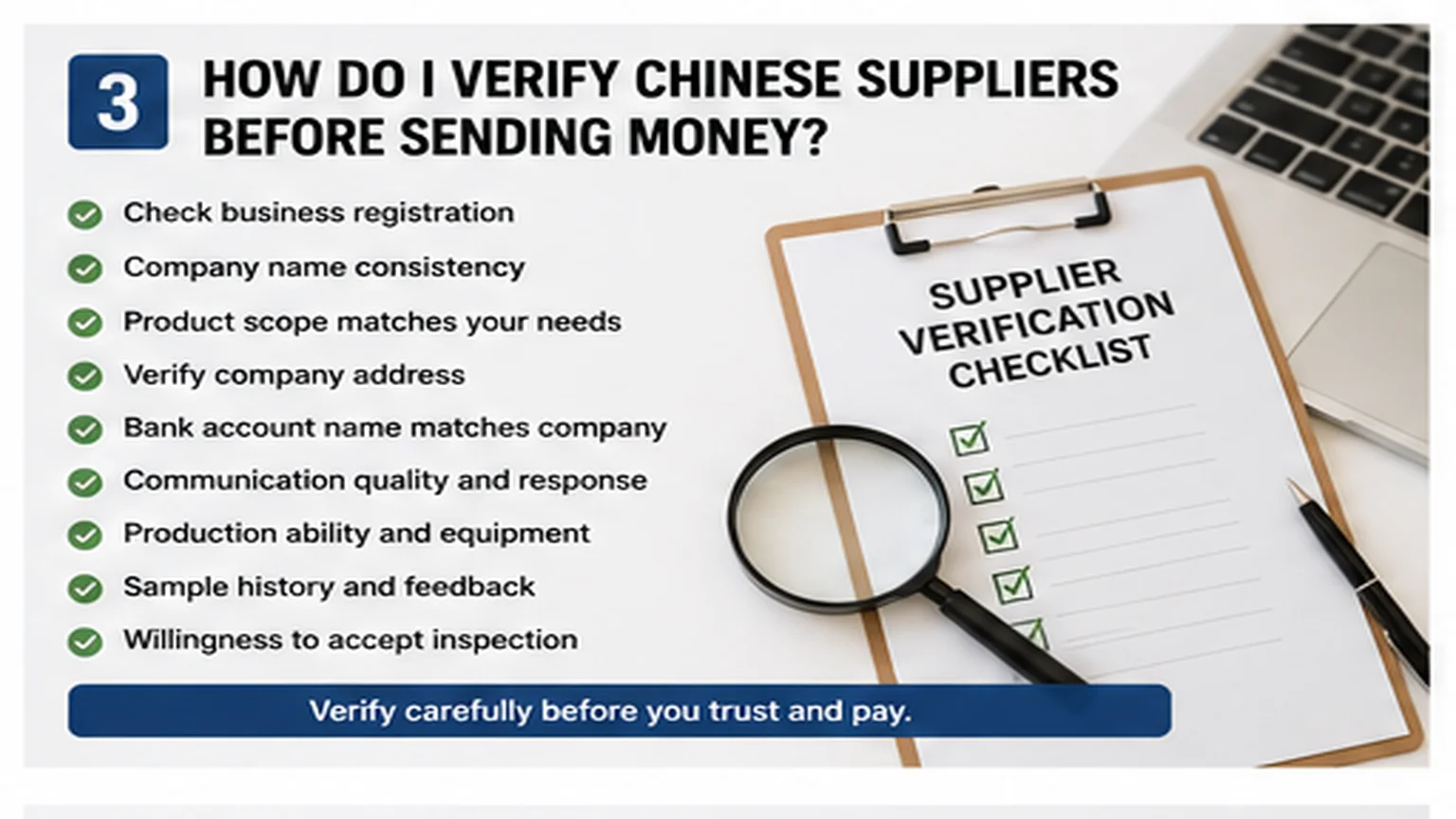
I verify whether the supplier matches the order
A supplier can be legally registered and still be a poor choice for a specific order.[^5] I need to know whether the company can make or source the product at the required quality level. I check if the company name matches the bank account, invoice, platform profile, and business license.[^6] I also check whether their product range looks focused or random. If a supplier sells furniture, electronics, cosmetics, and industrial parts on one page, I ask more questions.
| Check item | Why I check it | What I want to see |
|---|---|---|
| Registered name | It reduces fake identity risk | Same name across documents |
| Business scope | It shows product fit | Related product category |
| Product photos | It shows possible experience | Real workshop or production photos |
| Quotation logic | It shows control of cost | Clear material, MOQ, lead time |
| Inspection acceptance | It shows confidence | Supplier allows third-party checks |
I also ask for details that a real supplier should know. I ask about material options, mold cost, packaging size, defect rates, production time, and sample time. If answers are copied, slow, or inconsistent, I slow down. Before sending money, I want the supplier to prove more than existence. I want proof of ability, fit, and basic accountability.
4. How Do I Check Product Quality Before Bulk Production?
I do not approve bulk production from photos alone. I need samples, written standards, and a clear comparison method.
I check product quality before bulk production by reviewing samples, confirming materials, measuring key specs, testing function, approving packaging, and writing inspection standards before the factory starts mass production.
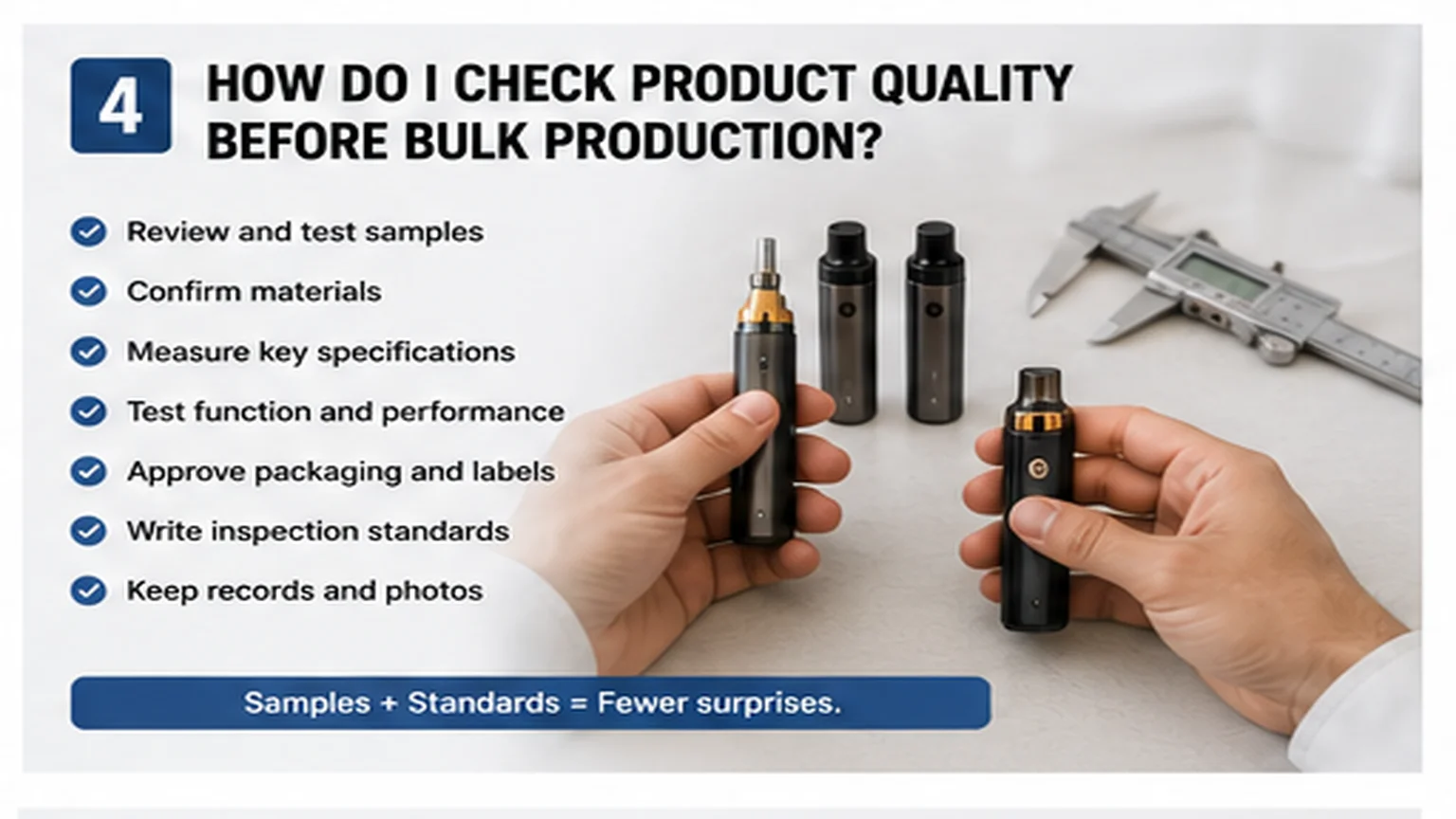
I turn a sample into a written standard
A sample is not only a product to touch. It is a control tool. I use it to define what the supplier must produce later. I check the material, color, size, weight, function, logo position, accessories, packaging, and labeling.[^7] I also take photos and notes. If the buyer approves a sample without written details, the supplier may later say that small changes are normal. I prefer to make the approved sample and the specification sheet work together.
| Quality point | What I check | Why it matters |
|---|---|---|
| Material | Grade, thickness, surface | It affects durability and cost |
| Size | Key dimensions | It prevents fit problems |
| Function | Use test or basic stress test | It reduces return risk |
| Color | Sample against reference | It avoids batch mismatch |
| Packaging | Box, inserts, labels | It protects product and brand |
I have seen beginner buyers approve a good sample, then receive bulk goods that look similar but feel different. This happens when the sample was hand-picked, but production was not controlled. I reduce this risk by setting a sample approval record.[^8] I also list unacceptable defects before production starts. The goal is simple. I want the factory to know exactly what I will inspect later.
5. What Safe Payment Methods and Contract Terms Should I Use for Importing from China?
I avoid paying 100% upfront when the supplier is new. I need payment terms that match real progress.
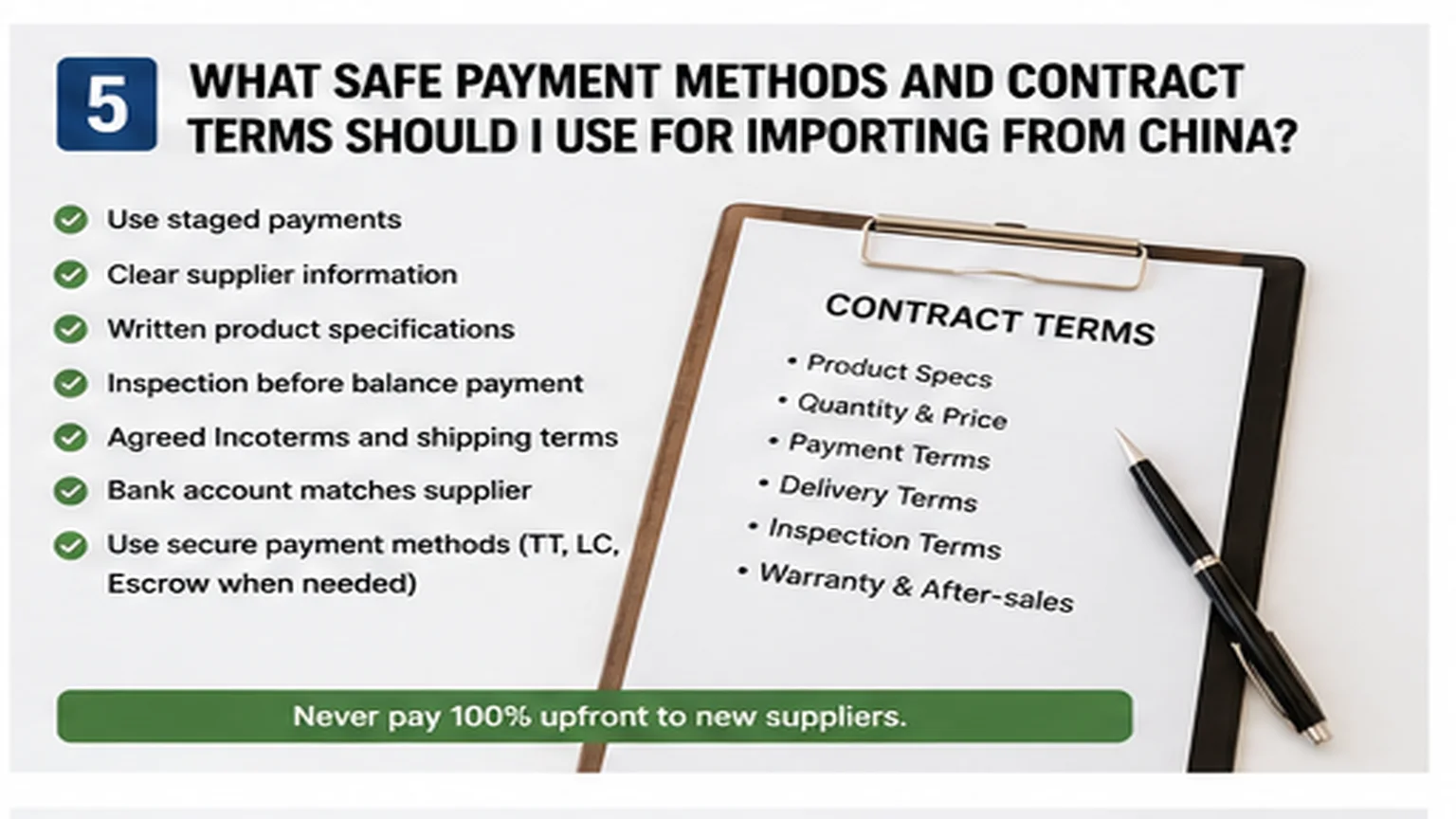
I use payment as a control point
Payment terms should protect both sides. A supplier often needs a deposit to buy materials and start production. A buyer needs control before final payment. For many regular orders, I prefer a deposit and balance after inspection. The exact terms depend on product, order size, supplier history, and production risk. I do not present this as legal advice. I use it as practical sourcing control.
| Term | Risk reduced | My practical rule |
|---|---|---|
| Deposit payment | Starts production | I avoid full payment to new suppliers |
| Balance after inspection | Reduces quality risk | I inspect before release |
| Company bank account | Reduces identity risk | I match name with supplier |
| Written specs | Reduces dispute risk | I attach details to order |
| Delivery term | Reduces cost confusion | I confirm EXW, FOB, CIF, or DDP meaning |
I also watch for payment account changes. If a supplier suddenly asks me to pay another company or a personal account, I pause.[^10] I confirm by video call, written email, and company documents. I also make sure the order record includes product name, quantity, unit price, packaging, delivery time, defect rules, and inspection plan. Simple written terms do not solve every dispute, but they give me a stronger base when I need to push for correction.
6. Why Do Factory Audits, Samples, and Pre-Shipment Inspections Matter?
I use audits, samples, and inspections because they catch problems before the goods leave China. After shipment, fixing issues becomes much harder.
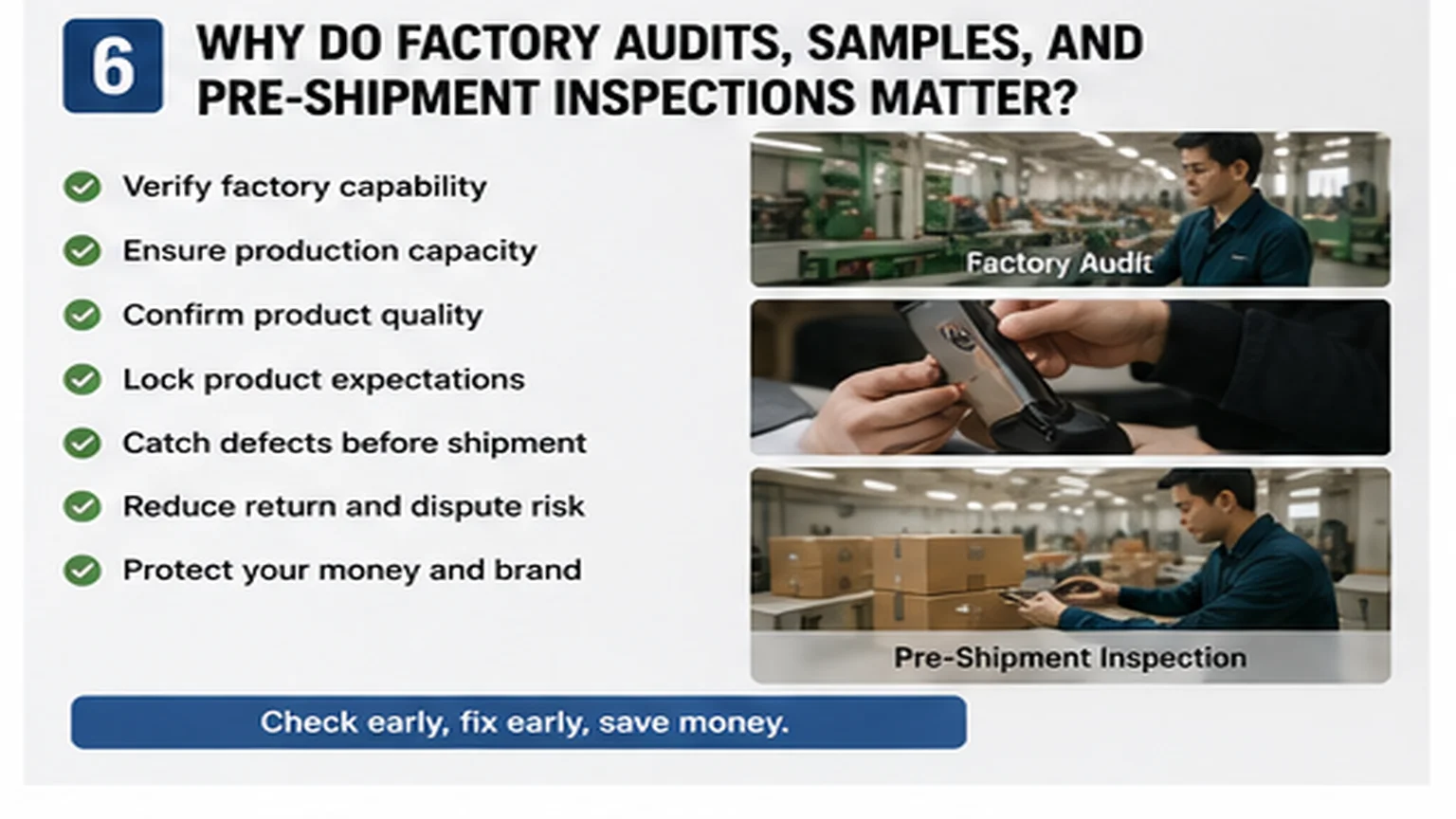
I build checkpoints before the goods move
A factory audit helps me understand whether a supplier has the space, staff, machines, process, and product experience to handle the order. I do not need a full audit for every small test order, but I need some level of verification. For higher-risk or higher-value orders, a more formal check makes sense. Samples help me confirm what should be produced. Pre-shipment inspection helps me see what was actually produced.
| Checkpoint | When I use it | What it reduces |
|---|---|---|
| Supplier background check | Before payment | Fake or poor-fit supplier risk |
| Factory audit | Before large order | Capacity and process risk |
| Sample approval | Before bulk production | Specification mismatch risk |
| During-production check | Mid-production | Late discovery risk |
| Pre-shipment inspection | Before balance or shipment | Defect and quantity risk |
I once helped a buyer after a first supplier shipped goods with poor stitching and weak packaging. The buyer had approved only a product photo, not a real sample. The next time, I arranged sample confirmation and inspection standards before production. The process was not complex. It was just more disciplined. I inspected against clear points, not against feelings. That difference matters. Inspection is not about blaming the supplier. It is about confirming that the final goods match the agreement.
7. How Can Warehousing, Consolidation, and Shipping Reduce Import Risk?
I do not treat shipping as the last step. Bad warehouse control can damage goods, mix orders, or create document problems.
Warehousing, consolidation, and shipping reduce import risk by checking goods before export, organizing cartons, combining suppliers, improving packaging control, and keeping shipment details clear before goods leave China.
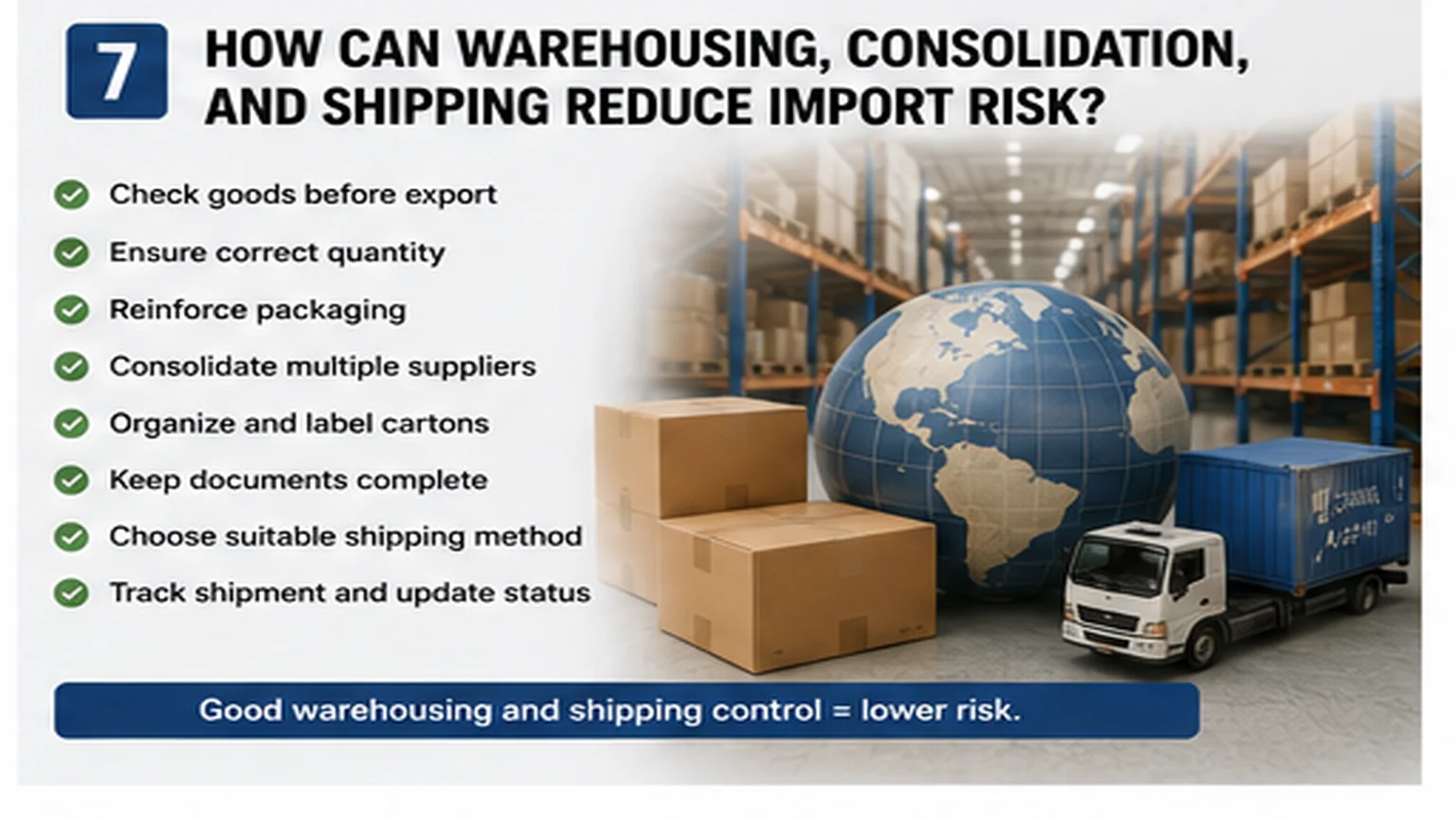
I use logistics control to protect the purchase
Many beginners focus only on supplier risk. I also focus on what happens after production. If goods from several suppliers are shipped separately without control, costs can rise fast. Cartons may be weak. Labels may be wrong. Accessories may be missing. A China warehouse can receive goods, check cartons, count units, combine orders, replace damaged packaging, add labels, and prepare shipment photos. This is useful for e-commerce sellers, DTC brands, wholesalers, and buyers testing several products at once.
| Logistics step | Problem it helps prevent | How I use it |
|---|---|---|
| Warehouse receiving | Missing or wrong cartons | I count and record arrivals |
| Carton check | Weak export packaging | I ask for reinforcement when needed |
| Consolidation | High shipping cost | I combine goods from suppliers |
| Label control | Amazon or retail label errors | I check labels before shipment |
| Shipping plan | Wrong cost expectation | I compare air, sea, rail, or express options |
Shipping terms also matter. EXW, FOB, CIF, and DDP can create very different responsibilities and costs.[^12] I do not assume the cheapest freight quote is best. I look at total landed cost, timeline, customs responsibility, and delivery address. I also keep photos, packing lists, carton counts, and tracking details. When something goes wrong, records help me find the issue faster.
8. When Should I Use a China Sourcing Agent to Avoid Costly Mistakes?
I believe buyers can source directly when orders are simple and risk is low. I also know when local support saves money.
I use a China sourcing agent when I need supplier verification, sample control, price comparison, quality inspection, packaging support, order consolidation, factory follow-up, or help recovering from sourcing mistakes.
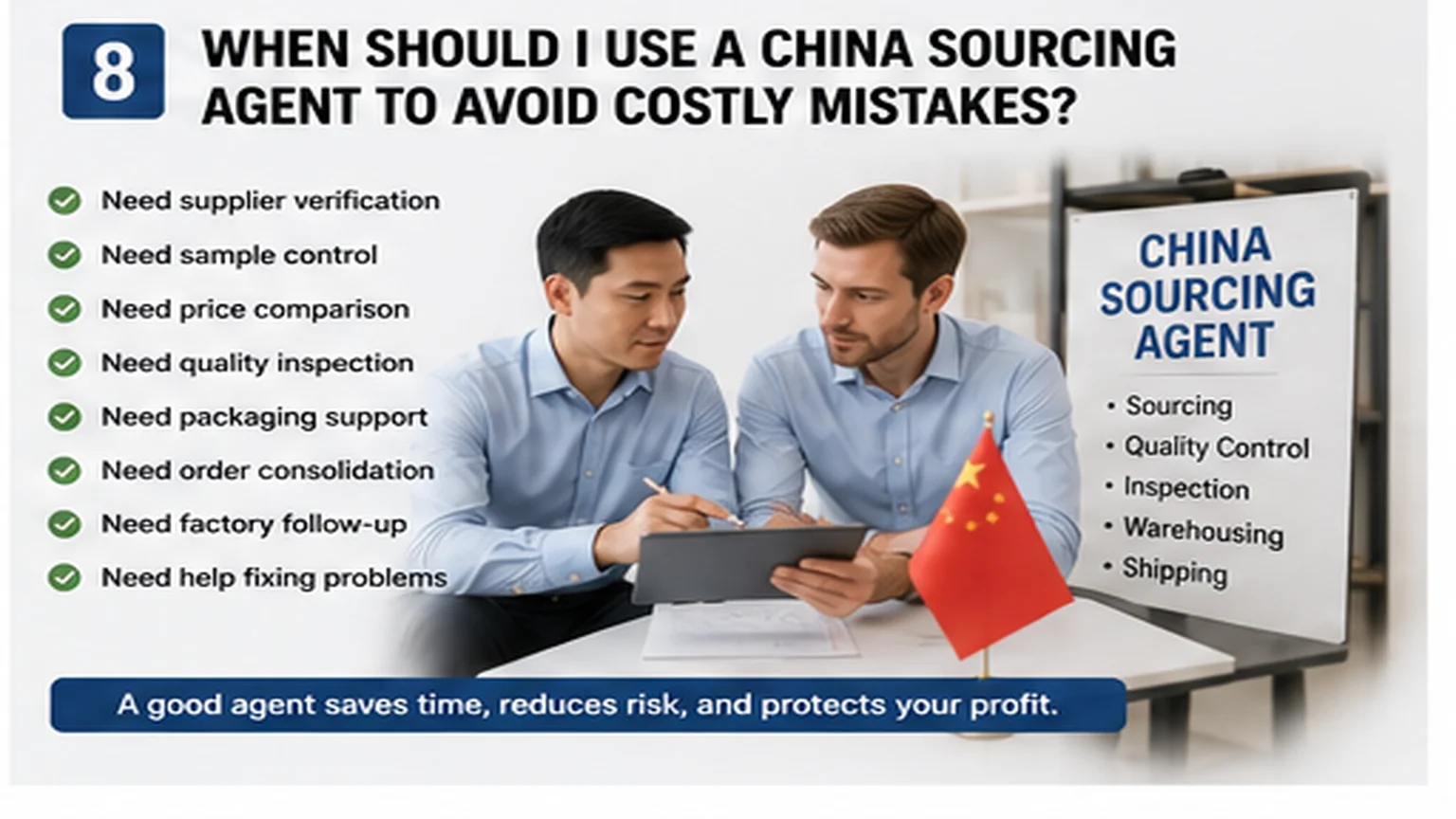
I use local support when risk is bigger than the service cost
A sourcing agent is not magic. A good agent should not promise zero risk. I see my role as a local sourcing office, quality coordinator, and supply chain assistant. I help buyers ask better questions, check suppliers, compare quotes fairly, control samples, follow production, inspect goods, arrange warehouse services, and manage shipment. This is useful when the buyer does not speak Chinese, does not have time to verify suppliers, or needs several products from different factories.
| Situation | Why an agent helps | What I usually handle |
|---|---|---|
| First-time import | Buyer lacks process | I set the sourcing workflow |
| Custom product | Specs must be clear | I confirm samples and details |
| Multiple suppliers | Coordination is hard | I consolidate orders |
| Quality-sensitive goods | Defects are costly | I arrange inspection |
| Supplier problem | Recovery needs local action | I re-source or negotiate fixes |
I have helped buyers who came to me after paying for goods that did not match the listing. In many cases, the issue was not only dishonesty. The buyer had no sample standard, no inspection plan, and no local follow-up. I try to fix the process first. At KingSourcing, I want the buyer to have clear supplier information, clear product details, clear quality points, and clear shipment steps. That is how I make China sourcing simpler and safer.
Conclusion
I import from China with checks, samples, staged payments, inspection, and logistics control. I cannot remove every risk, but I can reduce costly mistakes.
[^1]: "[PDF] Procurement Regulations for IPF Borrowers - The World Bank", https://thedocs.worldbank.org/en/doc/6c0602876d68949e80820507d90a14ed-0290012023/original/Procurement-Regulations-September-2023.pdf. The International Trade Centre and similar trade institutions describe supplier due diligence, written purchase specifications, inspection arrangements, payment controls, and shipping documentation as core controls in cross-border purchasing, supporting this process as a general import-risk framework. Evidence role: general_support; source type: institution. Supports: The source should support that supplier due diligence, written specifications, payment controls, inspection, and documentation are standard risk-management steps in international purchasing.. Scope note: This would support the process as accepted practice, not prove that it prevents every loss in China sourcing. [^2]: "Integrity in public procurement: Anti-Corruption and Integrity Outlook ...", https://www.oecd.org/en/publications/2026/03/anti-corruption-and-integrity-outlook-2026_d8f55b04/full-report/component-14.html. Public procurement-integrity guidance from bodies such as the OECD identifies inadequate supplier due diligence, vague requirements, and abnormal pricing as risk factors for fraud, nonperformance, or poor-value purchasing. Evidence role: expert_consensus; source type: institution. Supports: The source should identify weak supplier due diligence, vague specifications, unrealistic pricing, and poor contract controls as recognized procurement or sourcing risk factors.. Scope note: The evidence is likely to be general procurement-risk guidance rather than China-specific proof. [^3]: "[DOC] draft-procurement-procedures-2-14-24.docx", https://www.doa.la.gov/media/orrp4dxm/draft-procurement-procedures-2-14-24.docx. Procurement guidance commonly requires bids or quotations to be evaluated against the same technical specifications, packaging requirements, and delivery terms, because differences in these assumptions can change price comparability. Evidence role: mechanism; source type: institution. Supports: The source should explain that quotations must be compared against the same technical specifications, packaging requirements, testing standards, and delivery terms.. Scope note: This supports the pricing mechanism generally and does not establish that any particular cheap quote is deceptive. [^4]: "Scams and Your Small Business: A Guide for Business", https://www.ftc.gov/business-guidance/resources/scams-your-small-business-guide-business. Government fraud advisories describe supplier impersonation, false documents, unusually favorable offers, and last-minute payment-account changes as recognized red flags in commercial fraud and payment-diversion schemes. Evidence role: general_support; source type: government. Supports: The source should corroborate that supplier impersonation, false documentation, bait-and-switch conduct, unusually low pricing, and payment-account changes are recognized trade fraud red flags.. Scope note: Official advisories may not cover every item in the list or classify the patterns as uniquely China-specific. [^5]: "[PDF] Procurement Regulations for IPF Borrowers - The World Bank", https://thedocs.worldbank.org/en/doc/6c0602876d68949e80820507d90a14ed-0290012023/original/Procurement-Regulations-September-2023.pdf. Supplier-qualification guidance generally treats legal registration as only one element of due diligence and also requires assessment of technical capacity, experience, resources, and suitability for the specific contract. Evidence role: expert_consensus; source type: institution. Supports: The source should support that supplier qualification normally assesses technical capacity, experience, resources, and fit, not merely legal registration.. Scope note: This supports the principle of supplier assessment but does not evaluate any individual Chinese supplier. [^6]: "Customer Due Diligence Requirements for Financial Institutions", https://www.federalregister.gov/documents/2016/05/11/2016-10567/customer-due-diligence-requirements-for-financial-institutions. Law-enforcement guidance on business payment fraud advises organizations to verify vendor identity and bank-account details through independent channels before transferring funds, supporting name-matching as a practical payment-control step. Evidence role: mechanism; source type: government. Supports: The source should support verifying vendor identity and payment details before sending funds, especially when beneficiary information differs.. Scope note: Name matching reduces identity risk but does not guarantee product quality or supplier performance. [^7]: "Quality System Regulation Labeling Requirements - FDA", https://www.fda.gov/medical-devices/device-labeling/quality-system-regulation-labeling-requirements. Quality-management standards such as ISO 9001 require organizations to define product requirements and verify conformity to specified characteristics, which is consistent with checking materials, dimensions, function, packaging, and labeling. Evidence role: mechanism; source type: institution. Supports: The source should support that quality control relies on defined product requirements and verification of measurable characteristics.. Scope note: ISO 9001 supports the quality-control principle rather than prescribing this exact checklist for every product. [^8]: "Documentation and Records: Harmonized GMP Requirements - PMC", https://pmc.ncbi.nlm.nih.gov/articles/PMC3122044/. Quality-management guidance emphasizes documented product requirements and retained records as evidence for verifying conformity, supporting the use of an approved-sample record as a production-control reference. Evidence role: mechanism; source type: institution. Supports: The source should explain that documented product requirements and retained records help verify conformity during production and inspection.. Scope note: The source may support documentation generally rather than use the exact phrase “sample approval record.” [^9]: "Methods of Payment - International Trade Administration", https://www.trade.gov/methods-payment. Trade-finance and procurement guidance treats payment structure, written specifications, inspection rights, delivery terms, and verified beneficiary details as tools for allocating and reducing transaction risk in international purchasing. Evidence role: expert_consensus; source type: institution. Supports: The source should support that payment structures and documentation are used to allocate risk and maintain control in international trade transactions.. Scope note: The source would support the risk-control rationale, not establish a universally safest payment formula for all imports. [^10]: "Business Email Compromise - FBI", https://www.fbi.gov/how-we-can-help-you/scams-and-safety/common-frauds-and-scams/business-email-compromise. FBI guidance on business email compromise identifies altered vendor payment instructions and fraudulent bank-account changes as common mechanisms for diverting business payments. Evidence role: case_reference; source type: government. Supports: The source should document that sudden vendor bank-account changes and requests for alternate payment recipients are common warning signs in payment-diversion fraud.. Scope note: This supports the payment-fraud risk but does not prove that every alternate-account request is fraudulent. [^11]: "ISO 19011: Guidelines for Auditing Management Systems - ASQ", https://asq.org/quality-resources/iso-19011?srsltid=AfmBOoqBx5yl8hCLFqMunMFbbKGNEw6eT-pXVUEnNdtw4M-gFhJyr2Ui. Auditing and inspection standards, including ISO guidance for management-system audits and sampling inspection, support the use of audits and pre-shipment checks to assess supplier capability and identify nonconformities before goods are released. Evidence role: mechanism; source type: institution. Supports: The source should support that audits assess management or production capability, samples define acceptance expectations, and inspection detects nonconformities before release.. Scope note: These standards support the control mechanisms generally; effectiveness depends on audit scope, sampling plan, inspector competence, and product risk. [^12]: "Know Your Incoterms - International Trade Administration", https://www.trade.gov/know-your-incoterms. The International Chamber of Commerce’s Incoterms rules define EXW, FOB, CIF, and DDP as trade terms that allocate different seller and buyer obligations for delivery, risk transfer, costs, and transport-related responsibilities. Evidence role: definition; source type: institution. Supports: The source should define EXW, FOB, CIF, and DDP and explain that each term assigns different obligations, costs, and risk-transfer points..