I see beginners lose money when they rush supplier selection. The problem grows when price looks good, but quality, timing, and shipping stay unclear.
To source products from China safely, I follow a step-by-step process: choose the right product, define requirements, compare suppliers, confirm samples, verify quality, manage production, inspect goods, and plan shipping before placing a larger order[^1].

I do not treat China sourcing as a simple shopping task. I treat it as a risk control process. When I help buyers source from China, I usually start with one question: “How can I test and manage this supplier before I put real money at risk?” This guide will walk through that process in a clear way, so you can start with more control and fewer surprises.
1. What Does Sourcing Products from China Really Mean?
Many beginners think sourcing means finding a cheap supplier. That idea sounds simple, but it creates risk when the buyer skips checks, samples, and production control.
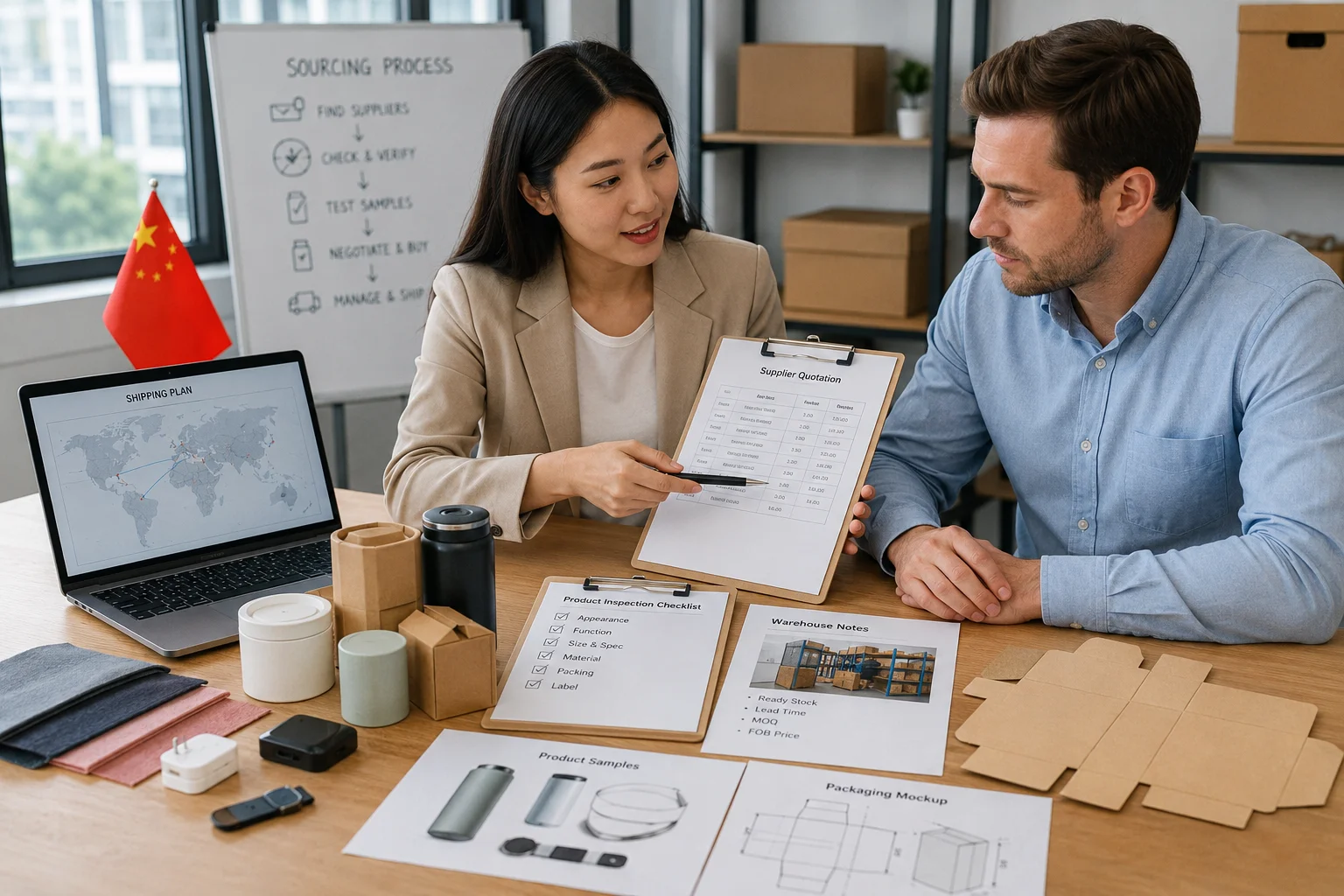
Sourcing products from China means finding, checking, testing, buying, and managing products from Chinese suppliers.[^2] I also include quotation comparison, sample review, production follow-up, quality inspection, packaging, warehousing, and shipping in the full sourcing process.
Sourcing is not just supplier search
When I talk with first-time importers, I often notice the same misunderstanding. They ask, “Where can I find a supplier?” That is a fair question. But it is not the full question. A better question is, “How can I verify, test, and manage a supplier before I take a bigger risk?”
A supplier profile on a platform can look professional. A product photo can look clean. A quotation can look attractive. But none of these things prove that the supplier can make your exact product, follow your packaging needs, meet your deadline, or handle problems after payment.
| Sourcing Part | What I Check | Why It Matters |
|---|---|---|
| Supplier search | Factory type, trading company, product focus | I need to know who is really handling the order |
| Quote review | Unit price, MOQ, packaging, shipping terms | I need to compare total cost, not only product price |
| Sample testing | Material, size, function, finish, packaging | I need proof before production |
| Production control | Timeline, updates, photos, changes | I need to catch issues early |
| Inspection | Quantity, defects, labeling, cartons | I need to reduce bad shipments |
| Shipping | Method, cost, documents, delivery time | I need to avoid delays and hidden costs |
The real job is risk management
I see China sourcing as a chain. If one link is weak, the whole order can suffer. A low price does not help if the product arrives late, breaks easily, or needs rework. A fast supplier does not help if the packaging is wrong. A good sample does not help if mass production is different.
This is why I prefer a step-by-step sourcing process. I want each step to answer three basic questions. What should I do now? Why does it matter? What can go wrong if I skip it? That simple habit makes sourcing more practical for beginners.
2. Why Many Beginners Choose China for Product Sourcing?
Many new sellers feel stuck because local supply is limited or too expensive. China looks attractive, but the opportunity also comes with distance and control problems.
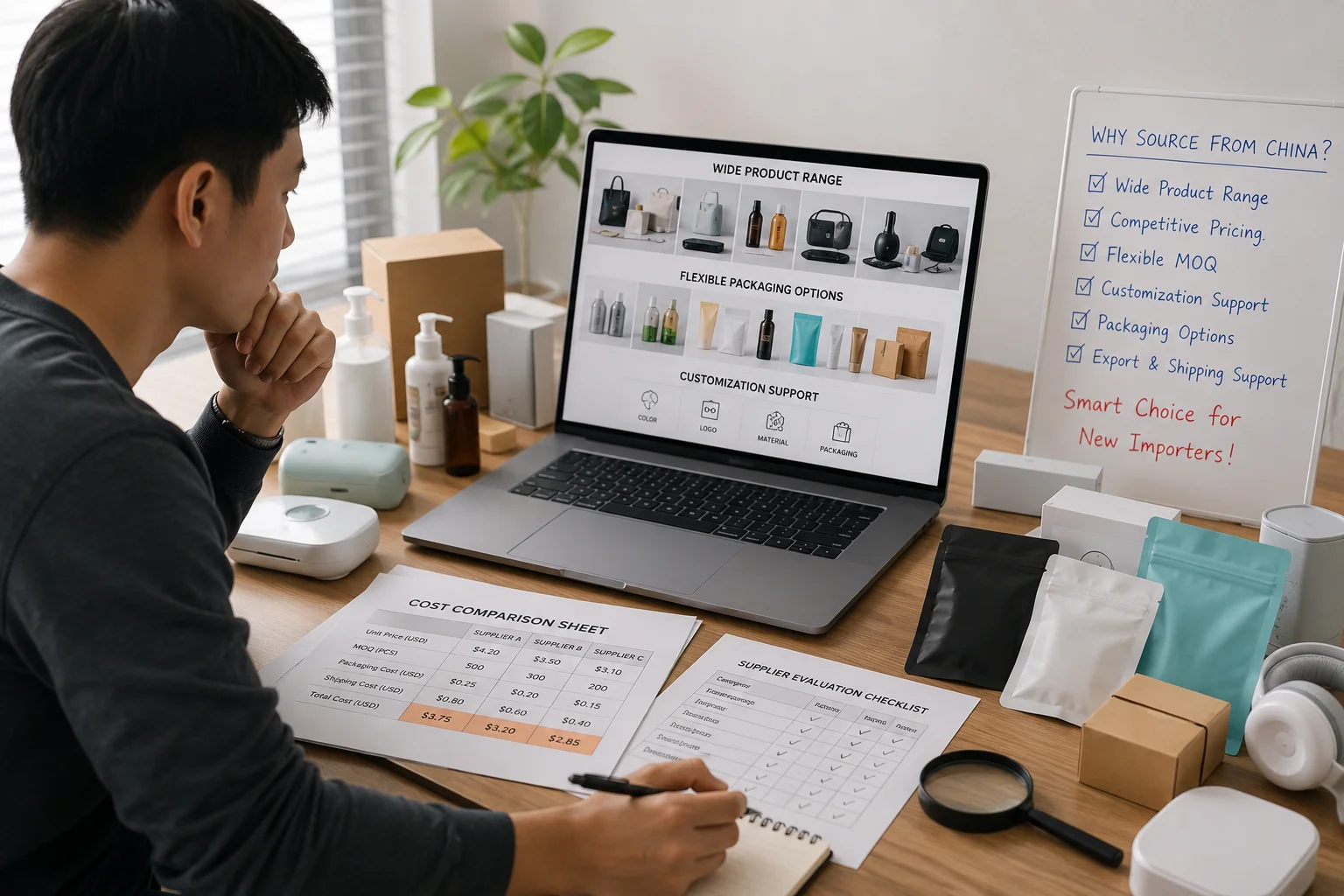
Beginners choose China because it offers a wide product range, flexible manufacturing, custom packaging options, competitive pricing[^3], and mature export support. I still advise buyers to compare suppliers carefully because the lowest price can create a higher total cost.[^4]
China offers choice, speed, and product depth
I understand why many beginners start with China. China has deep supply chains across many product categories.[^5] I can often find many supplier types for the same product. Some suppliers focus on low MOQ orders. Some factories focus on custom production. Some trading companies combine products from different factories. This gives beginners more choices.
But choice can also create confusion. Two suppliers may offer the same product photo, but the real quality may be different. One supplier may use better material. Another may use thinner parts. One may include packaging. Another may quote only the bare product. If I only compare the unit price, I may choose the wrong supplier.
| Reason Beginners Choose China | Real Benefit | Risk If I Do Not Manage It |
|---|---|---|
| Large product range | I can test many product ideas | I may choose a supplier with weak product focus |
| Lower manufacturing cost | I may improve profit margin | I may accept poor quality for a low price |
| Custom options | I can build a brand product | I may get wrong logo, color, or packaging |
| Export experience | I can ship to many markets | I may still face document or shipping issues |
| Supplier competition | I can compare offers | I may compare unclear quotes |
Low price is not always low cost
Many first-time buyers underestimate total cost. I often remind them that product cost is only one part. The total cost can include sample fees, mold fees, packaging fees, inspection fees, storage fees, shipping fees, duties, returns, and replacement cost.[^6] A supplier with a slightly higher unit price may still be the better choice if the quality is stable and the communication is clear.
I do not tell beginners to avoid low-cost suppliers. I tell them to understand what the price includes. If the supplier gives a very low quote, I ask more questions. What material is used? What packaging is included? What is the defect standard? What is the lead time? What happens if the product fails inspection?
This is the practical way to use China’s strength without letting price become the only decision factor.
3. Step 1: How Do I Choose the Right Product and Define My Requirements?
A weak product brief creates confusion from day one. Suppliers then guess your needs, and those guesses can become wrong samples, wrong quotes, and wrong production.
I choose the right product by checking market demand, profit space, shipping size, safety risk, customization needs, and supplier availability. I then write clear requirements for material, size, color, function, packaging, quantity, and quality standard.

I start with product fit before supplier search
Before I contact suppliers, I want to know what I am buying. This sounds basic, but many beginners skip it. They send a screenshot and ask, “How much?” The supplier then gives a rough price based on a rough idea. Later, the buyer changes the color, material, packaging, and quantity. The price changes too. This creates frustration on both sides.
I prefer to make a simple product requirement sheet. It does not need to be perfect at the beginning. It only needs to be clear enough for suppliers to quote the same thing.
| Requirement | What I Write Down | Why I Need It |
|---|---|---|
| Product type | Exact product name and use | I avoid supplier misunderstanding |
| Material | Plastic type, fabric, metal, wood, or mix | I control quality and cost |
| Size and weight | Product size, carton size if known | I estimate shipping cost |
| Color and finish | Pantone color, coating, texture | I avoid visual mismatch |
| Function | Main use, load, battery, moving parts | I reduce performance risk |
| Packaging | Plain box, color box, insert, label | I prepare for retail or ecommerce |
| Quantity | Test order and future order estimate | I check MOQ and price level |
I avoid products that are too risky for my stage
I also think about what can go wrong. If I am a beginner with a small budget, I do not want a product with too many unknowns. Electronics, children’s products, cosmetics, food-contact items, and medical-related goods can have stricter compliance needs.[^7] I may still source them, but I need more checks.
For beginners, I often suggest starting with products that are easier to inspect and easier to ship. A product with fewer parts, lower breakage risk, and simple packaging can be easier to manage. If the product needs strong branding, I also check whether the supplier can support custom packaging at my quantity.
The goal is not to find a perfect product. The goal is to choose a product that I can test, inspect, and deliver with reasonable control.
4. Step 2: How Do I Find and Compare Reliable Chinese Suppliers?
Supplier search feels easy until every supplier claims to be good. The real problem is not finding names. The real problem is knowing which supplier deserves trust.
I find Chinese suppliers through sourcing platforms, trade shows, referrals, industry clusters, search engines, and local sourcing teams. I compare them by product focus, communication, MOQ, sample quality, production ability, price details, and problem-solving attitude.
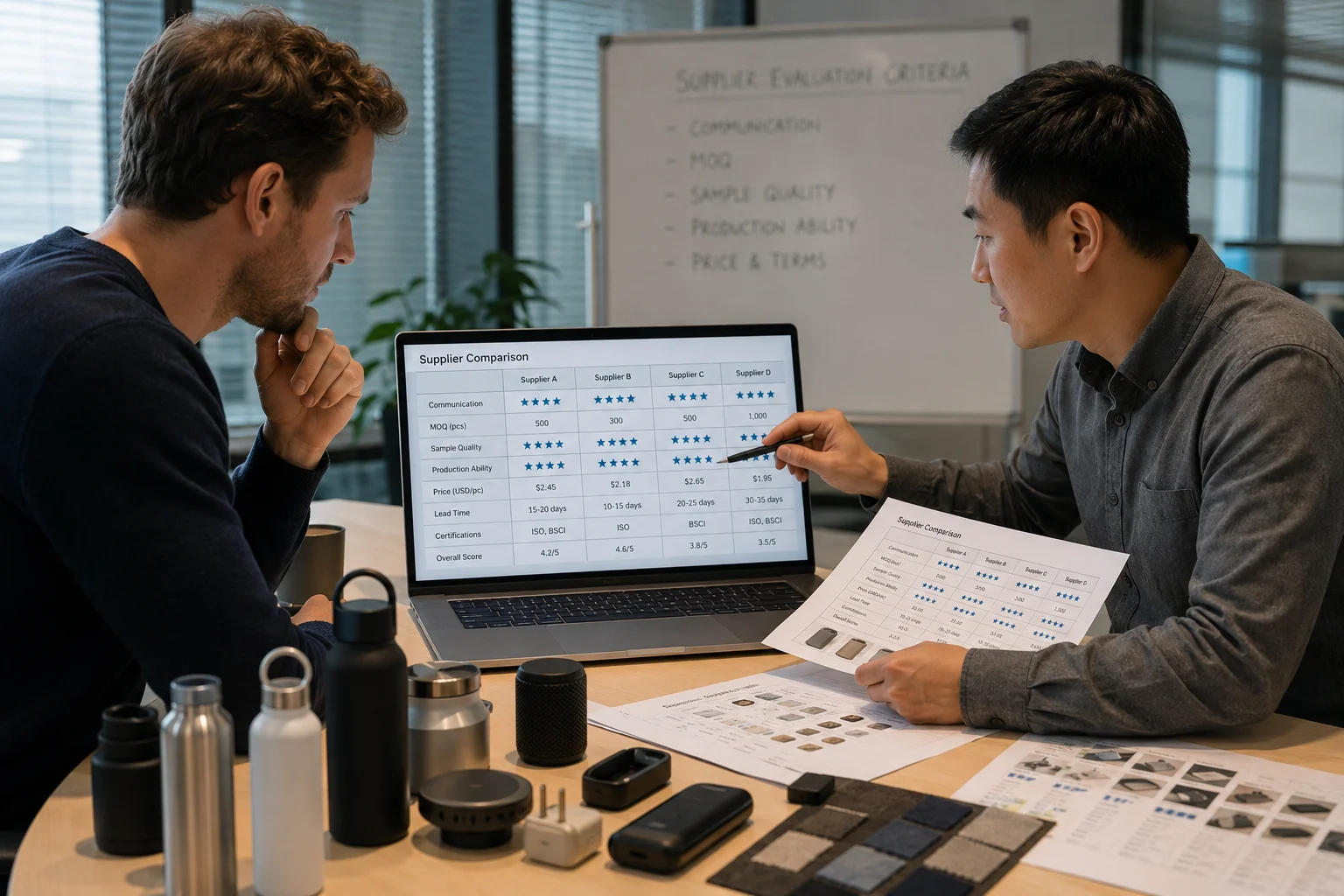
I look beyond supplier listings
I do not treat a supplier listing as final proof. A listing is only a starting point. I check whether the supplier actually understands the product. I also check whether they ask useful questions. A good supplier usually wants to confirm details before quoting. A weak supplier may only send a price and push for payment.
I also pay attention to communication. I do not expect perfect English. I expect clear answers. If I ask five specific questions and the supplier answers only one, I see a warning sign. If the supplier avoids key questions about material, MOQ, lead time, or packaging, I slow down.
| Supplier Factor | Good Sign | Warning Sign |
|---|---|---|
| Product focus | Supplier shows many related products | Supplier sells too many unrelated items |
| Communication | Supplier answers clearly and directly | Supplier avoids details or changes answers |
| MOQ | MOQ matches my test plan or has options | MOQ is unclear or keeps changing |
| Quote details | Price includes clear terms | Price is low but missing key items |
| Sample support | Supplier can send sample and explain lead time | Supplier refuses sample without reason |
| Production ability | Supplier explains process and timeline | Supplier gives vague promises |
| After-sales attitude | Supplier discusses defect handling | Supplier says problems never happen |
I compare suppliers on total value
I usually shortlist three to five suppliers for the same product. I do not only ask, “Who is cheapest?” I ask, “Who can deliver the right product with fewer surprises?” A supplier that gives a clear price, realistic timeline, and good sample may be safer than a supplier that gives the lowest quote.
Beginners can use platforms like Alibaba to start. They can also explore trade fairs, Google searches, supplier directories, and local networks. If they use 1688, they need to be more careful because many suppliers focus on the domestic market and may not support export needs directly.[^8]
If I cannot clearly compare suppliers, I ask for more information. I ask for product photos, videos, packaging details, test reports if needed, factory photos, and sample options. I do not need to attack the supplier. I just need enough information to make a careful decision.
5. Step 3: How Do I Request Quotes, Samples, and Product Details?
A cheap quote can look exciting, but it may hide missing packaging, unclear material, wrong shipping terms, or a much higher cost after production starts.
I request quotes by sending the same product requirements to each supplier. I ask for unit price, MOQ, sample cost, lead time, packaging, customization fees, payment terms, and shipping size. I always confirm samples before larger production.
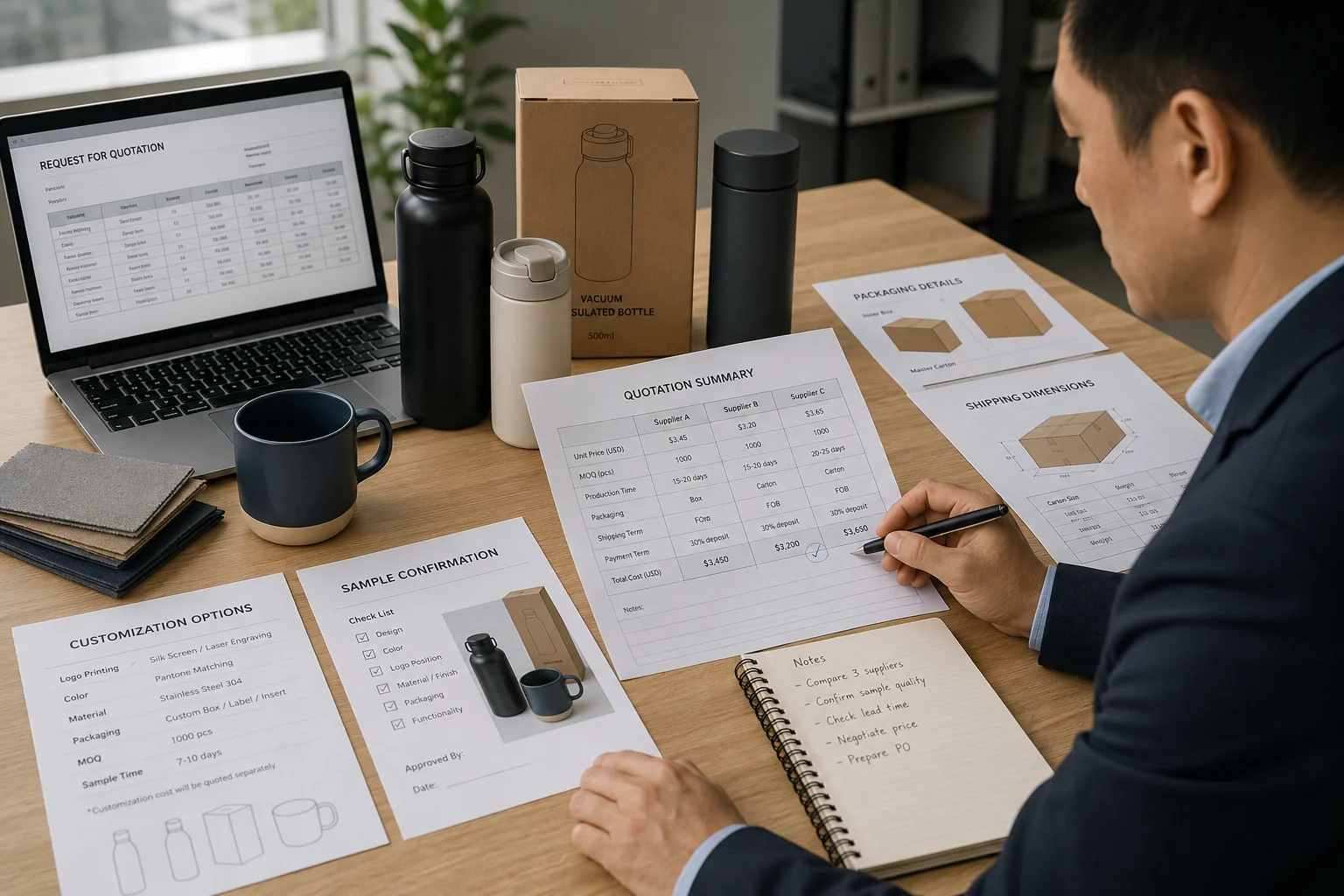
I make suppliers quote the same product
When I request a quote, I want suppliers to price the same standard. If one supplier quotes with retail packaging and another quotes without packaging, the cheaper supplier may not be cheaper. If one supplier uses thicker material and another uses thinner material, the quotes are not equal.
I use a simple quote request format. I keep it short, but I make it complete.
| Quote Item | What I Ask | Why I Ask |
|---|---|---|
| Unit price | Price at 100, 500, 1,000 pieces if possible | I understand price levels |
| MOQ | Minimum order for standard and custom version | I plan test order size |
| Sample cost | Product sample, customization sample, shipping | I know testing cost |
| Lead time | Sample time and bulk production time | I plan launch schedule |
| Packaging | Individual box, carton, label, insert | I avoid surprise costs |
| Custom cost | Logo, color, mold, artwork, packaging | I know brand setup cost |
| Payment terms | Deposit, balance, method | I control payment risk |
| Carton details | Weight, size, quantity per carton | I estimate shipping cost |
I treat samples as proof, not decoration
I always recommend sample checking before a real order.[^9] A sample helps me check material, color, size, function, finish, smell, weight, packaging, and user experience. It also shows how the supplier handles small details.
But I do not assume mass production will match the sample automatically.[^10] I need to confirm the approved sample with photos, comments, and written requirements. If I approve the sample with changes, I write the changes clearly. For example, I may write, “Approve the sample, but change the logo position to the center and use a thicker inner bag.”
Beginners sometimes skip samples to save money. I understand the budget concern. But skipping samples can cost more later. If the product is wrong after mass production, the supplier may not accept full responsibility, especially if the requirement was unclear. A sample is not just a product. It is a reference point for production and inspection.
6. Step 4: How Do I Check Supplier Reliability, Product Quality, and Compliance?
Trusting a supplier too early can turn a small mistake into a full shipment problem. I prefer to verify before payment, not after damage is done.
I check supplier reliability by reviewing business information, product focus, communication quality, sample results, factory ability, payment safety, and past export experience. I check product quality through samples, clear standards, inspection plans, and compliance documents when needed.
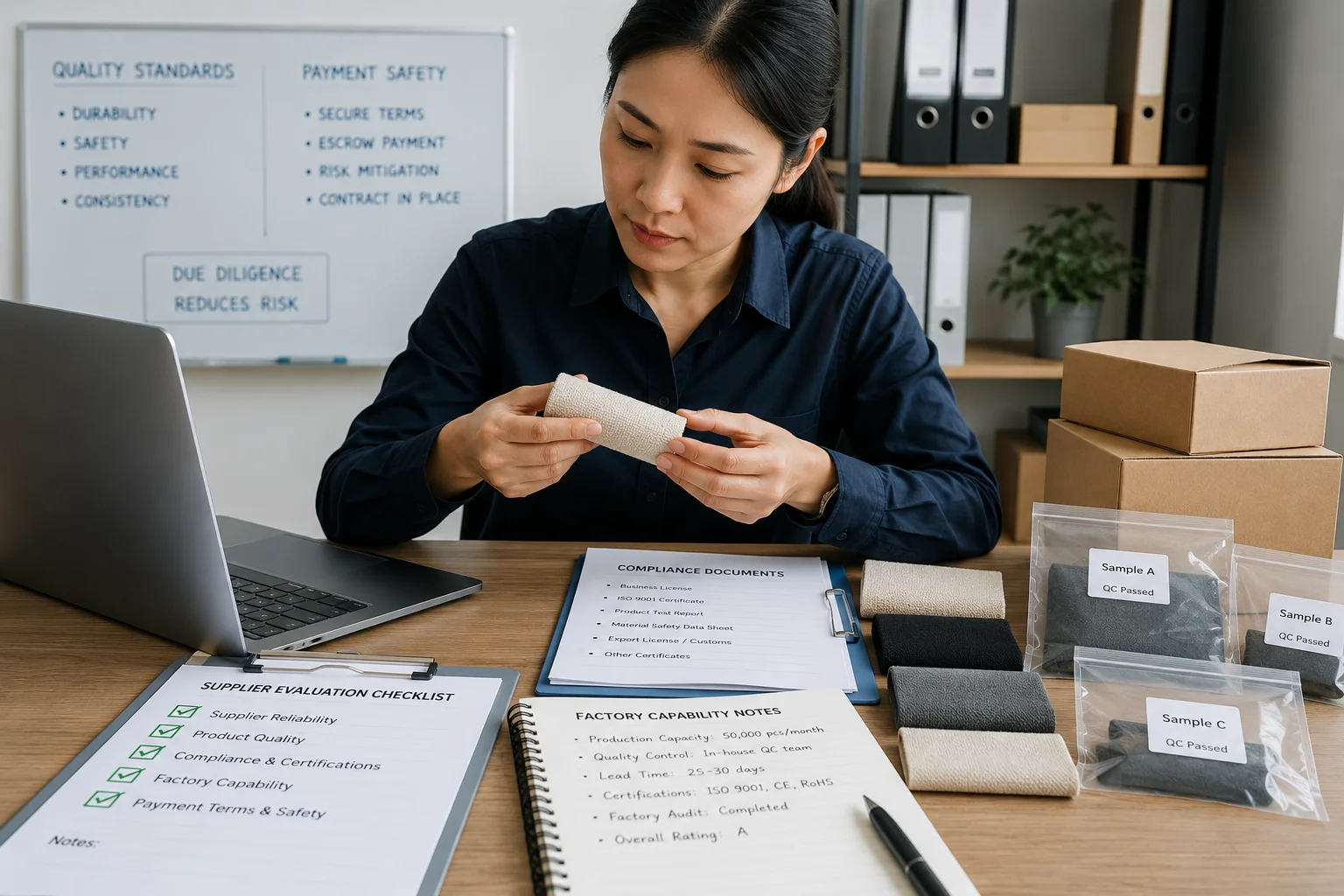
I verify the supplier before I increase risk
I do not need to assume every supplier is risky. Many Chinese suppliers are professional and honest. But I still verify because my money, timeline, and customer reputation are at stake. Verification is normal business practice.
For a small test order, basic verification may be enough. For a larger order or a custom product, I want deeper checks. I may review the supplier’s business license, product focus, factory photos, videos, export experience, and production process. If needed, I may arrange an on-site factory check through a local team.
| Check Area | Basic Check | Deeper Check |
|---|---|---|
| Company identity | Business license, company name, address | On-site supplier visit |
| Product focus | Related products and samples | Production line review |
| Communication | Clear answers and stable contact | Technical discussion with production staff |
| Payment safety | Company account and normal payment terms | Risk review before larger deposit |
| Quality control | Sample check and product photos | Pre-shipment inspection |
| Compliance | Supplier documents if required | Lab testing or third-party review when needed |
I define quality before inspection
Quality is not a feeling. I need to define it. If I only say “good quality,” the supplier may not know what I mean. I write clear points. I specify acceptable color range, size tolerance, material, logo position, packaging, label, accessories, and defect limits.
Compliance also depends on product and market. I do not treat every product the same. A simple home storage item may need fewer checks than a battery product or children’s item. If the product needs certain certificates or test reports, I ask early. I also understand that a document from one supplier does not always cover my exact product or market, so I stay careful.
If I skip this step, problems can appear after shipment. My customer may complain. My marketplace may request documents. Customs may ask questions. A basic check before production can reduce these painful problems.
7. Step 5: How Do I Manage Production, Inspection, Warehousing, and Shipping?
Many beginners relax after paying the deposit. That is dangerous because most problems happen during production, packing, inspection, and shipping preparation.
I manage production by confirming the order details, following the schedule, checking progress, arranging inspection, preparing packaging, storing goods if needed, and choosing shipping based on cost, speed, product type, and destination.
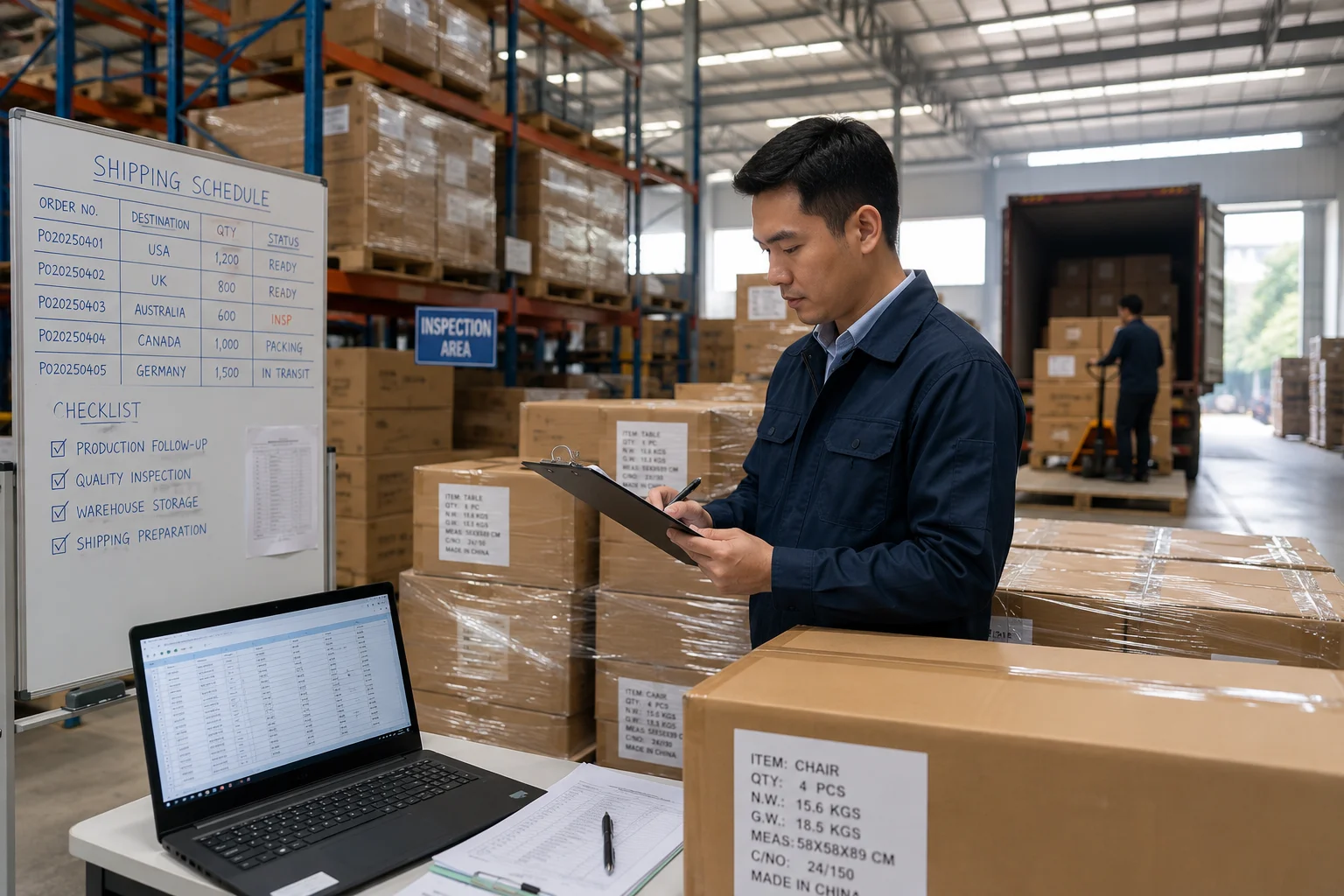
I keep production under control
After I place the order, I do not disappear until the goods are ready. I confirm the proforma invoice, product specifications, packaging artwork, production timeline, and payment schedule. I ask for progress updates at key points. I also ask for photos or videos when useful.
Production management is not about bothering the supplier every day. It is about catching problems early. If the supplier finds a material shortage, artwork issue, color mismatch, or packaging delay, I want to know before the final day.
| Stage | What I Confirm | What Can Go Wrong |
|---|---|---|
| Before production | Product specs, sample approval, artwork | Supplier uses old or unclear requirements |
| During production | Materials, first batch photos, timeline | Defects or delays appear too late |
| Before packing | Logo, labels, accessories, manual | Wrong inserts or missing parts |
| Before shipment | Quantity, cartons, inspection result | Bad products leave the factory |
| Warehousing | Storage needs and consolidation plan | Goods from different suppliers become messy |
| Shipping | Method, cost, delivery time, documents | Hidden cost or late delivery happens |
I use inspection as a safety gate
Inspection is one of the most practical steps in China sourcing.[^11] It does not make risk disappear, but it gives me a chance to catch problems before shipment. For small orders, I may use basic photo or video checks. For larger or important orders, I prefer a structured inspection.
I check quantity, appearance, function, size, packaging, labels, carton marks, and defect level. If I find problems, I discuss rework, sorting, discount, replacement, or other solutions before the goods leave China.
Warehousing and shipping also matter. If I buy from several suppliers, I may need to consolidate goods in one warehouse. This can reduce shipping cost and make packing more organized. If I ship direct without checking carton details, I may get a higher shipping bill than expected.
For beginners, shipping should be discussed early, not at the end. Product size and weight can change profit. A low product price can become unattractive if the item is bulky, fragile, or expensive to deliver.
8. When Should Beginners Work with a China Sourcing Agent?
Some buyers can manage sourcing by themselves, but many beginners get stuck when suppliers, samples, inspections, and shipping all need attention at the same time.
Beginners should consider a China sourcing agent when they lack supplier contacts, cannot verify factories, need custom products, face communication problems, buy from multiple suppliers, or want local support for inspection, warehousing, consolidation, and shipping coordination.

I choose support based on risk, not fear
I do not believe every beginner must use a sourcing agent. If the product is simple, the order is small, and the supplier communicates well, a buyer may handle the first test order directly. That can be a good learning experience.
But I also see many beginners underestimate the work. They think the supplier will manage everything. Sometimes that happens. Sometimes it does not. If the supplier is only responsible for production, then the buyer still needs to think about sampling, comparison, inspection, packaging, warehousing, shipping, and after-sales issues.
| Situation | DIY May Work | A Sourcing Agent May Help |
|---|---|---|
| Simple standard product | Supplier has clear listing and sample | I still want price and quality comparison |
| Custom product | Only small logo change | I need sample control and artwork follow-up |
| Multiple suppliers | One or two easy orders | I need consolidation and warehouse support |
| Quality concern | Low-risk product | I need inspection before shipment |
| Communication issue | Supplier answers clearly | I need local follow-up in Chinese |
| Larger order | I trust the supplier after tests | I need factory check and production tracking |
I see a sourcing agent as a local execution team
A good sourcing agent should not only forward messages. I see the real value in execution. The agent can search suppliers, compare quotes, check samples, visit factories when needed, follow production, inspect products, arrange packaging, combine orders, store goods, and coordinate shipping.
For KingSourcing, this is where our work fits. We act more like a China-based sourcing office, quality control team, supply chain coordinator, and logistics helper for overseas buyers. We are not here to promise the lowest price or zero risk. We are here to reduce avoidable mistakes and make the process easier to manage.
A low-budget beginner can still start carefully. The buyer can test with a smaller quantity, but I would not skip supplier verification, sample confirmation, basic quality checks, or clear shipping estimates. A growing brand may need more support because small errors can affect customers, reviews, and repeat sales.
I believe the right time to work with a sourcing agent is when the cost of mistakes becomes higher than the cost of local support.
Conclusion
I source from China step by step. I protect budget, quality, timing, and delivery by testing suppliers before I trust them with bigger orders.
[^1]: "Assessing the Best Supplier Selection Criteria in Supply Chain ...", https://pmc.ncbi.nlm.nih.gov/articles/PMC9102987/. Procurement and quality-management guidance commonly treats supplier evaluation, clearly specified purchasing requirements, verification of supplied products, and delivery controls as core elements of purchasing risk management; this supports the article’s staged sourcing framework, although it does not prove that this exact eight-step sequence is the only safe approach. Evidence role: expert_consensus; source type: institution. Supports: A neutral procurement or quality-management source should support the use of defined requirements, supplier evaluation, verification, inspection, and logistics planning as standard sourcing controls.. Scope note: The support is contextual because formal procurement guidance may describe equivalent controls without using the article’s exact sequence. [^2]: "Supplier evaluation - Wikipedia", https://en.wikipedia.org/wiki/Supplier_evaluation. Standard procurement references define sourcing as the process of identifying, evaluating, and selecting suppliers for needed goods or services, supporting the article’s distinction between supplier search and broader sourcing management. Evidence role: definition; source type: encyclopedia. Supports: A neutral procurement definition should show that sourcing includes identifying, evaluating, selecting, and managing suppliers rather than only locating names.. [^3]: "[PDF] China's Productivity Slowdown and Future Growth Potential", https://documents1.worldbank.org/curated/en/839401593007627879/pdf/Chinas-Productivity-Slowdown-and-Future-Growth-Potential.pdf. Studies of manufacturing competitiveness commonly attribute China’s export strength to scale economies, established supplier networks, infrastructure, and cost factors, which provides contextual support for the article’s statement that Chinese sourcing may offer competitive pricing. Evidence role: general_support; source type: institution. Supports: A neutral economic or institutional source should explain factors behind China’s manufacturing cost competitiveness, such as scale, supplier networks, labor productivity, infrastructure, or export capacity.. Scope note: The evidence would be general; actual prices vary by product, order size, specification, region, and supplier. [^4]: "Analyzing Costs Using Total Cost of Ownership", https://psep.smeal.psu.edu/short-courses/supply-chain-accelerator/advanced-procurement-analyzing-costs-using-total-cost-of-ownership. Total-cost-of-ownership research in procurement shows that acquisition price is only one component of supplier cost and that transportation, quality failures, inventory, service, and administrative costs can change the economic ranking of suppliers. Evidence role: mechanism; source type: paper. Supports: A procurement paper or institutional guide should support that supplier choice should consider total cost of ownership, not only quoted unit price.. [^5]: "Manufacturing, value added (% of GDP) - World Bank Open Data", https://data.worldbank.org/indicator/NV.IND.MANF.ZS. International trade and development statistics identify China as one of the world’s largest manufacturing producers and merchandise exporters, providing contextual support for the claim that buyers can find extensive supplier networks across product categories. Evidence role: statistic; source type: institution. Supports: An international institution should document China’s large manufacturing output, export scale, or role in global value chains, which contextualizes the claim about deep supply chains.. Scope note: The source would support China’s broad manufacturing and export capacity at a macro level, not verify depth for every individual product category. [^6]: "Landed Cost: Complete Guide to Calculating Total Import and ...", https://www.finaleinventory.com/blog/guides/landed-cost/. Customs and trade guidance on landed cost explains that import cost calculations may include the invoice value together with freight, insurance, duties, taxes, and other import-related charges, supporting the article’s point that unit price alone understates sourcing cost. Evidence role: definition; source type: government. Supports: A customs or trade source should define landed cost or import cost as including more than the invoice price, such as freight, insurance, duties, and related charges.. Scope note: Government landed-cost guidance may not list every commercial item named in the article, such as sample fees or replacement costs. [^7]: "Children's Product Certificate | CPSC.gov", https://www.cpsc.gov/Business--Manufacturing/Testing-Certification/Childrens-Product-Certificate. Government product-safety and market-access rules impose category-specific requirements on goods such as children’s products, electrical equipment, cosmetics, food-contact materials, and medical devices, supporting the article’s warning that these products can require additional compliance checks. Evidence role: expert_consensus; source type: government. Supports: Regulatory sources should show that these product categories are subject to specific safety, testing, labeling, or conformity requirements in major markets.. Scope note: The exact requirements depend on the destination market, product design, materials, and intended use. [^8]: "Alibaba Group - Wikipedia", https://en.wikipedia.org/wiki/Alibaba_Group. Descriptions of 1688.com characterize it as Alibaba Group’s China-focused wholesale marketplace, which supports the article’s caution that some sellers there may be oriented toward domestic trade rather than direct export service. Evidence role: definition; source type: encyclopedia. Supports: A neutral description should identify 1688 as a Chinese domestic wholesale marketplace, distinguishing it from export-oriented international sourcing platforms.. Scope note: This does not mean all 1688 suppliers lack export capability; it only supports the platform’s domestic-market orientation. [^9]: "[PDF] a model quality assurance system for procurement agencies - IRIS", https://iris.who.int/bitstreams/26e034a9-48b0-4dd3-852b-3a26a2a19246/download. Quality-management practice uses sample, prototype, or first-article approval to verify that a product conforms to specified requirements before broader production or acceptance, supporting the article’s recommendation to check samples before a larger order. Evidence role: mechanism; source type: institution. Supports: A quality-management source should explain that approving samples or prototypes helps verify specifications before production or acceptance.. [^10]: "[DOC] EQA_Exh5.docx - DOE Office of Science", https://science.osti.gov/-/media/SCMS/Management-Systems/QUAL/EQA/EQA_Exh5.docx. Quality-management standards emphasize controlled production conditions, monitoring, measurement, and verification of product conformity, indicating that an approved sample is a reference point rather than proof that all mass-produced units will conform. Evidence role: mechanism; source type: institution. Supports: A quality-management standard or guide should support that production conformity depends on controlled processes, monitoring, and inspection, not merely on a prior sample.. [^11]: "[PDF] ISO 2859-1 - UNT Chemistry", https://chemistry.unt.edu/~tgolden/courses/iso2859-1.pdf. Inspection and acceptance-sampling standards describe procedures for checking lots for nonconformities before acceptance or shipment, supporting the article’s view that inspection is a practical control point before goods leave the factory. Evidence role: expert_consensus; source type: institution. Supports: A quality-control or trade source should support that inspection and sampling before shipment are common methods for detecting nonconformities before goods are dispatched.. Scope note: Inspection reduces but does not eliminate risk because sampling can miss defects and cannot fully replace process control.