Choosing a China sourcing company or a freelancer can feel difficult when you need help buying from China but do not have an in-house team. A lower fee may look attractive, yet unclear ownership, missed quality steps, and poor handoffs can create bigger costs later.[^1] The right choice depends on your project complexity and risk tolerance.
Quick Answer
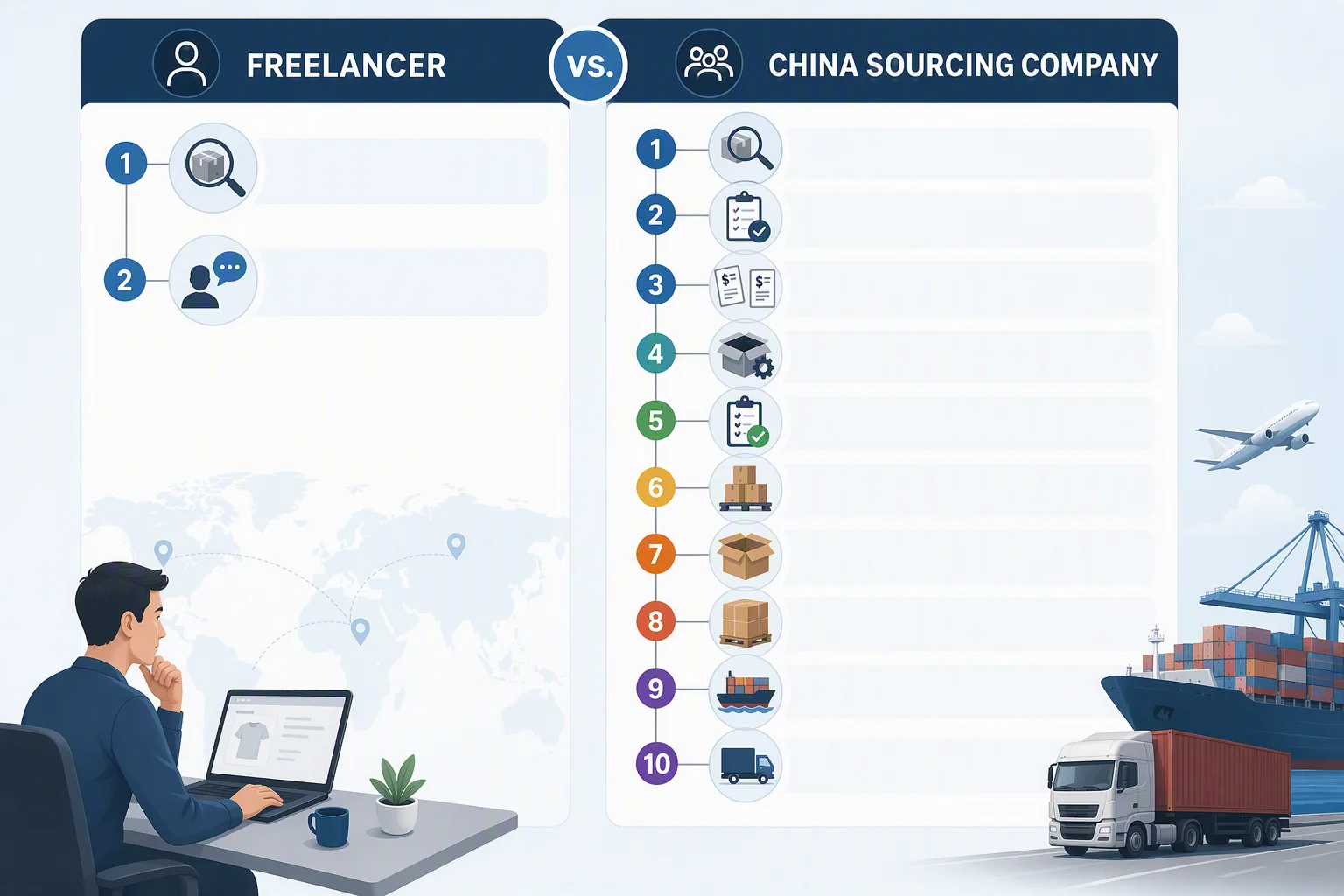
A freelancer can be a good choice for a simple, clearly defined sourcing task, such as finding one product from one supplier. A China sourcing company may be a better fit when your purchase involves several suppliers, customized products, quality inspections, order consolidation, or shipping coordination. I recommend comparing who owns each procurement task, how progress is reported, and how problems are handled—not just the quoted service fee.
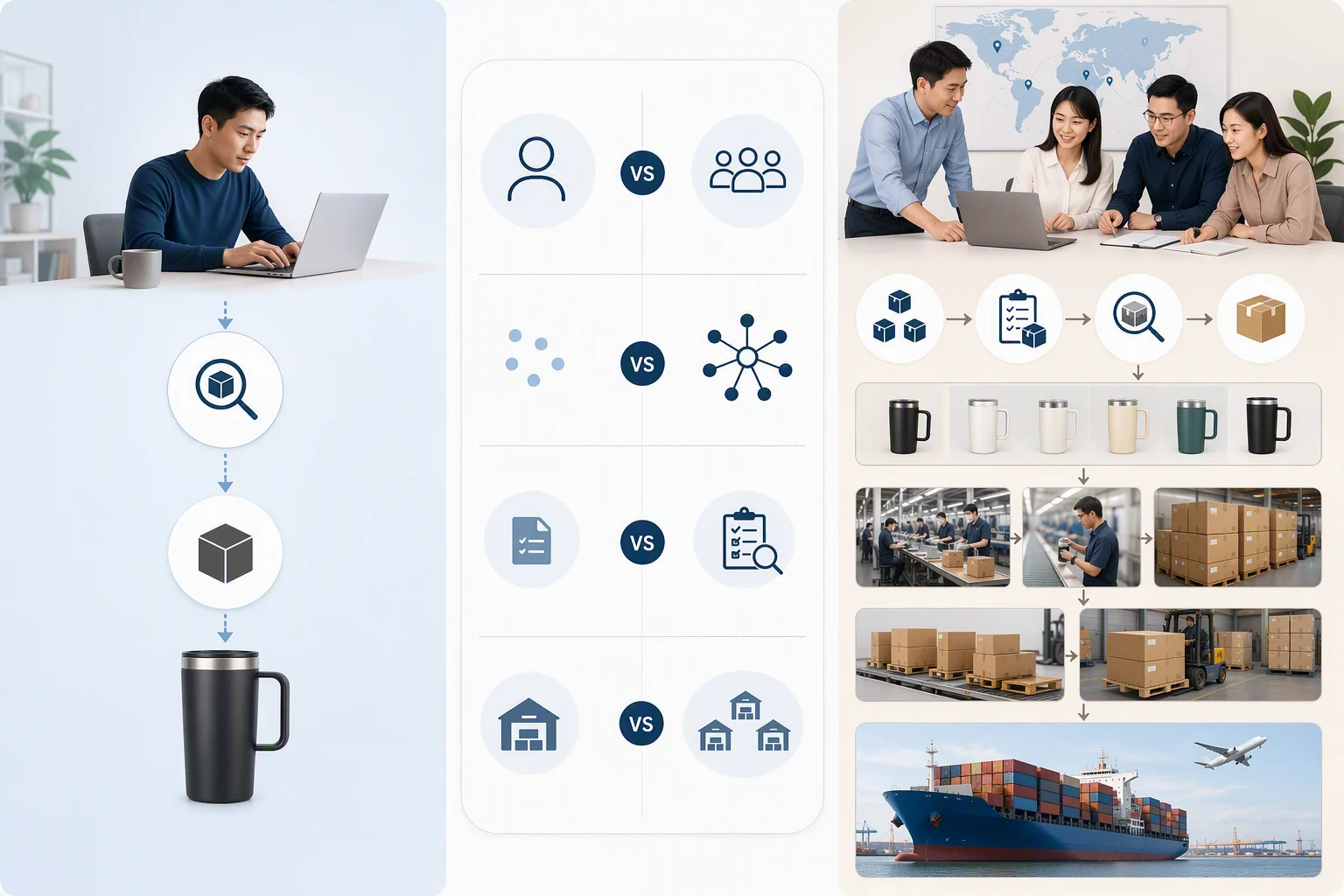
The decision becomes clearer when you look beyond the first supplier search. I have seen that sourcing work often expands after buyers request samples, compare quotations, revise packaging, arrange inspections, or combine products from different factories. Those extra steps are where coordination capacity matters most.
Is the Freelancer-Versus-Sourcing-Company Choice Primarily a Fee Comparison?
A low commission or flat project fee can make one option seem obvious. However, a narrow fee comparison can hide important work that may not be included, such as factory verification, sample follow-up, production updates, or pre-shipment inspection. Buyers can then face unexpected coordination gaps after placing an order.
The freelancer-versus-sourcing-company choice is not primarily a fee comparison. It is a decision about procurement coverage, accountability, and execution risk. I suggest that buyers compare the full cost of managing a purchase, including time, rework, shipping handoffs, quality issues, and the internal effort required when something does not go as planned.
Why the cheapest quote may not be the lowest total cost
A freelancer may quote for supplier research and communication only. A sourcing company may quote for a broader process. Neither approach is automatically better. The important question is whether the scope matches what your order actually requires.
For example, sourcing a standard phone accessory from one established supplier involves a different workload from developing a private-label consumer product with custom colors, barcodes, packaging inserts, and several SKUs. The second project can require repeated communication among the buyer, factory, packaging supplier, inspection team, warehouse, and freight provider.[^8]
I encourage buyers to separate service price from total procurement cost. Total cost can include:
- Time spent finding and qualifying suppliers
- Quotation comparison and specification clarification
- Sample revisions and approval records
- Communication during production
- Quality-control planning and inspection follow-up
- Labeling, packaging, and carton-mark checks
- Warehouse receiving and multi-supplier consolidation
- Shipping coordination and document follow-up
- Rework, replacement, or delay costs if requirements were missed
Compare the work, not the business label
The terms “freelancer” and “China sourcing company” do not tell you enough by themselves. Some freelancers have strong product knowledge, reliable factory relationships, and disciplined reporting. Some companies may have broad service lists but unclear execution ownership. I would not select either option based only on the label.
Instead, I recommend asking each provider to describe the workflow in writing.
| Procurement area | Questions for a freelancer | Questions for a China sourcing company |
|---|---|---|
| Supplier search | How many suppliers will you identify and compare? | Who performs supplier screening and how is it documented? |
| Supplier verification | What checks are included before I pay a deposit? | What verification steps are included, and what evidence will I receive? |
| Samples | Who follows up on changes and confirms specifications? | Who manages sample records, revisions, and approval communication? |
| Production | Will you provide updates after the order is placed? | Who follows production milestones and handles delays or deviations? |
| Quality control | Is inspection included, and what standard will be used? | Who conducts or coordinates inspection, and how are defects reported? |
| Consolidation | Can you receive products from multiple suppliers? | Who checks inbound quantities, labels, and packaging before consolidation? |
| Exceptions | Who responds if a supplier misses a requirement? | Who owns escalation, corrective action follow-up, and buyer updates? |
A good comparison gives you more than a price. It gives you a map of responsibility.
I believe the most useful sourcing proposal is one that makes the buyer’s remaining responsibilities visible.
When Is a Freelancer a Practical Choice for China Sourcing?
Buyers can overcomplicate a small project by paying for process coverage they do not need. At the same time, they can under-resource a project that looks simple but has hidden customization or compliance requirements. The key is to define the task before choosing the person or team.
A capable freelancer can be a practical option for China sourcing when the product, supplier base, specifications, and deliverables are straightforward. This is often true for a single product from one supplier, especially when the buyer can make decisions quickly and retain responsibility for some supplier, quality, and shipping coordination.
A freelancer may fit a low-complexity project
I would consider a freelancer when most of the following conditions apply:
- You are sourcing one product or a small product range
- You expect to work with one supplier
- Your product has standard specifications
- You need limited or no customization
- Your packaging is simple or already finalized
- You can approve samples and decisions without delay
- You have a clear inspection plan or can manage quality requirements yourself
- You do not need multi-supplier consolidation
- You are comfortable coordinating freight separately
- You have documented deliverables, timing, and reporting expectations
For a first test order, this route can be sensible. A buyer may only need help identifying suitable suppliers, translating requirements, collecting quotations, and arranging samples. In that situation, a focused freelancer can provide direct support without adding an extensive procurement structure.
The buyer must still control the scope
The risk is not that a freelancer is inherently unreliable. The risk is that the project becomes larger than the original agreement.
A request can start with “find a supplier for this item” and later include custom branding, safety documentation, retail packaging, barcode labels, accessory bundles, product photos, carton-drop concerns, inspection requirements, and shipping coordination. Each new requirement creates more parties to manage.[^9]
When I review a sourcing brief, I look for the points where work may expand:
- Product changes: Are materials, dimensions, colors, or functions still being decided?
- Customization: Does the buyer need a logo, custom mold, firmware change, insert card, or branded packaging?
- Supplier count: Is one factory enough, or will components and packaging come from separate suppliers?
- Quality sensitivity: Would minor cosmetic defects, incorrect labeling, or performance variation create a serious sales problem?
- Logistics complexity: Will the order require warehouse receiving, repacking, consolidation, or shipment splitting?
If the answer is “yes” to several of these questions, the buyer may need broader process support than a simple sourcing assignment provides.
How Can a China Sourcing Company Reduce Coordination Risk?
As an order grows, buyers can lose visibility between supplier selection and final shipment. Messages may be spread across chat apps, spreadsheets, invoices, and freight bookings. Without a clear process, a small issue can pass from one party to another without anyone owning the response.
A China sourcing company can reduce coordination risk by managing a defined workflow across supplier research, quotation comparison, samples, production follow-up, inspection, consolidation, and shipping coordination. This does not remove supplier or delivery risk, but it can reduce single-point dependency and make responsibilities easier to track.
Process coverage matters when handoffs multiply
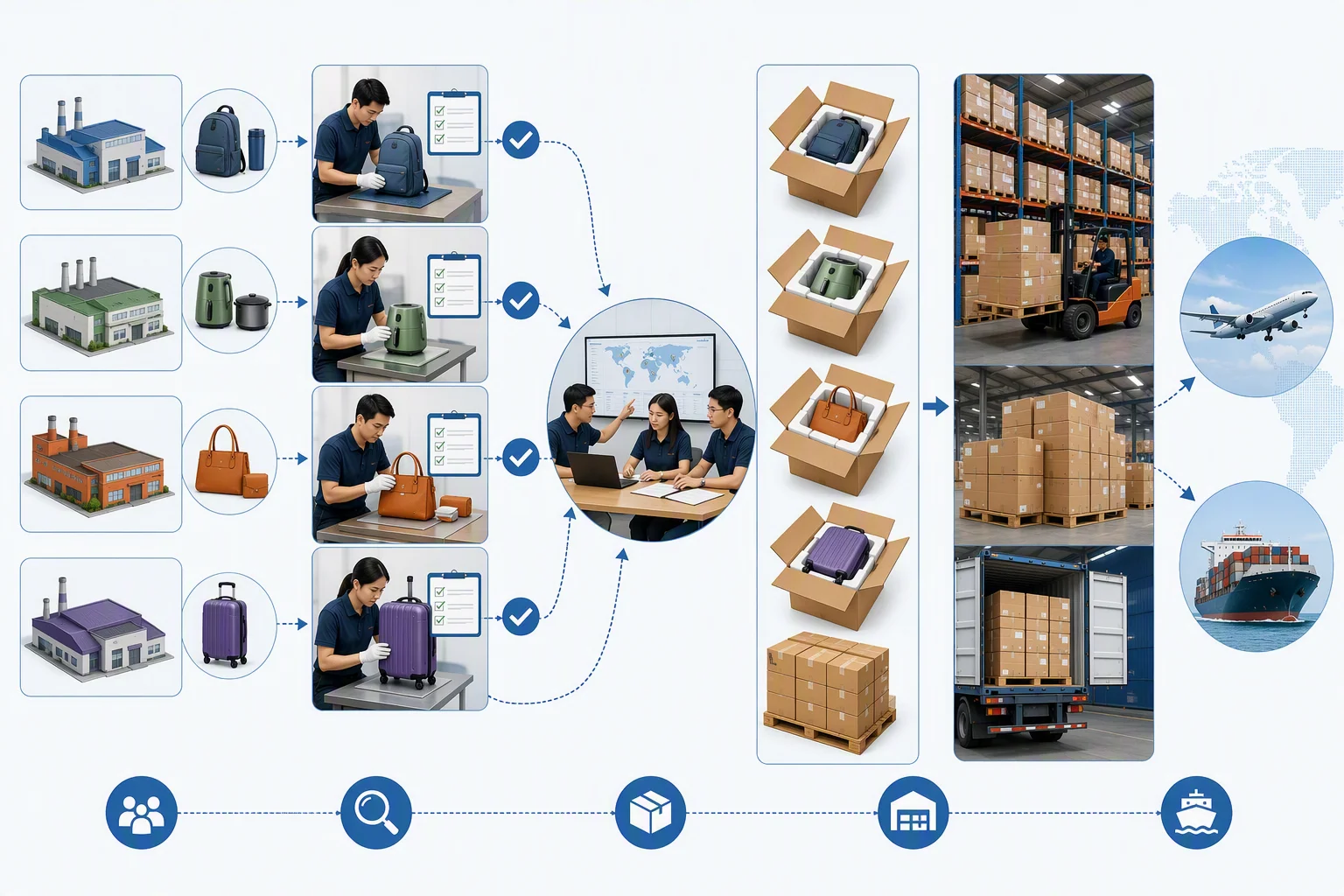
At KingSourcing, I see the value of structured support most clearly when an overseas buyer works with multiple Chinese factories. One factory may produce the main product. Another may make customized packaging. A third may supply accessories or promotional inserts. The final shipment may need all goods checked, labeled, combined, and packed to the buyer’s instructions.
That type of order does not necessarily require a large purchasing program. It does require clear ownership.
A China sourcing company may offer useful process coverage when buyers need:
- Supplier sourcing and comparison across several options
- Basic supplier or factory verification before payment decisions
- Sample development and specification follow-up
- OEM, ODM, or private-label coordination
- Production milestone communication
- Third-party or in-house inspection coordination, depending on the agreed scope
- One-by-one product checking for suitable product categories and agreed standards
- Packaging, labeling, barcode, and carton-mark review
- Receiving goods from several factories
- Warehousing and order consolidation
- International shipping coordination
However, buyers should not assume that every provider performs every step in the same way. I recommend asking whether the provider conducts a task directly, coordinates a third party, or expects the buyer to manage it.
Avoid single-point dependency
Single-point dependency happens when all project knowledge sits with one individual, one supplier contact, or one informal message thread.[^2] If that person becomes unavailable, changes roles, or misses a critical detail, the buyer may not have a clear record of what was agreed.
A sourcing company may reduce this dependency if it uses documented procedures, shared records, assigned responsibilities, and escalation paths. Still, buyers should verify this rather than assume it.
Useful questions include:
- Who is my day-to-day contact?
- Who covers the project if that person is unavailable?
- Will I receive written quotation comparisons?
- How are approved samples and specifications recorded?
- What production updates should I expect?
- What inspection standard will be used?
- Who communicates with the supplier when defects are found?
- How are quantity shortages, packaging errors, or shipping delays escalated?
For growing brands, the strongest option is often the one that makes the project manageable even when an exception occurs.
What Should You Verify Before Hiring a China Sourcing Company or Freelancer?
A polished website, a large contact list, or a low fee does not confirm delivery capability. Buyers may discover too late that supplier screening was shallow, quality-control scope was unclear, or shipping support ended when goods left the factory. Verification should happen before deposits are paid.
Before hiring a freelancer or a China sourcing company, I recommend verifying execution ownership, reporting methods, quality-control scope, and exception handling. Ask for a written service scope that identifies what is included, what is excluded, who performs each task, and what information you will receive at key milestones.
Use a practical procurement complexity checklist
You do not need a complicated scoring model. I suggest reviewing five factors first.
1. Number of suppliers
One supplier is easier to manage than five.[^10] More suppliers create more quotation comparisons, payment timing, delivery schedules, inbound checks, and consolidation needs.
2. Number of SKUs
A single SKU is relatively simple. A large product range can create variation in labels, packaging, carton quantities, quality standards, and replenishment planning.
3. Customization requirements
Customization increases the importance of approved samples, specification sheets, artwork confirmation, and production communication.[^3] Small misunderstandings can become expensive when repeated across a full production run.
4. Quality-control needs
Buyers should define what “acceptable quality” means before production.[^4] This may include appearance, function, quantity, labeling, packaging, and agreed defect limits. For application-specific requirements, I recommend qualified professional evaluation and appropriate testing by competent parties.
5. Logistics handoffs
Every handoff adds a potential failure point.[^5] Goods may move from factory to warehouse, from warehouse to freight forwarder, and then through export and import processes. Buyers should confirm who checks quantities and labels at each relevant stage.
Ask for evidence, not broad assurances
I would ask providers for examples of their process documents without requiring them to disclose confidential client information. Useful evidence may include:
- A sample quotation comparison format
- A supplier verification checklist
- A sample inspection report format
- A production follow-up schedule
- A packaging and labeling checklist
- A consolidation receiving process
- A communication and escalation procedure
If a provider references factory audits, quality systems, test reports, or certifications, treat those items as documents to review and verify.[^6] Their relevance can vary by product category, market, and application.
The best provider for your business is not necessarily the one that promises the most. It is the one that clearly explains what it will do, what you must do, and how both sides will respond when the plan changes.
Frequently Asked Questions
Is a freelancer cheaper than a China sourcing company?
A freelancer may have a lower initial fee for a narrow assignment, but buyers should compare the full scope. I recommend including supplier verification, sample follow-up, quality checks, consolidation, shipping coordination, and the buyer’s own time before deciding which option is more cost-effective.
Can a freelancer handle quality inspection in China?
Some freelancers can coordinate or perform agreed inspection activities, depending on their location, capacity, and experience. Buyers should confirm the inspection method, product checks, reporting format, defect standard, and who will follow up with the supplier if problems are found.
When should I use a China sourcing company?
I would consider a China sourcing company when your project involves multiple suppliers, multiple SKUs, custom products, private-label packaging, production follow-up, quality-control coordination, consolidation, or shipping support. These projects usually have more handoffs and require clearer process ownership.
What should a sourcing agreement include?
A sourcing agreement should define the product scope, deliverables, fees, payment terms, reporting frequency, supplier verification steps, inspection scope, confidentiality expectations, responsibility boundaries, and exception handling. I also recommend documenting what is excluded so there are fewer assumptions after work begins.
Does a sourcing company guarantee product quality or delivery?
No provider can reasonably guarantee that every supplier, product, or shipment will be problem-free.[^7] A China sourcing company can help reduce risk through verification, communication, inspection coordination, and structured follow-up, but buyers should retain approval controls and evaluate product-specific requirements carefully.
Conclusion
The choice between a freelancer and a China sourcing company should reflect your real procurement workload, not only the initial service fee. I would use a capable freelancer for a simple, tightly defined task with limited supplier and logistics complexity. I would consider a sourcing company when customization, quality control, supplier coordination, consolidation, and shipping handoffs increase. At KingSourcing, we help overseas buyers build a clearer China procurement process—from supplier evaluation through inspection, consolidation, and delivery coordination. Contact us to discuss the level of sourcing support your project requires.
[^1]: "New Quality Cost Framework (QCF) Based on the Hybrid Fuzzy ...", https://pmc.ncbi.nlm.nih.gov/articles/PMC8979713/. Total-cost-of-ownership approaches recognize that acquisition decisions can incur additional costs from quality failures, rework, delays, and supplier-management activities beyond the initial quoted price. Evidence role: general_support; source type: research. Supports: Research or public procurement guidance explaining that supplier quality failures, rework, delays, and coordination burdens contribute to total cost beyond purchase price.. Scope note: This supports the general cost principle, not the cost outcome of any particular freelancer or sourcing-company engagement. [^2]: "[PDF] Appendix J: Strengthening the Resilience of Outsourced Technology ...", https://www.ffiec.gov/sites/default/files/media/press-releases/2015/2015-appendix-j.pdf. Business-continuity guidance treats reliance on a single person, system, or process as a potential single point of failure because its unavailability can interrupt operations or delay decisions. Evidence role: definition; source type: government. Supports: Business-continuity guidance defining single points of failure and explaining risks created by dependence on one person, system, or process.. Scope note: The concept is applied here by analogy; communication practices in a sourcing project may not constitute a technical single point of failure. [^3]: "Supplier Quality Agreement dated as of December 20 ... - SEC.gov", https://www.sec.gov/Archives/edgar/data/1527352/000182912624008446/nexalintech_ex10-19.htm. Research on product customization and supplier integration indicates that increased design variation requires more complete specification exchange, feedback, and approval controls to limit misunderstandings during production. Evidence role: mechanism; source type: research. Supports: Quality-management and product-development research explaining why customization increases information exchange and the need to control specifications and approvals.. Scope note: The appropriate documents and approval process depend on the product’s technical, regulatory, and commercial requirements. [^4]: "Part 46 - Quality Assurance - Acquisition.GOV", https://www.acquisition.gov/far/part-46. Quality-management standards emphasize determining product requirements and applying defined criteria for verification or acceptance, so that conformity can be assessed consistently. Evidence role: expert_consensus; source type: institution. Supports: Quality-management standards or inspection guidance requiring organizations to define product requirements and criteria for acceptance or verification.. Scope note: A standard establishes a management principle and may require product-specific interpretation; it does not itself determine an appropriate defect threshold. [^5]: "Supply chain disruptions and resilience: a major review ... - PMC", https://pmc.ncbi.nlm.nih.gov/articles/PMC7792559/. Logistics research identifies transfers between organizations and facilities as coordination points where incomplete information, schedule mismatch, and handling variation may increase the risk of delay or error. Evidence role: mechanism; source type: paper. Supports: Logistics and supply-chain research on how interorganizational and physical transfer points can create additional opportunities for delay, information distortion, and handling errors.. Scope note: A handoff is not inherently defective; standardized documentation, tracking, and controls can mitigate the associated risk. [^6]: "Perform Due Diligence - International Trade Administration", https://www.trade.gov/perform-due-diligence. Conformity-assessment guidance distinguishes valid certification and test evidence by its issuer, scope, accreditation status, and applicability to the product or process being assessed, supporting review rather than reliance on unsupported claims. Evidence role: general_support; source type: institution. Supports: Conformity-assessment or accreditation guidance explaining the need to check the validity, scope, issuer, and applicability of certificates and test documentation.. Scope note: Verification of documentation cannot by itself establish ongoing factory performance or confirm that every shipped unit conforms. [^7]: "Part 46 - Quality Assurance - Acquisition.GOV", https://www.acquisition.gov/far/part-46. Risk-management guidance recognizes residual risk: inspections, verification, and monitoring can reduce the likelihood or impact of failures but cannot guarantee that all supplier, product, or delivery problems will be absent. Evidence role: expert_consensus; source type: institution. Supports: Risk-management and quality-assurance guidance recognizing that controls reduce and manage risk but do not eliminate all uncertainty or nonconformity.. Scope note: The level of residual risk depends on the product, supplier controls, inspection design, transport conditions, and contractual allocation of responsibility. [^8]: "Supply Chain Management vs. Logistics: Key Insights and Differences", https://www.amu.apus.edu/area-of-study/business-administration-and-management/resources/supply-chain-management-vs-logistics/. Supply-chain studies describe customized products and multi-stage fulfillment as activities requiring coordination across manufacturers, packaging operations, quality-control functions, warehouses, and transport providers. Evidence role: mechanism; source type: paper. Supports: Supply-chain research describing how product customization, packaging, quality assurance, warehousing, and freight activities create interorganizational coordination requirements.. Scope note: The source would describe the general coordination mechanism; the exact parties involved vary by product, contract terms, and shipping model. [^9]: "4.4 Project Scope Management - Pressbooks@MSL", https://pressbooks.ulib.csuohio.edu/project-management-navigating-the-complexity/chapter/4-4-project-scope-management/. Research on project and supply-chain complexity finds that increasing task interdependence and the number of participating organizations raises coordination demands and the potential for communication failures. Evidence role: mechanism; source type: research. Supports: Research linking greater task interdependence, stakeholder numbers, and product or process complexity with higher coordination demands.. Scope note: Complexity is influenced by process design and information systems as well as by the number of requirements. [^10]: "Embracing supply base complexity: The contingency role ...", http://myweb.sabanciuniv.edu/melekates/files/2021/06/IJOPM-SBC-Author-version3.pdf. Studies of supply-base management report that a larger number of suppliers can increase the administrative, information-sharing, monitoring, and coordination demands placed on buyers. Evidence role: general_support; source type: paper. Supports: Research on supply-base complexity showing that larger supplier bases increase supplier relationship, information, monitoring, and coordination requirements.. Scope note: More suppliers may also provide resilience, competition, or specialized capability; the optimal number depends on the purchasing context.