A China sourcing agent contract matters because informal WhatsApp messages and email promises can leave buyers exposed to hidden fees, unclear quality duties, and supplier transparency concerns[^1]. These gaps often appear only after deposits are paid or production is delayed. I recommend using a practical agreement that makes responsibilities, costs, approvals, and exit rights clear before work begins.
A reliable China sourcing agent contract should define the service scope, supplier sourcing process, pricing and commission structure, quality control responsibilities, confidentiality obligations, supplier information ownership, shipping coordination, payment rules, dispute handling, and termination conditions. Buyers should also require fee transparency, anti-kickback controls[^2], audit access, and written approval rules so the relationship remains measurable, auditable, and replaceable.
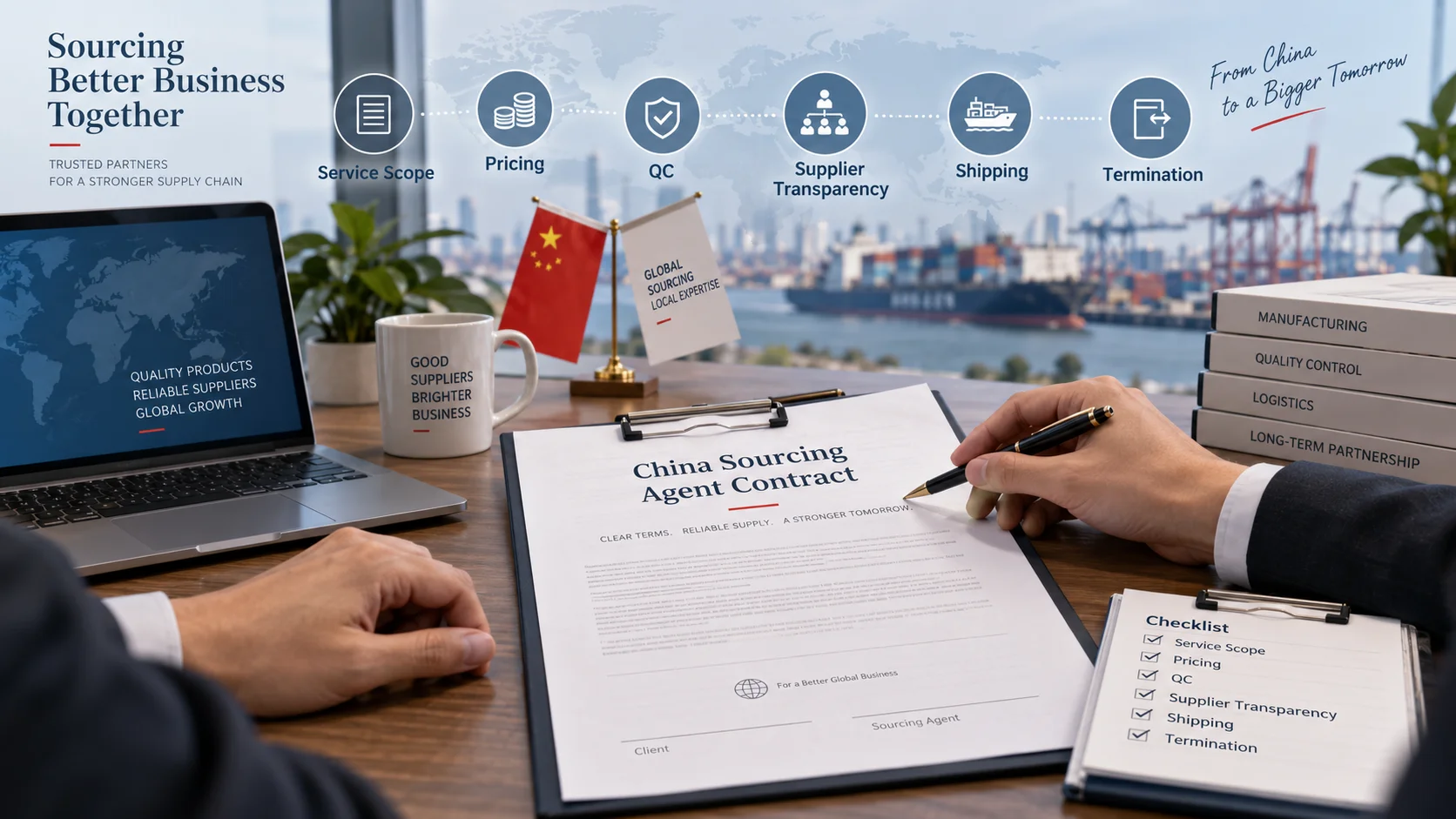
A contract does not need to become a 30-page legal document to be useful. In my experience, the strongest agreements focus on the operational points that create disputes in real China procurement: who selects suppliers, who approves costs, who owns factory information, and what happens when products fail inspection.
Quick Answer: What Should a China Sourcing Agent Contract Include?
A vague sourcing arrangement can create uncertainty from the first quotation. Buyers may assume that factory audits, sample follow-up, QC, and shipping support are included[^3], while the agent may treat them as extra services. I have seen this mismatch cause avoidable tension before an order even reaches production.
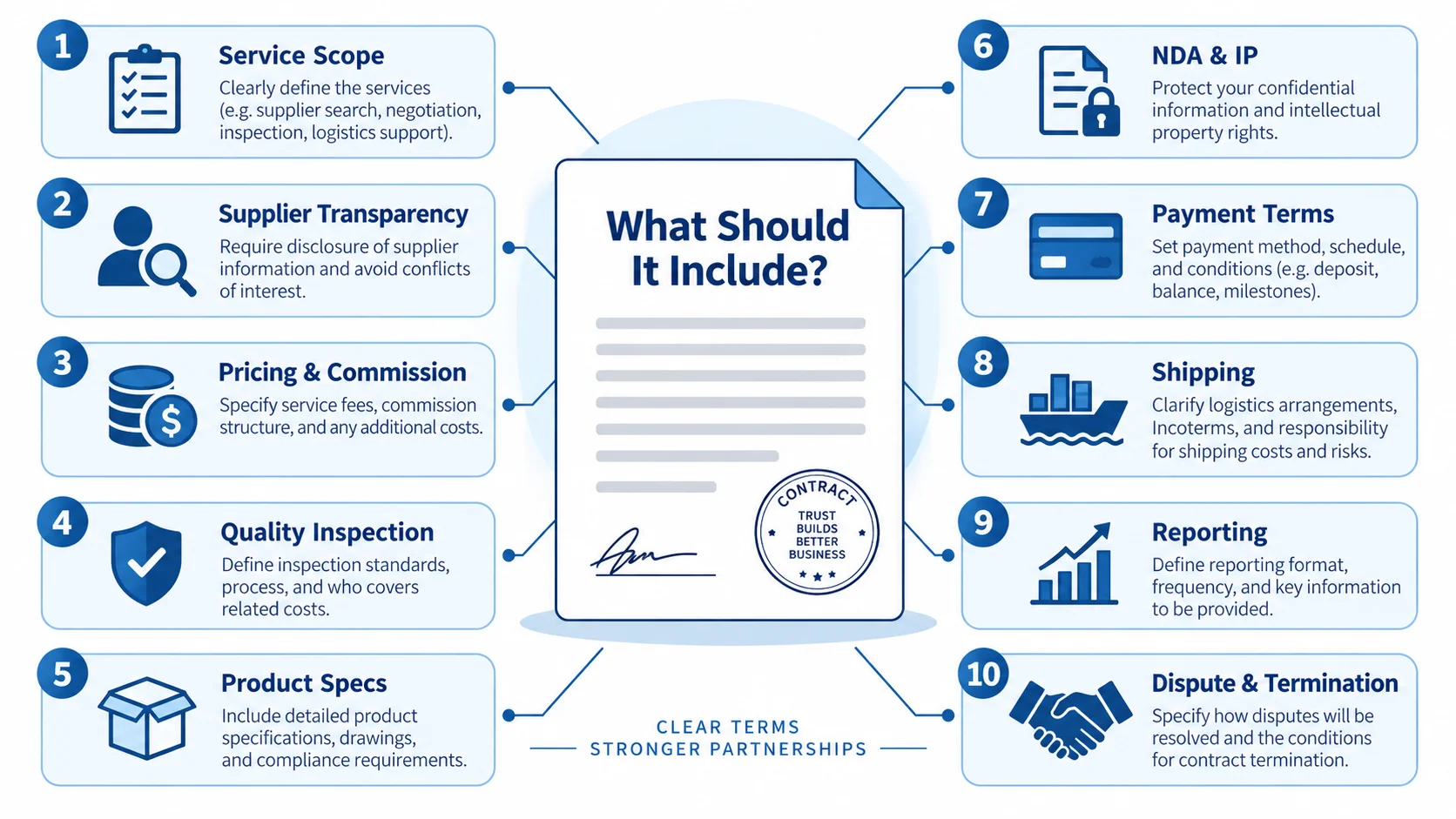
A China sourcing agent contract should include service scope, supplier transparency, pricing and commission, quality inspection procedures, product specifications, NDA and IP protection, payment terms, shipping responsibilities, reporting requirements, dispute escalation, and termination rights. It should state who approves decisions, who pays third parties, and what evidence supports each transaction.
Start With the Controls That Matter Most
I usually advise buyers to build the agreement in layers. The first layer should address money and visibility. The second should cover product quality and production controls. The final layer should protect continuity if the working relationship ends.
Useful clause headings can include:
- Commission & Scope
- Supplier Incentives & Anti-Kickback
- FX & Pass-Through Costs
- Audit & Data Access
- AQL & Acceptance
- Pre-Shipment Inspection
- Nonconformance Remedies
- Dispute Escalation & Evidence
- Termination, Handover & Transition Assistance
A practical agreement should also identify the buyer’s role. For example, I recommend that buyers retain written approval rights for:
- Final supplier selection
- Purchase order issuance
- Product specification changes
- Tooling or mold payments
- Price increases
- Packaging changes
- Shipment release after inspection
A sourcing partner can manage the workflow, but the buyer should remain in control of commercial decisions.
Jurisdiction-specific contract language, dispute venues, and enforcement should always be reviewed with qualified local legal counsel. I treat the operational contract as a procurement control document, not a substitute for legal advice.
Why Do Buyers Need a China Sourcing Agent Contract Before Ordering?
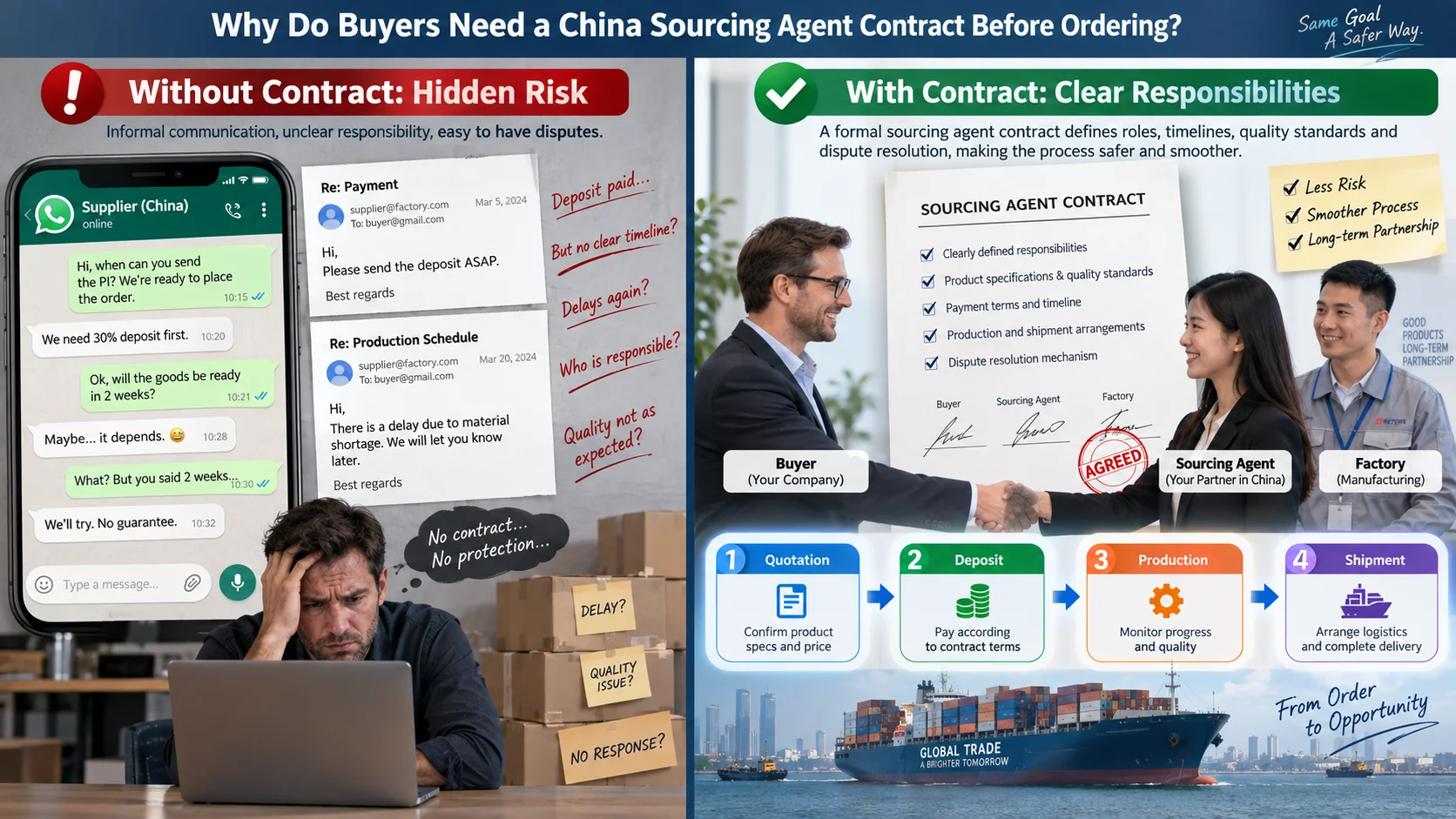
Many first-time buyers begin with a supplier introduction and a few messages. That approach feels fast, but it creates risk when the project becomes more complex. Without agreed responsibilities, buyers may not know whether the agent is responsible for checking a factory, following up production, or resolving a defect claim.
A China sourcing agent contract gives both parties a written operating framework before deposits and purchase orders create financial exposure. It reduces confusion around fees, supplier selection, quality checks, production delays, and shipment coordination. It also gives buyers a record of what the sourcing partner agreed to do.
Why Messages Are Not Enough
WhatsApp and email are useful working tools, but they are poor substitutes for a clear sourcing agent agreement. Important decisions can be buried in message threads, misunderstood across languages, or changed without a clear approval trail.
The difference between China sourcing agent vs factory direct buying is not simply cost. Factory-direct buying may reduce one layer of communication, but buyers must manage supplier verification, negotiation, quality control, production follow-up, consolidation, and logistics themselves. A sourcing agent can coordinate these tasks, but only if the service scope is defined.
I once worked through a negotiation where a buyer believed “quality checking” meant full pre-shipment inspection. The service provider believed it meant occasional production follow-up. The issue was resolved before production because both sides listed the expected inspection checkpoints and reporting format. That small clarification prevented a much larger dispute later.
A contract helps buyers address common risks:
- Supplier introduction only: The agent finds a factory but does not manage production.
- Hidden service charges: A low commission may exclude QC, sample handling, banking fees, or warehousing.
- Unclear defect responsibility: The agent may coordinate a claim but not fund rework or replacement.
- Production delay uncertainty: No one knows who must communicate with the factory or update the buyer.
- Supplier opacity: The buyer cannot tell whether quotations are competitive or whether incentives exist.
Comparison Table: China Sourcing Agent Contract Checklist at a Glance?
Buyers often face a long contract and do not know where to focus first. The key is to review the commercial and operational clauses before spending too much time on formal wording. I use the following checklist to identify missing controls quickly.
A good China sourcing agent contract should let a buyer answer three questions: What will the agent do? What will it cost? What happens if something goes wrong? If the agreement does not answer those questions clearly, I recommend revising it before work starts.
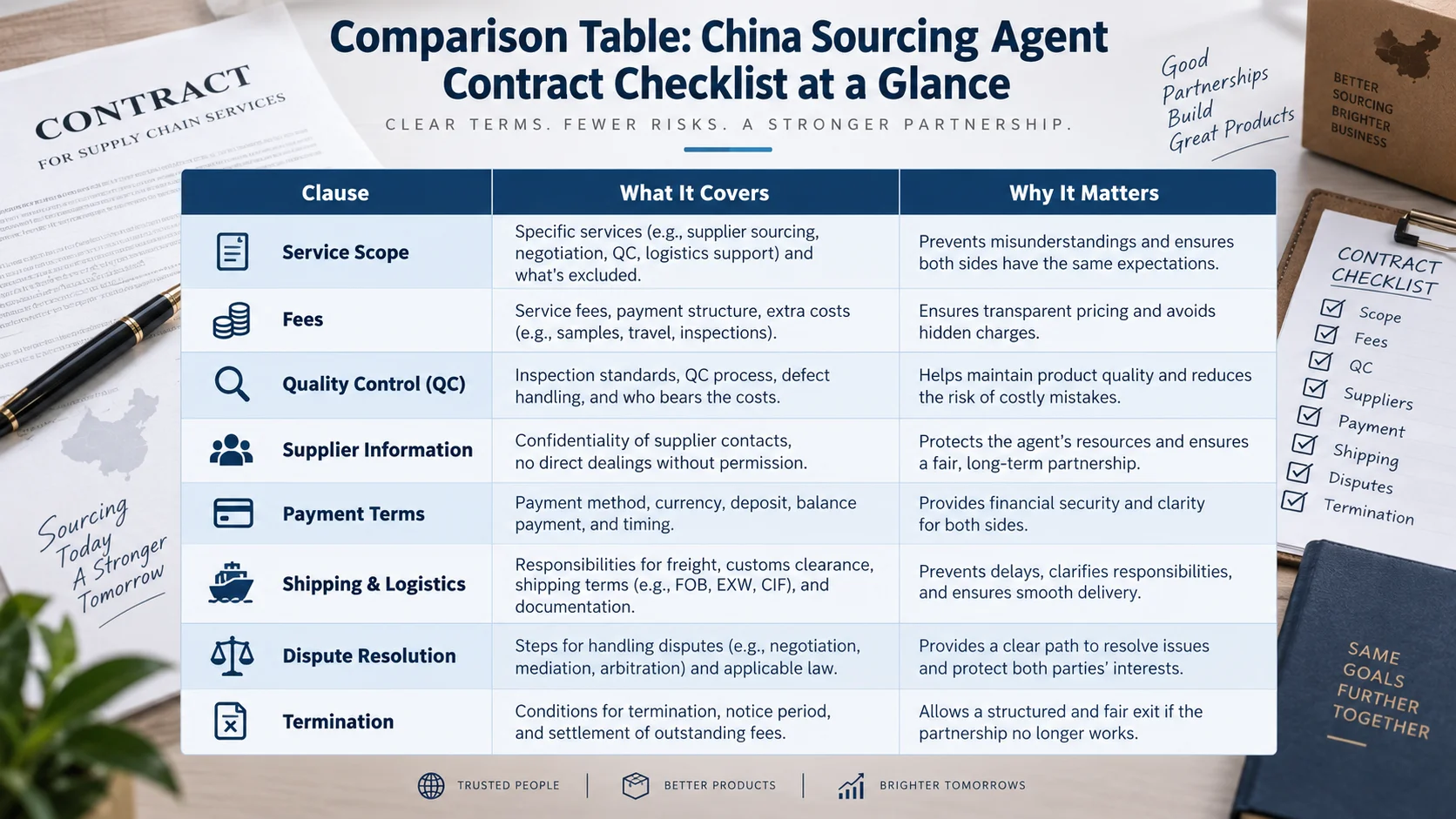
| Contract Section | What Buyers Should Confirm | Why It Matters |
|---|---|---|
| Service Scope | Supplier search, quotation, samples, QC, shipping support | Avoid unclear responsibilities |
| Agent Fees | Commission, service fee, payment schedule | Prevent hidden costs |
| Supplier Transparency | Whether supplier details are disclosed | Build trust |
| Quality Control | Inspection standards and reporting process | Reduce defective products |
| Product Specification | Approved samples and requirements | Avoid production mismatch |
| Confidentiality | NDA and information protection | Protect business data |
| Payment Terms | Deposit, balance, refund conditions | Reduce financial risk |
| Delivery Terms | Lead time, shipping responsibility | Control delays |
| Warranty & After-sales | Defect handling process | Protect buyers after delivery |
| Termination | Exit conditions and outstanding orders | Avoid future disputes |
Use the Checklist as a Working Document
I suggest turning this table into a live onboarding checklist. Each item should link to a document, process, or named person.
For example:
- The service scope should link to a workflow or statement of work.
- The product specification should link to drawings, photos, packaging files, and an approved sample record.
- The quality control section should link to an inspection checklist and AQL standard where relevant.
- The supplier transparency section should define whether buyers receive factory names, addresses, business registration records, and quotation comparisons.
- The termination section should list the files the agent must hand over.
This approach is especially useful for multi-SKU sourcing, private-label products, and e-commerce orders. A small unclear point can become expensive when it affects several factories, packaging suppliers, and freight partners at the same time.
Service Scope: What Will Your China Sourcing Agent Handle?
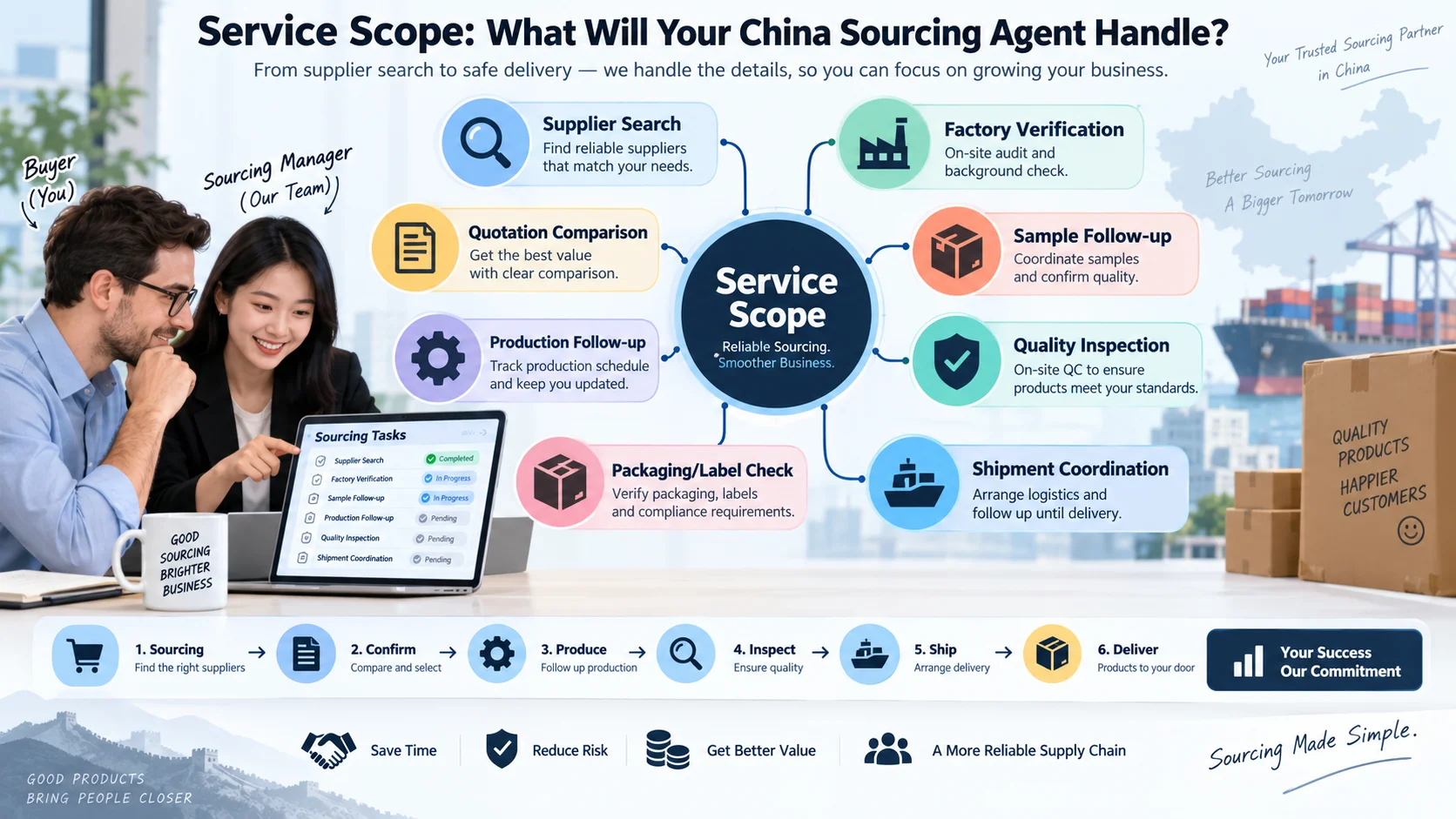
“Help buyer source products” is one of the least useful phrases in a procurement agreement. It sounds flexible, but it does not say whether the sourcing partner will verify factories, compare quotations, inspect goods, manage labels, or coordinate shipment.
A China sourcing agent contract should break the service scope into specific tasks and deliverables. Buyers should know what the agent will do, how often the agent will report, which work is included in the fee, and which activities require separate approval or payment.[^4]
Supplier Sourcing
The agreement can cover:
- Factory searching based on the buyer’s product brief
- RFQ management and quotation comparison
- Basic supplier verification
- Factory audit coordination, if requested
- Supplier capability review for OEM or ODM projects
- Collection of compliance documents for buyer review
Procurement and Production Support
The service scope may also include:
- Price negotiation support
- Sample coordination
- Purchase order follow-up
- Production status updates
- Packaging and labeling coordination
- Quality inspection booking or execution
- Warehouse receiving and consolidation
Logistics Support
For shipping support, buyers should define whether the agent handles:
- Carton marking and packing list checks
- Export document coordination
- Consolidation from multiple factories
- Freight quotation comparison
- Shipping booking coordination
- Communication with forwarders
I recommend adding a simple responsibility matrix. A buyer may approve suppliers and POs, while the agent manages RFQs and factory communication. A freight forwarder may arrange transport, while the agent confirms carton counts and document consistency.
This matters because shipping coordination is not the same as assuming legal responsibility for international transportation, customs clearance, or destination duties. The agreement should state the boundary clearly.
Supplier Transparency and Ownership of Supplier Information?
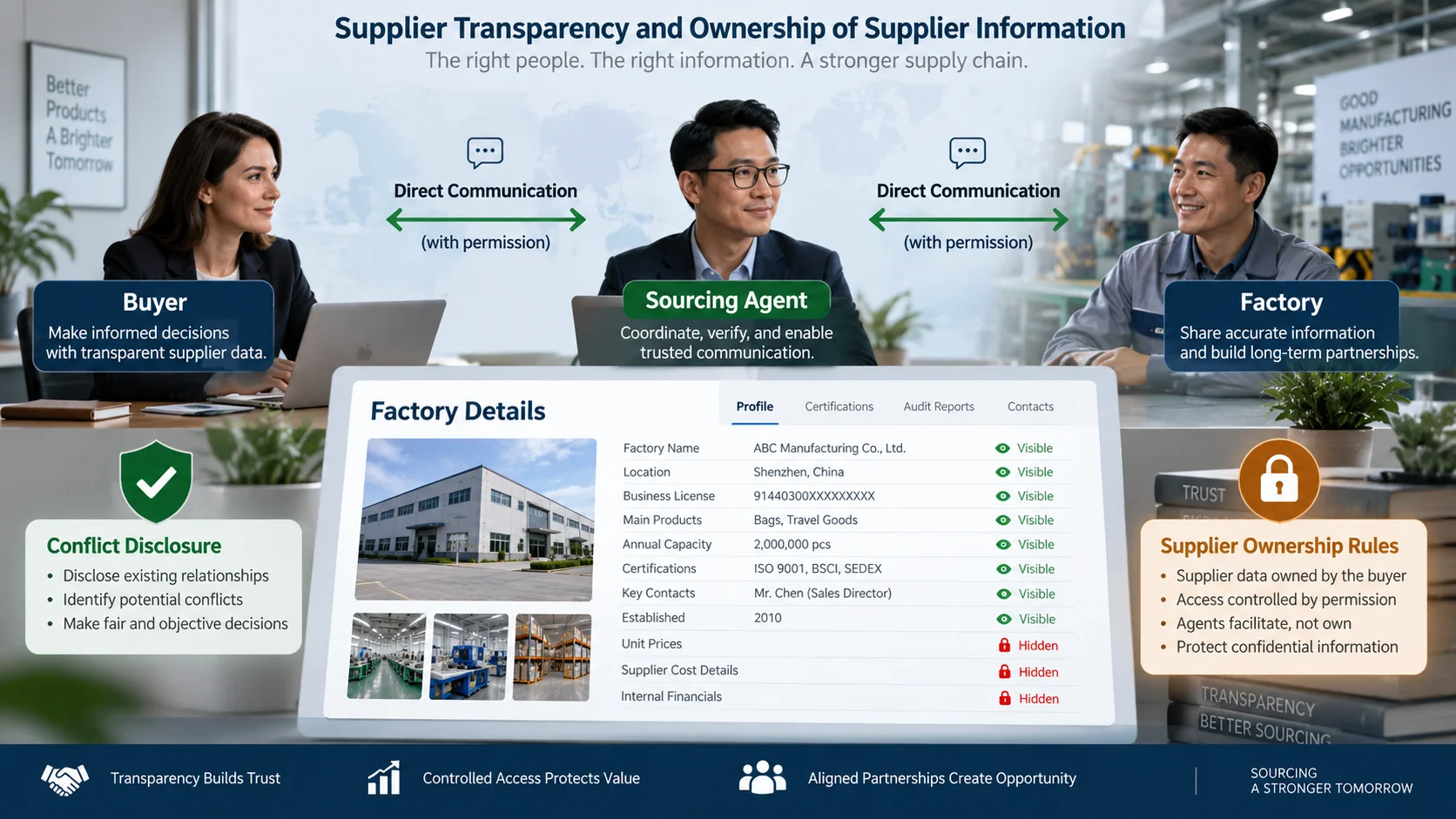
Buyers often ask me one direct question: “Will the sourcing agent hide the factory?” This concern is understandable, especially when buyers are building long-term private-label or wholesale programs. However, total factory access is not the only measure of a good sourcing relationship.
A China sourcing agent contract should state whether supplier details will be disclosed, when direct buyer-factory communication is allowed, how supplier relationships are managed, and whether the agent must disclose conflicts of interest. Clear rules reduce mistrust without weakening procurement coordination.
Define What “Transparency” Means
Supplier transparency can include:
- Factory legal name and address
- Main contact details
- Business license or registration documents for review
- Quotation comparison sheets
- Product capability and MOQ information
- Audit findings or verification notes
- Purchase order and production status records
Professional sourcing agents create value through supplier evaluation, communication, quality management, problem-solving, and order coordination. They should not rely only on hiding factory information to retain a client.
Add Conflict-of-Interest Controls
I consider anti-kickback language essential[^5]. The contract should prohibit undisclosed supplier rebates, commissions, gifts, hospitality, or other financial incentives that could affect supplier selection or pricing.
Example operational wording:
“The agent shall disclose supplier incentives, rebates, commissions, or material benefits related to buyer orders. Any undisclosed incentive is prohibited unless the buyer gives written approval.”
Buyers can also request evidence such as quotation comparison files, supplier email confirmations, bank payment records, and written rebate disclosures. In one de-identified negotiation, an agent initially resisted a rebate disclosure clause because it felt intrusive. The parties resolved it by allowing reasonable confidentiality while requiring disclosure of incentives linked to the buyer’s orders. That created a more workable arrangement.
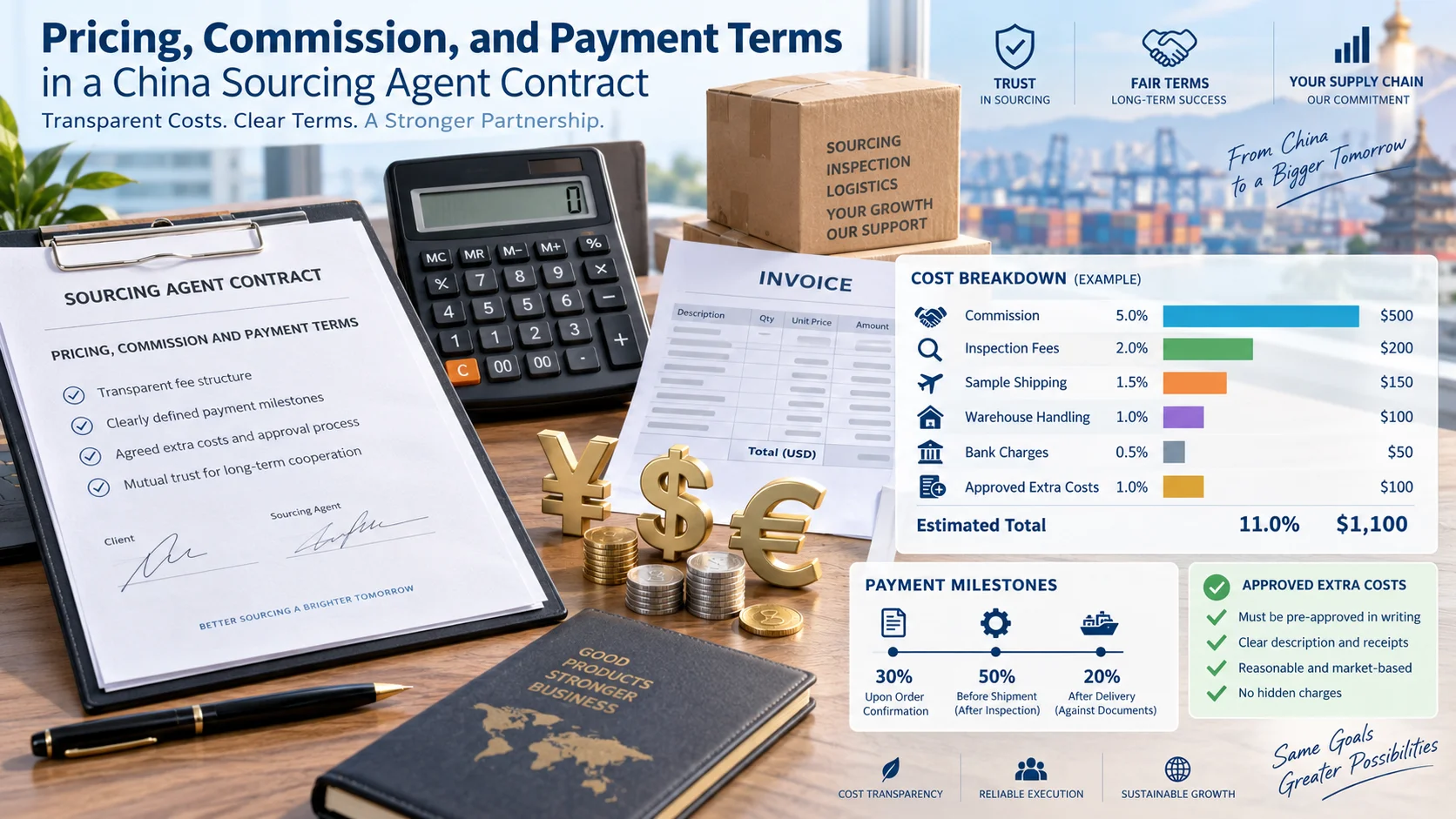
Pricing, Commission, and Payment Terms in a China Sourcing Agent Contract?
A low commission rate does not always mean lower total sourcing cost. Buyers can face unexpected charges for inspections, warehouse handling, sample shipping, bank transfers, currency conversion, export paperwork, or project management.[^6] These charges are not necessarily improper, but they should be visible before the buyer commits.
A China sourcing agent contract should state the fee model, commission basis, payment milestones, included services, excluded services, third-party costs, currency rules, and approval process for additional spending. Transparency should be more important than a headline percentage.
Common Fee Models
| Fee Model | Best Fit | Buyer Checkpoint |
|---|---|---|
| Commission percentage | Repeat purchasing programs | Confirm whether it applies to ex-factory or landed cost |
| Fixed sourcing fee | Defined product search project | Confirm number of suppliers, samples, and revisions |
| Monthly service fee | Ongoing procurement support | Set KPIs and reporting requirements |
| Hybrid model | Complex multi-SKU purchasing | Separate fixed work from transaction commissions |
Build a Fee-Transparency Baseline
I recommend that buyers define:
- The exact commission percentage
- The cost base used for commission calculations
- When the fee becomes payable
- Whether QC is included or separate
- Whether freight is included or separate
- How foreign-exchange conversion is calculated
- Which third-party fees are passed through at cost
- Which expenses require written pre-approval
For FX, buyers may agree on a published benchmark plus a fixed spread. For example, the contract might reference a recognized daily market rate and state the permitted conversion margin. The exact source should be agreed in writing.
For payment architecture, I generally prefer buyer-to-factory payment where practical. The buyer pays the approved factory directly, while the sourcing agent invoices commission based on agreed milestones and supporting records. If the agent handles funds, buyers should consider a designated account, periodic reconciliation, approval thresholds, and visibility over payment records.
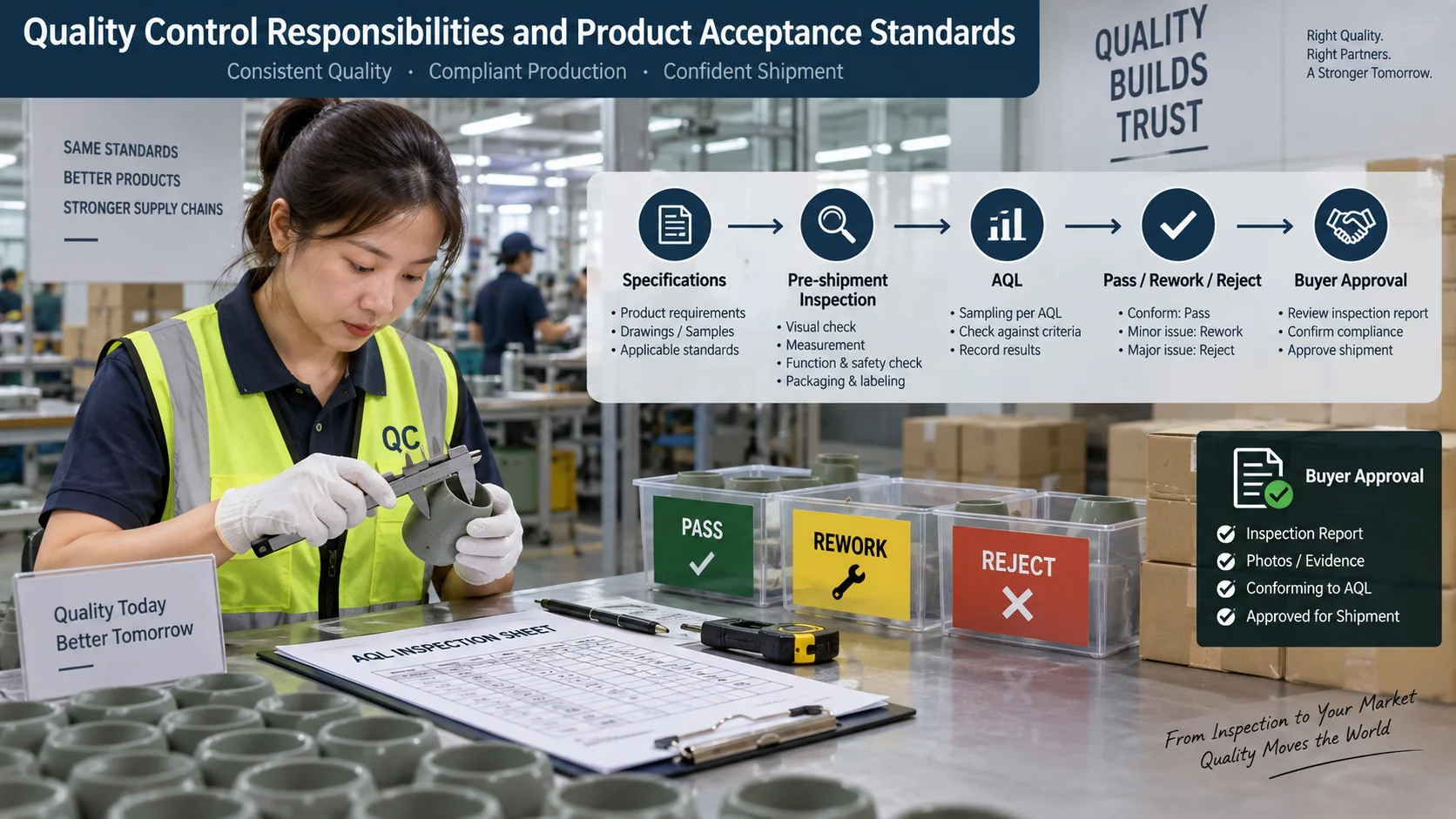
Quality Control Responsibilities and Product Acceptance Standards?
Quality disputes are often not caused by a lack of effort. They happen because the buyer, factory, and sourcing agent never agreed on what “acceptable quality” means. A buyer may expect a flawless finish, while a factory may consider small cosmetic variation normal.
A China sourcing agent contract should define how quality is controlled, what standards apply, when inspections occur, who pays for them, what reports are provided, and what happens when goods fail. The sourcing agent can coordinate QC, but the buyer must approve acceptance standards before mass production.
Set the Quality Gate Before Production
For many consumer products, I recommend documenting:
- Approved sample or “golden sample”
- Product dimensions and materials
- Color references and logo placement
- Packaging requirements
- Functional test requirements
- Critical, major, and minor defect definitions
- AQL level and sample size, where appropriate
- Required photos, videos, and inspection report format
An AQL process[^7] can be useful, but buyers should not treat it as a universal guarantee. The appropriate inspection level depends on the product, order value, safety risk, and intended market. Electrical products, children’s products, and regulated items may require additional testing or qualified professional assessment.
Use a Remedy Ladder
The contract should define a nonconformance process:
- Rework if the defect can be corrected before shipment.
- Replacement if rework is not feasible.
- Price credit or negotiated compensation for agreed remaining defects.
- Escalation to third-party inspection or formal dispute handling when evidence is disputed.
I recommend specifying re-inspection triggers, turnaround times, and who pays for rework or repeat inspection. Buyers should also define whether urgent shipment can proceed with written exception approval. Without that rule, time pressure can override the quality process without a clear record.
Confidentiality, NDA, and Intellectual Property Protection?
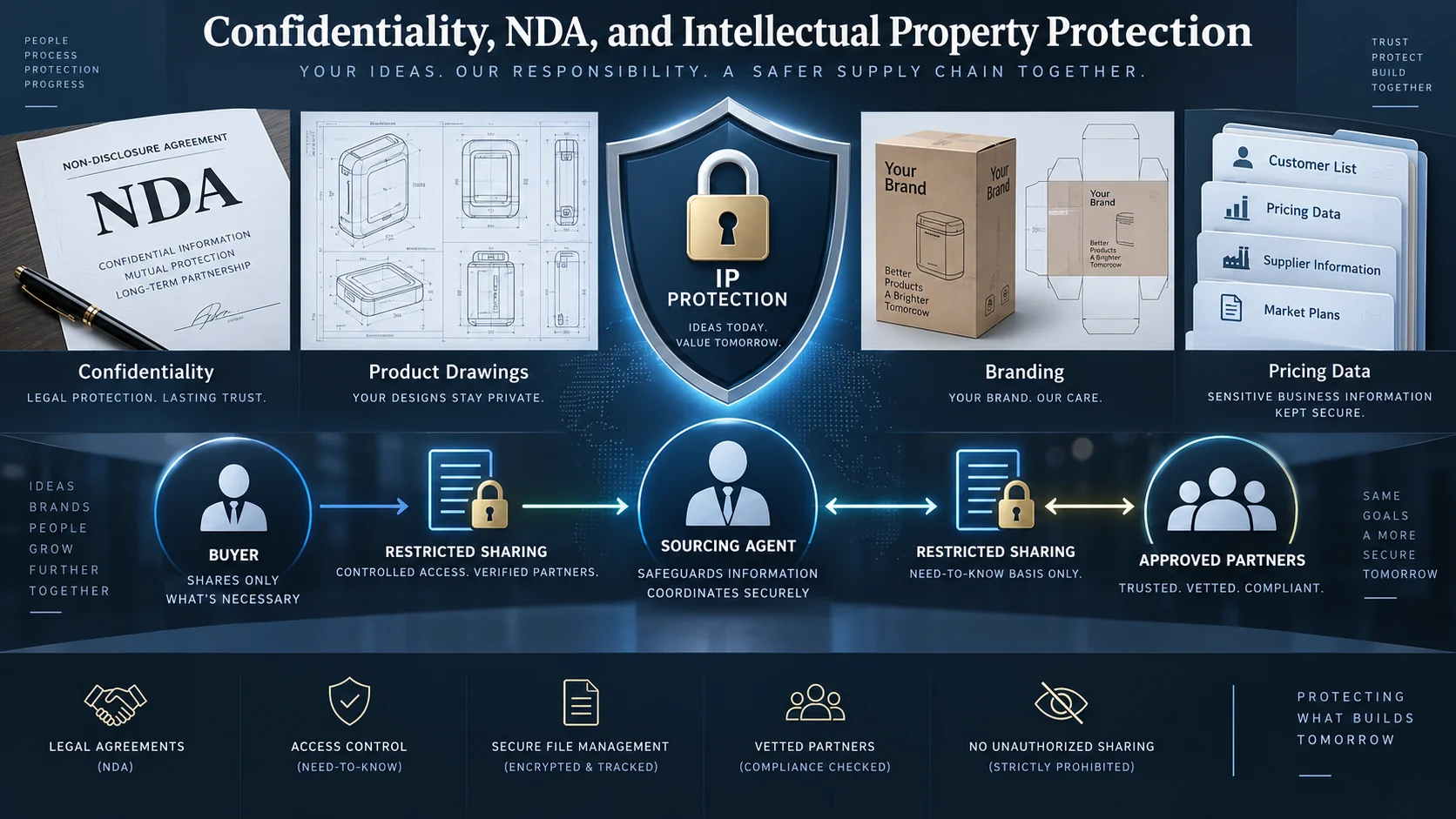
OEM products, custom packaging, private-label designs, and customer data can lose value if confidential information is shared too broadly. Buyers may assume an NDA is automatic, but a sourcing relationship can involve factories, packaging vendors, freight partners, inspection companies, and translators.
A China sourcing agent contract should include confidentiality obligations covering product drawings, specifications, supplier data, customer information, pricing, branding, and commercial plans. Buyers should also clarify who may receive information and what happens to files after the relationship ends.[^8]
Protect the Practical Assets
I suggest identifying the information that needs protection:
- CAD files, drawings, molds, and prototypes
- Packaging artwork and label files
- Product specifications and test standards
- Customer lists and sales information
- Pricing, margins, and purchase volumes
- Trademark assets and brand guidelines
- Supplier quotation and negotiation information
A sourcing agent should only share necessary information with suppliers and service providers involved in the project. Buyers should require the agent to use reasonable controls when transferring files[^9] and to avoid using customer designs for unrelated projects.
The agreement should also clarify ownership of working files. For example, buyers may own product specifications, packaging artwork, QC reports, purchase order logs, and supplier files created for their program. This becomes important if the buyer changes agents later.
I avoid promising that any contract can eliminate IP risk. Instead, I recommend layered controls: limited disclosure, supplier verification, written confidentiality obligations, trademark registration strategy where appropriate, documented ownership, and controlled access to design files. Buyers should consult qualified IP and legal professionals for application-specific protection.[^10]
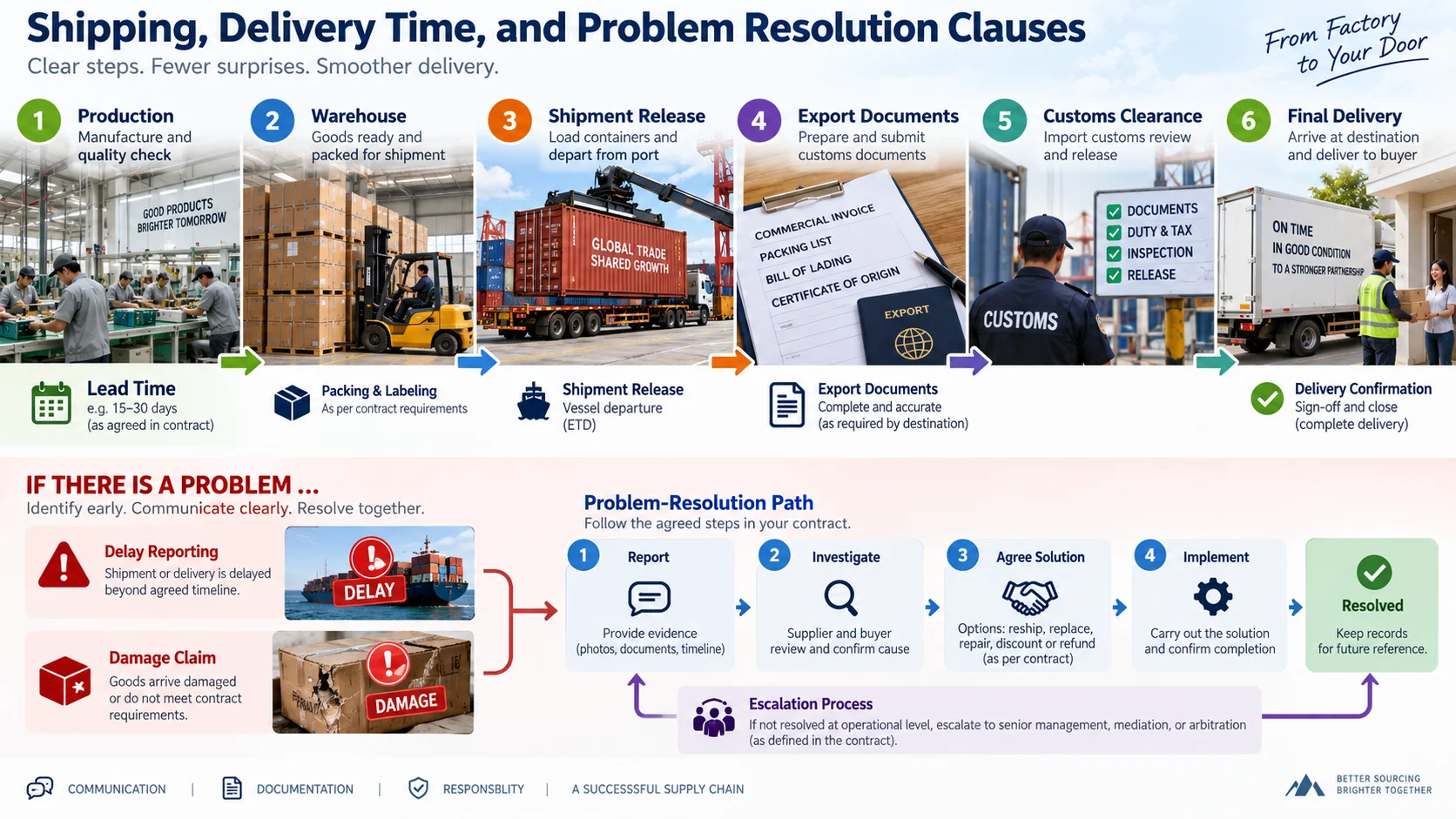
Shipping, Delivery Time, and Problem Resolution Clauses?
Late delivery can affect inventory availability, product launches, marketplace rankings, and customer relationships. Yet many sourcing agreements only say that the agent will “assist with shipping.” That phrase does not explain who checks export documents, who reports delays, or who handles damaged cartons.
A China sourcing agent contract should define production lead times, reporting cadence, shipment release authority, logistics coordination tasks, document responsibilities, and the escalation process for delays or damage. It should separate factory obligations, agent coordination duties, forwarder responsibilities, and buyer approvals.
Assign Responsibilities by Stage
| Stage | Buyer | Sourcing Agent | Factory / Forwarder |
|---|---|---|---|
| Production schedule | Approves key dates | Tracks progress and reports exceptions | Produces goods and updates status |
| Shipment release | Approves shipment after review | Confirms inspection and documents | Prepares goods and shipping documents |
| Freight booking | Approves quote or method | Coordinates communication | Forwarder books and transports |
| Delay management | Approves recovery decisions | Escalates and documents issues | Provides corrective action plan |
| Damage claim | Provides commercial evidence | Supports evidence collection | Carrier or responsible party handles claim |
Create an Evidence-Based Escalation Path
I recommend a simple process:
- The agent identifies an issue and informs the buyer within an agreed response window.
- The agent gathers photos, videos, production records, inspection reports, and relevant messages.
- The parties agree on corrective action, cost allocation, and timing.
- If unresolved, the parties use an independent inspection, mediation, arbitration, or another agreed route.
The agreement should not imply that a sourcing agent controls customs authorities, shipping lines, or destination port conditions. Instead, it should define the agent’s coordination and communication responsibilities. Clear limits protect both sides from unrealistic expectations.
How Can You Choose a Reliable China Sourcing Agent Before Signing a Contract?
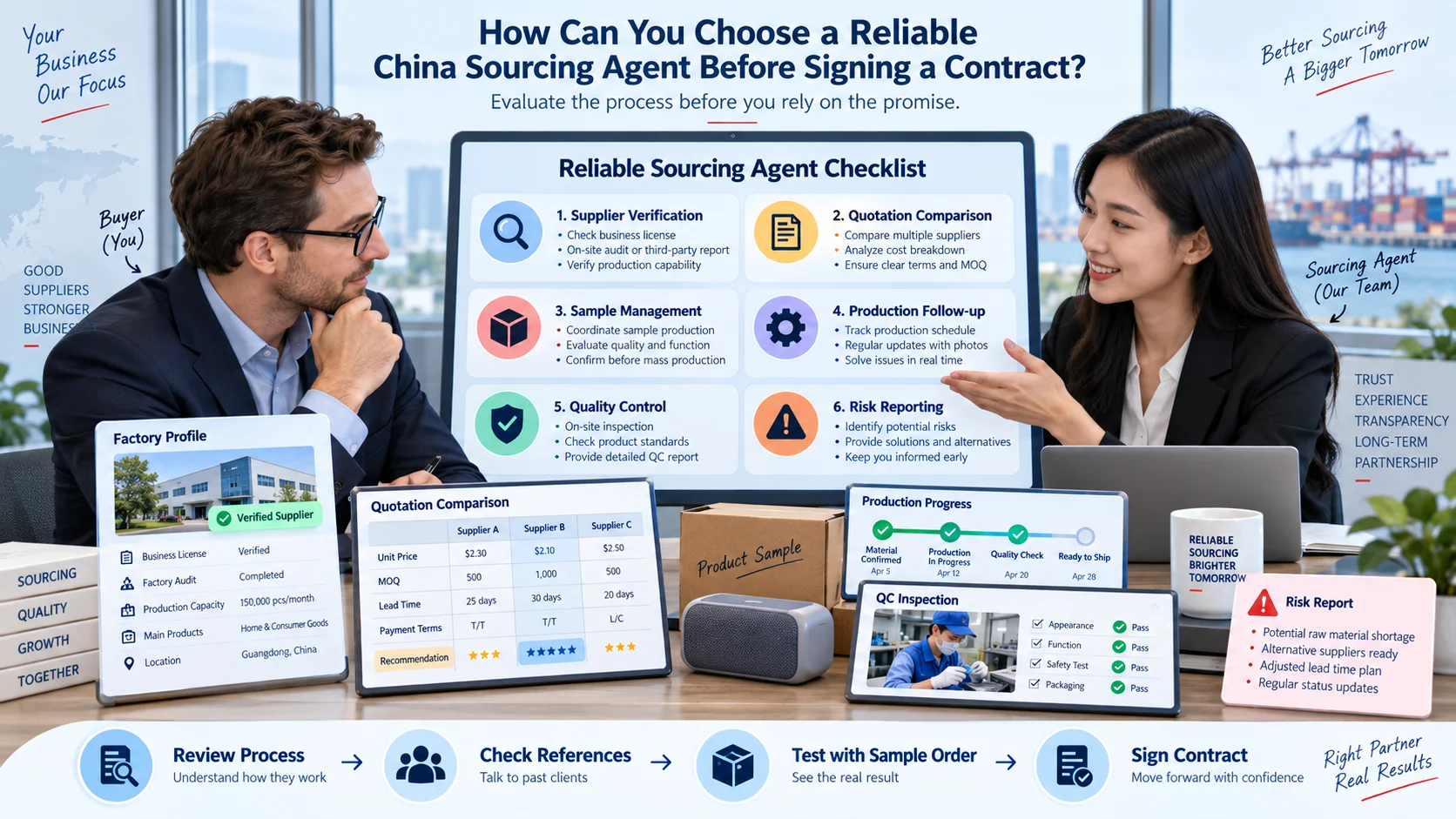
A contract is only as useful as the partner who follows it. Buyers can use strong clauses to improve accountability, but they should still evaluate the sourcing agent’s workflow, communication quality, supplier access, QC capability, and experience with their product category before signing.
A reliable China sourcing agent contract should be supported by a transparent operating process. Buyers should look for a sourcing partner that can explain how it verifies suppliers, compares quotations, manages samples, tracks production, handles inspections, and reports risks before those risks become expensive.
My Practical Evaluation Checklist
A professional sourcing partner should provide:
- ✅ A clear sourcing and procurement workflow
- ✅ Transparent quotation comparison
- ✅ Supplier and factory verification capability
- ✅ Defined QC and inspection procedures
- ✅ Experience with export coordination
- ✅ Clear communication channels and reporting cadence
- ✅ Realistic lead-time discussions
- ✅ Relevant customer cases or references where available
- ✅ Defined fee structure and third-party cost handling
- ✅ A willingness to document responsibilities
I also recommend asking how the agent handles underperformance. Strong partners should be comfortable discussing reporting KPIs such as RFQ turnaround time, sample lead time, on-time delivery rate, inspection pass rate, and issue-response SLA.
For larger or repeat purchasing programs, buyers can include monthly reports covering:
- Open RFQs and quotation status
- Supplier shortlist and verification status
- Cost and FX variance
- Sample progress
- Production milestones
- QC outcomes
- Shipment status
- Open risks and corrective actions
At KingSourcing, we support overseas buyers with supplier sourcing, quotation comparison, factory verification, sample development, production follow-up, quality inspection, packaging, consolidation, and shipping coordination. Send your product brief or supplier quote to KingSourcing, and our team can help evaluate sourcing options, supplier risks, and procurement solutions in China.
Frequently Asked Questions
What is the most important clause in a China sourcing agent contract?
I consider fee transparency and anti-kickback controls the most important starting point. The agreement should state the commission basis, service inclusions, third-party charges, supplier rebate rules, and buyer audit rights. Buyers need visibility before they can properly evaluate price, supplier selection, and sourcing performance.
Should I pay the factory directly or pay the sourcing agent?
I generally recommend direct buyer-to-factory payment when the transaction structure allows it. This approach gives buyers stronger payment visibility while the agent invoices its commission separately. If an agent handles funds, buyers should require reconciliations, approval controls, payment evidence, and a designated account structure.
Does a sourcing agent guarantee product quality?
A sourcing agent should not promise a universal quality guarantee. The agent can coordinate inspections, communicate with factories, and manage corrective actions. However, buyers should define product specifications, approved samples, defect standards, and acceptance criteria before mass production.
Can I ask a China sourcing agent to disclose factory information?
Yes, buyers can request supplier transparency, but the agreement should define what information is shared and when. I recommend requesting legal factory details, quotation comparisons, capability information, and verification records. The contract should also address direct communication rules and conflicts of interest.
What happens when I want to change sourcing agents?
The contract should require an orderly handover. Buyers should receive supplier lists, quotations, purchase order records, QC reports, product files, packaging artwork, open-issue trackers, and shipment status information. I recommend including a transition assistance period with a defined timeline and any agreed fees.
Conclusion
A well-structured China sourcing agent contract helps buyers control the issues that most often damage China procurement projects: unclear fees, undisclosed incentives, supplier opacity, weak QC processes, delayed communication, and difficult exits. I recommend starting with transparent pricing, anti-kickback terms, audit access, and clear approval authority. Then define quality gates, payment flow, delivery responsibilities, and handover rights. If you are evaluating suppliers or planning a sourcing program in China, KingSourcing can help you build a more transparent and manageable procurement workflow.
Work With a China Sourcing Partner
If you're planning an order from China, our sourcing team can help with supplier verification, factory audits, QC inspections, order consolidation, and shipping. Contact our sourcing team to discuss your requirements.
Related reading: China Sourcing Agent for Startups: When It Makes Sense
[^1]: "Implications of international trade and investment agreements ...", https://pmc.ncbi.nlm.nih.gov/articles/PMC10195275/. Research highlights that informal agreements in international trade often lead to disputes over hidden costs, unclear responsibilities, and lack of supplier transparency, particularly in cross-border sourcing arrangements. Evidence role: general_support; source type: research. Supports: The risks of hidden fees, unclear quality duties, and supplier transparency issues in informal sourcing agreements.. [^2]: "Anti-Kickback Clause - Procurement Services", https://www.cmu.edu/finance/procurementservices/policies-procedures/anti-kickback-clause.html. Research on procurement ethics highlights that undisclosed kickbacks can compromise supplier selection and lead to inflated costs, emphasizing the need for anti-kickback clauses in contracts. Evidence role: general_support; source type: research. Supports: The importance of anti-kickback controls in sourcing agent contracts to ensure transparency and fair supplier selection.. [^3]: "8 Common Mistakes When Hiring a Sourcing Agent in China", https://mutualsourcing.com/8-common-mistakes-when-hiring-a-sourcing-agent-in-china/. Studies on sourcing practices indicate that buyers frequently misinterpret the scope of services included in sourcing agent agreements, leading to disputes over additional costs for audits, quality control, and logistics. Evidence role: general_support; source type: research. Supports: Buyers often assume that services like factory audits, sample follow-up, quality control, and shipping support are included in sourcing agent contracts, leading to misunderstandings.. [^4]: "Reporting Agency Contracts - Department of Enterprise Services", https://des.wa.gov/purchase/washington-state-procurement-manual/manage-report-and-track-agency-contracts/reporting-agency-contracts. Educational materials on contract management emphasize that clearly defining the scope of work and reporting requirements helps prevent misunderstandings and disputes in business agreements. Evidence role: general_support; source type: education. Supports: The importance of clearly defining the scope of work and reporting requirements in sourcing agent contracts.. [^5]: "HIPAA, Stark Law, and Anti-Kickback Statute Explained", https://www.wsulaw.edu/news/understanding-hipaa-stark-law-and-anti-kickback-regulations-what-healthcare-leaders-need-to-know/. Research on procurement ethics underscores the role of anti-kickback clauses in reducing conflicts of interest and ensuring fair supplier selection. Evidence role: general_support; source type: research. Supports: The necessity of anti-kickback clauses in sourcing agent contracts to ensure transparency and prevent unethical practices.. [^6]: "Part 16 - Types of Contracts", https://www.acquisition.gov/far/part-16. Studies on international trade practices highlight that buyers often encounter hidden costs in sourcing agreements, including fees for inspections, logistics, and administrative tasks. Evidence role: general_support; source type: research. Supports: The prevalence of unexpected charges in sourcing agreements, such as for inspections, warehouse handling, and other services.. [^7]: "Acceptable Quality Limit, AQL", https://www.qima.com/aql-acceptable-quality-limit. Educational resources on quality control explain that the AQL process is a statistical sampling method and does not guarantee the quality of every individual product in a batch. Evidence role: general_support; source type: education. Supports: The limitations of the AQL process in ensuring product quality in international sourcing.. [^8]: "504.802 Contract files.", https://www.acquisition.gov/gsam/504.802. Educational resources on contract management emphasize the need for clear information-sharing and file-handling protocols to safeguard sensitive business data in supplier relationships. Evidence role: general_support; source type: education. Supports: The importance of defining information-sharing and file-handling protocols in sourcing agreements to protect sensitive data.. [^9]: "Reducing Supply Chain Vulnerabilities: The Role of Secure ...", https://www.kiteworks.com/secure-file-sharing/uk-businesses-reduce-supply-chain-vulnerabilities-with-secure-file-transfer/. Educational resources on data security emphasize the need for secure file transfer protocols to prevent unauthorized access to sensitive information in business transactions. Evidence role: general_support; source type: education. Supports: The importance of implementing reasonable controls for secure file transfers in sourcing agreements to protect confidential information.. [^10]: "The Role of Patents and Trademarks in International Trade", https://scholar.smu.edu/cgi/viewcontent.cgi?article=4339&context=til. Legal experts recommend consulting intellectual property professionals to ensure comprehensive protection in international sourcing agreements. Evidence role: expert_consensus; source type: education. Supports: The recommendation for buyers to consult legal professionals for intellectual property protection in sourcing agreements..