China MOQ can feel like a barrier when I am testing a new product, especially when a supplier asks for more units than my budget or sales data can support. The risk is clear: I may tie up cash in inventory before I know whether customers want it. The solution is to understand what creates MOQ and negotiate the right conditions—not simply demand a lower number.
China MOQ means the minimum order quantity a supplier is willing to produce or sell under specific conditions. Buyers can often reduce MOQ by choosing existing products, limiting colors and variations, using standard packaging, accepting a higher unit price, combining compatible items, or placing a small trial order before scaling. However, lower MOQ is not always the lowest-cost or lowest-risk option.
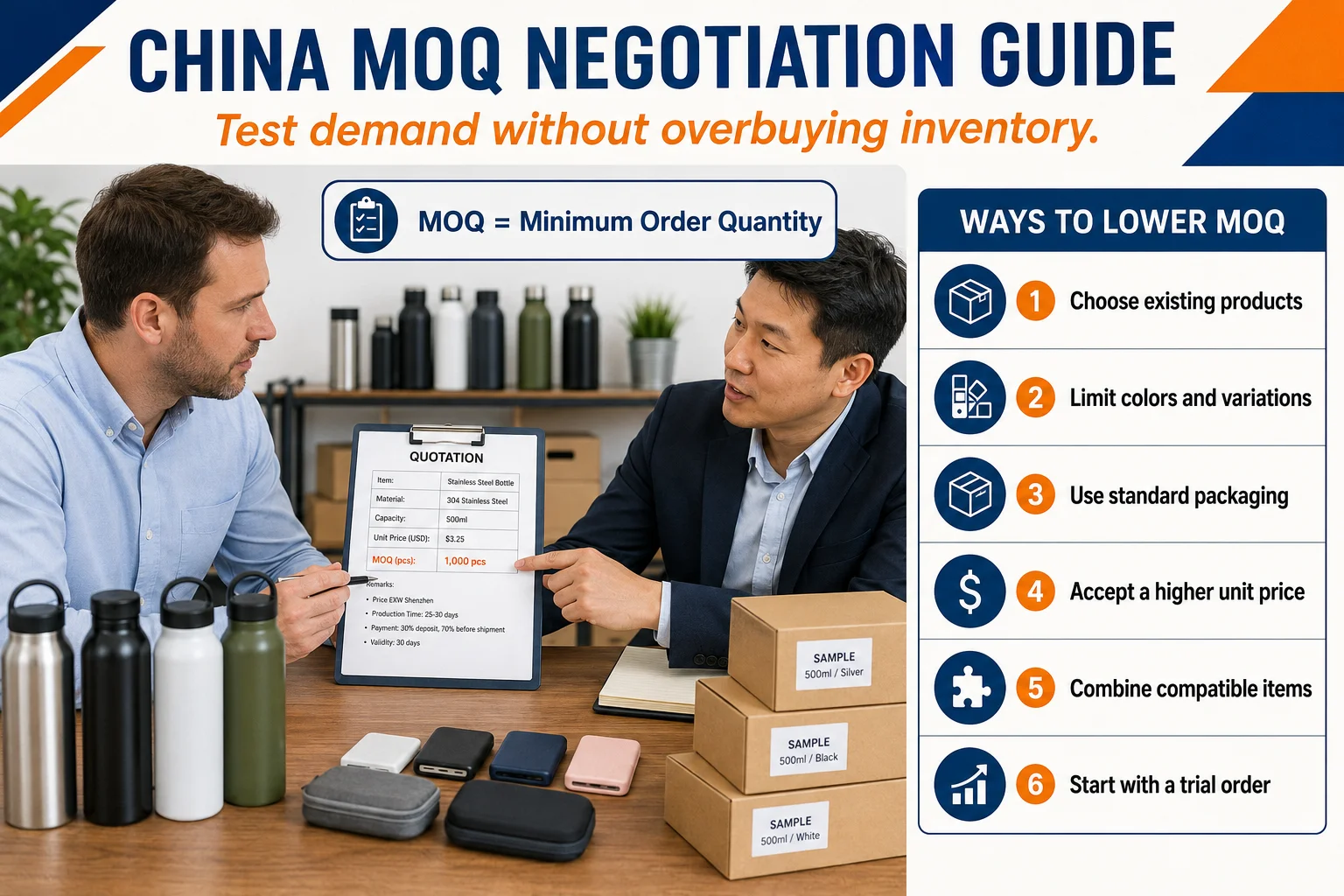
MOQ is not one fixed rule across China sourcing. I have seen a supplier accept 100 units of a stock item but require 1,000 units once the buyer adds a logo, custom color, printed box, or unique accessory. The details behind the order matter more than the headline MOQ.
1. Quick Answer: What Is China MOQ and How Can Buyers Lower It?
A high China MOQ can make a new product launch feel impossible. I may only need a small quantity to test demand, but the supplier may need a larger run to make production worthwhile.[^1] This gap creates cash-flow pressure and unnecessary inventory risk.
MOQ is the minimum quantity a Chinese supplier requires for a product, color, material, packaging option, or total order value.[^2] Small buyers can lower China MOQ by selecting ready-made products, reducing SKU variations, choosing plain packaging, paying a slightly higher unit price, combining items from one supplier, or treating the first order as a trial order.
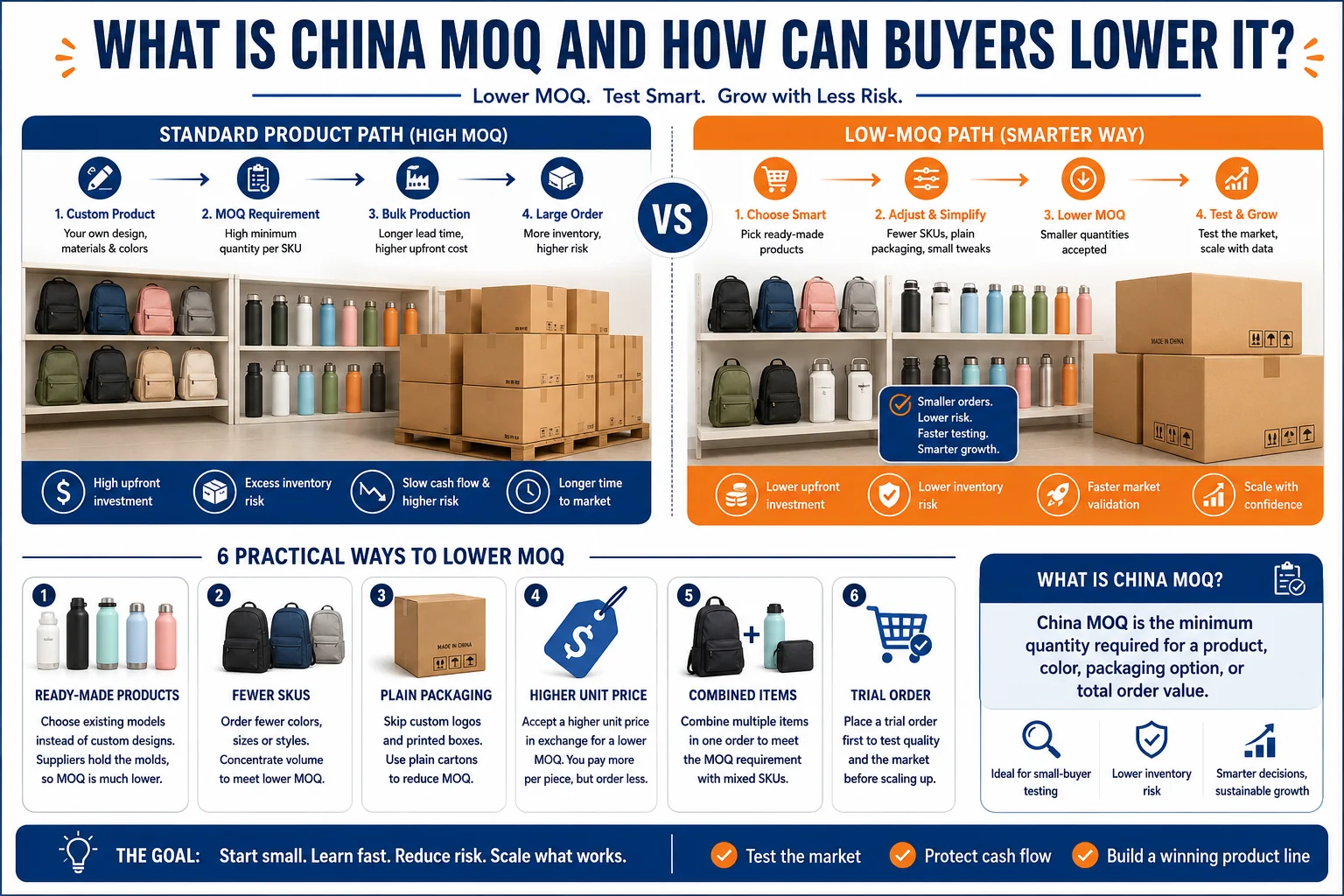
I always encourage buyers to begin with the real business question: Am I validating demand, or am I building a customized product for scale?
Start with the lowest-risk version of the product
When I help a buyer discuss MOQ, I do not start by asking, “Can you do 50 pieces?” I first clarify what can change:
- Can the buyer use the supplier’s existing mold?
- Can the buyer choose an existing color?
- Can the logo be added with a simple label instead of a permanent mold change?
- Can the buyer use a plain carton or standard box?
- Can several variations be reduced into one or two best-selling SKUs?
In one composite buyer conversation, a new ecommerce seller wanted a fully customized item in four colors with branded gift boxes. The factory’s MOQ was too high for a first launch. We simplified the first order to one standard color, a logo sticker, and neutral packaging. The buyer still created a branded offer, but with much less inventory exposure.
A lower MOQ is possible only when the supplier can reduce its setup work, material risk, and operational disruption. I view MOQ negotiation as a trade-off discussion, not a battle over one number.
2. What Does China MOQ Mean in China Sourcing?
Buyers often see one MOQ on a quotation and assume it applies to the entire order. In reality, China MOQ may apply separately to the product, color, packaging, material, or order value. Missing this distinction can create unexpected costs after sampling.
In China sourcing, MOQ can refer to the minimum units per product, color, size, material, logo process, package design, or total purchase value. A supplier may accept a low total quantity while requiring a minimum quantity for each customized element. Buyers should ask which MOQ applies before confirming a quote.
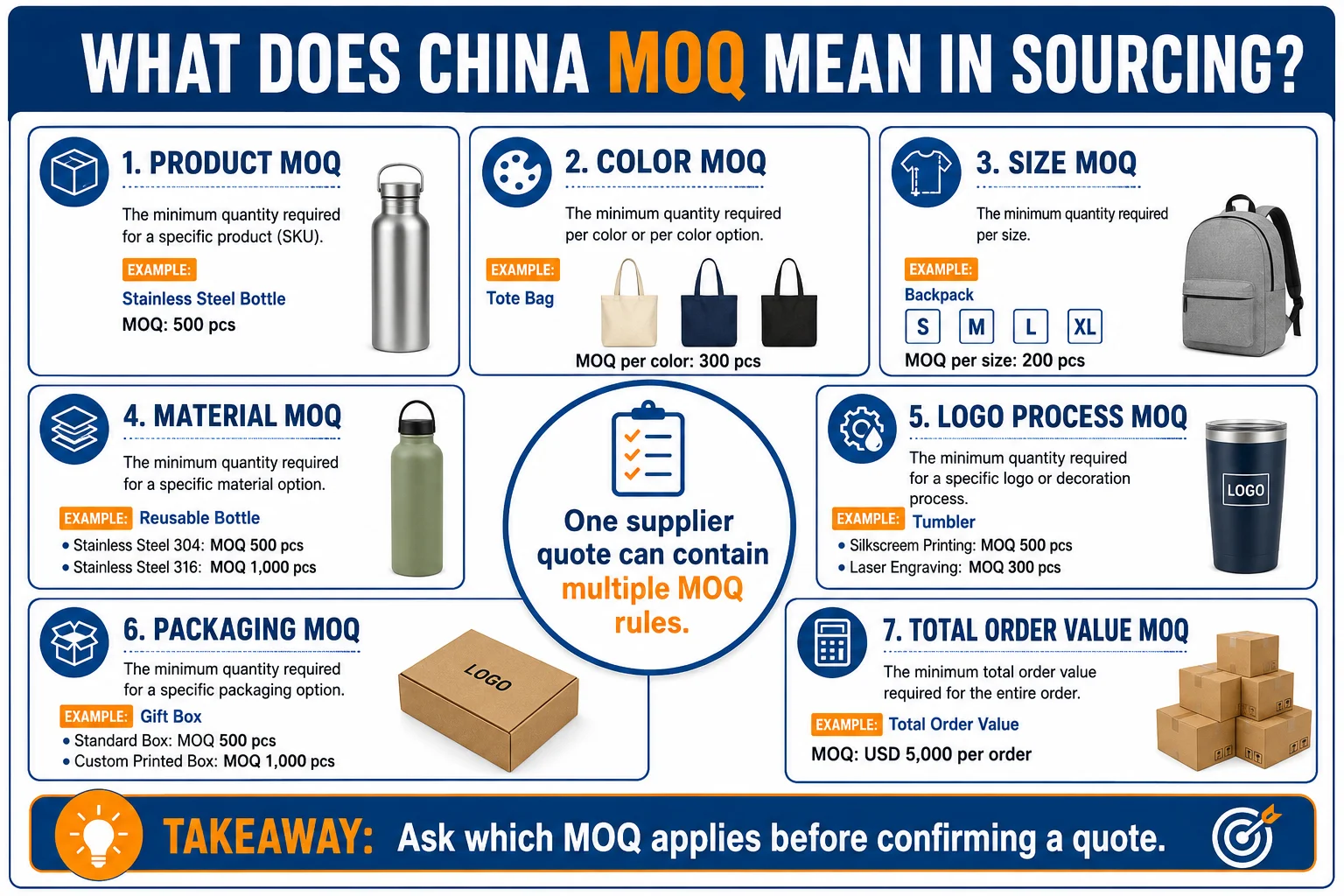
Common MOQ categories
| MOQ type | What it controls | Typical buyer impact |
|---|---|---|
| Product MOQ | Total units of one product | Limits the smallest production run |
| Color MOQ | Units per color | Makes multi-color orders harder |
| Size MOQ | Units per size | Can force an uneven size mix |
| Material MOQ | Minimum material purchase | Raises MOQ for custom fabric or finishes |
| Packaging MOQ | Printed boxes, bags, inserts, labels | Often affects branded orders |
| Order-value MOQ | Minimum order amount | Common with trading companies or small suppliers |
A supplier may tell me, “MOQ is 500 pieces,” but I need to ask follow-up questions:
- Is that 500 pieces for one color or all colors combined?
- Does the MOQ include logo printing?
- Does custom packaging have a separate requirement?
- Can sizes be mixed?
- Is there a minimum order value instead of a strict unit quantity?
This matters because an order of 500 units across five colors may not be workable if the supplier needs 500 units per color. Likewise, a factory may accept a low quantity for the product but require a larger print run for custom boxes.
I recommend that buyers request a written quote showing each MOQ line separately. That simple step reduces confusion and makes supplier comparisons far more accurate.
3. Why Do Chinese Suppliers Set Minimum Order Quantities?
It is easy to assume that suppliers use MOQ to turn away small buyers. In my experience, most legitimate MOQ requirements reflect production economics and operational limits. The supplier still needs to buy materials, schedule workers, prepare equipment, and manage quality for a small order.
Chinese suppliers set minimum order quantities because small runs still require material purchasing, machine setup, labor, quality checks, packaging preparation, production planning, and profit.[^3] MOQ helps suppliers avoid losing money or holding unusable materials after producing a customized order.
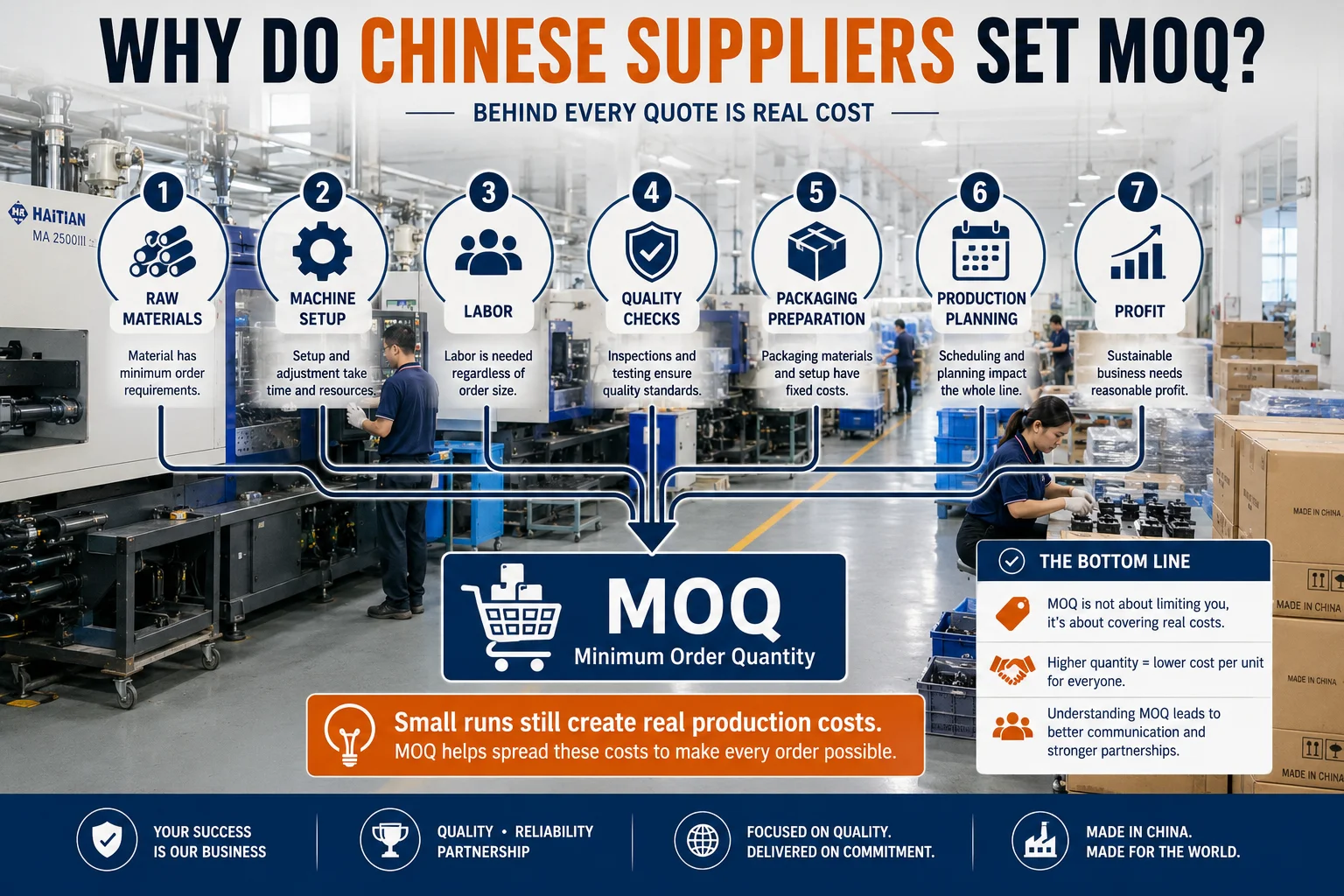
What happens before production starts
Even a small order may require the same basic preparation as a large order:
- Reviewing product specifications
- Ordering raw materials or components
- Setting up machines or production lines
- Preparing screens, molds, files, or printing plates
- Training or assigning workers
- Conducting in-process and final inspections
- Packing and arranging shipment documentation
For a factory, the operational effort does not always fall in proportion to order quantity. Producing 100 units may require much of the same coordination as producing 1,000 units.
Custom work creates additional constraints. A custom fabric color may require a dyeing minimum.[^4] A branded box may require a printer’s minimum run. A new mold may involve a one-time tooling fee and a separate production MOQ.[^5] Even simple logo application can add labor and setup.
I do not treat MOQ as proof that a supplier is difficult. I treat it as a signal to ask which part of the order is creating the constraint.
Suppliers also protect their planning capacity. During busy seasons, a factory may prefer larger, repeatable orders because small jobs interrupt production schedules. During slower periods, the same supplier may be more flexible. Outcomes vary by product category, supplier type, customization level, and current factory workload.
4. Comparison Table: Standard China MOQ vs Low-MOQ Sourcing?
A low-MOQ order may seem safer because I buy less inventory. However, I may pay more per unit, receive fewer customization options, or face higher shipping costs per item. Standard MOQ orders often offer better unit economics, but they require more confidence in demand.
Standard China MOQ orders usually provide lower unit prices, broader customization, and stronger factory engagement.[^6] Low-MOQ sourcing usually reduces upfront inventory risk but can involve higher unit prices, standard packaging, fewer options, and limited payment flexibility. Buyers should compare total landed cost and risk, not quantity alone.
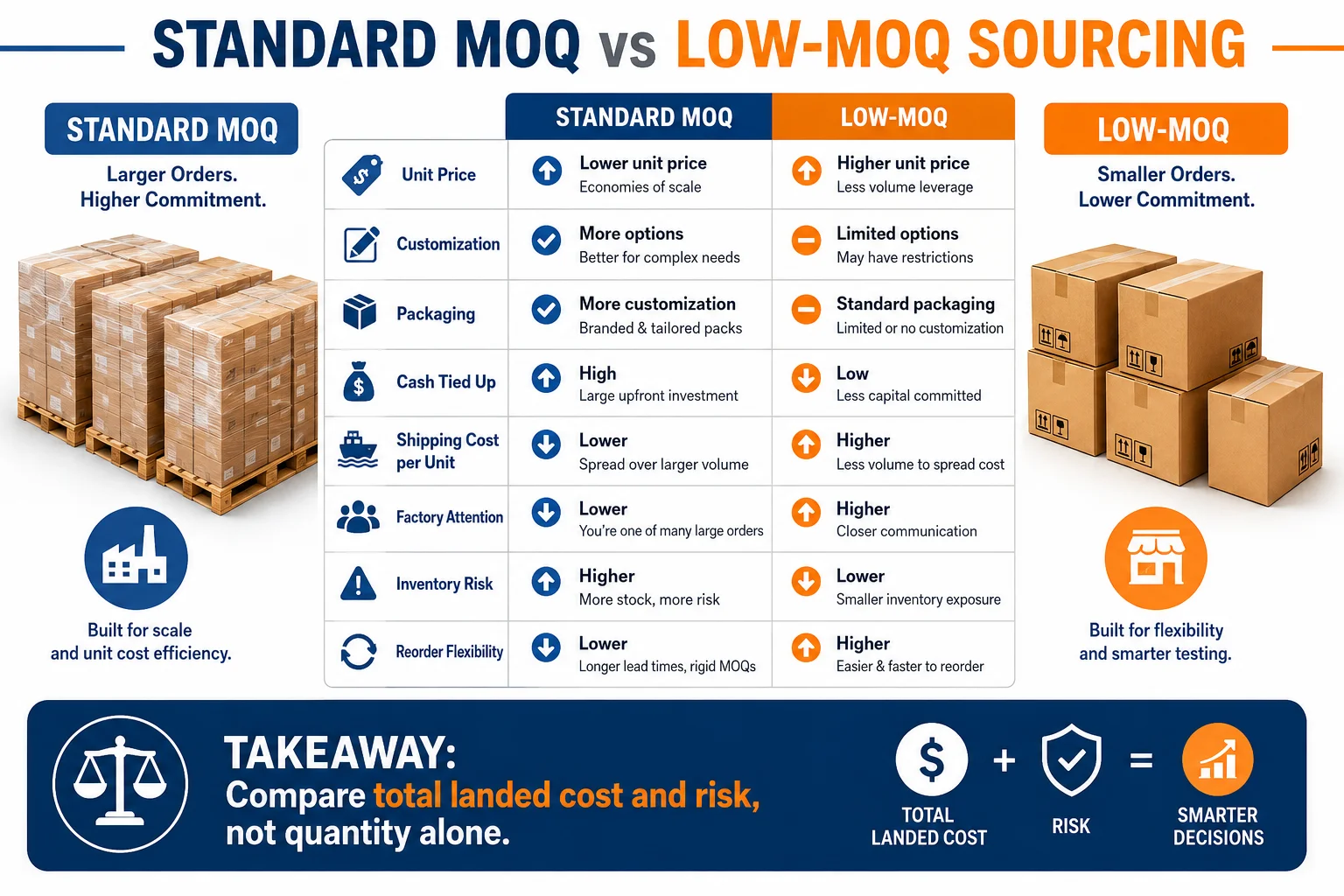
| Factor | Standard MOQ Order | Low-MOQ Order |
|---|---|---|
| Unit price | Usually more competitive | Often higher |
| Customization | More options available | Usually limited |
| Packaging | Custom packaging may be practical | Standard or simple packaging is common |
| Lead time | May require scheduled production | Stock items can be faster; custom small runs may be slower |
| Payment terms | More room for discussion with established suppliers | Often stricter, especially for first orders |
| Supplier choice | More factories may be available | Stock suppliers and flexible workshops may be more relevant |
| Inventory risk | Higher | Lower |
| Shipping cost per unit | Often lower at scale | Often higher for small shipments |
Choose the order model that matches your stage
I usually see two sensible paths:
Demand-validation path:
I choose an existing product, reduce variations, use simple packaging, and buy enough to test sales channels. I accept that the unit cost may be higher.
Scale-up path:
I use early sales data to identify the best SKU. Then I invest in stronger customization, improved packaging, and a production quantity that supports better margins.
A buyer should not force a low MOQ if the product needs custom materials, premium packaging, or complex assembly to succeed. In that situation, a higher MOQ may be a genuine production requirement. The best decision balances cash flow, product positioning, reorder potential, and acceptable risk.
5. What Determines a Supplier’s China MOQ?
Two suppliers can quote very different MOQs for similar products. This does not automatically mean one quote is wrong. Each supplier may use different materials, production methods, machinery, stock levels, and commercial models.
A supplier’s China MOQ depends on product type, customization level, raw materials, production process, packaging requirements, factory capacity, stock availability, seasonality, and expected profit. Stock products often support lower MOQs, while custom products usually require higher quantities or additional setup fees.
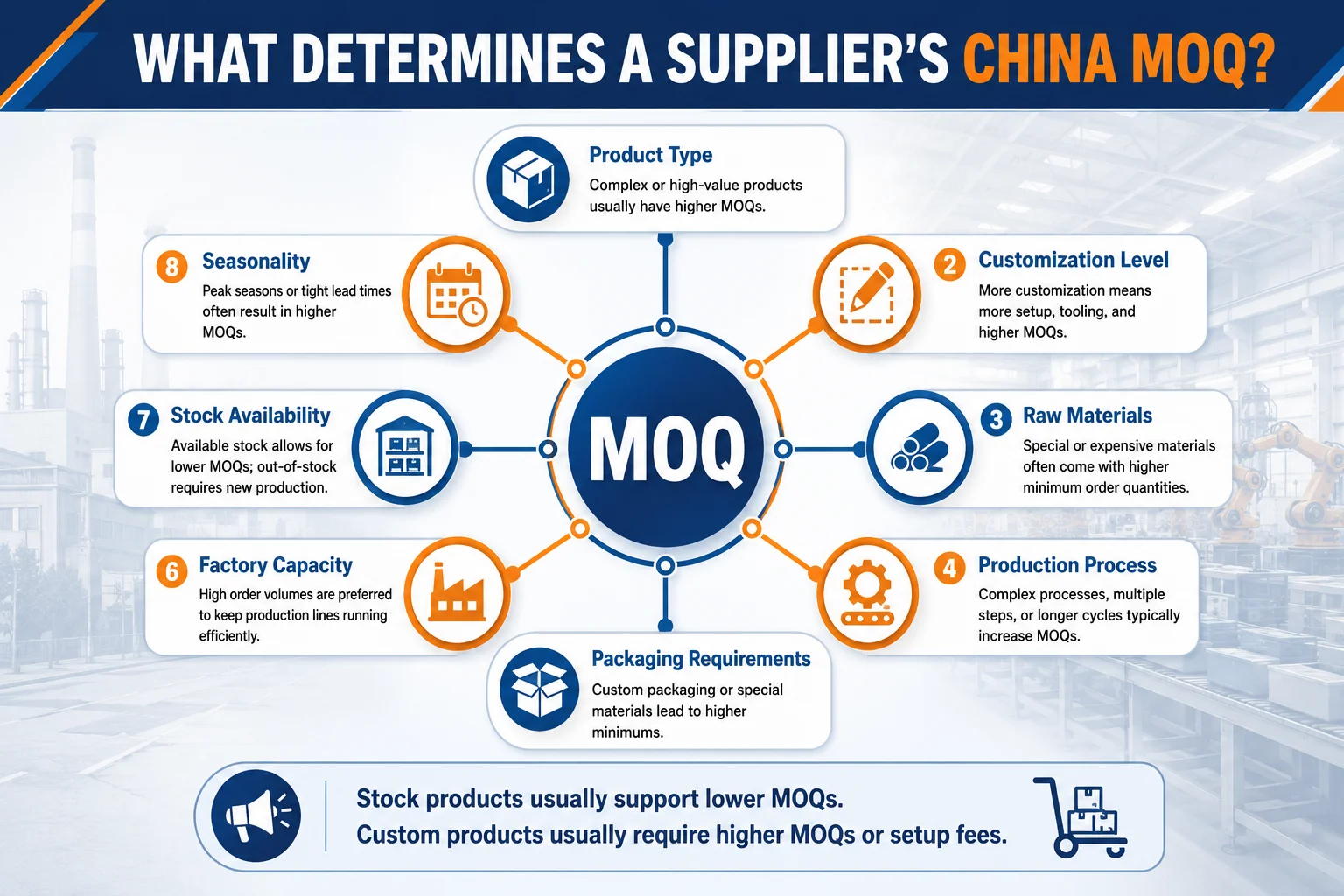
The biggest MOQ drivers
Product type: Simple stock accessories, household items, and ready-made goods may be available in smaller quantities. Products involving electronics, complex assembly, safety testing, or specialized components may need larger commitments.
Customization level: A logo on an existing item is different from a new shape, exclusive color, custom fabric, or unique product function. Every added requirement can create another minimum.
Materials and components: Suppliers may need to purchase materials in their own minimum quantities. If my product uses a special fabric, metal finish, zipper, battery, or accessory, the supplier may not be able to buy just enough for my small order.
Production process: Injection molding, embroidery, screen printing, sewing, die cutting, and assembly all have different setup requirements. I avoid assuming that one MOQ rule applies to every category.
Packaging: Buyers often focus on product MOQ but overlook packaging MOQ. Printed retail boxes, custom inserts, hangtags, and barcode labels can become the limiting factor.
Season and capacity: During peak production periods, factories may prioritize larger orders. During slower months, they may be more open to trial runs, especially if the buyer has a credible reorder plan.
Factory size also matters. A large factory may have higher formal MOQ requirements but stronger quality systems. A smaller workshop may accept less volume but offer less process consistency.[^7] I compare suitability, not just flexibility.
6. How Can I Negotiate a Lower China MOQ with Chinese Suppliers?
A buyer can rarely negotiate a lower MOQ by repeating the same request. I get better results when I show the supplier which conditions I can simplify and why the first order could lead to repeat business.
To negotiate lower China MOQ, buyers should reduce complexity and offer practical trade-offs. They can use existing molds, choose fewer colors, accept standard materials and packaging, pay a higher unit price or setup fee, combine compatible items, request split delivery, and position the order as a structured trial before a potential reorder.
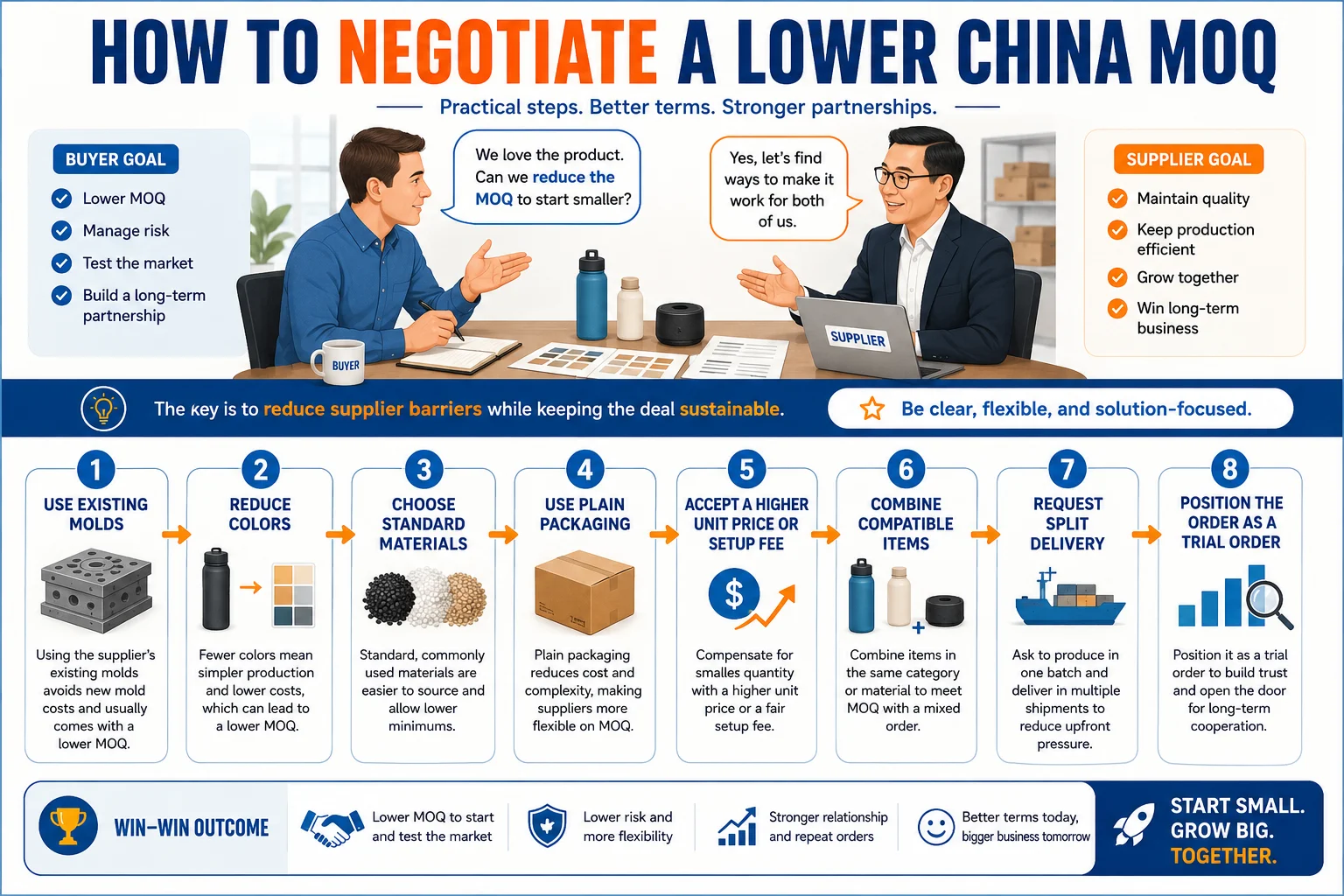
A practical negotiation framework
I suggest that buyers communicate clearly:
“We are testing this product in our market. For the first order, we can use your existing design, standard color, and plain packaging. Please advise your best quantity for a trial order, the unit price at that quantity, and the MOQ for a repeat customized order.”
This message gives the supplier room to propose workable options.
Negotiation options that often help
- Use existing molds or designs. New molds can create both tooling costs and higher production minimums.
- Reduce colors and variants. One color in 300 units is often easier than three colors in 100 units each.
- Use standard packaging. I can add branded stickers, inserts, or labels later through a more flexible packaging supplier.
- Accept a higher unit price. The supplier may agree to a small run if the margin covers extra handling.
- Pay a setup-related fee. This can be more realistic than pushing the supplier to absorb setup costs.
- Combine compatible products. Some suppliers can mix models, colors, or sizes if components and processes overlap.
- Request staged delivery. I may produce one run but arrange deliveries in batches if the supplier has storage capacity.
- Build credibility. Clear specifications, fast decisions, realistic timelines, and a reorder plan can improve discussions.
No script guarantees success. A genuine factory constraint cannot be negotiated away. Still, a buyer who offers sensible trade-offs usually receives more useful answers than a buyer who only asks for the lowest possible MOQ.
7. What Are the Hidden Costs and Risks of Low-MOQ Orders?
Low MOQ reduces inventory exposure, but it can create other costs that are less obvious at the quotation stage. I have seen buyers celebrate a low quantity, then discover that freight, packaging, defects, or expensive reorders weakened the business case.
Low-MOQ orders can involve higher unit prices, setup fees, limited quality consistency, leftover-material charges, stricter payment terms, and higher shipping costs per unit.[^8] Buyers should treat low MOQ as a testing tool and calculate the full landed cost before deciding it is the cheapest option.
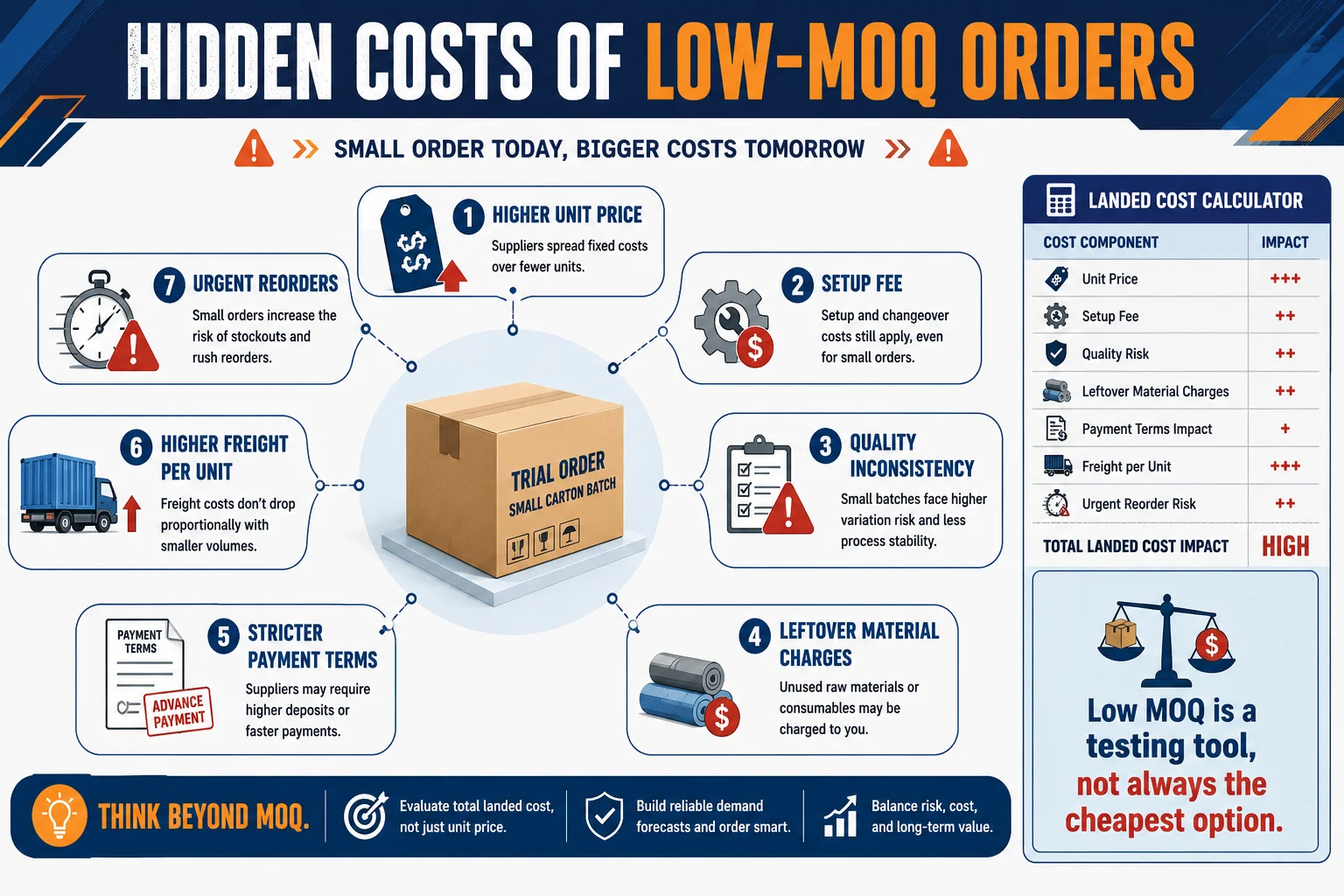
Costs buyers should calculate
A small order can carry fixed costs that do not shrink much with quantity:
- Product sample charges
- Logo or artwork setup fees
- Mold, printing plate, or screen fees
- Custom packaging charges
- Inspection costs
- Bank, payment platform, or currency fees
- Freight, customs, duties, and local delivery
For example, air shipping may help a buyer launch quickly, but it can make the landed cost per unit much higher than sea freight or consolidated shipping.[^9] Small parcels can also create less room for freight optimization.
Quality and supplier-fit risk
Low-MOQ orders can also receive less production attention, especially if a supplier is balancing larger customers. This does not mean small orders always have poor quality. It means buyers need clear specifications, approved samples, and practical inspection plans.
I also watch for suppliers who offer an unusually low MOQ but provide vague product details, inconsistent photos, or unclear payment terms. A low threshold is not automatically a good sign. It may indicate stock availability, but it can also indicate weak process control or a trading company without stable supply.
For a first order, I prefer a quantity that is small enough to test demand but large enough to make quality control, shipping, and future reordering commercially sensible.
8. How Can I Compare Supplier Quotes Beyond China MOQ?
MOQ is only one line in a supplier quotation. I can receive a low MOQ quote that looks attractive but becomes expensive after packaging, tooling, freight, and inspection are added. A higher MOQ quote may offer better quality controls or a more viable reorder path.
To compare China MOQ quotes properly, buyers should review unit price, total order value, materials, customization, tooling, packaging, sample fees, payment terms, lead time, quality requirements, shipping, and total landed cost. The best supplier is not always the one with the lowest MOQ or lowest unit price.
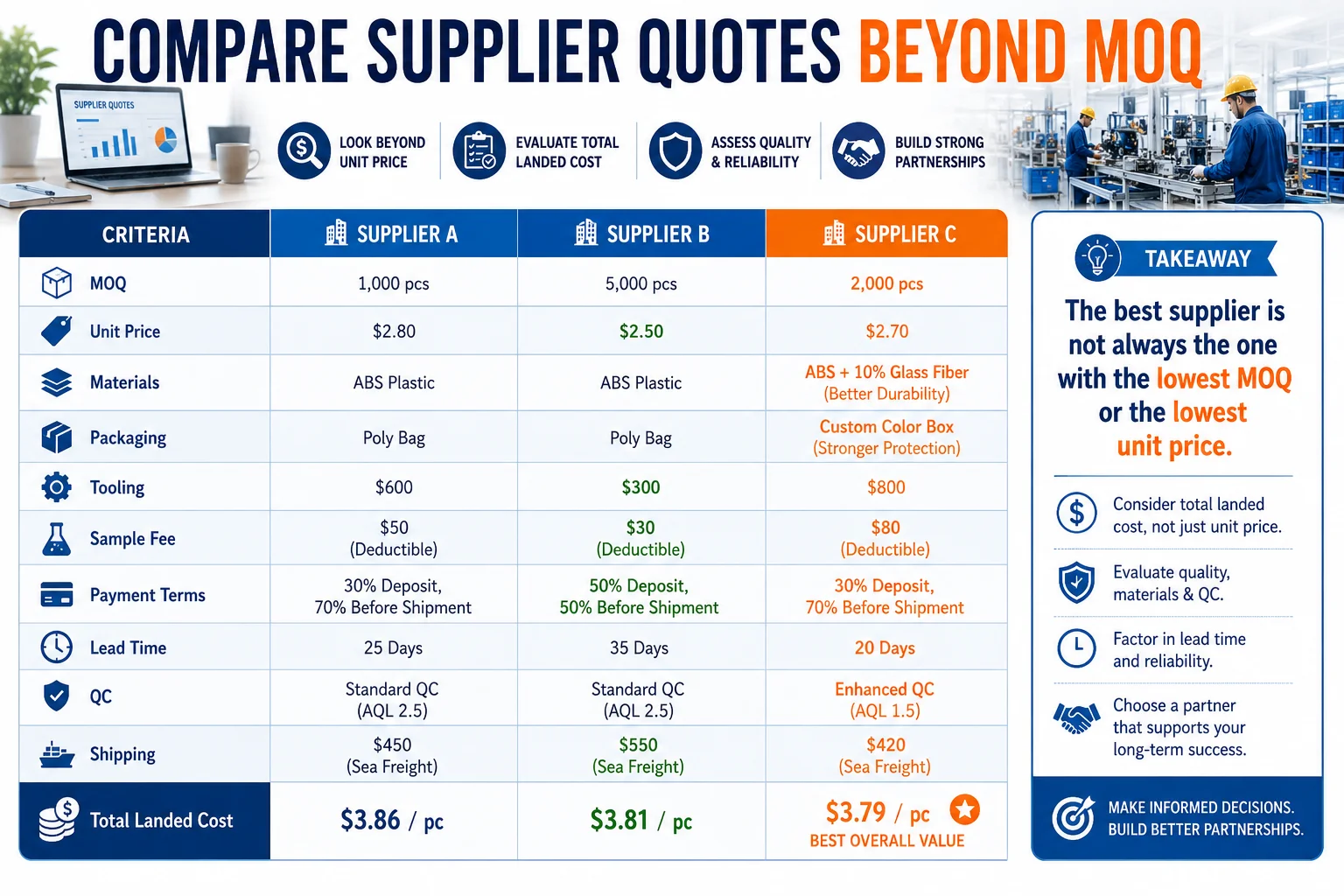
Use a quote-comparison checklist
| Quote item | Question to ask |
|---|---|
| Product specification | Are materials, dimensions, colors, and components identical? |
| Unit price | Does it apply to the exact quantity and customization level? |
| Tooling or mold fee | Is it one-time, refundable, or reusable for future orders? |
| Packaging | Is packaging included, and what is the MOQ for it? |
| Sample cost | Can it be credited against a production order? |
| Payment terms | What deposit is required, and when is the balance due? |
| Lead time | Does it begin after deposit, sample approval, or artwork confirmation? |
| Quality control | What inspection standard and defect handling process apply? |
| Shipping | What is included under EXW, FOB, DDP, or another trade term?[^10] |
I ask suppliers to quote the same product specification whenever possible. Otherwise, I am comparing different products rather than competing offers.
A composite example from our sourcing work involved three suppliers with different MOQs. The lowest-MOQ supplier had a higher unit price and no packaging support. The middle quote had a slightly higher order quantity but included better materials and consolidated packaging. The buyer selected the middle option because the total landed cost and brand presentation were stronger.
I also consider future reorders. If a supplier can support stable materials, consistent quality, and reasonable scaling, that relationship may be more valuable than a one-time bargain.
9. How Does KingSourcing Help Buyers Source Small Quantities from China?
Small-quantity sourcing requires more than finding a supplier who says yes. I need to confirm whether the product, quality level, packaging, timeline, and logistics plan still make sense at that order size. This is where local coordination can reduce avoidable mistakes.
KingSourcing helps buyers manage China MOQ by screening suppliers, clarifying production conditions, comparing quotes, negotiating practical low-MOQ options, arranging samples, coordinating quality inspections, consolidating orders, providing warehousing, and organizing international shipping. We help buyers make informed sourcing decisions rather than promise impossible MOQ reductions.
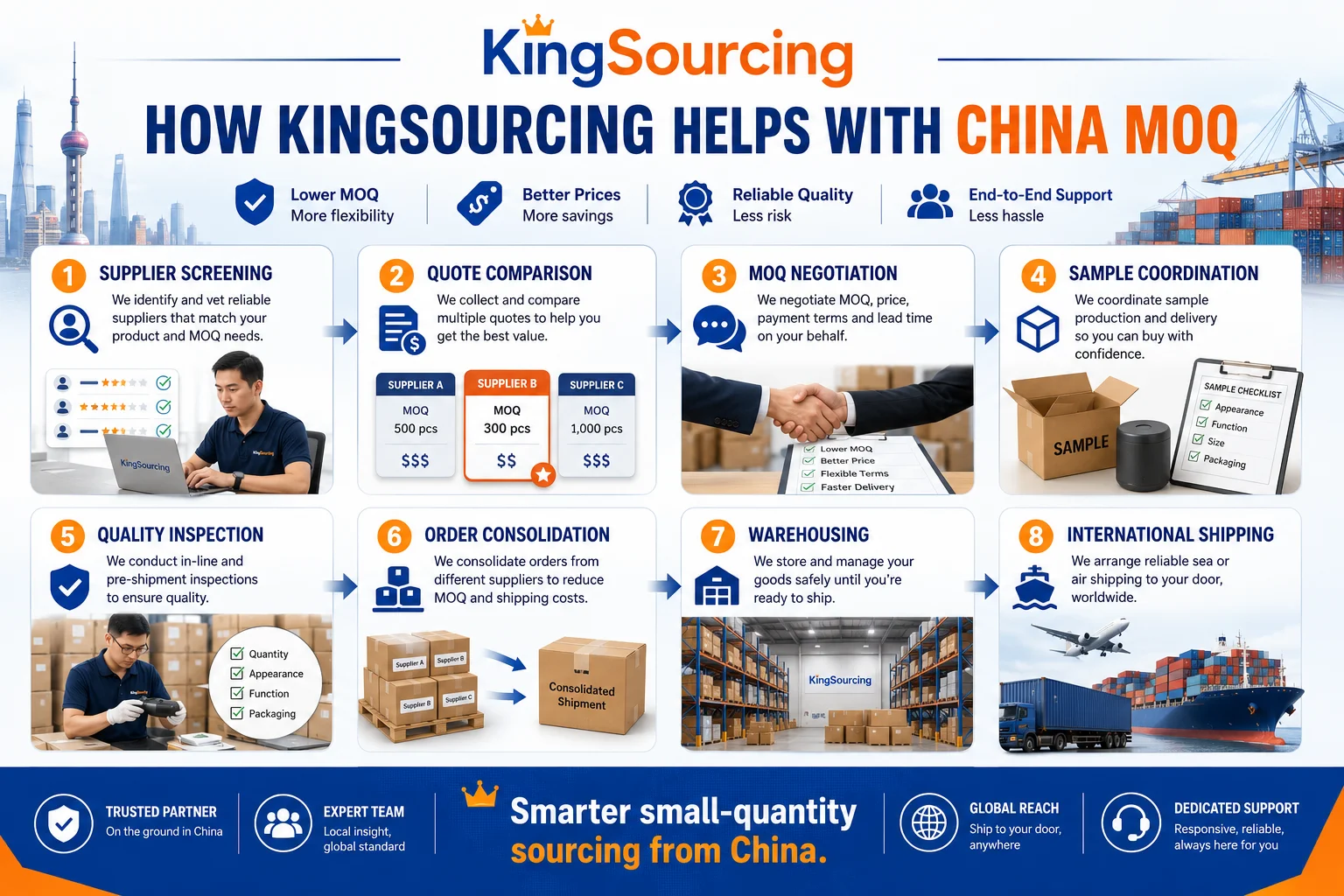
How we support a first order
At KingSourcing, we can help buyers:
- Identify factories, stock suppliers, and suitable sourcing channels
- Clarify MOQ by product, color, logo, packaging, and order value
- Compare quotations on consistent specifications
- Discuss trial-order options with suppliers
- Arrange samples and sample revisions
- Coordinate custom labels, inserts, and practical packaging alternatives
- Conduct 1-by-1 product inspection where appropriate
- Store goods and consolidate products from multiple suppliers
- Arrange shipping options based on budget and delivery needs
I often find that consolidation creates flexibility. A buyer may source a low-MOQ main product from one supplier, then add accessories, inserts, or packaging through other suitable suppliers. We can help coordinate these parts before shipment, rather than forcing the buyer to manage several China-based contacts alone.
We do not bypass genuine factory production limits. Instead, we help buyers understand those limits early, identify alternatives, and make choices that match their stage of business. For a seller testing with a limited budget, that may mean starting with standard products. For a growing DTC brand, it may mean building a roadmap from samples to custom production and repeat orders.
10. Frequently Asked Questions About China MOQ?
Can Chinese suppliers accept orders below MOQ?
Yes, some Chinese suppliers can accept orders below MOQ, especially for stock products, standard colors, simple packaging, or trial orders. However, they may charge a higher unit price, require a setup fee, or limit customization. Each supplier and product category operates differently.
Why is MOQ higher for custom products?
Custom products often require special materials, machine setup, logo application, molds, printing files, or packaging runs. Suppliers need enough volume to cover these costs and avoid leftover inventory. A custom product MOQ may include separate minimums for the product, color, and packaging.
Does a lower MOQ mean a higher price?
A lower MOQ often means a higher unit price because the supplier spreads setup, labor, and handling costs across fewer units. However, buyers should compare total landed cost, not unit price alone. A smaller first order can still be the lower-risk choice for market testing.
Can different products be combined to meet MOQ?
Sometimes suppliers allow buyers to combine colors, sizes, models, or related products to meet MOQ. This is more likely when the items use the same materials, production process, or packaging. Buyers should ask whether MOQ applies per SKU, per color, or across the full order.
How much deposit is required for a small order?
Deposit requirements vary by supplier, product, customization level, and relationship history. Many suppliers request an upfront deposit before production and the balance before shipment[^11], but terms are not universal. Buyers should confirm payment milestones, sample approval, inspection arrangements, and trade terms in writing.
Is Alibaba MOQ negotiable?
Alibaba MOQ is often negotiable, but the listed figure may reflect a supplier’s preferred production quantity rather than a guaranteed minimum. Buyers should ask what conditions support a smaller order, including stock availability, colors, packaging, logo requirements, and higher-price trial options.
Conclusion
China MOQ is not simply a number to push down. It reflects materials, production setup, packaging, labor, capacity, and the supplier’s ability to handle a small order profitably. I recommend that buyers first decide whether they are testing demand or preparing to scale a customized product. Then, simplify the first order where possible and compare total landed cost, quality, lead time, and reorder potential. If you need a practical China sourcing plan for a small or growing order, contact KingSourcing to discuss supplier options, inspections, consolidation, and shipping.
[^1]: "An optimal batch size for a production system operating ...", https://www.academia.edu/12697085/An_optimal_batch_size_for_a_production_system_operating_under_periodic_delivery_policy. Operations-management research describes how fixed setup and changeover costs can make very small production batches comparatively costly, creating an economic basis for minimum-order requirements. Evidence role: mechanism; source type: paper. Supports: Operations-management research should support the relationship between fixed setup costs, batch size, and the economics of short production runs.. Scope note: The size of this effect varies by technology, labor intensity, capacity utilization, and product design. [^2]: "Raw Material Minimum Order Quantity Optimization", https://dspace.mit.edu/entities/publication/e43f520c-9951-4e8d-b867-36c7afb5234c. Minimum order quantity is commonly defined in procurement and inventory management as the smallest quantity a supplier is willing to supply or produce under stated ordering conditions. Evidence role: definition; source type: education. Supports: A supply-chain or procurement reference should define minimum order quantity as the smallest quantity a supplier will sell or produce, often as a condition of ordering.. Scope note: Whether the minimum applies separately to colors, packaging, or order value depends on the supplier contract and production process. [^3]: "Estimation of cellular manufacturing cost components using ...", https://digitalcommons.unl.edu/cgi/viewcontent.cgi?article=1091&context=imsefacpub. Manufacturing studies show that setup, scheduling, and quality-assurance activities can impose fixed or semi-fixed costs that do not decrease in direct proportion to batch size. Evidence role: mechanism; source type: paper. Supports: Manufacturing research should document that setup, planning, inspection, and preparation activities may not decline proportionally with output quantity.. Scope note: Material purchasing, packaging preparation, and profit margins are contract- and product-specific and should not be assumed for every order. [^4]: "Advancements in Sustainable Natural Dyes for Textile ... - PMC", https://pmc.ncbi.nlm.nih.gov/articles/PMC10458907/. Textile dyeing is generally performed in batches requiring process preparation and controlled liquor-to-fabric conditions, factors that can limit the practicality of very small custom-color lots. Evidence role: mechanism; source type: research. Supports: Textile-processing sources should explain that batch dyeing requires defined lot sizes and process preparation, which can constrain very small custom-color orders.. Scope note: The applicable minimum batch depends on fiber type, dyeing method, equipment capacity, and mill policy. [^5]: "Injection Molding", https://techfoundry.ucdavis.edu/injection-molding. Injection-molding guidance identifies mold tooling as an upfront capital cost separate from per-unit production costs, so suppliers may separately price tooling and production volume. Evidence role: mechanism; source type: education. Supports: Engineering or manufacturing guidance should explain that injection-molding tooling is a substantial upfront cost, distinct from per-part production costs and volume decisions.. Scope note: Not all products use injection molding, and a separate MOQ is a commercial policy rather than an inevitable technical requirement. [^6]: "Dynamic Procurement, Quantity Discounts, and Supply Chain ...", https://www.academia.edu/30423760/Dynamic_Procurement_Quantity_Discounts_and_Supply_Chain_Efficiency. Economic and operations research finds that fixed production and ordering costs can lower average unit cost as order quantity increases and can make customized production more economically feasible. Evidence role: general_support; source type: paper. Supports: Research should support the general relationship between larger production quantities, fixed-cost allocation, and lower average unit cost.. Scope note: The evidence does not directly establish that larger orders always receive better supplier engagement, which remains relationship- and capacity-dependent. [^7]: "1002727156-kaynak.pdf - UNT Digital Library", https://digital.library.unt.edu/ark:/67531/metadc277695/m2/1/high_res_d/1002727156-kaynak.pdf. Studies of manufacturing quality management have reported that organizational resources and formal quality systems can differ by firm size, potentially affecting process standardization. Evidence role: general_support; source type: paper. Supports: Research should examine associations between firm size, formal quality-management practices, and process capability in manufacturing.. Scope note: Firm size alone does not determine quality performance or MOQ policy; supplier-specific audits and product-level evidence remain necessary. [^8]: "Raw Material Minimum Order Quantity Optimization", https://dspace.mit.edu/bitstream/handle/1721.1/121302/1240293813-MIT.pdf?sequence=1. Freight economics and supply-chain research indicate that fixed handling and transportation costs are often spread across more units in larger shipments, while production setup costs can similarly raise the cost of small runs. Evidence role: mechanism; source type: government. Supports: Transport or supply-chain evidence should support that shipment consolidation and larger loads can reduce transportation cost per unit, while operations research can support setup-cost allocation.. Scope note: These mechanisms do not by themselves prove that low-MOQ orders have poorer quality consistency, leftover-material charges, or stricter payment terms in every supplier relationship. [^9]: "Fathoming Shipping Costs: An Exploration", https://documents1.worldbank.org/curated/en/099436104042241280/pdf/IDU0c20d2ae90046304ca009ab508217e50747bd.pdf. International transport guidance generally characterizes air freight as faster and maritime freight as more economical for many non-urgent, higher-volume shipments. Evidence role: general_support; source type: institution. Supports: International transport guidance should compare the relative speed and cost characteristics of air and maritime freight.. Scope note: Actual landed-cost differences depend on route, weight or volume, fuel prices, duties, service level, and consolidation arrangements. [^10]: "Know Your Incoterms", https://www.trade.gov/know-your-incoterms. The International Chamber of Commerce’s Incoterms rules define EXW, FOB, and DDP as standardized trade terms that allocate delivery obligations, costs, and risk between seller and buyer. Evidence role: definition; source type: institution. Supports: The International Chamber of Commerce rules should define EXW, FOB, and DDP and describe how each term allocates delivery, risk, cost, export, import, and carriage obligations.. Scope note: The applicable obligations depend on the agreed Incoterms edition, named place or port, transport mode, and the parties’ contract. [^11]: "Methods of Payment", https://www.trade.gov/methods-payment. Official trade-finance guidance recognizes advance payment as a method under which the buyer pays before shipment, a structure that can help suppliers finance production while increasing buyer exposure. Evidence role: general_support; source type: government. Supports: Official trade-finance guidance should describe advance payment as a payment method in which buyers pay before goods are shipped, including its role in supplier financing and buyer risk.. Scope note: This does not establish a universal deposit percentage or prove that all suppliers require a balance payment before shipment.