China product inspection is essential when you buy from overseas factories but do not have a local team watching production. Without clear checks, small defects, wrong materials, missing accessories, or poor packaging can become expensive returns after arrival. We help importers reduce this risk by turning approved requirements into evidence-based inspection decisions before shipping.
China product inspection is a quality-control process that compares bulk goods with approved samples, specifications, packaging requirements, and order details before shipment.[^1] Importers should inspect products before production, during production, and before shipping when the order value, product risk, or sales-channel requirements justify it. The goal is not to promise zero defects; it is to identify issues early enough to correct them at the factory.
A good inspection process does more than count defects. We use it to answer a practical shipment-release question: Do you have enough evidence to ship these goods with confidence? The answer depends on what was approved, what was found, whether the issues are fixable, and how much risk your business can accept.
What Is China Product Inspection for Importers?
Many importers assume an inspection is a quick visual check at the end of production. That approach can miss the real cause of quality problems. If requirements were unclear from the start, even a careful final inspection may only reveal issues when time is already limited.
China product inspection is the process of checking goods against agreed requirements before they leave the supplier. It may include quantity verification, visual checks, measurements, functional testing, packaging review, label checks, and sample comparison. The inspection report gives buyers evidence to approve shipment, request rework, arrange re-inspection, or place the order on hold.
In coordinating supplier communication, production follow-up, inspections, and shipment preparation for overseas buyers, we often see one key difference between smooth orders and difficult ones: the smooth orders define “acceptable” before production begins.
Inspection, Factory Audits, and Laboratory Testing Are Different
These services can support each other, but they solve different problems.
| Service | Main Purpose | Typical Timing |
|---|---|---|
| Product inspection | Checks whether goods match agreed requirements | Before, during, or after production |
| Factory or supplier audit | Reviews supplier capability, systems, and basic credibility | Before placing an order |
| Laboratory testing | Tests materials or products against specific standards | Before sale or when compliance is required |
| Production follow-up | Tracks milestones, materials, and production progress | Throughout production |
A product inspection does not replace product safety certification, regulatory compliance testing, or legal import requirements. If you sell in the United States, EU, UK, Australia, or another market, you should confirm the applicable requirements for your product category with qualified compliance resources.
What We Usually Check
The exact inspection checklist should match the product. Still, most China product inspection work includes:
- Product quantity and carton count
- Product appearance and workmanship
- Dimensions, weight, and color consistency
- Product functions and assembly
- Materials and components where practical
- Logos, labels, manuals, and barcode placement
- Accessories, inserts, and bundled items
- Inner packaging and master-carton condition
- Comparison with the approved sample and purchase order
Why Should Importers Inspect Products Before Shipping?
A supplier may produce a good sample but face normal production challenges during bulk manufacturing. Different workers, replacement materials, rushed timelines, or unclear packaging instructions can create variation. If you discover these issues after delivery, you may have fewer practical options.
Importers should inspect products before shipping because factory-side problems are usually cheaper and easier to correct than destination-country problems[^2]. A pre-shipment check can identify wrong specifications, functional defects, missing items, packaging damage, and labeling errors before freight costs, customs clearance, warehousing, and customer returns increase the cost of the mistake.
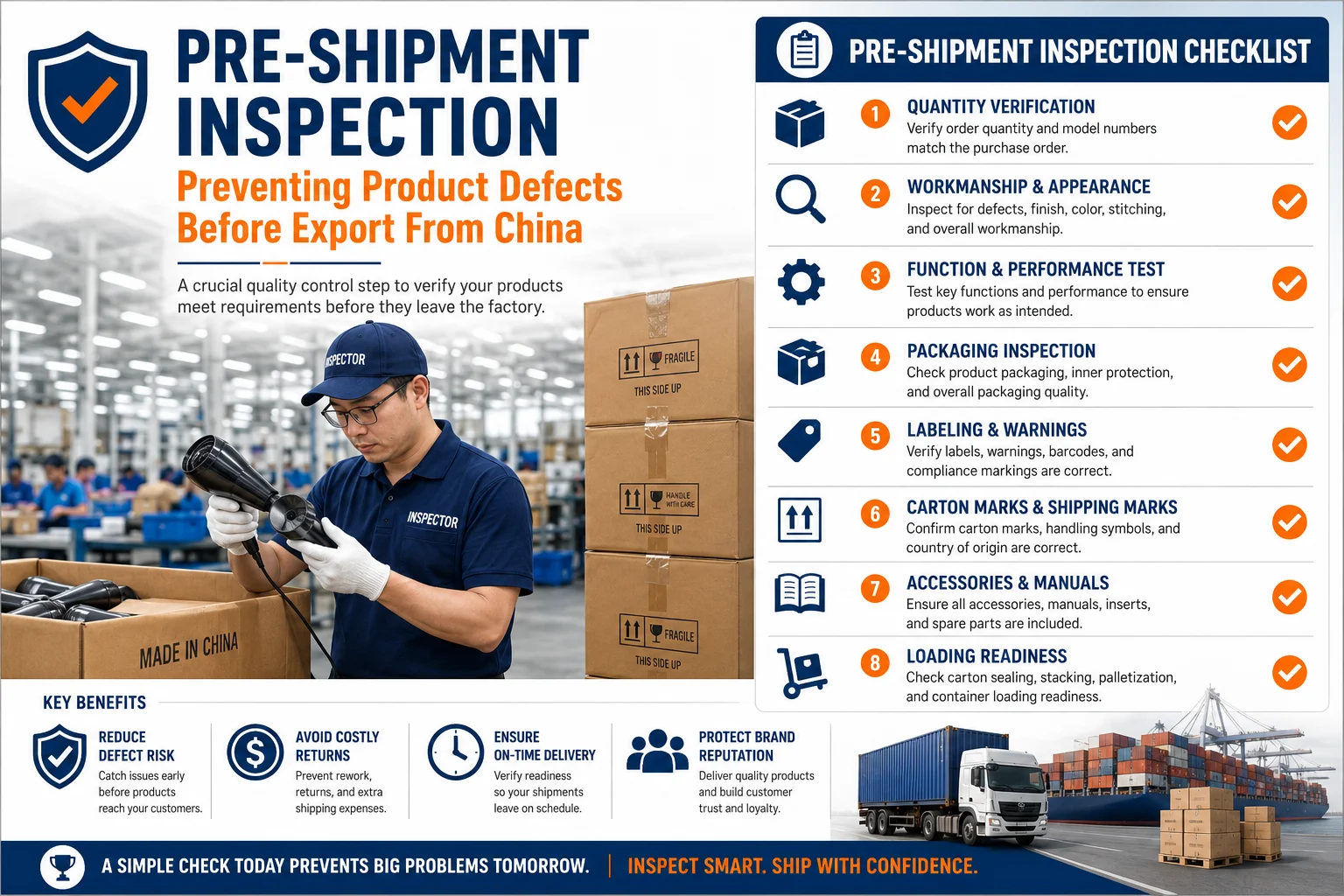
The biggest risk is not always a visibly damaged product. A small issue can have a major commercial effect when it affects customer expectations.
For example, a seller may receive 2,000 units that look acceptable at first glance. However, the logo may be printed 5 mm off-center, the instruction leaflet may show the wrong model number, or one accessory may be missing from 8% of cartons. These issues can lead to poor reviews, marketplace complaints, delayed launches, or time-consuming warehouse rework.
Common Risks We See Before Shipment
We often help buyers identify issues such as:
- Bulk goods that differ from the approved sample
- Incorrect product color, fabric, finish, or component
- Dimensions outside the buyer’s tolerance
- Weak seams, scratches, stains, glue marks, or sharp edges
- Products that fail basic function checks
- Missing cables, screws, manuals, or replacement parts
- Incorrect barcode labels or carton marks
- Cartons that are too weak for international handling
- Poor packing that allows damage during transportation
The goal is not to make every item cosmetically perfect. The goal is to decide which issues affect safety, functionality, saleability, brand reputation, and shipment risk.
For a $500 test order, a simple pre-shipment check may be enough. For a high-value private-label launch, a complex product, or goods shipping directly to an Amazon warehouse, the inspection plan may need more detail. We recommend setting the plan according to the potential cost of failure, not just the product price.
Which China Product Inspection Type Fits Your Order?
Buyers often choose only a final inspection because it is familiar. However, a final check is not always the best first control point. If the product requires custom materials, special printing, complicated assembly, or strict delivery timing, earlier checks can prevent larger problems.
The right China product inspection type depends on your product complexity, order size, supplier history, order value, and the cost of correcting defects. Pre-production checks prevent misunderstandings, during-production inspections reveal issues while changes are still possible, and pre-shipment inspections support a final shipping decision.[^3]
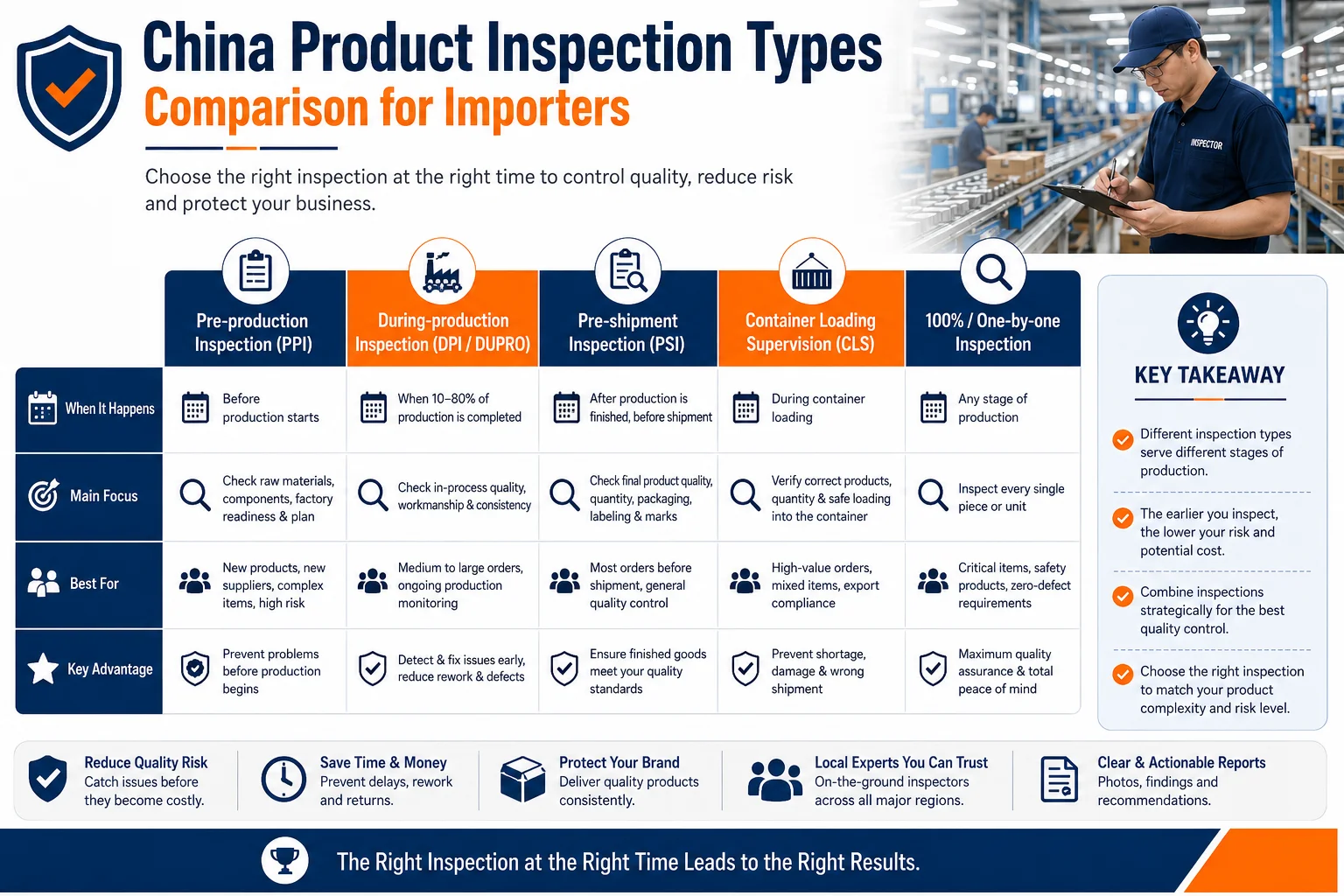
| Inspection Type | Best Time | Main Focus | Best For |
|---|---|---|---|
| Pre-production inspection | Before mass production | Materials, components, approved sample, specifications | Custom products and first orders |
| During-production inspection | When roughly 20–80% is complete | Workmanship, process consistency, production progress | Larger or repeat orders |
| Pre-shipment inspection | When production is substantially complete | Finished goods, quantity, packaging, random samples | Most standard import orders |
| Container loading inspection | During loading | Carton count, loading condition, container condition | Full-container shipments |
| 1-by-1 inspection | During or after production | Every unit or every designated unit | High-risk, fragile, or customer-facing products |
A Practical Timing Framework
We suggest asking these questions before choosing the service:
-
Is this your first order with the supplier?
A first order usually needs more evidence than a repeat order with stable results. -
Is the product customized?
Custom colors, logos, packaging, molds, electronics, and bundles create more points where errors can occur. -
Can defects be fixed after arrival?
If your warehouse can quickly relabel goods, the risk differs from a product that needs factory repair. -
What happens if the product cannot be sold?
Marketplace penalties, launch delays, returns, disposal costs, and customer complaints should affect the inspection budget. -
Does the product have irreversible risks?
For products involving safety, regulated claims, batteries, children, food contact, or destination-market rules, you should plan additional compliance verification as appropriate.
A staged quality-control plan often gives better protection than relying on one final visit. We do not apply the same checklist to every client because every product and risk profile is different.
What Should a Pre-Shipment Inspection Check?
The last few days before shipment can be stressful. Buyers may feel pressure to release goods because freight is booked, stock is low, or a sales launch is approaching. That is exactly when a clear inspection scope becomes valuable.
A pre-shipment inspection should check finished-product quantity, appearance, dimensions, functionality, accessories, packaging, labels, and carton marks against the approved sample and written specifications. Inspectors usually use random sampling unless the buyer requests 1-by-1 inspection.[^4] The result should document defects clearly enough for the buyer and supplier to agree on next steps.
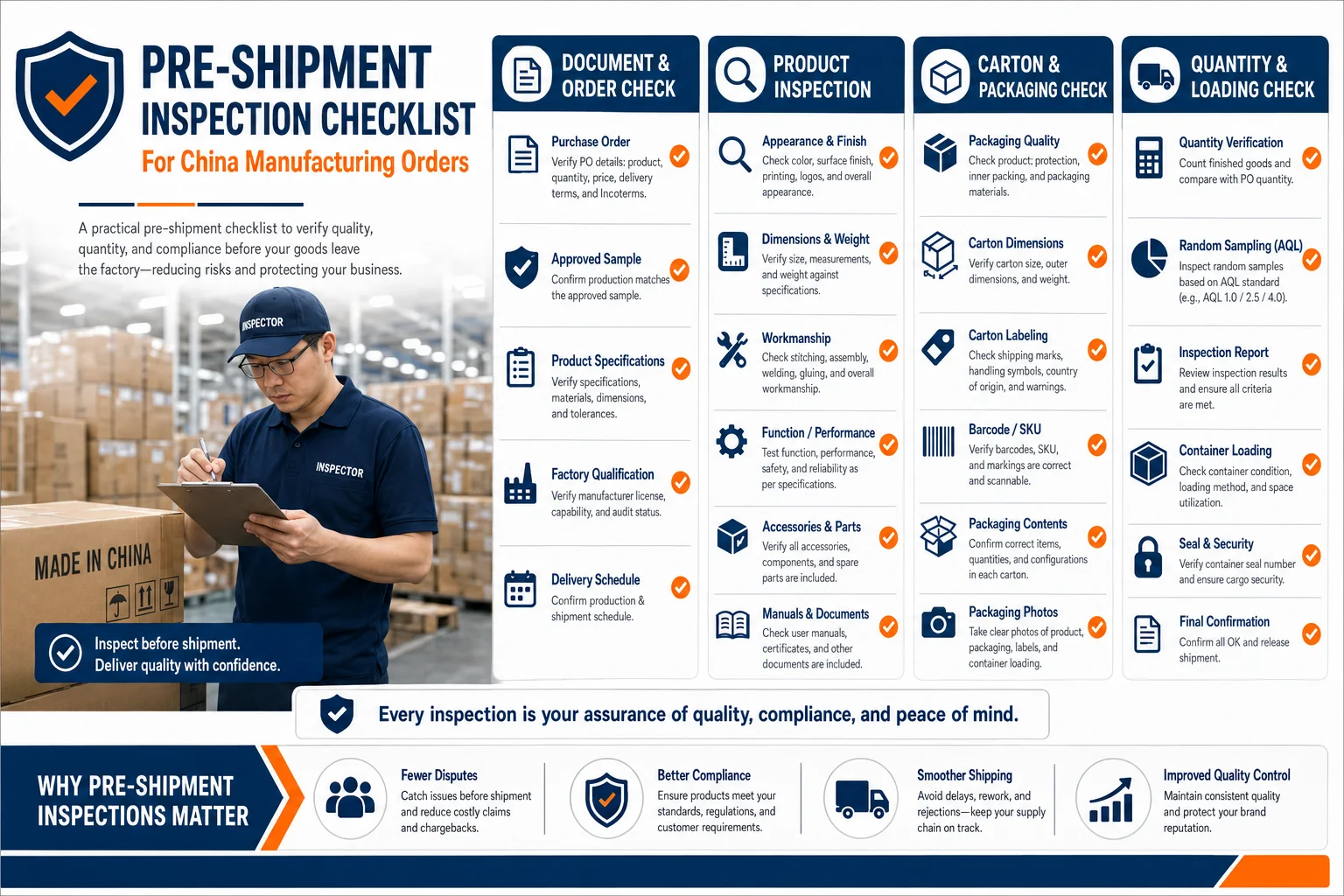
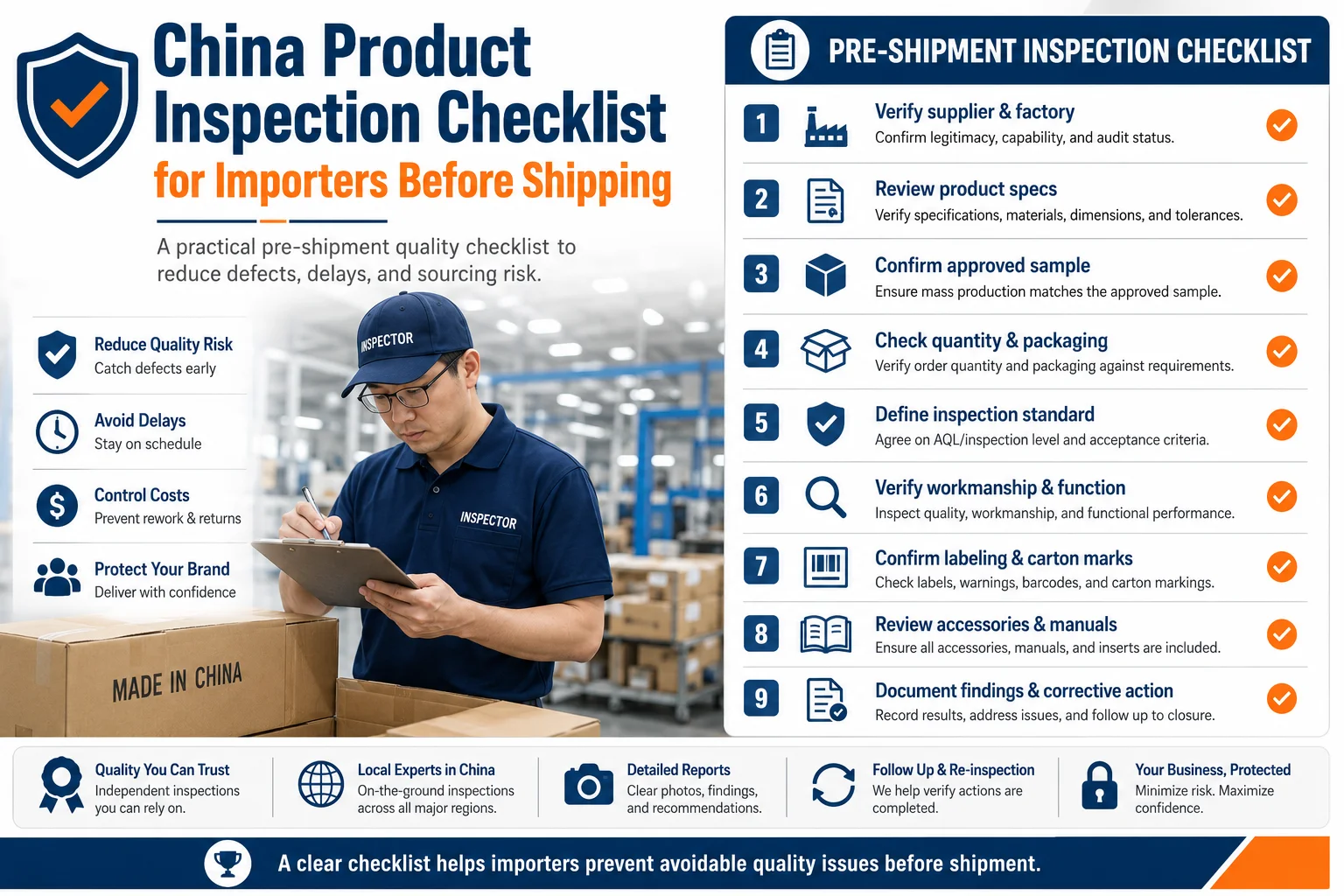
A useful pre-shipment inspection starts with paperwork, not just products. We compare the purchase order, approved sample, specification sheet, packaging artwork, and any agreed defect standards. If the reference documents conflict, we clarify the issue before treating it as a factory defect.
Core Pre-Shipment Inspection Areas
| Check Area | Example Questions |
|---|---|
| Quantity | Are the ordered units, cartons, and sets complete? |
| Appearance | Are there scratches, stains, loose threads, dents, or print defects? |
| Dimensions | Do measurements match the agreed tolerances? |
| Function | Does the product operate, assemble, open, close, charge, or connect as intended? |
| Accessories | Are all cables, manuals, screws, inserts, and spare parts included? |
| Packaging | Does the packaging protect the goods and match approved artwork? |
| Labeling | Are logos, barcodes, warnings, model numbers, and carton marks correct? |
| Cartons | Are cartons sealed, dry, strong enough, and packed correctly? |
Random Sampling and Defect Classification
Random sampling does not mean checking items casually. It means selecting units from different cartons and locations, then evaluating defects against an agreed method.
We usually separate defects into practical categories:
- Critical defects: Issues that may create serious safety, legal, or major customer-use risks.
- Major defects: Problems that affect function, saleability, or the customer experience.
- Minor defects: Small issues that do not usually prevent normal use or sale.
AQL sampling plans are common in international trade[^5], but the right thresholds must be agreed for the product and order. We recommend confirming any AQL level, product-specific standard, or market compliance requirement before production rather than assuming a universal number will fit every situation.
When Is 1-by-1 Inspection Better Than Random Sampling?
Random sampling can provide a practical view of overall production quality, but it cannot guarantee that every unit has been checked.[^6] For some products, that level of uncertainty is acceptable. For others, one missed defect can create a costly customer problem.
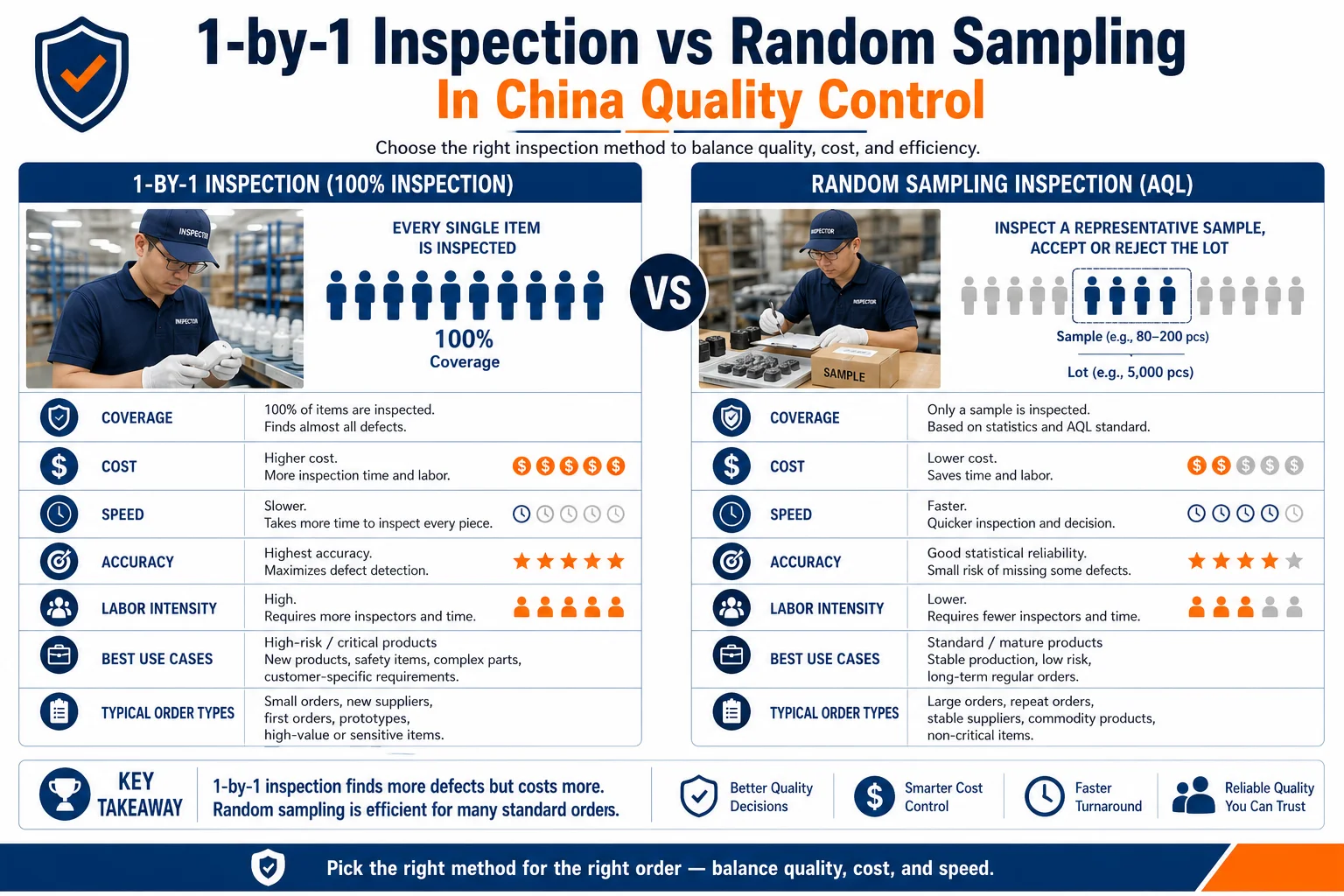
1-by-1 inspection means checking every unit against defined criteria, while random sampling inspection checks a selected portion of the order. Full inspection offers stronger defect detection but requires more time and cost.[^7] It is most useful for products with high defect risk, complex assembly, fragile components, customer-facing packaging, or a low tolerance for individual failures.
Key Differences
| Factor | 1-by-1 Inspection | Random Sampling Inspection |
|---|---|---|
| Units checked | Every unit | Selected units |
| Cost | Higher | Lower |
| Speed | Slower | Faster |
| Defect detection | Finds defects in checked criteria across all units | Estimates overall batch quality |
| Best use | High-risk or high-value products | Standard, stable production orders |
| Remaining risk | Lower, but not zero | Higher because unselected units are not checked |
We may recommend 1-by-1 inspection when products are individually packed, easily damaged, technically simple to test, or likely to create returns if even one unit fails. Examples may include fashion accessories with visible finish requirements, promotional kits with multiple components, glass items, simple electronic accessories, and products going directly to end customers.
However, full inspection is only effective when the inspection criteria are clear. Checking every unit for “good quality” is not enough. We need defined checks such as: Does the zipper operate? Is the logo aligned? Is the accessory included? Does the product turn on? Is the color within the approved range?
In one order we coordinated, the buyer chose a full check because each retail set contained several small pieces. The main issue was not product damage. It was inconsistent accessory packing. Finding that before shipping allowed the supplier to correct the packing process before the goods reached the buyer’s fulfillment center.
How Can You Compare Approved Samples With Bulk Production?
An approved sample is one of the most useful quality-control tools an importer has. Yet many buyers approve a sample through photos or a quick message and never create a reference record. That makes bulk comparisons harder when disagreements appear later.
To compare approved samples with bulk production, importers should document the sample’s color, material, dimensions, function, logo, accessories, workmanship, and packaging before mass production begins. The bulk inspection should use that approved reference together with written specifications, photos, measurements, and agreed acceptable variations.
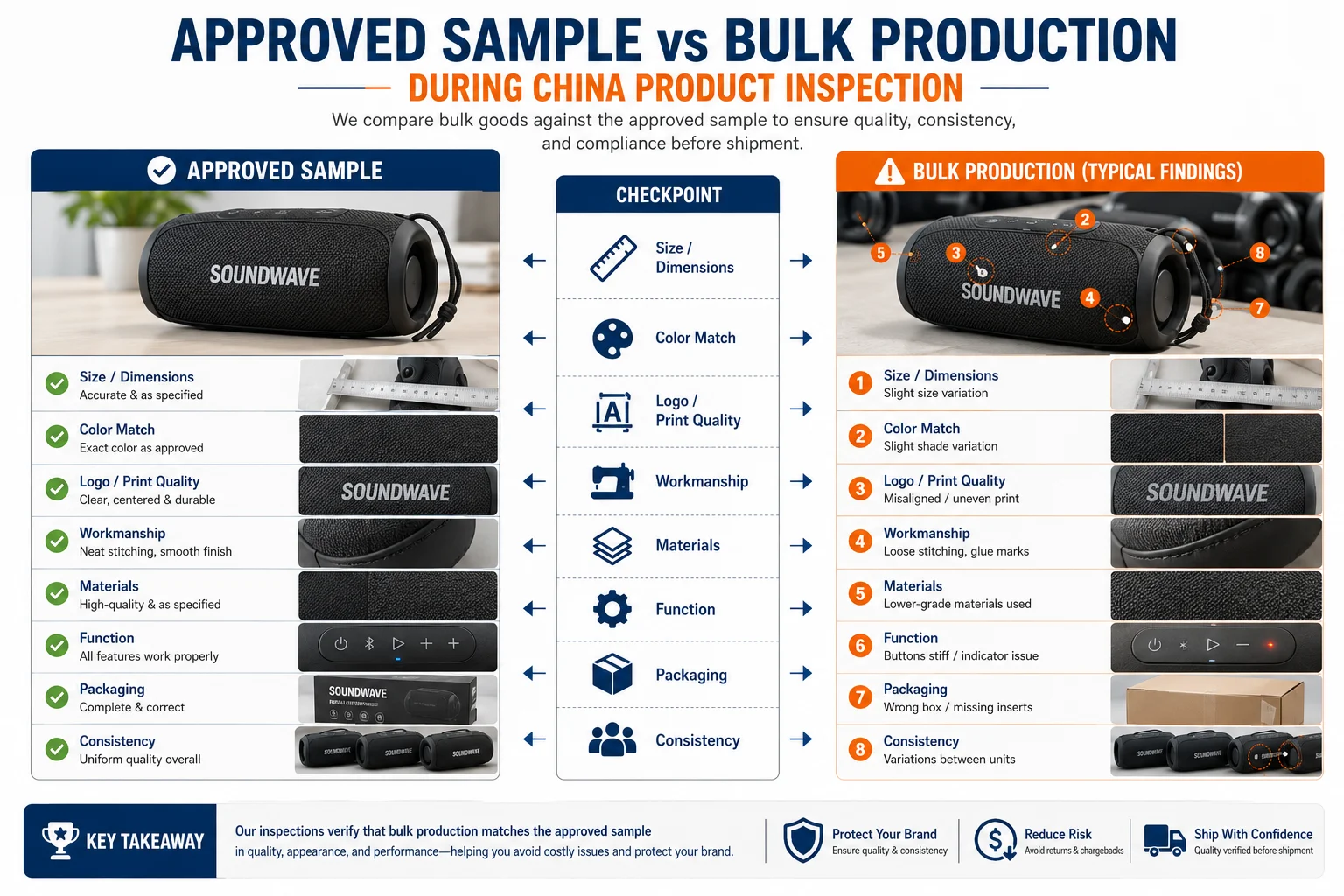
We encourage buyers to keep a simple “golden sample” record. It does not need to be complicated, but it should make expectations visible to both the supplier and the inspection team.
Build a Sample Approval File
Your file can include:
- Clear photos from several angles
- Material name, color code, or fabric composition
- Product measurements and acceptable tolerances
- Weight where relevant
- Logo artwork and placement measurements
- Required accessories and quantities
- Functional test instructions
- Packaging photos and packing sequence
- Barcode, warning label, and carton-mark artwork
- Notes on known acceptable variations
For color-sensitive products, photos alone may not be reliable because lighting, camera settings, and screens differ.[^8] We recommend using physical swatches, Pantone references, material samples, or other agreed references where appropriate.
Compare More Than Appearance
A product can look close to the sample and still create customer complaints. We compare bulk production with approved requirements across several areas:
- Materials: Is the fabric, coating, thickness, component, or finish consistent?
- Construction: Are seams, joints, assembly points, and edges made to the expected standard?
- Function: Does the product work in the same way as the approved sample?
- Branding: Are logos, fonts, colors, labels, and placements correct?
- Packaging: Does the package protect the product and present the brand as intended?
When a difference appears, we do not assume it is automatically unacceptable. We first ask: Was this variation approved? Does it affect use, saleability, or compliance? Can it be corrected before shipment? This approach keeps decisions practical rather than emotional.
What Product Defects Are Commonly Found During Inspections?
Importers often worry about dramatic factory mistakes. In reality, many defects are small, repeatable process issues. A slightly loose stitch, an incorrect insert, or a weak carton may look minor alone. Across hundreds or thousands of units, the commercial impact can become significant.[^9]
Common defects found during China product inspection include scratches, stains, poor workmanship, functional failures, wrong materials, incorrect dimensions, missing accessories, damaged packaging, and incorrect labels. Inspectors should record the defect type, location, quantity, severity, and supporting photos so the buyer can decide whether rework, re-inspection, conditional acceptance, or a shipment hold is appropriate.
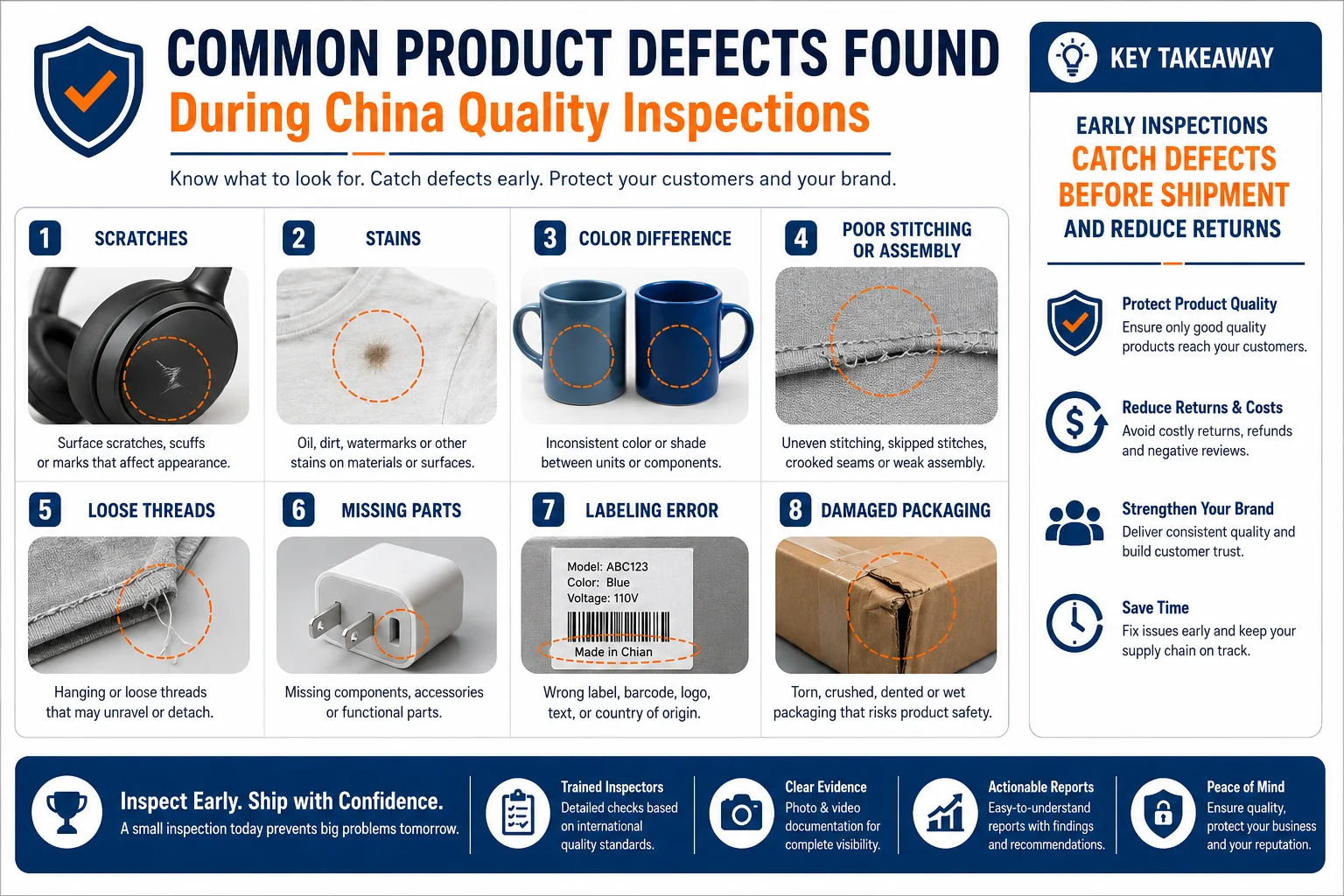
Typical Defect Categories
| Defect Category | Examples | Potential Impact |
|---|---|---|
| Cosmetic | Scratches, color variation, glue marks, stains | Poor reviews and reduced saleability |
| Workmanship | Loose stitching, rough edges, weak assembly | Product failure or poor perceived quality |
| Functional | Switch failure, poor fit, broken mechanism | Returns and customer complaints |
| Specification | Wrong dimensions, weight, material, or color | Product may not meet buyer requirements |
| Packaging | Crushed boxes, weak inserts, poor protection | Transit damage and retail presentation issues |
| Labeling | Wrong barcode, logo, warning, or model number | Warehouse delays and listing problems |
| Completeness | Missing accessories, manuals, or parts | Products cannot be used or sold as intended |
A clear defect report should show more than a pass or fail status. We find that buyers need enough detail to make a commercial decision. That includes photos, videos where useful, measurement results, carton information, quantity checked, defect counts, and notes on whether the supplier can rework the issue.
If an inspection identifies defects, the next step is not always cancellation. We may coordinate with the supplier to define corrective actions, separate defective goods, repair or repack units, confirm replacement components, and arrange a re-inspection. The best decision depends on the severity of the issue, the delivery deadline, and the buyer’s ability to manage remaining risk.
How Does KingSourcing Manage Inspection and Defect Prevention?
Overseas buyers often do not need another generic inspection checklist. They need a China-based team that can connect sourcing, sample approval, production communication, quality checks, packaging, and shipment preparation in one process.
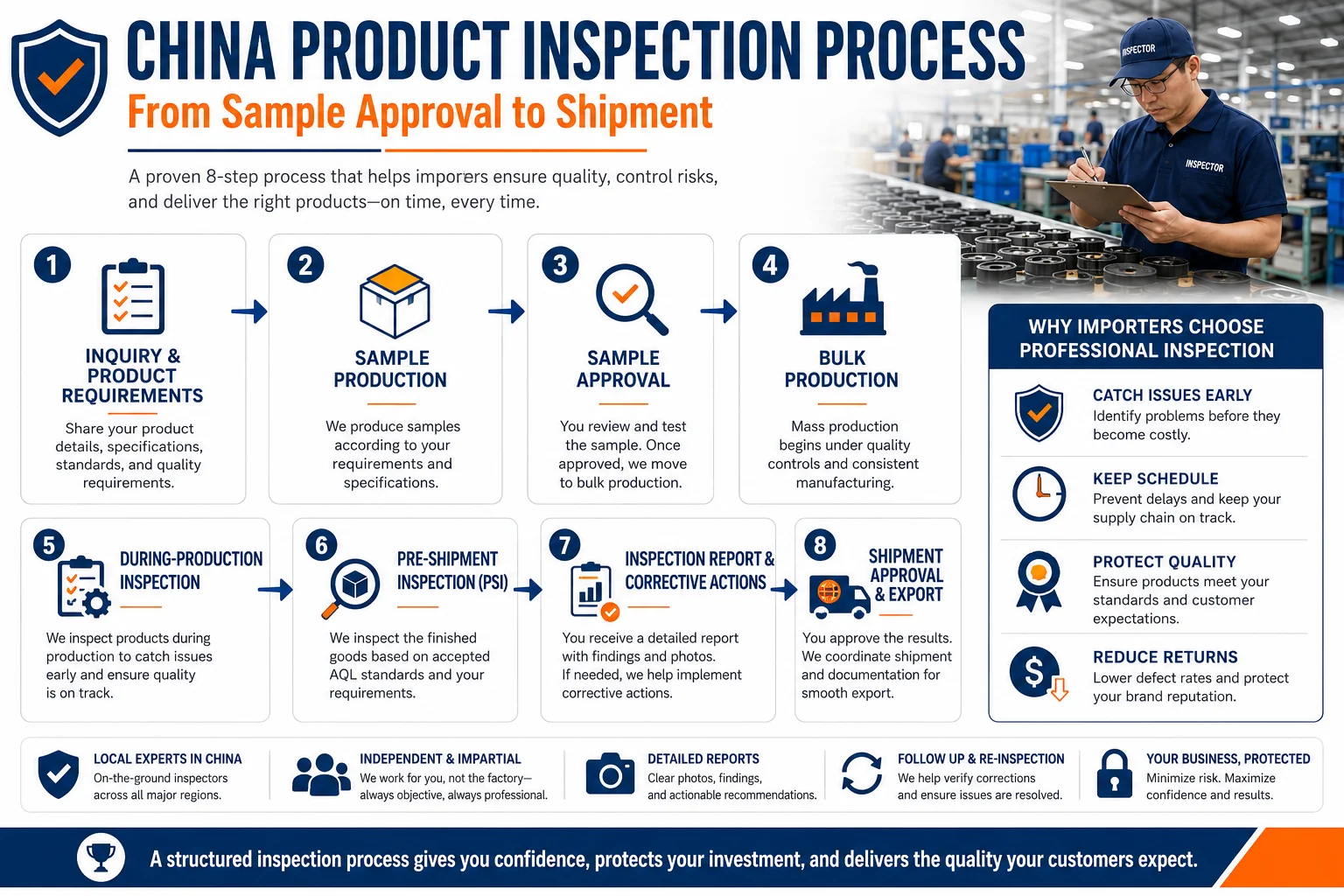
KingSourcing manages China product inspection as part of a wider defect-prevention workflow. We help buyers define requirements, compare samples with bulk goods, coordinate production follow-up, arrange pre-shipment or 1-by-1 inspection, communicate corrective actions, support re-inspection, and prepare goods for shipment only after the buyer has the evidence needed to make a release decision.
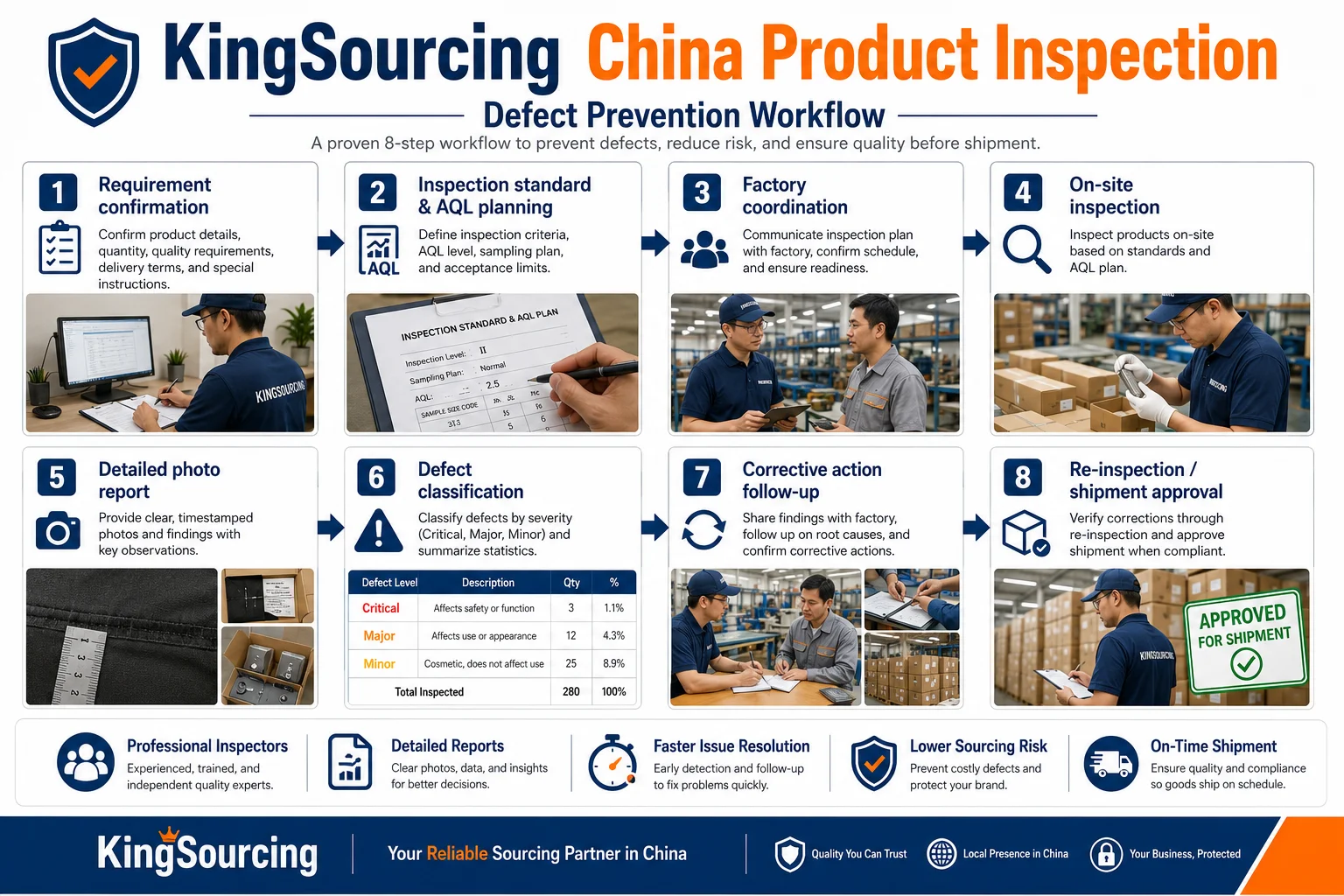
Our role is not to claim that an inspection can remove every risk. Instead, we help make quality risks visible earlier and easier to manage.
Our Practical Workflow
-
Confirm the product requirements
We collect the purchase order, approved sample details, packaging instructions, required accessories, and key quality points. -
Create an inspection-focused checklist
We identify the areas that matter most for the product. A clothing order may focus on sizing, stitching, labels, and color. A bundled product may focus on completeness, assembly, and packaging sequence. -
Follow production when needed
For suitable orders, we coordinate progress updates and raise questions before production reaches the final stage. -
Inspect before shipment
We can support random sampling inspection or 1-by-1 checks based on the agreed scope and risk level. -
Document findings clearly
We provide practical evidence so buyers can understand what was checked, what was found, and what needs attention. -
Coordinate corrective actions
When issues appear, we discuss rework, repacking, sorting, replacement, or re-inspection with the supplier and buyer. -
Support loading and logistics preparation
We can also help with carton consolidation, storage, container-loading supervision, shipping coordination, and door-to-door logistics.
We treat inspection as a shipment-release tool, not a paperwork exercise. The important question is always: “What evidence do we have, and what should we do next?”
Frequently Asked Questions
When should I inspect products in China?
We recommend planning inspection before production begins, then selecting the right stage based on product risk. A pre-production check helps with customized goods, during-production inspection helps identify process issues early, and pre-shipment inspection helps buyers make a final release decision before freight is arranged.
How much does a China product inspection cost?
China product inspection costs vary by city, product complexity, inspection method, order size, and whether you need random sampling, 1-by-1 inspection, re-inspection, or loading supervision. We recommend comparing the inspection cost with the potential cost of returns, rework, delayed launches, and unsellable inventory.
What is included in a pre-shipment inspection?
A pre-shipment inspection commonly includes quantity verification, random product sampling, visual checks, measurements, functional testing where applicable, packaging review, label checks, accessory verification, carton inspection, and comparison against approved samples or specifications. The exact scope should be agreed before inspection begins.
Is random sampling inspection reliable?
Random sampling inspection can provide useful evidence about the overall quality of a batch when it follows an agreed method and checklist. However, it does not check every unit. Buyers with high-risk products, fragile goods, complex bundles, or low tolerance for defects may prefer 1-by-1 inspection.
What happens if a product inspection fails?
If an inspection fails, buyers should review the documented findings against the agreed standards. Possible actions include rework, repacking, sorting defective units, replacing missing items, negotiating conditional acceptance, arranging re-inspection, or holding shipment. The right choice depends on defect severity, timing, and commercial risk.
Conclusion
China product inspection is not just a final visual check before goods leave the factory. It is a practical risk-control process that begins with clear standards, approved samples, and written requirements. By checking bulk production, packaging, functionality, accessories, and labels before shipment, importers can make better release decisions and reduce avoidable destination-country costs. If you need a China-based team to support sourcing, quality control, 1-by-1 inspection, re-inspection, and shipping coordination, contact KingSourcing and let us make your China sourcing simpler.
Tags: China Product Inspection, Pre-Shipment Inspection, Quality Control in China, 1-by-1 Inspection, Product Defect Prevention, China Sourcing Agent, Import from China
Need Supplier Verification or a Factory Audit?
Sourcing from China carries real supplier and quality risk. We provide factory audits, product inspections, and QC oversight before shipment. Learn about our sourcing and QC services or talk to our team.
Related reading: How a Sourcing Agent Helps with Quality Control in China
[^1]: "Trade Guide: WTO PSI", https://www.trade.gov/trade-guide-wto-psi. Inspection is a conformity-assessment activity used to determine whether a product, process, or service meets specified requirements; in trade practice, those requirements may include product specifications, quantities, and packaging. Evidence role: definition; source type: institution. Supports: That inspection is a conformity-evaluation activity used to determine whether products meet specified requirements.. Scope note: The source establishes the general inspection concept; the exact documents and checks used depend on the buyer-supplier agreement. [^2]: "Error Cost Escalation Through the Project Life Cycle", https://ntrs.nasa.gov/api/citations/20100036670/downloads/20100036670.pdf. Quality-management literature describes a cost-of-quality pattern in which defects identified earlier can generally be corrected before downstream handling, distribution, warranty, and customer-return costs are incurred. Evidence role: mechanism; source type: research. Supports: That the cost of correcting defects tends to rise when defects are discovered later in the production and delivery process.. Scope note: The size of the cost difference depends on the product, contract terms, freight arrangements, and available rework options. [^3]: "Quality assurance: A critical ingredient for organizational ...", https://www.iso.org/quality-management/quality-assurance. Quality-assurance frameworks support planned verification at relevant stages of production, allowing requirements to be confirmed before manufacture, nonconformities to be identified during production, and finished output to be evaluated before release. Evidence role: general_support; source type: institution. Supports: That quality assurance can use planned controls at multiple points in a production process rather than relying solely on final inspection.. Scope note: The most appropriate control points and inspection scope depend on process risk and product requirements. [^4]: "ISO 2859-1", https://chemistry.unt.edu/~tgolden/courses/iso2859-1.pdf. Acceptance-sampling standards describe inspection based on samples drawn from production lots, whereas 100 percent inspection evaluates every unit in the lot against defined criteria. Evidence role: definition; source type: institution. Supports: That acceptance inspection can be based on samples selected from a lot, in contrast with inspection of every unit.. Scope note: Whether sampling or full inspection is appropriate depends on the agreed plan, lot characteristics, defect consequences, and inspection feasibility. [^5]: "ISO 2859-1", https://chemistry.unt.edu/~tgolden/courses/iso2859-1.pdf. ISO acceptance-sampling systems use the acceptable quality limit (AQL) as a parameter for lot-by-lot inspection by attributes and for determining sampling plans and acceptance criteria. Evidence role: definition; source type: institution. Supports: That AQL is a parameter used in acceptance-sampling systems for inspection by attributes.. Scope note: An AQL is not a guarantee of defect-free goods and does not itself establish product safety or regulatory compliance. [^6]: "6.2.2. What kinds of Lot Acceptance Sampling Plans (LASPs ...", https://www.itl.nist.gov/div898/handbook/pmc/section2/pmc22.htm. Acceptance sampling evaluates a lot from a selected subset of units; because not all units are examined, the method involves sampling risk and cannot ensure that every individual nonconforming unit is detected. Evidence role: mechanism; source type: government. Supports: That sampling inspection uses observations from a subset of units to make a decision about a lot and therefore has sampling risk.. Scope note: The reliability of a sampling decision depends on the sampling plan, sample size, defect distribution, and execution of the inspection. [^7]: "6.2.2. What kinds of Lot Acceptance Sampling Plans (LASPs ...", https://www.itl.nist.gov/div898/handbook/pmc/section2/pmc22.htm. Quality-control literature distinguishes 100 percent inspection from acceptance sampling: examining every unit can identify nonconformities in the tested characteristics throughout the lot, but requires substantially greater inspection effort than examining a sample. Evidence role: mechanism; source type: research. Supports: That 100 percent inspection requires examination of all units and generally demands more resources than sampling inspection.. Scope note: Full inspection can still miss defects when test methods are incomplete, inspectors make errors, or defects are intermittent or latent. [^8]: "Color rendering of light sources | NIST", https://www.nist.gov/pml/sensor-science/optical-radiation/color-rendering-light-sources. Color-science research shows that color appearance and digital color reproduction depend on illumination, imaging devices, display characteristics, and viewing conditions, limiting the reliability of photographs as sole color references. Evidence role: mechanism; source type: research. Supports: That perceived and reproduced color are affected by illumination, capture systems, displays, and viewing conditions.. Scope note: Controlled imaging workflows and calibrated displays can improve consistency but do not necessarily substitute for an agreed physical reference. [^9]: "Load Optimization for Shippers", https://nepis.epa.gov/Exe/ZyPURL.cgi?Dockey=P100X04S.TXT. Packaging research and distribution-testing guidance recognize that inadequate protective packaging can increase the risk of product damage during handling and transport, with losses accumulating across shipment volumes. Evidence role: general_support; source type: research. Supports: That inadequate packaging can contribute to product damage and related costs during distribution and handling.. Scope note: The commercial impact for a particular shipment depends on product fragility, transport conditions, packaging design, and recovery arrangements.