Quick Answer
A China sourcing agent can help a startup avoid supplier mistakes, but the wrong partner can add cost without adding control. I often see European and North American 3C founders compare factory prices first, while overlooking communication, sampling, inspections, compliance documents, and delivery follow-up. I use an execution-capacity test to help buyers decide whether direct sourcing or agency support fits their situation.
A China sourcing agent makes sense when I cannot confidently manage supplier screening, product sampling, customization, quality inspection, delivery coordination, and after-sales communication by myself. Direct factory sourcing may work for a focused product, clear specifications, and an experienced internal team. I should compare the agent’s transparent fees against the total sourcing cost and execution risk, not only the quoted unit price.
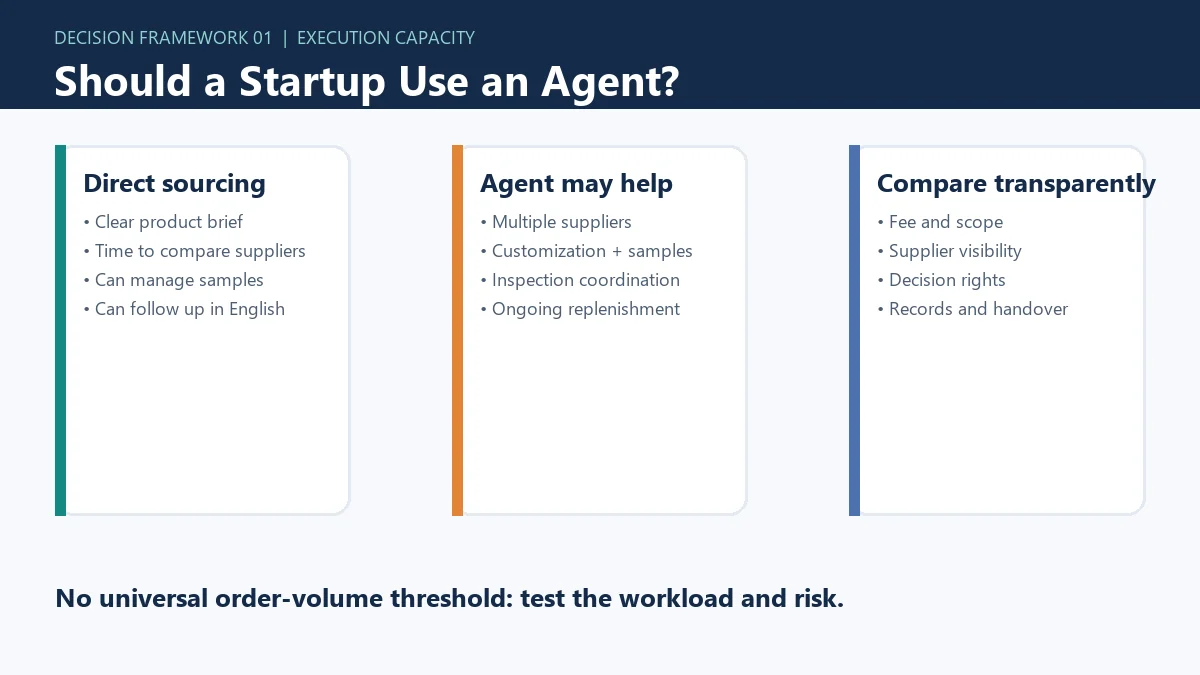
Many startups begin with a simple goal: find a competitive factory and place an order quickly. In practice, the difficult work usually starts after the first quotation. The following sections explain how I evaluate execution capacity, what an agent should actually do, how I compare sourcing models, and which warning signs deserve attention before I commit.
Can a China Sourcing Agent Help Me Pass the Execution-Capacity Test?
A startup may understand its product idea but still lack the time, people, and systems needed to execute a China purchase. I see this problem often in 3C sourcing, where a USB cable, charger, GaN charger, TWS earbud, or smartwatch can involve several specifications and compliance documents.
I pass the execution-capacity test when I can independently identify suitable suppliers, compare technical offers, approve samples, verify production quality, coordinate shipping, and handle problems in the supplier’s working language. If I cannot complete these tasks reliably, a China sourcing agent may reduce operational risk.
What does the execution-capacity test include?
I do not use a universal order-volume threshold to decide whether a startup needs an agent. A small order can be difficult, while a larger order can be manageable if the buyer has a capable procurement team. I focus instead on the number of decisions and follow-up tasks that the buyer can realistically control.
I ask myself these questions:
-
Can I define the product clearly?
I need a written specification for materials, dimensions, colors, packaging, performance, included accessories, labeling, and acceptable variations. A product image alone usually does not provide enough information.[^1] -
Can I screen suppliers beyond a marketplace profile?
I need to check whether the supplier makes the product, trades it, or uses another factory. I also need to review relevant business information, production capability, communication quality, and document availability. -
Can I manage sample revisions?
A sample may look acceptable but still miss important requirements. I need to record every change and compare the final approved sample with the production version. -
Can I arrange quality control?
I should decide whether to inspect during production, before shipment, or at another stage. I also need a written inspection checklist and a process for handling nonconformities. -
Can I follow delivery and after-sales issues?
Delays, missing cartons, incorrect labels, product defects, and replacement requests require steady communication. A startup owner may not have the time to manage these issues across time zones.
Why does 3C sourcing require close follow-up?
Consumer electronics can contain multiple risk points.[^4] A charger may require attention to input and output specifications, plug type, housing, thermal behavior, packaging, markings, and destination-market requirements. A TWS earbud may include batteries, firmware, Bluetooth functions, charging cases, and app-related questions.
I do not treat a supplier’s certificate image as proof that a product is ready for every market.[^5] I ask the supplier to provide current, product-specific documents, then I recommend that the buyer verify them with a qualified compliance professional. Requirements can depend on the product model, destination country, importer role, labeling, wireless functions, battery configuration, and other details.[^6]
When does an agent add practical value?
A China sourcing agent may help when I have:
- Several product categories to coordinate at the same time.
- Custom packaging, branding, colors, or accessories.
- Multiple factories for one product line.
- Limited Chinese-language communication ability.
- No local person to visit or inspect suppliers.
- A short launch schedule that requires frequent follow-up.
- A need to combine products from different suppliers.
- Concerns about replacement handling after delivery.
- Limited experience comparing samples with mass production.
The agent does not remove my responsibility as the buyer. I still need to approve specifications, samples, packaging, and commercial terms. However, the agent can provide local execution support that I may not have internally.
What Should a China Sourcing Agent Handle for a Startup?
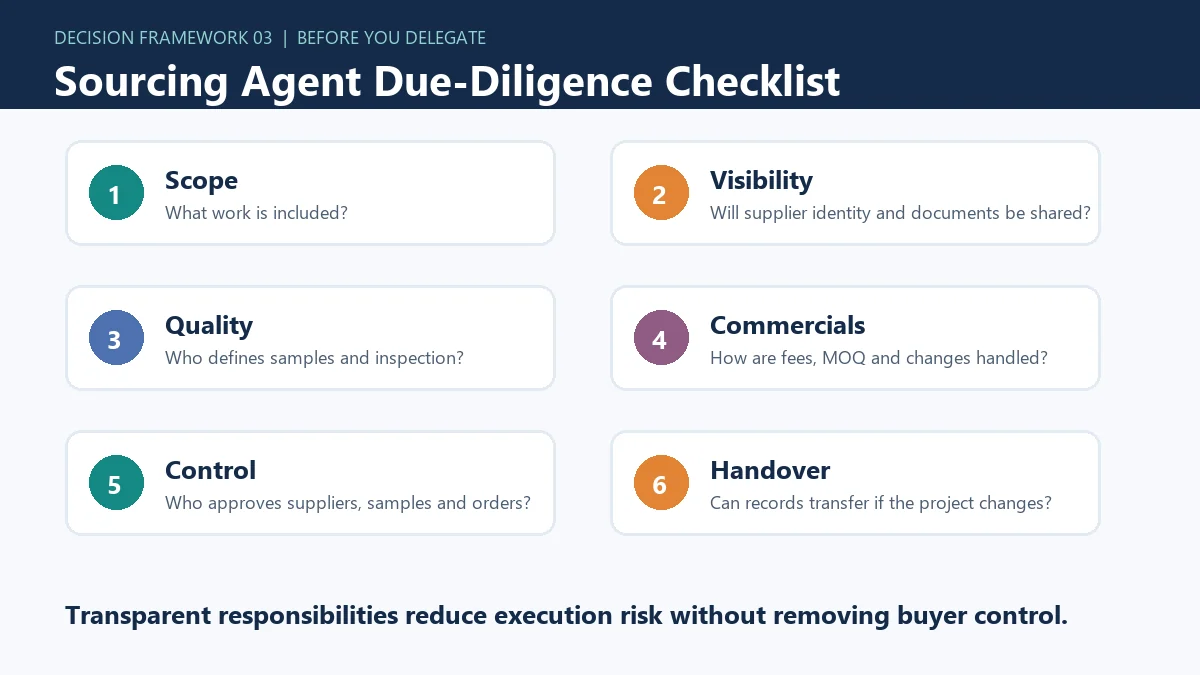
A vague promise to “find a factory” is not enough for me. I expect a China sourcing agent to explain the actual work included, the work excluded, the communication process, and the fees. I also want to understand how the agent protects supplier visibility rather than creating unnecessary dependence.
A useful China sourcing agent should support supplier screening, quotation comparison, sampling, customization communication, inspection coordination, delivery follow-up, multi-supplier planning, and after-sales handling. The agent should explain each service clearly and should give the buyer appropriate visibility into suppliers, specifications, documents, approvals, and production progress.
Supplier screening and quotation comparison
I start by turning the product request into a sourcing brief. The brief can include:
- Product name and intended use.
- Technical specifications.
- Target market and destination country.
- Required packaging and labeling.
- Branding or customization requirements.
- Expected order schedule.
- Preferred commercial terms.
- Quality expectations and inspection points.
- Available compliance documents to be verified.
A capable sourcing partner should use this information to compare suppliers on more than price. I look at communication, production fit, sample quality, customization ability, lead-time credibility, packaging capability, and willingness to provide documents.
| Evaluation area | What I review | Why it matters |
|---|---|---|
| Product fit | Experience with the required product | A general electronics supplier may not fit a specialized item |
| Communication | Speed, clarity, and technical understanding | Misunderstandings can become production defects |
| Customization | Tooling, branding, packaging, and accessory options | Startups often need more than an off-the-shelf product |
| Sample process | Revision control and approval records | The first sample may not represent the final product |
| Quality process | Inspection methods and corrective action | A low price does not control production variation |
| Documents | Product-specific reports and certificates | Buyers must verify suitability for the target market |
| Delivery | Production schedule and shipping coordination | Delays can affect launch plans and inventory |
| After-sales | Defect reporting and replacement process | The relationship continues after shipment |
Sampling and the sample-to-production gap
I treat sampling as a controlled decision stage, not as a formality. I write down what I approved, including the version, color, materials, functions, packaging, accessories, and visible finish.
The sample-to-production gap can appear in several ways:[^2]
- A different material is used to reduce cost.
- A component changes because the original part is unavailable.
- Printing or logo placement shifts.
- Packaging dimensions change.
- Firmware or software settings differ.
- Cable length, connector construction, or charging performance changes.
- A supplier treats an approved sample as a general reference rather than a binding quality standard.
I ask how the approved sample will be recorded in the purchase order or production documents. I also ask how changes will be communicated before mass production. An agent can help follow up, but I still need to approve meaningful changes.
Inspection coordination and delivery follow-up
An agent may arrange an inspection company or coordinate a factory visit, but I want the inspection scope in writing. A generic visual check may not cover the issues that matter to my product.[^3] For example, I may need checks for dimensions, labeling, packaging quantity, basic functions, accessories, workmanship, or sample comparison.
I also want a clear process for nonconforming goods:
- The inspection identifies an issue.
- The buyer receives evidence and a report.
- The supplier proposes corrective action.
- The buyer approves or rejects the proposed solution.
- A reinspection or production review takes place if needed.
- The final shipment decision is documented.
Delivery follow-up should include production progress, carton information, shipping documents, and communication about delays. I do not assume that an agent controls the carrier, customs authority, or factory schedule. I expect the agent to communicate facts promptly and help coordinate the next action.
Multi-supplier coordination and after-sales
A startup may source USB cables from one factory, chargers from another, and TWS products from a third. Each supplier can use different packaging standards, lead times, carton sizes, and communication habits. An agent may help create one planning view for the complete order.
After-sales handling also deserves attention. I ask:
- Who receives the defect report?
- What evidence does the supplier require?
- Who decides whether a replacement is appropriate?
- Who pays for rework, replacement, or additional freight?
- How are repeated issues tracked?
- Does the agent help with communication after the shipment is complete?
The answers should appear in the commercial agreement. I do not rely only on a verbal promise.
Is Direct Factory Sourcing Cheaper Than Using a China Sourcing Agent?
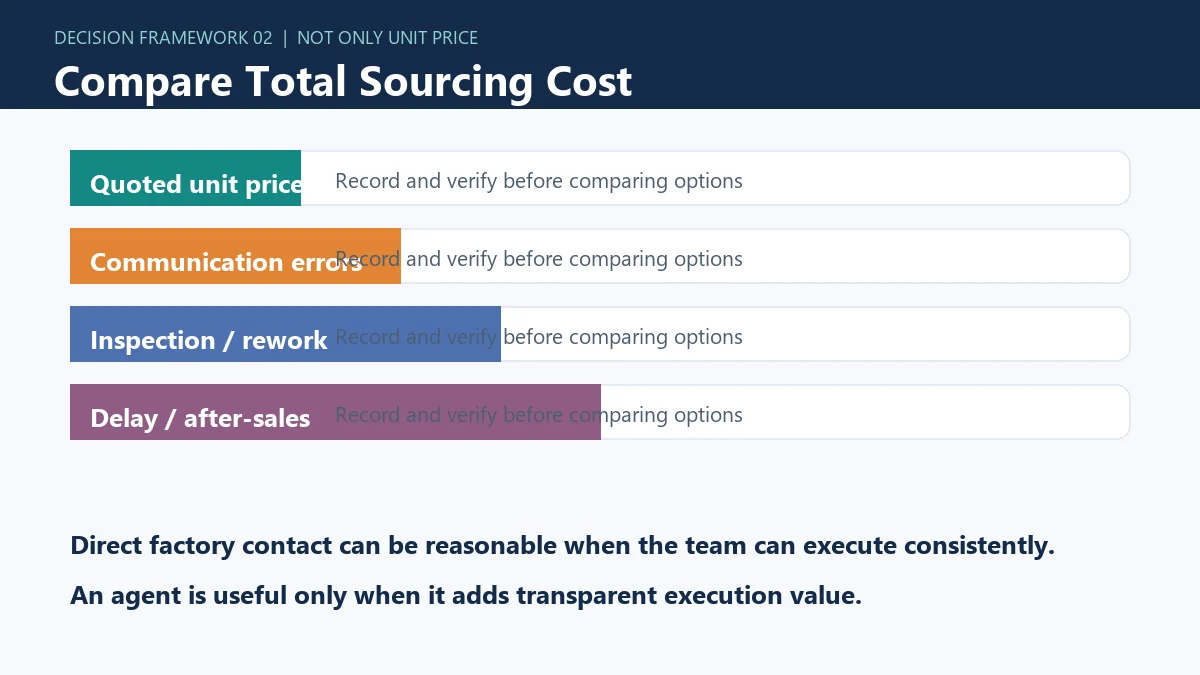
Direct factory sourcing can provide a lower visible unit price, but that price does not represent the complete procurement cost.[^7] I compare supplier management time, sample expenses, inspection, travel, translation, delays, rework, payment risk, and after-sales effort before deciding.
Direct factory sourcing may have a lower quoted unit price because it removes an intermediary fee. However, a China sourcing agent may create value by reducing avoidable errors and coordination work. I compare both models using total sourcing cost, internal workload, and execution risk rather than unit price alone.[^8]
What belongs in total sourcing cost?
I use a broad cost view because the cheapest quotation can become expensive after problems appear. My comparison includes:
- Product price.
- Tooling or setup fees.
- Sample and revision costs.
- Packaging development.
- Inspection fees.
- Freight and consolidation costs.
- Translation or communication support.
- Travel and local transport.
- Payment charges.
- Rework and replacement exposure.
- Inventory caused by delay.
- Internal staff time.
- Customer service time after delivery.
- Cost of missed launch or retail timing.
I do not assign a guaranteed financial saving to an agent. The result depends on the product, supplier, contract, quality process, order structure, and the agent’s actual performance. I use the comparison to make the trade-off visible.
Direct sourcing versus agent-supported sourcing
| Factor | Direct factory sourcing | Agent-supported sourcing |
|---|---|---|
| Unit-price visibility | Usually direct | May include service margin or fee |
| Supplier relationship | Controlled directly by buyer | Shared with agent unless agreed otherwise |
| Local communication | Buyer manages it | Agent may support it |
| Screening workload | Buyer carries most responsibility | Agent may pre-screen and compare |
| Customization follow-up | Buyer coordinates revisions | Agent may manage factory communication |
| Inspection | Buyer arranges independently | Agent may coordinate inspection |
| Multi-supplier orders | More complex for a small team | Agent may consolidate communication |
| After-sales | Buyer handles supplier disputes | Agent may assist with follow-up |
| Transparency | Direct access can be high | Depends on the agent’s reporting policy |
| Risk allocation | Buyer carries more execution risk | Some operational work is delegated |
I see direct sourcing as reasonable when I have a clear product, stable specifications, strong communication ability, sufficient time, and a process for quality and compliance review. I see agent support as potentially useful when the project contains several moving parts that I cannot manage consistently.
What does a transparent fee structure look like?
I ask the agent to state whether fees are:
- A fixed project fee.
- A percentage of the purchase value.
- A product-development fee.
- A sourcing fee per supplier.
- A quality-inspection coordination fee.
- A logistics or consolidation fee.
- A combination of these models.
I also ask whether the agent receives any supplier-side commission. If an agent receives compensation from both sides, I want that relationship disclosed. I need to know whether the agent’s recommendation is based on product suitability, price, availability, an existing relationship, or another factor.
Why is supplier visibility important?
I do not want the agent to hide the supplier unnecessarily. I may need to review the factory’s legal identity, address, production capability, quotation, documents, and sample records. The exact level of access can be agreed commercially, but I prefer a process that gives me enough information to make informed decisions.
I also ask who owns:
- Product specifications.
- Artwork and packaging files.
- Tooling or molds.
- Sample records.
- Test reports supplied by the factory.
- Inspection reports.
- Purchase documentation.
- Supplier contact information.
A professional relationship can include confidentiality while still giving the buyer proper visibility. I consider this balance important because startup founders need to build a repeatable supply chain, not only complete one shipment.
When Should a Startup Contact a China Sourcing Agent?
A startup should contact a sourcing agent when its operational needs exceed its internal procurement capacity. I do not decide based only on company size, product category, or expected order volume. I decide after reviewing complexity, market requirements, customization, supplier count, schedule pressure, and the consequences of a mistake.
I consider a China sourcing agent when I need local coordination, several suppliers, customized 3C products, repeated sampling, inspection support, or structured after-sales communication. I may choose direct sourcing when I have a focused product, reliable supplier contacts, adequate internal time, and the ability to verify quality and destination-market requirements independently.
Situations where direct sourcing may be reasonable
I may contact factories directly when the following conditions apply:
- I have already identified a supplier with relevant product experience.
- The product specification is stable and easy to communicate.
- I only need limited customization.
- I can communicate directly and document decisions.
- I have a plan for sample approval and mass-production control.
- I can arrange qualified inspections.
- I understand the responsibilities of the importer.
- I can verify product-specific documents for my destination market.
- I have enough time to manage production and shipping follow-up.
- I have a clear process for defects and replacements.
Direct sourcing can give me closer control over the commercial relationship. It can also help me learn the supply chain firsthand. However, I should not confuse direct access with guaranteed quality. I still need due diligence, written specifications, quality controls, and professional compliance advice where appropriate.
Situations where an agent may help
I may benefit from an agent when:
- I am sourcing several related products.
- I need branded packaging or private-label production.
- I want to compare multiple factories.
- I cannot visit suppliers.
- I need help with Chinese-language technical communication.
- I need sample revisions coordinated quickly.
- I plan to combine goods from multiple suppliers.
- I have limited experience with inspections.
- I need someone to follow up on delays.
- I expect ongoing replacement or after-sales questions.
I often see early-stage founders focus on finding a supplier and underestimate the work required to maintain a supplier relationship. An agent may help me create a repeatable workflow, but only if the agent provides clear reporting and accepts defined responsibilities.
How should I interview a potential sourcing agent?
I prepare practical questions before I start:
- How do you identify and screen suppliers?
- Will you disclose the supplier’s legal identity and factory location?
- How do you compare factories beyond quotation price?
- What does your fee include?
- Do you receive supplier-side commissions?
- Who owns the samples, specifications, artwork, and tooling?
- How do you control changes between sample approval and production?
- How do you coordinate inspections?
- What happens if goods fail an inspection?
- How do you handle delays and after-sales problems?
- Which activities require separate fees?
- How do you protect confidential product information?
- Can you provide a written project schedule?
- Which documents can the supplier provide for verification?
- What decisions must I approve personally?
I also request a sample reporting format. A useful report may include supplier comparisons, quotation assumptions, sample photos, open questions, document status, production updates, and unresolved risks.
What warning signs should I notice?
I become cautious when an agent:
- Promises a guaranteed price, quality result, or certification outcome.
- Refuses to explain fees.
- Avoids identifying the actual supplier.
- Sends certificates without matching model information.
- Pressures me to skip samples or inspections.
- Cannot explain how changes are controlled.
- Gives an unusually low price without assumptions.
- Treats all 3C products as if they have identical requirements.
- Claims that one document automatically proves market compliance.
- Provides no written process for defects or delays.
I do not expect an agent to control every factory or regulatory event. I do expect clear boundaries, timely information, and honest escalation when a problem appears.
How Can I Reduce the Sample-to-Production Gap With a China Sourcing Agent?
The sample-to-production gap appears when the approved sample and the shipped product are not sufficiently consistent. I reduce this risk by documenting the sample, defining acceptance criteria, approving changes in writing, and arranging appropriate production inspection.
I reduce the sample-to-production gap by creating a controlled approval record. The record should identify the exact sample version, specifications, materials, functions, packaging, artwork, and acceptable tolerances. I then connect that record to the purchase order, production instructions, and inspection checklist.
What should a sample approval record contain?
I create a sample file that includes:
- Supplier name and factory identity.
- Product model or internal reference.
- Sample date and revision number.
- Photos from several angles.
- Measurements and key specifications.
- Color references.
- Materials and components.
- Functions tested.
- Packaging and accessories.
- Logo and artwork files.
- Open issues and agreed corrections.
- Buyer approval date.
- Conditions for future changes.
I do not assume that photos alone are sufficient. If a feature matters to performance, safety, appearance, or customer expectations, I want the requirement expressed in a measurable or clearly observable way.
How can an agent support production control?
A sourcing agent can help by sending the approved specification to the factory, confirming that the factory understands the requirements, and requesting updates at agreed stages. The agent can also help coordinate a third-party inspection or a qualified local inspection process.
I ask for production evidence that matches the project stage, such as:
- Confirmation that production has started.
- Photos of packaging or components.
- Evidence of major approved changes.
- Production progress updates.
- Inspection scheduling.
- Carton and shipping information.
- A record of corrective actions.
These records do not replace a professional inspection. They help me identify communication gaps before the goods leave the factory.
How should I think about compliance documents?
I treat certifications, test reports, declarations, and other compliance documents as documents to verify, not as automatic conclusions. The buyer should confirm whether the document matches the exact product model, components, factory, issuing organization, date, and destination-market requirements.
I recommend involving qualified professionals for application-specific decisions. The agent or factory may provide documents, but the importer may still carry responsibilities for product information, labeling, technical files, testing, battery transport, wireless functions, or other requirements. The correct process depends on the product and market.
What should happen after inspection?
If the inspection identifies a problem, I want a written decision process. I may accept the goods, request rework, request replacement, negotiate a commercial solution, or stop shipment. The correct response depends on the defect, contract, evidence, and business impact.
I also distinguish between:
- Critical issues, which may affect safety, legal requirements, or core function.
- Major issues, which may prevent normal sale or customer use.
- Minor issues, which may affect appearance but not basic function.
I do not use a generic defect classification without considering the product and market. I ask a qualified inspection provider to define the applicable method and sampling plan.
Frequently Asked Questions
Is a China sourcing agent necessary for every startup?
No. I may manage direct sourcing if I have a focused product, clear specifications, sufficient time, reliable communication, and a practical quality-control process. I consider an agent when the project includes customization, several suppliers, limited local knowledge, or a high need for follow-up.
Does a China sourcing agent always reduce the product price?
No. An agent may charge a fee or include a margin, so the visible unit price may not be lower. I compare the complete sourcing cost, including sampling, inspection, coordination time, delays, rework, and after-sales work. The main potential value is execution support, not a guaranteed price reduction.
Should I allow an agent to hide the factory name?
I prefer appropriate supplier visibility. I need enough information to evaluate the supplier, verify documents, understand the commercial relationship, and protect my supply-chain planning. Confidentiality can still apply, but I become cautious when an agent refuses to explain the supplier relationship.
Can an agent guarantee product certifications?
No responsible sourcing partner should guarantee that a product meets every destination-market requirement without product-specific evaluation. I ask for relevant documents, verify their model and scope, and consult qualified professionals about applicable requirements.
How can I check whether an agent is suitable for 3C products?
I ask about experience with the relevant category, sample management, customization, inspection coordination, battery or wireless products where applicable, document verification, delivery follow-up, and after-sales handling. I also request a written fee schedule and a clear explanation of supplier visibility.
Conclusion
A China sourcing agent may help a 3C startup when the project requires more execution capacity than the founder or internal team can provide. I evaluate supplier screening, sample control, customization, inspection, delivery, multi-supplier coordination, after-sales support, transparent fees, and supplier visibility. I choose direct sourcing when I can manage these responsibilities consistently. I choose agency support when it can reduce operational risk without reducing transparency. Contact my Shenzhen-based team to discuss your product requirements, supplier options, MOQ, lead time, customization, and export planning for European or North American markets.
[^1]: "Recommendations of Specifications, Standards, and ...", https://www.epa.gov/greenerproducts/recommendations-specifications-standards-and-ecolabels-federal-purchasing. A technical product specification normally records measurable requirements and acceptance criteria that cannot be established from a visual reference alone. Evidence role: general_support; source type: education. Supports: The source should explain why technical, dimensional, material, performance, and acceptance requirements are needed beyond visual descriptions.. Scope note: This supports the general specification principle; the adequacy of a product image depends on the product and the information conveyed. [^2]: "QUALITY CONTROL FOR SAMPLING AND LABORATORY ...", https://stacks.cdc.gov/view/cdc/178839/cdc_178839_DS1.pdf. Quality-management research identifies process variation and uncontrolled changes between development and production as mechanisms through which manufactured output can differ from an approved reference sample. Evidence role: mechanism; source type: paper. Supports: The source should describe how process variation, substituted components, and changes in production conditions can cause mass-produced goods to diverge from prototypes or approved samples.. Scope note: The mechanism is general and does not establish that every supplier or product will exhibit a sample-to-production discrepancy. [^3]: "The Role of Visual Inspection in the 21st Century", https://www.osti.gov/servlets/purl/1476816. Inspection methods are scope-dependent: visual examination can identify observable workmanship conditions, whereas functional, dimensional, electrical, or safety requirements generally require additional defined tests. Evidence role: mechanism; source type: research. Supports: The source should distinguish visual examination from functional, dimensional, electrical, or other product-specific tests.. Scope note: The exact inspection combination depends on the product, specification, risk level, and applicable standard. [^4]: "EU WEEE_RoHS", https://www.trade.gov/eu-weeerohs. Government product-safety and market-access frameworks treat electronic devices as potentially subject to several distinct technical and information requirements, including electrical safety, electromagnetic compatibility, radio equipment, batteries, and labeling. Evidence role: general_support; source type: government. Supports: The source should document that electronic products can be subject to multiple requirements involving electrical safety, electromagnetic compatibility, radio functions, batteries, labeling, and market access.. Scope note: Applicable obligations vary by product configuration, jurisdiction, intended use, and economic-operator role. [^5]: "Conformity Assessment Basics", https://www.nist.gov/standardsgov/conformity-assessment-basics. Official conformity-assessment guidance indicates that market access depends on applicable product rules and supporting technical documentation for the relevant product, not merely on an undifferentiated certificate image. Evidence role: expert_consensus; source type: government. Supports: The source should explain that conformity depends on the applicable legislation, product model, technical documentation, testing, and responsible economic operator rather than on an isolated certificate image.. Scope note: The cited framework may apply only to the jurisdiction and product categories covered by that authority. [^6]: "Packaging and Labeling Requirements FAQs - NIST", https://www.nist.gov/pml/owm/faqs/packaging-and-labeling-requirements-faqs. Regulatory guidance assigns product-specific and jurisdiction-specific obligations to economic operators, with requirements that may change according to labeling, radio functionality, battery characteristics, and the importer’s role. Evidence role: definition; source type: government. Supports: The source should define how product type, destination market, labeling, wireless capability, batteries, and importer status affect conformity and market-access obligations.. Scope note: No single authority covers all countries; the source provides context for its stated jurisdiction rather than a universal rule. [^7]: "Analyzing Costs Using Total Cost of Ownership", https://psep.smeal.psu.edu/short-courses/supply-chain-accelerator/advanced-procurement-analyzing-costs-using-total-cost-of-ownership. Procurement and operations research distinguish the quoted purchase price from broader acquisition costs, which can include transaction, quality, logistics, delay, and supplier-management costs. Evidence role: mechanism; source type: paper. Supports: The source should explain that purchase price is only one component of acquisition cost and that transaction, quality, logistics, delay, and management costs can affect the total.. Scope note: The magnitude and relevance of these costs depend on the sourcing arrangement, product, order size, and organization. [^8]: "Part 31 - Contract Cost Principles and Procedures", https://www.acquisition.gov/far/part-31. Supplier-selection literature commonly evaluates alternatives using multiple criteria, including total cost, operational performance, and supply-chain risk, rather than relying on purchase price alone. Evidence role: expert_consensus; source type: paper. Supports: The source should support multi-criteria supplier or sourcing evaluation that incorporates cost, performance, risk, and organizational factors.. Scope note: A general decision framework does not determine which criteria or weights are appropriate for a particular startup.