
Quick Answer
When I calculate product cost, shipping cost, and customs cost for a China sourcing project, I do not start with the supplier’s unit price alone. A low quotation can become expensive after packaging, inspection, domestic delivery, freight, duty, tax, and destination fees are added. A complete landed-cost model gives me a more reliable basis for pricing and purchasing decisions.[1]
To calculate product cost, shipping cost, and customs cost, I first list every product-side expense, then estimate international freight and destination charges, and finally confirm customs duty, import tax, brokerage, and clearance fees for the destination country. I divide the total landed cost by the sellable quantity to compare suppliers and estimate profit.[2]

The practical goal is not to find one universal formula. Each product, shipment method, destination, trade term, and order structure can change the result. I use a cost worksheet that separates confirmed prices from estimates, then ask suppliers, freight forwarders, customs brokers, or relevant authorities to verify the items that depend on local rules.
How Do I Calculate Product Cost, Shipping Cost, and Customs Cost?
Many overseas buyers compare factory quotations before they know what each quotation includes. This creates a common problem: one supplier may include basic packaging and domestic delivery, while another may quote only the product inside the factory. I therefore calculate each cost category separately before comparing offers.
I calculate total landed cost by adding the complete product-side cost, origin and international logistics costs, customs duty, import tax or VAT/GST, clearance charges, and other destination fees. I then divide the total by the quantity received in sellable condition. The final calculation must state the destination, Incoterm, currency, shipment method, and assumptions.
A practical landed-cost formula
I use the following structure:
Total landed cost = product-side costs + origin charges + international shipping + customs duty + import taxes + clearance and destination charges
Then:
Landed cost per sellable unit = total landed cost ÷ sellable quantity[3]
This formula is useful only when I define every term. For example, “product-side costs” may include:
- Factory product price
- Customization or tooling
- Retail packaging
- Labels, inserts, manuals, and barcodes
- Sampling and sample delivery
- Pre-shipment inspection
- Inner cartons and export cartons
- Domestic transportation in China
- Sourcing or purchasing service fees
- Bank, payment, or documentation charges
I do not automatically include every item in every order. I mark each line as included, excluded, estimated, or awaiting confirmation. This simple habit prevents a supplier’s unit price from appearing more comparable than it really is.
Step 1: Verify the product-side cost
The supplier’s unit price is usually the starting point, not the final product cost. I ask the supplier to confirm the quotation basis in writing.
| Cost item | Questions I ask |
|---|---|
| Product price | Is the price based on the requested specification and quantity? |
| Packaging | Does it include retail packaging, polybags, cartons, inserts, or labels? |
| Customization | Are printing, logo setup, molds, tooling, or development fees separate? |
| Quality control | Is factory inspection included, or will the buyer arrange it separately? |
| Delivery | Does the supplier deliver to a warehouse, port, or forwarder in China? |
| Quantity | Does the quoted quantity include samples, replacements, or defective units? |
| Payment | Are bank charges, platform fees, or currency conversion costs excluded? |
In quotation reviews, I have seen apparent price differences caused by omitted packaging and domestic transportation. A supplier quotation may look cheaper because it covers the product only. Another supplier may include a carton, label, and delivery to a consolidation warehouse. The second offer can be more competitive after I normalize the scope.
I use a “same specification, same scope” comparison. That means I request the same product materials, dimensions, functions, packaging, logo process, order quantity, inspection standard, and delivery point from each supplier. Without this alignment, I may compare different products rather than different suppliers.
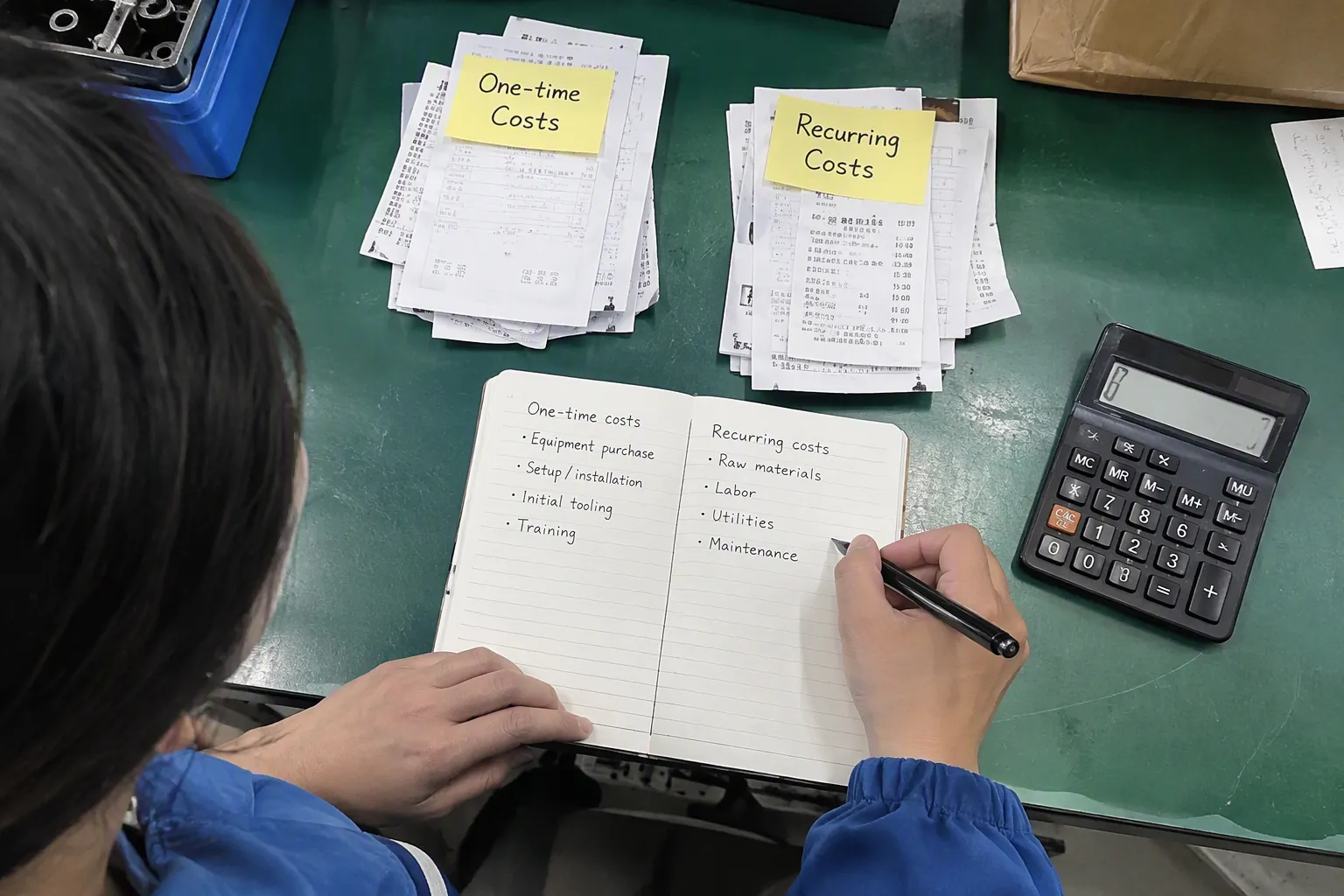
Step 2: Separate one-time and recurring costs
Some expenses apply to one order, while others apply to the entire product development program. I separate them before calculating the per-unit cost.
One-time or low-frequency costs may include:
- Mold or tooling charges
- Artwork preparation
- Product development
- Compliance testing requested by the buyer
- Sample development
- Initial factory setup
- Packaging plate or printing setup fees
Recurring costs may include:
- Product unit price
- Packaging materials
- Inspection
- Domestic delivery
- Freight
- Import duty and tax
- Warehousing and handling
If I spread a one-time mold fee across a small trial order, the first shipment will show a high unit cost. If I expect several future orders, I can also prepare a second view that spreads the fee across a realistic forecast quantity. I keep both views because the first-order cash requirement and the long-term product economics are different questions.
Step 3: Calculate shipping as a scenario

Shipping cost is not always calculated from product quantity alone. I first collect the shipment details:
- Number of cartons
- Carton length, width, and height
- Gross weight
- Net weight
- Product volume
- Pickup location
- Destination country and delivery address
- Shipment method
- Required delivery date
- Whether the cargo is dangerous, battery-powered, fragile, or oversized
- Whether several suppliers will be consolidated
For air freight and some express services, the carrier may compare actual weight with volumetric weight.[4] For ocean freight, the shipment may be charged by container, cubic meter, or another quoted basis. The exact method depends on the service and route, so I ask the freight provider to state the chargeable basis.
A basic volume calculation is:[5]
Carton volume in cubic meters = length × width × height in centimeters ÷ 1,000,000
For example, a carton measuring 50 × 40 × 30 centimeters has a volume of 0.06 cubic meters. I multiply that figure by the number of cartons to estimate total cargo volume. I still ask the forwarder to confirm the chargeable volume because palletization, minimum charges, dimensional rules, and handling requirements can change the bill.
I usually compare at least two shipping scenarios:
| Scenario | When I use it | Costs I verify |
|---|---|---|
| Express or air | Samples, urgent replenishment, small test orders | Pickup, fuel surcharge, remote-area fee, clearance, delivery |
| LCL ocean | Larger cargo that does not fill a container | Origin handling, consolidation, ocean freight, destination handling |
| FCL ocean | Larger repeat orders | Container rate, documentation, port fees, trucking, unloading |
| Door-to-door service | Buyers wanting one coordinated delivery | Included destination services and excluded taxes or fees |
| Consolidated shipment | Orders from multiple factories | Warehouse receiving, storage, handling, relabeling, and split costs |
I do not use a freight estimate without checking its validity period. Rates can change with route conditions, fuel charges, peak periods, port congestion, and carrier capacity.[6] I also confirm whether the quote is door-to-door, port-to-port, or warehouse-to-warehouse.
Step 4: Understand customs-related costs

I keep customs duty, import tax, customs clearance, brokerage, and destination charges as separate lines. “Customs cost” is not one universal charge.
The final duty rate and classification depend on the product, material, function, country of origin, destination country, and applicable customs rules.[7] I do not assign a fixed HS code or duty rate without confirmation. I ask the importer’s customs broker or the relevant customs authority to verify the classification and current treatment.
The main categories may include:
-
Customs duty
This is a tariff calculated under the destination country’s customs rules. The calculation may use customs value, quantity, weight, or another basis, depending on the product and jurisdiction. -
Import VAT or GST
Some countries calculate import VAT or GST using a taxable base that can include the customs value, duty, and certain shipping or insurance costs.[8] I ask a local tax professional or customs broker to confirm whether the tax is recoverable for the importing business. -
Customs clearance or brokerage
A broker or logistics provider may charge for preparing and submitting entry documents, communicating with customs, and arranging release. -
Destination handling fees
These can include terminal handling, documentation, delivery order, storage, inspection handling, security, demurrage, detention, trucking, and warehouse charges. Whether a fee applies depends on the shipment and service contract. -
Special product requirements
Certain products may need additional documents, testing, labeling, permits, or declarations. I treat these requirements as product- and destination-specific rather than assuming they apply everywhere.
I also confirm the Incoterm. An EXW quotation can leave more origin work and transport with the buyer. A DDP quotation may include more logistics services, but I still ask what taxes, customs declarations, and destination charges are actually included. The Incoterm does not remove the need to understand the importer’s legal and tax responsibilities.
Step 5: Build an example without hiding assumptions

I often create a simple illustrative model before requesting final quotes. The figures below are examples for calculation practice, not universal shipping or tax rates.
| Cost category | Example amount |
|---|---|
| 500 products at $8.00 | $4,000 |
| Retail packaging and labels | $250 |
| China domestic delivery | $120 |
| Pre-shipment inspection | $180 |
| Consolidation and export handling | $150 |
| International freight estimate | $900 |
| Customs duty estimate | To be confirmed |
| Import tax or VAT/GST estimate | To be confirmed |
| Destination brokerage and delivery | $300 |
| Subtotal before unconfirmed tax items | $5,900 |
The subtotal equals $5,900, or $11.80 per unit before duty and import tax. If 20 units are damaged, rejected, or reserved for samples, the sellable quantity becomes 480 units. The cost per sellable unit then becomes higher than the simple 500-unit calculation.
This example shows why I do not divide the supplier invoice by the purchase quantity and call the result the landed cost. I also do not present the unconfirmed customs items as final numbers. I highlight them so the buyer knows that the pricing decision is incomplete.
What I request from suppliers and forwarders
I use a written checklist because verbal confirmation can leave important details unclear.
From the supplier, I request:
- Product specification and unit price
- Minimum order quantity and price tiers
- Packaging specification and cost
- Carton dimensions and weights
- Product and carton quantities
- Logo, label, and customization charges
- Sample and tooling fees
- Production lead time
- Delivery location in China
- Commercial invoice and packing-list information
From the freight forwarder, I request:
- Shipping route and service type
- Chargeable weight or volume
- Origin pickup and handling charges
- Export documentation fees
- International freight
- Destination handling
- Customs clearance or brokerage
- Last-mile delivery
- Storage, inspection, and other possible surcharges
- Quote validity period
- Explicit exclusions, including duty and import tax
I ask the forwarder to provide a line-by-line quotation rather than one unexplained total. A single “shipping and customs” amount makes it difficult to compare providers or identify unexpected charges.
How I compare sourcing options
I compare the final landed-cost estimate, not just the factory unit price. I also consider quality and delivery risk because a cheaper product can become more expensive after rework, replacement, delay, or poor packaging.
| Evaluation factor | Supplier A | Supplier B | What I check |
|---|---|---|---|
| Unit price | Confirmed | Confirmed | Same specification and quantity |
| Packaging | Included or separate | Included or separate | Same presentation and protection |
| Domestic delivery | Confirmed | Estimated | Same delivery point |
| Inspection | Included or separate | Included or separate | Same inspection scope |
| Freight scenario | Estimated | Estimated | Same route and service |
| Customs items | To confirm | To confirm | Same classification assumptions |
| Lead time | Confirmed | Confirmed | Production and shipping separately |
| Quality risk | Evidence required | Evidence required | Samples, inspection, factory review |
I use the lowest landed-cost option only when the product quality, packaging, lead time, documentation, and supplier capability meet the purchasing requirement. A supplier with a slightly higher product price may be the better option if the quotation is more transparent and the process creates fewer quality or delivery risks.
Create three cost views
I find it useful to prepare three versions of the calculation:
-
Confirmed cost view
This includes only amounts supported by written supplier or logistics quotations. -
Estimated landed-cost view
This adds reasonable freight, duty, tax, and destination estimates clearly marked as provisional. -
Risk-adjusted planning view
This includes possible but not yet confirmed costs, such as extra inspection, storage, repacking, or a second delivery attempt. I label this as a planning scenario, not a guaranteed charge.
These views help me avoid false precision. A spreadsheet that shows $12.37 per unit can look authoritative even when half the inputs are estimates. I prefer to show the number and the confidence level of each input.
Common calculation mistakes
I see several recurring errors in import cost planning:
- Treating the factory unit price as the landed product cost
- Ignoring packaging because it appears on a separate quotation
- Forgetting domestic delivery from the factory to the consolidation warehouse
- Calculating freight from net weight while the carrier uses volumetric weight
- Dividing by ordered quantity instead of sellable quantity
- Treating duty and VAT/GST as the same charge
- Assuming DDP means every destination obligation is resolved
- Using an old freight quotation after the validity period
- Applying one country’s duty rate to another country
- Comparing EXW, FOB, CIF, and DDP prices as if they have identical scope
- Leaving inspection, storage, repacking, or document fees outside the model
- Setting a retail price before confirming the real landed cost
I reduce these errors by writing assumptions beside every number. I also ask a qualified customs broker or local tax professional to review classification and tax questions before I commit to a commercial pricing decision.
Frequently Asked Questions
What is the difference between product cost and landed cost?
Product cost usually refers to the item and the costs needed to prepare it for shipment, such as packaging or customization. Landed cost is broader. It includes product-side expenses, freight, customs duty, import tax, clearance, destination charges, and other costs required to receive the goods.
Does the supplier’s unit price include packaging?
It may or may not. I never assume that retail boxes, labels, inserts, export cartons, protective materials, or special packaging are included. I request a packaging specification and a separate price breakdown, especially when I compare quotations from several Chinese suppliers.
How do I estimate shipping cost for goods from China?
I collect carton dimensions, gross weight, quantity, origin, destination, and shipment method. I then request quotes for express, air, LCL, FCL, or consolidated shipping as appropriate. The forwarder should confirm the chargeable weight or volume and list origin, freight, destination, and excluded charges.
Are customs duty and import VAT the same?
No. Customs duty is a tariff applied under the destination country’s customs rules. Import VAT or GST is a consumption tax that may be calculated on a different taxable base. The applicable rates, recovery rules, and filing responsibilities depend on the product and destination, so I ask a qualified local adviser or customs broker to verify them.
Should I use landed cost when setting my selling price?
Yes, I use landed cost as a starting point for pricing and margin analysis. I also account for marketplace fees, payment processing, storage, fulfillment, returns, marketing, and operating expenses. I keep estimated customs and freight costs visible until the relevant providers confirm them.
Conclusion
To calculate product cost, shipping cost, and customs cost accurately, I build the model from the complete product specification rather than the supplier’s unit price alone. I separate packaging, inspection, domestic delivery, freight, duty, import tax, brokerage, and destination charges. I also mark estimates clearly and compare suppliers using per-unit landed cost based on sellable quantity. For a China sourcing project, KingSourcing can help verify suppliers, compare quotations, coordinate inspections, consolidate orders, and organize shipping. Contact us when you need a clearer cost breakdown before approving your next purchase.
Sources
- Total Landed Cost Model", The source describes landed cost as the broader cost of acquiring goods, including expenses beyond the supplier's quoted price, which supports using it for comparative purchasing and pricing analysis
- Inventory Accounting Guidelines - Division of Financial Services", Managerial-accounting guidance explains that costs and losses associated with inventory affect the cost attributable to units available for sale, supporting analysis based on sellable output rather than ordered quantity alone
- [PDF] Total Landed Cost Model - DSpace@MIT", The source defines per-unit landed cost as the relevant acquisition cost allocated across the units available for sale, supporting the article's calculation structure
- Air Cargo Tariffs and Rules: What You Need to Know", Air-cargo guidance explains that chargeable weight may be determined by comparing actual weight with volume-based weight, supporting the article's warning that carton dimensions can affect freight charges
- SI Units - Volume", The source gives the rectangular-prism volume formula and the conversion from cubic centimeters to cubic meters, supporting the stated carton-volume calculation
- Tell Me How: How One Shipping Jam Can Stop Your Daily Bread", International transport analysis identifies fuel costs, demand and capacity conditions, and port disruption as factors associated with changes in freight rates, supporting the use of validity periods for quotations
- Harmonized Tariff Schedule", Customs guidance explains that tariff treatment is determined through classification under the applicable tariff schedule and through origin rules, supporting the article's caution against assigning a universal duty rate
- The Role of Digital Platforms in the Collection of VAT/GST ...", Official import-tax guidance provides examples in which the VAT or GST base is derived from customs value and may include duty and specified transport or insurance costs, supporting the article's conditional formulation